Upal Ghosh appointed to D.C. mayor’s Leadership Council for a Cleaner Anacostia River
from UMBC News
UMBC News | Published: Sep 18, 2024 |By:Catherine Meyers
On September 12, UMBC’s Upal Ghosh, from the Department of Chemical, Biochemical, and Environmental Engineering, was sworn in as a member of the Washington, D.C., mayor’s Leadership Council for a Cleaner Anacostia River (LCCAR). The council consists of 25 high-level government officials, community leaders, and environmental experts who support the vision of a swimmable and fishable Anacostia River. The members meet quarterly to advise the D.C. government on ongoing restoration projects.
The Anacostia River, which runs from Prince George’s County in Maryland into Washington, D.C., before joining the Potomac River and ultimately flowing into the Chesapeake Bay, has historically suffered from high levels of industrial pollution and contamination from sewage overflow. In recent years, government officials have been making concerted efforts to clean up the river. UMBC was invited to sit on the council, with Ghosh as the representative, based on the university’s key contributions to these clean-up efforts.
 On Sept. 12, Upal Ghosh (top left) and other members of the LCCAR were sworn in during a virtual meeting of the council. (Image courtesy of Ghosh)
Since 2016, Ghosh and his UMBC colleagues and students have developed innovative methods of measuring contaminants in the river and created models to elucidate where the contaminants come from and how they travel through and accumulate in the water, sediment, and aquatic life, such as fish. Nathalie Lombard, a research assistant professor at UMBC who has played a significant role in the projects, will serve as the alternate representative on the LLCAR when Ghosh cannot attend.
In addition to his work on the Anacostia, Ghosh and his students have studied and contributed to the cleanup of the waterways throughout Maryland, Delaware, and across the country. “Students learn a lot from being out in the field,” Ghosh says. “They learn how the science and engineering we do helps guide major decisions. Our ultimate goal is making a positive difference in the health of the river, lake, or bay. That gives me a lot of excitement, and it really motivates the students too.”
Read original post via UMBC NEWS: Upal Ghosh Appointed To D.C. Mayor’s Leadership Council For A Cleaner Anacostia River - UMBC
]]>
UMBC News | Published: Sep 18, 2024 |By:Catherine Meyers On September 12, UMBC’s Upal Ghosh, from the Department of Chemical, Biochemical, and Environmental Engineering, was sworn in as a member...
https://dev.my.umbc.edu/api/v0/pixel/news/144072/guest@my.umbc.edu/8f57de1fd5874947076a22abb7de8539/api/pixel
cbee
coeit
faculty
fall-2024
ghosh
news
Chemical, Biochemical and Environmental Engineering
https://dev.my.umbc.edu/groups/cbee
https://assets4-dev.my.umbc.edu/system/shared/avatars/groups/000/000/771/b5e579e81b2e3624611890fa3ca2716a/xsmall.png?1746794587
https://assets2-dev.my.umbc.edu/system/shared/avatars/groups/000/000/771/b5e579e81b2e3624611890fa3ca2716a/original.png?1746794587
https://assets1-dev.my.umbc.edu/system/shared/avatars/groups/000/000/771/b5e579e81b2e3624611890fa3ca2716a/xxlarge.png?1746794587
https://assets2-dev.my.umbc.edu/system/shared/avatars/groups/000/000/771/b5e579e81b2e3624611890fa3ca2716a/xlarge.png?1746794587
https://assets2-dev.my.umbc.edu/system/shared/avatars/groups/000/000/771/b5e579e81b2e3624611890fa3ca2716a/large.png?1746794587
https://assets4-dev.my.umbc.edu/system/shared/avatars/groups/000/000/771/b5e579e81b2e3624611890fa3ca2716a/medium.png?1746794587
https://assets1-dev.my.umbc.edu/system/shared/avatars/groups/000/000/771/b5e579e81b2e3624611890fa3ca2716a/small.png?1746794587
https://assets4-dev.my.umbc.edu/system/shared/avatars/groups/000/000/771/b5e579e81b2e3624611890fa3ca2716a/xsmall.png?1746794587
https://assets1-dev.my.umbc.edu/system/shared/avatars/groups/000/000/771/b5e579e81b2e3624611890fa3ca2716a/xxsmall.png?1746794587
Chemical, Biochemical and Environmental Engineering
https://assets2-dev.my.umbc.edu/system/shared/thumbnails/news/000/144/072/6ae323c355a16250b66c41004a6f7c0e/xxlarge.jpg?1726777022
https://assets2-dev.my.umbc.edu/system/shared/thumbnails/news/000/144/072/6ae323c355a16250b66c41004a6f7c0e/xlarge.jpg?1726777022
https://assets1-dev.my.umbc.edu/system/shared/thumbnails/news/000/144/072/6ae323c355a16250b66c41004a6f7c0e/large.jpg?1726777022
https://assets1-dev.my.umbc.edu/system/shared/thumbnails/news/000/144/072/6ae323c355a16250b66c41004a6f7c0e/medium.jpg?1726777022
https://assets1-dev.my.umbc.edu/system/shared/thumbnails/news/000/144/072/6ae323c355a16250b66c41004a6f7c0e/small.jpg?1726777022
https://assets1-dev.my.umbc.edu/system/shared/thumbnails/news/000/144/072/6ae323c355a16250b66c41004a6f7c0e/xsmall.jpg?1726777022
https://assets2-dev.my.umbc.edu/system/shared/thumbnails/news/000/144/072/6ae323c355a16250b66c41004a6f7c0e/xxsmall.jpg?1726777022
0
0
true
Thu, 19 Sep 2024 16:19:54 -0400
Fri, 20 Sep 2024 10:14:46 -0400
Dr. Ghosh assesses environmental impact of bridge collapse
Excerpt UMBC Magazine
In response to the tragic collapse of the Francis Scott Key Bridge, Dr. Upal Ghosh, professorCBEE, assesses potential environmental impacts, particularly concerning the hazardous materials aboard the cargo ship. His insights into the potential ecological repercussions underscored the department's commitment to safeguarding the Patapsco River and surrounding communities.
Excerpt from UMBC Magazine “Infrastructure of support after Key Bridge collapse” by Adriana Fraser, published on June 13, 2024
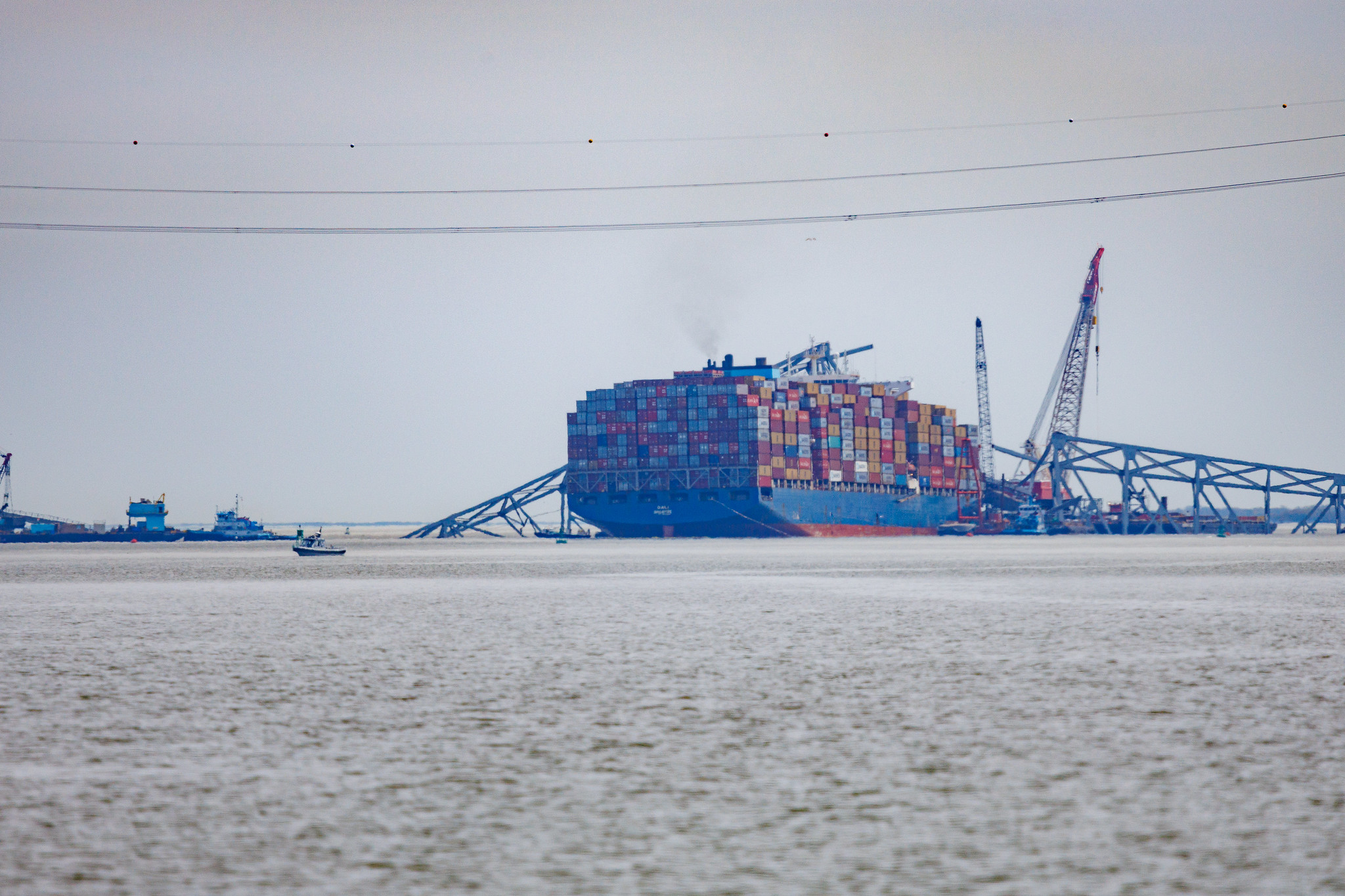 The remains of the Francis Scott Key Bridge after a collision with a malfunctioning cargo ship on March 26. (Photo source: Corey Jennings '10, Maryland Comptroller/Flickr)
Examining the environmental impacts of the collapse
The ship that collided into the bridge was carrying 56 containers of hazardous materials, including corrosives, flammables, and lithium-ion batteries. The cargo ship was also carrying more than one million gallons of fuel at the time of the impact. City officials began their investigations into the incident, which included determining the environmental impacts to the Patapsco River and surrounding communities.
Upal Ghosh, professor of chemical, biochemical, and environmental engineering, whose research includes examining the effects of toxic pollutants in soils, sediments, and aquatic environments, was among the experts who weighed in on assessing the potentially hazardous effects of the containers that were resting at the bottom of the river.
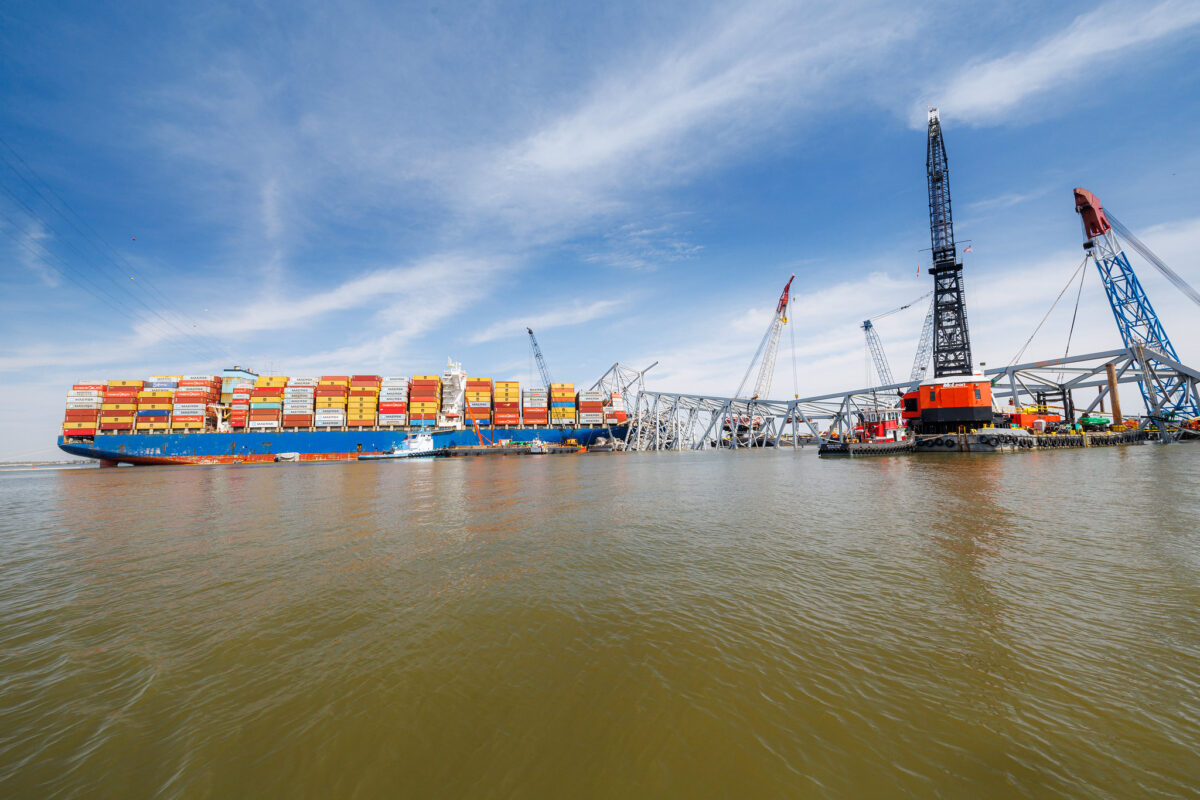 Maryland Comptroller Brooke Lierman and representatives of the Office of the Governor take a tour of the Francis Scott Key Bridge collapse site on a Maryland Department of Natural Resources police boat. (Photo source: Corey Jennings ’10, Maryland Comptroller/Flickr)
Ghosh told the Baltimore Sun days after the collapse that environmental officials’ first priority would likely be making sure none of the intact containers were breached.
“If you have containers that contain oily material, those things will, if they are breached, be releasing over time,” Ghosh said. “I would think if there is a release that goes down into the sediments under the water, it would be a local impact right there.”
Farah Nibbs, assistant professor of emergency and disaster health systems, is also thinking about future ways to contain the effects of similar disasters. Contributing factors to the bridge’s collapse, she says, can be tied to the 2012 expansion and modernization of the Port of Baltimore. Those changes did not happen hand in hand with improvements in safety management needed to accommodate ships of such huge sizes that now were able to port in the city. Risks from collisions, fuel spills, and contamination still lack proper oversight and regulation.
“A novel approach for decision-makers may be to view Maryland’s emergency management and transportation experts and service providers—as well as the physical bridge infrastructure itself—as part of the community’s lifeline systems,” said Nibbs.
~~
Read the full article: Infrastructure Of Support After Key Bridge Collapse - UMBC: University Of Maryland, Baltimore County
]]>
In response to the tragic collapse of the Francis Scott Key Bridge, Dr. Upal Ghosh, professorCBEE, assesses potential environmental impacts, particularly concerning the hazardous materials aboard...
https://dev.my.umbc.edu/api/v0/pixel/news/142482/guest@my.umbc.edu/07e4001c5ec8f5aca841833b20e59429/api/pixel
faculty
ghosh
news
spring-2024
Chemical, Biochemical and Environmental Engineering
https://dev.my.umbc.edu/groups/cbee
https://assets4-dev.my.umbc.edu/system/shared/avatars/groups/000/000/771/b5e579e81b2e3624611890fa3ca2716a/xsmall.png?1746794587
https://assets2-dev.my.umbc.edu/system/shared/avatars/groups/000/000/771/b5e579e81b2e3624611890fa3ca2716a/original.png?1746794587
https://assets1-dev.my.umbc.edu/system/shared/avatars/groups/000/000/771/b5e579e81b2e3624611890fa3ca2716a/xxlarge.png?1746794587
https://assets2-dev.my.umbc.edu/system/shared/avatars/groups/000/000/771/b5e579e81b2e3624611890fa3ca2716a/xlarge.png?1746794587
https://assets2-dev.my.umbc.edu/system/shared/avatars/groups/000/000/771/b5e579e81b2e3624611890fa3ca2716a/large.png?1746794587
https://assets4-dev.my.umbc.edu/system/shared/avatars/groups/000/000/771/b5e579e81b2e3624611890fa3ca2716a/medium.png?1746794587
https://assets1-dev.my.umbc.edu/system/shared/avatars/groups/000/000/771/b5e579e81b2e3624611890fa3ca2716a/small.png?1746794587
https://assets4-dev.my.umbc.edu/system/shared/avatars/groups/000/000/771/b5e579e81b2e3624611890fa3ca2716a/xsmall.png?1746794587
https://assets1-dev.my.umbc.edu/system/shared/avatars/groups/000/000/771/b5e579e81b2e3624611890fa3ca2716a/xxsmall.png?1746794587
Chemical, Biochemical and Environmental Engineering
0
0
true
Mon, 17 Jun 2024 13:40:07 -0400
Mon, 17 Jun 2024 15:01:09 -0400
IN THE NEWS - CBEE pioneers PFAS Analysis in Chesapeake
Excerpt from: "Strong, Sticky, and Tricky to Measure"
CBEE IN THE NEWS:
Chesapeake Quarterly‘s Complicated Contaminants: Finding PFAS in the Chesapeake Bay, Volume 23, Number 1 | May 2024
EXCERPT FROM: Strong, Sticky, and Tricky to Measure
By Madeleine Jepsen | April 25, 2024
….
A Breakdown of the Chemicals that Don’t Break Down
The namesake chemical bond found in all PFAS—a fluorine atom bonded to a carbon atom—is one of the strongest organic bonds found in nature. The strength of this bond is the main reason why PFAS can linger in the water or soil and make their way into fish tissue—and into the birds or humans eating those fish.
Although plants like marigolds can produce toxic pesticides naturally as a defense mechanism against deer and other predators, there’s a natural pathway for these molecules to break down. Then, the molecule’s components can be reassembled and recycled for other uses.
“All of these chemicals that are produced in nature have a pathway of recycling where the carbon goes back to carbon dioxide, the hydrogen and oxygen goes back to water, and then something else reproduces those chemicals from the basic elements,” says Upal Ghosh, a professor of chemical and environmental engineering at the University of Maryland, Baltimore County.
Unlike other human-introduced contaminants in the environment, such as hydrophobic PCBs that only accumulate in fish fat, many of the common PFAS also have components that allow them to interact with both water and fats.
PFAS with eight or more carbon atoms linked together to form a molecular “tail” have been found to accumulate in fish and humans more readily and can interfere with human health. There are two main components of these longer PFAS—the molecule’s “head” with the carbon-fluorine bond that can interact with water, and the chain of carbons that form the “tail.” Combined, these traits allow PFAS to move through soils and waterways into organisms without breaking down.
In this way, PFAS are almost like a strong magnet, with two sides that each have opposite pulls. This allows PFAS to interact with a wider variety of molecules in fish and humans—in particular, proteins and blood. Unlike most pesticides, whose shapes are designed to bind to specific proteins and inhibit specific functions, PFAS can bind to many proteins.
….
Passive Sampling Provides a Panoramic Picture of PFAS
To get a more holistic sense of the average PFAS concentrations in a water body over time, environmental engineer Lee Blaney and his laboratory are developing passive samplers. These circular devices remain in the water for a longer stretch of time. As the samplers remain in the water, they record PFAS concentrations in the water that reflect a longer stretch of time: a panorama compared to the one-time snapshot of a grab sample.
The ion-exchange membranes Blaney’s team uses contain positive charges that are anchored to a membrane on the device. Initially, the fixed positive charges in the membrane contain chloride, an ion commonly found in Bay water. When the passive sampler is set in the water, PFAS molecules with a higher affinity for the positively charged sites replace chloride and bind to the membrane. This same ion-exchange chemistry is employed in some filters to treat PFAS-impacted drinking water.
Back in the lab, researchers use the corresponding chemical reactions to release PFAS from the sampler, measure PFAS levels, and back-calculate the PFAS concentrations in the water body where the sampler was deployed.
Part of the challenge is developing passive samplers that accumulate all PFAS of concern. Short-chain PFAS don’t have the same affinity for conventional passive samplers that work well to capture long-chain PFAS. Blaney and his lab are testing new ion-exchange membranes that improve uptake of short-chain PFAS, so that their concentrations in water bodies can be more accurately and sensitively measured.
To develop additional compounds that can catch PFAS in passive samplers, Upal Ghosh has taken another chemical engineering approach. Ghosh has used molecules that are known to bind to PFAS in organisms, like components of pig blood, isolated these compounds, and used them to bind PFAS in passive samplers.
While passive samplers provide researchers with a better understanding of overall PFAS levels in a water body, they aren’t perfect. They require calibration, since the researchers calculate the concentrations of PFAS in the water based on chemical reaction rates of PFAS binding to the passive sampler, which depend on temperature, flow, pH, and salinity of the water.
Passive samplers can also smooth out “spikes” in PFAS levels, meaning the peaks in PFAS levels that are recorded by the sampler are not as large as the true peak level in the water body. Still, Lee says, passive samplers have a higher chance of capturing a spike in PFAS levels than a one-off grab sample because of their longer timeframe in the water.
….
Back in the Lab
Not all labs are equipped to process PFAS samples—and those that can have undergone rigorous review to ensure that any PFAS they detect are coming from the samples they process, and not residual PFAS from the equipment they’re using.
The “gold standard” of analysis used by federal agencies, commercial labs, and most academic labs for detecting and identifying PFAS is liquid chromatography paired with tandem mass spectrometry. These two analytical methods combined, often referred to as LC-MS/MS, allow researchers to separate out the different molecular components of a sample, and then analyze the mass of a particular molecule to determine its chemical structure and quantity in the sample.
Liquid chromatography with tandem mass spectrometry allows researchers to measure how much of a particular PFAS is in a sample, even in very small quantities. To identify and distinguish different compounds, researchers compare their samples against standards with pure, known quantities of specific PFAS. Researchers can also use these standards to compare against an unknown sample to determine the exact concentrations of PFAS in field samples. This method can be useful for researchers like Blaney, who needs to identify the different types of PFAS present in a sample.
“One of the things I'm really interested in is sampling from places where you don't expect to find contaminants, because maybe there's something there that we're missing,” Blaney says.
A limiting factor in PFAS analysis is that there are thousands of variations of PFAS, but standards for only about 200 specific compounds. Although these standards include many of the PFAS that are known to affect human health, additional standards could help researchers gain a more holistic understanding of the compounds circulating in the water or sediment. Researchers can run the standards through their own instruments so they know exactly how each PFAS would appear in the readouts, adding additional certainty to their measurements.
For even more refined analysis, some researchers like Carrie McDonough, an assistant professor of chemistry at Carnegie Mellon University, turn to another spectrometry method called high-resolution mass spectrometry. This method allows researchers to differentiate between molecules with similar masses, and can help to identify compounds that don’t have analytical standards, like many types of PFAS. Similar to how a microscope at higher resolution allows researchers to get a more in-depth view, high-resolution mass spectrometry gives researchers more refined peaks from their samples. The refined analysis also allows researchers to work toward identifying unknown PFAS without a standard.
Through new field sampling methods like passive sampling and detailed laboratory analysis, researchers are gaining a better understanding of PFAS in the Bay. With these technological developments, PFAS are steadily becoming less tricky to measure.
Read full article
Photo Credit: Chesapeake Quarterly Cover photo by Jay Fleming
]]>
CBEE IN THE NEWS: Chesapeake Quarterly‘s Complicated Contaminants: Finding PFAS in the Chesapeake Bay, Volume 23, Number 1 | May 2024 EXCERPT FROM: Strong, Sticky, and Tricky to Measure By...
https://dev.my.umbc.edu/api/v0/pixel/news/142239/guest@my.umbc.edu/570e73ceaaea93e46333ecd3355223bb/api/pixel
blaney
faculty
ghosh
research
spring-2024
Chemical, Biochemical and Environmental Engineering
https://dev.my.umbc.edu/groups/cbee
https://assets4-dev.my.umbc.edu/system/shared/avatars/groups/000/000/771/b5e579e81b2e3624611890fa3ca2716a/xsmall.png?1746794587
https://assets2-dev.my.umbc.edu/system/shared/avatars/groups/000/000/771/b5e579e81b2e3624611890fa3ca2716a/original.png?1746794587
https://assets1-dev.my.umbc.edu/system/shared/avatars/groups/000/000/771/b5e579e81b2e3624611890fa3ca2716a/xxlarge.png?1746794587
https://assets2-dev.my.umbc.edu/system/shared/avatars/groups/000/000/771/b5e579e81b2e3624611890fa3ca2716a/xlarge.png?1746794587
https://assets2-dev.my.umbc.edu/system/shared/avatars/groups/000/000/771/b5e579e81b2e3624611890fa3ca2716a/large.png?1746794587
https://assets4-dev.my.umbc.edu/system/shared/avatars/groups/000/000/771/b5e579e81b2e3624611890fa3ca2716a/medium.png?1746794587
https://assets1-dev.my.umbc.edu/system/shared/avatars/groups/000/000/771/b5e579e81b2e3624611890fa3ca2716a/small.png?1746794587
https://assets4-dev.my.umbc.edu/system/shared/avatars/groups/000/000/771/b5e579e81b2e3624611890fa3ca2716a/xsmall.png?1746794587
https://assets1-dev.my.umbc.edu/system/shared/avatars/groups/000/000/771/b5e579e81b2e3624611890fa3ca2716a/xxsmall.png?1746794587
Chemical, Biochemical and Environmental Engineering
https://assets3-dev.my.umbc.edu/system/shared/thumbnails/news/000/142/239/7e10a27b305449df35773ad35f924319/xxlarge.jpg?1716999433
https://assets1-dev.my.umbc.edu/system/shared/thumbnails/news/000/142/239/7e10a27b305449df35773ad35f924319/xlarge.jpg?1716999433
https://assets4-dev.my.umbc.edu/system/shared/thumbnails/news/000/142/239/7e10a27b305449df35773ad35f924319/large.jpg?1716999433
https://assets4-dev.my.umbc.edu/system/shared/thumbnails/news/000/142/239/7e10a27b305449df35773ad35f924319/medium.jpg?1716999433
https://assets3-dev.my.umbc.edu/system/shared/thumbnails/news/000/142/239/7e10a27b305449df35773ad35f924319/small.jpg?1716999433
https://assets4-dev.my.umbc.edu/system/shared/thumbnails/news/000/142/239/7e10a27b305449df35773ad35f924319/xsmall.jpg?1716999433
https://assets4-dev.my.umbc.edu/system/shared/thumbnails/news/000/142/239/7e10a27b305449df35773ad35f924319/xxsmall.jpg?1716999433
0
0
true
Wed, 29 May 2024 12:17:58 -0400
Wed, 29 May 2024 12:52:42 -0400
IN THE NEWS: “doctors of the environment” clean up PFAS
Dr. Ghosh and team in Chesapeake Quarterly
CBEE IN THE NEWS:
Chesapeake Quarterly‘s Complicated Contaminants: Finding PFAS in the Chesapeake Bay - Volume 23, Number 1 | May 2024
EXCERPT FROM: Diagnosing the PFAS Problem: Scientists Investigate So-Called ‘Forever Chemicals’ in the Chesapeake Bay
By Ashley Goetz | May 8, 2024
“We kind of think of ourselves as the doctors of the environment,” says Upal Ghosh, a professor of chemical and environmental engineering at the University of Maryland, Baltimore County. In order to make a diagnosis, a doctor might study your symptoms, order tests, and review your medical reports. Similarly, when there are signs of sickness in an ecosystem, scientists start with the Symptoms.
They formulate ways to gather information—collecting field samples, analyzing them in a lab, running experiments, and using mathematical models. And, like doctors, only once they learn enough to diagnose the problem can they begin to offer remedies.
For per- and polyfluoroalkyl substances, or PFAS, science is still largely in the diagnosis stage.
PFAS, perhaps most commonly known by their nickname, “forever chemicals,” are a vast group of human-made chemicals found in common household products, like nonstick pans, carpets, cosmetics, and fast-food packaging. They are widespread, long-lasting, and in some cases, toxic. Studies have shown that even at very low levels, certain PFAS can harm people and wildlife.
….
Although PFOA and PFOS are no longer made in the United States, they are still regularly detected in water and soil samples. That’s because PFAS don’t get recycled in the environment. The carbon-fluorine bond in PFAS is one of the strongest in chemistry, making PFAS super-stable. “People have called the perfluorochemicals molecular rebars,” says Ghosh. “They don’t break down.” Over time, PFAS have escaped from the places they were made, used, and thrown away into the soil, air, and water that support life on Earth. And once introduced, PFAS tend to stick around.
….
Fate and Forecast
When it comes to PFAS, nearly every researcher will tell you, “It’s complicated.” And they’re right. Thousands of chemicals are classified as PFAS. They are seemingly everywhere, and they behave unlike many of the contaminants researchers and regulators have dealt with before.
Yet, buoyed by increasing public interest and concern, researchers continue to seek answers about PFAS. “How do you design a remedy? It really starts with defining the problem correctly,” says Upal Ghosh. Only then, he says, can we turn our attention toward the interventions and engineering needed to treat the issue.
Read full article
]]>
CBEE IN THE NEWS: Chesapeake Quarterly‘s Complicated Contaminants: Finding PFAS in the Chesapeake Bay - Volume 23, Number 1 | May 2024 EXCERPT FROM: Diagnosing the PFAS Problem: Scientists...
https://dev.my.umbc.edu/api/v0/pixel/news/142226/guest@my.umbc.edu/0e62eeaaf490dd2bc7a9a2e8325dbb5f/api/pixel
ghosh
news
research
spring-2024
Chemical, Biochemical and Environmental Engineering
https://dev.my.umbc.edu/groups/cbee
https://assets4-dev.my.umbc.edu/system/shared/avatars/groups/000/000/771/b5e579e81b2e3624611890fa3ca2716a/xsmall.png?1746794587
https://assets2-dev.my.umbc.edu/system/shared/avatars/groups/000/000/771/b5e579e81b2e3624611890fa3ca2716a/original.png?1746794587
https://assets1-dev.my.umbc.edu/system/shared/avatars/groups/000/000/771/b5e579e81b2e3624611890fa3ca2716a/xxlarge.png?1746794587
https://assets2-dev.my.umbc.edu/system/shared/avatars/groups/000/000/771/b5e579e81b2e3624611890fa3ca2716a/xlarge.png?1746794587
https://assets2-dev.my.umbc.edu/system/shared/avatars/groups/000/000/771/b5e579e81b2e3624611890fa3ca2716a/large.png?1746794587
https://assets4-dev.my.umbc.edu/system/shared/avatars/groups/000/000/771/b5e579e81b2e3624611890fa3ca2716a/medium.png?1746794587
https://assets1-dev.my.umbc.edu/system/shared/avatars/groups/000/000/771/b5e579e81b2e3624611890fa3ca2716a/small.png?1746794587
https://assets4-dev.my.umbc.edu/system/shared/avatars/groups/000/000/771/b5e579e81b2e3624611890fa3ca2716a/xsmall.png?1746794587
https://assets1-dev.my.umbc.edu/system/shared/avatars/groups/000/000/771/b5e579e81b2e3624611890fa3ca2716a/xxsmall.png?1746794587
Chemical, Biochemical and Environmental Engineering
https://assets1-dev.my.umbc.edu/system/shared/thumbnails/news/000/142/226/5310f969b64707705f14aa0f165d663e/xxlarge.jpg?1716926867
https://assets4-dev.my.umbc.edu/system/shared/thumbnails/news/000/142/226/5310f969b64707705f14aa0f165d663e/xlarge.jpg?1716926867
https://assets1-dev.my.umbc.edu/system/shared/thumbnails/news/000/142/226/5310f969b64707705f14aa0f165d663e/large.jpg?1716926867
https://assets3-dev.my.umbc.edu/system/shared/thumbnails/news/000/142/226/5310f969b64707705f14aa0f165d663e/medium.jpg?1716926867
https://assets2-dev.my.umbc.edu/system/shared/thumbnails/news/000/142/226/5310f969b64707705f14aa0f165d663e/small.jpg?1716926867
https://assets3-dev.my.umbc.edu/system/shared/thumbnails/news/000/142/226/5310f969b64707705f14aa0f165d663e/xsmall.jpg?1716926867
https://assets1-dev.my.umbc.edu/system/shared/thumbnails/news/000/142/226/5310f969b64707705f14aa0f165d663e/xxsmall.jpg?1716926867
3
0
true
Tue, 28 May 2024 16:09:47 -0400
Wed, 29 May 2024 09:19:00 -0400
Dr. Upal Ghosh work is recognized by NIEHS
from UMBC NEWS
National Institutes of Environmental Health Sciences highlight Professor Upal Ghosh’s work cleaning contaminated waterways
By: Catherine Meyers | Published: Feb 23, 2024 | UMBC NEWS
The positive environmental and health impacts of work led by Upal Ghosh, professor of chemical, biochemical, and environmental engineering at UMBC, was recently highlighted by the National Institutes of Environmental Health Sciences (NIEHS). The agency showcased a low-cost technology that Ghosh and his colleagues developed to clean waterways contaminated with polychlorinated biphenyls (PCBs), a group of likely carcinogenic chemicals that were used in insulation, coolants, and electrical equipment for decades before being banned in the U.S. in 1979.
The chemicals are stable and persist in the environment, often accumulating in fish that live in contaminated waterways and posing a risk to humans who consume those fish. NIEHS funded Ghosh’s research into using activated carbon pellets to bind the chemicals in place at the bottom of the waterways. This prevents the PCBs from circulating through the aquatic food chain. In projects carried out in contaminated lakes, rivers, and harbors in Delaware, Maryland, and elsewhere, Ghosh’s team demonstrated that the technique could significantly reduce the concentration of PCBs in the water and in aquatic lifeforms. Importantly, the technique is also significantly cheaper than standard clean-up approaches, such as dredging and disposing of contaminated sediment.
In related work performed with Kevin Sowers, from the Institute of Marine and Environmental Technology, Ghosh’s team also developed a way to combine the activated carbon with microbes that break down PCBs, reducing their toxicity.
With NIEHS support, Ghosh has co-founded two companies—Sediment Solutions and RemBac—to commercialize the technology and deploy it at full-scale to clean up contaminated sites across the country, such as at Mirror Lake in Delaware.
“The technology brings together innovations in material science and biology,” says Ghosh. It’s an honor, he says, that the NIEHS, the leading agency in the country that funds research on public health and the environment, recognized “the real impact our research is having on improving public health.”
]]>
National Institutes of Environmental Health Sciences highlight Professor Upal Ghosh’s work cleaning contaminated waterways By: Catherine Meyers | Published: Feb 23, 2024 | UMBC NEWS The...
https://dev.my.umbc.edu/api/v0/pixel/news/140929/guest@my.umbc.edu/73e47a5784c5de7a8e728b6e8af7374c/api/pixel
faculty
ghosh
news
research
spring-2024
Chemical, Biochemical and Environmental Engineering
https://dev.my.umbc.edu/groups/cbee
https://assets4-dev.my.umbc.edu/system/shared/avatars/groups/000/000/771/b5e579e81b2e3624611890fa3ca2716a/xsmall.png?1746794587
https://assets2-dev.my.umbc.edu/system/shared/avatars/groups/000/000/771/b5e579e81b2e3624611890fa3ca2716a/original.png?1746794587
https://assets1-dev.my.umbc.edu/system/shared/avatars/groups/000/000/771/b5e579e81b2e3624611890fa3ca2716a/xxlarge.png?1746794587
https://assets2-dev.my.umbc.edu/system/shared/avatars/groups/000/000/771/b5e579e81b2e3624611890fa3ca2716a/xlarge.png?1746794587
https://assets2-dev.my.umbc.edu/system/shared/avatars/groups/000/000/771/b5e579e81b2e3624611890fa3ca2716a/large.png?1746794587
https://assets4-dev.my.umbc.edu/system/shared/avatars/groups/000/000/771/b5e579e81b2e3624611890fa3ca2716a/medium.png?1746794587
https://assets1-dev.my.umbc.edu/system/shared/avatars/groups/000/000/771/b5e579e81b2e3624611890fa3ca2716a/small.png?1746794587
https://assets4-dev.my.umbc.edu/system/shared/avatars/groups/000/000/771/b5e579e81b2e3624611890fa3ca2716a/xsmall.png?1746794587
https://assets1-dev.my.umbc.edu/system/shared/avatars/groups/000/000/771/b5e579e81b2e3624611890fa3ca2716a/xxsmall.png?1746794587
Chemical, Biochemical and Environmental Engineering
https://assets3-dev.my.umbc.edu/system/shared/thumbnails/news/000/140/929/575203133eab45ceb0d1367a92bb2028/xxlarge.jpg?1713198214
https://assets3-dev.my.umbc.edu/system/shared/thumbnails/news/000/140/929/575203133eab45ceb0d1367a92bb2028/xlarge.jpg?1713198214
https://assets1-dev.my.umbc.edu/system/shared/thumbnails/news/000/140/929/575203133eab45ceb0d1367a92bb2028/large.jpg?1713198214
https://assets4-dev.my.umbc.edu/system/shared/thumbnails/news/000/140/929/575203133eab45ceb0d1367a92bb2028/medium.jpg?1713198214
https://assets4-dev.my.umbc.edu/system/shared/thumbnails/news/000/140/929/575203133eab45ceb0d1367a92bb2028/small.jpg?1713198214
https://assets3-dev.my.umbc.edu/system/shared/thumbnails/news/000/140/929/575203133eab45ceb0d1367a92bb2028/xsmall.jpg?1713198214
https://assets2-dev.my.umbc.edu/system/shared/thumbnails/news/000/140/929/575203133eab45ceb0d1367a92bb2028/xxsmall.jpg?1713198214
1
0
true
Mon, 15 Apr 2024 12:24:46 -0400
IN THE NEWS: Low-Cost Technology Cleans Up Environment
NIEHS highlights impacts of research on public health
Low-Cost Technology Cleans Up Contaminated Sites
An innovative technology, developed with funding from the NIEHS Superfund Research Program (SRP), can deliver amendments that immobilize and degrade polychlorinated biphenyls (PCBs) in aquatic environments. The technology has proven effective in the field and resulted in millions of dollars in estimated cost savings at cleanup sites.
The Problem:
PCBs are a large and complex group of chemicals that were used in insulation, coolants, and electrical equipment. Although commercial production of PCBs was banned in the United States in 1979, they persist in the environment because of their stable chemical structure. PCBs can also accumulate in the aquatic food web, where they can pose a threat to human health.
SRP Solutions:
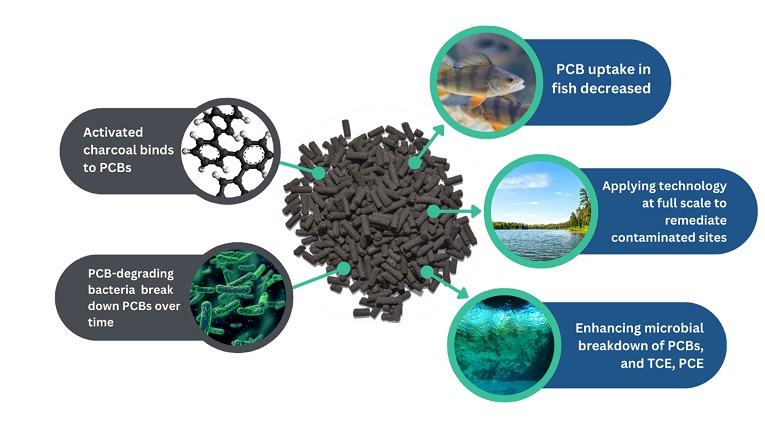
SediMite, developed by Upal Ghosh, Ph.D., of the University of Maryland, Baltimore County, and collaborators, uses activated carbon in the form of specialized pellets to bind to PCBs and reduce their bioavailability, or uptake by fish and other aquatic organisms. The technology can also be combined with microbes that break down PCBs, reducing their toxicity.
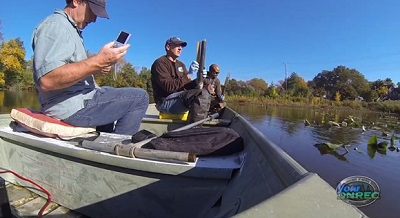 Ghosh, right, and colleagues collect sediment samples to measure PCBs. (Image from the DNRECYouTube videohighlighting the work at the Christina River)
Documenting Effectiveness in the Field
- The approach reduces PCBs in sediment porewater and surface water in the field
- The technology lowers PCB levels measured in lake fish
Ghosh and his team collaborated with the Delaware Department of Natural Resources and Environmental Control (DNREC) to use the technology at Mirror Lake. They demonstrated that between 2013 and 2018, PCB concentrations in sediment porewater decreased by about 80% after applying SediMite. They also measured a 70% reduction in PCB levels in the lake’s fish.
Their success has important implications for human health because PCB contamination is the primary reason that fish consumption advisories are issued by DNREC and the Delaware Division of Public Health.
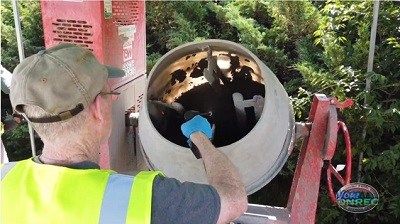 Sowers sprays PCB-degrading microorganisms onto activated carbon pellets to clean up PCBs and keep them from contaminating the Christina River. (Image from the DNREC YouTube video highlighting the work at the Christina River)
Building on this achievement, DNREC used an enhanced version of the SediMite technology in a new project to reduce PBCs in the Christina River. Ghosh and colleague Kevin Sowers, Ph.D., combined the activated carbon with microorganisms that can break down PCBs to both immobilize PCBs in the sediment and degrade them over time. After five months, SediMite enhanced with PCB-degrading microbes reduced the amount of PCBs in the sediment by approximately 25%. PCB concentrations decreased by around 35% in the surface water and 64% in sediment porewater.
Videos developed by DNREC depict the successes at Mirror Lake and the Christina River projects.
Building the Foundation
- Activated carbon reduces PCB bioavailability in the lab
- The technology offers significant cost savings compared to other clean-up methods
The technology builds on years of research by Ghosh and colleagues. SediMite was initially developed in part with SRP funding in an early project focused on optimizing the delivery method to apply activated carbon pellets to contaminated sites.
Ghosh had previously collaborated with Richard Luthy, Ph.D., an SRP grant recipient at Stanford University, to develop the novel concept of amending sediments with sorbents to reduce pollutant bioavailability. Their initial studies resulted in a method, patented in 2006, to stabilize persistent organic contaminants using carbon as sorbents and laid much of the groundwork for identifying potential barriers and future research needs to make the technology a viable reality, including the need for efficient methods to deliver the sorbents to sediment.
Ghosh then collaborated with Charlie Menzie, Ph.D., to develop SediMite to efficiently deliver amendments to sediments through a U.S. EPA Small Business Innovation Research program grant. Initial tests demonstrated that it was a feasible technology for use in the field. With SRP funding, the researchers scaled up their method to deliver activated carbon pellets from the lab to the field and patented SediMite in 2010.
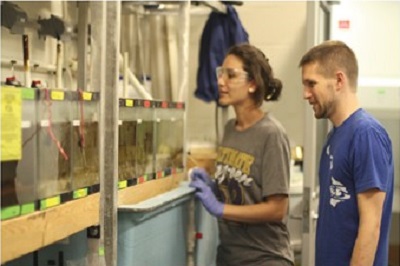 SRP trainees in Ghosh's lab measure PCB levels in water and fish during early lab experiments with activated carbon. (Photo courtesy of Upal Ghosh)
Ghosh continued his research in a second SRP-funded project aimed at evaluating whether fish uptake less PCBs after remediation with activated carbon. The team used lab studies and modeling approaches to demonstrate that fish can reduced their PCB uptake by as much as 87% after 90 days of treatment with activated carbon.
They also showed that SediMite decreased the assimilation efficiency of PCBs by up to 93%. Assimilation efficiency measures the amount of the contaminant that remains in the body compared to the amount that is excreted. This early work by the scientists included scaling up their remediation work to the field study at Mirror Lake.
The technology was implemented in full-scale to remediate a five-acre lake in Dover, Delaware in 2013. It was also selected as a component of the cleanup strategy for a contaminated sediment site in Middle River, Maryland, where the approach was estimated to cost approximately $22 million less than traditional methods, such as dredging and hauling.
Optimizing for Use at Scale
- Scaling up bacteria growth, dispersal, and deployment.
- Demonstrating effectiveness in the field.
- Collaborating in full-scale remediation projects.
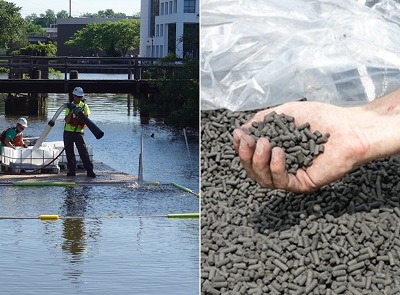 The activated carbon pellets can easily deliver microorganisms across large areas of contaminated sediment to both sequester and degrade PCBs. (Photos courtesy of RemBac)
While developing and patenting SediMite, the researchers identified some limitations to large-scale application of the technology. To address these limitations, Ghosh and Sowers, in collaboration with environmental scientist Bennett Amos, founded RemBac Environmental to enhance the SediMite carbon pellets with PCB-degrading microorganisms. Rembac was funded in 2020 through an SRP small business grant.
In the first phase of their project, they tested methods to optimize growing and storing large volumes of PCB-degrading organisms over time. They also developed and tested methods to apply the microbes more uniformly and cost-effectively to high volumes of activated carbon pellets, enabling them to scale up their technology to broader commercial use.
In the second phase of their project, the team plans to field test the effectiveness and utility of their technology at the New Bedford Harbor Superfund site. They hope their findings will inform regulators and other stakeholders as different PCB clean-up strategies are considered.
In 2022, the Elizabeth River Project started using SediMite to remediate Paradise Creek, a 14-acre tributary to the Elizabeth River in Virginia that is contaminated with PCBs. Another full-scale project, led by EPA, is using SediMite to remove dioxin from sediments in the Scanlon Reservoir in Minnesota.
SRP Funding Creates Synergy
The successful field trial at the Christina River and the newer SRP-funded projects represent a synergy between Ghosh’s development of SediMite and Sower’s early SRP-funded work that demonstrated that using specific microorganisms and conditions to stimulate them resulted in 80% of PCBs being degraded in Superfund sediments under realistic conditions.
New Directions
In 2021, Ghosh and team were awarded a four-year SRP grant to develop carbon-based sorbent materials to enhance the ability of bacteria to break down PCBs in sediments and mixtures of tetrachloroethylene (PCE) and trichloroethylene (TCE) in groundwater. PCE and TCE are chemicals often used in manufacturing and are the most frequently detected volatile organic chemicals in groundwater.
By understanding the interaction between surface chemistry and microbial degradation, the team expects to develop new technologies to remediate PCBs, PCE, TCE, and other chlorinated contaminants often found in the environment.
link to full article:
https://www.niehs.nih.gov/research/supported/centers/srp/phi/archives/remediation/sedimite
]]>
Excerpt from February 2024 - National Institute of Health (NIH), National Institute of Environmental Health Science (NIEHS) Superfund Research Program, Public Health Impact Story Low-Cost...
https://dev.my.umbc.edu/api/v0/pixel/news/138951/guest@my.umbc.edu/7bba21e8254f99b1175cc1ca6219698e/api/pixel
ghosh
research
spring-2024
Chemical, Biochemical and Environmental Engineering
https://dev.my.umbc.edu/groups/cbee
https://assets4-dev.my.umbc.edu/system/shared/avatars/groups/000/000/771/b5e579e81b2e3624611890fa3ca2716a/xsmall.png?1746794587
https://assets2-dev.my.umbc.edu/system/shared/avatars/groups/000/000/771/b5e579e81b2e3624611890fa3ca2716a/original.png?1746794587
https://assets1-dev.my.umbc.edu/system/shared/avatars/groups/000/000/771/b5e579e81b2e3624611890fa3ca2716a/xxlarge.png?1746794587
https://assets2-dev.my.umbc.edu/system/shared/avatars/groups/000/000/771/b5e579e81b2e3624611890fa3ca2716a/xlarge.png?1746794587
https://assets2-dev.my.umbc.edu/system/shared/avatars/groups/000/000/771/b5e579e81b2e3624611890fa3ca2716a/large.png?1746794587
https://assets4-dev.my.umbc.edu/system/shared/avatars/groups/000/000/771/b5e579e81b2e3624611890fa3ca2716a/medium.png?1746794587
https://assets1-dev.my.umbc.edu/system/shared/avatars/groups/000/000/771/b5e579e81b2e3624611890fa3ca2716a/small.png?1746794587
https://assets4-dev.my.umbc.edu/system/shared/avatars/groups/000/000/771/b5e579e81b2e3624611890fa3ca2716a/xsmall.png?1746794587
https://assets1-dev.my.umbc.edu/system/shared/avatars/groups/000/000/771/b5e579e81b2e3624611890fa3ca2716a/xxsmall.png?1746794587
Chemical, Biochemical and Environmental Engineering
https://assets4-dev.my.umbc.edu/system/shared/thumbnails/news/000/138/951/a0e85fc0f0bf840f0c5ba49e650339f9/xxlarge.jpg?1707841196
https://assets4-dev.my.umbc.edu/system/shared/thumbnails/news/000/138/951/a0e85fc0f0bf840f0c5ba49e650339f9/xlarge.jpg?1707841196
https://assets3-dev.my.umbc.edu/system/shared/thumbnails/news/000/138/951/a0e85fc0f0bf840f0c5ba49e650339f9/large.jpg?1707841196
https://assets3-dev.my.umbc.edu/system/shared/thumbnails/news/000/138/951/a0e85fc0f0bf840f0c5ba49e650339f9/medium.jpg?1707841196
https://assets3-dev.my.umbc.edu/system/shared/thumbnails/news/000/138/951/a0e85fc0f0bf840f0c5ba49e650339f9/small.jpg?1707841196
https://assets3-dev.my.umbc.edu/system/shared/thumbnails/news/000/138/951/a0e85fc0f0bf840f0c5ba49e650339f9/xsmall.jpg?1707841196
https://assets2-dev.my.umbc.edu/system/shared/thumbnails/news/000/138/951/a0e85fc0f0bf840f0c5ba49e650339f9/xxsmall.jpg?1707841196
1
0
true
Tue, 13 Feb 2024 10:57:30 -0500
Tue, 13 Feb 2024 11:20:07 -0500
In the News: Dr. Ghosh on C&E News Postcast on wastewater
What happens when wastewater treatment facilities fail?
Dr. Upal Ghosh, professor of chemical, biochemical, and environmental engineering, is intereviewed as part of the a recent C&E News Podcast with Stereo Chemistry.
The Podcast: Here’s what happens when wastewater treatment facilities fail.
During the podcast the podcasters visit two struggling wastewater treatment plants in Baltimore to examine the impact on surrounding ecosystems and explore the future of wastewater chemistry
Dr. Upal Ghosh's interview starts at 14.40 min into the recording. The podcast is all about bioprocess, infrastructure funds, and circular economy!
]]>
Dr. Upal Ghosh, professor of chemical, biochemical, and environmental engineering, is intereviewed as part of the a recent C&E News Podcast with Stereo Chemistry. The Podcast: Here’s what...
https://dev.my.umbc.edu/api/v0/pixel/news/134253/guest@my.umbc.edu/d1fc52d23dbc7819a4b4c5caf8d15218/api/pixel
faculty
ghosh
news
summer-2023
Chemical, Biochemical and Environmental Engineering
https://dev.my.umbc.edu/groups/cbee
https://assets4-dev.my.umbc.edu/system/shared/avatars/groups/000/000/771/b5e579e81b2e3624611890fa3ca2716a/xsmall.png?1746794587
https://assets2-dev.my.umbc.edu/system/shared/avatars/groups/000/000/771/b5e579e81b2e3624611890fa3ca2716a/original.png?1746794587
https://assets1-dev.my.umbc.edu/system/shared/avatars/groups/000/000/771/b5e579e81b2e3624611890fa3ca2716a/xxlarge.png?1746794587
https://assets2-dev.my.umbc.edu/system/shared/avatars/groups/000/000/771/b5e579e81b2e3624611890fa3ca2716a/xlarge.png?1746794587
https://assets2-dev.my.umbc.edu/system/shared/avatars/groups/000/000/771/b5e579e81b2e3624611890fa3ca2716a/large.png?1746794587
https://assets4-dev.my.umbc.edu/system/shared/avatars/groups/000/000/771/b5e579e81b2e3624611890fa3ca2716a/medium.png?1746794587
https://assets1-dev.my.umbc.edu/system/shared/avatars/groups/000/000/771/b5e579e81b2e3624611890fa3ca2716a/small.png?1746794587
https://assets4-dev.my.umbc.edu/system/shared/avatars/groups/000/000/771/b5e579e81b2e3624611890fa3ca2716a/xsmall.png?1746794587
https://assets1-dev.my.umbc.edu/system/shared/avatars/groups/000/000/771/b5e579e81b2e3624611890fa3ca2716a/xxsmall.png?1746794587
Chemical, Biochemical and Environmental Engineering
0
0
true
Mon, 10 Jul 2023 12:01:51 -0400
Mon, 10 Jul 2023 12:03:15 -0400
Sustainable Aquaculture: Solving the off-flavor problem
Matthew Stromberg, environmental engineering PhD student
Ph.D. student Matthew Stromberg describes his Sustainable Aquaculcure research in this beautiful video. A collaboration between marine biologists and environmental engineers is attempting to solve the critical off-flavor problem in aquaculture while minimizing water usage. See the cool tanks growing salmon in the lab!
]]>
Ph.D. student Matthew Stromberg describes his Sustainable Aquaculcure research in this beautiful video. A collaboration between marine biologists and environmental engineers is attempting to solve...
https://dev.my.umbc.edu/api/v0/pixel/news/133738/guest@my.umbc.edu/96dcc2658ee1fc9a40e78be630e8ab90/api/pixel
faculty
ghosh
grad
research
spring-2023
Chemical, Biochemical and Environmental Engineering
https://dev.my.umbc.edu/groups/cbee
https://assets4-dev.my.umbc.edu/system/shared/avatars/groups/000/000/771/b5e579e81b2e3624611890fa3ca2716a/xsmall.png?1746794587
https://assets2-dev.my.umbc.edu/system/shared/avatars/groups/000/000/771/b5e579e81b2e3624611890fa3ca2716a/original.png?1746794587
https://assets1-dev.my.umbc.edu/system/shared/avatars/groups/000/000/771/b5e579e81b2e3624611890fa3ca2716a/xxlarge.png?1746794587
https://assets2-dev.my.umbc.edu/system/shared/avatars/groups/000/000/771/b5e579e81b2e3624611890fa3ca2716a/xlarge.png?1746794587
https://assets2-dev.my.umbc.edu/system/shared/avatars/groups/000/000/771/b5e579e81b2e3624611890fa3ca2716a/large.png?1746794587
https://assets4-dev.my.umbc.edu/system/shared/avatars/groups/000/000/771/b5e579e81b2e3624611890fa3ca2716a/medium.png?1746794587
https://assets1-dev.my.umbc.edu/system/shared/avatars/groups/000/000/771/b5e579e81b2e3624611890fa3ca2716a/small.png?1746794587
https://assets4-dev.my.umbc.edu/system/shared/avatars/groups/000/000/771/b5e579e81b2e3624611890fa3ca2716a/xsmall.png?1746794587
https://assets1-dev.my.umbc.edu/system/shared/avatars/groups/000/000/771/b5e579e81b2e3624611890fa3ca2716a/xxsmall.png?1746794587
Chemical, Biochemical and Environmental Engineering
https://assets3-dev.my.umbc.edu/system/shared/thumbnails/news/000/133/738/60cf2dfda93076f7c68a70ba6c9b8409/xxlarge.jpg?1685030087
https://assets2-dev.my.umbc.edu/system/shared/thumbnails/news/000/133/738/60cf2dfda93076f7c68a70ba6c9b8409/xlarge.jpg?1685030087
https://assets4-dev.my.umbc.edu/system/shared/thumbnails/news/000/133/738/60cf2dfda93076f7c68a70ba6c9b8409/large.jpg?1685030087
https://assets1-dev.my.umbc.edu/system/shared/thumbnails/news/000/133/738/60cf2dfda93076f7c68a70ba6c9b8409/medium.jpg?1685030087
https://assets2-dev.my.umbc.edu/system/shared/thumbnails/news/000/133/738/60cf2dfda93076f7c68a70ba6c9b8409/small.jpg?1685030087
https://assets4-dev.my.umbc.edu/system/shared/thumbnails/news/000/133/738/60cf2dfda93076f7c68a70ba6c9b8409/xsmall.jpg?1685030087
https://assets3-dev.my.umbc.edu/system/shared/thumbnails/news/000/133/738/60cf2dfda93076f7c68a70ba6c9b8409/xxsmall.jpg?1685030087
4
0
true
Thu, 25 May 2023 11:55:07 -0400
Working to diversify and advance environmental science
UMBC, USGS and EPA sign new agreement
CBEE faculty, Dr. Claire Welty, Professor of Department of Chemical, Biochemical and Environmental Engineering and Director of Center for Urban Environmental Research and Education, Drs. Lee Blaney, Upal Ghosh, Chris Hennigan, Brian Reed, Claire Welty, are also affiliated with the Interdisciplinary Consortium for Applied Research in the Environment (ICARE) are beneficiaries of successful collaborations between the three organizations.
]]>
On a recent Friday, representatives of UMBC, the U.S. Geological Survey and the U.S. Environmental Protection Agency gathered in UMBC’s Albin O. Kuhn Library Gallery and pledged to work together...
https://dev.my.umbc.edu/api/v0/pixel/news/133435/guest@my.umbc.edu/fd829d8fd572efa3ed4d0ec8236f6fed/api/pixel
blaney
faculty
ghosh
hennigan
reed
research
spring-2023
welty
Chemical, Biochemical and Environmental Engineering
https://dev.my.umbc.edu/groups/cbee
https://assets4-dev.my.umbc.edu/system/shared/avatars/groups/000/000/771/b5e579e81b2e3624611890fa3ca2716a/xsmall.png?1746794587
https://assets2-dev.my.umbc.edu/system/shared/avatars/groups/000/000/771/b5e579e81b2e3624611890fa3ca2716a/original.png?1746794587
https://assets1-dev.my.umbc.edu/system/shared/avatars/groups/000/000/771/b5e579e81b2e3624611890fa3ca2716a/xxlarge.png?1746794587
https://assets2-dev.my.umbc.edu/system/shared/avatars/groups/000/000/771/b5e579e81b2e3624611890fa3ca2716a/xlarge.png?1746794587
https://assets2-dev.my.umbc.edu/system/shared/avatars/groups/000/000/771/b5e579e81b2e3624611890fa3ca2716a/large.png?1746794587
https://assets4-dev.my.umbc.edu/system/shared/avatars/groups/000/000/771/b5e579e81b2e3624611890fa3ca2716a/medium.png?1746794587
https://assets1-dev.my.umbc.edu/system/shared/avatars/groups/000/000/771/b5e579e81b2e3624611890fa3ca2716a/small.png?1746794587
https://assets4-dev.my.umbc.edu/system/shared/avatars/groups/000/000/771/b5e579e81b2e3624611890fa3ca2716a/xsmall.png?1746794587
https://assets1-dev.my.umbc.edu/system/shared/avatars/groups/000/000/771/b5e579e81b2e3624611890fa3ca2716a/xxsmall.png?1746794587
Chemical, Biochemical and Environmental Engineering
0
0
true
Thu, 11 May 2023 11:26:41 -0400
Researchers Help With Breakthroughs In Salmon Farming
Matthew Stromberg, environmental engineering Ph.D. student, was recently mentioned in the Science article, "OCEANS AWAY: Is raising salmon on land the next big thing in farming fish?" by Erik Stokstad. Stomberg is co-advised by Dr. Ghosh, professor of chemical, biochemical, and environmental engineering and Dr. Zohar, professor of marine biotechnology.
The article explores the emerging trend of land-based fish farming, specifically focusing on Superior Fresh, a Wisconsin-based farm that raises Atlantic salmon. The farm's unique approach to raising fish in tanks and integrating them with its greenhouse operations has attracted attention from investors and customers looking for locally produced and high-quality fish.
The article highlights the challenges associated with land-based fish farming, including the high costs of equipment and infrastructure, potential environmental impacts, and the need to address fish health and welfare. To address some of these challenges, the farm has implemented various innovative practices, such as using ultraviolet light to purify water and using antisense RNA to prevent salmon from sexually maturing and ensuring larger filets.
Stromberg is testing a system that uses ultraviolet light and titanium electrodes to break down water-borne chemicals that can give land-reared salmon a muddy flavor. Their research is crucial in ensuring the long-term success of land-based fish farming.
Image Credit: University of Wisconsin-Stevens Point
]]>
Matthew Stromberg, environmental engineering Ph.D. student, was recently mentioned in the Science article, "OCEANS AWAY: Is raising salmon on land the next big thing in farming fish?" by Erik...
https://dev.my.umbc.edu/api/v0/pixel/news/133019/guest@my.umbc.edu/48874c0286a1a51a932bd93bd8b2bbf6/api/pixel
ghosh
grad
research
spring-2023
Chemical, Biochemical and Environmental Engineering
https://dev.my.umbc.edu/groups/cbee
https://assets4-dev.my.umbc.edu/system/shared/avatars/groups/000/000/771/b5e579e81b2e3624611890fa3ca2716a/xsmall.png?1746794587
https://assets2-dev.my.umbc.edu/system/shared/avatars/groups/000/000/771/b5e579e81b2e3624611890fa3ca2716a/original.png?1746794587
https://assets1-dev.my.umbc.edu/system/shared/avatars/groups/000/000/771/b5e579e81b2e3624611890fa3ca2716a/xxlarge.png?1746794587
https://assets2-dev.my.umbc.edu/system/shared/avatars/groups/000/000/771/b5e579e81b2e3624611890fa3ca2716a/xlarge.png?1746794587
https://assets2-dev.my.umbc.edu/system/shared/avatars/groups/000/000/771/b5e579e81b2e3624611890fa3ca2716a/large.png?1746794587
https://assets4-dev.my.umbc.edu/system/shared/avatars/groups/000/000/771/b5e579e81b2e3624611890fa3ca2716a/medium.png?1746794587
https://assets1-dev.my.umbc.edu/system/shared/avatars/groups/000/000/771/b5e579e81b2e3624611890fa3ca2716a/small.png?1746794587
https://assets4-dev.my.umbc.edu/system/shared/avatars/groups/000/000/771/b5e579e81b2e3624611890fa3ca2716a/xsmall.png?1746794587
https://assets1-dev.my.umbc.edu/system/shared/avatars/groups/000/000/771/b5e579e81b2e3624611890fa3ca2716a/xxsmall.png?1746794587
Chemical, Biochemical and Environmental Engineering
https://assets3-dev.my.umbc.edu/system/shared/thumbnails/news/000/133/019/38cde54d2f4eb4367d4d141f58817ee5/xxlarge.jpg?1682607300
https://assets4-dev.my.umbc.edu/system/shared/thumbnails/news/000/133/019/38cde54d2f4eb4367d4d141f58817ee5/xlarge.jpg?1682607300
https://assets4-dev.my.umbc.edu/system/shared/thumbnails/news/000/133/019/38cde54d2f4eb4367d4d141f58817ee5/large.jpg?1682607300
https://assets2-dev.my.umbc.edu/system/shared/thumbnails/news/000/133/019/38cde54d2f4eb4367d4d141f58817ee5/medium.jpg?1682607300
https://assets3-dev.my.umbc.edu/system/shared/thumbnails/news/000/133/019/38cde54d2f4eb4367d4d141f58817ee5/small.jpg?1682607300
https://assets1-dev.my.umbc.edu/system/shared/thumbnails/news/000/133/019/38cde54d2f4eb4367d4d141f58817ee5/xsmall.jpg?1682607300
https://assets4-dev.my.umbc.edu/system/shared/thumbnails/news/000/133/019/38cde54d2f4eb4367d4d141f58817ee5/xxsmall.jpg?1682607300
0
0
true
Wed, 26 Apr 2023 21:07:21 -0400
Thu, 27 Apr 2023 10:55:24 -0400