NEW PUBLICATION: Probing Electrochemical Strain Generation in Vanadium Oxide Cathodes during Cycling of Aqueous Zinc-Ion Batteries via Imaging Technique
Bret Marckx, PhD student ‘27; Dr. Capraz, PhD Advisor
Congratulations to Bret Marckx!
His paper is highlighted as "ACS Editor's Choice", meaning that in the entire ACS database, his paper was selected to be highlighted on the day it was published.
Authors:
Bret A. Marckx, Hunter Maclennan, and Ömer Özgür Capraz
Title:
Probing Electrochemical Strain Generation in Vanadium Oxide Cathodes during Cycling of Aqueous Zinc-Ion Batteries via Imaging Technique
Abstract:
Aqueous batteries have received a great deal of attention for grid-scale energy storage applications but suffer from low-capacity retention and utilization. A lack of understanding of chemomechanical instabilities and charge storage mechanisms in cathodes limits the development of advanced aqueous batteries. To shed light on these instabilities, operando techniques are necessary to probe the complex interplay between electrochemistry and mechanics during cycling. Here, we report an operando technique to probe electrochemical strains in cathodes in aqueous electrolytes during battery cycling via optical imaging and digital image correlation. Operando mechanical measurements indicate that the cathode undergoes positive strain generation during discharge and negative generation during charge. Strain derivatives reveal a close correlation between electrochemical and mechanical behaviors, highlighting the connection between electrochemistry and mechanics. This operando imaging technique is broadly applicable and paves the way for a deeper understanding of deformation mechanisms in aqueous, multivalent ion battery materials.
full article:https://pubs.acs.org/doi/10.1021/cbmi.5c00003
]]>
Congratulations to Bret Marckx! His paper is highlighted as "ACS Editor's Choice", meaning that in the entire ACS database, his paper was selected to be highlighted on the day it was published....
https://dev.my.umbc.edu/api/v0/pixel/news/148819/guest@my.umbc.edu/020be0de4fb37398d2f93afbe0904c2b/api/pixel
capraz
grad
research
spring-2025
Chemical, Biochemical and Environmental Engineering
https://dev.my.umbc.edu/groups/cbee
https://assets4-dev.my.umbc.edu/system/shared/avatars/groups/000/000/771/b5e579e81b2e3624611890fa3ca2716a/xsmall.png?1746794587
https://assets2-dev.my.umbc.edu/system/shared/avatars/groups/000/000/771/b5e579e81b2e3624611890fa3ca2716a/original.png?1746794587
https://assets1-dev.my.umbc.edu/system/shared/avatars/groups/000/000/771/b5e579e81b2e3624611890fa3ca2716a/xxlarge.png?1746794587
https://assets2-dev.my.umbc.edu/system/shared/avatars/groups/000/000/771/b5e579e81b2e3624611890fa3ca2716a/xlarge.png?1746794587
https://assets2-dev.my.umbc.edu/system/shared/avatars/groups/000/000/771/b5e579e81b2e3624611890fa3ca2716a/large.png?1746794587
https://assets4-dev.my.umbc.edu/system/shared/avatars/groups/000/000/771/b5e579e81b2e3624611890fa3ca2716a/medium.png?1746794587
https://assets1-dev.my.umbc.edu/system/shared/avatars/groups/000/000/771/b5e579e81b2e3624611890fa3ca2716a/small.png?1746794587
https://assets4-dev.my.umbc.edu/system/shared/avatars/groups/000/000/771/b5e579e81b2e3624611890fa3ca2716a/xsmall.png?1746794587
https://assets1-dev.my.umbc.edu/system/shared/avatars/groups/000/000/771/b5e579e81b2e3624611890fa3ca2716a/xxsmall.png?1746794587
Chemical, Biochemical and Environmental Engineering
https://assets1-dev.my.umbc.edu/system/shared/thumbnails/news/000/148/819/6e6d0bd324309652b3ef45514be1e9a4/xxlarge.jpg?1744121377
https://assets1-dev.my.umbc.edu/system/shared/thumbnails/news/000/148/819/6e6d0bd324309652b3ef45514be1e9a4/xlarge.jpg?1744121377
https://assets1-dev.my.umbc.edu/system/shared/thumbnails/news/000/148/819/6e6d0bd324309652b3ef45514be1e9a4/large.jpg?1744121377
https://assets1-dev.my.umbc.edu/system/shared/thumbnails/news/000/148/819/6e6d0bd324309652b3ef45514be1e9a4/medium.jpg?1744121377
https://assets1-dev.my.umbc.edu/system/shared/thumbnails/news/000/148/819/6e6d0bd324309652b3ef45514be1e9a4/small.jpg?1744121377
https://assets2-dev.my.umbc.edu/system/shared/thumbnails/news/000/148/819/6e6d0bd324309652b3ef45514be1e9a4/xsmall.jpg?1744121377
https://assets3-dev.my.umbc.edu/system/shared/thumbnails/news/000/148/819/6e6d0bd324309652b3ef45514be1e9a4/xxsmall.jpg?1744121377
0
0
true
Tue, 08 Apr 2025 12:14:05 -0400
UMBC team leads research into AI tools that can assess the feasibility of scientific claims
Reposted from UMBC News: https://umbc.edu/quick-posts/students-celebrate-engineering-and-computing-week-with-fun-and-networking/
A multidisciplinary team of UMBC researchers was recently awarded $3.8 million from the Defense Advanced Research Projects Agency (DARPA) to develop new computational methods for assessing the feasibility of scientific claims. The project is motivated by the speed and volume of new developments in science and the need for tools to help evaluate the soundness of new claims.
“Some scientific claims are peer reviewed by independent experts, but others, such as from company press releases, or papers posted to pre-prints sites, are not,” says Frank Ferraro, an associate professor of computer science and lead researcher on the award. And even when science is peer-reviewed, there can still be errors, Ferraro notes. For example, recent research highlighting the danger of flame retardant chemicals leaching from black plastic into food was widely reported on, before it was discovered that an error in the paper led to a significant overstating of the exposure risk.
An AI science assistant
The idea of an AI assistant specifically designed to tackle complex research questions has been catching on recently. OpenAI, the creators of ChatGPT, recently debuted their “DeepResearch” tool, which the company says can use reasoning to synthesize large amounts of online information and complete multi-step research tasks.
Ferraro says the tool he and his colleagues hope to develop should stand-out from other approaches by employing a strongly iterative process, necessary to really take apart and analyze claims. The tool will break down a scientific claim into constituent sub-claims, and apply a wide range of evidence and reasoning approaches to assess the feasibility of each one.
 Tyler Josephson (Marlayna Demond ’11/UMBC)
The team, which includes UMBC faculty Tejas Gokhale, computer science and electrical engineering, and Tyler Josephson, chemical, biochemical, and environmental engineering, as well as colleagues from Stony Brook University, the University of Texas at Austin, and the University of Cambridge, will develop and test the tool on three leading areas of scientific research: materials science, AI, and quantum computing.
“It’s a little meta that the AI will be analyzing AI,” Ferraro says. More than 20 UMBC undergrads, grad students, and post-docs will take part in the project. “They’ll get opportunities to network with peers on a highly relevant topic,” Ferraro says. “They’ll be helping guide the national conversation on these issues.”
]]>
Reposted from UMBC News: https://umbc.edu/quick-posts/students-celebrate-engineering-and-computing-week-with-fun-and-networking/ A multidisciplinary team of UMBC researchers was recently...
https://dev.my.umbc.edu/api/v0/pixel/news/148688/guest@my.umbc.edu/bcc7656879b3313598e09a461360c64e/api/pixel
grad
josephson
research
spring-2025
ug
ugrad
Chemical, Biochemical and Environmental Engineering
https://dev.my.umbc.edu/groups/cbee
https://assets4-dev.my.umbc.edu/system/shared/avatars/groups/000/000/771/b5e579e81b2e3624611890fa3ca2716a/xsmall.png?1746794587
https://assets2-dev.my.umbc.edu/system/shared/avatars/groups/000/000/771/b5e579e81b2e3624611890fa3ca2716a/original.png?1746794587
https://assets1-dev.my.umbc.edu/system/shared/avatars/groups/000/000/771/b5e579e81b2e3624611890fa3ca2716a/xxlarge.png?1746794587
https://assets2-dev.my.umbc.edu/system/shared/avatars/groups/000/000/771/b5e579e81b2e3624611890fa3ca2716a/xlarge.png?1746794587
https://assets2-dev.my.umbc.edu/system/shared/avatars/groups/000/000/771/b5e579e81b2e3624611890fa3ca2716a/large.png?1746794587
https://assets4-dev.my.umbc.edu/system/shared/avatars/groups/000/000/771/b5e579e81b2e3624611890fa3ca2716a/medium.png?1746794587
https://assets1-dev.my.umbc.edu/system/shared/avatars/groups/000/000/771/b5e579e81b2e3624611890fa3ca2716a/small.png?1746794587
https://assets4-dev.my.umbc.edu/system/shared/avatars/groups/000/000/771/b5e579e81b2e3624611890fa3ca2716a/xsmall.png?1746794587
https://assets1-dev.my.umbc.edu/system/shared/avatars/groups/000/000/771/b5e579e81b2e3624611890fa3ca2716a/xxsmall.png?1746794587
Chemical, Biochemical and Environmental Engineering
https://assets1-dev.my.umbc.edu/system/shared/thumbnails/news/000/148/688/0171ccdce6d00d1547a5fbeeb1fbaa53/xxlarge.jpg?1743774253
https://assets3-dev.my.umbc.edu/system/shared/thumbnails/news/000/148/688/0171ccdce6d00d1547a5fbeeb1fbaa53/xlarge.jpg?1743774253
https://assets4-dev.my.umbc.edu/system/shared/thumbnails/news/000/148/688/0171ccdce6d00d1547a5fbeeb1fbaa53/large.jpg?1743774253
https://assets3-dev.my.umbc.edu/system/shared/thumbnails/news/000/148/688/0171ccdce6d00d1547a5fbeeb1fbaa53/medium.jpg?1743774253
https://assets1-dev.my.umbc.edu/system/shared/thumbnails/news/000/148/688/0171ccdce6d00d1547a5fbeeb1fbaa53/small.jpg?1743774253
https://assets4-dev.my.umbc.edu/system/shared/thumbnails/news/000/148/688/0171ccdce6d00d1547a5fbeeb1fbaa53/xsmall.jpg?1743774253
https://assets4-dev.my.umbc.edu/system/shared/thumbnails/news/000/148/688/0171ccdce6d00d1547a5fbeeb1fbaa53/xxsmall.jpg?1743774253
0
0
true
Fri, 04 Apr 2025 09:46:01 -0400
Tue, 08 Apr 2025 12:11:43 -0400
Students celebrate Engineering and Computing Week with fun and networking
Reposted from UMBC News: https://umbc.edu/quick-posts/students-celebrate-engineering-and-computing-week-with-fun-and-networking/
Where can UMBC engineering and computing students mingle with friends and mentors over sweet treats, test their knowledge and design skills in friendly competition, and network with potential employers? If it’s February, the answer is the annual Engineering and Computing Week, a traditional celebration of technology, held each year at UMBC to coincide with National Engineers Week.
The UMBC chapter of the engineering honors society Tau Beta Pi, in collaboration with various student engineering organizations on campus, organizes the week of activities each year. This year, the line-up of events featured a mix of social activities, such as painting and crafting, presentations from student organizations, and chances for teams to compete in games testing engineering knowledge and design skills.
UMBC chapters of the Information Systems Security Association, the American Institute of Chemical Engineers, the American Society of Mechanical Engineers, the Society of Women Engineers, Engineers without Borders, and the Institute of Electrical and Electronics Engineers all helped organize sessions. UMBC CyberDawgs, a group of UMBC students who share a common interest in cybersecurity, also participated.
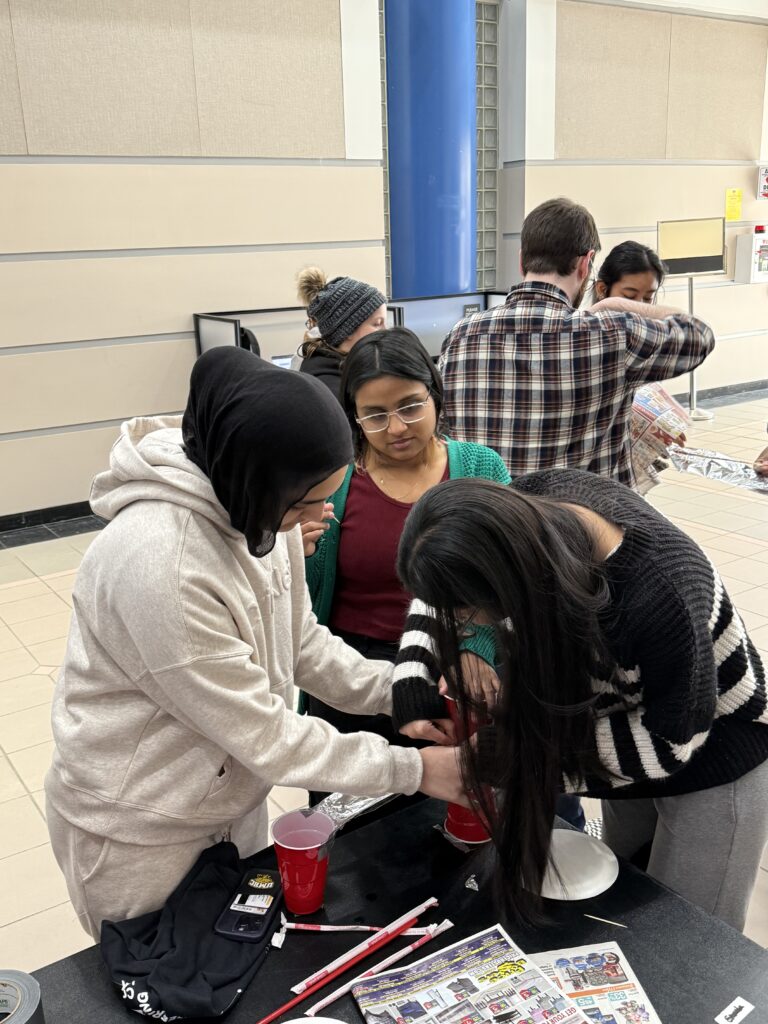 Students build devices to direct water flow, during the Engineers Without Borders “Where’s My Water” event. (Image courtesy of August Phelps)
Students could also join faculty, staff, and alumni from the College of Engineering and Information Technology at an evening reception at the Guinness Brewery near UMBC to socialize and network.
“I think the biggest success from the week was the great turnout and engagement we got from the students,” says August Phelps, a mechanical engineering senior and vice president of the UMBC chapter of Tau Beta Pi.
He says the event showcases the wide variety of engineering-focused student organizations at UMBC, which hold events throughout the year and offer great opportunities for students to develop leadership skills and form lasting connections with their peers.
“I hope attendees left feeling more connected as a community,” he says.
]]>
Reposted from UMBC News: https://umbc.edu/quick-posts/students-celebrate-engineering-and-computing-week-with-fun-and-networking/ Where can UMBC engineering and computing students mingle with...
https://dev.my.umbc.edu/api/v0/pixel/news/148687/guest@my.umbc.edu/1b05f177062161c25e7d150c5562c0e4/api/pixel
spring-2025
ug
ugrad
Chemical, Biochemical and Environmental Engineering
https://dev.my.umbc.edu/groups/cbee
https://assets4-dev.my.umbc.edu/system/shared/avatars/groups/000/000/771/b5e579e81b2e3624611890fa3ca2716a/xsmall.png?1746794587
https://assets2-dev.my.umbc.edu/system/shared/avatars/groups/000/000/771/b5e579e81b2e3624611890fa3ca2716a/original.png?1746794587
https://assets1-dev.my.umbc.edu/system/shared/avatars/groups/000/000/771/b5e579e81b2e3624611890fa3ca2716a/xxlarge.png?1746794587
https://assets2-dev.my.umbc.edu/system/shared/avatars/groups/000/000/771/b5e579e81b2e3624611890fa3ca2716a/xlarge.png?1746794587
https://assets2-dev.my.umbc.edu/system/shared/avatars/groups/000/000/771/b5e579e81b2e3624611890fa3ca2716a/large.png?1746794587
https://assets4-dev.my.umbc.edu/system/shared/avatars/groups/000/000/771/b5e579e81b2e3624611890fa3ca2716a/medium.png?1746794587
https://assets1-dev.my.umbc.edu/system/shared/avatars/groups/000/000/771/b5e579e81b2e3624611890fa3ca2716a/small.png?1746794587
https://assets4-dev.my.umbc.edu/system/shared/avatars/groups/000/000/771/b5e579e81b2e3624611890fa3ca2716a/xsmall.png?1746794587
https://assets1-dev.my.umbc.edu/system/shared/avatars/groups/000/000/771/b5e579e81b2e3624611890fa3ca2716a/xxsmall.png?1746794587
Chemical, Biochemical and Environmental Engineering
https://assets2-dev.my.umbc.edu/system/shared/thumbnails/news/000/148/687/ba0efb96d7efb58bd1b212bfa7842041/xxlarge.jpg?1743773867
https://assets4-dev.my.umbc.edu/system/shared/thumbnails/news/000/148/687/ba0efb96d7efb58bd1b212bfa7842041/xlarge.jpg?1743773867
https://assets3-dev.my.umbc.edu/system/shared/thumbnails/news/000/148/687/ba0efb96d7efb58bd1b212bfa7842041/large.jpg?1743773867
https://assets1-dev.my.umbc.edu/system/shared/thumbnails/news/000/148/687/ba0efb96d7efb58bd1b212bfa7842041/medium.jpg?1743773867
https://assets2-dev.my.umbc.edu/system/shared/thumbnails/news/000/148/687/ba0efb96d7efb58bd1b212bfa7842041/small.jpg?1743773867
https://assets4-dev.my.umbc.edu/system/shared/thumbnails/news/000/148/687/ba0efb96d7efb58bd1b212bfa7842041/xsmall.jpg?1743773867
https://assets2-dev.my.umbc.edu/system/shared/thumbnails/news/000/148/687/ba0efb96d7efb58bd1b212bfa7842041/xxsmall.jpg?1743773867
0
0
true
Fri, 04 Apr 2025 09:41:38 -0400
Fri, 04 Apr 2025 12:49:59 -0400
Students partner with Baltimore community members to measure ‘forever chemicals’ in local waters
Reposted from UMBC News: https://umbc.edu/stories/measuring-forever-chemicals-in-baltimore-waters/
On a sunny and unseasonably warm Halloween this past fall, a group of costumed UMBC students strolled the banks of the Inner Harbor in Baltimore. The costumes were in good fun, but the spirit driving them to the city that day was more scientific than spectral: They were there to check on samplers they had installed around the harbor to measure the concentrations of certain chemicals called per- and polyfluoroalkyl substances, or PFAS, in the water.
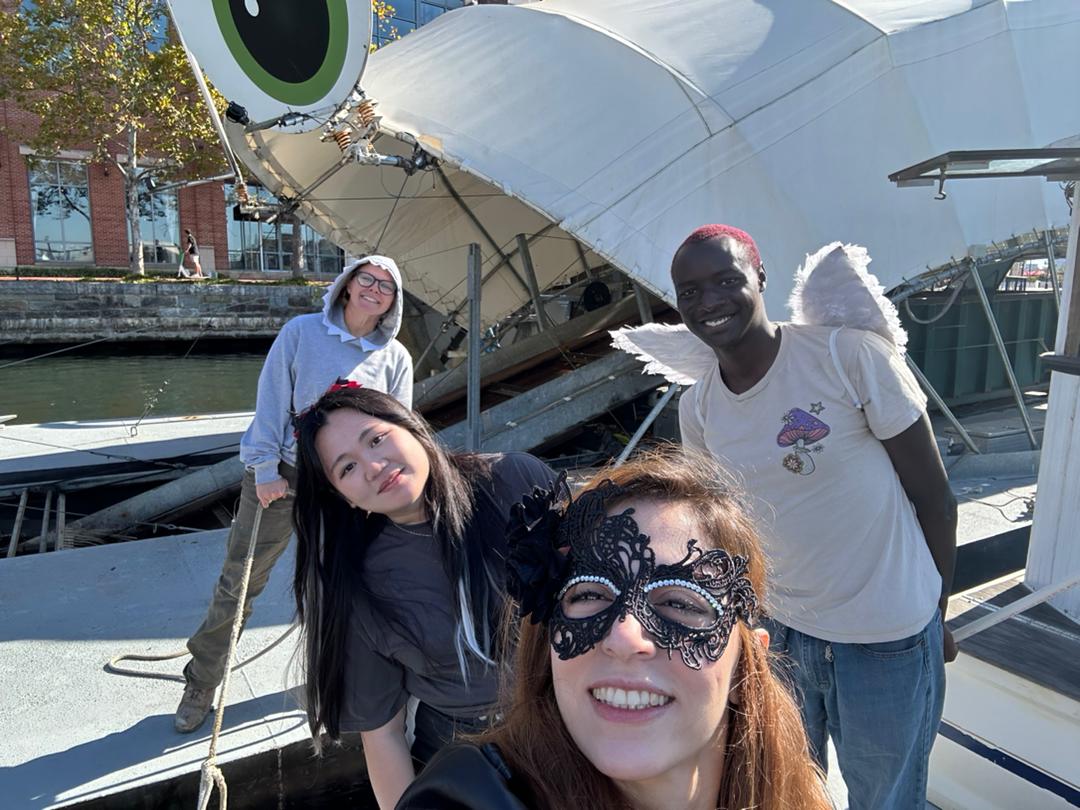 On Halloween, from right to left, Alvin Bett, an undergraduate student working in Blaney’s lab, Hamidi, Siao, and Leigh Auth, a boat captain with the Waterfront Partnership of Baltimore who helped the group access the trash wheels to install their PFAS sensors. (Image courtesy of Siao)
PFAS are used in a diverse range of products, including cleaning products, clothing, and fire-fighting foam, and have earned the nickname “forever chemicals” because of the way they persist in the environment. There are growing concerns about the health effects of the chemicals, and in recent years there have been efforts to eliminate PFAS from some consumer products and regulate their concentration in drinking water.
The UMBC students’ work to measure PFAS in Baltimore Harbor is one of the first projects aiming to get an understanding of how much of the chemicals are found in the waters around Baltimore and where they might be coming from. Margaret Siao, a master’s student in chemical engineering, took a lead role in the work as part of the ICARE program, which links researchers and Baltimore community members on environmental projects around the city.
Donya Hamidi, an environmental engineering Ph.D. student, also took part in the project, which served as a test case for a larger project she is working on, seeking to expand the utility of innovative passive samplers to measure PFAS in any water source.
“I’ve lived in Baltimore most of my life,” says Siao. “The harbor is a big part of the city, although many people don’t go out on the water. And that’s one of the reasons I wanted to look at the water quality.”
PFAS are everywhere
There are thousands of different PFAS chemicals. Because of their widespread use and resistance to degradation, they are found throughout the country in the water, soil, air, and food, and in the blood of humans and animals.
Exposure to some forms of PFAS has been linked to a range of health problems, including decreased fertility in women, developmental effects in children, reduced immune function, and increased risk of cancer and obesity.
“The PFAS issue just gets more and more complicated by the day,” says Lee Blaney, the environmental engineering professor who leads the lab where Siao and Hamidi work. He notes the EPA recently released an initial risk assessment for certain PFAS found in biosolids, which are a byproduct of wastewater treatment and are sometimes applied to agricultural land as fertilizer. “It’s a big, far-reaching issue.”
Partnering with the community
Blaney is an expert on PFAS, and as concerns about the prevalence and potential health effects of the chemicals have grown, his lab has been a leading partner with Baltimore community members who advocate for and are responsible for the quality of the water.
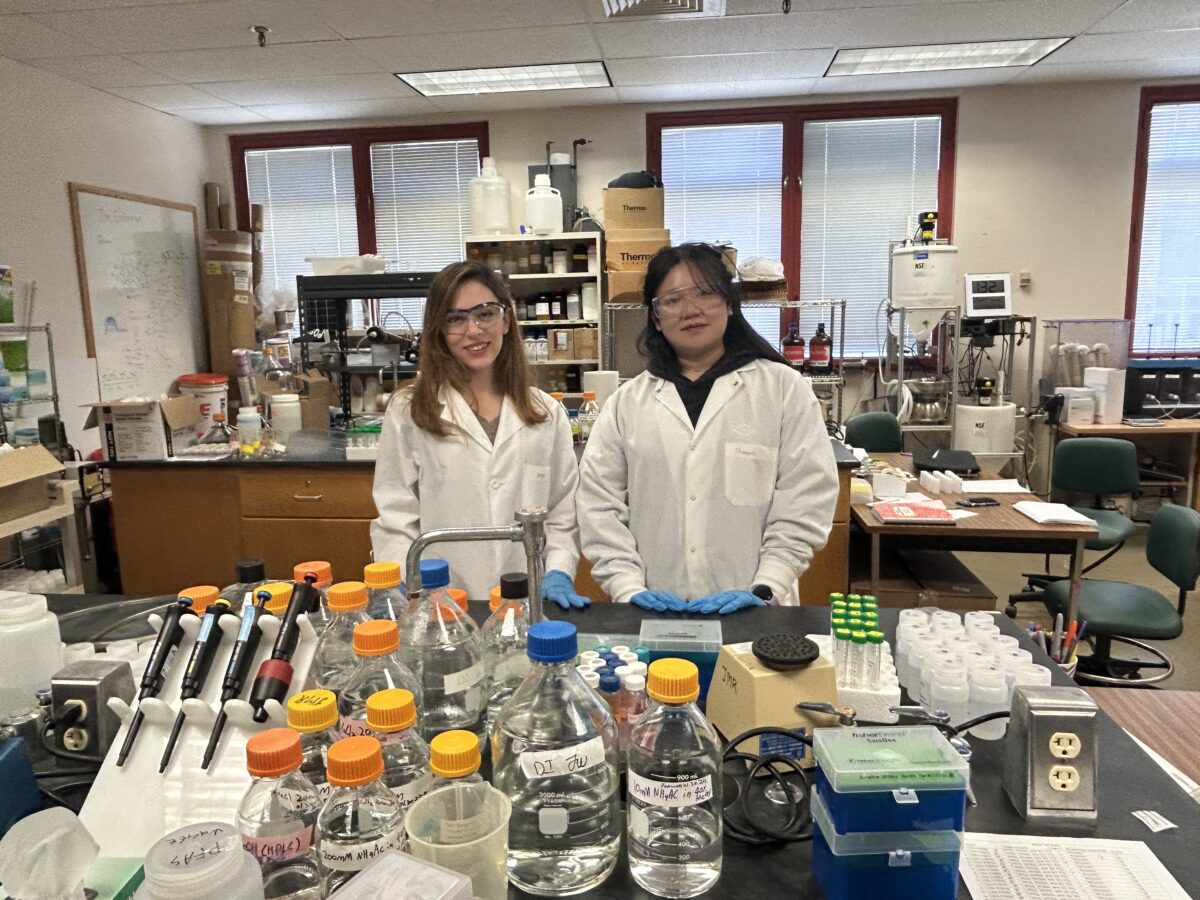 Hamidi (left) and Siao in the lab where they analyze samples for PFAS concentrations. (Image courtesy of Hamidi)
Siao’s ICARE project was a partnership with the United States Geological Survey Maryland-Delaware-D.C. Water Science Center and Blue Water Baltimore, a non-profit organization with the mission to restore the quality of Baltimore’s rivers, streams, and harbor. Blue Water Baltimore shared their knowledge of the harbor and area waterways and their connections with the community, while lab members shared their expertise and will share their PFAS data once it has been analyzed.
“PFAS is a hot topic, so Margaret’s project is really good timing,” says Barbara Johnson, who was Siao’s mentor at Blue Water Baltimore. “I think her data will be very useful for us in helping the public understand what PFAS are, for example just understanding how many different kinds there are. Margaret has taught me so much about PFAS.”
As part of the field work, Siao and Hamidi also sampled water at the outlet of the Patapsco Wastewater Treatment Plant in Baltimore. That partnership arose when Mohammed Almafrachi, who works as an engineer for the Baltimore City Department of Public Works, became interested in the PFAS issue and sought out a local expert.
“Last year, I found Dr. Blaney’s name on the internet. I drove to the campus, found his office, and he was there. I introduced myself as an engineer at the city of Baltimore, and we sat down and started talking,” Almafrachi says. From that conversation grew not only the collaboration to measure PFAS at the wastewater treatment plant, but also a tour of Baltimore’s largest drinking water treatment plant that Almafrachi gave students in Blaney’s class on environmental physicochemical processes last spring. Almafrachi said he was happy to provide students with a window on a real-world workplace where their skills might one day be applied.
“If you have not gone to the field, then you are not yet a full engineer,” says Almafrachi. “We can talk about theories and textbooks endlessly, but the field is where you really test your skills.”
The value of field work
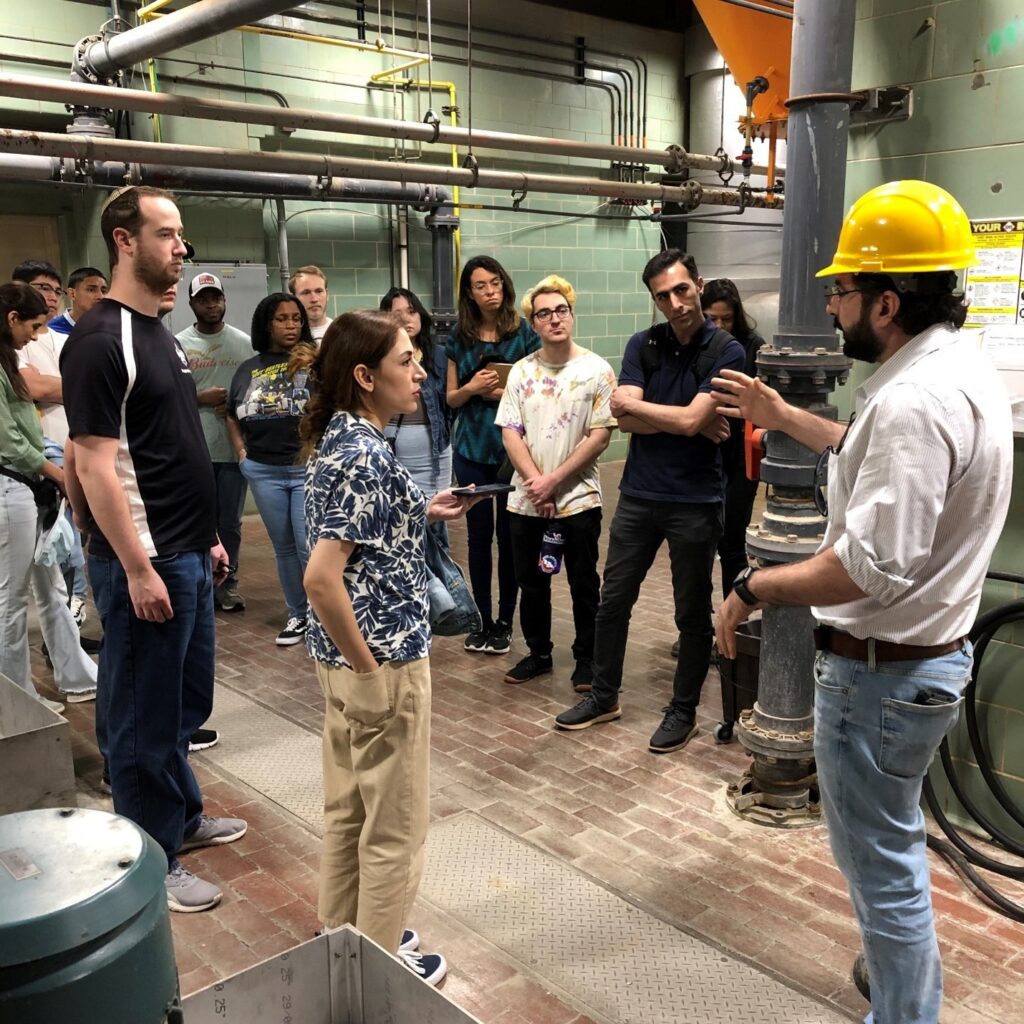 Almafrachi (right) led a tour of the Ashburton Filtration Plant, Baltimore’s largest drinking water treatment plant, for students in Blaney’s environmental physicochemical processes class. (Photo courtesy of Blaney)
Siao and Hamidi agree with Almafrachi about the value of field work. They installed their PFAS samplers at three of the four trash wheels around Baltimore Harbor—personified contraptions named Mr. Trash Wheel, Professor Trash Wheel, and Gwynnda the Good Wheel of the West that collect floating trash and keep it from dirtying the harbor. To get to the trash wheels, they took a flat-bottomed wooden boat, “more like a floating platform with a little cabin,” Siao says.
“Almost every time we collected a sampler, we saw something new or unexpected, for example algae growing on the sampler, and we had to figure out what was going on at that particular site,” says Hamidi. The team’s work and the measurements they collected and are currently analyzing will serve as a foundation for future studies about PFAS in the local environment.
Both Hamidi and Siao say they valued the teamwork of their trips, and the chance to meet people in the community impacted by their research.
“If you are stuck in a lab all day, it’s easy to forget why you’re doing research,” says Siao. “This project gave me a chance to interact with people outside of academia, to learn about what’s important to them, and to learn how to communicate about science with them, which is a really important skill.”
]]>
Reposted from UMBC News: https://umbc.edu/stories/measuring-forever-chemicals-in-baltimore-waters/ On a sunny and unseasonably warm Halloween this past fall, a group of costumed UMBC students...
https://dev.my.umbc.edu/api/v0/pixel/news/148667/guest@my.umbc.edu/978de2125f50821bcc23d58ba8401811/api/pixel
blaney
grad
research
spring-2025
ug
ugrad
Chemical, Biochemical and Environmental Engineering
https://dev.my.umbc.edu/groups/cbee
https://assets4-dev.my.umbc.edu/system/shared/avatars/groups/000/000/771/b5e579e81b2e3624611890fa3ca2716a/xsmall.png?1746794587
https://assets2-dev.my.umbc.edu/system/shared/avatars/groups/000/000/771/b5e579e81b2e3624611890fa3ca2716a/original.png?1746794587
https://assets1-dev.my.umbc.edu/system/shared/avatars/groups/000/000/771/b5e579e81b2e3624611890fa3ca2716a/xxlarge.png?1746794587
https://assets2-dev.my.umbc.edu/system/shared/avatars/groups/000/000/771/b5e579e81b2e3624611890fa3ca2716a/xlarge.png?1746794587
https://assets2-dev.my.umbc.edu/system/shared/avatars/groups/000/000/771/b5e579e81b2e3624611890fa3ca2716a/large.png?1746794587
https://assets4-dev.my.umbc.edu/system/shared/avatars/groups/000/000/771/b5e579e81b2e3624611890fa3ca2716a/medium.png?1746794587
https://assets1-dev.my.umbc.edu/system/shared/avatars/groups/000/000/771/b5e579e81b2e3624611890fa3ca2716a/small.png?1746794587
https://assets4-dev.my.umbc.edu/system/shared/avatars/groups/000/000/771/b5e579e81b2e3624611890fa3ca2716a/xsmall.png?1746794587
https://assets1-dev.my.umbc.edu/system/shared/avatars/groups/000/000/771/b5e579e81b2e3624611890fa3ca2716a/xxsmall.png?1746794587
Chemical, Biochemical and Environmental Engineering
https://assets1-dev.my.umbc.edu/system/shared/thumbnails/news/000/148/667/feec7735d4b19844b2402c58183036a0/xxlarge.jpg?1743702048
https://assets1-dev.my.umbc.edu/system/shared/thumbnails/news/000/148/667/feec7735d4b19844b2402c58183036a0/xlarge.jpg?1743702048
https://assets3-dev.my.umbc.edu/system/shared/thumbnails/news/000/148/667/feec7735d4b19844b2402c58183036a0/large.jpg?1743702048
https://assets2-dev.my.umbc.edu/system/shared/thumbnails/news/000/148/667/feec7735d4b19844b2402c58183036a0/medium.jpg?1743702048
https://assets4-dev.my.umbc.edu/system/shared/thumbnails/news/000/148/667/feec7735d4b19844b2402c58183036a0/small.jpg?1743702048
https://assets3-dev.my.umbc.edu/system/shared/thumbnails/news/000/148/667/feec7735d4b19844b2402c58183036a0/xsmall.jpg?1743702048
https://assets1-dev.my.umbc.edu/system/shared/thumbnails/news/000/148/667/feec7735d4b19844b2402c58183036a0/xxsmall.jpg?1743702048
0
0
true
Thu, 03 Apr 2025 13:59:12 -0400
Thu, 03 Apr 2025 14:19:28 -0400
CBEE Student Places First at SWE Conference
Maya Schreiber, ‘27 Chemical Engineering
Maya Schreiber’s scientific abstract was accepted to the Society of Women Engineers Collegiate Competition for Undergraduates. The CBEE student then attended the 2025 Society of Women Engineers WE Local Conference in Cherry Hill, New Jersey on March 7-8, 2025.
Maya gave a 10 minute oral presentation titled “Measuring Oxygen Consumption to Understand Optimal Chronic Wound Healing Environments” and engaged in a Q&A session about her work with the judges and attendees. Her research poster was also displayed for the duration of the conference. The judges evaluated the presenters and awarded Maya with first place in the Undergraduate category. Congratulations to Maya on all of her success!
See Maya Schreiber’s Linked In post: https://shorturl.at/nknIb
PHOTO CREDIT: Maya Schreiber
]]>
Maya Schreiber’s scientific abstract was accepted to the Society of Women Engineers Collegiate Competition for Undergraduates. The CBEE student then attended the 2025 Society of Women Engineers WE...
Photo
https://assets1-dev.my.umbc.edu/system/shared/attachments/a1951b3972c6272bcf5ecfa138400fd7/69ed6f66/news/000/148/319/b46e530e5de5eb0bf0c76833fe7677c1/WE Local 25.png?1743085144
https://dev.my.umbc.edu/api/v0/pixel/news/148319/guest@my.umbc.edu/210037a0d66a2d9f62400cee90bd18c6/api/pixel
award
research
spring-2025
ug
ugrad
Chemical, Biochemical and Environmental Engineering
https://dev.my.umbc.edu/groups/cbee
https://assets4-dev.my.umbc.edu/system/shared/avatars/groups/000/000/771/b5e579e81b2e3624611890fa3ca2716a/xsmall.png?1746794587
https://assets2-dev.my.umbc.edu/system/shared/avatars/groups/000/000/771/b5e579e81b2e3624611890fa3ca2716a/original.png?1746794587
https://assets1-dev.my.umbc.edu/system/shared/avatars/groups/000/000/771/b5e579e81b2e3624611890fa3ca2716a/xxlarge.png?1746794587
https://assets2-dev.my.umbc.edu/system/shared/avatars/groups/000/000/771/b5e579e81b2e3624611890fa3ca2716a/xlarge.png?1746794587
https://assets2-dev.my.umbc.edu/system/shared/avatars/groups/000/000/771/b5e579e81b2e3624611890fa3ca2716a/large.png?1746794587
https://assets4-dev.my.umbc.edu/system/shared/avatars/groups/000/000/771/b5e579e81b2e3624611890fa3ca2716a/medium.png?1746794587
https://assets1-dev.my.umbc.edu/system/shared/avatars/groups/000/000/771/b5e579e81b2e3624611890fa3ca2716a/small.png?1746794587
https://assets4-dev.my.umbc.edu/system/shared/avatars/groups/000/000/771/b5e579e81b2e3624611890fa3ca2716a/xsmall.png?1746794587
https://assets1-dev.my.umbc.edu/system/shared/avatars/groups/000/000/771/b5e579e81b2e3624611890fa3ca2716a/xxsmall.png?1746794587
Chemical, Biochemical and Environmental Engineering
https://assets1-dev.my.umbc.edu/system/shared/thumbnails/news/000/148/319/6c7504a9e28eed0226b6af302754767b/xxlarge.jpg?1742997674
https://assets1-dev.my.umbc.edu/system/shared/thumbnails/news/000/148/319/6c7504a9e28eed0226b6af302754767b/xlarge.jpg?1742997674
https://assets3-dev.my.umbc.edu/system/shared/thumbnails/news/000/148/319/6c7504a9e28eed0226b6af302754767b/large.jpg?1742997674
https://assets1-dev.my.umbc.edu/system/shared/thumbnails/news/000/148/319/6c7504a9e28eed0226b6af302754767b/medium.jpg?1742997674
https://assets1-dev.my.umbc.edu/system/shared/thumbnails/news/000/148/319/6c7504a9e28eed0226b6af302754767b/small.jpg?1742997674
https://assets2-dev.my.umbc.edu/system/shared/thumbnails/news/000/148/319/6c7504a9e28eed0226b6af302754767b/xsmall.jpg?1742997674
https://assets4-dev.my.umbc.edu/system/shared/thumbnails/news/000/148/319/6c7504a9e28eed0226b6af302754767b/xxsmall.jpg?1742997674
0
0
true
Wed, 26 Mar 2025 12:42:48 -0400
Wed, 02 Apr 2025 12:14:38 -0400
McDonogh High School Students Learn About Engineering at CBEE
McDonogh High School Visit to CBEE
Students from McDonogh High School’s Chemical Engineering class visited the Department of Chemical, Biochemical and Environmental Engineering (CBEE) on February 27th. They toured lab spaces, heard from faculty and students about their innovative research, and learned about CBEE’s academic program. They were accompanied by Dr. Melanie Batarseh, an Upper School Science Teacher, and Jennifer Little, an Academic Dean.
The visit began with Dr. Marten, the Chair of CBEE, sharing insights about the department’s academic offerings and research projects. McDonogh students shared about the chemical engineering projects they were working on and asked questions about CBEE. COEIT Advisor, Hailey Turney, joined to give an overview of the application process for the CBEE program. Students enjoyed breakfast and won UMBC swag by answering questions about CBEE.
Then, students toured the laboratories of Dr. Josephson, Dr. Almodovar, and Dr. Hennigan. During the tours, ongoing research projects were discussed, equipment demonstrations were given, and lab samples were passed around to inspire curiosity amongst students.
This visit was a great opportunity for high school students to connect with CBEE faculty and students, explore potential engineering career paths, and better understand the real-world impact of chemical, biochemical, and environmental engineering.
]]>
Students from McDonogh High School’s Chemical Engineering class visited the Department of Chemical, Biochemical and Environmental Engineering (CBEE) on February 27th. They toured lab spaces, heard...
https://dev.my.umbc.edu/api/v0/pixel/news/148052/guest@my.umbc.edu/65a00615a6fc3e3d1a163b6eb8d079bf/api/pixel
almodovar
hennigan
high-school
josephson
marten
prospective-student
recruitment
spring-2025
ug
ugrad
Chemical, Biochemical and Environmental Engineering
https://dev.my.umbc.edu/groups/cbee
https://assets4-dev.my.umbc.edu/system/shared/avatars/groups/000/000/771/b5e579e81b2e3624611890fa3ca2716a/xsmall.png?1746794587
https://assets2-dev.my.umbc.edu/system/shared/avatars/groups/000/000/771/b5e579e81b2e3624611890fa3ca2716a/original.png?1746794587
https://assets1-dev.my.umbc.edu/system/shared/avatars/groups/000/000/771/b5e579e81b2e3624611890fa3ca2716a/xxlarge.png?1746794587
https://assets2-dev.my.umbc.edu/system/shared/avatars/groups/000/000/771/b5e579e81b2e3624611890fa3ca2716a/xlarge.png?1746794587
https://assets2-dev.my.umbc.edu/system/shared/avatars/groups/000/000/771/b5e579e81b2e3624611890fa3ca2716a/large.png?1746794587
https://assets4-dev.my.umbc.edu/system/shared/avatars/groups/000/000/771/b5e579e81b2e3624611890fa3ca2716a/medium.png?1746794587
https://assets1-dev.my.umbc.edu/system/shared/avatars/groups/000/000/771/b5e579e81b2e3624611890fa3ca2716a/small.png?1746794587
https://assets4-dev.my.umbc.edu/system/shared/avatars/groups/000/000/771/b5e579e81b2e3624611890fa3ca2716a/xsmall.png?1746794587
https://assets1-dev.my.umbc.edu/system/shared/avatars/groups/000/000/771/b5e579e81b2e3624611890fa3ca2716a/xxsmall.png?1746794587
Chemical, Biochemical and Environmental Engineering
https://assets1-dev.my.umbc.edu/system/shared/thumbnails/news/000/148/052/9f224d89a48876e66f05d01bd6bb1e16/xxlarge.jpg?1741804479
https://assets2-dev.my.umbc.edu/system/shared/thumbnails/news/000/148/052/9f224d89a48876e66f05d01bd6bb1e16/xlarge.jpg?1741804479
https://assets4-dev.my.umbc.edu/system/shared/thumbnails/news/000/148/052/9f224d89a48876e66f05d01bd6bb1e16/large.jpg?1741804479
https://assets4-dev.my.umbc.edu/system/shared/thumbnails/news/000/148/052/9f224d89a48876e66f05d01bd6bb1e16/medium.jpg?1741804479
https://assets2-dev.my.umbc.edu/system/shared/thumbnails/news/000/148/052/9f224d89a48876e66f05d01bd6bb1e16/small.jpg?1741804479
https://assets4-dev.my.umbc.edu/system/shared/thumbnails/news/000/148/052/9f224d89a48876e66f05d01bd6bb1e16/xsmall.jpg?1741804479
https://assets1-dev.my.umbc.edu/system/shared/thumbnails/news/000/148/052/9f224d89a48876e66f05d01bd6bb1e16/xxsmall.jpg?1741804479
0
0
true
Wed, 12 Mar 2025 14:41:40 -0400
Congratulations to Dr. Eryigit
Congratulations to Dr. Mesut Eryigit. He is now a faculty member at Balikesir University in Turkey. Dr. Eryigit was a post-doctoral fellow funded by Tubitak (The Scientific and Technological Research Institution of Turkey) with Dr. Özgür Çapraz from December 2023 through November 2024. The experience gained as a post-doc at UMBC was a tremendous asset for Dr. Eryigit as he search for his academic position.
]]>
Congratulations to Dr. Mesut Eryigit. He is now a faculty member at Balikesir University in Turkey. Dr. Eryigit was a post-doctoral fellow funded by Tubitak (The Scientific and Technological...
https://dev.my.umbc.edu/api/v0/pixel/news/148002/guest@my.umbc.edu/ee0107a0a00cd6ba24ae28b6d86ef38b/api/pixel
capraz
spring-2025
Chemical, Biochemical and Environmental Engineering
https://dev.my.umbc.edu/groups/cbee
https://assets4-dev.my.umbc.edu/system/shared/avatars/groups/000/000/771/b5e579e81b2e3624611890fa3ca2716a/xsmall.png?1746794587
https://assets2-dev.my.umbc.edu/system/shared/avatars/groups/000/000/771/b5e579e81b2e3624611890fa3ca2716a/original.png?1746794587
https://assets1-dev.my.umbc.edu/system/shared/avatars/groups/000/000/771/b5e579e81b2e3624611890fa3ca2716a/xxlarge.png?1746794587
https://assets2-dev.my.umbc.edu/system/shared/avatars/groups/000/000/771/b5e579e81b2e3624611890fa3ca2716a/xlarge.png?1746794587
https://assets2-dev.my.umbc.edu/system/shared/avatars/groups/000/000/771/b5e579e81b2e3624611890fa3ca2716a/large.png?1746794587
https://assets4-dev.my.umbc.edu/system/shared/avatars/groups/000/000/771/b5e579e81b2e3624611890fa3ca2716a/medium.png?1746794587
https://assets1-dev.my.umbc.edu/system/shared/avatars/groups/000/000/771/b5e579e81b2e3624611890fa3ca2716a/small.png?1746794587
https://assets4-dev.my.umbc.edu/system/shared/avatars/groups/000/000/771/b5e579e81b2e3624611890fa3ca2716a/xsmall.png?1746794587
https://assets1-dev.my.umbc.edu/system/shared/avatars/groups/000/000/771/b5e579e81b2e3624611890fa3ca2716a/xxsmall.png?1746794587
Chemical, Biochemical and Environmental Engineering
0
0
true
Tue, 11 Mar 2025 10:31:12 -0400
Tue, 11 Mar 2025 10:31:44 -0400
UMBC Delegates Strengthen Global Ties at Prestigious Tech Conference in India
UMBC team builds global ties at PIWOT conference in India
Reposted from UMBC News: https://umbc.edu/quick-posts/umbc-delegates-conference-in-india/
Photo credit: The UMBC team of (left to right) Ramana Vinjamuri, Anupam Joshi, Upal Ghosh, Karuna Pande Joshi, Govind Rao, and David Di Maria at the PIWOT conference. (Photo courtesy of Karuna Joshi)
A six-person UMBC team built international connections at the “PIWOT – World of Technology” conference, held in late January in Mumbai, India. The conference is organized by the alumni association for graduates of the prestigious Indian Institutes of Technology (IITs), and attracts many of the leaders in science and technology in India and around the world. The CEO of Alphabet, Inc. (Google’s parent company), the co-founder of Sun Microsystems, and the CEO of IBM are all graduates of IITs.
UMBC was represented at the conference by Anupam Joshi, acting dean of the College of Engineering and Information Technology; Upal Ghosh, professor in the Department of Chemical, Biochemical and Environmental Engineering; Ramana Vinjamuri, associate professor in the Department of Computer Science and Electrical Engineering and director of the NSF IUCRC BRAIN Center; Govind Rao, director of the Center for Advanced Sensor Technology and professor in the Department of Chemical, Biochemical and Environmental Engineering; Karuna Pande Joshi, professor in the Department of Information Systems and director of the NSF IUCRC Center for Accelerated Real Time Analytics; and David Di Maria, senior international officer and associate vice provost for international education at UMBC.
 Dean Joshi spoke at the conference about the impact of technology on education. (Photo courtesy of Govind Rao)
The UMBC team staffed a well-trafficked booth in the Expo Hall. As an extension of the meeting, they also visited IITs at Mumbai, Hyderabad, and Tirupati, and met with the directors of these institutions to discuss institutional agreements and lay the groundwork for international faculty and student exchanges.
This year’s PIWOT conference focused on the impact of technology across multiple dimensions of life, from the professional to the personal. Dean Joshi took part as a speaker on a panel about the impact of technology on education. The UMBC booth also displayed the low-cost infant incubator developed by Professor Govind Rao

The UMBC booth displayed the low-cost infant incubator developed by Professor Govind Rao. (Photo courtesy of Karuna Joshi)
]]>
Reposted from UMBC News: https://umbc.edu/quick-posts/umbc-delegates-conference-in-india/ Photo credit: The UMBC team of (left to right) Ramana Vinjamuri, Anupam Joshi, Upal Ghosh, Karuna Pande...
https://dev.my.umbc.edu/api/v0/pixel/news/147680/guest@my.umbc.edu/c62db79718f126d7abc555914520f4c1/api/pixel
ghosh
grad
rao
research
spring-2025
Chemical, Biochemical and Environmental Engineering
https://dev.my.umbc.edu/groups/cbee
https://assets4-dev.my.umbc.edu/system/shared/avatars/groups/000/000/771/b5e579e81b2e3624611890fa3ca2716a/xsmall.png?1746794587
https://assets2-dev.my.umbc.edu/system/shared/avatars/groups/000/000/771/b5e579e81b2e3624611890fa3ca2716a/original.png?1746794587
https://assets1-dev.my.umbc.edu/system/shared/avatars/groups/000/000/771/b5e579e81b2e3624611890fa3ca2716a/xxlarge.png?1746794587
https://assets2-dev.my.umbc.edu/system/shared/avatars/groups/000/000/771/b5e579e81b2e3624611890fa3ca2716a/xlarge.png?1746794587
https://assets2-dev.my.umbc.edu/system/shared/avatars/groups/000/000/771/b5e579e81b2e3624611890fa3ca2716a/large.png?1746794587
https://assets4-dev.my.umbc.edu/system/shared/avatars/groups/000/000/771/b5e579e81b2e3624611890fa3ca2716a/medium.png?1746794587
https://assets1-dev.my.umbc.edu/system/shared/avatars/groups/000/000/771/b5e579e81b2e3624611890fa3ca2716a/small.png?1746794587
https://assets4-dev.my.umbc.edu/system/shared/avatars/groups/000/000/771/b5e579e81b2e3624611890fa3ca2716a/xsmall.png?1746794587
https://assets1-dev.my.umbc.edu/system/shared/avatars/groups/000/000/771/b5e579e81b2e3624611890fa3ca2716a/xxsmall.png?1746794587
Chemical, Biochemical and Environmental Engineering
https://assets3-dev.my.umbc.edu/system/shared/thumbnails/news/000/147/680/3dd0379bdd2beeb13c573c1527d27bbc/xxlarge.jpg?1740604258
https://assets3-dev.my.umbc.edu/system/shared/thumbnails/news/000/147/680/3dd0379bdd2beeb13c573c1527d27bbc/xlarge.jpg?1740604258
https://assets1-dev.my.umbc.edu/system/shared/thumbnails/news/000/147/680/3dd0379bdd2beeb13c573c1527d27bbc/large.jpg?1740604258
https://assets1-dev.my.umbc.edu/system/shared/thumbnails/news/000/147/680/3dd0379bdd2beeb13c573c1527d27bbc/medium.jpg?1740604258
https://assets4-dev.my.umbc.edu/system/shared/thumbnails/news/000/147/680/3dd0379bdd2beeb13c573c1527d27bbc/small.jpg?1740604258
https://assets1-dev.my.umbc.edu/system/shared/thumbnails/news/000/147/680/3dd0379bdd2beeb13c573c1527d27bbc/xsmall.jpg?1740604258
https://assets4-dev.my.umbc.edu/system/shared/thumbnails/news/000/147/680/3dd0379bdd2beeb13c573c1527d27bbc/xxsmall.jpg?1740604258
0
0
true
Wed, 26 Feb 2025 16:11:15 -0500
Thu, 03 Apr 2025 12:28:37 -0400
NEW PUBLICATION: Modeling time scale of integration in equilibrium passive sampling
Oindrila Ghosh, PhD ‘24 environmental engineering,Upal Ghosh
Congratulations to Oindrila Ghosh, Ph.D. ‘24 environmental engineering!
The first chapter of her PhD Dissertation was published in the Environmental Toxicology and Chemistry Journal, in January 2025. This paper, 'Modeling time scale of integration in equilibrium passive sampling', started as a simple modeling exercise. In the end, the team discovered the potential of this mathematical model to interpret 'time-integration' provided by Passive Samplers and its role as a helpful tool that can be used to strategize sampling practices for specific objectives.
Authors:
Oindrila Ghosh, Songjing Yan, Mandar Bokare, Upal Ghosh
Title:
Modeling time scale of integration in equilibrium passive sampling
Abstract:
Passive samplers (PSs) deployed in the field for several months provide a time-averaged measurement of the freely dissolved concentration of pollutants, which is important for assessing ecological exposure and estimating pollutant loads. A comprehensive theoretical modeling assessment of the sampling time scale of integration (TSI) of an equilibrium PS is required to correctly interpret the results. We address this knowledge gap by modeling exchange kinetics of polychlorinated biphenyl congeners in low-density polyethylene (PE) PS based on diffusive transport and first-order kinetics. We evaluate the sampling TSI by analyzing the response of the PS to simulated pulsed concentration increases in the water column that lasted for 1 day in a total sampling period of 90 days. More hydrophobic compounds experience slower transfer into the sampler and show a longer TSI compared with less hydrophobic compounds. Similarly, a thick sampler shows longer TSI than a thinner sampler. The sampling TSI for a typical 25.4 μm PE sheet ranged widely from 14–15 days for a dichlorobiphenyl to 43–45 days for a hexachlorobiphenyl. We show that strategic deployment of a thick and thin passive sampler can be used to narrow the range of TSIs for all congeners and used to simultaneously capture episodic events along with long-term averages.
full article: https://doi.org/10.1093/etojnl/vgae003
]]>
Congratulations to Oindrila Ghosh, Ph.D. ‘24 environmental engineering! The first chapter of her PhD Dissertation was published in the Environmental Toxicology and Chemistry Journal, in January...
https://dev.my.umbc.edu/api/v0/pixel/news/146910/guest@my.umbc.edu/3dab7e88869b6ab029f6b64e86830f44/api/pixel
ghosh
grad
research
spring-2025
upal
Chemical, Biochemical and Environmental Engineering
https://dev.my.umbc.edu/groups/cbee
https://assets4-dev.my.umbc.edu/system/shared/avatars/groups/000/000/771/b5e579e81b2e3624611890fa3ca2716a/xsmall.png?1746794587
https://assets2-dev.my.umbc.edu/system/shared/avatars/groups/000/000/771/b5e579e81b2e3624611890fa3ca2716a/original.png?1746794587
https://assets1-dev.my.umbc.edu/system/shared/avatars/groups/000/000/771/b5e579e81b2e3624611890fa3ca2716a/xxlarge.png?1746794587
https://assets2-dev.my.umbc.edu/system/shared/avatars/groups/000/000/771/b5e579e81b2e3624611890fa3ca2716a/xlarge.png?1746794587
https://assets2-dev.my.umbc.edu/system/shared/avatars/groups/000/000/771/b5e579e81b2e3624611890fa3ca2716a/large.png?1746794587
https://assets4-dev.my.umbc.edu/system/shared/avatars/groups/000/000/771/b5e579e81b2e3624611890fa3ca2716a/medium.png?1746794587
https://assets1-dev.my.umbc.edu/system/shared/avatars/groups/000/000/771/b5e579e81b2e3624611890fa3ca2716a/small.png?1746794587
https://assets4-dev.my.umbc.edu/system/shared/avatars/groups/000/000/771/b5e579e81b2e3624611890fa3ca2716a/xsmall.png?1746794587
https://assets1-dev.my.umbc.edu/system/shared/avatars/groups/000/000/771/b5e579e81b2e3624611890fa3ca2716a/xxsmall.png?1746794587
Chemical, Biochemical and Environmental Engineering
https://assets3-dev.my.umbc.edu/system/shared/thumbnails/news/000/146/910/e03b799d3d11840e00ea98a44e31035e/xxlarge.jpg?1738262689
https://assets3-dev.my.umbc.edu/system/shared/thumbnails/news/000/146/910/e03b799d3d11840e00ea98a44e31035e/xlarge.jpg?1738262689
https://assets2-dev.my.umbc.edu/system/shared/thumbnails/news/000/146/910/e03b799d3d11840e00ea98a44e31035e/large.jpg?1738262689
https://assets1-dev.my.umbc.edu/system/shared/thumbnails/news/000/146/910/e03b799d3d11840e00ea98a44e31035e/medium.jpg?1738262689
https://assets2-dev.my.umbc.edu/system/shared/thumbnails/news/000/146/910/e03b799d3d11840e00ea98a44e31035e/small.jpg?1738262689
https://assets2-dev.my.umbc.edu/system/shared/thumbnails/news/000/146/910/e03b799d3d11840e00ea98a44e31035e/xsmall.jpg?1738262689
https://assets4-dev.my.umbc.edu/system/shared/thumbnails/news/000/146/910/e03b799d3d11840e00ea98a44e31035e/xxsmall.jpg?1738262689
0
0
true
Thu, 30 Jan 2025 13:46:24 -0500
NEW PUBLICATION: Current Strategies and Future Directions of Wearable Biosensors for Measuring Stress Biochemical Markers for Neuropsychiatric Applications
Zach Sheffield, Ph.D. candidate; Dr. Rao, Ph.D. Advisor
Authors:
Zach Sheffield, Priyanka Paul, Shraddha Krishnakumar, Dipanjan Pan
Title:
Current Strategies and Future Directions of Wearable Biosensors for Measuring Stress Biochemical Markers for Neuropsychiatric Applications
Abstract:
Most wearable biosensors aimed at capturing psychological state target stress biomarkers in the form of physical symptoms that can correlate with dysfunction in the central nervous system (CNS). However, such markers lack the specificity needed for diagnostic or preventative applications. Wearable biochemical sensors (WBSs) have the potential to fill this gap, however, the technology is still in its infancy. Most WBSs proposed thus far target cortisol. Although cortisol detection is demonstrated as a viable method for approximating the extent and severity of psychological stress, the hormone also lacks specificity. Multiplex WBSs that simultaneously target cortisol alongside other viable stress-related biochemical markers (SBMs) can prove to be indispensable for understanding how psychological stress contributes to the pathophysiology of neuropsychiatric illnesses (NPIs) and, thus, lead to the discovery of new biomarkers and more objective clinical tools. However, none target more than one SBM implicated in NPIs. Till this review, cortisol's connection to dysfunctions in the CNS, to other SBMs, and their implication in various NPIs has not been discussed in the context of developing WBS technology. As such, this review is meant to inform the biosensing and neuropsychiatric communities of viable future directions and possible challenges for WBS technology for neuropsychiatric applications.
full article: https://doi.org/10.1002/advs.20241133
]]>
Authors: Zach Sheffield, Priyanka Paul, Shraddha Krishnakumar, Dipanjan Pan Title: Current Strategies and Future Directions of Wearable Biosensors for Measuring Stress Biochemical Markers...
https://dev.my.umbc.edu/api/v0/pixel/news/146587/guest@my.umbc.edu/5c11166cf21ca87b30cfc87fafbab822/api/pixel
grad
rao
research
spring-2025
Chemical, Biochemical and Environmental Engineering
https://dev.my.umbc.edu/groups/cbee
https://assets4-dev.my.umbc.edu/system/shared/avatars/groups/000/000/771/b5e579e81b2e3624611890fa3ca2716a/xsmall.png?1746794587
https://assets2-dev.my.umbc.edu/system/shared/avatars/groups/000/000/771/b5e579e81b2e3624611890fa3ca2716a/original.png?1746794587
https://assets1-dev.my.umbc.edu/system/shared/avatars/groups/000/000/771/b5e579e81b2e3624611890fa3ca2716a/xxlarge.png?1746794587
https://assets2-dev.my.umbc.edu/system/shared/avatars/groups/000/000/771/b5e579e81b2e3624611890fa3ca2716a/xlarge.png?1746794587
https://assets2-dev.my.umbc.edu/system/shared/avatars/groups/000/000/771/b5e579e81b2e3624611890fa3ca2716a/large.png?1746794587
https://assets4-dev.my.umbc.edu/system/shared/avatars/groups/000/000/771/b5e579e81b2e3624611890fa3ca2716a/medium.png?1746794587
https://assets1-dev.my.umbc.edu/system/shared/avatars/groups/000/000/771/b5e579e81b2e3624611890fa3ca2716a/small.png?1746794587
https://assets4-dev.my.umbc.edu/system/shared/avatars/groups/000/000/771/b5e579e81b2e3624611890fa3ca2716a/xsmall.png?1746794587
https://assets1-dev.my.umbc.edu/system/shared/avatars/groups/000/000/771/b5e579e81b2e3624611890fa3ca2716a/xxsmall.png?1746794587
Chemical, Biochemical and Environmental Engineering
https://assets4-dev.my.umbc.edu/system/shared/thumbnails/news/000/146/587/27c083ae489a86ce4c13a64a7664059e/xxlarge.jpg?1737060043
https://assets2-dev.my.umbc.edu/system/shared/thumbnails/news/000/146/587/27c083ae489a86ce4c13a64a7664059e/xlarge.jpg?1737060043
https://assets2-dev.my.umbc.edu/system/shared/thumbnails/news/000/146/587/27c083ae489a86ce4c13a64a7664059e/large.jpg?1737060043
https://assets1-dev.my.umbc.edu/system/shared/thumbnails/news/000/146/587/27c083ae489a86ce4c13a64a7664059e/medium.jpg?1737060043
https://assets4-dev.my.umbc.edu/system/shared/thumbnails/news/000/146/587/27c083ae489a86ce4c13a64a7664059e/small.jpg?1737060043
https://assets2-dev.my.umbc.edu/system/shared/thumbnails/news/000/146/587/27c083ae489a86ce4c13a64a7664059e/xsmall.jpg?1737060043
https://assets2-dev.my.umbc.edu/system/shared/thumbnails/news/000/146/587/27c083ae489a86ce4c13a64a7664059e/xxsmall.jpg?1737060043
0
0
true
Thu, 16 Jan 2025 15:42:23 -0500