CBEE students & faculty highlighted: UMBC LSAMP
2023 Annual Report
The UMBC LSAMP 2022-2023 Annual Report highlights involvement in the UMBC LOUIS STOKES ALLIANCE FOR MINORITY PARTICIPATION (LSAMP) program. LSAMP participants have access to individualized advising, campus workshops, funded research experiences, and national and international conferences to strengthen their STEM identity and promote entry into top graduate programs.
We want to specifically celebrate the achievements of those pursuing their bachelors of science in chemical engineering and the departmental faculty supporting their efforts.
ANNUAL BIOMEDICAL RESEARCH CONFERENCE FOR MINORITIZED STUDENTS (ABRCMS) (Page 11)
Name| Major| Topic | Faculty Advisor
Evalynn Ellison | Chemical Engineering | Molecular Biotechnology | Dr. Brandon DeKosky
Ariel Wilson-Gray | Chemical Engineering | Bioengineering | Dr. Tamara Kinzer-Ursem
SUMMER 2023 RESEARCH FELLOWSHIP PROGRAM (Page 27)
Name and Class | Major |Topic| Faculty Mentor | University
Nhyira Ghunney ‘24 | Biological Sciences | Tissue Engineering | Dr. Erin Lavik | UMBC
Amaya Johnson ‘25 | Biological Sciences | Tissue Engineering | Dr. Erin Lavik | UMBC
CLASS OF 2023 GRADUATING FELLOWS AND POST-GRADUATION PLANS (Page 34-35)
Joana Hernandez Chemical Engineering Prospective Graduate Student
Diego Iglesias Vega Chemical Engineering Graduate Student at MIT
Rachel Myers Chemical Engineering PhD Student at Massachusetts Institute of Technology
]]>
The UMBC LSAMP 2022-2023 Annual Report highlights involvement in the UMBC LOUIS STOKES ALLIANCE FOR MINORITY PARTICIPATION (LSAMP) program. LSAMP participants have access to individualized...
https://dev.my.umbc.edu/api/v0/pixel/news/141323/guest@my.umbc.edu/58d6d4142a98f626fcfb17ac1b11f0da/api/pixel
award
faculty
lavik
lsamp
research
ug
ug-award
ug-research
Chemical, Biochemical and Environmental Engineering
https://dev.my.umbc.edu/groups/cbee
https://assets4-dev.my.umbc.edu/system/shared/avatars/groups/000/000/771/b5e579e81b2e3624611890fa3ca2716a/xsmall.png?1746794587
https://assets2-dev.my.umbc.edu/system/shared/avatars/groups/000/000/771/b5e579e81b2e3624611890fa3ca2716a/original.png?1746794587
https://assets1-dev.my.umbc.edu/system/shared/avatars/groups/000/000/771/b5e579e81b2e3624611890fa3ca2716a/xxlarge.png?1746794587
https://assets2-dev.my.umbc.edu/system/shared/avatars/groups/000/000/771/b5e579e81b2e3624611890fa3ca2716a/xlarge.png?1746794587
https://assets2-dev.my.umbc.edu/system/shared/avatars/groups/000/000/771/b5e579e81b2e3624611890fa3ca2716a/large.png?1746794587
https://assets4-dev.my.umbc.edu/system/shared/avatars/groups/000/000/771/b5e579e81b2e3624611890fa3ca2716a/medium.png?1746794587
https://assets1-dev.my.umbc.edu/system/shared/avatars/groups/000/000/771/b5e579e81b2e3624611890fa3ca2716a/small.png?1746794587
https://assets4-dev.my.umbc.edu/system/shared/avatars/groups/000/000/771/b5e579e81b2e3624611890fa3ca2716a/xsmall.png?1746794587
https://assets1-dev.my.umbc.edu/system/shared/avatars/groups/000/000/771/b5e579e81b2e3624611890fa3ca2716a/xxsmall.png?1746794587
Chemical, Biochemical and Environmental Engineering
https://assets2-dev.my.umbc.edu/system/shared/thumbnails/news/000/141/323/0ee5815fd7ad36a1496f30cb9be4c135/xxlarge.jpg?1713978206
https://assets3-dev.my.umbc.edu/system/shared/thumbnails/news/000/141/323/0ee5815fd7ad36a1496f30cb9be4c135/xlarge.jpg?1713978206
https://assets2-dev.my.umbc.edu/system/shared/thumbnails/news/000/141/323/0ee5815fd7ad36a1496f30cb9be4c135/large.jpg?1713978206
https://assets3-dev.my.umbc.edu/system/shared/thumbnails/news/000/141/323/0ee5815fd7ad36a1496f30cb9be4c135/medium.jpg?1713978206
https://assets2-dev.my.umbc.edu/system/shared/thumbnails/news/000/141/323/0ee5815fd7ad36a1496f30cb9be4c135/small.jpg?1713978206
https://assets2-dev.my.umbc.edu/system/shared/thumbnails/news/000/141/323/0ee5815fd7ad36a1496f30cb9be4c135/xsmall.jpg?1713978206
https://assets1-dev.my.umbc.edu/system/shared/thumbnails/news/000/141/323/0ee5815fd7ad36a1496f30cb9be4c135/xxsmall.jpg?1713978206
1
0
true
Wed, 24 Apr 2024 13:04:06 -0400
Wed, 24 Apr 2024 13:07:34 -0400
In the News: Dr. Rao interviewed by GEN News
from Genetic Engineering & Biotechnology News
Excerpt from:
Machine Learning for Bioprocess Sensor Innovation
By Gareth John Macdonald - January 31, 2024
Machine learning (ML) could allow drug firms to create predictive process models that optimize development, production, and quality control. But, before embracing ML on the factory floor, manufacturers will need data to “train” the computer algorithms that drive the approach. And this means having process sensors sophisticated enough to track multiple parameters in real-time in highly complex cell cultures according to an industry expert.
Machine learning is a specialized form of artificial intelligence in which computer programs learn to solve tasks or understand the dynamics of complex systems with minimal or no direction. The process is iterative, and the solutions improve over time as more data is introduced.
This need for training data is driving innovation in process sensors, says Govind Rao, PhD, who is director of the Center for Advanced Sensor Technology at the University of Maryland, Baltimore County.
“At the end of the day, AI/ML tools will allow for process monitoring to be simplified once data are generated at scale to relate process conditions to critical quality attributes. The need to run QC tests on quarantined bulk drug substance will be greatly reduced,” he explains. “However, to get there will require high-density process monitoring to allow ML/AI algorithms to relate process conditions to off-line measurements such as glycosylation, aggregation, etc.”
Read full article
]]>
Excerpt from: Machine Learning for Bioprocess Sensor Innovation By Gareth John Macdonald - January 31, 2024 Machine learning (ML) could allow drug firms to create predictive process models...
https://dev.my.umbc.edu/api/v0/pixel/news/140934/guest@my.umbc.edu/f71f604cb5f09a711d3d33938ebf4521/api/pixel
faculty
news
rao
research
spring-2024
Chemical, Biochemical and Environmental Engineering
https://dev.my.umbc.edu/groups/cbee
https://assets4-dev.my.umbc.edu/system/shared/avatars/groups/000/000/771/b5e579e81b2e3624611890fa3ca2716a/xsmall.png?1746794587
https://assets2-dev.my.umbc.edu/system/shared/avatars/groups/000/000/771/b5e579e81b2e3624611890fa3ca2716a/original.png?1746794587
https://assets1-dev.my.umbc.edu/system/shared/avatars/groups/000/000/771/b5e579e81b2e3624611890fa3ca2716a/xxlarge.png?1746794587
https://assets2-dev.my.umbc.edu/system/shared/avatars/groups/000/000/771/b5e579e81b2e3624611890fa3ca2716a/xlarge.png?1746794587
https://assets2-dev.my.umbc.edu/system/shared/avatars/groups/000/000/771/b5e579e81b2e3624611890fa3ca2716a/large.png?1746794587
https://assets4-dev.my.umbc.edu/system/shared/avatars/groups/000/000/771/b5e579e81b2e3624611890fa3ca2716a/medium.png?1746794587
https://assets1-dev.my.umbc.edu/system/shared/avatars/groups/000/000/771/b5e579e81b2e3624611890fa3ca2716a/small.png?1746794587
https://assets4-dev.my.umbc.edu/system/shared/avatars/groups/000/000/771/b5e579e81b2e3624611890fa3ca2716a/xsmall.png?1746794587
https://assets1-dev.my.umbc.edu/system/shared/avatars/groups/000/000/771/b5e579e81b2e3624611890fa3ca2716a/xxsmall.png?1746794587
Chemical, Biochemical and Environmental Engineering
https://assets3-dev.my.umbc.edu/system/shared/thumbnails/news/000/140/934/f7ca4e2247a2472fe5f7a91c638a0d44/xxlarge.jpg?1713199903
https://assets3-dev.my.umbc.edu/system/shared/thumbnails/news/000/140/934/f7ca4e2247a2472fe5f7a91c638a0d44/xlarge.jpg?1713199903
https://assets3-dev.my.umbc.edu/system/shared/thumbnails/news/000/140/934/f7ca4e2247a2472fe5f7a91c638a0d44/large.jpg?1713199903
https://assets4-dev.my.umbc.edu/system/shared/thumbnails/news/000/140/934/f7ca4e2247a2472fe5f7a91c638a0d44/medium.jpg?1713199903
https://assets4-dev.my.umbc.edu/system/shared/thumbnails/news/000/140/934/f7ca4e2247a2472fe5f7a91c638a0d44/small.jpg?1713199903
https://assets1-dev.my.umbc.edu/system/shared/thumbnails/news/000/140/934/f7ca4e2247a2472fe5f7a91c638a0d44/xsmall.jpg?1713199903
https://assets4-dev.my.umbc.edu/system/shared/thumbnails/news/000/140/934/f7ca4e2247a2472fe5f7a91c638a0d44/xxsmall.jpg?1713199903
1
0
true
Mon, 15 Apr 2024 12:53:02 -0400
Tue, 16 Apr 2024 09:45:50 -0400
Dr. Lee Blaney receives Faculty Advancement Award
]]>
Congratulations Dr. Lee Blaney on the selection by the UMBC Honors and Awards Committee to receive one of two UMBC Marilyn E. Demorest Faculty Advancement Awards for 2023-2024.
https://dev.my.umbc.edu/api/v0/pixel/news/140932/guest@my.umbc.edu/363732511345c620c2a8528ff169743a/api/pixel
award
blaney
faculty
spring-2024
Chemical, Biochemical and Environmental Engineering
https://dev.my.umbc.edu/groups/cbee
https://assets4-dev.my.umbc.edu/system/shared/avatars/groups/000/000/771/b5e579e81b2e3624611890fa3ca2716a/xsmall.png?1746794587
https://assets2-dev.my.umbc.edu/system/shared/avatars/groups/000/000/771/b5e579e81b2e3624611890fa3ca2716a/original.png?1746794587
https://assets1-dev.my.umbc.edu/system/shared/avatars/groups/000/000/771/b5e579e81b2e3624611890fa3ca2716a/xxlarge.png?1746794587
https://assets2-dev.my.umbc.edu/system/shared/avatars/groups/000/000/771/b5e579e81b2e3624611890fa3ca2716a/xlarge.png?1746794587
https://assets2-dev.my.umbc.edu/system/shared/avatars/groups/000/000/771/b5e579e81b2e3624611890fa3ca2716a/large.png?1746794587
https://assets4-dev.my.umbc.edu/system/shared/avatars/groups/000/000/771/b5e579e81b2e3624611890fa3ca2716a/medium.png?1746794587
https://assets1-dev.my.umbc.edu/system/shared/avatars/groups/000/000/771/b5e579e81b2e3624611890fa3ca2716a/small.png?1746794587
https://assets4-dev.my.umbc.edu/system/shared/avatars/groups/000/000/771/b5e579e81b2e3624611890fa3ca2716a/xsmall.png?1746794587
https://assets1-dev.my.umbc.edu/system/shared/avatars/groups/000/000/771/b5e579e81b2e3624611890fa3ca2716a/xxsmall.png?1746794587
Chemical, Biochemical and Environmental Engineering
https://assets2-dev.my.umbc.edu/system/shared/thumbnails/news/000/140/932/748b5dc8746295d6c0b9bb1704bf591b/xxlarge.jpg?1713198372
https://assets3-dev.my.umbc.edu/system/shared/thumbnails/news/000/140/932/748b5dc8746295d6c0b9bb1704bf591b/xlarge.jpg?1713198372
https://assets3-dev.my.umbc.edu/system/shared/thumbnails/news/000/140/932/748b5dc8746295d6c0b9bb1704bf591b/large.jpg?1713198372
https://assets3-dev.my.umbc.edu/system/shared/thumbnails/news/000/140/932/748b5dc8746295d6c0b9bb1704bf591b/medium.jpg?1713198372
https://assets2-dev.my.umbc.edu/system/shared/thumbnails/news/000/140/932/748b5dc8746295d6c0b9bb1704bf591b/small.jpg?1713198372
https://assets1-dev.my.umbc.edu/system/shared/thumbnails/news/000/140/932/748b5dc8746295d6c0b9bb1704bf591b/xsmall.jpg?1713198372
https://assets2-dev.my.umbc.edu/system/shared/thumbnails/news/000/140/932/748b5dc8746295d6c0b9bb1704bf591b/xxsmall.jpg?1713198372
3
0
true
Mon, 15 Apr 2024 12:47:20 -0400
Wed, 17 Apr 2024 11:06:24 -0400
Dr. Upal Ghosh work is recognized by NIEHS
from UMBC NEWS
National Institutes of Environmental Health Sciences highlight Professor Upal Ghosh’s work cleaning contaminated waterways
By: Catherine Meyers | Published: Feb 23, 2024 | UMBC NEWS
The positive environmental and health impacts of work led by Upal Ghosh, professor of chemical, biochemical, and environmental engineering at UMBC, was recently highlighted by the National Institutes of Environmental Health Sciences (NIEHS). The agency showcased a low-cost technology that Ghosh and his colleagues developed to clean waterways contaminated with polychlorinated biphenyls (PCBs), a group of likely carcinogenic chemicals that were used in insulation, coolants, and electrical equipment for decades before being banned in the U.S. in 1979.
The chemicals are stable and persist in the environment, often accumulating in fish that live in contaminated waterways and posing a risk to humans who consume those fish. NIEHS funded Ghosh’s research into using activated carbon pellets to bind the chemicals in place at the bottom of the waterways. This prevents the PCBs from circulating through the aquatic food chain. In projects carried out in contaminated lakes, rivers, and harbors in Delaware, Maryland, and elsewhere, Ghosh’s team demonstrated that the technique could significantly reduce the concentration of PCBs in the water and in aquatic lifeforms. Importantly, the technique is also significantly cheaper than standard clean-up approaches, such as dredging and disposing of contaminated sediment.
In related work performed with Kevin Sowers, from the Institute of Marine and Environmental Technology, Ghosh’s team also developed a way to combine the activated carbon with microbes that break down PCBs, reducing their toxicity.
With NIEHS support, Ghosh has co-founded two companies—Sediment Solutions and RemBac—to commercialize the technology and deploy it at full-scale to clean up contaminated sites across the country, such as at Mirror Lake in Delaware.
“The technology brings together innovations in material science and biology,” says Ghosh. It’s an honor, he says, that the NIEHS, the leading agency in the country that funds research on public health and the environment, recognized “the real impact our research is having on improving public health.”
]]>
National Institutes of Environmental Health Sciences highlight Professor Upal Ghosh’s work cleaning contaminated waterways By: Catherine Meyers | Published: Feb 23, 2024 | UMBC NEWS The...
https://dev.my.umbc.edu/api/v0/pixel/news/140929/guest@my.umbc.edu/73e47a5784c5de7a8e728b6e8af7374c/api/pixel
faculty
ghosh
news
research
spring-2024
Chemical, Biochemical and Environmental Engineering
https://dev.my.umbc.edu/groups/cbee
https://assets4-dev.my.umbc.edu/system/shared/avatars/groups/000/000/771/b5e579e81b2e3624611890fa3ca2716a/xsmall.png?1746794587
https://assets2-dev.my.umbc.edu/system/shared/avatars/groups/000/000/771/b5e579e81b2e3624611890fa3ca2716a/original.png?1746794587
https://assets1-dev.my.umbc.edu/system/shared/avatars/groups/000/000/771/b5e579e81b2e3624611890fa3ca2716a/xxlarge.png?1746794587
https://assets2-dev.my.umbc.edu/system/shared/avatars/groups/000/000/771/b5e579e81b2e3624611890fa3ca2716a/xlarge.png?1746794587
https://assets2-dev.my.umbc.edu/system/shared/avatars/groups/000/000/771/b5e579e81b2e3624611890fa3ca2716a/large.png?1746794587
https://assets4-dev.my.umbc.edu/system/shared/avatars/groups/000/000/771/b5e579e81b2e3624611890fa3ca2716a/medium.png?1746794587
https://assets1-dev.my.umbc.edu/system/shared/avatars/groups/000/000/771/b5e579e81b2e3624611890fa3ca2716a/small.png?1746794587
https://assets4-dev.my.umbc.edu/system/shared/avatars/groups/000/000/771/b5e579e81b2e3624611890fa3ca2716a/xsmall.png?1746794587
https://assets1-dev.my.umbc.edu/system/shared/avatars/groups/000/000/771/b5e579e81b2e3624611890fa3ca2716a/xxsmall.png?1746794587
Chemical, Biochemical and Environmental Engineering
https://assets3-dev.my.umbc.edu/system/shared/thumbnails/news/000/140/929/575203133eab45ceb0d1367a92bb2028/xxlarge.jpg?1713198214
https://assets3-dev.my.umbc.edu/system/shared/thumbnails/news/000/140/929/575203133eab45ceb0d1367a92bb2028/xlarge.jpg?1713198214
https://assets1-dev.my.umbc.edu/system/shared/thumbnails/news/000/140/929/575203133eab45ceb0d1367a92bb2028/large.jpg?1713198214
https://assets4-dev.my.umbc.edu/system/shared/thumbnails/news/000/140/929/575203133eab45ceb0d1367a92bb2028/medium.jpg?1713198214
https://assets4-dev.my.umbc.edu/system/shared/thumbnails/news/000/140/929/575203133eab45ceb0d1367a92bb2028/small.jpg?1713198214
https://assets3-dev.my.umbc.edu/system/shared/thumbnails/news/000/140/929/575203133eab45ceb0d1367a92bb2028/xsmall.jpg?1713198214
https://assets2-dev.my.umbc.edu/system/shared/thumbnails/news/000/140/929/575203133eab45ceb0d1367a92bb2028/xxsmall.jpg?1713198214
1
0
true
Mon, 15 Apr 2024 12:24:46 -0400
New Publication: Wearable Transdermal Biosensors
Chapter in Wearable Biosensing in Medicine and Healthcare
The team at the Center for Advanced Sensor Technology, University of Maryland Baltimore County and our collaborators, are excited to share the recent publication of the book chapter titled “Wearable Transdermal Biosensors," in Springer. This chapter delves into the fascinating world of biosensors and their potential to revolutionize healthcare.
We are proud of the CAST team for their contributed to the growing body of research in this field and invite you to read our chapter at the link below.
Book Title: Wearable Biosensing in Medicine and Healthcare
Chapter Title: Wearable Transdermal Biosensors
Authors: Govind Rao, Venkatesh Srinivasan, Zach Sheffield, Preety Ahuja, Sanjeev Kumar, Xudong Ge, Ketan Dighe & Chad Sundberg
First Online: 04 January 2024
Keywords:
Wearable sensors
Biomedical diagnostics
Point-of-care
Transdermal sensors
Biosensing
About this book:
This book contains chapters on wearable biomedical sensors and their assistive technologies for promoting behavioral change in medical and health care. Part I reviews several wearable biomedical sensors based on biocompatible materials and nano and micro-electromechanical systems (MEMS) technologies in the medical and dental fields. Part II introduces the latest approaches to wearable biosensing using unique devices for various skin targets such as sweat, interstitial fluid, and transcutaneous gases. Part III presents technologies supporting wearable sensors, including soft and flexible materials, manufacturing methods, skin volatile-marker imaging, and energy harvesting devices.
This book is intended for graduate students, academic researchers, and professors that work in medical and healthcare research fields, as well as industry professionals involved in the development of wearable and flexible sensing devices and measurement systems for human bio/chemical sensing, medical monitoring, and healthcare services, and for medical professionals and government officials who are driving behavior change in health care.
Excerpt from:
Two Minority Serving Universities Advance ChemCatBio Research Priorities With New Funding
~~ Published in: January, 2024
Catalyst deactivation and slow computational research methods are recognized barriers for rapidly moving catalyst-driven bioenergy technologies from discovery to scale-up. But researchers are closer to mitigating both challenges thanks to two university-led projects in partnership with the Chemical Catalysis for Bioenergy Consortium (ChemCatBio).
The University of New Mexico and University of Maryland, Baltimore County were awarded funding from the U.S. Department of Energy Bioenergy Technologies Office and the Minority Serving Institution STEM Research & Development Consortium as part of a funding call for ChemCatBio. The funding partnership aims to reduce barriers of entry for minority serving institutions and increase bioenergy research collaboration.
According to ChemCatBio Director Josh Schaidle, the projects are part of a consortium strategy to synchronize catalyst innovation and diversity, equity, and inclusion.
"We are excited to partner with both universities and tap the unique expertise they bring to addressing catalyst deactivation and speeding catalyst discovery," he said. "These diverse institutions, people, and perspectives are essential to realizing the vision of ChemCatBio, which is the rapid decarbonization of our economy."
University of Maryland, Baltimore County - Applying a Novel Symbolic Regression To Speed Up Surface Chemistry Simulations
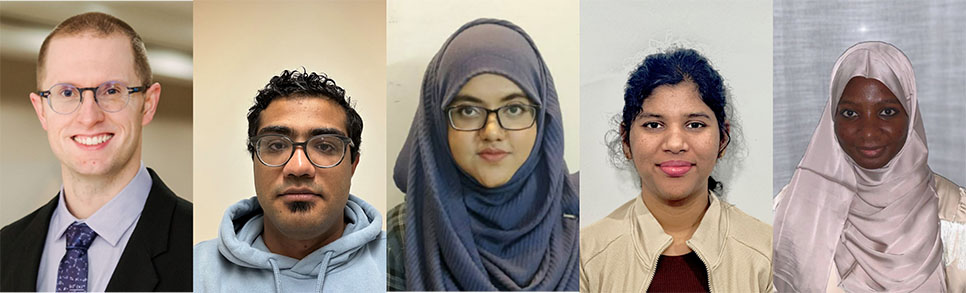
From left: Tyler Josephson, Kianoush Ramezani Shabolaghi, Samiha Sharlin, Charishma Puli, and Fariha Agbere. Photos courtesy of Tyler, Kianoush, Samiha, Charishma, and Fariha, respectively.
Collaborators:
Tyler Josephson, assistant professor
Kianoush Ramezani Shabolaghi, chemical engineering Ph.D. candidate
Samiha Sharlin, Ph.D. candidate
Charishma Puli, data science M.S. student
Fariha Agbere, chemical engineering B.S. student
ChemCatBio researchers are developing methods for upgrading biomass into a feedstock of mixed olefins, which can be upgraded into energy-dense sustainable aviation fuel using zeolite catalysts. However, questions remain on how the molecular shape of the catalyst - especially the porosity of the catalyst - affects the efficiency of those reactions.
In the past, quantum chemistry has been used to study such chemical reactions, but those methods are slow and expensive when scaled up to large systems. To speed up the rate of discovery, a team from the Department of Chemical, Biochemical, and Environmental Engineering at University of Maryland, Baltimore County are using machine learning to learn how the interactions work at the quantum chemistry scale.
"With our new methods, we aim to study larger systems and more realistic conditions," explained Tyler Josephson, the principal investigator, who was recently awarded a NSF career award. "If we can predict in the computer that this zeolite architecture works better than that zeolite architecture, that's useful information for experimentalists."
Josephson said that the project complements broader research work in the ATOMS Lab to bring machine learning and automated reasoning into chemical engineering.
As summer wildfire smoke choked Baltimore, UMBC air pollution researchers leapt into action
By: Catherine Meyers | Published: Dec 7, 2023 | UMBC NEWS
Starting this May, a series of wildfires in Eastern Canada sent enormous smoke clouds wafting into the U.S., triggering air quality warnings in cities from the Midwest to the Northeast. For days, orange skies backdropped landscapes clouded by acrid air. People who could hunkered inside with the doors and windows shut. Those who had to go out faced itchy eyes, burning throats, and worse.
As a resident of the Baltimore area—which was blanketed with particularly bad smoke in both early and late June—UMBC Professor Chris Hennigan looked at the haze with dismay. But as an environmental engineer who studies air pollution, he had an additional thought: “We were looking at the air quality forecasts, and we thought ‘We have to gather data,’” he says.
The public found many colorful words to describe the summer’s unwanted smoke: brutal, eerie, dystopian.
Hennigan and his team have been working to put numbers to the adjectives. On the roof of the engineering building, the researchers installed a squat, white sensor that monitors the levels of tiny particles in the air, particularly those measuring 2.5 micrometers in diameter or less—smaller than most bacteria. Called PM2.5, these particles are released in large numbers during fires. They are dangerous to human health because they can work their way into the deepest parts of the lungs and even enter the bloodstream.
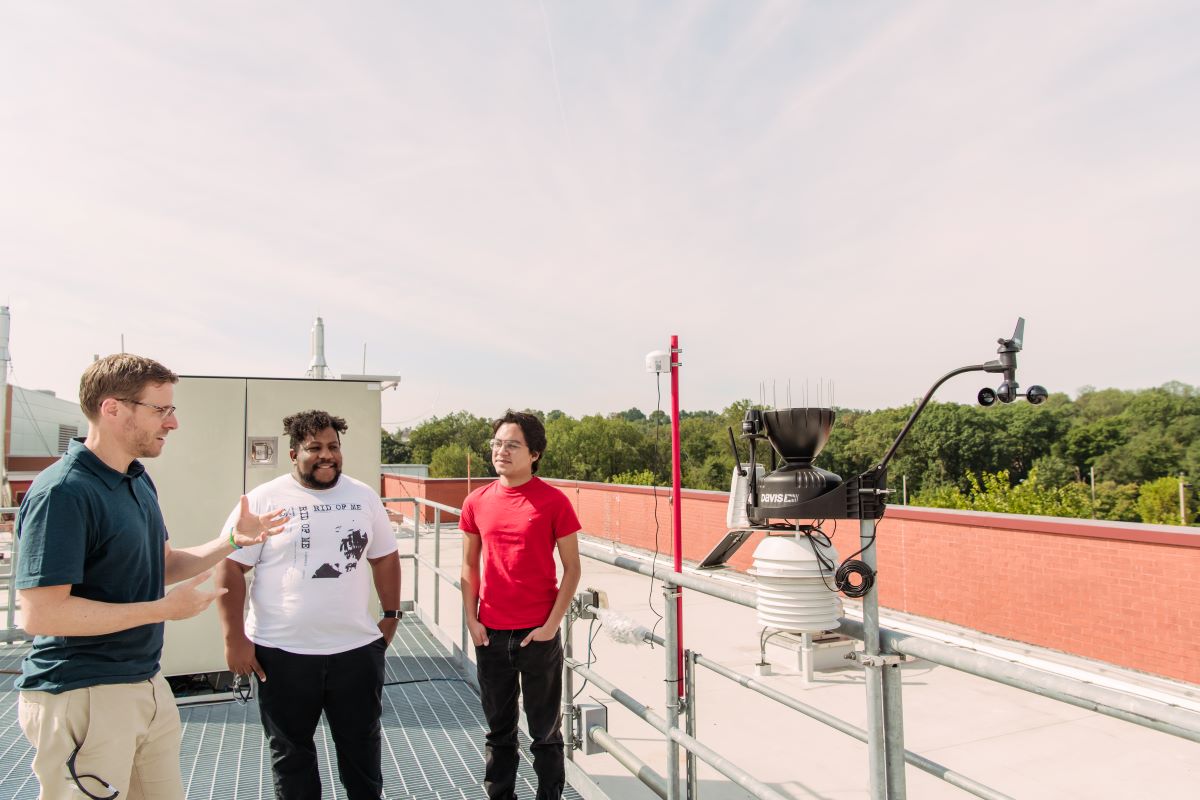 Chris Hennigan, Joel Tyson, Ph.D. ’23, and Luis Rodriguez ’25 (left to right) on the roof of the engineering building next to an air quality sensor. (Marlayna Demond ’11/UMBC)
The sensor showed huge spikes in PM2.5 when the smoke blew through, on some days reaching levels considered unhealthy for anyone to breathe.
The researchers also set up equipment to filter particles out of the air. After 24 hours, they collected the filters, which they are storing, neatly labeled, in a refrigerator in Hennigan’s lab.
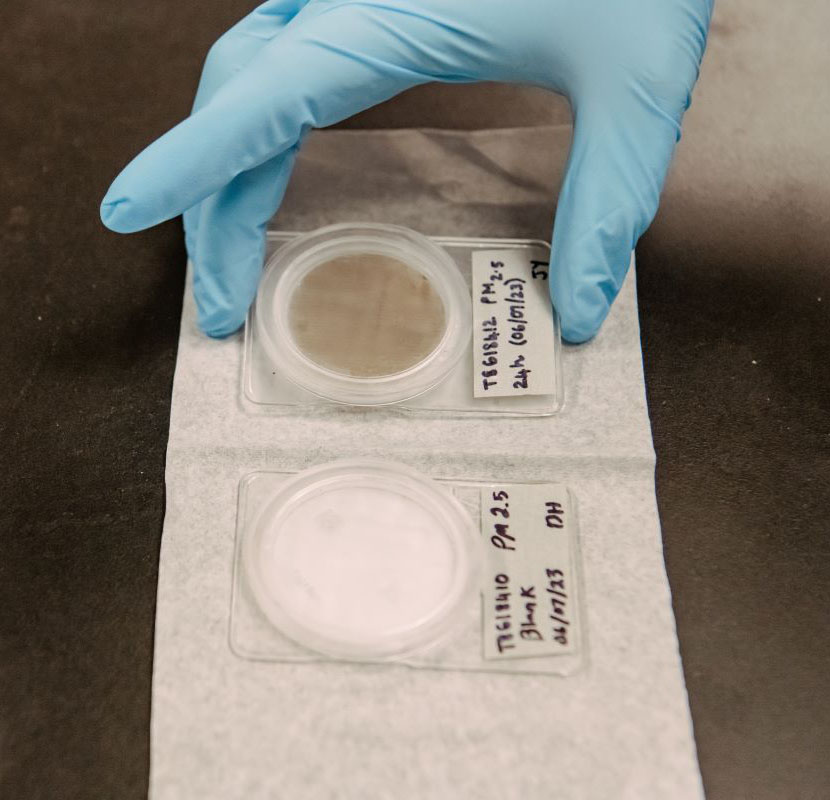 Hennigan shows samples of smoke particles collected this summer. (Marlayna Demond ’11/UMBC)
The filtered samples will advance at least two ongoing investigations, Hennigan says. In one avenue of inquiry, Joel Tyson, Ph.D. ’23, biochemical engineering, is studying how tiny particles can harm human lung cells. Before this year’s smoky summer, Tyson had been studying the toxic effects of particulate matter normally found in the Baltimore air. With the new smoke samples, he will start to investigate whether wildfire smoke particles, per unit, are more toxic than regular urban particulate matter, which comes from sources such as cars and power plants. Some studies have indicated that wildfire particulate matter is indeed more toxic, but more research is needed before any definitive conclusions can be reached.
In another line of research, Hennigan is also studying how particles in the air, including from smoke, may affect the climate. Undergraduate chemical engineering students Danielle Larios ’25 and Luis Rodriguez ’25 are assisting in the investigations.
The researchers study how particles of brown-colored carbon-containing material absorb light. Burning vegetation sends large amounts of this brown carbon into the atmosphere. It’s possible that the particles are trapping significant heat from the sun, accelerating the pace of planetary warming. Such effects are not normally included in global climate models, and better understanding of the process could improve humanity’s ability to predict, and manage, the coming years of climate upheaval.
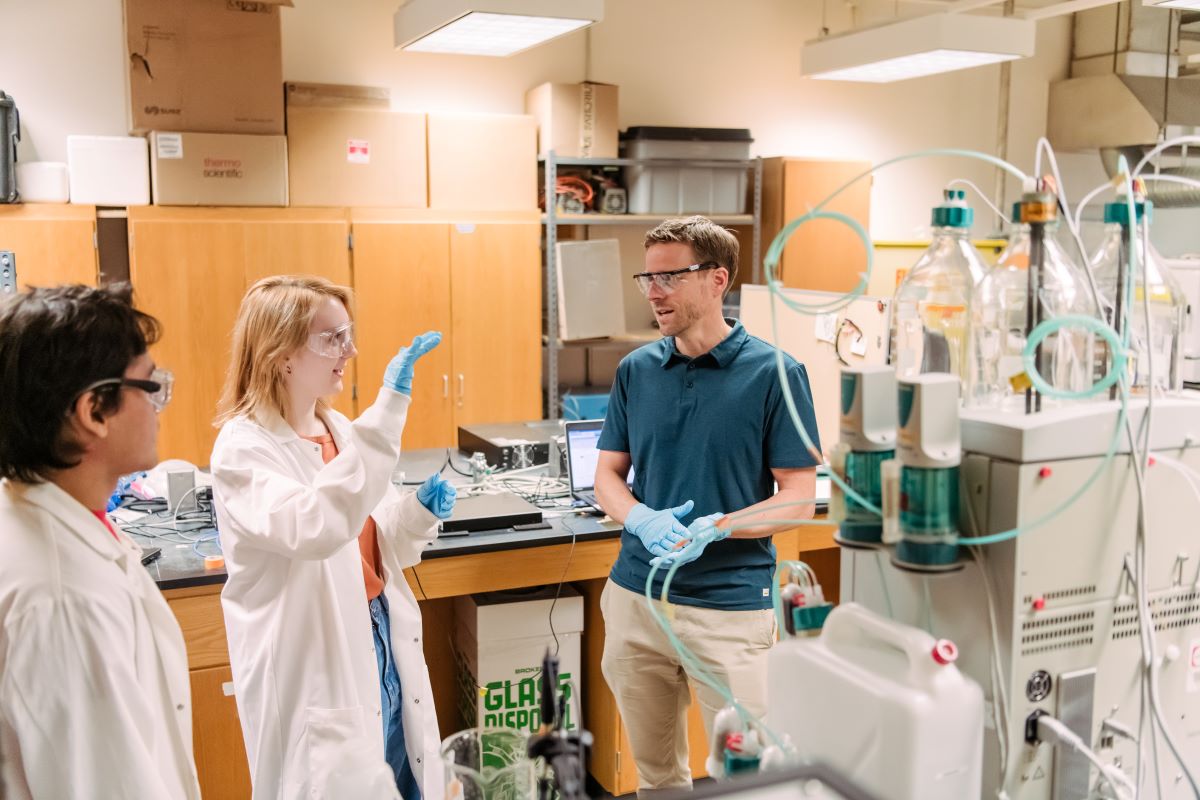 Rodriguez, Danielle Larios ’25 and Hennigan (left to right) discuss research in the lab. (Marlayna Demond ’11/UMBC)
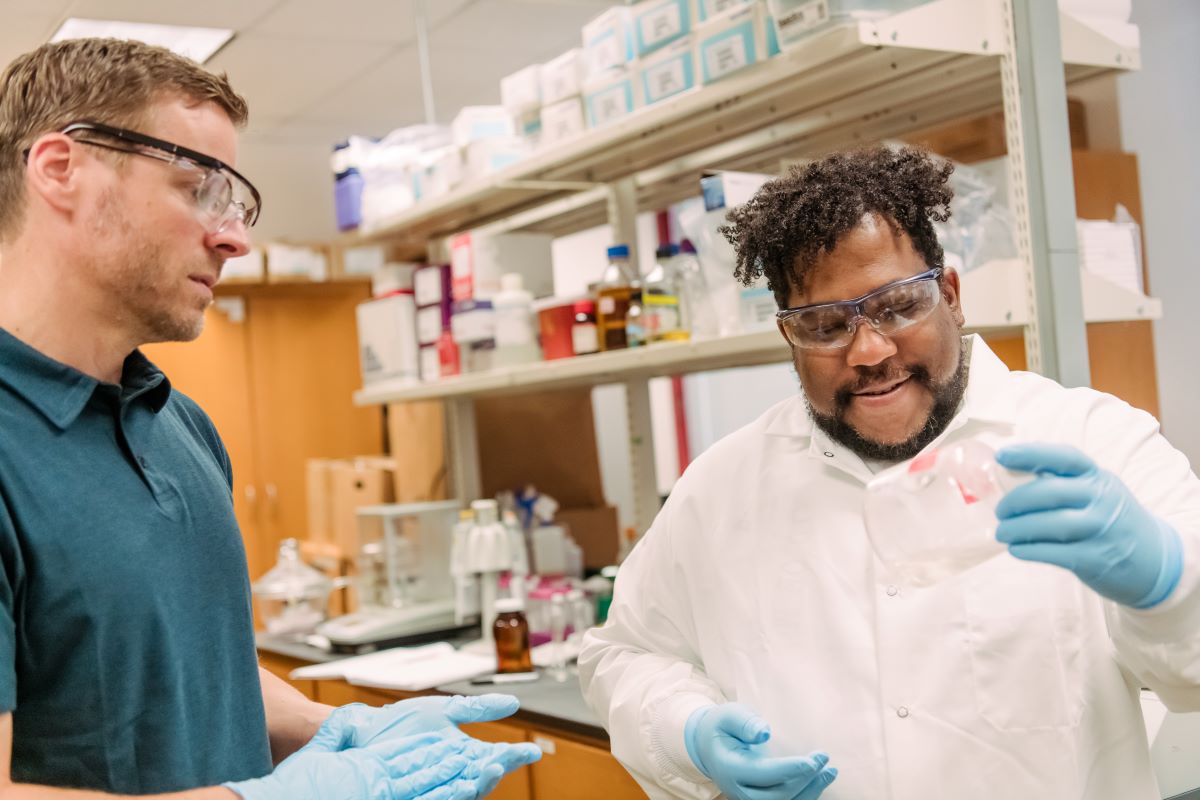 Hennigan and Tyson in the lab. (Marlayna Demond ’11/UMBC)
Climate change and wildfires are intimately linked. This summer was not only smoky, but also scorching. July marked the hottest month ever recorded, and scientists predict that as the world continues to warm, wildfires will continue to increase in quantity and intensity. “Smokeageddon,” as headlines put it, may become the new normal.
Hennigan says recent research illuminates how much wildfire smoke has contributed to air pollution trends. He points to a paper published in September in the scientific journal Nature that estimated that since 2016, wildfire smoke in the contiguous United States has undone around 25% of the progress in air quality made between 2000 and 2016.
For the researchers in Hennigan’s lab, those effects have been felt personally.
Rodriguez recalled how in June he had to go out to buy a fresh pack of N95 masks. “The smoke was just awful,” he says. Larios says she felt a burning at the back of her throat in just 15 minutes walking to her car.
For Tyson, the effects of the smoke were so bad that at one point he struggled to breathe and had to visit the doctor. The episode, he says, drove home the importance of his toxicology research.
All three note both the complexity of the systems they are studying and the importance of discovering new knowledge that might help society handle the environmental challenges it faces.
“Our work can have real-world impact, and that’s exciting,” says Larios.
]]>
As summer wildfire smoke choked Baltimore, UMBC air pollution researchers leapt into action By: Catherine Meyers | Published: Dec 7, 2023 | UMBC NEWS Starting this May, a series of...
https://dev.my.umbc.edu/api/v0/pixel/news/137634/guest@my.umbc.edu/a05c2d461ebbba5380b8b9fbd01aa9c8/api/pixel
faculty
grad
hennigan
news
phd
research
ug
ugrad
Chemical, Biochemical and Environmental Engineering
https://dev.my.umbc.edu/groups/cbee
https://assets4-dev.my.umbc.edu/system/shared/avatars/groups/000/000/771/b5e579e81b2e3624611890fa3ca2716a/xsmall.png?1746794587
https://assets2-dev.my.umbc.edu/system/shared/avatars/groups/000/000/771/b5e579e81b2e3624611890fa3ca2716a/original.png?1746794587
https://assets1-dev.my.umbc.edu/system/shared/avatars/groups/000/000/771/b5e579e81b2e3624611890fa3ca2716a/xxlarge.png?1746794587
https://assets2-dev.my.umbc.edu/system/shared/avatars/groups/000/000/771/b5e579e81b2e3624611890fa3ca2716a/xlarge.png?1746794587
https://assets2-dev.my.umbc.edu/system/shared/avatars/groups/000/000/771/b5e579e81b2e3624611890fa3ca2716a/large.png?1746794587
https://assets4-dev.my.umbc.edu/system/shared/avatars/groups/000/000/771/b5e579e81b2e3624611890fa3ca2716a/medium.png?1746794587
https://assets1-dev.my.umbc.edu/system/shared/avatars/groups/000/000/771/b5e579e81b2e3624611890fa3ca2716a/small.png?1746794587
https://assets4-dev.my.umbc.edu/system/shared/avatars/groups/000/000/771/b5e579e81b2e3624611890fa3ca2716a/xsmall.png?1746794587
https://assets1-dev.my.umbc.edu/system/shared/avatars/groups/000/000/771/b5e579e81b2e3624611890fa3ca2716a/xxsmall.png?1746794587
Chemical, Biochemical and Environmental Engineering
https://assets1-dev.my.umbc.edu/system/shared/thumbnails/news/000/137/634/6b23f7999debbc216e1a292c3352b8b5/xxlarge.jpg?1702060952
https://assets4-dev.my.umbc.edu/system/shared/thumbnails/news/000/137/634/6b23f7999debbc216e1a292c3352b8b5/xlarge.jpg?1702060952
https://assets2-dev.my.umbc.edu/system/shared/thumbnails/news/000/137/634/6b23f7999debbc216e1a292c3352b8b5/large.jpg?1702060952
https://assets1-dev.my.umbc.edu/system/shared/thumbnails/news/000/137/634/6b23f7999debbc216e1a292c3352b8b5/medium.jpg?1702060952
https://assets4-dev.my.umbc.edu/system/shared/thumbnails/news/000/137/634/6b23f7999debbc216e1a292c3352b8b5/small.jpg?1702060952
https://assets4-dev.my.umbc.edu/system/shared/thumbnails/news/000/137/634/6b23f7999debbc216e1a292c3352b8b5/xsmall.jpg?1702060952
https://assets2-dev.my.umbc.edu/system/shared/thumbnails/news/000/137/634/6b23f7999debbc216e1a292c3352b8b5/xxsmall.jpg?1702060952
0
0
true
Fri, 08 Dec 2023 13:48:32 -0500
Fri, 08 Dec 2023 14:18:12 -0500
In the News: Promises of Point-of-Care Manufacturing
BioPharm International November 2023, Volume 36, Issue 11
excerpt from
Considering the Promises of Point-of-Care Manufacturing
~~ Published on: November 1, 2023, Jennifer Markarian
Emergence of advanced manufacturing technology to ensure quality of biopharmaceutical drugs combined with efforts to identify a regulatory pathway indicate that a distributed manufacturing model is within reach.
Although biopharmaceutical production today generally takes place in centralized manufacturing facilities, industry and regulators are taking a close look at the benefits of decentralized or distributed manufacturing, which involves smaller and flexible-volume manufacturing operations in multiple locations closer to the site of use and even to point-of-care (POC) locations. POC manufacturing is seen as essential for efficiency in producing personalized medicines. In the near-term future, POC production is likely to be in a controlled environment such as a hospital, clinic, or pharmacy, while in the long term, POC production could extend to other locations. Such a model could enable quality drug production anywhere, from the battlefield to remote villages or even outer space, experts suggest.
The impetus for POC manufacturing comes in part from its potential to alleviate pressing problems, such as drug shortages, pandemic preparedness, and equitable availability of treatments. It is also driven by technological advances that promise to allow efficient and consistently high-quality production using new equipment, analytical tools, and quality control paradigms.
These technologies offer the benefit of making drugs much closer to where and when they are needed. "The advantages of making medicines on demand--to solve issues such as the difficulty of predicting demand and the complexity of the supply chain--are compelling," states Govind Rao, professor at the University of Maryland, Baltimore County (UMBC) and director of UMBC's Center for Advanced Sensor Technology.
FDA recognizes the need for flexible and agile manufacturing and sees the potential for portable, distributed manufacturing units to be used for POC manufacturing. In October 2022, the Center for Drug Evaluation and Research (CDER) published a discussion paper that highlighted areas to consider for drugs regulated by CDER as well as the Center for Biologics Evaluation and Research and called for public feedback (1). FDA and the Product Quality Research Institute (PQRI) also held a workshop in November 2022 to gather input from stakeholders. For advanced manufacturing technologies--particularly distributed manufacturing, POC manufacturing, artificial intelligence (AI), and end-to-end continuous manufacturing--seeking input is the first step in FDA's new Framework for Regulatory Advanced Manufacturing Evaluation (FRAME) initiative, according to a presentation by Michael Kopcha, director of CDER's Office of Pharmaceutical Quality (2).
]]>
excerpt from Considering the Promises of Point-of-Care Manufacturing ~~ Published on: November 1, 2023, Jennifer Markarian BioPharm International, BioPharm International, November 2023,...
https://www.genengnews.com/topics/bioprocessing/point-of-care-drug-production-would-aid-patients-and-industry/
https://dev.my.umbc.edu/api/v0/pixel/news/137101/guest@my.umbc.edu/0e8490c80a7a359b51349ab18d50335b/api/pixel
faculty
fall-2023
news
rao
research
Chemical, Biochemical and Environmental Engineering
https://dev.my.umbc.edu/groups/cbee
https://assets4-dev.my.umbc.edu/system/shared/avatars/groups/000/000/771/b5e579e81b2e3624611890fa3ca2716a/xsmall.png?1746794587
https://assets2-dev.my.umbc.edu/system/shared/avatars/groups/000/000/771/b5e579e81b2e3624611890fa3ca2716a/original.png?1746794587
https://assets1-dev.my.umbc.edu/system/shared/avatars/groups/000/000/771/b5e579e81b2e3624611890fa3ca2716a/xxlarge.png?1746794587
https://assets2-dev.my.umbc.edu/system/shared/avatars/groups/000/000/771/b5e579e81b2e3624611890fa3ca2716a/xlarge.png?1746794587
https://assets2-dev.my.umbc.edu/system/shared/avatars/groups/000/000/771/b5e579e81b2e3624611890fa3ca2716a/large.png?1746794587
https://assets4-dev.my.umbc.edu/system/shared/avatars/groups/000/000/771/b5e579e81b2e3624611890fa3ca2716a/medium.png?1746794587
https://assets1-dev.my.umbc.edu/system/shared/avatars/groups/000/000/771/b5e579e81b2e3624611890fa3ca2716a/small.png?1746794587
https://assets4-dev.my.umbc.edu/system/shared/avatars/groups/000/000/771/b5e579e81b2e3624611890fa3ca2716a/xsmall.png?1746794587
https://assets1-dev.my.umbc.edu/system/shared/avatars/groups/000/000/771/b5e579e81b2e3624611890fa3ca2716a/xxsmall.png?1746794587
Chemical, Biochemical and Environmental Engineering
https://assets1-dev.my.umbc.edu/system/shared/thumbnails/news/000/137/101/d3cb90dea0ddc9525a55a74c346e94c7/xxlarge.jpg?1700066584
https://assets1-dev.my.umbc.edu/system/shared/thumbnails/news/000/137/101/d3cb90dea0ddc9525a55a74c346e94c7/xlarge.jpg?1700066584
https://assets4-dev.my.umbc.edu/system/shared/thumbnails/news/000/137/101/d3cb90dea0ddc9525a55a74c346e94c7/large.jpg?1700066584
https://assets3-dev.my.umbc.edu/system/shared/thumbnails/news/000/137/101/d3cb90dea0ddc9525a55a74c346e94c7/medium.jpg?1700066584
https://assets2-dev.my.umbc.edu/system/shared/thumbnails/news/000/137/101/d3cb90dea0ddc9525a55a74c346e94c7/small.jpg?1700066584
https://assets3-dev.my.umbc.edu/system/shared/thumbnails/news/000/137/101/d3cb90dea0ddc9525a55a74c346e94c7/xsmall.jpg?1700066584
https://assets2-dev.my.umbc.edu/system/shared/thumbnails/news/000/137/101/d3cb90dea0ddc9525a55a74c346e94c7/xxsmall.jpg?1700066584
0
0
true
Wed, 15 Nov 2023 11:58:44 -0500
Faculty Search: Tenure-Track, Assistant Professor
broad fields of biomedical or biomolecular engineering
Description
The Department of Chemical, Biochemical, and Environmental Engineering (CBEE) at the University of Maryland Baltimore County (UMBC) seeks to fill a tenure-track position in the broad fields of biomedical or biomolecular engineering, including areas involving synthetic biology, systems biology, bioinformatics, biomanufacturing, metabolic engineering, and biological materials. We are especially interested in applicants who conduct interdisciplinary research which will complement the current expertise in our department and college.
UMBC is an Affirmative Action/Equal Opportunity Employer. Minorities, women, veterans, and individuals with disabilities are encouraged to apply.
]]>
Description The Department of Chemical, Biochemical, and Environmental Engineering (CBEE) at the University of Maryland Baltimore County (UMBC) seeks to fill a tenure-track position in the broad...
https://dev.my.umbc.edu/api/v0/pixel/news/136996/guest@my.umbc.edu/76afa97c4c6e640db7dee7597f548d56/api/pixel
faculty
fall-2023
Chemical, Biochemical and Environmental Engineering
https://dev.my.umbc.edu/groups/cbee
https://assets4-dev.my.umbc.edu/system/shared/avatars/groups/000/000/771/b5e579e81b2e3624611890fa3ca2716a/xsmall.png?1746794587
https://assets2-dev.my.umbc.edu/system/shared/avatars/groups/000/000/771/b5e579e81b2e3624611890fa3ca2716a/original.png?1746794587
https://assets1-dev.my.umbc.edu/system/shared/avatars/groups/000/000/771/b5e579e81b2e3624611890fa3ca2716a/xxlarge.png?1746794587
https://assets2-dev.my.umbc.edu/system/shared/avatars/groups/000/000/771/b5e579e81b2e3624611890fa3ca2716a/xlarge.png?1746794587
https://assets2-dev.my.umbc.edu/system/shared/avatars/groups/000/000/771/b5e579e81b2e3624611890fa3ca2716a/large.png?1746794587
https://assets4-dev.my.umbc.edu/system/shared/avatars/groups/000/000/771/b5e579e81b2e3624611890fa3ca2716a/medium.png?1746794587
https://assets1-dev.my.umbc.edu/system/shared/avatars/groups/000/000/771/b5e579e81b2e3624611890fa3ca2716a/small.png?1746794587
https://assets4-dev.my.umbc.edu/system/shared/avatars/groups/000/000/771/b5e579e81b2e3624611890fa3ca2716a/xsmall.png?1746794587
https://assets1-dev.my.umbc.edu/system/shared/avatars/groups/000/000/771/b5e579e81b2e3624611890fa3ca2716a/xxsmall.png?1746794587
Chemical, Biochemical and Environmental Engineering
https://assets2-dev.my.umbc.edu/system/shared/thumbnails/news/000/136/996/d42a4b115954dbef374b4714cb6bd2bf/xxlarge.jpg?1699633615
https://assets4-dev.my.umbc.edu/system/shared/thumbnails/news/000/136/996/d42a4b115954dbef374b4714cb6bd2bf/xlarge.jpg?1699633615
https://assets3-dev.my.umbc.edu/system/shared/thumbnails/news/000/136/996/d42a4b115954dbef374b4714cb6bd2bf/large.jpg?1699633615
https://assets4-dev.my.umbc.edu/system/shared/thumbnails/news/000/136/996/d42a4b115954dbef374b4714cb6bd2bf/medium.jpg?1699633615
https://assets1-dev.my.umbc.edu/system/shared/thumbnails/news/000/136/996/d42a4b115954dbef374b4714cb6bd2bf/small.jpg?1699633615
https://assets2-dev.my.umbc.edu/system/shared/thumbnails/news/000/136/996/d42a4b115954dbef374b4714cb6bd2bf/xsmall.jpg?1699633615
https://assets4-dev.my.umbc.edu/system/shared/thumbnails/news/000/136/996/d42a4b115954dbef374b4714cb6bd2bf/xxsmall.jpg?1699633615
0
0
true
Fri, 10 Nov 2023 11:30:29 -0500
Fri, 10 Nov 2023 11:31:36 -0500
CBEE students win IFPAC 2023 student poster presentations
IFPAC has been leading the way in Advanced Manufacturing Science for over 35 years.
The annual conference 'IFPAC 2023' held June 4-7, 2023 in North Bethesda, MD and attended by more than 400 people focused on 'A Framework for the future, advanced manufacturing quality & innovation'.
Many students presented their research during two poster sessions. UMBC graduate students mentored by CBEE faculty earned first and second places for the best student poster presentations.
1st place winner:
- Vikash Kumar, Chemical and Biochemical Engineering, PhD
Poster Title : Reinventing Shake Flask Fermentation: The Membrane Flask
2nd place winners:
- Vida Rahmatnejad, Chemical and Biochemical Engineering, PhD;
Poster Title: Flow Cell: A Completely Noninvasive Monitoring System for Cell Culture Processes - Revati Kadolkar, Chemical and Biochemical Engineering, PhD;
Poster Title: Application of mechanistic modelling for the understanding of tailing in high performance liquid chromatography (HPLC)
]]>
IFPAC has been leading the way in Advanced Manufacturing Science for over 35 years. The annual conference 'IFPAC 2023' held June 4-7, 2023 in North Bethesda, MD and attended by more than 400...
https://dev.my.umbc.edu/api/v0/pixel/news/133966/guest@my.umbc.edu/3a3429a84a4da93d2f3de41e8bf0b88c/api/pixel
award
faculty
grad
rao
research
Chemical, Biochemical and Environmental Engineering
https://dev.my.umbc.edu/groups/cbee
https://assets4-dev.my.umbc.edu/system/shared/avatars/groups/000/000/771/b5e579e81b2e3624611890fa3ca2716a/xsmall.png?1746794587
https://assets2-dev.my.umbc.edu/system/shared/avatars/groups/000/000/771/b5e579e81b2e3624611890fa3ca2716a/original.png?1746794587
https://assets1-dev.my.umbc.edu/system/shared/avatars/groups/000/000/771/b5e579e81b2e3624611890fa3ca2716a/xxlarge.png?1746794587
https://assets2-dev.my.umbc.edu/system/shared/avatars/groups/000/000/771/b5e579e81b2e3624611890fa3ca2716a/xlarge.png?1746794587
https://assets2-dev.my.umbc.edu/system/shared/avatars/groups/000/000/771/b5e579e81b2e3624611890fa3ca2716a/large.png?1746794587
https://assets4-dev.my.umbc.edu/system/shared/avatars/groups/000/000/771/b5e579e81b2e3624611890fa3ca2716a/medium.png?1746794587
https://assets1-dev.my.umbc.edu/system/shared/avatars/groups/000/000/771/b5e579e81b2e3624611890fa3ca2716a/small.png?1746794587
https://assets4-dev.my.umbc.edu/system/shared/avatars/groups/000/000/771/b5e579e81b2e3624611890fa3ca2716a/xsmall.png?1746794587
https://assets1-dev.my.umbc.edu/system/shared/avatars/groups/000/000/771/b5e579e81b2e3624611890fa3ca2716a/xxsmall.png?1746794587
Chemical, Biochemical and Environmental Engineering
1
1
true
Mon, 21 Aug 2023 14:34:51 -0400
Tue, 22 Aug 2023 07:11:07 -0400