<?xml version="1.0"?>
<News hasArchived="false" page="4" pageCount="10" pageSize="10" timestamp="Mon, 20 Apr 2026 12:12:37 -0400" url="https://dev.my.umbc.edu/groups/cbee/posts.xml?page=4&amp;tag=faculty">
  <NewsItem contentIssues="false" id="134278" important="false" status="posted" url="https://dev.my.umbc.edu/groups/cbee/posts/134278">
    <Title>New Publication by CBEE Alumni</Title>
    <Tagline>Dr. Yun Jiao, PhD '21 Chemical and Biochemical Engineering</Tagline>
    <Body>
      <![CDATA[
          <div class="html-content"><div><strong>Dr. Yun Jiao</strong>, PhD '21 chemical and biochemical engineering, has a new paper, based on her doctoral research, "Brain injury accelerates the onset of a reversible age-related microglial phenotype associated with inflammatory neurodegeneration", which was published in the ScienceAdvances.  </div><div><br></div><div>The article is available here:</div><div><a href="https://www.science.org/doi/10.1126/sciadv.add1101" rel="nofollow external" class="bo">DOI: 10.1126/sciadv.add1101</a></div><div><br></div><div><h3>Abstract</h3></div><p>Lipofuscin is an autofluorescent (AF) pigment formed by lipids and misfolded proteins, which accumulates in postmitotic cells with advanced age. Here, we immunophenotyped microglia in the brain of old C57BL/6 mice (&gt;18 months old) and demonstrate that in comparison to young mice, one-third of old microglia are AF, characterized by profound changes in lipid and iron content, phagocytic activity, and oxidative stress. Pharmacological depletion of microglia in old mice eliminated the AF microglia following repopulation and reversed microglial dysfunction. Age-related neurological deficits and neurodegeneration after traumatic brain injury (TBI) were attenuated in old mice lacking AF microglia. Furthermore, increased phagocytic activity, lysosomal burden, and lipid accumulation in microglia persisted for up to 1 year after TBI, were modified by <em>APOE4</em> genotype, and chronically driven by phagocyte-mediated oxidative stress. Thus, AF may reflect a pathological state in aging microglia associated with increased phagocytosis of neurons and myelin and inflammatory neurodegeneration that can be further accelerated by TBI.</p></div>
      ]]>
    </Body>
    <Summary>Dr. Yun Jiao, PhD '21 chemical and biochemical engineering, has a new paper, based on her doctoral research, "Brain injury accelerates the onset of a reversible age-related microglial phenotype...</Summary>
    <TrackingUrl>https://dev.my.umbc.edu/api/v0/pixel/news/134278/guest@my.umbc.edu/178db7ef58b53351a93d4ea335f06fd2/api/pixel</TrackingUrl>
    <Tag>alumni</Tag>
    <Tag>faculty</Tag>
    <Tag>grad</Tag>
    <Tag>research</Tag>
    <Tag>spring-2023</Tag>
    <Tag>szeto</Tag>
    <Group token="cbee">Chemical, Biochemical and Environmental Engineering</Group>
    <GroupUrl>https://dev.my.umbc.edu/groups/cbee</GroupUrl>
    <AvatarUrl>https://assets4-dev.my.umbc.edu/system/shared/avatars/groups/000/000/771/b5e579e81b2e3624611890fa3ca2716a/xsmall.png?1746794587</AvatarUrl>
    <AvatarUrl size="original">https://assets2-dev.my.umbc.edu/system/shared/avatars/groups/000/000/771/b5e579e81b2e3624611890fa3ca2716a/original.png?1746794587</AvatarUrl>
    <AvatarUrl size="xxlarge">https://assets1-dev.my.umbc.edu/system/shared/avatars/groups/000/000/771/b5e579e81b2e3624611890fa3ca2716a/xxlarge.png?1746794587</AvatarUrl>
    <AvatarUrl size="xlarge">https://assets2-dev.my.umbc.edu/system/shared/avatars/groups/000/000/771/b5e579e81b2e3624611890fa3ca2716a/xlarge.png?1746794587</AvatarUrl>
    <AvatarUrl size="large">https://assets2-dev.my.umbc.edu/system/shared/avatars/groups/000/000/771/b5e579e81b2e3624611890fa3ca2716a/large.png?1746794587</AvatarUrl>
    <AvatarUrl size="medium">https://assets4-dev.my.umbc.edu/system/shared/avatars/groups/000/000/771/b5e579e81b2e3624611890fa3ca2716a/medium.png?1746794587</AvatarUrl>
    <AvatarUrl size="small">https://assets1-dev.my.umbc.edu/system/shared/avatars/groups/000/000/771/b5e579e81b2e3624611890fa3ca2716a/small.png?1746794587</AvatarUrl>
    <AvatarUrl size="xsmall">https://assets4-dev.my.umbc.edu/system/shared/avatars/groups/000/000/771/b5e579e81b2e3624611890fa3ca2716a/xsmall.png?1746794587</AvatarUrl>
    <AvatarUrl size="xxsmall">https://assets1-dev.my.umbc.edu/system/shared/avatars/groups/000/000/771/b5e579e81b2e3624611890fa3ca2716a/xxsmall.png?1746794587</AvatarUrl>
    <Sponsor>Chemical, Biochemical and Environmental Engineering</Sponsor>
    <PawCount>0</PawCount>
    <CommentCount>0</CommentCount>
    <CommentsAllowed>true</CommentsAllowed>
    <PostedAt>Wed, 12 Jul 2023 12:17:39 -0400</PostedAt>
    <EditAt>Mon, 29 Apr 2024 11:53:44 -0400</EditAt>
  </NewsItem>
  <NewsItem contentIssues="false" id="134277" important="false" status="posted" url="https://dev.my.umbc.edu/groups/cbee/posts/134277">
  <Title>New Publication by CBEE Alumni</Title>
  <Tagline>Dr. Michael H. Zhang, PhD '21</Tagline>
  <Body>
    <![CDATA[
    <div class="html-content"><div><strong>Dr. Michael H. Zhang</strong>, PhD '21 chemical and biochemical engineering has a new paper, based on his doctoral research, "Lipid–Polymer Hybrid Nanoparticles Utilize B Cells and Dendritic Cells to Elicit Distinct Antigen-Specific CD4+ and CD8+ T Cell Responses", which was published in the ACS Applied Bio Materials.  </div><div><br></div><div>The article is available here:</div><div><a href="https://pubs.acs.org/doi/full/10.1021/acsabm.3c00229" rel="nofollow external" class="bo">https://pubs.acs.org/doi/full/10.1021/acsabm.3c00229</a></div><div><br></div><div><h3>Abstract</h3></div><div><p>Antigen-presenting cells (APCs) are widely studied for treating immune-mediated diseases, and dendritic cells (DCs) are potent APCs that uptake and present antigens (Ags). However, DCs face several challenges that hinder their clinical translation due to their inability to control Ag dosing and low abundance in peripheral blood. B cells are a potential alternative to DCs, but their poor nonspecific Ag uptake capabilities compromise controllable priming of T cells. Here, we developed phospholipid-conjugated Ags (L-Ags) and lipid–polymer hybrid nanoparticles (L/P-Ag NPs) as delivery platforms to expand the range of accessible APCs for use in T cell priming. These delivery platforms were evaluated using DCs, CD40-activated B cells, and resting B cells to understand the impacts of various Ag delivery mechanisms for generation of Ag-specific T cell responses. L-Ag delivery (termed depoting) of MHC class I- and II-restricted Ags successfully loaded all APC types in a tunable manner and primed both Ag-specific CD8<sup>+</sup> and CD4<sup>+</sup> T cells, respectively. Incorporating L-Ags and polymer-conjugated Ags (P-Ag) into NPs can direct Ags to different uptake pathways to engineer the dynamics of presentation and shape T cell responses. DCs were capable of processing and presenting Ag delivered from both L- and P-Ag NPs, yet B cells could only utilize Ag delivered from L-Ag NPs, which led to differential cytokine secretion profiles in coculture studies. Altogether, we show that L-Ags and P-Ags can be rationally paired within a single NP to leverage distinct delivery mechanisms to access multiple Ag processing pathways in two APC types, offering a modular delivery platform for engineering Ag-specific immunotherapies.</p></div></div>
]]>
  </Body>
  <Summary>Dr. Michael H. Zhang, PhD '21 chemical and biochemical engineering has a new paper, based on his doctoral research, "Lipid–Polymer Hybrid Nanoparticles Utilize B Cells and Dendritic Cells to...</Summary>
  <TrackingUrl>https://dev.my.umbc.edu/api/v0/pixel/news/134277/guest@my.umbc.edu/903fc45d7af4b3b6d81d42340822646f/api/pixel</TrackingUrl>
  <Tag>alumni</Tag>
  <Tag>faculty</Tag>
  <Tag>grad</Tag>
  <Tag>research</Tag>
  <Tag>spring-2023</Tag>
  <Tag>szeto</Tag>
  <Group token="cbee">Chemical, Biochemical and Environmental Engineering</Group>
  <GroupUrl>https://dev.my.umbc.edu/groups/cbee</GroupUrl>
  <AvatarUrl>https://assets4-dev.my.umbc.edu/system/shared/avatars/groups/000/000/771/b5e579e81b2e3624611890fa3ca2716a/xsmall.png?1746794587</AvatarUrl>
  <AvatarUrl size="original">https://assets2-dev.my.umbc.edu/system/shared/avatars/groups/000/000/771/b5e579e81b2e3624611890fa3ca2716a/original.png?1746794587</AvatarUrl>
  <AvatarUrl size="xxlarge">https://assets1-dev.my.umbc.edu/system/shared/avatars/groups/000/000/771/b5e579e81b2e3624611890fa3ca2716a/xxlarge.png?1746794587</AvatarUrl>
  <AvatarUrl size="xlarge">https://assets2-dev.my.umbc.edu/system/shared/avatars/groups/000/000/771/b5e579e81b2e3624611890fa3ca2716a/xlarge.png?1746794587</AvatarUrl>
  <AvatarUrl size="large">https://assets2-dev.my.umbc.edu/system/shared/avatars/groups/000/000/771/b5e579e81b2e3624611890fa3ca2716a/large.png?1746794587</AvatarUrl>
  <AvatarUrl size="medium">https://assets4-dev.my.umbc.edu/system/shared/avatars/groups/000/000/771/b5e579e81b2e3624611890fa3ca2716a/medium.png?1746794587</AvatarUrl>
  <AvatarUrl size="small">https://assets1-dev.my.umbc.edu/system/shared/avatars/groups/000/000/771/b5e579e81b2e3624611890fa3ca2716a/small.png?1746794587</AvatarUrl>
  <AvatarUrl size="xsmall">https://assets4-dev.my.umbc.edu/system/shared/avatars/groups/000/000/771/b5e579e81b2e3624611890fa3ca2716a/xsmall.png?1746794587</AvatarUrl>
  <AvatarUrl size="xxsmall">https://assets1-dev.my.umbc.edu/system/shared/avatars/groups/000/000/771/b5e579e81b2e3624611890fa3ca2716a/xxsmall.png?1746794587</AvatarUrl>
  <Sponsor>Chemical, Biochemical and Environmental Engineering</Sponsor>
  <PawCount>0</PawCount>
  <CommentCount>0</CommentCount>
  <CommentsAllowed>true</CommentsAllowed>
  <PostedAt>Wed, 12 Jul 2023 12:13:10 -0400</PostedAt>
</NewsItem>
  <NewsItem contentIssues="true" id="134254" important="false" status="posted" url="https://dev.my.umbc.edu/groups/cbee/posts/134254">
  <Title>CBEE students &amp; faculty highlighted: UMBC LSAMP</Title>
  <Tagline>2021 - 2022  Annual Report</Tagline>
  <Body>
    <![CDATA[
    <div class="html-content"><p>The <a href="https://lsamp.umbc.edu/wp-content/uploads/sites/371/2023/06/UMBC-LSAMP-Year-in-review-21-22-comp.pdf" rel="nofollow external" class="bo">UMBC LSAMP 2021-2022 Annual Report</a> <span>highlights involvement in the UMBC LOUIS STOKES </span>ALLIANCE FOR MINORITY PARTICIPATION (LSAMP) program. LSAMP participants have access to individualized advising, campus workshops, funded research experiences, and national and international conferences to strengthen their STEM identity and promote entry into top graduate programs. </p><div>We want to specifically celebrate the achievements of those pursuing their bachelors of science in chemical engineering and the departmental faculty supporting their efforts. </div><div><br></div><p><br></p><p>"...sometimes you feel as if you're not making much progress but then you come to understand that your data can be helpful to others. My PI has taught me that my role in the research lab is valuable and that routine observations can lead to progress in an experiment. "</p><p><em>- Excerpt From A Chemical Engineering Major '23 Research Reflection -</em></p><p><em><br></em></p><h4><span>FALL 2021 RESEARCH FELLOWSHIP PROGRAM (Pg 26 )</span></h4><p>Name and Class | Major | Topic | Faculty Mentor | University</p><ul><li><strong>Kaiya Meggett '25 | Pre-Chemical Engineering</strong> | Genetics | Dr. Jeff Leips | UMBC</li></ul><h4><span><strong>SPRING 2022 RESEARCH FELLOWSHIP  PROGRAM (pg 27)</strong></span></h4>Name and Class | Major | Topic | Faculty Mentor | University<ul><li><strong>Makayla Headley ‘22</strong><span> | </span><strong>Chemical Engineering</strong><span> | Engineering Education | Dr. Jamie Gurganus | UMBC</span></li><li><strong>Ouriel Ndalamba ‘23 | Chemical Engineering</strong> | Toxicological Chemistry | <strong>Dr. Lee Blaney</strong> | UMBC</li><li><strong>Diego Iglesias Vega ‘23 | Chemical Engineering</strong> | Toxicological Chemistry | <strong>Dr. Lee Blaney</strong> | UMBC </li></ul><p><br></p><p>"As I increase my involvement in my research project, I begin to appreciate the knowledge I
    have acquired over my academic career. Knowledge that I previously thought would be
    unnecessary began to gain purpose in my head as I used it everyday in the lab. Even topics
    that I knew would be important in my future career were very abstract. But to my surprise
    and relief, I was able to apply the concepts earlier than expected as an undergraduate
    researcher. This turned these abstract ideas and theoretical concepts into a useful tool that
    made my job possible and easier." </p><p><em>- Excerpt From A Chemical Engineering Major '23
    Research Reflection -</em></p><p><em><br></em></p><p><span>SUMMER 2022 RESEARCH FELLOWSHIP PROGRAM (pg 34)</span></p><div><div>Name and Class | Major | Topic | Faculty Mentor | University</div><div><ul><li><strong>Shashane Anderson ‘25 | Pre-Chemical Engineering</strong> | Atmospheric Chemistry | <strong>Dr. Christopher Hennigan</strong> | UMBC</li><li><strong>Makayla Headley '22 | Chemical Engineering</strong> | Analytical Chemistry | Dr. Jamie Gurganus | UMBC</li><li><strong>Madison McLaren ‘23 | Chemical Engineering </strong>| Environmental Engineering | <strong>Dr. Christopher Hennigan</strong> | UMBC </li></ul><div><br></div></div></div><h4>FALL 2022 RESEARCH FELLOWSHIP PROGRAM </h4><div><ul><li><strong>Diego Iglesias Vega ‘23 | Chemical Engineering</strong> | Toxicological Chemistry | <strong>Dr. Lee Blaney</strong> | UMBC </li></ul></div><div><br></div><div><h4>LSAMP Faculty Research Mentors (pg 31)</h4></div><div><ul><li><strong>Dr. Lee Blaney</strong> | Professor | Chemical, Biochemical, and Environmental Engineering | Toxicological Chemistry | UMBC</li><li><strong>Dr. Christopher Hennigan</strong> | Associate Professor | Chemical, Biochemical, and Environmental Engineering | Atmospheric
    Chemistry | UMBC</li></ul><div><br></div><div>"One thing I’ve become increasingly grateful for when it come to LSAMP is their effort in connecting me
    with a faculty member that cares about me. I’m so appreciative to finally have a mentor figure during
    my college career, and I couldn’t have asked for a more guiding mentor. My mentor has encouraged me as
    a student researcher and as a prospective graduate student. We have had several meetings to discuss
    graduate school, and he has offered to help guide me through the application process. This type of
    encouragement is something I’ve really needed throughout college, and I’m grateful to finally have it.
    <em>- Excerpt From A Chemical Engineering Major '24
    Research Reflection</em> - </div></div><div><br></div><div><br></div><h4><span>Faculty Spotlight (pg 33)</span></h4><div><strong>Dr. Erin Lavik</strong> is an Professor and Associate Dean for Research and Faculty Development
    in the College of Engineering and information Technology. Her research team combines polymer synthesis
    and processing, drug delivery, and stem cell biology in pursuit of new approaches to therapy. Each year, Dr.
    Lavik welcomes LSAMP Research Fellows into her lab hosting 8 scholars since 2018. Aye Tuedon '25 states,
    "Dr. Lavik is a great mentor who is genuinely interested in the advancement of each student under her
    guidance. She has taught me to never underestimate myself and is always supportive of my research
    journey."</div><div> </div><h4><span>CLASS OF 2022 GRADUATING FELLOWS AND POST-GRADUATION PLANS (pg 40)</span></h4><div><div><ul><li><strong>Justin Damon</strong> Chemical Engineering BS is pursuing his PhD at Georgia Institute of Technology\</li></ul></div></div></div>
]]>
  </Body>
  <Summary>The UMBC LSAMP 2021-2022 Annual Report highlights involvement in the UMBC LOUIS STOKES ALLIANCE FOR MINORITY PARTICIPATION (LSAMP) program. LSAMP participants have access to individualized...</Summary>
  <TrackingUrl>https://dev.my.umbc.edu/api/v0/pixel/news/134254/guest@my.umbc.edu/591391708a728307450fe631ba59e735/api/pixel</TrackingUrl>
  <Tag>award</Tag>
  <Tag>blaney</Tag>
  <Tag>faculty</Tag>
  <Tag>hennigan</Tag>
  <Tag>lavik</Tag>
  <Tag>lsamp</Tag>
  <Tag>research</Tag>
  <Tag>ug</Tag>
  <Tag>ug-award</Tag>
  <Tag>ug-research</Tag>
  <Tag>undergrad</Tag>
  <Group token="cbee">Chemical, Biochemical and Environmental Engineering</Group>
  <GroupUrl>https://dev.my.umbc.edu/groups/cbee</GroupUrl>
  <AvatarUrl>https://assets4-dev.my.umbc.edu/system/shared/avatars/groups/000/000/771/b5e579e81b2e3624611890fa3ca2716a/xsmall.png?1746794587</AvatarUrl>
  <AvatarUrl size="original">https://assets2-dev.my.umbc.edu/system/shared/avatars/groups/000/000/771/b5e579e81b2e3624611890fa3ca2716a/original.png?1746794587</AvatarUrl>
  <AvatarUrl size="xxlarge">https://assets1-dev.my.umbc.edu/system/shared/avatars/groups/000/000/771/b5e579e81b2e3624611890fa3ca2716a/xxlarge.png?1746794587</AvatarUrl>
  <AvatarUrl size="xlarge">https://assets2-dev.my.umbc.edu/system/shared/avatars/groups/000/000/771/b5e579e81b2e3624611890fa3ca2716a/xlarge.png?1746794587</AvatarUrl>
  <AvatarUrl size="large">https://assets2-dev.my.umbc.edu/system/shared/avatars/groups/000/000/771/b5e579e81b2e3624611890fa3ca2716a/large.png?1746794587</AvatarUrl>
  <AvatarUrl size="medium">https://assets4-dev.my.umbc.edu/system/shared/avatars/groups/000/000/771/b5e579e81b2e3624611890fa3ca2716a/medium.png?1746794587</AvatarUrl>
  <AvatarUrl size="small">https://assets1-dev.my.umbc.edu/system/shared/avatars/groups/000/000/771/b5e579e81b2e3624611890fa3ca2716a/small.png?1746794587</AvatarUrl>
  <AvatarUrl size="xsmall">https://assets4-dev.my.umbc.edu/system/shared/avatars/groups/000/000/771/b5e579e81b2e3624611890fa3ca2716a/xsmall.png?1746794587</AvatarUrl>
  <AvatarUrl size="xxsmall">https://assets1-dev.my.umbc.edu/system/shared/avatars/groups/000/000/771/b5e579e81b2e3624611890fa3ca2716a/xxsmall.png?1746794587</AvatarUrl>
  <Sponsor>Chemical, Biochemical and Environmental Engineering</Sponsor>
  <ThumbnailUrl size="xxlarge">https://assets1-dev.my.umbc.edu/system/shared/thumbnails/news/000/134/254/e0f0a48960cd99688ebafdc850906b85/xxlarge.jpg?1689008082</ThumbnailUrl>
  <ThumbnailUrl size="xlarge">https://assets4-dev.my.umbc.edu/system/shared/thumbnails/news/000/134/254/e0f0a48960cd99688ebafdc850906b85/xlarge.jpg?1689008082</ThumbnailUrl>
  <ThumbnailUrl size="large">https://assets1-dev.my.umbc.edu/system/shared/thumbnails/news/000/134/254/e0f0a48960cd99688ebafdc850906b85/large.jpg?1689008082</ThumbnailUrl>
  <ThumbnailUrl size="medium">https://assets1-dev.my.umbc.edu/system/shared/thumbnails/news/000/134/254/e0f0a48960cd99688ebafdc850906b85/medium.jpg?1689008082</ThumbnailUrl>
  <ThumbnailUrl size="small">https://assets4-dev.my.umbc.edu/system/shared/thumbnails/news/000/134/254/e0f0a48960cd99688ebafdc850906b85/small.jpg?1689008082</ThumbnailUrl>
  <ThumbnailUrl size="xsmall">https://assets3-dev.my.umbc.edu/system/shared/thumbnails/news/000/134/254/e0f0a48960cd99688ebafdc850906b85/xsmall.jpg?1689008082</ThumbnailUrl>
  <ThumbnailUrl size="xxsmall">https://assets3-dev.my.umbc.edu/system/shared/thumbnails/news/000/134/254/e0f0a48960cd99688ebafdc850906b85/xxsmall.jpg?1689008082</ThumbnailUrl>
  <PawCount>1</PawCount>
  <CommentCount>0</CommentCount>
  <CommentsAllowed>true</CommentsAllowed>
  <PostedAt>Mon, 10 Jul 2023 12:53:04 -0400</PostedAt>
  <EditAt>Tue, 23 Apr 2024 10:42:34 -0400</EditAt>
</NewsItem>
  <NewsItem contentIssues="false" id="134253" important="false" status="posted" url="https://dev.my.umbc.edu/groups/cbee/posts/134253">
    <Title>In the News: Dr. Ghosh on C&amp;E News Postcast on wastewater</Title>
    <Tagline>What happens when wastewater treatment facilities fail?</Tagline>
    <Body>
      <![CDATA[
          <div class="html-content">Dr. Upal Ghosh, professor of chemical, biochemical, and environmental engineering, is intereviewed as part of the a recent C&amp;E News Podcast with Stereo Chemistry. <div><br></div><div>The Podcast: <strong><em>Here’s what happens when wastewater treatment facilities fail.</em></strong></div><div>During the podcast the podcasters visit two struggling wastewater treatment plants in Baltimore to examine the impact on surrounding ecosystems and explore the future of wastewater chemistry</div><div><br></div><div>Dr. Upal Ghosh's interview  starts at 14.40 min into the recording. The podcast is all about bioprocess, infrastructure funds, and circular economy!</div><div><br></div><div>Direct link to the podcast and transcript: <a href="https://cen.acs.org/environment/water/Podcast-what-happens-wastewater-treatment-facilities-fail/101/web/2023/06" rel="nofollow external" class="bo">https://cen.acs.org/environment/water/Podcast-what-happens-wastewater-treatment-facilities-fail/101/web/2023/06</a> </div></div>
      ]]>
    </Body>
    <Summary>Dr. Upal Ghosh, professor of chemical, biochemical, and environmental engineering, is intereviewed as part of the a recent C&amp;E News Podcast with Stereo Chemistry.     The Podcast: Here’s what...</Summary>
    <TrackingUrl>https://dev.my.umbc.edu/api/v0/pixel/news/134253/guest@my.umbc.edu/d1fc52d23dbc7819a4b4c5caf8d15218/api/pixel</TrackingUrl>
    <Tag>faculty</Tag>
    <Tag>ghosh</Tag>
    <Tag>news</Tag>
    <Tag>summer-2023</Tag>
    <Group token="cbee">Chemical, Biochemical and Environmental Engineering</Group>
    <GroupUrl>https://dev.my.umbc.edu/groups/cbee</GroupUrl>
    <AvatarUrl>https://assets4-dev.my.umbc.edu/system/shared/avatars/groups/000/000/771/b5e579e81b2e3624611890fa3ca2716a/xsmall.png?1746794587</AvatarUrl>
    <AvatarUrl size="original">https://assets2-dev.my.umbc.edu/system/shared/avatars/groups/000/000/771/b5e579e81b2e3624611890fa3ca2716a/original.png?1746794587</AvatarUrl>
    <AvatarUrl size="xxlarge">https://assets1-dev.my.umbc.edu/system/shared/avatars/groups/000/000/771/b5e579e81b2e3624611890fa3ca2716a/xxlarge.png?1746794587</AvatarUrl>
    <AvatarUrl size="xlarge">https://assets2-dev.my.umbc.edu/system/shared/avatars/groups/000/000/771/b5e579e81b2e3624611890fa3ca2716a/xlarge.png?1746794587</AvatarUrl>
    <AvatarUrl size="large">https://assets2-dev.my.umbc.edu/system/shared/avatars/groups/000/000/771/b5e579e81b2e3624611890fa3ca2716a/large.png?1746794587</AvatarUrl>
    <AvatarUrl size="medium">https://assets4-dev.my.umbc.edu/system/shared/avatars/groups/000/000/771/b5e579e81b2e3624611890fa3ca2716a/medium.png?1746794587</AvatarUrl>
    <AvatarUrl size="small">https://assets1-dev.my.umbc.edu/system/shared/avatars/groups/000/000/771/b5e579e81b2e3624611890fa3ca2716a/small.png?1746794587</AvatarUrl>
    <AvatarUrl size="xsmall">https://assets4-dev.my.umbc.edu/system/shared/avatars/groups/000/000/771/b5e579e81b2e3624611890fa3ca2716a/xsmall.png?1746794587</AvatarUrl>
    <AvatarUrl size="xxsmall">https://assets1-dev.my.umbc.edu/system/shared/avatars/groups/000/000/771/b5e579e81b2e3624611890fa3ca2716a/xxsmall.png?1746794587</AvatarUrl>
    <Sponsor>Chemical, Biochemical and Environmental Engineering</Sponsor>
    <PawCount>0</PawCount>
    <CommentCount>0</CommentCount>
    <CommentsAllowed>true</CommentsAllowed>
    <PostedAt>Mon, 10 Jul 2023 12:01:51 -0400</PostedAt>
    <EditAt>Mon, 10 Jul 2023 12:03:15 -0400</EditAt>
  </NewsItem>
  <NewsItem contentIssues="true" id="133878" important="false" status="posted" url="https://dev.my.umbc.edu/groups/cbee/posts/133878">
    <Title>Dr. Neha Raikar promoted to Senior Lecturer</Title>
    <Body>
      <![CDATA[
          <div class="html-content"><div><br></div><div>Congratulations Dr. Neha Raikar on the successful promotion to the rank of Senior Lecturer! </div></div>
      ]]>
    </Body>
    <Summary>Congratulations Dr. Neha Raikar on the successful promotion to the rank of Senior Lecturer! </Summary>
    <TrackingUrl>https://dev.my.umbc.edu/api/v0/pixel/news/133878/guest@my.umbc.edu/bbdcca61897a175463777fa7b06d50a4/api/pixel</TrackingUrl>
    <Tag>faculty</Tag>
    <Tag>raikar</Tag>
    <Tag>spring-2023</Tag>
    <Group token="cbee">Chemical, Biochemical and Environmental Engineering</Group>
    <GroupUrl>https://dev.my.umbc.edu/groups/cbee</GroupUrl>
    <AvatarUrl>https://assets4-dev.my.umbc.edu/system/shared/avatars/groups/000/000/771/b5e579e81b2e3624611890fa3ca2716a/xsmall.png?1746794587</AvatarUrl>
    <AvatarUrl size="original">https://assets2-dev.my.umbc.edu/system/shared/avatars/groups/000/000/771/b5e579e81b2e3624611890fa3ca2716a/original.png?1746794587</AvatarUrl>
    <AvatarUrl size="xxlarge">https://assets1-dev.my.umbc.edu/system/shared/avatars/groups/000/000/771/b5e579e81b2e3624611890fa3ca2716a/xxlarge.png?1746794587</AvatarUrl>
    <AvatarUrl size="xlarge">https://assets2-dev.my.umbc.edu/system/shared/avatars/groups/000/000/771/b5e579e81b2e3624611890fa3ca2716a/xlarge.png?1746794587</AvatarUrl>
    <AvatarUrl size="large">https://assets2-dev.my.umbc.edu/system/shared/avatars/groups/000/000/771/b5e579e81b2e3624611890fa3ca2716a/large.png?1746794587</AvatarUrl>
    <AvatarUrl size="medium">https://assets4-dev.my.umbc.edu/system/shared/avatars/groups/000/000/771/b5e579e81b2e3624611890fa3ca2716a/medium.png?1746794587</AvatarUrl>
    <AvatarUrl size="small">https://assets1-dev.my.umbc.edu/system/shared/avatars/groups/000/000/771/b5e579e81b2e3624611890fa3ca2716a/small.png?1746794587</AvatarUrl>
    <AvatarUrl size="xsmall">https://assets4-dev.my.umbc.edu/system/shared/avatars/groups/000/000/771/b5e579e81b2e3624611890fa3ca2716a/xsmall.png?1746794587</AvatarUrl>
    <AvatarUrl size="xxsmall">https://assets1-dev.my.umbc.edu/system/shared/avatars/groups/000/000/771/b5e579e81b2e3624611890fa3ca2716a/xxsmall.png?1746794587</AvatarUrl>
    <Sponsor>Chemical, Biochemical and Environmental Engineering</Sponsor>
    <ThumbnailUrl size="xxlarge">https://assets4-dev.my.umbc.edu/system/shared/thumbnails/news/000/133/878/705e03d711ff15eeb1818576afb04a08/xxlarge.jpg?1686056824</ThumbnailUrl>
    <ThumbnailUrl size="xlarge">https://assets3-dev.my.umbc.edu/system/shared/thumbnails/news/000/133/878/705e03d711ff15eeb1818576afb04a08/xlarge.jpg?1686056824</ThumbnailUrl>
    <ThumbnailUrl size="large">https://assets4-dev.my.umbc.edu/system/shared/thumbnails/news/000/133/878/705e03d711ff15eeb1818576afb04a08/large.jpg?1686056824</ThumbnailUrl>
    <ThumbnailUrl size="medium">https://assets1-dev.my.umbc.edu/system/shared/thumbnails/news/000/133/878/705e03d711ff15eeb1818576afb04a08/medium.jpg?1686056824</ThumbnailUrl>
    <ThumbnailUrl size="small">https://assets1-dev.my.umbc.edu/system/shared/thumbnails/news/000/133/878/705e03d711ff15eeb1818576afb04a08/small.jpg?1686056824</ThumbnailUrl>
    <ThumbnailUrl size="xsmall">https://assets4-dev.my.umbc.edu/system/shared/thumbnails/news/000/133/878/705e03d711ff15eeb1818576afb04a08/xsmall.jpg?1686056824</ThumbnailUrl>
    <ThumbnailUrl size="xxsmall">https://assets4-dev.my.umbc.edu/system/shared/thumbnails/news/000/133/878/705e03d711ff15eeb1818576afb04a08/xxsmall.jpg?1686056824</ThumbnailUrl>
    <PawCount>19</PawCount>
    <CommentCount>14</CommentCount>
    <CommentsAllowed>true</CommentsAllowed>
    <PostedAt>Tue, 06 Jun 2023 09:07:18 -0400</PostedAt>
  </NewsItem>
  <NewsItem contentIssues="true" id="133877" important="false" status="posted" url="https://dev.my.umbc.edu/groups/cbee/posts/133877">
    <Title>Dr. Christopher Hennigan promoted to Professor</Title>
    <Body>
      <![CDATA[
          <div class="html-content"><div><br></div><div>Congratulations Dr. Christopher Hennigan on the successful promotion to the rank of Professor! </div></div>
      ]]>
    </Body>
    <Summary>Congratulations Dr. Christopher Hennigan on the successful promotion to the rank of Professor! </Summary>
    <TrackingUrl>https://dev.my.umbc.edu/api/v0/pixel/news/133877/guest@my.umbc.edu/363def9560c8a3a409253ee1a7dc84e9/api/pixel</TrackingUrl>
    <Tag>faculty</Tag>
    <Tag>hennigan</Tag>
    <Tag>spring-2023</Tag>
    <Group token="cbee">Chemical, Biochemical and Environmental Engineering</Group>
    <GroupUrl>https://dev.my.umbc.edu/groups/cbee</GroupUrl>
    <AvatarUrl>https://assets4-dev.my.umbc.edu/system/shared/avatars/groups/000/000/771/b5e579e81b2e3624611890fa3ca2716a/xsmall.png?1746794587</AvatarUrl>
    <AvatarUrl size="original">https://assets2-dev.my.umbc.edu/system/shared/avatars/groups/000/000/771/b5e579e81b2e3624611890fa3ca2716a/original.png?1746794587</AvatarUrl>
    <AvatarUrl size="xxlarge">https://assets1-dev.my.umbc.edu/system/shared/avatars/groups/000/000/771/b5e579e81b2e3624611890fa3ca2716a/xxlarge.png?1746794587</AvatarUrl>
    <AvatarUrl size="xlarge">https://assets2-dev.my.umbc.edu/system/shared/avatars/groups/000/000/771/b5e579e81b2e3624611890fa3ca2716a/xlarge.png?1746794587</AvatarUrl>
    <AvatarUrl size="large">https://assets2-dev.my.umbc.edu/system/shared/avatars/groups/000/000/771/b5e579e81b2e3624611890fa3ca2716a/large.png?1746794587</AvatarUrl>
    <AvatarUrl size="medium">https://assets4-dev.my.umbc.edu/system/shared/avatars/groups/000/000/771/b5e579e81b2e3624611890fa3ca2716a/medium.png?1746794587</AvatarUrl>
    <AvatarUrl size="small">https://assets1-dev.my.umbc.edu/system/shared/avatars/groups/000/000/771/b5e579e81b2e3624611890fa3ca2716a/small.png?1746794587</AvatarUrl>
    <AvatarUrl size="xsmall">https://assets4-dev.my.umbc.edu/system/shared/avatars/groups/000/000/771/b5e579e81b2e3624611890fa3ca2716a/xsmall.png?1746794587</AvatarUrl>
    <AvatarUrl size="xxsmall">https://assets1-dev.my.umbc.edu/system/shared/avatars/groups/000/000/771/b5e579e81b2e3624611890fa3ca2716a/xxsmall.png?1746794587</AvatarUrl>
    <Sponsor>Chemical, Biochemical and Environmental Engineering</Sponsor>
    <ThumbnailUrl size="xxlarge">https://assets2-dev.my.umbc.edu/system/shared/thumbnails/news/000/133/877/9f9dd03f4d8c1128d73acd30a055f5a4/xxlarge.jpg?1686056756</ThumbnailUrl>
    <ThumbnailUrl size="xlarge">https://assets2-dev.my.umbc.edu/system/shared/thumbnails/news/000/133/877/9f9dd03f4d8c1128d73acd30a055f5a4/xlarge.jpg?1686056756</ThumbnailUrl>
    <ThumbnailUrl size="large">https://assets2-dev.my.umbc.edu/system/shared/thumbnails/news/000/133/877/9f9dd03f4d8c1128d73acd30a055f5a4/large.jpg?1686056756</ThumbnailUrl>
    <ThumbnailUrl size="medium">https://assets1-dev.my.umbc.edu/system/shared/thumbnails/news/000/133/877/9f9dd03f4d8c1128d73acd30a055f5a4/medium.jpg?1686056756</ThumbnailUrl>
    <ThumbnailUrl size="small">https://assets2-dev.my.umbc.edu/system/shared/thumbnails/news/000/133/877/9f9dd03f4d8c1128d73acd30a055f5a4/small.jpg?1686056756</ThumbnailUrl>
    <ThumbnailUrl size="xsmall">https://assets1-dev.my.umbc.edu/system/shared/thumbnails/news/000/133/877/9f9dd03f4d8c1128d73acd30a055f5a4/xsmall.jpg?1686056756</ThumbnailUrl>
    <ThumbnailUrl size="xxsmall">https://assets3-dev.my.umbc.edu/system/shared/thumbnails/news/000/133/877/9f9dd03f4d8c1128d73acd30a055f5a4/xxsmall.jpg?1686056756</ThumbnailUrl>
    <PawCount>10</PawCount>
    <CommentCount>4</CommentCount>
    <CommentsAllowed>true</CommentsAllowed>
    <PostedAt>Tue, 06 Jun 2023 09:06:21 -0400</PostedAt>
  </NewsItem>
  <NewsItem contentIssues="false" id="133776" important="false" status="posted" url="https://dev.my.umbc.edu/groups/cbee/posts/133776">
  <Title>New Publication by Hennigan lab</Title>
  <Tagline>Journal of Hazardous Materials</Tagline>
  <Body>
    <![CDATA[
    <div class="html-content"><div>The Hennigan Lab has a new paper, "Measurement artifacts in the dithiothreitol (DTT) oxidative potential assay caused by interactions between aqueous metals and phosphate buffer", which was just published in the Journal of Hazardous Materials.  </div><div><br></div><div>The article is available here:</div><div><a href="https://lnkd.in/efBvfvpW" rel="nofollow external" class="bo">https://lnkd.in/efBvfvpW</a></div><div><br></div><div><h3>Highlights</h3><div>• A bias in the dithiothreitol (DTT) oxidative potential (OP) assay is characterized.</div><div>• Metal precipitation in the assay is due to interactions with the PO4 buffer matrix.</div><div>• Metal precipitation in the DTT assay has a profound effect on the OP response.</div><div>• The artifact is affected by the PO4 buffer concentration and ionic strength.</div><div>• The assay artifact has implications for studies of particulate matter toxicity.</div></div><div><br></div><div><br></div><div><h3>Abstract</h3><div>Metals in particulate matter (PM) are hypothesized to have enhanced toxicity based on their ability to catalyze reactive oxygen species (ROS) formation. Acellular assays are used to measure the oxidative potential (OP) of PM and its individual components. Many OP assays, including the dithiothreitol (DTT) assay, use a phosphate buffer matrix to simulate biological conditions (pH 7.4 and 37 °C). Prior work from our group observed transition metal precipitation in the DTT assay, consistent with thermodynamic equilibria. In this study, we characterized the effects of metal precipitation on OP measured by the DTT assay. Metal precipitation was affected by aqueous metal concentrations, ionic strength, and phosphate concentrations in ambient PM sampled in Baltimore, MD and a standard PM sample (NIST SRM-1648a, Urban Particulate Matter). Critically, differences in metal precipitation induced differing OP responses of the DTT assay as a function of phosphate concentration in all PM samples analyzed. These results indicate that comparison of DTT assay results obtained at differing phosphate buffer concentrations is highly problematic. Further, these results have implications for other chemical and biological assays that use phosphate buffer for pH control and their use to infer PM toxicity.</div></div></div>
]]>
  </Body>
  <Summary>The Hennigan Lab has a new paper, "Measurement artifacts in the dithiothreitol (DTT) oxidative potential assay caused by interactions between aqueous metals and phosphate buffer", which was just...</Summary>
  <TrackingUrl>https://dev.my.umbc.edu/api/v0/pixel/news/133776/guest@my.umbc.edu/2c42ee478332287f7798a9f33fd63d73/api/pixel</TrackingUrl>
  <Tag>faculty</Tag>
  <Tag>grad</Tag>
  <Tag>hennigan</Tag>
  <Tag>research</Tag>
  <Tag>spring-2023</Tag>
  <Group token="cbee">Chemical, Biochemical and Environmental Engineering</Group>
  <GroupUrl>https://dev.my.umbc.edu/groups/cbee</GroupUrl>
  <AvatarUrl>https://assets4-dev.my.umbc.edu/system/shared/avatars/groups/000/000/771/b5e579e81b2e3624611890fa3ca2716a/xsmall.png?1746794587</AvatarUrl>
  <AvatarUrl size="original">https://assets2-dev.my.umbc.edu/system/shared/avatars/groups/000/000/771/b5e579e81b2e3624611890fa3ca2716a/original.png?1746794587</AvatarUrl>
  <AvatarUrl size="xxlarge">https://assets1-dev.my.umbc.edu/system/shared/avatars/groups/000/000/771/b5e579e81b2e3624611890fa3ca2716a/xxlarge.png?1746794587</AvatarUrl>
  <AvatarUrl size="xlarge">https://assets2-dev.my.umbc.edu/system/shared/avatars/groups/000/000/771/b5e579e81b2e3624611890fa3ca2716a/xlarge.png?1746794587</AvatarUrl>
  <AvatarUrl size="large">https://assets2-dev.my.umbc.edu/system/shared/avatars/groups/000/000/771/b5e579e81b2e3624611890fa3ca2716a/large.png?1746794587</AvatarUrl>
  <AvatarUrl size="medium">https://assets4-dev.my.umbc.edu/system/shared/avatars/groups/000/000/771/b5e579e81b2e3624611890fa3ca2716a/medium.png?1746794587</AvatarUrl>
  <AvatarUrl size="small">https://assets1-dev.my.umbc.edu/system/shared/avatars/groups/000/000/771/b5e579e81b2e3624611890fa3ca2716a/small.png?1746794587</AvatarUrl>
  <AvatarUrl size="xsmall">https://assets4-dev.my.umbc.edu/system/shared/avatars/groups/000/000/771/b5e579e81b2e3624611890fa3ca2716a/xsmall.png?1746794587</AvatarUrl>
  <AvatarUrl size="xxsmall">https://assets1-dev.my.umbc.edu/system/shared/avatars/groups/000/000/771/b5e579e81b2e3624611890fa3ca2716a/xxsmall.png?1746794587</AvatarUrl>
  <Sponsor>Chemical, Biochemical and Environmental Engineering</Sponsor>
  <PawCount>2</PawCount>
  <CommentCount>0</CommentCount>
  <CommentsAllowed>true</CommentsAllowed>
  <PostedAt>Tue, 30 May 2023 08:57:55 -0400</PostedAt>
  <EditAt>Tue, 30 May 2023 08:58:41 -0400</EditAt>
</NewsItem>
  <NewsItem contentIssues="true" id="133738" important="false" status="posted" url="https://dev.my.umbc.edu/groups/cbee/posts/133738">
    <Title>Sustainable Aquaculture: Solving the off-flavor problem</Title>
    <Tagline>Matthew Stromberg, environmental engineering PhD student</Tagline>
    <Body>
      <![CDATA[
          <div class="html-content">Ph.D. student <strong>Matthew Stromberg</strong> describes his Sustainable Aquaculcure research in this beautiful video. A collaboration between marine biologists and environmental engineers is attempting to solve the critical off-flavor problem in aquaculture while minimizing water usage. See the cool tanks growing salmon in the lab!<div><div><br></div><div><br></div><div>VIEW VIDEO: </div><div><a href="https://youtu.be/3N20qg6nEIw" rel="nofollow external" class="bo">https://youtu.be/3N20qg6nEIw</a></div><div><br></div></div></div>
      ]]>
    </Body>
    <Summary>Ph.D. student Matthew Stromberg describes his Sustainable Aquaculcure research in this beautiful video. A collaboration between marine biologists and environmental engineers is attempting to solve...</Summary>
    <TrackingUrl>https://dev.my.umbc.edu/api/v0/pixel/news/133738/guest@my.umbc.edu/96dcc2658ee1fc9a40e78be630e8ab90/api/pixel</TrackingUrl>
    <Tag>faculty</Tag>
    <Tag>ghosh</Tag>
    <Tag>grad</Tag>
    <Tag>research</Tag>
    <Tag>spring-2023</Tag>
    <Group token="cbee">Chemical, Biochemical and Environmental Engineering</Group>
    <GroupUrl>https://dev.my.umbc.edu/groups/cbee</GroupUrl>
    <AvatarUrl>https://assets4-dev.my.umbc.edu/system/shared/avatars/groups/000/000/771/b5e579e81b2e3624611890fa3ca2716a/xsmall.png?1746794587</AvatarUrl>
    <AvatarUrl size="original">https://assets2-dev.my.umbc.edu/system/shared/avatars/groups/000/000/771/b5e579e81b2e3624611890fa3ca2716a/original.png?1746794587</AvatarUrl>
    <AvatarUrl size="xxlarge">https://assets1-dev.my.umbc.edu/system/shared/avatars/groups/000/000/771/b5e579e81b2e3624611890fa3ca2716a/xxlarge.png?1746794587</AvatarUrl>
    <AvatarUrl size="xlarge">https://assets2-dev.my.umbc.edu/system/shared/avatars/groups/000/000/771/b5e579e81b2e3624611890fa3ca2716a/xlarge.png?1746794587</AvatarUrl>
    <AvatarUrl size="large">https://assets2-dev.my.umbc.edu/system/shared/avatars/groups/000/000/771/b5e579e81b2e3624611890fa3ca2716a/large.png?1746794587</AvatarUrl>
    <AvatarUrl size="medium">https://assets4-dev.my.umbc.edu/system/shared/avatars/groups/000/000/771/b5e579e81b2e3624611890fa3ca2716a/medium.png?1746794587</AvatarUrl>
    <AvatarUrl size="small">https://assets1-dev.my.umbc.edu/system/shared/avatars/groups/000/000/771/b5e579e81b2e3624611890fa3ca2716a/small.png?1746794587</AvatarUrl>
    <AvatarUrl size="xsmall">https://assets4-dev.my.umbc.edu/system/shared/avatars/groups/000/000/771/b5e579e81b2e3624611890fa3ca2716a/xsmall.png?1746794587</AvatarUrl>
    <AvatarUrl size="xxsmall">https://assets1-dev.my.umbc.edu/system/shared/avatars/groups/000/000/771/b5e579e81b2e3624611890fa3ca2716a/xxsmall.png?1746794587</AvatarUrl>
    <Sponsor>Chemical, Biochemical and Environmental Engineering</Sponsor>
    <ThumbnailUrl size="xxlarge">https://assets3-dev.my.umbc.edu/system/shared/thumbnails/news/000/133/738/60cf2dfda93076f7c68a70ba6c9b8409/xxlarge.jpg?1685030087</ThumbnailUrl>
    <ThumbnailUrl size="xlarge">https://assets2-dev.my.umbc.edu/system/shared/thumbnails/news/000/133/738/60cf2dfda93076f7c68a70ba6c9b8409/xlarge.jpg?1685030087</ThumbnailUrl>
    <ThumbnailUrl size="large">https://assets4-dev.my.umbc.edu/system/shared/thumbnails/news/000/133/738/60cf2dfda93076f7c68a70ba6c9b8409/large.jpg?1685030087</ThumbnailUrl>
    <ThumbnailUrl size="medium">https://assets1-dev.my.umbc.edu/system/shared/thumbnails/news/000/133/738/60cf2dfda93076f7c68a70ba6c9b8409/medium.jpg?1685030087</ThumbnailUrl>
    <ThumbnailUrl size="small">https://assets2-dev.my.umbc.edu/system/shared/thumbnails/news/000/133/738/60cf2dfda93076f7c68a70ba6c9b8409/small.jpg?1685030087</ThumbnailUrl>
    <ThumbnailUrl size="xsmall">https://assets4-dev.my.umbc.edu/system/shared/thumbnails/news/000/133/738/60cf2dfda93076f7c68a70ba6c9b8409/xsmall.jpg?1685030087</ThumbnailUrl>
    <ThumbnailUrl size="xxsmall">https://assets3-dev.my.umbc.edu/system/shared/thumbnails/news/000/133/738/60cf2dfda93076f7c68a70ba6c9b8409/xxsmall.jpg?1685030087</ThumbnailUrl>
    <PawCount>4</PawCount>
    <CommentCount>0</CommentCount>
    <CommentsAllowed>true</CommentsAllowed>
    <PostedAt>Thu, 25 May 2023 11:55:07 -0400</PostedAt>
  </NewsItem>
  <NewsItem contentIssues="true" id="133687" important="false" status="posted" url="https://dev.my.umbc.edu/groups/cbee/posts/133687">
    <Title>CBEE student and faculty recognized during 2023 CWIT awards</Title>
    <Body>
      <![CDATA[
          <div class="html-content">CWIT Community Awards recognize the contributions of exemplary members of our community, increase the visibility of their impact, and inspire others to help further the CWIT mission and uphold the CWIT values.  They were recognized at the <a href="https://cwit.umbc.edu/2023_community_awards/" rel="nofollow external" class="bo">2023 CWIT Community Awards and Graduate Recognition Ceremony</a> on May 11, 2023.<div><br> 
          
          <h3>Exemplary Peer Mentor Awardee</h3>
          <h4>Catherine Wraback, CWIT Scholar | '23 Chemical Engineering, traditional track</h4>
          The Exemplary Peer Mentor Award is given to a current CWIT Peer Mentor who has demonstrated CWIT’s values, while actively supporting and mentoring their mentee(s). Current Scholars and Affiliates who are in the role of a Peer Mentor in 2022-2023 academic year are eligible for the award.<div><br>  
          
          <h3>Exemplary Faculty Mentor Awardee</h3>
          <h4>Dr. Neha Raikar, Lecturer, CBEE</h4>
          The Exemplary Faculty Mentor Award is given to a current CWIT Faculty Mentor who has demonstrated CWIT’s values, while actively supporting and mentoring their mentee(s). All  Faculty Mentors in 2022-2023 academic year are eligible for the award.</div></div></div>
      ]]>
    </Body>
    <Summary>CWIT Community Awards recognize the contributions of exemplary members of our community, increase the visibility of their impact, and inspire others to help further the CWIT mission and uphold the...</Summary>
    <TrackingUrl>https://dev.my.umbc.edu/api/v0/pixel/news/133687/guest@my.umbc.edu/820997c0b9673d253e8a02d953c03377/api/pixel</TrackingUrl>
    <Tag>award</Tag>
    <Tag>faculty</Tag>
    <Tag>raikar</Tag>
    <Tag>spring-2022</Tag>
    <Tag>ug</Tag>
    <Tag>ugrad</Tag>
    <Group token="cbee">Chemical, Biochemical and Environmental Engineering</Group>
    <GroupUrl>https://dev.my.umbc.edu/groups/cbee</GroupUrl>
    <AvatarUrl>https://assets4-dev.my.umbc.edu/system/shared/avatars/groups/000/000/771/b5e579e81b2e3624611890fa3ca2716a/xsmall.png?1746794587</AvatarUrl>
    <AvatarUrl size="original">https://assets2-dev.my.umbc.edu/system/shared/avatars/groups/000/000/771/b5e579e81b2e3624611890fa3ca2716a/original.png?1746794587</AvatarUrl>
    <AvatarUrl size="xxlarge">https://assets1-dev.my.umbc.edu/system/shared/avatars/groups/000/000/771/b5e579e81b2e3624611890fa3ca2716a/xxlarge.png?1746794587</AvatarUrl>
    <AvatarUrl size="xlarge">https://assets2-dev.my.umbc.edu/system/shared/avatars/groups/000/000/771/b5e579e81b2e3624611890fa3ca2716a/xlarge.png?1746794587</AvatarUrl>
    <AvatarUrl size="large">https://assets2-dev.my.umbc.edu/system/shared/avatars/groups/000/000/771/b5e579e81b2e3624611890fa3ca2716a/large.png?1746794587</AvatarUrl>
    <AvatarUrl size="medium">https://assets4-dev.my.umbc.edu/system/shared/avatars/groups/000/000/771/b5e579e81b2e3624611890fa3ca2716a/medium.png?1746794587</AvatarUrl>
    <AvatarUrl size="small">https://assets1-dev.my.umbc.edu/system/shared/avatars/groups/000/000/771/b5e579e81b2e3624611890fa3ca2716a/small.png?1746794587</AvatarUrl>
    <AvatarUrl size="xsmall">https://assets4-dev.my.umbc.edu/system/shared/avatars/groups/000/000/771/b5e579e81b2e3624611890fa3ca2716a/xsmall.png?1746794587</AvatarUrl>
    <AvatarUrl size="xxsmall">https://assets1-dev.my.umbc.edu/system/shared/avatars/groups/000/000/771/b5e579e81b2e3624611890fa3ca2716a/xxsmall.png?1746794587</AvatarUrl>
    <Sponsor>Chemical, Biochemical and Environmental Engineering</Sponsor>
    <ThumbnailUrl size="xxlarge">https://assets4-dev.my.umbc.edu/system/shared/thumbnails/news/000/133/687/fc72dbdf2299a25e69808fd7d37b5993/xxlarge.jpg?1684856807</ThumbnailUrl>
    <ThumbnailUrl size="xlarge">https://assets2-dev.my.umbc.edu/system/shared/thumbnails/news/000/133/687/fc72dbdf2299a25e69808fd7d37b5993/xlarge.jpg?1684856807</ThumbnailUrl>
    <ThumbnailUrl size="large">https://assets1-dev.my.umbc.edu/system/shared/thumbnails/news/000/133/687/fc72dbdf2299a25e69808fd7d37b5993/large.jpg?1684856807</ThumbnailUrl>
    <ThumbnailUrl size="medium">https://assets4-dev.my.umbc.edu/system/shared/thumbnails/news/000/133/687/fc72dbdf2299a25e69808fd7d37b5993/medium.jpg?1684856807</ThumbnailUrl>
    <ThumbnailUrl size="small">https://assets3-dev.my.umbc.edu/system/shared/thumbnails/news/000/133/687/fc72dbdf2299a25e69808fd7d37b5993/small.jpg?1684856807</ThumbnailUrl>
    <ThumbnailUrl size="xsmall">https://assets3-dev.my.umbc.edu/system/shared/thumbnails/news/000/133/687/fc72dbdf2299a25e69808fd7d37b5993/xsmall.jpg?1684856807</ThumbnailUrl>
    <ThumbnailUrl size="xxsmall">https://assets1-dev.my.umbc.edu/system/shared/thumbnails/news/000/133/687/fc72dbdf2299a25e69808fd7d37b5993/xxsmall.jpg?1684856807</ThumbnailUrl>
    <PawCount>1</PawCount>
    <CommentCount>0</CommentCount>
    <CommentsAllowed>true</CommentsAllowed>
    <PostedAt>Tue, 23 May 2023 11:47:31 -0400</PostedAt>
  </NewsItem>
  <NewsItem contentIssues="true" id="133064" important="false" status="posted" url="https://dev.my.umbc.edu/groups/cbee/posts/133064">
  <Title>Tyler Josephson advances research with NSF CAREER AWARD</Title>
  <Tagline>Creating &#8220;AI Scientists&#8221;</Tagline>
  <Body>
    <![CDATA[
    <div class="html-content"><em>from <a href="https://umbc.edu/stories/tyler-josephson-wins-nsf-career-award-ai/" rel="nofollow external" class="bo">UMBC NEWS</a>, "Creating “AI Scientists”: Tyler Josephson advances a new field of research through $650,000 NSF CAREER award",  by Catherine Meyers on Published: May 12, 2023</em><div><br></div><div><br></div>
    
    <p><strong>Tyler Josephson</strong>’s <a href="https://atomslab.github.io/" rel="nofollow external" class="bo">lab</a> sits off a main corridor in the <a href="https://cbee.umbc.edu/" rel="nofollow external" class="bo">department of chemical, biochemical and environmental engineering</a> at UMBC. Open the door, though, and you’ll see nary a beaker, chemical closet, or lab coat. Inside, a few computers sit on tables. You might see equations scrawled on the white board or a few students poring over lines of code.</p>
    <p>Using this modest setup, Josephson has launched an ambitious project to equip computers to make scientific discoveries—starting in the realm of chemistry. This March he won a prestigious<a href="https://www.nsf.gov/awardsearch/showAward?AWD_ID=2236769" rel="nofollow external" class="bo"> NSF CAREER award</a> to advance the project.</p>
    <p>The goal of the work is ultimately to speed up the process of science, which should in turn give humanity new knowledge and tools to face down big challenges such as climate change and environmental degradation.</p>
    <p>As Josephson and his students dive into the work, they are bringing together techniques from across mathematics, computer science, and chemical engineering. Their first step is to translate chemical theories into a rigorous mathematical language that a computer can understand.</p>
    <h4><strong>Math as the language of science</strong></h4>
    <p>In 1623, the Italian natural philosopher Galileo Galilei wrote an <a href="https://web.stanford.edu/~jsabol/certainty/readings/Galileo-Assayer.pdf" rel="nofollow external" class="bo">essay</a> in which he described nature as a book written in “the language of mathematics.” Many scientists since have puzzled over the mysterious power of math to describe physical phenomena.</p>
    <p>Josephson and his students are tapping into this power. They are using a tool developed by researchers at Microsoft called the Lean theorem prover.<a href="https://www.microsoft.com/en-us/research/project/lean/" rel="nofollow external" class="bo"> Lean</a> is both a computer language and a program for checking each step of a rigorous mathematical proof.</p>
    <p>“Formal proofs, which are verified by a computer, differ from the informal, handwritten versions often used by scientists,” says Josephson. Informal proofs are easier to write, but they usually skip logical steps, assuming a human reader will have the knowledge and skill to follow along. This means that errors can creep in undetected.</p>
    <p>On the other hand, if a proof has been written and checked in Lean, it is guaranteed to be correct as long as the stated assumptions are true.</p>
    <h4><strong>A community of Lean programmers</strong></h4>
    <p>Lean has a dedicated community of volunteer developers who have built a large library of mathematical proofs, each of which can then serve as a building block for more complicated proofs. They aim to <a href="https://www.quantamagazine.org/building-the-mathematical-library-of-the-future-20201001/" rel="nofollow external" class="bo">digitize mathematics</a>, starting with the entirety of the undergraduate math curriculum, which will lay the foundation for formal proofs in advanced modern mathematics.</p>
    <p>Josephson plans to build a similar library with formally correct derivations in science and engineering, starting with chemical concepts such as the thermodynamic behavior of gases and of molecules sticking and unsticking from surfaces.</p>
    <p>He and his students describe their approach in a first<a href="https://arxiv.org/pdf/2210.12150.pdf" rel="nofollow external" class="bo"> paper</a> on the subject, and are in the process of submitting it to journals.</p>
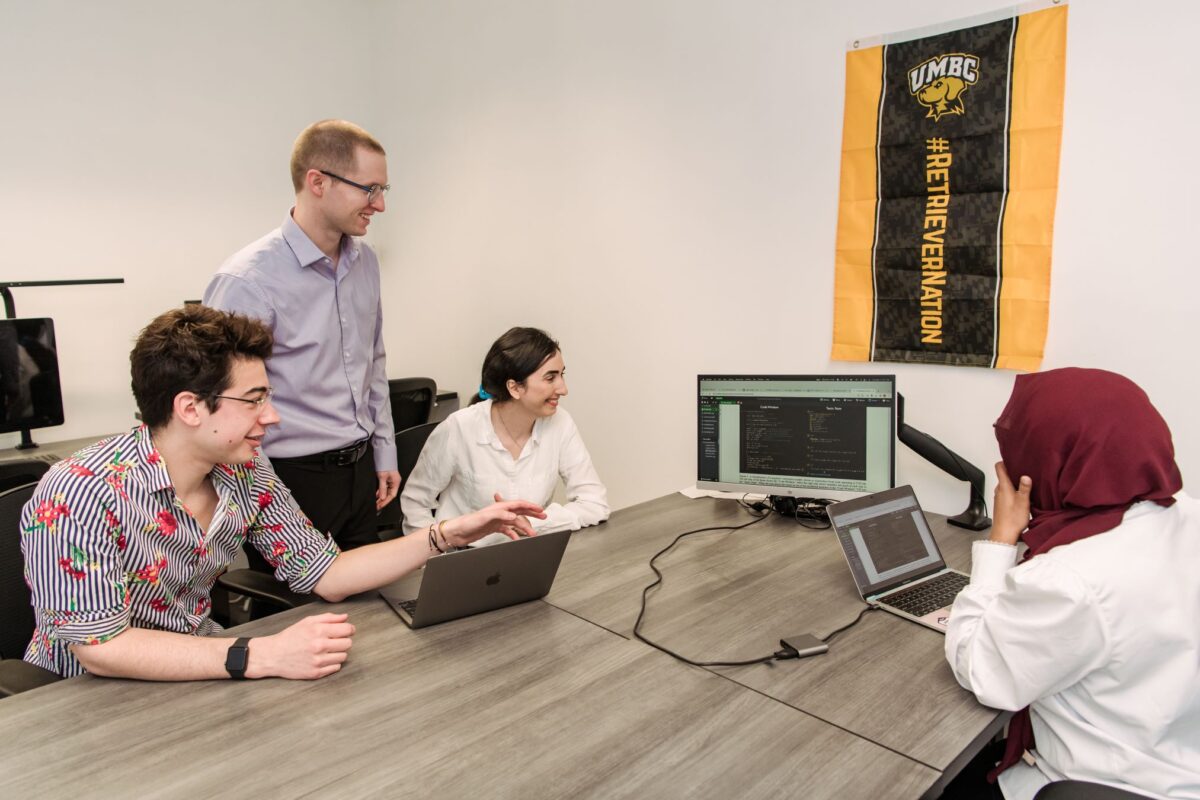
    <img src="https://umbc.edu/wp-content/uploads/2023/05/Tyler-Josephson-lab-resized-1200x800.jpg" alt='One standing person and three seated people (all AI researchers) look at computer monitor placed on a table. A banner on the wall reads "UMBC" and "#RetrieverNation"' width="1200" height="800" style="max-width: 100%; height: auto;">
    Tyler Josephson (standing) and students Max Bobbin (left), Parivash Feyzishendi (center), and Samiha Sharlin (right) in the lab. (Marlayna Demond ’11/UMBC)
    
    <p>The power of the work will multiply as more of the foundations of science are translated into Lean, so a large part of the team’s work will also be to recruit, inspire, and train fellow proof creators. They will hold workshops to showcase Lean for scientists and engineers, and they plan to create fun and educational games that will teach Lean-programming skills to newcomers.</p>
    <p>“I’m really excited to share this tool with students and the scientific community,” Josephson says.</p>
    <h4><strong>Building better scientific computing tools</strong></h4>
    <p>Josephson’s goal to formally verify scientific theories isn’t just an intellectual exercise—it’s a means of building better tools for better science. One such tool he plans to create with NSF CAREER award support is Lean-based computer software that can simulate the behavior of molecules under a range of conditions. </p>
    <p>Scientists often use such software to test theories as an alternative to physical experiments. It can be easier to run simulations of reactions on a computer, for example, than to mix real chemicals again and again, and some molecular phenomena may happen so fast, or under such extreme conditions, that current experimental tools cannot capture them.</p>
    <p>However, bugs can mar the performance of the software. For example, starting in 2011, a hidden coding error fueled a seven-year “<a href="https://pubs.aip.org/physicstoday/Online/4628/The-war-over-supercooled-water" rel="nofollow external" class="bo">war over supercooled water</a>,” in which two scientific groups disagreed about what happens to ultrapure water when it is cooled significantly below the freezing point of normal water, and then suddenly crystallizes.</p>
    <p>Code written in Lean is unique from that written in the programming languages commonly used in scientific computing, since it can be provably free of such math errors, Josephson says. </p>
    <p>As more scientists and engineers learn to write code and proofs in Lean, others will be able to write bug-free software for applications as diverse as weather forecasting, drug discovery, and predicting material performance.</p>
    <h4><strong>“AI scientists” who reason on their own</strong></h4>
    <p>Ultimately, Josephson hopes to use a Lean-based library of scientific knowledge to train computers as fellow scientists. For example, large language models, such as the recently popularized ChatGPT, might be trained on a library of scientific proofs and gain the ability to “autocomplete” proofs on their own, translate informal proofs from the literature into formal ones, and even discover entirely new scientific theories, which could then be checked for correctness by Lean.</p>
    <p>A tool like this might revolutionize science. In Galileo’s time, a single person could master large portions of human scientific knowledge, but now scientists usually go to school for decades to become experts in a tiny subfield, Josephson says.</p>
    <p>AI scientists capable of digesting a database of thousands of scientific proofs in multiple disciplines might draw connections across them to reveal new discoveries. “Such a tool could lead to an AI-powered Renaissance in interdisciplinary scientific discovery,” says Josephson.</p>
    <p>While such lofty goals remain in the future, Josephson and his students are energized by the possibilities. As they embark on an exciting scientific journey, they are thrilled to bring as many people as possible along on the ride.</p></div>
]]>
  </Body>
  <Summary>from UMBC NEWS, "Creating “AI Scientists”: Tyler Josephson advances a new field of research through $650,000 NSF CAREER award",  by Catherine Meyers on Published: May 12, 2023         Tyler...</Summary>
  <TrackingUrl>https://dev.my.umbc.edu/api/v0/pixel/news/133064/guest@my.umbc.edu/3d87a874ac5b8c8fc9d5e108c4749646/api/pixel</TrackingUrl>
  <Tag>award</Tag>
  <Tag>faculty</Tag>
  <Tag>josephson</Tag>
  <Tag>spring-2023</Tag>
  <Group token="cbee">Chemical, Biochemical and Environmental Engineering</Group>
  <GroupUrl>https://dev.my.umbc.edu/groups/cbee</GroupUrl>
  <AvatarUrl>https://assets4-dev.my.umbc.edu/system/shared/avatars/groups/000/000/771/b5e579e81b2e3624611890fa3ca2716a/xsmall.png?1746794587</AvatarUrl>
  <AvatarUrl size="original">https://assets2-dev.my.umbc.edu/system/shared/avatars/groups/000/000/771/b5e579e81b2e3624611890fa3ca2716a/original.png?1746794587</AvatarUrl>
  <AvatarUrl size="xxlarge">https://assets1-dev.my.umbc.edu/system/shared/avatars/groups/000/000/771/b5e579e81b2e3624611890fa3ca2716a/xxlarge.png?1746794587</AvatarUrl>
  <AvatarUrl size="xlarge">https://assets2-dev.my.umbc.edu/system/shared/avatars/groups/000/000/771/b5e579e81b2e3624611890fa3ca2716a/xlarge.png?1746794587</AvatarUrl>
  <AvatarUrl size="large">https://assets2-dev.my.umbc.edu/system/shared/avatars/groups/000/000/771/b5e579e81b2e3624611890fa3ca2716a/large.png?1746794587</AvatarUrl>
  <AvatarUrl size="medium">https://assets4-dev.my.umbc.edu/system/shared/avatars/groups/000/000/771/b5e579e81b2e3624611890fa3ca2716a/medium.png?1746794587</AvatarUrl>
  <AvatarUrl size="small">https://assets1-dev.my.umbc.edu/system/shared/avatars/groups/000/000/771/b5e579e81b2e3624611890fa3ca2716a/small.png?1746794587</AvatarUrl>
  <AvatarUrl size="xsmall">https://assets4-dev.my.umbc.edu/system/shared/avatars/groups/000/000/771/b5e579e81b2e3624611890fa3ca2716a/xsmall.png?1746794587</AvatarUrl>
  <AvatarUrl size="xxsmall">https://assets1-dev.my.umbc.edu/system/shared/avatars/groups/000/000/771/b5e579e81b2e3624611890fa3ca2716a/xxsmall.png?1746794587</AvatarUrl>
  <Sponsor>Chemical, Biochemical and Environmental Engineering</Sponsor>
  <ThumbnailUrl size="xxlarge">https://assets1-dev.my.umbc.edu/system/shared/thumbnails/news/000/133/064/f3c6a66c048263f2b362db019ca84932/xxlarge.jpg?1684341161</ThumbnailUrl>
  <ThumbnailUrl size="xlarge">https://assets4-dev.my.umbc.edu/system/shared/thumbnails/news/000/133/064/f3c6a66c048263f2b362db019ca84932/xlarge.jpg?1684341161</ThumbnailUrl>
  <ThumbnailUrl size="large">https://assets4-dev.my.umbc.edu/system/shared/thumbnails/news/000/133/064/f3c6a66c048263f2b362db019ca84932/large.jpg?1684341161</ThumbnailUrl>
  <ThumbnailUrl size="medium">https://assets1-dev.my.umbc.edu/system/shared/thumbnails/news/000/133/064/f3c6a66c048263f2b362db019ca84932/medium.jpg?1684341161</ThumbnailUrl>
  <ThumbnailUrl size="small">https://assets1-dev.my.umbc.edu/system/shared/thumbnails/news/000/133/064/f3c6a66c048263f2b362db019ca84932/small.jpg?1684341161</ThumbnailUrl>
  <ThumbnailUrl size="xsmall">https://assets4-dev.my.umbc.edu/system/shared/thumbnails/news/000/133/064/f3c6a66c048263f2b362db019ca84932/xsmall.jpg?1684341161</ThumbnailUrl>
  <ThumbnailUrl size="xxsmall">https://assets3-dev.my.umbc.edu/system/shared/thumbnails/news/000/133/064/f3c6a66c048263f2b362db019ca84932/xxsmall.jpg?1684341161</ThumbnailUrl>
  <PawCount>0</PawCount>
  <CommentCount>0</CommentCount>
  <CommentsAllowed>true</CommentsAllowed>
  <PostedAt>Wed, 17 May 2023 12:37:43 -0400</PostedAt>
  <EditAt>Mon, 29 Apr 2024 12:36:11 -0400</EditAt>
</NewsItem>
</News>