Dr. Upal Ghosh work is recognized by NIEHS
from UMBC NEWS
National Institutes of Environmental Health Sciences highlight Professor Upal Ghosh’s work cleaning contaminated waterways
By: Catherine Meyers | Published: Feb 23, 2024 | UMBC NEWS
The positive environmental and health impacts of work led by Upal Ghosh, professor of chemical, biochemical, and environmental engineering at UMBC, was recently highlighted by the National Institutes of Environmental Health Sciences (NIEHS). The agency showcased a low-cost technology that Ghosh and his colleagues developed to clean waterways contaminated with polychlorinated biphenyls (PCBs), a group of likely carcinogenic chemicals that were used in insulation, coolants, and electrical equipment for decades before being banned in the U.S. in 1979.
The chemicals are stable and persist in the environment, often accumulating in fish that live in contaminated waterways and posing a risk to humans who consume those fish. NIEHS funded Ghosh’s research into using activated carbon pellets to bind the chemicals in place at the bottom of the waterways. This prevents the PCBs from circulating through the aquatic food chain. In projects carried out in contaminated lakes, rivers, and harbors in Delaware, Maryland, and elsewhere, Ghosh’s team demonstrated that the technique could significantly reduce the concentration of PCBs in the water and in aquatic lifeforms. Importantly, the technique is also significantly cheaper than standard clean-up approaches, such as dredging and disposing of contaminated sediment.
In related work performed with Kevin Sowers, from the Institute of Marine and Environmental Technology, Ghosh’s team also developed a way to combine the activated carbon with microbes that break down PCBs, reducing their toxicity.
With NIEHS support, Ghosh has co-founded two companies—Sediment Solutions and RemBac—to commercialize the technology and deploy it at full-scale to clean up contaminated sites across the country, such as at Mirror Lake in Delaware.
“The technology brings together innovations in material science and biology,” says Ghosh. It’s an honor, he says, that the NIEHS, the leading agency in the country that funds research on public health and the environment, recognized “the real impact our research is having on improving public health.”
]]>
National Institutes of Environmental Health Sciences highlight Professor Upal Ghosh’s work cleaning contaminated waterways By: Catherine Meyers | Published: Feb 23, 2024 | UMBC NEWS The...
https://dev.my.umbc.edu/api/v0/pixel/news/140929/guest@my.umbc.edu/73e47a5784c5de7a8e728b6e8af7374c/api/pixel
faculty
ghosh
news
research
spring-2024
Chemical, Biochemical and Environmental Engineering
https://dev.my.umbc.edu/groups/cbee
https://assets4-dev.my.umbc.edu/system/shared/avatars/groups/000/000/771/b5e579e81b2e3624611890fa3ca2716a/xsmall.png?1746794587
https://assets2-dev.my.umbc.edu/system/shared/avatars/groups/000/000/771/b5e579e81b2e3624611890fa3ca2716a/original.png?1746794587
https://assets1-dev.my.umbc.edu/system/shared/avatars/groups/000/000/771/b5e579e81b2e3624611890fa3ca2716a/xxlarge.png?1746794587
https://assets2-dev.my.umbc.edu/system/shared/avatars/groups/000/000/771/b5e579e81b2e3624611890fa3ca2716a/xlarge.png?1746794587
https://assets2-dev.my.umbc.edu/system/shared/avatars/groups/000/000/771/b5e579e81b2e3624611890fa3ca2716a/large.png?1746794587
https://assets4-dev.my.umbc.edu/system/shared/avatars/groups/000/000/771/b5e579e81b2e3624611890fa3ca2716a/medium.png?1746794587
https://assets1-dev.my.umbc.edu/system/shared/avatars/groups/000/000/771/b5e579e81b2e3624611890fa3ca2716a/small.png?1746794587
https://assets4-dev.my.umbc.edu/system/shared/avatars/groups/000/000/771/b5e579e81b2e3624611890fa3ca2716a/xsmall.png?1746794587
https://assets1-dev.my.umbc.edu/system/shared/avatars/groups/000/000/771/b5e579e81b2e3624611890fa3ca2716a/xxsmall.png?1746794587
Chemical, Biochemical and Environmental Engineering
https://assets3-dev.my.umbc.edu/system/shared/thumbnails/news/000/140/929/575203133eab45ceb0d1367a92bb2028/xxlarge.jpg?1713198214
https://assets3-dev.my.umbc.edu/system/shared/thumbnails/news/000/140/929/575203133eab45ceb0d1367a92bb2028/xlarge.jpg?1713198214
https://assets1-dev.my.umbc.edu/system/shared/thumbnails/news/000/140/929/575203133eab45ceb0d1367a92bb2028/large.jpg?1713198214
https://assets4-dev.my.umbc.edu/system/shared/thumbnails/news/000/140/929/575203133eab45ceb0d1367a92bb2028/medium.jpg?1713198214
https://assets4-dev.my.umbc.edu/system/shared/thumbnails/news/000/140/929/575203133eab45ceb0d1367a92bb2028/small.jpg?1713198214
https://assets3-dev.my.umbc.edu/system/shared/thumbnails/news/000/140/929/575203133eab45ceb0d1367a92bb2028/xsmall.jpg?1713198214
https://assets2-dev.my.umbc.edu/system/shared/thumbnails/news/000/140/929/575203133eab45ceb0d1367a92bb2028/xxsmall.jpg?1713198214
1
0
true
Mon, 15 Apr 2024 12:24:46 -0400
Congratulations to CBEE winner at GEARS 2024
Sahar Souizi, ENEN PhD & Revati Kadolkar, CENG PHD
Celebrating our CBEE students at the GEARS (Graduate Experience, Achievements & Research Symposium) 2024. Sahar Souizi, Environmental Engineering PhD student in Dr. Blaney’s Lab, clinched the runner-up title, and Revati Kadolkar, Chemical and Biochemical Engineering PhD, under Dr. Frey & CAST, seized the People's Choice Award.
Congratulations Sahar and Revati, for your outstanding achievements!
GEARS provides a platform for students to showcase their creative achievements, present research accomplishments, and share their experiences with peers. GEARS aims to provide a friendly atmosphere to promote collaboration, improve communication skills, and celebrate the hard work of UMBC graduate students.
]]>
Celebrating our CBEE students at the GEARS (Graduate Experience, Achievements & Research Symposium) 2024. Sahar Souizi, Environmental Engineering PhD student in Dr. Blaney’s Lab, clinched the...
https://dev.my.umbc.edu/api/v0/pixel/news/140872/guest@my.umbc.edu/6fdb991690118eeb6f4bc446a7d12e49/api/pixel
award
blaney
frey
gears
grad
rao
research
spring-2024
symposium
Chemical, Biochemical and Environmental Engineering
https://dev.my.umbc.edu/groups/cbee
https://assets4-dev.my.umbc.edu/system/shared/avatars/groups/000/000/771/b5e579e81b2e3624611890fa3ca2716a/xsmall.png?1746794587
https://assets2-dev.my.umbc.edu/system/shared/avatars/groups/000/000/771/b5e579e81b2e3624611890fa3ca2716a/original.png?1746794587
https://assets1-dev.my.umbc.edu/system/shared/avatars/groups/000/000/771/b5e579e81b2e3624611890fa3ca2716a/xxlarge.png?1746794587
https://assets2-dev.my.umbc.edu/system/shared/avatars/groups/000/000/771/b5e579e81b2e3624611890fa3ca2716a/xlarge.png?1746794587
https://assets2-dev.my.umbc.edu/system/shared/avatars/groups/000/000/771/b5e579e81b2e3624611890fa3ca2716a/large.png?1746794587
https://assets4-dev.my.umbc.edu/system/shared/avatars/groups/000/000/771/b5e579e81b2e3624611890fa3ca2716a/medium.png?1746794587
https://assets1-dev.my.umbc.edu/system/shared/avatars/groups/000/000/771/b5e579e81b2e3624611890fa3ca2716a/small.png?1746794587
https://assets4-dev.my.umbc.edu/system/shared/avatars/groups/000/000/771/b5e579e81b2e3624611890fa3ca2716a/xsmall.png?1746794587
https://assets1-dev.my.umbc.edu/system/shared/avatars/groups/000/000/771/b5e579e81b2e3624611890fa3ca2716a/xxsmall.png?1746794587
Chemical, Biochemical and Environmental Engineering
https://assets2-dev.my.umbc.edu/system/shared/thumbnails/news/000/140/872/58ea2209c29c15f5d5251b68ac65e72b/xxlarge.jpg?1713199802
https://assets1-dev.my.umbc.edu/system/shared/thumbnails/news/000/140/872/58ea2209c29c15f5d5251b68ac65e72b/xlarge.jpg?1713199802
https://assets3-dev.my.umbc.edu/system/shared/thumbnails/news/000/140/872/58ea2209c29c15f5d5251b68ac65e72b/large.jpg?1713199802
https://assets4-dev.my.umbc.edu/system/shared/thumbnails/news/000/140/872/58ea2209c29c15f5d5251b68ac65e72b/medium.jpg?1713199802
https://assets3-dev.my.umbc.edu/system/shared/thumbnails/news/000/140/872/58ea2209c29c15f5d5251b68ac65e72b/small.jpg?1713199802
https://assets2-dev.my.umbc.edu/system/shared/thumbnails/news/000/140/872/58ea2209c29c15f5d5251b68ac65e72b/xsmall.jpg?1713199802
https://assets2-dev.my.umbc.edu/system/shared/thumbnails/news/000/140/872/58ea2209c29c15f5d5251b68ac65e72b/xxsmall.jpg?1713199802
4
0
true
Fri, 12 Apr 2024 16:43:50 -0400
Mon, 15 Apr 2024 12:51:25 -0400
UMBC Hosts East Coast Chemical Engineering Conference
from UMBC NEWS
Hundreds of East Coast chemical engineering students to gather at UMBC for regional conference
By: Catherine Meyers | Published: Mar 29, 2024 | UMBC NEWS
Over the weekend of April 6 – 7, the UMBC student chapter of the American Institute of Chemical Engineers (AIChE) will host the 2024 Mid-Atlantic Regional Conference on campus. The event will feature workshops, research presentations, and a career fair with companies such as AstraZeneca and Astek Diagnostics and schools including Johns Hopkins University, Rutgers University, the University of Delaware, and Lehigh University. It will also feature the conferences’ two signature competitive events: Chemical Engineering Jeopardy and ChemE Car—a competition to build and operate a car powered and stopped by chemical reactions.
Organizers expect more than 350 attendees from more than 30 universities across the region. UMBC students are encouraged to register to attend, even if they aren’t chemical engineering majors. “As the premier student chemical engineering conference in the region, this event will offer great opportunities for networking, presenting research, landing internships and jobs, and general professional development,” says Terra Miley ’25, chemical engineering, who is serving as the communications chair for the student organizing committee.
Photo credit: The UMBC campus will host hundreds of chemical engineering students in early April for a regional meeting of the American Institute of Chemical Engineers. (Marlayna Demond ’11/UMBC)
]]>
Hundreds of East Coast chemical engineering students to gather at UMBC for regional conference By: Catherine Meyers | Published: Mar 29, 2024 | UMBC NEWS Over the weekend of April 6 – 7, the...
https://dev.my.umbc.edu/api/v0/pixel/news/140870/guest@my.umbc.edu/ec1db82a167a76400a860c40a838d308/api/pixel
aiche
news
research
spring-2024
ug
ugrad
Chemical, Biochemical and Environmental Engineering
https://dev.my.umbc.edu/groups/cbee
https://assets4-dev.my.umbc.edu/system/shared/avatars/groups/000/000/771/b5e579e81b2e3624611890fa3ca2716a/xsmall.png?1746794587
https://assets2-dev.my.umbc.edu/system/shared/avatars/groups/000/000/771/b5e579e81b2e3624611890fa3ca2716a/original.png?1746794587
https://assets1-dev.my.umbc.edu/system/shared/avatars/groups/000/000/771/b5e579e81b2e3624611890fa3ca2716a/xxlarge.png?1746794587
https://assets2-dev.my.umbc.edu/system/shared/avatars/groups/000/000/771/b5e579e81b2e3624611890fa3ca2716a/xlarge.png?1746794587
https://assets2-dev.my.umbc.edu/system/shared/avatars/groups/000/000/771/b5e579e81b2e3624611890fa3ca2716a/large.png?1746794587
https://assets4-dev.my.umbc.edu/system/shared/avatars/groups/000/000/771/b5e579e81b2e3624611890fa3ca2716a/medium.png?1746794587
https://assets1-dev.my.umbc.edu/system/shared/avatars/groups/000/000/771/b5e579e81b2e3624611890fa3ca2716a/small.png?1746794587
https://assets4-dev.my.umbc.edu/system/shared/avatars/groups/000/000/771/b5e579e81b2e3624611890fa3ca2716a/xsmall.png?1746794587
https://assets1-dev.my.umbc.edu/system/shared/avatars/groups/000/000/771/b5e579e81b2e3624611890fa3ca2716a/xxsmall.png?1746794587
Chemical, Biochemical and Environmental Engineering
https://assets2-dev.my.umbc.edu/system/shared/thumbnails/news/000/140/870/bef5b39eff57e9e7478ccbe5c10d3c38/xxlarge.jpg?1712954264
https://assets2-dev.my.umbc.edu/system/shared/thumbnails/news/000/140/870/bef5b39eff57e9e7478ccbe5c10d3c38/xlarge.jpg?1712954264
https://assets3-dev.my.umbc.edu/system/shared/thumbnails/news/000/140/870/bef5b39eff57e9e7478ccbe5c10d3c38/large.jpg?1712954264
https://assets2-dev.my.umbc.edu/system/shared/thumbnails/news/000/140/870/bef5b39eff57e9e7478ccbe5c10d3c38/medium.jpg?1712954264
https://assets3-dev.my.umbc.edu/system/shared/thumbnails/news/000/140/870/bef5b39eff57e9e7478ccbe5c10d3c38/small.jpg?1712954264
https://assets1-dev.my.umbc.edu/system/shared/thumbnails/news/000/140/870/bef5b39eff57e9e7478ccbe5c10d3c38/xsmall.jpg?1712954264
https://assets3-dev.my.umbc.edu/system/shared/thumbnails/news/000/140/870/bef5b39eff57e9e7478ccbe5c10d3c38/xxsmall.jpg?1712954264
1
0
true
Fri, 12 Apr 2024 14:29:48 -0400
Fri, 12 Apr 2024 16:42:32 -0400
February 2024 - CBEE Alumni Update
Career updates
Are you a CBEE Alumni? Stay connected via Linkedin
Let us know what you're doing now and share an update
here.
Marriah Ellington
M.S '23, Environmental Engineering
Advisor: Dr. Lee Blaney
Mariah is now working at the US Patent and Trademark Office as a Chemical Patent Examiner.
Jenny Thomas
B.S. '23, Chemical Engineering, Trading Track
Jenny started as a Process Engineer at GlobalFoundries July 2023 in Albany, NY.
Mike German
B.S. '09, Chemical Engineering, Biotechnology and Bioengineering Track
Mike German is a part of Last Energy as a Business Development Manager as of August 2023, a company at the forefront of transforming nuclear energy through the development of small modular reactors (SMRs). With a profound commitment to advancing clean energy solutions, Mike is convinced that SMRs represent the next leap in achieving a sustainable power future. Holding a Ph.D. in environmental engineering and having demonstrated his ability to forge strategic partnerships during his tenure at Drinkwell and Amorphic Tech, Mike envisions a world where energy is not only plentiful but also safe and environmentally friendly.
Ian Vaillant
M.S '23, Chemical Engineering
Ian works for the US Naval surface warfare center Indian Head division as a chemical engineer in the product and process development and scale up division, energetic formulations group.
Sharan Shah
B.S '21, Chemical Engineering, Biotechnology and Bioengineering Track
Sharan accepted an offer with Exelon/Baltimore Gas and Electric, having previously worked at IZI Medical Products as a Quality Engineer.
Matthew Murdock
B.S '21, Chemical Engineering, Traditional Track
Matthew Murdock completed his Master's in Chemical Engineering at University of Delaware. He is Currently Flow Assurance Engineer at ExxonMobil.
Neil (Nghia) Tran
B.S '21, Chemical Engineering, Biotechnology and Bioengineering Track
Neil Tran will start his internship at Albemarle this summer 2024, specializing in computational chemistry. Neil Tran is pursuing his Ph.D. in Chemical and Biomolecular Engineering at the University of Illinois Urbana-Champaign.
Andrew Hurdle
B.S '23, Chemical Engineering, Biotechnology and Bioengineering Track
Andrew is now working as the Oil Movements Contact Engineer for ExxonMobil in Beaumont, TX.
Wayne (Andy) Gotsch
B.S '12, Chemical Engineering, Traditional Track
Andy currently works at TAI Engineering in Owings Mills as a Senior Process Engineer and Project Manager. He recently obtained his Professional Engineering License in Chemical Engineering for Maryland. He currently has two patents pending for hygienic manufacturing components.
(Image: This list of UMBC Alumni employers should not be construed as sponsorship, affiliation, or approval by the trademark owner.)
Low-Cost Technology Cleans Up Contaminated Sites
An innovative technology, developed with funding from the NIEHS Superfund Research Program (SRP), can deliver amendments that immobilize and degrade polychlorinated biphenyls (PCBs) in aquatic environments. The technology has proven effective in the field and resulted in millions of dollars in estimated cost savings at cleanup sites.
The Problem:
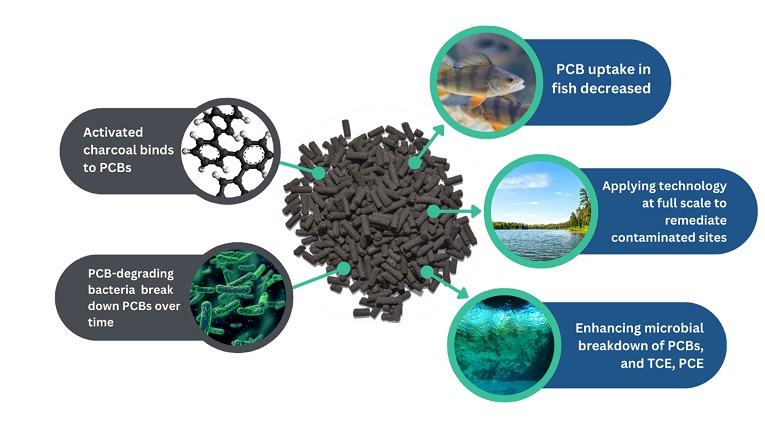
PCBs are a large and complex group of chemicals that were used in insulation, coolants, and electrical equipment. Although commercial production of PCBs was banned in the United States in 1979, they persist in the environment because of their stable chemical structure. PCBs can also accumulate in the aquatic food web, where they can pose a threat to human health.
SRP Solutions:
SediMite, developed by Upal Ghosh, Ph.D., of the University of Maryland, Baltimore County, and collaborators, uses activated carbon in the form of specialized pellets to bind to PCBs and reduce their bioavailability, or uptake by fish and other aquatic organisms. The technology can also be combined with microbes that break down PCBs, reducing their toxicity.
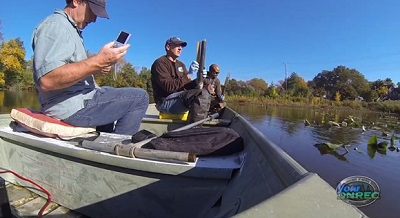 Ghosh, right, and colleagues collect sediment samples to measure PCBs. (Image from the DNRECYouTube videohighlighting the work at the Christina River)
Documenting Effectiveness in the Field
- The approach reduces PCBs in sediment porewater and surface water in the field
- The technology lowers PCB levels measured in lake fish
Ghosh and his team collaborated with the Delaware Department of Natural Resources and Environmental Control (DNREC) to use the technology at Mirror Lake. They demonstrated that between 2013 and 2018, PCB concentrations in sediment porewater decreased by about 80% after applying SediMite. They also measured a 70% reduction in PCB levels in the lake’s fish.
Their success has important implications for human health because PCB contamination is the primary reason that fish consumption advisories are issued by DNREC and the Delaware Division of Public Health.
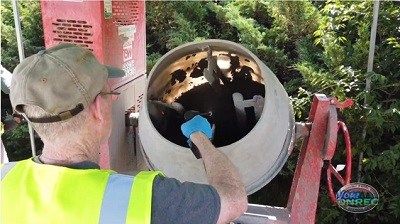 Sowers sprays PCB-degrading microorganisms onto activated carbon pellets to clean up PCBs and keep them from contaminating the Christina River. (Image from the DNREC YouTube video highlighting the work at the Christina River)
Building on this achievement, DNREC used an enhanced version of the SediMite technology in a new project to reduce PBCs in the Christina River. Ghosh and colleague Kevin Sowers, Ph.D., combined the activated carbon with microorganisms that can break down PCBs to both immobilize PCBs in the sediment and degrade them over time. After five months, SediMite enhanced with PCB-degrading microbes reduced the amount of PCBs in the sediment by approximately 25%. PCB concentrations decreased by around 35% in the surface water and 64% in sediment porewater.
Videos developed by DNREC depict the successes at Mirror Lake and the Christina River projects.
Building the Foundation
- Activated carbon reduces PCB bioavailability in the lab
- The technology offers significant cost savings compared to other clean-up methods
The technology builds on years of research by Ghosh and colleagues. SediMite was initially developed in part with SRP funding in an early project focused on optimizing the delivery method to apply activated carbon pellets to contaminated sites.
Ghosh had previously collaborated with Richard Luthy, Ph.D., an SRP grant recipient at Stanford University, to develop the novel concept of amending sediments with sorbents to reduce pollutant bioavailability. Their initial studies resulted in a method, patented in 2006, to stabilize persistent organic contaminants using carbon as sorbents and laid much of the groundwork for identifying potential barriers and future research needs to make the technology a viable reality, including the need for efficient methods to deliver the sorbents to sediment.
Ghosh then collaborated with Charlie Menzie, Ph.D., to develop SediMite to efficiently deliver amendments to sediments through a U.S. EPA Small Business Innovation Research program grant. Initial tests demonstrated that it was a feasible technology for use in the field. With SRP funding, the researchers scaled up their method to deliver activated carbon pellets from the lab to the field and patented SediMite in 2010.
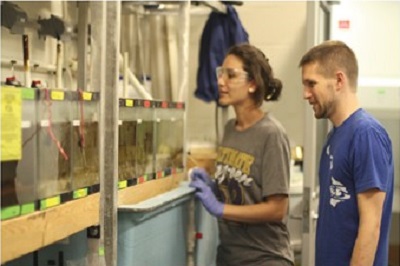 SRP trainees in Ghosh's lab measure PCB levels in water and fish during early lab experiments with activated carbon. (Photo courtesy of Upal Ghosh)
Ghosh continued his research in a second SRP-funded project aimed at evaluating whether fish uptake less PCBs after remediation with activated carbon. The team used lab studies and modeling approaches to demonstrate that fish can reduced their PCB uptake by as much as 87% after 90 days of treatment with activated carbon.
They also showed that SediMite decreased the assimilation efficiency of PCBs by up to 93%. Assimilation efficiency measures the amount of the contaminant that remains in the body compared to the amount that is excreted. This early work by the scientists included scaling up their remediation work to the field study at Mirror Lake.
The technology was implemented in full-scale to remediate a five-acre lake in Dover, Delaware in 2013. It was also selected as a component of the cleanup strategy for a contaminated sediment site in Middle River, Maryland, where the approach was estimated to cost approximately $22 million less than traditional methods, such as dredging and hauling.
Optimizing for Use at Scale
- Scaling up bacteria growth, dispersal, and deployment.
- Demonstrating effectiveness in the field.
- Collaborating in full-scale remediation projects.
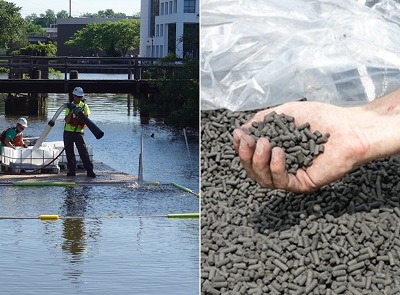 The activated carbon pellets can easily deliver microorganisms across large areas of contaminated sediment to both sequester and degrade PCBs. (Photos courtesy of RemBac)
While developing and patenting SediMite, the researchers identified some limitations to large-scale application of the technology. To address these limitations, Ghosh and Sowers, in collaboration with environmental scientist Bennett Amos, founded RemBac Environmental to enhance the SediMite carbon pellets with PCB-degrading microorganisms. Rembac was funded in 2020 through an SRP small business grant.
In the first phase of their project, they tested methods to optimize growing and storing large volumes of PCB-degrading organisms over time. They also developed and tested methods to apply the microbes more uniformly and cost-effectively to high volumes of activated carbon pellets, enabling them to scale up their technology to broader commercial use.
In the second phase of their project, the team plans to field test the effectiveness and utility of their technology at the New Bedford Harbor Superfund site. They hope their findings will inform regulators and other stakeholders as different PCB clean-up strategies are considered.
In 2022, the Elizabeth River Project started using SediMite to remediate Paradise Creek, a 14-acre tributary to the Elizabeth River in Virginia that is contaminated with PCBs. Another full-scale project, led by EPA, is using SediMite to remove dioxin from sediments in the Scanlon Reservoir in Minnesota.
SRP Funding Creates Synergy
The successful field trial at the Christina River and the newer SRP-funded projects represent a synergy between Ghosh’s development of SediMite and Sower’s early SRP-funded work that demonstrated that using specific microorganisms and conditions to stimulate them resulted in 80% of PCBs being degraded in Superfund sediments under realistic conditions.
New Directions
In 2021, Ghosh and team were awarded a four-year SRP grant to develop carbon-based sorbent materials to enhance the ability of bacteria to break down PCBs in sediments and mixtures of tetrachloroethylene (PCE) and trichloroethylene (TCE) in groundwater. PCE and TCE are chemicals often used in manufacturing and are the most frequently detected volatile organic chemicals in groundwater.
By understanding the interaction between surface chemistry and microbial degradation, the team expects to develop new technologies to remediate PCBs, PCE, TCE, and other chlorinated contaminants often found in the environment.
link to full article:
https://www.niehs.nih.gov/research/supported/centers/srp/phi/archives/remediation/sedimite
]]>
Excerpt from February 2024 - National Institute of Health (NIH), National Institute of Environmental Health Science (NIEHS) Superfund Research Program, Public Health Impact Story Low-Cost...
https://dev.my.umbc.edu/api/v0/pixel/news/138951/guest@my.umbc.edu/7bba21e8254f99b1175cc1ca6219698e/api/pixel
ghosh
research
spring-2024
Chemical, Biochemical and Environmental Engineering
https://dev.my.umbc.edu/groups/cbee
https://assets4-dev.my.umbc.edu/system/shared/avatars/groups/000/000/771/b5e579e81b2e3624611890fa3ca2716a/xsmall.png?1746794587
https://assets2-dev.my.umbc.edu/system/shared/avatars/groups/000/000/771/b5e579e81b2e3624611890fa3ca2716a/original.png?1746794587
https://assets1-dev.my.umbc.edu/system/shared/avatars/groups/000/000/771/b5e579e81b2e3624611890fa3ca2716a/xxlarge.png?1746794587
https://assets2-dev.my.umbc.edu/system/shared/avatars/groups/000/000/771/b5e579e81b2e3624611890fa3ca2716a/xlarge.png?1746794587
https://assets2-dev.my.umbc.edu/system/shared/avatars/groups/000/000/771/b5e579e81b2e3624611890fa3ca2716a/large.png?1746794587
https://assets4-dev.my.umbc.edu/system/shared/avatars/groups/000/000/771/b5e579e81b2e3624611890fa3ca2716a/medium.png?1746794587
https://assets1-dev.my.umbc.edu/system/shared/avatars/groups/000/000/771/b5e579e81b2e3624611890fa3ca2716a/small.png?1746794587
https://assets4-dev.my.umbc.edu/system/shared/avatars/groups/000/000/771/b5e579e81b2e3624611890fa3ca2716a/xsmall.png?1746794587
https://assets1-dev.my.umbc.edu/system/shared/avatars/groups/000/000/771/b5e579e81b2e3624611890fa3ca2716a/xxsmall.png?1746794587
Chemical, Biochemical and Environmental Engineering
https://assets4-dev.my.umbc.edu/system/shared/thumbnails/news/000/138/951/a0e85fc0f0bf840f0c5ba49e650339f9/xxlarge.jpg?1707841196
https://assets4-dev.my.umbc.edu/system/shared/thumbnails/news/000/138/951/a0e85fc0f0bf840f0c5ba49e650339f9/xlarge.jpg?1707841196
https://assets3-dev.my.umbc.edu/system/shared/thumbnails/news/000/138/951/a0e85fc0f0bf840f0c5ba49e650339f9/large.jpg?1707841196
https://assets3-dev.my.umbc.edu/system/shared/thumbnails/news/000/138/951/a0e85fc0f0bf840f0c5ba49e650339f9/medium.jpg?1707841196
https://assets3-dev.my.umbc.edu/system/shared/thumbnails/news/000/138/951/a0e85fc0f0bf840f0c5ba49e650339f9/small.jpg?1707841196
https://assets3-dev.my.umbc.edu/system/shared/thumbnails/news/000/138/951/a0e85fc0f0bf840f0c5ba49e650339f9/xsmall.jpg?1707841196
https://assets2-dev.my.umbc.edu/system/shared/thumbnails/news/000/138/951/a0e85fc0f0bf840f0c5ba49e650339f9/xxsmall.jpg?1707841196
1
0
true
Tue, 13 Feb 2024 10:57:30 -0500
Tue, 13 Feb 2024 11:20:07 -0500
Applications Open: BEMORE REU Summer 2024
We are now accepting applications for the third cohort of the BEMORE REU program at UMBC.
Application Deadline:
For best consideration, please submit your applications by March 1, 2024.
The BEMORE REU program prepares students to address knowledge gaps, develop new technologies, and bring unique perspectives to complex problems in biochemical and environmental engineering and science.
Students that join the BEMORE REU Site will gain the interdisciplinary knowledge, skills, and training to address a variety of grand challenges.
Research Topics:
- water pollution & treatment
- sustainable plastic replacements
- smart polymers
- urban air quality
- novel biomaterials
- sustainable batteries and more.
Additional details are available at https://bemore.umbc.edu/
Program details:
- June 3, 2024 to August 9, 2024
- $6000 stipend, travel allowance, and free on-campus housing
- Access to state-of-the-art laboratories
- Work with a diverse team of faculty and other students
- Learn about current issues in biochemical and environmental engineering and science
- Enjoy field trips, group activities, and our awards banquet
Eligibility:
- All majors are welcome to apply
- Current student at a two- or four-year college or university
- US citizen or permanent resident
]]>
We are now accepting applications for the third cohort of the BEMORE REU program at UMBC. Application Deadline: For best consideration, please submit your applications by March 1, 2024....
https://dev.my.umbc.edu/api/v0/pixel/news/138171/guest@my.umbc.edu/3223e9900b7870457f1197f33210e6c8/api/pixel
almodovar
bemorereu
blaney
capraz
hennigan
spring-2024
ug
ugrad
Chemical, Biochemical and Environmental Engineering
https://dev.my.umbc.edu/groups/cbee
https://assets4-dev.my.umbc.edu/system/shared/avatars/groups/000/000/771/b5e579e81b2e3624611890fa3ca2716a/xsmall.png?1746794587
https://assets2-dev.my.umbc.edu/system/shared/avatars/groups/000/000/771/b5e579e81b2e3624611890fa3ca2716a/original.png?1746794587
https://assets1-dev.my.umbc.edu/system/shared/avatars/groups/000/000/771/b5e579e81b2e3624611890fa3ca2716a/xxlarge.png?1746794587
https://assets2-dev.my.umbc.edu/system/shared/avatars/groups/000/000/771/b5e579e81b2e3624611890fa3ca2716a/xlarge.png?1746794587
https://assets2-dev.my.umbc.edu/system/shared/avatars/groups/000/000/771/b5e579e81b2e3624611890fa3ca2716a/large.png?1746794587
https://assets4-dev.my.umbc.edu/system/shared/avatars/groups/000/000/771/b5e579e81b2e3624611890fa3ca2716a/medium.png?1746794587
https://assets1-dev.my.umbc.edu/system/shared/avatars/groups/000/000/771/b5e579e81b2e3624611890fa3ca2716a/small.png?1746794587
https://assets4-dev.my.umbc.edu/system/shared/avatars/groups/000/000/771/b5e579e81b2e3624611890fa3ca2716a/xsmall.png?1746794587
https://assets1-dev.my.umbc.edu/system/shared/avatars/groups/000/000/771/b5e579e81b2e3624611890fa3ca2716a/xxsmall.png?1746794587
Chemical, Biochemical and Environmental Engineering
https://assets3-dev.my.umbc.edu/system/shared/thumbnails/news/000/138/171/d978d6890a8046cfff4760d5b472b789/xxlarge.jpg?1705092013
https://assets4-dev.my.umbc.edu/system/shared/thumbnails/news/000/138/171/d978d6890a8046cfff4760d5b472b789/xlarge.jpg?1705092013
https://assets2-dev.my.umbc.edu/system/shared/thumbnails/news/000/138/171/d978d6890a8046cfff4760d5b472b789/large.jpg?1705092013
https://assets1-dev.my.umbc.edu/system/shared/thumbnails/news/000/138/171/d978d6890a8046cfff4760d5b472b789/medium.jpg?1705092013
https://assets1-dev.my.umbc.edu/system/shared/thumbnails/news/000/138/171/d978d6890a8046cfff4760d5b472b789/small.jpg?1705092013
https://assets3-dev.my.umbc.edu/system/shared/thumbnails/news/000/138/171/d978d6890a8046cfff4760d5b472b789/xsmall.jpg?1705092013
https://assets4-dev.my.umbc.edu/system/shared/thumbnails/news/000/138/171/d978d6890a8046cfff4760d5b472b789/xxsmall.jpg?1705092013
0
0
true
Fri, 12 Jan 2024 15:43:50 -0500
New Publication: Wearable Transdermal Biosensors
Chapter in Wearable Biosensing in Medicine and Healthcare
The team at the Center for Advanced Sensor Technology, University of Maryland Baltimore County and our collaborators, are excited to share the recent publication of the book chapter titled “Wearable Transdermal Biosensors," in Springer. This chapter delves into the fascinating world of biosensors and their potential to revolutionize healthcare.
We are proud of the CAST team for their contributed to the growing body of research in this field and invite you to read our chapter at the link below.
Book Title: Wearable Biosensing in Medicine and Healthcare
Chapter Title: Wearable Transdermal Biosensors
Authors: Govind Rao, Venkatesh Srinivasan, Zach Sheffield, Preety Ahuja, Sanjeev Kumar, Xudong Ge, Ketan Dighe & Chad Sundberg
First Online: 04 January 2024
Keywords:
Wearable sensors
Biomedical diagnostics
Point-of-care
Transdermal sensors
Biosensing
About this book:
This book contains chapters on wearable biomedical sensors and their assistive technologies for promoting behavioral change in medical and health care. Part I reviews several wearable biomedical sensors based on biocompatible materials and nano and micro-electromechanical systems (MEMS) technologies in the medical and dental fields. Part II introduces the latest approaches to wearable biosensing using unique devices for various skin targets such as sweat, interstitial fluid, and transcutaneous gases. Part III presents technologies supporting wearable sensors, including soft and flexible materials, manufacturing methods, skin volatile-marker imaging, and energy harvesting devices.
This book is intended for graduate students, academic researchers, and professors that work in medical and healthcare research fields, as well as industry professionals involved in the development of wearable and flexible sensing devices and measurement systems for human bio/chemical sensing, medical monitoring, and healthcare services, and for medical professionals and government officials who are driving behavior change in health care.
Excerpt from:
Two Minority Serving Universities Advance ChemCatBio Research Priorities With New Funding
~~ Published in: January, 2024
Catalyst deactivation and slow computational research methods are recognized barriers for rapidly moving catalyst-driven bioenergy technologies from discovery to scale-up. But researchers are closer to mitigating both challenges thanks to two university-led projects in partnership with the Chemical Catalysis for Bioenergy Consortium (ChemCatBio).
The University of New Mexico and University of Maryland, Baltimore County were awarded funding from the U.S. Department of Energy Bioenergy Technologies Office and the Minority Serving Institution STEM Research & Development Consortium as part of a funding call for ChemCatBio. The funding partnership aims to reduce barriers of entry for minority serving institutions and increase bioenergy research collaboration.
According to ChemCatBio Director Josh Schaidle, the projects are part of a consortium strategy to synchronize catalyst innovation and diversity, equity, and inclusion.
"We are excited to partner with both universities and tap the unique expertise they bring to addressing catalyst deactivation and speeding catalyst discovery," he said. "These diverse institutions, people, and perspectives are essential to realizing the vision of ChemCatBio, which is the rapid decarbonization of our economy."
University of Maryland, Baltimore County - Applying a Novel Symbolic Regression To Speed Up Surface Chemistry Simulations
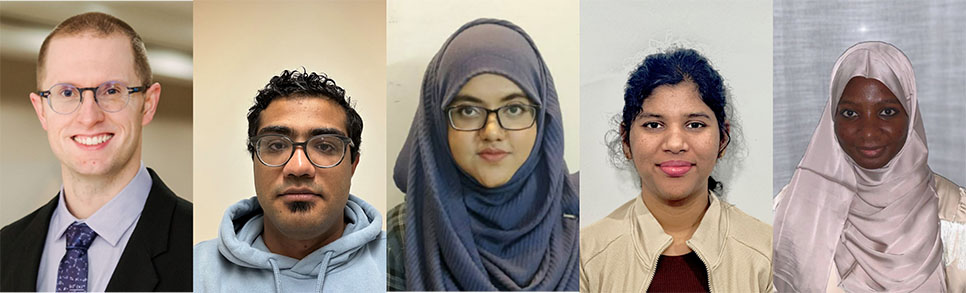
From left: Tyler Josephson, Kianoush Ramezani Shabolaghi, Samiha Sharlin, Charishma Puli, and Fariha Agbere. Photos courtesy of Tyler, Kianoush, Samiha, Charishma, and Fariha, respectively.
Collaborators:
Tyler Josephson, assistant professor
Kianoush Ramezani Shabolaghi, chemical engineering Ph.D. candidate
Samiha Sharlin, Ph.D. candidate
Charishma Puli, data science M.S. student
Fariha Agbere, chemical engineering B.S. student
ChemCatBio researchers are developing methods for upgrading biomass into a feedstock of mixed olefins, which can be upgraded into energy-dense sustainable aviation fuel using zeolite catalysts. However, questions remain on how the molecular shape of the catalyst - especially the porosity of the catalyst - affects the efficiency of those reactions.
In the past, quantum chemistry has been used to study such chemical reactions, but those methods are slow and expensive when scaled up to large systems. To speed up the rate of discovery, a team from the Department of Chemical, Biochemical, and Environmental Engineering at University of Maryland, Baltimore County are using machine learning to learn how the interactions work at the quantum chemistry scale.
"With our new methods, we aim to study larger systems and more realistic conditions," explained Tyler Josephson, the principal investigator, who was recently awarded a NSF career award. "If we can predict in the computer that this zeolite architecture works better than that zeolite architecture, that's useful information for experimentalists."
Josephson said that the project complements broader research work in the ATOMS Lab to bring machine learning and automated reasoning into chemical engineering.