Working to diversify and advance environmental science
UMBC, USGS and EPA sign new agreement
CBEE faculty, Dr. Claire Welty, Professor of Department of Chemical, Biochemical and Environmental Engineering and Director of Center for Urban Environmental Research and Education, Drs. Lee Blaney, Upal Ghosh, Chris Hennigan, Brian Reed, Claire Welty, are also affiliated with the Interdisciplinary Consortium for Applied Research in the Environment (ICARE) are beneficiaries of successful collaborations between the three organizations.
]]>
On a recent Friday, representatives of UMBC, the U.S. Geological Survey and the U.S. Environmental Protection Agency gathered in UMBC’s Albin O. Kuhn Library Gallery and pledged to work together...
https://dev.my.umbc.edu/api/v0/pixel/news/133435/guest@my.umbc.edu/fd829d8fd572efa3ed4d0ec8236f6fed/api/pixel
blaney
faculty
ghosh
hennigan
reed
research
spring-2023
welty
Chemical, Biochemical and Environmental Engineering
https://dev.my.umbc.edu/groups/cbee
https://assets4-dev.my.umbc.edu/system/shared/avatars/groups/000/000/771/b5e579e81b2e3624611890fa3ca2716a/xsmall.png?1746794587
https://assets2-dev.my.umbc.edu/system/shared/avatars/groups/000/000/771/b5e579e81b2e3624611890fa3ca2716a/original.png?1746794587
https://assets1-dev.my.umbc.edu/system/shared/avatars/groups/000/000/771/b5e579e81b2e3624611890fa3ca2716a/xxlarge.png?1746794587
https://assets2-dev.my.umbc.edu/system/shared/avatars/groups/000/000/771/b5e579e81b2e3624611890fa3ca2716a/xlarge.png?1746794587
https://assets2-dev.my.umbc.edu/system/shared/avatars/groups/000/000/771/b5e579e81b2e3624611890fa3ca2716a/large.png?1746794587
https://assets4-dev.my.umbc.edu/system/shared/avatars/groups/000/000/771/b5e579e81b2e3624611890fa3ca2716a/medium.png?1746794587
https://assets1-dev.my.umbc.edu/system/shared/avatars/groups/000/000/771/b5e579e81b2e3624611890fa3ca2716a/small.png?1746794587
https://assets4-dev.my.umbc.edu/system/shared/avatars/groups/000/000/771/b5e579e81b2e3624611890fa3ca2716a/xsmall.png?1746794587
https://assets1-dev.my.umbc.edu/system/shared/avatars/groups/000/000/771/b5e579e81b2e3624611890fa3ca2716a/xxsmall.png?1746794587
Chemical, Biochemical and Environmental Engineering
0
0
true
Thu, 11 May 2023 11:26:41 -0400
Ellington wins awards at 2023 CPRC-HDC Joint Spring Meeting
The Society of Environmental Toxicology and Chemistry 2nd Annual Hudson-Delaware & Chesapeake-Potomac Regional Chapter Joint Spring Meeting was held in Easton, Maryland from April 17 - 28, 2023.
In preparation for the 2023 CPRC-HDC Joint Spring Meeting, Marriah Ellington, M.S. chemical and biochemical engineering ' 23, received a travel award to attend the conference to presenter the research she conducted under the mentorship of Dr. Lee Blaney, Professor of Chemical, Biochemical and Environmental Engineering.
During the meeting, Ellington won the 2nd place poster presentation award for her poster titled "Improving transformation efficiency, recovery efficiency, and throughput for total oxidizable precursor analysis of PFAS in soil"
Authors: Marriah Ellington, Ke He, Margaret Siao, Jiabao Liang, Lee Blaney
Abstract: Per- and polyfluoroalkyl substances (PFAS) comprise more than 10,000 compounds with variable physicochemical properties. Targeted analytical approaches require standards that are limited, expensive, or unavailable. The total oxidizable precursor (TOP) assay represents one option to address the complexity associated with unknown PFAS precursors. In particular, the TOP assay transforms precursors into perfluoroalkyl acid (PFAA) endpoints via hydroxyl and sulfate radical-driven reactions. Solid samples, such as soil, sediment, and biosolids, contain high concentrations of reactive species scavengers that inhibit precursor oxidation; furthermore, PFAS extraction from solids involves solvent addition, which increases the potential for reactive species scavenging and necessitates further processing steps. The objective of this work was to improve the transformation efficiency, recovery efficiency, and throughput of the TOP assay for soil samples. Recovery efficiency was tracked via mass-labeled PFAA surrogates, which were not oxidized in TOP. Transformation efficiency was evaluated by introducing the M8-PFOSA surrogate standard into the original sample before extraction. PFAS, precursors, and mass-labeled surrogates were extracted with methanol, and the extracts were diluted with deionized water to 20% methanol. To improve transformation efficiency, solid-phase extraction with weak-anion exchange cartridges was used to remove background organic matter. Precursors were eluted with acetonitrile, evaporated, and reconstituted with TOP reagents. After 24 h at 85 °C, the PFAA end-products were present in saline water, affecting analytical compatibility and complicating enrichment. A QuEChERS extraction was employed by adding acetonitrile, magnesium sulfate, and sodium chloride. The acetonitrile-based extract was evaporated, reconstituted with internal standards, and analyzed for targeted PFAS. Recovery efficiency was dependent on chain length and ranged from 64 to 115%. The M8-PFOSA transformation efficiency was greater than 75% for over 20 soil samples from a PFAS-impacted site. Results showed ng g-1 quantitation of over 30 PFAS, highlighting the strong performance of this modified TOP assay for real solid samples.
]]>
The Society of Environmental Toxicology and Chemistry 2nd Annual Hudson-Delaware & Chesapeake-Potomac Regional Chapter Joint Spring Meeting was held in Easton, Maryland from April 17 - 28,...
https://dev.my.umbc.edu/api/v0/pixel/news/133356/guest@my.umbc.edu/8e326e4445bce880c5515e0e3d6fdb99/api/pixel
award
blaney
faculty
grad
spring-2023
Chemical, Biochemical and Environmental Engineering
https://dev.my.umbc.edu/groups/cbee
https://assets4-dev.my.umbc.edu/system/shared/avatars/groups/000/000/771/b5e579e81b2e3624611890fa3ca2716a/xsmall.png?1746794587
https://assets2-dev.my.umbc.edu/system/shared/avatars/groups/000/000/771/b5e579e81b2e3624611890fa3ca2716a/original.png?1746794587
https://assets1-dev.my.umbc.edu/system/shared/avatars/groups/000/000/771/b5e579e81b2e3624611890fa3ca2716a/xxlarge.png?1746794587
https://assets2-dev.my.umbc.edu/system/shared/avatars/groups/000/000/771/b5e579e81b2e3624611890fa3ca2716a/xlarge.png?1746794587
https://assets2-dev.my.umbc.edu/system/shared/avatars/groups/000/000/771/b5e579e81b2e3624611890fa3ca2716a/large.png?1746794587
https://assets4-dev.my.umbc.edu/system/shared/avatars/groups/000/000/771/b5e579e81b2e3624611890fa3ca2716a/medium.png?1746794587
https://assets1-dev.my.umbc.edu/system/shared/avatars/groups/000/000/771/b5e579e81b2e3624611890fa3ca2716a/small.png?1746794587
https://assets4-dev.my.umbc.edu/system/shared/avatars/groups/000/000/771/b5e579e81b2e3624611890fa3ca2716a/xsmall.png?1746794587
https://assets1-dev.my.umbc.edu/system/shared/avatars/groups/000/000/771/b5e579e81b2e3624611890fa3ca2716a/xxsmall.png?1746794587
Chemical, Biochemical and Environmental Engineering
https://assets2-dev.my.umbc.edu/system/shared/thumbnails/news/000/133/356/dc21b508147255d7f6deda0eccd1fad1/xxlarge.jpg?1683648095
https://assets2-dev.my.umbc.edu/system/shared/thumbnails/news/000/133/356/dc21b508147255d7f6deda0eccd1fad1/xlarge.jpg?1683648095
https://assets1-dev.my.umbc.edu/system/shared/thumbnails/news/000/133/356/dc21b508147255d7f6deda0eccd1fad1/large.jpg?1683648095
https://assets2-dev.my.umbc.edu/system/shared/thumbnails/news/000/133/356/dc21b508147255d7f6deda0eccd1fad1/medium.jpg?1683648095
https://assets2-dev.my.umbc.edu/system/shared/thumbnails/news/000/133/356/dc21b508147255d7f6deda0eccd1fad1/small.jpg?1683648095
https://assets1-dev.my.umbc.edu/system/shared/thumbnails/news/000/133/356/dc21b508147255d7f6deda0eccd1fad1/xsmall.jpg?1683648095
https://assets4-dev.my.umbc.edu/system/shared/thumbnails/news/000/133/356/dc21b508147255d7f6deda0eccd1fad1/xxsmall.jpg?1683648095
3
0
true
Tue, 09 May 2023 11:37:04 -0400
Wed, 10 May 2023 10:17:51 -0400
CBEE students win regional AIChE Jeopardy competition
Team qualifies for National competition, four years running
UMBC chemical engineering students win first place in the 2023 Mid-Atlantic Regional AIChE ChemE Jeopardy Competition. Thus, qualifying for the 2023 National AIChE ChemE Jeopardy Competition in Orlando, FL in November as part of the AIChE National Conference. This is the fourth year in a row a UMBC team qualified for the National AIChE ChemE Jeopardy Competition.
Eighteen teams competed during the AIChE ChemE Jeopardy Mid-Atlantic Competition held at Virginia Tech in Blacksburg, VA, including two teams from UMBC. After the preliminary rounds, the UMBC teams placed first and second in the semi-finals, tied at 9 points each. The semifinal round was a knockout round, and UMBC’s ‘Team One’ advanced to the finals. The final round of competition was between UMBC, Johns Hopkins University (2nd place) and Stony Brook University (3rd place).
The success of both teams is the result of consistent hard work and support from the teams’ faculty advisors are Dr. Neha Raikar and Dr. Mariajosé Castellanos as well as other students. Taylor deSilva, chemical engineering ‘23, is instrumental in preparing the teams for competition by organizing weekly practices including setting up sample game boards.
Team One
- Ethan Banks, chemical engineering, traditional track ‘24
- Paul Loberg, chemical engineering, biotechnology and bioengineering track ‘24
- Max Bobbin, chemical engineering, environmental engineering & sustainability track ‘23
- Catherine Wraback - chemical engineering, traditional track ‘23
Team Two
- Pavan Umashankar, chemical engineering, biotechnology and bioengineering track ‘24
- Colin Jones, chemical engineering, biotechnology and bioengineering track ‘25
- Jacob Craft, chemical engineering, environmental engineering & sustainability track ‘24
- Zachary Bogart, chemical engineering, environmental engineering & sustainability track ‘23
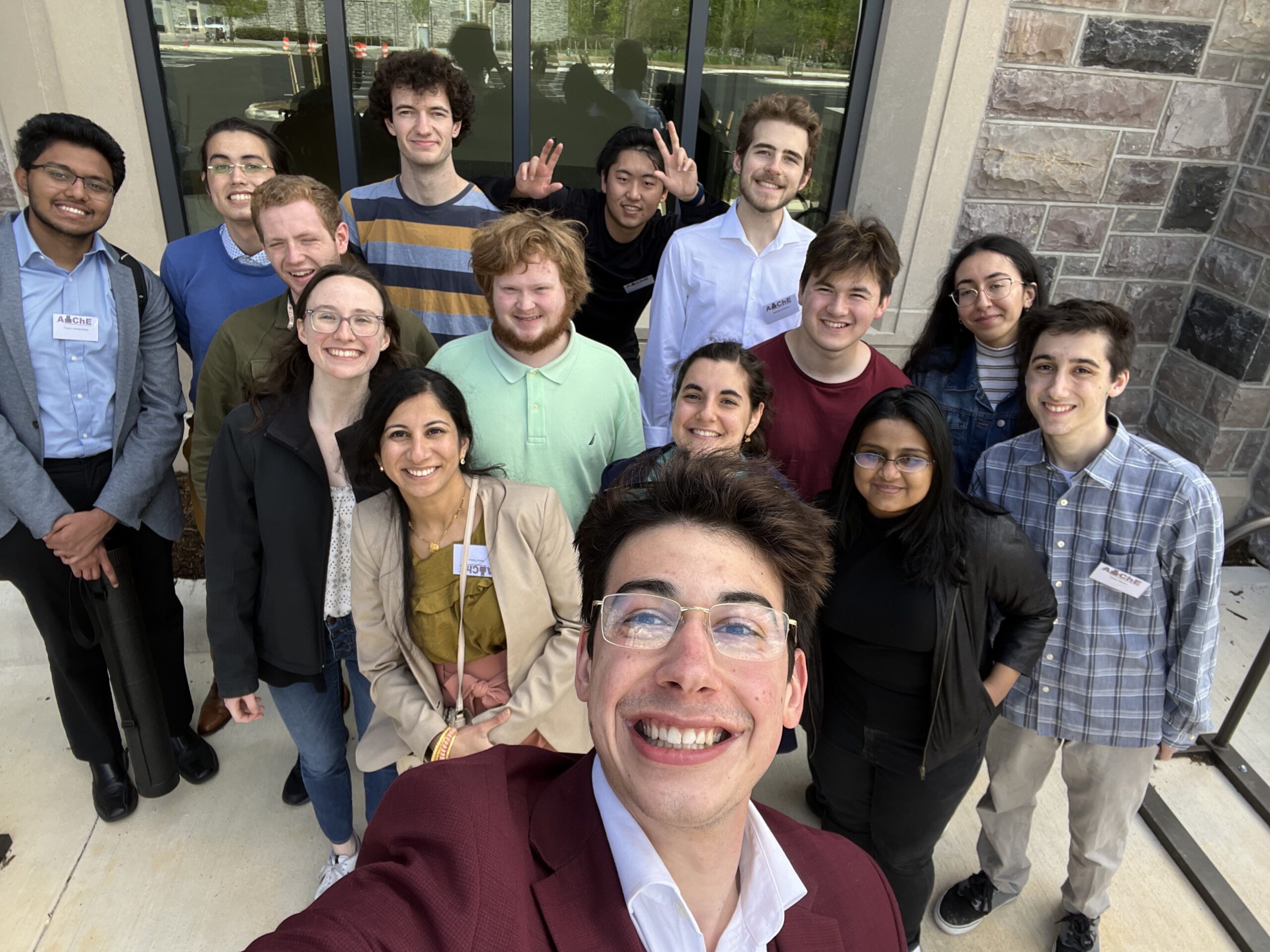
UMBC CBEE students and advisor at the AIChE 2023 Mid-Atlantic Student Regional Conference, April 22-23
Photo Credit: Max Bobbin
Back to front; Pavan Umashankar, Paul Loberg, Caton , David Ni, Zachary Bogart, Ben Willing, Catherine Wraback, Jacob Craft, Colin Jones, Neha Sian, Dr. Neha Raikar, Sarah Donyaee, Afrah Ahmed, Ethan Banks, Max Bobbin.
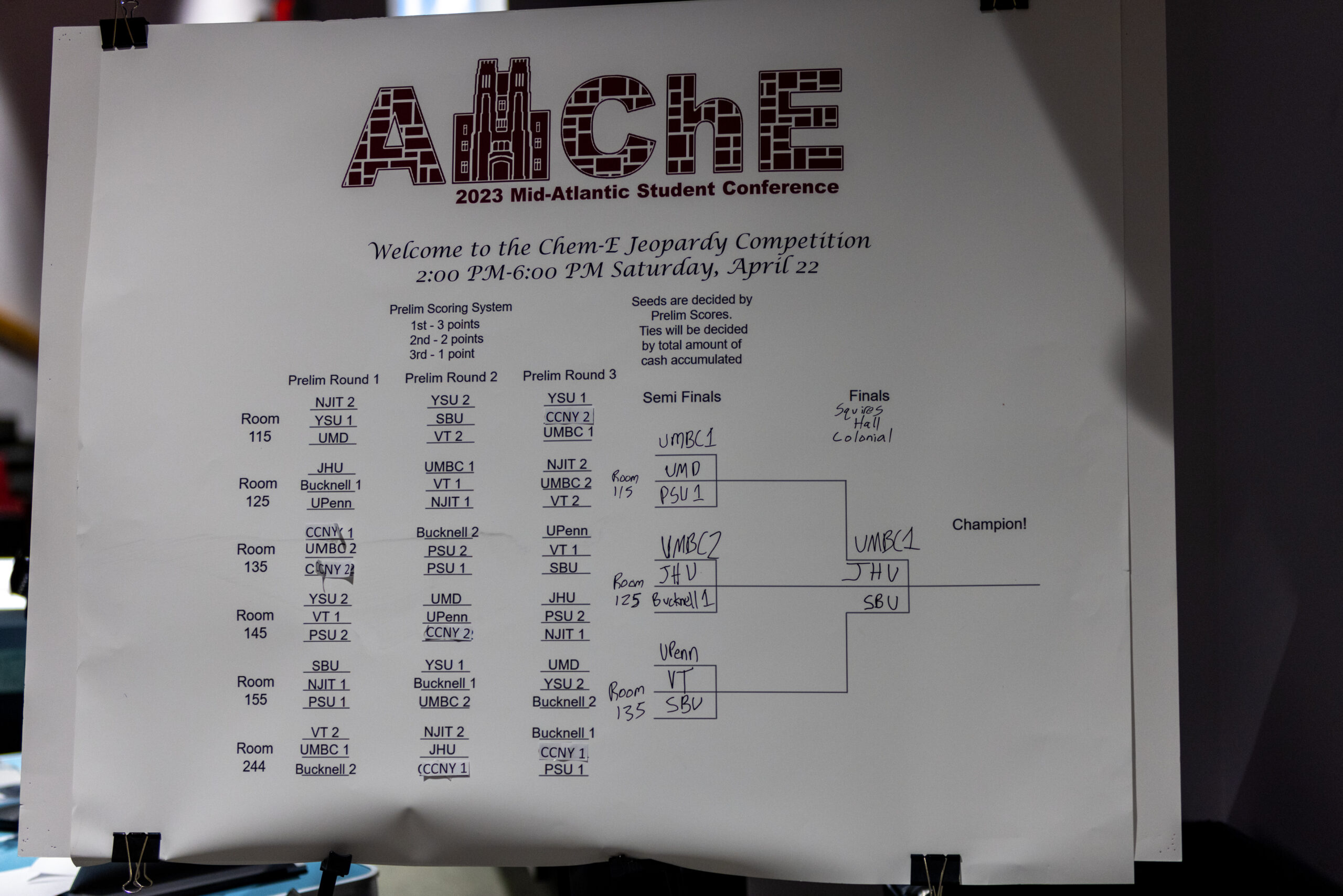
AIChE Conference Chem-E Jeopardy Competition Bracket
UMBC teams placed 1st and 2nd in the Semi Finals round, tied at 9 points.
]]>
UMBC chemical engineering students win first place in the 2023 Mid-Atlantic Regional AIChE ChemE Jeopardy Competition. Thus, qualifying for the 2023 National AIChE ChemE Jeopardy Competition in...
https://dev.my.umbc.edu/api/v0/pixel/news/132968/guest@my.umbc.edu/b383b0d62af4910bf3fa3b38d89da732/api/pixel
castellanos
faculty
jeopardy
raikar
ug
ugrad
Chemical, Biochemical and Environmental Engineering
https://dev.my.umbc.edu/groups/cbee
https://assets4-dev.my.umbc.edu/system/shared/avatars/groups/000/000/771/b5e579e81b2e3624611890fa3ca2716a/xsmall.png?1746794587
https://assets2-dev.my.umbc.edu/system/shared/avatars/groups/000/000/771/b5e579e81b2e3624611890fa3ca2716a/original.png?1746794587
https://assets1-dev.my.umbc.edu/system/shared/avatars/groups/000/000/771/b5e579e81b2e3624611890fa3ca2716a/xxlarge.png?1746794587
https://assets2-dev.my.umbc.edu/system/shared/avatars/groups/000/000/771/b5e579e81b2e3624611890fa3ca2716a/xlarge.png?1746794587
https://assets2-dev.my.umbc.edu/system/shared/avatars/groups/000/000/771/b5e579e81b2e3624611890fa3ca2716a/large.png?1746794587
https://assets4-dev.my.umbc.edu/system/shared/avatars/groups/000/000/771/b5e579e81b2e3624611890fa3ca2716a/medium.png?1746794587
https://assets1-dev.my.umbc.edu/system/shared/avatars/groups/000/000/771/b5e579e81b2e3624611890fa3ca2716a/small.png?1746794587
https://assets4-dev.my.umbc.edu/system/shared/avatars/groups/000/000/771/b5e579e81b2e3624611890fa3ca2716a/xsmall.png?1746794587
https://assets1-dev.my.umbc.edu/system/shared/avatars/groups/000/000/771/b5e579e81b2e3624611890fa3ca2716a/xxsmall.png?1746794587
Chemical, Biochemical and Environmental Engineering
https://assets1-dev.my.umbc.edu/system/shared/thumbnails/news/000/132/968/0776e7de98944c15b7a6b61fe85e0199/xxlarge.jpg?1682511687
https://assets3-dev.my.umbc.edu/system/shared/thumbnails/news/000/132/968/0776e7de98944c15b7a6b61fe85e0199/xlarge.jpg?1682511687
https://assets1-dev.my.umbc.edu/system/shared/thumbnails/news/000/132/968/0776e7de98944c15b7a6b61fe85e0199/large.jpg?1682511687
https://assets4-dev.my.umbc.edu/system/shared/thumbnails/news/000/132/968/0776e7de98944c15b7a6b61fe85e0199/medium.jpg?1682511687
https://assets4-dev.my.umbc.edu/system/shared/thumbnails/news/000/132/968/0776e7de98944c15b7a6b61fe85e0199/small.jpg?1682511687
https://assets1-dev.my.umbc.edu/system/shared/thumbnails/news/000/132/968/0776e7de98944c15b7a6b61fe85e0199/xsmall.jpg?1682511687
https://assets3-dev.my.umbc.edu/system/shared/thumbnails/news/000/132/968/0776e7de98944c15b7a6b61fe85e0199/xxsmall.jpg?1682511687
0
0
true
Wed, 26 Apr 2023 09:08:00 -0400
Wed, 26 Apr 2023 21:13:29 -0400
A new way to make a virus-fighting protein could save lives
A new way to make a virus-fighting protein could save lives during the next pandemic
The quick and portable production process, described in a newly accepted paper in the journal New Biotechnology, could be easily deployed at the source of a future virus outbreak
A multidisciplinary research team has produced a promising virus-fighting protein using a quick, portable process that could be easily deployed at the source of a future virus outbreak. The team includes researchers from the University of Maryland, Baltimore County (UMBC), Stanford University, the National Cancer Institute (NCI) and the National Center for Advanced Translational Science. The research has been accepted for publication in the journal New Biotechnology.
Griffithsin is a protein originally isolated from red algae. More than a decade ago, researchers in the Molecular Targets Program of the NCI discovered it could protect cells from the HIV virus and it is now in Phase 1 clinical trials in humans. Griffithsin sticks to the surface glycoproteins of certain viruses, making it difficult for the virus to enter host cells. (Glycoproteins are proteins with sugar molecules on them.)
“It’s like taking clay and sticking it to the prongs of an electrical plug to prevent it from entering a socket,” says Govind Rao, a professor of chemical and biochemical engineering at UMBC who is one of the lead researchers on the project. The protein disables a wide range of viruses, including the virus that causes COVID-19.
Medicines that are made with biological molecules like griffithsin are called biologics. They are normally manufactured in huge batches using living cells such as E.coli bacteria. (The cells are given DNA-encoded instructions for how to make the medicine.) However, that method has drawbacks, including the need to keep the cells alive.
Rao and his colleagues developed a method to manufacture griffithsin that does not require living cells. Instead, the researchers take the protein-manufacturing “guts” out of the cells. Into this soup of cellular components, they then add the DNA instructions for making griffithsin, along with the needed molecular building blocks.
“The cellular machinery still works, even without a living cell to support it,” says Rao. “The method is simple and effective.”
Using cell-free manufacturing methods, the researchers produced significant quantities of griffithsin in less than 24 hours. They purified the protein to strict standards and demonstrated in lab experiments that it could disable both HIV and SARS-CoV-2 virusesas effectively as the same griffithsin protein made by living cells.
The researchers envision that the method could be quickly deployed to make antiviral medicine at the origin of disease outbreaks. The method could be easily adapted to work with a portable, suitcase-sized biologics manufacturing device, dubbed Bio-MOD, that Rao and a team of mostly UMBC researchers recently developed. They described the device in a 2018 paper in the journal Nature Biomedical Engineering.
The new griffithsin protein manufacturing process together with the portable Bio-MOD device could be a powerful weapon to quickly combat new viruses before they spread.
]]>
NEWS RELEASE 12-APR-2023 A new way to make a virus-fighting protein could save lives during the next pandemic The quick and portable production process, described in a newly accepted...
https://dev.my.umbc.edu/api/v0/pixel/news/132718/guest@my.umbc.edu/016eb6e1310d898946b0551a5b5e0530/api/pixel
faculty
rao
spring-2023
Chemical, Biochemical and Environmental Engineering
https://dev.my.umbc.edu/groups/cbee
https://assets4-dev.my.umbc.edu/system/shared/avatars/groups/000/000/771/b5e579e81b2e3624611890fa3ca2716a/xsmall.png?1746794587
https://assets2-dev.my.umbc.edu/system/shared/avatars/groups/000/000/771/b5e579e81b2e3624611890fa3ca2716a/original.png?1746794587
https://assets1-dev.my.umbc.edu/system/shared/avatars/groups/000/000/771/b5e579e81b2e3624611890fa3ca2716a/xxlarge.png?1746794587
https://assets2-dev.my.umbc.edu/system/shared/avatars/groups/000/000/771/b5e579e81b2e3624611890fa3ca2716a/xlarge.png?1746794587
https://assets2-dev.my.umbc.edu/system/shared/avatars/groups/000/000/771/b5e579e81b2e3624611890fa3ca2716a/large.png?1746794587
https://assets4-dev.my.umbc.edu/system/shared/avatars/groups/000/000/771/b5e579e81b2e3624611890fa3ca2716a/medium.png?1746794587
https://assets1-dev.my.umbc.edu/system/shared/avatars/groups/000/000/771/b5e579e81b2e3624611890fa3ca2716a/small.png?1746794587
https://assets4-dev.my.umbc.edu/system/shared/avatars/groups/000/000/771/b5e579e81b2e3624611890fa3ca2716a/xsmall.png?1746794587
https://assets1-dev.my.umbc.edu/system/shared/avatars/groups/000/000/771/b5e579e81b2e3624611890fa3ca2716a/xxsmall.png?1746794587
Chemical, Biochemical and Environmental Engineering
0
0
true
Mon, 17 Apr 2023 15:50:33 -0400
Mon, 17 Apr 2023 15:52:38 -0400
Dr. Josephson interviewed on Quirks & Quarks
Dr. Tyler Josephson, assistant professor of Chemical, Biochemical and Environmental Engineering at UMBC, is interviewed on Canadian Broadcasting Corporation science show "Quirks and Quarks".
Humans are no longer the only ones capable of making scientific discoveries. Kepler's third law of planetary motion has been re-discovered centuries after it was first described – but this time, an artificial intelligence system is taking the credit.
Dubbed AI-Descartes, this "AI scientist" was developed by a team of researchers from IBM Research, Samsung AI, and the University of Maryland, Baltimore County (UMBC).
"I think scientists have so many different problems to solve. And if we solve them faster with AI, they just open up brand new questions for us to go after next," Tyler Josephson told Quirks & Quarks host Bob McDonald.
FULL ARTICLE & PODCAST :
Image Credit:
Artist's concept of our solar system showing a sense of scale and distance.
The planets and dwarf planet Pluto are shown in their correct order of distance from the sun, their correct relative sizes and their correct relative orbital distances. The sizes of the bodies are greatly exaggerated relative to the orbital distances.
The faint rings of Jupiter, Uranus and Neptune are not shown. Eris, Haumea and Makemake do not appear in the illustration owing to their highly tilted orbits. The dwarf planet Ceres is not shown separately; it resides in the asteroid belt between Mars and Jupiter.
#BBD0E0 »
]]>
Dr. Tyler Josephson, assistant professor of Chemical, Biochemical and Environmental Engineering at UMBC, is interviewed on Canadian Broadcasting Corporation science show "Quirks and Quarks". ...
https://dev.my.umbc.edu/api/v0/pixel/news/132687/guest@my.umbc.edu/ccedc3deaf1efc87ccfd7e85fc6b3ed3/api/pixel
faculty
josephson
spring-2023
Chemical, Biochemical and Environmental Engineering
https://dev.my.umbc.edu/groups/cbee
https://assets4-dev.my.umbc.edu/system/shared/avatars/groups/000/000/771/b5e579e81b2e3624611890fa3ca2716a/xsmall.png?1746794587
https://assets2-dev.my.umbc.edu/system/shared/avatars/groups/000/000/771/b5e579e81b2e3624611890fa3ca2716a/original.png?1746794587
https://assets1-dev.my.umbc.edu/system/shared/avatars/groups/000/000/771/b5e579e81b2e3624611890fa3ca2716a/xxlarge.png?1746794587
https://assets2-dev.my.umbc.edu/system/shared/avatars/groups/000/000/771/b5e579e81b2e3624611890fa3ca2716a/xlarge.png?1746794587
https://assets2-dev.my.umbc.edu/system/shared/avatars/groups/000/000/771/b5e579e81b2e3624611890fa3ca2716a/large.png?1746794587
https://assets4-dev.my.umbc.edu/system/shared/avatars/groups/000/000/771/b5e579e81b2e3624611890fa3ca2716a/medium.png?1746794587
https://assets1-dev.my.umbc.edu/system/shared/avatars/groups/000/000/771/b5e579e81b2e3624611890fa3ca2716a/small.png?1746794587
https://assets4-dev.my.umbc.edu/system/shared/avatars/groups/000/000/771/b5e579e81b2e3624611890fa3ca2716a/xsmall.png?1746794587
https://assets1-dev.my.umbc.edu/system/shared/avatars/groups/000/000/771/b5e579e81b2e3624611890fa3ca2716a/xxsmall.png?1746794587
Chemical, Biochemical and Environmental Engineering
https://assets2-dev.my.umbc.edu/system/shared/thumbnails/news/000/132/687/3e8773a5d2f360213b09c01c950245f3/xxlarge.jpg?1681742769
https://assets4-dev.my.umbc.edu/system/shared/thumbnails/news/000/132/687/3e8773a5d2f360213b09c01c950245f3/xlarge.jpg?1681742769
https://assets4-dev.my.umbc.edu/system/shared/thumbnails/news/000/132/687/3e8773a5d2f360213b09c01c950245f3/large.jpg?1681742769
https://assets4-dev.my.umbc.edu/system/shared/thumbnails/news/000/132/687/3e8773a5d2f360213b09c01c950245f3/medium.jpg?1681742769
https://assets3-dev.my.umbc.edu/system/shared/thumbnails/news/000/132/687/3e8773a5d2f360213b09c01c950245f3/small.jpg?1681742769
https://assets2-dev.my.umbc.edu/system/shared/thumbnails/news/000/132/687/3e8773a5d2f360213b09c01c950245f3/xsmall.jpg?1681742769
https://assets4-dev.my.umbc.edu/system/shared/thumbnails/news/000/132/687/3e8773a5d2f360213b09c01c950245f3/xxsmall.jpg?1681742769
0
0
true
Mon, 17 Apr 2023 10:46:33 -0400
Dr. Josephson collaborates to develop new AI scientist
Dr. Tyler Josephson, assistant professor of Chemical, Biochemical and Environmental Engineering at UMBC, in collaboration with researchers at IBM Research, Samsung AI, developed AI-Descartes, a new AI scientist, which reproduced key parts of Nobel Prize-winning work, including Langmuir’s gas behavior equations and Kepler’s third law of planetary motion. Supported by the Defense Advanced Research Projects Agency (DARPA), the AI system utilizes symbolic regression to find equations fitting data, and its most distinctive feature is its logical reasoning ability. This enables AI-Descartes to determine which equations best fit with background scientific theory. The system is particularly effective with noisy, real-world data and small data sets. The team is working on creating new datasets and training computers to read scientific papers and construct background theories to refine and expand the system’s capabilities.
READ FULL ARTICLE:
JOURNAL ARTICLE:
]]>
Dr. Tyler Josephson, assistant professor of Chemical, Biochemical and Environmental Engineering at UMBC, in collaboration with researchers at IBM Research, Samsung AI, developed AI-Descartes, a...
https://dev.my.umbc.edu/api/v0/pixel/news/132684/guest@my.umbc.edu/1f92d6cf7bfd00964acc86cc9a25d44a/api/pixel
faculty
josephson
spring-2023
Chemical, Biochemical and Environmental Engineering
https://dev.my.umbc.edu/groups/cbee
https://assets4-dev.my.umbc.edu/system/shared/avatars/groups/000/000/771/b5e579e81b2e3624611890fa3ca2716a/xsmall.png?1746794587
https://assets2-dev.my.umbc.edu/system/shared/avatars/groups/000/000/771/b5e579e81b2e3624611890fa3ca2716a/original.png?1746794587
https://assets1-dev.my.umbc.edu/system/shared/avatars/groups/000/000/771/b5e579e81b2e3624611890fa3ca2716a/xxlarge.png?1746794587
https://assets2-dev.my.umbc.edu/system/shared/avatars/groups/000/000/771/b5e579e81b2e3624611890fa3ca2716a/xlarge.png?1746794587
https://assets2-dev.my.umbc.edu/system/shared/avatars/groups/000/000/771/b5e579e81b2e3624611890fa3ca2716a/large.png?1746794587
https://assets4-dev.my.umbc.edu/system/shared/avatars/groups/000/000/771/b5e579e81b2e3624611890fa3ca2716a/medium.png?1746794587
https://assets1-dev.my.umbc.edu/system/shared/avatars/groups/000/000/771/b5e579e81b2e3624611890fa3ca2716a/small.png?1746794587
https://assets4-dev.my.umbc.edu/system/shared/avatars/groups/000/000/771/b5e579e81b2e3624611890fa3ca2716a/xsmall.png?1746794587
https://assets1-dev.my.umbc.edu/system/shared/avatars/groups/000/000/771/b5e579e81b2e3624611890fa3ca2716a/xxsmall.png?1746794587
Chemical, Biochemical and Environmental Engineering
https://assets3-dev.my.umbc.edu/system/shared/thumbnails/news/000/132/684/0ca47d4f916e30560088c0788ae54826/xxlarge.jpg?1681741753
https://assets3-dev.my.umbc.edu/system/shared/thumbnails/news/000/132/684/0ca47d4f916e30560088c0788ae54826/xlarge.jpg?1681741753
https://assets2-dev.my.umbc.edu/system/shared/thumbnails/news/000/132/684/0ca47d4f916e30560088c0788ae54826/large.jpg?1681741753
https://assets3-dev.my.umbc.edu/system/shared/thumbnails/news/000/132/684/0ca47d4f916e30560088c0788ae54826/medium.jpg?1681741753
https://assets1-dev.my.umbc.edu/system/shared/thumbnails/news/000/132/684/0ca47d4f916e30560088c0788ae54826/small.jpg?1681741753
https://assets3-dev.my.umbc.edu/system/shared/thumbnails/news/000/132/684/0ca47d4f916e30560088c0788ae54826/xsmall.jpg?1681741753
https://assets3-dev.my.umbc.edu/system/shared/thumbnails/news/000/132/684/0ca47d4f916e30560088c0788ae54826/xxsmall.jpg?1681741753
0
0
true
Mon, 17 Apr 2023 10:31:05 -0400
Dr. Rao featured on the Finding Genius Podcast
Exploring The Next Generation Of Therapeutics
How To Develop Safe And Effective Medications | Exploring The Next Generation Of Therapeutics
What will the next generation of medicine production look like? Dr. Govind Rao is a Professor of Chemical and Biochemical Engineering, and the Director of the Center for Advanced Sensor Technology at the University of Maryland Baltimore County (UMBC) joins us today to discuss the importance of constructing safe and effective medications – standards that are harder to reach than one may think…
Listen to Govind Rao here: bit.ly/3KdhTr7
Episode also available on Apple Podcasts: apple.co/30PvU9C
]]>
How To Develop Safe And Effective Medications | Exploring The Next Generation Of Therapeutics What will the next generation of medicine production look like? Dr. Govind Rao is a Professor of...
https://dev.my.umbc.edu/api/v0/pixel/news/132410/guest@my.umbc.edu/86862dd7fed79c025811348ba349e821/api/pixel
faculty
rao
spring-2023
Chemical, Biochemical and Environmental Engineering
https://dev.my.umbc.edu/groups/cbee
https://assets4-dev.my.umbc.edu/system/shared/avatars/groups/000/000/771/b5e579e81b2e3624611890fa3ca2716a/xsmall.png?1746794587
https://assets2-dev.my.umbc.edu/system/shared/avatars/groups/000/000/771/b5e579e81b2e3624611890fa3ca2716a/original.png?1746794587
https://assets1-dev.my.umbc.edu/system/shared/avatars/groups/000/000/771/b5e579e81b2e3624611890fa3ca2716a/xxlarge.png?1746794587
https://assets2-dev.my.umbc.edu/system/shared/avatars/groups/000/000/771/b5e579e81b2e3624611890fa3ca2716a/xlarge.png?1746794587
https://assets2-dev.my.umbc.edu/system/shared/avatars/groups/000/000/771/b5e579e81b2e3624611890fa3ca2716a/large.png?1746794587
https://assets4-dev.my.umbc.edu/system/shared/avatars/groups/000/000/771/b5e579e81b2e3624611890fa3ca2716a/medium.png?1746794587
https://assets1-dev.my.umbc.edu/system/shared/avatars/groups/000/000/771/b5e579e81b2e3624611890fa3ca2716a/small.png?1746794587
https://assets4-dev.my.umbc.edu/system/shared/avatars/groups/000/000/771/b5e579e81b2e3624611890fa3ca2716a/xsmall.png?1746794587
https://assets1-dev.my.umbc.edu/system/shared/avatars/groups/000/000/771/b5e579e81b2e3624611890fa3ca2716a/xxsmall.png?1746794587
Chemical, Biochemical and Environmental Engineering
https://assets4-dev.my.umbc.edu/system/shared/thumbnails/news/000/132/410/89429e811bdc37d6476cd41cab63fd73/xxlarge.jpg?1680874550
https://assets2-dev.my.umbc.edu/system/shared/thumbnails/news/000/132/410/89429e811bdc37d6476cd41cab63fd73/xlarge.jpg?1680874550
https://assets1-dev.my.umbc.edu/system/shared/thumbnails/news/000/132/410/89429e811bdc37d6476cd41cab63fd73/large.jpg?1680874550
https://assets4-dev.my.umbc.edu/system/shared/thumbnails/news/000/132/410/89429e811bdc37d6476cd41cab63fd73/medium.jpg?1680874550
https://assets3-dev.my.umbc.edu/system/shared/thumbnails/news/000/132/410/89429e811bdc37d6476cd41cab63fd73/small.jpg?1680874550
https://assets3-dev.my.umbc.edu/system/shared/thumbnails/news/000/132/410/89429e811bdc37d6476cd41cab63fd73/xsmall.jpg?1680874550
https://assets3-dev.my.umbc.edu/system/shared/thumbnails/news/000/132/410/89429e811bdc37d6476cd41cab63fd73/xxsmall.jpg?1680874550
0
0
true
Fri, 07 Apr 2023 09:37:10 -0400
Dr. Ghosh interviewed about cleanup from derailment spill
Dr. Ghosh provided his expert opinion on the wastewater treatment from the Norfolk Southern derailment spill. The article "
With risk of Ohio toxic waste uncertain, Mayor Scott found a way to block the deal" by Emily Sullivan was publish in the
Baltimore Banner.
Dr. Ghosh is a professor of chemical, biochemical, and environmental engineering at UMBC, where his research group explores the fundamental processes that control pollutant fate in soils, sediments, and aquatic environments.
]]>
Dr. Ghosh provided his expert opinion on the wastewater treatment from the Norfolk Southern derailment spill. The article "With risk of Ohio toxic waste uncertain, Mayor Scott found a way to block...
https://dev.my.umbc.edu/api/v0/pixel/news/132239/guest@my.umbc.edu/78b30585cb9bde12d8b75bbebe8cdacb/api/pixel
faculty
ghosh
news
Chemical, Biochemical and Environmental Engineering
https://dev.my.umbc.edu/groups/cbee
https://assets4-dev.my.umbc.edu/system/shared/avatars/groups/000/000/771/b5e579e81b2e3624611890fa3ca2716a/xsmall.png?1746794587
https://assets2-dev.my.umbc.edu/system/shared/avatars/groups/000/000/771/b5e579e81b2e3624611890fa3ca2716a/original.png?1746794587
https://assets1-dev.my.umbc.edu/system/shared/avatars/groups/000/000/771/b5e579e81b2e3624611890fa3ca2716a/xxlarge.png?1746794587
https://assets2-dev.my.umbc.edu/system/shared/avatars/groups/000/000/771/b5e579e81b2e3624611890fa3ca2716a/xlarge.png?1746794587
https://assets2-dev.my.umbc.edu/system/shared/avatars/groups/000/000/771/b5e579e81b2e3624611890fa3ca2716a/large.png?1746794587
https://assets4-dev.my.umbc.edu/system/shared/avatars/groups/000/000/771/b5e579e81b2e3624611890fa3ca2716a/medium.png?1746794587
https://assets1-dev.my.umbc.edu/system/shared/avatars/groups/000/000/771/b5e579e81b2e3624611890fa3ca2716a/small.png?1746794587
https://assets4-dev.my.umbc.edu/system/shared/avatars/groups/000/000/771/b5e579e81b2e3624611890fa3ca2716a/xsmall.png?1746794587
https://assets1-dev.my.umbc.edu/system/shared/avatars/groups/000/000/771/b5e579e81b2e3624611890fa3ca2716a/xxsmall.png?1746794587
Chemical, Biochemical and Environmental Engineering
0
0
true
Tue, 04 Apr 2023 08:26:15 -0400
Enhancing Remediation Technology to Clean Up Contaminants
15 years of research and translation lead by Dr. Ghosh
The National Institute of Environmental Health Sciences (NIEHS) published a feature on Dr. Ghosh's research and translation over the last 15 years funded through the R01 program. Dr. Ghosh is a professor of chemical, biochemical, and environmental engineering at UMBC, where his research group explores the fundamental processes that control pollutant fate in soils, sediments, and aquatic environments.
By exploring how chemical contaminants move through the environment and affect aquatic food webs, Upal Ghosh, Ph.D., of the University of Maryland, Baltimore County (UMBC), aims to develop and implement technologies to help ecosystems recover from pollution.
With consistent NIEHS funding since 2007, Ghosh studies contaminants called polychlorinated biphenyls (PCBs), which can build up in organisms over time and along the food chain. Ghosh assesses pollutant bioavailability, or the amount of a contaminant available for uptake by fish and other organisms, with a particular focus on PCBs.
“During my undergraduate studies in chemical engineering, I got to visit different industrial sites and understand how we produce chemicals in bulk,” Ghosh said. “Although chemical industries provide many benefits for people — producing thousands of consumer products we use today — I was disappointed to see the problems that occur when chemicals like PCBs are mismanaged and enter the environment.”
His goal is to use nature-based strategies to clean up contaminants and reduce exposures in aquatic organisms and humans alike.
PCBs Pose a Public Health Issue
PCBs are a group of chemicals formerly used in many industrial and consumer products, such as electrical equipment, insulation, paint, and plastics. Although the federal government banned PCB production in 1979, the compounds persist in soils, sediments, and water bodies due to their stable chemical structure.
Exposure to PCBs has been associated with a wide variety of health effects, including liver problems, poor birth outcomes, hormone disruption, and cancer. In general, people are exposed to PCBs by eating contaminated fish, meat, or dairy products.
“If we can limit the amount of PCBs bioavailable to fish, we can also help protect human health,” Ghosh explained.
To better understand PCB accumulation in organisms, Ghosh’s team has been studying the Anacostia River in Washington, D.C., which faces ongoing PCB contamination. The river’s long history of urbanization and industrialization has resulted in pollution, poor water quality, and contaminated sediments in the riverbed.
The team deployed passive samplers and freshwater mussels into the Anacostia River as dual methods to identify PCB sources. Mussels are sedentary, long-lived filter feeders that have been shown to accumulate contaminants without metabolizing them. They then developed models to accurately predict PCB accumulation in mussels and different fish species in the river.
According to Ghosh, this research demonstrated that controlling ongoing PCB inputs from one heavily impacted tributary was critical for the reduction of PCB levels in fish.
“At many contaminated sites, we found that PCB hotspots were located near disadvantaged communities, which poses an environmental justice and health equity issue for the people who live there,” Ghosh said.
read full article
image credits:
Photo courtesy of Upal Ghosh
]]>
The National Institute of Environmental Health Sciences (NIEHS) published a feature on Dr. Ghosh's research and translation over the last 15 years funded through the R01 program. Dr. Ghosh is a...
https://dev.my.umbc.edu/api/v0/pixel/news/132093/guest@my.umbc.edu/2a5bfca92a7e2974b081a4b4f79cf90e/api/pixel
faculty
ghosh
research
Chemical, Biochemical and Environmental Engineering
https://dev.my.umbc.edu/groups/cbee
https://assets4-dev.my.umbc.edu/system/shared/avatars/groups/000/000/771/b5e579e81b2e3624611890fa3ca2716a/xsmall.png?1746794587
https://assets2-dev.my.umbc.edu/system/shared/avatars/groups/000/000/771/b5e579e81b2e3624611890fa3ca2716a/original.png?1746794587
https://assets1-dev.my.umbc.edu/system/shared/avatars/groups/000/000/771/b5e579e81b2e3624611890fa3ca2716a/xxlarge.png?1746794587
https://assets2-dev.my.umbc.edu/system/shared/avatars/groups/000/000/771/b5e579e81b2e3624611890fa3ca2716a/xlarge.png?1746794587
https://assets2-dev.my.umbc.edu/system/shared/avatars/groups/000/000/771/b5e579e81b2e3624611890fa3ca2716a/large.png?1746794587
https://assets4-dev.my.umbc.edu/system/shared/avatars/groups/000/000/771/b5e579e81b2e3624611890fa3ca2716a/medium.png?1746794587
https://assets1-dev.my.umbc.edu/system/shared/avatars/groups/000/000/771/b5e579e81b2e3624611890fa3ca2716a/small.png?1746794587
https://assets4-dev.my.umbc.edu/system/shared/avatars/groups/000/000/771/b5e579e81b2e3624611890fa3ca2716a/xsmall.png?1746794587
https://assets1-dev.my.umbc.edu/system/shared/avatars/groups/000/000/771/b5e579e81b2e3624611890fa3ca2716a/xxsmall.png?1746794587
Chemical, Biochemical and Environmental Engineering
https://assets4-dev.my.umbc.edu/system/shared/thumbnails/news/000/132/093/030481698d85c27166f7bb3a8121c110/xxlarge.jpg?1680180371
https://assets4-dev.my.umbc.edu/system/shared/thumbnails/news/000/132/093/030481698d85c27166f7bb3a8121c110/xlarge.jpg?1680180371
https://assets1-dev.my.umbc.edu/system/shared/thumbnails/news/000/132/093/030481698d85c27166f7bb3a8121c110/large.jpg?1680180371
https://assets2-dev.my.umbc.edu/system/shared/thumbnails/news/000/132/093/030481698d85c27166f7bb3a8121c110/medium.jpg?1680180371
https://assets2-dev.my.umbc.edu/system/shared/thumbnails/news/000/132/093/030481698d85c27166f7bb3a8121c110/small.jpg?1680180371
https://assets4-dev.my.umbc.edu/system/shared/thumbnails/news/000/132/093/030481698d85c27166f7bb3a8121c110/xsmall.jpg?1680180371
https://assets2-dev.my.umbc.edu/system/shared/thumbnails/news/000/132/093/030481698d85c27166f7bb3a8121c110/xxsmall.jpg?1680180371
0
0
true
Thu, 30 Mar 2023 09:00:05 -0400
New technology for on site vaccine and medicine production
Research led by Dr. Govind Rao, Director of Center for Advanced Sensor Technology and professor in the department of Chemical, Biochemical and Environmental Engineering is featured in a recent article posted on leaps.org titled “With This New Technology, Hospitals and Pharmacies Could Make Vaccines and Medicines Onsite, 2023” The story was written based on a preprint of a paper with Shayan Borhani, Chemical Engineering PhD candidate as the first author. Aaron Thole, Chemical Engineering PhD student and Dr. Doug Frey, professor in the department of Chemical, Biochemical and Environmental Engineering are also co-authors. (https://www.biorxiv.org/content/10.1101/2022.12.19.521044v1).
The article describes a process to develop a compelling pandemic mitigation strategy to promptly suppress viral emergence at the source of an outbreak using proteins such as GRFT which are efficacious in neutralizing a broad range of viruses. This process is shown to produce a product with consistent purity and potency in less than 24 hours using cell-free biomanufacturing.
The collaborators demonstrated GRFT production using two independent cell-free systems, one plant and one microbial. Griffithsin purity and quality were verified using standard regulatory metrics. Efficacy was demonstrated in vitro against SARS-CoV-2 and HIV-1 and was nearly identical to that of GRFT expressed in vivo. The proposed production process is efficient and can be readily scaled up and deployed anywhere in the world where a viral pathogen might emerge. The current emergence of viral variants has resulted in frequent updating of existing vaccines and loss of efficacy for front-line monoclonal antibody therapies.
Dr. Rao wants to advance technology to the point where any hospital or pharmacy could load up the media containing molecular factories, mix up the necessary amino acids, nucleotides, and enzymes, and harvest the medications in a matter of hours. This will enable on-site and on-demand medication production. Once this approach is thoroughly validated it might revolutionize medicine-making even outside of hospitals and pharmacies and extend beyond urgent situations.
]]>
Research led by Dr. Govind Rao, Director of Center for Advanced Sensor Technology and professor in the department of Chemical, Biochemical and Environmental Engineering is featured in a recent...
https://dev.my.umbc.edu/api/v0/pixel/news/131272/guest@my.umbc.edu/49a46a088c3674416e09c8503dec67d6/api/pixel
faculty
frey
grad
rao
research
spring-2022
Chemical, Biochemical and Environmental Engineering
https://dev.my.umbc.edu/groups/cbee
https://assets4-dev.my.umbc.edu/system/shared/avatars/groups/000/000/771/b5e579e81b2e3624611890fa3ca2716a/xsmall.png?1746794587
https://assets2-dev.my.umbc.edu/system/shared/avatars/groups/000/000/771/b5e579e81b2e3624611890fa3ca2716a/original.png?1746794587
https://assets1-dev.my.umbc.edu/system/shared/avatars/groups/000/000/771/b5e579e81b2e3624611890fa3ca2716a/xxlarge.png?1746794587
https://assets2-dev.my.umbc.edu/system/shared/avatars/groups/000/000/771/b5e579e81b2e3624611890fa3ca2716a/xlarge.png?1746794587
https://assets2-dev.my.umbc.edu/system/shared/avatars/groups/000/000/771/b5e579e81b2e3624611890fa3ca2716a/large.png?1746794587
https://assets4-dev.my.umbc.edu/system/shared/avatars/groups/000/000/771/b5e579e81b2e3624611890fa3ca2716a/medium.png?1746794587
https://assets1-dev.my.umbc.edu/system/shared/avatars/groups/000/000/771/b5e579e81b2e3624611890fa3ca2716a/small.png?1746794587
https://assets4-dev.my.umbc.edu/system/shared/avatars/groups/000/000/771/b5e579e81b2e3624611890fa3ca2716a/xsmall.png?1746794587
https://assets1-dev.my.umbc.edu/system/shared/avatars/groups/000/000/771/b5e579e81b2e3624611890fa3ca2716a/xxsmall.png?1746794587
Chemical, Biochemical and Environmental Engineering
0
0
true
Mon, 27 Feb 2023 12:32:44 -0500