Dr. Blaney & team receive grant to remove PFAS from water
Funding from SERDP and ESTCP
Congratulations to Dr. Lee Blaney and his team!
Dr. Lee Blaney, professor of chemical, biochemical, and environmental engineering, received funding for his project titled “Novel functionalization of conventional sorbents for enhanced selectivity and improved concentration of ultrashort- and short-chain PFAS” from the Strategic Environmental Research and Development Program (SERDP) and Environmental Security Technology Certification Program (ESTCP). This project is part of the FY 2024 solicitations for SERDP and ESTCP. This project is a collaboration with Dr. Ke He (UMBC), Dr. Wenqing Xu (Villanova University), and Dr. Jessica Ray (University of Washington).
Project Title: Novel functionalization of conventional sorbents for enhanced selectivity and
improved concentration of ultrashort- and short-chain PFAS
Lead Principal Investigator: Lee Blaney
Objective: The overall goal of this project is to improve commercially available adsorbents, such as
anion-exchange resins and granular activity carbon, through specific surface chemistry modifications that enhance the capacity and selectivity for 18 ultrashort- and short-chain per- and polyfluoroalkyl substances (PFAS). In particular, we will develop (i) hybrid anion-exchange (HAIX) resins, (ii) metal oxide-biochar composites, and (iii) multi-PFAS templated molecularly imprinted polymers on granular activated carbon (mMIP@GAC) adsorbents. These novel materials will be developed, characterized, and evaluated for adsorption, desorption, and performance in PFAS-impacted waters collected from DoD facilities.
Technical Approach: The proposed HAIX, metal oxide-biochar, and mMIP@GAC adsorbents represent paradigm shifts that will improve our ability to remove ultrashort- and short-chain PFAS from impacted waters. We have identified 18 ultrashort- and short-chain PFAS as targets, but additional chemicals of concern will be considered during the project period. The project objective will be achieved through (i) materials development and characterization, (ii) batch adsorption tests to identify isotherm parameters, determine the impacts of water quality parameters, and measure mass transport properties, (iii) batch regeneration tests to optimize not only PFAS desorption, but also PFAS destruction in downstream processes, and (iv) column tests to demonstrate the performance of the proposed materials in at least six real waters collected from DoD facilities, extend treatment capacity compared to the base materials, and measure design parameters needed for future scale-up efforts.
Benefits: The expected outcomes of this work include (i) improved capabilities for the removal and concentration of ultrashort- and short-chain PFAS in ex situ water treatment processes or remediation operations, (ii) better understanding of the fundamental adsorption-desorption behavior of PFAS with innovative adsorbents designed for treatment of PFAS that are poorly adsorbed by conventional materials and (iii) enhanced regeneration protocols that are amenable to downstream PFAS destruction. As all three adsorbent classes build upon commercially available materials, we are confident in the feasibility of technology transfer and timely implementation at DoD facilities. The main benefit to DoD stems from the improved removal of ultrashort- and short-chain PFAS in fixed-bed adsorption reactors. This outcome is important because the targeted compounds, represent a liability for future regulatory requirements based on total PFAS mass concentrations.
]]>
Congratulations to Dr. Lee Blaney and his team! Dr. Lee Blaney, professor of chemical, biochemical, and environmental engineering, received funding for his project titled “Novel...
https://dev.my.umbc.edu/api/v0/pixel/news/141439/guest@my.umbc.edu/16f3c4a32b3028d3a6f0ddc671cf61ad/api/pixel
award
blaney
faculty
research
serdp
spring-2024
Chemical, Biochemical and Environmental Engineering
https://dev.my.umbc.edu/groups/cbee
https://assets4-dev.my.umbc.edu/system/shared/avatars/groups/000/000/771/b5e579e81b2e3624611890fa3ca2716a/xsmall.png?1746794587
https://assets2-dev.my.umbc.edu/system/shared/avatars/groups/000/000/771/b5e579e81b2e3624611890fa3ca2716a/original.png?1746794587
https://assets1-dev.my.umbc.edu/system/shared/avatars/groups/000/000/771/b5e579e81b2e3624611890fa3ca2716a/xxlarge.png?1746794587
https://assets2-dev.my.umbc.edu/system/shared/avatars/groups/000/000/771/b5e579e81b2e3624611890fa3ca2716a/xlarge.png?1746794587
https://assets2-dev.my.umbc.edu/system/shared/avatars/groups/000/000/771/b5e579e81b2e3624611890fa3ca2716a/large.png?1746794587
https://assets4-dev.my.umbc.edu/system/shared/avatars/groups/000/000/771/b5e579e81b2e3624611890fa3ca2716a/medium.png?1746794587
https://assets1-dev.my.umbc.edu/system/shared/avatars/groups/000/000/771/b5e579e81b2e3624611890fa3ca2716a/small.png?1746794587
https://assets4-dev.my.umbc.edu/system/shared/avatars/groups/000/000/771/b5e579e81b2e3624611890fa3ca2716a/xsmall.png?1746794587
https://assets1-dev.my.umbc.edu/system/shared/avatars/groups/000/000/771/b5e579e81b2e3624611890fa3ca2716a/xxsmall.png?1746794587
Chemical, Biochemical and Environmental Engineering
https://assets2-dev.my.umbc.edu/system/shared/thumbnails/news/000/141/439/04754ab6cc8aa597f3e1aa3b99fc51f0/xxlarge.jpg?1714398238
https://assets2-dev.my.umbc.edu/system/shared/thumbnails/news/000/141/439/04754ab6cc8aa597f3e1aa3b99fc51f0/xlarge.jpg?1714398238
https://assets2-dev.my.umbc.edu/system/shared/thumbnails/news/000/141/439/04754ab6cc8aa597f3e1aa3b99fc51f0/large.jpg?1714398238
https://assets3-dev.my.umbc.edu/system/shared/thumbnails/news/000/141/439/04754ab6cc8aa597f3e1aa3b99fc51f0/medium.jpg?1714398238
https://assets3-dev.my.umbc.edu/system/shared/thumbnails/news/000/141/439/04754ab6cc8aa597f3e1aa3b99fc51f0/small.jpg?1714398238
https://assets1-dev.my.umbc.edu/system/shared/thumbnails/news/000/141/439/04754ab6cc8aa597f3e1aa3b99fc51f0/xsmall.jpg?1714398238
https://assets1-dev.my.umbc.edu/system/shared/thumbnails/news/000/141/439/04754ab6cc8aa597f3e1aa3b99fc51f0/xxsmall.jpg?1714398238
3
0
true
Mon, 29 Apr 2024 09:57:29 -0400
Mon, 29 Apr 2024 12:32:04 -0400
Undergraduate Research: Ariel Wilson-Gray
‘26 chemical engineering - biotechnology & bioengineering
Ariel Wilson-Gray,
‘26 chemical engineering - biotechnology & bioengineering track,
When did you do your Internship?
Summer 2023
Where was your Internship?
Purdue University with Dr. Tamara Kinzer-Ursem
What is the focus of your Internship?
Optimizing Antibody Conjugation using F-C Specific Oligonucleotides
What are you looking forward to the most about your Internship?
Before I started, I was most excited to step foot in a real lab and work on projects on my own.
What was the best part of your Internship OR What was the biggest learning moment of your Internship ?
As this was my first internship, the graduate student I worked with was very accommodating and I was able to learn a lot of new techniques including gel-electrophoresis, western blot, and NanoDrop.
What advice do you have for students who are interested in getting involved in research or an internship?
Go for it! Even if the topic is not exactly what you’re interested in, the experience can help hone your interest and maybe introduce a new one.
Are you a member of any clubs/campus organizations?
NOBCChE, ChewMBC, NSBE, AIChE
What are your goals after graduation?
PhD in Biomedical Engineering
Learn more about Ariel Wilson-Gray:
https://www.linkedin.com/in/ariel-wilson-gray-428646236/
]]>
Ariel Wilson-Gray, ‘26 chemical engineering - biotechnology & bioengineering track, When did you do your Internship? Summer 2023 Where was your Internship? Purdue University with Dr....
https://dev.my.umbc.edu/api/v0/pixel/news/141352/guest@my.umbc.edu/7337432d92f1f438bb18eda386ad34b5/api/pixel
internship
research
student-highlight
summer-2023
ug
ugrad
Chemical, Biochemical and Environmental Engineering
https://dev.my.umbc.edu/groups/cbee
https://assets4-dev.my.umbc.edu/system/shared/avatars/groups/000/000/771/b5e579e81b2e3624611890fa3ca2716a/xsmall.png?1746794587
https://assets2-dev.my.umbc.edu/system/shared/avatars/groups/000/000/771/b5e579e81b2e3624611890fa3ca2716a/original.png?1746794587
https://assets1-dev.my.umbc.edu/system/shared/avatars/groups/000/000/771/b5e579e81b2e3624611890fa3ca2716a/xxlarge.png?1746794587
https://assets2-dev.my.umbc.edu/system/shared/avatars/groups/000/000/771/b5e579e81b2e3624611890fa3ca2716a/xlarge.png?1746794587
https://assets2-dev.my.umbc.edu/system/shared/avatars/groups/000/000/771/b5e579e81b2e3624611890fa3ca2716a/large.png?1746794587
https://assets4-dev.my.umbc.edu/system/shared/avatars/groups/000/000/771/b5e579e81b2e3624611890fa3ca2716a/medium.png?1746794587
https://assets1-dev.my.umbc.edu/system/shared/avatars/groups/000/000/771/b5e579e81b2e3624611890fa3ca2716a/small.png?1746794587
https://assets4-dev.my.umbc.edu/system/shared/avatars/groups/000/000/771/b5e579e81b2e3624611890fa3ca2716a/xsmall.png?1746794587
https://assets1-dev.my.umbc.edu/system/shared/avatars/groups/000/000/771/b5e579e81b2e3624611890fa3ca2716a/xxsmall.png?1746794587
Chemical, Biochemical and Environmental Engineering
https://assets3-dev.my.umbc.edu/system/shared/thumbnails/news/000/141/352/4186c0e597bd570c83b7b206d4115e16/xxlarge.jpg?1714055340
https://assets2-dev.my.umbc.edu/system/shared/thumbnails/news/000/141/352/4186c0e597bd570c83b7b206d4115e16/xlarge.jpg?1714055340
https://assets4-dev.my.umbc.edu/system/shared/thumbnails/news/000/141/352/4186c0e597bd570c83b7b206d4115e16/large.jpg?1714055340
https://assets3-dev.my.umbc.edu/system/shared/thumbnails/news/000/141/352/4186c0e597bd570c83b7b206d4115e16/medium.jpg?1714055340
https://assets3-dev.my.umbc.edu/system/shared/thumbnails/news/000/141/352/4186c0e597bd570c83b7b206d4115e16/small.jpg?1714055340
https://assets4-dev.my.umbc.edu/system/shared/thumbnails/news/000/141/352/4186c0e597bd570c83b7b206d4115e16/xsmall.jpg?1714055340
https://assets2-dev.my.umbc.edu/system/shared/thumbnails/news/000/141/352/4186c0e597bd570c83b7b206d4115e16/xxsmall.jpg?1714055340
1
0
true
Thu, 25 Apr 2024 10:29:32 -0400
Wed, 10 Sep 2025 11:51:39 -0400
CBEE students & faculty highlighted: UMBC LSAMP
2023 Annual Report
The UMBC LSAMP 2022-2023 Annual Report highlights involvement in the UMBC LOUIS STOKES ALLIANCE FOR MINORITY PARTICIPATION (LSAMP) program. LSAMP participants have access to individualized advising, campus workshops, funded research experiences, and national and international conferences to strengthen their STEM identity and promote entry into top graduate programs.
We want to specifically celebrate the achievements of those pursuing their bachelors of science in chemical engineering and the departmental faculty supporting their efforts.
ANNUAL BIOMEDICAL RESEARCH CONFERENCE FOR MINORITIZED STUDENTS (ABRCMS) (Page 11)
Name| Major| Topic | Faculty Advisor
Evalynn Ellison | Chemical Engineering | Molecular Biotechnology | Dr. Brandon DeKosky
Ariel Wilson-Gray | Chemical Engineering | Bioengineering | Dr. Tamara Kinzer-Ursem
SUMMER 2023 RESEARCH FELLOWSHIP PROGRAM (Page 27)
Name and Class | Major |Topic| Faculty Mentor | University
Nhyira Ghunney ‘24 | Biological Sciences | Tissue Engineering | Dr. Erin Lavik | UMBC
Amaya Johnson ‘25 | Biological Sciences | Tissue Engineering | Dr. Erin Lavik | UMBC
CLASS OF 2023 GRADUATING FELLOWS AND POST-GRADUATION PLANS (Page 34-35)
Joana Hernandez Chemical Engineering Prospective Graduate Student
Diego Iglesias Vega Chemical Engineering Graduate Student at MIT
Rachel Myers Chemical Engineering PhD Student at Massachusetts Institute of Technology
]]>
The UMBC LSAMP 2022-2023 Annual Report highlights involvement in the UMBC LOUIS STOKES ALLIANCE FOR MINORITY PARTICIPATION (LSAMP) program. LSAMP participants have access to individualized...
https://dev.my.umbc.edu/api/v0/pixel/news/141323/guest@my.umbc.edu/58d6d4142a98f626fcfb17ac1b11f0da/api/pixel
award
faculty
lavik
lsamp
research
ug
ug-award
ug-research
Chemical, Biochemical and Environmental Engineering
https://dev.my.umbc.edu/groups/cbee
https://assets4-dev.my.umbc.edu/system/shared/avatars/groups/000/000/771/b5e579e81b2e3624611890fa3ca2716a/xsmall.png?1746794587
https://assets2-dev.my.umbc.edu/system/shared/avatars/groups/000/000/771/b5e579e81b2e3624611890fa3ca2716a/original.png?1746794587
https://assets1-dev.my.umbc.edu/system/shared/avatars/groups/000/000/771/b5e579e81b2e3624611890fa3ca2716a/xxlarge.png?1746794587
https://assets2-dev.my.umbc.edu/system/shared/avatars/groups/000/000/771/b5e579e81b2e3624611890fa3ca2716a/xlarge.png?1746794587
https://assets2-dev.my.umbc.edu/system/shared/avatars/groups/000/000/771/b5e579e81b2e3624611890fa3ca2716a/large.png?1746794587
https://assets4-dev.my.umbc.edu/system/shared/avatars/groups/000/000/771/b5e579e81b2e3624611890fa3ca2716a/medium.png?1746794587
https://assets1-dev.my.umbc.edu/system/shared/avatars/groups/000/000/771/b5e579e81b2e3624611890fa3ca2716a/small.png?1746794587
https://assets4-dev.my.umbc.edu/system/shared/avatars/groups/000/000/771/b5e579e81b2e3624611890fa3ca2716a/xsmall.png?1746794587
https://assets1-dev.my.umbc.edu/system/shared/avatars/groups/000/000/771/b5e579e81b2e3624611890fa3ca2716a/xxsmall.png?1746794587
Chemical, Biochemical and Environmental Engineering
https://assets2-dev.my.umbc.edu/system/shared/thumbnails/news/000/141/323/0ee5815fd7ad36a1496f30cb9be4c135/xxlarge.jpg?1713978206
https://assets3-dev.my.umbc.edu/system/shared/thumbnails/news/000/141/323/0ee5815fd7ad36a1496f30cb9be4c135/xlarge.jpg?1713978206
https://assets2-dev.my.umbc.edu/system/shared/thumbnails/news/000/141/323/0ee5815fd7ad36a1496f30cb9be4c135/large.jpg?1713978206
https://assets3-dev.my.umbc.edu/system/shared/thumbnails/news/000/141/323/0ee5815fd7ad36a1496f30cb9be4c135/medium.jpg?1713978206
https://assets2-dev.my.umbc.edu/system/shared/thumbnails/news/000/141/323/0ee5815fd7ad36a1496f30cb9be4c135/small.jpg?1713978206
https://assets2-dev.my.umbc.edu/system/shared/thumbnails/news/000/141/323/0ee5815fd7ad36a1496f30cb9be4c135/xsmall.jpg?1713978206
https://assets1-dev.my.umbc.edu/system/shared/thumbnails/news/000/141/323/0ee5815fd7ad36a1496f30cb9be4c135/xxsmall.jpg?1713978206
1
0
true
Wed, 24 Apr 2024 13:04:06 -0400
Wed, 24 Apr 2024 13:07:34 -0400
Congratulations to all CBEE presenters at URCAD
On April 10, 2024, hundreds of research posters, oral presentations, dance performances, films, interactive games, and much more were hosted in the University Center and other venues around campus, all presented by UMBC’s undergraduate students.
Congratulations to all CBEE students who participated in the event!
Alvin Bett | Influence of Solution PH On PFAS Accumulation in a Novel Equilibrium Passive Sampler | Lee Blaney | Chemical, Biochemical, and Environmental Engineering
An Dang | Phosphate Recovery By Donnan Dialysis: Impact of Operating Parameters in a Batch-Recycle Reactor | Lee Blaney | Chemical, Biochemical, and Environmental Engineering
Casey Douglas | Phenotypic Characterization of an Aspergillus Nidulans ∆mpkA∆hogA Strain | Mark R. Marten | Chemical, Biochemical, and Environmental Engineering
Evalynn Ellison | A Synthetic Data Generator to Accelerate Machine Learning Algorithm Development | Brandon DeKosky | Massachusetts Institute of Technology
Elias Gilotte | Online ATP Monitoring in Cell-Free Protein Synthesis | Govind Rao | Chemical, Biochemical, and Environmental Engineering
Garrett Hill | Phenotypic Characterization of Aspergillus Nidulans Protein Kinase PrkA | Mark Marten | Chemical, Biochemical, and Environmental Engineering
Raey Hunde | Advancing In Vitro Tissue Models: The Development of an Innovative High Throughput Model of the Colon | Erin Lavik | Chemical, Biochemical, and Environmental Engineering
Terra Miley | Genetically Encoded Fluorescent Magnesium Sensor to be Used in an Industrial Cell-Free Bioreactor | Govind Rao | Chemical, Biochemical, and Environmental Engineering
Meredith Morse | Characterizing the Aspergillus Nidulans Kinase Deletion Library For Septation in Response to Cell Wall Stress | Mark Marten | Chemical, Biochemical, and Environmental Engineering
Chiad Onyeje | Verification of Hemostatic Nanocapsules Through Rotational Thromboelastometry Analysis | Erin Lavik | Chemical, Biochemical, and Environmental Engineering
Tatiana Perez | Phenotypic Characterization of the Aspergillus Nidulans Double-deletion Mutant ΔmpkAΔnrc2 \ Mark Marten | Chemical, Biochemical, and Environmental Engineering
Matthew Quintanilla | High Throughput Screens to Discover Uncharacterized Cell Wall Signaling Kinases in Aspergillus Nidulans | Mark Marten | Chemical, Biochemical, and Environmental Engineering
Andrea Sequeira | Characterization of ΔmpkAΔsnf1 Double Deletion Strain in Aspergillus Nidulans | Mark Marten | Chemical, Biochemical, and Environmental Engineering
]]>
On April 10, 2024, hundreds of research posters, oral presentations, dance performances, films, interactive games, and much more were hosted in the University Center and other venues around...
https://dev.my.umbc.edu/api/v0/pixel/news/141053/guest@my.umbc.edu/a82fd8c913867d49a8aaff81e55fbcdf/api/pixel
blaney
marten
rao
research
spring-2024
ug
ugrad
urcad
Chemical, Biochemical and Environmental Engineering
https://dev.my.umbc.edu/groups/cbee
https://assets4-dev.my.umbc.edu/system/shared/avatars/groups/000/000/771/b5e579e81b2e3624611890fa3ca2716a/xsmall.png?1746794587
https://assets2-dev.my.umbc.edu/system/shared/avatars/groups/000/000/771/b5e579e81b2e3624611890fa3ca2716a/original.png?1746794587
https://assets1-dev.my.umbc.edu/system/shared/avatars/groups/000/000/771/b5e579e81b2e3624611890fa3ca2716a/xxlarge.png?1746794587
https://assets2-dev.my.umbc.edu/system/shared/avatars/groups/000/000/771/b5e579e81b2e3624611890fa3ca2716a/xlarge.png?1746794587
https://assets2-dev.my.umbc.edu/system/shared/avatars/groups/000/000/771/b5e579e81b2e3624611890fa3ca2716a/large.png?1746794587
https://assets4-dev.my.umbc.edu/system/shared/avatars/groups/000/000/771/b5e579e81b2e3624611890fa3ca2716a/medium.png?1746794587
https://assets1-dev.my.umbc.edu/system/shared/avatars/groups/000/000/771/b5e579e81b2e3624611890fa3ca2716a/small.png?1746794587
https://assets4-dev.my.umbc.edu/system/shared/avatars/groups/000/000/771/b5e579e81b2e3624611890fa3ca2716a/xsmall.png?1746794587
https://assets1-dev.my.umbc.edu/system/shared/avatars/groups/000/000/771/b5e579e81b2e3624611890fa3ca2716a/xxsmall.png?1746794587
Chemical, Biochemical and Environmental Engineering
https://assets4-dev.my.umbc.edu/system/shared/thumbnails/news/000/141/053/97d19ec1299d17fc7b63b0eb80ab9b1e/xxlarge.jpg?1713379565
https://assets4-dev.my.umbc.edu/system/shared/thumbnails/news/000/141/053/97d19ec1299d17fc7b63b0eb80ab9b1e/xlarge.jpg?1713379565
https://assets2-dev.my.umbc.edu/system/shared/thumbnails/news/000/141/053/97d19ec1299d17fc7b63b0eb80ab9b1e/large.jpg?1713379565
https://assets4-dev.my.umbc.edu/system/shared/thumbnails/news/000/141/053/97d19ec1299d17fc7b63b0eb80ab9b1e/medium.jpg?1713379565
https://assets2-dev.my.umbc.edu/system/shared/thumbnails/news/000/141/053/97d19ec1299d17fc7b63b0eb80ab9b1e/small.jpg?1713379565
https://assets3-dev.my.umbc.edu/system/shared/thumbnails/news/000/141/053/97d19ec1299d17fc7b63b0eb80ab9b1e/xsmall.jpg?1713379565
https://assets1-dev.my.umbc.edu/system/shared/thumbnails/news/000/141/053/97d19ec1299d17fc7b63b0eb80ab9b1e/xxsmall.jpg?1713379565
0
0
true
Wed, 17 Apr 2024 14:46:39 -0400
In the News: Dr. Rao interviewed by GEN News
from Genetic Engineering & Biotechnology News
Excerpt from:
Machine Learning for Bioprocess Sensor Innovation
By Gareth John Macdonald - January 31, 2024
Machine learning (ML) could allow drug firms to create predictive process models that optimize development, production, and quality control. But, before embracing ML on the factory floor, manufacturers will need data to “train” the computer algorithms that drive the approach. And this means having process sensors sophisticated enough to track multiple parameters in real-time in highly complex cell cultures according to an industry expert.
Machine learning is a specialized form of artificial intelligence in which computer programs learn to solve tasks or understand the dynamics of complex systems with minimal or no direction. The process is iterative, and the solutions improve over time as more data is introduced.
This need for training data is driving innovation in process sensors, says Govind Rao, PhD, who is director of the Center for Advanced Sensor Technology at the University of Maryland, Baltimore County.
“At the end of the day, AI/ML tools will allow for process monitoring to be simplified once data are generated at scale to relate process conditions to critical quality attributes. The need to run QC tests on quarantined bulk drug substance will be greatly reduced,” he explains. “However, to get there will require high-density process monitoring to allow ML/AI algorithms to relate process conditions to off-line measurements such as glycosylation, aggregation, etc.”
Read full article
]]>
Excerpt from: Machine Learning for Bioprocess Sensor Innovation By Gareth John Macdonald - January 31, 2024 Machine learning (ML) could allow drug firms to create predictive process models...
https://dev.my.umbc.edu/api/v0/pixel/news/140934/guest@my.umbc.edu/f71f604cb5f09a711d3d33938ebf4521/api/pixel
faculty
news
rao
research
spring-2024
Chemical, Biochemical and Environmental Engineering
https://dev.my.umbc.edu/groups/cbee
https://assets4-dev.my.umbc.edu/system/shared/avatars/groups/000/000/771/b5e579e81b2e3624611890fa3ca2716a/xsmall.png?1746794587
https://assets2-dev.my.umbc.edu/system/shared/avatars/groups/000/000/771/b5e579e81b2e3624611890fa3ca2716a/original.png?1746794587
https://assets1-dev.my.umbc.edu/system/shared/avatars/groups/000/000/771/b5e579e81b2e3624611890fa3ca2716a/xxlarge.png?1746794587
https://assets2-dev.my.umbc.edu/system/shared/avatars/groups/000/000/771/b5e579e81b2e3624611890fa3ca2716a/xlarge.png?1746794587
https://assets2-dev.my.umbc.edu/system/shared/avatars/groups/000/000/771/b5e579e81b2e3624611890fa3ca2716a/large.png?1746794587
https://assets4-dev.my.umbc.edu/system/shared/avatars/groups/000/000/771/b5e579e81b2e3624611890fa3ca2716a/medium.png?1746794587
https://assets1-dev.my.umbc.edu/system/shared/avatars/groups/000/000/771/b5e579e81b2e3624611890fa3ca2716a/small.png?1746794587
https://assets4-dev.my.umbc.edu/system/shared/avatars/groups/000/000/771/b5e579e81b2e3624611890fa3ca2716a/xsmall.png?1746794587
https://assets1-dev.my.umbc.edu/system/shared/avatars/groups/000/000/771/b5e579e81b2e3624611890fa3ca2716a/xxsmall.png?1746794587
Chemical, Biochemical and Environmental Engineering
https://assets3-dev.my.umbc.edu/system/shared/thumbnails/news/000/140/934/f7ca4e2247a2472fe5f7a91c638a0d44/xxlarge.jpg?1713199903
https://assets3-dev.my.umbc.edu/system/shared/thumbnails/news/000/140/934/f7ca4e2247a2472fe5f7a91c638a0d44/xlarge.jpg?1713199903
https://assets3-dev.my.umbc.edu/system/shared/thumbnails/news/000/140/934/f7ca4e2247a2472fe5f7a91c638a0d44/large.jpg?1713199903
https://assets4-dev.my.umbc.edu/system/shared/thumbnails/news/000/140/934/f7ca4e2247a2472fe5f7a91c638a0d44/medium.jpg?1713199903
https://assets4-dev.my.umbc.edu/system/shared/thumbnails/news/000/140/934/f7ca4e2247a2472fe5f7a91c638a0d44/small.jpg?1713199903
https://assets1-dev.my.umbc.edu/system/shared/thumbnails/news/000/140/934/f7ca4e2247a2472fe5f7a91c638a0d44/xsmall.jpg?1713199903
https://assets4-dev.my.umbc.edu/system/shared/thumbnails/news/000/140/934/f7ca4e2247a2472fe5f7a91c638a0d44/xxsmall.jpg?1713199903
1
0
true
Mon, 15 Apr 2024 12:53:02 -0400
Tue, 16 Apr 2024 09:45:50 -0400
Dr. Upal Ghosh work is recognized by NIEHS
from UMBC NEWS
National Institutes of Environmental Health Sciences highlight Professor Upal Ghosh’s work cleaning contaminated waterways
By: Catherine Meyers | Published: Feb 23, 2024 | UMBC NEWS
The positive environmental and health impacts of work led by Upal Ghosh, professor of chemical, biochemical, and environmental engineering at UMBC, was recently highlighted by the National Institutes of Environmental Health Sciences (NIEHS). The agency showcased a low-cost technology that Ghosh and his colleagues developed to clean waterways contaminated with polychlorinated biphenyls (PCBs), a group of likely carcinogenic chemicals that were used in insulation, coolants, and electrical equipment for decades before being banned in the U.S. in 1979.
The chemicals are stable and persist in the environment, often accumulating in fish that live in contaminated waterways and posing a risk to humans who consume those fish. NIEHS funded Ghosh’s research into using activated carbon pellets to bind the chemicals in place at the bottom of the waterways. This prevents the PCBs from circulating through the aquatic food chain. In projects carried out in contaminated lakes, rivers, and harbors in Delaware, Maryland, and elsewhere, Ghosh’s team demonstrated that the technique could significantly reduce the concentration of PCBs in the water and in aquatic lifeforms. Importantly, the technique is also significantly cheaper than standard clean-up approaches, such as dredging and disposing of contaminated sediment.
In related work performed with Kevin Sowers, from the Institute of Marine and Environmental Technology, Ghosh’s team also developed a way to combine the activated carbon with microbes that break down PCBs, reducing their toxicity.
With NIEHS support, Ghosh has co-founded two companies—Sediment Solutions and RemBac—to commercialize the technology and deploy it at full-scale to clean up contaminated sites across the country, such as at Mirror Lake in Delaware.
“The technology brings together innovations in material science and biology,” says Ghosh. It’s an honor, he says, that the NIEHS, the leading agency in the country that funds research on public health and the environment, recognized “the real impact our research is having on improving public health.”
]]>
National Institutes of Environmental Health Sciences highlight Professor Upal Ghosh’s work cleaning contaminated waterways By: Catherine Meyers | Published: Feb 23, 2024 | UMBC NEWS The...
https://dev.my.umbc.edu/api/v0/pixel/news/140929/guest@my.umbc.edu/73e47a5784c5de7a8e728b6e8af7374c/api/pixel
faculty
ghosh
news
research
spring-2024
Chemical, Biochemical and Environmental Engineering
https://dev.my.umbc.edu/groups/cbee
https://assets4-dev.my.umbc.edu/system/shared/avatars/groups/000/000/771/b5e579e81b2e3624611890fa3ca2716a/xsmall.png?1746794587
https://assets2-dev.my.umbc.edu/system/shared/avatars/groups/000/000/771/b5e579e81b2e3624611890fa3ca2716a/original.png?1746794587
https://assets1-dev.my.umbc.edu/system/shared/avatars/groups/000/000/771/b5e579e81b2e3624611890fa3ca2716a/xxlarge.png?1746794587
https://assets2-dev.my.umbc.edu/system/shared/avatars/groups/000/000/771/b5e579e81b2e3624611890fa3ca2716a/xlarge.png?1746794587
https://assets2-dev.my.umbc.edu/system/shared/avatars/groups/000/000/771/b5e579e81b2e3624611890fa3ca2716a/large.png?1746794587
https://assets4-dev.my.umbc.edu/system/shared/avatars/groups/000/000/771/b5e579e81b2e3624611890fa3ca2716a/medium.png?1746794587
https://assets1-dev.my.umbc.edu/system/shared/avatars/groups/000/000/771/b5e579e81b2e3624611890fa3ca2716a/small.png?1746794587
https://assets4-dev.my.umbc.edu/system/shared/avatars/groups/000/000/771/b5e579e81b2e3624611890fa3ca2716a/xsmall.png?1746794587
https://assets1-dev.my.umbc.edu/system/shared/avatars/groups/000/000/771/b5e579e81b2e3624611890fa3ca2716a/xxsmall.png?1746794587
Chemical, Biochemical and Environmental Engineering
https://assets3-dev.my.umbc.edu/system/shared/thumbnails/news/000/140/929/575203133eab45ceb0d1367a92bb2028/xxlarge.jpg?1713198214
https://assets3-dev.my.umbc.edu/system/shared/thumbnails/news/000/140/929/575203133eab45ceb0d1367a92bb2028/xlarge.jpg?1713198214
https://assets1-dev.my.umbc.edu/system/shared/thumbnails/news/000/140/929/575203133eab45ceb0d1367a92bb2028/large.jpg?1713198214
https://assets4-dev.my.umbc.edu/system/shared/thumbnails/news/000/140/929/575203133eab45ceb0d1367a92bb2028/medium.jpg?1713198214
https://assets4-dev.my.umbc.edu/system/shared/thumbnails/news/000/140/929/575203133eab45ceb0d1367a92bb2028/small.jpg?1713198214
https://assets3-dev.my.umbc.edu/system/shared/thumbnails/news/000/140/929/575203133eab45ceb0d1367a92bb2028/xsmall.jpg?1713198214
https://assets2-dev.my.umbc.edu/system/shared/thumbnails/news/000/140/929/575203133eab45ceb0d1367a92bb2028/xxsmall.jpg?1713198214
1
0
true
Mon, 15 Apr 2024 12:24:46 -0400
Congratulations to CBEE winner at GEARS 2024
Sahar Souizi, ENEN PhD & Revati Kadolkar, CENG PHD
Celebrating our CBEE students at the GEARS (Graduate Experience, Achievements & Research Symposium) 2024. Sahar Souizi, Environmental Engineering PhD student in Dr. Blaney’s Lab, clinched the runner-up title, and Revati Kadolkar, Chemical and Biochemical Engineering PhD, under Dr. Frey & CAST, seized the People's Choice Award.
Congratulations Sahar and Revati, for your outstanding achievements!
GEARS provides a platform for students to showcase their creative achievements, present research accomplishments, and share their experiences with peers. GEARS aims to provide a friendly atmosphere to promote collaboration, improve communication skills, and celebrate the hard work of UMBC graduate students.
]]>
Celebrating our CBEE students at the GEARS (Graduate Experience, Achievements & Research Symposium) 2024. Sahar Souizi, Environmental Engineering PhD student in Dr. Blaney’s Lab, clinched the...
https://dev.my.umbc.edu/api/v0/pixel/news/140872/guest@my.umbc.edu/6fdb991690118eeb6f4bc446a7d12e49/api/pixel
award
blaney
frey
gears
grad
rao
research
spring-2024
symposium
Chemical, Biochemical and Environmental Engineering
https://dev.my.umbc.edu/groups/cbee
https://assets4-dev.my.umbc.edu/system/shared/avatars/groups/000/000/771/b5e579e81b2e3624611890fa3ca2716a/xsmall.png?1746794587
https://assets2-dev.my.umbc.edu/system/shared/avatars/groups/000/000/771/b5e579e81b2e3624611890fa3ca2716a/original.png?1746794587
https://assets1-dev.my.umbc.edu/system/shared/avatars/groups/000/000/771/b5e579e81b2e3624611890fa3ca2716a/xxlarge.png?1746794587
https://assets2-dev.my.umbc.edu/system/shared/avatars/groups/000/000/771/b5e579e81b2e3624611890fa3ca2716a/xlarge.png?1746794587
https://assets2-dev.my.umbc.edu/system/shared/avatars/groups/000/000/771/b5e579e81b2e3624611890fa3ca2716a/large.png?1746794587
https://assets4-dev.my.umbc.edu/system/shared/avatars/groups/000/000/771/b5e579e81b2e3624611890fa3ca2716a/medium.png?1746794587
https://assets1-dev.my.umbc.edu/system/shared/avatars/groups/000/000/771/b5e579e81b2e3624611890fa3ca2716a/small.png?1746794587
https://assets4-dev.my.umbc.edu/system/shared/avatars/groups/000/000/771/b5e579e81b2e3624611890fa3ca2716a/xsmall.png?1746794587
https://assets1-dev.my.umbc.edu/system/shared/avatars/groups/000/000/771/b5e579e81b2e3624611890fa3ca2716a/xxsmall.png?1746794587
Chemical, Biochemical and Environmental Engineering
https://assets2-dev.my.umbc.edu/system/shared/thumbnails/news/000/140/872/58ea2209c29c15f5d5251b68ac65e72b/xxlarge.jpg?1713199802
https://assets1-dev.my.umbc.edu/system/shared/thumbnails/news/000/140/872/58ea2209c29c15f5d5251b68ac65e72b/xlarge.jpg?1713199802
https://assets3-dev.my.umbc.edu/system/shared/thumbnails/news/000/140/872/58ea2209c29c15f5d5251b68ac65e72b/large.jpg?1713199802
https://assets4-dev.my.umbc.edu/system/shared/thumbnails/news/000/140/872/58ea2209c29c15f5d5251b68ac65e72b/medium.jpg?1713199802
https://assets3-dev.my.umbc.edu/system/shared/thumbnails/news/000/140/872/58ea2209c29c15f5d5251b68ac65e72b/small.jpg?1713199802
https://assets2-dev.my.umbc.edu/system/shared/thumbnails/news/000/140/872/58ea2209c29c15f5d5251b68ac65e72b/xsmall.jpg?1713199802
https://assets2-dev.my.umbc.edu/system/shared/thumbnails/news/000/140/872/58ea2209c29c15f5d5251b68ac65e72b/xxsmall.jpg?1713199802
4
0
true
Fri, 12 Apr 2024 16:43:50 -0400
Mon, 15 Apr 2024 12:51:25 -0400
UMBC Hosts East Coast Chemical Engineering Conference
from UMBC NEWS
Hundreds of East Coast chemical engineering students to gather at UMBC for regional conference
By: Catherine Meyers | Published: Mar 29, 2024 | UMBC NEWS
Over the weekend of April 6 – 7, the UMBC student chapter of the American Institute of Chemical Engineers (AIChE) will host the 2024 Mid-Atlantic Regional Conference on campus. The event will feature workshops, research presentations, and a career fair with companies such as AstraZeneca and Astek Diagnostics and schools including Johns Hopkins University, Rutgers University, the University of Delaware, and Lehigh University. It will also feature the conferences’ two signature competitive events: Chemical Engineering Jeopardy and ChemE Car—a competition to build and operate a car powered and stopped by chemical reactions.
Organizers expect more than 350 attendees from more than 30 universities across the region. UMBC students are encouraged to register to attend, even if they aren’t chemical engineering majors. “As the premier student chemical engineering conference in the region, this event will offer great opportunities for networking, presenting research, landing internships and jobs, and general professional development,” says Terra Miley ’25, chemical engineering, who is serving as the communications chair for the student organizing committee.
Photo credit: The UMBC campus will host hundreds of chemical engineering students in early April for a regional meeting of the American Institute of Chemical Engineers. (Marlayna Demond ’11/UMBC)
]]>
Hundreds of East Coast chemical engineering students to gather at UMBC for regional conference By: Catherine Meyers | Published: Mar 29, 2024 | UMBC NEWS Over the weekend of April 6 – 7, the...
https://dev.my.umbc.edu/api/v0/pixel/news/140870/guest@my.umbc.edu/ec1db82a167a76400a860c40a838d308/api/pixel
aiche
news
research
spring-2024
ug
ugrad
Chemical, Biochemical and Environmental Engineering
https://dev.my.umbc.edu/groups/cbee
https://assets4-dev.my.umbc.edu/system/shared/avatars/groups/000/000/771/b5e579e81b2e3624611890fa3ca2716a/xsmall.png?1746794587
https://assets2-dev.my.umbc.edu/system/shared/avatars/groups/000/000/771/b5e579e81b2e3624611890fa3ca2716a/original.png?1746794587
https://assets1-dev.my.umbc.edu/system/shared/avatars/groups/000/000/771/b5e579e81b2e3624611890fa3ca2716a/xxlarge.png?1746794587
https://assets2-dev.my.umbc.edu/system/shared/avatars/groups/000/000/771/b5e579e81b2e3624611890fa3ca2716a/xlarge.png?1746794587
https://assets2-dev.my.umbc.edu/system/shared/avatars/groups/000/000/771/b5e579e81b2e3624611890fa3ca2716a/large.png?1746794587
https://assets4-dev.my.umbc.edu/system/shared/avatars/groups/000/000/771/b5e579e81b2e3624611890fa3ca2716a/medium.png?1746794587
https://assets1-dev.my.umbc.edu/system/shared/avatars/groups/000/000/771/b5e579e81b2e3624611890fa3ca2716a/small.png?1746794587
https://assets4-dev.my.umbc.edu/system/shared/avatars/groups/000/000/771/b5e579e81b2e3624611890fa3ca2716a/xsmall.png?1746794587
https://assets1-dev.my.umbc.edu/system/shared/avatars/groups/000/000/771/b5e579e81b2e3624611890fa3ca2716a/xxsmall.png?1746794587
Chemical, Biochemical and Environmental Engineering
https://assets2-dev.my.umbc.edu/system/shared/thumbnails/news/000/140/870/bef5b39eff57e9e7478ccbe5c10d3c38/xxlarge.jpg?1712954264
https://assets2-dev.my.umbc.edu/system/shared/thumbnails/news/000/140/870/bef5b39eff57e9e7478ccbe5c10d3c38/xlarge.jpg?1712954264
https://assets3-dev.my.umbc.edu/system/shared/thumbnails/news/000/140/870/bef5b39eff57e9e7478ccbe5c10d3c38/large.jpg?1712954264
https://assets2-dev.my.umbc.edu/system/shared/thumbnails/news/000/140/870/bef5b39eff57e9e7478ccbe5c10d3c38/medium.jpg?1712954264
https://assets3-dev.my.umbc.edu/system/shared/thumbnails/news/000/140/870/bef5b39eff57e9e7478ccbe5c10d3c38/small.jpg?1712954264
https://assets1-dev.my.umbc.edu/system/shared/thumbnails/news/000/140/870/bef5b39eff57e9e7478ccbe5c10d3c38/xsmall.jpg?1712954264
https://assets3-dev.my.umbc.edu/system/shared/thumbnails/news/000/140/870/bef5b39eff57e9e7478ccbe5c10d3c38/xxsmall.jpg?1712954264
1
0
true
Fri, 12 Apr 2024 14:29:48 -0400
Fri, 12 Apr 2024 16:42:32 -0400
CBEE Student Achieves Top Presenter Honor at 2023 ABRCMS
Evalynn Ellison, ‘25 chemical engineering, bio track
Evalynn Ellison, ‘25 chemical engineering, secured the title of top junior presenter in the engineering, physics, and mathematics category for presenting the poster based on her summer research project titled, "In-Frame Cloning of Chimeric Antigen Receptors to Improve Cancer Therapeutic Discovery" at the Annual Biomedical Research Conference for Minority Students (ABRCMS) conference held in November 2023.
Poster title: In-Frame Cloning of Chimeric Antigen Receptors to Improve Cancer Therapeutic Discovery
Authors: Evalynn Ellison (1), Azady Pirhanov (2,3), and Brandon DeKosky (2,3)
1Department of Chemical, Biochemical and Environmental Engineering, University of Maryland, Baltimore County (UMBC)
2Department of Chemical Engineering, Massachusetts Institute of Technology (MIT)
3The Ragon Institute of MGH, MIT, and Harvard
Abstract: Chimeric Antigen Receptors (CARs) are being used to create promising cancer immunotherapies; however, high-throughput CAR discovery remains a challenge due to the many possible proteins that must be screened for activity. In particular, creating very large and diverse CAR gene libraries for effective CAR discovery has been a limitation. This research project focused on developing and optimizing a system to identify productively inserted CAR genes after cloning into expression vectors. To accomplish this, we developed a high-throughput in-frame CAR clone identification strategy based on a fluorescent protein mCherry assay. The changes in fluorescent reporter mCherry expression levels would signal that a potential CAR was expressed in-frame. After cloning test genes, samples were analyzed by flow cytometry to measure the level of fluorescence and percentage of cells expressing fluorescent protein mCherry. We concluded that the designed mCherry-based fluorescent reporter system was sensitive and specific, making it a successful validator of cloned CAR genes. These CAR platforms can be used for cancer therapeutic discovery toward cell-based immunotherapies, such as CAR-Ts. Our new approach to identify CAR candidates will make therapeutic development more streamlined and efficient.
Photo credit: Evalynn Ellison
]]>
Evalynn Ellison, ‘25 chemical engineering, secured the title of top junior presenter in the engineering, physics, and mathematics category for presenting the poster based on her summer research...
https://dev.my.umbc.edu/api/v0/pixel/news/140866/guest@my.umbc.edu/5ec2f6114e3e059afd3630466c728a7c/api/pixel
award
fall-2023
research
ug
ugrad
Chemical, Biochemical and Environmental Engineering
https://dev.my.umbc.edu/groups/cbee
https://assets4-dev.my.umbc.edu/system/shared/avatars/groups/000/000/771/b5e579e81b2e3624611890fa3ca2716a/xsmall.png?1746794587
https://assets2-dev.my.umbc.edu/system/shared/avatars/groups/000/000/771/b5e579e81b2e3624611890fa3ca2716a/original.png?1746794587
https://assets1-dev.my.umbc.edu/system/shared/avatars/groups/000/000/771/b5e579e81b2e3624611890fa3ca2716a/xxlarge.png?1746794587
https://assets2-dev.my.umbc.edu/system/shared/avatars/groups/000/000/771/b5e579e81b2e3624611890fa3ca2716a/xlarge.png?1746794587
https://assets2-dev.my.umbc.edu/system/shared/avatars/groups/000/000/771/b5e579e81b2e3624611890fa3ca2716a/large.png?1746794587
https://assets4-dev.my.umbc.edu/system/shared/avatars/groups/000/000/771/b5e579e81b2e3624611890fa3ca2716a/medium.png?1746794587
https://assets1-dev.my.umbc.edu/system/shared/avatars/groups/000/000/771/b5e579e81b2e3624611890fa3ca2716a/small.png?1746794587
https://assets4-dev.my.umbc.edu/system/shared/avatars/groups/000/000/771/b5e579e81b2e3624611890fa3ca2716a/xsmall.png?1746794587
https://assets1-dev.my.umbc.edu/system/shared/avatars/groups/000/000/771/b5e579e81b2e3624611890fa3ca2716a/xxsmall.png?1746794587
Chemical, Biochemical and Environmental Engineering
https://assets3-dev.my.umbc.edu/system/shared/thumbnails/news/000/140/866/203a8f5d20d7e448c3ffc590a84da590/xxlarge.jpg?1712942096
https://assets2-dev.my.umbc.edu/system/shared/thumbnails/news/000/140/866/203a8f5d20d7e448c3ffc590a84da590/xlarge.jpg?1712942096
https://assets4-dev.my.umbc.edu/system/shared/thumbnails/news/000/140/866/203a8f5d20d7e448c3ffc590a84da590/large.jpg?1712942096
https://assets2-dev.my.umbc.edu/system/shared/thumbnails/news/000/140/866/203a8f5d20d7e448c3ffc590a84da590/medium.jpg?1712942096
https://assets4-dev.my.umbc.edu/system/shared/thumbnails/news/000/140/866/203a8f5d20d7e448c3ffc590a84da590/small.jpg?1712942096
https://assets1-dev.my.umbc.edu/system/shared/thumbnails/news/000/140/866/203a8f5d20d7e448c3ffc590a84da590/xsmall.jpg?1712942096
https://assets2-dev.my.umbc.edu/system/shared/thumbnails/news/000/140/866/203a8f5d20d7e448c3ffc590a84da590/xxsmall.jpg?1712942096
0
0
true
Fri, 12 Apr 2024 13:15:10 -0400
Fri, 12 Apr 2024 13:32:47 -0400
IN THE NEWS: Low-Cost Technology Cleans Up Environment
NIEHS highlights impacts of research on public health
Low-Cost Technology Cleans Up Contaminated Sites
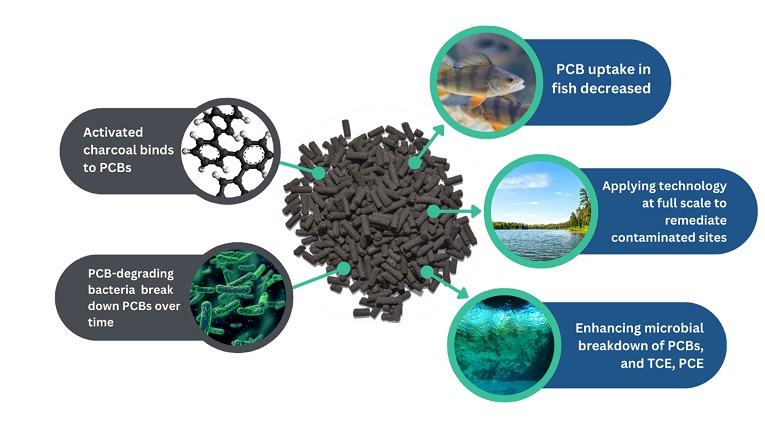
An innovative technology, developed with funding from the NIEHS Superfund Research Program (SRP), can deliver amendments that immobilize and degrade polychlorinated biphenyls (PCBs) in aquatic environments. The technology has proven effective in the field and resulted in millions of dollars in estimated cost savings at cleanup sites.
The Problem:
PCBs are a large and complex group of chemicals that were used in insulation, coolants, and electrical equipment. Although commercial production of PCBs was banned in the United States in 1979, they persist in the environment because of their stable chemical structure. PCBs can also accumulate in the aquatic food web, where they can pose a threat to human health.
SRP Solutions:
SediMite, developed by Upal Ghosh, Ph.D., of the University of Maryland, Baltimore County, and collaborators, uses activated carbon in the form of specialized pellets to bind to PCBs and reduce their bioavailability, or uptake by fish and other aquatic organisms. The technology can also be combined with microbes that break down PCBs, reducing their toxicity.
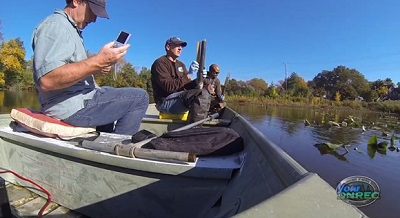 Ghosh, right, and colleagues collect sediment samples to measure PCBs. (Image from the DNRECYouTube videohighlighting the work at the Christina River)
Documenting Effectiveness in the Field
- The approach reduces PCBs in sediment porewater and surface water in the field
- The technology lowers PCB levels measured in lake fish
Ghosh and his team collaborated with the Delaware Department of Natural Resources and Environmental Control (DNREC) to use the technology at Mirror Lake. They demonstrated that between 2013 and 2018, PCB concentrations in sediment porewater decreased by about 80% after applying SediMite. They also measured a 70% reduction in PCB levels in the lake’s fish.
Their success has important implications for human health because PCB contamination is the primary reason that fish consumption advisories are issued by DNREC and the Delaware Division of Public Health.
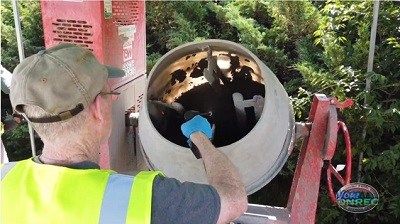 Sowers sprays PCB-degrading microorganisms onto activated carbon pellets to clean up PCBs and keep them from contaminating the Christina River. (Image from the DNREC YouTube video highlighting the work at the Christina River)
Building on this achievement, DNREC used an enhanced version of the SediMite technology in a new project to reduce PBCs in the Christina River. Ghosh and colleague Kevin Sowers, Ph.D., combined the activated carbon with microorganisms that can break down PCBs to both immobilize PCBs in the sediment and degrade them over time. After five months, SediMite enhanced with PCB-degrading microbes reduced the amount of PCBs in the sediment by approximately 25%. PCB concentrations decreased by around 35% in the surface water and 64% in sediment porewater.
Videos developed by DNREC depict the successes at Mirror Lake and the Christina River projects.
Building the Foundation
- Activated carbon reduces PCB bioavailability in the lab
- The technology offers significant cost savings compared to other clean-up methods
The technology builds on years of research by Ghosh and colleagues. SediMite was initially developed in part with SRP funding in an early project focused on optimizing the delivery method to apply activated carbon pellets to contaminated sites.
Ghosh had previously collaborated with Richard Luthy, Ph.D., an SRP grant recipient at Stanford University, to develop the novel concept of amending sediments with sorbents to reduce pollutant bioavailability. Their initial studies resulted in a method, patented in 2006, to stabilize persistent organic contaminants using carbon as sorbents and laid much of the groundwork for identifying potential barriers and future research needs to make the technology a viable reality, including the need for efficient methods to deliver the sorbents to sediment.
Ghosh then collaborated with Charlie Menzie, Ph.D., to develop SediMite to efficiently deliver amendments to sediments through a U.S. EPA Small Business Innovation Research program grant. Initial tests demonstrated that it was a feasible technology for use in the field. With SRP funding, the researchers scaled up their method to deliver activated carbon pellets from the lab to the field and patented SediMite in 2010.
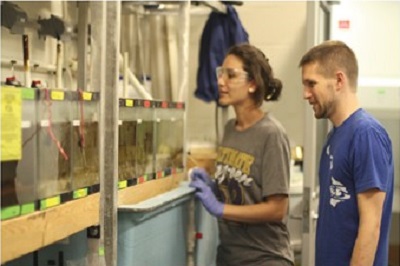 SRP trainees in Ghosh's lab measure PCB levels in water and fish during early lab experiments with activated carbon. (Photo courtesy of Upal Ghosh)
Ghosh continued his research in a second SRP-funded project aimed at evaluating whether fish uptake less PCBs after remediation with activated carbon. The team used lab studies and modeling approaches to demonstrate that fish can reduced their PCB uptake by as much as 87% after 90 days of treatment with activated carbon.
They also showed that SediMite decreased the assimilation efficiency of PCBs by up to 93%. Assimilation efficiency measures the amount of the contaminant that remains in the body compared to the amount that is excreted. This early work by the scientists included scaling up their remediation work to the field study at Mirror Lake.
The technology was implemented in full-scale to remediate a five-acre lake in Dover, Delaware in 2013. It was also selected as a component of the cleanup strategy for a contaminated sediment site in Middle River, Maryland, where the approach was estimated to cost approximately $22 million less than traditional methods, such as dredging and hauling.
Optimizing for Use at Scale
- Scaling up bacteria growth, dispersal, and deployment.
- Demonstrating effectiveness in the field.
- Collaborating in full-scale remediation projects.
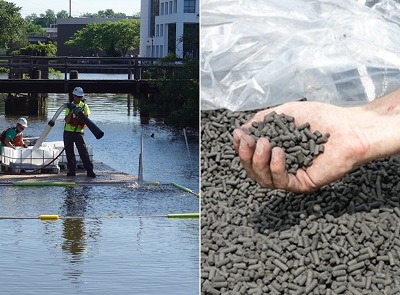 The activated carbon pellets can easily deliver microorganisms across large areas of contaminated sediment to both sequester and degrade PCBs. (Photos courtesy of RemBac)
While developing and patenting SediMite, the researchers identified some limitations to large-scale application of the technology. To address these limitations, Ghosh and Sowers, in collaboration with environmental scientist Bennett Amos, founded RemBac Environmental to enhance the SediMite carbon pellets with PCB-degrading microorganisms. Rembac was funded in 2020 through an SRP small business grant.
In the first phase of their project, they tested methods to optimize growing and storing large volumes of PCB-degrading organisms over time. They also developed and tested methods to apply the microbes more uniformly and cost-effectively to high volumes of activated carbon pellets, enabling them to scale up their technology to broader commercial use.
In the second phase of their project, the team plans to field test the effectiveness and utility of their technology at the New Bedford Harbor Superfund site. They hope their findings will inform regulators and other stakeholders as different PCB clean-up strategies are considered.
In 2022, the Elizabeth River Project started using SediMite to remediate Paradise Creek, a 14-acre tributary to the Elizabeth River in Virginia that is contaminated with PCBs. Another full-scale project, led by EPA, is using SediMite to remove dioxin from sediments in the Scanlon Reservoir in Minnesota.
SRP Funding Creates Synergy
The successful field trial at the Christina River and the newer SRP-funded projects represent a synergy between Ghosh’s development of SediMite and Sower’s early SRP-funded work that demonstrated that using specific microorganisms and conditions to stimulate them resulted in 80% of PCBs being degraded in Superfund sediments under realistic conditions.
New Directions
In 2021, Ghosh and team were awarded a four-year SRP grant to develop carbon-based sorbent materials to enhance the ability of bacteria to break down PCBs in sediments and mixtures of tetrachloroethylene (PCE) and trichloroethylene (TCE) in groundwater. PCE and TCE are chemicals often used in manufacturing and are the most frequently detected volatile organic chemicals in groundwater.
By understanding the interaction between surface chemistry and microbial degradation, the team expects to develop new technologies to remediate PCBs, PCE, TCE, and other chlorinated contaminants often found in the environment.
link to full article:
https://www.niehs.nih.gov/research/supported/centers/srp/phi/archives/remediation/sedimite
]]>
Excerpt from February 2024 - National Institute of Health (NIH), National Institute of Environmental Health Science (NIEHS) Superfund Research Program, Public Health Impact Story Low-Cost...
https://dev.my.umbc.edu/api/v0/pixel/news/138951/guest@my.umbc.edu/7bba21e8254f99b1175cc1ca6219698e/api/pixel
ghosh
research
spring-2024
Chemical, Biochemical and Environmental Engineering
https://dev.my.umbc.edu/groups/cbee
https://assets4-dev.my.umbc.edu/system/shared/avatars/groups/000/000/771/b5e579e81b2e3624611890fa3ca2716a/xsmall.png?1746794587
https://assets2-dev.my.umbc.edu/system/shared/avatars/groups/000/000/771/b5e579e81b2e3624611890fa3ca2716a/original.png?1746794587
https://assets1-dev.my.umbc.edu/system/shared/avatars/groups/000/000/771/b5e579e81b2e3624611890fa3ca2716a/xxlarge.png?1746794587
https://assets2-dev.my.umbc.edu/system/shared/avatars/groups/000/000/771/b5e579e81b2e3624611890fa3ca2716a/xlarge.png?1746794587
https://assets2-dev.my.umbc.edu/system/shared/avatars/groups/000/000/771/b5e579e81b2e3624611890fa3ca2716a/large.png?1746794587
https://assets4-dev.my.umbc.edu/system/shared/avatars/groups/000/000/771/b5e579e81b2e3624611890fa3ca2716a/medium.png?1746794587
https://assets1-dev.my.umbc.edu/system/shared/avatars/groups/000/000/771/b5e579e81b2e3624611890fa3ca2716a/small.png?1746794587
https://assets4-dev.my.umbc.edu/system/shared/avatars/groups/000/000/771/b5e579e81b2e3624611890fa3ca2716a/xsmall.png?1746794587
https://assets1-dev.my.umbc.edu/system/shared/avatars/groups/000/000/771/b5e579e81b2e3624611890fa3ca2716a/xxsmall.png?1746794587
Chemical, Biochemical and Environmental Engineering
https://assets4-dev.my.umbc.edu/system/shared/thumbnails/news/000/138/951/a0e85fc0f0bf840f0c5ba49e650339f9/xxlarge.jpg?1707841196
https://assets4-dev.my.umbc.edu/system/shared/thumbnails/news/000/138/951/a0e85fc0f0bf840f0c5ba49e650339f9/xlarge.jpg?1707841196
https://assets3-dev.my.umbc.edu/system/shared/thumbnails/news/000/138/951/a0e85fc0f0bf840f0c5ba49e650339f9/large.jpg?1707841196
https://assets3-dev.my.umbc.edu/system/shared/thumbnails/news/000/138/951/a0e85fc0f0bf840f0c5ba49e650339f9/medium.jpg?1707841196
https://assets3-dev.my.umbc.edu/system/shared/thumbnails/news/000/138/951/a0e85fc0f0bf840f0c5ba49e650339f9/small.jpg?1707841196
https://assets3-dev.my.umbc.edu/system/shared/thumbnails/news/000/138/951/a0e85fc0f0bf840f0c5ba49e650339f9/xsmall.jpg?1707841196
https://assets2-dev.my.umbc.edu/system/shared/thumbnails/news/000/138/951/a0e85fc0f0bf840f0c5ba49e650339f9/xxsmall.jpg?1707841196
1
0
true
Tue, 13 Feb 2024 10:57:30 -0500
Tue, 13 Feb 2024 11:20:07 -0500