<?xml version="1.0"?>
<News hasArchived="false" page="1" pageCount="3" pageSize="10" timestamp="Mon, 20 Apr 2026 05:01:07 -0400" url="https://dev.my.umbc.edu/groups/cbee/posts.xml?tag=news">
  <NewsItem contentIssues="false" id="157217" important="false" status="posted" url="https://dev.my.umbc.edu/groups/cbee/posts/157217">
    <Title>Upal Ghosh&#8217;s research on PCB contamination in fish highlighted by the Bay Journal</Title>
    <Body>
      <![CDATA[
          <div class="html-content"><p>Reposted from COEIT myUMBC: <a href="https://my3.my.umbc.edu/groups/coeit/posts/157100" rel="nofollow external" class="bo">Upal Ghosh’s recent research on PCB contamination in fish highlighted by the Bay Journal</a></p>
          <hr><div><div><p></p><div>Polychlorinated biphenyls (PCBs), a group of likely carcinogenic chemicals, were banned in the U.S. in 1979. Yet because the chemicals were so widely used, and linger in the environment for so long, PCBs continue to be a major source of fish consumption advisories in Maryland and surrounding states. </div><div><br></div><div>A <a href="https://my3.my.umbc.edu/groups/coeit/posts/157100/7a1e4/11a93682a0419c1bdc26b542273091e1/web/link?link=https%3A%2F%2Fpubs.acs.org%2Fdoi%2F10.1021%2Facsestwater.5c01099" rel="nofollow external" class="bo">recent study</a> by Professor Upal Ghosh, in the Department of Chemical, Biochemical, and Environmental Engineering, demonstrates the "unfinished work" of ridding our waters of PCB pollutants, the researchers write. The study was highlighted in <a href="https://my3.my.umbc.edu/groups/coeit/posts/157100/7a1e4/f8164b1989a92add092954d234eddb03/web/link?link=https%3A%2F%2Fwww.bayjournal.com%2Fnews%2Fpollution%2Fovershadowed-by-forever-chemicals-pcbs-remain-a-toxic-threat-to-chesapeake-waters%2Farticle_bfe7854f-5891-4b2f-96c9-d77fd123108b.html" rel="nofollow external" class="bo">a story in the Bay Journal</a>.</div><div><br>The researchers, led by Ghosh and Research Assistant Professor Nathalie Lombard, analyzed PCB concentrations in fish that had been collected across 323 monitoring stations in Maryland over three decades. They identified five watersheds as highly impacted by PCBs, including the Upper Chesapeake Bay. Most impacted waterways have seen gradual, yet steady improvements over the years, with the exception of the Gunpowder-Patapsco near Baltimore, which showed no decrease in PCB pollution concentration levels in fish since 1996. </div><div><br></div><p></p><div>Overall, the study showed that the ban on PCBs and pollution remediation efforts implemented across Maryland and surrounding states have helped waterways recover, the researchers say, but more efforts are still needed.</div><div><br></div><div><br></div></div></div><div></div></div>
      ]]>
    </Body>
    <Summary>Reposted from COEIT myUMBC: Upal Ghosh’s recent research on PCB contamination in fish highlighted by the Bay Journal       Polychlorinated biphenyls (PCBs), a group of likely carcinogenic...</Summary>
    <TrackingUrl>https://dev.my.umbc.edu/api/v0/pixel/news/157217/guest@my.umbc.edu/487e76fedccde3e79e30faeca48a8ac7/api/pixel</TrackingUrl>
    <Tag>faculty</Tag>
    <Tag>ghosh</Tag>
    <Tag>news</Tag>
    <Tag>research</Tag>
    <Tag>spring-2026</Tag>
    <Group token="cbee">Chemical, Biochemical and Environmental Engineering</Group>
    <GroupUrl>https://dev.my.umbc.edu/groups/cbee</GroupUrl>
    <AvatarUrl>https://assets4-dev.my.umbc.edu/system/shared/avatars/groups/000/000/771/b5e579e81b2e3624611890fa3ca2716a/xsmall.png?1746794587</AvatarUrl>
    <AvatarUrl size="original">https://assets2-dev.my.umbc.edu/system/shared/avatars/groups/000/000/771/b5e579e81b2e3624611890fa3ca2716a/original.png?1746794587</AvatarUrl>
    <AvatarUrl size="xxlarge">https://assets1-dev.my.umbc.edu/system/shared/avatars/groups/000/000/771/b5e579e81b2e3624611890fa3ca2716a/xxlarge.png?1746794587</AvatarUrl>
    <AvatarUrl size="xlarge">https://assets2-dev.my.umbc.edu/system/shared/avatars/groups/000/000/771/b5e579e81b2e3624611890fa3ca2716a/xlarge.png?1746794587</AvatarUrl>
    <AvatarUrl size="large">https://assets2-dev.my.umbc.edu/system/shared/avatars/groups/000/000/771/b5e579e81b2e3624611890fa3ca2716a/large.png?1746794587</AvatarUrl>
    <AvatarUrl size="medium">https://assets4-dev.my.umbc.edu/system/shared/avatars/groups/000/000/771/b5e579e81b2e3624611890fa3ca2716a/medium.png?1746794587</AvatarUrl>
    <AvatarUrl size="small">https://assets1-dev.my.umbc.edu/system/shared/avatars/groups/000/000/771/b5e579e81b2e3624611890fa3ca2716a/small.png?1746794587</AvatarUrl>
    <AvatarUrl size="xsmall">https://assets4-dev.my.umbc.edu/system/shared/avatars/groups/000/000/771/b5e579e81b2e3624611890fa3ca2716a/xsmall.png?1746794587</AvatarUrl>
    <AvatarUrl size="xxsmall">https://assets1-dev.my.umbc.edu/system/shared/avatars/groups/000/000/771/b5e579e81b2e3624611890fa3ca2716a/xxsmall.png?1746794587</AvatarUrl>
    <Sponsor>Chemical, Biochemical and Environmental Engineering</Sponsor>
    <ThumbnailUrl size="xxlarge">https://assets3-dev.my.umbc.edu/system/shared/thumbnails/news/000/157/217/e2b72c5c17e974c6e65bd8b56dc291f1/xxlarge.jpg?1772741830</ThumbnailUrl>
    <ThumbnailUrl size="xlarge">https://assets2-dev.my.umbc.edu/system/shared/thumbnails/news/000/157/217/e2b72c5c17e974c6e65bd8b56dc291f1/xlarge.jpg?1772741830</ThumbnailUrl>
    <ThumbnailUrl size="large">https://assets3-dev.my.umbc.edu/system/shared/thumbnails/news/000/157/217/e2b72c5c17e974c6e65bd8b56dc291f1/large.jpg?1772741830</ThumbnailUrl>
    <ThumbnailUrl size="medium">https://assets2-dev.my.umbc.edu/system/shared/thumbnails/news/000/157/217/e2b72c5c17e974c6e65bd8b56dc291f1/medium.jpg?1772741830</ThumbnailUrl>
    <ThumbnailUrl size="small">https://assets2-dev.my.umbc.edu/system/shared/thumbnails/news/000/157/217/e2b72c5c17e974c6e65bd8b56dc291f1/small.jpg?1772741830</ThumbnailUrl>
    <ThumbnailUrl size="xsmall">https://assets3-dev.my.umbc.edu/system/shared/thumbnails/news/000/157/217/e2b72c5c17e974c6e65bd8b56dc291f1/xsmall.jpg?1772741830</ThumbnailUrl>
    <ThumbnailUrl size="xxsmall">https://assets4-dev.my.umbc.edu/system/shared/thumbnails/news/000/157/217/e2b72c5c17e974c6e65bd8b56dc291f1/xxsmall.jpg?1772741830</ThumbnailUrl>
    <ThumbnailAltText>Ghosh shows fish tissue samples processed by Jasmine Ives, undergraduate intern, to isolate PCBs for measurement.</ThumbnailAltText>
    <PawCount>0</PawCount>
    <CommentCount>0</CommentCount>
    <CommentsAllowed>false</CommentsAllowed>
    <PostedAt>Thu, 05 Mar 2026 15:18:11 -0500</PostedAt>
    <EditAt>Thu, 05 Mar 2026 15:19:18 -0500</EditAt>
  </NewsItem>
  <NewsItem contentIssues="false" id="154586" important="false" status="posted" url="https://dev.my.umbc.edu/groups/cbee/posts/154586">
    <Title>CBEE Professor Tyler Josephson chosen as Simons Foundation Pivot Fellow</Title>
    <Tagline>AI &amp; Theory-Oriented Molecular Science (ATOMS) Lab</Tagline>
    <Body>
      <![CDATA[
          <div class="html-content"><div>Reposted from UMBC AI: <a href="https://my3.my.umbc.edu/groups/umbc-ai/posts/154557" rel="nofollow external" class="bo">UMBC Professor Tyler Josephson chosen as Simons Foundation Pivot Fellow</a>. </div><div><br></div><div>CBEE professor Tyler Josephson was selected as a 2025 Pivot Fellow by the <a href="https://www.simonsfoundation.org/" rel="nofollow external" class="bo">Simons Foundation</a>.  At UMBC, Prof. Josephson leads the <a href="https://atomslab.github.io/" rel="nofollow external" class="bo">AI &amp; Theory-Oriented Molecular Science Lab</a> (ATOMS), which develops computational methods for molecular simulation and automated discovery of scientific theories. </div><div><br></div><div>Techniques used in the ATOMS Lab include quantum chemistry, Monte Carlo, symbolic regression, and formal theorem proving using Lean. His research is currently supported by the NSF and the DoD, including an NSF CAREER Award for "<a href="https://www.nsf.gov/awardsearch/show-award/?AWD_ID=2236769&amp;HistoricalAwards=false" rel="nofollow external" class="bo">Automated Reasoning to Advance Chemical Theory</a>" and an Army HBCU/MSI Early Career Award for "Simulation methods for reactive adsorption of emerging water pollutants."</div><div><br></div><div><a href="https://www.simonsfoundation.org/simons-pivot-fellowship/?mc_cid=d0bea2e060&amp;mc_eid=UNIQID&amp;swcfpc=1" rel="nofollow external" class="bo">The Simons Foundation Pivot Fellowship</a> is open to faculty in the natural sciences, mathematics, engineering, data science, and computer science at academic institutions or equivalent positions elsewhere. Fellows receive salary support, as well as funding for research, travel, and professional development. At the end of their fellowship year, they are invited to apply for a research award of up to $1.5 million over three years. Read more about the <a href="https://www.simonsfoundation.org/2025/11/13/simons-foundation-announces-fourth-class-of-pivot-fellows/" rel="nofollow external" class="bo">2025 Pivot Fellows</a>.</div></div>
      ]]>
    </Body>
    <Summary>Reposted from UMBC AI: UMBC Professor Tyler Josephson chosen as Simons Foundation Pivot Fellow.      CBEE professor Tyler Josephson was selected as a 2025 Pivot Fellow by the Simons Foundation. ...</Summary>
    <TrackingUrl>https://dev.my.umbc.edu/api/v0/pixel/news/154586/guest@my.umbc.edu/171c3d527ff898e5f742640543504cca/api/pixel</TrackingUrl>
    <Tag>award</Tag>
    <Tag>fellow</Tag>
    <Tag>josephson</Tag>
    <Tag>news</Tag>
    <Tag>pivot</Tag>
    <Group token="cbee">Chemical, Biochemical and Environmental Engineering</Group>
    <GroupUrl>https://dev.my.umbc.edu/groups/cbee</GroupUrl>
    <AvatarUrl>https://assets4-dev.my.umbc.edu/system/shared/avatars/groups/000/000/771/b5e579e81b2e3624611890fa3ca2716a/xsmall.png?1746794587</AvatarUrl>
    <AvatarUrl size="original">https://assets2-dev.my.umbc.edu/system/shared/avatars/groups/000/000/771/b5e579e81b2e3624611890fa3ca2716a/original.png?1746794587</AvatarUrl>
    <AvatarUrl size="xxlarge">https://assets1-dev.my.umbc.edu/system/shared/avatars/groups/000/000/771/b5e579e81b2e3624611890fa3ca2716a/xxlarge.png?1746794587</AvatarUrl>
    <AvatarUrl size="xlarge">https://assets2-dev.my.umbc.edu/system/shared/avatars/groups/000/000/771/b5e579e81b2e3624611890fa3ca2716a/xlarge.png?1746794587</AvatarUrl>
    <AvatarUrl size="large">https://assets2-dev.my.umbc.edu/system/shared/avatars/groups/000/000/771/b5e579e81b2e3624611890fa3ca2716a/large.png?1746794587</AvatarUrl>
    <AvatarUrl size="medium">https://assets4-dev.my.umbc.edu/system/shared/avatars/groups/000/000/771/b5e579e81b2e3624611890fa3ca2716a/medium.png?1746794587</AvatarUrl>
    <AvatarUrl size="small">https://assets1-dev.my.umbc.edu/system/shared/avatars/groups/000/000/771/b5e579e81b2e3624611890fa3ca2716a/small.png?1746794587</AvatarUrl>
    <AvatarUrl size="xsmall">https://assets4-dev.my.umbc.edu/system/shared/avatars/groups/000/000/771/b5e579e81b2e3624611890fa3ca2716a/xsmall.png?1746794587</AvatarUrl>
    <AvatarUrl size="xxsmall">https://assets1-dev.my.umbc.edu/system/shared/avatars/groups/000/000/771/b5e579e81b2e3624611890fa3ca2716a/xxsmall.png?1746794587</AvatarUrl>
    <Sponsor>Chemical, Biochemical and Environmental Engineering</Sponsor>
    <ThumbnailUrl size="xxlarge">https://assets1-dev.my.umbc.edu/system/shared/thumbnails/news/000/154/586/57d692a9ab310a5af60a53fd700f454d/xxlarge.jpg?1763476692</ThumbnailUrl>
    <ThumbnailUrl size="xlarge">https://assets1-dev.my.umbc.edu/system/shared/thumbnails/news/000/154/586/57d692a9ab310a5af60a53fd700f454d/xlarge.jpg?1763476692</ThumbnailUrl>
    <ThumbnailUrl size="large">https://assets2-dev.my.umbc.edu/system/shared/thumbnails/news/000/154/586/57d692a9ab310a5af60a53fd700f454d/large.jpg?1763476692</ThumbnailUrl>
    <ThumbnailUrl size="medium">https://assets3-dev.my.umbc.edu/system/shared/thumbnails/news/000/154/586/57d692a9ab310a5af60a53fd700f454d/medium.jpg?1763476692</ThumbnailUrl>
    <ThumbnailUrl size="small">https://assets2-dev.my.umbc.edu/system/shared/thumbnails/news/000/154/586/57d692a9ab310a5af60a53fd700f454d/small.jpg?1763476692</ThumbnailUrl>
    <ThumbnailUrl size="xsmall">https://assets3-dev.my.umbc.edu/system/shared/thumbnails/news/000/154/586/57d692a9ab310a5af60a53fd700f454d/xsmall.jpg?1763476692</ThumbnailUrl>
    <ThumbnailUrl size="xxsmall">https://assets4-dev.my.umbc.edu/system/shared/thumbnails/news/000/154/586/57d692a9ab310a5af60a53fd700f454d/xxsmall.jpg?1763476692</ThumbnailUrl>
    <ThumbnailAltText>Tyler Josephson chosen as Simons Foundation Pivot Fellow</ThumbnailAltText>
    <PawCount>0</PawCount>
    <CommentCount>0</CommentCount>
    <CommentsAllowed>true</CommentsAllowed>
    <PostedAt>Tue, 18 Nov 2025 09:46:40 -0500</PostedAt>
  </NewsItem>
  <NewsItem contentIssues="true" id="146003" important="false" status="posted" url="https://dev.my.umbc.edu/groups/cbee/posts/146003">
  <Title>UMBC Students Excel at Annual AIChE Meeting</Title>
  <Tagline>UMBC students shine at the AIChE</Tagline>
  <Body>
    <![CDATA[
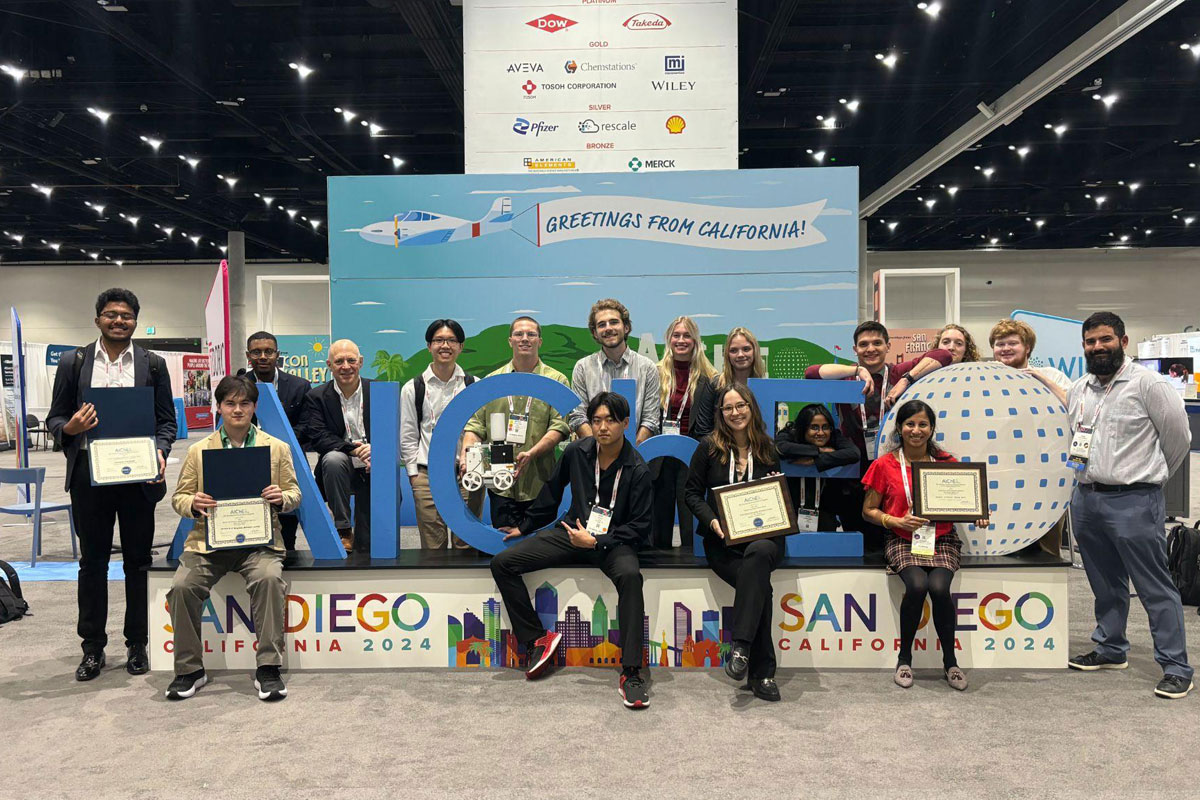
    <div class="html-content"><p><img src="https://umbc.edu/wp-content/uploads/2024/11/AIChE-2024_Group-photo.jpg" alt="UMBC AIChE chapter members and faculty mentors at the AIChE conference in San Diego. (Photo courtesy of Neha Raikar)" width="1200" height="800" style="max-width: 100%; height: auto;">UMBC AIChE chapter members and faculty mentors at the AIChE conference in San Diego. (Photo courtesy of Neha Raikar)</p>
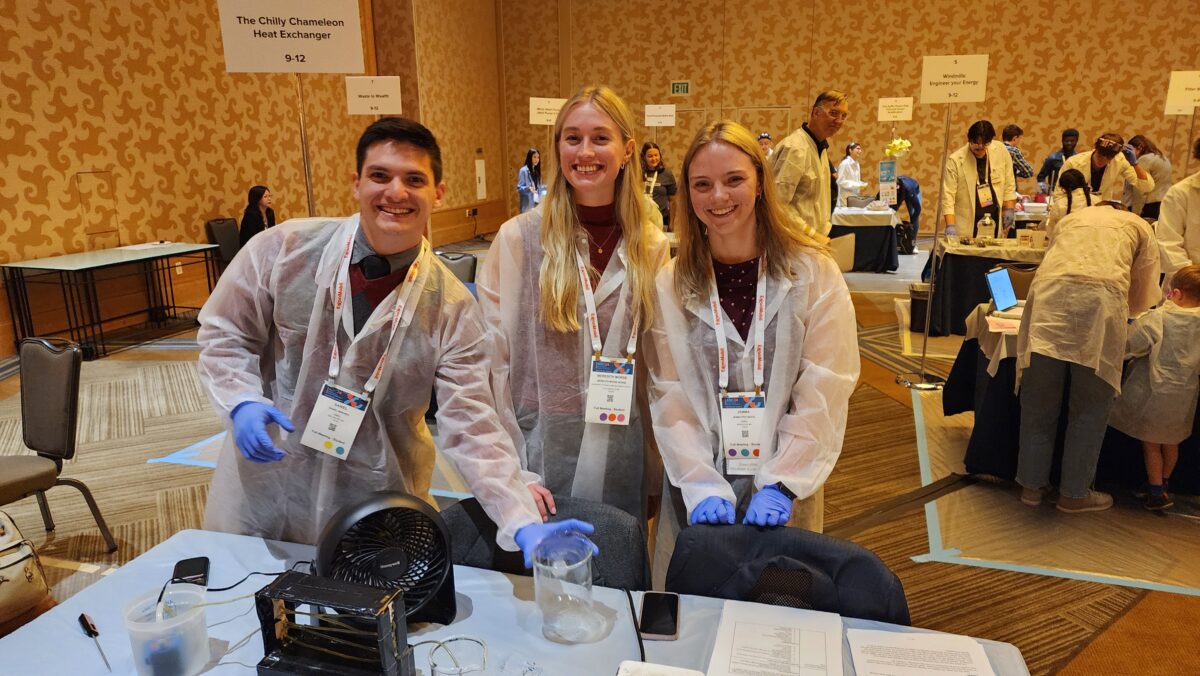
    <p>UMBC chemical engineering students excelled again at the <a href="https://www.aiche.org/conferences/aiche-annual-meeting/2024" rel="nofollow external" class="bo"><strong>annual meeting of the American Institute of Chemical Engineers</strong></a> (AIChE), held in San Diego this fall. The UMBC ChemE Jeopardy team, led by senior chemical engineering student <strong>Colin Jones</strong>, claimed third place at the national competition held during the conference; the K – 12 STEM outreach team, led by senior chemical engineering student <strong>Jemma Pryzbocki</strong>, won the top judges’ award in the high school category for designing a module to teach concepts of heat exchange; and the UMBC AIChE club won a best student chapter award.</p>
    <p>The UMBC ChemE car team, which designed a car that starts and stops by chemical reactions, also performed respectably in a competitive field. The team was led by senior chemical engineering student <strong>Ben Welling</strong>. Several students also received individual recognitions—senior chemical engineering and biochemistry student <strong>Pavan Umashankar</strong> won a <a href="https://www.aiche.org/community/awards/donald-f-mildred-topp-othmer-scholarship-awards" rel="nofollow external" class="bo"><strong>Donald F. &amp; Mildred Topp Othmer Scholarship Award</strong></a> and senior <strong>Meredith Morse</strong>, chemical engineering, took third place in the student poster session in the food, pharmaceutical, and biotechnology division.</p>
    <p><img src="https://umbc.edu/wp-content/uploads/2024/11/AIChE-K-12-Outreach-1200x676.jpg" alt="K – 12 STEM outreach team members (from left to right) Daniel Miranda, Meredith Morse, and Jemma Przybocki demonstrate their teaching module, “The Chilly Chameleon Heat Exchanger.” (Photo courtesy of Neha Raikar)" width="1200" height="676" style="max-width: 100%; height: auto;">K – 12 STEM outreach team members (from left to right) Daniel Miranda, Meredith Morse, and Jemma Przybocki demonstrate their teaching module, “The Chilly Chameleon Heat Exchanger.” (Photo courtesy of Neha Raikar)</p>
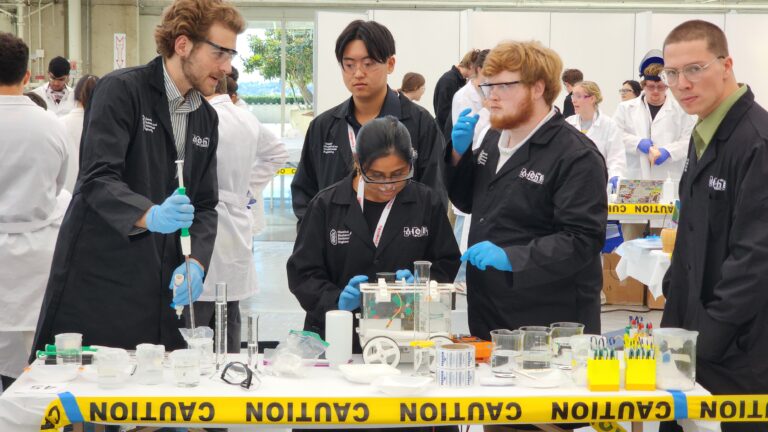
    <p><img src="https://umbc.edu/wp-content/uploads/2024/11/AIChE-ChemE-Car-768x432.jpg" alt="ChemE car team members (from left to right) Ben Welling (team captain), David Ni, Afrah Ahmed, Jacob Craft, and Michael Dinan prepare their car for competition. (Photo courtesy of Neha Raikar)" width="768" height="432" style="max-width: 100%; height: auto;"></p>
    <p>ChemE car team members (from left to right) Ben Welling (team captain), David Ni, Afrah Ahmed, Jacob Craft, and Michael Dinan prepare their car for competition. (Photo courtesy of Neha Raikar)</p>
    <p>“The students deserve a big round of applause for all their dedication and hard work,” says <strong>Neha Raikar</strong>, a senior lecturer in the Department of Chemical, Biochemical, and Environmental Engineering (CBEE) and one of the advisors to the student AIChE chapter. </p>
    <p>“The chemical engineering major demands exceptional attention to detail and hard work,” says <strong>Mariajosé Castellanos</strong>, another CBEE faculty who advises the AIChE chapter. “It is truly inspiring to see our students consistently apply their skills and make a lasting mark on the national stage!”</p>
    <p>UMBC students have achieved impressive AIChE conference success for many years running. The ChemE Jeopardy team has reached the final every year since 2020, and the K – 12 STEM outreach team, which only began competing last year, has won awards at each event. Earlier this year, the UMBC student chapter showed off their growth and talents by <a href="https://umbc.edu/stories/umbc-chemical-engineering-club-shines-as-student-conference-hosts/" rel="nofollow external" class="bo"><strong>hosting a regional meeting of AIChE</strong></a> for the first time.</p>
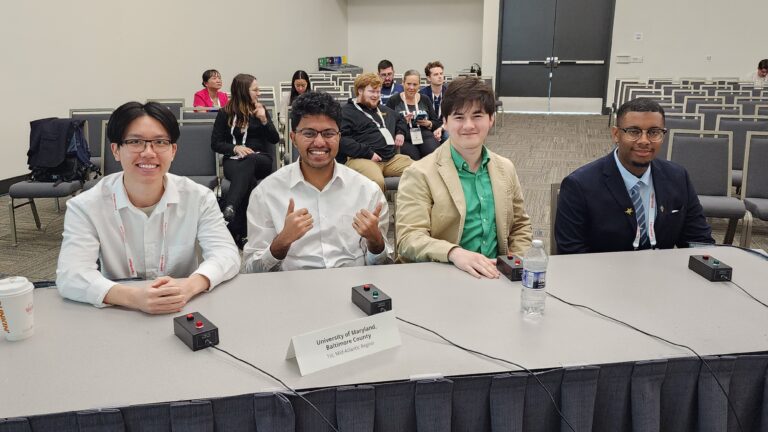
    <p><img src="https://umbc.edu/wp-content/uploads/2024/11/AIChE-Jeopardy-768x432.jpg" alt="ChemE Jeopardy team members (from left to right) Jonathan Wu, Pavan Umashankar, Colin Jones, and Joshua Lewis take their places behind the buzzers. (Photo courtesy of Neha Raikar)" width="768" height="432" style="max-width: 100%; height: auto;"></p>
    <p>ChemE Jeopardy team members (from left to right) Jonathan Wu, Pavan Umashankar, Colin Jones, and Joshua Lewis take their places behind the buzzers. (Photo courtesy of Neha Raikar)</p></div>
]]>
  </Body>
  <Summary>UMBC AIChE chapter members and faculty mentors at the AIChE conference in San Diego. (Photo courtesy of Neha Raikar)   UMBC chemical engineering students excelled again at the annual meeting of...</Summary>
  <TrackingUrl>https://dev.my.umbc.edu/api/v0/pixel/news/146003/guest@my.umbc.edu/ecadf08bf290dc84dc238a57de08cb82/api/pixel</TrackingUrl>
  <Tag>aiche</Tag>
  <Tag>award</Tag>
  <Tag>castellanos</Tag>
  <Tag>fall-2024</Tag>
  <Tag>news</Tag>
  <Tag>raikar</Tag>
  <Tag>research</Tag>
  <Tag>ug</Tag>
  <Tag>ugrad</Tag>
  <Group token="cbee">Chemical, Biochemical and Environmental Engineering</Group>
  <GroupUrl>https://dev.my.umbc.edu/groups/cbee</GroupUrl>
  <AvatarUrl>https://assets4-dev.my.umbc.edu/system/shared/avatars/groups/000/000/771/b5e579e81b2e3624611890fa3ca2716a/xsmall.png?1746794587</AvatarUrl>
  <AvatarUrl size="original">https://assets2-dev.my.umbc.edu/system/shared/avatars/groups/000/000/771/b5e579e81b2e3624611890fa3ca2716a/original.png?1746794587</AvatarUrl>
  <AvatarUrl size="xxlarge">https://assets1-dev.my.umbc.edu/system/shared/avatars/groups/000/000/771/b5e579e81b2e3624611890fa3ca2716a/xxlarge.png?1746794587</AvatarUrl>
  <AvatarUrl size="xlarge">https://assets2-dev.my.umbc.edu/system/shared/avatars/groups/000/000/771/b5e579e81b2e3624611890fa3ca2716a/xlarge.png?1746794587</AvatarUrl>
  <AvatarUrl size="large">https://assets2-dev.my.umbc.edu/system/shared/avatars/groups/000/000/771/b5e579e81b2e3624611890fa3ca2716a/large.png?1746794587</AvatarUrl>
  <AvatarUrl size="medium">https://assets4-dev.my.umbc.edu/system/shared/avatars/groups/000/000/771/b5e579e81b2e3624611890fa3ca2716a/medium.png?1746794587</AvatarUrl>
  <AvatarUrl size="small">https://assets1-dev.my.umbc.edu/system/shared/avatars/groups/000/000/771/b5e579e81b2e3624611890fa3ca2716a/small.png?1746794587</AvatarUrl>
  <AvatarUrl size="xsmall">https://assets4-dev.my.umbc.edu/system/shared/avatars/groups/000/000/771/b5e579e81b2e3624611890fa3ca2716a/xsmall.png?1746794587</AvatarUrl>
  <AvatarUrl size="xxsmall">https://assets1-dev.my.umbc.edu/system/shared/avatars/groups/000/000/771/b5e579e81b2e3624611890fa3ca2716a/xxsmall.png?1746794587</AvatarUrl>
  <Sponsor>Chemical, Biochemical and Environmental Engineering</Sponsor>
  <ThumbnailUrl size="xxlarge">https://assets4-dev.my.umbc.edu/system/shared/thumbnails/news/000/146/003/02d6717cb65448ed9604e5248bf612d1/xxlarge.jpg?1733166226</ThumbnailUrl>
  <ThumbnailUrl size="xlarge">https://assets4-dev.my.umbc.edu/system/shared/thumbnails/news/000/146/003/02d6717cb65448ed9604e5248bf612d1/xlarge.jpg?1733166226</ThumbnailUrl>
  <ThumbnailUrl size="large">https://assets2-dev.my.umbc.edu/system/shared/thumbnails/news/000/146/003/02d6717cb65448ed9604e5248bf612d1/large.jpg?1733166226</ThumbnailUrl>
  <ThumbnailUrl size="medium">https://assets2-dev.my.umbc.edu/system/shared/thumbnails/news/000/146/003/02d6717cb65448ed9604e5248bf612d1/medium.jpg?1733166226</ThumbnailUrl>
  <ThumbnailUrl size="small">https://assets1-dev.my.umbc.edu/system/shared/thumbnails/news/000/146/003/02d6717cb65448ed9604e5248bf612d1/small.jpg?1733166226</ThumbnailUrl>
  <ThumbnailUrl size="xsmall">https://assets4-dev.my.umbc.edu/system/shared/thumbnails/news/000/146/003/02d6717cb65448ed9604e5248bf612d1/xsmall.jpg?1733166226</ThumbnailUrl>
  <ThumbnailUrl size="xxsmall">https://assets3-dev.my.umbc.edu/system/shared/thumbnails/news/000/146/003/02d6717cb65448ed9604e5248bf612d1/xxsmall.jpg?1733166226</ThumbnailUrl>
  <PawCount>0</PawCount>
  <CommentCount>0</CommentCount>
  <CommentsAllowed>true</CommentsAllowed>
  <PostedAt>Mon, 02 Dec 2024 14:03:07 -0500</PostedAt>
  <EditAt>Mon, 02 Dec 2024 15:16:25 -0500</EditAt>
</NewsItem>
  <NewsItem contentIssues="true" id="144104" important="false" status="posted" url="https://dev.my.umbc.edu/groups/cbee/posts/144104">
  <Title>FROM NIEHS: Path to environmental engineering</Title>
  <Tagline>NIEHS Director's converstaion with Dr. Ghosh</Tagline>
  <Body>
    <![CDATA[
    <div class="html-content"><div>
    <h3>Path to environmental engineering</h3>
    <p>By Rick Woychik | <a href="https://factor.niehs.nih.gov/2024/9/feature/4-feature-innovative-environmental-remediation" rel="nofollow external" class="bo">Environmental Factor</a> | September 2024</p>
    </div>
    <div>Rick Woychik: What inspired you to pursue a research career?</div>
    <div>
    <div>Upal Ghosh: If I go back and think about it, my early childhood played a big role. My father worked in a research institute in a coal mining town called Dhanbad in Bihar, India. He was the head of the Health Division at the Mining Research Institute.</div>
    <div>My father was a chemist by training, and he was researching the correlation between air pollution and cardiovascular disease in miners. I remember he had a jar with a preserved lung of a coal miner, and it was black from the coal dust. Seeing that black lung left a big imprint on me.</div>
    <div>I watched my father on local rooftops, conducting air sampling, and then going to hospitals to collect data on cardiovascular disease to correlate with mining activities. I’m sure that had an impact on how I viewed the relationship between environmental health and human health. That interest grew over time.</div>
    <div>I went on to study chemical engineering in Bombay. I’m an undergraduate chemical engineer by training, but I didn’t want to work in industry. I became more interested in the environment and nature, and I joined the nature club. My experiences led me to pursue environmental engineering.</div>
    <div>I completed my master’s and Ph.D. in environmental engineering at the State University of New York at Buffalo. Then I spent a few years at Stanford University with Dick Luthy, who was one of my greatest mentors, before being hired here at UMBC to start our environmental engineering program. We’ve made great strides over the past 22 years, and we have built a strong program here.</div>
    </div>
    <div>
    
    <p>(Rick Woychik, Ph.D., directs NIEHS and the National Toxicology Program.)</p>
    </div>
    <p>Read Original Post from Environmental FactorEnvironmental Factor<br>Your Online Source for NIEHS News: <a href="https://factor.niehs.nih.gov/2024/9/feature/4-feature-innovative-environmental-remediation" rel="nofollow external" class="bo">https://factor.niehs.nih.gov/2024/9/feature/4-feature-innovative-environmental-remediation</a></p>
    <div><br>
    <div>Photo credit: Rick Woychik, Ph.D., directs NIEHS and the National Toxicology Program. (Image courtesy of NIEHS)</div>
    </div></div>
]]>
  </Body>
  <Summary>Path to environmental engineering   By Rick Woychik | Environmental Factor | September 2024     Rick Woychik: What inspired you to pursue a research career?     Upal Ghosh: If I go back and think...</Summary>
  <TrackingUrl>https://dev.my.umbc.edu/api/v0/pixel/news/144104/guest@my.umbc.edu/652367c23d279509987138e8e9b7d924/api/pixel</TrackingUrl>
  <Tag>faculty</Tag>
  <Tag>fall-2024</Tag>
  <Tag>ghosh</Tag>
  <Tag>news</Tag>
  <Tag>research</Tag>
  <Group token="cbee">Chemical, Biochemical and Environmental Engineering</Group>
  <GroupUrl>https://dev.my.umbc.edu/groups/cbee</GroupUrl>
  <AvatarUrl>https://assets4-dev.my.umbc.edu/system/shared/avatars/groups/000/000/771/b5e579e81b2e3624611890fa3ca2716a/xsmall.png?1746794587</AvatarUrl>
  <AvatarUrl size="original">https://assets2-dev.my.umbc.edu/system/shared/avatars/groups/000/000/771/b5e579e81b2e3624611890fa3ca2716a/original.png?1746794587</AvatarUrl>
  <AvatarUrl size="xxlarge">https://assets1-dev.my.umbc.edu/system/shared/avatars/groups/000/000/771/b5e579e81b2e3624611890fa3ca2716a/xxlarge.png?1746794587</AvatarUrl>
  <AvatarUrl size="xlarge">https://assets2-dev.my.umbc.edu/system/shared/avatars/groups/000/000/771/b5e579e81b2e3624611890fa3ca2716a/xlarge.png?1746794587</AvatarUrl>
  <AvatarUrl size="large">https://assets2-dev.my.umbc.edu/system/shared/avatars/groups/000/000/771/b5e579e81b2e3624611890fa3ca2716a/large.png?1746794587</AvatarUrl>
  <AvatarUrl size="medium">https://assets4-dev.my.umbc.edu/system/shared/avatars/groups/000/000/771/b5e579e81b2e3624611890fa3ca2716a/medium.png?1746794587</AvatarUrl>
  <AvatarUrl size="small">https://assets1-dev.my.umbc.edu/system/shared/avatars/groups/000/000/771/b5e579e81b2e3624611890fa3ca2716a/small.png?1746794587</AvatarUrl>
  <AvatarUrl size="xsmall">https://assets4-dev.my.umbc.edu/system/shared/avatars/groups/000/000/771/b5e579e81b2e3624611890fa3ca2716a/xsmall.png?1746794587</AvatarUrl>
  <AvatarUrl size="xxsmall">https://assets1-dev.my.umbc.edu/system/shared/avatars/groups/000/000/771/b5e579e81b2e3624611890fa3ca2716a/xxsmall.png?1746794587</AvatarUrl>
  <Sponsor>Chemical, Biochemical and Environmental Engineering</Sponsor>
  <ThumbnailUrl size="xxlarge">https://assets1-dev.my.umbc.edu/system/shared/thumbnails/news/000/144/104/55a9af419f6612eb59fcd2309144ec38/xxlarge.jpg?1726852384</ThumbnailUrl>
  <ThumbnailUrl size="xlarge">https://assets3-dev.my.umbc.edu/system/shared/thumbnails/news/000/144/104/55a9af419f6612eb59fcd2309144ec38/xlarge.jpg?1726852384</ThumbnailUrl>
  <ThumbnailUrl size="large">https://assets3-dev.my.umbc.edu/system/shared/thumbnails/news/000/144/104/55a9af419f6612eb59fcd2309144ec38/large.jpg?1726852384</ThumbnailUrl>
  <ThumbnailUrl size="medium">https://assets4-dev.my.umbc.edu/system/shared/thumbnails/news/000/144/104/55a9af419f6612eb59fcd2309144ec38/medium.jpg?1726852384</ThumbnailUrl>
  <ThumbnailUrl size="small">https://assets1-dev.my.umbc.edu/system/shared/thumbnails/news/000/144/104/55a9af419f6612eb59fcd2309144ec38/small.jpg?1726852384</ThumbnailUrl>
  <ThumbnailUrl size="xsmall">https://assets2-dev.my.umbc.edu/system/shared/thumbnails/news/000/144/104/55a9af419f6612eb59fcd2309144ec38/xsmall.jpg?1726852384</ThumbnailUrl>
  <ThumbnailUrl size="xxsmall">https://assets1-dev.my.umbc.edu/system/shared/thumbnails/news/000/144/104/55a9af419f6612eb59fcd2309144ec38/xxsmall.jpg?1726852384</ThumbnailUrl>
  <PawCount>0</PawCount>
  <CommentCount>0</CommentCount>
  <CommentsAllowed>true</CommentsAllowed>
  <PostedAt>Fri, 20 Sep 2024 13:14:27 -0400</PostedAt>
  <EditAt>Fri, 20 Sep 2024 13:16:13 -0400</EditAt>
</NewsItem>
  <NewsItem contentIssues="true" id="144102" important="false" status="posted" url="https://dev.my.umbc.edu/groups/cbee/posts/144102">
  <Title>FROM NIEHS: Chemical contamination reduced by grantee&#8217;s innovative technology</Title>
  <Tagline>NIEHS Director's converstaion with Dr. Ghosh</Tagline>
  <Body>
    <![CDATA[
    <div class="html-content"><div><h3>Chemical contamination reduced by grantee’s innovative technology</h3><p><strong>I spoke with Upal Ghosh, Ph.D., about how effective environmental remediation requires rigorous exposure science, engineering.</strong></p><div><br></div><div>By Rick Woychik | <a href="https://factor.niehs.nih.gov/2024/9/feature/4-feature-innovative-environmental-remediation" rel="nofollow external" class="bo">Environmental Factor</a> | September 2024</div></div><div><br></div><div>
    <div>
    <p>Environmental contamination is a pressing challenge in parts of the U.S. and in many places around the world, affecting ecosystems, wildlife, and human health. From legacy pollutants like PCBs (polychlorinated biphenyls) to emerging contaminants such as PFAS (per- and polyfluoroalkyl substances), the complexity and scale of exposures is often daunting. But within these challenges lies opportunity for innovation, where it is possible to harness scientific and engineering breakthroughs to clean up contamination and protect public health. Recently, I had the privilege of speaking with someone who has dedicated his career to doing just that.</p>
    <hr>
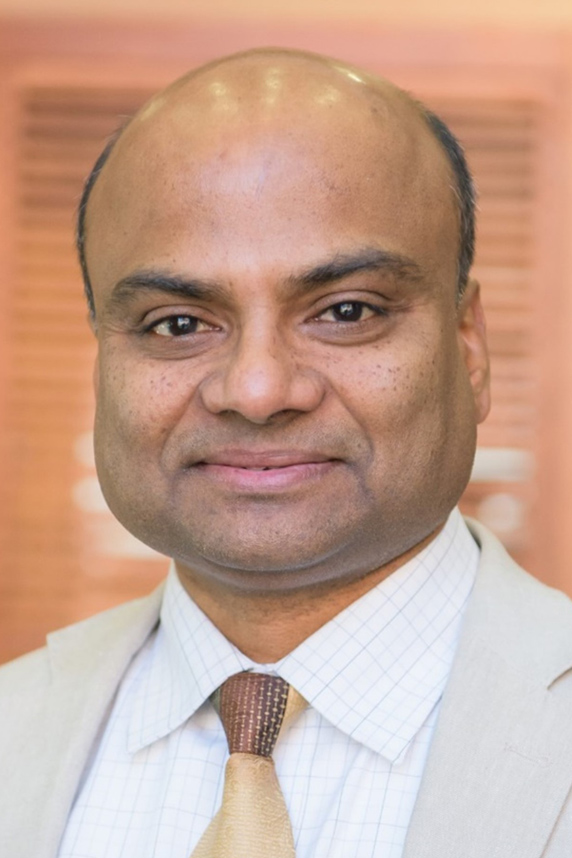
    <img src="https://factor.niehs.nih.gov/sites/niehs-factor/files/2024/08/feature/innovative-environmental-remediation-body1.jpg" alt="Upal Ghosh, Ph.D." style="max-width: 100%; height: auto;">
    “Anytime a new technology is created, there may be some risk,” noted Ghosh. “But being able to take a risk on something that theoretically could work creates a situation where technologies can flourish and move from the lab to the field. Throughout my career, I’ve been fortunate to find enabling environments that allow new ideas to be tested.” (Photo courtesy of Upal Ghosh)
    
    <hr>
    
    <p>NIEHS grant recipient <a href="https://cbee.umbc.edu/upal-ghosh/" rel="nofollow external" class="bo">Upal Ghosh, Ph.D.</a>, is a professor of environmental engineering at the University of Maryland, Baltimore County, who has developed practical, scalable solutions to some of the toughest contamination problems we face. Much of his work focuses on reducing the bioavailability of pollutants — preventing them from entering the food web and reaching humans — in bodies of water such as lakes and rivers. SediMite, a technology he helped to create and commercialize, offers a sustainable solution to environmental cleanup of PCBs.</p>
    <p>Beyond his efforts in the lab, Dr. Ghosh works closely with communities disproportionately affected by contamination. His projects in places like Washington, D.C., Baltimore, and Delaware have demonstrated the benefits of his remediation technology, helping to reduce fish consumption advisories, restore wetlands, and strengthen resiliency among residents.</p>
    <p>In our conversation, Dr. Ghosh shared insights into the scale of environmental contamination globally and the evolving landscape of remediation technologies. He discussed the importance of understanding how exposures in a water body can lead to exposures in humans, as that knowledge is crucial to developing effective cleanup approaches. Dr. Ghosh also described his early interest in science and what inspired him to pursue a research career.</p>
    <h2>Economy and environment</h2>
    <p><strong>Rick Woychik</strong>: Thank you, Dr. Ghosh, for taking the time to speak with me. Can you provide an overview of the scale of environmental contamination problems, both in the U.S. and globally?</p>
    <p><strong>Upal Ghosh</strong>: Sure. The way I think about it, the scale of environmental problems is related to the scale of the economy. A lot of the problems we discuss — from <a href="https://www.epa.gov/superfund/what-superfund" rel="nofollow external" class="bo">Superfund sites</a> such as Love Canal to current challenges around <a href="https://www.niehs.nih.gov/health/topics/agents/pfc" rel="nofollow external" class="bo">PFAS contamination</a> — are tied to how productive an economy is, and how production and usage practices have caused leakages.</p>
    <p>The U.S. was the largest manufacturing center for many products, and we’re seeing the footprint of that. Love Canal is a prime example. All of these Superfund sites are remnants of an era where laws weren’t in place to internalize costs and reduce externalities, and now we’re realizing that.</p>
    <hr>
    <img src="https://factor.niehs.nih.gov/sites/niehs-factor/files/2024/08/feature/innovative-environmental-remediation-body2.jpg" alt="Ghosh on boat" style="max-width: 100%; height: auto;">
    Ghosh is shown here collecting sediments from the Fort Eustis Superfund site in Virginia. “Working at PCB-contaminated sites like this makes you think, ‘How can we reduce human and ecological exposure without destroying vibrant wetland ecosystems?’” said Ghosh. (Image courtesy of Upal Ghosh)
    
    <hr>
    <p>I also travel internationally, and I see the same trends in developing countries. In India, they're ramping up production, and China has already reached high levels of industrial production. They’re starting to face challenges associated with manufacturing, transporting, and using large volumes of chemicals to provide their populations with a quality of life they expect and deserve.</p>
    <p>In pharmaceutical production, we’re seeing leakages of pharmaceuticals, and with large-volume chemicals like petroleum and pesticides, every functioning economy creates this footprint. So, in short, the scale of the problem has often been tied to the scale of the economy. But I believe that new technologies will help to create a better dynamic, allowing for both strong economic growth and strong environmental health.</p>
    <h2>To solve the problem, first define it</h2>
    <p><strong>RW</strong>: How do you go about developing remediation approaches?</p>
    <p><strong>UG</strong>: Environmental contamination poses an interesting challenge for scientists and engineers because the problem is often poorly defined. If I put PCB molecules in a beaker of clean water, as a scientist, I can describe the behavior accurately. But when I deal with a river, lake, or coastal bay, the matrix is much more complicated. For a variety of reasons, such as complex geochemistry, hydrodynamics, air-water exchange, and so forth, the attributes of contamination are not uniform. The behavior of compounds in that matrix becomes much more difficult to describe.</p>
    <p>For example, in the PCB cases I’ve worked on, we have to try to understand not just what’s happening in a complex body of water, but also a complex ecological system that ultimately leads to human exposure via the food web. So, defining the problem is the first part of effective technology development, and in fact I think that’s where many technology needs lie: accurately defining exposure. We can’t solve the problem unless we do so.</p>
    <hr>
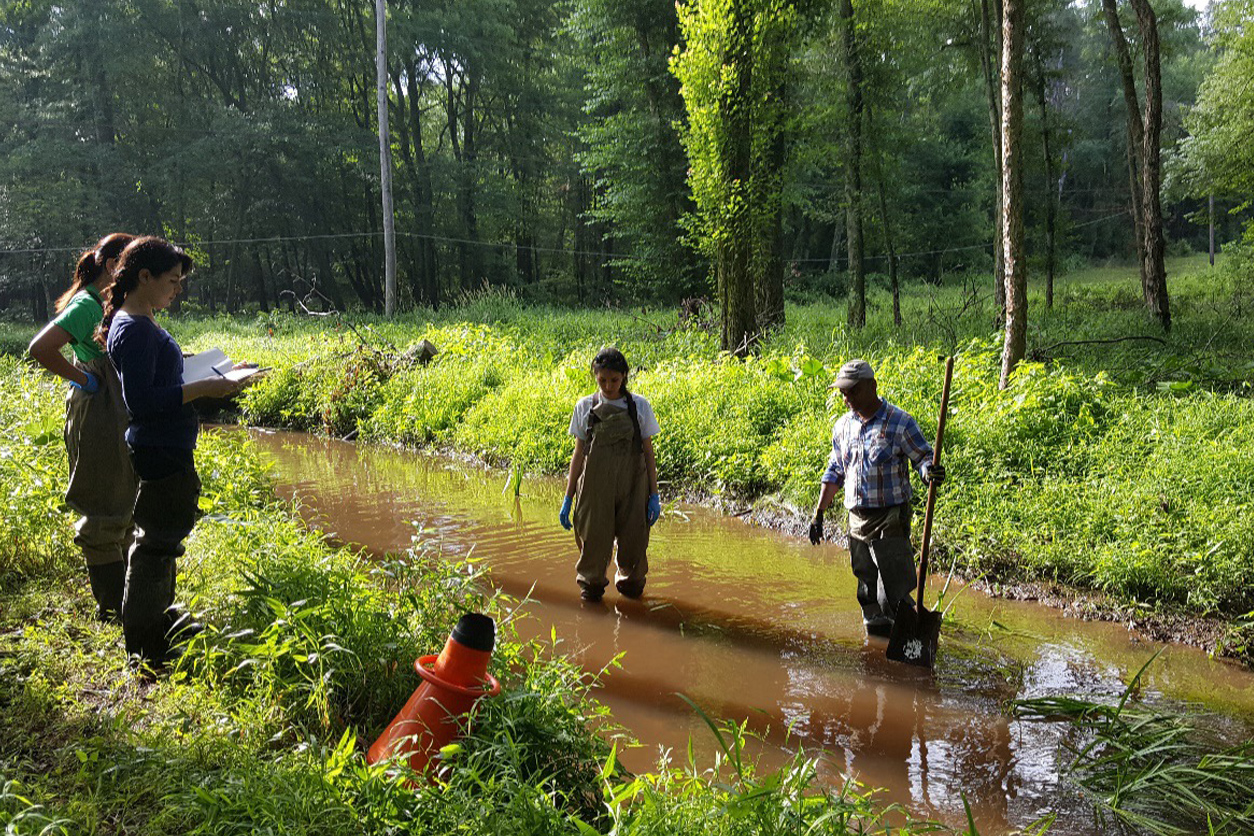
    <img src="https://factor.niehs.nih.gov/sites/niehs-factor/files/2024/08/feature/innovative-environmental-remediation-body3.jpg" alt="Ghosh and team standing in the river" style="max-width: 100%; height: auto;">
    Ghosh, right, is shown here installing passive samplers with students at a tributary of the Anacostia River in Washington, D.C., to help local decisionmakers better define the PCB and pesticide pollution problem and refine their remediation approach. (Photo courtesy of Upal Ghosh)
    
    <hr>
    <p>A lot of my work, and much of my colleagues’ work, falls under this category of accurately defining exposure, of understanding the bioavailability of pollutants in the soil or sediment environment. Once we understand the exposure — and the dominant exposure pathways — then I can bring in engineers, communities, and policymakers to create effective solutions.</p>
    <h2>Discovering black carbon’s key role</h2>
    <p><strong>RW</strong>: This is very interesting. If I’m understanding you correctly, the goal is to not just determine PCB levels in the soil of a riverbed, for example, but also to assess how much PCB in the soil of the riverbed will make it into the water and be ingested by fish, or absorbed through their gills, and eventually consumed by humans. Is that what you’re getting at?</p>
    <p><strong>UG</strong>: That’s exactly right. It’s not just about measuring contamination in sediments but understanding how it moves through the aquatic environment and enters the food web. Once we can accurately define the dominant exposure pathways, we can tailor our remediation efforts to address the most critical sources of exposure. To that end, we’ve adopted passive sampling techniques and environmental modeling methods to better assess the movement and exposures.</p>
    <p>Early in my research, when I was at Stanford working with my colleague and mentor Dr. Dick Luthy, we were studying the bioavailability of pollutants, looking specifically at PAHs [polycyclic aromatic hydrocarbons] and PCBs in sediments. The question we were asking was: Why is the bioavailability so different across sites? For example, when I took sediments from the Baltimore harbor versus sediments from the Milwaukee harbor, they didn’t behave the same.</p>
    <p>Just looking at the organic matter content, mineral content, and particle size wasn’t explaining the differences, which were sometimes more than an order of magnitude. In some sediments, pollutants like PAHs and PCBs were bound up much more strongly than we would predict. So, we started looking at that more carefully and discovered that in sediments where pollutants were strongly bound and less bioavailable, black carbon was present. Black carbon, the graphitic form of carbon, occurs naturally and can also come from things like forest fires, coal coke, and soot.</p>
    <p>We showed that these naturally present black carbon particles were binding PAHs and PCBs with affinities two orders of magnitude stronger than organic materials of plant origin. That was interesting because we could now explain the difference across our study sites. Some of our early papers focused on these natural differences in organic matter geochemistry, explaining the differences in bioavailability. Of course, we didn’t stop at just understanding the science — we wanted to use that knowledge to develop remediation technology.</p>
    <h2>Pellets pack a punch</h2>
    <p><strong>RW</strong>: And this is where the product you helped to develop, SediMite, comes into play. Can you explain the technology behind it?</p>
    <hr>
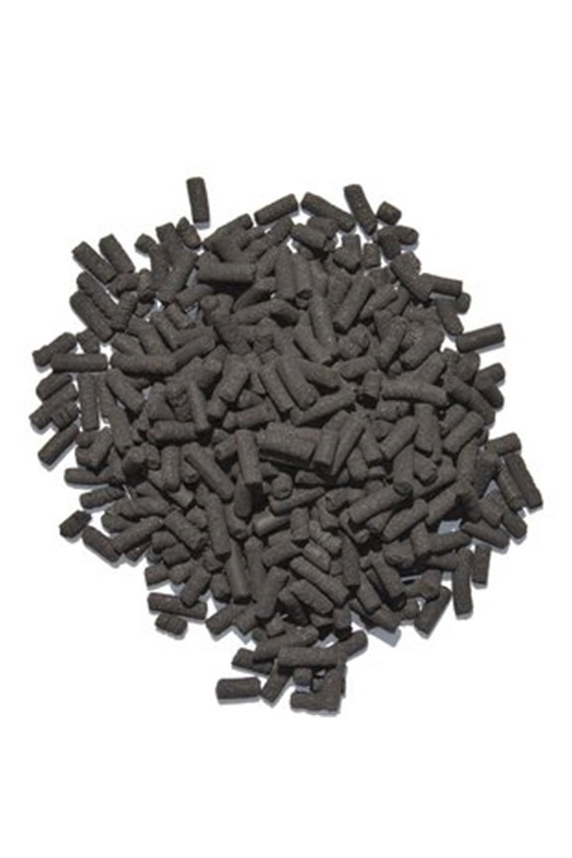
    <img src="https://factor.niehs.nih.gov/sites/niehs-factor/files/2024/08/feature/innovative-environmental-remediation-body4.jpg" alt="SediMite pellets" style="max-width: 100%; height: auto;">
    Ghosh patented SediMite in 2010 and created a university spin-off company to produce it at scale. (Photo courtesy of Sediment Solutions)
    
    <hr>
    <p><strong>UG</strong>: SediMite works by binding contaminants in sediments, reducing their availability to organisms in the food web. The product consists of activated carbon packaged into pellets, which makes it easy to handle and apply in the field. Once dispersed in sediments, the activated carbon binds to hydrophobic pollutants like PCBs, making them less bioavailable to aquatic organisms. It can apply to a whole range of hydrophobic chemicals — pesticides, dioxins, and even PFAS. It works for some metals, too. We have done some work with mercury, and it binds strongly.</p>
    <p>What sets this technology apart from traditional methods like dredging is that it minimizes environmental disruption. Dredging can release buried contaminants into the water, potentially exacerbating the problem. With SediMite, we’re able to stabilize contaminants in place, reducing the risk of exposure without disturbing the ecosystem. Additionally, this method is often more cost-effective than large-scale dredging and landfill disposal. SediMite can also be adjusted, so we can blend new formulations of absorbents in our pellets to target different pollutants.</p>
    <h2>Targeting contamination hotspots</h2>
    <p><strong>RW</strong>: It sounds like this technology has the potential to significantly improve remediation efforts. How scalable is it? Could it be applied to larger bodies of water, like Lake Michigan?</p>
    <p><strong>UG</strong>: Scaling is always a consideration, and while SediMite can be successfully applied to larger areas, it’s often most effective in targeted locations where contamination levels are highest. With targeted dispersal, we have been able to reduce PCB bioavailability by 80% or more. We’ve successfully applied this technology in places like Mirror Lake in Delaware, where it helped to reduce concentrations in fish to levels below consumption advisory guidelines.</p>
    <p>The broader notion of introducing activated carbon in a contaminated site, demonstrated successfully through our research, has now become mainstream technology. For example, the technique has been applied at multiple Superfund sites, such as the <a href="https://semspub.epa.gov/work/02/580386.pdf" rel="nofollow external" class="bo">Passaic River</a> in New Jersey.</p>
    <p>In a large body of water like Lake Michigan, the focus would likely be on contaminated hotspots near industrial sites rather than attempting to treat the entire lake. This targeted approach allows for more efficient use of resources while still achieving significant risk reduction.</p>
    <p>Recently, the U.S. Environmental Protection Agency used our product in Minnesota’s Scanlon Reservoir to clean up dioxins, and they covered about 15 acres. They used SediMite to reduce bioavailability in shoreline areas with wetlands without destroying the wetlands.</p>
    <h2>Using microbes to degrade contaminants</h2>
    <p><strong>RW</strong>: One intriguing aspect of your work involves microbial degradation of contaminants. Can you tell us more about that?</p>
    <p><strong>UG</strong>: Absolutely. Microbial degradation is the ultimate solution — finding ways to not only bind contaminants but also break them down over time. In the case of PCBs, there are naturally occurring microorganisms that can dechlorinate these compounds, making them less harmful. We’ve worked with my microbiologist colleague Dr. Kevin Sowers to isolate these organisms, grow them in the lab, and then reintroduce them into contaminated environments as microbial catalysts. This process enhances the natural degradation of contaminants, further reducing their impact over time.</p>
    <h2>For the benefit of communities</h2>
    <p><strong>RW</strong>: It’s inspiring to see remediation technologies applied in the real world. Could you share some examples of how your work has benefited communities disproportionately affected by environmental contamination?</p>
    <p><strong>UG</strong>: One project that stands out is the Middle Branch Resiliency Initiative in Southwest Baltimore, a community that faces multiple environmental challenges, including contaminated sediments and coastal flooding. By using SediMite to treat nearby sediments and creating elevated wetlands, we’re not only improving environmental conditions but also helping to protect the community from future flooding events. This project shows how environmental remediation can be integrated with broader resilience and restoration efforts, ultimately enhancing the quality of life for residents.</p>
    </div>
    <p>(Rick Woychik, Ph.D., directs NIEHS and the National Toxicology Program.)</p>
    <h5><br></h5></div>Read Original Post from Environmental FactorEnvironmental Factor<br>Your Online Source for NIEHS News: <a href="https://factor.niehs.nih.gov/2024/9/feature/4-feature-innovative-environmental-remediation" rel="nofollow external" class="bo">https://factor.niehs.nih.gov/2024/9/feature/4-feature-innovative-environmental-remediation</a><div><br></div><div>Photo credit: Rick Woychik, Ph.D., directs NIEHS and the National Toxicology Program. (Image courtesy of NIEHS)</div></div>
]]>
  </Body>
  <Summary>Chemical contamination reduced by grantee’s innovative technology  I spoke with Upal Ghosh, Ph.D., about how effective environmental remediation requires rigorous exposure science, engineering....</Summary>
  <TrackingUrl>https://dev.my.umbc.edu/api/v0/pixel/news/144102/guest@my.umbc.edu/2c601ff79b1021d3edd14fba422a7a16/api/pixel</TrackingUrl>
  <Tag>faculty</Tag>
  <Tag>fall-2024</Tag>
  <Tag>ghosh</Tag>
  <Tag>news</Tag>
  <Tag>research</Tag>
  <Group token="cbee">Chemical, Biochemical and Environmental Engineering</Group>
  <GroupUrl>https://dev.my.umbc.edu/groups/cbee</GroupUrl>
  <AvatarUrl>https://assets4-dev.my.umbc.edu/system/shared/avatars/groups/000/000/771/b5e579e81b2e3624611890fa3ca2716a/xsmall.png?1746794587</AvatarUrl>
  <AvatarUrl size="original">https://assets2-dev.my.umbc.edu/system/shared/avatars/groups/000/000/771/b5e579e81b2e3624611890fa3ca2716a/original.png?1746794587</AvatarUrl>
  <AvatarUrl size="xxlarge">https://assets1-dev.my.umbc.edu/system/shared/avatars/groups/000/000/771/b5e579e81b2e3624611890fa3ca2716a/xxlarge.png?1746794587</AvatarUrl>
  <AvatarUrl size="xlarge">https://assets2-dev.my.umbc.edu/system/shared/avatars/groups/000/000/771/b5e579e81b2e3624611890fa3ca2716a/xlarge.png?1746794587</AvatarUrl>
  <AvatarUrl size="large">https://assets2-dev.my.umbc.edu/system/shared/avatars/groups/000/000/771/b5e579e81b2e3624611890fa3ca2716a/large.png?1746794587</AvatarUrl>
  <AvatarUrl size="medium">https://assets4-dev.my.umbc.edu/system/shared/avatars/groups/000/000/771/b5e579e81b2e3624611890fa3ca2716a/medium.png?1746794587</AvatarUrl>
  <AvatarUrl size="small">https://assets1-dev.my.umbc.edu/system/shared/avatars/groups/000/000/771/b5e579e81b2e3624611890fa3ca2716a/small.png?1746794587</AvatarUrl>
  <AvatarUrl size="xsmall">https://assets4-dev.my.umbc.edu/system/shared/avatars/groups/000/000/771/b5e579e81b2e3624611890fa3ca2716a/xsmall.png?1746794587</AvatarUrl>
  <AvatarUrl size="xxsmall">https://assets1-dev.my.umbc.edu/system/shared/avatars/groups/000/000/771/b5e579e81b2e3624611890fa3ca2716a/xxsmall.png?1746794587</AvatarUrl>
  <Sponsor>Chemical, Biochemical and Environmental Engineering</Sponsor>
  <ThumbnailUrl size="xxlarge">https://assets3-dev.my.umbc.edu/system/shared/thumbnails/news/000/144/102/eacf9b2d0a66c0730b01eb78ad35fbe9/xxlarge.jpg?1726851683</ThumbnailUrl>
  <ThumbnailUrl size="xlarge">https://assets2-dev.my.umbc.edu/system/shared/thumbnails/news/000/144/102/eacf9b2d0a66c0730b01eb78ad35fbe9/xlarge.jpg?1726851683</ThumbnailUrl>
  <ThumbnailUrl size="large">https://assets3-dev.my.umbc.edu/system/shared/thumbnails/news/000/144/102/eacf9b2d0a66c0730b01eb78ad35fbe9/large.jpg?1726851683</ThumbnailUrl>
  <ThumbnailUrl size="medium">https://assets2-dev.my.umbc.edu/system/shared/thumbnails/news/000/144/102/eacf9b2d0a66c0730b01eb78ad35fbe9/medium.jpg?1726851683</ThumbnailUrl>
  <ThumbnailUrl size="small">https://assets1-dev.my.umbc.edu/system/shared/thumbnails/news/000/144/102/eacf9b2d0a66c0730b01eb78ad35fbe9/small.jpg?1726851683</ThumbnailUrl>
  <ThumbnailUrl size="xsmall">https://assets2-dev.my.umbc.edu/system/shared/thumbnails/news/000/144/102/eacf9b2d0a66c0730b01eb78ad35fbe9/xsmall.jpg?1726851683</ThumbnailUrl>
  <ThumbnailUrl size="xxsmall">https://assets1-dev.my.umbc.edu/system/shared/thumbnails/news/000/144/102/eacf9b2d0a66c0730b01eb78ad35fbe9/xxsmall.jpg?1726851683</ThumbnailUrl>
  <PawCount>0</PawCount>
  <CommentCount>0</CommentCount>
  <CommentsAllowed>true</CommentsAllowed>
  <PostedAt>Fri, 20 Sep 2024 13:07:06 -0400</PostedAt>
  <EditAt>Fri, 20 Sep 2024 13:17:00 -0400</EditAt>
</NewsItem>
  <NewsItem contentIssues="true" id="144072" important="false" status="posted" url="https://dev.my.umbc.edu/groups/cbee/posts/144072">
  <Title>Upal Ghosh appointed to D.C. mayor&#8217;s Leadership Council for a Cleaner Anacostia River</Title>
  <Tagline>from UMBC News</Tagline>
  <Body>
    <![CDATA[
    <div class="html-content"><p><a href="https://umbc.edu/quick-posts/upal-ghosh-leadership-council-for-a-cleaner-anacostia-river/" rel="nofollow external" class="bo"> UMBC News</a> | Published: Sep 18, 2024 |By:<a href="https://umbc.edu/author/cmeyers2/" rel="nofollow external" class="bo"><strong>Catherine Meyers</strong></a></p>
    <p>On September 12, UMBC’s <strong><a href="https://cbee.umbc.edu/upal-ghosh/" rel="nofollow external" class="bo">Upal Ghosh</a></strong>, from the Department of Chemical, Biochemical, and Environmental Engineering, was sworn in as a member of the Washington, D.C., mayor’s Leadership Council for a Cleaner Anacostia River (LCCAR). The council consists of 25 high-level government officials, community leaders, and environmental experts who support the vision of a swimmable and fishable Anacostia River. The members meet quarterly to advise the D.C. government on ongoing restoration projects. </p>
    <p>The Anacostia River, which runs from Prince George’s County in Maryland into Washington, D.C., before joining the Potomac River and ultimately flowing into the Chesapeake Bay, has historically suffered from high levels of industrial pollution and contamination from sewage overflow. In recent years, government officials have been making concerted efforts to clean up the river. UMBC was invited to sit on the council, with Ghosh as the representative, based on the university’s key contributions to these clean-up efforts. </p>
    <img src="https://umbc.edu/wp-content/uploads/2024/09/LCCAR-swearing-in_Sept.-12.png" alt="Screen shots shows people on conference call on top and agenda for meeting below. Some people raise their hands for a swearing in." width="601" height="485" style="max-width: 100%; height: auto;">
    On Sept. 12, Upal Ghosh (top left) and other members of the LCCAR were sworn in during a virtual meeting of the council. (Image courtesy of Ghosh)
    
    <p><br>Since 2016, Ghosh and his UMBC colleagues and students have developed innovative methods of measuring contaminants in the river and created models to elucidate where the contaminants come from and how they travel through and accumulate in the water, sediment, and aquatic life, such as fish. <strong><a href="https://imet.usmd.edu/directory/nathalie-lombard" rel="nofollow external" class="bo">Nathalie Lombard</a></strong>, a research assistant professor at UMBC who has played a significant role in the projects, will serve as the alternate representative on the LLCAR when Ghosh cannot attend. </p>
    <p><br>In addition to his work on the Anacostia, Ghosh and his students have studied and contributed to the cleanup of the <a href="https://factor.niehs.nih.gov/2024/9/feature/4-feature-innovative-environmental-remediation" rel="nofollow external" class="bo">waterways throughout Maryland, Delaware, and across the country</a>. “Students learn a lot from being out in the field,” Ghosh says. “They learn how the science and engineering we do helps guide major decisions. Our ultimate goal is making a positive difference in the health of the river, lake, or bay. That gives me a lot of excitement, and it really motivates the students too.”</p>
    <p>Read original post via UMBC NEWS: <a href="https://umbc.edu/quick-posts/upal-ghosh-leadership-council-for-a-cleaner-anacostia-river/" rel="nofollow external" class="bo">Upal Ghosh Appointed To D.C. Mayor’s Leadership Council For A Cleaner Anacostia River - UMBC</a></p></div>
]]>
  </Body>
  <Summary>UMBC News | Published: Sep 18, 2024 |By:Catherine Meyers   On September 12, UMBC’s Upal Ghosh, from the Department of Chemical, Biochemical, and Environmental Engineering, was sworn in as a member...</Summary>
  <TrackingUrl>https://dev.my.umbc.edu/api/v0/pixel/news/144072/guest@my.umbc.edu/8f57de1fd5874947076a22abb7de8539/api/pixel</TrackingUrl>
  <Tag>cbee</Tag>
  <Tag>coeit</Tag>
  <Tag>faculty</Tag>
  <Tag>fall-2024</Tag>
  <Tag>ghosh</Tag>
  <Tag>news</Tag>
  <Group token="cbee">Chemical, Biochemical and Environmental Engineering</Group>
  <GroupUrl>https://dev.my.umbc.edu/groups/cbee</GroupUrl>
  <AvatarUrl>https://assets4-dev.my.umbc.edu/system/shared/avatars/groups/000/000/771/b5e579e81b2e3624611890fa3ca2716a/xsmall.png?1746794587</AvatarUrl>
  <AvatarUrl size="original">https://assets2-dev.my.umbc.edu/system/shared/avatars/groups/000/000/771/b5e579e81b2e3624611890fa3ca2716a/original.png?1746794587</AvatarUrl>
  <AvatarUrl size="xxlarge">https://assets1-dev.my.umbc.edu/system/shared/avatars/groups/000/000/771/b5e579e81b2e3624611890fa3ca2716a/xxlarge.png?1746794587</AvatarUrl>
  <AvatarUrl size="xlarge">https://assets2-dev.my.umbc.edu/system/shared/avatars/groups/000/000/771/b5e579e81b2e3624611890fa3ca2716a/xlarge.png?1746794587</AvatarUrl>
  <AvatarUrl size="large">https://assets2-dev.my.umbc.edu/system/shared/avatars/groups/000/000/771/b5e579e81b2e3624611890fa3ca2716a/large.png?1746794587</AvatarUrl>
  <AvatarUrl size="medium">https://assets4-dev.my.umbc.edu/system/shared/avatars/groups/000/000/771/b5e579e81b2e3624611890fa3ca2716a/medium.png?1746794587</AvatarUrl>
  <AvatarUrl size="small">https://assets1-dev.my.umbc.edu/system/shared/avatars/groups/000/000/771/b5e579e81b2e3624611890fa3ca2716a/small.png?1746794587</AvatarUrl>
  <AvatarUrl size="xsmall">https://assets4-dev.my.umbc.edu/system/shared/avatars/groups/000/000/771/b5e579e81b2e3624611890fa3ca2716a/xsmall.png?1746794587</AvatarUrl>
  <AvatarUrl size="xxsmall">https://assets1-dev.my.umbc.edu/system/shared/avatars/groups/000/000/771/b5e579e81b2e3624611890fa3ca2716a/xxsmall.png?1746794587</AvatarUrl>
  <Sponsor>Chemical, Biochemical and Environmental Engineering</Sponsor>
  <ThumbnailUrl size="xxlarge">https://assets2-dev.my.umbc.edu/system/shared/thumbnails/news/000/144/072/6ae323c355a16250b66c41004a6f7c0e/xxlarge.jpg?1726777022</ThumbnailUrl>
  <ThumbnailUrl size="xlarge">https://assets2-dev.my.umbc.edu/system/shared/thumbnails/news/000/144/072/6ae323c355a16250b66c41004a6f7c0e/xlarge.jpg?1726777022</ThumbnailUrl>
  <ThumbnailUrl size="large">https://assets1-dev.my.umbc.edu/system/shared/thumbnails/news/000/144/072/6ae323c355a16250b66c41004a6f7c0e/large.jpg?1726777022</ThumbnailUrl>
  <ThumbnailUrl size="medium">https://assets1-dev.my.umbc.edu/system/shared/thumbnails/news/000/144/072/6ae323c355a16250b66c41004a6f7c0e/medium.jpg?1726777022</ThumbnailUrl>
  <ThumbnailUrl size="small">https://assets1-dev.my.umbc.edu/system/shared/thumbnails/news/000/144/072/6ae323c355a16250b66c41004a6f7c0e/small.jpg?1726777022</ThumbnailUrl>
  <ThumbnailUrl size="xsmall">https://assets1-dev.my.umbc.edu/system/shared/thumbnails/news/000/144/072/6ae323c355a16250b66c41004a6f7c0e/xsmall.jpg?1726777022</ThumbnailUrl>
  <ThumbnailUrl size="xxsmall">https://assets2-dev.my.umbc.edu/system/shared/thumbnails/news/000/144/072/6ae323c355a16250b66c41004a6f7c0e/xxsmall.jpg?1726777022</ThumbnailUrl>
  <PawCount>0</PawCount>
  <CommentCount>0</CommentCount>
  <CommentsAllowed>true</CommentsAllowed>
  <PostedAt>Thu, 19 Sep 2024 16:19:54 -0400</PostedAt>
  <EditAt>Fri, 20 Sep 2024 10:14:46 -0400</EditAt>
</NewsItem>
  <NewsItem contentIssues="true" id="144012" important="false" status="posted" url="https://dev.my.umbc.edu/groups/cbee/posts/144012">
  <Title>Lee Blaney assumes presidency of the Association of Environmental Engineering and Science Professors</Title>
  <Tagline>From UMBC News</Tagline>
  <Body>
    <![CDATA[
    <div class="html-content"><p>From <a href="https://umbc.edu/stories/lee-blaney-president-association-environmental-engineering-science-professors/" rel="nofollow external" class="bo">UMBC News</a> | By: Catherine Meyers | Published: Sep 16, 2024</p><p>Professor <strong>Lee Blaney</strong>, in the Department of Chemical, Biochemical, and Environmental Engineering, formally assumed the role of president of the Association of Environmental Engineering and Science Professors (AEESP) at a board of directors meeting in early September.</p>
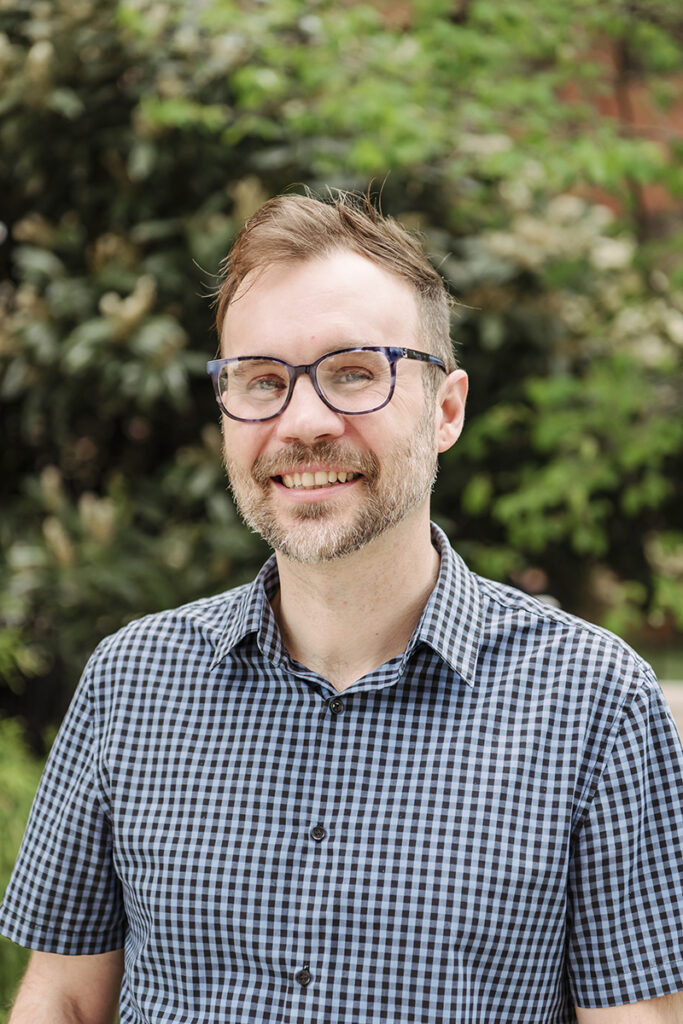
    <img src="https://www.umbc.edu/wp-content/uploads/2024/09/PFSA24-Lee-Blaney-1882-683x1024.jpg" alt="A man wearing glasses and checkered shirt smile at camera in front of greenery." width="170" style="max-width: 100%; height: auto;">
    <br>Lee Blaney (Marlayna Demond ’11/UMBC)
    
    
    <p><br></p><p>AEESP is a nonprofit organization founded in 1963 to foster inclusive connections between environmental engineering and science researchers and educators. It provides programs for members to develop the academic networks and career skills needed for professional success, increase equitable societal impact of environmental engineering and science scholarship and creative expression, and reimagine the skills necessary for environmental engineers and scientists to provide solutions that benefit regional, national, and global communities. </p>
    <p>The association currently has more than 1000 members from universities around the world. AEESP assists its members in improving education and research programs, encourages graduate education, and provides information to government agencies and the public. The biennial AEESP Research and Education Conference brings the field together to share research, teaching, and outreach outcomes. Blaney’s term as president will include the next conference, which is scheduled to occur in May 2025 at Duke University. </p>
    <p>“We’re excited about Dr. Blaney’s new role as president of AEESP,” says <strong>Mark Marten</strong>, the chair of the Department of Chemical, Biochemical, and Environmental Engineering. “His deep involvement with this organization not only makes a positive impact in our discipline, but also raises awareness of our department and UMBC in this influential community.” </p>
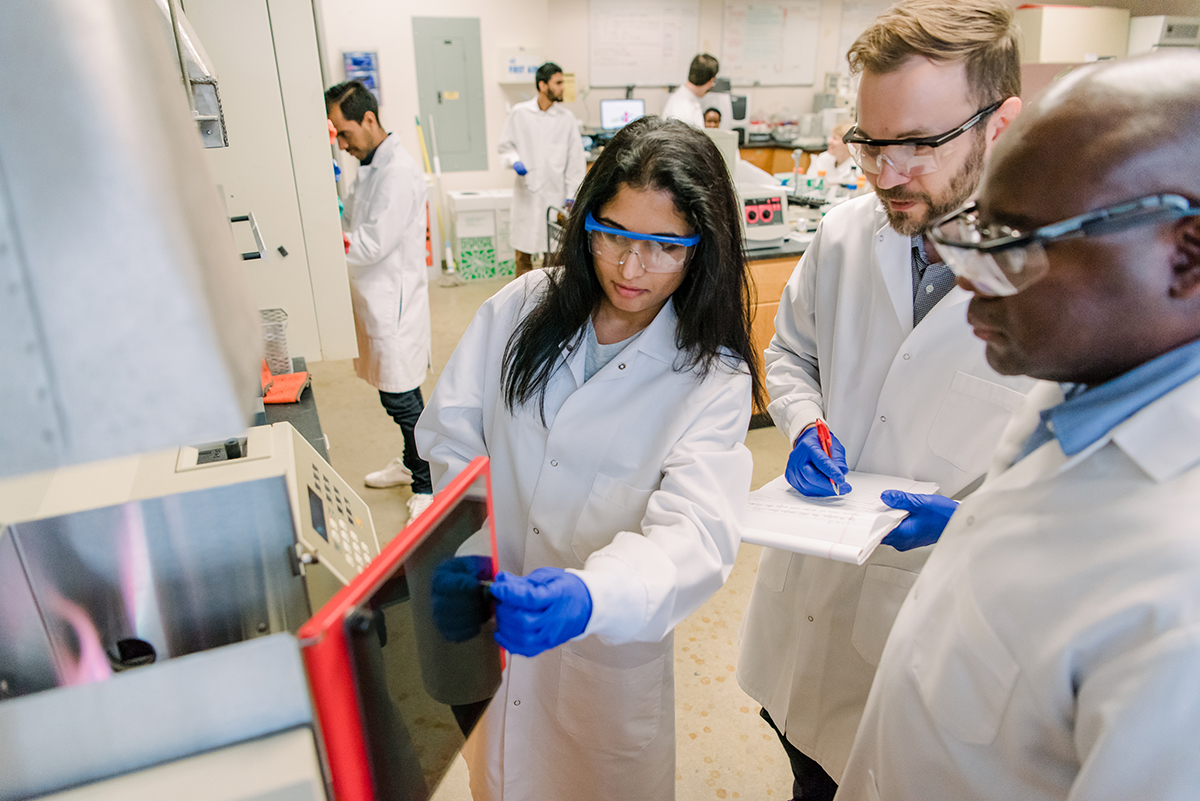
    <p>Blaney and his research group study environmental contaminants of emerging concern, <a href="https://umbc.edu/quick-posts/lee-blaney-wins-funding-to-develop-new-ways-to-remove-forever-chemicals-from-water/" rel="nofollow external" class="bo">such as per- and polyfluoroalkyl substances</a>, or PFAS, which are sometimes called “forever chemicals” because of the way they persist in the environment. They also research how to recover vital resources, such as nitrogen and phosphorus, from waste streams to improve water quality and ensure sustainable development. Blaney was a winner of the <a href="https://pubs.acs.org/doi/10.1021/acs.estlett.0c00904?utm_source=SendGrid_ealert&amp;utm_medium=ealert&amp;utm_campaign=TOC_estlcu_v7_i12&amp;ref=SendGrid_ealert_TOC_estlcu_v7_i12_" rel="nofollow external" class="bo">2021 James J. Morgan Early Career Award</a> from the American Chemical Society, and has also been recognized for the quality of his <a href="https://facultystaffawards.umbc.edu/umbc-presidential-faculty-staff-awards-2022/2020-2023-presidential-teaching-professor/" rel="nofollow external" class="bo">teaching</a> and <a href="https://facultystaffawards.umbc.edu/lee-blaney/" rel="nofollow external" class="bo">mentorship</a>.</p>
    <img src="https://umbc.edu/wp-content/uploads/2024/09/Lee-Blaney-Lab19-0755.jpg" alt="People wearing lab coats, gloves, and safety glasses stand in a lab. In the center, a woman opens the door of a piece of lab equipment while two men stand nearby, one holding a pen and paper." width="1200" height="801" style="max-width: 100%; height: auto;">
    Lee Blaney (center) in his UMBC lab in 2019. (Marlayna Demond ’11/UMBC)
    
    <p>Blaney joined AEESP in 2012 after starting as an assistant professor at UMBC. He quickly joined and became chair of the AEESP Membership &amp; Demographics Committee, through which he led efforts to initiate a student video competition (check out this <a href="https://www.youtube.com/watch?v=MUT8zya53Vg" rel="nofollow external" class="bo">winning video from UMBC</a>). He also led efforts to document the demographics of environmental engineering faculty and students in reports such as “<a href="https://www.liebertpub.com/doi/abs/10.1089/ees.2016.0063" rel="nofollow external" class="bo">Trends in Population and Demographics of U.S. Environmental Engineering Students and Faculty from 2005 to 2013</a>” and “<a href="https://www.liebertpub.com/doi/abs/10.1089/ees.2017.0337" rel="nofollow external" class="bo">Another Grand Challenge: Diversity in Environmental Engineering</a>.”</p>
    <p>In 2021, Blaney was elected to the AEESP board of directors. Since that time, he has led a number of initiatives aimed at improving inclusion. During his one-year term as president, he will lead the board and executive committee, provide new charges to standing committees, correspond with members, represent AEESP at conferences and meetings, and drive new initiatives to grow the organization and support its members. </p>
    <img src="https://umbc.edu/wp-content/uploads/2024/09/2023-AEESP-Research-and-Education-Conference.jpg" alt="Four people wearing conference badges stand in large room and smile at camera." width="1200" height="900" style="max-width: 100%; height: auto;">
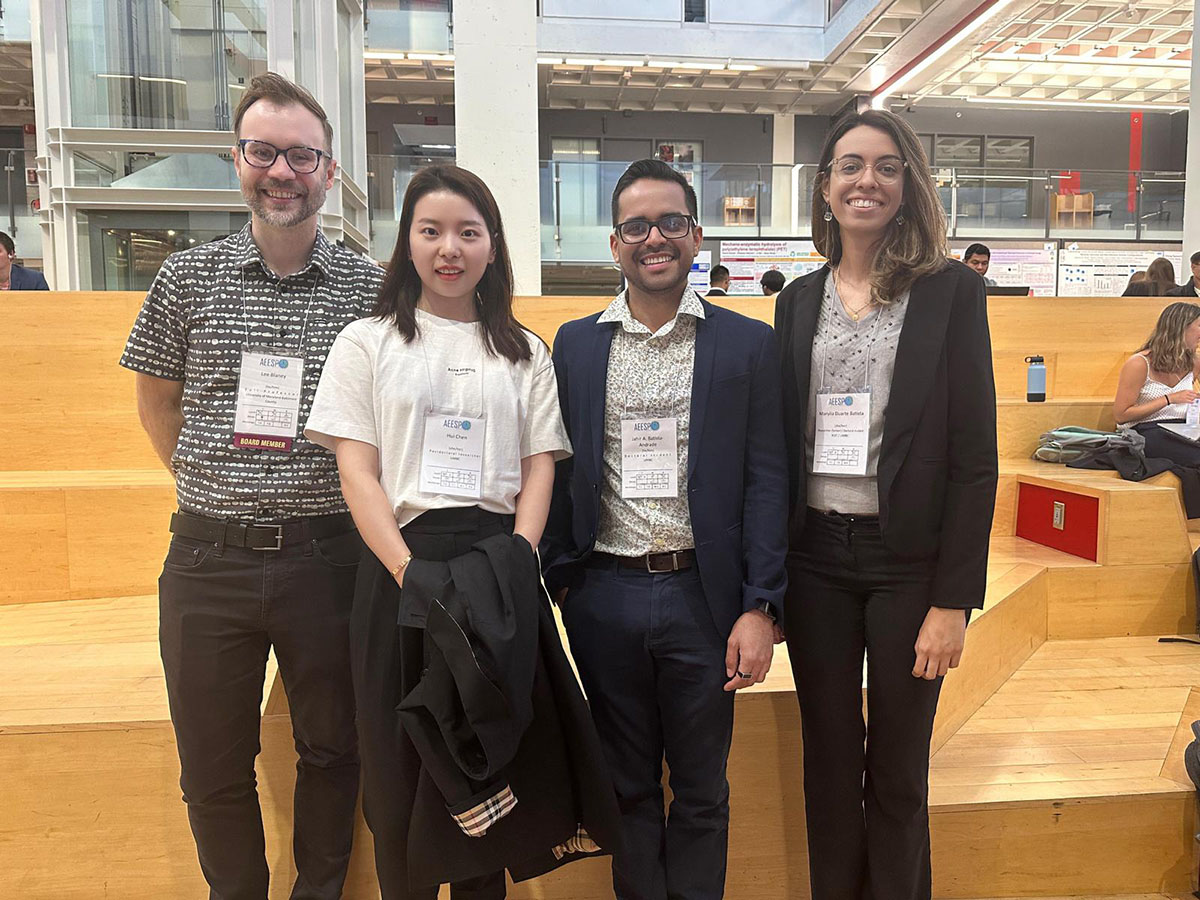
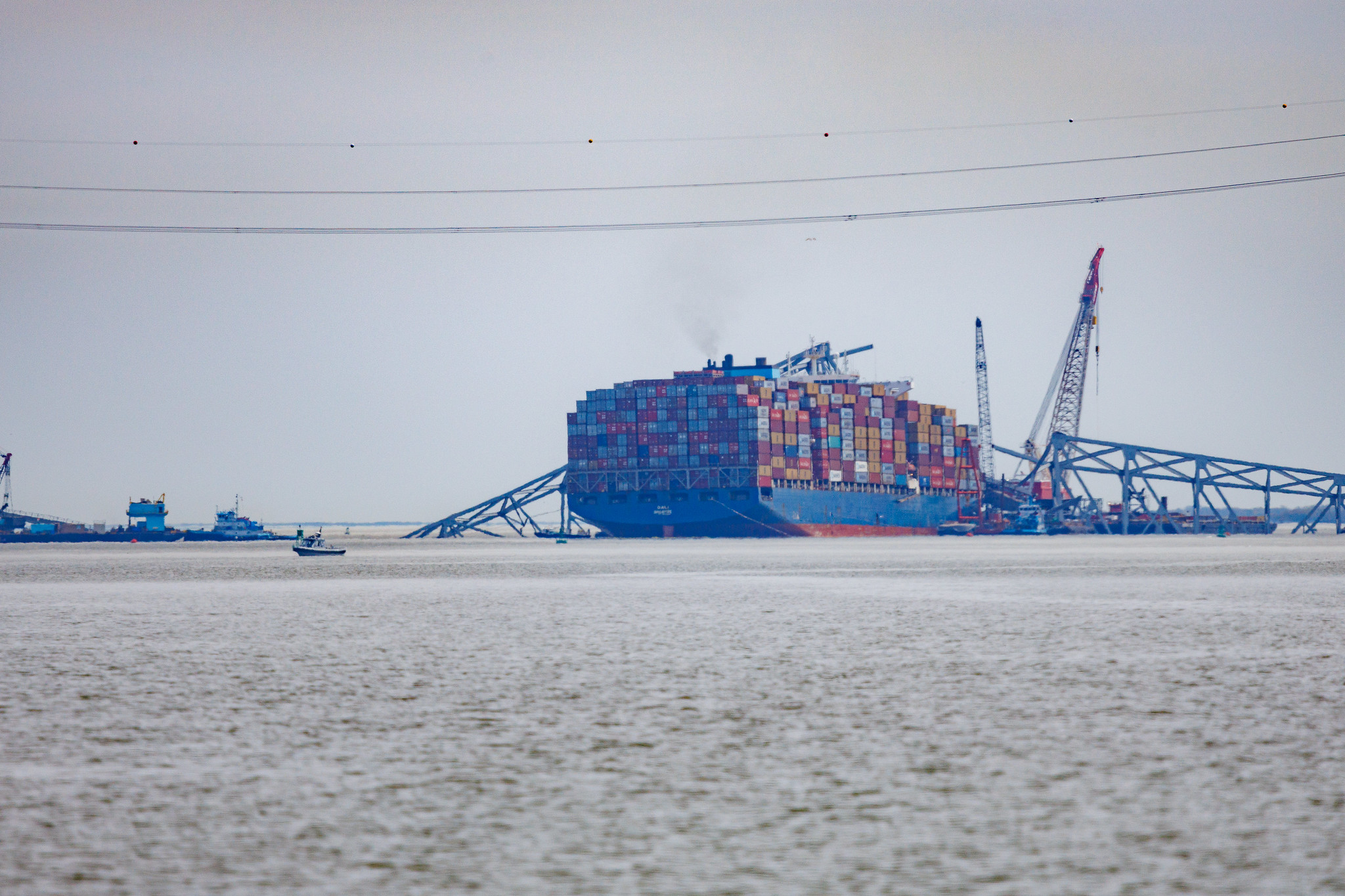
    Lee Blaney (left) and his group members (left to right), Hui Chen (completed postdoc in 2024, now assistant professor at James Madison University), Jahir Batista Andrade, Ph.D. ’23, (now postdoc at University of Minnesota), and Marylia Duarte Batista (current Ph.D. student), at the 2023 AEESP Research and Education Conference in Boston. (Photo courtesy of Blaney)
    
    <p>In his first presidential address to AEESP, given in June, Blaney told members of how he found direction as an undergraduate student after attending a talk by environmental engineer Arup SenGupta, who spoke of efforts to remove arsenic from contaminated groundwater in rural villages in India.</p>
    <p>“His passion and dedication to helping those without other resources inspired me, set me on the path to becoming an environmental engineer, and helped me to become a better person,” Blaney said. He hopes to bring these same values to AEESP and its members.</p>
    <p>As president of AEESP, Blaney plans to develop an “AEESP Experts” program, which will connect environmental experts with reporters, and also an “AEESP Communities of Practice” initiative, which will gather small groups of AEESP members to develop new resources, such as new course material on climate change or best practices for graduate student recruitment, which can be shared with the whole community.</p><p><br></p><p>Read original post via UMBC NEWS: <a href="https://umbc.edu/stories/lee-blaney-president-association-environmental-engineering-science-professors/" rel="nofollow external" class="bo">Lee Blaney assumes presidency of the Association of Environmental Engineering and Science Professors</a></p><div><br></div></div>
]]>
  </Body>
  <Summary>From UMBC News | By: Catherine Meyers | Published: Sep 16, 2024  Professor Lee Blaney, in the Department of Chemical, Biochemical, and Environmental Engineering, formally assumed the role of...</Summary>
  <TrackingUrl>https://dev.my.umbc.edu/api/v0/pixel/news/144012/guest@my.umbc.edu/22bd330d437a3e89a2c8510cd58b6f79/api/pixel</TrackingUrl>
  <Tag>blaney</Tag>
  <Tag>faculty</Tag>
  <Tag>fall-2024</Tag>
  <Tag>marten</Tag>
  <Tag>news</Tag>
  <Group token="cbee">Chemical, Biochemical and Environmental Engineering</Group>
  <GroupUrl>https://dev.my.umbc.edu/groups/cbee</GroupUrl>
  <AvatarUrl>https://assets4-dev.my.umbc.edu/system/shared/avatars/groups/000/000/771/b5e579e81b2e3624611890fa3ca2716a/xsmall.png?1746794587</AvatarUrl>
  <AvatarUrl size="original">https://assets2-dev.my.umbc.edu/system/shared/avatars/groups/000/000/771/b5e579e81b2e3624611890fa3ca2716a/original.png?1746794587</AvatarUrl>
  <AvatarUrl size="xxlarge">https://assets1-dev.my.umbc.edu/system/shared/avatars/groups/000/000/771/b5e579e81b2e3624611890fa3ca2716a/xxlarge.png?1746794587</AvatarUrl>
  <AvatarUrl size="xlarge">https://assets2-dev.my.umbc.edu/system/shared/avatars/groups/000/000/771/b5e579e81b2e3624611890fa3ca2716a/xlarge.png?1746794587</AvatarUrl>
  <AvatarUrl size="large">https://assets2-dev.my.umbc.edu/system/shared/avatars/groups/000/000/771/b5e579e81b2e3624611890fa3ca2716a/large.png?1746794587</AvatarUrl>
  <AvatarUrl size="medium">https://assets4-dev.my.umbc.edu/system/shared/avatars/groups/000/000/771/b5e579e81b2e3624611890fa3ca2716a/medium.png?1746794587</AvatarUrl>
  <AvatarUrl size="small">https://assets1-dev.my.umbc.edu/system/shared/avatars/groups/000/000/771/b5e579e81b2e3624611890fa3ca2716a/small.png?1746794587</AvatarUrl>
  <AvatarUrl size="xsmall">https://assets4-dev.my.umbc.edu/system/shared/avatars/groups/000/000/771/b5e579e81b2e3624611890fa3ca2716a/xsmall.png?1746794587</AvatarUrl>
  <AvatarUrl size="xxsmall">https://assets1-dev.my.umbc.edu/system/shared/avatars/groups/000/000/771/b5e579e81b2e3624611890fa3ca2716a/xxsmall.png?1746794587</AvatarUrl>
  <Sponsor>Chemical, Biochemical and Environmental Engineering</Sponsor>
  <ThumbnailUrl size="xxlarge">https://assets2-dev.my.umbc.edu/system/shared/thumbnails/news/000/144/012/f2220563be1e736a340793e0622087f8/xxlarge.jpg?1726673870</ThumbnailUrl>
  <ThumbnailUrl size="xlarge">https://assets2-dev.my.umbc.edu/system/shared/thumbnails/news/000/144/012/f2220563be1e736a340793e0622087f8/xlarge.jpg?1726673870</ThumbnailUrl>
  <ThumbnailUrl size="large">https://assets1-dev.my.umbc.edu/system/shared/thumbnails/news/000/144/012/f2220563be1e736a340793e0622087f8/large.jpg?1726673870</ThumbnailUrl>
  <ThumbnailUrl size="medium">https://assets1-dev.my.umbc.edu/system/shared/thumbnails/news/000/144/012/f2220563be1e736a340793e0622087f8/medium.jpg?1726673870</ThumbnailUrl>
  <ThumbnailUrl size="small">https://assets2-dev.my.umbc.edu/system/shared/thumbnails/news/000/144/012/f2220563be1e736a340793e0622087f8/small.jpg?1726673870</ThumbnailUrl>
  <ThumbnailUrl size="xsmall">https://assets4-dev.my.umbc.edu/system/shared/thumbnails/news/000/144/012/f2220563be1e736a340793e0622087f8/xsmall.jpg?1726673870</ThumbnailUrl>
  <ThumbnailUrl size="xxsmall">https://assets4-dev.my.umbc.edu/system/shared/thumbnails/news/000/144/012/f2220563be1e736a340793e0622087f8/xxsmall.jpg?1726673870</ThumbnailUrl>
  <PawCount>1</PawCount>
  <CommentCount>0</CommentCount>
  <CommentsAllowed>true</CommentsAllowed>
  <PostedAt>Wed, 18 Sep 2024 11:38:00 -0400</PostedAt>
  <EditAt>Thu, 19 Sep 2024 15:49:23 -0400</EditAt>
</NewsItem>
  <NewsItem contentIssues="true" id="142482" important="false" status="posted" url="https://dev.my.umbc.edu/groups/cbee/posts/142482">
  <Title>Dr. Ghosh assesses environmental impact of bridge collapse</Title>
  <Tagline>Excerpt UMBC Magazine</Tagline>
  <Body>
    <![CDATA[
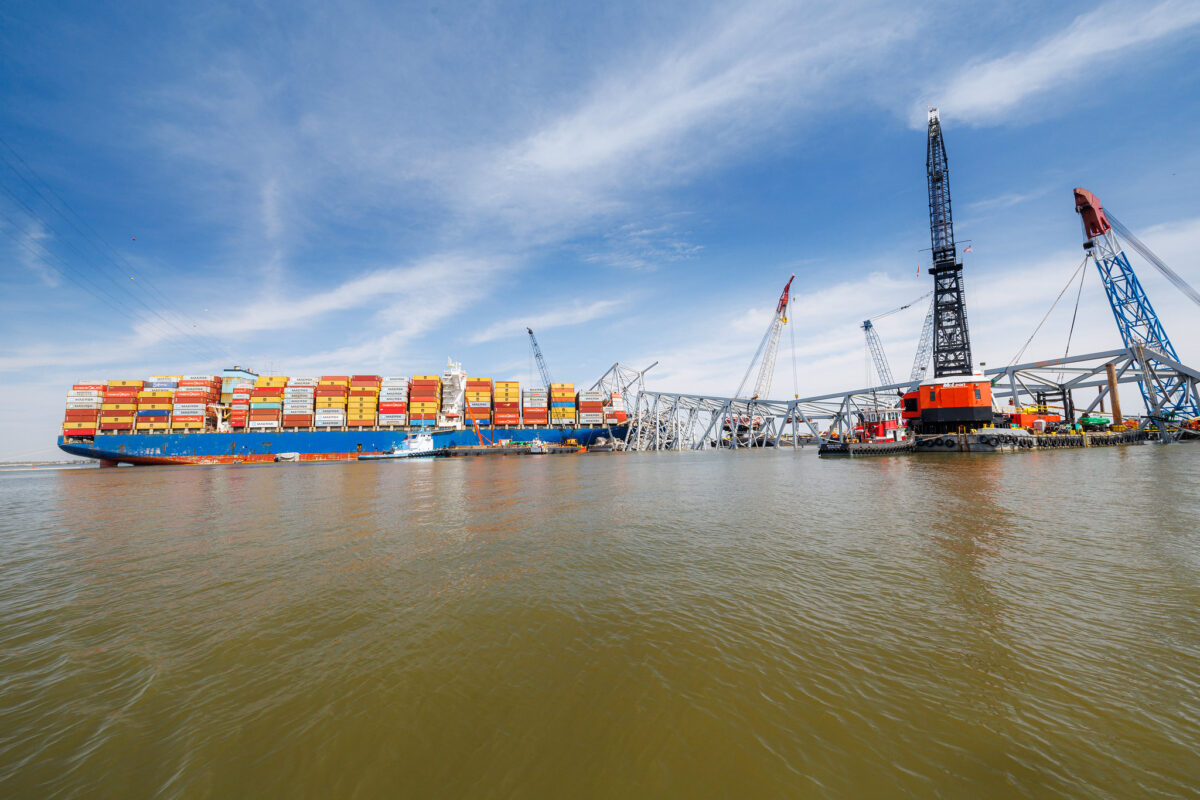
    <div class="html-content">In response to the tragic collapse of the Francis Scott Key Bridge, Dr. Upal Ghosh, professorCBEE, assesses potential environmental impacts, particularly concerning the hazardous materials aboard the cargo ship. His insights into the potential ecological repercussions underscored the department's commitment to safeguarding the Patapsco River and surrounding communities.<br><br><em>Excerpt from UMBC Magazine “<a href="https://umbc.edu/stories/support-after-key-bridge-collapse/" rel="nofollow external" class="bo"><strong>Infrastructure of support after Key Bridge collapse</strong></a><strong>”</strong> by Adriana Fraser, published on June 13, 2024</em>
    <p><img src="https://umbc.edu/wp-content/uploads/2024/05/Key-Bridge-Collapse.jpg" alt="The remains of the Francis Scott Key Bridge after a collision with a malfunctioning cargo ship on March 26. (Photo source: Corey Jennings '10, Maryland Comptroller/Flickr)" width="928" height="619" style="max-width: 100%; height: auto;"><em>The remains of the Francis Scott Key Bridge after a collision with a malfunctioning cargo ship on March 26. (Photo source: Corey Jennings '10, Maryland Comptroller/Flickr)</em></p><p><strong>Examining the environmental impacts of the collapse </strong></p><p>The ship that collided into the bridge was carrying 56 containers of hazardous materials, including corrosives, flammables, and lithium-ion batteries. The cargo ship was also carrying more than one million gallons of fuel at the time of the impact. City officials began their investigations into the incident, which included determining the environmental impacts to the Patapsco River and surrounding communities. </p>
    <p><strong>Upal Ghosh</strong>, professor of chemical, biochemical, and environmental engineering, whose research includes examining the effects of toxic pollutants in soils, sediments, and aquatic environments, was among the experts who weighed in on assessing the potentially hazardous effects of the containers that were resting at the bottom of the river. <br><br><img src="https://umbc.edu/wp-content/uploads/2024/05/Key-Bridge-Collapse-2-1200x800.jpg" alt="" width="800" height="460" style="max-width: 100%; height: auto;"><em>Maryland Comptroller Brooke Lierman and representatives of the Office of the Governor take a tour of the Francis Scott Key Bridge collapse site on a Maryland Department of Natural Resources police boat. (Photo source: Corey Jennings ’10, <a href="https://flickr.com/photos/mdcomptroller/53643621629/in/album-72177720316111136/" rel="nofollow external" class="bo">Maryland Comptroller/Flickr</a>)</em></p>
    <p>Ghosh told the <em>Baltimore Sun</em> days after the collapse that environmental officials’ first priority would likely be making sure none of the intact containers were breached.</p>
    <p>“If you have containers that contain oily material, those things will, if they are breached, be releasing over time,” Ghosh said. “I would think if there is a release that goes down into the sediments under the water, it would be a local impact right there.” </p>
    <p><strong>Farah Nibbs</strong>, assistant professor of emergency and disaster health systems, is also thinking about future ways to contain the effects of similar disasters. Contributing factors to the bridge’s collapse, she says, can be tied to the 2012 expansion and modernization of the Port of Baltimore. Those changes did not happen hand in hand with improvements in safety management needed to accommodate ships of such huge sizes that now were able to port in the city. Risks from collisions, fuel spills, and contamination still lack proper oversight and regulation.</p>
    <p>“A novel approach for decision-makers may be to view Maryland’s emergency management and transportation experts and service providers—as well as the physical bridge infrastructure itself—as part of the community’s lifeline systems,” said Nibbs. </p><p><strong><em>~~</em></strong></p><p><strong><em>Read the full article: <a href="https://umbc.edu/stories/support-after-key-bridge-collapse/" rel="nofollow external" class="bo">Infrastructure Of Support After Key Bridge Collapse - UMBC: University Of Maryland, Baltimore County</a></em></strong></p></div>
]]>
  </Body>
  <Summary>In response to the tragic collapse of the Francis Scott Key Bridge, Dr. Upal Ghosh, professorCBEE, assesses potential environmental impacts, particularly concerning the hazardous materials aboard...</Summary>
  <TrackingUrl>https://dev.my.umbc.edu/api/v0/pixel/news/142482/guest@my.umbc.edu/07e4001c5ec8f5aca841833b20e59429/api/pixel</TrackingUrl>
  <Tag>faculty</Tag>
  <Tag>ghosh</Tag>
  <Tag>news</Tag>
  <Tag>spring-2024</Tag>
  <Group token="cbee">Chemical, Biochemical and Environmental Engineering</Group>
  <GroupUrl>https://dev.my.umbc.edu/groups/cbee</GroupUrl>
  <AvatarUrl>https://assets4-dev.my.umbc.edu/system/shared/avatars/groups/000/000/771/b5e579e81b2e3624611890fa3ca2716a/xsmall.png?1746794587</AvatarUrl>
  <AvatarUrl size="original">https://assets2-dev.my.umbc.edu/system/shared/avatars/groups/000/000/771/b5e579e81b2e3624611890fa3ca2716a/original.png?1746794587</AvatarUrl>
  <AvatarUrl size="xxlarge">https://assets1-dev.my.umbc.edu/system/shared/avatars/groups/000/000/771/b5e579e81b2e3624611890fa3ca2716a/xxlarge.png?1746794587</AvatarUrl>
  <AvatarUrl size="xlarge">https://assets2-dev.my.umbc.edu/system/shared/avatars/groups/000/000/771/b5e579e81b2e3624611890fa3ca2716a/xlarge.png?1746794587</AvatarUrl>
  <AvatarUrl size="large">https://assets2-dev.my.umbc.edu/system/shared/avatars/groups/000/000/771/b5e579e81b2e3624611890fa3ca2716a/large.png?1746794587</AvatarUrl>
  <AvatarUrl size="medium">https://assets4-dev.my.umbc.edu/system/shared/avatars/groups/000/000/771/b5e579e81b2e3624611890fa3ca2716a/medium.png?1746794587</AvatarUrl>
  <AvatarUrl size="small">https://assets1-dev.my.umbc.edu/system/shared/avatars/groups/000/000/771/b5e579e81b2e3624611890fa3ca2716a/small.png?1746794587</AvatarUrl>
  <AvatarUrl size="xsmall">https://assets4-dev.my.umbc.edu/system/shared/avatars/groups/000/000/771/b5e579e81b2e3624611890fa3ca2716a/xsmall.png?1746794587</AvatarUrl>
  <AvatarUrl size="xxsmall">https://assets1-dev.my.umbc.edu/system/shared/avatars/groups/000/000/771/b5e579e81b2e3624611890fa3ca2716a/xxsmall.png?1746794587</AvatarUrl>
  <Sponsor>Chemical, Biochemical and Environmental Engineering</Sponsor>
  <PawCount>0</PawCount>
  <CommentCount>0</CommentCount>
  <CommentsAllowed>true</CommentsAllowed>
  <PostedAt>Mon, 17 Jun 2024 13:40:07 -0400</PostedAt>
  <EditAt>Mon, 17 Jun 2024 15:01:09 -0400</EditAt>
</NewsItem>
  <NewsItem contentIssues="true" id="142271" important="false" status="posted" url="https://dev.my.umbc.edu/groups/cbee/posts/142271">
  <Title>Chemical Engineering Club shines with Student Conference</Title>
  <Tagline>From UMBC NEWS</Tagline>
  <Body>
    <![CDATA[
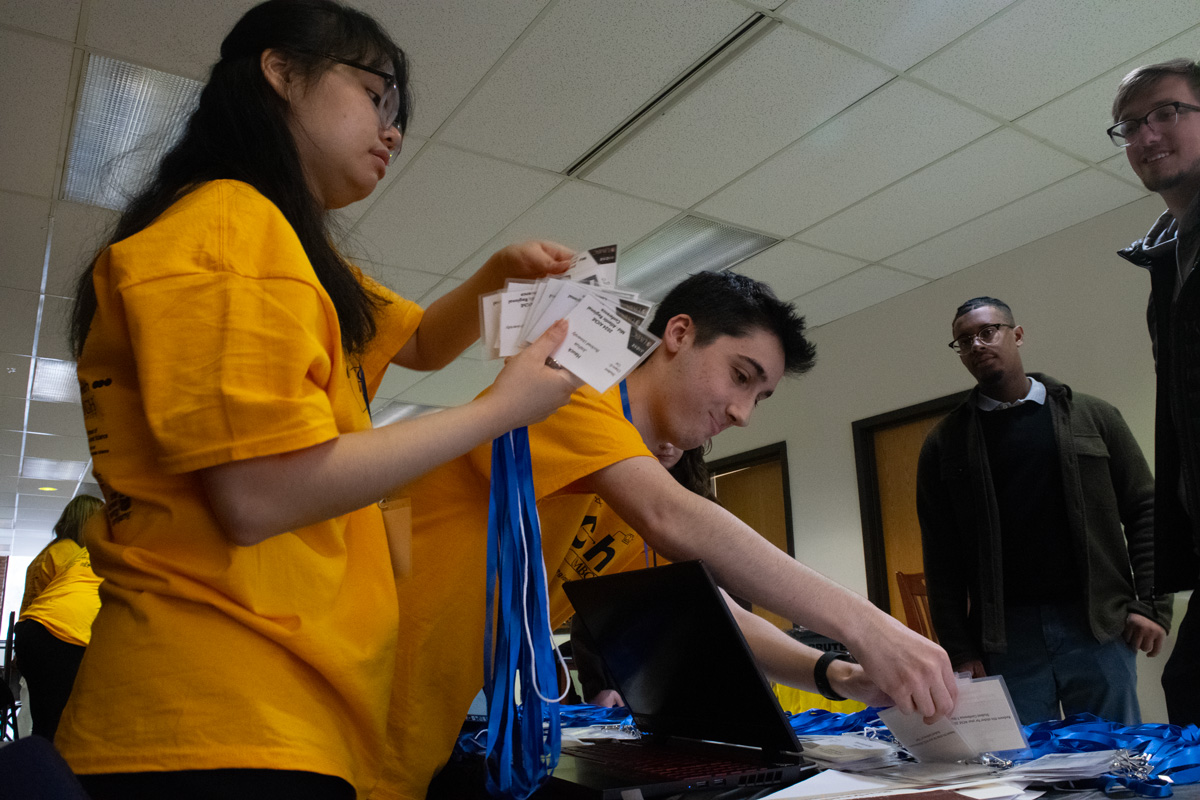
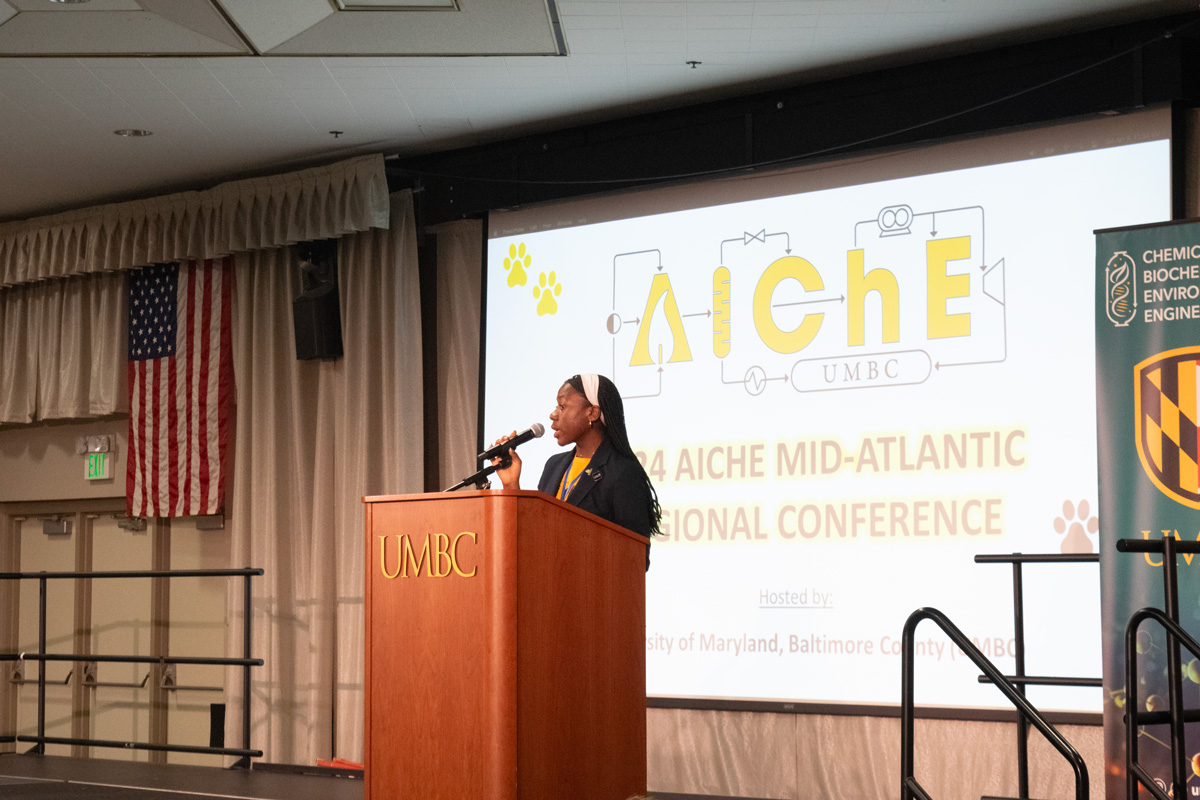
    <div class="html-content"><p>On the first weekend of April, hundreds of chemical engineering students from across the Mid-Atlantic converged on the UMBC campus for two days of learning, networking, and friendly competition. They heard talks from academic and industry leaders, attended workshops and a career fair, competed in rounds of ChemE Jeopardy, mixed chemicals to power small cars along a track in the ChemE Car competition, and mingled over catered lunches, dinners, and cups of evening hot cocoa. </p>
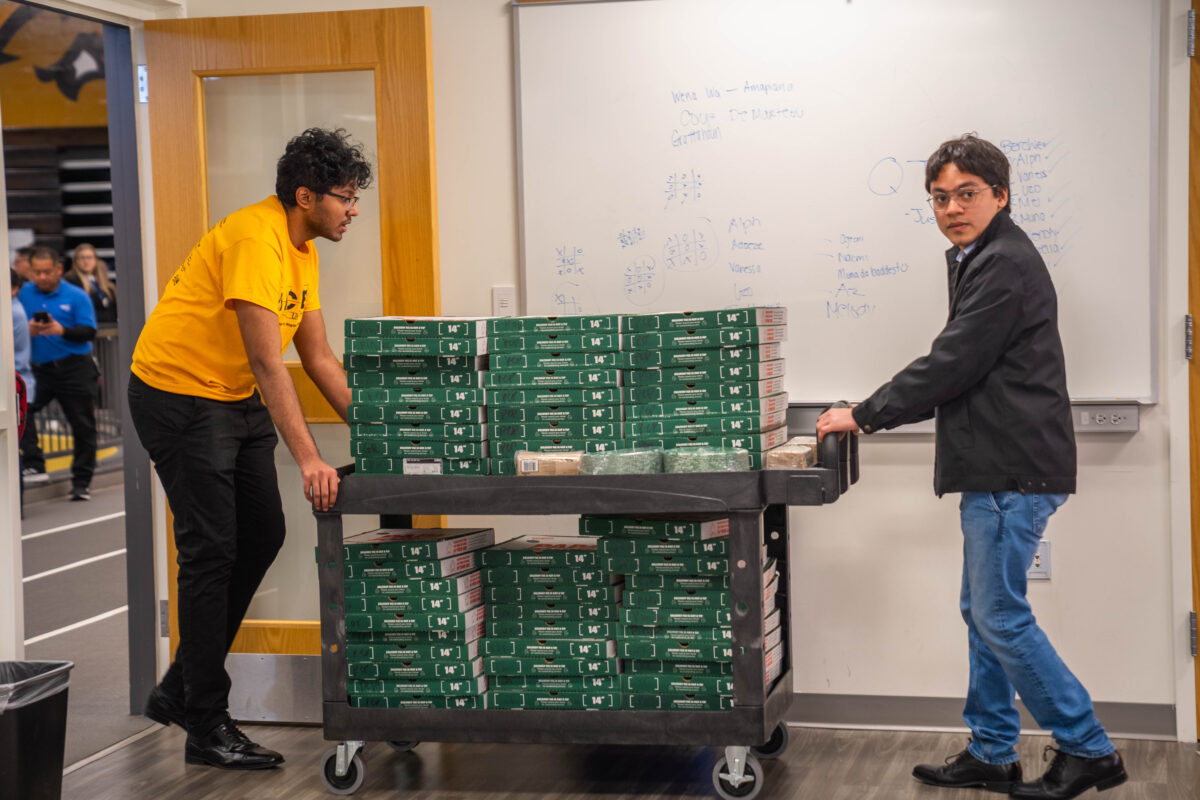
    <p>The activities were all part of the <a href="https://aiche2024.umbc.edu/" rel="nofollow external" class="bo">2024 Mid-Atlantic Student Regional Conference</a> of the American Institute of Chemical Engineers (AIChE)—hosted by the UMBC student chapter of the national group. Around 400 people attended the event, an increase from last year’s conference at Virginia Tech. Organizing the logistics, recruiting speakers and sponsors, securing rooms, and ordering thousands of plates worth of food presented a formidable challenge—one that the UMBC students tackled with aplomb. </p>
    
    <img src="https://umbc.edu/wp-content/uploads/2024/05/Conference-badges-Danielle-Clark.jpg" alt="A desk covered with conference badges. Two people wait in line, while two people behind the desk look for the right badges." width="1200" height="800" style="max-width: 100%; height: auto;">
    Managing check-in. (Photo by Danielle Clark)
    
    <img src="https://umbc.edu/wp-content/uploads/2024/05/Opening-remarks-Danielle-Clark.jpg" alt="A woman stands at a podium with the letters UMBC on it. In the background is a slide that says AIChE Mid-Atlantic Regional Conference." width="1200" height="800" style="max-width: 100%; height: auto;">
    Welcoming attendees. (Photo by Danielle Clark)
    
    <img src="https://umbc.edu/wp-content/uploads/2024/05/Pizza-delivery-Julianna-Falconer-1200x800.jpg" alt="Two people push a cart stacked with pizza boxes." width="1200" height="800" style="max-width: 100%; height: auto;">
    Delivering pizza. (Photo by Julianna Falconer)
    
    
    <p>“I am feeling fantastic after the conference,” says<strong> Pavan Umashankar</strong> ’25, chemical engineering and biochemistry and molecular biology, who served as the chair of the conference organizing committee. “I am super proud of everyone’s commitment and dedication to make it a resounding success.”</p>
    <p>“Truly, I could gush about the UMBC conference planning team all day,” says Alyssa Block, the membership associate of ChemE student programs for AIChE. “These students really are the future leaders of their profession and of AIChE: engaged, excited, collaborative, supportive of each other, and willing to lend a hand.” </p>
    <h4><strong>A club on the upswing</strong> </h4>
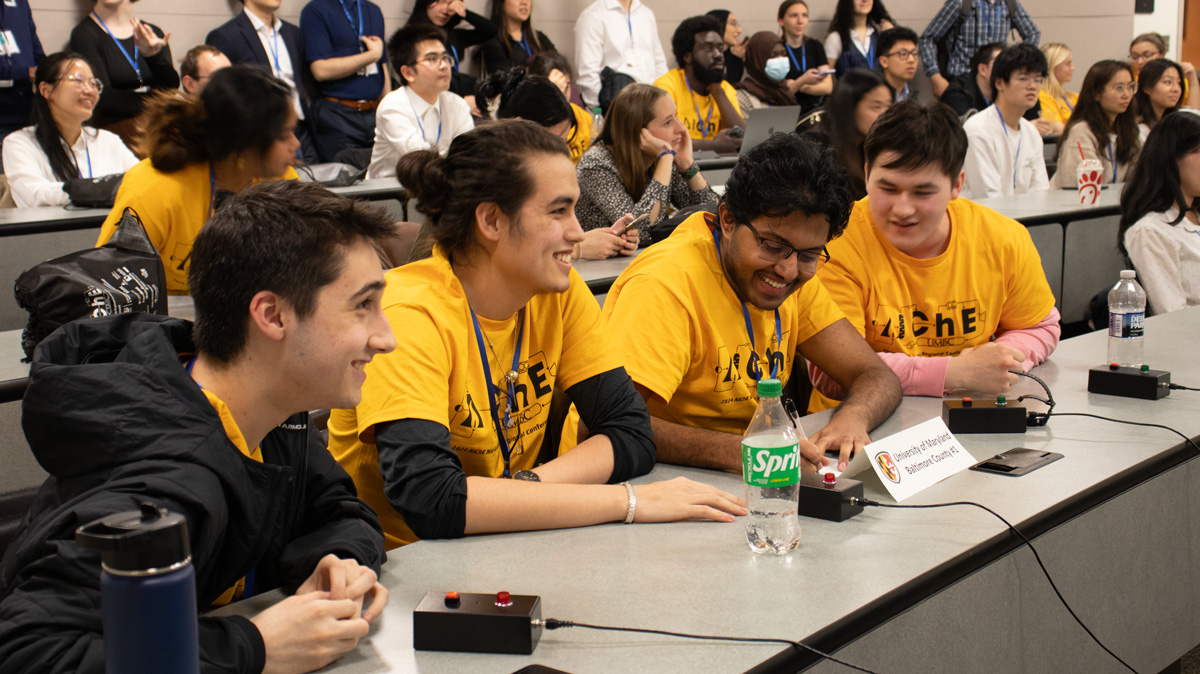
    <p>Hosting an AIChE regional conference for the first time at UMBC marked a milestone for a student club that has seen increasing levels of engagement and success in recent years. While many <a href="https://www.chronicle.com/article/why-campus-life-fell-apart" rel="nofollow external" class="bo">college clubs across the country are in decline</a> post-Covid, UMBC’s AIChE student chapter is on a clear upward trajectory. The club sent its first team to compete in ChemE Jeopardy at the spring 2019 AIChE regional meeting. Just three years later, the UMBC team <a href="https://umbc.edu/stories/umbc-chemical-engineering-students-win-cheme-jeopardy-national-championship/" rel="nofollow external" class="bo">won the national ChemE Jeopardy</a> competition. </p>
    <p><strong>Neha Raikar</strong>, a senior lecturer in the Department of Chemical, Biochemical, and Environmental Engineering (CBEE) and one of the advisors to the student AIChE chapter, remembers attending the 2019 meeting: “Back then, we wondered if we would ever be able to host a regional conference at UMBC,” she says. “We’ve achieved that goal.” </p>
    <p>It was especially remarkable, she adds, to see some members of UMBC’s first ChemE Jeopardy and ChemE car teams return to this year’s conference as industry representatives.</p>
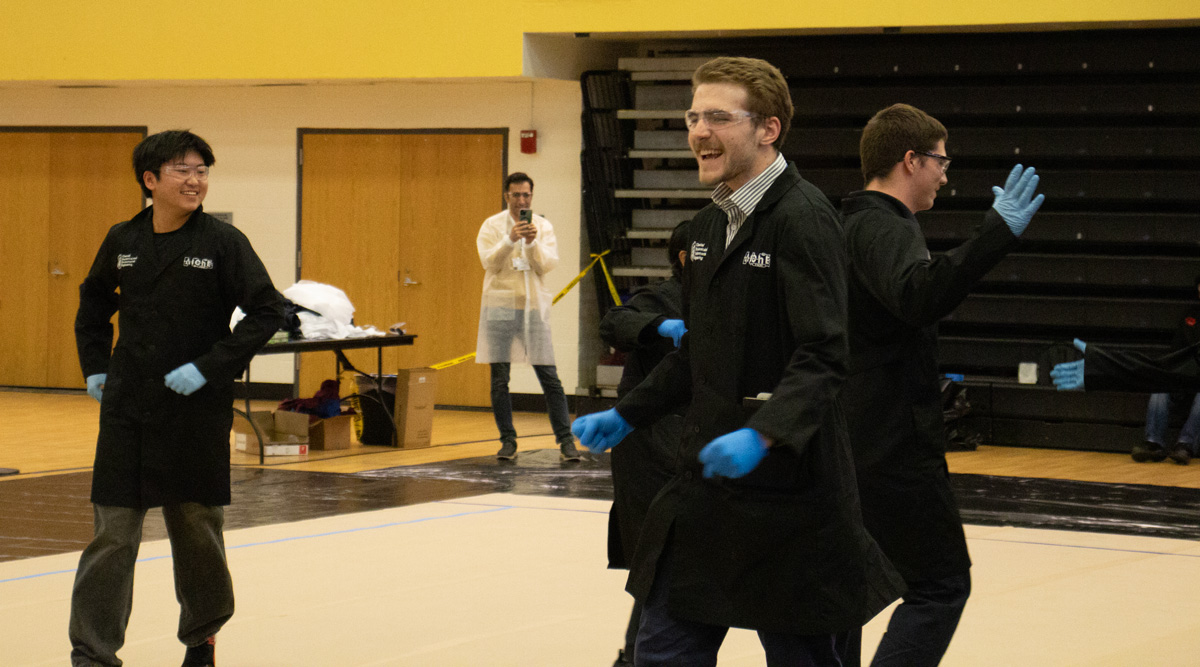
    <p>Strong attendance and smooth conference logistics weren’t the only successes of the weekend—UMBC also <a href="https://intellectualsports.umbc.edu/news-events/news-stories/post/140743/" rel="nofollow external" class="bo">triumphed in the ChemE Jeopardy and ChemE car competitions</a>. </p>
    
    <img src="https://umbc.edu/wp-content/uploads/2024/05/Jeopardy-4.jpg" alt="Four people sit behind buzzers at long lecture room table. One writes on a piece of papers. Many other people sit or stand behind the front row." width="1200" height="674" style="max-width: 100%; height: auto;">
    The UMBC #1 Jeopardy team during a preliminary round. (Photo by Patch Hatley)
    
    <img src="https://umbc.edu/wp-content/uploads/2024/05/ChemE-Car.jpg" alt="People in black lab coats and blue gloves celebrate and high five." width="1200" height="667" style="max-width: 100%; height: auto;">
    The UMBC ChemE Car team celebrates a good run. (Photo by Patch Hatley)<br>
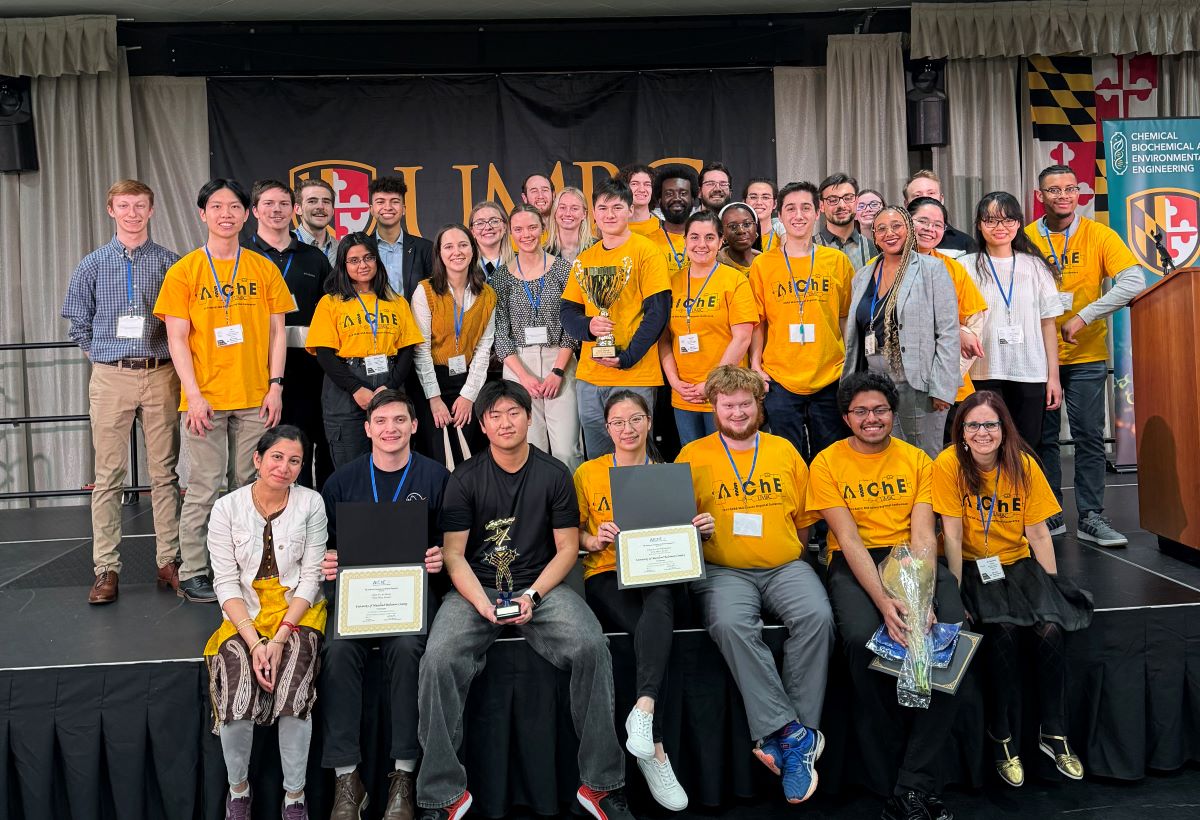
    
    
    <p>“Planning for the conference was already a significant undertaking, and on top of that, many of our students participated, and excelled, in the competitions,” says Raikar. “Their achievements not only showcased their individual capabilities but also the strength of our club as a whole, which is growing and thriving.”</p>
    <h4>A winning formula</h4>
    <p>AIChE chapter members and their advisors ascribe the club’s success to the hard work and dedication of the students coupled with the support of the CBEE department, college, and university. Thirteen CBEE students formed the conference planning committee, which met regularly to ensure all conference planning efforts were on track. An additional 37 students and 14 faculty and staff also volunteered their time—as check-in staff, poster and presentation judges, and more. About 10 UMBC alumni actively participated in the conference, and others contributed to fundraising efforts, helping the organizing committee secure <a href="https://aiche2024.umbc.edu/our-sponsors/" rel="nofollow external" class="bo">sponsorships</a> from notable companies such as AstraZeneca, ExxonMobil, Advanced Thermal Batteries, and Astek Diagnostics and from the chemical engineering department of Columbia University. </p>
    <p><strong><a href="https://umbc.edu/stories/an-dang-chemical-engineer/" rel="nofollow external" class="bo">An Dang</a></strong> ’24, chemical engineering, led the fundraising efforts. She gamely approached industry representatives at the UMBC career fair and made the pitch. “I’m not an extrovert, and being in these roles forced me to go out of my comfort zone,” she says.</p>
    <p>“Securing sponsorships was vital for making the conference possible, and An did a remarkable job” says <strong>Mariajosé Castellanos</strong>, another CBEE faculty who advises the AIChE chapter. Castellanos also praised the management skills of conference planning committee chair Umashankar. “Despite his modesty, Pavan is a true mastermind in everything he does,” she says.</p>
    <p>For their part, the students applauded the support of the CBEE department, especially the work of their two advisors, Raikar and Castellanos, and the event planning support of <strong>Andrea Miller</strong>, the CBEE graduate program coordinator. </p>
    <img src="https://umbc.edu/wp-content/uploads/2024/05/AIChE-Conference-volunteers-resized.jpg" alt="Large group of people, many wearing yellow AIChE shirts, gather on stage and pose for the camera." width="1200" height="820" style="max-width: 100%; height: auto;">
    UMBC AIChE chapter students and faculty advisors pose for a group photo after a successful conference. (Photo courtesy of Mariajosé Castellanos.)
    
    <p>The conference was both a marker of the club’s success and an opportunity for individual students to grow their skill sets.</p>
    <p>“I have developed leadership and project management skills, which will be incredibly useful throughout my professional career,” says Umashankar. </p>
    <p><strong>Ben Welling</strong> ’25, chemical engineering, the leader of the UMBC ChemE car team, believes his experience with the competition helped him land internships. “I talked about it extensively with employers. They like leadership experience and it shows you are willing to do more than is required.” </p>
    <p>Raikar sees a bright future for the student stars of this year’s conference and for the club as a whole. “I hope the conference will boost the club membership and participation of students in other AIChE activities,” she says. And, she adds, the conference shows that with support, “UMBC students can accomplish any task.”</p></div>
]]>
  </Body>
  <Summary>On the first weekend of April, hundreds of chemical engineering students from across the Mid-Atlantic converged on the UMBC campus for two days of learning, networking, and friendly competition....</Summary>
  <TrackingUrl>https://dev.my.umbc.edu/api/v0/pixel/news/142271/guest@my.umbc.edu/3d6571baf24e193bd86ca74684041696/api/pixel</TrackingUrl>
  <Tag>aiche</Tag>
  <Tag>news</Tag>
  <Tag>research</Tag>
  <Tag>ug</Tag>
  <Tag>ugrad</Tag>
  <Group token="cbee">Chemical, Biochemical and Environmental Engineering</Group>
  <GroupUrl>https://dev.my.umbc.edu/groups/cbee</GroupUrl>
  <AvatarUrl>https://assets4-dev.my.umbc.edu/system/shared/avatars/groups/000/000/771/b5e579e81b2e3624611890fa3ca2716a/xsmall.png?1746794587</AvatarUrl>
  <AvatarUrl size="original">https://assets2-dev.my.umbc.edu/system/shared/avatars/groups/000/000/771/b5e579e81b2e3624611890fa3ca2716a/original.png?1746794587</AvatarUrl>
  <AvatarUrl size="xxlarge">https://assets1-dev.my.umbc.edu/system/shared/avatars/groups/000/000/771/b5e579e81b2e3624611890fa3ca2716a/xxlarge.png?1746794587</AvatarUrl>
  <AvatarUrl size="xlarge">https://assets2-dev.my.umbc.edu/system/shared/avatars/groups/000/000/771/b5e579e81b2e3624611890fa3ca2716a/xlarge.png?1746794587</AvatarUrl>
  <AvatarUrl size="large">https://assets2-dev.my.umbc.edu/system/shared/avatars/groups/000/000/771/b5e579e81b2e3624611890fa3ca2716a/large.png?1746794587</AvatarUrl>
  <AvatarUrl size="medium">https://assets4-dev.my.umbc.edu/system/shared/avatars/groups/000/000/771/b5e579e81b2e3624611890fa3ca2716a/medium.png?1746794587</AvatarUrl>
  <AvatarUrl size="small">https://assets1-dev.my.umbc.edu/system/shared/avatars/groups/000/000/771/b5e579e81b2e3624611890fa3ca2716a/small.png?1746794587</AvatarUrl>
  <AvatarUrl size="xsmall">https://assets4-dev.my.umbc.edu/system/shared/avatars/groups/000/000/771/b5e579e81b2e3624611890fa3ca2716a/xsmall.png?1746794587</AvatarUrl>
  <AvatarUrl size="xxsmall">https://assets1-dev.my.umbc.edu/system/shared/avatars/groups/000/000/771/b5e579e81b2e3624611890fa3ca2716a/xxsmall.png?1746794587</AvatarUrl>
  <Sponsor>Chemical, Biochemical and Environmental Engineering</Sponsor>
  <ThumbnailUrl size="xxlarge">https://assets4-dev.my.umbc.edu/system/shared/thumbnails/news/000/142/271/71c5d282380dec4ba167cdacffba8fe1/xxlarge.jpg?1717184352</ThumbnailUrl>
  <ThumbnailUrl size="xlarge">https://assets2-dev.my.umbc.edu/system/shared/thumbnails/news/000/142/271/71c5d282380dec4ba167cdacffba8fe1/xlarge.jpg?1717184352</ThumbnailUrl>
  <ThumbnailUrl size="large">https://assets4-dev.my.umbc.edu/system/shared/thumbnails/news/000/142/271/71c5d282380dec4ba167cdacffba8fe1/large.jpg?1717184352</ThumbnailUrl>
  <ThumbnailUrl size="medium">https://assets1-dev.my.umbc.edu/system/shared/thumbnails/news/000/142/271/71c5d282380dec4ba167cdacffba8fe1/medium.jpg?1717184352</ThumbnailUrl>
  <ThumbnailUrl size="small">https://assets1-dev.my.umbc.edu/system/shared/thumbnails/news/000/142/271/71c5d282380dec4ba167cdacffba8fe1/small.jpg?1717184352</ThumbnailUrl>
  <ThumbnailUrl size="xsmall">https://assets2-dev.my.umbc.edu/system/shared/thumbnails/news/000/142/271/71c5d282380dec4ba167cdacffba8fe1/xsmall.jpg?1717184352</ThumbnailUrl>
  <ThumbnailUrl size="xxsmall">https://assets2-dev.my.umbc.edu/system/shared/thumbnails/news/000/142/271/71c5d282380dec4ba167cdacffba8fe1/xxsmall.jpg?1717184352</ThumbnailUrl>
  <PawCount>3</PawCount>
  <CommentCount>0</CommentCount>
  <CommentsAllowed>true</CommentsAllowed>
  <PostedAt>Fri, 31 May 2024 15:40:38 -0400</PostedAt>
  <EditAt>Fri, 31 May 2024 15:42:00 -0400</EditAt>
</NewsItem>
  <NewsItem contentIssues="true" id="142226" important="false" status="posted" url="https://dev.my.umbc.edu/groups/cbee/posts/142226">
  <Title>IN THE NEWS: &#8220;doctors of the environment&#8221; clean up PFAS</Title>
  <Tagline>Dr. Ghosh and team in Chesapeake Quarterly</Tagline>
  <Body>
    <![CDATA[
    <div class="html-content"><p><strong>CBEE IN THE NEWS: </strong></p>
    <p>Chesapeake Quarterly‘s Complicated Contaminants: Finding PFAS in the Chesapeake Bay - <a href="https://www.chesapeakequarterly.net/V23N1/" rel="nofollow external" class="bo">Volume 23, Number 1 | May 2024</a></p>
    <p><em><strong>EXCERPT FROM:  </strong></em><a href="https://storymaps.arcgis.com/stories/940e35fe36be4c4590508d477a4187c8" rel="nofollow external" class="bo">Diagnosing the PFAS Problem: Scientists Investigate So-Called ‘Forever Chemicals’ in the Chesapeake Bay</a></p>
    <p>By Ashley Goetz | May 8, 2024</p>
    <p>“We kind of think of ourselves as the doctors of the environment,” says <strong>Upal Ghosh</strong>, a professor of chemical and environmental engineering at the University of Maryland, Baltimore County. In order to make a diagnosis, a doctor might study your symptoms, order tests, and review your medical reports. Similarly, when there are signs of sickness in an ecosystem, scientists start with the Symptoms.</p>
    <p>They formulate ways to gather information—collecting field samples, analyzing them in a lab, running experiments, and using mathematical models. And, like doctors, only once they learn enough to diagnose the problem can they begin to offer remedies. </p>
    <p>For per- and polyfluoroalkyl substances, or PFAS, science is still largely in the diagnosis stage.</p>
    <p>PFAS, perhaps most commonly known by their nickname, “forever chemicals,” are a vast group of human-made chemicals found in common household products, like nonstick pans, carpets, cosmetics, and fast-food packaging. They are widespread, long-lasting, and in some cases, toxic. Studies have shown that even at very low levels, certain PFAS can harm people and wildlife. </p>
    <p>…. </p>
    <p>Although PFOA and PFOS are no longer made in the United States, they are still regularly detected in water and soil samples. That’s because PFAS don’t get recycled in the environment. The carbon-fluorine bond in PFAS is one of the strongest in chemistry, making PFAS super-stable. “People have called the perfluorochemicals molecular rebars,” says <strong>Ghosh</strong>. “They don’t break down.” Over time, PFAS have escaped from the places they were made, used, and thrown away into the soil, air, and water that support life on Earth. And once introduced, PFAS tend to stick around.</p>
    <p>….</p>
    <p><strong>Fate and Forecast</strong></p>
    <p>When it comes to PFAS, nearly every researcher will tell you, “It’s complicated.” And they’re right. Thousands of chemicals are classified as PFAS. They are seemingly everywhere, and they behave unlike many of the contaminants researchers and regulators have dealt with before.</p>
    <p>Yet, buoyed by increasing public interest and concern, researchers continue to seek answers about PFAS. “How do you design a remedy? It really starts with defining the problem correctly,” says Upal <strong>Ghosh</strong>. Only then, he says, can we turn our attention toward the interventions and engineering needed to treat the issue.</p>
    <p><br><br></p>
    <p><a href="https://storymaps.arcgis.com/stories/940e35fe36be4c4590508d477a4187c8" rel="nofollow external" class="bo"><em>Read full article</em></a></p></div>
]]>
  </Body>
  <Summary>CBEE IN THE NEWS:    Chesapeake Quarterly‘s Complicated Contaminants: Finding PFAS in the Chesapeake Bay - Volume 23, Number 1 | May 2024   EXCERPT FROM:  Diagnosing the PFAS Problem: Scientists...</Summary>
  <TrackingUrl>https://dev.my.umbc.edu/api/v0/pixel/news/142226/guest@my.umbc.edu/0e62eeaaf490dd2bc7a9a2e8325dbb5f/api/pixel</TrackingUrl>
  <Tag>ghosh</Tag>
  <Tag>news</Tag>
  <Tag>research</Tag>
  <Tag>spring-2024</Tag>
  <Group token="cbee">Chemical, Biochemical and Environmental Engineering</Group>
  <GroupUrl>https://dev.my.umbc.edu/groups/cbee</GroupUrl>
  <AvatarUrl>https://assets4-dev.my.umbc.edu/system/shared/avatars/groups/000/000/771/b5e579e81b2e3624611890fa3ca2716a/xsmall.png?1746794587</AvatarUrl>
  <AvatarUrl size="original">https://assets2-dev.my.umbc.edu/system/shared/avatars/groups/000/000/771/b5e579e81b2e3624611890fa3ca2716a/original.png?1746794587</AvatarUrl>
  <AvatarUrl size="xxlarge">https://assets1-dev.my.umbc.edu/system/shared/avatars/groups/000/000/771/b5e579e81b2e3624611890fa3ca2716a/xxlarge.png?1746794587</AvatarUrl>
  <AvatarUrl size="xlarge">https://assets2-dev.my.umbc.edu/system/shared/avatars/groups/000/000/771/b5e579e81b2e3624611890fa3ca2716a/xlarge.png?1746794587</AvatarUrl>
  <AvatarUrl size="large">https://assets2-dev.my.umbc.edu/system/shared/avatars/groups/000/000/771/b5e579e81b2e3624611890fa3ca2716a/large.png?1746794587</AvatarUrl>
  <AvatarUrl size="medium">https://assets4-dev.my.umbc.edu/system/shared/avatars/groups/000/000/771/b5e579e81b2e3624611890fa3ca2716a/medium.png?1746794587</AvatarUrl>
  <AvatarUrl size="small">https://assets1-dev.my.umbc.edu/system/shared/avatars/groups/000/000/771/b5e579e81b2e3624611890fa3ca2716a/small.png?1746794587</AvatarUrl>
  <AvatarUrl size="xsmall">https://assets4-dev.my.umbc.edu/system/shared/avatars/groups/000/000/771/b5e579e81b2e3624611890fa3ca2716a/xsmall.png?1746794587</AvatarUrl>
  <AvatarUrl size="xxsmall">https://assets1-dev.my.umbc.edu/system/shared/avatars/groups/000/000/771/b5e579e81b2e3624611890fa3ca2716a/xxsmall.png?1746794587</AvatarUrl>
  <Sponsor>Chemical, Biochemical and Environmental Engineering</Sponsor>
  <ThumbnailUrl size="xxlarge">https://assets1-dev.my.umbc.edu/system/shared/thumbnails/news/000/142/226/5310f969b64707705f14aa0f165d663e/xxlarge.jpg?1716926867</ThumbnailUrl>
  <ThumbnailUrl size="xlarge">https://assets4-dev.my.umbc.edu/system/shared/thumbnails/news/000/142/226/5310f969b64707705f14aa0f165d663e/xlarge.jpg?1716926867</ThumbnailUrl>
  <ThumbnailUrl size="large">https://assets1-dev.my.umbc.edu/system/shared/thumbnails/news/000/142/226/5310f969b64707705f14aa0f165d663e/large.jpg?1716926867</ThumbnailUrl>
  <ThumbnailUrl size="medium">https://assets3-dev.my.umbc.edu/system/shared/thumbnails/news/000/142/226/5310f969b64707705f14aa0f165d663e/medium.jpg?1716926867</ThumbnailUrl>
  <ThumbnailUrl size="small">https://assets2-dev.my.umbc.edu/system/shared/thumbnails/news/000/142/226/5310f969b64707705f14aa0f165d663e/small.jpg?1716926867</ThumbnailUrl>
  <ThumbnailUrl size="xsmall">https://assets3-dev.my.umbc.edu/system/shared/thumbnails/news/000/142/226/5310f969b64707705f14aa0f165d663e/xsmall.jpg?1716926867</ThumbnailUrl>
  <ThumbnailUrl size="xxsmall">https://assets1-dev.my.umbc.edu/system/shared/thumbnails/news/000/142/226/5310f969b64707705f14aa0f165d663e/xxsmall.jpg?1716926867</ThumbnailUrl>
  <PawCount>3</PawCount>
  <CommentCount>0</CommentCount>
  <CommentsAllowed>true</CommentsAllowed>
  <PostedAt>Tue, 28 May 2024 16:09:47 -0400</PostedAt>
  <EditAt>Wed, 29 May 2024 09:19:00 -0400</EditAt>
</NewsItem>
</News>