<?xml version="1.0"?>
<News hasArchived="false" page="1" pageCount="1" pageSize="10" timestamp="Sun, 19 Apr 2026 18:36:00 -0400" url="https://dev.my.umbc.edu/groups/cbee/posts.xml?tag=spring-2026">
  <NewsItem contentIssues="false" id="157283" important="false" status="posted" url="https://dev.my.umbc.edu/groups/cbee/posts/157283">
  <Title>CAST Lab members present at IFPAC 2026</Title>
  <Body>
    <![CDATA[
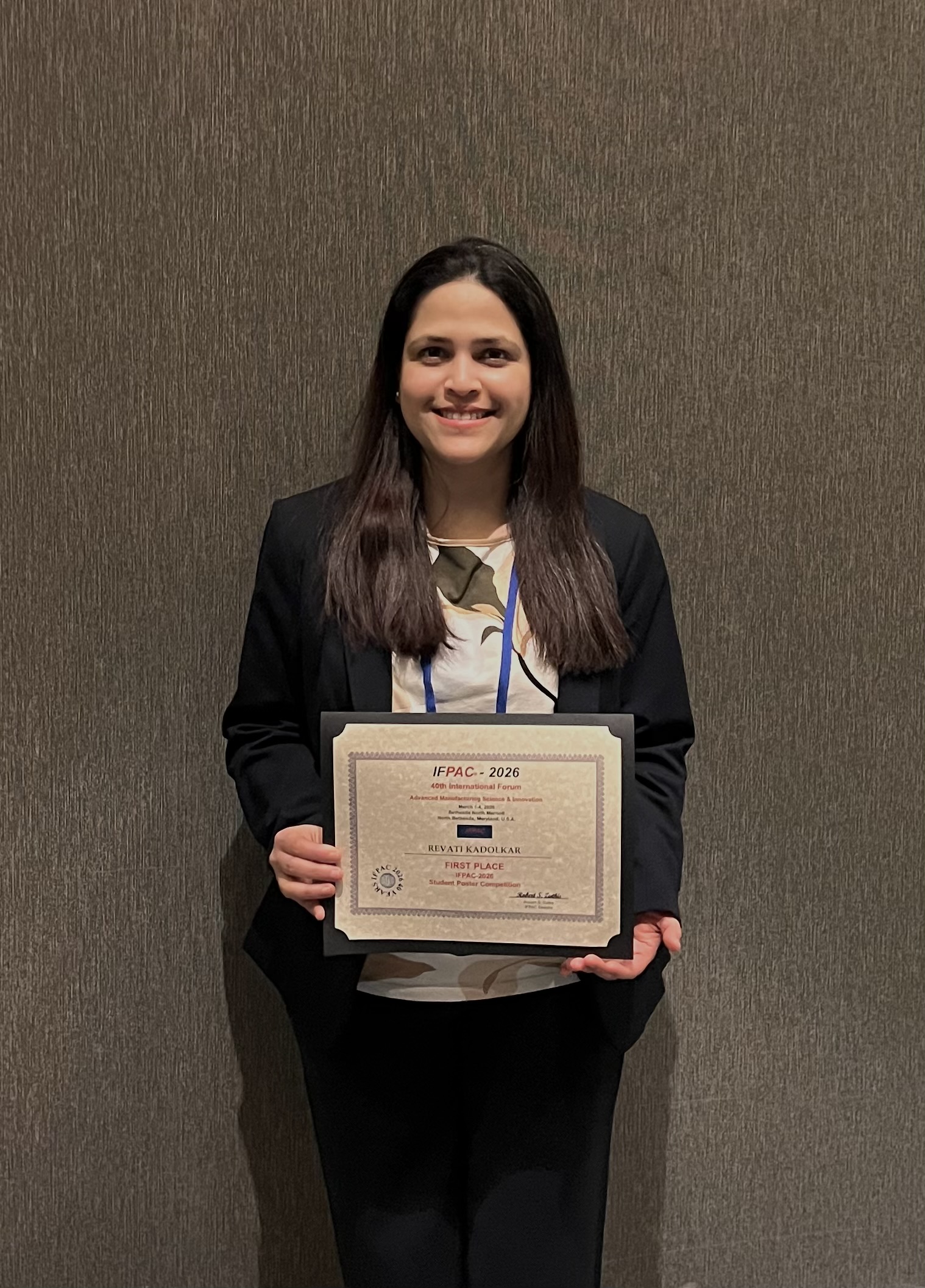
    <div class="html-content">Six students from the <a href="https://cast.umbc.edu/" rel="nofollow external" class="bo">CAST lab</a> went to the 2026 IFPAC (International Forum for Process Analytical Chemistry) meeting in Bethesda, MD on March 2-5, 2026, and all six students presented posters.<div><br></div><div>Shown in the photo, from left to right, are: Neveen Faris, MS student, CBEE, UMBC; Jahanavi Dhavala, Sophomore, Department of Biological Sciences, UMBC;  Francheska Burrola, Sophomore, McNair Scholar, Department of Biological Sciences, UMBC; Alexandria Slokan, Senior, Fischell Department of Bioengineering, UMCP; Rishika Bandi, Sophomore, Department of Biological Sciences, UMBC; and Revati Kadolkar, PhD student, CBEE, UMBC.<br><div><br></div><div>Revati Kadolkar, (co-advised by Dr. Rao and Dr. Frey), won first place in the student poster competition with her poster entitled “<em>Application of Mechanistic Modeling for the Development of a Miniaturized Size Exclusion Chromatography (SEC) Column for On-Site Quantitative Analysis</em>."  </div></div><div><br></div><div>Congrats, Revati! </div><div><img src="https://cbee.umbc.edu/wp-content/uploads/sites/312/2026/03/Revati-Kadolkar-IFPAC-2026.jpeg" alt="Revati Kadolkar holds her first-place award certificate." style="max-width: 100%; height: auto;"></div></div>
]]>
  </Body>
  <Summary>Six students from the CAST lab went to the 2026 IFPAC (International Forum for Process Analytical Chemistry) meeting in Bethesda, MD on March 2-5, 2026, and all six students presented posters....</Summary>
  <TrackingUrl>https://dev.my.umbc.edu/api/v0/pixel/news/157283/guest@my.umbc.edu/84ac7ab71dabd174b20a434e69770589/api/pixel</TrackingUrl>
  <Tag>cast</Tag>
  <Tag>frey</Tag>
  <Tag>rao</Tag>
  <Tag>research</Tag>
  <Tag>spring-2026</Tag>
  <Group token="cbee">Chemical, Biochemical and Environmental Engineering</Group>
  <GroupUrl>https://dev.my.umbc.edu/groups/cbee</GroupUrl>
  <AvatarUrl>https://assets4-dev.my.umbc.edu/system/shared/avatars/groups/000/000/771/b5e579e81b2e3624611890fa3ca2716a/xsmall.png?1746794587</AvatarUrl>
  <AvatarUrl size="original">https://assets2-dev.my.umbc.edu/system/shared/avatars/groups/000/000/771/b5e579e81b2e3624611890fa3ca2716a/original.png?1746794587</AvatarUrl>
  <AvatarUrl size="xxlarge">https://assets1-dev.my.umbc.edu/system/shared/avatars/groups/000/000/771/b5e579e81b2e3624611890fa3ca2716a/xxlarge.png?1746794587</AvatarUrl>
  <AvatarUrl size="xlarge">https://assets2-dev.my.umbc.edu/system/shared/avatars/groups/000/000/771/b5e579e81b2e3624611890fa3ca2716a/xlarge.png?1746794587</AvatarUrl>
  <AvatarUrl size="large">https://assets2-dev.my.umbc.edu/system/shared/avatars/groups/000/000/771/b5e579e81b2e3624611890fa3ca2716a/large.png?1746794587</AvatarUrl>
  <AvatarUrl size="medium">https://assets4-dev.my.umbc.edu/system/shared/avatars/groups/000/000/771/b5e579e81b2e3624611890fa3ca2716a/medium.png?1746794587</AvatarUrl>
  <AvatarUrl size="small">https://assets1-dev.my.umbc.edu/system/shared/avatars/groups/000/000/771/b5e579e81b2e3624611890fa3ca2716a/small.png?1746794587</AvatarUrl>
  <AvatarUrl size="xsmall">https://assets4-dev.my.umbc.edu/system/shared/avatars/groups/000/000/771/b5e579e81b2e3624611890fa3ca2716a/xsmall.png?1746794587</AvatarUrl>
  <AvatarUrl size="xxsmall">https://assets1-dev.my.umbc.edu/system/shared/avatars/groups/000/000/771/b5e579e81b2e3624611890fa3ca2716a/xxsmall.png?1746794587</AvatarUrl>
  <Sponsor>Chemical, Biochemical and Environmental Engineering</Sponsor>
  <ThumbnailUrl size="xxlarge">https://assets4-dev.my.umbc.edu/system/shared/thumbnails/news/000/157/283/23565d06adc93d8433fce482194db1e3/xxlarge.jpg?1773063665</ThumbnailUrl>
  <ThumbnailUrl size="xlarge">https://assets1-dev.my.umbc.edu/system/shared/thumbnails/news/000/157/283/23565d06adc93d8433fce482194db1e3/xlarge.jpg?1773063665</ThumbnailUrl>
  <ThumbnailUrl size="large">https://assets3-dev.my.umbc.edu/system/shared/thumbnails/news/000/157/283/23565d06adc93d8433fce482194db1e3/large.jpg?1773063665</ThumbnailUrl>
  <ThumbnailUrl size="medium">https://assets3-dev.my.umbc.edu/system/shared/thumbnails/news/000/157/283/23565d06adc93d8433fce482194db1e3/medium.jpg?1773063665</ThumbnailUrl>
  <ThumbnailUrl size="small">https://assets4-dev.my.umbc.edu/system/shared/thumbnails/news/000/157/283/23565d06adc93d8433fce482194db1e3/small.jpg?1773063665</ThumbnailUrl>
  <ThumbnailUrl size="xsmall">https://assets1-dev.my.umbc.edu/system/shared/thumbnails/news/000/157/283/23565d06adc93d8433fce482194db1e3/xsmall.jpg?1773063665</ThumbnailUrl>
  <ThumbnailUrl size="xxsmall">https://assets2-dev.my.umbc.edu/system/shared/thumbnails/news/000/157/283/23565d06adc93d8433fce482194db1e3/xxsmall.jpg?1773063665</ThumbnailUrl>
  <ThumbnailAltText>Six members from CAST lab present at 2026 IFPAC</ThumbnailAltText>
  <PawCount>0</PawCount>
  <CommentCount>0</CommentCount>
  <CommentsAllowed>true</CommentsAllowed>
  <PostedAt>Mon, 09 Mar 2026 10:37:51 -0400</PostedAt>
  <EditAt>Wed, 11 Mar 2026 07:46:48 -0400</EditAt>
</NewsItem>
  <NewsItem contentIssues="false" id="157217" important="false" status="posted" url="https://dev.my.umbc.edu/groups/cbee/posts/157217">
    <Title>Upal Ghosh&#8217;s research on PCB contamination in fish highlighted by the Bay Journal</Title>
    <Body>
      <![CDATA[
          <div class="html-content"><p>Reposted from COEIT myUMBC: <a href="https://my3.my.umbc.edu/groups/coeit/posts/157100" rel="nofollow external" class="bo">Upal Ghosh’s recent research on PCB contamination in fish highlighted by the Bay Journal</a></p>
          <hr><div><div><p></p><div>Polychlorinated biphenyls (PCBs), a group of likely carcinogenic chemicals, were banned in the U.S. in 1979. Yet because the chemicals were so widely used, and linger in the environment for so long, PCBs continue to be a major source of fish consumption advisories in Maryland and surrounding states. </div><div><br></div><div>A <a href="https://my3.my.umbc.edu/groups/coeit/posts/157100/7a1e4/11a93682a0419c1bdc26b542273091e1/web/link?link=https%3A%2F%2Fpubs.acs.org%2Fdoi%2F10.1021%2Facsestwater.5c01099" rel="nofollow external" class="bo">recent study</a> by Professor Upal Ghosh, in the Department of Chemical, Biochemical, and Environmental Engineering, demonstrates the "unfinished work" of ridding our waters of PCB pollutants, the researchers write. The study was highlighted in <a href="https://my3.my.umbc.edu/groups/coeit/posts/157100/7a1e4/f8164b1989a92add092954d234eddb03/web/link?link=https%3A%2F%2Fwww.bayjournal.com%2Fnews%2Fpollution%2Fovershadowed-by-forever-chemicals-pcbs-remain-a-toxic-threat-to-chesapeake-waters%2Farticle_bfe7854f-5891-4b2f-96c9-d77fd123108b.html" rel="nofollow external" class="bo">a story in the Bay Journal</a>.</div><div><br>The researchers, led by Ghosh and Research Assistant Professor Nathalie Lombard, analyzed PCB concentrations in fish that had been collected across 323 monitoring stations in Maryland over three decades. They identified five watersheds as highly impacted by PCBs, including the Upper Chesapeake Bay. Most impacted waterways have seen gradual, yet steady improvements over the years, with the exception of the Gunpowder-Patapsco near Baltimore, which showed no decrease in PCB pollution concentration levels in fish since 1996. </div><div><br></div><p></p><div>Overall, the study showed that the ban on PCBs and pollution remediation efforts implemented across Maryland and surrounding states have helped waterways recover, the researchers say, but more efforts are still needed.</div><div><br></div><div><br></div></div></div><div></div></div>
      ]]>
    </Body>
    <Summary>Reposted from COEIT myUMBC: Upal Ghosh’s recent research on PCB contamination in fish highlighted by the Bay Journal       Polychlorinated biphenyls (PCBs), a group of likely carcinogenic...</Summary>
    <TrackingUrl>https://dev.my.umbc.edu/api/v0/pixel/news/157217/guest@my.umbc.edu/487e76fedccde3e79e30faeca48a8ac7/api/pixel</TrackingUrl>
    <Tag>faculty</Tag>
    <Tag>ghosh</Tag>
    <Tag>news</Tag>
    <Tag>research</Tag>
    <Tag>spring-2026</Tag>
    <Group token="cbee">Chemical, Biochemical and Environmental Engineering</Group>
    <GroupUrl>https://dev.my.umbc.edu/groups/cbee</GroupUrl>
    <AvatarUrl>https://assets4-dev.my.umbc.edu/system/shared/avatars/groups/000/000/771/b5e579e81b2e3624611890fa3ca2716a/xsmall.png?1746794587</AvatarUrl>
    <AvatarUrl size="original">https://assets2-dev.my.umbc.edu/system/shared/avatars/groups/000/000/771/b5e579e81b2e3624611890fa3ca2716a/original.png?1746794587</AvatarUrl>
    <AvatarUrl size="xxlarge">https://assets1-dev.my.umbc.edu/system/shared/avatars/groups/000/000/771/b5e579e81b2e3624611890fa3ca2716a/xxlarge.png?1746794587</AvatarUrl>
    <AvatarUrl size="xlarge">https://assets2-dev.my.umbc.edu/system/shared/avatars/groups/000/000/771/b5e579e81b2e3624611890fa3ca2716a/xlarge.png?1746794587</AvatarUrl>
    <AvatarUrl size="large">https://assets2-dev.my.umbc.edu/system/shared/avatars/groups/000/000/771/b5e579e81b2e3624611890fa3ca2716a/large.png?1746794587</AvatarUrl>
    <AvatarUrl size="medium">https://assets4-dev.my.umbc.edu/system/shared/avatars/groups/000/000/771/b5e579e81b2e3624611890fa3ca2716a/medium.png?1746794587</AvatarUrl>
    <AvatarUrl size="small">https://assets1-dev.my.umbc.edu/system/shared/avatars/groups/000/000/771/b5e579e81b2e3624611890fa3ca2716a/small.png?1746794587</AvatarUrl>
    <AvatarUrl size="xsmall">https://assets4-dev.my.umbc.edu/system/shared/avatars/groups/000/000/771/b5e579e81b2e3624611890fa3ca2716a/xsmall.png?1746794587</AvatarUrl>
    <AvatarUrl size="xxsmall">https://assets1-dev.my.umbc.edu/system/shared/avatars/groups/000/000/771/b5e579e81b2e3624611890fa3ca2716a/xxsmall.png?1746794587</AvatarUrl>
    <Sponsor>Chemical, Biochemical and Environmental Engineering</Sponsor>
    <ThumbnailUrl size="xxlarge">https://assets3-dev.my.umbc.edu/system/shared/thumbnails/news/000/157/217/e2b72c5c17e974c6e65bd8b56dc291f1/xxlarge.jpg?1772741830</ThumbnailUrl>
    <ThumbnailUrl size="xlarge">https://assets2-dev.my.umbc.edu/system/shared/thumbnails/news/000/157/217/e2b72c5c17e974c6e65bd8b56dc291f1/xlarge.jpg?1772741830</ThumbnailUrl>
    <ThumbnailUrl size="large">https://assets3-dev.my.umbc.edu/system/shared/thumbnails/news/000/157/217/e2b72c5c17e974c6e65bd8b56dc291f1/large.jpg?1772741830</ThumbnailUrl>
    <ThumbnailUrl size="medium">https://assets2-dev.my.umbc.edu/system/shared/thumbnails/news/000/157/217/e2b72c5c17e974c6e65bd8b56dc291f1/medium.jpg?1772741830</ThumbnailUrl>
    <ThumbnailUrl size="small">https://assets2-dev.my.umbc.edu/system/shared/thumbnails/news/000/157/217/e2b72c5c17e974c6e65bd8b56dc291f1/small.jpg?1772741830</ThumbnailUrl>
    <ThumbnailUrl size="xsmall">https://assets3-dev.my.umbc.edu/system/shared/thumbnails/news/000/157/217/e2b72c5c17e974c6e65bd8b56dc291f1/xsmall.jpg?1772741830</ThumbnailUrl>
    <ThumbnailUrl size="xxsmall">https://assets4-dev.my.umbc.edu/system/shared/thumbnails/news/000/157/217/e2b72c5c17e974c6e65bd8b56dc291f1/xxsmall.jpg?1772741830</ThumbnailUrl>
    <ThumbnailAltText>Ghosh shows fish tissue samples processed by Jasmine Ives, undergraduate intern, to isolate PCBs for measurement.</ThumbnailAltText>
    <PawCount>0</PawCount>
    <CommentCount>0</CommentCount>
    <CommentsAllowed>false</CommentsAllowed>
    <PostedAt>Thu, 05 Mar 2026 15:18:11 -0500</PostedAt>
    <EditAt>Thu, 05 Mar 2026 15:19:18 -0500</EditAt>
  </NewsItem>
</News>