IEEE Colloquium on Sensor Devices, 9/25
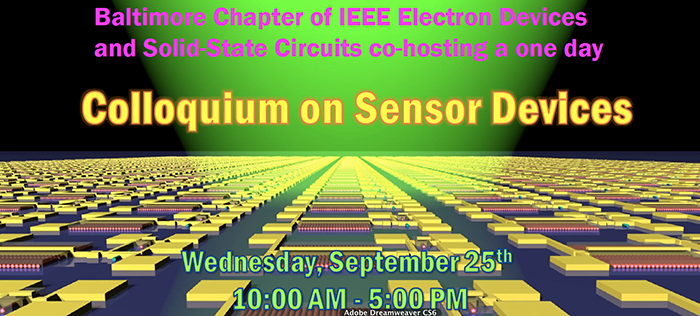
The Baltimore Chapter of IEEE Electron Devices and Solid-State Circuits is co-hosting a free, one-day Colloquium on Sensor Devices from 10:00 to 5:00 on Wednesday, September 25. The event will be held in the Benjamin Banneker Room (2212) of the Stamp Union Building at the University of Maryland, College Park.
Invited speakers include Dr. Philip Perconti (Army Research Laboratory), Prof. M. Alam (Purdue University), Dr. Parvez Uppal (Army Research Laboratory), Prof. Mark Reed (Yale University), Dr. Herbert Bennett (NIST), Prof. Michael Shur (RPI), Dr. Anupama Kaul (National Science Foundation) and Prof. Agis Iliadis (UMCP).
Attendance is free. To register please contact: Dr. Naresh C. Das (naresh.c.das2.civ at mail.mil), Dr. Victor Veliadis (victor.veliadis at ngc.com).
]]>
The Baltimore Chapter of IEEE Electron Devices and Solid-State Circuits is co-hosting a free, one-day Colloquium on Sensor Devices from 10:00 to 5:00 on Wednesday, September 25. The event will be...
http://www.csee.umbc.edu/2013/09/ieee-colloquium-on-sensor-devices-925/
https://dev.my.umbc.edu/api/v0/pixel/news/35485/guest@my.umbc.edu/8e524ffacdf4ebc734dd3508420187da/api/pixel
computer-engineering
computer-science
electrical-engineering
events
news
research
talks
Computer Science and Electrical Engineering
https://dev.my.umbc.edu/groups/csee
https://assets3-dev.my.umbc.edu/system/shared/avatars/groups/000/000/099/d117dca133c64bf78a4b7696dd007189/xsmall.png?1314043393
https://assets1-dev.my.umbc.edu/system/shared/avatars/groups/000/000/099/d117dca133c64bf78a4b7696dd007189/original.png?1314043393
https://assets1-dev.my.umbc.edu/system/shared/avatars/groups/000/000/099/d117dca133c64bf78a4b7696dd007189/xxlarge.png?1314043393
https://assets4-dev.my.umbc.edu/system/shared/avatars/groups/000/000/099/d117dca133c64bf78a4b7696dd007189/xlarge.png?1314043393
https://assets3-dev.my.umbc.edu/system/shared/avatars/groups/000/000/099/d117dca133c64bf78a4b7696dd007189/large.png?1314043393
https://assets1-dev.my.umbc.edu/system/shared/avatars/groups/000/000/099/d117dca133c64bf78a4b7696dd007189/medium.png?1314043393
https://assets2-dev.my.umbc.edu/system/shared/avatars/groups/000/000/099/d117dca133c64bf78a4b7696dd007189/small.png?1314043393
https://assets3-dev.my.umbc.edu/system/shared/avatars/groups/000/000/099/d117dca133c64bf78a4b7696dd007189/xsmall.png?1314043393
https://assets3-dev.my.umbc.edu/system/shared/avatars/groups/000/000/099/d117dca133c64bf78a4b7696dd007189/xxsmall.png?1314043393
Computer Science and Electrical Engineering
0
0
true
Wed, 11 Sep 2013 11:30:43 -0400
UMBC Linux Users Group meets 12-1 Wednesdays in ITE234 starting 9/11
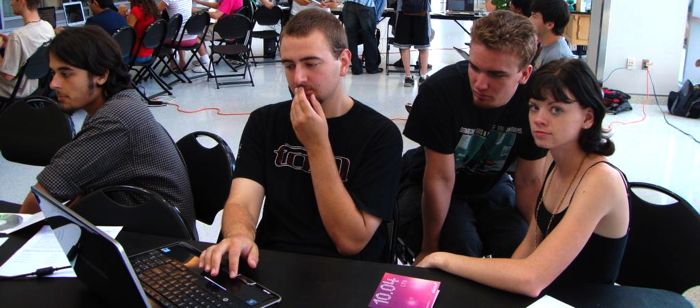
The UMBC Linux Users Group (LUG) will meet during the Fall 2013 semester on Wednesdays starting on September 11 from Noon to 1:00pm in ITE 234. If you are interested in becoming a member, please come to a few meetings and check it out.
The UMBC LUG was established in 1997 as an organization of and for people interested in the Linux operating system. This includes people who want to learn how to install and use it on their personal computers as well as those who use it regularly and want to expand and deepen their knowledge about it.
The LUG also helps members and non-members install, update and use Linux Operating System and software during its periodic Installfests.
UMBC-LUG members come from all walks of life and courses of study. You'll find among its ranks faculty, staff and students from Information Systems, Chemistry, Mechanical Engineering, Math, Visual Arts, Sociology, Music, Social Work, and yes, even Computer Science, all bound together by a common love of Linux. Membership is not limited to UMBC students and attendance by non-members and prospective members is always welcome.
]]>
The UMBC Linux Users Group (LUG) will meet during the Fall 2013 semester on Wednesdays starting on September 11 from Noon to 1:00pm in ITE 234. If you are interested in becoming a member, please...
http://www.csee.umbc.edu/2013/09/umbc-linux-users-group-to-meet-12-1-wednesdays-in-ite234/
https://dev.my.umbc.edu/api/v0/pixel/news/35433/guest@my.umbc.edu/fcf8f1001b4c382b73919b0c3cc2203d/api/pixel
computer-engineering
computer-science
cybersecurity
electrical-engineering
news
students
Computer Science and Electrical Engineering
https://dev.my.umbc.edu/groups/csee
https://assets3-dev.my.umbc.edu/system/shared/avatars/groups/000/000/099/d117dca133c64bf78a4b7696dd007189/xsmall.png?1314043393
https://assets1-dev.my.umbc.edu/system/shared/avatars/groups/000/000/099/d117dca133c64bf78a4b7696dd007189/original.png?1314043393
https://assets1-dev.my.umbc.edu/system/shared/avatars/groups/000/000/099/d117dca133c64bf78a4b7696dd007189/xxlarge.png?1314043393
https://assets4-dev.my.umbc.edu/system/shared/avatars/groups/000/000/099/d117dca133c64bf78a4b7696dd007189/xlarge.png?1314043393
https://assets3-dev.my.umbc.edu/system/shared/avatars/groups/000/000/099/d117dca133c64bf78a4b7696dd007189/large.png?1314043393
https://assets1-dev.my.umbc.edu/system/shared/avatars/groups/000/000/099/d117dca133c64bf78a4b7696dd007189/medium.png?1314043393
https://assets2-dev.my.umbc.edu/system/shared/avatars/groups/000/000/099/d117dca133c64bf78a4b7696dd007189/small.png?1314043393
https://assets3-dev.my.umbc.edu/system/shared/avatars/groups/000/000/099/d117dca133c64bf78a4b7696dd007189/xsmall.png?1314043393
https://assets3-dev.my.umbc.edu/system/shared/avatars/groups/000/000/099/d117dca133c64bf78a4b7696dd007189/xxsmall.png?1314043393
Computer Science and Electrical Engineering
0
0
true
Tue, 10 Sep 2013 16:35:16 -0400
Curtis Menyuk gets IEEE Photonics Society Willm. Streifer Scientific Achievement Award
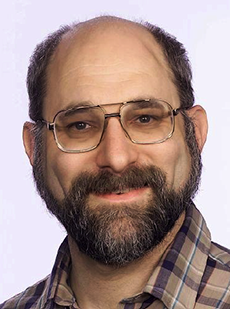 Professor Curtis R. Menyuk of the UMBC Computer Science and Electrical Engineering Department has been awarded the 2013 IEEE Photonics Society William Streifer Scientific Achievement Award. The award recongnizes Dr. Menyuk
"For seminal advances in the fundamental understanding and mitigation of polarization effects in high-performance optical fiber communication systems."
He will receive the award at presentation during the awards Ceremony at the 2013 IEEE Photonics Conference at the Hyatt Regency Bellevue, Bellevue, Washington in September.
The William Streifer Scientific Achievement Award is given to recognize an exceptional single scientific contribution which has had a significant impact in the field of lasers and electro-optics in the past 10 years. The award is given for a relatively recent, single contribution, which has had a major impact on the Photonics Society research community. It may be given to an individual or a group for a single contribution of significant work in the field.
Professor Curtis Menyuk was born March 26, 1954. He received the B.S. and M.S. degrees from MIT in 1976 and the Ph.D. from UCLA in 1981. He has worked as a research associate at the University of Maryland, College Park and at Science Applications International Corporation in McLean, VA. In 1986 he became an Associate Professor in the Department of Electrical Engineering at the University of Maryland Baltimore County, and he was the founding member of this department. In 1993, he was promoted to Professor. He was on partial leave from UMBC from Fall, 1996 until Fall, 2002. From 1996 – 2001, he worked part-time for the Department of Defense, co-directing the Optical Networking program at the DoD Laboratory for Telecommunications Sciences in Adelphi, MD from 1999 – 2001. In 2001 – 2002, he was Chief Scientist at PhotonEx Corporation. In 2008 – 2009, he was a JILA Visiting Fellow at the University of Colorado.
For the last 25 years, his primary research area has been theoretical and computational studies of lasers, nonlinear optics, and fiber optic communications. He has authored or co-authored more than 230 archival journal publications as well as numerous other publications and presentations, and he is a co-inventor of 5 patents. He has also edited three books. The equations and algorithms that he and his research group at UMBC have developed to model optical fiber systems are used extensively in the telecommunications and photonics industry. He is a member of the Society for Industrial and Applied Mathematics. He is a fellow of the American Physical Society, the Optical Society of America, and the IEEE. He is a former UMBC Presidential Research Professor.
]]>
Professor Curtis R. Menyuk of the UMBC Computer Science and Electrical Engineering Department has been awarded the 2013 IEEE Photonics Society William Streifer Scientific Achievement Award. The...
http://www.csee.umbc.edu/2013/08/prof-curtis-menyuk-receives-2013-ieee-photonics-society-william-streifer-scientific-achievement-award/
https://dev.my.umbc.edu/api/v0/pixel/news/34751/guest@my.umbc.edu/d7db04caa1ecc9fb2ea5763caba676c6/api/pixel
electrical-engineering
faculty-and-staff
news
research
Computer Science and Electrical Engineering
https://dev.my.umbc.edu/groups/csee
https://assets3-dev.my.umbc.edu/system/shared/avatars/groups/000/000/099/d117dca133c64bf78a4b7696dd007189/xsmall.png?1314043393
https://assets1-dev.my.umbc.edu/system/shared/avatars/groups/000/000/099/d117dca133c64bf78a4b7696dd007189/original.png?1314043393
https://assets1-dev.my.umbc.edu/system/shared/avatars/groups/000/000/099/d117dca133c64bf78a4b7696dd007189/xxlarge.png?1314043393
https://assets4-dev.my.umbc.edu/system/shared/avatars/groups/000/000/099/d117dca133c64bf78a4b7696dd007189/xlarge.png?1314043393
https://assets3-dev.my.umbc.edu/system/shared/avatars/groups/000/000/099/d117dca133c64bf78a4b7696dd007189/large.png?1314043393
https://assets1-dev.my.umbc.edu/system/shared/avatars/groups/000/000/099/d117dca133c64bf78a4b7696dd007189/medium.png?1314043393
https://assets2-dev.my.umbc.edu/system/shared/avatars/groups/000/000/099/d117dca133c64bf78a4b7696dd007189/small.png?1314043393
https://assets3-dev.my.umbc.edu/system/shared/avatars/groups/000/000/099/d117dca133c64bf78a4b7696dd007189/xsmall.png?1314043393
https://assets3-dev.my.umbc.edu/system/shared/avatars/groups/000/000/099/d117dca133c64bf78a4b7696dd007189/xxsmall.png?1314043393
Computer Science and Electrical Engineering
1
0
true
Tue, 27 Aug 2013 16:16:29 -0400
CSEE professor Dr. Tulay Adali receives USM Regents’ Faculty Award for Scholarship/Research/Creative Activity
 More than twenty years ago, Tulay Adali stepped onto UMBC’s campus as an assistant professor right after receiving her PhD. Much has changed since then.
Now a professor of Computer Science and Electrical Engineering, Dr. Adali runs a highly active Machine Learning for Signal Processing Lab (MLSPLab). Her recent appointment as an IEEE Signal Processing Society Distinguished Lecturer has prompted invitations to speak around the world about her research in the theory and development of algorithms for signal processing. This March, Dr. Adali was awarded the University System of Maryland Regents’ Faculty Award for Scholarship, Research, or Creative Activity.
Her secret to success?
“Planning or thinking about the future is not something I do,” said Dr. Adali in her acceptance speech at the Presidential Faculty and Staff Ceremony where she was honored in March. “I rather make sure I enjoy what I do and have fun along the way.” Her technique seems to be paying off. For proof, just take a look at the recognition received by her research in two distinct areas: the development of powerful datadriven methods, and the analysis and fusion of medical imaging data. In 2008, Dr. Adali was elected a fellow of the American Institute for Medical and Biological Engineering (AIMBE). In 2009, the Institute of Electrical and Electronics Engineering (IEEE) elected her a fellow for her work on the theory and practice of statistical signal processing.
In 2011, a paper by Dr. Adali and colleagues titled “Complex ICA using nonlinear functions” received the 2010 IEEE Signal Processing Society Best Paper Award. The work develops a complete framework, allowing for the processing of complex data in a manner similar to the realvalued case, eliminating the need to make many of the simplifying assumptions commonly employed. The results of this NSFfunded study led to the development of a complete datadriven framework that enables joint use of sample dependence and higherorderstatistics.
Dr. Adali’s work in medical image analysis and fusion has also gained notoriety. She has been working on methods for datadriven analysis of medical imaging data, and for the analysis of functional magnetic resonance imaging (fMRI) data for understanding brain function. She and her colleagues discovered that fusing more than two modalities increases the sensitivity and specificity of the analyses of fMRI, electroencephalography (EEG) and structural MRI data. In March 2011, an IEEE Spectrum article mentioned her success in obtaining very high classification accuracy in identifying mental disorders in patients. Then in April 2011, in addition to her ongoing projects funded by the NSF, NIH, and the Mind Research Network, she received a grant from Michelin Research to study irregular wear detection in tires, where the new data-driven framework is applied to a completely new problem domain.
These notable research advances made Dr. Adali stand out as a nominee for this year’s Regents’ Faculty Award for Scholarship, Research, or Creative Activity. It is the highest honor given by the Board of Regents to faculty members, given to faculty members who have gone above and beyond the call of duty. This year, Dr. Adali joins only three other USM faculty members who were recognized for their exceptional research contributions. “Dr. Adali has been steadily building her research career and I am not surprised by the award since her research is remarkable,” says Dr. Carter, CSEE Department Chair. “I see her continuing to grow her research in areas of signal processing for medical applications and becoming a key UMBC faculty member
]]>
More than twenty years ago, Tulay Adali stepped onto UMBC’s campus as an assistant professor right after receiving her PhD. Much has changed since then. Now a professor of Computer Science and...
http://www.csee.umbc.edu/2013/06/csee-professor-dr-tulay-adali-receives-usm-regents-faculty-award-for-scholarshipresearchcreative-activity/
https://dev.my.umbc.edu/api/v0/pixel/news/30941/guest@my.umbc.edu/e253083a70039a39b9fcd21fc9fe7913/api/pixel
electrical-engineering
faculty-and-staff
news
research
research-awards
Computer Science and Electrical Engineering
https://dev.my.umbc.edu/groups/csee
https://assets3-dev.my.umbc.edu/system/shared/avatars/groups/000/000/099/d117dca133c64bf78a4b7696dd007189/xsmall.png?1314043393
https://assets1-dev.my.umbc.edu/system/shared/avatars/groups/000/000/099/d117dca133c64bf78a4b7696dd007189/original.png?1314043393
https://assets1-dev.my.umbc.edu/system/shared/avatars/groups/000/000/099/d117dca133c64bf78a4b7696dd007189/xxlarge.png?1314043393
https://assets4-dev.my.umbc.edu/system/shared/avatars/groups/000/000/099/d117dca133c64bf78a4b7696dd007189/xlarge.png?1314043393
https://assets3-dev.my.umbc.edu/system/shared/avatars/groups/000/000/099/d117dca133c64bf78a4b7696dd007189/large.png?1314043393
https://assets1-dev.my.umbc.edu/system/shared/avatars/groups/000/000/099/d117dca133c64bf78a4b7696dd007189/medium.png?1314043393
https://assets2-dev.my.umbc.edu/system/shared/avatars/groups/000/000/099/d117dca133c64bf78a4b7696dd007189/small.png?1314043393
https://assets3-dev.my.umbc.edu/system/shared/avatars/groups/000/000/099/d117dca133c64bf78a4b7696dd007189/xsmall.png?1314043393
https://assets3-dev.my.umbc.edu/system/shared/avatars/groups/000/000/099/d117dca133c64bf78a4b7696dd007189/xxsmall.png?1314043393
Computer Science and Electrical Engineering
3
0
true
Thu, 06 Jun 2013 19:43:17 -0400
Phd Defense: Dingkai Guo, Mid-Infrared Photonic Integration 6/4
Ph.D. Dissertation Defense
Mid-Infrared Photonic Integration
Dingkai Guo
10:00am Tuesday, 4 June 2013, TRC CASPR conference room
The mid-Infrared (Mid-IR) wavelength range is important for applications including medical and security imaging, environmental trace gas sensing and free space communications. However, photonic integrated circuits (PICs) in the mid-IR range are completely under-developed which significantly slows the reduction of mid-IR system size, weight, and coupling losses and limits the development of highly functional mid-IR photonic modules with lower cost. In this dissertation, a solution to mid-IR photonic integration was demonstrated using a compact widely tunable mid-IR transmitter and a mid-IR amplifying photo-detector, which can be integrated with the mid-IR source.
This integrated widely tunable mid-IR source is fabricated by incorporating super structure grating (SSG) to the mid-IR quantum cascade laser (QCL) waveguide. The emission wavelength of the fabricated SSG-DBR QCL can be well controlled by varying the injection currents to the two grating sections. The wavelength can be tuned from 4.58μm to 4.77μm (90cm-1) with a supermode spacing of 30nm. This SSG-DBR QCL can be a compact replacement for the external cavity QCL used in current mid-IR sensors.
Mid-IR amplification and detection can be achieved using the same material as the mid-IR source. This QCL amplifier has an adjustable bandwidth and tunable gain peak, so it can function as a tunable mid-IR filter. By biasing the QCL just below its threshold, we demonstrated more than 11dB optical gain and over 28dB electrical gain at specified wavelengths. In the electrical gain measurement process, the resonant amplifier also functioned as a detector. This indicates that intersubband-based gain materials are ideal candidates for mid-IR photonic integrations.
Beside the optimized fabrication processes, new characterization technique based on the electrical derivative of the QCL I-V curves is used to quickly acquire the QCL threshold and leakage current, and explore the device carrier transport. The leakage currents present in different QCL waveguide structures are also studied and compared using this technique.
Finally, we report that the telecom wavelengths induced optical quenching effects on mid-IR QCLs when the QCLs are operated well above their threshold. The quenching effect is a result of intersubband bandbending and it depends on the coupled near-IR intensity, wavelength, and the QCL voltage bias. The quenching effects not only can be used for mid-IR QCL optical switching and modulation but also reveal that the mid-IR QCLs can function as “converters” to convert the telecom optical signal into the mid-IR optical signal at the near-IR fiber end.
A coherent mid-IR transceiver with both transmitting and receiving functions can be realized based on each integrated component introduced in this dissertation. This compact transceiver includes an integrated widely tunable mid-IR source, a mid-IR filter, amplifier, and detector based on the same material system.
Committee: Drs. Fow-Sen Choa (Chair), Anthony Johnson, Terrance Worchesky (Physics) , Li Yan, Gymama Slaughter
]]>
Ph.D. Dissertation Defense Mid-Infrared Photonic Integration Dingkai Guo 10:00am Tuesday, 4 June 2013, TRC CASPR conference room The mid-Infrared (Mid-IR) wavelength range is important for...
http://www.csee.umbc.edu/2013/06/phd-defense-dingkai-guo-mid-infrared-photonic-integration-64/
https://dev.my.umbc.edu/api/v0/pixel/news/30718/guest@my.umbc.edu/4bbf7463d20ee8f86ccc2976eef499d7/api/pixel
defense
electrical-engineering
graduate
news
research
talks
Computer Science and Electrical Engineering
https://dev.my.umbc.edu/groups/csee
https://assets3-dev.my.umbc.edu/system/shared/avatars/groups/000/000/099/d117dca133c64bf78a4b7696dd007189/xsmall.png?1314043393
https://assets1-dev.my.umbc.edu/system/shared/avatars/groups/000/000/099/d117dca133c64bf78a4b7696dd007189/original.png?1314043393
https://assets1-dev.my.umbc.edu/system/shared/avatars/groups/000/000/099/d117dca133c64bf78a4b7696dd007189/xxlarge.png?1314043393
https://assets4-dev.my.umbc.edu/system/shared/avatars/groups/000/000/099/d117dca133c64bf78a4b7696dd007189/xlarge.png?1314043393
https://assets3-dev.my.umbc.edu/system/shared/avatars/groups/000/000/099/d117dca133c64bf78a4b7696dd007189/large.png?1314043393
https://assets1-dev.my.umbc.edu/system/shared/avatars/groups/000/000/099/d117dca133c64bf78a4b7696dd007189/medium.png?1314043393
https://assets2-dev.my.umbc.edu/system/shared/avatars/groups/000/000/099/d117dca133c64bf78a4b7696dd007189/small.png?1314043393
https://assets3-dev.my.umbc.edu/system/shared/avatars/groups/000/000/099/d117dca133c64bf78a4b7696dd007189/xsmall.png?1314043393
https://assets3-dev.my.umbc.edu/system/shared/avatars/groups/000/000/099/d117dca133c64bf78a4b7696dd007189/xxsmall.png?1314043393
Computer Science and Electrical Engineering
0
0
true
Mon, 03 Jun 2013 12:02:07 -0400
Mon, 03 Jun 2013 12:02:07 -0400
PhD defense: Quantum Cascade Laser Arrays for Standoff Photoacoustic Chemical Detection, 5/17
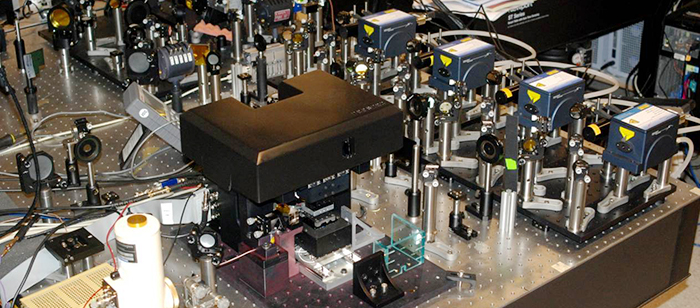
Ph.D. Dissertation Defense
High Power Mid-infrared Quantum Cascade Laser Array
for Standoff Photoacoustic Chemical Detection
Xing Chen
1:00-3:00pm Friday, 17 May 17 2013, TRC CASPR Conference Room
Quantum cascade lasers (QCLs) are compact, portable, powerful semiconductor laser sources with emission wavelengths from mid-infrared (mid-IR) to terahertz (THz) regions of the electromagnetic spectrum. Mid-IR (i.e. wavelengths from 3 to 20 µm) QCLs are of great importance in a wide range of applications such as trace gas sensing, environmental monitoring, free space communication, medical diagnosis and so on. High power QCLs are particularly important to applications such as infrared counter measure (IRCM) and standoff chemical detections. In such applications, the system performances critically depend on the amount of power a QCL can produce. This dissertation includes two major studies: the first part of the dissertation includes design, fabrication and characterization of high power mid-IR QCL arrays; the second part involves standoff chemical detection using QCLs as laser sources and photoacoustic effect as sensing technologies.
In the first part of the dissertation, we design, fabricate and characterize multi-emitter QCL arrays consisting of multiple narrow laser stripes. Simulation results indicate that the proposed multi-emitter laser arrays present much better thermal performance than a broad area laser device, while having the same thermal management ability as a single narrow stripe device. We have successfully fabricated edge emitting and surface emitting QCL arrays with 5 and 16 emitters. Experimental results show that, with the same laser cavity length, a QCL array with 5 emitters produces over 3 times more power than a single emitter laser device. QCL array with 16 emitters generates about 4 W output peak power at wavelength ~7.9 µm. We have also fabricated surface emitting QCL arrays and demonstrated single mode emission.
The second part of the dissertation involves using high power mid-IR QCLs to perform standoff chemical detections based on photoacoustic sensing technologies. Photoacoustic effect is a light-matter interaction effect that involves generation of acoustic waves when a medium absorbs electromagnetic energy from light. It has been known as a sensitive spectroscopic technique for chemical sensing.
Standoff photoacoustic chemical detection with distance more than 41 feet using quantum cascade laser operated at relatively low power, less than 40 mW, is demonstrated. A simplified theoretical model is developed for pulsed laser photoacoustic effect in open-air environment. The standoff photoacoustic signal can be calibrated as a function of different parameters such as laser pulse energy, gas vapor concentration and detection distance. The results yield good agreements with theoretical model. Standoff detection of solid phase explosive chemicals has also been demonstrated by the use of an ultra-sensitive microphone and acoustic reflector. More than 8 feet detection distance is obtained for standoff photoacoustic sensing of explosives.
Committee: Drs. Fow-Sen Choa (Chair), Brian Cullum, Yordan Kostov, Ryan Robucci, Chen-Chia Wang and Li Yan
]]>
Ph.D. Dissertation Defense High Power Mid-infrared Quantum Cascade Laser Array for Standoff Photoacoustic Chemical Detection Xing Chen 1:00-3:00pm Friday, 17 May 17 2013, TRC CASPR...
http://www.csee.umbc.edu/2013/05/13936/
https://dev.my.umbc.edu/api/v0/pixel/news/29563/guest@my.umbc.edu/f16a7877838a77217133f681c0cea497/api/pixel
defense
electrical-engineering
news
research
talks
Computer Science and Electrical Engineering
https://dev.my.umbc.edu/groups/csee
https://assets3-dev.my.umbc.edu/system/shared/avatars/groups/000/000/099/d117dca133c64bf78a4b7696dd007189/xsmall.png?1314043393
https://assets1-dev.my.umbc.edu/system/shared/avatars/groups/000/000/099/d117dca133c64bf78a4b7696dd007189/original.png?1314043393
https://assets1-dev.my.umbc.edu/system/shared/avatars/groups/000/000/099/d117dca133c64bf78a4b7696dd007189/xxlarge.png?1314043393
https://assets4-dev.my.umbc.edu/system/shared/avatars/groups/000/000/099/d117dca133c64bf78a4b7696dd007189/xlarge.png?1314043393
https://assets3-dev.my.umbc.edu/system/shared/avatars/groups/000/000/099/d117dca133c64bf78a4b7696dd007189/large.png?1314043393
https://assets1-dev.my.umbc.edu/system/shared/avatars/groups/000/000/099/d117dca133c64bf78a4b7696dd007189/medium.png?1314043393
https://assets2-dev.my.umbc.edu/system/shared/avatars/groups/000/000/099/d117dca133c64bf78a4b7696dd007189/small.png?1314043393
https://assets3-dev.my.umbc.edu/system/shared/avatars/groups/000/000/099/d117dca133c64bf78a4b7696dd007189/xsmall.png?1314043393
https://assets3-dev.my.umbc.edu/system/shared/avatars/groups/000/000/099/d117dca133c64bf78a4b7696dd007189/xxsmall.png?1314043393
Computer Science and Electrical Engineering
1
0
true
Thu, 16 May 2013 12:01:02 -0400
CSEE grad student Asmita Korde presents paper at SPIE Defense Security and Sensing Conference
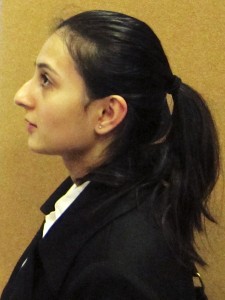 CSEE graduate student Asmita Korde will present a paper on her research with Professor Tinoosh Mohsenin tomorrow at the the SPIE Defense Security and Sensing Conference in the Baltimore Convention Center. Asmita was a UMBC CWIT Scholar and received a BS degree in Computer Engineering in 2011. She is now finishing her MS degree at UMBC in the Electrical Engineering program.
Her paper, Detection Performance of Radar Compressive Sensing in Noisy Environments, describes research done in collaboration with her mentor, Tinoosh Mohsenin, and Damon Bradley of the NASA Goddard Space Flight Center.
Here is the abstract.
In this paper, radar detection via compressive sensing is explored. Compressive sensing is a new theory of sampling which allows the reconstruction of a sparse signal by sampling at a much lower rate than the Nyquist rate. By using this technique in radar, the use of matched filter can be eliminated and high rate sampling can be replaced with low rate sampling. In this paper, compressive sensing is analyzed by applying varying factors such as noise and different measurement matrices. Different reconstruction algorithms are compared by generating ROC curves to determine their detection performance. We conduct simulations for a 64-length signal with 3 targets to determine the effectiveness of each algorithm in varying SNR. We also propose a simplified version of Orthogonal Matching Pursuit (OMP). Through numerous simulations, we _nd that a simplified version of Orthogonal Matching Pursuit (OMP), can give better results than the original OMP in noisy environments when sparsity is highly over estimated, but does not work as well for low noise environments.
]]>
CSEE graduate student Asmita Korde will present a paper on her research with Professor Tinoosh Mohsenin tomorrow at the the SPIE Defense Security and Sensing Conference in the Baltimore Convention...
http://www.csee.umbc.edu/2013/05/csee-grad-student-asmita-korde-presents-paper-at-spie-defense-security-and-sensing-conference/
https://dev.my.umbc.edu/api/v0/pixel/news/28630/guest@my.umbc.edu/27b9123c01743c42966d3df6a074c547/api/pixel
electrical-engineering
news
research
students
Computer Science and Electrical Engineering
https://dev.my.umbc.edu/groups/csee
https://assets3-dev.my.umbc.edu/system/shared/avatars/groups/000/000/099/d117dca133c64bf78a4b7696dd007189/xsmall.png?1314043393
https://assets1-dev.my.umbc.edu/system/shared/avatars/groups/000/000/099/d117dca133c64bf78a4b7696dd007189/original.png?1314043393
https://assets1-dev.my.umbc.edu/system/shared/avatars/groups/000/000/099/d117dca133c64bf78a4b7696dd007189/xxlarge.png?1314043393
https://assets4-dev.my.umbc.edu/system/shared/avatars/groups/000/000/099/d117dca133c64bf78a4b7696dd007189/xlarge.png?1314043393
https://assets3-dev.my.umbc.edu/system/shared/avatars/groups/000/000/099/d117dca133c64bf78a4b7696dd007189/large.png?1314043393
https://assets1-dev.my.umbc.edu/system/shared/avatars/groups/000/000/099/d117dca133c64bf78a4b7696dd007189/medium.png?1314043393
https://assets2-dev.my.umbc.edu/system/shared/avatars/groups/000/000/099/d117dca133c64bf78a4b7696dd007189/small.png?1314043393
https://assets3-dev.my.umbc.edu/system/shared/avatars/groups/000/000/099/d117dca133c64bf78a4b7696dd007189/xsmall.png?1314043393
https://assets3-dev.my.umbc.edu/system/shared/avatars/groups/000/000/099/d117dca133c64bf78a4b7696dd007189/xxsmall.png?1314043393
Computer Science and Electrical Engineering
0
0
true
Thu, 02 May 2013 16:51:49 -0400
talk: Quantum Engineering of Semiconductor Atomic Structures for Biosensing 4/30

Baltimore Chapter of Electron Devices and Solid-State Circuits
Quantum Engineering of Semiconductor Atomic Structures for Biosensing
Dr. Manijeh Razeghi
Center for Quantum Devices
Electrical Engineering and Computer Science
Northwestern University
5:30pm Tuesday, 30 April 2013
206 Technology Research Center, UMBC
5:30pm social hour, talk begins at 6:15pm. Free but please RSVP to Sorry, you need javascript to view this email address. by Monday, April 29
Nature offers us different kinds of atoms, but it takes human intelligence to put them together in an elegant way in order to realize functional structures not found in nature. III-V semiconductors are made of atoms from column III (B, Al, Ga, In, Tl) and column V (N, As, P, Sb, Bi) of the periodic table, and constitute a particularly rich variety of compounds with many useful optical and electronic properties. Guided by highly accurate simulations of the electronic structure, modern semiconductor optoelectronic devices are literally made atom by atom using advanced growth technology such as Molecular Beam Epitaxy (MBE) and Metal Organic Chemical Vapor Deposition (MOCVD). Recent breakthroughs have brought quantum engineering to an unprecedented level, creating light detectors and emitters over an extremely wide spectral range from 0.2 µm to 300 µm. Nitrogen serves as the best column V element for the short wavelength side of the electromagnetic spectrum, where we have demonstrated III-nitride light emitting diodes and photo detectors in the deep ultraviolet to visible wavelengths. In the infrared, III-V compounds using phosphorus, arsenic, or antimony from column V with indium, gallium, aluminum, or thallium from column III can create lasers and detectors based on quantum-dot (QD) or type-II superlattice (T2SL). These are fast becoming the choice of technology in crucial applications such as environmental monitoring and space exploration. Last but not least, on the far-infrared end of the electromagnetic spectrum known as the terahertz (THz) region, III-V semiconductors offer a unique solution of generating THz waves in a compact device at room temperature. Continued effort is being devoted to all of the above areas with the intention of developing smart technologies which meet the current challenges in environment, health, security, and energy. This talk will highlight contributions to the world of III-V semiconductor nano-scale optoelectronic devices from deep UV to THz.
Dr. Manijeh Razeghi received the Doctorat d'État es Sciences Physiques from the Université de Paris in 1980. After heading the Exploratory Materials Lab at Thomson-CSF (France), she joined Northwestern University in Evanston, IL, in the fall of 1991 as the Director of the Center for Quantum Devices, where she created undergraduate and graduate programs in solid-state engineering. Dr. Razeghi pioneered the development and implementation of major modern epitaxial techniques such as MOCVD, VPE, gas MBE, and MOMBE for the growth of entire compositional ranges of III-V compound semiconductors. She is on the editorial board of journals such as the Journal of Nanotechnology and the Journal of Nanoscience and Nanotechnology, and is an Associate Editor of the Opto-Electronics Review. Dr. Razeghi is on the International Advisory Board for the Polish Committee of Science, and is an Adjunct Professor at the College of Optical Sciences of the University of Arizona in Tucson. She ha s authored or co-authored more than 1000 papers, over 30 book chapters, and fifteen books, including the textbooks Technology of Quantum Devices and Fundamentals of Solid State Engineering, 3rd Edition. Two of her books, MOCVD Challenge Vol. 1 (1989) and MOCVD Challenge Vol. 2 (1995), discuss some of her pioneering work in InP-GaInAsP and GaAs-GaInAsP based systems. [The MOCVD Challenge, 2nd Edition (2010) represents the combined updated version of Volumes 1 and 2]. Dr. Razeghi holds 50 U.S. patents and has given more than 1000 invited and plenary talks. Her current research interest is in nanoscale optoelectronic quantum devices. Dr. Razeghi is a Fellow of MRS, IOP, IEEE, APS, SPIE, OSA, and the International Engineering Consortium (IEC), a Fellow and Life Member of the Society of Women Engineers (SWE), and a member of the Electrochemical Society, ACS, AAAS, and the French Academy of Sciences and Technology. She received the IBM Europe Science and Technology Prize in 1987, the Achievement Award from the SWE in 1995, the R.F. Bunshah! Award in 2004, and multiple best paper awards.
]]>
Baltimore Chapter of Electron Devices and Solid-State Circuits Quantum Engineering of Semiconductor Atomic Structures for Biosensing Dr. Manijeh Razeghi Center for Quantum Devices...
http://www.csee.umbc.edu/2013/04/talk-quantum-engineering-of-semiconductor-atomic-structures-for-biosensing/
https://dev.my.umbc.edu/api/v0/pixel/news/28216/guest@my.umbc.edu/f25859fecb1f8d6659d818cb94e74382/api/pixel
electrical-engineering
news
talks
Computer Science and Electrical Engineering
https://dev.my.umbc.edu/groups/csee
https://assets3-dev.my.umbc.edu/system/shared/avatars/groups/000/000/099/d117dca133c64bf78a4b7696dd007189/xsmall.png?1314043393
https://assets1-dev.my.umbc.edu/system/shared/avatars/groups/000/000/099/d117dca133c64bf78a4b7696dd007189/original.png?1314043393
https://assets1-dev.my.umbc.edu/system/shared/avatars/groups/000/000/099/d117dca133c64bf78a4b7696dd007189/xxlarge.png?1314043393
https://assets4-dev.my.umbc.edu/system/shared/avatars/groups/000/000/099/d117dca133c64bf78a4b7696dd007189/xlarge.png?1314043393
https://assets3-dev.my.umbc.edu/system/shared/avatars/groups/000/000/099/d117dca133c64bf78a4b7696dd007189/large.png?1314043393
https://assets1-dev.my.umbc.edu/system/shared/avatars/groups/000/000/099/d117dca133c64bf78a4b7696dd007189/medium.png?1314043393
https://assets2-dev.my.umbc.edu/system/shared/avatars/groups/000/000/099/d117dca133c64bf78a4b7696dd007189/small.png?1314043393
https://assets3-dev.my.umbc.edu/system/shared/avatars/groups/000/000/099/d117dca133c64bf78a4b7696dd007189/xsmall.png?1314043393
https://assets3-dev.my.umbc.edu/system/shared/avatars/groups/000/000/099/d117dca133c64bf78a4b7696dd007189/xxsmall.png?1314043393
Computer Science and Electrical Engineering
0
0
true
Wed, 24 Apr 2013 22:19:18 -0400
Wed, 24 Apr 2013 22:19:18 -0400
PhD defense: Analysis of brain network connectivity using spatial information
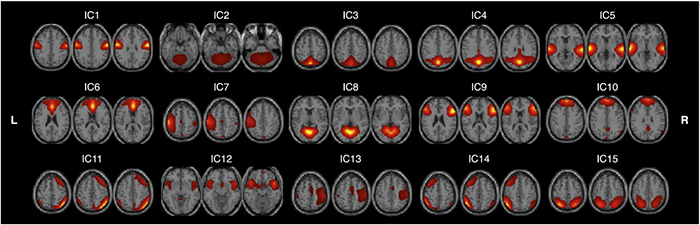
PhD Dissertation Defense
Analysis of brain network connectivity
using spatial information
Sai Ma
1:00pm Thursday, 18 April 2013, ITE 325b
In current functional magnetic resonance imaging (fMRI) research, one of the most active areas involves exploring statistical dependencies among brain regions, known as functional connectivity analysis. Data-driven methods, especially independent component analysis (ICA), have been successfully applied to fMRI data to extract distributed brain networks and offer an opportunity to investigate functional connectivity on a network level, thus at a multivariate level. However, the independence assumption in ICA is neither necessarily nor typically satisfied in real applications and an extension is desirable. Furthermore, most current ICA-based studies focus on the use of temporal information and second-order statistics for functional connectivity analysis. Taking spatial information and higher-order statistics in fMRI data into account is expected to lead to better understanding of the overall brain network connectivity in healthy controls and also in patients with mental disorders, such as schizophrenia.
We develop a dependent component analysis (DCA) framework to generalize the ICA-based connectivity analysis methods by grouping components into maximally independent clusters. First, we define functional network connectivity as the statistical dependence among spatial components, instead of the typically used temporal correlation. Based on this definition, we use a hypothesis test to automatically generate functional connectivity structure for a large number of brain networks. After that, we separate dependent components within a given cluster using prior information, such as sparsity and experimental paradigm information, to achieve a better decomposition. We also combine this DCA-based clustering analysis with graph-theoretical analysis to discover significant group differences in topological properties of functional connectivity structure. To extend the methodologies currently available for functional connectivity, we propose an independent vector analysis (IVA) based scheme to extract and analyze dynamic functional connectivity.
The methods we develop offer advantages for effective and efficient examination of not only static, but also dynamic functional connectivity among different brain networks. We identify significant differences in functional connectivity structure between healthy controls and patients with schizophrenia, which may prove useful to serve as potential biomarkers for diagnosis. We also find task-induced modulations in functional connectivity when comparing different active states in the brain. Furthermore, we observe temporal variability in functional connectivity structure and physiologically meaningful group differences in dynamic connectivity among several brain networks. Our methods can provide insights to understanding of functional characteristics of the brain network organization in healthy individuals and patients with schizophrenia.
Committee: Dr. Adali (Chair), Dr. Morris, Dr. Rutledge, Dr. LaBerge, Dr. Phlypo, Dr. Calhoun, and Dr. Westlake
]]>
PhD Dissertation Defense Analysis of brain network connectivity using spatial information Sai Ma 1:00pm Thursday, 18 April 2013, ITE 325b In current functional magnetic resonance imaging...
http://www.csee.umbc.edu/2013/04/phd-defense-analysis-of-brain-network-connectivity-using-spatial-information/
https://dev.my.umbc.edu/api/v0/pixel/news/27673/guest@my.umbc.edu/dafdc0ff0eb8f9f9e78022b538029ee8/api/pixel
electrical-engineering
graduate
news
research
talks
Computer Science and Electrical Engineering
https://dev.my.umbc.edu/groups/csee
https://assets3-dev.my.umbc.edu/system/shared/avatars/groups/000/000/099/d117dca133c64bf78a4b7696dd007189/xsmall.png?1314043393
https://assets1-dev.my.umbc.edu/system/shared/avatars/groups/000/000/099/d117dca133c64bf78a4b7696dd007189/original.png?1314043393
https://assets1-dev.my.umbc.edu/system/shared/avatars/groups/000/000/099/d117dca133c64bf78a4b7696dd007189/xxlarge.png?1314043393
https://assets4-dev.my.umbc.edu/system/shared/avatars/groups/000/000/099/d117dca133c64bf78a4b7696dd007189/xlarge.png?1314043393
https://assets3-dev.my.umbc.edu/system/shared/avatars/groups/000/000/099/d117dca133c64bf78a4b7696dd007189/large.png?1314043393
https://assets1-dev.my.umbc.edu/system/shared/avatars/groups/000/000/099/d117dca133c64bf78a4b7696dd007189/medium.png?1314043393
https://assets2-dev.my.umbc.edu/system/shared/avatars/groups/000/000/099/d117dca133c64bf78a4b7696dd007189/small.png?1314043393
https://assets3-dev.my.umbc.edu/system/shared/avatars/groups/000/000/099/d117dca133c64bf78a4b7696dd007189/xsmall.png?1314043393
https://assets3-dev.my.umbc.edu/system/shared/avatars/groups/000/000/099/d117dca133c64bf78a4b7696dd007189/xxsmall.png?1314043393
Computer Science and Electrical Engineering
0
0
true
Sun, 14 Apr 2013 08:35:42 -0400
PhD defense: Data-driven group analysis of complex-valued fMRI data
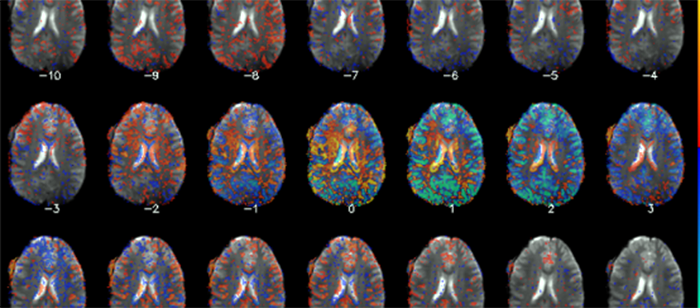
PhD Dissertation Defense
Data-driven group analysis of complex-valued fMRI data
Pedro A. Rodriguez
11:00am Tuesday, 16 April 2013, ITE 346, UMBC
Analysis of functional magnetic resonance imaging (fMRI) data in its native, complex form has been shown to increase the sensitivity of the analysis both for data-driven techniques such as independent component analysis (ICA) and for model-driven techniques. The promise of an increase in sensitivity and specificity in clinical studies provides a powerful motivation for utilizing both the phase and magnitude data; however, the unknown and noisy nature of the phase poses a challenge for successful study of the fMRI data. In addition, complex-valued analysis algorithms, such as ICA, suffer from an inherent phase ambiguity, which introduces additional difficulty for group analysis and visualization of the results. We present solutions for these issues, which have been among the main reasons phase information has been traditionally discarded, and show their effectiveness when used as part of a complex-valued group ICA algorithm application. The developed methods become key components of a framework that allows the development of new fully complex data-driven and semi-blind methods to process, analyze, and visualize fMRI data.
In this dissertation, we first introduce the methods developed as part of the fully complex framework for ICA of fMRI data. We introduce a physiologically motivated de-noising method that uses phase quality maps to successfully identify and eliminate noisy voxels—3D pixels—in the fMRI complex images so they can be used in individual and group studies. We also introduce a phase correction scheme that can be either applied sub-sequent to ICA of fMRI data or can be incorporated into the ICA algorithm in the form of prior information to eliminate the need for further processing for phase correction. Finally, we present two visualization methods that are used to augment the sensitivity and specificity in the detection of activated voxels. We show the benefits of using the developed methods on actual complex-valued fMRI data.
In the remainder of the dissertation, we focus on developing constrained ICA (C-ICA) algorithms for complex-valued fMRI data. C-ICA uses prior information, hence providing a balance between model-based and data-driven approaches such as ICA to improve the source estimation performance and robustness to noise. C-ICA algorithms have been used to improve the estimation performance in real-valued fMRI data, but—to our knowledge—have not been applied to complex-valued fMRI data. We develop the first C-ICA algorithm that uses complex-valued references to constrain either the sources or the mixing coefficients. The designed algorithm is not restricted to having a unitary demixing matrix, which is a major assumption in existing C-ICA algorithms. We show, on both simulated and actual fMRI data, how the performance of ICA improves by using prior information about the fMRI paradigm.
Committee: Dr. Adali (Chair), Dr. Morris, Dr. Rutledge, Dr. Laberge, Dr. Phlypo, and Dr. Calhoun
]]>
PhD Dissertation Defense Data-driven group analysis of complex-valued fMRI data Pedro A. Rodriguez 11:00am Tuesday, 16 April 2013, ITE 346, UMBC Analysis of functional magnetic resonance...
http://www.csee.umbc.edu/2013/04/phd-defense-data-driven-group-analysis-of-complex-valued-fmri-data/
https://dev.my.umbc.edu/api/v0/pixel/news/27660/guest@my.umbc.edu/867ff131084b654fd64d3fb11041a6f7/api/pixel
electrical-engineering
graduate
news
research
talks
Computer Science and Electrical Engineering
https://dev.my.umbc.edu/groups/csee
https://assets3-dev.my.umbc.edu/system/shared/avatars/groups/000/000/099/d117dca133c64bf78a4b7696dd007189/xsmall.png?1314043393
https://assets1-dev.my.umbc.edu/system/shared/avatars/groups/000/000/099/d117dca133c64bf78a4b7696dd007189/original.png?1314043393
https://assets1-dev.my.umbc.edu/system/shared/avatars/groups/000/000/099/d117dca133c64bf78a4b7696dd007189/xxlarge.png?1314043393
https://assets4-dev.my.umbc.edu/system/shared/avatars/groups/000/000/099/d117dca133c64bf78a4b7696dd007189/xlarge.png?1314043393
https://assets3-dev.my.umbc.edu/system/shared/avatars/groups/000/000/099/d117dca133c64bf78a4b7696dd007189/large.png?1314043393
https://assets1-dev.my.umbc.edu/system/shared/avatars/groups/000/000/099/d117dca133c64bf78a4b7696dd007189/medium.png?1314043393
https://assets2-dev.my.umbc.edu/system/shared/avatars/groups/000/000/099/d117dca133c64bf78a4b7696dd007189/small.png?1314043393
https://assets3-dev.my.umbc.edu/system/shared/avatars/groups/000/000/099/d117dca133c64bf78a4b7696dd007189/xsmall.png?1314043393
https://assets3-dev.my.umbc.edu/system/shared/avatars/groups/000/000/099/d117dca133c64bf78a4b7696dd007189/xxsmall.png?1314043393
Computer Science and Electrical Engineering
0
0
true
Sat, 13 Apr 2013 10:47:42 -0400
