talk: Nonnegative Binary Matrix Factorization on a D-Wave Quantum Annealer, 1:30 2/15
CHMPR Distinguished Lecture Series
Nonnegative Binary Matrix Factorization with a D-Wave Quantum Annealer
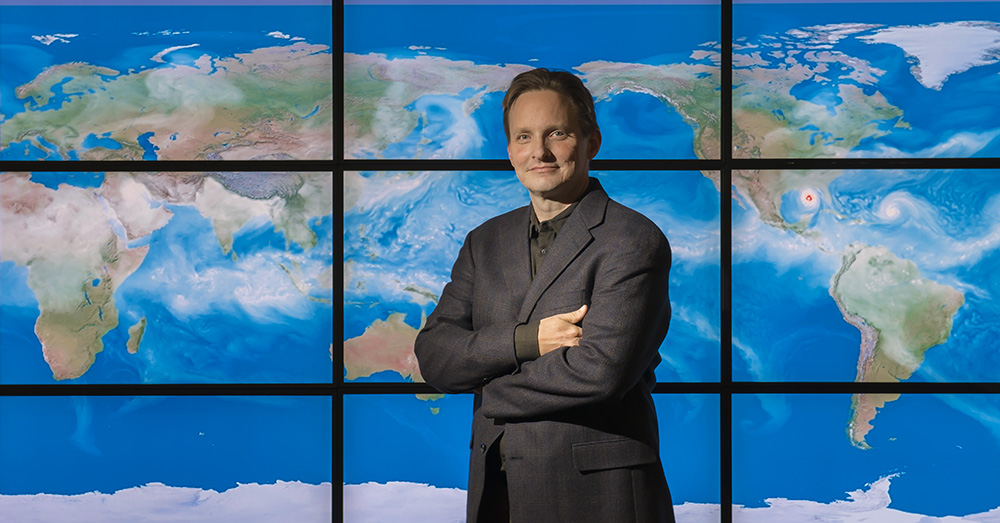
Dr. Daniel O’Malley Los Alamos National Laboratory
1:30 15 February 2018, ITE325, UMBC
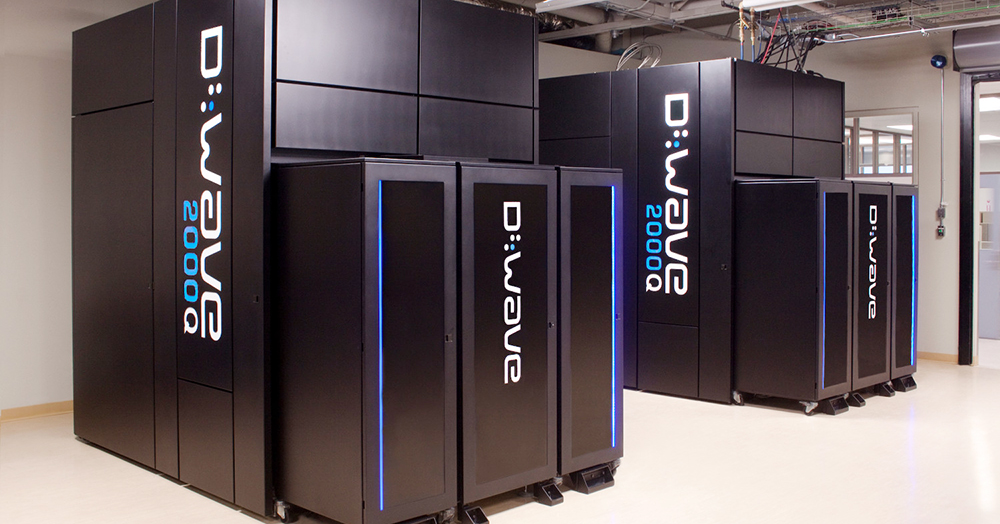
D-Wave quantum annealers represent a novel computational architecture and have attracted significant interest. Much of this interest has focused on the quantum behavior of D-Wave machines, and there have been few practical algorithms that use the D-Wave. Machine learning has been identified as an area where quantum annealing may be useful. Here, we show that the D-Wave 2X can be effectively used as part of an unsupervised machine learning method. This method takes a matrix as input and produces two low-rank matrices as output — one containing latent features in the data and another matrix describing how the features can be combined to approximately reproduce the input matrix. Despite the limited number of bits in the D-Wave hardware, this method is capable of handling a large input matrix. The D-Wave only limits the rank of the two output matrices. We apply this method to learn the features from a set of facial images and compare the performance of the D-Wave to two classical tools. This method is able to learn facial features and accurately reproduce the set of facial images. The performance of the D-Wave is mixed. It outperforms the two classical codes in a benchmark when only a short amount of computational time is allowed (200-20,000 microseconds), but these results suggest heuristics that would likely outperform the D-Wave in this benchmark.
Daniel O’Malley is a scientist in the Computational Earth Science group at Los Alamos National Laboratory (LANL). Prior to that, he held postdoctoral positions at LANL and in the Department of Earth, Atmospheric and Planetary Sciences at Purdue University. He studied at Purdue University, receiving a B.S. degree in computer science and mathematics (2004), an M.S. in mathematics (2006) and a Ph.D. in applied mathematics (2011). His research interests include computational science (with an emphasis on subsurface flow and transport), quantum computing, uncertainty quantification, and machine learning. He has won numerous awards including a Director’s Postdoctoral Fellowship from LANL (2014), the InterPore-Fraunhofer Award for Young Researchers from the International Society for Porous Media (2012), a Charles C. Chappelle Fellowship from Purdue University (2004), and the Meyer E. Jerison Memorial Award in Analysis from the Department of Mathematics at Purdue University (2004).
]]>
CHMPR Distinguished Lecture Series Nonnegative Binary Matrix Factorization with a D-Wave Quantum Annealer Dr. Daniel O’Malley Los Alamos National Laboratory 1:30 15 February 2018,...https://www.csee.umbc.edu/2018/02/nonnegative-binary-matrix-factorization-d-wave-quantum-annealer-umbc/https://dev.my.umbc.edu/api/v0/pixel/news/73852/guest@my.umbc.edu/c41f6eebdb50d1d4840cfdf3cbefb6e0/api/pixelaicomputer-engineeringcomputer-sciencedata-sciencemachine-learningnewstalksComputer Science and Electrical Engineeringhttps://dev.my.umbc.edu/groups/cseehttps://assets3-dev.my.umbc.edu/system/shared/avatars/groups/000/000/099/d117dca133c64bf78a4b7696dd007189/xsmall.png?1314043393https://assets1-dev.my.umbc.edu/system/shared/avatars/groups/000/000/099/d117dca133c64bf78a4b7696dd007189/original.png?1314043393https://assets1-dev.my.umbc.edu/system/shared/avatars/groups/000/000/099/d117dca133c64bf78a4b7696dd007189/xxlarge.png?1314043393https://assets4-dev.my.umbc.edu/system/shared/avatars/groups/000/000/099/d117dca133c64bf78a4b7696dd007189/xlarge.png?1314043393https://assets3-dev.my.umbc.edu/system/shared/avatars/groups/000/000/099/d117dca133c64bf78a4b7696dd007189/large.png?1314043393https://assets1-dev.my.umbc.edu/system/shared/avatars/groups/000/000/099/d117dca133c64bf78a4b7696dd007189/medium.png?1314043393https://assets2-dev.my.umbc.edu/system/shared/avatars/groups/000/000/099/d117dca133c64bf78a4b7696dd007189/small.png?1314043393https://assets3-dev.my.umbc.edu/system/shared/avatars/groups/000/000/099/d117dca133c64bf78a4b7696dd007189/xsmall.png?1314043393https://assets3-dev.my.umbc.edu/system/shared/avatars/groups/000/000/099/d117dca133c64bf78a4b7696dd007189/xxsmall.png?1314043393Computer Science and Electrical Engineering11trueMon, 12 Feb 2018 09:16:41 -0500Mon, 12 Feb 2018 09:16:41 -0500talk: Results of the 2018 SFS Research Study at UMBC, 12pm Fri 2/9, ITE228
The UMBC Cyber Defense Lab presents
Results from the January 2018 SFS Research Study at UMBC
Enis Golaszewski
Department of Information Systems University of Maryland, Baltimore County
12:00–1:00pm, Friday, 9 February 2018, ITE 228 (or nearby)
January 22-26, 2018, UMBC SFS scholars worked collaboratively to analyze the security of a targeted aspect of the UMBC computer system. The focus of this year’s study was the WebAdmin module that enables users to perform various functions on their accounts, including changing the password. Students identified vulnerabilities involving failure to sanitize user input properly and suggested mitigations. Participants comprised BS, MS, MPS, and PhD students studying computer science, computer engineering, information systems, and cybersecurity, including SFS scholars who transferred from Montgomery College and Prince George’s Community College to complete their four-year degrees at UMBC. We hope that other universities can benefit from our motivational and educational strategy of cooperating with the university’s IT staff to engage students in active project-based learning centering on focused questions about the university computer system.
This project was supported in part by the National Science Foundation under SFS grant 1241576.
Enis Golaszewski (*protected email*) is a PhD student and SFS scholar in computer science working with Dr. Sherman on blockchain, protocol analysis, and the security of software-defined networks.
]]>
The UMBC Cyber Defense Lab presents Results from the January 2018 SFS Research Study at UMBC Enis Golaszewski Department of Information Systems University of Maryland, Baltimore County...https://www.csee.umbc.edu/2018/02/talk-results-2018-research-study-umbc-cybersecurity-security/https://dev.my.umbc.edu/api/v0/pixel/news/73666/guest@my.umbc.edu/cd5d03b0a23642f36aaa3b109d08f568/api/pixelcomputer-sciencecybersecuritynewsstudentstalksComputer Science and Electrical Engineeringhttps://dev.my.umbc.edu/groups/cseehttps://assets3-dev.my.umbc.edu/system/shared/avatars/groups/000/000/099/d117dca133c64bf78a4b7696dd007189/xsmall.png?1314043393https://assets1-dev.my.umbc.edu/system/shared/avatars/groups/000/000/099/d117dca133c64bf78a4b7696dd007189/original.png?1314043393https://assets1-dev.my.umbc.edu/system/shared/avatars/groups/000/000/099/d117dca133c64bf78a4b7696dd007189/xxlarge.png?1314043393https://assets4-dev.my.umbc.edu/system/shared/avatars/groups/000/000/099/d117dca133c64bf78a4b7696dd007189/xlarge.png?1314043393https://assets3-dev.my.umbc.edu/system/shared/avatars/groups/000/000/099/d117dca133c64bf78a4b7696dd007189/large.png?1314043393https://assets1-dev.my.umbc.edu/system/shared/avatars/groups/000/000/099/d117dca133c64bf78a4b7696dd007189/medium.png?1314043393https://assets2-dev.my.umbc.edu/system/shared/avatars/groups/000/000/099/d117dca133c64bf78a4b7696dd007189/small.png?1314043393https://assets3-dev.my.umbc.edu/system/shared/avatars/groups/000/000/099/d117dca133c64bf78a4b7696dd007189/xsmall.png?1314043393https://assets3-dev.my.umbc.edu/system/shared/avatars/groups/000/000/099/d117dca133c64bf78a4b7696dd007189/xxsmall.png?1314043393Computer Science and Electrical Engineering10trueSun, 04 Feb 2018 21:08:32 -0500talk: Towards Hardware Cybersecurity, 11am Tue 2/20, ITE325, UMBC
Electronic system security, trust and reliability has become an increasingly critical area of concern for modern society. Secure hardware systems, platforms, as well as supply chains are critical to industry and government sectors such as national defense, healthcare, transportation, and finance.
Traditionally, authenticity and integrity of data has been protected with various security protocol at the software level with the underlying hardware assumed to be secure, and reliable. This assumption however is no longer true with an increasing number of attacks reported on the hardware. Counterfeiting electronic components, inserting hardware trojans, and cloning integrated circuits are just few out of many malicious byproducts of hardware vulnerabilities, which need to be urgently addressed.
In the first part of this talk I will address the security and vulnerability challenges in the horizontal integrated hardware development process. I will then present the concept of hybrid spin-transfer torque CMOS look up table based design which is our latest effort on developing a cost-effective solution to prevent physical reverse engineering attacks.
In the second part of my talk I will present how information at the hardware level can be used to address some of the major challenges of software security vulnerabilities monitoring and detection methods. I will first discuss these challenges and will then show how the use of data at the hardware architecture level in combination with an effective machine learning based predictor helps protecting systems against various classes of hardware vulnerability attacks.
I will conclude the talk by emphasizing the importance of this emerging area and proposing a research agenda for the future.
Dr. Houman Homayoun is an Assistant Professor in the Department of Electrical and Computer Engineering at George Mason University. He also holds a courtesy appointment with the Department of Computer Science as well as Information Science and Technology Department. He is the director of GMU’s Accelerated, Secure, and Energy-Efficient Computing Laboratory (ASEEC). Prior to joining GMU, Houman spent two years at the University of California, San Diego, as NSF Computing Innovation (CI) Fellow awarded by the CRA-CCC. Houman graduated in 2010 from University of California, Irvine with a Ph.D. in Computer Science. He was a recipient of the four-year University of California, Irvine Computer Science Department chair fellowship. Houman received the MS degree in computer engineering in 2005 from University of Victoria and BS degree in electrical engineering in 2003 from Sharif University of Technology. Houman conducts research in hardware security and trust, big data computing, and heterogeneous computing, where he has published more than 80 technical papers in the prestigious conferences and journals on the subject. Since 2012 he leads ten research projects, a total of $7.2 million in funding, supported by DARPA, AFRL, NSF, NIST, and GM on the topics of hardware security and trust, big data computing, heterogeneous architectures, and biomedical computing. Houman received the 2016 GLSVLSI conference best paper award for developing a manycore accelerator for wearable biomedical computing. Since 2017 he has been serving as an Associate Editor of IEEE Transactions on VLSI. He is currently serving as technical program co-chair of 2018 GLSVLSI conference.
]]>
Towards Hardware Cybersecurity Professor Houman Homayoun George Mason University 11:00am-12:00pm Tuesday, 20 Febuary 2018, ITE 325, UMBC Electronic system security, trust and reliability...https://www.csee.umbc.edu/2018/02/talk-umbc-towards-hardware-cybersecurity-homayoun/https://dev.my.umbc.edu/api/v0/pixel/news/73667/guest@my.umbc.edu/3d18c5bb71e9949bd3b97011a7f48228/api/pixelcomputer-engineeringcomputer-sciencecybersecuritydata-scienceeventsnewstalksComputer Science and Electrical Engineeringhttps://dev.my.umbc.edu/groups/cseehttps://assets3-dev.my.umbc.edu/system/shared/avatars/groups/000/000/099/d117dca133c64bf78a4b7696dd007189/xsmall.png?1314043393https://assets1-dev.my.umbc.edu/system/shared/avatars/groups/000/000/099/d117dca133c64bf78a4b7696dd007189/original.png?1314043393https://assets1-dev.my.umbc.edu/system/shared/avatars/groups/000/000/099/d117dca133c64bf78a4b7696dd007189/xxlarge.png?1314043393https://assets4-dev.my.umbc.edu/system/shared/avatars/groups/000/000/099/d117dca133c64bf78a4b7696dd007189/xlarge.png?1314043393https://assets3-dev.my.umbc.edu/system/shared/avatars/groups/000/000/099/d117dca133c64bf78a4b7696dd007189/large.png?1314043393https://assets1-dev.my.umbc.edu/system/shared/avatars/groups/000/000/099/d117dca133c64bf78a4b7696dd007189/medium.png?1314043393https://assets2-dev.my.umbc.edu/system/shared/avatars/groups/000/000/099/d117dca133c64bf78a4b7696dd007189/small.png?1314043393https://assets3-dev.my.umbc.edu/system/shared/avatars/groups/000/000/099/d117dca133c64bf78a4b7696dd007189/xsmall.png?1314043393https://assets3-dev.my.umbc.edu/system/shared/avatars/groups/000/000/099/d117dca133c64bf78a4b7696dd007189/xxsmall.png?1314043393Computer Science and Electrical Engineering20trueSun, 04 Feb 2018 19:08:51 -0500Sat, 17 Feb 2018 19:08:51 -0500talk: PKI in the Defense Information Systems Agency, 12-1 Fri 12/1, ITE228
UMBC Cyber Defense Lab
PKI in the Defense Information Systems Agency (DISA)
Phil Scheffler
Chief Engineer – Joint Enablers
ID2 – Cyber Development Directorate
Defense Information Systems Agency
12:00–1pm, Dec 1, 2017, ITE 228
As a combat support agency within the Department of Defense, DISA faces unlimited challenges with Public-Key Infrastructure (PKI). Chief Engineer Phil Scheffler will shed some light on DoD PKI at the Defense Information Systems Agency (DISA), and challenges deploying PKI across such a large enterprise.
Philip Scheffler is the Chief Engineer for the ID2 Joint Enablers Division in DISA’s Cyber Development Directorate. He joined DISA in 2010 as an NSA Information Assurance Scholar on the Public Key Enablement team. Over the past 7 years, Phil has been the technical lead for various PKI initiatives for the DoD. Mr. Scheffler has a B.A. in Economics from Brandeis University and a M.S in Computer Science from Boston University.
]]>
UMBC Cyber Defense Lab PKI in the Defense Information Systems Agency (DISA) Phil Scheffler Chief Engineer – Joint Enablers ID2 – Cyber Development Directorate Defense Information...https://www.csee.umbc.edu/2017/11/umbc-talk-pki-defense-information-systems-agency/https://dev.my.umbc.edu/api/v0/pixel/news/72435/guest@my.umbc.edu/5794dd5e0bd9fd7ff8d8e6ca12efffad/api/pixelcybersecuritynewstalksComputer Science and Electrical Engineeringhttps://dev.my.umbc.edu/groups/cseehttps://assets3-dev.my.umbc.edu/system/shared/avatars/groups/000/000/099/d117dca133c64bf78a4b7696dd007189/xsmall.png?1314043393https://assets1-dev.my.umbc.edu/system/shared/avatars/groups/000/000/099/d117dca133c64bf78a4b7696dd007189/original.png?1314043393https://assets1-dev.my.umbc.edu/system/shared/avatars/groups/000/000/099/d117dca133c64bf78a4b7696dd007189/xxlarge.png?1314043393https://assets4-dev.my.umbc.edu/system/shared/avatars/groups/000/000/099/d117dca133c64bf78a4b7696dd007189/xlarge.png?1314043393https://assets3-dev.my.umbc.edu/system/shared/avatars/groups/000/000/099/d117dca133c64bf78a4b7696dd007189/large.png?1314043393https://assets1-dev.my.umbc.edu/system/shared/avatars/groups/000/000/099/d117dca133c64bf78a4b7696dd007189/medium.png?1314043393https://assets2-dev.my.umbc.edu/system/shared/avatars/groups/000/000/099/d117dca133c64bf78a4b7696dd007189/small.png?1314043393https://assets3-dev.my.umbc.edu/system/shared/avatars/groups/000/000/099/d117dca133c64bf78a4b7696dd007189/xsmall.png?1314043393https://assets3-dev.my.umbc.edu/system/shared/avatars/groups/000/000/099/d117dca133c64bf78a4b7696dd007189/xxsmall.png?1314043393Computer Science and Electrical Engineering30trueWed, 29 Nov 2017 21:37:22 -0500talk: Jim Kurose (NSF) An Expanding and Expansive View of Computing, 1pm Mon 11/20
Distinguished Lecture
An Expanding and Expansive View of Computing
Jim Kurose
Assistant Director, National Science Foundation
Directorate of Computer and Information Science and Engineering
1:00-2:15pm Monday, 20 November 2017, ITE325b, UMBC
Advances in computer and information science and engineering are providing unprecedented opportunities for research and education. My talk will begin with an overview of CISE activities and programs at the National Science Foundation and include a discussion of current trends that are shaping the future of our discipline. I will also discuss the opportunities as well as the challenges that lay ahead for our community and for CISE.
Dr. Kurose is on leave from the University of Massachusetts Amherst, where he is a Distinguished Professor in the College of Information and Computer Sciences. He has served in a number of administrative roles at UMass and has been a Visiting Scientist at IBM Research; INRIA; Institut EURECOM; the University of Paris; the Laboratory for Information, Network and Communication Sciences; and Technicolor Research Labs.
His research interests include network protocols and architecture, network measurement, sensor networks, multimedia communication, and modeling and performance evaluation. Dr. Kurose has served on many national and international advisory boards and panels and has received numerous awards for his research and teaching. With Keith Ross, he is the co-author of the textbook, Computer Networking, a top down approach (6th edition) published by Addison-Wesley/Pearson.
Dr. Kurose received his Ph.D. in computer science from Columbia University and a Bachelor of Arts degree in physics from Wesleyan University. He is a Fellow of the Association for Computing Machinery (ACM) and the Institute of Electrical and Electronic Engineers (IEEE).
]]>
Distinguished Lecture An Expanding and Expansive View of Computing Jim Kurose Assistant Director, National Science Foundation Directorate of Computer and Information Science and Engineering...https://www.csee.umbc.edu/2017/11/talk-jim-kurose-nsf-expanding-expansive-view-computing-umbc/https://dev.my.umbc.edu/api/v0/pixel/news/72148/guest@my.umbc.edu/2c9d1eca0620e5eca9879636f2a7a3e6/api/pixeleventsnewstalksComputer Science and Electrical Engineeringhttps://dev.my.umbc.edu/groups/cseehttps://assets3-dev.my.umbc.edu/system/shared/avatars/groups/000/000/099/d117dca133c64bf78a4b7696dd007189/xsmall.png?1314043393https://assets1-dev.my.umbc.edu/system/shared/avatars/groups/000/000/099/d117dca133c64bf78a4b7696dd007189/original.png?1314043393https://assets1-dev.my.umbc.edu/system/shared/avatars/groups/000/000/099/d117dca133c64bf78a4b7696dd007189/xxlarge.png?1314043393https://assets4-dev.my.umbc.edu/system/shared/avatars/groups/000/000/099/d117dca133c64bf78a4b7696dd007189/xlarge.png?1314043393https://assets3-dev.my.umbc.edu/system/shared/avatars/groups/000/000/099/d117dca133c64bf78a4b7696dd007189/large.png?1314043393https://assets1-dev.my.umbc.edu/system/shared/avatars/groups/000/000/099/d117dca133c64bf78a4b7696dd007189/medium.png?1314043393https://assets2-dev.my.umbc.edu/system/shared/avatars/groups/000/000/099/d117dca133c64bf78a4b7696dd007189/small.png?1314043393https://assets3-dev.my.umbc.edu/system/shared/avatars/groups/000/000/099/d117dca133c64bf78a4b7696dd007189/xsmall.png?1314043393https://assets3-dev.my.umbc.edu/system/shared/avatars/groups/000/000/099/d117dca133c64bf78a4b7696dd007189/xxsmall.png?1314043393Computer Science and Electrical Engineering30trueThu, 16 Nov 2017 19:00:25 -0500talk: An Introduction to Quantum Cryptography, Noon Friday 11/17, ITE231
The UMBC Cyber Defense Lab presents
An Introduction to Quantum Cryptography: Or, How Alice Outwits Eve
Sam Lomonaco, CSEE, UMBC
12:00–1:00pm, Friday, 17 November 2017, ITE 231, UMBC
Alice and Bob wish to communicate without the archvillainess Eve eavesdropping on their conversation. Alice decides to take two college courses, one in cryptography, the other in quantum mechanics. During the courses, she discovers she can use what she has learned to devise a cryptographic communication system that automatically detects whether or not Eve is up to her villainous eavesdropping. Some of the topics discussed are Heisenberg’s Uncertainty Principle, the Vernam cipher, the BB84 and B92 cryptographic protocols. The talk ends with a discussion of some of Eve’s possible eavesdropping strategies, i.e., opaque eavesdropping, translucent eavesdropping, and translucent eavesdropping with entanglement.
Samuel J. Lomonaco Jr. received his PhD in mathematics from Princeton University. He has been a full professor of computer science and electrical engineering at the University of Maryland, Baltimore County (UMBC) since 1985, serving as founding chair of the CS Department from 1985 to 1991. Representative Awards, Accomplishments, and Honors include: (1) He was a visiting key research scientist at the Mathematical Sciences Research Institute (MSRI) at the University of California at Berkley in 2004. (2) He was a senior LaGrange fellow at the Institute for Scientific Exchange in Torino, Italy in 2005. (3) For contributions made to the development of the programming language Ada, he received an award from the United States Under Secretary of Defense for Research and Engineering, Dr. Richard DeLauer. (4) He was the first to introduce quantum information science to the American Mathematical Society (AMS) by organizing and giving a two-day AMS short course on quantum computation at the Annual Meeting of the AMS in Washington, DC, in January 2000. (5) He published four books on quantum computation and information science. (6) He accepted an invitation to be a guest editor of the Journal of Quantum Information Processing for a special issue on topological quantum computation.
]]>
The UMBC Cyber Defense Lab presents An Introduction to Quantum Cryptography: Or, How Alice Outwits Eve Sam Lomonaco, CSEE, UMBC 12:00–1:00pm, Friday, 17 November 2017, ITE 231, UMBC Alice...https://www.csee.umbc.edu/2017/11/umbc-introduction-quantum-cryptography-lomonaco/https://dev.my.umbc.edu/api/v0/pixel/news/72082/guest@my.umbc.edu/be0f403b6444f02cec66bba6fb862dc8/api/pixelcomputer-engineeringcomputer-sciencecybersecuritynewstalksComputer Science and Electrical Engineeringhttps://dev.my.umbc.edu/groups/cseehttps://assets3-dev.my.umbc.edu/system/shared/avatars/groups/000/000/099/d117dca133c64bf78a4b7696dd007189/xsmall.png?1314043393https://assets1-dev.my.umbc.edu/system/shared/avatars/groups/000/000/099/d117dca133c64bf78a4b7696dd007189/original.png?1314043393https://assets1-dev.my.umbc.edu/system/shared/avatars/groups/000/000/099/d117dca133c64bf78a4b7696dd007189/xxlarge.png?1314043393https://assets4-dev.my.umbc.edu/system/shared/avatars/groups/000/000/099/d117dca133c64bf78a4b7696dd007189/xlarge.png?1314043393https://assets3-dev.my.umbc.edu/system/shared/avatars/groups/000/000/099/d117dca133c64bf78a4b7696dd007189/large.png?1314043393https://assets1-dev.my.umbc.edu/system/shared/avatars/groups/000/000/099/d117dca133c64bf78a4b7696dd007189/medium.png?1314043393https://assets2-dev.my.umbc.edu/system/shared/avatars/groups/000/000/099/d117dca133c64bf78a4b7696dd007189/small.png?1314043393https://assets3-dev.my.umbc.edu/system/shared/avatars/groups/000/000/099/d117dca133c64bf78a4b7696dd007189/xsmall.png?1314043393https://assets3-dev.my.umbc.edu/system/shared/avatars/groups/000/000/099/d117dca133c64bf78a4b7696dd007189/xxsmall.png?1314043393Computer Science and Electrical Engineering60trueWed, 15 Nov 2017 08:10:40 -0500talk: DOE Energy Exascale Earth System Model, 2:30 Tue 10/31, ITE325
CHMPR Distinguished Lecture Series
Energy Exascale Earth System Model
Dr. Mark Taylor, E3SM Chief Computational Scientist, Sandia National Laboratories
2:30pm Tuesday, 31 October 2017, ITE 325, UMBC
Dr. Taylor will present an overview of the DOE Energy Exascale Earth System Model (E3SM), including Sandia’s role in numerical algorithms, parallel scalability, and computational performance. E3SM is designed to run on upcoming next-generation DOE supercomputers. Adapting simulation codes to these new architectures is expected to be more disruptive than the previous transition from vector to massively parallel supercomputers. E3SM development is driven by several grand challenge science questions focused Earth’s cryosphere, biogeochemical and water cycle systems. E3SM has a new land and atmosphere component models branched from the CESM v1.2, coupled to new MPAS ocean, sea ice, and land ice models.
The current performance and throughput challenges of the E3SM high-resolution coupled configuration on several DOE computers will be discussed. Our current focus is on the NERSC Cori system with Intel Xeon Phi architecture, in the longer term we hope to make effective use of the upcoming NVIDIA GPU based system at ORNL. An analysis is presented of the E3SM spectral element atmosphere dycore following the NGGPS dycore computational evaluation protocol, but with an emphasis on the throughput rates needed for climate simulations. For even higher resolution simulations, we will rely on E3SM’s ability to use unstructured grids in all component models. This will allow us to achieve cloud-resolving resolution in select regions of interest seamlessly within the global modeling system.
Mark Taylor is a mathematician who specializes in numerical methods for parallel computing and geophysical flows. He currently serves as Chief Computational Scientist for the DOE’s Accelerated Climate Modeling for Energy (ACME) project. Mark developed the mimetic/conservative formulation of the spectral element method, one of the atmospheric dynamical cores used in the Community Earth System Model (CESM) and the ACME project. Mark received his Ph.D. from New York University’s Courant Institute of Mathematical Sciences in 1992 and has worked at Sandia National Laboratories since 2004. In 2014 he was awarded The Secretary of Energy Achievement Award for his work unifying the DOE climate modeling research community and enabling the development of high-resolution fully-coupled climate-system simulations.
]]>
CHMPR Distinguished Lecture Series Energy Exascale Earth System Model Dr. Mark Taylor, E3SM Chief Computational Scientist, Sandia National Laboratories 2:30pm Tuesday, 31 October 2017,...https://www.csee.umbc.edu/2017/10/talk-umbc-csee-mark-taylor-doe-energy-exascale-earth-system-model/https://dev.my.umbc.edu/api/v0/pixel/news/71571/guest@my.umbc.edu/48ff22dff8735d6ff1ff6ddd18934a64/api/pixelcomputer-sciencedata-sciencenewsresearchtalksComputer Science and Electrical Engineeringhttps://dev.my.umbc.edu/groups/cseehttps://assets3-dev.my.umbc.edu/system/shared/avatars/groups/000/000/099/d117dca133c64bf78a4b7696dd007189/xsmall.png?1314043393https://assets1-dev.my.umbc.edu/system/shared/avatars/groups/000/000/099/d117dca133c64bf78a4b7696dd007189/original.png?1314043393https://assets1-dev.my.umbc.edu/system/shared/avatars/groups/000/000/099/d117dca133c64bf78a4b7696dd007189/xxlarge.png?1314043393https://assets4-dev.my.umbc.edu/system/shared/avatars/groups/000/000/099/d117dca133c64bf78a4b7696dd007189/xlarge.png?1314043393https://assets3-dev.my.umbc.edu/system/shared/avatars/groups/000/000/099/d117dca133c64bf78a4b7696dd007189/large.png?1314043393https://assets1-dev.my.umbc.edu/system/shared/avatars/groups/000/000/099/d117dca133c64bf78a4b7696dd007189/medium.png?1314043393https://assets2-dev.my.umbc.edu/system/shared/avatars/groups/000/000/099/d117dca133c64bf78a4b7696dd007189/small.png?1314043393https://assets3-dev.my.umbc.edu/system/shared/avatars/groups/000/000/099/d117dca133c64bf78a4b7696dd007189/xsmall.png?1314043393https://assets3-dev.my.umbc.edu/system/shared/avatars/groups/000/000/099/d117dca133c64bf78a4b7696dd007189/xxsmall.png?1314043393Computer Science and Electrical Engineering10trueSun, 29 Oct 2017 11:56:24 -0400talk: Creating a Smart and Connected Health System, 10am Tue 10/31
UMBC Information Systems Department
Creating a Smart and Connected Health System
Dr. Wendy J. Nilsen
Program Director, Smart and Connected Health Division
Information and Intelligent Systems Directorate
Computer & Information Science & Engineering
National Science Foundation
10am, Tuesday, 31 October 2017, ITE 459, UMBC
Science is changing rapidly and new transdisciplinary approaches are resulting in advances across scientific domains. Due to developments in computing and engineering, nested with a changing policy environment, medicine and public health are also at the cusp of a transformation that will accelerate discovery, improve health outcomes, decrease costs, and address the complexity of challenging health problems. To realize these advances requires partnerships between the scientific and health domains. Research communities are developing breakthrough ideas in a variety of diverse areas relevant to health, such as sensor networks, informatics, machine learning and datamining, decision support systems, modeling of behavioral and cognitive processes, as well as system and process harmonization. Solutions that effectively influence health must satisfy a multitude of constraints creating challenges and opportunities that individual disciplines cannot address alone. Computer science and engineering are poised to contribute to these changes by bring sophisticated techniques to partnerships in the biomedical realm. This talk will cover some advances being made and a vision for future. This talk explores the challenges in developing a smart health research ecosystem and highlights opportunities and promising new areas of research.
Wendy Nilsen, Ph.D. is a Program Director for the Smart and Connected Health Program in the Directorate for Computer & Information Science & Engineering at the National Science Foundation. Her work focuses on the intersection of technology and health. This includes a wide range of methods for data collection, advanced analytics and the creation of effective cyber-human systems. Her interests span the areas of sensing, analytics, cyber-physical systems, information systems, big data and robotics. More specifically, her efforts include: serving as co-chair of the Health Information Technology Research and Development working group of the Networking and Information Technology Research and Development Program; the lead for the NSF/NIH Smart and Connected Health announcement; convening workshops to address methodology in technology in health research; serving on numerous federal technology initiatives; and, leading training institutes. Previously, Wendy was at the National Institutes of Health.
]]>
UMBC Information Systems Department Creating a Smart and Connected Health System Dr. Wendy J. Nilsen Program Director, Smart and Connected Health Division Information and Intelligent Systems...https://www.csee.umbc.edu/2017/10/creating-smart-connected-health-system-nsf/https://dev.my.umbc.edu/api/v0/pixel/news/71451/guest@my.umbc.edu/a96c2e133e8918d85137e9d24381e4cf/api/pixelnewstalksComputer Science and Electrical Engineeringhttps://dev.my.umbc.edu/groups/cseehttps://assets3-dev.my.umbc.edu/system/shared/avatars/groups/000/000/099/d117dca133c64bf78a4b7696dd007189/xsmall.png?1314043393https://assets1-dev.my.umbc.edu/system/shared/avatars/groups/000/000/099/d117dca133c64bf78a4b7696dd007189/original.png?1314043393https://assets1-dev.my.umbc.edu/system/shared/avatars/groups/000/000/099/d117dca133c64bf78a4b7696dd007189/xxlarge.png?1314043393https://assets4-dev.my.umbc.edu/system/shared/avatars/groups/000/000/099/d117dca133c64bf78a4b7696dd007189/xlarge.png?1314043393https://assets3-dev.my.umbc.edu/system/shared/avatars/groups/000/000/099/d117dca133c64bf78a4b7696dd007189/large.png?1314043393https://assets1-dev.my.umbc.edu/system/shared/avatars/groups/000/000/099/d117dca133c64bf78a4b7696dd007189/medium.png?1314043393https://assets2-dev.my.umbc.edu/system/shared/avatars/groups/000/000/099/d117dca133c64bf78a4b7696dd007189/small.png?1314043393https://assets3-dev.my.umbc.edu/system/shared/avatars/groups/000/000/099/d117dca133c64bf78a4b7696dd007189/xsmall.png?1314043393https://assets3-dev.my.umbc.edu/system/shared/avatars/groups/000/000/099/d117dca133c64bf78a4b7696dd007189/xxsmall.png?1314043393Computer Science and Electrical Engineering20trueTue, 24 Oct 2017 23:41:57 -0400Nilanjan Banerjee: When What You Wear Understands You
When What You Wear Understands You
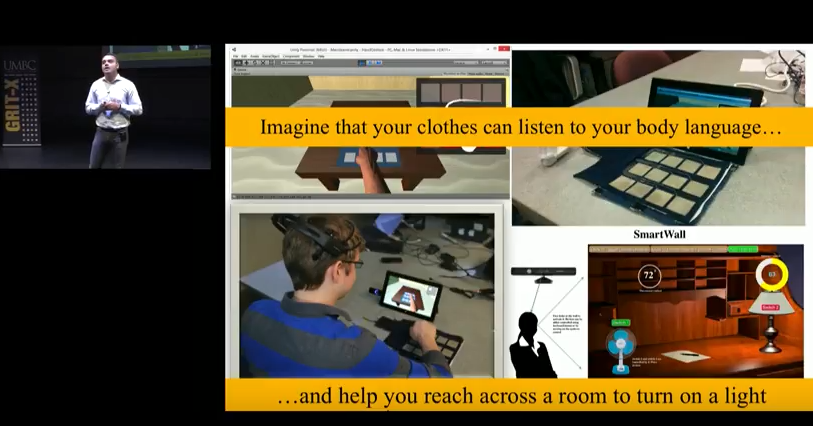
Professor Nilanjan Banerjee give a short talk at yher Grit-x event on recent research on systems that use intelligent, wearable sensors to provide better human-computer interfaces and for medical applications.
How can cutting-edge research on textile sensors and wearable radar sensors help us recognize gestures, monitor sleep fragmentation, and diagnose sleep disorders? The Banerjee lab has developed and applied sensors to users with upper extremity mobility impairments, adults suffering from insomnia and restless leg syndrome, and kids with attention deficit/hyperactivity disorder, with the intent to begin answering that question.
]]>
When What You Wear Understands You Professor Nilanjan Banerjee give a short talk at yher Grit-x event on recent research on systems that use intelligent, wearable sensors to provide better...https://www.csee.umbc.edu/2017/10/nilanjan-banerjee-when-what-you-wear-understands-you/https://dev.my.umbc.edu/api/v0/pixel/news/71301/guest@my.umbc.edu/4b4ceddd9c3746a06e5c7b66833ad28b/api/pixelcomputer-engineeringcomputer-sciencenewsresearchtalksComputer Science and Electrical Engineeringhttps://dev.my.umbc.edu/groups/cseehttps://assets3-dev.my.umbc.edu/system/shared/avatars/groups/000/000/099/d117dca133c64bf78a4b7696dd007189/xsmall.png?1314043393https://assets1-dev.my.umbc.edu/system/shared/avatars/groups/000/000/099/d117dca133c64bf78a4b7696dd007189/original.png?1314043393https://assets1-dev.my.umbc.edu/system/shared/avatars/groups/000/000/099/d117dca133c64bf78a4b7696dd007189/xxlarge.png?1314043393https://assets4-dev.my.umbc.edu/system/shared/avatars/groups/000/000/099/d117dca133c64bf78a4b7696dd007189/xlarge.png?1314043393https://assets3-dev.my.umbc.edu/system/shared/avatars/groups/000/000/099/d117dca133c64bf78a4b7696dd007189/large.png?1314043393https://assets1-dev.my.umbc.edu/system/shared/avatars/groups/000/000/099/d117dca133c64bf78a4b7696dd007189/medium.png?1314043393https://assets2-dev.my.umbc.edu/system/shared/avatars/groups/000/000/099/d117dca133c64bf78a4b7696dd007189/small.png?1314043393https://assets3-dev.my.umbc.edu/system/shared/avatars/groups/000/000/099/d117dca133c64bf78a4b7696dd007189/xsmall.png?1314043393https://assets3-dev.my.umbc.edu/system/shared/avatars/groups/000/000/099/d117dca133c64bf78a4b7696dd007189/xxsmall.png?1314043393Computer Science and Electrical Engineering30trueFri, 20 Oct 2017 09:50:01 -0400talk: H. Zhang on BFT- From the “Saddest Moment” to the Era of Blockchains, 12pm Fri 10/20
The UMBC Cyber Defense Lab presents
BFT—From the “Saddest Moment” to the Era of Blockchains
Haibin Zhang, CSEE, UMBC
12:00–1:00pm, Friday, 20 October 2017, ITE 231
Blockchains can generally be divided into two categories: permissionless blockchains (e.g., Bitcoin, Ethereum), and permissioned blockchains (e.g., Hyperledger Fabric). In permissionless blockchains, anyone can participate in the protocol. In permissioned blockchains, participants know the IDs of all other participants but do not need to trust them, a particularly useful scenario for business applications. As an emerging technology transforming business models, permissioned blockchains inspired a large number of industrial implementations. The Hyperledger Project (under the Linux Foundation) became a global collaborative project, now with 150+ industry members. Byzantine fault-tolerant (BFT) protocols regained prominence because they can support permissioned blockchain systems. For building permissioned blockchains, BFT is widely regarded as the most appropriate primitive, one accepted by academe and industry. In this talk, I will describe a number of efficient BFT blockchain systems that I helped invent, including BChain, ByzID, CBFT, and secure causal BFT. In addition, I will share my vision for blockchains and associated research opportunities.
Haibin Zhang is an assistant professor in the CSEE Department at UMBC. He is interested in cloud computing, cryptography, security, privacy, and distributed systems. He received the best paper candidate award at the 33rd IEEE International Symposium on Reliable Distributed Systems and proved the security of a NIST standard on ciphertext stealing. Zhang is one of the main inventors of Norton Zone, Symantec’s scalable cloud storage, and BChain, a highly efficient BFT protocol fully implemented within Hyperledger blockchain framework.
Host: Alan T. Sherman, *protected email*
The UMBC Cyber Defense Lab meets biweekly Fridays. All meetings are open to the public
In spring 2018, Sherman will teach a CMSC-491/691 special topics class on blockchains and digital currencies.
]]>
The UMBC Cyber Defense Lab presents BFT—From the “Saddest Moment” to the Era of Blockchains Haibin Zhang, CSEE, UMBC 12:00–1:00pm, Friday, 20 October 2017, ITE 231 Blockchains can...https://www.csee.umbc.edu/2017/10/byzantine-fault-tolerant-blockchain-systems/https://dev.my.umbc.edu/api/v0/pixel/news/71174/guest@my.umbc.edu/4950c95b8a651a0a54dae0cb317ed631/api/pixelcybersecuritynewstalksComputer Science and Electrical Engineeringhttps://dev.my.umbc.edu/groups/cseehttps://assets3-dev.my.umbc.edu/system/shared/avatars/groups/000/000/099/d117dca133c64bf78a4b7696dd007189/xsmall.png?1314043393https://assets1-dev.my.umbc.edu/system/shared/avatars/groups/000/000/099/d117dca133c64bf78a4b7696dd007189/original.png?1314043393https://assets1-dev.my.umbc.edu/system/shared/avatars/groups/000/000/099/d117dca133c64bf78a4b7696dd007189/xxlarge.png?1314043393https://assets4-dev.my.umbc.edu/system/shared/avatars/groups/000/000/099/d117dca133c64bf78a4b7696dd007189/xlarge.png?1314043393https://assets3-dev.my.umbc.edu/system/shared/avatars/groups/000/000/099/d117dca133c64bf78a4b7696dd007189/large.png?1314043393https://assets1-dev.my.umbc.edu/system/shared/avatars/groups/000/000/099/d117dca133c64bf78a4b7696dd007189/medium.png?1314043393https://assets2-dev.my.umbc.edu/system/shared/avatars/groups/000/000/099/d117dca133c64bf78a4b7696dd007189/small.png?1314043393https://assets3-dev.my.umbc.edu/system/shared/avatars/groups/000/000/099/d117dca133c64bf78a4b7696dd007189/xsmall.png?1314043393https://assets3-dev.my.umbc.edu/system/shared/avatars/groups/000/000/099/d117dca133c64bf78a4b7696dd007189/xxsmall.png?1314043393Computer Science and Electrical Engineering20trueMon, 16 Oct 2017 22:56:46 -0400