<?xml version="1.0"?>
<News hasArchived="false" page="1" pageCount="1" pageSize="10" timestamp="Mon, 20 Apr 2026 19:33:48 -0400" url="https://dev.my.umbc.edu/groups/csee/posts.xml?tag=menyuk">
  <NewsItem contentIssues="true" id="142312" important="false" status="posted" url="https://dev.my.umbc.edu/groups/csee/posts/142312">
    <Title>How to count time: Curtis Menyuk addresses age-old problem</Title>
    <Tagline>Optics and frequency combs for more accurate time keeping</Tagline>
    <Body>
      <![CDATA[
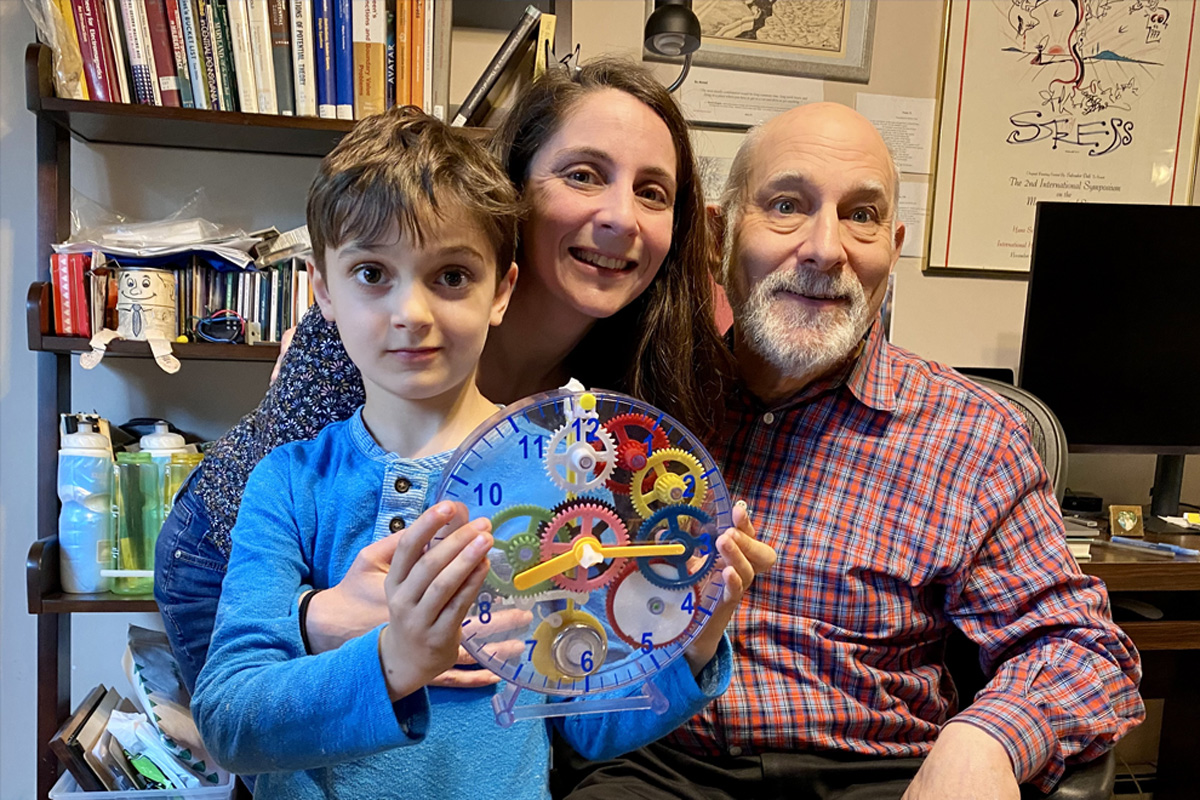
          <div class="html-content"><div><img src="https://umbc.edu/wp-content/uploads/2024/05/Curtis-Menyuk-with-daughter-and-grandson.jpg" style="max-width: 100%; height: auto;"></div><div><br></div><div><span>UMBC Magazine has an <strong><a href="https://umbc.edu/stories/time-and-optics-research-curtis-menyuk/" rel="nofollow external" class="bo">article</a></strong> on CSEE Professor </span><strong><a href="https://www.csee.umbc.edu/people/faculty/curtis-r-menyuk/" rel="nofollow external" class="bo">Curtis Menyuk</a><span> </span></strong><span>and his seminal work on using optics and frequency combs to develop more accurate time-keeping technology. This has led to the recent establishment of the <strong><a href="https://umbc.edu/stories/light-based-timing-and-navigation-research/" rel="nofollow external" class="bo">Center for Navigation, Timing, and Frequency Research</a></strong> (CENTAUR) at UMBC with support from the Army Research Laboratory. Its research on optical clocks can improve the accuracy of the current satellite-based Global Positioning System and provide alternatives in case of its failure.</span></div></div>
      ]]>
    </Body>
    <Summary>UMBC Magazine has an article on CSEE Professor Curtis Menyuk and his seminal work on using optics and frequency combs to develop more accurate time-keeping technology. This has led to the recent...</Summary>
    <Website>https://umbc.edu/stories/time-and-optics-research-curtis-menyuk/</Website>
    <TrackingUrl>https://dev.my.umbc.edu/api/v0/pixel/news/142312/guest@my.umbc.edu/095d6ebc07a8ec055f9c82807dbe0c90/api/pixel</TrackingUrl>
    <Tag>centaur</Tag>
    <Tag>frequency-combs</Tag>
    <Tag>menyuk</Tag>
    <Tag>optics</Tag>
    <Group token="csee">Computer Science and Electrical Engineering</Group>
    <GroupUrl>https://dev.my.umbc.edu/groups/csee</GroupUrl>
    <AvatarUrl>https://assets3-dev.my.umbc.edu/system/shared/avatars/groups/000/000/099/d117dca133c64bf78a4b7696dd007189/xsmall.png?1314043393</AvatarUrl>
    <AvatarUrl size="original">https://assets1-dev.my.umbc.edu/system/shared/avatars/groups/000/000/099/d117dca133c64bf78a4b7696dd007189/original.png?1314043393</AvatarUrl>
    <AvatarUrl size="xxlarge">https://assets1-dev.my.umbc.edu/system/shared/avatars/groups/000/000/099/d117dca133c64bf78a4b7696dd007189/xxlarge.png?1314043393</AvatarUrl>
    <AvatarUrl size="xlarge">https://assets4-dev.my.umbc.edu/system/shared/avatars/groups/000/000/099/d117dca133c64bf78a4b7696dd007189/xlarge.png?1314043393</AvatarUrl>
    <AvatarUrl size="large">https://assets3-dev.my.umbc.edu/system/shared/avatars/groups/000/000/099/d117dca133c64bf78a4b7696dd007189/large.png?1314043393</AvatarUrl>
    <AvatarUrl size="medium">https://assets1-dev.my.umbc.edu/system/shared/avatars/groups/000/000/099/d117dca133c64bf78a4b7696dd007189/medium.png?1314043393</AvatarUrl>
    <AvatarUrl size="small">https://assets2-dev.my.umbc.edu/system/shared/avatars/groups/000/000/099/d117dca133c64bf78a4b7696dd007189/small.png?1314043393</AvatarUrl>
    <AvatarUrl size="xsmall">https://assets3-dev.my.umbc.edu/system/shared/avatars/groups/000/000/099/d117dca133c64bf78a4b7696dd007189/xsmall.png?1314043393</AvatarUrl>
    <AvatarUrl size="xxsmall">https://assets3-dev.my.umbc.edu/system/shared/avatars/groups/000/000/099/d117dca133c64bf78a4b7696dd007189/xxsmall.png?1314043393</AvatarUrl>
    <Sponsor>Computer Science and Electrical Engineering</Sponsor>
    <PawCount>0</PawCount>
    <CommentCount>0</CommentCount>
    <CommentsAllowed>true</CommentsAllowed>
    <PostedAt>Tue, 04 Jun 2024 11:44:55 -0400</PostedAt>
    <EditAt>Tue, 04 Jun 2024 11:45:27 -0400</EditAt>
  </NewsItem>
  <NewsItem contentIssues="true" id="138239" important="false" status="posted" url="https://dev.my.umbc.edu/groups/csee/posts/138239">
  <Title>Professor Menyuk wins the SPIE G. G. Stokes Award!</Title>
  <Tagline>Exceptional contributions in Optical Polarization!</Tagline>
  <Body>
    <![CDATA[
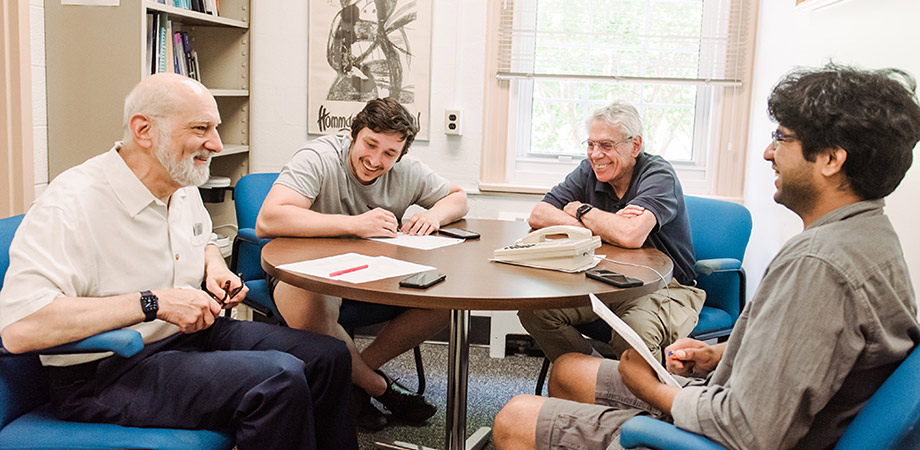
    <div class="html-content"><p><span><img src="https://www.csee.umbc.edu/wp-content/uploads/sites/659/2024/01/Curtis-Menyuk.jpg" style="max-width: 100%; height: auto;"></span></p><p><span>Dr. Menyuk is the winner of the 2024 G. G. Stokes Award in
    Optical Polarization. This award is made annually by SPIE the International
    Society for Optics and Photonics, and it honors exceptional contributions to
    the field of optical polarization.</span></p><p><span>Professor Menyuk's award is focused on his nearly forty
    years of contributions to the understanding of the interplay of polarization
    effects, nonlinearity, and noise in optical systems. Dr. Menyuk has carried out
    work that spanned the optical fiber revolution that started in the 1980s and
    continued through the early 2000s. At the beginning of this time, internet
    connections were slow and unreliable; but in the end, internet traffic became
    fast enough to enable the video streaming applications that we now take for
    granted. Equations and algorithms that Dr. Menyuk developed played an important
    role in this development. For the past twenty years, his work has focused on
    frequency combs - a technology that has revolutionized time and frequency
    evolution and will likely lead to a redefinition of the second. It has long
    been known that light comes in two polarizations. These polarizations can be
    separated by polarized lenses. Road glare or glare from the hood of the car is
    preferentially in a horizontal direction, and a polarized lens that lets
    through vertically polarized light eliminates a large amount of this glare. In
    optical fibers, the light in two different polarizations will move at two
    different speeds, which can lead to signal distortion.</span></p><p><span>In 1981, a team of scientists at AT&amp;T Bell Labs found
    that nonlinear effects in optical fibers will lead to the creation of solitons.
    In an optical fiber, light at different frequencies will move with different
    speeds. Any optical signal is made up of multiple frequencies, which will
    spread and distort the signal. This effect is called dispersion. However, in an
    optical pulse with sufficient energy, the frequencies begin to interact, which
    is referred to as a nonlinear interaction, and can become bound to each other.
    With the right energy, dispersion and nonlinearity exactly compensate, and the
    pulse travels without distortion. This pulse is called a soliton. Dr. Menyuk
    showed that the same nonlinearity that compensates for dispersion can
    compensate for the difference in speed between the two polarizations, referred
    to as birefringence, if this difference is not too large. In most practical
    cases, this difference is too large, and Dr. Menyuk working with many
    collaborators showed that randomly varying the birefringence in the fiber,
    which can be done by spinning the fiber, will then eliminate the distortion.</span></p><p><span>In more recent work, Dr. Menyuk has focused on micro
    resonators (tiny optical resonators) where, once again, solitons can be created
    and minimizing the interaction between different polarizations is important.
    This work is ongoing and has already led to important results that has been
    accomplished in collaboration with researchers at NIST and will be published in
    part in a forthcoming Nature article, 'Kerr-Induced Synchronization of a Cavity
    Soliton to an Optical Reference'. Most recently, Dr. Menyuk has been named the
    director of a new research center at UMBC, The Center for Navigation, Timing,
    and Frequency Research (CeNTaVR).</span></p><p><span>Read more about </span><span>Curtis R. Menyuk and the 2024 SPIE
    G.G. Stokes Award in Optical Polarization: <a href="https://spie.org/news/curtis-r-menyuk-the-2024-spie-gg-stokes-award-in-optical-polarization" rel="nofollow external" class="bo">https://spie.org/news/curtis-r-menyuk-the-2024-spie-gg-stokes-award-in-optical-polarization</a></span></p></div>
]]>
  </Body>
  <Summary>Dr. Menyuk is the winner of the 2024 G. G. Stokes Award in Optical Polarization. This award is made annually by SPIE the International Society for Optics and Photonics, and it honors exceptional...</Summary>
  <Website>https://photonics.umbc.edu/publications/PdfPapers/PAJ320.pdf</Website>
  <TrackingUrl>https://dev.my.umbc.edu/api/v0/pixel/news/138239/guest@my.umbc.edu/5b9197e90bb72d9d8d79c49c0d144f0a/api/pixel</TrackingUrl>
  <Tag>award</Tag>
  <Tag>dr</Tag>
  <Tag>g-g</Tag>
  <Tag>menyuk</Tag>
  <Tag>optical</Tag>
  <Tag>polarization</Tag>
  <Tag>stokes</Tag>
  <Group token="csee">Computer Science and Electrical Engineering</Group>
  <GroupUrl>https://dev.my.umbc.edu/groups/csee</GroupUrl>
  <AvatarUrl>https://assets3-dev.my.umbc.edu/system/shared/avatars/groups/000/000/099/d117dca133c64bf78a4b7696dd007189/xsmall.png?1314043393</AvatarUrl>
  <AvatarUrl size="original">https://assets1-dev.my.umbc.edu/system/shared/avatars/groups/000/000/099/d117dca133c64bf78a4b7696dd007189/original.png?1314043393</AvatarUrl>
  <AvatarUrl size="xxlarge">https://assets1-dev.my.umbc.edu/system/shared/avatars/groups/000/000/099/d117dca133c64bf78a4b7696dd007189/xxlarge.png?1314043393</AvatarUrl>
  <AvatarUrl size="xlarge">https://assets4-dev.my.umbc.edu/system/shared/avatars/groups/000/000/099/d117dca133c64bf78a4b7696dd007189/xlarge.png?1314043393</AvatarUrl>
  <AvatarUrl size="large">https://assets3-dev.my.umbc.edu/system/shared/avatars/groups/000/000/099/d117dca133c64bf78a4b7696dd007189/large.png?1314043393</AvatarUrl>
  <AvatarUrl size="medium">https://assets1-dev.my.umbc.edu/system/shared/avatars/groups/000/000/099/d117dca133c64bf78a4b7696dd007189/medium.png?1314043393</AvatarUrl>
  <AvatarUrl size="small">https://assets2-dev.my.umbc.edu/system/shared/avatars/groups/000/000/099/d117dca133c64bf78a4b7696dd007189/small.png?1314043393</AvatarUrl>
  <AvatarUrl size="xsmall">https://assets3-dev.my.umbc.edu/system/shared/avatars/groups/000/000/099/d117dca133c64bf78a4b7696dd007189/xsmall.png?1314043393</AvatarUrl>
  <AvatarUrl size="xxsmall">https://assets3-dev.my.umbc.edu/system/shared/avatars/groups/000/000/099/d117dca133c64bf78a4b7696dd007189/xxsmall.png?1314043393</AvatarUrl>
  <Sponsor>Computer Science and Electrical Engineering</Sponsor>
  <PawCount>1</PawCount>
  <CommentCount>0</CommentCount>
  <CommentsAllowed>true</CommentsAllowed>
  <PostedAt>Wed, 17 Jan 2024 15:45:38 -0500</PostedAt>
  <EditAt>Wed, 17 Jan 2024 16:11:22 -0500</EditAt>
</NewsItem>
</News>