Local Paid Summer Research Opportunity
University of Maryland School of Medicine
The Center currently invites applicants for the 2016 Summer Undergraduate Research Program. This program provides undergraduate students the opportunity to conduct research in preclinical and clinical laboratories at the MPRC and other laboratories of the Department of Psychiatry, University of Maryland School of Medicine in Baltimore.
In addition to a mentored hands-on research experience, students will participate in a didactic lecture series, research and ethics discussions with faculty, literature journal club, a career development seminar, and a Scholars’ Research Day at the end of the summer. Throughout the summer, students will work and interact with various faculty, graduate students, postdoctoral fellows and research assistants while gaining experience in preclinical and/or clinical research. Students will enhance their independent thinking and develop communication and presentation skills necessary to becoming a successful scientist.
Benefits
- Summer scholars will receive a stipend for a 10-week commitment (May 31 - August 5)
- On-campus housing is available at the University of Maryland Baltimore County (UMBC) dormitory
Eligibility
- Students with undergraduate student status during the program dates
- GPA of 3.0 or higher on a 4.0 scale
- Ideal candidates have a strong interest in pursuing a graduate degree
- The University of Maryland, Baltimore is an Equal Opportunity/Affirmative Action Employer. Minorities, women, veterans and individuals with disabilities are encouraged to apply
]]>
The Center currently invites applicants for the 2016 Summer Undergraduate Research Program. This program provides undergraduate students the opportunity to conduct research in preclinical and...
http://www.mprc.umaryland.edu/ConteCenter/researchprogram/
https://dev.my.umbc.edu/api/v0/pixel/news/56247/guest@my.umbc.edu/c713adf045e624cbb7398aed81a4a47b/api/pixel
maryland
medicine
of
reu
school
university
Undergraduate Research
https://dev.my.umbc.edu/groups/undergradresearch
https://assets2-dev.my.umbc.edu/system/shared/avatars/groups/000/000/006/875606ced2b629148af4caa1a4e8dd3c/xsmall.png?1600355057
https://assets3-dev.my.umbc.edu/system/shared/avatars/groups/000/000/006/875606ced2b629148af4caa1a4e8dd3c/original.jpg?1600355057
https://assets4-dev.my.umbc.edu/system/shared/avatars/groups/000/000/006/875606ced2b629148af4caa1a4e8dd3c/xxlarge.png?1600355057
https://assets1-dev.my.umbc.edu/system/shared/avatars/groups/000/000/006/875606ced2b629148af4caa1a4e8dd3c/xlarge.png?1600355057
https://assets2-dev.my.umbc.edu/system/shared/avatars/groups/000/000/006/875606ced2b629148af4caa1a4e8dd3c/large.png?1600355057
https://assets2-dev.my.umbc.edu/system/shared/avatars/groups/000/000/006/875606ced2b629148af4caa1a4e8dd3c/medium.png?1600355057
https://assets4-dev.my.umbc.edu/system/shared/avatars/groups/000/000/006/875606ced2b629148af4caa1a4e8dd3c/small.png?1600355057
https://assets2-dev.my.umbc.edu/system/shared/avatars/groups/000/000/006/875606ced2b629148af4caa1a4e8dd3c/xsmall.png?1600355057
https://assets4-dev.my.umbc.edu/system/shared/avatars/groups/000/000/006/875606ced2b629148af4caa1a4e8dd3c/xxsmall.png?1600355057
Undergraduate Research
https://assets4-dev.my.umbc.edu/system/shared/thumbnails/news/000/056/247/cb1ff3a993b6d96808c89ef43afdb8a1/xxlarge.jpg?1448463115
https://assets2-dev.my.umbc.edu/system/shared/thumbnails/news/000/056/247/cb1ff3a993b6d96808c89ef43afdb8a1/xlarge.jpg?1448463115
https://assets2-dev.my.umbc.edu/system/shared/thumbnails/news/000/056/247/cb1ff3a993b6d96808c89ef43afdb8a1/large.jpg?1448463115
https://assets1-dev.my.umbc.edu/system/shared/thumbnails/news/000/056/247/cb1ff3a993b6d96808c89ef43afdb8a1/medium.jpg?1448463115
https://assets1-dev.my.umbc.edu/system/shared/thumbnails/news/000/056/247/cb1ff3a993b6d96808c89ef43afdb8a1/small.jpg?1448463115
https://assets4-dev.my.umbc.edu/system/shared/thumbnails/news/000/056/247/cb1ff3a993b6d96808c89ef43afdb8a1/xsmall.jpg?1448463115
https://assets2-dev.my.umbc.edu/system/shared/thumbnails/news/000/056/247/cb1ff3a993b6d96808c89ef43afdb8a1/xxsmall.jpg?1448463115
20
0
true
Wed, 25 Nov 2015 09:52:18 -0500
PAID Summer Opportunity in Field Biology at Baker University
"In the Canopy with Wheelchairs & Tardigrades"
In the Canopy with Wheelchairs & Tardigrades
National Science Foundation Research Opportunity
3D Invertebrate Herbivory and Biodiversity in Deciduous North American Forest Canopies: Inspiring Students with Physical Disabilities to Pursue Field Biology
May 31 - August 9, 2015 | Baker University, Baldwin City, Kan.
We are looking for a few students who have the confidence to climb into the tops of trees and explore. Students who can ask questions that do not yet have answers. Students who want to learn from the unknown.
The Research Project
This is a three-dimensional research project to define the taxonomy and distribution of tardigrades (water bears) in the canopy and the herbivory of insects on a North American deciduous forest.The project is a fast-paced, tree-climbing, data-collecting, rapid-analysis and results-oriented internship. It is not for the timid. The plan is to climb and collect in the cooler mornings and spend the hotter afternoons and evenings processing specimens in the labs. Weekends include visits to local cultural sites and water bear hunts.
Students will be professionally trained to ascend into the canopy. There they will measure the impact of micro and macro invertebrates on the habitat and establish a baseline from which change can be measured. This is the cutting edge of ecological analysis in a world affected by climate change. Students will learn to use remote sensing, GIS, HPLC, GC-MS, and an EA scanning electron microscope to document the microenvironment.
Students will be employed for the summer. They will collaborate with the principle investigators to prepare their data for presentation and publication. They will also meet and network with the scientists and graduate students at the North Carolina Museum of Natural Sciences, University of Kansas Microscopy and Analytical Imaging Lab, Kansas State University long-term environmental research site, and the Missouri Botanical Garden. Students may attend a regional, national, or international meeting and present their results.
Students will be part of a small team of young scientists who are defining and establishing a base line for the condition of the temperate forests before global warming completely exerts pressure for the forests and canopy to change.
The Hypothesis
Unlike in the tropics, there are no differences in the animals or plants that live at different levels of deciduous trees in temperate forests.
To test this hypothesis students will conduct vertical transects at multiple sites on various species of trees. Field collections will be moss, lichen and leaves.
Based at the new Boyd Center at Baker University in Baldwin City, Kan., the project will explore the canopy of the transition zone between the eastern deciduous forest and the tall grass prairie biomes.
In the lab, students will extract, identify and quantize the animals (water bears) found in each sample and learn to create scanning electron microscope images.
Students will analyze the chemistry of the habitat (moss/lichen) with GC, Mass, spec, and HPLC for its influence on the interstitial aquatic environment in which the animals live. The leaves of the trees will be analyzed for insect herbivory.
The data will be mapped with GIS to predict other places where similar populations might exist. The data will establish a baseline from which change caused by global warming can be measured in the future.
Students will use professional tools such as PowerPoint to present their findings at the North Carolina Museum of Natural Sciences and regional meetings. They will also have the opportunity to produce manuscripts for publication.
]]>
In the Canopy with Wheelchairs & Tardigrades National Science Foundation Research Opportunity 3D Invertebrate Herbivory and Biodiversity in Deciduous North American Forest Canopies:...
http://www.bakeru.edu/canopy
https://dev.my.umbc.edu/api/v0/pixel/news/56245/guest@my.umbc.edu/5b2a33a93b50ac588be177d0136ff0df/api/pixel
baker
opportunity
reu
summer
university
Undergraduate Research
https://dev.my.umbc.edu/groups/undergradresearch
https://assets2-dev.my.umbc.edu/system/shared/avatars/groups/000/000/006/875606ced2b629148af4caa1a4e8dd3c/xsmall.png?1600355057
https://assets3-dev.my.umbc.edu/system/shared/avatars/groups/000/000/006/875606ced2b629148af4caa1a4e8dd3c/original.jpg?1600355057
https://assets4-dev.my.umbc.edu/system/shared/avatars/groups/000/000/006/875606ced2b629148af4caa1a4e8dd3c/xxlarge.png?1600355057
https://assets1-dev.my.umbc.edu/system/shared/avatars/groups/000/000/006/875606ced2b629148af4caa1a4e8dd3c/xlarge.png?1600355057
https://assets2-dev.my.umbc.edu/system/shared/avatars/groups/000/000/006/875606ced2b629148af4caa1a4e8dd3c/large.png?1600355057
https://assets2-dev.my.umbc.edu/system/shared/avatars/groups/000/000/006/875606ced2b629148af4caa1a4e8dd3c/medium.png?1600355057
https://assets4-dev.my.umbc.edu/system/shared/avatars/groups/000/000/006/875606ced2b629148af4caa1a4e8dd3c/small.png?1600355057
https://assets2-dev.my.umbc.edu/system/shared/avatars/groups/000/000/006/875606ced2b629148af4caa1a4e8dd3c/xsmall.png?1600355057
https://assets4-dev.my.umbc.edu/system/shared/avatars/groups/000/000/006/875606ced2b629148af4caa1a4e8dd3c/xxsmall.png?1600355057
Undergraduate Research
https://assets3-dev.my.umbc.edu/system/shared/thumbnails/news/000/056/245/5b13783914c219f584f7c974777f6e4e/xxlarge.jpg?1448462504
https://assets1-dev.my.umbc.edu/system/shared/thumbnails/news/000/056/245/5b13783914c219f584f7c974777f6e4e/xlarge.jpg?1448462504
https://assets4-dev.my.umbc.edu/system/shared/thumbnails/news/000/056/245/5b13783914c219f584f7c974777f6e4e/large.jpg?1448462504
https://assets4-dev.my.umbc.edu/system/shared/thumbnails/news/000/056/245/5b13783914c219f584f7c974777f6e4e/medium.jpg?1448462504
https://assets1-dev.my.umbc.edu/system/shared/thumbnails/news/000/056/245/5b13783914c219f584f7c974777f6e4e/small.jpg?1448462504
https://assets1-dev.my.umbc.edu/system/shared/thumbnails/news/000/056/245/5b13783914c219f584f7c974777f6e4e/xsmall.jpg?1448462504
https://assets4-dev.my.umbc.edu/system/shared/thumbnails/news/000/056/245/5b13783914c219f584f7c974777f6e4e/xxsmall.jpg?1448462504
14
0
true
Wed, 25 Nov 2015 09:41:57 -0500
New spring course: Principles of Human-Robot Interaction
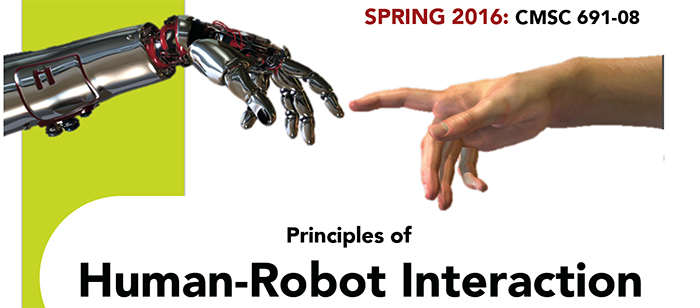
CSEE professor Cynthia Matuszek will teach a new special topics course this spring on Principles of Human-Robot Interaction. The graduate level course (CMSC 691-08) will meet on Tuesday and Thursdays from 4:00 to 5:30pm in 013 Sherman Hall.
Principles of Human-Robot Interaction
An introduction to robots in our daily lives
CMSC691-08, 4:00-5:15pm Tue/Thr, starting 26 January 2016, UMBC
Robots are becoming ubiquitous. From Roombas in our homes, to surgical robots in hospitals, to giant manipulators that assemble cars, robots are everywhere. In the past, robots have only ever interacted with highly trained experts. Now, as they are being deployed more widely, we must address new questions about how our robots can interact day-to-day with end users — non-experts — safely, usefully, and pleasantly. This new area of research is called Human-Robot Interaction, or HRI.
This 3-credit special topics course aims to introduce students to current research in HRI and provide hands-on experience with HRI research. Students will explore the diverse range of research topics in this area, learn to identify HRI problems in their own research, and carry out a collaborative project involving human-robot interactions. Topics to be covered include:
- Social robots: how can robots be social beings? When do we want them to?
- Human-robot collaboration: humans and robots working together on tasks
- Natural-language interactions with robots and human-robot dialog
- Telerobotics: the uses of remote presence and teleoperation
- Expressive robots: how can robots express emotion – and should they?
Students may benefit from having some previous coursework or experience in AI, machine learning, or robotics, but none are necessary. Undergraduate students can enroll with the instructor’s permission. For more information, contact Dr. Matuszek at cmat at umbc.edu.
]]>
CSEE professor Cynthia Matuszek will teach a new special topics course this spring on Principles of Human-Robot Interaction. The graduate level course (CMSC 691-08) will meet on Tuesday and...
http://www.csee.umbc.edu/2015/11/new-spring-course-principles-of-human-robot-interaction/
https://dev.my.umbc.edu/api/v0/pixel/news/56230/guest@my.umbc.edu/94b0578024b2d65cd8f50ca6b42c9f27/api/pixel
computer-science
graduate
news
robotics
Computer Science and Electrical Engineering
https://dev.my.umbc.edu/groups/csee
https://assets3-dev.my.umbc.edu/system/shared/avatars/groups/000/000/099/d117dca133c64bf78a4b7696dd007189/xsmall.png?1314043393
https://assets1-dev.my.umbc.edu/system/shared/avatars/groups/000/000/099/d117dca133c64bf78a4b7696dd007189/original.png?1314043393
https://assets1-dev.my.umbc.edu/system/shared/avatars/groups/000/000/099/d117dca133c64bf78a4b7696dd007189/xxlarge.png?1314043393
https://assets4-dev.my.umbc.edu/system/shared/avatars/groups/000/000/099/d117dca133c64bf78a4b7696dd007189/xlarge.png?1314043393
https://assets3-dev.my.umbc.edu/system/shared/avatars/groups/000/000/099/d117dca133c64bf78a4b7696dd007189/large.png?1314043393
https://assets1-dev.my.umbc.edu/system/shared/avatars/groups/000/000/099/d117dca133c64bf78a4b7696dd007189/medium.png?1314043393
https://assets2-dev.my.umbc.edu/system/shared/avatars/groups/000/000/099/d117dca133c64bf78a4b7696dd007189/small.png?1314043393
https://assets3-dev.my.umbc.edu/system/shared/avatars/groups/000/000/099/d117dca133c64bf78a4b7696dd007189/xsmall.png?1314043393
https://assets3-dev.my.umbc.edu/system/shared/avatars/groups/000/000/099/d117dca133c64bf78a4b7696dd007189/xxsmall.png?1314043393
Computer Science and Electrical Engineering
1
0
true
Tue, 24 Nov 2015 14:23:17 -0500
Tue, 24 Nov 2015 14:23:17 -0500
New spring course: Principles of Human-Robot Interaction
CSEE professor Cynthia Matuszek will teach a new special topics course this spring on Principles of Human-Robot Interaction. The graduate level course (CMSC 691-08) will meet on Tuesday and Thursdays from 4:00 to 5:30pm in 013 Sherman Hall.
Principles of Human-Robot Interaction
An introduction to robots in our daily lives
CMSC691-08, 4:00-5:15pm Tue/Thr, starting 26 January 2016, UMBC
Robots are becoming ubiquitous. From Roombas in our homes, to surgical robots in hospitals, to giant manipulators that assemble cars, robots are everywhere. In the past, robots have only ever interacted with highly trained experts. Now, as they are being deployed more widely, we must address new questions about how our robots can interact day-to-day with end users — non-experts — safely, usefully, and pleasantly. This new area of research is called Human-Robot Interaction, or HRI.
This 3-credit special topics course aims to introduce students to current research in HRI and provide hands-on experience with HRI research. Students will explore the diverse range of research topics in this area, learn to identify HRI problems in their own research, and carry out a collaborative project involving human-robot interactions. Topics to be covered include:
- Social robots: how can robots be social beings? When do we want them to?
- Human-robot collaboration: humans and robots working together on tasks
- Natural-language interactions with robots and human-robot dialog
- Telerobotics: the uses of remote presence and teleoperation
- Expressive robots: how can robots express emotion – and should they?
Students may benefit from having some previous coursework or experience in AI, machine learning, or robotics, but none are necessary. Undergraduate students can enroll with the instructor’s permission. For more information, contact Dr. Matuszek at cmat at umbc.edu.
]]>
CSEE professor Cynthia Matuszek will teach a new special topics course this spring on Principles of Human-Robot Interaction. The graduate level course (CMSC 691-08) will meet on Tuesday and...
https://www.csee.umbc.edu/2015/11/new-spring-course-principles-of-human-robot-interaction/
https://dev.my.umbc.edu/api/v0/pixel/news/57871/guest@my.umbc.edu/eba2288b016419603bb92820c069bacb/api/pixel
computer-science
graduate
news
robotics
Computer Science and Electrical Engineering
https://dev.my.umbc.edu/groups/csee
https://assets3-dev.my.umbc.edu/system/shared/avatars/groups/000/000/099/d117dca133c64bf78a4b7696dd007189/xsmall.png?1314043393
https://assets1-dev.my.umbc.edu/system/shared/avatars/groups/000/000/099/d117dca133c64bf78a4b7696dd007189/original.png?1314043393
https://assets1-dev.my.umbc.edu/system/shared/avatars/groups/000/000/099/d117dca133c64bf78a4b7696dd007189/xxlarge.png?1314043393
https://assets4-dev.my.umbc.edu/system/shared/avatars/groups/000/000/099/d117dca133c64bf78a4b7696dd007189/xlarge.png?1314043393
https://assets3-dev.my.umbc.edu/system/shared/avatars/groups/000/000/099/d117dca133c64bf78a4b7696dd007189/large.png?1314043393
https://assets1-dev.my.umbc.edu/system/shared/avatars/groups/000/000/099/d117dca133c64bf78a4b7696dd007189/medium.png?1314043393
https://assets2-dev.my.umbc.edu/system/shared/avatars/groups/000/000/099/d117dca133c64bf78a4b7696dd007189/small.png?1314043393
https://assets3-dev.my.umbc.edu/system/shared/avatars/groups/000/000/099/d117dca133c64bf78a4b7696dd007189/xsmall.png?1314043393
https://assets3-dev.my.umbc.edu/system/shared/avatars/groups/000/000/099/d117dca133c64bf78a4b7696dd007189/xxsmall.png?1314043393
Computer Science and Electrical Engineering
0
0
true
Tue, 24 Nov 2015 14:23:17 -0500
How You Can Honor Both Sides of the Thanksgiving Table
An article from Sojourners magazine
What role does Thanksgiving play in our lives and our faith?
When we think about the meeting of the first pilgrims and Indians, we usually connect vicariously to one side of that old Plymouth encounter, mysteriously linking our faith journey to the early pilgrims’ faith journey. But what about those long-ago Indians? Is there a reason to remember them as more than a foil for the pilgrims?
Perhaps without realizing it, Thanksgiving, among its many other functions, is a holiday that serves the purpose of perpetuating a national myth. How often do we ask, “What happened to the Indians?” If we consider them at all, we are slow to admit that perhaps leaving the them in a frozen state of time at the earliest Thanksgiving dinner helps to make us feel better about what would eventually become the genocide of Native Americans and of their continued mistreatment.
Year after year we think warmly of that first union of the pilgrims and the Indians — and then we continue on in the supposed faith tradition of one of those peoples without another thought to the fate of the others.
Our annual celebration, mostly without us realizing it, wipes the Indigenous genocide slate clean and perpetuates the myth that everything is now okay. But it's not okay.
We should take the time to admit and lament the staggering mistreatment of Native Americans and the alarming rates of disease and dysfunction brought on by colonialism.
We lament over intentional and unintentional genocide; over stolen land; over families destroyed; over spirituality suppressed; and over the continued mistreatment and marginalization of indigenous peoples.
Yet there’s more we can do. Here are a few ways you can faithfully honor both sides of the Thanksgiving table this year.
1. Plymouth Was Not the First Thanksgiving In America
Both real and imagined descendants of the First Thanksgiving should consider the godly legacy left by the Native Americans. Thanksgiving in America didn't begin with the pilgrims. For thousands of years, many feasts of thanksgiving have been characteristic of American Indigenous tribes. These ceremonies and feasts still continue today among Native Americans, all in thanks to the Creator.
In reality, that First Thanksgiving was simply the first opportunity for the pilgrims to join millennial-old traditions among America's Indigenous peoples to thank God. Americans, both the real and the vicarious descendants of the First Thanksgiving, should consider the godly legacy left by Native Americans. It might also serve them well to remember that the Creator was already present before they arrived on the land upon which they were living.
2. The Native Americans Were the Hosts, Not the Guests
New immigrants (anyone arriving in America after 1491) should view the Plymouth feast as indigenous peoples welcoming newcomers, and as a result take the opportunity to express gratitude to local Indigenous peoples and all creation — especially those plants and animals that provided the feast and extended others' lives another day by sacrificing theirs.
Settlers should view themselves as good guests of the land, and rethink their social posture with humility. They should express gratitude today to local indigenous peoples and all creation, especially those plants and animals that provided the feast and continue to sacrifice to provide for us all.
As America's host people, Native Americans are the covenanted keepers of the land, and view its care as a sacred duty. Our land-keeping responsibilities include bringing the land, the people, and the rest of creation back into harmony. Traditionally, we have done this through prayer, ceremony, and special festivals. If people are willing, Thanksgiving can be a time of reconciliation and healing of the land.
3. An Invitation To Be Hospitable
The holiday can also be used to promote a new grand myth or metaphor for hospitality to the poor, the disenfranchised, the newest immigrants, and those who we consider "the cultural other." How? People throughout the whole world who have been the recipients of the devastation brought on by the dominant myth of colonialism and unfair capital theft should be invited to Thanksgiving tables everywhere in order to cultivate new friendships. We cannot hate, or even ignore, one another and expect to heal the land and please God.
By thanking the Creator and showing love to one another, we can actually begin restoring harmony in the land. This can begin with a simple meal.
Our Indian elders knew that many of the so-called “Christian" settlers did not act like the Jesus whom they claimed to represent. They also knew that in our shared histories we sometimes enjoyed times of peace and friendship that reflected something better than the many unhappy times.
Without ignoring the centuries of injustice, together we should celebrate those times of friendship and build upon them. After all, isn't the point of a myth to set a good narrative that can be built upon in the present?
To me, this is the point of Thanksgiving. The holiday is a time to share stories both of joy and pain and still be thankful for all life. Thanksgiving is a time for us all to share our mutual humanity. Without ignoring the historical truth of the big picture and the fate of the Native Americans, we can use the Thanksgiving holiday as continuous narrative for peace and friendship.
Let's build upon that part of the myth.
By Randy Woodley
]]>
What role does Thanksgiving play in our lives and our faith? When we think about the meeting of the first pilgrims and Indians, we usually connect vicariously to one side of that old...
https://sojo.net/articles/faith-action/how-you-can-honor-both-sides-thanksgiving-table
https://dev.my.umbc.edu/api/v0/pixel/news/56208/guest@my.umbc.edu/82d2117371b1cab64ee5de735fd29120/api/pixel
american
culture
diversity
honor
inclusion
indian
native
recognition
remembrance
thanksgiving
The Mosaic: Center for Cultural Diversity
https://dev.my.umbc.edu/groups/themosaic
https://assets3-dev.my.umbc.edu/system/shared/avatars/groups/000/000/079/8da8369525d899e6fa49decd5a80b73f/xsmall.png?1755890395
https://assets2-dev.my.umbc.edu/system/shared/avatars/groups/000/000/079/8da8369525d899e6fa49decd5a80b73f/original.png?1755890395
https://assets3-dev.my.umbc.edu/system/shared/avatars/groups/000/000/079/8da8369525d899e6fa49decd5a80b73f/xxlarge.png?1755890395
https://assets2-dev.my.umbc.edu/system/shared/avatars/groups/000/000/079/8da8369525d899e6fa49decd5a80b73f/xlarge.png?1755890395
https://assets3-dev.my.umbc.edu/system/shared/avatars/groups/000/000/079/8da8369525d899e6fa49decd5a80b73f/large.png?1755890395
https://assets4-dev.my.umbc.edu/system/shared/avatars/groups/000/000/079/8da8369525d899e6fa49decd5a80b73f/medium.png?1755890395
https://assets1-dev.my.umbc.edu/system/shared/avatars/groups/000/000/079/8da8369525d899e6fa49decd5a80b73f/small.png?1755890395
https://assets3-dev.my.umbc.edu/system/shared/avatars/groups/000/000/079/8da8369525d899e6fa49decd5a80b73f/xsmall.png?1755890395
https://assets1-dev.my.umbc.edu/system/shared/avatars/groups/000/000/079/8da8369525d899e6fa49decd5a80b73f/xxsmall.png?1755890395
Student Life's Mosaic and Interfaith Centers
7
0
true
Tue, 24 Nov 2015 13:37:56 -0500
Mon, 30 Nov 2015 10:22:37 -0500
New Management Development Program at M&T Bank
Technical, Business, and Analytical Majors Encouraged!
Management Development ProgramBuild Your Future at M&T Apply through UMBCworks today! Since 1983, M&T's Management Development Program (MDP) has been the entry point for undergraduate students looking to develop their professional skills. What you can expect from the Management Development Program - A year-long program designed to develop your leadership skills
- Direct-position-placement where you can immediately provide value
- Intensive training in communication, leadership, and finance, enabling you to apply these skills in critical roles
- Access to an instant peer group and networking opportunities to help you learn and grow within the bank
- A bridge from college to career
The Management Development Program offers two career tracks - Analyst track – providing undergraduates with positions in finance/accounting, human resources, marketing, credit & risk management, technology, treasury and many more
- Retail track – providing undergraduates the opportunity to start on the path to retail branch management while learning branch operations/sales strategies and obtaining licenses
|
Management Development Program Qualifications - Bachelor's (or MS/MBA) candidates with less than 1 year of full-time work experience
- Cumulative GPA of 3.0 or above
- Superior interpersonal skills & experience in making presentations
- Strong analytical ability
- Excellent written and verbal communication skills
- Authorization to work in the U.S. on a full-time, permanent basis without additional sponsorship
Technology Function: Management Trainees working in Technology will further develop technical and project management skills. Employees will participate one of the bank’s strategic initiatives to optimize daily operations through: •Application development •Architecture •Innovation •Production Operations
Locations: Headquartered in Buffalo, NY, M&T Bank has locations throughout DC, DE, MD, NJ, NY, PA, VA, and WV. To learn more about M&T’s financial performance, commitment to its community, and culture, visit www.mtb.com/AboutUs.
Apply via UMBCworks today:9279465
Apply to position 9278560 in UMBCworks.
|
|
]]>
Management Development Program Build Your Future at M&T Apply through UMBCworks today! Since 1983, M&T's Management Development Program (MDP) has been the entry point for...
http://careers.umbc.edu/umbcworks/
https://dev.my.umbc.edu/api/v0/pixel/news/56226/guest@my.umbc.edu/44f67baa1e54a20a00f145eb6c0c1b93/api/pixel
Career Center
https://dev.my.umbc.edu/groups/careers
https://assets2-dev.my.umbc.edu/system/shared/avatars/groups/000/000/018/729f2c7eeeab66f50f4ab3677539a585/xsmall.png?1411655278
https://assets4-dev.my.umbc.edu/system/shared/avatars/groups/000/000/018/729f2c7eeeab66f50f4ab3677539a585/original.jpg?1411655278
https://assets2-dev.my.umbc.edu/system/shared/avatars/groups/000/000/018/729f2c7eeeab66f50f4ab3677539a585/xxlarge.png?1411655278
https://assets1-dev.my.umbc.edu/system/shared/avatars/groups/000/000/018/729f2c7eeeab66f50f4ab3677539a585/xlarge.png?1411655278
https://assets2-dev.my.umbc.edu/system/shared/avatars/groups/000/000/018/729f2c7eeeab66f50f4ab3677539a585/large.png?1411655278
https://assets3-dev.my.umbc.edu/system/shared/avatars/groups/000/000/018/729f2c7eeeab66f50f4ab3677539a585/medium.png?1411655278
https://assets3-dev.my.umbc.edu/system/shared/avatars/groups/000/000/018/729f2c7eeeab66f50f4ab3677539a585/small.png?1411655278
https://assets2-dev.my.umbc.edu/system/shared/avatars/groups/000/000/018/729f2c7eeeab66f50f4ab3677539a585/xsmall.png?1411655278
https://assets2-dev.my.umbc.edu/system/shared/avatars/groups/000/000/018/729f2c7eeeab66f50f4ab3677539a585/xxsmall.png?1411655278
Career Center
https://assets1-dev.my.umbc.edu/system/shared/thumbnails/news/000/056/226/41bf9a159a04b2c5aad9f42d03eac490/xxlarge.jpg?1448386328
https://assets3-dev.my.umbc.edu/system/shared/thumbnails/news/000/056/226/41bf9a159a04b2c5aad9f42d03eac490/xlarge.jpg?1448386328
https://assets4-dev.my.umbc.edu/system/shared/thumbnails/news/000/056/226/41bf9a159a04b2c5aad9f42d03eac490/large.jpg?1448386328
https://assets4-dev.my.umbc.edu/system/shared/thumbnails/news/000/056/226/41bf9a159a04b2c5aad9f42d03eac490/medium.jpg?1448386328
https://assets3-dev.my.umbc.edu/system/shared/thumbnails/news/000/056/226/41bf9a159a04b2c5aad9f42d03eac490/small.jpg?1448386328
https://assets1-dev.my.umbc.edu/system/shared/thumbnails/news/000/056/226/41bf9a159a04b2c5aad9f42d03eac490/xsmall.jpg?1448386328
https://assets1-dev.my.umbc.edu/system/shared/thumbnails/news/000/056/226/41bf9a159a04b2c5aad9f42d03eac490/xxsmall.jpg?1448386328
1
0
true
Tue, 24 Nov 2015 12:25:44 -0500
Tue, 24 Nov 2015 12:32:51 -0500
User Generated Passwords 3×3 vs 4×4 Grid Sizes for Android
Is Bigger Better?
Is Bigger Better? Comparing User Generated Passwords on
3×3 vs. 4×4 Grid Sizes for Android’s Pattern Unlock
Adam Aviv, USNA
1:00-2:00pm Tuesday, 1 December 2015, ITE 459
Android’s graphical authentication mechanism requires users to unlock their devices by “drawing” a pattern that connects a sequence of contact points arranged in a 3×3 grid. Prior studies have shown that human-generated patterns are far less complex than one would desire; large portions can be trivially guessed with sufficient training. Custom modifications to Android, such as CyanogenMod, offer ways to increase the grid size beyond 3×3, and in this paper we ask the question: Does increasing the grid size increase the security of human-generated patterns?
To answer this question, we conducted two large studies, one in-lab and one online, collecting 934 total 3×3 patterns and 504 4×4 patterns. Analysis shows that for both 3×3 and 4×4 patterns, there is a high incidence of repeated patterns and symmetric pairs (patterns that derive from others based on a sequence of flips and rotations). Further, many of the 4×4 patterns are similar versions of 3×3 patterns distributed over the larger grid space. Leveraging this information, we developed the most advanced guessing algorithm in this space, and we find that guessing the first 20% (0.2) of patterns for both 3×3 and 4×4 can be done as efficiently as guessing a random 2-digit PIN. Guessing larger portions of 4×4 patterns (0.5), however, requires 2-bits more entropy than guessing the same ratio of 3×3 patterns, but the entropy is still on the order of cracking random 3-digit PINs. These results suggest that while there may be some benefit to expanding the grid size to 4×4, the majority of patterns will remain trivially guessable and insecure against broad guessing attacks.
Adam J. Aviv is an Assistant Professor of Computer Science at the United States Naval Academy, receiving his Ph.D. from the University of Pennsylvania under the advisement of Jonathan Smith and Matt Blaze. He has varied research interests including in system and network security, applied cryptography, smartphone security, and more recently in the area of usable security with a focus on mobile devices.
]]>
Is Bigger Better? Comparing User Generated Passwords on 3×3 vs. 4×4 Grid Sizes for Android’s Pattern Unlock Adam Aviv, USNA 1:00-2:00pm Tuesday, 1 December 2015, ITE 459 Android’s graphical...
http://www.csee.umbc.edu/2015/11/talk-user-generated-passwords-on-3x3-vs-4x4-grid-sizes-for-android/?utm_campaign=19942&utm_medium=twitter&utm_source=twitter
https://dev.my.umbc.edu/api/v0/pixel/news/56224/guest@my.umbc.edu/98494a41dd216ba5de1761cf72be87d6/api/pixel
android
infosec
passwords
privacy
security
Information Systems Security Association, UMBC Chapter
https://dev.my.umbc.edu/groups/issa
https://assets4-dev.my.umbc.edu/system/shared/avatars/groups/000/000/514/0bdfb1231eca53e69ca24c2de2eb6912/xsmall.png?1772925484
https://assets4-dev.my.umbc.edu/system/shared/avatars/groups/000/000/514/0bdfb1231eca53e69ca24c2de2eb6912/original.jpg?1772925484
https://assets3-dev.my.umbc.edu/system/shared/avatars/groups/000/000/514/0bdfb1231eca53e69ca24c2de2eb6912/xxlarge.png?1772925484
https://assets3-dev.my.umbc.edu/system/shared/avatars/groups/000/000/514/0bdfb1231eca53e69ca24c2de2eb6912/xlarge.png?1772925484
https://assets4-dev.my.umbc.edu/system/shared/avatars/groups/000/000/514/0bdfb1231eca53e69ca24c2de2eb6912/large.png?1772925484
https://assets2-dev.my.umbc.edu/system/shared/avatars/groups/000/000/514/0bdfb1231eca53e69ca24c2de2eb6912/medium.png?1772925484
https://assets1-dev.my.umbc.edu/system/shared/avatars/groups/000/000/514/0bdfb1231eca53e69ca24c2de2eb6912/small.png?1772925484
https://assets4-dev.my.umbc.edu/system/shared/avatars/groups/000/000/514/0bdfb1231eca53e69ca24c2de2eb6912/xsmall.png?1772925484
https://assets4-dev.my.umbc.edu/system/shared/avatars/groups/000/000/514/0bdfb1231eca53e69ca24c2de2eb6912/xxsmall.png?1772925484
IS Dept
0
0
true
Tue, 24 Nov 2015 11:40:53 -0500
Paid Summer 2016 Research Opportunities at Harvard-MIT
Spend the summer in Boston!
Looking for a summer research opportunity? Check out these two paid research opportunities for these majors: biology, physics, engineering, and bioinformatics. All disciplines are accepted!
The Harvard-MIT
Program in Health Sciences and Technology (HST) is sponsoring its 2016
Summer Institute with one track in Biomedical Informatics and another in
Biomedical Optics.
We would like to invite undergraduate students from your institution to
visit our website at http://web.mit.edu/hstsummer. Underrepresented minority students are encouraged
to apply. Please note the January 2016 application deadlines below.
The MGH Summer Institute in Biomedical Optics, BioOpticsSummerInstitute@mgh.harvard.edu
The Summer Institute in Biomedical Informatics offers
an intensive internship that includes classes, research projects and
training in technical communication. Classes with clinical researchers
meet twice a week; the mentored research projects, carried out under the
supervision of investigators at Harvard Medical
School (HMS), the Harvard teaching hospitals and MIT, may, and often
do, result in refereed publications. The labs are located in various HMS
sites, including Children's Hospital and the Brigham and Women's
Hospital. Please note that this is a research-oriented
program for students who aspire to a career involving research in genetics/genomics and/or bioinformatics/computer science and related disciplines. Our partner for
the program is the Department of Biomedical Informatics (DBMI) at HMS. Contact this program by email at bigsummer@mit.edu. Application
Deadline: Saturday, January 30, 2016.
The MGH Summer Institute in Biomedical Optics is
run by the Wellman Center for Photomedicine at Massachusetts General
Hospital (MGH). During the summer, students attend the Biomedical Optics
Lecture Series, work on a specific project in a lab at the main campus
of MGH or at MIT, and receive additional training
in technical communications and responsible conduct of research. The
mentors in this program are academically demanding; they are looking for
students with strong engineering, physics and biology backgrounds. This
program may be contacted by email to BioOpticsSummerInstitute@mgh.harvard.edu. Applications
must be postmarked by: Friday, January 15, 2016.
We
are looking for a combination of academic excellence and diversity in
our summer students. Underrepresented minority students are encouraged
to apply. The lab descriptions
on the website state more specific requirements for Biomedical Optics.
In the Bioinformatics program, students will be matched with a lab based
on their stated interests and dialogue with the program director.
While
the idea of a joint program at both Harvard and MIT may be intimidating
to some students, please know that lab mentors are aware that
undergraduates are not post-docs, and
that their job as mentors is to encourage, not dissuade, students from
pursuing research. Boston is a lovely place to be in the summer with
our long days and ideal climate, and a big part of our job is to make
sure students have fun, meet lots of people,
and feel well cared for. Students in both programs also receive a
stipend for the summer.
Complete
applications for both programs include an application form, official
transcripts from undergraduate institutions attended, and two letters of
recommendation.
Note:
Students are required to attend the entire nine weeks (with rare
exceptions made when school schedules or presentation opportunities are
an issue), and must be U.S. citizens
or permanent residents. Housing is provided on the MIT campus.
]]>
Looking for a summer research opportunity? Check out these two paid research opportunities for these majors: biology, physics, engineering, and bioinformatics. All disciplines are accepted!...
https://dev.my.umbc.edu/api/v0/pixel/news/56222/guest@my.umbc.edu/73595697bf66b179607ce815793620a7/api/pixel
Career Center
https://dev.my.umbc.edu/groups/careers
https://assets2-dev.my.umbc.edu/system/shared/avatars/groups/000/000/018/729f2c7eeeab66f50f4ab3677539a585/xsmall.png?1411655278
https://assets4-dev.my.umbc.edu/system/shared/avatars/groups/000/000/018/729f2c7eeeab66f50f4ab3677539a585/original.jpg?1411655278
https://assets2-dev.my.umbc.edu/system/shared/avatars/groups/000/000/018/729f2c7eeeab66f50f4ab3677539a585/xxlarge.png?1411655278
https://assets1-dev.my.umbc.edu/system/shared/avatars/groups/000/000/018/729f2c7eeeab66f50f4ab3677539a585/xlarge.png?1411655278
https://assets2-dev.my.umbc.edu/system/shared/avatars/groups/000/000/018/729f2c7eeeab66f50f4ab3677539a585/large.png?1411655278
https://assets3-dev.my.umbc.edu/system/shared/avatars/groups/000/000/018/729f2c7eeeab66f50f4ab3677539a585/medium.png?1411655278
https://assets3-dev.my.umbc.edu/system/shared/avatars/groups/000/000/018/729f2c7eeeab66f50f4ab3677539a585/small.png?1411655278
https://assets2-dev.my.umbc.edu/system/shared/avatars/groups/000/000/018/729f2c7eeeab66f50f4ab3677539a585/xsmall.png?1411655278
https://assets2-dev.my.umbc.edu/system/shared/avatars/groups/000/000/018/729f2c7eeeab66f50f4ab3677539a585/xxsmall.png?1411655278
Career Center
6
0
true
Tue, 24 Nov 2015 10:20:57 -0500
talk: User Generated Passwords on 3×3 vs. 4×4 Grid Sizes for Android
UMBC Department of Information Systems
Is Bigger Better? Comparing User Generated Passwords on
3×3 vs. 4×4 Grid Sizes for Android’s Pattern Unlock
Adam Aviv, USNA
1:00-2:00pm Tuesday, 1 December 2015, ITE 459
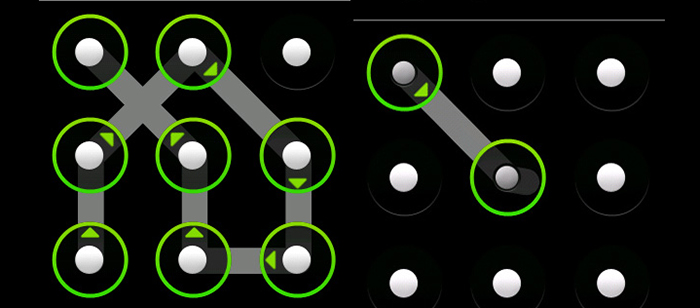
Android’s graphical authentication mechanism requires users to unlock their devices by “drawing” a pattern that connects a sequence of contact points arranged in a 3×3 grid. Prior studies have shown that human-generated patterns are far less complex than one would desire; large portions can be trivially guessed with sufficient training. Custom modifications to Android, such as CyanogenMod, offer ways to increase the grid size beyond 3×3, and in this paper we ask the question: Does increasing the grid size increase the security of human-generated patterns?
To answer this question, we conducted two large studies, one in-lab and one online, collecting 934 total 3×3 patterns and 504 4×4 patterns. Analysis shows that for both 3×3 and 4×4 patterns, there is a high incidence of repeated patterns and symmetric pairs (patterns that derive from others based on a sequence of flips and rotations). Further, many of the 4×4 patterns are similar versions of 3×3 patterns distributed over the larger grid space. Leveraging this information, we developed the most advanced guessing algorithm in this space, and we find that guessing the first 20% (0.2) of patterns for both 3×3 and 4×4 can be done as efficiently as guessing a random 2-digit PIN. Guessing larger portions of 4×4 patterns (0.5), however, requires 2-bits more entropy than guessing the same ratio of 3×3 patterns, but the entropy is still on the order of cracking random 3-digit PINs. These results suggest that while there may be some benefit to expanding the grid size to 4×4, the majority of patterns will remain trivially guessable and insecure against broad guessing attacks.
Adam J. Aviv is an Assistant Professor of Computer Science at the United States Naval Academy, receiving his Ph.D. from the University of Pennsylvania under the advisement of Jonathan Smith and Matt Blaze. He has varied research interests including in system and network security, applied cryptography, smartphone security, and more recently in the area of usable security with a focus on mobile devices.
]]>
UMBC Department of Information Systems Is Bigger Better? Comparing User Generated Passwords on 3×3 vs. 4×4 Grid Sizes for Android’s Pattern Unlock Adam Aviv, USNA 1:00-2:00pm Tuesday, 1...
http://www.csee.umbc.edu/2015/11/talk-user-generated-passwords-on-3x3-vs-4x4-grid-sizes-for-android/
https://dev.my.umbc.edu/api/v0/pixel/news/56219/guest@my.umbc.edu/b4e0e6ef67f6dff8f8b0de8a148e98e2/api/pixel
cybersecurity
news
talks
Computer Science and Electrical Engineering
https://dev.my.umbc.edu/groups/csee
https://assets3-dev.my.umbc.edu/system/shared/avatars/groups/000/000/099/d117dca133c64bf78a4b7696dd007189/xsmall.png?1314043393
https://assets1-dev.my.umbc.edu/system/shared/avatars/groups/000/000/099/d117dca133c64bf78a4b7696dd007189/original.png?1314043393
https://assets1-dev.my.umbc.edu/system/shared/avatars/groups/000/000/099/d117dca133c64bf78a4b7696dd007189/xxlarge.png?1314043393
https://assets4-dev.my.umbc.edu/system/shared/avatars/groups/000/000/099/d117dca133c64bf78a4b7696dd007189/xlarge.png?1314043393
https://assets3-dev.my.umbc.edu/system/shared/avatars/groups/000/000/099/d117dca133c64bf78a4b7696dd007189/large.png?1314043393
https://assets1-dev.my.umbc.edu/system/shared/avatars/groups/000/000/099/d117dca133c64bf78a4b7696dd007189/medium.png?1314043393
https://assets2-dev.my.umbc.edu/system/shared/avatars/groups/000/000/099/d117dca133c64bf78a4b7696dd007189/small.png?1314043393
https://assets3-dev.my.umbc.edu/system/shared/avatars/groups/000/000/099/d117dca133c64bf78a4b7696dd007189/xsmall.png?1314043393
https://assets3-dev.my.umbc.edu/system/shared/avatars/groups/000/000/099/d117dca133c64bf78a4b7696dd007189/xxsmall.png?1314043393
Computer Science and Electrical Engineering
0
0
true
Tue, 24 Nov 2015 09:10:40 -0500
Tue, 24 Nov 2015 09:10:40 -0500
talk: User Generated Passwords on 3×3 vs. 4×4 Grid Sizes for Android
UMBC Department of Information Systems
Is Bigger Better? Comparing User Generated Passwords on
3×3 vs. 4×4 Grid Sizes for Android’s Pattern Unlock
Adam Aviv, USNA
1:00-2:00pm Tuesday, 1 December 2015, ITE 459
Android’s graphical authentication mechanism requires users to unlock their devices by “drawing” a pattern that connects a sequence of contact points arranged in a 3×3 grid. Prior studies have shown that human-generated patterns are far less complex than one would desire; large portions can be trivially guessed with sufficient training. Custom modifications to Android, such as CyanogenMod, offer ways to increase the grid size beyond 3×3, and in this paper we ask the question: Does increasing the grid size increase the security of human-generated patterns?
To answer this question, we conducted two large studies, one in-lab and one online, collecting 934 total 3×3 patterns and 504 4×4 patterns. Analysis shows that for both 3×3 and 4×4 patterns, there is a high incidence of repeated patterns and symmetric pairs (patterns that derive from others based on a sequence of flips and rotations). Further, many of the 4×4 patterns are similar versions of 3×3 patterns distributed over the larger grid space. Leveraging this information, we developed the most advanced guessing algorithm in this space, and we find that guessing the first 20% (0.2) of patterns for both 3×3 and 4×4 can be done as efficiently as guessing a random 2-digit PIN. Guessing larger portions of 4×4 patterns (0.5), however, requires 2-bits more entropy than guessing the same ratio of 3×3 patterns, but the entropy is still on the order of cracking random 3-digit PINs. These results suggest that while there may be some benefit to expanding the grid size to 4×4, the majority of patterns will remain trivially guessable and insecure against broad guessing attacks.
Adam J. Aviv is an Assistant Professor of Computer Science at the United States Naval Academy, receiving his Ph.D. from the University of Pennsylvania under the advisement of Jonathan Smith and Matt Blaze. He has varied research interests including in system and network security, applied cryptography, smartphone security, and more recently in the area of usable security with a focus on mobile devices.
]]>
UMBC Department of Information Systems Is Bigger Better? Comparing User Generated Passwords on 3×3 vs. 4×4 Grid Sizes for Android’s Pattern Unlock Adam Aviv, USNA 1:00-2:00pm Tuesday, 1...
https://www.csee.umbc.edu/2015/11/talk-user-generated-passwords-on-3x3-vs-4x4-grid-sizes-for-android/
https://dev.my.umbc.edu/api/v0/pixel/news/57872/guest@my.umbc.edu/9879a9b0affc2641fa879e146374ae5a/api/pixel
cybersecurity
news
talks
Computer Science and Electrical Engineering
https://dev.my.umbc.edu/groups/csee
https://assets3-dev.my.umbc.edu/system/shared/avatars/groups/000/000/099/d117dca133c64bf78a4b7696dd007189/xsmall.png?1314043393
https://assets1-dev.my.umbc.edu/system/shared/avatars/groups/000/000/099/d117dca133c64bf78a4b7696dd007189/original.png?1314043393
https://assets1-dev.my.umbc.edu/system/shared/avatars/groups/000/000/099/d117dca133c64bf78a4b7696dd007189/xxlarge.png?1314043393
https://assets4-dev.my.umbc.edu/system/shared/avatars/groups/000/000/099/d117dca133c64bf78a4b7696dd007189/xlarge.png?1314043393
https://assets3-dev.my.umbc.edu/system/shared/avatars/groups/000/000/099/d117dca133c64bf78a4b7696dd007189/large.png?1314043393
https://assets1-dev.my.umbc.edu/system/shared/avatars/groups/000/000/099/d117dca133c64bf78a4b7696dd007189/medium.png?1314043393
https://assets2-dev.my.umbc.edu/system/shared/avatars/groups/000/000/099/d117dca133c64bf78a4b7696dd007189/small.png?1314043393
https://assets3-dev.my.umbc.edu/system/shared/avatars/groups/000/000/099/d117dca133c64bf78a4b7696dd007189/xsmall.png?1314043393
https://assets3-dev.my.umbc.edu/system/shared/avatars/groups/000/000/099/d117dca133c64bf78a4b7696dd007189/xxsmall.png?1314043393
Computer Science and Electrical Engineering
0
0
true
Tue, 24 Nov 2015 09:10:40 -0500