ESI scientists promote HARP2 at the annual NASA PACE Science Team Meeting
The first annual joint NASA Plankton Aerosol Cloud ocean Ecosystem
(PACE) Science Team Meeting (PAC3) was held at the NASA Goddard Institute for Space Studies
(GISS) in New York City, NY from February 18 – 21, 2025. This event brought together over 100 scientists from the PACE Science and Applications Team, researchers funded to use PACE data for new scientific directions; the PACE Validation Science Team, researchers who have field observations that will be used to validate PACE measurements; and, team members of the PACE-PAX field campaign, the recent airborne study that underflew PACE with compatible remote sensing instruments over the southwestern US.
ESI’s multi-angle polarimeter instruments,
HARP2, one of three main payloads on the NASA PACE satellite, and
AirHARP2, its airborne counterpart, were focal points in discussion and collaborative effort across the three PACE teams. During PAC3, ESI director
Dr. J. Vanderlei Martins gave an overview of current calibration and data processing efforts with HARP2. ESI scientist
Dr. Lorraine Remer discussed new results from her team’s aerosol retrieval algorithm applied to data from the PACE Ocean Color Instrument (OCI). ESI scientist
Dr. Brent McBride spoke to the members of PACE-PAX about the current calibration and data processing effort for the AirHARP2 instrument, a suite of four remote sensors that flew on the high-altitude NASA ER-2 aircraft during the campaign. ESI scientist
Dr. Xiaoguang Xu also participated in person, and other ESI scientists and graduate students joined remotely throughout the week.
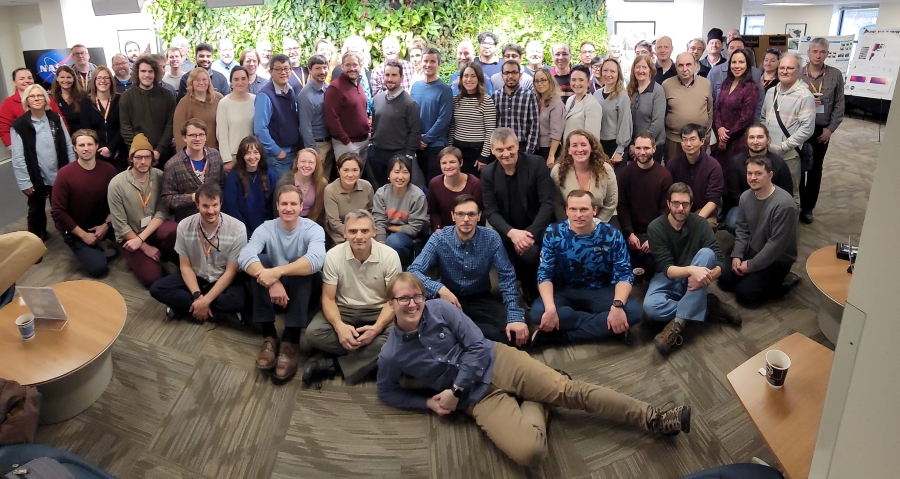
Photo: PAC3 participants, including international partners, NASA civil servants, graduate students, and ESI scientists Drs. J. Vanderlei Martins, Xiaoguang Xu, and Brent McBride. Photo Credit: Kirk Knobelspiesse/NASA GSFC.
]]>
The first annual joint NASA Plankton Aerosol Cloud ocean Ecosystem (PACE) Science Team Meeting (PAC3) was held at the NASA Goddard Institute for Space Studies (GISS) in New York City, NY from...
Photo
https://assets4-dev.my.umbc.edu/system/shared/attachments/ff787dbdea685001eb1a07c63eb26296/69e77d69/news/000/147/810/bfe6aba8566250a3c320b69138822c03/PAC3 meeting web.jpg?1741040414
https://dev.my.umbc.edu/api/v0/pixel/news/147810/guest@my.umbc.edu/17f052ff655db71f13f652b0eeb645d3/api/pixel
esi
Earth and Space Institute
https://dev.my.umbc.edu/groups/esi
https://assets4-dev.my.umbc.edu/system/shared/avatars/groups/000/002/124/0edf78e65ae95730e0c3687aa55486c5/xsmall.png?1708376163
https://assets1-dev.my.umbc.edu/system/shared/avatars/groups/000/002/124/0edf78e65ae95730e0c3687aa55486c5/original.png?1708376163
https://assets3-dev.my.umbc.edu/system/shared/avatars/groups/000/002/124/0edf78e65ae95730e0c3687aa55486c5/xxlarge.png?1708376163
https://assets3-dev.my.umbc.edu/system/shared/avatars/groups/000/002/124/0edf78e65ae95730e0c3687aa55486c5/xlarge.png?1708376163
https://assets3-dev.my.umbc.edu/system/shared/avatars/groups/000/002/124/0edf78e65ae95730e0c3687aa55486c5/large.png?1708376163
https://assets4-dev.my.umbc.edu/system/shared/avatars/groups/000/002/124/0edf78e65ae95730e0c3687aa55486c5/medium.png?1708376163
https://assets3-dev.my.umbc.edu/system/shared/avatars/groups/000/002/124/0edf78e65ae95730e0c3687aa55486c5/small.png?1708376163
https://assets4-dev.my.umbc.edu/system/shared/avatars/groups/000/002/124/0edf78e65ae95730e0c3687aa55486c5/xsmall.png?1708376163
https://assets4-dev.my.umbc.edu/system/shared/avatars/groups/000/002/124/0edf78e65ae95730e0c3687aa55486c5/xxsmall.png?1708376163
Earth and Space Institute
https://assets1-dev.my.umbc.edu/system/shared/thumbnails/news/000/147/810/c6c552e86275f82c6c2bf10f1268f43f/xxlarge.jpg?1741040741
https://assets3-dev.my.umbc.edu/system/shared/thumbnails/news/000/147/810/c6c552e86275f82c6c2bf10f1268f43f/xlarge.jpg?1741040741
https://assets4-dev.my.umbc.edu/system/shared/thumbnails/news/000/147/810/c6c552e86275f82c6c2bf10f1268f43f/large.jpg?1741040741
https://assets3-dev.my.umbc.edu/system/shared/thumbnails/news/000/147/810/c6c552e86275f82c6c2bf10f1268f43f/medium.jpg?1741040741
https://assets3-dev.my.umbc.edu/system/shared/thumbnails/news/000/147/810/c6c552e86275f82c6c2bf10f1268f43f/small.jpg?1741040741
https://assets3-dev.my.umbc.edu/system/shared/thumbnails/news/000/147/810/c6c552e86275f82c6c2bf10f1268f43f/xsmall.jpg?1741040741
https://assets4-dev.my.umbc.edu/system/shared/thumbnails/news/000/147/810/c6c552e86275f82c6c2bf10f1268f43f/xxsmall.jpg?1741040741
12
0
false
Mon, 03 Mar 2025 17:29:31 -0500
February 8, 2025 marks one year of UMBC's HARP2 instrument in space!
The Hyper-Angular Rainbow Polarimeter (HARP2) is a multi-angle imaging polarimeter instrument, which was built, calibrated, and currently is supported by an interdisciplinary team of scientists and engineers at UMBC’s Earth and Space Institute (ESI). HARP2 was launched to space on-board the NASA Plankton Aerosol Cloud ocean Ecosystem
(PACE) mission on February 8, 2024. The instrument was turned on over the next few days, and on February 19, 2024, ESI engineers began commissioning activities at NASA Goddard Space Flight Center (GSFC) to assess instrument health and validate its science operations.
On April 11, 2024, for the first time, the world saw what HARP2 sees from space: beautiful rainbows atop liquid water clouds, a hazy, blue atmosphere observed from oblique angles, aerosol plumes floating broadly over a dark ocean, and most importantly, wide swath imagery of the Earth, every two days. To date, HARP2 has imaged the entire Earth over 180 times and with special polarized eyes that reveal an almost alien world (see image below). Sensitivity to polarization allows scientists to discriminate different kinds, sizes, and shapes of aerosols (such as dust and smoke), separate liquid water droplets from ice crystals, and distinguish light scattering from molecules from information coming from the ocean. These measurements will help the climate community answer pressing science questions that could only be addressed with global data from a HARP-like instrument.
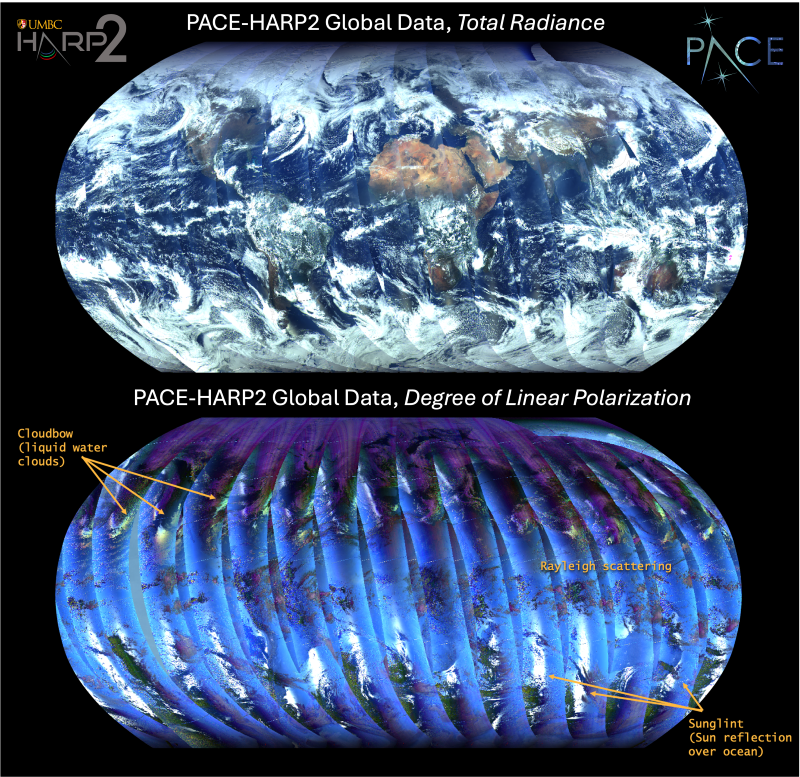
Photo: Global HARP2 data in top-of-atmosphere radiance, a form of energy, (top) and degree of linear polarization (DOLP, bottom), the ratio of polarized light to all light energy. The DOLP map emphasizes the direct reflection of the Sun off the ocean surface, the blue haze from light scattered by atmospheric molecules, and the "cloudbow", a ring-like signal that only comes from liquid water cloud droplets. (Credit: A. Puthukkudy/ESI)
HARP2 is an exciting leap in space technology and science capability for UMBC. The climate community is starting to use HARP2 data to benefit society and policy, to reduce our uncertainties in climate prediction, to study land use change, the interaction between aerosol particles and clouds, and the composition of phytoplankton in the ocean, and learning how to efficiently process the gigabytes and gigabytes of HARP2 data streaming down from PACE daily. Much of this work is led by scientists at the ESI along with our partners in
GESTAR II and NASA GSFC.
Congratulations to UMBC, the Earth and Space Institute, and HARP2!
]]>
The Hyper-Angular Rainbow Polarimeter (HARP2) is a multi-angle imaging polarimeter instrument, which was built, calibrated, and currently is supported by an interdisciplinary team of scientists...
Photo
https://assets3-dev.my.umbc.edu/system/shared/attachments/b3620261502a61bb171b317362132287/69e77d69/news/000/147/281/546967809a9a2792688dd284354a3a80/ESI_myumbc_HARP2_1year web.png?1739382268
https://dev.my.umbc.edu/api/v0/pixel/news/147281/guest@my.umbc.edu/4ec1230f3b757cbb2a0779e5aaf03a13/api/pixel
esi
Earth and Space Institute
https://dev.my.umbc.edu/groups/esi
https://assets4-dev.my.umbc.edu/system/shared/avatars/groups/000/002/124/0edf78e65ae95730e0c3687aa55486c5/xsmall.png?1708376163
https://assets1-dev.my.umbc.edu/system/shared/avatars/groups/000/002/124/0edf78e65ae95730e0c3687aa55486c5/original.png?1708376163
https://assets3-dev.my.umbc.edu/system/shared/avatars/groups/000/002/124/0edf78e65ae95730e0c3687aa55486c5/xxlarge.png?1708376163
https://assets3-dev.my.umbc.edu/system/shared/avatars/groups/000/002/124/0edf78e65ae95730e0c3687aa55486c5/xlarge.png?1708376163
https://assets3-dev.my.umbc.edu/system/shared/avatars/groups/000/002/124/0edf78e65ae95730e0c3687aa55486c5/large.png?1708376163
https://assets4-dev.my.umbc.edu/system/shared/avatars/groups/000/002/124/0edf78e65ae95730e0c3687aa55486c5/medium.png?1708376163
https://assets3-dev.my.umbc.edu/system/shared/avatars/groups/000/002/124/0edf78e65ae95730e0c3687aa55486c5/small.png?1708376163
https://assets4-dev.my.umbc.edu/system/shared/avatars/groups/000/002/124/0edf78e65ae95730e0c3687aa55486c5/xsmall.png?1708376163
https://assets4-dev.my.umbc.edu/system/shared/avatars/groups/000/002/124/0edf78e65ae95730e0c3687aa55486c5/xxsmall.png?1708376163
Earth and Space Institute
https://assets1-dev.my.umbc.edu/system/shared/thumbnails/news/000/147/281/17facdf9270e10be84c1eaf4baf43a62/xxlarge.jpg?1739382623
https://assets1-dev.my.umbc.edu/system/shared/thumbnails/news/000/147/281/17facdf9270e10be84c1eaf4baf43a62/xlarge.jpg?1739382623
https://assets1-dev.my.umbc.edu/system/shared/thumbnails/news/000/147/281/17facdf9270e10be84c1eaf4baf43a62/large.jpg?1739382623
https://assets2-dev.my.umbc.edu/system/shared/thumbnails/news/000/147/281/17facdf9270e10be84c1eaf4baf43a62/medium.jpg?1739382623
https://assets2-dev.my.umbc.edu/system/shared/thumbnails/news/000/147/281/17facdf9270e10be84c1eaf4baf43a62/small.jpg?1739382623
https://assets1-dev.my.umbc.edu/system/shared/thumbnails/news/000/147/281/17facdf9270e10be84c1eaf4baf43a62/xsmall.jpg?1739382623
https://assets4-dev.my.umbc.edu/system/shared/thumbnails/news/000/147/281/17facdf9270e10be84c1eaf4baf43a62/xxsmall.jpg?1739382623
10
0
false
Wed, 12 Feb 2025 12:51:59 -0500
Congratulations to our recent PhD, ME, and MS graduates!
Three ESI researchers recently defended their dissertation and theses.
ESI research engineer,
Dr. Ivan Gamino del Rio, earned his PhD in Space Research and Astrobiology from the Universidad de Alcalá, Spain in fall 2024. Dr. Gamino del Rio’s dissertation was titled “New hardware computer architecture approach to increase the reliability of space computer systems”. He developed a novel computational framework from the ground up for space applications, which included a parallel processor to keep track of the telemetry of on-board software as it is running. At the ESI, Dr. Gamino del Rio is currently supporting software development for the Trans-Iron Galactic Element Recorder for the International Space Station (TIGERISS) instrument.
TIGERISS, a collaboration between NASA GSFC and several US universities including UMBC (CSST and ESI), will measure the abundance of heavy elements in cosmic rays emanating from high-energy events, such as supernovas. TIGERISS measurements will help scientists to better understand how and where these particles originated throughout our Milky Way galaxy.
ESI research engineer
Carissa Arillo earned her Masters of Engineering in Robotics at the A. James Clark School of Engineering at the University of Maryland College Park in fall 2024. Her coursework involved robot perception, navigation, and control, as well as machine learning and modeling. As part of her ME research, Arillo developed a large-scale mission-based autonomous navigation robot with a focus in embedded systems for robotics. At ESI, Arillo leads the software development of a new digital twin architecture for future remote sensing applications. This project is a collaboration between UMBC/ESI and a partnering space industry corporation. Arillo supervises a small team of UMBC students in the demonstration of neural networks that direct a leader-follower pair of spaceborne remote sensors to detect and measure Earth targets.
ESI systems engineer
Danny Nelson earned his Masters of Science in Mechanical Engineering from UMBC in winter 2025. His thesis was titled "Thermal design and analysis of a next-generation Hyper-Angular Rainbow Polarimeter (HARP) instrument". Nelson developed a thermal model that assesses the design and on-orbit temperature control performance of MegaHARP, a planned future iteration of HARP2.
HARP2 is ESI’s advanced Earth observation instrument that is currently on-board the NASA Plankton Aerosol Cloud ocean Ecosystem (PACE) mission. He currently supports the testing and development of the
AirHARP2 instrument suite at ESI, mission support for
OreSat and HARP2, and GAPMAP, a multi-angle polarimeter mission out of UMBC technology incubation company, GRASP-Earth.
Congratulations Ivan, Carissa, and Danny!
]]>
Three ESI researchers recently defended their dissertation and theses. ESI research engineer, Dr. Ivan Gamino del Rio, earned his PhD in Space Research and Astrobiology from the Universidad de...
https://dev.my.umbc.edu/api/v0/pixel/news/147052/guest@my.umbc.edu/19321604f003ee0497849ec762bc7e0d/api/pixel
esi
Earth and Space Institute
https://dev.my.umbc.edu/groups/esi
https://assets4-dev.my.umbc.edu/system/shared/avatars/groups/000/002/124/0edf78e65ae95730e0c3687aa55486c5/xsmall.png?1708376163
https://assets1-dev.my.umbc.edu/system/shared/avatars/groups/000/002/124/0edf78e65ae95730e0c3687aa55486c5/original.png?1708376163
https://assets3-dev.my.umbc.edu/system/shared/avatars/groups/000/002/124/0edf78e65ae95730e0c3687aa55486c5/xxlarge.png?1708376163
https://assets3-dev.my.umbc.edu/system/shared/avatars/groups/000/002/124/0edf78e65ae95730e0c3687aa55486c5/xlarge.png?1708376163
https://assets3-dev.my.umbc.edu/system/shared/avatars/groups/000/002/124/0edf78e65ae95730e0c3687aa55486c5/large.png?1708376163
https://assets4-dev.my.umbc.edu/system/shared/avatars/groups/000/002/124/0edf78e65ae95730e0c3687aa55486c5/medium.png?1708376163
https://assets3-dev.my.umbc.edu/system/shared/avatars/groups/000/002/124/0edf78e65ae95730e0c3687aa55486c5/small.png?1708376163
https://assets4-dev.my.umbc.edu/system/shared/avatars/groups/000/002/124/0edf78e65ae95730e0c3687aa55486c5/xsmall.png?1708376163
https://assets4-dev.my.umbc.edu/system/shared/avatars/groups/000/002/124/0edf78e65ae95730e0c3687aa55486c5/xxsmall.png?1708376163
Earth and Space Institute
https://assets2-dev.my.umbc.edu/system/shared/thumbnails/news/000/147/052/eddcf5940a3759f3790f1377ec624db3/xxlarge.jpg?1738774485
https://assets3-dev.my.umbc.edu/system/shared/thumbnails/news/000/147/052/eddcf5940a3759f3790f1377ec624db3/xlarge.jpg?1738774485
https://assets4-dev.my.umbc.edu/system/shared/thumbnails/news/000/147/052/eddcf5940a3759f3790f1377ec624db3/large.jpg?1738774485
https://assets3-dev.my.umbc.edu/system/shared/thumbnails/news/000/147/052/eddcf5940a3759f3790f1377ec624db3/medium.jpg?1738774485
https://assets2-dev.my.umbc.edu/system/shared/thumbnails/news/000/147/052/eddcf5940a3759f3790f1377ec624db3/small.jpg?1738774485
https://assets3-dev.my.umbc.edu/system/shared/thumbnails/news/000/147/052/eddcf5940a3759f3790f1377ec624db3/xsmall.jpg?1738774485
https://assets1-dev.my.umbc.edu/system/shared/thumbnails/news/000/147/052/eddcf5940a3759f3790f1377ec624db3/xxsmall.jpg?1738774485
11
0
false
Wed, 05 Feb 2025 11:55:33 -0500
Wed, 05 Feb 2025 11:55:33 -0500
ESI scientist Dr. Anin Puthukkudy awarded UMBC CIDER grant
Dr. Puthukkudy proposed to use new AI techniques to infer information about aerosol and Earth’s surface from satellite data. His study will use the data record from
ESI’s HARP2 instrument, a multi-angle imaging polarimeter on the NASA Plankton Aerosol Cloud ocean Ecosystem
(PACE) satellite. Dr. Puthukkudy will also supervise an undergraduate student in the development and training of the neural networks, in conjunction with satellite data processing and atmospheric modeling. This work is a collaboration with
Dr. J. Vanderlei Martins, professor of Physics at UMBC and director of the ESI, and ESI research scientists
Dr. Xiaoguang Xu and
Dr. Brent McBride.
Congratulations, Dr. Puthukkudy!
Photo: Global aerosol retrievals using the GRASP algorithm on PACE-HARP2 data show a variety of aerosol source and transport pathways. HARP2 measurements contain enough information to differentiate aerosol size, shape, and type from space. (Photo Credit: A. Puthukkudy/ESI)
The goal of the
PACE-PAX mission was to validate the atmospheric, surface, and ocean measurements of the NASA PACE mission. The campaign was a massive effort to collocate spaceborne, airborne, shipborne, and in-water assets over Southern California and the eastern Pacific Ocean from August to October 2024.
Dr. McBride and Ms. Smith, as well as an extended team that included ESI chief engineer
Dominik Cieslak, mechanical engineer
Ian Decker, systems engineer
Danny Nelson, and UMBC ATPH graduate student
Noah Sienkiewicz, supported the Airborne Hyper-Angular Rainbow Polarimeter (AirHARP2) instrument in the field. AirHARP2 is a 1:1 copy of ESI’s HARP2 instrument on the NASA PACE mission. AirHARP2 took data onboard the high-altitude NASA ER-2 research aircraft during the campaign and flew under the PACE spacecraft on several days. On a flight day, ESI personnel made sure the instrument was ready for flight and monitored the instrument health and telemetry during flight. ESI field support also worked with a remote team at UMBC to check the flight data quality and prepare for the next day’s events.
AirHARP2 data from the PACE-PAX campaign will be publicly available at the
NASA LARC DAAC archive on March 31, 2025.
Photo: UMBC ATPH graduate student Rachel Smith (left) and ESI scientist Dr. Brent McBride (right) test electrical connections on the AirHARP2 instrument inside the ER-2 super-pod during PACE-PAX. Photo Credit: Erica McNamee/NASA
]]>
ESI scientist Dr. Brent McBride and UMBC ATPH graduate student Rachel Smith contributed to a recent NASA feature article, "PACE-PAX: A Day in the Life of a NASA Field Campaign" on the NASA...
Photo
https://assets1-dev.my.umbc.edu/system/shared/attachments/b595f888a8b653ad94f31f54cf98add4/69e77d69/news/000/146/453/19befc599c62e4ca3fe396e8f7b2082c/Smith_McBride_PACEPAX web.jpg?1736196576
https://dev.my.umbc.edu/api/v0/pixel/news/146453/guest@my.umbc.edu/74411241b4c858096103a666fe29cda3/api/pixel
esi
Earth and Space Institute
https://dev.my.umbc.edu/groups/esi
https://assets4-dev.my.umbc.edu/system/shared/avatars/groups/000/002/124/0edf78e65ae95730e0c3687aa55486c5/xsmall.png?1708376163
https://assets1-dev.my.umbc.edu/system/shared/avatars/groups/000/002/124/0edf78e65ae95730e0c3687aa55486c5/original.png?1708376163
https://assets3-dev.my.umbc.edu/system/shared/avatars/groups/000/002/124/0edf78e65ae95730e0c3687aa55486c5/xxlarge.png?1708376163
https://assets3-dev.my.umbc.edu/system/shared/avatars/groups/000/002/124/0edf78e65ae95730e0c3687aa55486c5/xlarge.png?1708376163
https://assets3-dev.my.umbc.edu/system/shared/avatars/groups/000/002/124/0edf78e65ae95730e0c3687aa55486c5/large.png?1708376163
https://assets4-dev.my.umbc.edu/system/shared/avatars/groups/000/002/124/0edf78e65ae95730e0c3687aa55486c5/medium.png?1708376163
https://assets3-dev.my.umbc.edu/system/shared/avatars/groups/000/002/124/0edf78e65ae95730e0c3687aa55486c5/small.png?1708376163
https://assets4-dev.my.umbc.edu/system/shared/avatars/groups/000/002/124/0edf78e65ae95730e0c3687aa55486c5/xsmall.png?1708376163
https://assets4-dev.my.umbc.edu/system/shared/avatars/groups/000/002/124/0edf78e65ae95730e0c3687aa55486c5/xxsmall.png?1708376163
Earth and Space Institute
https://assets2-dev.my.umbc.edu/system/shared/thumbnails/news/000/146/453/94c670fda1edab6860a0fc5cfc384b08/xxlarge.jpg?1736459418
https://assets1-dev.my.umbc.edu/system/shared/thumbnails/news/000/146/453/94c670fda1edab6860a0fc5cfc384b08/xlarge.jpg?1736459418
https://assets2-dev.my.umbc.edu/system/shared/thumbnails/news/000/146/453/94c670fda1edab6860a0fc5cfc384b08/large.jpg?1736459418
https://assets3-dev.my.umbc.edu/system/shared/thumbnails/news/000/146/453/94c670fda1edab6860a0fc5cfc384b08/medium.jpg?1736459418
https://assets1-dev.my.umbc.edu/system/shared/thumbnails/news/000/146/453/94c670fda1edab6860a0fc5cfc384b08/small.jpg?1736459418
https://assets4-dev.my.umbc.edu/system/shared/thumbnails/news/000/146/453/94c670fda1edab6860a0fc5cfc384b08/xsmall.jpg?1736459418
https://assets3-dev.my.umbc.edu/system/shared/thumbnails/news/000/146/453/94c670fda1edab6860a0fc5cfc384b08/xxsmall.jpg?1736459418
13
0
false
Mon, 13 Jan 2025 10:52:28 -0500
OreSat 0.5 beeps and blinks in space!
OreSat 0.5 is a 2U (20x10x10 cm) small satellite developed in collaboration between the ESI and Portland State University (PSU). After a five-year development, OreSat 0.5 was launched from Vandenberg AFB in California on August 16, 2024. The first telemetry signals were received at PSU a few hours after launch. OreSat 0.5 was confirmed to be power positive on December 23, 2024, which means the next step is a test image capture!
In space, OreSat 0.5 will measure specific signals from cirrus clouds for the purpose of global mapping and climate study. If successful, OreSat 0.5 will be the foundation for a future mission, OreSat 1. Aspects of the OreSat mission serve as a testbed for future ESI payloads as well. Stay up to date with OreSat on the
PSU website.
Photo: The SpaceX Transporter-11 mission carrying the OreSat 0.5
smallsat takes off from Vandenburg AFB, California on August 16, 2024. Image Credit: PSU
ESI members participated in two conferences this past fall: the Advancements in Polarimetric Observations (APOLO) in Kyoto, Japan, from November 18 -22, 2024 and the American Geophysical Union (AGU) in Washington, DC from December 8 -13, 2024.
UMBC ATPH graduate students
Noah Sienkiewicz,
Rachel Smith,
Nirandi Jayasinghe, and
Greema Regmi presented at APOLO and the latter three also at AGU. Mr. Sienkiewicz showed the latest results in the calibration of
HARP2, and Ms. Smith discussed a new cloud property retrieval technique applied to HARP2 data. Ms. Jayasinghe presented research on the interactions between aerosols and clouds, and Ms. Regmi used two different instruments, a polarimeter and a lidar, to tease out finer details about aerosol-shaped properties.
Dr. Brent McBride, research scientist at ESI, co-convened a special interdisciplinary session on the science of the
NASA PACE mission at AGU, alongside
Dr. Susanne Craig (616/UMBC/GESTAR II), Skye Caplan (616/GSFC), and Dr. Bastiaan van Diedenhoven (SRON) on December 10, 2024. This session focused on current research in clouds, aerosols, land, ocean, modeling efforts, and algorithm development in support of PACE.
In this session, ESI scientists
Dr. Anin Puthukkudy presented global HARP2 aerosol retrievals and
Dr. Xiaoguang Xu discussed how to use HARP2 data to differentiate ice from liquid water clouds. ESI project scientist
Dr. Lorraine Remer speculated on the future of aerosol remote sensing, Dr. McBride showed how PACE can be used to study hurricane properties, and ESI director
Dr. J. Vanderlei Martins proposed a new method for retrieving aerosol radiative forcing from HARP2 multi-angle data.
Visit us at the ESI hallway on the third floor of the
UMBC Physics building to learn more about HARP2, PACE, and our current research directions.
Photo, left to right: UMBC ATPH graduate students Nirandi Jayasinghe and Rachel Smith, ESI director Dr. J. Vanderlei Martins, and UMBC ATPH graduate students Greema Regmi and Hannah Seppala stand next to a woman in traditional kimono attire at the APOLO conference in Kyoto, Japan. (Photo credit: R. Smith/ESI)
]]>
ESI members participated in two conferences this past fall: the Advancements in Polarimetric Observations (APOLO) in Kyoto, Japan, from November 18 -22, 2024 and the American Geophysical Union...
Photo
https://assets1-dev.my.umbc.edu/system/shared/attachments/93bb0f4448707289779cc9838720064e/69e77d69/news/000/146/438/1af939a4e94043bd8c02a1f6ac7d1043/APOLO_japan.jpg?1735933321
https://dev.my.umbc.edu/api/v0/pixel/news/146438/guest@my.umbc.edu/84d8650ae00853c77755d1b345216ab3/api/pixel
esi
Earth and Space Institute
https://dev.my.umbc.edu/groups/esi
https://assets4-dev.my.umbc.edu/system/shared/avatars/groups/000/002/124/0edf78e65ae95730e0c3687aa55486c5/xsmall.png?1708376163
https://assets1-dev.my.umbc.edu/system/shared/avatars/groups/000/002/124/0edf78e65ae95730e0c3687aa55486c5/original.png?1708376163
https://assets3-dev.my.umbc.edu/system/shared/avatars/groups/000/002/124/0edf78e65ae95730e0c3687aa55486c5/xxlarge.png?1708376163
https://assets3-dev.my.umbc.edu/system/shared/avatars/groups/000/002/124/0edf78e65ae95730e0c3687aa55486c5/xlarge.png?1708376163
https://assets3-dev.my.umbc.edu/system/shared/avatars/groups/000/002/124/0edf78e65ae95730e0c3687aa55486c5/large.png?1708376163
https://assets4-dev.my.umbc.edu/system/shared/avatars/groups/000/002/124/0edf78e65ae95730e0c3687aa55486c5/medium.png?1708376163
https://assets3-dev.my.umbc.edu/system/shared/avatars/groups/000/002/124/0edf78e65ae95730e0c3687aa55486c5/small.png?1708376163
https://assets4-dev.my.umbc.edu/system/shared/avatars/groups/000/002/124/0edf78e65ae95730e0c3687aa55486c5/xsmall.png?1708376163
https://assets4-dev.my.umbc.edu/system/shared/avatars/groups/000/002/124/0edf78e65ae95730e0c3687aa55486c5/xxsmall.png?1708376163
Earth and Space Institute
https://assets2-dev.my.umbc.edu/system/shared/thumbnails/news/000/146/438/9f37b89711065099b697b95310ab9d79/xxlarge.jpg?1735933826
https://assets4-dev.my.umbc.edu/system/shared/thumbnails/news/000/146/438/9f37b89711065099b697b95310ab9d79/xlarge.jpg?1735933826
https://assets1-dev.my.umbc.edu/system/shared/thumbnails/news/000/146/438/9f37b89711065099b697b95310ab9d79/large.jpg?1735933826
https://assets1-dev.my.umbc.edu/system/shared/thumbnails/news/000/146/438/9f37b89711065099b697b95310ab9d79/medium.jpg?1735933826
https://assets3-dev.my.umbc.edu/system/shared/thumbnails/news/000/146/438/9f37b89711065099b697b95310ab9d79/small.jpg?1735933826
https://assets3-dev.my.umbc.edu/system/shared/thumbnails/news/000/146/438/9f37b89711065099b697b95310ab9d79/xsmall.jpg?1735933826
https://assets1-dev.my.umbc.edu/system/shared/thumbnails/news/000/146/438/9f37b89711065099b697b95310ab9d79/xxsmall.jpg?1735933826
13
0
false
Fri, 03 Jan 2025 14:57:05 -0500
Martins and McBride promote ESI at UMBC's GRIT-X event
The academic flagship event of UMBC's Homecoming celebration is GRIT-X, a series of TED-style talks given by accomplished UMBC faculty. This year, the organizers invited prior GRIT-X speakers to a post-event showcase where they could promote their work. After the event on October 24, 2024, ESI director and Physics professor Dr. Vanderlei Martins and ESI research scientist Dr. Brent McBride spoke to attendees about their experiences building and supporting the HARP2 instrument on the NASA PACE mission. Additionally, one of the GRIT-X talks this year was led by fellow Physics professor Dr. Todd Pittman. Learn more about the event at https://research.umbc.edu/grit-x/.
Dr. McBride and Dr. Martins speak with attendees after GRIT-X, standing in the back near the black curtain. Photo Credit: UMBC/Marlayna Demond.
]]>
The academic flagship event of UMBC's Homecoming celebration is GRIT-X, a series of TED-style talks given by accomplished UMBC faculty. This year, the organizers invited prior GRIT-X speakers to a...
Photo
https://assets3-dev.my.umbc.edu/system/shared/attachments/b2a0349686fcd652e0e2463dcad16bf2/69e77d6a/news/000/145/568/f0a444af0c8029ca796c4f2115d66548/GRIT-X-Homecoming24-5426 web.jpg?1731437251
https://dev.my.umbc.edu/api/v0/pixel/news/145568/guest@my.umbc.edu/cab6fe66a42db4e7652e4e9ad5d69df9/api/pixel
esi
Earth and Space Institute
https://dev.my.umbc.edu/groups/esi
https://assets4-dev.my.umbc.edu/system/shared/avatars/groups/000/002/124/0edf78e65ae95730e0c3687aa55486c5/xsmall.png?1708376163
https://assets1-dev.my.umbc.edu/system/shared/avatars/groups/000/002/124/0edf78e65ae95730e0c3687aa55486c5/original.png?1708376163
https://assets3-dev.my.umbc.edu/system/shared/avatars/groups/000/002/124/0edf78e65ae95730e0c3687aa55486c5/xxlarge.png?1708376163
https://assets3-dev.my.umbc.edu/system/shared/avatars/groups/000/002/124/0edf78e65ae95730e0c3687aa55486c5/xlarge.png?1708376163
https://assets3-dev.my.umbc.edu/system/shared/avatars/groups/000/002/124/0edf78e65ae95730e0c3687aa55486c5/large.png?1708376163
https://assets4-dev.my.umbc.edu/system/shared/avatars/groups/000/002/124/0edf78e65ae95730e0c3687aa55486c5/medium.png?1708376163
https://assets3-dev.my.umbc.edu/system/shared/avatars/groups/000/002/124/0edf78e65ae95730e0c3687aa55486c5/small.png?1708376163
https://assets4-dev.my.umbc.edu/system/shared/avatars/groups/000/002/124/0edf78e65ae95730e0c3687aa55486c5/xsmall.png?1708376163
https://assets4-dev.my.umbc.edu/system/shared/avatars/groups/000/002/124/0edf78e65ae95730e0c3687aa55486c5/xxsmall.png?1708376163
Earth and Space Institute
https://assets2-dev.my.umbc.edu/system/shared/thumbnails/news/000/145/568/c34d33b0d303856bb69867d680cb245e/xxlarge.jpg?1731437492
https://assets2-dev.my.umbc.edu/system/shared/thumbnails/news/000/145/568/c34d33b0d303856bb69867d680cb245e/xlarge.jpg?1731437492
https://assets3-dev.my.umbc.edu/system/shared/thumbnails/news/000/145/568/c34d33b0d303856bb69867d680cb245e/large.jpg?1731437492
https://assets1-dev.my.umbc.edu/system/shared/thumbnails/news/000/145/568/c34d33b0d303856bb69867d680cb245e/medium.jpg?1731437492
https://assets3-dev.my.umbc.edu/system/shared/thumbnails/news/000/145/568/c34d33b0d303856bb69867d680cb245e/small.jpg?1731437492
https://assets2-dev.my.umbc.edu/system/shared/thumbnails/news/000/145/568/c34d33b0d303856bb69867d680cb245e/xsmall.jpg?1731437492
https://assets1-dev.my.umbc.edu/system/shared/thumbnails/news/000/145/568/c34d33b0d303856bb69867d680cb245e/xxsmall.jpg?1731437492
10
0
false
Tue, 12 Nov 2024 13:52:40 -0500
NASA GSFC feature on ESI research engineer Carissa Arillo
ESI research engineer Carissa Arillo recounts her time supporting the NASA Plankton-Aerosol-Cloud-ocean Ecosystem (PACE) mission at NASA Goddard Space Flight Center in this new Conversations with Goddard feature titled "Carissa Arillo: Testing Spacecraft, Penning the Owner’s Manuals." She supported flight operations for HARP2 in preparation for the PACE launch as part of NASA GSFC's Mission Operations Center. At the ESI, Carissa leads HARP2 on-orbit flight operations on PACE and artificial intelligence development for a new Earth science mission concept.
(Profile photo credit: NASA/Dennis Henry)
]]>
ESI research engineer Carissa Arillo recounts her time supporting the NASA Plankton-Aerosol-Cloud-ocean Ecosystem (PACE) mission at NASA Goddard Space Flight Center in this new Conversations with...
https://dev.my.umbc.edu/api/v0/pixel/news/145485/guest@my.umbc.edu/ddd9602192687acda278d94c4f53c5aa/api/pixel
esi
Earth and Space Institute
https://dev.my.umbc.edu/groups/esi
https://assets4-dev.my.umbc.edu/system/shared/avatars/groups/000/002/124/0edf78e65ae95730e0c3687aa55486c5/xsmall.png?1708376163
https://assets1-dev.my.umbc.edu/system/shared/avatars/groups/000/002/124/0edf78e65ae95730e0c3687aa55486c5/original.png?1708376163
https://assets3-dev.my.umbc.edu/system/shared/avatars/groups/000/002/124/0edf78e65ae95730e0c3687aa55486c5/xxlarge.png?1708376163
https://assets3-dev.my.umbc.edu/system/shared/avatars/groups/000/002/124/0edf78e65ae95730e0c3687aa55486c5/xlarge.png?1708376163
https://assets3-dev.my.umbc.edu/system/shared/avatars/groups/000/002/124/0edf78e65ae95730e0c3687aa55486c5/large.png?1708376163
https://assets4-dev.my.umbc.edu/system/shared/avatars/groups/000/002/124/0edf78e65ae95730e0c3687aa55486c5/medium.png?1708376163
https://assets3-dev.my.umbc.edu/system/shared/avatars/groups/000/002/124/0edf78e65ae95730e0c3687aa55486c5/small.png?1708376163
https://assets4-dev.my.umbc.edu/system/shared/avatars/groups/000/002/124/0edf78e65ae95730e0c3687aa55486c5/xsmall.png?1708376163
https://assets4-dev.my.umbc.edu/system/shared/avatars/groups/000/002/124/0edf78e65ae95730e0c3687aa55486c5/xxsmall.png?1708376163
Earth and Space Institute
https://assets3-dev.my.umbc.edu/system/shared/thumbnails/news/000/145/485/e3204ed2f5299aa9146dde5e19854425/xxlarge.jpg?1731095245
https://assets3-dev.my.umbc.edu/system/shared/thumbnails/news/000/145/485/e3204ed2f5299aa9146dde5e19854425/xlarge.jpg?1731095245
https://assets3-dev.my.umbc.edu/system/shared/thumbnails/news/000/145/485/e3204ed2f5299aa9146dde5e19854425/large.jpg?1731095245
https://assets3-dev.my.umbc.edu/system/shared/thumbnails/news/000/145/485/e3204ed2f5299aa9146dde5e19854425/medium.jpg?1731095245
https://assets3-dev.my.umbc.edu/system/shared/thumbnails/news/000/145/485/e3204ed2f5299aa9146dde5e19854425/small.jpg?1731095245
https://assets3-dev.my.umbc.edu/system/shared/thumbnails/news/000/145/485/e3204ed2f5299aa9146dde5e19854425/xsmall.jpg?1731095245
https://assets4-dev.my.umbc.edu/system/shared/thumbnails/news/000/145/485/e3204ed2f5299aa9146dde5e19854425/xxsmall.jpg?1731095245
17
0
false
Fri, 08 Nov 2024 14:50:15 -0500
ESI joins the Maryland Aerospace Industry and Education Roundtable
On Wednesday, October 23, 2024, ESI faculty, interns, and students attended the Maryland Aerospace Industry and Education Roundtable at the University of Maryland, College Park in College Park, MD. This networking event brought together industry professionals, local and state politicians, and university partners to foster new collaborations and career opportunities for the state’s growing STEM workforce. UMBC Atmospheric Physics graduate student
Rachel Smith and ESI systems engineer
Danny Nelson spoke to the attendees about their interest in STEM and their current role in ESI and UMBC. The event was also attended by federal representatives from NASA and NOAA.
From left, ESI engineering intern Lars Sobieski, UMBC Atmospheric Physics graduate students Noah Sienkiewicz and Rachel Smith, Maryland Lieutenant Governor Aruna Miller, ESI Director Dr. Vanderlei Martins, ESI systems engineer Danny Nelson, and ESI software development intern Charlemagne Marc.
]]>
On Wednesday, October 23, 2024, ESI faculty, interns, and students attended the Maryland Aerospace Industry and Education Roundtable at the University of Maryland, College Park in College Park,...
Photo
https://assets2-dev.my.umbc.edu/system/shared/attachments/3f6bcff34c9e71f36986f6d4289b9948/69e77d6a/news/000/145/048/9db8c4faafdd92e8892fd40b8968daf6/ESI MD Roundtable group photo B.jpg?1729790276
https://dev.my.umbc.edu/api/v0/pixel/news/145048/guest@my.umbc.edu/066aa32e93ab1aa1c710fd8084eae46e/api/pixel
esi
Earth and Space Institute
https://dev.my.umbc.edu/groups/esi
https://assets4-dev.my.umbc.edu/system/shared/avatars/groups/000/002/124/0edf78e65ae95730e0c3687aa55486c5/xsmall.png?1708376163
https://assets1-dev.my.umbc.edu/system/shared/avatars/groups/000/002/124/0edf78e65ae95730e0c3687aa55486c5/original.png?1708376163
https://assets3-dev.my.umbc.edu/system/shared/avatars/groups/000/002/124/0edf78e65ae95730e0c3687aa55486c5/xxlarge.png?1708376163
https://assets3-dev.my.umbc.edu/system/shared/avatars/groups/000/002/124/0edf78e65ae95730e0c3687aa55486c5/xlarge.png?1708376163
https://assets3-dev.my.umbc.edu/system/shared/avatars/groups/000/002/124/0edf78e65ae95730e0c3687aa55486c5/large.png?1708376163
https://assets4-dev.my.umbc.edu/system/shared/avatars/groups/000/002/124/0edf78e65ae95730e0c3687aa55486c5/medium.png?1708376163
https://assets3-dev.my.umbc.edu/system/shared/avatars/groups/000/002/124/0edf78e65ae95730e0c3687aa55486c5/small.png?1708376163
https://assets4-dev.my.umbc.edu/system/shared/avatars/groups/000/002/124/0edf78e65ae95730e0c3687aa55486c5/xsmall.png?1708376163
https://assets4-dev.my.umbc.edu/system/shared/avatars/groups/000/002/124/0edf78e65ae95730e0c3687aa55486c5/xxsmall.png?1708376163
Earth and Space Institute
https://assets1-dev.my.umbc.edu/system/shared/thumbnails/news/000/145/048/3eeac971e97a93f2cd073c6a3de6e9c4/xxlarge.jpg?1729790421
https://assets2-dev.my.umbc.edu/system/shared/thumbnails/news/000/145/048/3eeac971e97a93f2cd073c6a3de6e9c4/xlarge.jpg?1729790421
https://assets3-dev.my.umbc.edu/system/shared/thumbnails/news/000/145/048/3eeac971e97a93f2cd073c6a3de6e9c4/large.jpg?1729790421
https://assets4-dev.my.umbc.edu/system/shared/thumbnails/news/000/145/048/3eeac971e97a93f2cd073c6a3de6e9c4/medium.jpg?1729790421
https://assets1-dev.my.umbc.edu/system/shared/thumbnails/news/000/145/048/3eeac971e97a93f2cd073c6a3de6e9c4/small.jpg?1729790421
https://assets3-dev.my.umbc.edu/system/shared/thumbnails/news/000/145/048/3eeac971e97a93f2cd073c6a3de6e9c4/xsmall.jpg?1729790421
https://assets3-dev.my.umbc.edu/system/shared/thumbnails/news/000/145/048/3eeac971e97a93f2cd073c6a3de6e9c4/xxsmall.jpg?1729790421
12
0
false
Thu, 24 Oct 2024 13:22:04 -0400