<?xml version="1.0"?>
<News hasArchived="false" page="22" pageCount="37" pageSize="10" timestamp="Sun, 26 Apr 2026 16:24:12 -0400" url="https://dev.my.umbc.edu/groups/gestar2/posts.xml?page=22&amp;tag=gestar2">
  <NewsItem contentIssues="true" id="133932" important="false" status="posted" url="https://dev.my.umbc.edu/groups/gestar2/posts/133932">
    <Title>GESTAR II scientists contribute to SNWG-22 Survey</Title>
    <Body>
      <![CDATA[
          <div class="html-content"><div><a href="https://gestar2.umbc.edu/directory/researchers-a-f/#PCampbell" rel="nofollow external" class="bo">Petya Campbell</a> (618/UMBC), <a href="https://gestar2.umbc.edu/directory/researchers-a-f/#Emberson" rel="nofollow external" class="bo">Robert Emberson</a> (617/UMBC), <a href="https://gestar2.umbc.edu/directory/researchers-g-k/#Ganeshan" rel="nofollow external" class="bo">Manisha Ganeshan</a> (613/MSU), and <a href="https://gestar2.umbc.edu/directory/researchers-g-k/#Guimond" rel="nofollow external" class="bo">Stephen Guimond</a> (612/UMBC) were recognized for their contributions to this year's <a href="https://calval.cr.usgs.gov/apps/snwg?_ga=2.46796327.1647301629.1686250980-1120592382.1673281723" rel="nofollow external" class="bo">Satellite Needs Working Group</a> (SNWG)-22 survey. Final reports have been submitted to respective agencies as well as the Office of Management and Budget (<a href="https://www.whitehouse.gov/omb/" rel="nofollow external" class="bo">OMB</a>), the U.S. Group on Earth Observations (<a href="https://usgeo.gov/" rel="nofollow external" class="bo">USGEO</a>), and the SNWG. This year, the team included 101 individuals from NASA, NOAA, and USGS as well as 17 <a href="https://impact.earthdata.nasa.gov/project/snwg.html" rel="nofollow external" class="bo">IMPACT</a> specialists. Click <a href="https://www.earthdata.nasa.gov/esds/impact/snwg" rel="nofollow external" class="bo">here</a> to learn more about the SNWG, its survey, and the role that it plays within NASA and other federal agencies. </div></div>
      ]]>
    </Body>
    <Summary>Petya Campbell (618/UMBC), Robert Emberson (617/UMBC), Manisha Ganeshan (613/MSU), and Stephen Guimond (612/UMBC) were recognized for their contributions to this year's Satellite Needs Working...</Summary>
    <TrackingUrl>https://dev.my.umbc.edu/api/v0/pixel/news/133932/guest@my.umbc.edu/0ca4fdd188079102485c5249395c2d87/api/pixel</TrackingUrl>
    <Tag>gestar2</Tag>
    <Group token="gestar2">Goddard Earth Sciences Technology and Research II</Group>
    <GroupUrl>https://dev.my.umbc.edu/groups/gestar2</GroupUrl>
    <AvatarUrl>https://assets3-dev.my.umbc.edu/system/shared/avatars/groups/000/001/988/1dcee2628d726541e45f1ba8c31afe98/xsmall.png?1645477833</AvatarUrl>
    <AvatarUrl size="original">https://assets1-dev.my.umbc.edu/system/shared/avatars/groups/000/001/988/1dcee2628d726541e45f1ba8c31afe98/original.png?1645477833</AvatarUrl>
    <AvatarUrl size="xxlarge">https://assets1-dev.my.umbc.edu/system/shared/avatars/groups/000/001/988/1dcee2628d726541e45f1ba8c31afe98/xxlarge.png?1645477833</AvatarUrl>
    <AvatarUrl size="xlarge">https://assets4-dev.my.umbc.edu/system/shared/avatars/groups/000/001/988/1dcee2628d726541e45f1ba8c31afe98/xlarge.png?1645477833</AvatarUrl>
    <AvatarUrl size="large">https://assets2-dev.my.umbc.edu/system/shared/avatars/groups/000/001/988/1dcee2628d726541e45f1ba8c31afe98/large.png?1645477833</AvatarUrl>
    <AvatarUrl size="medium">https://assets4-dev.my.umbc.edu/system/shared/avatars/groups/000/001/988/1dcee2628d726541e45f1ba8c31afe98/medium.png?1645477833</AvatarUrl>
    <AvatarUrl size="small">https://assets1-dev.my.umbc.edu/system/shared/avatars/groups/000/001/988/1dcee2628d726541e45f1ba8c31afe98/small.png?1645477833</AvatarUrl>
    <AvatarUrl size="xsmall">https://assets3-dev.my.umbc.edu/system/shared/avatars/groups/000/001/988/1dcee2628d726541e45f1ba8c31afe98/xsmall.png?1645477833</AvatarUrl>
    <AvatarUrl size="xxsmall">https://assets3-dev.my.umbc.edu/system/shared/avatars/groups/000/001/988/1dcee2628d726541e45f1ba8c31afe98/xxsmall.png?1645477833</AvatarUrl>
    <Sponsor>Goddard Earth Sciences Technology and Research II</Sponsor>
    <ThumbnailUrl size="xxlarge">https://assets4-dev.my.umbc.edu/system/shared/thumbnails/news/000/133/932/87ed2956e624698d4b6abfc53c423f65/xxlarge.jpg?1686252325</ThumbnailUrl>
    <ThumbnailUrl size="xlarge">https://assets1-dev.my.umbc.edu/system/shared/thumbnails/news/000/133/932/87ed2956e624698d4b6abfc53c423f65/xlarge.jpg?1686252325</ThumbnailUrl>
    <ThumbnailUrl size="large">https://assets3-dev.my.umbc.edu/system/shared/thumbnails/news/000/133/932/87ed2956e624698d4b6abfc53c423f65/large.jpg?1686252325</ThumbnailUrl>
    <ThumbnailUrl size="medium">https://assets1-dev.my.umbc.edu/system/shared/thumbnails/news/000/133/932/87ed2956e624698d4b6abfc53c423f65/medium.jpg?1686252325</ThumbnailUrl>
    <ThumbnailUrl size="small">https://assets4-dev.my.umbc.edu/system/shared/thumbnails/news/000/133/932/87ed2956e624698d4b6abfc53c423f65/small.jpg?1686252325</ThumbnailUrl>
    <ThumbnailUrl size="xsmall">https://assets3-dev.my.umbc.edu/system/shared/thumbnails/news/000/133/932/87ed2956e624698d4b6abfc53c423f65/xsmall.jpg?1686252325</ThumbnailUrl>
    <ThumbnailUrl size="xxsmall">https://assets1-dev.my.umbc.edu/system/shared/thumbnails/news/000/133/932/87ed2956e624698d4b6abfc53c423f65/xxsmall.jpg?1686252325</ThumbnailUrl>
    <PawCount>1</PawCount>
    <CommentCount>0</CommentCount>
    <CommentsAllowed>false</CommentsAllowed>
    <PostedAt>Thu, 08 Jun 2023 15:27:14 -0400</PostedAt>
  </NewsItem>
  <NewsItem contentIssues="true" id="133848" important="false" status="posted" url="https://dev.my.umbc.edu/groups/gestar2/posts/133848">
    <Title>Shuman contributes to Earth Observatory IOTD</Title>
    <Body>
      <![CDATA[
          <div class="html-content"><div>"In May 2021, Iceberg A-76 broke from the Ronne Ice Shelf in Antarctica. At the time, it was the largest iceberg floating anywhere in the world. Two years later, only fragments of the former berg remain."</div><div><a href="https://gestar2.umbc.edu/directory/researchers-r-z/#Shuman" rel="nofollow external" class="bo">Christopher Shuman</a> (615/UMBC) contributes to this Earth Observatory Image of the Day, <a href="https://earthobservatory.nasa.gov/images/151411/shrinking-iceberg-a-76a" rel="nofollow external" class="bo">"Shrinking Iceberg A-76A."</a></div></div>
      ]]>
    </Body>
    <Summary>"In May 2021, Iceberg A-76 broke from the Ronne Ice Shelf in Antarctica. At the time, it was the largest iceberg floating anywhere in the world. Two years later, only fragments of the former berg...</Summary>
    <TrackingUrl>https://dev.my.umbc.edu/api/v0/pixel/news/133848/guest@my.umbc.edu/6ad4e4dae373f4ee266def05a027c1b3/api/pixel</TrackingUrl>
    <Tag>gestar2</Tag>
    <Group token="gestar2">Goddard Earth Sciences Technology and Research II</Group>
    <GroupUrl>https://dev.my.umbc.edu/groups/gestar2</GroupUrl>
    <AvatarUrl>https://assets3-dev.my.umbc.edu/system/shared/avatars/groups/000/001/988/1dcee2628d726541e45f1ba8c31afe98/xsmall.png?1645477833</AvatarUrl>
    <AvatarUrl size="original">https://assets1-dev.my.umbc.edu/system/shared/avatars/groups/000/001/988/1dcee2628d726541e45f1ba8c31afe98/original.png?1645477833</AvatarUrl>
    <AvatarUrl size="xxlarge">https://assets1-dev.my.umbc.edu/system/shared/avatars/groups/000/001/988/1dcee2628d726541e45f1ba8c31afe98/xxlarge.png?1645477833</AvatarUrl>
    <AvatarUrl size="xlarge">https://assets4-dev.my.umbc.edu/system/shared/avatars/groups/000/001/988/1dcee2628d726541e45f1ba8c31afe98/xlarge.png?1645477833</AvatarUrl>
    <AvatarUrl size="large">https://assets2-dev.my.umbc.edu/system/shared/avatars/groups/000/001/988/1dcee2628d726541e45f1ba8c31afe98/large.png?1645477833</AvatarUrl>
    <AvatarUrl size="medium">https://assets4-dev.my.umbc.edu/system/shared/avatars/groups/000/001/988/1dcee2628d726541e45f1ba8c31afe98/medium.png?1645477833</AvatarUrl>
    <AvatarUrl size="small">https://assets1-dev.my.umbc.edu/system/shared/avatars/groups/000/001/988/1dcee2628d726541e45f1ba8c31afe98/small.png?1645477833</AvatarUrl>
    <AvatarUrl size="xsmall">https://assets3-dev.my.umbc.edu/system/shared/avatars/groups/000/001/988/1dcee2628d726541e45f1ba8c31afe98/xsmall.png?1645477833</AvatarUrl>
    <AvatarUrl size="xxsmall">https://assets3-dev.my.umbc.edu/system/shared/avatars/groups/000/001/988/1dcee2628d726541e45f1ba8c31afe98/xxsmall.png?1645477833</AvatarUrl>
    <Sponsor>Goddard Earth Sciences Technology and Research II</Sponsor>
    <ThumbnailUrl size="xxlarge">https://assets2-dev.my.umbc.edu/system/shared/thumbnails/news/000/133/848/1778fee671afbb7ebe3ef1d682c52f8c/xxlarge.jpg?1685724485</ThumbnailUrl>
    <ThumbnailUrl size="xlarge">https://assets2-dev.my.umbc.edu/system/shared/thumbnails/news/000/133/848/1778fee671afbb7ebe3ef1d682c52f8c/xlarge.jpg?1685724485</ThumbnailUrl>
    <ThumbnailUrl size="large">https://assets1-dev.my.umbc.edu/system/shared/thumbnails/news/000/133/848/1778fee671afbb7ebe3ef1d682c52f8c/large.jpg?1685724485</ThumbnailUrl>
    <ThumbnailUrl size="medium">https://assets2-dev.my.umbc.edu/system/shared/thumbnails/news/000/133/848/1778fee671afbb7ebe3ef1d682c52f8c/medium.jpg?1685724485</ThumbnailUrl>
    <ThumbnailUrl size="small">https://assets2-dev.my.umbc.edu/system/shared/thumbnails/news/000/133/848/1778fee671afbb7ebe3ef1d682c52f8c/small.jpg?1685724485</ThumbnailUrl>
    <ThumbnailUrl size="xsmall">https://assets3-dev.my.umbc.edu/system/shared/thumbnails/news/000/133/848/1778fee671afbb7ebe3ef1d682c52f8c/xsmall.jpg?1685724485</ThumbnailUrl>
    <ThumbnailUrl size="xxsmall">https://assets3-dev.my.umbc.edu/system/shared/thumbnails/news/000/133/848/1778fee671afbb7ebe3ef1d682c52f8c/xxsmall.jpg?1685724485</ThumbnailUrl>
    <PawCount>0</PawCount>
    <CommentCount>0</CommentCount>
    <CommentsAllowed>false</CommentsAllowed>
    <PostedAt>Fri, 02 Jun 2023 12:48:51 -0400</PostedAt>
  </NewsItem>
  <NewsItem contentIssues="true" id="133845" important="false" status="posted" url="https://dev.my.umbc.edu/groups/gestar2/posts/133845">
  <Title>Arteaga as PI, Weir as Co-I on newly funded NASA CMS grant</Title>
  <Body>
    <![CDATA[
    <div class="html-content"><div><div><a href="https://gestar2.umbc.edu/directory/researchers-a-f/#Arteaga" rel="nofollow external" class="bo">Lionel Arteaga</a> (610.1/UMBC) is the PI of the NASA Carbon Monitoring Systems (CMS) proposal, "Advancing Satellite-Constrained Modeled Air-Sea CO2 Fluxes with a Focus on the Strength of the Southern Ocean Carbon Sink," which was recently awarded funding. The research team also includes Cecile Rousseaux as a Co-I (GSFC/616), Seth Bushinsky as a Co-I (Univ. Hawaii), <a href="https://gestar2.umbc.edu/directory/researchers-r-z/#Weir" rel="nofollow external" class="bo">Brad Weir</a> as a Co-I (610.1/MSU), and Lesley Ott as a Collaborator (GSFC/610.1).</div><div><br></div><div>Dr. Arteaga provided the following information regarding this three-year grant:</div></div><div><br></div><div>"The ocean plays a critical role in mitigating climate change by removing approximately a quarter of annual anthropogenic CO2 emissions from the atmosphere. Model-based estimates point to the Southern Ocean as a key marine region, responsible for approximately 40% of the anthropogenic carbon uptake by the global ocean. However, the contemporary strength of the Southern Ocean carbon sink has recently come into question. ... [The] uncertainty in the strength of the Southern Ocean air-sea CO2 flux and its role in the global carbon cycle hinders our ability to constrain global carbon fluxes, one of the major goals of NASA's Carbon Monitoring System (CMS).</div><div><br></div><div><div>The NASA Ocean Biogeochemical Model (NOBM) produces near-global pCO2 and air-sea CO2 flux estimates that are currently included into the NASA's Goddard Earth Observing System (GEOS) models in support of the CMS effort to monitor global carbon fluxes. The NOBM assimilates ocean color data to improve the representation of biogeochemical fluxes and overcome spatial and temporal gaps in the space-based retrievals. Here, we propose to advance the satellite-constrained flux estimates by investigating the uncertainties in the Southern Ocean air-sea CO2 flux produced by the NOBM, and assess the value that remote sensing ocean color data can have in providing improved estimates of carbon fluxes in the ocean. [Our proposal] includes the delivery of refined in situ float-based carbon fluxes to serve as a constraint on the model-based estimates. [We also propose] to deliver maps of biogenic carbon export specific to each modeled phytoplankton type and investigate the role of ecological plankton complexity in regulating marine carbon uptake and export.</div><div><br></div><div>[Our] three goals are a) Delivery of seasonally-adjusted float-based Southern Ocean air-sea CO2 fluxes ...; b) Investigation of uncertainties in Southern Ocean air-sea CO2 flux from the NOBM ...; and, c) Delivery of model-based carbon export partitioning by phytoplankton functional types (PFTs) ... ."</div></div></div>
]]>
  </Body>
  <Summary>Lionel Arteaga (610.1/UMBC) is the PI of the NASA Carbon Monitoring Systems (CMS) proposal, "Advancing Satellite-Constrained Modeled Air-Sea CO2 Fluxes with a Focus on the Strength of the Southern...</Summary>
  <TrackingUrl>https://dev.my.umbc.edu/api/v0/pixel/news/133845/guest@my.umbc.edu/235221f6099fb692ed8a7e32e749c452/api/pixel</TrackingUrl>
  <Tag>gestar2</Tag>
  <Group token="gestar2">Goddard Earth Sciences Technology and Research II</Group>
  <GroupUrl>https://dev.my.umbc.edu/groups/gestar2</GroupUrl>
  <AvatarUrl>https://assets3-dev.my.umbc.edu/system/shared/avatars/groups/000/001/988/1dcee2628d726541e45f1ba8c31afe98/xsmall.png?1645477833</AvatarUrl>
  <AvatarUrl size="original">https://assets1-dev.my.umbc.edu/system/shared/avatars/groups/000/001/988/1dcee2628d726541e45f1ba8c31afe98/original.png?1645477833</AvatarUrl>
  <AvatarUrl size="xxlarge">https://assets1-dev.my.umbc.edu/system/shared/avatars/groups/000/001/988/1dcee2628d726541e45f1ba8c31afe98/xxlarge.png?1645477833</AvatarUrl>
  <AvatarUrl size="xlarge">https://assets4-dev.my.umbc.edu/system/shared/avatars/groups/000/001/988/1dcee2628d726541e45f1ba8c31afe98/xlarge.png?1645477833</AvatarUrl>
  <AvatarUrl size="large">https://assets2-dev.my.umbc.edu/system/shared/avatars/groups/000/001/988/1dcee2628d726541e45f1ba8c31afe98/large.png?1645477833</AvatarUrl>
  <AvatarUrl size="medium">https://assets4-dev.my.umbc.edu/system/shared/avatars/groups/000/001/988/1dcee2628d726541e45f1ba8c31afe98/medium.png?1645477833</AvatarUrl>
  <AvatarUrl size="small">https://assets1-dev.my.umbc.edu/system/shared/avatars/groups/000/001/988/1dcee2628d726541e45f1ba8c31afe98/small.png?1645477833</AvatarUrl>
  <AvatarUrl size="xsmall">https://assets3-dev.my.umbc.edu/system/shared/avatars/groups/000/001/988/1dcee2628d726541e45f1ba8c31afe98/xsmall.png?1645477833</AvatarUrl>
  <AvatarUrl size="xxsmall">https://assets3-dev.my.umbc.edu/system/shared/avatars/groups/000/001/988/1dcee2628d726541e45f1ba8c31afe98/xxsmall.png?1645477833</AvatarUrl>
  <Sponsor>Goddard Earth Sciences Technology and Research II</Sponsor>
  <ThumbnailUrl size="xxlarge">https://assets1-dev.my.umbc.edu/system/shared/thumbnails/news/000/133/845/cd32c90a9abf3dc694df7677271abeae/xxlarge.jpg?1685721588</ThumbnailUrl>
  <ThumbnailUrl size="xlarge">https://assets4-dev.my.umbc.edu/system/shared/thumbnails/news/000/133/845/cd32c90a9abf3dc694df7677271abeae/xlarge.jpg?1685721588</ThumbnailUrl>
  <ThumbnailUrl size="large">https://assets2-dev.my.umbc.edu/system/shared/thumbnails/news/000/133/845/cd32c90a9abf3dc694df7677271abeae/large.jpg?1685721588</ThumbnailUrl>
  <ThumbnailUrl size="medium">https://assets2-dev.my.umbc.edu/system/shared/thumbnails/news/000/133/845/cd32c90a9abf3dc694df7677271abeae/medium.jpg?1685721588</ThumbnailUrl>
  <ThumbnailUrl size="small">https://assets2-dev.my.umbc.edu/system/shared/thumbnails/news/000/133/845/cd32c90a9abf3dc694df7677271abeae/small.jpg?1685721588</ThumbnailUrl>
  <ThumbnailUrl size="xsmall">https://assets4-dev.my.umbc.edu/system/shared/thumbnails/news/000/133/845/cd32c90a9abf3dc694df7677271abeae/xsmall.jpg?1685721588</ThumbnailUrl>
  <ThumbnailUrl size="xxsmall">https://assets1-dev.my.umbc.edu/system/shared/thumbnails/news/000/133/845/cd32c90a9abf3dc694df7677271abeae/xxsmall.jpg?1685721588</ThumbnailUrl>
  <PawCount>0</PawCount>
  <CommentCount>0</CommentCount>
  <CommentsAllowed>false</CommentsAllowed>
  <PostedAt>Fri, 02 Jun 2023 12:01:11 -0400</PostedAt>
</NewsItem>
  <NewsItem contentIssues="true" id="133841" important="false" status="posted" url="https://dev.my.umbc.edu/groups/gestar2/posts/133841">
  <Title>GESTAR II Seminar Series, June 8 at 11:00am</Title>
  <Body>
    <![CDATA[
    <div class="html-content"><div>Join us for a virtual seminar by <a href="https://clasp.engin.umich.edu/people/huang-xianglei/" rel="nofollow external" class="bo">Dr. Xianglei Huang</a>, Professor of Climate and Space Sciences and Engineering, University of Michigan. His talk is titled "Including two missing longwave physics into the earth system model."</div><div><br></div><div>Date and Time: Thursday, June 8, 2023 at 11:00am</div><div>Join us via <a href="https://teams.microsoft.com/l/meetup-join/19%3ameeting_MTE4OWYxZjUtMmE4ZC00OWUxLWFkZTEtMTIzN2Q4NGI2Y2E4%40thread.v2/0?context=%7b%22Tid%22%3a%227005d458-45be-48ae-8140-d43da96dd17b%22%2c%22Oid%22%3a%22c58e54ca-3561-4059-bb24-a8af64733329%22%7d" rel="nofollow external" class="bo">Teams</a>.</div><div><br></div><div>Abstract: </div><div>"Climate models often ignore cloud scattering and surface emissivity in the longwave (LW) for computational efficiency. I will first review why such approximations were made decades ago, when the focus of model developments was not the same as that of today. Such approximations can cause biases in radiative fluxes and affect simulated climate, especially in the Arctic. We implemented treatments to both physics into the DoE Energy Exascale Earth System Model (E3SM) version 2 and assessed their impacts on the simulated mean-state global climate as well as climate sensitivity. By turning on and off the switches in the modified E3SMv2 model, we studied the changes in mean-state climate due to cloud LW scattering and surface emissivity effects. Cloud LW scattering warms the entire global troposphere by ~0.4 K on average; the warming is stronger in the Arctic (~0.8 K) than in the tropics due to the Arctic amplification phenomenon. When realistic emissivity is incorporated into the model, the surface skin temperature increases by 0.36 K instantaneously on a global average. Surface skin temperature, as well as surface air temperature and tropospheric temperature, further increases by 0.19 K due to the inclusion of surface spectral emissivity. The mean-state climate changes due to both effects are linearly additive. We further carried out simulations under the abrupt 4xCO2 scenario and found that total global-mean climate feedback does not change significantly after including either or both physics. Nevertheless, cloud radiative feedback could change as much as 10% when such processes are included. The connections of such modeling activities with NASA and ESA's ongoing missions will be discussed. I will conclude the presentation with further contemplations on the outlook of the surface-atmospheric radiative coupling in the earth system models."</div><div><br></div><div>Biography:</div><div><div>Being trained at Caltech/JPL for his Ph.D. and Princeton/GFDL as a postdoc, Prof. Huang has balanced expertise in space-borne observations and climate modeling. He is specialized in (1) atmospheric radiation and its application in both satellite remote sensing and climate modeling, (2) spectrally resolved measurements and its application in climate studies, (3) cloud-radiation-climate interactions, (4) radiation budgets and radiative couplings between atmosphere and surface.</div><div><br></div><div>Prof. Huang regularly teaches atmospheric radiation for upper-division undergraduates and for graduate students. He also teaches climate data analysis, a course tailored for analyzing large spatiotemporal datasets with strong correlational structures.</div></div></div>
]]>
  </Body>
  <Summary>Join us for a virtual seminar by Dr. Xianglei Huang, Professor of Climate and Space Sciences and Engineering, University of Michigan. His talk is titled "Including two missing longwave physics...</Summary>
  <TrackingUrl>https://dev.my.umbc.edu/api/v0/pixel/news/133841/guest@my.umbc.edu/27dae80297dcc548d798fd389416ba71/api/pixel</TrackingUrl>
  <Tag>gestar2</Tag>
  <Group token="gestar2">Goddard Earth Sciences Technology and Research II</Group>
  <GroupUrl>https://dev.my.umbc.edu/groups/gestar2</GroupUrl>
  <AvatarUrl>https://assets3-dev.my.umbc.edu/system/shared/avatars/groups/000/001/988/1dcee2628d726541e45f1ba8c31afe98/xsmall.png?1645477833</AvatarUrl>
  <AvatarUrl size="original">https://assets1-dev.my.umbc.edu/system/shared/avatars/groups/000/001/988/1dcee2628d726541e45f1ba8c31afe98/original.png?1645477833</AvatarUrl>
  <AvatarUrl size="xxlarge">https://assets1-dev.my.umbc.edu/system/shared/avatars/groups/000/001/988/1dcee2628d726541e45f1ba8c31afe98/xxlarge.png?1645477833</AvatarUrl>
  <AvatarUrl size="xlarge">https://assets4-dev.my.umbc.edu/system/shared/avatars/groups/000/001/988/1dcee2628d726541e45f1ba8c31afe98/xlarge.png?1645477833</AvatarUrl>
  <AvatarUrl size="large">https://assets2-dev.my.umbc.edu/system/shared/avatars/groups/000/001/988/1dcee2628d726541e45f1ba8c31afe98/large.png?1645477833</AvatarUrl>
  <AvatarUrl size="medium">https://assets4-dev.my.umbc.edu/system/shared/avatars/groups/000/001/988/1dcee2628d726541e45f1ba8c31afe98/medium.png?1645477833</AvatarUrl>
  <AvatarUrl size="small">https://assets1-dev.my.umbc.edu/system/shared/avatars/groups/000/001/988/1dcee2628d726541e45f1ba8c31afe98/small.png?1645477833</AvatarUrl>
  <AvatarUrl size="xsmall">https://assets3-dev.my.umbc.edu/system/shared/avatars/groups/000/001/988/1dcee2628d726541e45f1ba8c31afe98/xsmall.png?1645477833</AvatarUrl>
  <AvatarUrl size="xxsmall">https://assets3-dev.my.umbc.edu/system/shared/avatars/groups/000/001/988/1dcee2628d726541e45f1ba8c31afe98/xxsmall.png?1645477833</AvatarUrl>
  <Sponsor>Goddard Earth Sciences Technology and Research II</Sponsor>
  <ThumbnailUrl size="xxlarge">https://assets4-dev.my.umbc.edu/system/shared/thumbnails/news/000/133/841/fdf0814e69e12825fa6606c7f933e81d/xxlarge.jpg?1685716623</ThumbnailUrl>
  <ThumbnailUrl size="xlarge">https://assets2-dev.my.umbc.edu/system/shared/thumbnails/news/000/133/841/fdf0814e69e12825fa6606c7f933e81d/xlarge.jpg?1685716623</ThumbnailUrl>
  <ThumbnailUrl size="large">https://assets3-dev.my.umbc.edu/system/shared/thumbnails/news/000/133/841/fdf0814e69e12825fa6606c7f933e81d/large.jpg?1685716623</ThumbnailUrl>
  <ThumbnailUrl size="medium">https://assets2-dev.my.umbc.edu/system/shared/thumbnails/news/000/133/841/fdf0814e69e12825fa6606c7f933e81d/medium.jpg?1685716623</ThumbnailUrl>
  <ThumbnailUrl size="small">https://assets1-dev.my.umbc.edu/system/shared/thumbnails/news/000/133/841/fdf0814e69e12825fa6606c7f933e81d/small.jpg?1685716623</ThumbnailUrl>
  <ThumbnailUrl size="xsmall">https://assets4-dev.my.umbc.edu/system/shared/thumbnails/news/000/133/841/fdf0814e69e12825fa6606c7f933e81d/xsmall.jpg?1685716623</ThumbnailUrl>
  <ThumbnailUrl size="xxsmall">https://assets2-dev.my.umbc.edu/system/shared/thumbnails/news/000/133/841/fdf0814e69e12825fa6606c7f933e81d/xxsmall.jpg?1685716623</ThumbnailUrl>
  <PawCount>0</PawCount>
  <CommentCount>0</CommentCount>
  <CommentsAllowed>false</CommentsAllowed>
  <PostedAt>Fri, 02 Jun 2023 10:38:10 -0400</PostedAt>
</NewsItem>
  <NewsItem contentIssues="true" id="133822" important="false" status="posted" url="https://dev.my.umbc.edu/groups/gestar2/posts/133822">
  <Title>Craig as Scientific Lead with SARP-East</Title>
  <Body>
    <![CDATA[
    <div class="html-content"><p>For eight weeks this summer, undergraduate students, all
    college rising seniors, will be part of the inaugural Student Airborne Research
    Program <a href="https://baeri.org/sarp/2023/" rel="nofollow external" class="bo">(SARP)</a> - East. SARP-East was created on the heels of the successful SARP-West. The students will be conducting research, developing a hypothesis, presenting their findings, and working on a practice research proposal. </p>
    
    <p><a href="https://gestar2.umbc.edu/directory/researchers-a-f/#Craig" rel="nofollow external" class="bo">Susanne Craig</a> (616/UMBC) recently was appointed as
    scientific lead for the 'Surf' or aquatic aspect of the program. We asked Dr. Craig for more details about the
    upcoming workshop and her role.</p><p></p>
    
    <p>"I am collaborating with other faculty mentors to design the
    observation campaign that will investigate the aquatic aspect of SARP. These
    include colleagues from Virginia Commonwealth University, US EPA, Virginia
    Institute of Marine Science, and our wonderful graduate mentor from the
    University of Alabama. We will be conducting studies of the James River all the
    way down to the Chesapeake Bay using various approaches that include optical
    measurements, biogeochemical laboratory analyses of water samples, physical
    measurements of the water column, studies of tagged fish, and good old-fashioned
    examination of water samples under a microscope."</p><p></p>
    
    <p>We were curious about any specific research goals with the
    selected site being the Chesapeake Bay.</p>
    
    <p>"This [area] is a complex system where anthropogenic factors
    strongly influence the land, waterways, and atmosphere. We want to have a
    strong focus on the coupled human natural system of the Surf, Turf, Above the
    Earth and how they fit together. We have designed the program to have a strong
    interdisciplinary slant that involves surface to space, nose height to
    satellite, ground to geostationary."</p>
    
    <p>We inquired about the goals for the students.</p>
    
    <p>"The overall goal is to perform integrated observing
    strategies to address complex, process oriented Earth System Science goals.
    This involves studying processes in aquatic, terrestrial, and atmospheric
    systems. We want the students to have a "small bite" of a larger problem with
    an intrinsic focus on how we might scale our observations, i.e., whether that's
    from a point measurement to a satellite pixel, or to planet scale or the
    reverse. To achieve this, we'll be utilizing airborne NASA observing assets,
    such as NASA Langley's B200, SR-22, and Gulfstream III aircraft, and Dynamic
    Aviation's B200, uncrewed aerial vehicles (drones), ship-based observations, and
    in situ observations of various terrestrial systems."</p>
    
    <p>We wondered what Dr. Craig is most looking forward to in
    working with the students.</p><p></p>
    
    <p>"What I most look forward to is getting students excited
    about Earth system science - understanding that our water, land, and atmosphere
    is a connected system. If that piques their interest in pursuing studies in
    science, policy, environmental justice, or anything related, then I'd take that
    as a huge win! An even bigger win would be to engage folks who otherwise might
    not have considered such a career. I'm also hoping that we are beginning to
    dismantle some of the barriers to participation in such studies by ensuring
    that our recruitment process reaches out to communities of people who have been
    historically underrepresented in all of these fields. Justice, equity, diversity,
    and inclusion in our field is of huge importance to me. I am chairperson of The
    Oceanography Society's <a href="https://tos.org/diversity" rel="nofollow external" class="bo">JEDI</a> committee and I strongly believe that this aspect
    of being a scientist in my community is as important as the scientific studies."</p>
    
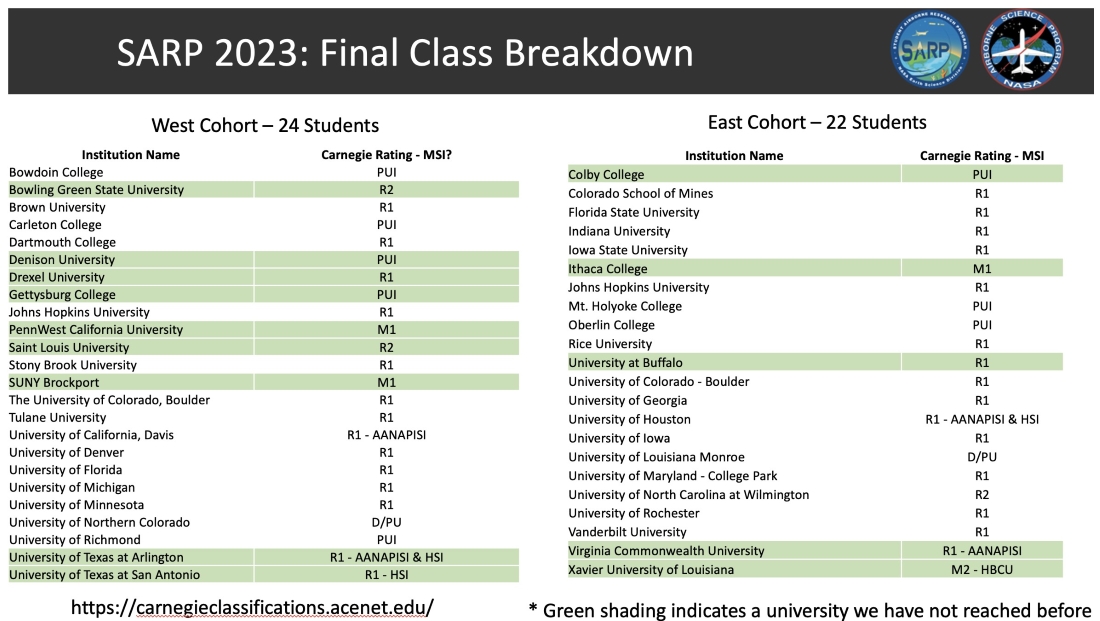
    <p>Participating students come from all around the country, and Dr.
    Craig provided an image of this year's geographic distribution. Note, applications
    for SARP are now closed for this year. The next application period will run
    from around November 2023 - January 2024.</p><p><img src="https://my3.my.umbc.edu/groups/gestar2/posts/133822/attachments/47564" style="max-width: 100%; height: auto;"></p></div>
]]>
  </Body>
  <Summary>For eight weeks this summer, undergraduate students, all college rising seniors, will be part of the inaugural Student Airborne Research Program (SARP) - East. SARP-East was created on the heels...</Summary>
  <AttachmentKind>Image</AttachmentKind>
  <AttachmentUrl>https://assets4-dev.my.umbc.edu/system/shared/attachments/fe332b8d05fd42bd5afd59f0f7d0ec08/69ee746c/news/000/133/822/56852300c43eeb8674290c2d6f383a30/SARP cohort distribution2.jpg?1685641097</AttachmentUrl>
  <Attachments>
    <Attachment kind="Image" url="https://dev.my.umbc.edu/groups/gestar2/posts/133822/attachments/47564"></Attachment>
  </Attachments>
  <TrackingUrl>https://dev.my.umbc.edu/api/v0/pixel/news/133822/guest@my.umbc.edu/1b57d27cf77e0aee55175ba3a6c6d1e5/api/pixel</TrackingUrl>
  <Tag>gestar2</Tag>
  <Group token="gestar2">Goddard Earth Sciences Technology and Research II</Group>
  <GroupUrl>https://dev.my.umbc.edu/groups/gestar2</GroupUrl>
  <AvatarUrl>https://assets3-dev.my.umbc.edu/system/shared/avatars/groups/000/001/988/1dcee2628d726541e45f1ba8c31afe98/xsmall.png?1645477833</AvatarUrl>
  <AvatarUrl size="original">https://assets1-dev.my.umbc.edu/system/shared/avatars/groups/000/001/988/1dcee2628d726541e45f1ba8c31afe98/original.png?1645477833</AvatarUrl>
  <AvatarUrl size="xxlarge">https://assets1-dev.my.umbc.edu/system/shared/avatars/groups/000/001/988/1dcee2628d726541e45f1ba8c31afe98/xxlarge.png?1645477833</AvatarUrl>
  <AvatarUrl size="xlarge">https://assets4-dev.my.umbc.edu/system/shared/avatars/groups/000/001/988/1dcee2628d726541e45f1ba8c31afe98/xlarge.png?1645477833</AvatarUrl>
  <AvatarUrl size="large">https://assets2-dev.my.umbc.edu/system/shared/avatars/groups/000/001/988/1dcee2628d726541e45f1ba8c31afe98/large.png?1645477833</AvatarUrl>
  <AvatarUrl size="medium">https://assets4-dev.my.umbc.edu/system/shared/avatars/groups/000/001/988/1dcee2628d726541e45f1ba8c31afe98/medium.png?1645477833</AvatarUrl>
  <AvatarUrl size="small">https://assets1-dev.my.umbc.edu/system/shared/avatars/groups/000/001/988/1dcee2628d726541e45f1ba8c31afe98/small.png?1645477833</AvatarUrl>
  <AvatarUrl size="xsmall">https://assets3-dev.my.umbc.edu/system/shared/avatars/groups/000/001/988/1dcee2628d726541e45f1ba8c31afe98/xsmall.png?1645477833</AvatarUrl>
  <AvatarUrl size="xxsmall">https://assets3-dev.my.umbc.edu/system/shared/avatars/groups/000/001/988/1dcee2628d726541e45f1ba8c31afe98/xxsmall.png?1645477833</AvatarUrl>
  <Sponsor>Goddard Earth Sciences Technology and Research II</Sponsor>
  <ThumbnailUrl size="xxlarge">https://assets2-dev.my.umbc.edu/system/shared/thumbnails/news/000/133/822/a856fbef48a5311b1cddf5c25ddc850e/xxlarge.jpg?1685641356</ThumbnailUrl>
  <ThumbnailUrl size="xlarge">https://assets2-dev.my.umbc.edu/system/shared/thumbnails/news/000/133/822/a856fbef48a5311b1cddf5c25ddc850e/xlarge.jpg?1685641356</ThumbnailUrl>
  <ThumbnailUrl size="large">https://assets1-dev.my.umbc.edu/system/shared/thumbnails/news/000/133/822/a856fbef48a5311b1cddf5c25ddc850e/large.jpg?1685641356</ThumbnailUrl>
  <ThumbnailUrl size="medium">https://assets2-dev.my.umbc.edu/system/shared/thumbnails/news/000/133/822/a856fbef48a5311b1cddf5c25ddc850e/medium.jpg?1685641356</ThumbnailUrl>
  <ThumbnailUrl size="small">https://assets1-dev.my.umbc.edu/system/shared/thumbnails/news/000/133/822/a856fbef48a5311b1cddf5c25ddc850e/small.jpg?1685641356</ThumbnailUrl>
  <ThumbnailUrl size="xsmall">https://assets3-dev.my.umbc.edu/system/shared/thumbnails/news/000/133/822/a856fbef48a5311b1cddf5c25ddc850e/xsmall.jpg?1685641356</ThumbnailUrl>
  <ThumbnailUrl size="xxsmall">https://assets1-dev.my.umbc.edu/system/shared/thumbnails/news/000/133/822/a856fbef48a5311b1cddf5c25ddc850e/xxsmall.jpg?1685641356</ThumbnailUrl>
  <PawCount>0</PawCount>
  <CommentCount>0</CommentCount>
  <CommentsAllowed>false</CommentsAllowed>
  <PostedAt>Thu, 01 Jun 2023 13:43:42 -0400</PostedAt>
</NewsItem>
  <NewsItem contentIssues="true" id="133783" important="false" status="posted" url="https://dev.my.umbc.edu/groups/gestar2/posts/133783">
  <Title>Clark as Co-I on newly funded NASA CMS Grant</Title>
  <Body>
    <![CDATA[
    <div class="html-content"><div><a href="https://gestar2.umbc.edu/directory/researchers-a-f/#Clark" rel="nofollow external" class="bo">J. Blake Clark</a> (616/UMBC) is a Co-I on a NASA Carbon Monitoring Systems proposal that was recently selected for funding. The grant, titled "Integrating Lateral Carbon Fluxes into Carbon Monitoring System (CMS) Ocean Carbon Estimates," will be led by PI Cecile Rousseaux (GSFC/616). In addition to Dr. Clark, other Co-Investigators include Louise Chini (UMD), George Hurtt (UMD), and Stephanie Schollaert Uz (NASA GSFC). Work is expected to begin in Summer 2023.</div><div><br></div><div>Dr. Clark provided the following summary:</div><div>"Climate, weather, and land characteristics directly affect the concentration and composition of organic and inorganic matter, including carbon, delivered to the rivers and ultimately to the oceans. Although the uptake of carbon dioxide by phytoplankton at the surface of the ocean and its recycling into dissolved organic carbon and nutrients are routinely represented in models, the lateral transfer of carbon from land to oceans is severely underrepresented or completely missing from current models. This is sorely needed for carbon accounting and particularly critical in the global assessment and estimates of carbon stocks. In this project we improve existing CMS products by adding this transfer and transformation of organic and inorganic matter as well as quantifying the effects of land use and changes on the resulting global ocean carbon flux. An existing terrestrial biosphere model (Ecosystem Demography model, ED) combined with the Land-Use Harmonization (LUH) dataset provide fluxes of carbon and nutrients from land to rivers under varying land use and land cover change scenarios. The River-Estuary model transports and transforms aqueous forms of carbon and nutrients to represent the lateral fluxes of carbon and nutrients from rivers to the NASA Ocean Biogeochemical Model (NOBM) currently used to produce the CMS global carbon fluxes. This project will add critical components and processes to the current CMS-flux products by adding the effects of land use and change on the transfer of carbon to rivers, the transport and transformation of organic and inorganic matter in rivers and the effects these processes have on the global ocean carbon budget. The modeling tools and output developed by this project will directly feed into the global carbon budget and be adopted by stakeholders in the ocean carbon sector, among others, who will provide feedback that will be used to co-develop monitoring tools and mitigation solutions."</div></div>
]]>
  </Body>
  <Summary>J. Blake Clark (616/UMBC) is a Co-I on a NASA Carbon Monitoring Systems proposal that was recently selected for funding. The grant, titled "Integrating Lateral Carbon Fluxes into Carbon Monitoring...</Summary>
  <TrackingUrl>https://dev.my.umbc.edu/api/v0/pixel/news/133783/guest@my.umbc.edu/ced20d6c963b94d53b02d2864cbefc06/api/pixel</TrackingUrl>
  <Tag>gestar2</Tag>
  <Group token="gestar2">Goddard Earth Sciences Technology and Research II</Group>
  <GroupUrl>https://dev.my.umbc.edu/groups/gestar2</GroupUrl>
  <AvatarUrl>https://assets3-dev.my.umbc.edu/system/shared/avatars/groups/000/001/988/1dcee2628d726541e45f1ba8c31afe98/xsmall.png?1645477833</AvatarUrl>
  <AvatarUrl size="original">https://assets1-dev.my.umbc.edu/system/shared/avatars/groups/000/001/988/1dcee2628d726541e45f1ba8c31afe98/original.png?1645477833</AvatarUrl>
  <AvatarUrl size="xxlarge">https://assets1-dev.my.umbc.edu/system/shared/avatars/groups/000/001/988/1dcee2628d726541e45f1ba8c31afe98/xxlarge.png?1645477833</AvatarUrl>
  <AvatarUrl size="xlarge">https://assets4-dev.my.umbc.edu/system/shared/avatars/groups/000/001/988/1dcee2628d726541e45f1ba8c31afe98/xlarge.png?1645477833</AvatarUrl>
  <AvatarUrl size="large">https://assets2-dev.my.umbc.edu/system/shared/avatars/groups/000/001/988/1dcee2628d726541e45f1ba8c31afe98/large.png?1645477833</AvatarUrl>
  <AvatarUrl size="medium">https://assets4-dev.my.umbc.edu/system/shared/avatars/groups/000/001/988/1dcee2628d726541e45f1ba8c31afe98/medium.png?1645477833</AvatarUrl>
  <AvatarUrl size="small">https://assets1-dev.my.umbc.edu/system/shared/avatars/groups/000/001/988/1dcee2628d726541e45f1ba8c31afe98/small.png?1645477833</AvatarUrl>
  <AvatarUrl size="xsmall">https://assets3-dev.my.umbc.edu/system/shared/avatars/groups/000/001/988/1dcee2628d726541e45f1ba8c31afe98/xsmall.png?1645477833</AvatarUrl>
  <AvatarUrl size="xxsmall">https://assets3-dev.my.umbc.edu/system/shared/avatars/groups/000/001/988/1dcee2628d726541e45f1ba8c31afe98/xxsmall.png?1645477833</AvatarUrl>
  <Sponsor>Goddard Earth Sciences Technology and Research II</Sponsor>
  <ThumbnailUrl size="xxlarge">https://assets4-dev.my.umbc.edu/system/shared/thumbnails/news/000/133/783/006e9c6d9c8c46149a5704179b57cf99/xxlarge.jpg?1685467216</ThumbnailUrl>
  <ThumbnailUrl size="xlarge">https://assets4-dev.my.umbc.edu/system/shared/thumbnails/news/000/133/783/006e9c6d9c8c46149a5704179b57cf99/xlarge.jpg?1685467216</ThumbnailUrl>
  <ThumbnailUrl size="large">https://assets4-dev.my.umbc.edu/system/shared/thumbnails/news/000/133/783/006e9c6d9c8c46149a5704179b57cf99/large.jpg?1685467216</ThumbnailUrl>
  <ThumbnailUrl size="medium">https://assets3-dev.my.umbc.edu/system/shared/thumbnails/news/000/133/783/006e9c6d9c8c46149a5704179b57cf99/medium.jpg?1685467216</ThumbnailUrl>
  <ThumbnailUrl size="small">https://assets2-dev.my.umbc.edu/system/shared/thumbnails/news/000/133/783/006e9c6d9c8c46149a5704179b57cf99/small.jpg?1685467216</ThumbnailUrl>
  <ThumbnailUrl size="xsmall">https://assets3-dev.my.umbc.edu/system/shared/thumbnails/news/000/133/783/006e9c6d9c8c46149a5704179b57cf99/xsmall.jpg?1685467216</ThumbnailUrl>
  <ThumbnailUrl size="xxsmall">https://assets4-dev.my.umbc.edu/system/shared/thumbnails/news/000/133/783/006e9c6d9c8c46149a5704179b57cf99/xxsmall.jpg?1685467216</ThumbnailUrl>
  <PawCount>2</PawCount>
  <CommentCount>0</CommentCount>
  <CommentsAllowed>false</CommentsAllowed>
  <PostedAt>Tue, 30 May 2023 13:21:05 -0400</PostedAt>
</NewsItem>
  <NewsItem contentIssues="true" id="133780" important="false" status="posted" url="https://dev.my.umbc.edu/groups/gestar2/posts/133780">
    <Title>Huemmrich and Campbell's work with ABoVE in EO IOTD</Title>
    <Body>
      <![CDATA[
          <div class="html-content">On May 27, 2023, <a href="https://gestar2.umbc.edu/directory/researchers-g-k/#Huemmrich" rel="nofollow external" class="bo">Fred Huemmrich</a> and <a href="https://gestar2.umbc.edu/directory/researchers-a-f/#PCampbell" rel="nofollow external" class="bo">Petya Campbell</a> (both 618/UMBC) and their work with NASA's Arctic Boreal Vulnerability Experiment (ABoVE) was featured in the Earth Observatory's Item of the Day, "<a href="https://earthobservatory.nasa.gov/images/151399/a-boreal-forest-awakens" rel="nofollow external" class="bo">A Boreal Forest Awakens</a>." This feature is further discussion of their Notes from the Field blog post, where they discussed their work in Fairbanks, Alaska, in April 2023. </div>
      ]]>
    </Body>
    <Summary>On May 27, 2023, Fred Huemmrich and Petya Campbell (both 618/UMBC) and their work with NASA's Arctic Boreal Vulnerability Experiment (ABoVE) was featured in the Earth Observatory's Item of the...</Summary>
    <TrackingUrl>https://dev.my.umbc.edu/api/v0/pixel/news/133780/guest@my.umbc.edu/fa890da62f96fcd9a99133d28de56f15/api/pixel</TrackingUrl>
    <Tag>gestar2</Tag>
    <Group token="gestar2">Goddard Earth Sciences Technology and Research II</Group>
    <GroupUrl>https://dev.my.umbc.edu/groups/gestar2</GroupUrl>
    <AvatarUrl>https://assets3-dev.my.umbc.edu/system/shared/avatars/groups/000/001/988/1dcee2628d726541e45f1ba8c31afe98/xsmall.png?1645477833</AvatarUrl>
    <AvatarUrl size="original">https://assets1-dev.my.umbc.edu/system/shared/avatars/groups/000/001/988/1dcee2628d726541e45f1ba8c31afe98/original.png?1645477833</AvatarUrl>
    <AvatarUrl size="xxlarge">https://assets1-dev.my.umbc.edu/system/shared/avatars/groups/000/001/988/1dcee2628d726541e45f1ba8c31afe98/xxlarge.png?1645477833</AvatarUrl>
    <AvatarUrl size="xlarge">https://assets4-dev.my.umbc.edu/system/shared/avatars/groups/000/001/988/1dcee2628d726541e45f1ba8c31afe98/xlarge.png?1645477833</AvatarUrl>
    <AvatarUrl size="large">https://assets2-dev.my.umbc.edu/system/shared/avatars/groups/000/001/988/1dcee2628d726541e45f1ba8c31afe98/large.png?1645477833</AvatarUrl>
    <AvatarUrl size="medium">https://assets4-dev.my.umbc.edu/system/shared/avatars/groups/000/001/988/1dcee2628d726541e45f1ba8c31afe98/medium.png?1645477833</AvatarUrl>
    <AvatarUrl size="small">https://assets1-dev.my.umbc.edu/system/shared/avatars/groups/000/001/988/1dcee2628d726541e45f1ba8c31afe98/small.png?1645477833</AvatarUrl>
    <AvatarUrl size="xsmall">https://assets3-dev.my.umbc.edu/system/shared/avatars/groups/000/001/988/1dcee2628d726541e45f1ba8c31afe98/xsmall.png?1645477833</AvatarUrl>
    <AvatarUrl size="xxsmall">https://assets3-dev.my.umbc.edu/system/shared/avatars/groups/000/001/988/1dcee2628d726541e45f1ba8c31afe98/xxsmall.png?1645477833</AvatarUrl>
    <Sponsor>Goddard Earth Sciences Technology and Research II</Sponsor>
    <ThumbnailUrl size="xxlarge">https://assets2-dev.my.umbc.edu/system/shared/thumbnails/news/000/133/780/241979ff76fea17605439950c7eb9377/xxlarge.jpg?1685459133</ThumbnailUrl>
    <ThumbnailUrl size="xlarge">https://assets1-dev.my.umbc.edu/system/shared/thumbnails/news/000/133/780/241979ff76fea17605439950c7eb9377/xlarge.jpg?1685459133</ThumbnailUrl>
    <ThumbnailUrl size="large">https://assets2-dev.my.umbc.edu/system/shared/thumbnails/news/000/133/780/241979ff76fea17605439950c7eb9377/large.jpg?1685459133</ThumbnailUrl>
    <ThumbnailUrl size="medium">https://assets4-dev.my.umbc.edu/system/shared/thumbnails/news/000/133/780/241979ff76fea17605439950c7eb9377/medium.jpg?1685459133</ThumbnailUrl>
    <ThumbnailUrl size="small">https://assets3-dev.my.umbc.edu/system/shared/thumbnails/news/000/133/780/241979ff76fea17605439950c7eb9377/small.jpg?1685459133</ThumbnailUrl>
    <ThumbnailUrl size="xsmall">https://assets4-dev.my.umbc.edu/system/shared/thumbnails/news/000/133/780/241979ff76fea17605439950c7eb9377/xsmall.jpg?1685459133</ThumbnailUrl>
    <ThumbnailUrl size="xxsmall">https://assets4-dev.my.umbc.edu/system/shared/thumbnails/news/000/133/780/241979ff76fea17605439950c7eb9377/xxsmall.jpg?1685459133</ThumbnailUrl>
    <PawCount>1</PawCount>
    <CommentCount>0</CommentCount>
    <CommentsAllowed>false</CommentsAllowed>
    <PostedAt>Tue, 30 May 2023 11:07:53 -0400</PostedAt>
  </NewsItem>
  <NewsItem contentIssues="true" id="133670" important="false" status="posted" url="https://dev.my.umbc.edu/groups/gestar2/posts/133670">
    <Title>Thompson as commencement speaker and lead author</Title>
    <Body>
      <![CDATA[
          <div class="html-content"><div>On May 12, 2023, <a href="https://gestar2.umbc.edu/directory/researchers-r-z/#Thompson" rel="nofollow external" class="bo">Anne Thompson</a> (610 Emeritus/UMBC) was a Commencement speaker at the Bryn Mawr College (Pennsylvania) Graduate Schools of the Arts and Sciences (GSAS) and of Social Service and Research (GSSSR). Dr. Thompson received her <a href="https://www.brynmawr.edu/news/2023-commencement-speakers-marie-bernard-72-anne-thompson-phd-78" rel="nofollow external" class="bo">PhD</a> in Physical Chemistry from Bryn Mawr's GSAS. We are certain she delivered inspiration to the Class of 2023.</div><div><br></div><div>Also, Dr. Thompson is lead author of a recent publication in Earth and Space Science:</div><div>Thompson, A. M. (610/UMBC), D. Kollonige, R. Stauffer, <a href="https://gestar2.umbc.edu/directory/researchers-g-k/#Kotsakis" rel="nofollow external" class="bo">A. Kotsakis</a> (614/ERT), <a href="https://gestar2.umbc.edu/directory/researchers-a-f/#Abuhassan" rel="nofollow external" class="bo">N. Abuhassan</a> (614/UMBC), <a href="https://gestar2.umbc.edu/directory/researchers-l-q/#Lamsal" rel="nofollow external" class="bo">L. Lamsal</a> (614/UMBC), R. Swap, D. Blake, A. Townsend-Small, and H. Wecht (2023). Two air quality regimes in Total Column NO2 over the Gulf of Mexico in May 2019: Shipboard and satellite views, Earth Space Sci., <a href="https://doi.org/10.1029/2022EA002473" rel="nofollow external" class="bo">https://doi.org/10.1029/2022EA002473</a>. </div><div><br></div></div>
      ]]>
    </Body>
    <Summary>On May 12, 2023, Anne Thompson (610 Emeritus/UMBC) was a Commencement speaker at the Bryn Mawr College (Pennsylvania) Graduate Schools of the Arts and Sciences (GSAS) and of Social Service and...</Summary>
    <TrackingUrl>https://dev.my.umbc.edu/api/v0/pixel/news/133670/guest@my.umbc.edu/0b2edced1fd3fe0900abbbac4b201614/api/pixel</TrackingUrl>
    <Tag>gestar2</Tag>
    <Group token="gestar2">Goddard Earth Sciences Technology and Research II</Group>
    <GroupUrl>https://dev.my.umbc.edu/groups/gestar2</GroupUrl>
    <AvatarUrl>https://assets3-dev.my.umbc.edu/system/shared/avatars/groups/000/001/988/1dcee2628d726541e45f1ba8c31afe98/xsmall.png?1645477833</AvatarUrl>
    <AvatarUrl size="original">https://assets1-dev.my.umbc.edu/system/shared/avatars/groups/000/001/988/1dcee2628d726541e45f1ba8c31afe98/original.png?1645477833</AvatarUrl>
    <AvatarUrl size="xxlarge">https://assets1-dev.my.umbc.edu/system/shared/avatars/groups/000/001/988/1dcee2628d726541e45f1ba8c31afe98/xxlarge.png?1645477833</AvatarUrl>
    <AvatarUrl size="xlarge">https://assets4-dev.my.umbc.edu/system/shared/avatars/groups/000/001/988/1dcee2628d726541e45f1ba8c31afe98/xlarge.png?1645477833</AvatarUrl>
    <AvatarUrl size="large">https://assets2-dev.my.umbc.edu/system/shared/avatars/groups/000/001/988/1dcee2628d726541e45f1ba8c31afe98/large.png?1645477833</AvatarUrl>
    <AvatarUrl size="medium">https://assets4-dev.my.umbc.edu/system/shared/avatars/groups/000/001/988/1dcee2628d726541e45f1ba8c31afe98/medium.png?1645477833</AvatarUrl>
    <AvatarUrl size="small">https://assets1-dev.my.umbc.edu/system/shared/avatars/groups/000/001/988/1dcee2628d726541e45f1ba8c31afe98/small.png?1645477833</AvatarUrl>
    <AvatarUrl size="xsmall">https://assets3-dev.my.umbc.edu/system/shared/avatars/groups/000/001/988/1dcee2628d726541e45f1ba8c31afe98/xsmall.png?1645477833</AvatarUrl>
    <AvatarUrl size="xxsmall">https://assets3-dev.my.umbc.edu/system/shared/avatars/groups/000/001/988/1dcee2628d726541e45f1ba8c31afe98/xxsmall.png?1645477833</AvatarUrl>
    <Sponsor>Goddard Earth Sciences Technology and Research II</Sponsor>
    <ThumbnailUrl size="xxlarge">https://assets1-dev.my.umbc.edu/system/shared/thumbnails/news/000/133/670/6b687c876fc09f18d8b6ffc6c6025f46/xxlarge.jpg?1684878102</ThumbnailUrl>
    <ThumbnailUrl size="xlarge">https://assets1-dev.my.umbc.edu/system/shared/thumbnails/news/000/133/670/6b687c876fc09f18d8b6ffc6c6025f46/xlarge.jpg?1684878102</ThumbnailUrl>
    <ThumbnailUrl size="large">https://assets3-dev.my.umbc.edu/system/shared/thumbnails/news/000/133/670/6b687c876fc09f18d8b6ffc6c6025f46/large.jpg?1684878102</ThumbnailUrl>
    <ThumbnailUrl size="medium">https://assets4-dev.my.umbc.edu/system/shared/thumbnails/news/000/133/670/6b687c876fc09f18d8b6ffc6c6025f46/medium.jpg?1684878102</ThumbnailUrl>
    <ThumbnailUrl size="small">https://assets3-dev.my.umbc.edu/system/shared/thumbnails/news/000/133/670/6b687c876fc09f18d8b6ffc6c6025f46/small.jpg?1684878102</ThumbnailUrl>
    <ThumbnailUrl size="xsmall">https://assets4-dev.my.umbc.edu/system/shared/thumbnails/news/000/133/670/6b687c876fc09f18d8b6ffc6c6025f46/xsmall.jpg?1684878102</ThumbnailUrl>
    <ThumbnailUrl size="xxsmall">https://assets1-dev.my.umbc.edu/system/shared/thumbnails/news/000/133/670/6b687c876fc09f18d8b6ffc6c6025f46/xxsmall.jpg?1684878102</ThumbnailUrl>
    <PawCount>0</PawCount>
    <CommentCount>0</CommentCount>
    <CommentsAllowed>false</CommentsAllowed>
    <PostedAt>Wed, 24 May 2023 16:43:51 -0400</PostedAt>
  </NewsItem>
  <NewsItem contentIssues="true" id="130360" important="false" status="posted" url="https://dev.my.umbc.edu/groups/gestar2/posts/130360">
    <Title>Huemmrich &amp; Campbell continue fieldwork with ABOVE</Title>
    <Body>
      <![CDATA[
          <div class="html-content"><a href="https://gestar2.umbc.edu/directory/researchers-g-k/#Huemmrich" rel="nofollow external" class="bo">Fred Huemmrich</a> (618/UMBC) recently shared the research he and <a href="https://gestar2.umbc.edu/directory/researchers-a-f/#PCampbell" rel="nofollow external" class="bo">Petya Campbell</a> (618/UMBC) have continued with the ABOVE field campaign. They contributed to the NASA Earth Observatory's Notes from the Field, with the post <a href="https://earthobservatory.nasa.gov/blogs/fromthefield/2023/05/18/illuminating-a-boreal-forests-spring-wake-up/" rel="nofollow external" class="bo">"Illuminating a Boreal Forest's Spring Wake-Up."</a> <div><br><div>"Our project is part of the NASA Terrestrial Ecology program's Arctic-Boreal Vulnerability Experiment (<a href="https://above.nasa.gov/" rel="nofollow external" class="bo">ABoVE</a>), a large-scale field study in Alaska and western Canada, whose overall goals are to make use of NASA technology to gain a better understanding of ecosystems at high latitudes, their responses to environmental change, and the effects of those changes."</div><div><br></div><div>Read more to discover how they utilize satellite imagery and fieldwork activities, which can include instruments like the FLoX, the MoniPAM instruments, and the FluoWat leaf clip, to detect photosynthesis and measure chlorophyll. </div><div>  </div></div></div>
      ]]>
    </Body>
    <Summary>Fred Huemmrich (618/UMBC) recently shared the research he and Petya Campbell (618/UMBC) have continued with the ABOVE field campaign. They contributed to the NASA Earth Observatory's Notes from...</Summary>
    <TrackingUrl>https://dev.my.umbc.edu/api/v0/pixel/news/130360/guest@my.umbc.edu/8c5ccf95b0c61aed8f29f24cc52b68d3/api/pixel</TrackingUrl>
    <Tag>gestar2</Tag>
    <Group token="gestar2">Goddard Earth Sciences Technology and Research II</Group>
    <GroupUrl>https://dev.my.umbc.edu/groups/gestar2</GroupUrl>
    <AvatarUrl>https://assets3-dev.my.umbc.edu/system/shared/avatars/groups/000/001/988/1dcee2628d726541e45f1ba8c31afe98/xsmall.png?1645477833</AvatarUrl>
    <AvatarUrl size="original">https://assets1-dev.my.umbc.edu/system/shared/avatars/groups/000/001/988/1dcee2628d726541e45f1ba8c31afe98/original.png?1645477833</AvatarUrl>
    <AvatarUrl size="xxlarge">https://assets1-dev.my.umbc.edu/system/shared/avatars/groups/000/001/988/1dcee2628d726541e45f1ba8c31afe98/xxlarge.png?1645477833</AvatarUrl>
    <AvatarUrl size="xlarge">https://assets4-dev.my.umbc.edu/system/shared/avatars/groups/000/001/988/1dcee2628d726541e45f1ba8c31afe98/xlarge.png?1645477833</AvatarUrl>
    <AvatarUrl size="large">https://assets2-dev.my.umbc.edu/system/shared/avatars/groups/000/001/988/1dcee2628d726541e45f1ba8c31afe98/large.png?1645477833</AvatarUrl>
    <AvatarUrl size="medium">https://assets4-dev.my.umbc.edu/system/shared/avatars/groups/000/001/988/1dcee2628d726541e45f1ba8c31afe98/medium.png?1645477833</AvatarUrl>
    <AvatarUrl size="small">https://assets1-dev.my.umbc.edu/system/shared/avatars/groups/000/001/988/1dcee2628d726541e45f1ba8c31afe98/small.png?1645477833</AvatarUrl>
    <AvatarUrl size="xsmall">https://assets3-dev.my.umbc.edu/system/shared/avatars/groups/000/001/988/1dcee2628d726541e45f1ba8c31afe98/xsmall.png?1645477833</AvatarUrl>
    <AvatarUrl size="xxsmall">https://assets3-dev.my.umbc.edu/system/shared/avatars/groups/000/001/988/1dcee2628d726541e45f1ba8c31afe98/xxsmall.png?1645477833</AvatarUrl>
    <Sponsor>Goddard Earth Sciences Technology and Research II</Sponsor>
    <ThumbnailUrl size="xxlarge">https://assets4-dev.my.umbc.edu/system/shared/thumbnails/news/000/130/360/6d96107d5ecac029f2a321e4ba34df7a/xxlarge.jpg?1684876857</ThumbnailUrl>
    <ThumbnailUrl size="xlarge">https://assets3-dev.my.umbc.edu/system/shared/thumbnails/news/000/130/360/6d96107d5ecac029f2a321e4ba34df7a/xlarge.jpg?1684876857</ThumbnailUrl>
    <ThumbnailUrl size="large">https://assets2-dev.my.umbc.edu/system/shared/thumbnails/news/000/130/360/6d96107d5ecac029f2a321e4ba34df7a/large.jpg?1684876857</ThumbnailUrl>
    <ThumbnailUrl size="medium">https://assets2-dev.my.umbc.edu/system/shared/thumbnails/news/000/130/360/6d96107d5ecac029f2a321e4ba34df7a/medium.jpg?1684876857</ThumbnailUrl>
    <ThumbnailUrl size="small">https://assets1-dev.my.umbc.edu/system/shared/thumbnails/news/000/130/360/6d96107d5ecac029f2a321e4ba34df7a/small.jpg?1684876857</ThumbnailUrl>
    <ThumbnailUrl size="xsmall">https://assets3-dev.my.umbc.edu/system/shared/thumbnails/news/000/130/360/6d96107d5ecac029f2a321e4ba34df7a/xsmall.jpg?1684876857</ThumbnailUrl>
    <ThumbnailUrl size="xxsmall">https://assets4-dev.my.umbc.edu/system/shared/thumbnails/news/000/130/360/6d96107d5ecac029f2a321e4ba34df7a/xxsmall.jpg?1684876857</ThumbnailUrl>
    <PawCount>0</PawCount>
    <CommentCount>0</CommentCount>
    <CommentsAllowed>false</CommentsAllowed>
    <PostedAt>Tue, 23 May 2023 17:21:59 -0400</PostedAt>
  </NewsItem>
  <NewsItem contentIssues="true" id="133584" important="false" status="posted" url="https://dev.my.umbc.edu/groups/gestar2/posts/133584">
  <Title>GESTAR II Seminar Series, May 23rd at 1:00pm</Title>
  <Body>
    <![CDATA[
    <div class="html-content"><div>Join us for a virtual seminar by <a href="https://www.atmos.colostate.edu/people/faculty/chiu/" rel="nofollow external" class="bo">Dr. Christine Chiu</a>, Professor at the Department of Atmospheric Science, Colorado State University. Her talk is titled "Clouds and aerosols laid bare - A 3D view from synergistic satellite observations for improved process-level understanding."</div><div><br></div><div>Date and Time: Tuesday, May 23, 2023 at 1:00pm</div><div>Join us via <a href="https://teams.microsoft.com/l/meetup-join/19%3ameeting_NDRiM2ZjMWQtMTFjZC00YzY4LWFmMzgtMDJkMmU2NTI2MDc2%40thread.v2/0?context=%7b%22Tid%22%3a%227005d458-45be-48ae-8140-d43da96dd17b%22%2c%22Oid%22%3a%22c58e54ca-3561-4059-bb24-a8af64733329%22%7d" rel="nofollow external" class="bo">Teams</a>.</div><div><br></div><div>Abstract: </div><div>"Marine boundary layer clouds cover a substantial portion of the global oceans and play an important role in determining the Earth's radiation budget. Their morphology, controlled by various dynamical factors and modulated by aerosols, is complex. It can range from single-layer stratiform in the high latitudes, mixtures of stratiform and cumuliform in the mid-latitudes, and mainly cumuliform in the tropics. Despite the distinct three-dimensional (3D) and heterogeneous nature of clouds, their interactions with radiation are often simplified to one-dimensional (1D) not only in models at all scales but also in satellite remote sensing applications. While it is a concern that the 1D simplification unavoidably introduces errors in cloud retrievals, missing critical information on 3D cloud properties has more profound impacts because it prevents us from offering much stronger observational constraints for understanding cloud-aerosol processes and improving model physics.   <div><br></div>To address this issue, I will show recent advances in remote sensing of 3D clouds and near-cloud aerosols. Specifically, our new retrieval framework accounts for cloud heterogeneity, incorporates 3D radiative effects directly, and uses synergistic satellite observations. It also capitalizes on a particle flow filter approach for the first time, which solves the fully non-linear retrieval problem and provides realistic error estimates. Applications and implications of these retrievals for an improved understanding of clouds and aerosols will be also discussed."</div><div><br></div><div>Biography:</div><div>Dr. Christine Chiu is a Professor at the Department of Atmospheric Science, Colorado State University. Prior to joining CSU, she was an Associate Professor at the Department of Meteorology, University of Reading, United Kingdom, a Research Assistant Professor at the University of Maryland, Baltimore County, and an Associate Scientist at NASA Goddard Space Flight Center.</div><div><br></div><div>Dr. Chiu has extensive experience in remote sensing and radiative transfer. She has been working on retrievals for cloud, precipitation, and aerosols; aerosol-cloud-precipitation interactions; and machine learning applications in cloud processes and radiative transfer. She is currently serving as the Chair of the Cloud and Precipitation Measurements and Science Group for the Atmospheric Radiation Measurement (ARM) Climate Research Facility, and a member of the International Radiation Commission and the Hyperspectral Imaging and Sounding of the Environment Program Committee. In the past, she has served as the Chair of the AMS Atmospheric Radiation Committee.</div></div>
]]>
  </Body>
  <Summary>Join us for a virtual seminar by Dr. Christine Chiu, Professor at the Department of Atmospheric Science, Colorado State University. Her talk is titled "Clouds and aerosols laid bare - A 3D view...</Summary>
  <TrackingUrl>https://dev.my.umbc.edu/api/v0/pixel/news/133584/guest@my.umbc.edu/b87f77d1a7136b5a9bd4c252c006384f/api/pixel</TrackingUrl>
  <Tag>gestar2</Tag>
  <Group token="gestar2">Goddard Earth Sciences Technology and Research II</Group>
  <GroupUrl>https://dev.my.umbc.edu/groups/gestar2</GroupUrl>
  <AvatarUrl>https://assets3-dev.my.umbc.edu/system/shared/avatars/groups/000/001/988/1dcee2628d726541e45f1ba8c31afe98/xsmall.png?1645477833</AvatarUrl>
  <AvatarUrl size="original">https://assets1-dev.my.umbc.edu/system/shared/avatars/groups/000/001/988/1dcee2628d726541e45f1ba8c31afe98/original.png?1645477833</AvatarUrl>
  <AvatarUrl size="xxlarge">https://assets1-dev.my.umbc.edu/system/shared/avatars/groups/000/001/988/1dcee2628d726541e45f1ba8c31afe98/xxlarge.png?1645477833</AvatarUrl>
  <AvatarUrl size="xlarge">https://assets4-dev.my.umbc.edu/system/shared/avatars/groups/000/001/988/1dcee2628d726541e45f1ba8c31afe98/xlarge.png?1645477833</AvatarUrl>
  <AvatarUrl size="large">https://assets2-dev.my.umbc.edu/system/shared/avatars/groups/000/001/988/1dcee2628d726541e45f1ba8c31afe98/large.png?1645477833</AvatarUrl>
  <AvatarUrl size="medium">https://assets4-dev.my.umbc.edu/system/shared/avatars/groups/000/001/988/1dcee2628d726541e45f1ba8c31afe98/medium.png?1645477833</AvatarUrl>
  <AvatarUrl size="small">https://assets1-dev.my.umbc.edu/system/shared/avatars/groups/000/001/988/1dcee2628d726541e45f1ba8c31afe98/small.png?1645477833</AvatarUrl>
  <AvatarUrl size="xsmall">https://assets3-dev.my.umbc.edu/system/shared/avatars/groups/000/001/988/1dcee2628d726541e45f1ba8c31afe98/xsmall.png?1645477833</AvatarUrl>
  <AvatarUrl size="xxsmall">https://assets3-dev.my.umbc.edu/system/shared/avatars/groups/000/001/988/1dcee2628d726541e45f1ba8c31afe98/xxsmall.png?1645477833</AvatarUrl>
  <Sponsor>Goddard Earth Sciences Technology and Research II</Sponsor>
  <ThumbnailUrl size="xxlarge">https://assets1-dev.my.umbc.edu/system/shared/thumbnails/news/000/133/584/3acedb34ffd32a2ac6d357dc722c55a1/xxlarge.jpg?1684357205</ThumbnailUrl>
  <ThumbnailUrl size="xlarge">https://assets2-dev.my.umbc.edu/system/shared/thumbnails/news/000/133/584/3acedb34ffd32a2ac6d357dc722c55a1/xlarge.jpg?1684357205</ThumbnailUrl>
  <ThumbnailUrl size="large">https://assets3-dev.my.umbc.edu/system/shared/thumbnails/news/000/133/584/3acedb34ffd32a2ac6d357dc722c55a1/large.jpg?1684357205</ThumbnailUrl>
  <ThumbnailUrl size="medium">https://assets4-dev.my.umbc.edu/system/shared/thumbnails/news/000/133/584/3acedb34ffd32a2ac6d357dc722c55a1/medium.jpg?1684357205</ThumbnailUrl>
  <ThumbnailUrl size="small">https://assets4-dev.my.umbc.edu/system/shared/thumbnails/news/000/133/584/3acedb34ffd32a2ac6d357dc722c55a1/small.jpg?1684357205</ThumbnailUrl>
  <ThumbnailUrl size="xsmall">https://assets3-dev.my.umbc.edu/system/shared/thumbnails/news/000/133/584/3acedb34ffd32a2ac6d357dc722c55a1/xsmall.jpg?1684357205</ThumbnailUrl>
  <ThumbnailUrl size="xxsmall">https://assets1-dev.my.umbc.edu/system/shared/thumbnails/news/000/133/584/3acedb34ffd32a2ac6d357dc722c55a1/xxsmall.jpg?1684357205</ThumbnailUrl>
  <PawCount>0</PawCount>
  <CommentCount>0</CommentCount>
  <CommentsAllowed>false</CommentsAllowed>
  <PostedAt>Wed, 17 May 2023 17:01:55 -0400</PostedAt>
</NewsItem>
</News>