<?xml version="1.0"?>
<News hasArchived="false" page="24" pageCount="37" pageSize="10" timestamp="Sun, 26 Apr 2026 16:24:10 -0400" url="https://dev.my.umbc.edu/groups/gestar2/posts.xml?page=24&amp;tag=gestar2">
  <NewsItem contentIssues="true" id="132478" important="false" status="posted" url="https://dev.my.umbc.edu/groups/gestar2/posts/132478">
  <Title>GESTAR II Seminar Series, April 13 at 11:00am</Title>
  <Body>
    <![CDATA[
    <div class="html-content"><div>Join us for a virtual seminar by Dr. Joe Turk, Jet Propulsion Laboratory (JPL), California Institute of Technology. At JPL, he is a member of the Radar Science and Engineering section. His talk is titled "Moisture in the Lower Free Troposphere and Observational Strategies for Obtaining Vertical Profiles In and Near Convection."</div><div><br></div><div>Date and Time: Thursday, April 13, 2023 at 11:00am</div><div>Join us via <a href="https://teams.microsoft.com/l/meetup-join/19%3ameeting_OTA5MWU2MTMtMTM3MS00NmIzLWJjYzgtMTFhODg3OTQ3NzY3%40thread.v2/0?context=%7b%22Tid%22%3a%227005d458-45be-48ae-8140-d43da96dd17b%22%2c%22Oid%22%3a%22c58e54ca-3561-4059-bb24-a8af64733329%22%7d" rel="nofollow external" class="bo">Teams</a>.</div><div><br></div><div>Abstract: </div><div><div>Recent developments indicate that moisture in the lower free troposphere (LFT) strongly affects deep convection. This basic process introduces observational constraints, due challenges in obtaining high-vertical resolution profiles of moisture and temperature in and near convective weather. In addition to identifying layers of influence, such observations would serve as diagnostics for the parameterization of convection in climate and weather forecast models by characterizing the dependence of convection on the humidity-temperature environment.</div><div><br></div><div>To address these constraints, the use of Global Navigation Satellite System (GNSS) polarimetric radio occultation (PRO) measurements is explained.  A closely-spaced sequence of PRO satellite observations would capture independent profiles of coordinated temperature, moisture and precipitation within convection and its environment. Similar to the principle underlying polarimetric weather radar, PRO relies upon hydrometeor shape asymmetry, such that a differential phase time delay is induced between the horizontal- and vertically-polarized radio signals propagating through a precipitation medium. The PRO concept has been demonstrated by the Radio Occultations and Heavy Precipitation (ROHP) experimental receiver orbiting onboard the Spanish PAZ satellite since May 2018. Highlights from the past four years of ROHP analysis will be presented, as well as applications for these data in weather modeling.</div></div><div><br></div><div>Biography:</div><div>Dr. Joe Turk is a member of the Radar Science and Engineering section at the Jet Propulsion Laboratory (JPL). His overall primary interest is atmospheric passive/active remote sensing related to clouds and precipitation, and the observations needed to improve their representation in weather and climate models. Prior to JPL, he worked for the Naval Research Laboratory's Marine Meteorology Division. He has been active in NASA's TRMM and GPM science teams, served as an editor for the AMS Journal of Hydrometeorology, and has been active in the organization of the CGMS/WMO International Precipitation Working Group since its inception. He received his undergraduate degrees from Michigan Technological University and, after a period in industry, his PhD from Colorado State University (electrical engineering), where he became interested in radar meteorology using the CSU and NCAR S-band polarimetric radar systems. When not analyzing the treasure trove of information buried in the archive of NASA's environmental satellite data, you can often find him on his bike exploring the hills and mountains of Southern California.</div><div><br></div><div>For more information on the GESTAR II Seminar Series, click <a href="https://gestar2.umbc.edu/gestar-ii-seminar-series/" rel="nofollow external" class="bo">here</a>.</div></div>
]]>
  </Body>
  <Summary>Join us for a virtual seminar by Dr. Joe Turk, Jet Propulsion Laboratory (JPL), California Institute of Technology. At JPL, he is a member of the Radar Science and Engineering section. His talk is...</Summary>
  <TrackingUrl>https://dev.my.umbc.edu/api/v0/pixel/news/132478/guest@my.umbc.edu/04ea14d134759399bb1f943f96e53689/api/pixel</TrackingUrl>
  <Tag>gestar2</Tag>
  <Group token="gestar2">Goddard Earth Sciences Technology and Research II</Group>
  <GroupUrl>https://dev.my.umbc.edu/groups/gestar2</GroupUrl>
  <AvatarUrl>https://assets3-dev.my.umbc.edu/system/shared/avatars/groups/000/001/988/1dcee2628d726541e45f1ba8c31afe98/xsmall.png?1645477833</AvatarUrl>
  <AvatarUrl size="original">https://assets1-dev.my.umbc.edu/system/shared/avatars/groups/000/001/988/1dcee2628d726541e45f1ba8c31afe98/original.png?1645477833</AvatarUrl>
  <AvatarUrl size="xxlarge">https://assets1-dev.my.umbc.edu/system/shared/avatars/groups/000/001/988/1dcee2628d726541e45f1ba8c31afe98/xxlarge.png?1645477833</AvatarUrl>
  <AvatarUrl size="xlarge">https://assets4-dev.my.umbc.edu/system/shared/avatars/groups/000/001/988/1dcee2628d726541e45f1ba8c31afe98/xlarge.png?1645477833</AvatarUrl>
  <AvatarUrl size="large">https://assets2-dev.my.umbc.edu/system/shared/avatars/groups/000/001/988/1dcee2628d726541e45f1ba8c31afe98/large.png?1645477833</AvatarUrl>
  <AvatarUrl size="medium">https://assets4-dev.my.umbc.edu/system/shared/avatars/groups/000/001/988/1dcee2628d726541e45f1ba8c31afe98/medium.png?1645477833</AvatarUrl>
  <AvatarUrl size="small">https://assets1-dev.my.umbc.edu/system/shared/avatars/groups/000/001/988/1dcee2628d726541e45f1ba8c31afe98/small.png?1645477833</AvatarUrl>
  <AvatarUrl size="xsmall">https://assets3-dev.my.umbc.edu/system/shared/avatars/groups/000/001/988/1dcee2628d726541e45f1ba8c31afe98/xsmall.png?1645477833</AvatarUrl>
  <AvatarUrl size="xxsmall">https://assets3-dev.my.umbc.edu/system/shared/avatars/groups/000/001/988/1dcee2628d726541e45f1ba8c31afe98/xxsmall.png?1645477833</AvatarUrl>
  <Sponsor>Goddard Earth Sciences Technology and Research II</Sponsor>
  <ThumbnailUrl size="xxlarge">https://assets2-dev.my.umbc.edu/system/shared/thumbnails/news/000/132/478/efab7c055cd0207a9c519928787eef09/xxlarge.jpg?1681140041</ThumbnailUrl>
  <ThumbnailUrl size="xlarge">https://assets3-dev.my.umbc.edu/system/shared/thumbnails/news/000/132/478/efab7c055cd0207a9c519928787eef09/xlarge.jpg?1681140041</ThumbnailUrl>
  <ThumbnailUrl size="large">https://assets3-dev.my.umbc.edu/system/shared/thumbnails/news/000/132/478/efab7c055cd0207a9c519928787eef09/large.jpg?1681140041</ThumbnailUrl>
  <ThumbnailUrl size="medium">https://assets3-dev.my.umbc.edu/system/shared/thumbnails/news/000/132/478/efab7c055cd0207a9c519928787eef09/medium.jpg?1681140041</ThumbnailUrl>
  <ThumbnailUrl size="small">https://assets4-dev.my.umbc.edu/system/shared/thumbnails/news/000/132/478/efab7c055cd0207a9c519928787eef09/small.jpg?1681140041</ThumbnailUrl>
  <ThumbnailUrl size="xsmall">https://assets3-dev.my.umbc.edu/system/shared/thumbnails/news/000/132/478/efab7c055cd0207a9c519928787eef09/xsmall.jpg?1681140041</ThumbnailUrl>
  <ThumbnailUrl size="xxsmall">https://assets3-dev.my.umbc.edu/system/shared/thumbnails/news/000/132/478/efab7c055cd0207a9c519928787eef09/xxsmall.jpg?1681140041</ThumbnailUrl>
  <PawCount>0</PawCount>
  <CommentCount>0</CommentCount>
  <CommentsAllowed>false</CommentsAllowed>
  <PostedAt>Mon, 10 Apr 2023 11:22:32 -0400</PostedAt>
</NewsItem>
  <NewsItem contentIssues="true" id="132154" important="false" status="posted" url="https://dev.my.umbc.edu/groups/gestar2/posts/132154">
  <Title>Shuman &amp; Casasanto Pay Tribute to Virginia Norwood &amp; Landsat</Title>
  <Body>
    <![CDATA[
    <div class="html-content">Earth scientists and researchers, the Landsat community, the NASA community, and countless others are remembering physicist, engineer, pioneer, and patent holder <a href="https://landsat.gsfc.nasa.gov/article/bidding-farewell-to-virginia-t-norwood-the-mother-of-landsat/" rel="nofollow external" class="bo">Virginia T. Norwood, the Mother of Landsat</a>, who passed away Sunday, March 26, 2023, at the age of 96. According to the Landsat Science <a href="https://landsat.gsfc.nasa.gov/" rel="nofollow external" class="bo">site</a>, "In 1965, director of the U.S. Geological Survey (USGS), William Pecora, proposed the idea of a remote sensing satellite program to gather facts about the natural resources of our planet." Fast forward: "In 1972, Landsat 1 launched carrying [Ms. Norwood's] Multispectral Scanner System (MSS)." In September 2021, at the launch of <a href="https://landsat.gsfc.nasa.gov/satellites/landsat-9/" rel="nofollow external" class="bo">Landsat 9</a> from Vandenberg Space Force Base in California, <a href="https://science.gsfc.nasa.gov/sed/bio/christopher.a.shuman" rel="nofollow external" class="bo">Christopher Shuman</a> (615/UMBC) and <a href="https://science.gsfc.nasa.gov/sed/bio/valerie.a.casasanto" rel="nofollow external" class="bo">Valerie Casasanto</a> (615/UMBC) had the pleasure of meeting Ms. Norwood. (They also recently participated in the <a href="https://gestar2.umbc.edu/news-highlights/post/126725/" rel="nofollow external" class="bo">50th anniversary</a> of the Landsat program in July 2022.)<div><div><br></div><div>Dr. Shuman, glaciologist and senior research scientist with GESTAR II, shared this Earth Observatory feature, which he contributed to and which uses Landsat data from the USGS, images that are 50 years apart and provide valuable insight to changes in Greenland's peripheral glaciers: "<a href="https://earthobservatory.nasa.gov/images/150267/a-half-century-of-loss-in-northwest-greenland" rel="nofollow external" class="bo">A Half-Century of Loss in Northwest Greenland</a>." He also provided his study, "50 Years of Landsat - Ice Cover Changes, East Greenland, from 1972 to 2022" (see below).</div><div><br></div><div>Ms. Casasanto, <a href="https://icesat-2.gsfc.nasa.gov/" rel="nofollow external" class="bo">ICESat-2 mission</a> outreach lead and JCET member, shared that she is "definitely inspired by her as a female from a time when the field was predominantly male, and who was doing something absolutely amazing for the world." She frequently uses Landsat data as it complements the ICESat-2 elevation data. Additionally, for a 2020 article about <a href="https://landsat.gsfc.nasa.gov/article/chasing-satellites-with-jacques-cousteau/" rel="nofollow external" class="bo">Landsat working with Jacques Cousteau</a>, she translated the interview from French with the chief diver.</div><div><br></div><div>We hope you will take the time to read this <a href="https://www.npr.org/2023/03/31/1167375710/virginia-norwood-satellite-land-imaging-nasa-died" rel="nofollow external" class="bo">piece from NPR</a>, to visit the <a href="https://earthobservatory.nasa.gov/" rel="nofollow external" class="bo">Earth Observatory site</a>, where Landsat images are shared from all over the world, and to appreciate the beauty of our planet and Ms. Norwood's legacy.</div></div><div><br></div><div><em>(Photo: At Landsat 9 launch, Valerie Casasanto; Virginia Norwood; Allison Nussbaum, Landsat Outreach Team; Ginger Butcher, Landsat Communications Lead. Photo provided by V. Casasanto.)</em></div></div>
]]>
  </Body>
  <Summary>Earth scientists and researchers, the Landsat community, the NASA community, and countless others are remembering physicist, engineer, pioneer, and patent holder Virginia T. Norwood, the Mother of...</Summary>
  <AttachmentKind>Presentation</AttachmentKind>
  <AttachmentUrl>https://assets4-dev.my.umbc.edu/system/shared/attachments/74ecd623a81012c0ff3a6e80d818e9ef/69ee746a/news/000/132/154/f6aed15f2be438a3eb192c8ae3a1436c/EastGreenlandIce_1972_2022_v2m_sm.pptx?1680291539</AttachmentUrl>
  <Attachments>
    <Attachment kind="Presentation" url="https://dev.my.umbc.edu/groups/gestar2/posts/132154/attachments/46731"></Attachment>
  </Attachments>
  <TrackingUrl>https://dev.my.umbc.edu/api/v0/pixel/news/132154/guest@my.umbc.edu/623a522426dd824b3e78c7656d32d116/api/pixel</TrackingUrl>
  <Tag>gestar2</Tag>
  <Tag>jcet</Tag>
  <Group token="gestar2">Goddard Earth Sciences Technology and Research II</Group>
  <GroupUrl>https://dev.my.umbc.edu/groups/gestar2</GroupUrl>
  <AvatarUrl>https://assets3-dev.my.umbc.edu/system/shared/avatars/groups/000/001/988/1dcee2628d726541e45f1ba8c31afe98/xsmall.png?1645477833</AvatarUrl>
  <AvatarUrl size="original">https://assets1-dev.my.umbc.edu/system/shared/avatars/groups/000/001/988/1dcee2628d726541e45f1ba8c31afe98/original.png?1645477833</AvatarUrl>
  <AvatarUrl size="xxlarge">https://assets1-dev.my.umbc.edu/system/shared/avatars/groups/000/001/988/1dcee2628d726541e45f1ba8c31afe98/xxlarge.png?1645477833</AvatarUrl>
  <AvatarUrl size="xlarge">https://assets4-dev.my.umbc.edu/system/shared/avatars/groups/000/001/988/1dcee2628d726541e45f1ba8c31afe98/xlarge.png?1645477833</AvatarUrl>
  <AvatarUrl size="large">https://assets2-dev.my.umbc.edu/system/shared/avatars/groups/000/001/988/1dcee2628d726541e45f1ba8c31afe98/large.png?1645477833</AvatarUrl>
  <AvatarUrl size="medium">https://assets4-dev.my.umbc.edu/system/shared/avatars/groups/000/001/988/1dcee2628d726541e45f1ba8c31afe98/medium.png?1645477833</AvatarUrl>
  <AvatarUrl size="small">https://assets1-dev.my.umbc.edu/system/shared/avatars/groups/000/001/988/1dcee2628d726541e45f1ba8c31afe98/small.png?1645477833</AvatarUrl>
  <AvatarUrl size="xsmall">https://assets3-dev.my.umbc.edu/system/shared/avatars/groups/000/001/988/1dcee2628d726541e45f1ba8c31afe98/xsmall.png?1645477833</AvatarUrl>
  <AvatarUrl size="xxsmall">https://assets3-dev.my.umbc.edu/system/shared/avatars/groups/000/001/988/1dcee2628d726541e45f1ba8c31afe98/xxsmall.png?1645477833</AvatarUrl>
  <Sponsor>Goddard Earth Sciences Technology and Research II</Sponsor>
  <ThumbnailUrl size="xxlarge">https://assets1-dev.my.umbc.edu/system/shared/thumbnails/news/000/132/154/22beaeab0a99b84fc8460e2b12edae82/xxlarge.jpg?1680293075</ThumbnailUrl>
  <ThumbnailUrl size="xlarge">https://assets1-dev.my.umbc.edu/system/shared/thumbnails/news/000/132/154/22beaeab0a99b84fc8460e2b12edae82/xlarge.jpg?1680293075</ThumbnailUrl>
  <ThumbnailUrl size="large">https://assets3-dev.my.umbc.edu/system/shared/thumbnails/news/000/132/154/22beaeab0a99b84fc8460e2b12edae82/large.jpg?1680293075</ThumbnailUrl>
  <ThumbnailUrl size="medium">https://assets2-dev.my.umbc.edu/system/shared/thumbnails/news/000/132/154/22beaeab0a99b84fc8460e2b12edae82/medium.jpg?1680293075</ThumbnailUrl>
  <ThumbnailUrl size="small">https://assets2-dev.my.umbc.edu/system/shared/thumbnails/news/000/132/154/22beaeab0a99b84fc8460e2b12edae82/small.jpg?1680293075</ThumbnailUrl>
  <ThumbnailUrl size="xsmall">https://assets3-dev.my.umbc.edu/system/shared/thumbnails/news/000/132/154/22beaeab0a99b84fc8460e2b12edae82/xsmall.jpg?1680293075</ThumbnailUrl>
  <ThumbnailUrl size="xxsmall">https://assets4-dev.my.umbc.edu/system/shared/thumbnails/news/000/132/154/22beaeab0a99b84fc8460e2b12edae82/xxsmall.jpg?1680293075</ThumbnailUrl>
  <PawCount>0</PawCount>
  <CommentCount>0</CommentCount>
  <CommentsAllowed>false</CommentsAllowed>
  <PostedAt>Fri, 31 Mar 2023 16:23:42 -0400</PostedAt>
</NewsItem>
  <NewsItem contentIssues="true" id="131975" important="false" status="posted" url="https://dev.my.umbc.edu/groups/gestar2/posts/131975">
  <Title>GESTAR II Seminar Series, March 31 at 10:00am</Title>
  <Body>
    <![CDATA[
    <div class="html-content"><div>Join us for a virtual seminar by <a href="https://esrl.noaa.gov/gsd/mdb/turner.html" rel="nofollow external" class="bo">Dr. David Turner</a>, NOAA. At NOAA, he is Lead, Model Assessment Section, Assimilation Development Branch, and Manager, NOAA Atmospheric Science for Renewable Energy (ASRE) Program. His talk is titled "Retrieving geophysical parameters from passive remote sensors: What we all should know."</div><div><br></div><div>Date and Time: <strong>Friday</strong>, March 31, 2023 at 10:00am</div><div>Join us via <a href="https://teams.microsoft.com/l/meetup-join/19%3ameeting_ZGJlNDAwMTUtYzkzMy00OTVhLWEwMTQtNmY0NGFlZmU5ZDQx%40thread.v2/0?context=%7b%22Tid%22%3a%227005d458-45be-48ae-8140-d43da96dd17b%22%2c%22Oid%22%3a%22c58e54ca-3561-4059-bb24-a8af64733329%22%7d" rel="nofollow external" class="bo">Teams</a>.</div><div>Note: This will be a virtual seminar with the opportunity to meet with Dr. Turner after the talk in the Physics Building, Room 401 on the UMBC campus.</div><div><br></div><div>Abstract: </div><div>Remote sensing instruments are heavily used to provide observations for both the operational and research communities. These sensors do not provide direct observations of the desired atmospheric variables, but instead, retrieval algorithms are necessary to convert the indirect observations into the variable of interest. This seminar will discuss the underlying assumptions made by many retrieval algorithms, and the various sources of uncertainty that need to be treated properly. The problem is often complicated by imperfect forward models, imperfect prior knowledge, and by the existence of non unique solutions. I'll demonstrate that Optimal Estimation (OE), which is a widely used Bayesian retrieval method that combines measurements, prior information, and the corresponding uncertainties, provides a solution of the atmospheric state with a full characterization of the uncertainty of the retrieval. </div><div><br></div><div>Biography:</div><div>Dr. David Turner received his BA and MS in mathematics at Eastern Washington University, and his PhD in atmospheric science at the University of Wisconsin - Madison. He worked as a scientist at a DOE National Lab and as a professor at the University of Wisconsin before joining NOAA. Dr. Turner's research interests include improving radiative transfer models, remote sensing with active and passive sensors, retrieval theory, studying the thermodynamic and dynamic structure of the boundary layer and its evolution, and using observations to improve operational weather prediction models.</div><div><br></div><div>For more information on the GESTAR II Seminar Series, click <a href="https://gestar2.umbc.edu/gestar-ii-seminar-series/" rel="nofollow external" class="bo">here</a>.</div></div>
]]>
  </Body>
  <Summary>Join us for a virtual seminar by Dr. David Turner, NOAA. At NOAA, he is Lead, Model Assessment Section, Assimilation Development Branch, and Manager, NOAA Atmospheric Science for Renewable Energy...</Summary>
  <TrackingUrl>https://dev.my.umbc.edu/api/v0/pixel/news/131975/guest@my.umbc.edu/7a7a5a5e76ce20a31d238958e40ba8b3/api/pixel</TrackingUrl>
  <Tag>gestar2</Tag>
  <Group token="gestar2">Goddard Earth Sciences Technology and Research II</Group>
  <GroupUrl>https://dev.my.umbc.edu/groups/gestar2</GroupUrl>
  <AvatarUrl>https://assets3-dev.my.umbc.edu/system/shared/avatars/groups/000/001/988/1dcee2628d726541e45f1ba8c31afe98/xsmall.png?1645477833</AvatarUrl>
  <AvatarUrl size="original">https://assets1-dev.my.umbc.edu/system/shared/avatars/groups/000/001/988/1dcee2628d726541e45f1ba8c31afe98/original.png?1645477833</AvatarUrl>
  <AvatarUrl size="xxlarge">https://assets1-dev.my.umbc.edu/system/shared/avatars/groups/000/001/988/1dcee2628d726541e45f1ba8c31afe98/xxlarge.png?1645477833</AvatarUrl>
  <AvatarUrl size="xlarge">https://assets4-dev.my.umbc.edu/system/shared/avatars/groups/000/001/988/1dcee2628d726541e45f1ba8c31afe98/xlarge.png?1645477833</AvatarUrl>
  <AvatarUrl size="large">https://assets2-dev.my.umbc.edu/system/shared/avatars/groups/000/001/988/1dcee2628d726541e45f1ba8c31afe98/large.png?1645477833</AvatarUrl>
  <AvatarUrl size="medium">https://assets4-dev.my.umbc.edu/system/shared/avatars/groups/000/001/988/1dcee2628d726541e45f1ba8c31afe98/medium.png?1645477833</AvatarUrl>
  <AvatarUrl size="small">https://assets1-dev.my.umbc.edu/system/shared/avatars/groups/000/001/988/1dcee2628d726541e45f1ba8c31afe98/small.png?1645477833</AvatarUrl>
  <AvatarUrl size="xsmall">https://assets3-dev.my.umbc.edu/system/shared/avatars/groups/000/001/988/1dcee2628d726541e45f1ba8c31afe98/xsmall.png?1645477833</AvatarUrl>
  <AvatarUrl size="xxsmall">https://assets3-dev.my.umbc.edu/system/shared/avatars/groups/000/001/988/1dcee2628d726541e45f1ba8c31afe98/xxsmall.png?1645477833</AvatarUrl>
  <Sponsor>Goddard Earth Sciences Technology and Research II</Sponsor>
  <ThumbnailUrl size="xxlarge">https://assets3-dev.my.umbc.edu/system/shared/thumbnails/news/000/131/975/cc95ff8bc079810fea32527aaee5b9cc/xxlarge.jpg?1679928005</ThumbnailUrl>
  <ThumbnailUrl size="xlarge">https://assets1-dev.my.umbc.edu/system/shared/thumbnails/news/000/131/975/cc95ff8bc079810fea32527aaee5b9cc/xlarge.jpg?1679928005</ThumbnailUrl>
  <ThumbnailUrl size="large">https://assets2-dev.my.umbc.edu/system/shared/thumbnails/news/000/131/975/cc95ff8bc079810fea32527aaee5b9cc/large.jpg?1679928005</ThumbnailUrl>
  <ThumbnailUrl size="medium">https://assets2-dev.my.umbc.edu/system/shared/thumbnails/news/000/131/975/cc95ff8bc079810fea32527aaee5b9cc/medium.jpg?1679928005</ThumbnailUrl>
  <ThumbnailUrl size="small">https://assets1-dev.my.umbc.edu/system/shared/thumbnails/news/000/131/975/cc95ff8bc079810fea32527aaee5b9cc/small.jpg?1679928005</ThumbnailUrl>
  <ThumbnailUrl size="xsmall">https://assets4-dev.my.umbc.edu/system/shared/thumbnails/news/000/131/975/cc95ff8bc079810fea32527aaee5b9cc/xsmall.jpg?1679928005</ThumbnailUrl>
  <ThumbnailUrl size="xxsmall">https://assets1-dev.my.umbc.edu/system/shared/thumbnails/news/000/131/975/cc95ff8bc079810fea32527aaee5b9cc/xxsmall.jpg?1679928005</ThumbnailUrl>
  <PawCount>0</PawCount>
  <CommentCount>0</CommentCount>
  <CommentsAllowed>false</CommentsAllowed>
  <PostedAt>Mon, 27 Mar 2023 10:43:18 -0400</PostedAt>
</NewsItem>
  <NewsItem contentIssues="true" id="131922" important="false" status="posted" url="https://dev.my.umbc.edu/groups/gestar2/posts/131922">
    <Title>Sayer, Huemmrich and Cetinic part of PACE story</Title>
    <Body>
      <![CDATA[
          <div class="html-content">In the NASA PACE Mission's blog entry titled <a href="https://blogs.nasa.gov/pace/2023/03/22/the-journey-of-a-carbon-atom-from-space-nasas-pace-mission-detects-carbon-in-the-sky-land-and-sea/" rel="nofollow external" class="bo">"The Journey of a Carbon Atom: From Space, NASA's PACE Mission Detects Carbon in the Sky, Land, and Sea,"</a> Erica McNamee, Science Writer at NASA's Goddard Space Flight Center, provides an overview of what kinds of discoveries will be possible from the <a href="https://pace.gsfc.nasa.gov/" rel="nofollow external" class="bo">PACE</a> mission's instruments and objectives. <a href="https://gestar2.umbc.edu/directory/researchers-r-z/#Sayer" rel="nofollow external" class="bo">Andy Sayer</a> (616/UMBC), <a href="https://gestar2.umbc.edu/directory/researchers-g-k/#Huemmrich" rel="nofollow external" class="bo">Fred Huemmrich</a> (618/UMBC), and <a href="https://gestar2.umbc.edu/directory/researchers-a-f/#Cetinic" rel="nofollow external" class="bo">Ivona Cetinic</a> (616/MSU) all contributed to this blog entry. The <a href="https://esi.umbc.edu/harp2-project/" rel="nofollow external" class="bo">HARP2 on PACE </a>instrument is also featured, led by <a href="https://gestar2.umbc.edu/directory/researchers-l-q/#Martins" rel="nofollow external" class="bo">Vanderlei Martins</a> (616/UMBC) and colleagues at the <a href="https://esi.umbc.edu/" rel="nofollow external" class="bo">Earth and Space Institute</a> at UMBC. </div>
      ]]>
    </Body>
    <Summary>In the NASA PACE Mission's blog entry titled "The Journey of a Carbon Atom: From Space, NASA's PACE Mission Detects Carbon in the Sky, Land, and Sea," Erica McNamee, Science Writer at NASA's...</Summary>
    <TrackingUrl>https://dev.my.umbc.edu/api/v0/pixel/news/131922/guest@my.umbc.edu/edabcc15516a663fb7258dc2aed97415/api/pixel</TrackingUrl>
    <Tag>gestar2</Tag>
    <Group token="gestar2">Goddard Earth Sciences Technology and Research II</Group>
    <GroupUrl>https://dev.my.umbc.edu/groups/gestar2</GroupUrl>
    <AvatarUrl>https://assets3-dev.my.umbc.edu/system/shared/avatars/groups/000/001/988/1dcee2628d726541e45f1ba8c31afe98/xsmall.png?1645477833</AvatarUrl>
    <AvatarUrl size="original">https://assets1-dev.my.umbc.edu/system/shared/avatars/groups/000/001/988/1dcee2628d726541e45f1ba8c31afe98/original.png?1645477833</AvatarUrl>
    <AvatarUrl size="xxlarge">https://assets1-dev.my.umbc.edu/system/shared/avatars/groups/000/001/988/1dcee2628d726541e45f1ba8c31afe98/xxlarge.png?1645477833</AvatarUrl>
    <AvatarUrl size="xlarge">https://assets4-dev.my.umbc.edu/system/shared/avatars/groups/000/001/988/1dcee2628d726541e45f1ba8c31afe98/xlarge.png?1645477833</AvatarUrl>
    <AvatarUrl size="large">https://assets2-dev.my.umbc.edu/system/shared/avatars/groups/000/001/988/1dcee2628d726541e45f1ba8c31afe98/large.png?1645477833</AvatarUrl>
    <AvatarUrl size="medium">https://assets4-dev.my.umbc.edu/system/shared/avatars/groups/000/001/988/1dcee2628d726541e45f1ba8c31afe98/medium.png?1645477833</AvatarUrl>
    <AvatarUrl size="small">https://assets1-dev.my.umbc.edu/system/shared/avatars/groups/000/001/988/1dcee2628d726541e45f1ba8c31afe98/small.png?1645477833</AvatarUrl>
    <AvatarUrl size="xsmall">https://assets3-dev.my.umbc.edu/system/shared/avatars/groups/000/001/988/1dcee2628d726541e45f1ba8c31afe98/xsmall.png?1645477833</AvatarUrl>
    <AvatarUrl size="xxsmall">https://assets3-dev.my.umbc.edu/system/shared/avatars/groups/000/001/988/1dcee2628d726541e45f1ba8c31afe98/xxsmall.png?1645477833</AvatarUrl>
    <Sponsor>Goddard Earth Sciences Technology and Research II</Sponsor>
    <ThumbnailUrl size="xxlarge">https://assets2-dev.my.umbc.edu/system/shared/thumbnails/news/000/131/922/0b7e0ca784fc576c7b26d34503ca55d7/xxlarge.jpg?1679515476</ThumbnailUrl>
    <ThumbnailUrl size="xlarge">https://assets3-dev.my.umbc.edu/system/shared/thumbnails/news/000/131/922/0b7e0ca784fc576c7b26d34503ca55d7/xlarge.jpg?1679515476</ThumbnailUrl>
    <ThumbnailUrl size="large">https://assets3-dev.my.umbc.edu/system/shared/thumbnails/news/000/131/922/0b7e0ca784fc576c7b26d34503ca55d7/large.jpg?1679515476</ThumbnailUrl>
    <ThumbnailUrl size="medium">https://assets3-dev.my.umbc.edu/system/shared/thumbnails/news/000/131/922/0b7e0ca784fc576c7b26d34503ca55d7/medium.jpg?1679515476</ThumbnailUrl>
    <ThumbnailUrl size="small">https://assets2-dev.my.umbc.edu/system/shared/thumbnails/news/000/131/922/0b7e0ca784fc576c7b26d34503ca55d7/small.jpg?1679515476</ThumbnailUrl>
    <ThumbnailUrl size="xsmall">https://assets4-dev.my.umbc.edu/system/shared/thumbnails/news/000/131/922/0b7e0ca784fc576c7b26d34503ca55d7/xsmall.jpg?1679515476</ThumbnailUrl>
    <ThumbnailUrl size="xxsmall">https://assets3-dev.my.umbc.edu/system/shared/thumbnails/news/000/131/922/0b7e0ca784fc576c7b26d34503ca55d7/xxsmall.jpg?1679515476</ThumbnailUrl>
    <PawCount>0</PawCount>
    <CommentCount>0</CommentCount>
    <CommentsAllowed>false</CommentsAllowed>
    <PostedAt>Wed, 22 Mar 2023 16:07:27 -0400</PostedAt>
  </NewsItem>
  <NewsItem contentIssues="true" id="131919" important="false" status="posted" url="https://dev.my.umbc.edu/groups/gestar2/posts/131919">
  <Title>Tan selected for a 2022 NASA Agency Honor Award</Title>
  <Body>
    <![CDATA[
    <div class="html-content"><div>Congratulations to <a href="https://gestar2.umbc.edu/directory/researchers-r-z/#Tan" rel="nofollow external" class="bo">Jackson Tan</a> (613/UMBC), who has been selected to receive one of NASA's prestigious awards, the Agency Honor Award! These awards acknowledge individuals and teams who show excellence and leadership in their roles. NASA Goddard Space Flight Center received 344 nominations, and a total of 189 selections (136 individuals and 53 teams) were made across 17 award categories. </div><div><br></div><div>Dr. Tan will receive the Early Career Achievement Medal: <em>For outstanding advancement of precipitation science by unveiling the rainfall properties of cloud regimes and providing multi-satellite algorithm innovations.</em></div><div><br></div><div>NASA will honor all the 2022 Agency Honor Award recipients from Goddard at a hybrid center ceremony the week of May 22, 2023. </div></div>
]]>
  </Body>
  <Summary>Congratulations to Jackson Tan (613/UMBC), who has been selected to receive one of NASA's prestigious awards, the Agency Honor Award! These awards acknowledge individuals and teams who show...</Summary>
  <TrackingUrl>https://dev.my.umbc.edu/api/v0/pixel/news/131919/guest@my.umbc.edu/07bf5d124870ef04fc33214d9b5e37a1/api/pixel</TrackingUrl>
  <Tag>gestar2</Tag>
  <Group token="gestar2">Goddard Earth Sciences Technology and Research II</Group>
  <GroupUrl>https://dev.my.umbc.edu/groups/gestar2</GroupUrl>
  <AvatarUrl>https://assets3-dev.my.umbc.edu/system/shared/avatars/groups/000/001/988/1dcee2628d726541e45f1ba8c31afe98/xsmall.png?1645477833</AvatarUrl>
  <AvatarUrl size="original">https://assets1-dev.my.umbc.edu/system/shared/avatars/groups/000/001/988/1dcee2628d726541e45f1ba8c31afe98/original.png?1645477833</AvatarUrl>
  <AvatarUrl size="xxlarge">https://assets1-dev.my.umbc.edu/system/shared/avatars/groups/000/001/988/1dcee2628d726541e45f1ba8c31afe98/xxlarge.png?1645477833</AvatarUrl>
  <AvatarUrl size="xlarge">https://assets4-dev.my.umbc.edu/system/shared/avatars/groups/000/001/988/1dcee2628d726541e45f1ba8c31afe98/xlarge.png?1645477833</AvatarUrl>
  <AvatarUrl size="large">https://assets2-dev.my.umbc.edu/system/shared/avatars/groups/000/001/988/1dcee2628d726541e45f1ba8c31afe98/large.png?1645477833</AvatarUrl>
  <AvatarUrl size="medium">https://assets4-dev.my.umbc.edu/system/shared/avatars/groups/000/001/988/1dcee2628d726541e45f1ba8c31afe98/medium.png?1645477833</AvatarUrl>
  <AvatarUrl size="small">https://assets1-dev.my.umbc.edu/system/shared/avatars/groups/000/001/988/1dcee2628d726541e45f1ba8c31afe98/small.png?1645477833</AvatarUrl>
  <AvatarUrl size="xsmall">https://assets3-dev.my.umbc.edu/system/shared/avatars/groups/000/001/988/1dcee2628d726541e45f1ba8c31afe98/xsmall.png?1645477833</AvatarUrl>
  <AvatarUrl size="xxsmall">https://assets3-dev.my.umbc.edu/system/shared/avatars/groups/000/001/988/1dcee2628d726541e45f1ba8c31afe98/xxsmall.png?1645477833</AvatarUrl>
  <Sponsor>Goddard Earth Sciences Technology and Research II</Sponsor>
  <ThumbnailUrl size="xxlarge">https://assets4-dev.my.umbc.edu/system/shared/thumbnails/news/000/131/919/d046eb98258b957a424c4693ae5bdcff/xxlarge.jpg?1679507708</ThumbnailUrl>
  <ThumbnailUrl size="xlarge">https://assets4-dev.my.umbc.edu/system/shared/thumbnails/news/000/131/919/d046eb98258b957a424c4693ae5bdcff/xlarge.jpg?1679507708</ThumbnailUrl>
  <ThumbnailUrl size="large">https://assets4-dev.my.umbc.edu/system/shared/thumbnails/news/000/131/919/d046eb98258b957a424c4693ae5bdcff/large.jpg?1679507708</ThumbnailUrl>
  <ThumbnailUrl size="medium">https://assets3-dev.my.umbc.edu/system/shared/thumbnails/news/000/131/919/d046eb98258b957a424c4693ae5bdcff/medium.jpg?1679507708</ThumbnailUrl>
  <ThumbnailUrl size="small">https://assets4-dev.my.umbc.edu/system/shared/thumbnails/news/000/131/919/d046eb98258b957a424c4693ae5bdcff/small.jpg?1679507708</ThumbnailUrl>
  <ThumbnailUrl size="xsmall">https://assets4-dev.my.umbc.edu/system/shared/thumbnails/news/000/131/919/d046eb98258b957a424c4693ae5bdcff/xsmall.jpg?1679507708</ThumbnailUrl>
  <ThumbnailUrl size="xxsmall">https://assets4-dev.my.umbc.edu/system/shared/thumbnails/news/000/131/919/d046eb98258b957a424c4693ae5bdcff/xxsmall.jpg?1679507708</ThumbnailUrl>
  <PawCount>1</PawCount>
  <CommentCount>0</CommentCount>
  <CommentsAllowed>false</CommentsAllowed>
  <PostedAt>Wed, 22 Mar 2023 14:05:16 -0400</PostedAt>
</NewsItem>
  <NewsItem contentIssues="true" id="131877" important="false" status="posted" url="https://dev.my.umbc.edu/groups/gestar2/posts/131877">
    <Title>GESTAR II and CSST II researchers awarded CIDER funding</Title>
    <Body>
      <![CDATA[
          <div class="html-content">This year, UMBC's Office of Research Development introduced the new <a href="https://research.umbc.edu/internal-funding-opportunities/" rel="nofollow external" class="bo">CIDER (Center and Institute Departmentally-Engaged Research) program</a>. According to a recent UMBC article, "This internal funding opportunity brings together researchers from different disciplines and types of research units across UMBC." <div><br></div><div><div><a href="https://research.umbc.edu/staff-directory/" rel="nofollow external" class="bo">Don Engel</a>, Assoc. VP of Research Development and Director of CSST (among other roles), is one of the creators of CIDER. He explains, "People with their primary appointments in centers or institutes ... are eligible to be PIs on CIDER proposals. ... CIDER was designed specifically with them in mind. It does require that they have a secondary collaborator (a co-I) who is in a degree-granting department, as an additional purpose of CIDER is to support building bridges between centers/institutes and the rest of the university."</div><div><br></div><div>This initial group of awardees included four research teams who were each awarded a $50,000 CIDER grant for 18 months to pursue their studies. Among the awardees is the proposal "Model Development for Polarimetric Remote Sensing of Clouds in the Thermal Infrared," led by GESTAR II's <a href="https://sciences.gsfc.nasa.gov/sed/bio/xxu" rel="nofollow external" class="bo">Xiaoguang Xu</a> (616/UMBC), with co-investigator <a href="https://physics.umbc.edu/people/faculty/martins/" rel="nofollow external" class="bo">Vanderlei Martins</a>, professor of physics and GESTAR II member (613/UMBC), and Jie Gong, NASA. </div><div><br></div><div>Additionally, funding was awarded for the proposal "Harnessing the Power of Machine Learning to Discover What Powers Distant Galaxies" led by <a href="https://science.gsfc.nasa.gov/sed/bio/antara.r.basu-zych" rel="nofollow external" class="bo">Antara Basu-Zych</a> (662/UMBC/CSST II), with co-investigator Sanjay Purushotham, assistant professor of information systems, and Kristen Garofali, NASA. (Both GESTAR II and CSST II are managed by <a href="https://research.umbc.edu/esra/" rel="nofollow external" class="bo">ESRA</a> (Earth &amp; Space Research Administration), part of UMBC's Office of Research and Creative Achievement.)</div><div><div><div><br></div><div>To learn more about this new and exciting funding opportunity, its development, and the other awardees, check out UMBC OIA's Adriana Fraser's <a href="https://umbc.edu/stories/cider-program-nursing-home-study/" rel="nofollow external" class="bo">article</a>. Congratulations to all!</div></div></div></div></div>
      ]]>
    </Body>
    <Summary>This year, UMBC's Office of Research Development introduced the new CIDER (Center and Institute Departmentally-Engaged Research) program. According to a recent UMBC article, "This internal funding...</Summary>
    <TrackingUrl>https://dev.my.umbc.edu/api/v0/pixel/news/131877/guest@my.umbc.edu/670c708f9d211edee2e85e95f0f0b5f2/api/pixel</TrackingUrl>
    <Tag>gestar2</Tag>
    <Group token="gestar2">Goddard Earth Sciences Technology and Research II</Group>
    <GroupUrl>https://dev.my.umbc.edu/groups/gestar2</GroupUrl>
    <AvatarUrl>https://assets3-dev.my.umbc.edu/system/shared/avatars/groups/000/001/988/1dcee2628d726541e45f1ba8c31afe98/xsmall.png?1645477833</AvatarUrl>
    <AvatarUrl size="original">https://assets1-dev.my.umbc.edu/system/shared/avatars/groups/000/001/988/1dcee2628d726541e45f1ba8c31afe98/original.png?1645477833</AvatarUrl>
    <AvatarUrl size="xxlarge">https://assets1-dev.my.umbc.edu/system/shared/avatars/groups/000/001/988/1dcee2628d726541e45f1ba8c31afe98/xxlarge.png?1645477833</AvatarUrl>
    <AvatarUrl size="xlarge">https://assets4-dev.my.umbc.edu/system/shared/avatars/groups/000/001/988/1dcee2628d726541e45f1ba8c31afe98/xlarge.png?1645477833</AvatarUrl>
    <AvatarUrl size="large">https://assets2-dev.my.umbc.edu/system/shared/avatars/groups/000/001/988/1dcee2628d726541e45f1ba8c31afe98/large.png?1645477833</AvatarUrl>
    <AvatarUrl size="medium">https://assets4-dev.my.umbc.edu/system/shared/avatars/groups/000/001/988/1dcee2628d726541e45f1ba8c31afe98/medium.png?1645477833</AvatarUrl>
    <AvatarUrl size="small">https://assets1-dev.my.umbc.edu/system/shared/avatars/groups/000/001/988/1dcee2628d726541e45f1ba8c31afe98/small.png?1645477833</AvatarUrl>
    <AvatarUrl size="xsmall">https://assets3-dev.my.umbc.edu/system/shared/avatars/groups/000/001/988/1dcee2628d726541e45f1ba8c31afe98/xsmall.png?1645477833</AvatarUrl>
    <AvatarUrl size="xxsmall">https://assets3-dev.my.umbc.edu/system/shared/avatars/groups/000/001/988/1dcee2628d726541e45f1ba8c31afe98/xxsmall.png?1645477833</AvatarUrl>
    <Sponsor>Goddard Earth Sciences Technology and Research II</Sponsor>
    <ThumbnailUrl size="xxlarge">https://assets1-dev.my.umbc.edu/system/shared/thumbnails/news/000/131/877/a2917144496685a377f046c65f8f8102/xxlarge.jpg?1679070819</ThumbnailUrl>
    <ThumbnailUrl size="xlarge">https://assets3-dev.my.umbc.edu/system/shared/thumbnails/news/000/131/877/a2917144496685a377f046c65f8f8102/xlarge.jpg?1679070819</ThumbnailUrl>
    <ThumbnailUrl size="large">https://assets1-dev.my.umbc.edu/system/shared/thumbnails/news/000/131/877/a2917144496685a377f046c65f8f8102/large.jpg?1679070819</ThumbnailUrl>
    <ThumbnailUrl size="medium">https://assets3-dev.my.umbc.edu/system/shared/thumbnails/news/000/131/877/a2917144496685a377f046c65f8f8102/medium.jpg?1679070819</ThumbnailUrl>
    <ThumbnailUrl size="small">https://assets2-dev.my.umbc.edu/system/shared/thumbnails/news/000/131/877/a2917144496685a377f046c65f8f8102/small.jpg?1679070819</ThumbnailUrl>
    <ThumbnailUrl size="xsmall">https://assets3-dev.my.umbc.edu/system/shared/thumbnails/news/000/131/877/a2917144496685a377f046c65f8f8102/xsmall.jpg?1679070819</ThumbnailUrl>
    <ThumbnailUrl size="xxsmall">https://assets1-dev.my.umbc.edu/system/shared/thumbnails/news/000/131/877/a2917144496685a377f046c65f8f8102/xxsmall.jpg?1679070819</ThumbnailUrl>
    <PawCount>0</PawCount>
    <CommentCount>0</CommentCount>
    <CommentsAllowed>false</CommentsAllowed>
    <PostedAt>Fri, 17 Mar 2023 12:35:33 -0400</PostedAt>
  </NewsItem>
  <NewsItem contentIssues="true" id="131805" important="false" status="posted" url="https://dev.my.umbc.edu/groups/gestar2/posts/131805">
  <Title>Tokay publishes two lead author papers</Title>
  <Body>
    <![CDATA[
    <div class="html-content"><a href="https://science.gsfc.nasa.gov/sed/bio/ali.tokay-1" rel="nofollow external" class="bo">Ali Tokay</a> (612/UMBC) recently published lead author papers in the Journal of Hydrometeorology and in the Journal of Applied Meteorology Climatology. Both papers reference the use of the Precipitation Imaging Package (PIP) and the ICE POP 2018 field campaign (International Collaborative Experiment - PyeongChang Olympics and Paralympic), and one references the SWER(Ze) relationships (snow water equivalent rate (SWER) from radar reflectivity (Ze)). In one of his abstracts, Dr. Tokay explains, "The SWER(Ze) relationship is a priority for <a href="https://gpm.nasa.gov/missions/GPM" rel="nofollow external" class="bo">NASA's Global Precipitation Measurement (GPM) mission</a> ground validation program as it is needed to comprehensively validate spaceborne precipitation retrievals." Dr. Tokay is a Research Associate Professor at UMBC who teaches the course "Weather and Climate" as part of the <a href="https://ges.umbc.edu/" rel="nofollow external" class="bo">GES Department</a>.<div><br></div><div><div>Tokay, A., C. N. Helms, K. Kim, P. N. Gatlin, and D. B. Wolff (2023). Evaluation of SWER(Ze) relationships by Precipitation Imaging Package (PIP) during ICE POP 2018. J. Hydrometeor., <a href="https://doi.org/10.1175/JHM-D-22-0101.1" rel="nofollow external" class="bo">https://doi.org/10.1175/JHM-D-22-0101.1</a>.</div><div><br></div><div>Tokay, A., L. Liao, R. Meneghini, C. N. Helms, S. J. Munchak, D. B. Wolff, and P. N. Gatlin (2023). Retrieval of normalized gamma size distribution parameters using Precipitation Imaging Package (PIP) snowfall observations during ICE POP 2018.  J. Appl. Meteor. Climatol., <a href="https://doi.org/10.1175/JAMC-D-21-0266.1" rel="nofollow external" class="bo">https://doi.org/10.1175/JAMC-D-21-0266.1</a>.</div><div><br></div><div><br></div><div><br></div><div><br></div><div><br></div><div><br></div><div><br></div></div></div>
]]>
  </Body>
  <Summary>Ali Tokay (612/UMBC) recently published lead author papers in the Journal of Hydrometeorology and in the Journal of Applied Meteorology Climatology. Both papers reference the use of the...</Summary>
  <TrackingUrl>https://dev.my.umbc.edu/api/v0/pixel/news/131805/guest@my.umbc.edu/b8ede4c8c0887f55385c799bbcd4e00f/api/pixel</TrackingUrl>
  <Tag>gestar2</Tag>
  <Group token="gestar2">Goddard Earth Sciences Technology and Research II</Group>
  <GroupUrl>https://dev.my.umbc.edu/groups/gestar2</GroupUrl>
  <AvatarUrl>https://assets3-dev.my.umbc.edu/system/shared/avatars/groups/000/001/988/1dcee2628d726541e45f1ba8c31afe98/xsmall.png?1645477833</AvatarUrl>
  <AvatarUrl size="original">https://assets1-dev.my.umbc.edu/system/shared/avatars/groups/000/001/988/1dcee2628d726541e45f1ba8c31afe98/original.png?1645477833</AvatarUrl>
  <AvatarUrl size="xxlarge">https://assets1-dev.my.umbc.edu/system/shared/avatars/groups/000/001/988/1dcee2628d726541e45f1ba8c31afe98/xxlarge.png?1645477833</AvatarUrl>
  <AvatarUrl size="xlarge">https://assets4-dev.my.umbc.edu/system/shared/avatars/groups/000/001/988/1dcee2628d726541e45f1ba8c31afe98/xlarge.png?1645477833</AvatarUrl>
  <AvatarUrl size="large">https://assets2-dev.my.umbc.edu/system/shared/avatars/groups/000/001/988/1dcee2628d726541e45f1ba8c31afe98/large.png?1645477833</AvatarUrl>
  <AvatarUrl size="medium">https://assets4-dev.my.umbc.edu/system/shared/avatars/groups/000/001/988/1dcee2628d726541e45f1ba8c31afe98/medium.png?1645477833</AvatarUrl>
  <AvatarUrl size="small">https://assets1-dev.my.umbc.edu/system/shared/avatars/groups/000/001/988/1dcee2628d726541e45f1ba8c31afe98/small.png?1645477833</AvatarUrl>
  <AvatarUrl size="xsmall">https://assets3-dev.my.umbc.edu/system/shared/avatars/groups/000/001/988/1dcee2628d726541e45f1ba8c31afe98/xsmall.png?1645477833</AvatarUrl>
  <AvatarUrl size="xxsmall">https://assets3-dev.my.umbc.edu/system/shared/avatars/groups/000/001/988/1dcee2628d726541e45f1ba8c31afe98/xxsmall.png?1645477833</AvatarUrl>
  <Sponsor>Goddard Earth Sciences Technology and Research II</Sponsor>
  <ThumbnailUrl size="xxlarge">https://assets4-dev.my.umbc.edu/system/shared/thumbnails/news/000/131/805/c971e4fb80e5622de361c086208f684d/xxlarge.jpg?1678900473</ThumbnailUrl>
  <ThumbnailUrl size="xlarge">https://assets2-dev.my.umbc.edu/system/shared/thumbnails/news/000/131/805/c971e4fb80e5622de361c086208f684d/xlarge.jpg?1678900473</ThumbnailUrl>
  <ThumbnailUrl size="large">https://assets1-dev.my.umbc.edu/system/shared/thumbnails/news/000/131/805/c971e4fb80e5622de361c086208f684d/large.jpg?1678900473</ThumbnailUrl>
  <ThumbnailUrl size="medium">https://assets4-dev.my.umbc.edu/system/shared/thumbnails/news/000/131/805/c971e4fb80e5622de361c086208f684d/medium.jpg?1678900473</ThumbnailUrl>
  <ThumbnailUrl size="small">https://assets3-dev.my.umbc.edu/system/shared/thumbnails/news/000/131/805/c971e4fb80e5622de361c086208f684d/small.jpg?1678900473</ThumbnailUrl>
  <ThumbnailUrl size="xsmall">https://assets1-dev.my.umbc.edu/system/shared/thumbnails/news/000/131/805/c971e4fb80e5622de361c086208f684d/xsmall.jpg?1678900473</ThumbnailUrl>
  <ThumbnailUrl size="xxsmall">https://assets1-dev.my.umbc.edu/system/shared/thumbnails/news/000/131/805/c971e4fb80e5622de361c086208f684d/xxsmall.jpg?1678900473</ThumbnailUrl>
  <PawCount>0</PawCount>
  <CommentCount>0</CommentCount>
  <CommentsAllowed>false</CommentsAllowed>
  <PostedAt>Wed, 15 Mar 2023 13:19:19 -0400</PostedAt>
</NewsItem>
  <NewsItem contentIssues="true" id="131647" important="false" status="posted" url="https://dev.my.umbc.edu/groups/gestar2/posts/131647">
    <Title>Arteaga published in Nature's Communications Biology</Title>
    <Body>
      <![CDATA[
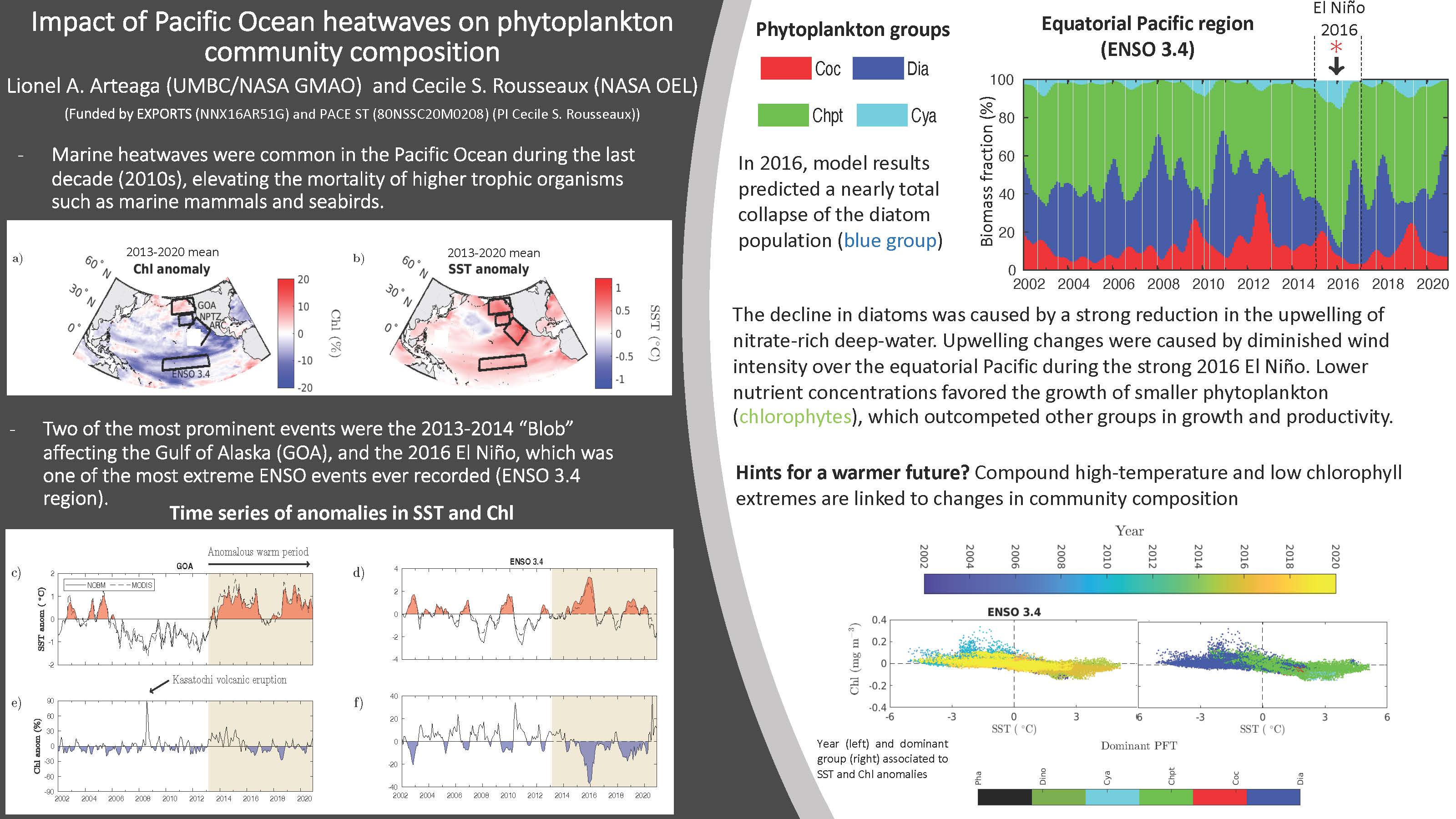
          <div class="html-content"><div><div><a href="https://science.gsfc.nasa.gov/sed/bio/lionel.arteagaquintero" rel="nofollow external" class="bo">Lionel Arteaga</a> (610.1/UMBC) has published a lead author article today in the Nature journal Communications Biology titled "Impact of Pacific Ocean heatwaves on phytoplankton community composition" (<a href="https://doi.org/10.1038/s42003-023-04645-0" rel="nofollow external" class="bo">doi:10.1038/s42003-023-04645-0</a>). Dr. Arteaga provided this summary and corresponding slide (credit: L. Arteaga):</div><div><br></div><div>"Since 2013, marine heatwaves have become recurrent throughout the equatorial and northeastern Pacific Ocean and are expected to increase in intensity relative to historic norms. Among the ecological ramifications associated with these high temperature anomalies are increased mortality of higher trophic organisms such as marine mammals and seabirds, which are likely triggered by changes in the composition of phytoplankton, the base of the marine trophic food web. Here, we combine NASA's biogeochemical modelling and satellite imagery to reveal community level shifts in phytoplankton composition during northeastern and equatorial Pacific Ocean warming events of the last decade (2010s). In the Gulf of Alaska, the expansion of the marine heatwave known as the "Blob" in 2014 altered the transport of nutrients sustaining phytoplankton growth, causing a decline in large and silica-dependent diatoms in favor of smaller phytoplankton groups. A more dramatic change was observed in the equatorial Pacific, where the extreme warm conditions of the 2016 El Nino resulted in a major decline of about 40% in surface chlorophyll, which was associated with a nearly total collapse in diatoms. These changes in community composition could signify an important reduction in the production and export of organic carbon that sustains marine ecosystems and regulates atmospheric carbon dioxide."</div></div><div><br></div><div><img src="https://my3.my.umbc.edu/groups/gestar2/posts/131647/attachments/46453" style="max-width: 100%; height: auto;"></div><div><br></div><div><br></div></div>
      ]]>
    </Body>
    <Summary>Lionel Arteaga (610.1/UMBC) has published a lead author article today in the Nature journal Communications Biology titled "Impact of Pacific Ocean heatwaves on phytoplankton community composition"...</Summary>
    <AttachmentKind>Image</AttachmentKind>
    <AttachmentUrl>https://assets3-dev.my.umbc.edu/system/shared/attachments/f1d01a4d0a81bcdb429f5817157ccad8/69ee746a/news/000/131/647/c1ca185ea0fad2ac9c1e9bf8e21c793e/NPheatPFTS_SummarySlide.jpg?1678721017</AttachmentUrl>
    <Attachments>
      <Attachment kind="Image" url="https://dev.my.umbc.edu/groups/gestar2/posts/131647/attachments/46453"></Attachment>
    </Attachments>
    <TrackingUrl>https://dev.my.umbc.edu/api/v0/pixel/news/131647/guest@my.umbc.edu/1c28b49d152809896f17691a76c7b73d/api/pixel</TrackingUrl>
    <Tag>gestar2</Tag>
    <Group token="gestar2">Goddard Earth Sciences Technology and Research II</Group>
    <GroupUrl>https://dev.my.umbc.edu/groups/gestar2</GroupUrl>
    <AvatarUrl>https://assets3-dev.my.umbc.edu/system/shared/avatars/groups/000/001/988/1dcee2628d726541e45f1ba8c31afe98/xsmall.png?1645477833</AvatarUrl>
    <AvatarUrl size="original">https://assets1-dev.my.umbc.edu/system/shared/avatars/groups/000/001/988/1dcee2628d726541e45f1ba8c31afe98/original.png?1645477833</AvatarUrl>
    <AvatarUrl size="xxlarge">https://assets1-dev.my.umbc.edu/system/shared/avatars/groups/000/001/988/1dcee2628d726541e45f1ba8c31afe98/xxlarge.png?1645477833</AvatarUrl>
    <AvatarUrl size="xlarge">https://assets4-dev.my.umbc.edu/system/shared/avatars/groups/000/001/988/1dcee2628d726541e45f1ba8c31afe98/xlarge.png?1645477833</AvatarUrl>
    <AvatarUrl size="large">https://assets2-dev.my.umbc.edu/system/shared/avatars/groups/000/001/988/1dcee2628d726541e45f1ba8c31afe98/large.png?1645477833</AvatarUrl>
    <AvatarUrl size="medium">https://assets4-dev.my.umbc.edu/system/shared/avatars/groups/000/001/988/1dcee2628d726541e45f1ba8c31afe98/medium.png?1645477833</AvatarUrl>
    <AvatarUrl size="small">https://assets1-dev.my.umbc.edu/system/shared/avatars/groups/000/001/988/1dcee2628d726541e45f1ba8c31afe98/small.png?1645477833</AvatarUrl>
    <AvatarUrl size="xsmall">https://assets3-dev.my.umbc.edu/system/shared/avatars/groups/000/001/988/1dcee2628d726541e45f1ba8c31afe98/xsmall.png?1645477833</AvatarUrl>
    <AvatarUrl size="xxsmall">https://assets3-dev.my.umbc.edu/system/shared/avatars/groups/000/001/988/1dcee2628d726541e45f1ba8c31afe98/xxsmall.png?1645477833</AvatarUrl>
    <Sponsor>Goddard Earth Sciences Technology and Research II</Sponsor>
    <ThumbnailUrl size="xxlarge">https://assets2-dev.my.umbc.edu/system/shared/thumbnails/news/000/131/647/48106e38e5607ee441890b481fecdc2a/xxlarge.jpg?1678722943</ThumbnailUrl>
    <ThumbnailUrl size="xlarge">https://assets3-dev.my.umbc.edu/system/shared/thumbnails/news/000/131/647/48106e38e5607ee441890b481fecdc2a/xlarge.jpg?1678722943</ThumbnailUrl>
    <ThumbnailUrl size="large">https://assets1-dev.my.umbc.edu/system/shared/thumbnails/news/000/131/647/48106e38e5607ee441890b481fecdc2a/large.jpg?1678722943</ThumbnailUrl>
    <ThumbnailUrl size="medium">https://assets2-dev.my.umbc.edu/system/shared/thumbnails/news/000/131/647/48106e38e5607ee441890b481fecdc2a/medium.jpg?1678722943</ThumbnailUrl>
    <ThumbnailUrl size="small">https://assets3-dev.my.umbc.edu/system/shared/thumbnails/news/000/131/647/48106e38e5607ee441890b481fecdc2a/small.jpg?1678722943</ThumbnailUrl>
    <ThumbnailUrl size="xsmall">https://assets2-dev.my.umbc.edu/system/shared/thumbnails/news/000/131/647/48106e38e5607ee441890b481fecdc2a/xsmall.jpg?1678722943</ThumbnailUrl>
    <ThumbnailUrl size="xxsmall">https://assets3-dev.my.umbc.edu/system/shared/thumbnails/news/000/131/647/48106e38e5607ee441890b481fecdc2a/xxsmall.jpg?1678722943</ThumbnailUrl>
    <PawCount>1</PawCount>
    <CommentCount>0</CommentCount>
    <CommentsAllowed>false</CommentsAllowed>
    <PostedAt>Mon, 13 Mar 2023 12:09:12 -0400</PostedAt>
  </NewsItem>
  <NewsItem contentIssues="true" id="131454" important="false" status="posted" url="https://dev.my.umbc.edu/groups/gestar2/posts/131454">
  <Title>GESTAR II Seminar Series, March 9th at 11:00am</Title>
  <Body>
    <![CDATA[
    <div class="html-content"><div>Join us for a virtual seminar by <a href="https://clementguilloteau.wixsite.com/home" rel="nofollow external" class="bo">Dr. Clement Guilloteau</a>, Research Scientist, University of California Irvine. His talk is titled "The representation of extremes in global precipitation records: a scale issue."</div><div><br></div><div>Date and Time: Thursday, March 9, 2023 at 11:00am</div><div><span>Join us via <a href="https://teams.microsoft.com/l/meetup-join/19%3ameeting_YWU3Y2RlNTAtOGUzMS00OWViLWEyZjEtYWI4MzVhY2RmNjMx%40thread.v2/0?context=%7b%22Tid%22%3a%227005d458-45be-48ae-8140-d43da96dd17b%22%2c%22Oid%22%3a%22c58e54ca-3561-4059-bb24-a8af64733329%22%7d" rel="nofollow external" class="bo">Teams</a>.</span></div><div><br></div><div>Abstract: </div><div><div>In the global monitoring of precipitation, extreme high values, even if relatively infrequent, are of particular interest to the research community, because of their strong hydrological and climatological impact and their impact on human activities. Moreover, the uncertainty regarding their evolution under a changing climate reinforces the necessity to have accurate measurements and records of precipitation extremes all around the globe. Global atmospheric models lack accuracy in reproducing precipitation extremes at scales relevant for decision making (sub-daily and sub-meso). The same applies to global observational precipitation products derived from gauges and/or satellite observations. Indeed, the information content of satellite-measured radiances and the limited spatio-temporal sampling allowed by the constellation of precipitation-relevant passive sensors does not always allow accurate deterministic mapping of extreme precipitation rates at resolution one degree and one day or finer. The global network of operational rain gauges also generally lacks the required density to produce accurate estimates of extreme precipitation amounts at these fine scales. Consequently, the many available global precipitation records are largely inconsistent with each other when it comes to precipitation extremes.</div><div><br></div><div>Moreover, the existing global precipitation estimates are generally designed to have minimal variance of their residual errors (minimum MSE estimates) or to produce the most likely estimate given the observations (maximum likelihood estimates). These types of estimators tend to produce smooth estimates and compress the dynamical range of the target variable, they don't preserve its statistical distribution and systematically underrepresent the occurrence of extremes. We discuss alternate techniques and optimization criteria for the statistical preservation of extremes in estimation products within a deep-learning framework. We also discuss the fact that the preservation of extremes must be assessed as a multiscale problem; indeed, preserving or correcting the statistical distribution of precipitation rates at the pixel level (i.e., at the native resolution of the estimate) does not guarantee that the distribution will be preserved at coarser aggregated scales. To preserve extremes across all scales one must consider the multiscale structure of precipitation fields and their spatial and temporal autocorrelation.</div></div><div><br></div><div>Biography:</div><div>Clement Guilloteau is an associate research scientist in the Department of Civil and Environmental Engineering at the University of California Irvine (UCI). His research, focusing on satellite hydrometeorology, with particular emphasis on the spatio-temporal dynamics and multiscale structure of storm systems, is funded by the NASA GPM program. He received his Ph.D. degree in atmospheric sciences from the University of Toulouse, France, in 2016. He has been a postdoctoral scholar at the UCI from 2017 to 2022 and an associate research scientist since 2023.</div><div><br></div><div>For more information on the GESTAR II Seminar Series, click <a href="https://gestar2.umbc.edu/gestar-ii-seminar-series/" rel="nofollow external" class="bo">here</a>.</div></div>
]]>
  </Body>
  <Summary>Join us for a virtual seminar by Dr. Clement Guilloteau, Research Scientist, University of California Irvine. His talk is titled "The representation of extremes in global precipitation records: a...</Summary>
  <TrackingUrl>https://dev.my.umbc.edu/api/v0/pixel/news/131454/guest@my.umbc.edu/9f67fa1bd314172fff454ddd64cb5afd/api/pixel</TrackingUrl>
  <Tag>gestar2</Tag>
  <Group token="gestar2">Goddard Earth Sciences Technology and Research II</Group>
  <GroupUrl>https://dev.my.umbc.edu/groups/gestar2</GroupUrl>
  <AvatarUrl>https://assets3-dev.my.umbc.edu/system/shared/avatars/groups/000/001/988/1dcee2628d726541e45f1ba8c31afe98/xsmall.png?1645477833</AvatarUrl>
  <AvatarUrl size="original">https://assets1-dev.my.umbc.edu/system/shared/avatars/groups/000/001/988/1dcee2628d726541e45f1ba8c31afe98/original.png?1645477833</AvatarUrl>
  <AvatarUrl size="xxlarge">https://assets1-dev.my.umbc.edu/system/shared/avatars/groups/000/001/988/1dcee2628d726541e45f1ba8c31afe98/xxlarge.png?1645477833</AvatarUrl>
  <AvatarUrl size="xlarge">https://assets4-dev.my.umbc.edu/system/shared/avatars/groups/000/001/988/1dcee2628d726541e45f1ba8c31afe98/xlarge.png?1645477833</AvatarUrl>
  <AvatarUrl size="large">https://assets2-dev.my.umbc.edu/system/shared/avatars/groups/000/001/988/1dcee2628d726541e45f1ba8c31afe98/large.png?1645477833</AvatarUrl>
  <AvatarUrl size="medium">https://assets4-dev.my.umbc.edu/system/shared/avatars/groups/000/001/988/1dcee2628d726541e45f1ba8c31afe98/medium.png?1645477833</AvatarUrl>
  <AvatarUrl size="small">https://assets1-dev.my.umbc.edu/system/shared/avatars/groups/000/001/988/1dcee2628d726541e45f1ba8c31afe98/small.png?1645477833</AvatarUrl>
  <AvatarUrl size="xsmall">https://assets3-dev.my.umbc.edu/system/shared/avatars/groups/000/001/988/1dcee2628d726541e45f1ba8c31afe98/xsmall.png?1645477833</AvatarUrl>
  <AvatarUrl size="xxsmall">https://assets3-dev.my.umbc.edu/system/shared/avatars/groups/000/001/988/1dcee2628d726541e45f1ba8c31afe98/xxsmall.png?1645477833</AvatarUrl>
  <Sponsor>Goddard Earth Sciences Technology and Research II</Sponsor>
  <ThumbnailUrl size="xxlarge">https://assets1-dev.my.umbc.edu/system/shared/thumbnails/news/000/131/454/b2541c8e6d2e56eeaf578dfc3752180d/xxlarge.jpg?1677876950</ThumbnailUrl>
  <ThumbnailUrl size="xlarge">https://assets1-dev.my.umbc.edu/system/shared/thumbnails/news/000/131/454/b2541c8e6d2e56eeaf578dfc3752180d/xlarge.jpg?1677876950</ThumbnailUrl>
  <ThumbnailUrl size="large">https://assets1-dev.my.umbc.edu/system/shared/thumbnails/news/000/131/454/b2541c8e6d2e56eeaf578dfc3752180d/large.jpg?1677876950</ThumbnailUrl>
  <ThumbnailUrl size="medium">https://assets3-dev.my.umbc.edu/system/shared/thumbnails/news/000/131/454/b2541c8e6d2e56eeaf578dfc3752180d/medium.jpg?1677876950</ThumbnailUrl>
  <ThumbnailUrl size="small">https://assets2-dev.my.umbc.edu/system/shared/thumbnails/news/000/131/454/b2541c8e6d2e56eeaf578dfc3752180d/small.jpg?1677876950</ThumbnailUrl>
  <ThumbnailUrl size="xsmall">https://assets2-dev.my.umbc.edu/system/shared/thumbnails/news/000/131/454/b2541c8e6d2e56eeaf578dfc3752180d/xsmall.jpg?1677876950</ThumbnailUrl>
  <ThumbnailUrl size="xxsmall">https://assets2-dev.my.umbc.edu/system/shared/thumbnails/news/000/131/454/b2541c8e6d2e56eeaf578dfc3752180d/xxsmall.jpg?1677876950</ThumbnailUrl>
  <PawCount>0</PawCount>
  <CommentCount>0</CommentCount>
  <CommentsAllowed>false</CommentsAllowed>
  <PostedAt>Fri, 03 Mar 2023 16:00:30 -0500</PostedAt>
</NewsItem>
  <NewsItem contentIssues="true" id="131230" important="false" status="posted" url="https://dev.my.umbc.edu/groups/gestar2/posts/131230">
  <Title>Publications led and co-authored by GESTAR II scientists</Title>
  <Body>
    <![CDATA[
    <div class="html-content">The following are recent select articles with GESTAR II researchers as either lead or co-author(s):<div><br></div><div><div>Dandridge, C., <a href="https://science.gsfc.nasa.gov/sed/bio/thomas.a.stanley" rel="nofollow external" class="bo">Stanley, T.A.</a> (617/UMBC), Kirschbaum, D.B., and Lakshmi, V. (2023), Spatial and Temporal Analysis of Global Landslide Reporting Using a Decade of the Global Landslide Catalog, Sustainability 2023, 15, <a href="https://doi.org/10.3390/su15043323" rel="nofollow external" class="bo">https://doi.org/10.3390/su15043323</a>. </div><div><br></div><div><a href="https://science.gsfc.nasa.gov/sed/bio/cornelius.c.salinas" rel="nofollow external" class="bo">Salinas, C. C. J. H.</a> (613/UMBC), Wu, D. L., <a href="https://science.gsfc.nasa.gov/sed/bio/jae.n.lee" rel="nofollow external" class="bo">Lee, J. N.</a> (613/UMBC), Chang, L. C., Qian, L., and Liu, H. (2023), Aura/MLS observes and SD-WACCM-X simulates the seasonality, quasi-biennial oscillation and El Nino-Southern Oscillation of the migrating diurnal tide driving upper mesospheric CO primarily through vertical advection, Atmos. Chem. Phys., 23, <a href="https://doi.org/10.5194/acp-23-1705-2023" rel="nofollow external" class="bo">https://doi.org/10.5194/acp-23-1705-2023</a>.</div><div><br></div><div><a href="https://science.gsfc.nasa.gov/sed/bio/andrew.sayer" rel="nofollow external" class="bo">Sayer, A. M.</a> (616/UMBC), Lelli, L., Cairns, B., van Diedenhoven, B., Ibrahim, A., Knobelspiesse, K. D., <a href="https://science.gsfc.nasa.gov/sed/bio/sergey.v.korkin" rel="nofollow external" class="bo">Korkin, S.</a> (613/UMBC), and Werdell, P. J. (2023), The CHROMA cloud-top pressure retrieval algorithm for the Plankton, Aerosol, Cloud, ocean Ecosystem (PACE) satellite mission, Atmos. Meas. Tech., 16, <a href="https://doi.org/10.5194/amt-16-969-2023" rel="nofollow external" class="bo">https://doi.org/10.5194/amt-16-969-2023</a>.</div></div><div><br></div><div><div>Wargan, K., <a href="https://sciences.gsfc.nasa.gov/sed/bio/brad.weir" rel="nofollow external" class="bo">Weir, B.</a> (610.1/MSU), Manney, G. L., Cohn, S. E., <a href="https://science.gsfc.nasa.gov/sed/bio/k.e.knowland" rel="nofollow external" class="bo">Knowland,</a> <a href="https://science.gsfc.nasa.gov/sed/bio/k.e.knowland" rel="nofollow external" class="bo">K. E.</a>  (610.1/MSU), <a href="https://science.gsfc.nasa.gov/sed/bio/pamela.a.wales" rel="nofollow external" class="bo">Wales, P. A.</a> (610.1/MSU), and Livesey, N. J. (2023), M2-SCREAM: A stratospheric composition reanalysis of Aura MLS data with MERRA-2 transport, Earth Space Sci., <a href="https://doi.org/10.1029/2022EA002632" rel="nofollow external" class="bo">https://doi.org/10.1029/2022EA002632</a>.</div></div><div><br></div></div>
]]>
  </Body>
  <Summary>The following are recent select articles with GESTAR II researchers as either lead or co-author(s):     Dandridge, C., Stanley, T.A. (617/UMBC), Kirschbaum, D.B., and Lakshmi, V. (2023), Spatial...</Summary>
  <TrackingUrl>https://dev.my.umbc.edu/api/v0/pixel/news/131230/guest@my.umbc.edu/e05d41195f1bf992804d0f1811bdda6c/api/pixel</TrackingUrl>
  <Tag>gestar2</Tag>
  <Group token="gestar2">Goddard Earth Sciences Technology and Research II</Group>
  <GroupUrl>https://dev.my.umbc.edu/groups/gestar2</GroupUrl>
  <AvatarUrl>https://assets3-dev.my.umbc.edu/system/shared/avatars/groups/000/001/988/1dcee2628d726541e45f1ba8c31afe98/xsmall.png?1645477833</AvatarUrl>
  <AvatarUrl size="original">https://assets1-dev.my.umbc.edu/system/shared/avatars/groups/000/001/988/1dcee2628d726541e45f1ba8c31afe98/original.png?1645477833</AvatarUrl>
  <AvatarUrl size="xxlarge">https://assets1-dev.my.umbc.edu/system/shared/avatars/groups/000/001/988/1dcee2628d726541e45f1ba8c31afe98/xxlarge.png?1645477833</AvatarUrl>
  <AvatarUrl size="xlarge">https://assets4-dev.my.umbc.edu/system/shared/avatars/groups/000/001/988/1dcee2628d726541e45f1ba8c31afe98/xlarge.png?1645477833</AvatarUrl>
  <AvatarUrl size="large">https://assets2-dev.my.umbc.edu/system/shared/avatars/groups/000/001/988/1dcee2628d726541e45f1ba8c31afe98/large.png?1645477833</AvatarUrl>
  <AvatarUrl size="medium">https://assets4-dev.my.umbc.edu/system/shared/avatars/groups/000/001/988/1dcee2628d726541e45f1ba8c31afe98/medium.png?1645477833</AvatarUrl>
  <AvatarUrl size="small">https://assets1-dev.my.umbc.edu/system/shared/avatars/groups/000/001/988/1dcee2628d726541e45f1ba8c31afe98/small.png?1645477833</AvatarUrl>
  <AvatarUrl size="xsmall">https://assets3-dev.my.umbc.edu/system/shared/avatars/groups/000/001/988/1dcee2628d726541e45f1ba8c31afe98/xsmall.png?1645477833</AvatarUrl>
  <AvatarUrl size="xxsmall">https://assets3-dev.my.umbc.edu/system/shared/avatars/groups/000/001/988/1dcee2628d726541e45f1ba8c31afe98/xxsmall.png?1645477833</AvatarUrl>
  <Sponsor>Goddard Earth Sciences Technology and Research II</Sponsor>
  <ThumbnailUrl size="xxlarge">https://assets2-dev.my.umbc.edu/system/shared/thumbnails/news/000/131/230/1b516fbad59bff2cc6804d9cc94d1cda/xxlarge.jpg?1677265109</ThumbnailUrl>
  <ThumbnailUrl size="xlarge">https://assets4-dev.my.umbc.edu/system/shared/thumbnails/news/000/131/230/1b516fbad59bff2cc6804d9cc94d1cda/xlarge.jpg?1677265109</ThumbnailUrl>
  <ThumbnailUrl size="large">https://assets1-dev.my.umbc.edu/system/shared/thumbnails/news/000/131/230/1b516fbad59bff2cc6804d9cc94d1cda/large.jpg?1677265109</ThumbnailUrl>
  <ThumbnailUrl size="medium">https://assets2-dev.my.umbc.edu/system/shared/thumbnails/news/000/131/230/1b516fbad59bff2cc6804d9cc94d1cda/medium.jpg?1677265109</ThumbnailUrl>
  <ThumbnailUrl size="small">https://assets1-dev.my.umbc.edu/system/shared/thumbnails/news/000/131/230/1b516fbad59bff2cc6804d9cc94d1cda/small.jpg?1677265109</ThumbnailUrl>
  <ThumbnailUrl size="xsmall">https://assets4-dev.my.umbc.edu/system/shared/thumbnails/news/000/131/230/1b516fbad59bff2cc6804d9cc94d1cda/xsmall.jpg?1677265109</ThumbnailUrl>
  <ThumbnailUrl size="xxsmall">https://assets2-dev.my.umbc.edu/system/shared/thumbnails/news/000/131/230/1b516fbad59bff2cc6804d9cc94d1cda/xxsmall.jpg?1677265109</ThumbnailUrl>
  <PawCount>0</PawCount>
  <CommentCount>0</CommentCount>
  <CommentsAllowed>false</CommentsAllowed>
  <PostedAt>Fri, 24 Feb 2023 13:58:56 -0500</PostedAt>
</NewsItem>
</News>