iHARP at FAIR in ML, AI Readiness & Reproducibility (FARR) Workshop
Ensuring research reproducibilty for lasting impact
iHARP is honored to have participated as both a sponsor and presenter at the FAIR in ML, AI Readiness & Reproducibility (FARR) Workshop, held in Washington, D.C., on April 8–9. We want to thank the leadership behind FARR for organizing an amazing and impactful workshop: Christine Kirkpatrick, Julie Christopher, Kevin Coakley, Daniel S. Katz, Douglas Rao, Lynne Schreiber, and Karen Stocks. The workshop was a resounding success, highlighting the critical importance of implementing and promoting data practices that ensure reproducible research across the AI, Data, and ML domains.
Key Highlights from the Workshop:
-
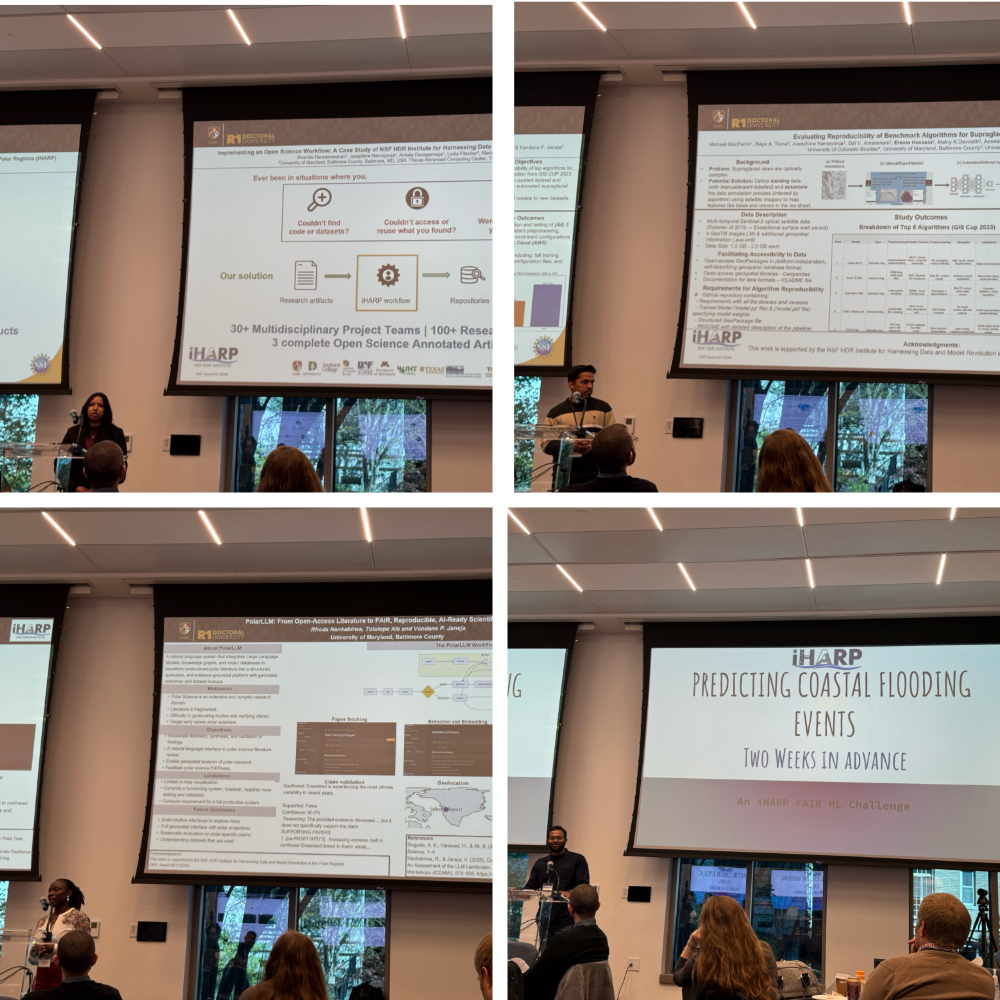
Poster Flash Talks: Mostafa Cham, Achala Denagamage, Emam Hossain, Ellie Davidson and Rhoda Nankabirwa presented flash talks on a diverse range of topics, including implementing Open Science workflows, AI-ready and reproducible data, and evaluating the reproducibility of benchmark algorithms.
-
The 2nd FAIR HDR ML Challenge: This session, co-led by three HDR centers—iHARP, A3D3, and Imageomics—offered attendees a deep dive into the complexities of managing a multi-faceted ML competition guided by FAIR principles. This year’s theme, Scientific Modeling out of Distribution (Scientific-Mood), featured distinct datasets curated by each institution to reflect their specific research areas.During the session, awards were presented to the winners of each individual sub-challenge as well as the overall grand prize winner.
Winner: iHARP would like to extend a huge congratulations to Dony Darmawan Putra for taking first place sub-challenge on its challenge: Predicting Coastal Flooding Events.
We would like to acknowledge and thank the leadership team who designed and ran iHARP’s challenge: Dr. Josephine Namayanja, Dr. Ratnaksha Lele, Dr. Aneesh Subramanian, Dr. Bayu Adhi Tama, and Dr. Vandana Janeja.
Our gratitude also goes to our dedicated support team who worked tirelessly behind the scenes: Sai Vikas Amaraneni, Emam Hossain, Dr. Maloy Kumar Devnath, and Subhankar Ghosh.
Being part of a mission focused on Findable, Accessible, Interoperable, and Reusable (FAIR) practices is vital to our work. These standards ensure that iHARP’s research breakthroughs remain accessible and maintain a lasting impact on the scientific community.
]]>
iHARP is honored to have participated as both a sponsor and presenter at the FAIR in ML, AI Readiness & Reproducibility (FARR) Workshop, held in Washington, D.C., on April 8–9. We want to...
Inline Image
https://assets2-dev.my.umbc.edu/system/shared/attachments/ada3acb56e87313d339ecfe419b39e70/69f4a5b9/news/000/158/921/4f141868f35ccdb63a508658bed4981b/Express-collage.png?1776456396
https://dev.my.umbc.edu/api/v0/pixel/news/158921/guest@my.umbc.edu/db08dc607b003b288abe2867ff8cff8c/api/pixel
iharp
iHARP
https://dev.my.umbc.edu/groups/iharp
https://assets2-dev.my.umbc.edu/system/shared/avatars/groups/000/002/011/5a4b2df3e2c5e51353edce5eaef18479/xsmall.png?1663786838
https://assets4-dev.my.umbc.edu/system/shared/avatars/groups/000/002/011/5a4b2df3e2c5e51353edce5eaef18479/original.png?1663786838
https://assets4-dev.my.umbc.edu/system/shared/avatars/groups/000/002/011/5a4b2df3e2c5e51353edce5eaef18479/xxlarge.png?1663786838
https://assets2-dev.my.umbc.edu/system/shared/avatars/groups/000/002/011/5a4b2df3e2c5e51353edce5eaef18479/xlarge.png?1663786838
https://assets3-dev.my.umbc.edu/system/shared/avatars/groups/000/002/011/5a4b2df3e2c5e51353edce5eaef18479/large.png?1663786838
https://assets1-dev.my.umbc.edu/system/shared/avatars/groups/000/002/011/5a4b2df3e2c5e51353edce5eaef18479/medium.png?1663786838
https://assets4-dev.my.umbc.edu/system/shared/avatars/groups/000/002/011/5a4b2df3e2c5e51353edce5eaef18479/small.png?1663786838
https://assets2-dev.my.umbc.edu/system/shared/avatars/groups/000/002/011/5a4b2df3e2c5e51353edce5eaef18479/xsmall.png?1663786838
https://assets3-dev.my.umbc.edu/system/shared/avatars/groups/000/002/011/5a4b2df3e2c5e51353edce5eaef18479/xxsmall.png?1663786838
iHARP
https://assets1-dev.my.umbc.edu/system/shared/thumbnails/news/000/158/921/e06663912d58c5fbb28ecd4c00ffb3d6/xxlarge.jpg?1776455622
https://assets4-dev.my.umbc.edu/system/shared/thumbnails/news/000/158/921/e06663912d58c5fbb28ecd4c00ffb3d6/xlarge.jpg?1776455622
https://assets3-dev.my.umbc.edu/system/shared/thumbnails/news/000/158/921/e06663912d58c5fbb28ecd4c00ffb3d6/large.jpg?1776455622
https://assets2-dev.my.umbc.edu/system/shared/thumbnails/news/000/158/921/e06663912d58c5fbb28ecd4c00ffb3d6/medium.jpg?1776455622
https://assets4-dev.my.umbc.edu/system/shared/thumbnails/news/000/158/921/e06663912d58c5fbb28ecd4c00ffb3d6/small.jpg?1776455622
https://assets4-dev.my.umbc.edu/system/shared/thumbnails/news/000/158/921/e06663912d58c5fbb28ecd4c00ffb3d6/xsmall.jpg?1776455622
https://assets2-dev.my.umbc.edu/system/shared/thumbnails/news/000/158/921/e06663912d58c5fbb28ecd4c00ffb3d6/xxsmall.jpg?1776455622
Seven people standing in a row at the iHARP at FARR workshop at the AGU Conference Center. From left to right: Dr. Vandana Janeja, Achala Denagamage, Dr. Josephine Namayanja, Rhoda Nankabirwa, Sai Vikas Amaraneni, Emam Hossain, and Ellie Davidson.
0
0
true
Fri, 17 Apr 2026 16:08:30 -0400
Akila Sampath Successfully Defends her PhD Dissertation
Congratulations Dr. Akila Sampath
Akila successfully defended on Monday, March 9, 2026
Throughout her time with us, Akila's dedicated contributions have made her an invaluable member of both the iHARP and UMBC communities. This significant achievement is a true testament to her scholarly rigor, hard work, and immense talent.
Congratulations, Akila, on this incredible milestone! We have been honored to witness your growth and look forward to your future successes. The entire iHARP community wishes you the very best as you embark on your next great adventure!
_____________________________
Dissertation Title
Physics-Integrated Deep Learning for Arctic Sea Ice Dynamics
Committee
- Dr. Jianwu Wang, Chair/Advisor (UMBC)
- Dr. Vandana Janeja, Co-Chair (UMBC)
- Dr. Houbing Song (UMBC)
- Dr. James Foulds (UMBC)
- Dr. Donald K Perovich (Dartmouth College)
- Dr. Nicole Schlegel (NOAA)
Abstract
Rapid
and accelerating Arctic climate change poses significant challenges for
artificial intelligence (AI) systems, primarily due to severe data
scarcity, inherent nonlinearities, and complex spatiotemporal
interactions within the ocean–ice–atmosphere system. Conventional deep
learning approaches rely heavily on large data volumes and often lack
physical consistency. Consequently, purely data-driven models may
produce physically implausible predictions and offer limited
interpretability, thereby reducing their utility for scientific
discovery and decision-making. To enable reliable and trustworthy sea
ice prediction, physics-embedded learning architectures are required to
leverage domain-specific priors that encode known physical laws,
constraints, and causal mechanisms.
This
dissertation presents a physics-integrated deep learning framework for
modeling and analyzing the time-series evolution of Arctic sea ice. The
proposed framework systematically combines physical knowledge with
data-driven learning to enhance predictive performance,
interpretability, and scientific validity. Specifically, this work
introduces three complementary strategies for embedding physical
constraints and governing principles directly into the learning process,
each addressing a distinct scientific challenge in Arctic climate
research.
First,
a physics-informed deep learning model is developed for sea ice
thickness prediction by explicitly incorporating thermodynamic
constraints and governing energy-balance laws into the loss function.
This approach ensures that model predictions respect known physical
relationships while remaining flexible enough to learn from sparse
observational data. Second, the dissertation introduces physics-encoded
neural network architectures that embed established physical
relationships directly into the model structure. These architectures
enable the inference of latent physical parameters from noisy,
incomplete proxy data, facilitating physically meaningful representation
learning. Third, knowledge-guided temporal causal models are formulated
to quantify the causal impact of sea ice variability on coupled oceanic
and atmospheric processes. By incorporating time-varying treatments,
causal structural constraints, and physics-based priors, these models
provide interpretable estimates of causal effects that are consistent
with established physical mechanisms rather than spurious correlations.
Across
all evaluation settings, the results demonstrate that
physics-integrated models consistently outperform conventional deep
learning baselines. Overall, this work highlights the critical role of
physics-integrated machine learning in advancing predictive capability,
causal understanding, and trustworthiness in climate and Earth system
modeling.
]]>
Akila successfully defended on Monday, March 9, 2026 Throughout her time with us, Akila's dedicated contributions have made her an invaluable member of both the iHARP and UMBC communities. This...
http://iharp.umbc.edu
https://dev.my.umbc.edu/api/v0/pixel/news/157439/guest@my.umbc.edu/ef3a7cb4d89324da170c966b0a4914ee/api/pixel
iharp
iHARP
https://dev.my.umbc.edu/groups/iharp
https://assets2-dev.my.umbc.edu/system/shared/avatars/groups/000/002/011/5a4b2df3e2c5e51353edce5eaef18479/xsmall.png?1663786838
https://assets4-dev.my.umbc.edu/system/shared/avatars/groups/000/002/011/5a4b2df3e2c5e51353edce5eaef18479/original.png?1663786838
https://assets4-dev.my.umbc.edu/system/shared/avatars/groups/000/002/011/5a4b2df3e2c5e51353edce5eaef18479/xxlarge.png?1663786838
https://assets2-dev.my.umbc.edu/system/shared/avatars/groups/000/002/011/5a4b2df3e2c5e51353edce5eaef18479/xlarge.png?1663786838
https://assets3-dev.my.umbc.edu/system/shared/avatars/groups/000/002/011/5a4b2df3e2c5e51353edce5eaef18479/large.png?1663786838
https://assets1-dev.my.umbc.edu/system/shared/avatars/groups/000/002/011/5a4b2df3e2c5e51353edce5eaef18479/medium.png?1663786838
https://assets4-dev.my.umbc.edu/system/shared/avatars/groups/000/002/011/5a4b2df3e2c5e51353edce5eaef18479/small.png?1663786838
https://assets2-dev.my.umbc.edu/system/shared/avatars/groups/000/002/011/5a4b2df3e2c5e51353edce5eaef18479/xsmall.png?1663786838
https://assets3-dev.my.umbc.edu/system/shared/avatars/groups/000/002/011/5a4b2df3e2c5e51353edce5eaef18479/xxsmall.png?1663786838
iHARP
https://assets3-dev.my.umbc.edu/system/shared/thumbnails/news/000/157/439/c40abdf206c0ecfb282ff92a7365fd20/xxlarge.jpg?1773333421
https://assets1-dev.my.umbc.edu/system/shared/thumbnails/news/000/157/439/c40abdf206c0ecfb282ff92a7365fd20/xlarge.jpg?1773333421
https://assets4-dev.my.umbc.edu/system/shared/thumbnails/news/000/157/439/c40abdf206c0ecfb282ff92a7365fd20/large.jpg?1773333421
https://assets3-dev.my.umbc.edu/system/shared/thumbnails/news/000/157/439/c40abdf206c0ecfb282ff92a7365fd20/medium.jpg?1773333421
https://assets3-dev.my.umbc.edu/system/shared/thumbnails/news/000/157/439/c40abdf206c0ecfb282ff92a7365fd20/small.jpg?1773333421
https://assets3-dev.my.umbc.edu/system/shared/thumbnails/news/000/157/439/c40abdf206c0ecfb282ff92a7365fd20/xsmall.jpg?1773333421
https://assets1-dev.my.umbc.edu/system/shared/thumbnails/news/000/157/439/c40abdf206c0ecfb282ff92a7365fd20/xxsmall.jpg?1773333421
Announcement graphic titled "Akila Sampath Successfully Defends her PhD Dissertation." The image shows a grid of six people in a virtual meeting, including Akila and committee members Dr. Jianwu Wang, Dr. James Foulds, Dr. Nicole Schlegel, Dr. Houbing Song, and Dr. Donald K. Perovich. Logos for UMBC, R1 Doctoral University, and iHARP are at the bottom.
0
0
true
Thu, 12 Mar 2026 12:45:23 -0400
Tolulope Ale Successfully Defends His PhD Dissertation
Congratulations Dr. Tolulope Ale
Tolulope (Tolu) successfully defended on Tuesday, November 18, 2025.
Tolu's dedicated contributions have made him an invaluable member of the iHARP and UMBC community. Following 3 successful internships with NASA GESTAR II, Amazon, and
Microsoft, Tolu has secured a full-time Microsoft Data Scientist
position commencing in 2026., This significant achievement is a testament to his hard work and talent.
Congratulations, Tolu, on this incredible accomplishment! We look forward to your continued growth and success. The entire iHARP community wishes you great success in your next adventure!
_____________________________
Dissertation Title
MULTIVARIATE EXPLAINABLE ANOMALY DETECTION WITH UNCERTAINTY ESTIMATION IN CLIMATE DATA
Committee
Dr Vandana Janeja, UMBC, Advisor/Chair
Dr. Jianwu Wang, UMBC
Dr. Patricia (Patti) Ordóñez, UMBC
Dr. Nicole Schlegel, NOAA
Dr. Sudip Chakraborty, iHARP/ UMBC,
Dr. Ratnaksha Lele, iHARP/ UMBC
Abstract
The multivariate time-series analysis of climate data represents a
crucial yet underexplored field. This is particularly relevant when
examining extreme climate events, such as snow melting in polar regions,
which require consideration of multiple variables to accurately capture
climate extremes. Anomalies in climate data often result from the
interplay of several variables, meaning that what appears anomalous
under univariate analysis may in fact, align with expected patterns once
contextualized within a multivariate framework. This approach more
accurately reflects the interconnected nature of real-world phenomena,
where events seldom occur in isolation. Despite advances in deep
learning for anomaly detection, very few efforts have focused on
analyzing multivariate climate data; this may be due to the lack of
comprehensive annotations and the complexity of climate variables.
Additionally, a significant limitation of existing anomaly detection
algorithms is their lack of explainability, especially in climate data,
where it is crucial to pinpoint which variable most significantly
influences an anomaly score. Beyond merely identifying anomalies, it is
vital to determine the primary variables driving them, enabling targeted
strategies to mitigate such occurrences in the climate domain.
We
first propose a Variational Autoencoder (VAE)-based anomaly detection
framework called Cluster-LSTM-VAE (CLV) that leveraged correlation-based
feature clustering and dynamic thresholding, to capture localized
dependencies and complex variable interactions across time. To provide
explainability, we develop an unsupervised attribution framework
grounded in a counterfactual explanation method to determine variables
contributing most to detected anomalies. This approach identifies which
climate drivers significantly contribute to anomalous melt events. We
further extend our framework to include a comprehensive
uncertainty-aware anomaly-detection module. By integrating
Three-Cornered-Hat (3CH) error-variance, we estimate data uncertainty
and propagate it through the detection pipeline to learn from uncertain
data while maintaining reliability.
We performed a comparative
evaluation across multiple climate model to demonstrate the performance
of the end-to-end pipeline. The results provide robust insights into the
simulation of ice-sheet surface melt dynamics, highlighting the
reliability of the climate models in representing snow-melt evolution.
Overall,
this dissertation delivers a unified framework for detecting,
explaining, and quantifying uncertainty in climate anomalies, providing a
scalable, interpretable approach for Earth system monitoring. The
proposed methods not only offer methodological innovations for machine
learning in environmental science but also hold practical implications
for policymakers and stakeholders in climate analysis and adaptation
planning.
]]>
Tolulope (Tolu) successfully defended on Tuesday, November 18, 2025. Tolu's dedicated contributions have made him an invaluable member of the iHARP and UMBC community. Following 3 successful...
http://iharp.umbc.edu
https://dev.my.umbc.edu/api/v0/pixel/news/154736/guest@my.umbc.edu/53a8bbc05e47da843cb326771dba3020/api/pixel
iharp
iHARP
https://dev.my.umbc.edu/groups/iharp
https://assets2-dev.my.umbc.edu/system/shared/avatars/groups/000/002/011/5a4b2df3e2c5e51353edce5eaef18479/xsmall.png?1663786838
https://assets4-dev.my.umbc.edu/system/shared/avatars/groups/000/002/011/5a4b2df3e2c5e51353edce5eaef18479/original.png?1663786838
https://assets4-dev.my.umbc.edu/system/shared/avatars/groups/000/002/011/5a4b2df3e2c5e51353edce5eaef18479/xxlarge.png?1663786838
https://assets2-dev.my.umbc.edu/system/shared/avatars/groups/000/002/011/5a4b2df3e2c5e51353edce5eaef18479/xlarge.png?1663786838
https://assets3-dev.my.umbc.edu/system/shared/avatars/groups/000/002/011/5a4b2df3e2c5e51353edce5eaef18479/large.png?1663786838
https://assets1-dev.my.umbc.edu/system/shared/avatars/groups/000/002/011/5a4b2df3e2c5e51353edce5eaef18479/medium.png?1663786838
https://assets4-dev.my.umbc.edu/system/shared/avatars/groups/000/002/011/5a4b2df3e2c5e51353edce5eaef18479/small.png?1663786838
https://assets2-dev.my.umbc.edu/system/shared/avatars/groups/000/002/011/5a4b2df3e2c5e51353edce5eaef18479/xsmall.png?1663786838
https://assets3-dev.my.umbc.edu/system/shared/avatars/groups/000/002/011/5a4b2df3e2c5e51353edce5eaef18479/xxsmall.png?1663786838
iHARP
https://assets3-dev.my.umbc.edu/system/shared/thumbnails/news/000/154/736/d2f972fd979943c1ac6d5b9dac5c444e/xxlarge.jpg?1763650282
https://assets2-dev.my.umbc.edu/system/shared/thumbnails/news/000/154/736/d2f972fd979943c1ac6d5b9dac5c444e/xlarge.jpg?1763650282
https://assets4-dev.my.umbc.edu/system/shared/thumbnails/news/000/154/736/d2f972fd979943c1ac6d5b9dac5c444e/large.jpg?1763650282
https://assets3-dev.my.umbc.edu/system/shared/thumbnails/news/000/154/736/d2f972fd979943c1ac6d5b9dac5c444e/medium.jpg?1763650282
https://assets2-dev.my.umbc.edu/system/shared/thumbnails/news/000/154/736/d2f972fd979943c1ac6d5b9dac5c444e/small.jpg?1763650282
https://assets2-dev.my.umbc.edu/system/shared/thumbnails/news/000/154/736/d2f972fd979943c1ac6d5b9dac5c444e/xsmall.jpg?1763650282
https://assets1-dev.my.umbc.edu/system/shared/thumbnails/news/000/154/736/d2f972fd979943c1ac6d5b9dac5c444e/xxsmall.jpg?1763650282
Left to right: Dr. Vandana Janeja, Tolulope Ale
On Screen Top (L to R) : Dr. Ratnaksha Lele, Dr. Nicole Schlegel
On screen bottom: Dr. Jianwu Wang
Left to Right: Dr. Sudip Chakraborty, Dr. Patricia Ordóñez
1
0
true
Thu, 20 Nov 2025 10:10:44 -0500
Thu, 20 Nov 2025 10:51:26 -0500
Maloy Kumar Devnath Successfully Defends His PhD Dissertation
Congratulations Dr. Maloy Kumar Devnath
Maloy successfully defended on Tuesday, November 11, 2025. Maloy has been an invaluable and dedicated member of the iHARP and UMBC community. We look forward to seeing what he does next!
Congratulations to Maloy on all of his hard work!!! iHARP wishes him great success in his next adventure!
_____________________________
Dissertation Title
Exploring the Relationship Between Sea Ice Retreat and Ice Sheet Melting in the Antarctic
Committee
- Dr. Vandana P. Janeja, Chair/Advisor, Department of Information Systems, University of Maryland, Baltimore County
- Dr. Sudip Chakraborty, Co-Chair/Co-Advisor, iHARP, University of Maryland, Baltimore County
- Dr. James Foulds, Department of Information Systems, University of Maryland, Baltimore County
- Dr. Jianwu Wang, Department of Information Systems, University of Maryland, Baltimore County
- Dr. Md Osman Gani, Department of Information Systems, University of Maryland, Baltimore County
- Dr. Aneesh Subramanian, Department of Atmospheric and Oceanic Sciences, University of Colorado Boulder
Abstract
The Antarctic region holds 90% of the Earth's freshwater. Antarctica's ice mass has been diminishing rapidly, with an estimated average loss of approximately ∼ 146 billion tons annually since 2002, according to the satellite measurements. The reduction in sea ice extent raises critical questions about its repercussions on ice sheet melting, as sea ice provides a protective barrier separating ice sheets from warm ocean currents and wave action. While Antarctic sea ice has been expanding until 2015, recent trends show a dramatic reversal with record low extents in February 2023. Understanding the relationship between sea ice changes and ice sheet melting is essential for deciphering the broader implications of global sea-level rise, a pressing concern for coastal communities, ecosystems, and policymakers. Furthermore, the nature of the sea ice retreat, especially after 2015, has not been well studied. This is important because anomalous events can retreat sea ice extent at a very high rate within a short period of time and can cause rapid losses by changing in the retreat onset timing, duration, and intensity. To address this, this research develops parameter free machine learning algorithms to detect anomalous melt events, variations in melt onset and duration, and to quantify the linkages or interactions between sea ice retreat and land ice or ice sheet melting. This thesis specifically aims to:
1. Design an effective parameter free machine learning algorithm to detect anomalous sea ice retreat events, which are characterized by negative changes.
2. Study the onset, duration, and intensity of the anomalous and steady state retreat events and how they evolve with time, affecting the sea ice area coverage(or loss in km2).
3. Quantify the linkages between sea ice retreat and ice sheet melting in regions experiencing anomalous melts.
By addressing these questions, this thesis contributes to a comprehensive understanding of the intricate interactions between sea ice retreat and ice sheet melting in the Antarctic region and their broader implications for global sea-level rise. Our study has found that anomalous retreat events, identified through the analysis of satellite images of sea ice extent, have prevailed since 2015 and have contributed significantly to total sea ice retreat. Furthermore, we have detected significant linkages between sea ice retreat and ice sheet melting.
We are pleased to announce the Undergraduate Data Science and AI Scholars program for supporting students in Spring 2026. The Data Science and AI Scholars program welcomes undergraduate scholars from multiple disciplines, including non-STEM majors, who will examine all aspects of data and its impact on society. This year, scholars will have the opportunity to be teaching fellowsor research fellows. Scholars will be able to work on research projects in Climate Science, Deepfake detection, and other data science-related projects.
Students selected through this effort will be part of the Data Science and AI Scholars program, which will be run in partnership withthe Center for Women in Technology (CWIT), the Information Systems Department (IS), and the Center for Social Science Scholarship (CS3).
Selected scholars will be assigned to respective affiliations (CWIT/IS or CS3) depending on the student's major, and the scholars' expectations per affiliation are as follows:
Center for Women in Technology (CWIT) Responsibilities:
Research Fellows
Scholars who will work as research fellows will work on a supervised research project and be mentored by faculty. Scholars will be paid $20.00/hour for specific tasks, for 5 - 10 hours per week.
Scholars will attend at least two events in Spring 2026 and/or participate in research initiatives and professional development for their leadership growth and mentoring. Mentors will coordinate this at CWIT.
Scholars will need to register as CWIT Affiliates to participate in the 2 required events.
Scholars will be required to enroll in a Zero-credit Practicum course on research experience (PRAC 98C) through the UMBC Career Center.
Teaching Fellows
Scholars will work as teaching fellows and peer mentors for undergraduate students in IS 296 - Foundations of Data Science, and support students throughout the course.. The scholars will devote time to mentoring and leadership development efforts for their advancement. The cohort of scholars will meet as a group under the supervision of the IS 296 instructor. Scholars will be paid $20.00/hour for specific tasks, for 5 - 10 hours per week during Spring 2026.
Scholars who will work as teaching fellows will be expected to be available to assist with classes and also present during lectures. Spring 2026 class schedule is as follows: Mondays 4:30 - 7:00 pm (Instructor: Dr. Karen Chen), Mondays 7:10 - 9:40 pm (Instructor: Zehra Zaidi), and Tuesdays 4:30 - 7:00 pm (Instructor: Dr. Neha Singh)
Scholars will be required to attend one mentoring meeting per month with the coordinator
Scholars will be required to enroll in a Zero-credit Practicum course on research experience (PRAC 98C) through the UMBC Career Center.
Center for Social Science Scholarship (CS3) Responsibilities:
Research Fellows
Scholars who will work as research fellows will work on a supervised research project and be mentored by faculty. Scholars will be paid $20.00/hour for specific tasks, for 5 - 10 hours per week.
Scholars will attend at least two events in Spring 2026 and/or participate in research initiatives and professional development for their leadership growth and mentoring. Mentors will coordinate this at CS3.
Scholars will also be expected to attend one mentoring meeting with the faculty.
Scholars will be required to enroll in a Zero-credit Practicum course on research experience (PRAC 98C) through the UMBC Career Center.
Background and Skills:
ALL applicants should have knowledge in AT LEAST ONE of the following:
Analysis of social, behavioral, economic, or geographic data
Python or one of the data science tools and/or languages (such as R, Rapid Miner, Weka, Orange, Knime, ML on cloud computing)
Jupyter Notebooks with Python or taken IS 296 in a prior semester.
Application Form:
Interested students should complete the Google Submission Form,OR access the form using the following link: https://forms.gle/FFUAa5RpDNMGYvTY9 by Friday, November 21, 2025.
Questions:
For questions, please email our team at DataScienceAIScholars@umbc.edu
To learn more about potential projects, please check out the following websites:
]]>
We are pleased to announce the Undergraduate Data Science and AI Scholars program for supporting students in Spring 2026. The Data Science and AI Scholars program welcomes undergraduate scholars...
https://dev.my.umbc.edu/api/v0/pixel/news/154401/guest@my.umbc.edu/1999add0f12a68792ebc3fbe46702c7b/api/pixel
iHARP
https://dev.my.umbc.edu/groups/iharp
https://assets2-dev.my.umbc.edu/system/shared/avatars/groups/000/002/011/5a4b2df3e2c5e51353edce5eaef18479/xsmall.png?1663786838
https://assets4-dev.my.umbc.edu/system/shared/avatars/groups/000/002/011/5a4b2df3e2c5e51353edce5eaef18479/original.png?1663786838
https://assets4-dev.my.umbc.edu/system/shared/avatars/groups/000/002/011/5a4b2df3e2c5e51353edce5eaef18479/xxlarge.png?1663786838
https://assets2-dev.my.umbc.edu/system/shared/avatars/groups/000/002/011/5a4b2df3e2c5e51353edce5eaef18479/xlarge.png?1663786838
https://assets3-dev.my.umbc.edu/system/shared/avatars/groups/000/002/011/5a4b2df3e2c5e51353edce5eaef18479/large.png?1663786838
https://assets1-dev.my.umbc.edu/system/shared/avatars/groups/000/002/011/5a4b2df3e2c5e51353edce5eaef18479/medium.png?1663786838
https://assets4-dev.my.umbc.edu/system/shared/avatars/groups/000/002/011/5a4b2df3e2c5e51353edce5eaef18479/small.png?1663786838
https://assets2-dev.my.umbc.edu/system/shared/avatars/groups/000/002/011/5a4b2df3e2c5e51353edce5eaef18479/xsmall.png?1663786838
https://assets3-dev.my.umbc.edu/system/shared/avatars/groups/000/002/011/5a4b2df3e2c5e51353edce5eaef18479/xxsmall.png?1663786838
iHARP
0
0
true
Mon, 10 Nov 2025 15:35:14 -0500
Get Ready to Hack the Future of Science!
Happening Now: Join us for a Virtual Hackathon
Join this Virtual Hackathon, and put your machine learning skills to the test! You'll be using open scientific data to tackle one of the most exciting challenges in AI: predicting out-of-domain events, actions, and climatic conditions.
Dive into fascinating projects like:
- Beetles as Sentinel Taxa
- Forecasting Monkey Motor Neuron Behavior
- Predicting Coastal Flooding Events
]]>
Join this Virtual Hackathon, and put your machine learning skills to the test! You'll be using open scientific data to tackle one of the most exciting challenges in AI: predicting out-of-domain...
https://lnkd.in/emTB6W4r
Flyer
https://assets1-dev.my.umbc.edu/system/shared/attachments/e34cdde6ca2d8fe63346e81d15c99bd9/69f4a5b9/news/000/154/076/63213c1d674c64aa9e731eae2dfa88a0/Year 2-NSF HDR ML Challenge_Flyer.pdf?1761850436
https://dev.my.umbc.edu/api/v0/pixel/news/154076/guest@my.umbc.edu/1b2f112b1feffec14265521dacb24385/api/pixel
iharp
iHARP
https://dev.my.umbc.edu/groups/iharp
https://assets2-dev.my.umbc.edu/system/shared/avatars/groups/000/002/011/5a4b2df3e2c5e51353edce5eaef18479/xsmall.png?1663786838
https://assets4-dev.my.umbc.edu/system/shared/avatars/groups/000/002/011/5a4b2df3e2c5e51353edce5eaef18479/original.png?1663786838
https://assets4-dev.my.umbc.edu/system/shared/avatars/groups/000/002/011/5a4b2df3e2c5e51353edce5eaef18479/xxlarge.png?1663786838
https://assets2-dev.my.umbc.edu/system/shared/avatars/groups/000/002/011/5a4b2df3e2c5e51353edce5eaef18479/xlarge.png?1663786838
https://assets3-dev.my.umbc.edu/system/shared/avatars/groups/000/002/011/5a4b2df3e2c5e51353edce5eaef18479/large.png?1663786838
https://assets1-dev.my.umbc.edu/system/shared/avatars/groups/000/002/011/5a4b2df3e2c5e51353edce5eaef18479/medium.png?1663786838
https://assets4-dev.my.umbc.edu/system/shared/avatars/groups/000/002/011/5a4b2df3e2c5e51353edce5eaef18479/small.png?1663786838
https://assets2-dev.my.umbc.edu/system/shared/avatars/groups/000/002/011/5a4b2df3e2c5e51353edce5eaef18479/xsmall.png?1663786838
https://assets3-dev.my.umbc.edu/system/shared/avatars/groups/000/002/011/5a4b2df3e2c5e51353edce5eaef18479/xxsmall.png?1663786838
iHARP
https://assets2-dev.my.umbc.edu/system/shared/thumbnails/news/000/154/076/65b60edb968f2213a859317852d0e32a/xxlarge.jpg?1761850220
https://assets2-dev.my.umbc.edu/system/shared/thumbnails/news/000/154/076/65b60edb968f2213a859317852d0e32a/xlarge.jpg?1761850220
https://assets1-dev.my.umbc.edu/system/shared/thumbnails/news/000/154/076/65b60edb968f2213a859317852d0e32a/large.jpg?1761850220
https://assets1-dev.my.umbc.edu/system/shared/thumbnails/news/000/154/076/65b60edb968f2213a859317852d0e32a/medium.jpg?1761850220
https://assets3-dev.my.umbc.edu/system/shared/thumbnails/news/000/154/076/65b60edb968f2213a859317852d0e32a/small.jpg?1761850220
https://assets3-dev.my.umbc.edu/system/shared/thumbnails/news/000/154/076/65b60edb968f2213a859317852d0e32a/xsmall.jpg?1761850220
https://assets4-dev.my.umbc.edu/system/shared/thumbnails/news/000/154/076/65b60edb968f2213a859317852d0e32a/xxsmall.jpg?1761850220
three decorative images to reflect projects
0
0
true
Thu, 30 Oct 2025 14:54:23 -0400
Fri, 14 Nov 2025 10:58:37 -0500
From iHARP to Microsoft: this summer, one of iHARP’s PhD candidates, Tolulope Ale turned research into real-world innovation
Summer Internship Story
This summer, iHARP PhD candidate Tolulope Ale brought his expertise to Microsoft as an intern.
Here's how Tolu summed up his experience: "This summer, I had a fantastic internship experience, supported by the Microsoft mentorship program, which helped me connect with colleagues at every level. I built an LLM customer-engagement chatbot using Semantic Kernel and Azure AI Foundry, with two key features: Brand Persona (responses tailored to a specific brand's voice/tone) and Conversation Style (Brand Persona, Casual, and Gen Z modes selectable by the user). I demoed the solution to my team, a data science group, leadership, and a broader cross-functional audience (DS, SWE, PM, and PMM), and it was very well received. A standout aspect of the design is its easy configurability for new brand use cases with minimal code changes. I also implemented evaluation for each LLM component and added a latency tracker to monitor performance end-to-end."
]]>
This summer, iHARP PhD candidate Tolulope Ale brought his expertise to Microsoft as an intern. Here's how Tolu summed up his experience: "This summer, I had a fantastic internship experience,...
https://dev.my.umbc.edu/api/v0/pixel/news/153190/guest@my.umbc.edu/4b76214625b87a150e3fb98421e40c18/api/pixel
iHARP
https://dev.my.umbc.edu/groups/iharp
https://assets2-dev.my.umbc.edu/system/shared/avatars/groups/000/002/011/5a4b2df3e2c5e51353edce5eaef18479/xsmall.png?1663786838
https://assets4-dev.my.umbc.edu/system/shared/avatars/groups/000/002/011/5a4b2df3e2c5e51353edce5eaef18479/original.png?1663786838
https://assets4-dev.my.umbc.edu/system/shared/avatars/groups/000/002/011/5a4b2df3e2c5e51353edce5eaef18479/xxlarge.png?1663786838
https://assets2-dev.my.umbc.edu/system/shared/avatars/groups/000/002/011/5a4b2df3e2c5e51353edce5eaef18479/xlarge.png?1663786838
https://assets3-dev.my.umbc.edu/system/shared/avatars/groups/000/002/011/5a4b2df3e2c5e51353edce5eaef18479/large.png?1663786838
https://assets1-dev.my.umbc.edu/system/shared/avatars/groups/000/002/011/5a4b2df3e2c5e51353edce5eaef18479/medium.png?1663786838
https://assets4-dev.my.umbc.edu/system/shared/avatars/groups/000/002/011/5a4b2df3e2c5e51353edce5eaef18479/small.png?1663786838
https://assets2-dev.my.umbc.edu/system/shared/avatars/groups/000/002/011/5a4b2df3e2c5e51353edce5eaef18479/xsmall.png?1663786838
https://assets3-dev.my.umbc.edu/system/shared/avatars/groups/000/002/011/5a4b2df3e2c5e51353edce5eaef18479/xxsmall.png?1663786838
iHARP
https://assets1-dev.my.umbc.edu/system/shared/thumbnails/news/000/153/190/760eb5cba918a301036811c1d1aff0c2/xxlarge.jpg?1759431706
https://assets2-dev.my.umbc.edu/system/shared/thumbnails/news/000/153/190/760eb5cba918a301036811c1d1aff0c2/xlarge.jpg?1759431706
https://assets1-dev.my.umbc.edu/system/shared/thumbnails/news/000/153/190/760eb5cba918a301036811c1d1aff0c2/large.jpg?1759431706
https://assets3-dev.my.umbc.edu/system/shared/thumbnails/news/000/153/190/760eb5cba918a301036811c1d1aff0c2/medium.jpg?1759431706
https://assets4-dev.my.umbc.edu/system/shared/thumbnails/news/000/153/190/760eb5cba918a301036811c1d1aff0c2/small.jpg?1759431706
https://assets1-dev.my.umbc.edu/system/shared/thumbnails/news/000/153/190/760eb5cba918a301036811c1d1aff0c2/xsmall.jpg?1759431706
https://assets2-dev.my.umbc.edu/system/shared/thumbnails/news/000/153/190/760eb5cba918a301036811c1d1aff0c2/xxsmall.jpg?1759431706
1
0
true
Thu, 02 Oct 2025 15:03:33 -0400
iHARP Publication Alert - Advancing climate model interpretability: Feature attribution for Arctic melt anomalies
iHARP supported research
Advancing climate model interpretability: Feature attribution for Arctic melt anomalies
Authored by Tolulope Ale (PhD Candidate), Dr. Nicole-Jeanne Schlegel, and Dr. Vandana Janeja
Abstract:
The focus of our work is improving the interpretability of anomalies in climate models and advancing our understanding of Arctic melt dynamics.
The Arctic and Antarctic ice sheets are experiencing rapid surface melting and increased freshwater runoff, contributing significantly to global sea level rise. Understanding the mechanisms driving snowmelt in these regions is crucial. ERA5, a widely used reanalysis dataset in polar climate studies, offers extensive climate variables and global data assimilation. However, its snowmelt model employs an energy imbalance approach that may oversimplify the
complexity of surface melt. In contrast, the Glacier Energy and Mass Balance (GEMB) model incorporates additional physical processes, such as snow accumulation, firn densification, and meltwater percolation/refreezing, providing a more detailed representation of surface melt dynamics.
In this research, we focus on analyzing surface snowmelt dynamics of the Greenland Ice Sheet using feature attribution for anomalous melt events in ERA5 and GEMB models. We present a novel unsupervised attribution method leveraging the counterfactual explanation method to analyze detected anomalies in ERA5 and GEMB. Our anomaly detection results are validated using MEaSUREs ground-truth data, and the attributions are evaluated against established feature ranking methods, including XGBoost, Shapley values, and Random Forest.
Our attribution framework identifies the physics behind each model and the climate features driving melt anomalies. These findings demonstrate the utility of our attribution method in enhancing the interpretability of anomalies in climate models and advancing our understanding of Arctic melt dynamics
Join us in congratulating the authors on their hard work and getting their paper accepted by the IEEE ICDM 2025, 25th IEEE International Conference on Data Mining
]]>
Advancing climate model interpretability: Feature attribution for Arctic melt anomalies Authored by Tolulope Ale (PhD Candidate), Dr. Nicole-Jeanne Schlegel, and Dr. Vandana Janeja...
Photo
https://assets3-dev.my.umbc.edu/system/shared/attachments/75e5ca1922c717c8de373fe5f72e6871/69f4a5b9/news/000/152/629/f24ecbe0fbfa50b086110fb70ef9d86f/Tolu-headshot-sep2025.jpeg?1758201666
https://dev.my.umbc.edu/api/v0/pixel/news/152629/guest@my.umbc.edu/23e910c596ec45252facdccbaa9c783b/api/pixel
iHARP
https://dev.my.umbc.edu/groups/iharp
https://assets2-dev.my.umbc.edu/system/shared/avatars/groups/000/002/011/5a4b2df3e2c5e51353edce5eaef18479/xsmall.png?1663786838
https://assets4-dev.my.umbc.edu/system/shared/avatars/groups/000/002/011/5a4b2df3e2c5e51353edce5eaef18479/original.png?1663786838
https://assets4-dev.my.umbc.edu/system/shared/avatars/groups/000/002/011/5a4b2df3e2c5e51353edce5eaef18479/xxlarge.png?1663786838
https://assets2-dev.my.umbc.edu/system/shared/avatars/groups/000/002/011/5a4b2df3e2c5e51353edce5eaef18479/xlarge.png?1663786838
https://assets3-dev.my.umbc.edu/system/shared/avatars/groups/000/002/011/5a4b2df3e2c5e51353edce5eaef18479/large.png?1663786838
https://assets1-dev.my.umbc.edu/system/shared/avatars/groups/000/002/011/5a4b2df3e2c5e51353edce5eaef18479/medium.png?1663786838
https://assets4-dev.my.umbc.edu/system/shared/avatars/groups/000/002/011/5a4b2df3e2c5e51353edce5eaef18479/small.png?1663786838
https://assets2-dev.my.umbc.edu/system/shared/avatars/groups/000/002/011/5a4b2df3e2c5e51353edce5eaef18479/xsmall.png?1663786838
https://assets3-dev.my.umbc.edu/system/shared/avatars/groups/000/002/011/5a4b2df3e2c5e51353edce5eaef18479/xxsmall.png?1663786838
iHARP
0
0
true
Thu, 18 Sep 2025 09:21:43 -0400
Thu, 18 Sep 2025 09:21:58 -0400
iHARP Publication Alert - Learning What Matters: Causal Time Series Modeling for Arctic Sea Ice Prediction
iHARP supported research
Learning What Matters: Causal Time Series Modeling for Arctic Sea Ice Prediction
Authored by Emam Hossain (PhD Candidate), Dr. Md Osman Gani
Abstract:
Conventional machine learning and deep learning models typically rely on correlation-based learning, which often fails to distinguish genuine causal relationships from spurious associations, limiting their robustness, interpretability, and ability to generalize. To overcome these limitations, we introduce a causality-aware deep learning framework that integrates Multivariate Granger Causality (MVGC) and PCMCI+ for causal feature selection within a hybrid neural architecture. Leveraging 43 years (1979–2021) of Arctic Sea Ice Extent (SIE) data and associated ocean-atmospheric variables at daily and monthly resolutions, the proposed method identifies causally influential predictors, prioritizes direct causes of SIE dynamics, reduces unnecessary features, and enhances computational efficiency. Experimental results show that incorporating causal inputs leads to improved prediction accuracy and interpretability across varying lead times. While demonstrated on Arctic SIE forecasting, the framework is broadly applicable to other dynamic, high-dimensional domains, offering a scalable approach that advances both the theoretical foundations and practical performance of causality-informed predictive modeling.
Check the full paper here: https://www.alphaxiv.org/abs/2509.09128
Join us in congratulating the authors on their hard work and getting their paper accepted by the IJCAI 2025 Workshop on AI for Time Series Analysis (AI4TS)
]]>
Learning What Matters: Causal Time Series Modeling for Arctic Sea Ice Prediction Authored by Emam Hossain (PhD Candidate), Dr. Md Osman Gani Abstract: Conventional machine learning and deep...
Image
https://assets2-dev.my.umbc.edu/system/shared/attachments/c8381e3c82c763676cdd54ef58698252/69f4a5b9/news/000/152/504/152894198d7e083e9d974cabceba0829/Emam-headshot-sep2025.jpg?1757964235
https://dev.my.umbc.edu/api/v0/pixel/news/152504/guest@my.umbc.edu/41024be247571ec1c0c7fa1b024bbd7d/api/pixel
iHARP
https://dev.my.umbc.edu/groups/iharp
https://assets2-dev.my.umbc.edu/system/shared/avatars/groups/000/002/011/5a4b2df3e2c5e51353edce5eaef18479/xsmall.png?1663786838
https://assets4-dev.my.umbc.edu/system/shared/avatars/groups/000/002/011/5a4b2df3e2c5e51353edce5eaef18479/original.png?1663786838
https://assets4-dev.my.umbc.edu/system/shared/avatars/groups/000/002/011/5a4b2df3e2c5e51353edce5eaef18479/xxlarge.png?1663786838
https://assets2-dev.my.umbc.edu/system/shared/avatars/groups/000/002/011/5a4b2df3e2c5e51353edce5eaef18479/xlarge.png?1663786838
https://assets3-dev.my.umbc.edu/system/shared/avatars/groups/000/002/011/5a4b2df3e2c5e51353edce5eaef18479/large.png?1663786838
https://assets1-dev.my.umbc.edu/system/shared/avatars/groups/000/002/011/5a4b2df3e2c5e51353edce5eaef18479/medium.png?1663786838
https://assets4-dev.my.umbc.edu/system/shared/avatars/groups/000/002/011/5a4b2df3e2c5e51353edce5eaef18479/small.png?1663786838
https://assets2-dev.my.umbc.edu/system/shared/avatars/groups/000/002/011/5a4b2df3e2c5e51353edce5eaef18479/xsmall.png?1663786838
https://assets3-dev.my.umbc.edu/system/shared/avatars/groups/000/002/011/5a4b2df3e2c5e51353edce5eaef18479/xxsmall.png?1663786838
iHARP
0
0
true
Mon, 15 Sep 2025 15:33:29 -0400
Omar Faruque successfuly defends his PhD Proposal!
Congratulations to Omar!
Omar Faruque (UMBC), iHARP Research Assistant successfully defended his PhD Proposal on Thursday, September 4, 2025. Join
iHARP in congratulating Omar on his successful PhD Proposal defense!
Title
Causal Analysis for Spatiotemporal Data Using Deep Learning
CommitteeDr. Jianwu Wang (Chair & Advisor), IS, UMBC
Dr. Xue Zheng (Co-Chair), LLNL
Dr. James Foulds, IS, UMBC
Dr. Osman Gani, IS, UMBC
Dr. Yiyi Huang, Bloomberg LP
Abstract
Causal analysis of observational data has become a central research area
for understanding complex natural and socio-technical systems. Domains
such as climate, healthcare, transportation, energy, and finance
generate rich temporal and spatiotemporal datasets that capture the
evolution of dynamic processes. Analyzing these data through a causal
lens is crucial not only for scientific interpretation of underlying
mechanisms but also for informing robust policy and decision-making. The
first step in studying such systems is the development of holistic
causal graphs that can represent the underlying causal mechanisms and
then quantifying the impacts of these causal relations. However,
observational data in these domains typically exhibit nonlinearity,
nonstationarity, spatial heterogeneity, autocorrelation, time-varying
confounding, and diverse noise distributions, posing significant
challenges for existing causal methods.
This thesis addresses
these challenges through three integrated contributions. First, we
propose the Transformer-Integrated Temporal Causal Discovery (TTCD)
framework, designed to uncover both contemporaneous and lagged causal
relations from nonstationary time series. TTCD features a Non-Stationary
Feature Learner to extract robust features, combining temporal and
frequency-domain attention with dynamic non-stationarity profiling. A
custom Causal Structure Learner then infers the underlying causal graph
from these latent features, without strong assumptions about the
underlying noise or data generation process.
Second, we extend
causal discovery to spatiotemporal data, which often arise in gridded
representations of physical and biological systems. As important
phenomena in scientific domains are naturally represented as
spatiotemporal data, it is required to analyze causal relations from
both spatial and temporal modality. To tackle the high dimensionality,
local spatial interference, and long-range dependencies inherent in
these datasets, we develop a hybrid autoencoder architecture that
integrates Graph Convolutional Networks (GCNs) with a Causal Graph
Transformer. Unlike prior approaches that rely on strong structural
assumptions, static graphs, or supervised signals, this model
dynamically learns adjacency structures, avoiding these assumptions. The
proposed method captures local connectivity through GCNs and long-range
dependencies through the attention-based causal graph transformer.
Finally,
we address the problem of causal inference in spatiotemporal systems
with hidden confounders, where standard approaches are invalidated by
unobserved factors, spatial interference, time-varying confounding, and
spillover effects. We introduce a deep learning based potential outcome
framework for inferring causal effects of applied treatments from
spatiotemporal data in the presence of hidden confounders. The proposed
model utilizes the causal graph diffusion technique to estimate
unobserved confounders, taking spatial and temporal dynamics into
account, and then predicts the factual and counterfactual outcomes of
the applied treatment by controlling time-varying confounding with the
help of a latent factor model.
Together, these contributions
establish a unified framework for causal discovery and inference in
temporal and spatiotemporal settings, advancing methodological
capabilities while providing practical tools for scientific and policy
applications. By applying the proposed methods to datasets from climate,
healthcare, and other natural systems, this work seeks to enhance the
reliability, interpretability, and actionability of causal analysis in
complex real-world domains.
]]>
Omar Faruque (UMBC), iHARP Research Assistant successfully defended his PhD Proposal on Thursday, September 4, 2025. Join iHARP in congratulating Omar on his successful PhD Proposal defense!...
http://iharp.umbc.edu
https://dev.my.umbc.edu/api/v0/pixel/news/152186/guest@my.umbc.edu/f2235e80729f2fcc0ecae335b265a756/api/pixel
iharp
iHARP
https://dev.my.umbc.edu/groups/iharp
https://assets2-dev.my.umbc.edu/system/shared/avatars/groups/000/002/011/5a4b2df3e2c5e51353edce5eaef18479/xsmall.png?1663786838
https://assets4-dev.my.umbc.edu/system/shared/avatars/groups/000/002/011/5a4b2df3e2c5e51353edce5eaef18479/original.png?1663786838
https://assets4-dev.my.umbc.edu/system/shared/avatars/groups/000/002/011/5a4b2df3e2c5e51353edce5eaef18479/xxlarge.png?1663786838
https://assets2-dev.my.umbc.edu/system/shared/avatars/groups/000/002/011/5a4b2df3e2c5e51353edce5eaef18479/xlarge.png?1663786838
https://assets3-dev.my.umbc.edu/system/shared/avatars/groups/000/002/011/5a4b2df3e2c5e51353edce5eaef18479/large.png?1663786838
https://assets1-dev.my.umbc.edu/system/shared/avatars/groups/000/002/011/5a4b2df3e2c5e51353edce5eaef18479/medium.png?1663786838
https://assets4-dev.my.umbc.edu/system/shared/avatars/groups/000/002/011/5a4b2df3e2c5e51353edce5eaef18479/small.png?1663786838
https://assets2-dev.my.umbc.edu/system/shared/avatars/groups/000/002/011/5a4b2df3e2c5e51353edce5eaef18479/xsmall.png?1663786838
https://assets3-dev.my.umbc.edu/system/shared/avatars/groups/000/002/011/5a4b2df3e2c5e51353edce5eaef18479/xxsmall.png?1663786838
iHARP
https://assets4-dev.my.umbc.edu/system/shared/thumbnails/news/000/152/186/c3a0219628e784d5f35656fde43dec8f/xxlarge.jpg?1757356100
https://assets2-dev.my.umbc.edu/system/shared/thumbnails/news/000/152/186/c3a0219628e784d5f35656fde43dec8f/xlarge.jpg?1757356100
https://assets3-dev.my.umbc.edu/system/shared/thumbnails/news/000/152/186/c3a0219628e784d5f35656fde43dec8f/large.jpg?1757356100
https://assets4-dev.my.umbc.edu/system/shared/thumbnails/news/000/152/186/c3a0219628e784d5f35656fde43dec8f/medium.jpg?1757356100
https://assets3-dev.my.umbc.edu/system/shared/thumbnails/news/000/152/186/c3a0219628e784d5f35656fde43dec8f/small.jpg?1757356100
https://assets4-dev.my.umbc.edu/system/shared/thumbnails/news/000/152/186/c3a0219628e784d5f35656fde43dec8f/xsmall.jpg?1757356100
https://assets1-dev.my.umbc.edu/system/shared/thumbnails/news/000/152/186/c3a0219628e784d5f35656fde43dec8f/xxsmall.jpg?1757356100
PhD committee standing with PhD Candidate after successful defense of proposal. 4 people in person, 2 people on TV Screen
2
0
true
Mon, 08 Sep 2025 14:29:34 -0400
Mon, 08 Sep 2025 14:35:29 -0400