Francis Nji successfully defends his PhD Proposal
Congratulatoins Francis!
Francis Nji, iHARP Research Assistant successfully defended his PhD Proposal on Monday, January 27, 2025. Join
iHARP in congratulating Francis on his successful PhD Proposal defense!
Title
Accurate Clustering of Multi-dimensional Multivariate Spatiotemporal data
Committee
- Dr Jianwu Wang - Advisor and Committee Chair (UMBC/ iHARP)
- Dr Vandana Janeja - Co-advisor and Committee Member (UMBC/ iHARP)
- Dr Aneesh Subramanian - Committee Member (UC-Boulder / iHARP)
- Dr James Foulds - Committee Member (UMBC)
- Dr Yiqun Xie - Committee Member (UMD)
Abstract
The growing availability of multivariate spatiotemporal data, which
includes datasets containing both spatial and temporal dimensions across
multiple variables, presents significant opportunities for extracting
insights into complex environmental systems, societal trends, and
dynamic processes in fields such as environmental monitoring, urban
planning, traffic management, transportation, social media analysis,
epidemiology, climatology, crime analysis and disaster management where
understanding the interactions between spatial locations and their
evolution over time is crucial for decision-making. Proper analysis of
these datasets enable researchers to understand interactions and
patterns that evolve over time and space, facilitating advancements in
predictive modeling, causal analysis, and decision-making for addressing
global challenges like climate change, resource management, and public
health crises. One of such analytical approaches to extract meaningful
insights from this data is clustering. Clustering is the process of
grouping data with similar spatial attributes, temporal attributes, or
both, from which many significant events and regular phenomena can be
discovered. However, clustering this data is highly challenging due to
the complexities involved in accounting for both spatial autocorrelation
and temporal dependencies, as well as the high dimensionality of
multivariate data. To tackle these challenges, this dissertation
presents three innovative approaches aimed at accurately partitioning
complex multivariate spatiotemporal data such that similar points are
grouped together and dissimilar points are segregated. Each proposed
model is designed to capture the nuanced spatial and temporal
relationships inherent in the data, while enhancing clustering
performance and stability. By leveraging advanced traditional and deep
learning techniques, the proposed models provide robust solutions for
managing the complexities of spatiotemporal datasets, resulting in more
accurate, stable and interpretable clustering outcomes.
The first
proposed model, Hybrid Ensemble Deep Graph Temporal Clustering
(HEDGTC), integrates homogeneous and heterogeneous ensemble clustering
techniques in an attempt to harness their individual strengths while
mitigating their weaknesses. HEDGTC further employs a dual-consensus
approach to address noise and misclassification that might result from
base clusters. To obtain the desired clusters, HEDGTC employs a deep
graph attention autoencoder network which simultaneously updates the
clustering loss and reconstruction loss to improve the clustering
results in terms of performance and stability. When compared with
existing state-of-the-art ensemble models, HEDGTC outperforms with
significant margins proving capable to capture implicit temporal
patterns and provides consistent results when tested on real-world
multivariate spatiotemporal datasets. Although HEDGTC outperforms
existing ensemble algorithms, it has its limitations. Real-world
multivariate spatiotemporal data is truly complex and can be
characterized by non-linearity: variables may exhibit nonlinear
interdependencies, localized patterns: clusters may form in specific
regions of space, time, or feature combinations, irrelevant dimensions:
datasets often contain redundant information, or irrelevant variables
and overlapping clusters: a single data point can belong to different
clusters. In such cases, HEDGTC might have a hard time to deal with this
dependencies therefore the need to develop advanced algorithms that,
unlike HEDGTC which rely on global features to perform clustering, will
include local feature subspaces and the capability to capture underlying
structures in data with both spatial and temporal dimensions.
To
address the limitations of HEDGTC, we propose a novel Attention-Guided
Deep Temporal Subspace Clustering (A-DATSC) for multivariate
spatiotemporal data. A-DATSC incorporates a deep subspace clustering
generator and a quality-verifying discriminator that work in tandem.
Inspired by the recent success of the U-Net architecture, the generator
combines CNN-RNN-attention mechanisms in an autoencoder to capture
spatial, temporal and salient representations respectively present in
multivariate spatiotemporal data. The autoencoder is equipped with a
fully connected GNN-based self-expressive network that extracts the
weights of the latent features into a coefficient matrix and a
clustering layer that performs clustering through the optimization of
the reconstruction loss, self-expressive loss and clustering loss in a
iterative manner. The discriminator evaluates current clustering
performance by inspecting whether the re-sampled data from estimated
subspaces have consistent subspace properties, and supervises the
generator to progressively improve subspace clustering. Experimental
results on three real-world multivariate spatiotemporal data demonstrate
the advantages of A-DATSC over shallow and few deep subspace clustering
models.
In recent years, research on clustering analysis has
largely focused on improving accuracy and efficiency, often at the cost
of interpretability. Geospatial clustering of multivariate
spatiotemporal data plays a critical role in analyzing complex spatial
patterns for applications such as urban planning, mobility analysis, and
climate monitoring. However, the interpretability of clustering results
remains a significant challenge due to the "black-box" nature of
clustering algorithms and the inherent complexity of multivariate
spatiotemporal data. Ensuring interpretability is essential for
fostering trust, meeting ethical standards, and complying with
regulatory requirements, as clustering-derived decisions must be
transparent and justifiable. To address these challenges, we propose a
novel end-to-end Interpretable Causal Clustering (ICC) model for high
dimensional multivariate spatiotemporal data. ICC employs a
causal-discovery feature engineering pre-clustering and a causal
inference in-clustering phase. Pre-clustering is achieved through an
ensemble of causal discovery methods to prioritize causally significant
features, enhanced by spatial modeling and sparsity regularization to
focus on relevant features. In-clustering is achieved through a U-Net
Autoencoder architecture with stacked GATv2 layers for capturing spatial
dependencies and ConvLSTM for temporal modeling. ICC integrates a
Probabilistic Discriminative Model (PDM) at the latent encoding layer to
further enhance the encoding of causally significant features, ensuring
that the latent representations respect causal constraints. ICC
incorporates Dynamic Bayesian Networks as a causal inference technique
to ensure that the clustering process respects causal dependencies. To
improve clustering results, ICC introduces a causal regularization loss
term that penalizes clusters that violate causal constraints. To further
enhance interpretability, ICC introduces Counterfactual reasoning that
seeks to validate clusters for causal consistency and maps them onto
geospatial and temporal causal graphs. This further tests the validity
of the clusters if they reflect true causal relationships. ICC mitigates
confounding effects by explicitly modeling confounders which reduces
noise and spurious correlations. Experimental results demonstrate that
ICC significantly enhances interpretability and accuracy in geospatial
clustering, offering actionable insights into the dynamics of
multivariate spatiotemporal climate data. We plan to evaluate our
approach on a suite of synthetic and real world clustering problems, and
compare across state of the art interpretable and non-interpretable
clustering algorithms.
]]>
Francis Nji, iHARP Research Assistant successfully defended his PhD Proposal on Monday, January 27, 2025. Join iHARP in congratulating Francis on his successful PhD Proposal defense! Title...
https://iharp.umbc.edu/
https://dev.my.umbc.edu/api/v0/pixel/news/146810/guest@my.umbc.edu/658f7d619d7f2761606c7135b99f5e63/api/pixel
iharp
iHARP
https://dev.my.umbc.edu/groups/iharp
https://assets2-dev.my.umbc.edu/system/shared/avatars/groups/000/002/011/5a4b2df3e2c5e51353edce5eaef18479/xsmall.png?1663786838
https://assets4-dev.my.umbc.edu/system/shared/avatars/groups/000/002/011/5a4b2df3e2c5e51353edce5eaef18479/original.png?1663786838
https://assets4-dev.my.umbc.edu/system/shared/avatars/groups/000/002/011/5a4b2df3e2c5e51353edce5eaef18479/xxlarge.png?1663786838
https://assets2-dev.my.umbc.edu/system/shared/avatars/groups/000/002/011/5a4b2df3e2c5e51353edce5eaef18479/xlarge.png?1663786838
https://assets3-dev.my.umbc.edu/system/shared/avatars/groups/000/002/011/5a4b2df3e2c5e51353edce5eaef18479/large.png?1663786838
https://assets1-dev.my.umbc.edu/system/shared/avatars/groups/000/002/011/5a4b2df3e2c5e51353edce5eaef18479/medium.png?1663786838
https://assets4-dev.my.umbc.edu/system/shared/avatars/groups/000/002/011/5a4b2df3e2c5e51353edce5eaef18479/small.png?1663786838
https://assets2-dev.my.umbc.edu/system/shared/avatars/groups/000/002/011/5a4b2df3e2c5e51353edce5eaef18479/xsmall.png?1663786838
https://assets3-dev.my.umbc.edu/system/shared/avatars/groups/000/002/011/5a4b2df3e2c5e51353edce5eaef18479/xxsmall.png?1663786838
iHARP
https://assets1-dev.my.umbc.edu/system/shared/thumbnails/news/000/146/810/941037366577c44e59f969c6eacb2a76/xxlarge.jpg?1738090897
https://assets2-dev.my.umbc.edu/system/shared/thumbnails/news/000/146/810/941037366577c44e59f969c6eacb2a76/xlarge.jpg?1738090897
https://assets3-dev.my.umbc.edu/system/shared/thumbnails/news/000/146/810/941037366577c44e59f969c6eacb2a76/large.jpg?1738090897
https://assets2-dev.my.umbc.edu/system/shared/thumbnails/news/000/146/810/941037366577c44e59f969c6eacb2a76/medium.jpg?1738090897
https://assets4-dev.my.umbc.edu/system/shared/thumbnails/news/000/146/810/941037366577c44e59f969c6eacb2a76/small.jpg?1738090897
https://assets2-dev.my.umbc.edu/system/shared/thumbnails/news/000/146/810/941037366577c44e59f969c6eacb2a76/xsmall.jpg?1738090897
https://assets2-dev.my.umbc.edu/system/shared/thumbnails/news/000/146/810/941037366577c44e59f969c6eacb2a76/xxsmall.jpg?1738090897
1
0
true
Tue, 28 Jan 2025 14:01:56 -0500
Full-Circle Climate Communication Workshop
Thank you to those who attended and participated in the first Full-Circle Climate Communication Workshop held at UMBC between January 13 to 17, 2025. The workshop successfully brought together over 50 people from a wide range of disciplines and with varied expertise to consider how best to communicate issues regarding climate resilience.
During the workshop, participants were challenged to strategize and develop new and innovative ways to communicate in a transdisciplinary team. Each team consisted of a variety of experts from a wide range of fields that included but were not limited to Public Policy, Data Science, Artificial Intelligence, Data Visualization, Visual Arts, Performance Arts, Geography, Storytelling, Media Communication, and Behavioral Sciences.
We truly thank everyone who made the workshop a success.
Full-Circle Climate Workshop Committee: Dr. Lee Boot, Dr. Anita Komlodi, Dr. Eric Stokan, Dr. Rebecca Williams, Dr. Josephine Namayanja, Nikki Monczewski
Those who helped support, and we could not have done it without them, include: Jasmin Diaz, Xiaofei Xie, and Hemanth Chelluri, as well as graduate student volunteers from iHARP.
This workshop was organized by the NSF HDR Institute for Harnessing Data and Model Revolution in the Polar Regions (iHARP) in collaboration with the Imaging Research Center (IRC), and the Center for Social Science Scholarship (CS3)., .
If you are interested in joining, participating, or speaking at the next Full-Circle Communication Workshop, please click here to join our mailing list.
]]>
Thank you to those who attended and participated in the first Full-Circle Climate Communication Workshop held at UMBC between January 13 to 17, 2025. The workshop successfully brought together...
http://iharp.umbc.edu
https://dev.my.umbc.edu/api/v0/pixel/news/146779/guest@my.umbc.edu/3d6a283bbeef030e2cf5d3bc64fefa48/api/pixel
iharp
iHARP
https://dev.my.umbc.edu/groups/iharp
https://assets2-dev.my.umbc.edu/system/shared/avatars/groups/000/002/011/5a4b2df3e2c5e51353edce5eaef18479/xsmall.png?1663786838
https://assets4-dev.my.umbc.edu/system/shared/avatars/groups/000/002/011/5a4b2df3e2c5e51353edce5eaef18479/original.png?1663786838
https://assets4-dev.my.umbc.edu/system/shared/avatars/groups/000/002/011/5a4b2df3e2c5e51353edce5eaef18479/xxlarge.png?1663786838
https://assets2-dev.my.umbc.edu/system/shared/avatars/groups/000/002/011/5a4b2df3e2c5e51353edce5eaef18479/xlarge.png?1663786838
https://assets3-dev.my.umbc.edu/system/shared/avatars/groups/000/002/011/5a4b2df3e2c5e51353edce5eaef18479/large.png?1663786838
https://assets1-dev.my.umbc.edu/system/shared/avatars/groups/000/002/011/5a4b2df3e2c5e51353edce5eaef18479/medium.png?1663786838
https://assets4-dev.my.umbc.edu/system/shared/avatars/groups/000/002/011/5a4b2df3e2c5e51353edce5eaef18479/small.png?1663786838
https://assets2-dev.my.umbc.edu/system/shared/avatars/groups/000/002/011/5a4b2df3e2c5e51353edce5eaef18479/xsmall.png?1663786838
https://assets3-dev.my.umbc.edu/system/shared/avatars/groups/000/002/011/5a4b2df3e2c5e51353edce5eaef18479/xxsmall.png?1663786838
iHARP
https://assets4-dev.my.umbc.edu/system/shared/thumbnails/news/000/146/779/080fe7d99bc690b2743704e32b044c05/xxlarge.jpg?1738013200
https://assets3-dev.my.umbc.edu/system/shared/thumbnails/news/000/146/779/080fe7d99bc690b2743704e32b044c05/xlarge.jpg?1738013200
https://assets3-dev.my.umbc.edu/system/shared/thumbnails/news/000/146/779/080fe7d99bc690b2743704e32b044c05/large.jpg?1738013200
https://assets2-dev.my.umbc.edu/system/shared/thumbnails/news/000/146/779/080fe7d99bc690b2743704e32b044c05/medium.jpg?1738013200
https://assets1-dev.my.umbc.edu/system/shared/thumbnails/news/000/146/779/080fe7d99bc690b2743704e32b044c05/small.jpg?1738013200
https://assets4-dev.my.umbc.edu/system/shared/thumbnails/news/000/146/779/080fe7d99bc690b2743704e32b044c05/xsmall.jpg?1738013200
https://assets4-dev.my.umbc.edu/system/shared/thumbnails/news/000/146/779/080fe7d99bc690b2743704e32b044c05/xxsmall.jpg?1738013200
0
0
true
Mon, 27 Jan 2025 16:28:48 -0500
Rohan Putatunda successfully defends his PhD Proposal
Congratulatoins Rohan!
Rohan Putatunda, iHARP Research Assistant successfully defended his PhD Proposal on Monday, January 27, 2025. Join
iHARP in congratulating Rohan on his successful PhD Proposal defense!
Title
Deep Learning for Ice Calving Front Analysis: Advancing Understanding through AI-Driven Techniques
Committee
- Dr. Vandana P. Janeja, (Chair)
- Dr. Sanjay Purushotham, (Co-Chair)
- Dr. Rebecca Williams
- Dr. Zhiyuan Chen
- Dr. SUDIP CHAKRABORTY
Abstract
Ice calving, the process where large ice masses detach from a glacier’s
terminus, is a significant driver of ice mass loss and contributes to
global sea-level rise. In ice calving, ice calving fronts refer to the
terminus regions where these events occur, often producing icebergs as
large as Manhattan, which eventually fragment into smaller pieces, or
"chicklets." These chicklets, influenced by environmental forces such as
ocean currents and winds, follow complex trajectories that can disrupt
maritime routes. Although traditional methods for monitoring ice-calving
fronts rely heavily on manual reviews of time series satellite imagery,
they are time-intensive, prone to human error, and lack scalability.
Recent advances in deep learning have introduced automation in
segmenting ice-calving fronts, but critical challenges such as
predicting future calving front positions and forecasting chicklet
trajectories remain underexplored. This thesis addresses three
fundamental challenges in understanding and predicting ice-calving
processes. First, it tackles the challenge of accurate segmentation of
ice calving fronts, characterized by sparse pixel representation,
through SEATTNET, a novel hybrid attention model that combines
squeeze-and-excitation (SE) blocks with spatial attention gates to
enhance feature representation and segmentation accuracy. Second, it
explores forecasting future ice-calving front position, where the
absence of explicit spatiotemporal data and the nonlinear nature of
latitude-longitude temporal sequences present significant challenges. To
address these, a georeferenced dataset derived from segmentation masks
is utilized alongside the GlaSpectra model, which employs spectral
convolution layers along with FFT and IFFT to capture global and local
spatial relationships, enabling precise trajectory forecasting. Finally,
this thesis also proposes to tackle the challenge of predicting the
movement of calved ice fragments, known as icebergs or "chicklets,"
whose trajectories are highly unpredictable due to the influence of
ocean currents, winds, and other environmental factors. To address this,
we used spatiotemporal data of iceberg movement over time and applied
ConvLSTM layers to capture both the spatial patterns and temporal
dynamics. To make predictions more accurate, we developed a custom drift
loss function that focuses on two key aspects: how the size and shape
of the chicklets change over time and how their movement patterns
evolve. The loss function incorporates the principle that the larger the
volume of the ice mass, the slower its movement pattern is likely to
be, ensuring that the model captures this critical physical
relationship. This approach enables our proposed deep learning based
model to not only predict the trajectory of the icebergs but also
understand the relationship between their motion and their changing
dimensions. By addressing these complexities, this research not only
advances the use of AI in glaciology, offering practical, and scalable,
tools for studying and predicting ice calving and its after-effect of
ice chicklets behavior, but also has potential applications in studying
landslide movements, and coastal erosion movement.
]]>
Rohan Putatunda, iHARP Research Assistant successfully defended his PhD Proposal on Monday, January 27, 2025. Join iHARP in congratulating Rohan on his successful PhD Proposal defense! Title...
https://iharp.umbc.edu/
https://dev.my.umbc.edu/api/v0/pixel/news/146771/guest@my.umbc.edu/ea91dba92e64ebdeacf93faacb9caa6f/api/pixel
iharp
iHARP
https://dev.my.umbc.edu/groups/iharp
https://assets2-dev.my.umbc.edu/system/shared/avatars/groups/000/002/011/5a4b2df3e2c5e51353edce5eaef18479/xsmall.png?1663786838
https://assets4-dev.my.umbc.edu/system/shared/avatars/groups/000/002/011/5a4b2df3e2c5e51353edce5eaef18479/original.png?1663786838
https://assets4-dev.my.umbc.edu/system/shared/avatars/groups/000/002/011/5a4b2df3e2c5e51353edce5eaef18479/xxlarge.png?1663786838
https://assets2-dev.my.umbc.edu/system/shared/avatars/groups/000/002/011/5a4b2df3e2c5e51353edce5eaef18479/xlarge.png?1663786838
https://assets3-dev.my.umbc.edu/system/shared/avatars/groups/000/002/011/5a4b2df3e2c5e51353edce5eaef18479/large.png?1663786838
https://assets1-dev.my.umbc.edu/system/shared/avatars/groups/000/002/011/5a4b2df3e2c5e51353edce5eaef18479/medium.png?1663786838
https://assets4-dev.my.umbc.edu/system/shared/avatars/groups/000/002/011/5a4b2df3e2c5e51353edce5eaef18479/small.png?1663786838
https://assets2-dev.my.umbc.edu/system/shared/avatars/groups/000/002/011/5a4b2df3e2c5e51353edce5eaef18479/xsmall.png?1663786838
https://assets3-dev.my.umbc.edu/system/shared/avatars/groups/000/002/011/5a4b2df3e2c5e51353edce5eaef18479/xxsmall.png?1663786838
iHARP
https://assets4-dev.my.umbc.edu/system/shared/thumbnails/news/000/146/771/715219208ee56f56eec1aa3aa1cd705d/xxlarge.jpg?1738010952
https://assets2-dev.my.umbc.edu/system/shared/thumbnails/news/000/146/771/715219208ee56f56eec1aa3aa1cd705d/xlarge.jpg?1738010952
https://assets1-dev.my.umbc.edu/system/shared/thumbnails/news/000/146/771/715219208ee56f56eec1aa3aa1cd705d/large.jpg?1738010952
https://assets3-dev.my.umbc.edu/system/shared/thumbnails/news/000/146/771/715219208ee56f56eec1aa3aa1cd705d/medium.jpg?1738010952
https://assets4-dev.my.umbc.edu/system/shared/thumbnails/news/000/146/771/715219208ee56f56eec1aa3aa1cd705d/small.jpg?1738010952
https://assets4-dev.my.umbc.edu/system/shared/thumbnails/news/000/146/771/715219208ee56f56eec1aa3aa1cd705d/xsmall.jpg?1738010952
https://assets4-dev.my.umbc.edu/system/shared/thumbnails/news/000/146/771/715219208ee56f56eec1aa3aa1cd705d/xxsmall.jpg?1738010952
0
0
true
Mon, 27 Jan 2025 15:50:11 -0500
Akila Sampath successfully defends her PhD Proposal
Congratulatoins Akila!
Akila Sampath, iHARP Research Assistant, successfully defended her PhD
Proposal on Wednesday, December 4, 2024. Join iHARP in congratulating Akila on her successful PhD proposal defense.
Title
Leveraging Physical Principles in Deep Learning to Study Arctic Sea Ice
Committee
- Dr. Jianwu Wang, Chair/Advisor (UMBC)
- Dr. Vandana Janeja, Co-Chair (UMBC)
- Dr. Houbing Song (UMBC)
- Dr. James Foulds (UMBC)
- Dr. Donald.k.Perovich (Dartmouth College)
- Dr. Nicole Schlegel (NOAA)
Abstract
The Arctic region is undergoing rapid environmental changes, with sea
ice loss being a prominent indicator. Accurate prediction of sea ice
thickness and extent is crucial for understanding climate change impacts
and informing policy decisions. Traditional climate models often
struggle to capture the complex interactions between atmospheric,
oceanic, and sea ice processes. In recent years, machine learning has
emerged as a powerful tool for analyzing large datasets and making
accurate predictions. However, machine learning models, while capable of
capturing complex patterns, can sometimes produce unrealistic or
physically implausible results. To address this limitation, we propose a
novel approach that combines the power of machine learning with the
rigor of physical principles. By integrating physics-informed techniques
into machine learning models, we aim to develop more accurate and
reliable predictions of sea ice conditions.
Physics-Informed Machine
Learning (PIML) is a novel approach that blends traditional scientific
models with the pattern-recognition capabilities of machine learning to
improve predictions of sea ice thickness. By leveraging both data-driven
and physics-based knowledge, PIML offers more accurate and reliable
predictions, even in data-scarce environments. This approach is
particularly well-suited for studying complex systems like the Arctic
sea ice. Our research introduces Physics-Encoded Neural Networks (PeNNs)
to predict snow density. PeNNs embed physical laws directly into the
neural network architecture, enabling the estimation of hidden physical
properties from observable data. This makes PeNNs highly effective for
tracking snow and ice conditions with precision. Additionally, we
developed a physics-guided model (PGM) to investigate the causal link
between sea ice loss and increased turbulence in the Beaufort Gyre
through wind current. By incorporating physical constraints, the PGM
ensures that predictions align with known scientific principles, aiding
in the understanding of these causal relationships. Our proposed models
offer a more comprehensive approach to studying Arctic sea ice. By
integrating physics into machine learning, we aim to create tools that
are both accurate and interpretable. This research provides valuable
insights into Arctic climate change and demonstrates how physics can
enhance the capabilities of machine learning models, leading to a deeper
understanding of the impacts of sea ice loss.
At the top pictured is Akila Sampath,
Middle Row, left to right: Dr. Jianwu Wang, Dr. Vandana Janeja, Dr.Nicole Schlegel.
Bottom Row, left to right: Dr. Donald.k.Perovich, Dr. James Foulds, Dr. Dr. Houbing Song
]]>
Akila Sampath, iHARP Research Assistant, successfully defended her PhD Proposal on Wednesday, December 4, 2024. Join iHARP in congratulating Akila on her successful PhD proposal defense....
https://iharp.umbc.edu/
https://dev.my.umbc.edu/api/v0/pixel/news/146207/guest@my.umbc.edu/04ceb04ee2d9332211c1dd32bcf1f959/api/pixel
iharp
iHARP
https://dev.my.umbc.edu/groups/iharp
https://assets2-dev.my.umbc.edu/system/shared/avatars/groups/000/002/011/5a4b2df3e2c5e51353edce5eaef18479/xsmall.png?1663786838
https://assets4-dev.my.umbc.edu/system/shared/avatars/groups/000/002/011/5a4b2df3e2c5e51353edce5eaef18479/original.png?1663786838
https://assets4-dev.my.umbc.edu/system/shared/avatars/groups/000/002/011/5a4b2df3e2c5e51353edce5eaef18479/xxlarge.png?1663786838
https://assets2-dev.my.umbc.edu/system/shared/avatars/groups/000/002/011/5a4b2df3e2c5e51353edce5eaef18479/xlarge.png?1663786838
https://assets3-dev.my.umbc.edu/system/shared/avatars/groups/000/002/011/5a4b2df3e2c5e51353edce5eaef18479/large.png?1663786838
https://assets1-dev.my.umbc.edu/system/shared/avatars/groups/000/002/011/5a4b2df3e2c5e51353edce5eaef18479/medium.png?1663786838
https://assets4-dev.my.umbc.edu/system/shared/avatars/groups/000/002/011/5a4b2df3e2c5e51353edce5eaef18479/small.png?1663786838
https://assets2-dev.my.umbc.edu/system/shared/avatars/groups/000/002/011/5a4b2df3e2c5e51353edce5eaef18479/xsmall.png?1663786838
https://assets3-dev.my.umbc.edu/system/shared/avatars/groups/000/002/011/5a4b2df3e2c5e51353edce5eaef18479/xxsmall.png?1663786838
iHARP
https://assets4-dev.my.umbc.edu/system/shared/thumbnails/news/000/146/207/26c06c4c7b3cea4b2523d05bdb967e05/xxlarge.jpg?1733864981
https://assets3-dev.my.umbc.edu/system/shared/thumbnails/news/000/146/207/26c06c4c7b3cea4b2523d05bdb967e05/xlarge.jpg?1733864981
https://assets3-dev.my.umbc.edu/system/shared/thumbnails/news/000/146/207/26c06c4c7b3cea4b2523d05bdb967e05/large.jpg?1733864981
https://assets1-dev.my.umbc.edu/system/shared/thumbnails/news/000/146/207/26c06c4c7b3cea4b2523d05bdb967e05/medium.jpg?1733864981
https://assets3-dev.my.umbc.edu/system/shared/thumbnails/news/000/146/207/26c06c4c7b3cea4b2523d05bdb967e05/small.jpg?1733864981
https://assets3-dev.my.umbc.edu/system/shared/thumbnails/news/000/146/207/26c06c4c7b3cea4b2523d05bdb967e05/xsmall.jpg?1733864981
https://assets4-dev.my.umbc.edu/system/shared/thumbnails/news/000/146/207/26c06c4c7b3cea4b2523d05bdb967e05/xxsmall.jpg?1733864981
0
0
true
Tue, 10 Dec 2024 16:09:48 -0500
iHARP Hackathon Kickoff Event Success
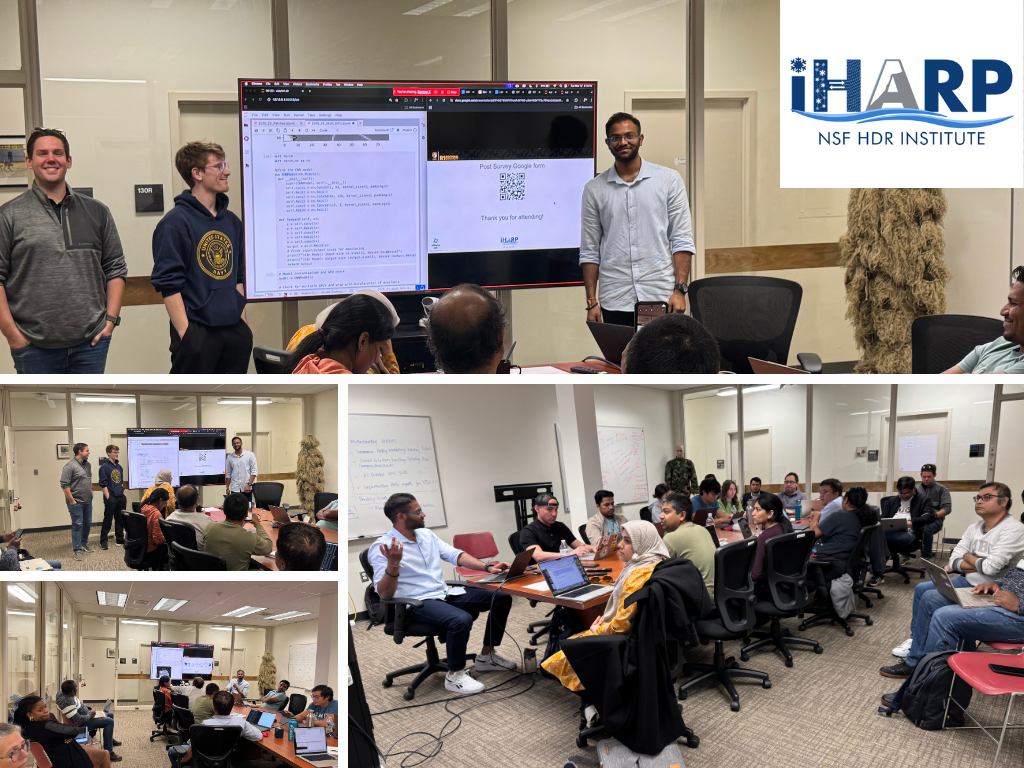
Kicking off the NSF HDR Machine Learning Challenge to Identify Anomalies in Challenges of Societal Importance, iHARP hosted a Hackathon at UMBC on November 22, 2024. Participants of the kickoff Hackathon had the opportunity to engage with three different data sets curated by three different NSF HDR Institutes. Challenge winners will get to showcase their work at a co-located workshop at the AAAI Conference in March 2025.
Thank you to everyone who attended and participated in the Hackathon Kickoff Event and a special thanks to all those who provided support and guidance to participants throughout the event!
]]>
Kicking off the NSF HDR Machine Learning Challenge to Identify Anomalies in Challenges of Societal Importance, iHARP hosted a Hackathon at UMBC on November 22, 2024. Participants of the kickoff...
http://iharp.umbc.edu
https://dev.my.umbc.edu/api/v0/pixel/news/146005/guest@my.umbc.edu/f102aced3f665b9031e7b485c1325fa7/api/pixel
iharp
iHARP
https://dev.my.umbc.edu/groups/iharp
https://assets2-dev.my.umbc.edu/system/shared/avatars/groups/000/002/011/5a4b2df3e2c5e51353edce5eaef18479/xsmall.png?1663786838
https://assets4-dev.my.umbc.edu/system/shared/avatars/groups/000/002/011/5a4b2df3e2c5e51353edce5eaef18479/original.png?1663786838
https://assets4-dev.my.umbc.edu/system/shared/avatars/groups/000/002/011/5a4b2df3e2c5e51353edce5eaef18479/xxlarge.png?1663786838
https://assets2-dev.my.umbc.edu/system/shared/avatars/groups/000/002/011/5a4b2df3e2c5e51353edce5eaef18479/xlarge.png?1663786838
https://assets3-dev.my.umbc.edu/system/shared/avatars/groups/000/002/011/5a4b2df3e2c5e51353edce5eaef18479/large.png?1663786838
https://assets1-dev.my.umbc.edu/system/shared/avatars/groups/000/002/011/5a4b2df3e2c5e51353edce5eaef18479/medium.png?1663786838
https://assets4-dev.my.umbc.edu/system/shared/avatars/groups/000/002/011/5a4b2df3e2c5e51353edce5eaef18479/small.png?1663786838
https://assets2-dev.my.umbc.edu/system/shared/avatars/groups/000/002/011/5a4b2df3e2c5e51353edce5eaef18479/xsmall.png?1663786838
https://assets3-dev.my.umbc.edu/system/shared/avatars/groups/000/002/011/5a4b2df3e2c5e51353edce5eaef18479/xxsmall.png?1663786838
iHARP
https://assets1-dev.my.umbc.edu/system/shared/thumbnails/news/000/146/005/c3939fbc1f7e884a7a6d49dc3d027956/xxlarge.jpg?1733169226
https://assets1-dev.my.umbc.edu/system/shared/thumbnails/news/000/146/005/c3939fbc1f7e884a7a6d49dc3d027956/xlarge.jpg?1733169226
https://assets2-dev.my.umbc.edu/system/shared/thumbnails/news/000/146/005/c3939fbc1f7e884a7a6d49dc3d027956/large.jpg?1733169226
https://assets4-dev.my.umbc.edu/system/shared/thumbnails/news/000/146/005/c3939fbc1f7e884a7a6d49dc3d027956/medium.jpg?1733169226
https://assets2-dev.my.umbc.edu/system/shared/thumbnails/news/000/146/005/c3939fbc1f7e884a7a6d49dc3d027956/small.jpg?1733169226
https://assets4-dev.my.umbc.edu/system/shared/thumbnails/news/000/146/005/c3939fbc1f7e884a7a6d49dc3d027956/xsmall.jpg?1733169226
https://assets2-dev.my.umbc.edu/system/shared/thumbnails/news/000/146/005/c3939fbc1f7e884a7a6d49dc3d027956/xxsmall.jpg?1733169226
0
0
true
Mon, 02 Dec 2024 14:55:10 -0500
UMBC Doctoral Candidacy Ceremony: iHARP Research Assistants Moving Forward as PhD Candidates
Congratulations Tolulope Ale and Maloy Kumar Devanth
Tolulope Ale and Maloy Kumar Devanth have been officially admitted to the Candidacy . On November 1, 2024, Tolulope Ale had the opportunity to participate in the time honored tradition of the UMBC Candidacy Ceremony marking a crucial milestone in the PhD journey. While unable to attend the ceremony, Maloy Kumar Devanth was out of town presenting his PhD research at the SIGSPATIAL 2024.
Please join us in congratulating Tolulope and Maloy on achieving this monumental milestone!
]]>
Tolulope Ale and Maloy Kumar Devanth have been officially admitted to the Candidacy . On November 1, 2024, Tolulope Ale had the opportunity to participate in the time honored tradition of the UMBC...
http://iharp.umbc.edu
https://dev.my.umbc.edu/api/v0/pixel/news/145952/guest@my.umbc.edu/185c4969ad5548c250770dd182d6ec85/api/pixel
iharp
iHARP
https://dev.my.umbc.edu/groups/iharp
https://assets2-dev.my.umbc.edu/system/shared/avatars/groups/000/002/011/5a4b2df3e2c5e51353edce5eaef18479/xsmall.png?1663786838
https://assets4-dev.my.umbc.edu/system/shared/avatars/groups/000/002/011/5a4b2df3e2c5e51353edce5eaef18479/original.png?1663786838
https://assets4-dev.my.umbc.edu/system/shared/avatars/groups/000/002/011/5a4b2df3e2c5e51353edce5eaef18479/xxlarge.png?1663786838
https://assets2-dev.my.umbc.edu/system/shared/avatars/groups/000/002/011/5a4b2df3e2c5e51353edce5eaef18479/xlarge.png?1663786838
https://assets3-dev.my.umbc.edu/system/shared/avatars/groups/000/002/011/5a4b2df3e2c5e51353edce5eaef18479/large.png?1663786838
https://assets1-dev.my.umbc.edu/system/shared/avatars/groups/000/002/011/5a4b2df3e2c5e51353edce5eaef18479/medium.png?1663786838
https://assets4-dev.my.umbc.edu/system/shared/avatars/groups/000/002/011/5a4b2df3e2c5e51353edce5eaef18479/small.png?1663786838
https://assets2-dev.my.umbc.edu/system/shared/avatars/groups/000/002/011/5a4b2df3e2c5e51353edce5eaef18479/xsmall.png?1663786838
https://assets3-dev.my.umbc.edu/system/shared/avatars/groups/000/002/011/5a4b2df3e2c5e51353edce5eaef18479/xxsmall.png?1663786838
iHARP
https://assets1-dev.my.umbc.edu/system/shared/thumbnails/news/000/145/952/053d8a2a92bb58b04cc3ae7cc800b26a/xxlarge.jpg?1732728780
https://assets3-dev.my.umbc.edu/system/shared/thumbnails/news/000/145/952/053d8a2a92bb58b04cc3ae7cc800b26a/xlarge.jpg?1732728780
https://assets2-dev.my.umbc.edu/system/shared/thumbnails/news/000/145/952/053d8a2a92bb58b04cc3ae7cc800b26a/large.jpg?1732728780
https://assets1-dev.my.umbc.edu/system/shared/thumbnails/news/000/145/952/053d8a2a92bb58b04cc3ae7cc800b26a/medium.jpg?1732728780
https://assets2-dev.my.umbc.edu/system/shared/thumbnails/news/000/145/952/053d8a2a92bb58b04cc3ae7cc800b26a/small.jpg?1732728780
https://assets3-dev.my.umbc.edu/system/shared/thumbnails/news/000/145/952/053d8a2a92bb58b04cc3ae7cc800b26a/xsmall.jpg?1732728780
https://assets4-dev.my.umbc.edu/system/shared/thumbnails/news/000/145/952/053d8a2a92bb58b04cc3ae7cc800b26a/xxsmall.jpg?1732728780
0
0
true
Wed, 27 Nov 2024 12:33:16 -0500
Wed, 27 Nov 2024 12:36:54 -0500
UMBC High Performance Computing (HPC) Boot Camp Expanding iHARP and UMCES Research Capabilities
To expand research capabilities, iHARP hosted a High Performance Computing (HPC) Bootcamp on November 12, 2024 led by iHARP Research Assistant Sai Vikas Amaraneni with support from DoIT members Roy Prouty, Philip Henry, Beamlak Bekele, and Max Breitmeyer.
iHARP and UMCES CGC-SCIPE researchers were introduced to UMBC’s HPC resources and gained hands-on training in the Ada High-Performance Computing (HPC) cluster. The bootcamp introduced fundamental concepts in Ada such as BASH basics, and environment setup for efficient research workflows, as well as managing jobs with SLURM. Attendees used a case study involving Patch-CNN for predicting sea ice extent in the Antarctic region (research project being presented at AGU this year), in order to understand the role of HPC in research boththrough single GPU and Multi-GPU training.
We would like to thank Sai Vikas Amaraneni and DoIT members Roy Prouty, Philip Henry, Beamlak Bekele, and Max Breitmeyer for their support and dedication to furthering research capabilities in iHARP and UMCES.
 ]]>
To expand research capabilities, iHARP hosted a High Performance Computing (HPC) Bootcamp on November 12, 2024 led by iHARP Research Assistant Sai Vikas Amaraneni with support from DoIT members...
http://iharp.umbc.edu
https://dev.my.umbc.edu/api/v0/pixel/news/145949/guest@my.umbc.edu/198ea1d1551baf9dcde721d4247b5496/api/pixel
iharp
iHARP
https://dev.my.umbc.edu/groups/iharp
https://assets2-dev.my.umbc.edu/system/shared/avatars/groups/000/002/011/5a4b2df3e2c5e51353edce5eaef18479/xsmall.png?1663786838
https://assets4-dev.my.umbc.edu/system/shared/avatars/groups/000/002/011/5a4b2df3e2c5e51353edce5eaef18479/original.png?1663786838
https://assets4-dev.my.umbc.edu/system/shared/avatars/groups/000/002/011/5a4b2df3e2c5e51353edce5eaef18479/xxlarge.png?1663786838
https://assets2-dev.my.umbc.edu/system/shared/avatars/groups/000/002/011/5a4b2df3e2c5e51353edce5eaef18479/xlarge.png?1663786838
https://assets3-dev.my.umbc.edu/system/shared/avatars/groups/000/002/011/5a4b2df3e2c5e51353edce5eaef18479/large.png?1663786838
https://assets1-dev.my.umbc.edu/system/shared/avatars/groups/000/002/011/5a4b2df3e2c5e51353edce5eaef18479/medium.png?1663786838
https://assets4-dev.my.umbc.edu/system/shared/avatars/groups/000/002/011/5a4b2df3e2c5e51353edce5eaef18479/small.png?1663786838
https://assets2-dev.my.umbc.edu/system/shared/avatars/groups/000/002/011/5a4b2df3e2c5e51353edce5eaef18479/xsmall.png?1663786838
https://assets3-dev.my.umbc.edu/system/shared/avatars/groups/000/002/011/5a4b2df3e2c5e51353edce5eaef18479/xxsmall.png?1663786838
iHARP
https://assets2-dev.my.umbc.edu/system/shared/thumbnails/news/000/145/949/bd4dc194caf49f7d81c7b5af68314c49/xxlarge.jpg?1732726386
https://assets3-dev.my.umbc.edu/system/shared/thumbnails/news/000/145/949/bd4dc194caf49f7d81c7b5af68314c49/xlarge.jpg?1732726386
https://assets2-dev.my.umbc.edu/system/shared/thumbnails/news/000/145/949/bd4dc194caf49f7d81c7b5af68314c49/large.jpg?1732726386
https://assets2-dev.my.umbc.edu/system/shared/thumbnails/news/000/145/949/bd4dc194caf49f7d81c7b5af68314c49/medium.jpg?1732726386
https://assets4-dev.my.umbc.edu/system/shared/thumbnails/news/000/145/949/bd4dc194caf49f7d81c7b5af68314c49/small.jpg?1732726386
https://assets4-dev.my.umbc.edu/system/shared/thumbnails/news/000/145/949/bd4dc194caf49f7d81c7b5af68314c49/xsmall.jpg?1732726386
https://assets4-dev.my.umbc.edu/system/shared/thumbnails/news/000/145/949/bd4dc194caf49f7d81c7b5af68314c49/xxsmall.jpg?1732726386
1
0
true
Wed, 27 Nov 2024 11:55:17 -0500
Maryland State Senator Sarah Elfreth Visits iHARP
Interacting & learning about ground breaking research
]]>
To expand research capabilities, iHARP hosted a High Performance Computing (HPC) Bootcamp on November 12, 2024 led by iHARP Research Assistant Sai Vikas Amaraneni with support from DoIT members...
http://iharp.umbc.edu
https://dev.my.umbc.edu/api/v0/pixel/news/145949/guest@my.umbc.edu/198ea1d1551baf9dcde721d4247b5496/api/pixel
iharp
iHARP
https://dev.my.umbc.edu/groups/iharp
https://assets2-dev.my.umbc.edu/system/shared/avatars/groups/000/002/011/5a4b2df3e2c5e51353edce5eaef18479/xsmall.png?1663786838
https://assets4-dev.my.umbc.edu/system/shared/avatars/groups/000/002/011/5a4b2df3e2c5e51353edce5eaef18479/original.png?1663786838
https://assets4-dev.my.umbc.edu/system/shared/avatars/groups/000/002/011/5a4b2df3e2c5e51353edce5eaef18479/xxlarge.png?1663786838
https://assets2-dev.my.umbc.edu/system/shared/avatars/groups/000/002/011/5a4b2df3e2c5e51353edce5eaef18479/xlarge.png?1663786838
https://assets3-dev.my.umbc.edu/system/shared/avatars/groups/000/002/011/5a4b2df3e2c5e51353edce5eaef18479/large.png?1663786838
https://assets1-dev.my.umbc.edu/system/shared/avatars/groups/000/002/011/5a4b2df3e2c5e51353edce5eaef18479/medium.png?1663786838
https://assets4-dev.my.umbc.edu/system/shared/avatars/groups/000/002/011/5a4b2df3e2c5e51353edce5eaef18479/small.png?1663786838
https://assets2-dev.my.umbc.edu/system/shared/avatars/groups/000/002/011/5a4b2df3e2c5e51353edce5eaef18479/xsmall.png?1663786838
https://assets3-dev.my.umbc.edu/system/shared/avatars/groups/000/002/011/5a4b2df3e2c5e51353edce5eaef18479/xxsmall.png?1663786838
iHARP
https://assets2-dev.my.umbc.edu/system/shared/thumbnails/news/000/145/949/bd4dc194caf49f7d81c7b5af68314c49/xxlarge.jpg?1732726386
https://assets3-dev.my.umbc.edu/system/shared/thumbnails/news/000/145/949/bd4dc194caf49f7d81c7b5af68314c49/xlarge.jpg?1732726386
https://assets2-dev.my.umbc.edu/system/shared/thumbnails/news/000/145/949/bd4dc194caf49f7d81c7b5af68314c49/large.jpg?1732726386
https://assets2-dev.my.umbc.edu/system/shared/thumbnails/news/000/145/949/bd4dc194caf49f7d81c7b5af68314c49/medium.jpg?1732726386
https://assets4-dev.my.umbc.edu/system/shared/thumbnails/news/000/145/949/bd4dc194caf49f7d81c7b5af68314c49/small.jpg?1732726386
https://assets4-dev.my.umbc.edu/system/shared/thumbnails/news/000/145/949/bd4dc194caf49f7d81c7b5af68314c49/xsmall.jpg?1732726386
https://assets4-dev.my.umbc.edu/system/shared/thumbnails/news/000/145/949/bd4dc194caf49f7d81c7b5af68314c49/xxsmall.jpg?1732726386
1
0
true
Wed, 27 Nov 2024 11:55:17 -0500
Maryland State Senator Sarah Elfreth Visits iHARP
Interacting & learning about ground breaking research
Maryland State Senator Elfreth visited the iHARP center at UMBC on October 22, 2024. During her visit, she engaged with researchers and learned about their groundbreaking work.
While at the center, Senator Elfreth experienced the immersive Virtual Ice Museum, created through a collaboration between iHARP and the Imaging Research Center (IRC) at UMBC. This Virtual Ice Museum allows audiences to explore climate change research in a new immersive and interactive format through virtual reality (VR).
We would like to thank the iHARP researchers who shared their work, as well as Ryan Zuber, the IRC Technical Director, for demonstrating the Virtual Ice Museum. We especially appreciate Senator Elfreth for taking the time from her busy schedule to meet with iHARP members and collaborators.
]]>
Maryland State Senator Elfreth visited the iHARP center at UMBC on October 22, 2024. During her visit, she engaged with researchers and learned about their groundbreaking work. While at the...
https://iharp.umbc.edu/
https://dev.my.umbc.edu/api/v0/pixel/news/145639/guest@my.umbc.edu/d14895e28a6ca4b446b21e239667ba78/api/pixel
iharp
iHARP
https://dev.my.umbc.edu/groups/iharp
https://assets2-dev.my.umbc.edu/system/shared/avatars/groups/000/002/011/5a4b2df3e2c5e51353edce5eaef18479/xsmall.png?1663786838
https://assets4-dev.my.umbc.edu/system/shared/avatars/groups/000/002/011/5a4b2df3e2c5e51353edce5eaef18479/original.png?1663786838
https://assets4-dev.my.umbc.edu/system/shared/avatars/groups/000/002/011/5a4b2df3e2c5e51353edce5eaef18479/xxlarge.png?1663786838
https://assets2-dev.my.umbc.edu/system/shared/avatars/groups/000/002/011/5a4b2df3e2c5e51353edce5eaef18479/xlarge.png?1663786838
https://assets3-dev.my.umbc.edu/system/shared/avatars/groups/000/002/011/5a4b2df3e2c5e51353edce5eaef18479/large.png?1663786838
https://assets1-dev.my.umbc.edu/system/shared/avatars/groups/000/002/011/5a4b2df3e2c5e51353edce5eaef18479/medium.png?1663786838
https://assets4-dev.my.umbc.edu/system/shared/avatars/groups/000/002/011/5a4b2df3e2c5e51353edce5eaef18479/small.png?1663786838
https://assets2-dev.my.umbc.edu/system/shared/avatars/groups/000/002/011/5a4b2df3e2c5e51353edce5eaef18479/xsmall.png?1663786838
https://assets3-dev.my.umbc.edu/system/shared/avatars/groups/000/002/011/5a4b2df3e2c5e51353edce5eaef18479/xxsmall.png?1663786838
iHARP
https://assets1-dev.my.umbc.edu/system/shared/thumbnails/news/000/145/639/2720a5a68d93c81033704613e28e1a5f/xxlarge.jpg?1731610229
https://assets3-dev.my.umbc.edu/system/shared/thumbnails/news/000/145/639/2720a5a68d93c81033704613e28e1a5f/xlarge.jpg?1731610229
https://assets1-dev.my.umbc.edu/system/shared/thumbnails/news/000/145/639/2720a5a68d93c81033704613e28e1a5f/large.jpg?1731610229
https://assets4-dev.my.umbc.edu/system/shared/thumbnails/news/000/145/639/2720a5a68d93c81033704613e28e1a5f/medium.jpg?1731610229
https://assets2-dev.my.umbc.edu/system/shared/thumbnails/news/000/145/639/2720a5a68d93c81033704613e28e1a5f/small.jpg?1731610229
https://assets4-dev.my.umbc.edu/system/shared/thumbnails/news/000/145/639/2720a5a68d93c81033704613e28e1a5f/xsmall.jpg?1731610229
https://assets1-dev.my.umbc.edu/system/shared/thumbnails/news/000/145/639/2720a5a68d93c81033704613e28e1a5f/xxsmall.jpg?1731610229
0
0
true
Thu, 14 Nov 2024 13:54:51 -0500
Hiring: Academic Program Specialist
Apply today!
The University of
Maryland, Baltimore County (UMBC) is seeking an Academic Program Specialist for
the iHARP Center. Reporting to the Operations and Communications Coordinator,
the incumbent will plan, develop and coordinate events and workshops, assist
the Director and Executive Director in research coordination efforts across
multiple grants under iHARP, as well as provide administrative support to iHARP
and supplemental grants.
In this position
will work closely with iHARP members across multiple institutions, UMBC campus
partners as well as various stakeholders. The ideal candidate will be
detail-oriented, self-motivated and work independently as well as a part of a
larger team.
For best
consideration, submit a cover letter, resume and contact
information for three professional references, (applications will be accepted until
the position is filled) to: https://listings.umbc.edu/cw/en-us/job/494758/academic-program-specialist
The Academic Program Specialist role is a full-time (40 hours), non-exempt staff position that is grant funded.
]]>
The University of Maryland, Baltimore County (UMBC) is seeking an Academic Program Specialist for the iHARP Center. Reporting to the Operations and Communications Coordinator, the incumbent will...
http://iharp.umbc.edu
https://dev.my.umbc.edu/api/v0/pixel/news/145588/guest@my.umbc.edu/533f5d6f81cb69e815bbaf566fdce86c/api/pixel
iharp
iHARP
https://dev.my.umbc.edu/groups/iharp
https://assets2-dev.my.umbc.edu/system/shared/avatars/groups/000/002/011/5a4b2df3e2c5e51353edce5eaef18479/xsmall.png?1663786838
https://assets4-dev.my.umbc.edu/system/shared/avatars/groups/000/002/011/5a4b2df3e2c5e51353edce5eaef18479/original.png?1663786838
https://assets4-dev.my.umbc.edu/system/shared/avatars/groups/000/002/011/5a4b2df3e2c5e51353edce5eaef18479/xxlarge.png?1663786838
https://assets2-dev.my.umbc.edu/system/shared/avatars/groups/000/002/011/5a4b2df3e2c5e51353edce5eaef18479/xlarge.png?1663786838
https://assets3-dev.my.umbc.edu/system/shared/avatars/groups/000/002/011/5a4b2df3e2c5e51353edce5eaef18479/large.png?1663786838
https://assets1-dev.my.umbc.edu/system/shared/avatars/groups/000/002/011/5a4b2df3e2c5e51353edce5eaef18479/medium.png?1663786838
https://assets4-dev.my.umbc.edu/system/shared/avatars/groups/000/002/011/5a4b2df3e2c5e51353edce5eaef18479/small.png?1663786838
https://assets2-dev.my.umbc.edu/system/shared/avatars/groups/000/002/011/5a4b2df3e2c5e51353edce5eaef18479/xsmall.png?1663786838
https://assets3-dev.my.umbc.edu/system/shared/avatars/groups/000/002/011/5a4b2df3e2c5e51353edce5eaef18479/xxsmall.png?1663786838
iHARP
https://assets2-dev.my.umbc.edu/system/shared/thumbnails/news/000/145/588/7d040d162aac8dd5c2b097ae43039e65/xxlarge.jpg?1731509913
https://assets2-dev.my.umbc.edu/system/shared/thumbnails/news/000/145/588/7d040d162aac8dd5c2b097ae43039e65/xlarge.jpg?1731509913
https://assets2-dev.my.umbc.edu/system/shared/thumbnails/news/000/145/588/7d040d162aac8dd5c2b097ae43039e65/large.jpg?1731509913
https://assets3-dev.my.umbc.edu/system/shared/thumbnails/news/000/145/588/7d040d162aac8dd5c2b097ae43039e65/medium.jpg?1731509913
https://assets1-dev.my.umbc.edu/system/shared/thumbnails/news/000/145/588/7d040d162aac8dd5c2b097ae43039e65/small.jpg?1731509913
https://assets3-dev.my.umbc.edu/system/shared/thumbnails/news/000/145/588/7d040d162aac8dd5c2b097ae43039e65/xsmall.jpg?1731509913
https://assets3-dev.my.umbc.edu/system/shared/thumbnails/news/000/145/588/7d040d162aac8dd5c2b097ae43039e65/xxsmall.jpg?1731509913
0
0
false
Wed, 13 Nov 2024 10:06:40 -0500
Dr. Bayu Adhi Tama at USM Postdoctoral Research Symposium
Sharing research and expanding networks
Dr. Bayu Adhi Tama attended the 1st USM Postdoctoral Research Symposium on Friday, September 30, 2024, at the University of Maryland, College Park. Dr. Tama presented a poster based on his research project Mapping subglacial bed topography using surface observations and machine learning:
challenges and opportunities. During the symposium, he had the opportunity to network with other Maryland Postdoctoral researchers.
]]>
Dr. Bayu Adhi Tama attended the 1st USM Postdoctoral Research Symposium on Friday, September 30, 2024, at the University of Maryland, College Park. Dr. Tama presented a poster based on his...
http://iharp.umbc.edu
https://dev.my.umbc.edu/api/v0/pixel/news/144375/guest@my.umbc.edu/1a38800990a1188c852d4200a56dc675/api/pixel
iharp
iHARP
https://dev.my.umbc.edu/groups/iharp
https://assets2-dev.my.umbc.edu/system/shared/avatars/groups/000/002/011/5a4b2df3e2c5e51353edce5eaef18479/xsmall.png?1663786838
https://assets4-dev.my.umbc.edu/system/shared/avatars/groups/000/002/011/5a4b2df3e2c5e51353edce5eaef18479/original.png?1663786838
https://assets4-dev.my.umbc.edu/system/shared/avatars/groups/000/002/011/5a4b2df3e2c5e51353edce5eaef18479/xxlarge.png?1663786838
https://assets2-dev.my.umbc.edu/system/shared/avatars/groups/000/002/011/5a4b2df3e2c5e51353edce5eaef18479/xlarge.png?1663786838
https://assets3-dev.my.umbc.edu/system/shared/avatars/groups/000/002/011/5a4b2df3e2c5e51353edce5eaef18479/large.png?1663786838
https://assets1-dev.my.umbc.edu/system/shared/avatars/groups/000/002/011/5a4b2df3e2c5e51353edce5eaef18479/medium.png?1663786838
https://assets4-dev.my.umbc.edu/system/shared/avatars/groups/000/002/011/5a4b2df3e2c5e51353edce5eaef18479/small.png?1663786838
https://assets2-dev.my.umbc.edu/system/shared/avatars/groups/000/002/011/5a4b2df3e2c5e51353edce5eaef18479/xsmall.png?1663786838
https://assets3-dev.my.umbc.edu/system/shared/avatars/groups/000/002/011/5a4b2df3e2c5e51353edce5eaef18479/xxsmall.png?1663786838
iHARP
https://assets1-dev.my.umbc.edu/system/shared/thumbnails/news/000/144/375/023040934abf55f62ac1e9bf7c34f4cf/xxlarge.jpg?1727805439
https://assets4-dev.my.umbc.edu/system/shared/thumbnails/news/000/144/375/023040934abf55f62ac1e9bf7c34f4cf/xlarge.jpg?1727805439
https://assets1-dev.my.umbc.edu/system/shared/thumbnails/news/000/144/375/023040934abf55f62ac1e9bf7c34f4cf/large.jpg?1727805439
https://assets3-dev.my.umbc.edu/system/shared/thumbnails/news/000/144/375/023040934abf55f62ac1e9bf7c34f4cf/medium.jpg?1727805439
https://assets2-dev.my.umbc.edu/system/shared/thumbnails/news/000/144/375/023040934abf55f62ac1e9bf7c34f4cf/small.jpg?1727805439
https://assets2-dev.my.umbc.edu/system/shared/thumbnails/news/000/144/375/023040934abf55f62ac1e9bf7c34f4cf/xsmall.jpg?1727805439
https://assets2-dev.my.umbc.edu/system/shared/thumbnails/news/000/144/375/023040934abf55f62ac1e9bf7c34f4cf/xxsmall.jpg?1727805439
0
0
true
Tue, 01 Oct 2024 13:57:39 -0400