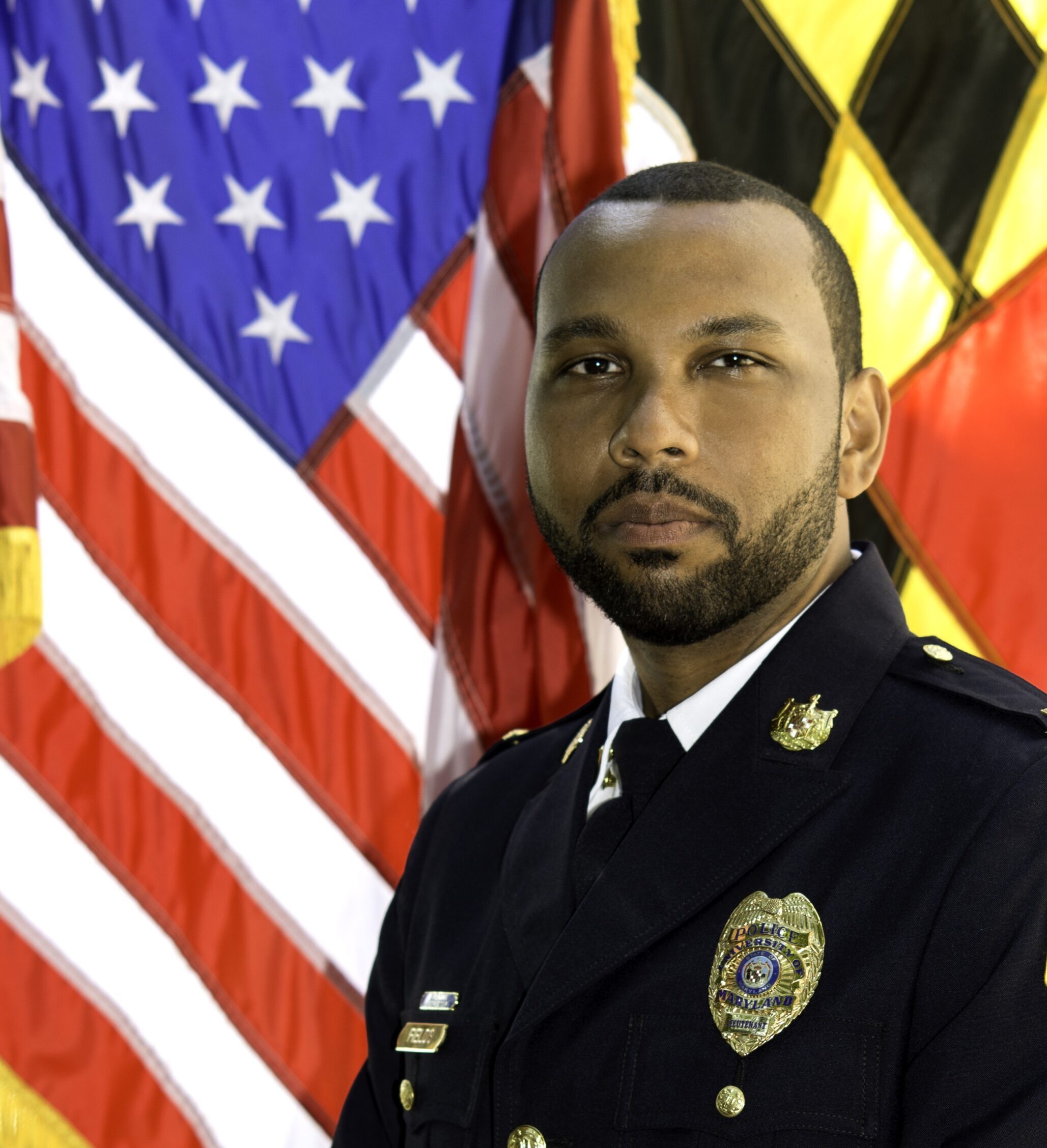
Van Riper Appointed VP for Communications and Marketing at UMBC
 Lisa K. Van Riper
Lisa K. Van Riper has been appointed as UMBC’s vice president for communications and marketing. She comes to UMBC from Goucher College in Baltimore, where she serves currently as vice president for marketing and communications. She will begin in the role at UMBC on July 21.
Van Riper has more than 25 years of experience in communications and marketing in higher education, consumer packaged goods and services corporations, and public service agencies. At Goucher, she leads a team of professionals who collaborate across campus to support the college’s goals for recruitment, fundraising, reputation-building, and more through an integrated, digital-first approach to storytelling and marketing. She successfully led a major branding initiative for the college and has overseen a broad effort to enhance and modernize the college’s digital marketing strategy and develop a cohesive, unifying brand identity.
As a member of the president’s cabinet at Goucher, Van Riper has also attended thoughtfully to internal communications for the college, serving as lead for crisis and issues management communications and for presidential and cabinet communications generally.
Prior to her role at Goucher, Van Riper served as vice president for marketing, communications, and information technology at Knox College in Galesburg, Illinois, and as vice president for communications and public relations at Common App. Her higher education leadership experience includes several years as assistant vice president for university communications at the University of Richmond, and her professional experience outside of higher education includes communications leadership roles with CarMax, Inc., and Alexandria Renew Enterprises, an independent, special-purpose government unit in Virginia that manages wastewater for the city of Alexandria and surrounding areas.
Van Riper earned a bachelor’s degree in English literature from Trinity College in Hartford, Connecticut, and is currently enrolled in Goucher’s Master of Fine Arts program in nonfiction. She is an active member of Leadership Baltimore County.
“In addition to being an expert marketer and talented communications professional, Lisa is a strong manager and leader who has successfully built and developed teams and fostered effective collaborations with campus partners. I am particularly excited about her skills in these areas and her deep interest in supporting the leadership and staff in University Communications and Marketing (UCM),” UMBC President Valerie Sheares Ashby shared in a message to the campus community.
“Lisa’s expertise and experience will contribute enormously to our shared work to advance UMBC’s strategic priorities and our mission as a dynamic, inclusive public research university.”
]]>
Lisa K. Van Riper Lisa K. Van Riper has been appointed as UMBC’s vice president for communications and marketing. She comes to UMBC from Goucher College in Baltimore, where she serves...
https://umbc.edu/stories/van-riper-vp-communications-and-marketing-at-umbc/
https://dev.my.umbc.edu/api/v0/pixel/news/150871/guest@my.umbc.edu/2feb19154d45954ce95452351cccdcc9/api/pixel
leadership
news
story
ucm
UMBC News & Magazine
https://dev.my.umbc.edu/groups/umbc-news-magazine
https://assets1-dev.my.umbc.edu/system/shared/avatars/groups/000/001/943/24435aa6207c452e7bc15cc74b42c7bb/xsmall.png?1748556657
https://assets1-dev.my.umbc.edu/system/shared/avatars/groups/000/001/943/24435aa6207c452e7bc15cc74b42c7bb/original.png?1748556657
https://assets2-dev.my.umbc.edu/system/shared/avatars/groups/000/001/943/24435aa6207c452e7bc15cc74b42c7bb/xxlarge.png?1748556657
https://assets2-dev.my.umbc.edu/system/shared/avatars/groups/000/001/943/24435aa6207c452e7bc15cc74b42c7bb/xlarge.png?1748556657
https://assets3-dev.my.umbc.edu/system/shared/avatars/groups/000/001/943/24435aa6207c452e7bc15cc74b42c7bb/large.png?1748556657
https://assets1-dev.my.umbc.edu/system/shared/avatars/groups/000/001/943/24435aa6207c452e7bc15cc74b42c7bb/medium.png?1748556657
https://assets2-dev.my.umbc.edu/system/shared/avatars/groups/000/001/943/24435aa6207c452e7bc15cc74b42c7bb/small.png?1748556657
https://assets1-dev.my.umbc.edu/system/shared/avatars/groups/000/001/943/24435aa6207c452e7bc15cc74b42c7bb/xsmall.png?1748556657
https://assets2-dev.my.umbc.edu/system/shared/avatars/groups/000/001/943/24435aa6207c452e7bc15cc74b42c7bb/xxsmall.png?1748556657
UMBC News & Magazine
0
0
false
Tue, 01 Jul 2025 10:06:15 -0400
Tue, 01 Jul 2025 10:06:15 -0400
Leadership Announcement
Dear UMBC Community,
It is my great pleasure to share the news that Lisa K. Van Riper has been appointed as UMBC’s vice president for communications and marketing. She comes to UMBC from Goucher College in Baltimore, where she serves currently as vice president for marketing and communications. She will begin in the role at UMBC on July 21.
Lisa has more than 25 years of experience in communications and marketing in higher education, consumer packaged goods and services corporations, and public service agencies. At Goucher, she leads a team of professionals who collaborate across campus to support the college’s goals for recruitment, fundraising, reputation-building, and more through an integrated, digital-first approach to storytelling and marketing. She successfully led a major branding initiative for the college and has overseen a broad effort to enhance and modernize the college’s digital marketing strategy and develop a cohesive, unifying brand identity.
As a member of the president’s cabinet at Goucher, Lisa has also attended thoughtfully to internal communications for the college, serving as lead for crisis and issues management communications and for presidential and cabinet communications generally.
Prior to her role at Goucher, Lisa served as vice president for marketing, communications, and information technology at Knox College in Galesburg, Illinois, and as vice president for communications and public relations at Common App. Her higher education leadership experience includes several years as assistant vice president for university communications at the University of Richmond, and her professional experience outside of higher education includes communications leadership roles with CarMax, Inc., and Alexandria Renew Enterprises, an independent, special-purpose government unit in Virginia that manages wastewater for the city of Alexandria and surrounding areas.
Lisa earned a bachelor’s degree in English literature from Trinity College in Hartford, Connecticut, and is currently enrolled in Goucher’s Master of Fine Arts program in Nonfiction. She is an active member of Leadership Baltimore County.
In addition to being an expert marketer and talented communications professional, Lisa is a strong manager and leader who has successfully built and developed teams and fostered effective collaborations with campus partners. I am particularly excited about her skills in these areas and her deep interest in supporting the leadership and staff in University Communications and Marketing (UCM). Lisa’s expertise and experience will contribute enormously to our shared work to advance UMBC’s strategic priorities and our mission as a dynamic, inclusive public research university.
My thanks to all who participated in this important search and to the UCM team for its steadfast dedication to their work and to UMBC. I want to offer my sincere thanks, as well, to Tim Cobb, who has provided valuable support as interim vice president of the division since January. Congratulations and welcome, Lisa!
Sincerely,
President Valerie Sheares Ashby
]]>
Dear UMBC Community, It is my great pleasure to share the news that Lisa K. Van Riper has been appointed as UMBC’s vice president for communications and marketing. She comes to UMBC from...
https://my3.my.umbc.edu/groups/announcements/posts/150866
https://dev.my.umbc.edu/api/v0/pixel/news/150869/guest@my.umbc.edu/4c9bbf998747e3d2e2fe06a75112e069/api/pixel
president
president-valerie-sheares-ashby
rss
story
UMBC News & Magazine
https://dev.my.umbc.edu/groups/umbc-news-magazine
https://assets1-dev.my.umbc.edu/system/shared/avatars/groups/000/001/943/24435aa6207c452e7bc15cc74b42c7bb/xsmall.png?1748556657
https://assets1-dev.my.umbc.edu/system/shared/avatars/groups/000/001/943/24435aa6207c452e7bc15cc74b42c7bb/original.png?1748556657
https://assets2-dev.my.umbc.edu/system/shared/avatars/groups/000/001/943/24435aa6207c452e7bc15cc74b42c7bb/xxlarge.png?1748556657
https://assets2-dev.my.umbc.edu/system/shared/avatars/groups/000/001/943/24435aa6207c452e7bc15cc74b42c7bb/xlarge.png?1748556657
https://assets3-dev.my.umbc.edu/system/shared/avatars/groups/000/001/943/24435aa6207c452e7bc15cc74b42c7bb/large.png?1748556657
https://assets1-dev.my.umbc.edu/system/shared/avatars/groups/000/001/943/24435aa6207c452e7bc15cc74b42c7bb/medium.png?1748556657
https://assets2-dev.my.umbc.edu/system/shared/avatars/groups/000/001/943/24435aa6207c452e7bc15cc74b42c7bb/small.png?1748556657
https://assets1-dev.my.umbc.edu/system/shared/avatars/groups/000/001/943/24435aa6207c452e7bc15cc74b42c7bb/xsmall.png?1748556657
https://assets2-dev.my.umbc.edu/system/shared/avatars/groups/000/001/943/24435aa6207c452e7bc15cc74b42c7bb/xxsmall.png?1748556657
UMBC News & Magazine
0
0
false
Tue, 01 Jul 2025 09:00:01 -0400
How can the James Webb Space Telescope see so far?
Written by Adi Foord, assistant professor of physics, UMBC
This article is part of The Conversation‘s “Curious Kids” series.
How does the camera on the James Webb Space Telescope work and see so far out?
– Kieran G., age 12, Minnesota
Imagine a camera so powerful it can see light from galaxies that formed more than 13 billion years ago. That’s exactly what NASA’s James Webb Space Telescope is built to do.
Since it launched in December 2021, Webb has been orbiting more than a million miles from Earth, capturing breathtaking images of deep space. But how does it actually work? And how can it see so far? The secret lies in its powerful cameras – especially ones that don’t see light the way our eyes do.
I’m an astrophysicist who studies galaxies and supermassive black holes, and the Webb telescope is an incredible tool for observing some of the earliest galaxies and black holes in the universe.
When Webb takes a picture of a distant galaxy, astronomers like me are actually seeing what that galaxy looked like billions of years ago. The light from that galaxy has been traveling across space for the billions of years it takes to reach the telescope’s mirror. It’s like having a time machine that takes snapshots of the early universe.
By using a giant mirror to collect ancient light, Webb has been discovering new secrets about the universe.
A telescope that sees heat
Unlike regular cameras or even the Hubble Space Telescope, which take images of visible light, Webb is designed to see a kind of light that’s invisible to your eyes: infrared light. Infrared light has longer wavelengths than visible light, which is why our eyes can’t detect it. But with the right instruments, Webb can capture infrared light to study some of the earliest and most distant objects in the universe.
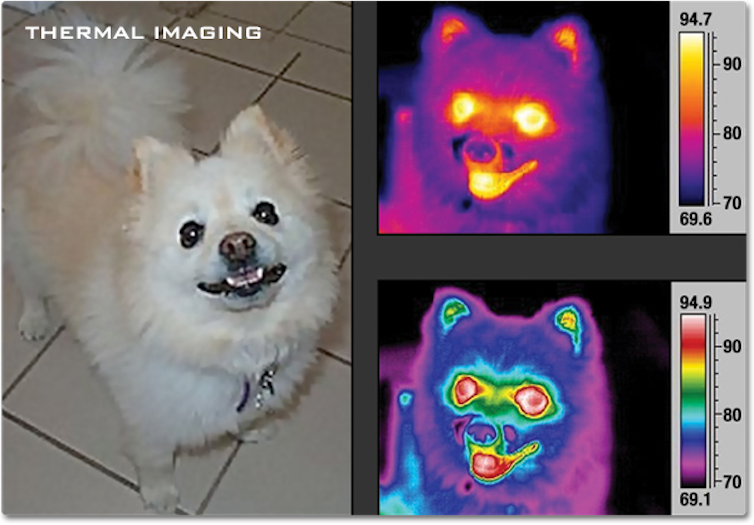 Infrared cameras, like night-vision goggles, allow you to ‘see’ the infrared waves emitting from warm objects such as humans and animals. The temperatures for the images are in degrees Fahrenheit. NASA/JPL-Caltech
Although the human eye cannot see it, people can detect infrared light as a form of heat using specialized technology, such as infrared cameras or thermal sensors. For example, night-vision goggles use infrared light to detect warm objects in the dark. Webb uses the same idea to study stars, galaxies and planets.
Why infrared? When visible light from faraway galaxies travels across the universe, it stretches out. This is because the universe is expanding. That stretching turns visible light into infrared light. So, the most distant galaxies in space don’t shine in visible light anymore – they glow in faint infrared. That’s the light Webb is built to detect.
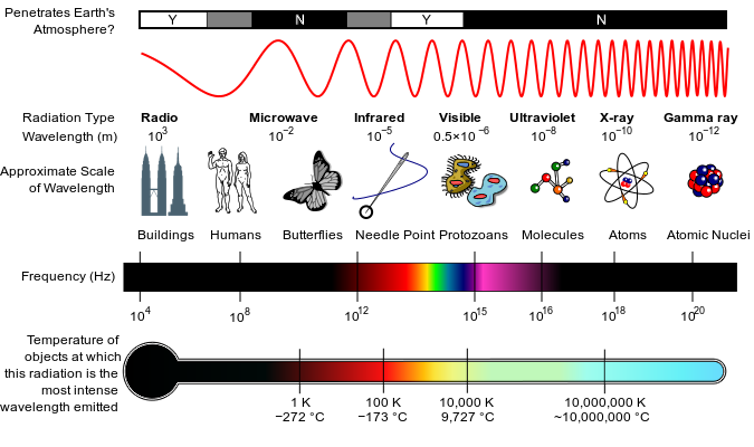 The rainbow of visible light that you can see is only a small slice of all the kinds of light. Some telescopes can detect light with a longer wavelength, such as infrared light, or light with a shorter wavelength, such as ultraviolet light. Others can detect X-rays or radio waves. Inductiveload, NASA/Wikimedia Commons, CC BY-SA
A golden mirror to gather the faintest glow
Before the light reaches the cameras, it first has to be collected by the Webb telescope’s enormous golden mirror. This mirror is over 21 feet (6.5 meters) wide and made of 18 smaller mirror pieces that fit together like a honeycomb. It’s coated in a thin layer of real gold – not just to look fancy, but because gold reflects infrared light extremely well.
The mirror gathers light from deep space and reflects it into the telescope’s instruments. The bigger the mirror, the more light it can collect – and the farther it can see. Webb’s mirror is the largest ever launched into space.
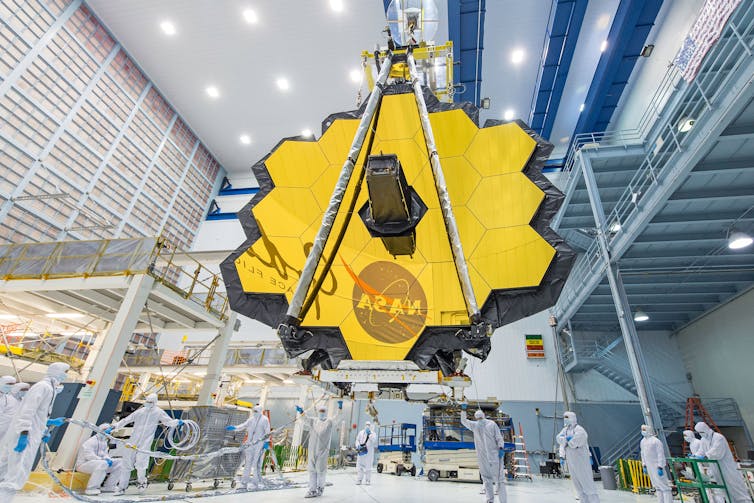 Webb’s 21-foot primary mirror, made of 18 hexagonal mirrors, is coated with a plating of gold. NASA
Inside the cameras: NIRCam and MIRI
The most important “eyes” of the telescope are two science instruments that act like cameras: NIRCam and MIRI.
NIRCam stands for near-infrared camera. It’s the primary camera on Webb and takes stunning images of galaxies and stars. It also has a coronagraph – a device that blocks out starlight so it can photograph very faint objects near bright sources, such as planets orbiting bright stars.
NIRCam works by imaging near-infrared light, the type closest to what human eyes can almost see, and splitting it into different wavelengths. This helps scientists learn not just what something looks like but what it’s made of. Different materials in space absorb and emit infrared light at specific wavelengths, creating a kind of unique chemical fingerprint. By studying these fingerprints, scientists can uncover the properties of distant stars and galaxies.
MIRI, or the mid-infrared instrument, detects longer infrared wavelengths, which are especially useful for spotting cooler and dustier objects, such as stars that are still forming inside clouds of gas. MIRI can even help find clues about the types of molecules in the atmospheres of planets that might support life.
Both cameras are far more sensitive than the standard cameras used on Earth. NIRCam and MIRI can detect the tiniest amounts of heat from billions of light-years away. If you had Webb’s NIRCam as your eyes, you could see the heat from a bumblebee on the Moon. That’s how sensitive it is.
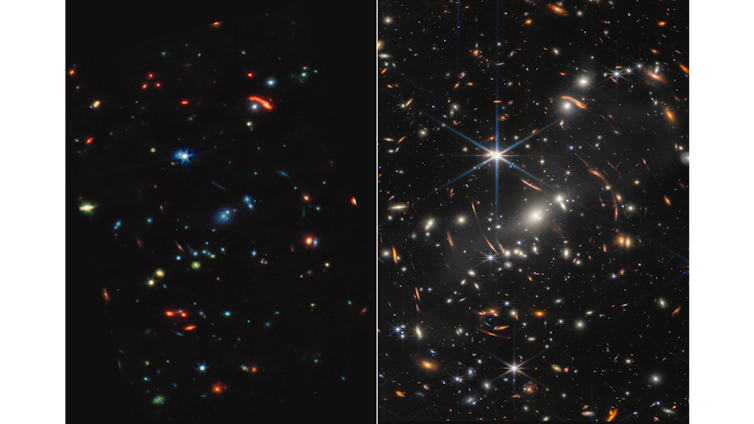 Webb’s first deep-field image: The MIRI image is on the left and the NIRCam image is on the right. NASA
Because Webb is trying to detect faint heat from faraway objects, it needs to keep itself as cold as possible. That’s why it carries a giant sun shield about the size of a tennis court. This five-layer sun shield blocks heat from the Sun, Earth and even the Moon, helping Webb stay incredibly cold: around -370 degrees F (-223 degrees C).
MIRI needs to be even colder. It has its own special refrigerator, called a cryocooler, to keep it chilled to nearly -447 degrees F (-266 degrees C). If Webb were even a little warm, its own heat would drown out the distant signals it’s trying to detect.
Turning space light into pictures
Once light reaches the Webb telescope’s cameras, it hits sensors called detectors. These detectors don’t capture regular photos like a phone camera. Instead, they convert the incoming infrared light into digital data. That data is then sent back to Earth, where scientists process it into full-color images.
The colors we see in Webb’s pictures aren’t what the camera “sees” directly. Because infrared light is invisible, scientists assign colors to different wavelengths to help us understand what’s in the image. These processed images help show the structure, age and composition of galaxies, stars and more.
By using a giant mirror to collect invisible infrared light and sending it to super-cold cameras, Webb lets us see galaxies that formed just after the universe began.
This article is republished from The Conversation under a Creative Commons license. Read the original article and see more than 300 UMBC articles available in The Conversation.
]]>
Written by Adi Foord, assistant professor of physics, UMBC This article is part of The Conversation‘s “Curious Kids” series. How does the camera on the James Webb Space Telescope work and...
https://umbc.edu/stories/how-can-the-james-webb-space-telescope-see-so-far/
https://dev.my.umbc.edu/api/v0/pixel/news/150862/guest@my.umbc.edu/78deae323bed2d055c51a1de187ca6e2/api/pixel
cnms
conversation
discovery
magazine
physics
story
the-conversation
UMBC News & Magazine
https://dev.my.umbc.edu/groups/umbc-news-magazine
https://assets1-dev.my.umbc.edu/system/shared/avatars/groups/000/001/943/24435aa6207c452e7bc15cc74b42c7bb/xsmall.png?1748556657
https://assets1-dev.my.umbc.edu/system/shared/avatars/groups/000/001/943/24435aa6207c452e7bc15cc74b42c7bb/original.png?1748556657
https://assets2-dev.my.umbc.edu/system/shared/avatars/groups/000/001/943/24435aa6207c452e7bc15cc74b42c7bb/xxlarge.png?1748556657
https://assets2-dev.my.umbc.edu/system/shared/avatars/groups/000/001/943/24435aa6207c452e7bc15cc74b42c7bb/xlarge.png?1748556657
https://assets3-dev.my.umbc.edu/system/shared/avatars/groups/000/001/943/24435aa6207c452e7bc15cc74b42c7bb/large.png?1748556657
https://assets1-dev.my.umbc.edu/system/shared/avatars/groups/000/001/943/24435aa6207c452e7bc15cc74b42c7bb/medium.png?1748556657
https://assets2-dev.my.umbc.edu/system/shared/avatars/groups/000/001/943/24435aa6207c452e7bc15cc74b42c7bb/small.png?1748556657
https://assets1-dev.my.umbc.edu/system/shared/avatars/groups/000/001/943/24435aa6207c452e7bc15cc74b42c7bb/xsmall.png?1748556657
https://assets2-dev.my.umbc.edu/system/shared/avatars/groups/000/001/943/24435aa6207c452e7bc15cc74b42c7bb/xxsmall.png?1748556657
UMBC News & Magazine
2
0
false
Mon, 30 Jun 2025 10:51:23 -0400
Erle Ellis and an international team of researchers propose a new way to motivate international action toward a better future for the living world
Imagine a world where, instead of pointing out everything nations are doing wrong to the living world based on how they create, improve, and sustain a thriving environment, we measure what they are doing right. By focusing on the good, people worldwide might be empowered to learn from success, instead of feeling more powerless in the face of all the messages of environmental harm and damage. For nearly three years, Erle Ellis, professor of geography and environmental systems, has collaborated with a team of researchers across six continents, led by the United Nations Development Program’s Human Development Report Office (UNDP-HDRO) to make that vision a reality by developing the Nature Relationship Index (NRI).
The NRI will be the first standardized global metric that measures the quality of a nation’s relationships with nature, including plants and animals, land, rivers, oceans, mountains, forests, deserts, and grasslands. Progress will be measured in terms of each nation’s contributions to the living world, based on three dimensions: the management of landscapes to enable people and nature to connect and thrive together, the use of nature to sustain human development without harming, diminishing, or degrading it, and financial, legal, and institutional support for environmental protections.
Towards a balanced living world
Nature, the world’s leading multidisciplinary science journal, has published this groundbreaking framework by conservation, environment, and human development experts and practitioners. The NRI is now being developed with the aim of a public release as part of the 2026 Human Development Report, with the goal of updating the NRI for all countries of the world annually.
“By focusing on human agency—people’s ability to hold values and make commitments and choices beyond their own individual well-being,” writes Ellis, the lead author, “the human development approach treats people as agents of change, rather than passive recipients of policy interventions, foregrounding people’s values, aspirations and struggles to achieve a better future.”
UMBC’s College of Arts, Humanities, and Social Sciences has named Ellis the 2025 – 2026 Lipitz Professor. The Roger C. Lipitz and the Lipitz Family Foundation endowed professorship that celebrates and sponsors cutting-edge research and teaching. This honor recognizes Ellis’s international leadership in research that supports the health of human-managed ecosystems at both local and global levels, aiming to guide sustainable and responsible stewardship. Ellis served as the 2021 – 2024 UMBC Presidential Research Professor for his contributions to ecology and geography, including landscape ecology and human-environmental interactions.
Learn more about Ellis’s research within UMBC’s Department of Geography and Environmental Systems.
]]>
Imagine a world where, instead of pointing out everything nations are doing wrong to the living world based on how they create, improve, and sustain a thriving environment, we measure what they...
https://umbc.edu/stories/nature-relationship-index-for-the-living-world/
https://dev.my.umbc.edu/api/v0/pixel/news/150852/guest@my.umbc.edu/46f6db96bd2ab3ba21aab6f44fa954cc/api/pixel
cahss
ges
news
policy-and-society
story
UMBC News & Magazine
https://dev.my.umbc.edu/groups/umbc-news-magazine
https://assets1-dev.my.umbc.edu/system/shared/avatars/groups/000/001/943/24435aa6207c452e7bc15cc74b42c7bb/xsmall.png?1748556657
https://assets1-dev.my.umbc.edu/system/shared/avatars/groups/000/001/943/24435aa6207c452e7bc15cc74b42c7bb/original.png?1748556657
https://assets2-dev.my.umbc.edu/system/shared/avatars/groups/000/001/943/24435aa6207c452e7bc15cc74b42c7bb/xxlarge.png?1748556657
https://assets2-dev.my.umbc.edu/system/shared/avatars/groups/000/001/943/24435aa6207c452e7bc15cc74b42c7bb/xlarge.png?1748556657
https://assets3-dev.my.umbc.edu/system/shared/avatars/groups/000/001/943/24435aa6207c452e7bc15cc74b42c7bb/large.png?1748556657
https://assets1-dev.my.umbc.edu/system/shared/avatars/groups/000/001/943/24435aa6207c452e7bc15cc74b42c7bb/medium.png?1748556657
https://assets2-dev.my.umbc.edu/system/shared/avatars/groups/000/001/943/24435aa6207c452e7bc15cc74b42c7bb/small.png?1748556657
https://assets1-dev.my.umbc.edu/system/shared/avatars/groups/000/001/943/24435aa6207c452e7bc15cc74b42c7bb/xsmall.png?1748556657
https://assets2-dev.my.umbc.edu/system/shared/avatars/groups/000/001/943/24435aa6207c452e7bc15cc74b42c7bb/xxsmall.png?1748556657
UMBC News & Magazine
1
0
false
Fri, 27 Jun 2025 14:12:12 -0400
Fri, 27 Jun 2025 14:12:12 -0400
New AI-supported, high-resolution Chesapeake Bay Watershed stream maps reveal additional waterways and will help prioritize restoration projects
A dataset unveiled today more than doubles the documented stream miles in the Chesapeake Bay Watershed, elevating the total from approximately 100,000 to over 200,000 miles. The Hyper-Resolution Hydrography Data used to generate the new stream maps stems from a collaboration between the University of Maryland, Baltimore County (UMBC), the Environmental Protection Agency’s Chesapeake Bay Program (CBP), and the Chesapeake Conservancy (CC), including UMBC alumni at CBP and CC.
The project lays a robust foundation for sustainable management of one of North America’s most critical ecosystems, which spans six states and supports millions of residents and iconic wildlife, such as blue crabs and migrating shorebirds. The new, high-resolution dataset offers the clearest picture yet of how water moves through both pristine landscapes and altered terrain throughout the watershed.
The novel, AI-supported mapping method the research team used also dramatically reduces costs, time, and labor required for stream mapping, making it easy to update as additional data become available or apply in other watersheds to amplify its impact.
“The landscape is shaped by running water. Stream networks are the primary conduit between the watershed and the Bay, and now we can characterize that connection in ways that we’ve never been able to before,” says Matthew Baker, UMBC professor of geography and environmental systems, and a lead on the mapping project. In addition to locating streams and tracing their flow paths with a high degree of precision, the mapping process also allowed the team to report estimates of each channel’s width and depth along its entire length.
 Matthew Baker led the generation of the new hydrography dataset. (Marlayna Demond ’11/UMBC)
A resource for restoration
“When you spend a lot of time looking at hillshade relief maps, you begin to recognize the extent of human manipulation of terrain and how dramatically we have shaped how water flows across the landscape,” Baker adds. The new data will allow individuals and organizations to improve efforts to mitigate any harms from human disruption.
Environmental groups and government agencies, including the CC and CBP, can use the data to prioritize restoration projects, like targeted streamside tree plantings that can mitigate excessive erosion—detected as unusually steep banks or deep channels relative to a stream’s width—and filter pollutants to improve water quality. Farmers and urban planners are likely to find it useful as well, to decrease the detrimental effects of agricultural runoff or wisely manage development to avoid flooding and minimize detrimental effects on wildlife habitat, for example.
“These maps represent over six years of hard work, and I can’t wait to see what people do with this highly anticipated dataset,” says David Saavedra ’14, environmental science. Saavedra’s role as a senior geospatial technical lead at the Chesapeake Conservancy had him intimately involved with the project from brainstorming to implementation.
The project has been personally rewarding for Saavedra, too. “To work alongside Dr. Matt Baker all these years has been a wonderful opportunity,” he says. “I continue to learn from him every day and am proud to consider him a colleague and mentor.”
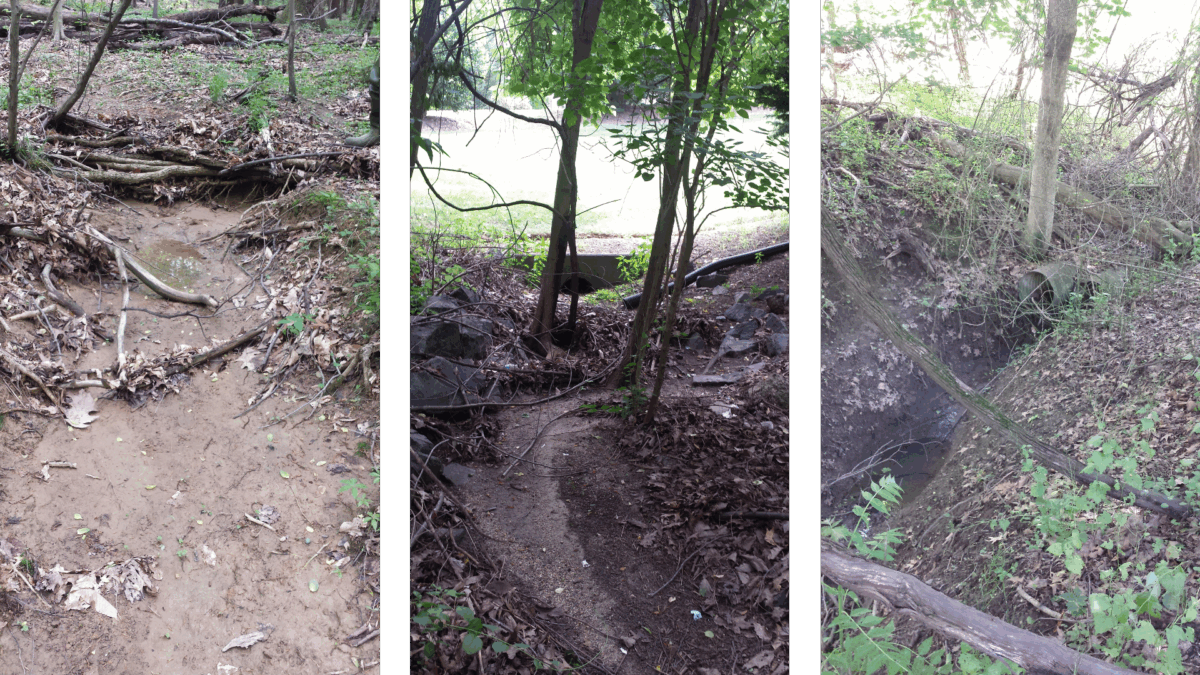 These streams were all missed by the previous dataset, but the new method picked them up. (David Saavedra)
What to leave in, what to leave out?
This project is the first to harness high-resolution LiDAR data and artificial intelligence for large-scale, automated stream mapping. LiDAR, a laser-based system deployed via aircraft, captured elevation data with centimeter-level accuracy, generating a three-dimensional portrait of the terrain. AI algorithms, leveraging resources at UMBC’s High-Performance Computing Facility (HPCF), then processed the data, employing computer-vision techniques to identify channels.
 David Saavedra played a key role in validating the new dataset at the Chesapeake Conservancy. (Courtesy of Saavedra)
The HPCF computers mapped the entire watershed in a mere two weeks—a feat that traditional methods might take years to accomplish. The results achieved 94 percent accuracy for streams represented in existing data, and between 67 and 82 percent accuracy for previously unmapped streams, as validated by Saavedra against two other datasets, aerial imagery and LiDAR-derived topographic maps.
“I led a painstaking process of manually evaluating over 7,000 stream reaches across the watershed to conduct a thorough accuracy assessment on this novel dataset,” Saavedra says. Now that the methodology has been demonstrated effective, that level of manual validation shouldn’t be necessary if the technique is applied elsewhere.
The algorithm needed some tweaks along the way, however. Initially, it included channel-shaped features that made less sense to include on a stream map, like detention ponds, green swales, gutters, and crop furrows. That necessitated modifications to the algorithm to remove those features.
“Part of the challenge in interpreting the terrain was to make distinctions between those features and more natural channels,” Baker says. “So in our model, we had to eliminate some features that were mapped initially. That was unexpected.”
Eye-opening opportunities
 Labeeb Ahmed is excited about the research possibilities the new dataset presents. (Courtesy of Ahmed)
The resulting maps offer a tenfold boost in resolution, moving from a 1:24,000 map scale to a 1:2,400 map scale with each pixel representing one square meter. The new stream maps align with recently-developed land cover maps produced at the same resolution, which are being released at the same time.
“I think when people begin using our hyper-resolution hydrography in conjunction with the one-meter land use data, it will be eye-opening to see just how connected the landscape is to our waterways,” Saavedra says. “There are so many opportunities to improve our region’s water quality, many of which may not have been readily apparent with previous data.”
Labeeb Ahmed ’15, environmental science, has been involved in managing the data release through his role as a geographer in the Chesapeake Bay Program at the EPA.
“The lack of consistent high-resolution hydrography data has always been a challenge, as it is critical for numerous outcomes outlined in the Chesapeake Bay Watershed Agreement, such as mapping forest buffers, non-tidal wetlands, species habitats for brook trout and black duck, and defining stream health,” he says. “This data release will enable novel and interesting research and scientific inquiries. I’m excited to see how other researchers and stakeholders will use this data in their conservation and restoration efforts.”
 The new stream maps (blue) not only show more streams than the old maps (red), but trace their paths in more detail. (Courtesy of Matthew Baker)
]]>
A dataset unveiled today more than doubles the documented stream miles in the Chesapeake Bay Watershed, elevating the total from approximately 100,000 to over 200,000 miles. The Hyper-Resolution...
https://umbc.edu/stories/high-resolution-stream-maps/
https://dev.my.umbc.edu/api/v0/pixel/news/150827/guest@my.umbc.edu/71cd4c5a97bb19a75d35859f8ff5731f/api/pixel
alumni
cahss
ges
news
research
science-and-tech
story
UMBC News & Magazine
https://dev.my.umbc.edu/groups/umbc-news-magazine
https://assets1-dev.my.umbc.edu/system/shared/avatars/groups/000/001/943/24435aa6207c452e7bc15cc74b42c7bb/xsmall.png?1748556657
https://assets1-dev.my.umbc.edu/system/shared/avatars/groups/000/001/943/24435aa6207c452e7bc15cc74b42c7bb/original.png?1748556657
https://assets2-dev.my.umbc.edu/system/shared/avatars/groups/000/001/943/24435aa6207c452e7bc15cc74b42c7bb/xxlarge.png?1748556657
https://assets2-dev.my.umbc.edu/system/shared/avatars/groups/000/001/943/24435aa6207c452e7bc15cc74b42c7bb/xlarge.png?1748556657
https://assets3-dev.my.umbc.edu/system/shared/avatars/groups/000/001/943/24435aa6207c452e7bc15cc74b42c7bb/large.png?1748556657
https://assets1-dev.my.umbc.edu/system/shared/avatars/groups/000/001/943/24435aa6207c452e7bc15cc74b42c7bb/medium.png?1748556657
https://assets2-dev.my.umbc.edu/system/shared/avatars/groups/000/001/943/24435aa6207c452e7bc15cc74b42c7bb/small.png?1748556657
https://assets1-dev.my.umbc.edu/system/shared/avatars/groups/000/001/943/24435aa6207c452e7bc15cc74b42c7bb/xsmall.png?1748556657
https://assets2-dev.my.umbc.edu/system/shared/avatars/groups/000/001/943/24435aa6207c452e7bc15cc74b42c7bb/xxsmall.png?1748556657
UMBC News & Magazine
2
0
false
Thu, 26 Jun 2025 10:08:53 -0400
Thu, 26 Jun 2025 10:08:53 -0400
Diane Alonso named senior fellow for generative AI pedagogy at USM Kirwan Center for Academic Innovation
The new stream maps (blue) not only show more streams than the old maps (red), but trace their paths in more detail. (Courtesy of Matthew Baker)
]]>
A dataset unveiled today more than doubles the documented stream miles in the Chesapeake Bay Watershed, elevating the total from approximately 100,000 to over 200,000 miles. The Hyper-Resolution...
https://umbc.edu/stories/high-resolution-stream-maps/
https://dev.my.umbc.edu/api/v0/pixel/news/150827/guest@my.umbc.edu/71cd4c5a97bb19a75d35859f8ff5731f/api/pixel
alumni
cahss
ges
news
research
science-and-tech
story
UMBC News & Magazine
https://dev.my.umbc.edu/groups/umbc-news-magazine
https://assets1-dev.my.umbc.edu/system/shared/avatars/groups/000/001/943/24435aa6207c452e7bc15cc74b42c7bb/xsmall.png?1748556657
https://assets1-dev.my.umbc.edu/system/shared/avatars/groups/000/001/943/24435aa6207c452e7bc15cc74b42c7bb/original.png?1748556657
https://assets2-dev.my.umbc.edu/system/shared/avatars/groups/000/001/943/24435aa6207c452e7bc15cc74b42c7bb/xxlarge.png?1748556657
https://assets2-dev.my.umbc.edu/system/shared/avatars/groups/000/001/943/24435aa6207c452e7bc15cc74b42c7bb/xlarge.png?1748556657
https://assets3-dev.my.umbc.edu/system/shared/avatars/groups/000/001/943/24435aa6207c452e7bc15cc74b42c7bb/large.png?1748556657
https://assets1-dev.my.umbc.edu/system/shared/avatars/groups/000/001/943/24435aa6207c452e7bc15cc74b42c7bb/medium.png?1748556657
https://assets2-dev.my.umbc.edu/system/shared/avatars/groups/000/001/943/24435aa6207c452e7bc15cc74b42c7bb/small.png?1748556657
https://assets1-dev.my.umbc.edu/system/shared/avatars/groups/000/001/943/24435aa6207c452e7bc15cc74b42c7bb/xsmall.png?1748556657
https://assets2-dev.my.umbc.edu/system/shared/avatars/groups/000/001/943/24435aa6207c452e7bc15cc74b42c7bb/xxsmall.png?1748556657
UMBC News & Magazine
2
0
false
Thu, 26 Jun 2025 10:08:53 -0400
Thu, 26 Jun 2025 10:08:53 -0400
Diane Alonso named senior fellow for generative AI pedagogy at USM Kirwan Center for Academic Innovation
Diane Alonso, a teaching professor and director of UMBC’s psychology program at the Universities at Shady Grove, has been named one of two senior fellows for generative AI pedagogy at the William E. Kirwan Center for Academic Innovation. The center was established in 2013 by the University System of Maryland (USM) Board of Regents and aims to be a focal point for advancing academic innovation both within Maryland and across higher education nationally.
Alonso will work alongside the other senior fellow—Tracy Tomlinson of the University of Maryland, College Park—and Jennifer Potter, the associate director at the Kirwan Center, to lead the development of the Kirwan Center’s generative AI programming in the 2025 – 2026 academic year. This includes the development of a curriculum to train and collaborate with select faculty from across the USM system in best practices for classroom use of generative AI, a type of AI that can create new content, including text, images, audio, and video, in response to prompts. These faculty will then convey the lessons from the sessions to their respective campus colleagues in spring 2026.
Bringing generative AI into the classroom
 Diane Alonso (Marlayna Demond ’11/UMBC)
Alonso has actively experimented with the integration of AI in her psychology courses over the past two years, sharing her insights with colleagues across the USM system. For example, she has asked students to compare their own handwritten ideas with ChatGPT-generated output on a similar topic and to evaluate the differences. Students learn about effective AI prompting and about ethical considerations such as biases and hallucinations. “We always follow these hands-on activities with debriefs and open discussions, and I make a point to model transparent and responsible AI usage,” Alonso says.
This year Alonso also worked with Neha Raikar, chemical, biochemical, and environmental engineering, to bring together a small group of UMBC faculty to engage in a year-long exploration of how to enhance teaching with AI. Participants shared ideas for using AI in the classroom, such as brainstorming discussion topics, generating podcasts from textbooks, and crafting and revising syllabi. They also shared concerns about the technology.
Alonso says she has been interested in technology’s role in education for decades. As early as the mid-1980s, she dabbled with basic AI programs and during her graduate education in the ’90s, she focused on how technology could transform the classroom. As a post-graduate, she worked in industry as a usability specialist, deepening her understanding of how people interact with complex systems.
“This role feels like the culmination of a lifetime fascination with technology, psychology, and education,” Alonso says. “I feel that things have now come full-circle.”
]]>
Diane Alonso, a teaching professor and director of UMBC’s psychology program at the Universities at Shady Grove, has been named one of two senior fellows for generative AI pedagogy at the William...
https://umbc.edu/stories/alonso-senior-fellow-for-generative-ai-pedagogy/
https://dev.my.umbc.edu/api/v0/pixel/news/150813/guest@my.umbc.edu/66475180c90a672b06714db491968c7e/api/pixel
cbee
coeit
news
policy-and-society
psychology
shady-grove
story
usm
UMBC News & Magazine
https://dev.my.umbc.edu/groups/umbc-news-magazine
https://assets1-dev.my.umbc.edu/system/shared/avatars/groups/000/001/943/24435aa6207c452e7bc15cc74b42c7bb/xsmall.png?1748556657
https://assets1-dev.my.umbc.edu/system/shared/avatars/groups/000/001/943/24435aa6207c452e7bc15cc74b42c7bb/original.png?1748556657
https://assets2-dev.my.umbc.edu/system/shared/avatars/groups/000/001/943/24435aa6207c452e7bc15cc74b42c7bb/xxlarge.png?1748556657
https://assets2-dev.my.umbc.edu/system/shared/avatars/groups/000/001/943/24435aa6207c452e7bc15cc74b42c7bb/xlarge.png?1748556657
https://assets3-dev.my.umbc.edu/system/shared/avatars/groups/000/001/943/24435aa6207c452e7bc15cc74b42c7bb/large.png?1748556657
https://assets1-dev.my.umbc.edu/system/shared/avatars/groups/000/001/943/24435aa6207c452e7bc15cc74b42c7bb/medium.png?1748556657
https://assets2-dev.my.umbc.edu/system/shared/avatars/groups/000/001/943/24435aa6207c452e7bc15cc74b42c7bb/small.png?1748556657
https://assets1-dev.my.umbc.edu/system/shared/avatars/groups/000/001/943/24435aa6207c452e7bc15cc74b42c7bb/xsmall.png?1748556657
https://assets2-dev.my.umbc.edu/system/shared/avatars/groups/000/001/943/24435aa6207c452e7bc15cc74b42c7bb/xxsmall.png?1748556657
UMBC News & Magazine
2
0
false
Wed, 25 Jun 2025 10:34:40 -0400
Wed, 25 Jun 2025 10:34:40 -0400
Leadership Announcement
Dear UMBC Community,
I am delighted to share the news that David M. Fields, who has been serving since late January as acting chief of police at UMBC, has been named to the permanent role. He assumes the leadership of the department following the retirement this spring of former chief Bruce Perry.
Prior to joining the UMBC community, Chief Fields spent 17 years as a sworn police officer at the University of Maryland, College Park. In 2014, he became the lead firearms instructor in the Training Division Fire Academy, which began a longtime role for Chief Fields in the training of officers and community members in emergency response. At College Park, he created and led the first Tactical Response Unit for the department, and he served as assistant training director of the Training Division before being promoted to captain and then patrol commander of the university’s police department.
In addition to his service as an officer, Chief Fields has spent more than a decade as an adjunct instructor with the Prince George’s County Municipal Academy providing firearms training and qualification to retired law enforcement officers under the Law Enforcement Safety Act, as well as instruction in patrol tactics for veteran and entry-level officers. Since 2016, he has served also as an adjunct instructor with Intelligence Consulting Partners, a firm that provides threat assessment, interactive training, and policy solutions for private and public agencies and organizations across the United States.
Chief Fields studied criminal justice at Bowie State University and University of Maryland University College (now University of Maryland Global Campus). He has provided us with exemplary leadership from the moment he joined UMBC. His expertise, integrity, and commitment to ensuring the safety of every member of the community are evident in everything he does, as is his dedication to the support and development of the sworn officers and staff members who comprise the department.
I am delighted that he has agreed to take on the permanent role of police chief for UMBC. I am grateful, as well, that Lieutenant Ed McDermott, who joined the department with Chief Fields in an acting capacity in January, will now assume a permanent role in the department. Having served previously as executive officer to the chief of the University of Maryland Police Department, Lt. McDermott will serve as chief of staff to Chief Fields at UMBC.
I know that many members of our community have had the opportunity to meet and/or work closely with Chief Fields and Lt. McDermott over the last few months and that those who have will share my enthusiasm about this terrific news. Welcome—once more—to Chief Fields and Lt. McDermott!
Sincerely,
President Valerie Sheares Ashby
]]>
Dear UMBC Community, I am delighted to share the news that David M. Fields, who has been serving since late January as acting chief of police at UMBC, has been named to the permanent role. He...
https://my3.my.umbc.edu/groups/announcements/posts/150776
https://dev.my.umbc.edu/api/v0/pixel/news/150828/guest@my.umbc.edu/632549d99ea112b55e161664810a60ac/api/pixel
president
president-valerie-sheares-ashby
rss
story
UMBC News & Magazine
https://dev.my.umbc.edu/groups/umbc-news-magazine
https://assets1-dev.my.umbc.edu/system/shared/avatars/groups/000/001/943/24435aa6207c452e7bc15cc74b42c7bb/xsmall.png?1748556657
https://assets1-dev.my.umbc.edu/system/shared/avatars/groups/000/001/943/24435aa6207c452e7bc15cc74b42c7bb/original.png?1748556657
https://assets2-dev.my.umbc.edu/system/shared/avatars/groups/000/001/943/24435aa6207c452e7bc15cc74b42c7bb/xxlarge.png?1748556657
https://assets2-dev.my.umbc.edu/system/shared/avatars/groups/000/001/943/24435aa6207c452e7bc15cc74b42c7bb/xlarge.png?1748556657
https://assets3-dev.my.umbc.edu/system/shared/avatars/groups/000/001/943/24435aa6207c452e7bc15cc74b42c7bb/large.png?1748556657
https://assets1-dev.my.umbc.edu/system/shared/avatars/groups/000/001/943/24435aa6207c452e7bc15cc74b42c7bb/medium.png?1748556657
https://assets2-dev.my.umbc.edu/system/shared/avatars/groups/000/001/943/24435aa6207c452e7bc15cc74b42c7bb/small.png?1748556657
https://assets1-dev.my.umbc.edu/system/shared/avatars/groups/000/001/943/24435aa6207c452e7bc15cc74b42c7bb/xsmall.png?1748556657
https://assets2-dev.my.umbc.edu/system/shared/avatars/groups/000/001/943/24435aa6207c452e7bc15cc74b42c7bb/xxsmall.png?1748556657
UMBC News & Magazine
0
0
false
Wed, 25 Jun 2025 10:28:25 -0400
Meet a Retriever—Arabia Morgan ’12, financial recruiter, content creator, and author
Meet Arabia Morgan ’12, media and communication studies with a minor in theatre. Arabia currently resides in Los Angeles, California, where she works as a financial recruiter with Edward Jones and enjoys making a positive impact on the lives of others. She is also a content creator with a life goal of becoming a voice actor. In 2023, Arabia added another feather to her cap as an author after publishing her debut novel, But I’m Fine Tho: Khadija Parker—inspired by some writing she started at UMBC. Take it away, Arabia!
Q: What initially brought you to UMBC?
A: I came to UMBC because a childhood friend, Victoria Sari ‘12, was attending the school. I was looking for a theatre program and decided to join her there. I hadn’t heard of the university prior to speaking with my friend. I immediately tried to embed myself in the campus culture to build community. I even started working in the dining hall to be able to provide for myself. Although I originally transferred to UMBC to major in theatre, I eventually changed my major to media and communication studies with a minor in theatre.
Q: Who in the UMBC community has inspired you or supported you?
A: At UMBC, I found a place where I felt seen. I loved my professors and how they pushed me. I still use the skill sets that I learned from my leaders. People like Rebecca Adelman, professor and chair of MCS, Professor Bill Shewbridge, Professor Jason Loviglio, and so many other professors in MCS and theatre really helped shape my future. They gave me purpose.
Q: What is your favorite part of Retriever Nation?
A: UMBC has given me a community like no other. Even being an alum of so many years ago, I still feel connected within my MCS program. I constantly receive updates on jobs, professors’ retirement announcements, and more.
MCS was an amazing program, and the lessons I learned still ring true to this day. I also really enjoy being able to say I went to an honors university.
Arabia Morgan ’12
media and communication studies
I graduated from UMBC in December of 2012 and have not stopped using my degree since. I have been invested in social media and have continuously grown my platforms over the years. I began writing my first novel during the COVID-19 pandemic, in June of 2020. It was one of the best decisions I could have made.
 Morgan posing by the old UMBC sign after graduation.
Q: Can you tell us about your book?
A: I found a gray hair, which prompted me to write about my feelings regarding what I perceived as a midlife crisis. I not only wrote about things I’ve encountered, but things people close to me have gone through as well. Funnily enough, while I was at UMBC, I had started what I call a diary. I wrote in this diary from 2011 to about 2019 about different men I met. Not necessarily relationships, but if I met you at a club, store, gas station, or wherever, I would write about it. I used some of the content as a muse to write about the main character of my book, Khadija Parker.
But I’m Fine Tho: Khadija Parker is a romantic journey of self-love. It tells the story of Khadija Parker, a young woman from Charlotte, North Carolina. She has spent most of her life as a people pleaser and hopeless romantic. Turning 25 made no difference. She felt that there were still many unforeseen obstacles preventing her from finding her happily ever after. It wasn’t until 30 that a light bulb illuminated, making things appear a little clearer for her. Khadija learns to close the revolving door of broken promises and begins to seek her own destiny while dealing with sexual assault, failed relationships, and many tribulations.



Pictured above: Morgan at a book signing from her book launch in February 2023.
Publishing this novel impacted me personally. I was afraid of the outcome. I often debated about putting this piece of work out into the world—would anyone even get it? Being an artist who creates real stories that the average person may go through is hard. A lot of people would rather read fairy tales and happy endings. I would rather write in truth.
Attending UMBC subconsciously started all of my accomplishments. For that, I thank you!
* * * * *
UMBC’s greatest strength is its people. When people meet Retrievers and hear about the passion they bring, the relationships they create, the ways they support each other, and the commitment they have to inclusive excellence, they truly get a sense of our community. That’s what “Meet a Retriever” is all about.
Learn more about how UMBC can help you achieve your goals.
]]>
Meet Arabia Morgan ’12, media and communication studies with a minor in theatre. Arabia currently resides in Los Angeles, California, where she works as a financial recruiter with Edward Jones and...
https://umbc.edu/stories/arabia-morgan-author/
https://dev.my.umbc.edu/api/v0/pixel/news/150804/guest@my.umbc.edu/ccec58355a42b0a095c0b5a2e1efb901/api/pixel
alumni
magazine
mcs
media-and-communication-studies
meet-a-retriever
retriever-authors
story
UMBC News & Magazine
https://dev.my.umbc.edu/groups/umbc-news-magazine
https://assets1-dev.my.umbc.edu/system/shared/avatars/groups/000/001/943/24435aa6207c452e7bc15cc74b42c7bb/xsmall.png?1748556657
https://assets1-dev.my.umbc.edu/system/shared/avatars/groups/000/001/943/24435aa6207c452e7bc15cc74b42c7bb/original.png?1748556657
https://assets2-dev.my.umbc.edu/system/shared/avatars/groups/000/001/943/24435aa6207c452e7bc15cc74b42c7bb/xxlarge.png?1748556657
https://assets2-dev.my.umbc.edu/system/shared/avatars/groups/000/001/943/24435aa6207c452e7bc15cc74b42c7bb/xlarge.png?1748556657
https://assets3-dev.my.umbc.edu/system/shared/avatars/groups/000/001/943/24435aa6207c452e7bc15cc74b42c7bb/large.png?1748556657
https://assets1-dev.my.umbc.edu/system/shared/avatars/groups/000/001/943/24435aa6207c452e7bc15cc74b42c7bb/medium.png?1748556657
https://assets2-dev.my.umbc.edu/system/shared/avatars/groups/000/001/943/24435aa6207c452e7bc15cc74b42c7bb/small.png?1748556657
https://assets1-dev.my.umbc.edu/system/shared/avatars/groups/000/001/943/24435aa6207c452e7bc15cc74b42c7bb/xsmall.png?1748556657
https://assets2-dev.my.umbc.edu/system/shared/avatars/groups/000/001/943/24435aa6207c452e7bc15cc74b42c7bb/xxsmall.png?1748556657
UMBC News & Magazine
1
0
false
Wed, 25 Jun 2025 08:29:01 -0400
Wed, 25 Jun 2025 08:29:01 -0400
Meet a Retriever—Jessica Floyd, Ph.D. ’17, gender and sexuality scholar and professor
Meet Jessica Floyd, Ph.D. ’17, language, literacy, and culture (LLC). She is an interdisciplinary researcher and scholar who investigates erotic worlds for what they might communicate about gender and sexuality. Her early interests began in her teens while reading the Marquis de Sade’s 120 Days of Sodom, which eventually led her to research John Wilmot, the Second Earl of Rochester, while an undergraduate student at Towson University, and then as a graduate student at the University of Maryland, College Park. Her interests eventually led her to study chanteys as a Ph.D. student at UMBC. Today, she is an adjunct instructor in the gender, women’s, and sexuality studies program at UMBC, and published her first book, Cabin Boys, Milkmaids, and Rough Seas: Identity in the Unexpurgated Repertoire of Stan Hugill, in 2024. Take it away, Jessica!
Q: What initially brought you to UMBC?
A: I came to UMBC because I was encouraged by a graduate of the LLC program, Dave Truscello, Ph.D. ’04, who was a member of the very first cohort of LLC doctoral students. Once I met faculty from UMBC, I knew that it was the place where I could achieve my dreams of a Ph.D. It was my hope that I would be able to grow a career as a scholar, publishing books and articles that were exciting and which stoked my curiosity. I have been able to do that.
Q: What do you love about the language, literacy, and culture program?
A: I loved the LLC program as it was a place where I was encouraged and supported in ways that I had never experienced before. The program is filled with faculty and mentors who are as excited about what you are doing as you are. There is nothing a student needs more than a group of people rallying behind them, and the LLC community felt like a safe and warm home.
My other favorite part of the LLC program and being in Retriever Nation is that I met my best friend and colleague, Steven Dashiell, professor of gender, women’s, and sexuality studies. He studied in the LLC program with me in my cohort.


Photos above: Floyd with her co-chairs, Amy Froide and Laura Rosenthal, after defending her doctoral thesis (left). Floyd with her family, Bill Sapp (dad), Kathy Sapp (mom), Cory Floyd (husband), after graduating from UMBC (right).
Q: How would you describe the support you find at UMBC?
A: UMBC is a place where you will be academically challenged, but supported in ways that will transform you. Challenges create strong scholars, but you need allies to work through those challenges. At UMBC, every faculty member is there to see you succeed and will lift you up even when you are at your most vulnerable.
Q: What is your favorite part of Retriever Nation?
A: UMBC is where I earned my doctorate, something that I have wanted since I was a teenager. Being a graduate from UMBC will always be associated with that accomplishment, and I continue to have a warm memory of UMBC based on the experiences there, the people I encountered, and the things I accomplished.
 Jessica Floyd, Ph.D. ’17, with the committee after defending her doctoral thesis. From left to right: Laura Rosenthal, Christine Mallinson, Jessica Floyd, Amy Froide, Kate Drabinski, Marjoleine Kars
Q: Who in the UMBC community has inspired you or supported you?
A: At UMBC, I was able to find a home. My mentor Amy Froide, director of UMBC’s Dresher Center for the Humanities, inspired me to keep pushing and was always in my corner to encourage me as I finished my doctorate. Dr. Froide counseled me during some of my most challenging rejections/revisions. Christine Mallinson, my LLC mentor and advisor, was always there to guide me toward the right path and to steer me in the direction I needed to go in order to accomplish my goals. Kate Drabinski, professor of gender, women’s, and sexuality studies, was also an incredible support and inspiration to me as I was working. She gave me space to stretch my legs and try things out, moving me towards my completed project. Carole McCann, professor of gender, women’s, and sexuality studies, provided the space for me and fellow LLC students to explore theoretical frameworks in gender and women’s studies in an intimate cohort. That experience was foundational to some of my theoretical work in the dissertation. She inspired me to be exacting.
UMBC's faculty allows you to be expansive and believe in you sometimes more than you believe in yourself.
Jessica Floyd, Ph.D. ’17
Language, Literacy, and Culture
Carole McCann hired me in the gender, women’s, and sexuality studies program in the spring of 2022, permitting me space to chase my dream of teaching at the four-year level. I have taught at the college level since 2011, but this was the first time that I taught at the four-year level and at a place that is dear to me.
I was hired to teach Intro to Critical Sexuality Studies, which is my passion and research focus. There, I introduce students to conceptions of sexuality, gender, and identity across time, from looking at erotic poetry from the Restoration in England to pulp erotic novels from the post-Stonewall era. I went on to teach Introduction to Gender and Women’s Studies and enjoyed working with students as we discussed foundational topics in the field.
Just this past fall 2024, I was asked to teach Doin’ It: Case Studies in the History of Western Sexuality, where I was able to draw on my doctoral work and teach an interdisciplinary history course, cross-listed with GWST. In my time teaching as an adjunct at UMBC, it has been exciting for me to work closely with students and see the incredibly creative projects and ideas they brought with them. What was most rewarding, for me, was seeing my own students light up in ways that I did as an undergraduate, taking some of their own research projects and developing them into conference papers, undergraduate theses, and even potential publications.
Q: Can you tell us about your book?
A: In 2024, I published my first book, Cabin Boys, Milkmaids, and Rough Seas: Identity in the Unexpurgated Repertoire of Stan Hugill, which grew out of my doctoral work at UMBC. The monograph specifically analyzes bawdy chanteys, sailing worksongs of the sea, from the repertoire of famed chantey singer and collector Stan Hugill and were a part of a collection of songs he sent to Gershon Legman, a notable collector and researcher of bawdy content. As a Dresher Center Fellow, I was able to travel to Opio, France, to meet with Legman’s widow and acquire the correspondence between Legman and Hugill that they exchanged as they were in the process of sharing material. Early in my doctoral work, Judith Legman, Legman’s widow, sent me a copy of the chapter containing the songs from Hugill’s repertoire that were a part of this epistolary exchange. These songs were thought long-lost, and nearly every collector I met noted the rarity of the collection.
The songs confirmed much of the cultural ideal about chanteys, which is that they are often salacious and highly erotic. Both my dissertation and the ultimate book project contend that chanteys are release valves for internal tensions: sexual, emotional, and psychological, and that sailors likely used chanteys as hidden transcripts that communicated complicated and kaleidoscopic desires. They are akin to confessions, and though they are often short and many sensations are buried under nautical metaphors, the songs are rich with complicated expressions of interiorities.
My initial interest in chanteys grew out of my master’s-level work at the University of Maryland, College Park. I began researching chanteys as anecdotal discussion of them demonstrated that they were a lot like the bawdy poetry I studied of John Wilmot, the Second Earl of Rochester. In fact, my initial interest in chanteys was based on hearing a rendition of “Barnacle Bill the Sailor” (not a chantey) sung at my kitchen table by my father. As I began researching chanteys, though, I realized that it was a far larger project than a master’s thesis, and ultimately proposed the chantey project when I applied for the Language, Literacy, and Culture Program at UMBC.
* * * * *
UMBC’s greatest strength is its people. When people meet Retrievers and hear about the passion they bring, the relationships they create, the ways they support each other, and the commitment they have to inclusive excellence, they truly get a sense of our community. That’s what “Meet a Retriever” is all about.
Learn more about how UMBC can help you achieve your goals.
]]>
Meet Jessica Floyd, Ph.D. ’17, language, literacy, and culture (LLC). She is an interdisciplinary researcher and scholar who investigates erotic worlds for what they might communicate about gender...
https://umbc.edu/stories/jessica-floyd-gender-and-sexuality-scholar/
https://dev.my.umbc.edu/api/v0/pixel/news/150805/guest@my.umbc.edu/6628ff24560ccab67dfa3ded96230ca4/api/pixel
alumni
llc
magazine
meet-a-retriever
retriever-authors
sexuality
story
uncategorized
UMBC News & Magazine
https://dev.my.umbc.edu/groups/umbc-news-magazine
https://assets1-dev.my.umbc.edu/system/shared/avatars/groups/000/001/943/24435aa6207c452e7bc15cc74b42c7bb/xsmall.png?1748556657
https://assets1-dev.my.umbc.edu/system/shared/avatars/groups/000/001/943/24435aa6207c452e7bc15cc74b42c7bb/original.png?1748556657
https://assets2-dev.my.umbc.edu/system/shared/avatars/groups/000/001/943/24435aa6207c452e7bc15cc74b42c7bb/xxlarge.png?1748556657
https://assets2-dev.my.umbc.edu/system/shared/avatars/groups/000/001/943/24435aa6207c452e7bc15cc74b42c7bb/xlarge.png?1748556657
https://assets3-dev.my.umbc.edu/system/shared/avatars/groups/000/001/943/24435aa6207c452e7bc15cc74b42c7bb/large.png?1748556657
https://assets1-dev.my.umbc.edu/system/shared/avatars/groups/000/001/943/24435aa6207c452e7bc15cc74b42c7bb/medium.png?1748556657
https://assets2-dev.my.umbc.edu/system/shared/avatars/groups/000/001/943/24435aa6207c452e7bc15cc74b42c7bb/small.png?1748556657
https://assets1-dev.my.umbc.edu/system/shared/avatars/groups/000/001/943/24435aa6207c452e7bc15cc74b42c7bb/xsmall.png?1748556657
https://assets2-dev.my.umbc.edu/system/shared/avatars/groups/000/001/943/24435aa6207c452e7bc15cc74b42c7bb/xxsmall.png?1748556657
UMBC News & Magazine
3
0
false
Wed, 25 Jun 2025 08:28:29 -0400
Meet a Retriever—Troy Suesse ’92, DOD declassification officer, space enthusiast, and author
Meet Troy Suesse ’92, computer science. Troy was born the day that man first set foot on the moon’s surface—July 20, 1969—one small step for man, and one giant glimpse into Troy’s future. His parents gave him the middle name Armstrong to commemorate the occasion, in honor of Neal Armstrong, the first man who walked on the moon that day. Thus, Troy’s obsession with space began.In 2022, Troy published his debut novel, Maximum Capacity, a hybrid science fiction/dystopian story set 1,000 years into the future, where Earth becomes dreadfully overcrowded and its resources depleted. Take it away, Troy!
Q: What initially brought you to UMBC?
A: Fresh out of high school, it seems only a small subset of students have truly identified their life’s ambitions. That was the case with me. I lived close to UMBC, and I had friends and family who also attended the university. I found that UMBC hosted a vast array of majors to choose from, many in STEM, which was of particular interest to me. I dabbled in a few different courses of study until I found my ideal pathway—computer science. My degree has opened up wonderful opportunities in my career.
In recent years, I’ve enjoyed watching UMBC’s sports programs grow. Perhaps most notably in 2018 when the 16-seeded men’s basketball team upset 1-seeded Virginia, the first time in NCAA men’s tournament history that has ever happened.
Q: What support does the UMBC community offer?
A: Make slow and steady progress toward your goals and dreams each day, but never isolate yourself from the resources that surround you. Most important of those resources—people. Connect with individuals who can help lift you to new heights, and accept the assistance of friends and mentors. I was able to find that at UMBC.
I'd encourage students to network with UMBC staff, ask questions, and explore the many areas of study available. If the first discipline you choose leaves you unfulfilled, don't be afraid to experience something new.
Troy Suesse ’92
computer science
I’m thankful to the staff and faculty of UMBC for supporting me in my pursuit of a degree in computer science. But computers wouldn’t forever remain at the center of my life’s passion, as you will see shortly. I’ve always maintained a deep appreciation for planet Earth and all of its living things.


Left: Suesse, on the right, with Baltimore Orioles catcher Adley Rutschman. Right: Suesse with former NASA astronaut Terrence Wilcutt, who signed a copy of Maximum Capacity for the author.
Q: Who has inspired you?
A: All of the astronauts who have ever flown a ship have ignited my appreciation for our incredible planet. I was born the day that man first walked on the moon. Thus, my middle name is Armstrong, after the first man to walk on its surface. I’ve always been fascinated by the enormity and beauty of our galaxy and universe. So much so that I was compelled to write my first novel, Maximum Capacity.
Q: Can you tell us about your current job and your book?
A: I am a declassification officer in the Department of Defense (DoD)’s declassification services, where we enjoy the privilege of making gobs of fascinating historical information from the DOD archives available for public consumption.
In 2022, I published my first novel, Maximum Capacity. The story is set 1,000 years into the future, where Earth becomes dreadfully overcrowded and its resources depleted. Planet Earth has run out of room. There’s not enough food or resources to sustain the masses. So, for every baby born, another human must die. Those who do not contribute toward the common good and survival of the human race are considered expendable.
This adventure takes place in the vicinity of the Chesapeake Bay!
Photo right: A Barnes & Noble book display after hosting a book signing event for Maximum Capacity.

* * * * *
UMBC’s greatest strength is its people. When people meet Retrievers and hear about the passion they bring, the relationships they create, the ways they support each other, and the commitment they have to inclusive excellence, they truly get a sense of our community. That’s what “Meet a Retriever” is all about.
Learn more about how UMBC can help you achieve your goals.
]]>
Meet Troy Suesse ’92, computer science. Troy was born the day that man first set foot on the moon’s surface—July 20, 1969—one small step for man, and one giant glimpse into Troy’s future. His...
https://umbc.edu/stories/troy-suesse-92-author/
https://dev.my.umbc.edu/api/v0/pixel/news/150806/guest@my.umbc.edu/e4cde60a0b31038ab78cc3e2a050d738/api/pixel
alumni
magazine
meet-a-retriever
novel
nsa
retriever-authors
story
UMBC News & Magazine
https://dev.my.umbc.edu/groups/umbc-news-magazine
https://assets1-dev.my.umbc.edu/system/shared/avatars/groups/000/001/943/24435aa6207c452e7bc15cc74b42c7bb/xsmall.png?1748556657
https://assets1-dev.my.umbc.edu/system/shared/avatars/groups/000/001/943/24435aa6207c452e7bc15cc74b42c7bb/original.png?1748556657
https://assets2-dev.my.umbc.edu/system/shared/avatars/groups/000/001/943/24435aa6207c452e7bc15cc74b42c7bb/xxlarge.png?1748556657
https://assets2-dev.my.umbc.edu/system/shared/avatars/groups/000/001/943/24435aa6207c452e7bc15cc74b42c7bb/xlarge.png?1748556657
https://assets3-dev.my.umbc.edu/system/shared/avatars/groups/000/001/943/24435aa6207c452e7bc15cc74b42c7bb/large.png?1748556657
https://assets1-dev.my.umbc.edu/system/shared/avatars/groups/000/001/943/24435aa6207c452e7bc15cc74b42c7bb/medium.png?1748556657
https://assets2-dev.my.umbc.edu/system/shared/avatars/groups/000/001/943/24435aa6207c452e7bc15cc74b42c7bb/small.png?1748556657
https://assets1-dev.my.umbc.edu/system/shared/avatars/groups/000/001/943/24435aa6207c452e7bc15cc74b42c7bb/xsmall.png?1748556657
https://assets2-dev.my.umbc.edu/system/shared/avatars/groups/000/001/943/24435aa6207c452e7bc15cc74b42c7bb/xxsmall.png?1748556657
UMBC News & Magazine
1
0
false
Wed, 25 Jun 2025 08:27:50 -0400