Dust aerosol research earns Jianyu Zheng, Ph.D. ’23, outstanding early-career award
Jianyu “Kevin” Zheng, a postdoctoral fellow with the Goddard Earth Sciences Technology and Research (GESTAR) Center II, whose work focuses on remote sensing for dust aerosols, is the recipient of the 2025 Elsevier/JQSRT Richard M. Goody Award. This honor recognizes early-career researchers for outstanding contributions to the fields of atmospheric radiation and remote sensing. Zheng, Ph.D. ’23, atmospheric physics, will accept the award in June at the 21st Electromagnetic and Light Scattering Conference in Milazzo, Italy.
Zheng researches microscopic particles from deserts that drift across the globe, influencing Earth’s climate. These particles play a dual role in the planet’s radiation budget, which describes how much heat is trapped or reflected.
“Aerosols can scatter solar radiation, but they can also absorb thermal radiation from the Earth. If the scattering effect is stronger, that will cause cooling. If the absorption effect is stronger, then it causes warming,” Zheng says. “That causes uncertainties, because right now we still don’t know to what extent aerosols are warming or cooling in different circumstances, due to our limited understanding of how aerosols’ properties change during global transport.”
Zheng’s research digs into this complexity, offering insights that could sharpen the accuracy of climate predictions.

A dust aerosol size surprise
Using satellite data, Zheng studies dust as it travels from Africa across the Atlantic Ocean. His findings show that dust particles are on average larger than most scientists expected. Other emerging research using samples collected from ocean-mounted buoys has also shown that large particles can stay aloft for weeks or months—much longer than researchers had assumed.
“Particle size on average generally decreases over time during transport,” Zheng says, “but our study shows that it remains relatively constant as dust transports over the North Atlantic until it reaches Puerto Rico and the Caribbean.”
He also identified seasonal shifts in particle sizes. Current climate models assume a constant rate of particle shrinkage as dust travels across the Atlantic, and they completely overlook seasonal dynamics, so Zheng’s discoveries are pushing experts to rethink how aerosols are represented in climate models.
Today Zheng is expanding his work to investigate particle size variability over land, an even more complex dynamic than over the ocean.
Left: Zheng also recently received the NASA Goddard Outstanding Scientific Achievement Award. (Courtesy of Zheng)
Finding his niche
Zheng’s academic journey began in China, where he completed a bachelor’s degree in geography and a master’s focused on atmospheric science. Then a chance encounter with Zhibo Zhang, professor of physics, changed his trajectory.
“I hadn’t thought about coming to the U.S., but Zhibo invited me to consider UMBC when we met at a research conference,” Zheng recalls. “I thought the United States might be a good choice to try learning in a different environment.”
With Zhang’s guidance and access to collaborators at the NASA Goddard Space Flight Center, Zheng has honed his expertise in dust aerosol research over several years.
 Jianyu Zheng (right) graduated with his Ph.D. in December 2023, conducting research with Zhibo Zhang (left). (Courtesy of Zheng)
“Zhibo is the reason I ended up taking this postdoc position at NASA Goddard, because of the close collaborators that he has there who were engaged with my Ph.D. project,” Zheng says. At Goddard, Zheng is mentored by Hongbin Yu, a research physical scientist.
“I have to give thanks to both of them, Zhibo and Hongbin, for keeping me motivated to continue this work. It helped me build up a reputation in this specific field early in my career,” Zheng says. “I think it’s the most important reason that I got this award, because right now I am an early-career scientist who is considered as rising in this field among the scientific community—they recognize this work.”
In his current role, Zheng continues to explore the frontiers of atmospheric science. His work not only deepens our understanding of aerosols but also lays the groundwork for more reliable climate models—with implications that reach far beyond the lab.
]]>
Jianyu “Kevin” Zheng, a postdoctoral fellow with the Goddard Earth Sciences Technology and Research (GESTAR) Center II, whose work focuses on remote sensing for dust aerosols, is the recipient of...
https://umbc.edu/stories/dust-aerosol-research-early-career-award/
https://dev.my.umbc.edu/api/v0/pixel/news/150443/guest@my.umbc.edu/d51ab8822b4ce1e3fb63b6176adcbaf6/api/pixel
cnms
gestar2
news
physics
research
science-and-tech
story
UMBC News & Magazine
https://dev.my.umbc.edu/groups/umbc-news-magazine
https://assets1-dev.my.umbc.edu/system/shared/avatars/groups/000/001/943/24435aa6207c452e7bc15cc74b42c7bb/xsmall.png?1748556657
https://assets1-dev.my.umbc.edu/system/shared/avatars/groups/000/001/943/24435aa6207c452e7bc15cc74b42c7bb/original.png?1748556657
https://assets2-dev.my.umbc.edu/system/shared/avatars/groups/000/001/943/24435aa6207c452e7bc15cc74b42c7bb/xxlarge.png?1748556657
https://assets2-dev.my.umbc.edu/system/shared/avatars/groups/000/001/943/24435aa6207c452e7bc15cc74b42c7bb/xlarge.png?1748556657
https://assets3-dev.my.umbc.edu/system/shared/avatars/groups/000/001/943/24435aa6207c452e7bc15cc74b42c7bb/large.png?1748556657
https://assets1-dev.my.umbc.edu/system/shared/avatars/groups/000/001/943/24435aa6207c452e7bc15cc74b42c7bb/medium.png?1748556657
https://assets2-dev.my.umbc.edu/system/shared/avatars/groups/000/001/943/24435aa6207c452e7bc15cc74b42c7bb/small.png?1748556657
https://assets1-dev.my.umbc.edu/system/shared/avatars/groups/000/001/943/24435aa6207c452e7bc15cc74b42c7bb/xsmall.png?1748556657
https://assets2-dev.my.umbc.edu/system/shared/avatars/groups/000/001/943/24435aa6207c452e7bc15cc74b42c7bb/xxsmall.png?1748556657
UMBC News & Magazine
2
0
false
Wed, 28 May 2025 14:35:05 -0400
Wed, 28 May 2025 14:35:05 -0400
Budget Planning and Projections
Dear UMBC Community,
We write today to provide an update on our budget planning for fiscal year 2026 (FY26) and to share with you a sense of the near-term financial picture for UMBC in light of reductions in state funding and further anticipated reductions in federally supported research and programs.
We
reported previously that the recently approved state budget for FY26 includes a 7 percent reduction in UMBC’s operating budget allocation. The University System of Maryland subsequently directed its institutions to prepare budget projections incorporating that cut plus an additional 3 percent for FY26 and an additional 5 percent for FY27.
The projections are in response to increased fiscal pressure, given state and federal funding cuts, anticipated cuts in indirect cost recovery on federal research grants, and a variety of uncertainties related to federal actions that could impact the state’s economy and affect revenues across our institutions. Federal impacts vary by institution, and so, too, will our responses.
For UMBC, the projections result in a bottom-line need to reduce our budget by $14.8 million for FY26. This is a sizable reduction, but we are confident at this time that we can achieve it through thoughtful, strategic reductions in spending across the university and without enacting salary reductions, furloughs, or layoffs. As we develop our final budget for FY26, we will also be looking ahead to FY27, for which we are projecting an additional cut of $10.5 million.
How will we close the $14.8 million gap for FY26? We expect the reductions to affect the entirety of the university, but we do not believe that across-the-board reductions will be the most effective or strategic approach, particularly amid such dynamic conditions. We are thinking carefully about how best to target these reductions, prioritizing our people, our mission, and our values as we do.
The budget office, which shared preliminary budget files with academic and administrative units in April, will soon share updated numbers with all units and support them in developing their detailed budgets over the coming weeks. Unit-level decisions will need to include such actions as reductions in operating expenses and discretionary budgets and considerations of vacant positions.
We extend our gratitude to you in advance for your commitment to this important work. This is a difficult moment for higher education, and UMBC is not immune to the challenges or uncertainty. Yet we are unwavering in our belief in UMBC and its ability to navigate through this moment successfully.
As I shared in the recent
conversation about strategic planning and UMBC’s future, we stand at the beginning of UMBC 3.0, building on the university’s history and its remarkable evolution since its founding in 1966. The current moment may cause us to pivot, to adjust timelines, and to adapt, but we will remain true to UMBC 1.0 and 2.0 and true to our values and our vision for 3.0. As I asked that day, can you imagine a UMBC that is not focused on student success? Can you imagine a UMBC that is not rooted in inclusive excellence? We cannot. We will not. We will move forward, with our shared commitment and dedication to who UMBC is and to everything it can be.
Sincerely,
President Valerie Sheares Ashby
Daniel Petree, Interim Vice President for Administration and Finance
]]>
Dear UMBC Community, We write today to provide an update on our budget planning for fiscal year 2026 (FY26) and to share with you a sense of the near-term financial picture for UMBC in...
https://my3.my.umbc.edu/groups/announcements/posts/150441
https://dev.my.umbc.edu/api/v0/pixel/news/150448/guest@my.umbc.edu/bb9da6123f94a689f2887263df6a140d/api/pixel
president
president-valerie-sheares-ashby
rss
story
UMBC News & Magazine
https://dev.my.umbc.edu/groups/umbc-news-magazine
https://assets1-dev.my.umbc.edu/system/shared/avatars/groups/000/001/943/24435aa6207c452e7bc15cc74b42c7bb/xsmall.png?1748556657
https://assets1-dev.my.umbc.edu/system/shared/avatars/groups/000/001/943/24435aa6207c452e7bc15cc74b42c7bb/original.png?1748556657
https://assets2-dev.my.umbc.edu/system/shared/avatars/groups/000/001/943/24435aa6207c452e7bc15cc74b42c7bb/xxlarge.png?1748556657
https://assets2-dev.my.umbc.edu/system/shared/avatars/groups/000/001/943/24435aa6207c452e7bc15cc74b42c7bb/xlarge.png?1748556657
https://assets3-dev.my.umbc.edu/system/shared/avatars/groups/000/001/943/24435aa6207c452e7bc15cc74b42c7bb/large.png?1748556657
https://assets1-dev.my.umbc.edu/system/shared/avatars/groups/000/001/943/24435aa6207c452e7bc15cc74b42c7bb/medium.png?1748556657
https://assets2-dev.my.umbc.edu/system/shared/avatars/groups/000/001/943/24435aa6207c452e7bc15cc74b42c7bb/small.png?1748556657
https://assets1-dev.my.umbc.edu/system/shared/avatars/groups/000/001/943/24435aa6207c452e7bc15cc74b42c7bb/xsmall.png?1748556657
https://assets2-dev.my.umbc.edu/system/shared/avatars/groups/000/001/943/24435aa6207c452e7bc15cc74b42c7bb/xxsmall.png?1748556657
UMBC News & Magazine
1
0
false
Wed, 28 May 2025 14:04:29 -0400
Awarding 100,000 dreams and counting—UMBC’s Class of 2025
Before Joy Gabrielle Ware walked off the Commencement stage, she stopped mid-stage to face her peers and shouted, “UM!” prompting a booming “BC!” response from the undergraduates and their families who packed the arena last week at UMBC’s 84th Undergraduate Commencement Ceremony. Ware, an individualized study major, was awarded the historic 100,000th degree since UMBC’s first Commencement class in 1970, which had 241 students—a stark contrast to the 1,528 undergraduate and over 700 graduate degrees awarded to the Class of 2025.
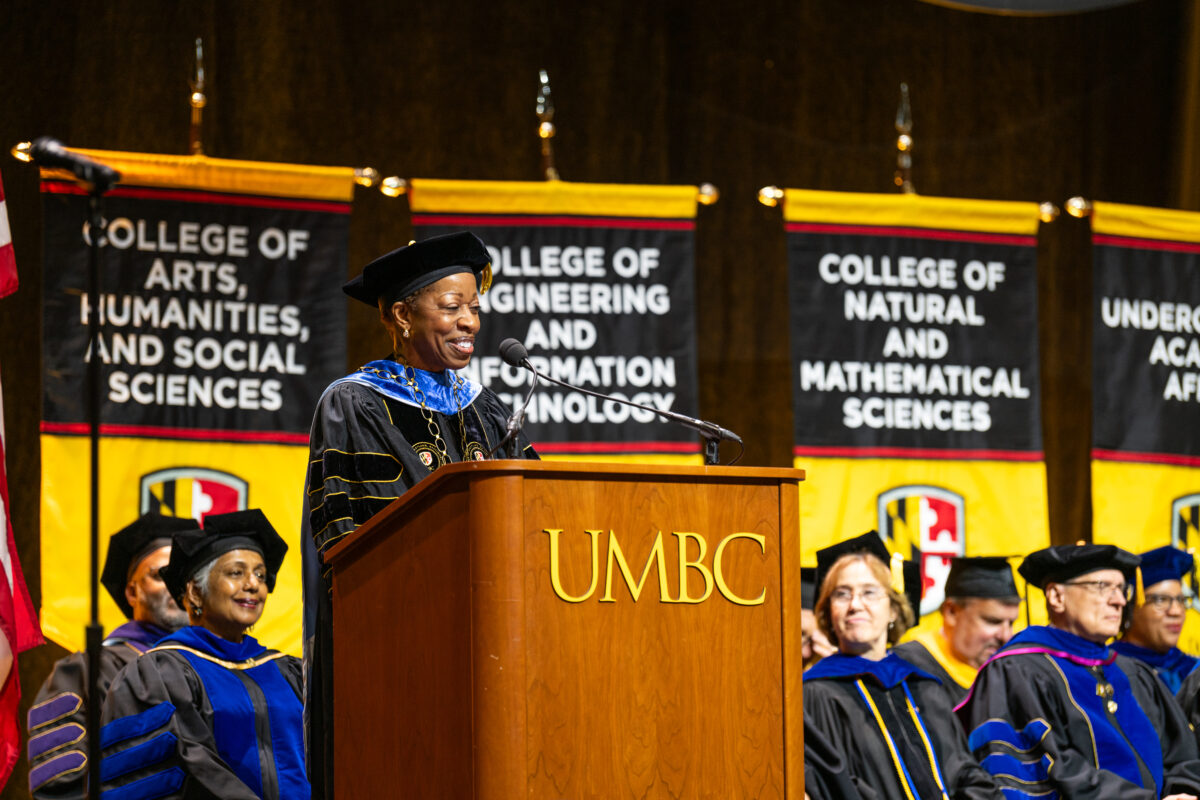
 (l) President Valerie Sheares Ashby addressing UMBC’s Class of 2025. (Brad Ziegler/UMBC) (r) Diane Tichnell ’70 (third from left) celebrates the publication of This Belongs To Us with fellow book editors Mimi Dietrich, Bob Dietrich, and Dale Gough. (Marlayna Demond ’11/UMBC).
To celebrate this historic moment, President Valerie Sheares Ashby paid tribute to the alumni known as the Founding Four, who represented graduates of the first four undergraduate classes from 1970 to 1973.
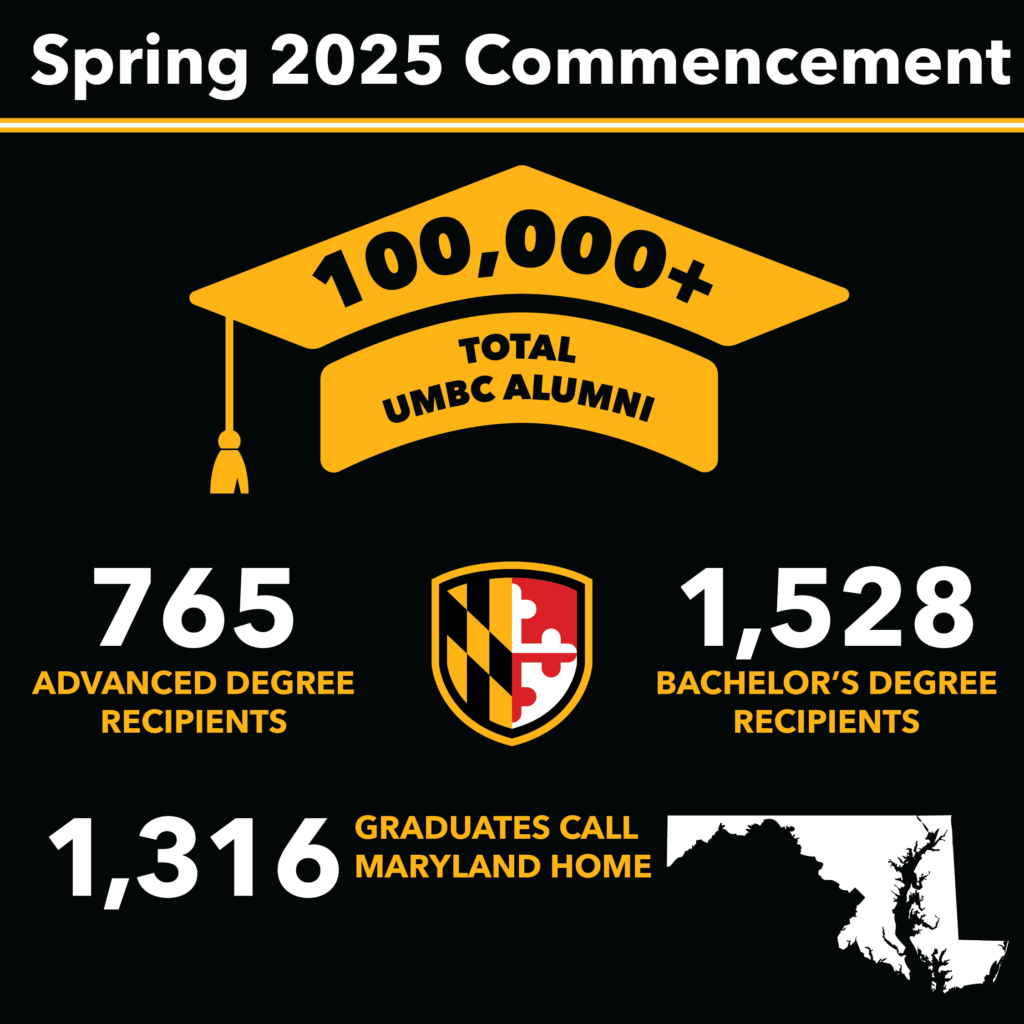
“What a profound impact UMBC has had on the state of Maryland and the world,” said Sheares Ashby. “Each one of our alumni has made a difference in some way, many of them as leaders and pathbreakers—in the public and private sectors, in the arts, in education, in research, in public service, and in their communities.”
Gratitude
The Class of 2025 celebrated and cheered for each other. However, thunderous applause rippled across UMBC’s Chesapeake Employers Insurance Arena every time a speaker asked the students to thank those who made their dreams come true. The stands were filled with roommates, classmates, mentors, and families who kept pointing the way when graduation seemed out of reach.
“You took risks when you chose to pursue this graduate degree. You stumbled and struggled and faced down your fears and insecurities,” said Graduate Student Association President Jessica Burstrem, Ph.D. ’25, language, literacy, and culture, in her address to her peers at the Graduate School Commencement ceremony.

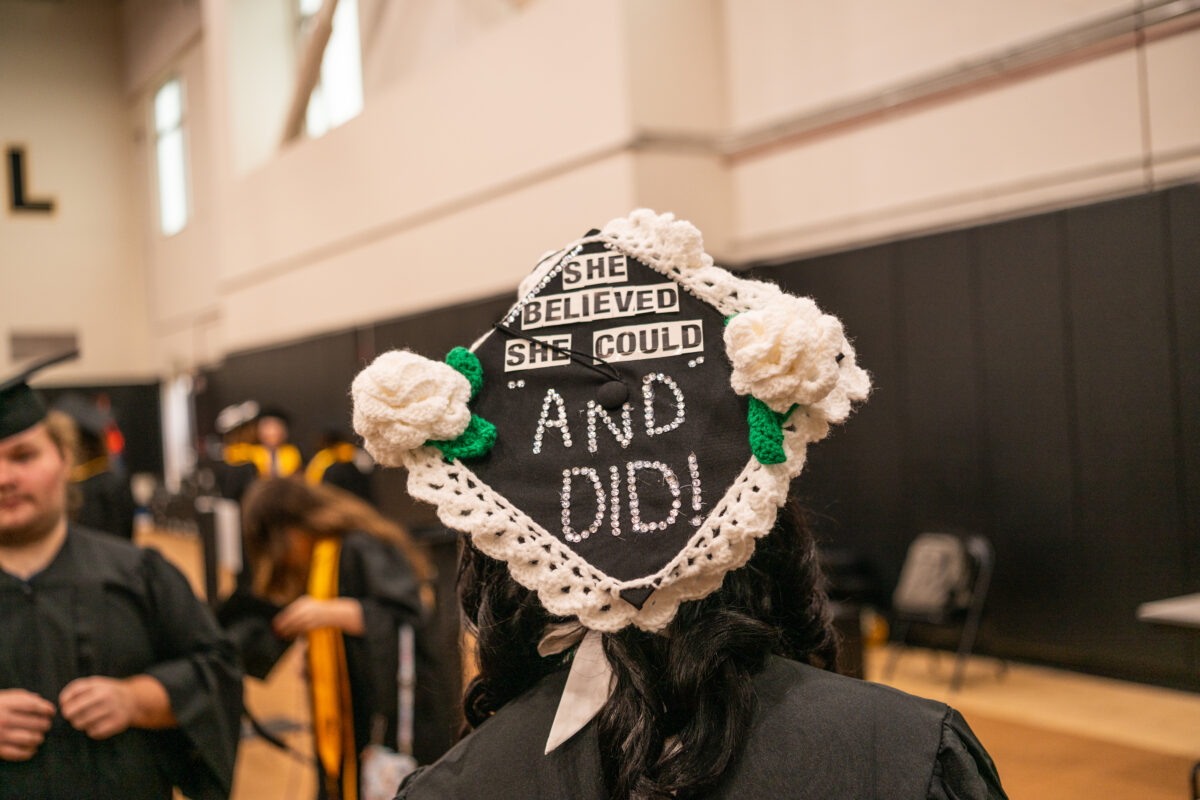 (l) Jessica Burstrem addressing the Graduate School Class of 2025. (Brad Ziegler/UMBC)
“That bravery is why you celebrate today. Those are the kinds of people the world always needs—people who do the right thing even if they are afraid. People of integrity and bravery. People who stand together,” said Burstrem.
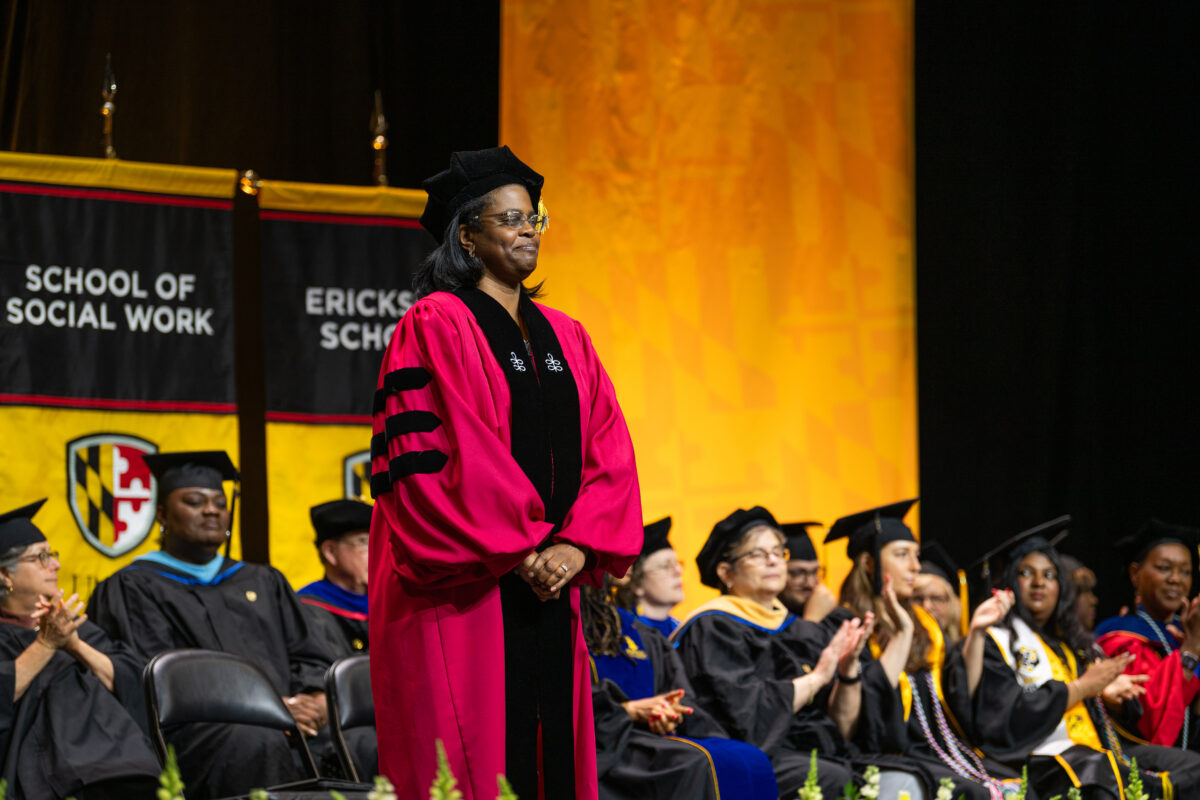
 (l) Sonja Brookins Santelises, chief executive officer of Baltimore City Public Schools, Thursday morning’s undergraduate commencement speaker and honorary degree recipient. (r) Anwesha Day, Ph.D. ’04, biochemistry and molecular biology, executive director in the Discovery Oncology Department of Genentech, spoke to Thursday afternoon’s graduates. (Brad Ziegler/UMBC)
The path of service
College wasn’t Tina Garcia’s first path, even after becoming the first in her family to graduate from high school. She served nearly a decade in the United States Air Force, rising to the rank of staff sergeant, before continuing her service within the government. After serving her country, Garcia chose to honor her family once again—this time by becoming the first to earn a college degree. She drew on her experience as a veteran and her majors in social work and psychology to co-found and serve as vice president of UMBC’s Student Service Members, Veterans, and Families organization.

 (l) Valedictorian Tina Garcia shares her journey to UMBC. (r) UMBC’s Color Guard opening the 2025 commencement ceremonies. (Brad Ziegler/UMBC)
“UMBC is where I found my community, and with it, a renewed sense of purpose to continue serving Veterans. I’m so grateful to everyone who continues this work, who shows up for veterans every day, and who refuses to let that momentum fade,” said Garcia, as one of two undergraduate valedictorians. “When we find belonging, we thrive. When we thrive, we create space for others to do the same. May you always find places where you belong and never let anyone convince you that you don’t.”
UMBC welcomes all
For international students, the meaning of community transcended physical boundaries, cultures, and languages, with graduate students representing 27 nations across five continents and Central America, and undergraduates representing 35 countries across six continents and the Caribbean, including Jamaican native, Akellia Bernard, a music performance major with a concentration in voice. Bernard, a member of UMBC’s Choir and Camerata, performed the national anthem for the three commencement ceremonies. This summer, Bernard plans to join the Choir and Camerata in Paris and Prague, where they have been invited to perform with the Czech National Symphony Orchestra.
 Akellia Bernardsings the Star-Spangled Banner at her undergraduate commencement ceremony. (Brad Ziegler/UMBC)
Praise Lasekan, a biological science major, whose family watched his valedictorian speech virtually back home in Ondo, Nigeria, was adamant about how the Retriever community became the vessel for his growth, acceptance, and joy.
 UMBC faculty and alumni give Praise Lasekan a standing ovation for his inspiring words. (Brad Ziegler/UMBC)
“The person you see standing in front of you today was once called a failure. People made fun of me. There were times I almost quit. But mentors, community, and the grace of God reminded me: Dreams don’t die, they just need to be stirred again,” said Lasekan. This fall, he will begin his Ph.D. at Brown University in the Department of Molecular Biology, Cell Biology, and Biochemistry. “UMBC showed me that community isn’t just who you’re around, it’s who holds you up when life feels heavy.” His journey resonated with the celebratory crowd and earned a standing ovation from the full house.
 And with the turn of the tassel, these students are officially UMBC Alumni. (Brad Ziegler/UMBC)
As Retrievers crossed their tassels from right to left, President Sheares Ashby reminded them that while the pursuit of their dreams might have had similar zig zags, they, “will be the ones who will listen to all the voices, fight for the needs of others, not just yourself, unite, not divide, bring calm to chaos, open doors, and see new ways forward.”
Listen to Akellia Bernard sing the Star-Spangled Banner, Governor Wes Moore’s message to the Class of 2025, and watch all three ceremonies at commencement.umbc.edu.
]]>
Before Joy Gabrielle Ware walked off the Commencement stage, she stopped mid-stage to face her peers and shouted, “UM!” prompting a booming “BC!” response from the undergraduates and their...
https://umbc.edu/stories/umbcs-class-of-2025/
https://dev.my.umbc.edu/api/v0/pixel/news/150428/guest@my.umbc.edu/976827328c289a34967296b2f158b9ce/api/pixel
biological-sciences
cahss
class-of-2025
cnms
coeit
community
feature
inds
music
news
psych
social-work
story
UMBC News & Magazine
https://dev.my.umbc.edu/groups/umbc-news-magazine
https://assets1-dev.my.umbc.edu/system/shared/avatars/groups/000/001/943/24435aa6207c452e7bc15cc74b42c7bb/xsmall.png?1748556657
https://assets1-dev.my.umbc.edu/system/shared/avatars/groups/000/001/943/24435aa6207c452e7bc15cc74b42c7bb/original.png?1748556657
https://assets2-dev.my.umbc.edu/system/shared/avatars/groups/000/001/943/24435aa6207c452e7bc15cc74b42c7bb/xxlarge.png?1748556657
https://assets2-dev.my.umbc.edu/system/shared/avatars/groups/000/001/943/24435aa6207c452e7bc15cc74b42c7bb/xlarge.png?1748556657
https://assets3-dev.my.umbc.edu/system/shared/avatars/groups/000/001/943/24435aa6207c452e7bc15cc74b42c7bb/large.png?1748556657
https://assets1-dev.my.umbc.edu/system/shared/avatars/groups/000/001/943/24435aa6207c452e7bc15cc74b42c7bb/medium.png?1748556657
https://assets2-dev.my.umbc.edu/system/shared/avatars/groups/000/001/943/24435aa6207c452e7bc15cc74b42c7bb/small.png?1748556657
https://assets1-dev.my.umbc.edu/system/shared/avatars/groups/000/001/943/24435aa6207c452e7bc15cc74b42c7bb/xsmall.png?1748556657
https://assets2-dev.my.umbc.edu/system/shared/avatars/groups/000/001/943/24435aa6207c452e7bc15cc74b42c7bb/xxsmall.png?1748556657
UMBC News & Magazine
0
0
false
Tue, 27 May 2025 20:14:29 -0400
Tue, 27 May 2025 20:14:29 -0400
Interdisciplinary UMBC team deepens understanding of cell migration, important for potential medical advances
Imagine cells navigating through a complex maze, guided by chemical signals and the physical landscape of their environment. At UMBC, a team of researchers has contributed an important discovery about how cells move, or migrate, through this maze of bodily tissues. Potential implications include better understanding of diseases like cancer and advancing medical treatments.
Published in iScience, the team’s study combines biological experiments and mathematics to reveal new insights into cell migration. Alex George, Ph.D. ’24, biological sciences, and Naghmeh Akhavan, Ph.D. ’25, mathematics, led the study, which explores how cells in fruit fly egg chambers navigate their environment. Their mentors, Michelle Starz-Gaiano, professor of biological sciences, and Brad Peercy, professor of mathematics, are co-authors.
By integrating mathematical modeling with advanced imaging, the team discovered that the physical shape of the egg chamber, combined with chemical signals called chemoattractants, significantly influences how cells move.
 Alex George (left) and Naghmeh Akhavan present their research at a conference at the University of Maryland, College Park. (Courtesy of Starz-Gaiano)
“This paper takes an interdisciplinary focus with tight collaboration between a mathematical framework and experimental design,” Peercy says. “The results promote the idea that complex distribution of chemical attractants can explain specific variations in migratory movement.” His enthusiasm highlights the study’s innovative approach, which merges precise mathematical models with real-world biological experiments to uncover patterns that were previously invisible.
Following the breadcrumbs
The team’s work focuses on border cells, a type of cell in fruit fly egg chambers, which are a model system for studying cell migration because of their similarities to processes in human development and disease. The team found that the border cells’ movement wasn’t just driven by continuously increasing chemical concentrations from one end of the egg chamber to the other, as earlier models suggested. Instead, the physical structure of the tissue—narrow tubes alternating with wider gaps—played a critical role.
“This was the first time that we characterized that there were these patterns of migration behavior that ended up correlating to aspects of the tissue geometry,” explains George, who specializes in capturing live images of these cells. He likens the process to Hansel and Gretel following breadcrumbs through a forest: On a flat plain, the trail is clear, but in a landscape with ravines and valleys, the breadcrumbs pool in unexpected ways, complicating the path.
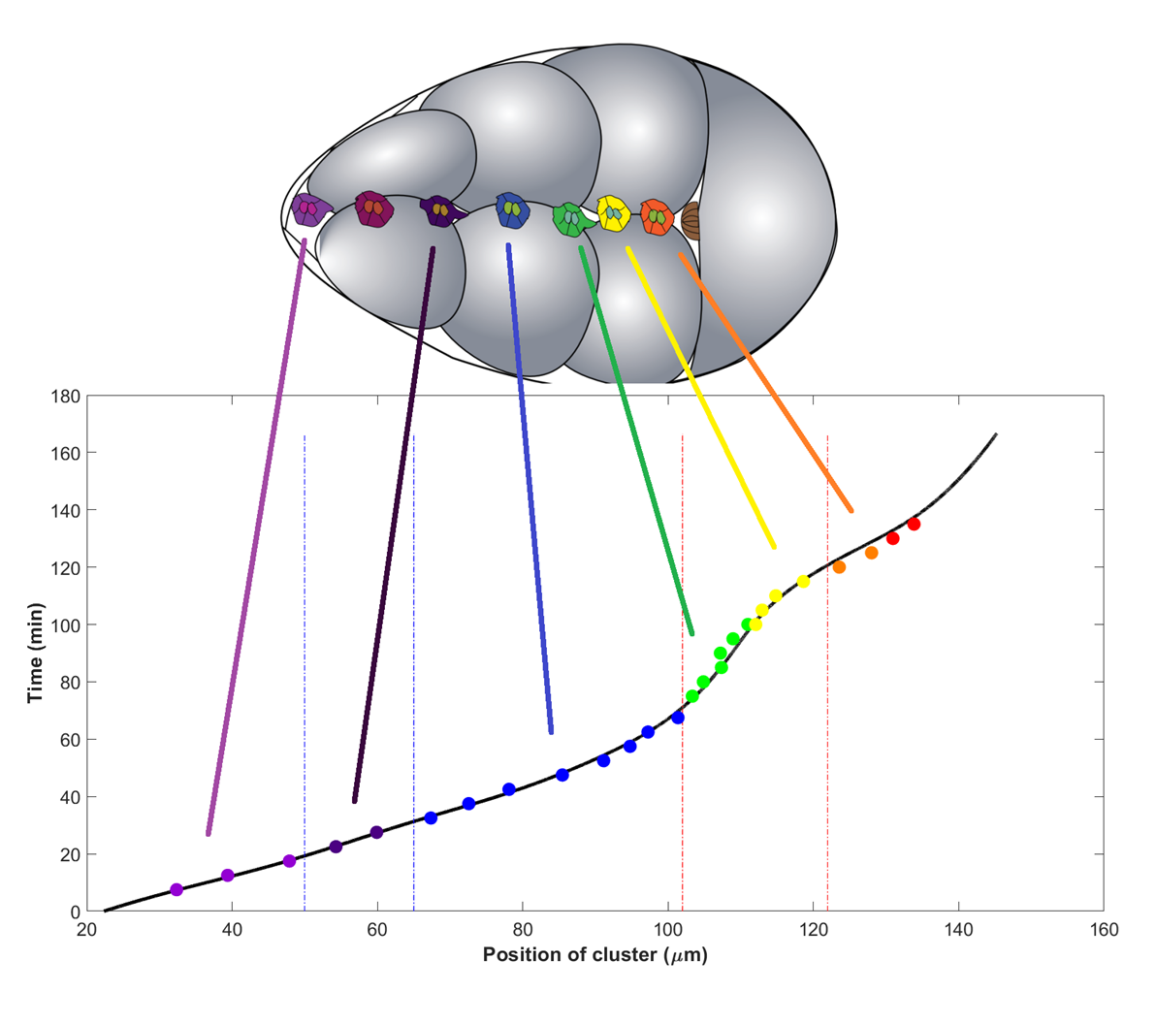 This visualization of Akhavan’s mathematical model shows how migration speed shifts in each zone of the egg chamber, pictured above the graph. A steeper slope indicates a slower speed. (Courtesy of Akhavan)
To understand this, Akhavan developed mathematical models that simulate how cells respond to both chemical signals and tissue geometry together. “Alex’s experiments showed that the speed is not exactly the way previous models showed it,” she says. Her models revealed that cells speed up in narrow tubes and slow down in larger gaps, a pattern confirmed by George’s imaging.
Both approaches—wet-lab experiments and modeling—bring unique strengths to the work. Putting them together “is like unveiling the invisible from two different perspectives,” George says. “My experiments would refine her model, and her model would refine my experiments.”
And then, “When our model shows exactly what Alex found in his experiments, we love that,” Akhavan adds.
Learning new languages
This synergy didn’t always come easily. Working across disciplines meant learning to speak each other’s scientific “languages.” Akhavan, with a background in pure mathematics, recalls that when she joined the project in spring 2022, “Everything was in a different language for me.” Similarly, “A couple of times I opened my MATLAB code and Alex’s eyes got huge,” Akhavan laughs.
Yet, their collaboration flourished, fostering not only scientific breakthroughs but also friendship. “It’s a challenge to communicate across disciplines since it’s almost like speaking in different languages,” Starz-Gaiano says. “Both Alex and Naghmeh got more adept at explaining their work and honing their research questions as a result of working together over a couple of years, which was great to watch.”
Putting together wet lab experiments and mathematical modeling “is like unveiling the invisible from two different perspectives. My experiments would refine her model, and her model would refine my experiments.”
Alex George, Ph.D. ’24, biological sciences
“It is a risky and vulnerable situation to be open with colleagues in areas in which you are not a burgeoning expert,” Peercy adds. “Naghmeh and Alex have grown so much through this project to genuinely rely on each other’s opinion.”
The study’s broader impact lies in its potential to inform fields beyond developmental biology. Cell migration is critical in processes like wound healing, immune responses, and cancer metastasis. “Most research on how cells navigate the world has focused only on chemical signals or only on structural ones, so this is one of the first studies to consider how those two things impact each other, which is likely to be relevant in many cases,” Starz-Gaiano explains. By showing how tissue geometry and chemical signals interact, the research could guide new strategies for controlling cell movement via medical treatments.


 Left: The team traveled to the Janelia Research Campus in Virginia to do advanced imaging for the cell migration project, which will open new avenues for research. (Courtesy of Starz-Gaiano) Center: A moment of levity in the Starz-Gaiano lab. (Courtesy of Akhavan) Right: Brad Peercy and Michelle Starz-Gaiano shared their collaborative work at the “RetriEVER Empowered: Student Success + Research + Community”event in April 2022.
New strategies lead to new discoveries
George refined his expertise in microscopy through working with Tagide deCarvalho in UMBC’s Keith R. Porter Imaging Facility. “It helped me learn a lot, getting my hands on other people’s work and visualizing all the cool things,” he says. “A picture is worth a thousand words, but a movie? Ten thousand words.” Now he’s taking his skills to the Dartmouth Cancer Center’s microscopy core facility at the Geisel School of Medicine, where he’ll start as a research scientist in June.
For Akhavan and George, leading this project has been a defining experience. Akhavan’s models, including a new approach that uses energy calculations to better capture the egg chamber’s complex geometry, have become a cornerstone of her dissertation, and she plans to continue this work post-graduation.
George and Akhavan’s mentors played a pivotal role in their success. “Michelle is a role model for me,” Akhavan says, praising the collaborative spirit of Starz-Gaiano and Peercy. “Dr. Peercy and Dr. Starz-Gaiano make the best combination for doing interdisciplinary research. This collaboration is amazing.”

 Left: Naghmeh Akhavan (center) accepts the Outstanding Graduate Research in Mathematics Award at CNMS Awards and Recognition Day. (Courtesy of Akhavan) Right: Michelle Starz-Gaiano and Alex George take some time for fun while attending the Society for Developmental Biology Annual Meeting in Chicago in 2023. (Courtesy of Starz-Gaiano)
The team’s work continues to evolve, including recent experiments at the Advanced Imaging Center at the Janelia Research Campus in Virginia, where George used advanced microscopes to capture previously unseen dynamics of the relevant chemoattractants. These findings will further refine their models, opening new avenues for research.
“We are developing new experimental strategies both on the biology and the math side of things,” Starz-Gaiano says, “so it will be exciting to see where this will take us next.”
]]>
Imagine cells navigating through a complex maze, guided by chemical signals and the physical landscape of their environment. At UMBC, a team of researchers has contributed an important discovery...
https://umbc.edu/stories/cell-migration-research-medical-advances/
https://dev.my.umbc.edu/api/v0/pixel/news/150422/guest@my.umbc.edu/5bddad5f85a6271f260efba4d150dbfc/api/pixel
biological-sciences
biology
cnms
gradresearch
mathematics-and-statistics
mathstat
news
research
science-and-tech
story
UMBC News & Magazine
https://dev.my.umbc.edu/groups/umbc-news-magazine
https://assets1-dev.my.umbc.edu/system/shared/avatars/groups/000/001/943/24435aa6207c452e7bc15cc74b42c7bb/xsmall.png?1748556657
https://assets1-dev.my.umbc.edu/system/shared/avatars/groups/000/001/943/24435aa6207c452e7bc15cc74b42c7bb/original.png?1748556657
https://assets2-dev.my.umbc.edu/system/shared/avatars/groups/000/001/943/24435aa6207c452e7bc15cc74b42c7bb/xxlarge.png?1748556657
https://assets2-dev.my.umbc.edu/system/shared/avatars/groups/000/001/943/24435aa6207c452e7bc15cc74b42c7bb/xlarge.png?1748556657
https://assets3-dev.my.umbc.edu/system/shared/avatars/groups/000/001/943/24435aa6207c452e7bc15cc74b42c7bb/large.png?1748556657
https://assets1-dev.my.umbc.edu/system/shared/avatars/groups/000/001/943/24435aa6207c452e7bc15cc74b42c7bb/medium.png?1748556657
https://assets2-dev.my.umbc.edu/system/shared/avatars/groups/000/001/943/24435aa6207c452e7bc15cc74b42c7bb/small.png?1748556657
https://assets1-dev.my.umbc.edu/system/shared/avatars/groups/000/001/943/24435aa6207c452e7bc15cc74b42c7bb/xsmall.png?1748556657
https://assets2-dev.my.umbc.edu/system/shared/avatars/groups/000/001/943/24435aa6207c452e7bc15cc74b42c7bb/xxsmall.png?1748556657
UMBC News & Magazine
0
0
false
Tue, 27 May 2025 14:10:11 -0400
Tue, 27 May 2025 14:10:11 -0400
New Art of Science award recognizes UMBC students who communicate research visually
For Rachel Brewster, professor of biological sciences, “science has always been visual,” she says. Her laboratory focuses on developmental biology, using zebrafish as a model organism. Zebrafish have transparent embryos, and imaging them as they grow and change is a core element of her group’s data collection.
“There is endless complexity and beauty captured in the images we generate using increasingly advanced imaging technologies,” Brewster says. “To me, this is not unlike the experience of viewing great works of art, such as impressionist paintings that bring the natural world to life through color, texture, and contrast.”
To that end, Brewster endowed the new Havelock and Jennifer Brewster Art of Science award in the College of Natural and Mathematical Sciences (CNMS). The award recognizes one CNMS student per year who produces original, visually stunning photographs, illustrations, or data visualizations that effectively communicate an important aspect of research.
“Scientific imaging that captures both beauty and meaning takes time, skill, and perseverance,” Brewster says. The new award acknowledges that “this kind of work deserves recognition not just within the scientific community, but beyond, because it has the power to spark curiosity, inspire others, and make science more accessible and engaging to the wider public.”
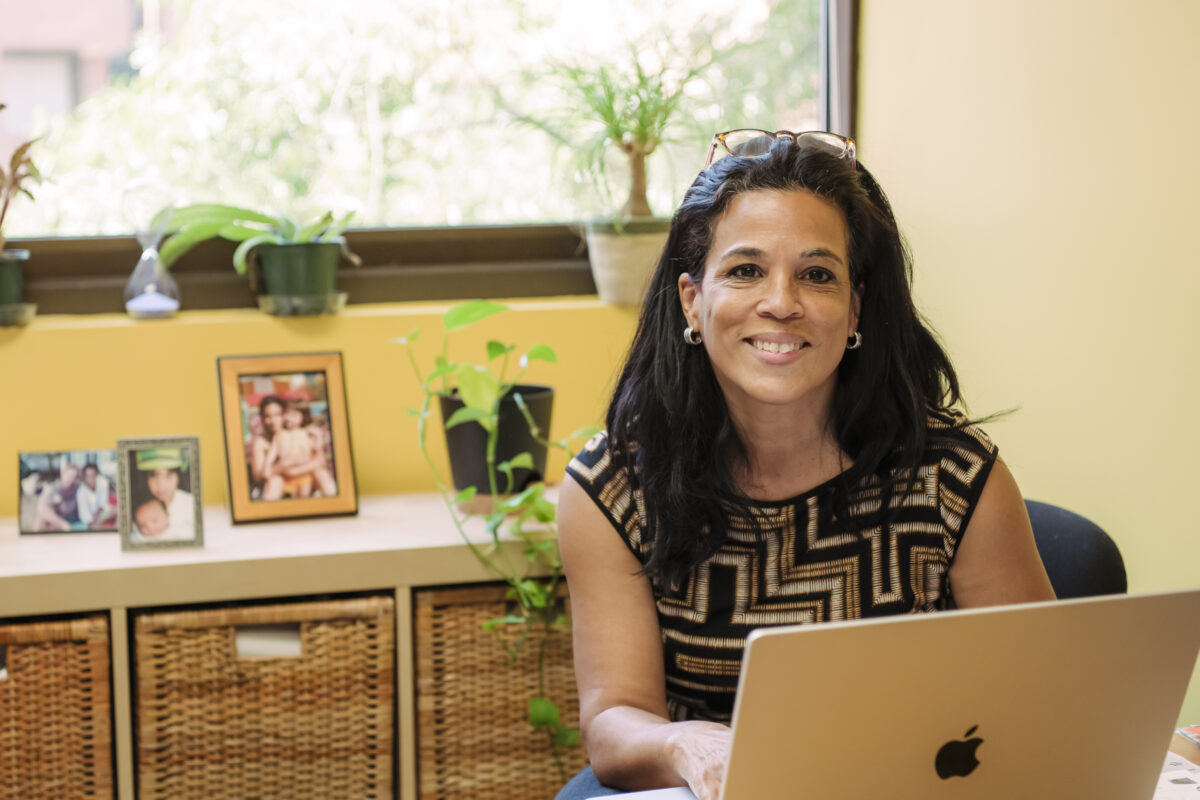 Rachel Brewster’s office is a welcoming space for students to come and ask questions. (Marlayna Demond ’11/UMBC)
Opening people’s minds to the art of science
Maggie Wang, a junior biochemistry and molecular biology major with a minor in art history and museum studies, is the first recipient of the new award. Participating in UMBC’s SCIART program, a collaboration with the Walters Art Museum in Baltimore, initially “opened my mind to the intersection of science and art,” Wang says.
As an undergraduate researcher in UMBC’s Molecular Characterization and Analysis Complex (MCAC), Wang’s desire to better understand the research equipment in the MCAC led her to produce detailed illustrations explaining the purpose of various instruments and the techniques they employ. With the encouragement of Cynthia Tope Niedermaier,MCAC facility manager, Wang polished her illustrations to help others learn about the equipment.
 Maggie Wang created detailed drawings of instruments in the MCAC accompanied by helpful explanations of their features, such as this Bruker 12T solariX Fourier Transform Ion Cyclotron Resonance Mass Spectrometer (FT-ICR-MS). (Courtesy of Wang)
This summer, Wang will develop educational diagrams of more MCAC instruments. In addition to her scientific art, she works with graphite, ink, and yarn to create pieces that frequently focus on themes of Chinese culture and women’s fashion. Wang plans to pursue additional study in medical illustration after she graduates from UMBC.
“Making art is a cathartic experience that allows me to express my creativity and emotions,” Wang says. “It also helps me connect with people from different backgrounds, opening the door to new perspectives and meaningful connections.”
Giving back in gratitude
Brewster strongly believes in UMBC’s mission to bring together and support students from a wide range of backgrounds, a goal she lives out daily within her own research group. Recently she also became co-lead of UMBC’s Meyerhoff Graduate Fellows Program, which offers financial support and a close community feel to promising STEM students from all backgrounds.
“I have seen firsthand the powerful role the program plays in building the next generation of scientists,” Brewster says. “The Meyerhoff Program offers a proven framework, showing that by engaging all those who have something to contribute, we can continue to thrive as a nation.”
Brewster’s gift to fund this award is also “a small expression of my deep and lasting gratitude to my late parents, whom I love and miss every day,” she says. UMBC has also had a major role in shaping her identity. “UMBC has been my home since 2004. It is here that I have grown, not just as a scientist, but as a person. A big part of who I am is inextricably linked to this university.”
]]>
For Rachel Brewster, professor of biological sciences, “science has always been visual,” she says. Her laboratory focuses on developmental biology, using zebrafish as a model organism. Zebrafish...
https://umbc.edu/stories/art-of-science-award/
https://dev.my.umbc.edu/api/v0/pixel/news/150421/guest@my.umbc.edu/e2e7f6d2f5d14cac243879fc6a00cd41/api/pixel
arts-and-culture
biology
chembiochem
cnms
mcac
news
science-and-tech
story
UMBC News & Magazine
https://dev.my.umbc.edu/groups/umbc-news-magazine
https://assets1-dev.my.umbc.edu/system/shared/avatars/groups/000/001/943/24435aa6207c452e7bc15cc74b42c7bb/xsmall.png?1748556657
https://assets1-dev.my.umbc.edu/system/shared/avatars/groups/000/001/943/24435aa6207c452e7bc15cc74b42c7bb/original.png?1748556657
https://assets2-dev.my.umbc.edu/system/shared/avatars/groups/000/001/943/24435aa6207c452e7bc15cc74b42c7bb/xxlarge.png?1748556657
https://assets2-dev.my.umbc.edu/system/shared/avatars/groups/000/001/943/24435aa6207c452e7bc15cc74b42c7bb/xlarge.png?1748556657
https://assets3-dev.my.umbc.edu/system/shared/avatars/groups/000/001/943/24435aa6207c452e7bc15cc74b42c7bb/large.png?1748556657
https://assets1-dev.my.umbc.edu/system/shared/avatars/groups/000/001/943/24435aa6207c452e7bc15cc74b42c7bb/medium.png?1748556657
https://assets2-dev.my.umbc.edu/system/shared/avatars/groups/000/001/943/24435aa6207c452e7bc15cc74b42c7bb/small.png?1748556657
https://assets1-dev.my.umbc.edu/system/shared/avatars/groups/000/001/943/24435aa6207c452e7bc15cc74b42c7bb/xsmall.png?1748556657
https://assets2-dev.my.umbc.edu/system/shared/avatars/groups/000/001/943/24435aa6207c452e7bc15cc74b42c7bb/xxsmall.png?1748556657
UMBC News & Magazine
0
0
false
Tue, 27 May 2025 13:05:54 -0400
Tue, 27 May 2025 13:05:54 -0400
Research days foster collaboration and showcase research across the College of Engineering and Information Technology
A dynamic research ecosystem was on display in a series of events showcasing existing projects and encouraging new collaborations across the College of Engineering and Information Technology (COEIT) this spring.
On April 11, the second annual COEIT Research Day brought together more than 180 students and faculty from COEIT’s four academic departments, as well as outside speakers and visitors. Attendance increased by around 20 percent from last year’s inaugural Research Day.
More than 100 researchers presented either talks or posters at the meeting, and several students won awards for their posters and were recognized at the COEIT Awards and Celebration event on May 4.
“A major success of this year’s Research Day was the presence of visitors and speakers from industry, nonprofits, and government,” says Vandana Janeja, the associate dean for research in COEIT. “The event gave these guests an opportunity to visit UMBC and to engage in the vibrant research happening within COEIT, making connections with our research community that we hope to see grow into long-lasting partnerships.”
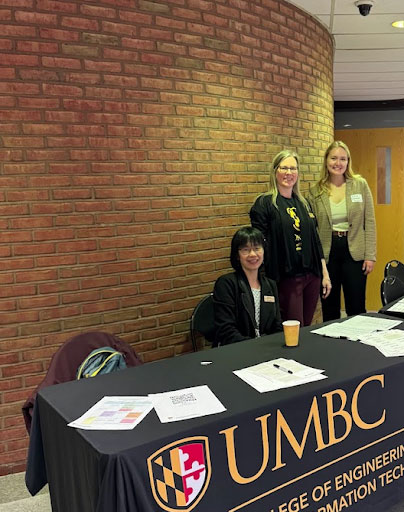 COEIT dean’s office staff Emily Tien, Amy Heckhaus, and Chloe Evered at COEIT Research Day. (Image courtesy of Vandana Janeja)
The college also launched a new call for COEIT Interdisciplinary Proposals. Last year, COEIT funded 11 projects from teams made up of researchers from two or more academic departments. The teams presented their results at this year’s event, on topics ranging from cybersecurity in manufacturing to thermally stable energy-harvesting materials.
On May 2, the Department of Computer Science and Electrical Engineering also hosted its annual research day, bringing together faculty, staff, and students to highlight the department’s latest advancements in research, from robotics to AI weather forecasting.
]]>
A dynamic research ecosystem was on display in a series of events showcasing existing projects and encouraging new collaborations across the College of Engineering and Information Technology...
https://umbc.edu/quick-posts/coeit-research-days/
https://dev.my.umbc.edu/api/v0/pixel/news/150553/guest@my.umbc.edu/2dabfa0e25e152f93f40d0b49805aa6b/api/pixel
cbee
coeit
csee
is
meche
news
quick-post
research
science-and-tech
UMBC News & Magazine
https://dev.my.umbc.edu/groups/umbc-news-magazine
https://assets1-dev.my.umbc.edu/system/shared/avatars/groups/000/001/943/24435aa6207c452e7bc15cc74b42c7bb/xsmall.png?1748556657
https://assets1-dev.my.umbc.edu/system/shared/avatars/groups/000/001/943/24435aa6207c452e7bc15cc74b42c7bb/original.png?1748556657
https://assets2-dev.my.umbc.edu/system/shared/avatars/groups/000/001/943/24435aa6207c452e7bc15cc74b42c7bb/xxlarge.png?1748556657
https://assets2-dev.my.umbc.edu/system/shared/avatars/groups/000/001/943/24435aa6207c452e7bc15cc74b42c7bb/xlarge.png?1748556657
https://assets3-dev.my.umbc.edu/system/shared/avatars/groups/000/001/943/24435aa6207c452e7bc15cc74b42c7bb/large.png?1748556657
https://assets1-dev.my.umbc.edu/system/shared/avatars/groups/000/001/943/24435aa6207c452e7bc15cc74b42c7bb/medium.png?1748556657
https://assets2-dev.my.umbc.edu/system/shared/avatars/groups/000/001/943/24435aa6207c452e7bc15cc74b42c7bb/small.png?1748556657
https://assets1-dev.my.umbc.edu/system/shared/avatars/groups/000/001/943/24435aa6207c452e7bc15cc74b42c7bb/xsmall.png?1748556657
https://assets2-dev.my.umbc.edu/system/shared/avatars/groups/000/001/943/24435aa6207c452e7bc15cc74b42c7bb/xxsmall.png?1748556657
UMBC News & Magazine
0
0
false
Tue, 27 May 2025 07:37:00 -0400
Tue, 27 May 2025 07:37:00 -0400
UMBC researchers partner with UMB to advance healthcare technology
Dong Li, assistant professor in the Department of Computer Science and Electrical Engineering (CSEE), and Konstantinos Kalpakis, associate professor in CSEE, were recently awarded funding from the University of Maryland, Baltimore’s (UMB) Institute for Clinical and Translational Research to support the development of innovative healthcare technology. Both UMBC researchers are partnering with colleagues at UMB on their projects.
Li’s research aims to develop a reliable method to monitor blood pressure with a smartphone. High blood pressure, or hypertension, affects more than 1.3 billion people globally, and while conventional devices to monitor blood pressure are accurate, they are bulky and impractical in everyday life, Li says. As an affordable and accessible alternative, Li is testing if a smartphone, outfitted with ultrasound sensors to measure blood flow and using the built-in microphone to record heart sounds, could deliver reliable readings. Li’s partnership with UMB will allow the team to conduct clinical trials, with both healthy individuals and those with hypertension, to rigorously evaluate the system’s accuracy and effectiveness.
In a separate project, Kalpakis and his colleagues are developing a new approach to help trauma physicians make better-informed treatment decisions quickly. The team is working on a machine-learning framework that can help ER doctors predict medical outcomes, such as which patients will experience severe complications from trauma such as hemorrhaging, and what their blood transfusion needs may be. Unlike other machine learning models, the new approach can update over time and deliver measures of uncertainty, helping clinicians place more trust in the model’s guidance.
“These projects highlight how interdisciplinary collaboration between UMBC and the University of Maryland School of Medicine can drive innovations in medical care and improve public health,” Li says. “I’m excited and proud to take this work forward.”
]]>
Dong Li, assistant professor in the Department of Computer Science and Electrical Engineering (CSEE), and Konstantinos Kalpakis, associate professor in CSEE, were recently awarded funding from the...
https://umbc.edu/quick-posts/umbc-researchers-partner-with-umb-to-advance-healthcare-technology/
https://dev.my.umbc.edu/api/v0/pixel/news/150401/guest@my.umbc.edu/086acb89451841f10d32b33a2b73e85b/api/pixel
coeit
csee
news
quick-post
research
science-and-tech
UMBC News & Magazine
https://dev.my.umbc.edu/groups/umbc-news-magazine
https://assets1-dev.my.umbc.edu/system/shared/avatars/groups/000/001/943/24435aa6207c452e7bc15cc74b42c7bb/xsmall.png?1748556657
https://assets1-dev.my.umbc.edu/system/shared/avatars/groups/000/001/943/24435aa6207c452e7bc15cc74b42c7bb/original.png?1748556657
https://assets2-dev.my.umbc.edu/system/shared/avatars/groups/000/001/943/24435aa6207c452e7bc15cc74b42c7bb/xxlarge.png?1748556657
https://assets2-dev.my.umbc.edu/system/shared/avatars/groups/000/001/943/24435aa6207c452e7bc15cc74b42c7bb/xlarge.png?1748556657
https://assets3-dev.my.umbc.edu/system/shared/avatars/groups/000/001/943/24435aa6207c452e7bc15cc74b42c7bb/large.png?1748556657
https://assets1-dev.my.umbc.edu/system/shared/avatars/groups/000/001/943/24435aa6207c452e7bc15cc74b42c7bb/medium.png?1748556657
https://assets2-dev.my.umbc.edu/system/shared/avatars/groups/000/001/943/24435aa6207c452e7bc15cc74b42c7bb/small.png?1748556657
https://assets1-dev.my.umbc.edu/system/shared/avatars/groups/000/001/943/24435aa6207c452e7bc15cc74b42c7bb/xsmall.png?1748556657
https://assets2-dev.my.umbc.edu/system/shared/avatars/groups/000/001/943/24435aa6207c452e7bc15cc74b42c7bb/xxsmall.png?1748556657
UMBC News & Magazine
1
0
false
Fri, 23 May 2025 15:23:01 -0400
James Smalls’ efforts to restore Féral Benga’s place in 20th-century performing arts just might preserve his grave site as well
Art historian James Smalls, a professor of visual arts, researches the intersections of race, gender, and queer sexuality in both 19th-century art and the broader visual culture of the Black diaspora. Smalls is on a thrilling adventure to uncover the life and legacy of Senegalese performer known as Féral Benga and restore him to his rightful place in art history, and in a twist of timing fate, his research might also protect Benga’s final resting place. Smalls spent nine months in 2024 at the Getty Research Institute in California as part of their Getty Scholars Program, which gave him time to work on his next book, Féral Benga: African Muse of Modernism, and continue connecting the dots of Benga’s artistic impact.
Q: What led you to research Féral Benga?
A: I found a black and white photo of a sculpture by Richmond Barthé, an African American sculptor of the Harlem Renaissance. It’s a beautiful sculpture of a Black man holding aloft a kind of saber, doing this hypnotic dance. It was titled Féral Benga, and I thought, ‘Well, what’s that? Is that a type of dance that I’m looking at or something else?’ Eventually, I found out that this is the stage name of François Benga, who adopted the name when he began performing at the Folies Bergère [a famous cabaret music hall in Paris]. Benga was a very statuesque sort of dancer. His dance technique combined African dance with classical ballet and acrobatics. I wanted to learn more, which led to years of research trying to create an archive of his life and art.
 Féral Benga, La danse du sabre, c. 1934, by Lucien Waléry. (Courtesy Bibliothèque de France)
Q: How did Féral Benga‘s statue inspire the next step of your research journey?
A: I discovered that Benga became a muse for visual artists during the early part of the 20th century and that he had a very interesting personality.
He was a very magnetic sort of person and had many amorous affairs. Benga was gay and belonged to a gay circle of avant-garde artists. Jean Cocteau was one of those people and included him in his first avant-garde film, The Blood of a Poet, in 1932.
 Postcard of Féral Benga at the Folies-Bergère, about 1930, by Lucien Waléry. (Images courtesy of the Getty)
Q: What were some of Féral Benga’s contributions before and after World War II?
A: Before WWII, Benga owned a cabaret and a Senegalese restaurant in Paris where he performed. After WWII, he again established a nightclub, a cabaret called La Rose Rouge, where young African artists and students gathered and created works, leading to the beginning of the Négritude movement within the performing arts. [The Négritude movement was an anti-colonial cultural and political movement founded by a group of African and Caribbean students in Paris in the 1930s who sought to reclaim the value of blackness and African culture.]
I want to dispel the notion that women and people of color did not contribute to modernism and the avant-garde movement. They are sort of written out of art history. I’ve learned Benga contributed greatly to these two movements. Through my research, I want to bring that to the surface so that people are aware of that, that they’re just not on the side.
Q: Did your research bring any unexpected finds?
A: I put an alert out on eBay for any imagery of Féral Benga. For a while, I didn’t hear anything. Then, suddenly, something came up. A woman in France started selling photographs of him without knowing who he was. She had this huge box of images and wanted to sell them piecemeal to make money. Each time she sent me a photo, she added some candid shots of the dancer. One shows him smoking a cigarette at a party, and another in a park. Suddenly, Swiss art dealers bought the rest of the collection. They have agreed to let me use the photos for my book.
It turned out the woman’s father was an estate dealer. He found this box of photos in a house in Châteauroux, in central France, that I later discovered was Féral Benga’s house.
Q: Did you find additional traces of Benga’s life during your trip to France?
A: I went to the Saint-Denis cemetery in Châteauroux and found the family tomb where he is buried. I’m still researching the family, which is difficult because there are no records. It’s interesting work because I’m trying to piece together this life that was very popular and well-known at the time but then suddenly sort of disappeared from history.
The concession [rights to the plot of land] on the family tomb is set to run out in 2028—the French government will disinter the remains and put them in different ossuaries. I’m petitioning the French government to preserve Féral Benga’s grave because he is an important icon of Black diasporic modernism.
Q: Are there connections between this research and the research for your first book, The Homoerotic Photography of Carl Van Vechten: Public Face, Private Thoughts?
A: Carl Van Vechten was a great patron of the Harlem Renaissance, a writer, and a photographer. If you see old photographs of African Americans from the Harlem Renaissance, portraits of people in music, dance, theater, and cultural people, those images are by Carl Van Vechten. He was very well known during the period. He also did a lot of private erotic photography, which is what my book was about.
 Benga with his troupe, La Magie Noire in Harlem, 1936. (Image courtesy of Smalls)
The connection to my new book is that Féral Benga arrived in New York City in 1937, and Carl Van Vechten invited Féral Benga over into his studio apartment and took many interesting photographs of him.
It’s been a great journey piecing all this research together. Now, I must finish the book.
Learn more about UMBC’s Department of Visual Arts.
]]>
Art historian James Smalls, a professor of visual arts, researches the intersections of race, gender, and queer sexuality in both 19th-century art and the broader visual culture of the Black...
https://umbc.edu/stories/james-smalls-efforts-to-restore-feral-benga/
https://dev.my.umbc.edu/api/v0/pixel/news/150375/guest@my.umbc.edu/c0000f27e3d38747d041ead4de954897/api/pixel
cahss
cahss-research
discovery
international
magazine
research
story
visualarts
UMBC News & Magazine
https://dev.my.umbc.edu/groups/umbc-news-magazine
https://assets1-dev.my.umbc.edu/system/shared/avatars/groups/000/001/943/24435aa6207c452e7bc15cc74b42c7bb/xsmall.png?1748556657
https://assets1-dev.my.umbc.edu/system/shared/avatars/groups/000/001/943/24435aa6207c452e7bc15cc74b42c7bb/original.png?1748556657
https://assets2-dev.my.umbc.edu/system/shared/avatars/groups/000/001/943/24435aa6207c452e7bc15cc74b42c7bb/xxlarge.png?1748556657
https://assets2-dev.my.umbc.edu/system/shared/avatars/groups/000/001/943/24435aa6207c452e7bc15cc74b42c7bb/xlarge.png?1748556657
https://assets3-dev.my.umbc.edu/system/shared/avatars/groups/000/001/943/24435aa6207c452e7bc15cc74b42c7bb/large.png?1748556657
https://assets1-dev.my.umbc.edu/system/shared/avatars/groups/000/001/943/24435aa6207c452e7bc15cc74b42c7bb/medium.png?1748556657
https://assets2-dev.my.umbc.edu/system/shared/avatars/groups/000/001/943/24435aa6207c452e7bc15cc74b42c7bb/small.png?1748556657
https://assets1-dev.my.umbc.edu/system/shared/avatars/groups/000/001/943/24435aa6207c452e7bc15cc74b42c7bb/xsmall.png?1748556657
https://assets2-dev.my.umbc.edu/system/shared/avatars/groups/000/001/943/24435aa6207c452e7bc15cc74b42c7bb/xxsmall.png?1748556657
UMBC News & Magazine
0
0
false
Thu, 22 May 2025 17:34:56 -0400
Thu, 22 May 2025 17:34:56 -0400
Dionne Cole ’25: Family, faith, and friends help this Retriever find her academic path
Dionne Cole, a native of Montgomery County, came to UMBC expecting to pursue a career in biology. But after a few semesters, she found her true calling lay in the intersection of social work, public health, and social justice. Guided by her faith as well as the support of her family and the community she built at UMBC, Dionne took on a dual degree, combining her newfound passion for social work with biology. She did her social work field placement at Retriever Essentials—a partnership advancing food access at UMBC—this year and became an advocate for students experiencing food insecurity, impressing everyone with her hard work and determination to make a difference. She plans to take time next year to work, before returning to school to get her master’s in public health.
Q: What made you decide to come to UMBC?
A: During the college application process, I was actually looking to go overseas because I love traveling and also because my family is from London. But I ended up coming to UMBC because I received a good award package, and I saw how they really valued community. That was a value that I cultivated in high school that I wanted to continue fostering in college. And then, because I was interested in being a bio major, seeing how research-oriented UMBC seemed, was also appealing as well. I think I made the right choice.
Q: Did you find the community you were looking for?
A: Yeah, in a big way. My faith is a big aspect of my life, so a lot of that community that I was looking for came through a group I joined called Bethel Campus Fellowship. Just being able to be around people who are like-minded and can also support and encourage you while you are a college student—that’s a lot. I also found community in the Social Work Student Association and the Public Health Council of Majors where I was able to connect with people who had similar interests. That was empowering because I wanted to go into a field that really valued public service and valued people. Being a member in those two clubs really reinforced that for me. And my internship at Retriever Essentials, which I am just wrapping up now, has been within itself a community of people who really care about other people and want to serve.
Q: How did you choose to be a dual degree student?
A: I came in as a bio major and early on, I started realizing that I was being prepared to either go into STEM research or medicine. Those are great fields, but that’s not really what I want to do. I talked with my cousin about the healthcare field, and she explained to me the value of social work. And then I talked to a social worker at my mom’s workplace and started doing my own research, and I was like, “okay, this is a field that has what I’m looking for.”
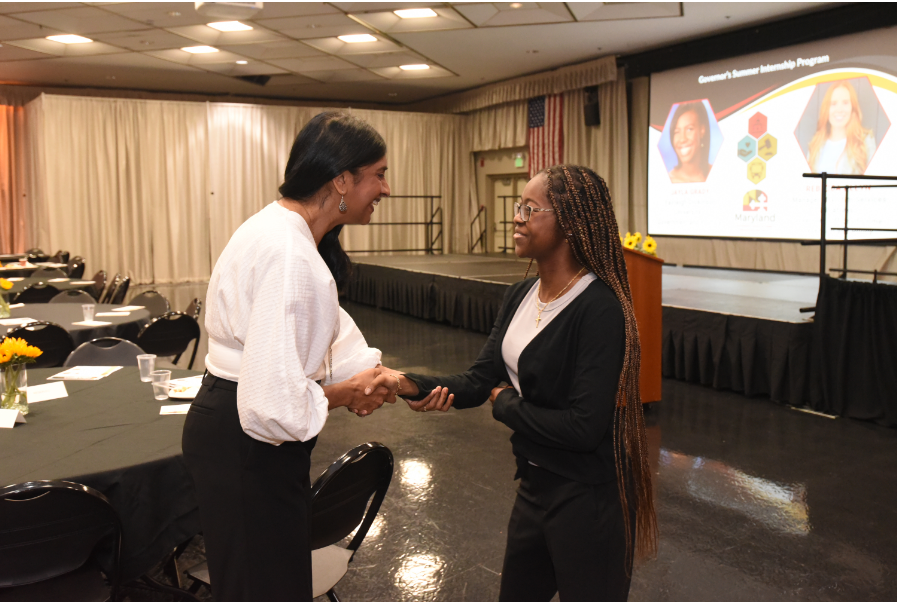 Cole shakes hands with Aruna Miller, Lt. Governor of Maryland. (Photo courtesy of Cole)
I didn’t switch right away. I took two intro to social work classes just to see if I would like it. I fell in love with the core values, particularly social justice. I am social justice-oriented, so once I learned more about social work, I thought: This is it for me—I’m going to add social work to my degree plan and start pursuing opportunities that are more in line with that. But I still kept the bio background because I love biology.
Q: How did you end up at Retriever Essentials and what was that like for you? What did you learn?
A: I started at Retriever Essentials as a community liaison with Maryland Food Bank, largely doing SNAP [Supplemental Nutrition Assistance Program] outreach on campus. When it came time to choose my field placement for the social work curriculum, I chose Retriever Essentials. I learned how prevalent food insecurity is on college campuses and how much of a public health issue it is. I found out food insecurity is more prevalent on college campuses than it is among the general population because of the cost of higher ed and all of these other compounding factors.
I think that was probably the biggest thing that I learned. I didn’t know it was a public health issue when I originally came in. Through managing their Save-a-Swipe program, I met with students who were experiencing food insecurity and I assessed their situation. And that was a very interesting experience, just sitting with students and hearing them talk about all the ways in which food insecurity affects them. A lot of the students I met with were international graduate students and their stories impacted me a lot because they traveled all this way—they’re coming here to advance their education—and yet their basic needs aren’t being met. And that was just really hard to hear. But the one thing I will say about social work is that it teaches you how to take the things that you see that are very frustrating to you or heartbreaking to you, and use them as fuel to try and advocate and make things better.
Q: Did you find places at UMBC to make your voice heard?
A: Yes. I have a friend [Emmanuella Osei ’26, public health] who was also interested in food insecurity, and she had her own research project just surveying the prevalence of it on this campus. Mine was evaluating Retriever Essentials and how it’s doing at helping students overcome food insecurity. We decided to merge our projects and, with the help of my field instructor—Sue Poandl, who is also her McNair Scholar mentor—we actually got a meeting that is next week with Dr. Renique Kersh, the vice president of Student Affairs to talk about that research.
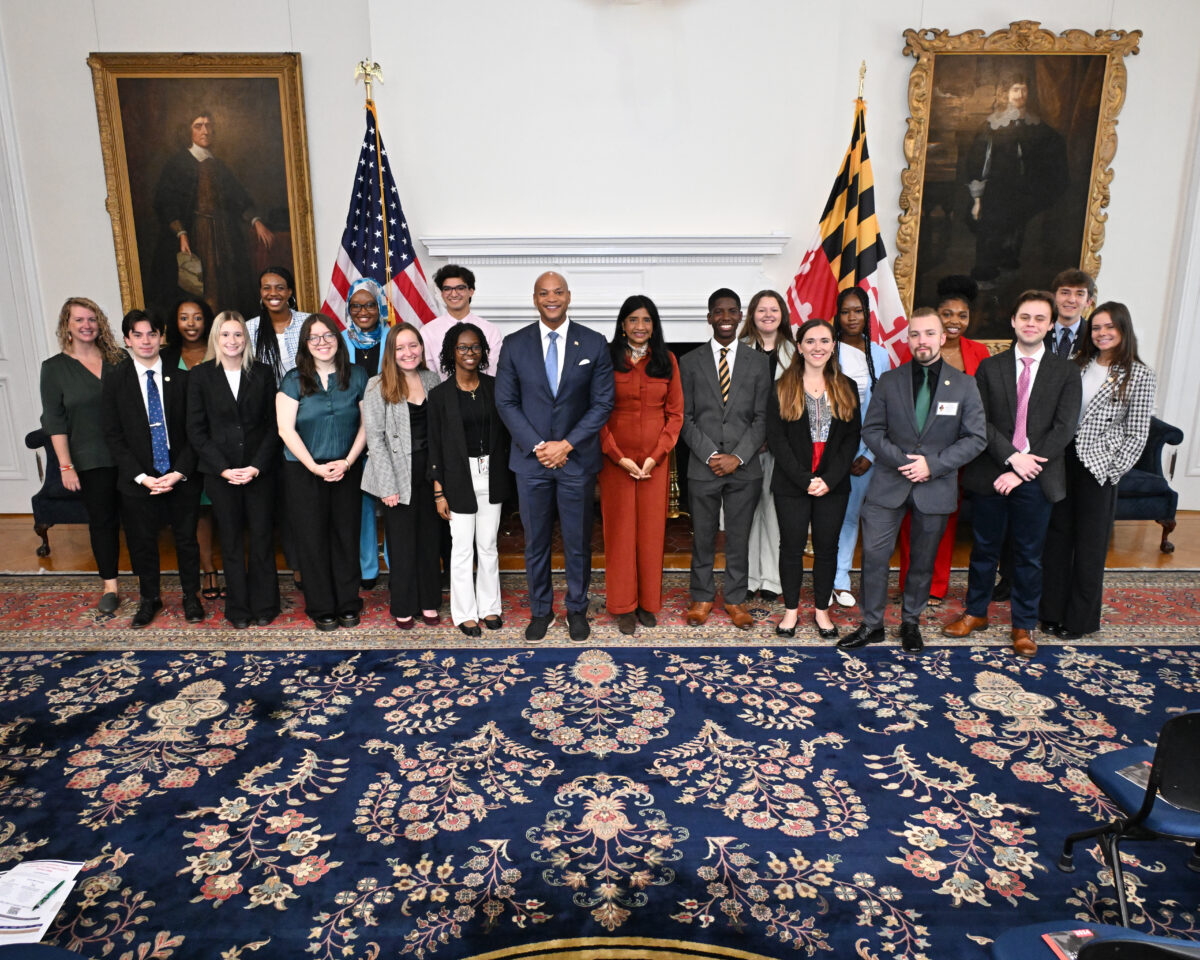 Cole with Governor Wes Moore (just left of him in the white pants and black jacket) during the closing ceremony of the Governor’s Summer Internship Program (GSIP). (Photo courtesy of Cole)
UMBC listens because when we went to my field instructor and the leaders of Retriever Support Services and Retriever Essentials about what we wanted to do, they were very much supportive and said: How can we help you get this in a place or in front of a person who can actually do something about it?
Q: Social work can be very emotionally demanding. What have you learned about self-care while you’ve prepared yourself for a career in social work and public health?
A: My field instructor says to lean on your people. I had a lot of days where, after meeting with a bunch of students, I would feel the weight of their stories and it would be very hard for me to process and think. And that goes back to having community, particularly in my faith,and being able to go to my friends who are not social work majors. They can only understand what I’m going through to a certain degree, but just being with them makes me feel lighter—even if I’m not necessarily talking about what’s bothering me. And verbally processing with them, just being able to be in their presence and have their prayers and stuff like that—it was really helpful.
Q: What impact do you think you contributed to UMBC that will be here after you are gone?
A: I would hope that it’s community—the same value that I came in wanting to foster. I hope it’s the same value that I leave behind: valuing community in every way. Because you don’t get to the finish line without your community. And community can come in so many different forms. What I get out of my fellowship community is not necessarily the same that I got out of my Retriever Essentials community. But they both helped me, and they both did their part in getting me to the finish line, and also taught me so many things that have helped me grow as a person.
 Cole during a Maryland Public Service Scholars Program interview. (Marlayna Demond ’11/UMBC)
I really hope that people see from me the value of the community that is around them academically. There are so many professors and staff and faculty who took jobs at a university because they wanted to help and empower students to fulfill their dreams: lean on that. Some professors might seem scary, but lean on them because most of them just want to help. Same thing with student orgs. The people who run them don’t only enjoy the interest that the club is for, but genuinely believe in the gathering of people. And yeah, I hope that I’ve added to the value of community that this university already had.
]]>
Dionne Cole, a native of Montgomery County, came to UMBC expecting to pursue a career in biology. But after a few semesters, she found her true calling lay in the intersection of social work,...
https://umbc.edu/stories/dionne-cole-25-family-faith-and-friends-help/
https://dev.my.umbc.edu/api/v0/pixel/news/150360/guest@my.umbc.edu/0087012574aaedacc70ff39ba4b380e5/api/pixel
biology
class-of-2025
cnms
news
science-and-tech
social-work
story
UMBC News & Magazine
https://dev.my.umbc.edu/groups/umbc-news-magazine
https://assets1-dev.my.umbc.edu/system/shared/avatars/groups/000/001/943/24435aa6207c452e7bc15cc74b42c7bb/xsmall.png?1748556657
https://assets1-dev.my.umbc.edu/system/shared/avatars/groups/000/001/943/24435aa6207c452e7bc15cc74b42c7bb/original.png?1748556657
https://assets2-dev.my.umbc.edu/system/shared/avatars/groups/000/001/943/24435aa6207c452e7bc15cc74b42c7bb/xxlarge.png?1748556657
https://assets2-dev.my.umbc.edu/system/shared/avatars/groups/000/001/943/24435aa6207c452e7bc15cc74b42c7bb/xlarge.png?1748556657
https://assets3-dev.my.umbc.edu/system/shared/avatars/groups/000/001/943/24435aa6207c452e7bc15cc74b42c7bb/large.png?1748556657
https://assets1-dev.my.umbc.edu/system/shared/avatars/groups/000/001/943/24435aa6207c452e7bc15cc74b42c7bb/medium.png?1748556657
https://assets2-dev.my.umbc.edu/system/shared/avatars/groups/000/001/943/24435aa6207c452e7bc15cc74b42c7bb/small.png?1748556657
https://assets1-dev.my.umbc.edu/system/shared/avatars/groups/000/001/943/24435aa6207c452e7bc15cc74b42c7bb/xsmall.png?1748556657
https://assets2-dev.my.umbc.edu/system/shared/avatars/groups/000/001/943/24435aa6207c452e7bc15cc74b42c7bb/xxsmall.png?1748556657
UMBC News & Magazine
1
0
false
Thu, 22 May 2025 11:38:20 -0400
Thu, 22 May 2025 11:38:20 -0400
A class reunion half a world away
With such a large population of Marylanders at UMBC, it’s not that unusual to run into someone you went to high school with. But when that someone is from your high school in Canberra, Australia, that’s a little more unexpected.
It was the love of the game that unexpectedly brought senior Annie Grove, biology,and junior Erin Behel, mechanical engineering,back together a few years after and a few thousand miles from where they first became friends. Behel is a softball player and daughter of a U.S. Marine, so moving was a regular family pastime. When she found herself in Australia (her mother’s home country) in grade seven, she met Grove, a soccer player, in high school. Once Behel’s father’s contract ended in 2018, she returned to Maryland. Unbeknownst to one another, they were both looking for athletic opportunities in the United States.
“I posted my announcement on social media saying I committed to UMBC, and I started getting all these messages from friends in Canberra saying ‘We’re pretty sure that’s where Grove is going!’” recalls Behel. “It was just insanity that out of all the colleges in the U.S., we’d both end up here.”
The friends can’t remember their first on-campus meeting (probably either the first student-athlete meeting or a visit to Behel’s dorm where Grove recalls “seeing all her pretty plants!”). But it’s certain they’ve enjoyed each other’s support since reconnecting and cheering from the stands at one another’s games.
There’s no “I” in team
Grove and Behel are just two of the many international student-athletes who have made UMBC their home away from home and support is at the forefront of those decisions.
Bruna De Padua, media and communications studies, originally traveled from Brazil to a small university in rural Missouri to pursue swimming. After a few months, she knew the fit wasn’t right and joined the NCAA transfer portal. Enter UMBC.
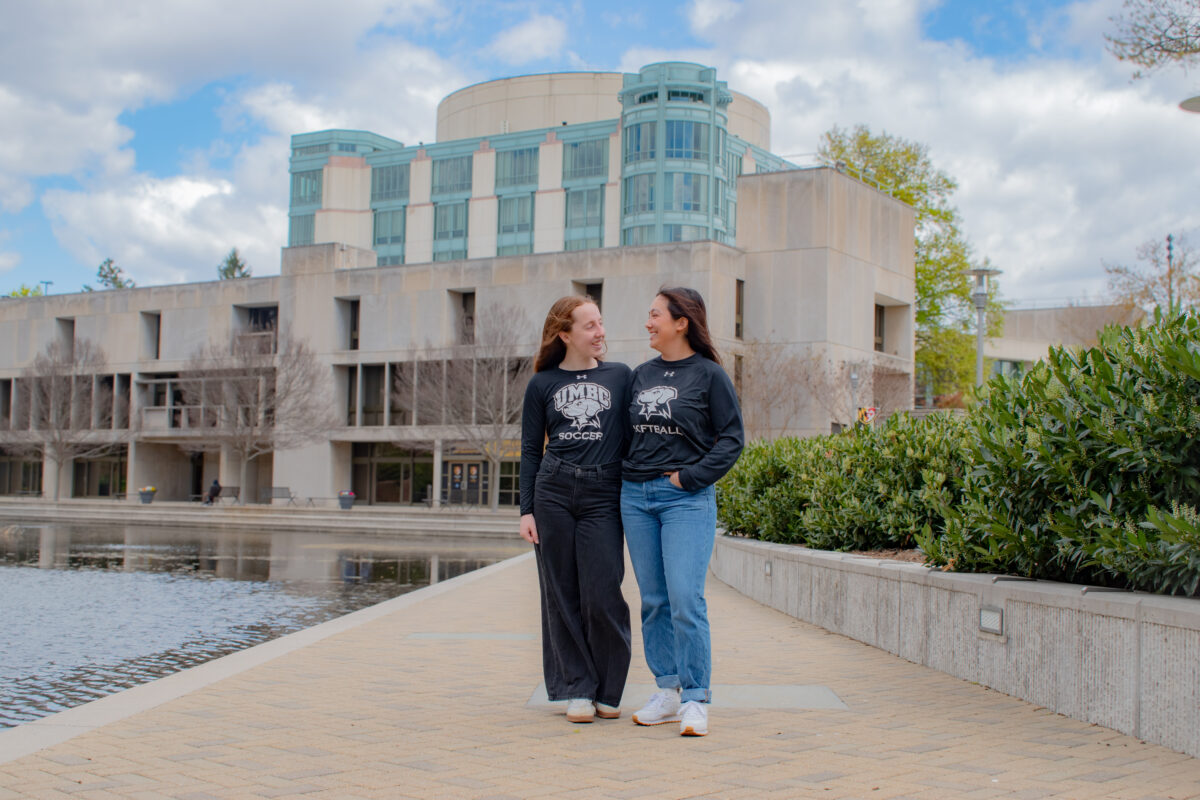 Grove, left, and Behel, right, are still on the same wavelength after all this time, unintentionally twinning in front of the library. (Mashaal Awan ’25/UMBC)
“As soon as I committed to UMBC, the process was so different from my other university,” De Padua says. For example, she appreciated how head swim coach Matt Donovan made sure she knew who to contact around campus for questions and help. Behel and Grove echo these sentiments, especially as it pertains to being able to focus on academics.
“I’ve heard from former teammates at other schools that they feel like they’re being punished if they choose to go to class and I’ve never, ever felt that,” says Behel.
Grove agreed, sharing, “Our coaches have always said that we need to go to class. And there’s so much emphasis on communication.”
Follow the leader
While they all agree the coaching staff has been invaluable in making their time at UMBC successful, they’re also grateful for fellow Retrievers who have helped throughout their journey.
De Padua is navigating her junior year now and knew she needed an internship to fulfill her academic requirements. After doing commercial modeling at an agency a fellow swim team alum Rola Hussein ’24 from Egypt worked for, De Padua was able to parlay that into her own spring/summer internship opportunity for the agency, doing social media and marketing.
 De Padua, right, congratulates teammate Makaela Hill. (Ian Feldmann ’21/UMBC Athletics)
She’s not the only one who was helped academically by her peers. Behel recalls a mechanical engineering softball player several years ahead of her who “paved the way for us to be able to show our coach and ourselves it’s possible to do both.”
In turn, Behel, De Padua, and Grove all seek to offer others support. “I’ve had so many conversations with people about how to get a bank account, how to get a phone number…really adult tasks that I had to figure out early on and now I’m passing it along,” says Grove.
They see UMBC as their home away from home and would encourage any international student-athlete to consider joining them. When asked what advice she would give to any new Retrievers from across the world, Grove simply summed up her experience by suggesting, “Just say yes to things and see what happens.”
]]>
With such a large population of Marylanders at UMBC, it’s not that unusual to run into someone you went to high school with. But when that someone is from your high school in Canberra, Australia,...
https://umbc.edu/stories/a-class-reunion-half-a-world-away/
https://dev.my.umbc.edu/api/v0/pixel/news/150330/guest@my.umbc.edu/10dcc2960210a68b1ecb561c2c57c95d/api/pixel
at-play
athletics
biology
campus-life
cnms
coeit
international
magazine
meche
spring-2025
story
UMBC News & Magazine
https://dev.my.umbc.edu/groups/umbc-news-magazine
https://assets1-dev.my.umbc.edu/system/shared/avatars/groups/000/001/943/24435aa6207c452e7bc15cc74b42c7bb/xsmall.png?1748556657
https://assets1-dev.my.umbc.edu/system/shared/avatars/groups/000/001/943/24435aa6207c452e7bc15cc74b42c7bb/original.png?1748556657
https://assets2-dev.my.umbc.edu/system/shared/avatars/groups/000/001/943/24435aa6207c452e7bc15cc74b42c7bb/xxlarge.png?1748556657
https://assets2-dev.my.umbc.edu/system/shared/avatars/groups/000/001/943/24435aa6207c452e7bc15cc74b42c7bb/xlarge.png?1748556657
https://assets3-dev.my.umbc.edu/system/shared/avatars/groups/000/001/943/24435aa6207c452e7bc15cc74b42c7bb/large.png?1748556657
https://assets1-dev.my.umbc.edu/system/shared/avatars/groups/000/001/943/24435aa6207c452e7bc15cc74b42c7bb/medium.png?1748556657
https://assets2-dev.my.umbc.edu/system/shared/avatars/groups/000/001/943/24435aa6207c452e7bc15cc74b42c7bb/small.png?1748556657
https://assets1-dev.my.umbc.edu/system/shared/avatars/groups/000/001/943/24435aa6207c452e7bc15cc74b42c7bb/xsmall.png?1748556657
https://assets2-dev.my.umbc.edu/system/shared/avatars/groups/000/001/943/24435aa6207c452e7bc15cc74b42c7bb/xxsmall.png?1748556657
UMBC News & Magazine
2
0
false
Wed, 21 May 2025 11:34:52 -0400
Wed, 21 May 2025 11:34:52 -0400

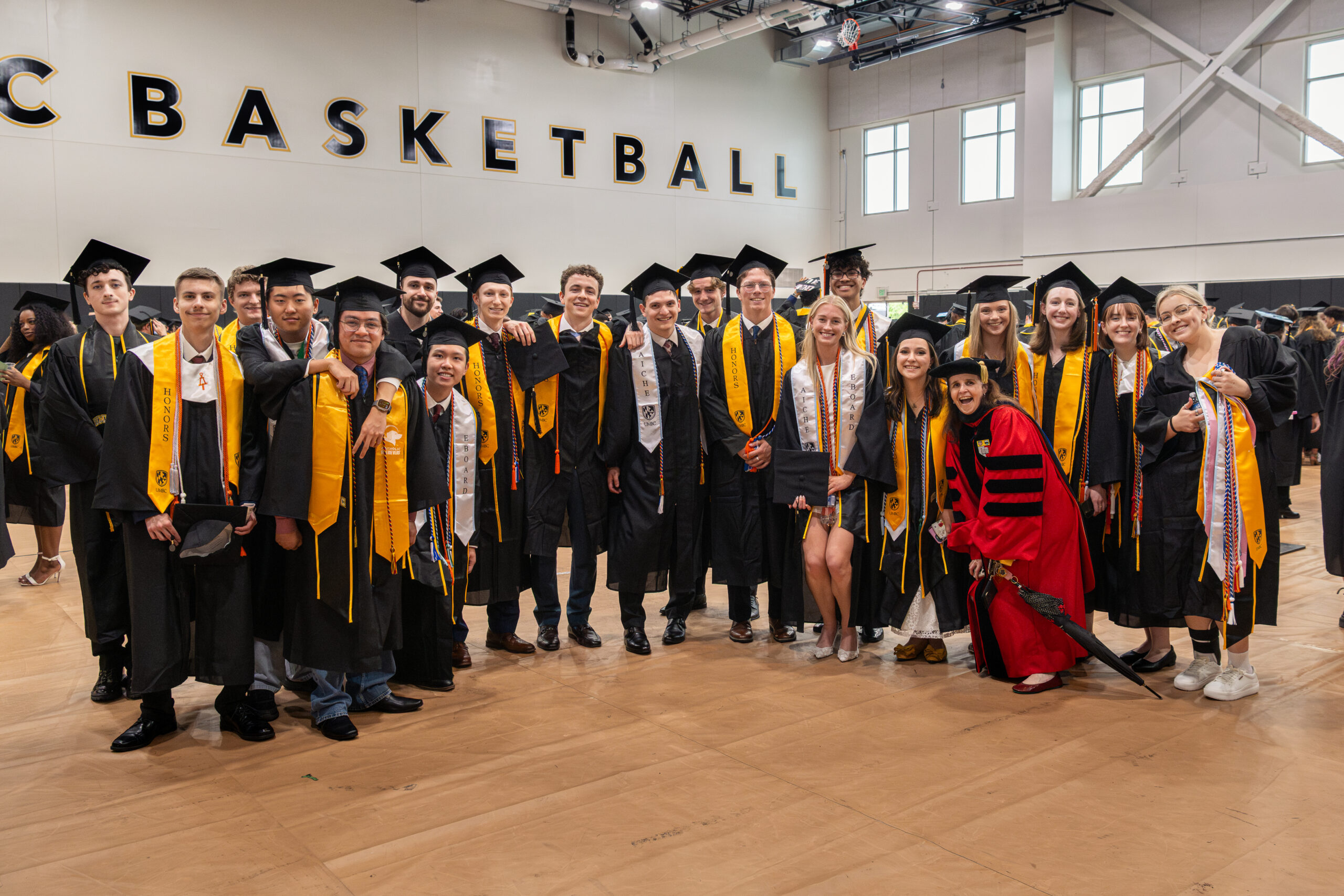


 Celebrating graduation day! (Brad Ziegler/UMBC)