Community starts in the kitchen—Q&A with Ekiben’s Steve Chu ’12 and professor and author Mark Padoongpatt
The tantalizing aroma of food from everyone’s favorite UMBC alumni-founded restaurant, Ekiben, wafts through the air of the Albin O. Kuhn Library and Gallery. People are drawn in by the steamed buns and tofu nuggets and stay for the community, including a Q&A with Ekiben co-owner Steve Chu ’12, economics, and Mark Padoongpatt, associate professor and director of the Asian and Asian American Studies Program at the University of Nevada, Las Vegas. The discussion, part of the Reframing Global Asias Conversation Series and led by UMBC’s Global Asias Initiatives postdoctoral fellow Mika Thornburg, dives into Padoongpatt’s book, Flavors of Empire, with Chu providing support using his own experience creating community through food.
Mika Thornburg: Tell us a little about your personal history and how you came to work with food.
Steve Chu: When my family immigrated from Taiwan to the U.S., most decided to go into the restaurant business. All my aunts and uncles had restaurants at one point in time, so I grew up with it. I understood the work hours behind it, the work ethic. When I was 13, I read Anthony Bourdain’s Kitchen Confidential. I told my mom that this is what I wanted to do, and she was like, “No, you’re going to college.”
So I came to UMBC, studied economics, and every paper I did was about food. I did a paper on Taco Bell, did a paper on Chipotle, and around sophomore year I was like, alright, this is getting kind of silly. So I decided to get my first job in a restaurant and work and go to school full time. That’s when I started diving into this industry and I haven’t really looked back since.
Mark Padoongpatt: Growing up as a Thai American, you get associated with food even if you have no professional relationship to food at all. I didn’t want to perpetuate that stereotype, so I avoided even thinking about food until graduate school. And that’s when I realized Thai people are so visible through food. Thai food comes to stand in for Thai people and there’s really nothing else we know about Thai people.
So instead of talking about the community outside of food, I thought maybe I should just think about that. How did we come to this point where Thai food comes to stand in for Thai people? Since then, I’ve been thinking about food as a very dynamic way to study communities.

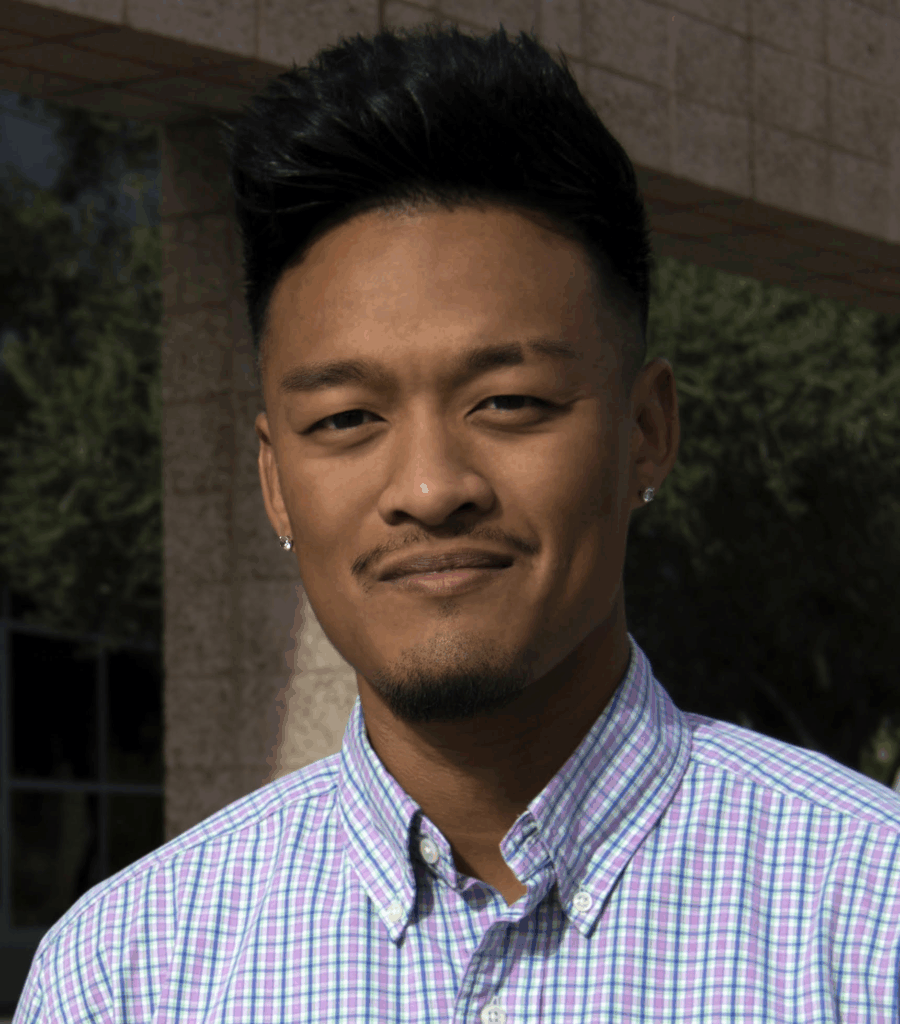
Steve Chu ’12, left, and Mark Padoongpatt, right.
Thornburg: Our event theme is about food and community. Can you speak a little bit about your perspective on the relationship between these two things from your respective position?
Chu: Food brings people together. You see that at this event, you see that at Costco with the free sample line. When we opened Ekiben in Baltimore City, we realized that it was a very polarized city, so we built a space where people from all walks of life could come, afford the food, and sit next to someone that they typically wouldn’t be sitting next to. On any Saturday, you’ll have a squeegee kid sitting next to a Jewish grandmother listening to Cardi B on the speakers, eating some fried chicken. It’s things that you normally wouldn’t put together. Food is a really, really powerful tool to build a community.
 Chu and Ekiben co-owner Ephrem Abebe ’13, information systems, chat with a customer in their original Fells Point location. Photo by Marlayna Demond ’11/UMBC.
Thornburg: What role can food play in changing culture and relationships between different groups of people, whether they be individuals, local communities or entire nations?
Padoongpatt: Food culture is incredibly transformative. Just look at European empires. How did they grow? Through food commodities. They created political and economic systems that were around food and food production. And so in terms of nation building, the evidence is all there in terms of the significance of food and the role that food can play.
The Thai government for the last 15 years has been pouring a lot of effort, time, and energy into this through a kind of gastro diplomacy so that more people will come to Thailand. I think it is a great way to stimulate curiosity and human connection, but just the eating of the food itself is not enough.
Chu: What I find really cool is if you grew up in a very diverse community, chances are you’ve had a very diverse group of friends and you’ve tried a very diverse group of foods. And that helps break down walls and allow for understanding and the building of community. One of the coolest things about coming to UMBC was how diverse a group of friends I was able to meet.
After UMBC, I went to New York and worked as a line cook, and I brought back a lot of creativity with me. I sat down with my two future business partners, [Ephrem Abebe ’13, information systems, and Nikhil Yesurpriya ’13, M.S. ’16, biological sciences]. I said, “Hey, bring me all these random ingredients that your moms aren’t using in the pantry.” And so they bring me all this stuff, and over time we just learned how to incorporate it into our core menu. Honestly, there wasn’t a lot of thought behind it—except, “that tastes good.”
Learn more about the Global Asias Initiative and follow along with their events.
]]>
The tantalizing aroma of food from everyone’s favorite UMBC alumni-founded restaurant, Ekiben, wafts through the air of the Albin O. Kuhn Library and Gallery. People are drawn in by the steamed...
https://umbc.edu/stories/community-starts-in-the-kitchen/
https://dev.my.umbc.edu/api/v0/pixel/news/150232/guest@my.umbc.edu/ffba7d4ce69f531b7e1004153f991fa3/api/pixel
alumni
at-play
baltimore-city
cahss
campus-life
coeit
economics
ekiben
global-asias
information-systems-management
magazine
story
UMBC News & Magazine
https://dev.my.umbc.edu/groups/umbc-news-magazine
https://assets1-dev.my.umbc.edu/system/shared/avatars/groups/000/001/943/24435aa6207c452e7bc15cc74b42c7bb/xsmall.png?1748556657
https://assets1-dev.my.umbc.edu/system/shared/avatars/groups/000/001/943/24435aa6207c452e7bc15cc74b42c7bb/original.png?1748556657
https://assets2-dev.my.umbc.edu/system/shared/avatars/groups/000/001/943/24435aa6207c452e7bc15cc74b42c7bb/xxlarge.png?1748556657
https://assets2-dev.my.umbc.edu/system/shared/avatars/groups/000/001/943/24435aa6207c452e7bc15cc74b42c7bb/xlarge.png?1748556657
https://assets3-dev.my.umbc.edu/system/shared/avatars/groups/000/001/943/24435aa6207c452e7bc15cc74b42c7bb/large.png?1748556657
https://assets1-dev.my.umbc.edu/system/shared/avatars/groups/000/001/943/24435aa6207c452e7bc15cc74b42c7bb/medium.png?1748556657
https://assets2-dev.my.umbc.edu/system/shared/avatars/groups/000/001/943/24435aa6207c452e7bc15cc74b42c7bb/small.png?1748556657
https://assets1-dev.my.umbc.edu/system/shared/avatars/groups/000/001/943/24435aa6207c452e7bc15cc74b42c7bb/xsmall.png?1748556657
https://assets2-dev.my.umbc.edu/system/shared/avatars/groups/000/001/943/24435aa6207c452e7bc15cc74b42c7bb/xxsmall.png?1748556657
UMBC News & Magazine
0
0
false
Fri, 16 May 2025 10:51:47 -0400
Fri, 16 May 2025 10:51:47 -0400
Governments continue losing efforts to gain backdoor access to secure communications
Written by Richard Forno, principal lecturer in computer science and electrical engineering, UMBC
Reports that prominent American national security officials used a freely available encrypted messaging app, coupled with the rise of authoritarian policies around the world, have led to a surge in interest in encrypted apps like Signal and WhatsApp. These apps prevent anyone, including the government and the app companies themselves, from reading messages they intercept.
The spotlight on encrypted apps is also a reminder of the complex debate pitting government interests against individual liberties. Governments desire to monitor everyday communications for law enforcement, national security and sometimes darker purposes. On the other hand, citizens and businesses claim the right to enjoy private digital discussions in today’s online world.
The positions governments take often are framed as a “war on encryption” by technology policy experts and civil liberties advocates. As a cybersecurity researcher, I’ve followed the debate for nearly 30 years and remain convinced that this is not a fight that governments can easily win.
Understanding the ‘golden key’
Traditionally, strong encryption capabilities were considered military technologies crucial to national security and not available to the public. However, in 1991, computer scientist Phil Zimmermann released a new type of encryption software called Pretty Good Privacy (PGP). It was free, open-source software available on the internet that anyone could download. PGP allowed people to exchange email and files securely, accessible only to those with the shared decryption key, in ways similar to highly secured government systems.
Following an investigation into Zimmermann, the U.S. government came to realize that technology develops faster than law and began to explore remedies. It also began to understand that once something is placed on the internet, neither laws nor policy can control its global availability.
Fearing that terrorists or criminals might use such technology to plan attacks, arrange financing or recruit members, the Clinton administration advocated a system called the Clipper Chip, based on a concept of key escrow. The idea was to give a trusted third party access to the encryption system and the government could use that access when it demonstrated a law enforcement or national security need.
End-to-end encryption and backdoor access explained.
Clipper was based on the idea of a “golden key,” namely, a way for those with good intentions – intelligence services, police – to access encrypted data, while keeping people with bad intentions – criminals, terrorists – out.
Clipper Chip devices never gained traction outside the U.S. government, in part because its encryption algorithm was classified and couldn’t be publicly peer-reviewed. However, in the years since, governments around the world have continued to embrace the golden key concept as they grapple with the constant stream of technology developments reshaping how people access and share information.
Following Edward Snowden’s disclosures about global surveillance of digital communications in 2013, Google and Apple took steps to make it virtually impossible for anyone but an authorized user to access data on a smartphone. Even a court order was ineffective, much to the chagrin of law enforcement. In Apple’s case, the company’s approach to privacy and security was tested in 2016 when the company refused to build a mechanism to help the FBI break into an encrypted iPhone owned by a suspect in the San Bernardino terrorist attack.
At its core, encryption is, fundamentally, very complicated math. And while the golden key concept continues to hold allure for governments, it is mathematically difficult to achieve with an acceptable degree of trust. And even if it was viable, implementing it in practice makes the internet less safe. Security experts agree that any backdoor access, even if hidden or controlled by a trusted entity, is vulnerable to hacking.
Competing justifications and tech realities
Governments around the world continue to wrestle with the proliferation of strong encryption in messaging tools, social media and virtual private networks.
For example, rather than embrace a technical golden key, a recent proposal in France would have provided the government the ability to add a hidden “ghost” participant to any encrypted chat for surveillance purposes. However, legislators removed this from the final proposal after civil liberties and cybersecurity experts warned that such an approach would undermine basic cybersecurity practices and trust in secure systems.
In 2025, the U.K. government secretly ordered Apple to add a backdoor to its encryption services worldwide. Rather than comply, Apple removed the ability for its iPhone and iCloud customers in the U.K. to use its Advanced Data Protection encryption features. In this case, Apple chose to defend its users’ security in the face of government mandates, which ironically now means that users in the U.K. may be less secure.
Apple pulled its advanced encryption service from the U.K. market rather than grant the U.K. government backdoor access.
In the United States, provisions removed from the 2020 EARN IT bill would have forced companies to scan online messages and photos to guard against child exploitation by creating a golden-key-type hidden backdoor. Opponents viewed this as a stealth way of bypassing end-to-end encryption. The bill did not advance to a full vote when it was last reintroduced in the 2023-2024 legislative session.
Opposing scanning for child sexual abuse material is a controversial concern when encryption is involved: Although Apple received significant public backlash over its plans to scan user devices for such material in ways that users claimed violated Apple’s privacy stance, victims of child abuse have sued the company for not better protecting children.
Even privacy-centric Switzerland and the European Union are exploring ways of dealing with digital surveillance and privacy in an encrypted world.
The laws of math and physics, not politics
Governments usually claim that weakening encryption is necessary to fight crime and protect the nation – and there is a valid concern there. However, when that argument fails to win the day, they often turn to claiming to need backdoors to protect children from exploitation.
From a cybersecurity perspective, it is nearly impossible to create a backdoor to a communications product that is only accessible for certain purposes or under certain conditions. If a passageway exists, it’s only a matter of time before it is exploited for nefarious purposes. In other words, creating what is essentially a software vulnerability to help the good guys will inevitably end up helping the bad guys, too.
Often overlooked in this debate is that if encryption is weakened to improve surveillance for governmental purposes, it will drive criminals and terrorists further underground. Using different or homegrown technologies, they will still be able to exchange information in ways that governments can’t readily access. But everyone else’s digital security will be needlessly diminished.
This lack of online privacy and security is especially dangerous for journalists, activists, domestic violence survivors and other at-risk communities around the world.
Encryption obeys the laws of math and physics, not politics. Once invented, it can’t be un-invented, even if it frustrates governments. Along those lines, if governments are struggling with strong encryption now, how will they contend with a world when everyone is using significantly more complex techniques like quantum cryptography?
Governments remain in an unenviable position regarding strong encryption. Ironically, one of the countermeasures the government recommended in response to China’s hacking of global telephone systems in the Salt Typhoon attacks was to use strong encryption in messaging apps such as Signal or iMessage.
Reconciling that with their ongoing quest to weaken or restrict strong encryption for their own surveillance interests will be a difficult challenge to overcome.
This article is republished from The Conversation under a Creative Commons license. Read the original article and see more than 250 UMBC articles available in The Conversation.
]]>
Written by Richard Forno, principal lecturer in computer science and electrical engineering, UMBC Reports that prominent American national security officials used a freely available encrypted...
https://umbc.edu/stories/governments-continue-losing-efforts-to-gain-backdoor-access-to-secure-communications/
https://dev.my.umbc.edu/api/v0/pixel/news/150225/guest@my.umbc.edu/c3cb0ee58316922895469d3133b6942b/api/pixel
coeit
csee
discovery
magazine
story
the-conversation
UMBC News & Magazine
https://dev.my.umbc.edu/groups/umbc-news-magazine
https://assets1-dev.my.umbc.edu/system/shared/avatars/groups/000/001/943/24435aa6207c452e7bc15cc74b42c7bb/xsmall.png?1748556657
https://assets1-dev.my.umbc.edu/system/shared/avatars/groups/000/001/943/24435aa6207c452e7bc15cc74b42c7bb/original.png?1748556657
https://assets2-dev.my.umbc.edu/system/shared/avatars/groups/000/001/943/24435aa6207c452e7bc15cc74b42c7bb/xxlarge.png?1748556657
https://assets2-dev.my.umbc.edu/system/shared/avatars/groups/000/001/943/24435aa6207c452e7bc15cc74b42c7bb/xlarge.png?1748556657
https://assets3-dev.my.umbc.edu/system/shared/avatars/groups/000/001/943/24435aa6207c452e7bc15cc74b42c7bb/large.png?1748556657
https://assets1-dev.my.umbc.edu/system/shared/avatars/groups/000/001/943/24435aa6207c452e7bc15cc74b42c7bb/medium.png?1748556657
https://assets2-dev.my.umbc.edu/system/shared/avatars/groups/000/001/943/24435aa6207c452e7bc15cc74b42c7bb/small.png?1748556657
https://assets1-dev.my.umbc.edu/system/shared/avatars/groups/000/001/943/24435aa6207c452e7bc15cc74b42c7bb/xsmall.png?1748556657
https://assets2-dev.my.umbc.edu/system/shared/avatars/groups/000/001/943/24435aa6207c452e7bc15cc74b42c7bb/xxsmall.png?1748556657
UMBC News & Magazine
2
0
false
Fri, 16 May 2025 10:09:58 -0400
Fri, 16 May 2025 10:09:58 -0400
Oyinlola Oluka ’25, political science and philosophy, sees no limits for herself
For Oyinlola Oluka, political science and philosophy, doing the right thing is not just a mantra but a career path. A law school hopeful since middle school, Oluka, a first-generation Nigerian American, has a keen interest in the efforts of African countries to move from political instability toward accountability for human rights violations. She knows that holding governments accountable is a lofty task, but fear is not in her vocabulary—justice is. At UMBC, she found a kindred spirit in Jeffrey Davis, a political science professor whose passion for human rights and politics began at 12 years old after joining Amnesty International. Oluka delved deeply into the complexities of international law in Davis’s classes, inspiring her to shift her ambitions toward becoming an international human rights judge—someone committed to upholding human rights at the highest level.
Q: What motivated you to come to UMBC?
 Oyinlola Oluka carrying her sister Atinuke Oluka at her graduation. (Image courtesy of Oluka)
A: My sister, Atinuke Oluka, is a Retriever. She graduated in 2022 with degrees in psychology and biological sciences. I saw how many opportunities UMBC gave her—how she felt like she belonged and how smoothly she transitioned from high school to college. I don’t see limits for myself either, so I decided to follow in her footsteps. The opportunities I’ve had at UMBC have changed the way I approach life.
Q: In what ways do you live out your ‘no limits’ philosophy?
A: I am a first-generation Nigerian American.My family inspires me. They experienced Nigeria’s instability, but did not let it limit their future. I knew I wanted to be a lawyer in middle school. So, once I came to UMBC, I took advantage of opportunities to help me learn more about being a lawyer and due process, such as civil rights, criminal justice, and international law classes. As part of UMBC’s Legal Internship Program, I worked at the Baltimore City Juvenile Justice Center under the mentorship of the Honorable Judge Nicole K. Barmore, an associate judge in Baltimore City’s Circuit Court.
I chose philosophy as my second major and completed a certificate in philosophy, law, and politics, another in French, a minor in law and justice, and participated in Philosophers Anonymous, which serves as a council of majors. My hard work earned me memberships in Pi Sigma Alpha, the National Political Science Honor Society, and Phi Beta Kappa Society, an academic honor society.
 Oyinlola Oluka assists with a client intake at UMBC’s first Expungement Clinic in partnership with Maryland Legal Aid. (Image courtesy of Molly Timko, UMBC’s pre-law academic advisor)
Giving back to UMBC is also important to me. I am a tutor at UMBC’s Writing Center and a teaching assistant for ENGL 393 Technical Communication. All of this while working as a certified pharmacy technician. UMBC’s Black Student Union, the African Student Association, and Philosophers Anonymous allowed me to help foster a sense of community on campus.
Simply put, I don’t limit myself—not to one field, skill, or experience. I always make sure that what I’m doing now aligns with my long-term goals. If I can see myself succeeding where I am, then I know I can succeed elsewhere, too. I will be the first person in my family to pursue a career in law.
Q: How did you choose to add a philosophy major?
A: When I applied to UMBC while I was at Towson High School, the application asked what other major I might consider, which I interpreted as a backup in case my first choice didn’t work out. I chose philosophy because of my passion for the law. It offered a safe, inquisitive space to explore and understand fundamental questions about the world around us. To my surprise, I was admitted as a dual major. I decided to keep it, and it turned out to be one of the best decisions of my life.
In 2024, the Department of Philosophy nominated and voted to award me the Evelyn Barker Book Prize for superior academic performance by a senior. I am proud to receive this award because it demonstrates that my contributions to the department and the discipline, as a whole, made an impact. Even though picking this major was initially unintentional, it proved to be a discipline that fit perfectly with the person I strive to be. This award shows me that I am taking the necessary steps to actualize my dreams and aspirations. My experience in the department has been phenomenal, and I would absolutely make the same choice again.
Q: Is there someone who has served as a mentor for you?
A: My favorite classes were taught by Jeffrey Davis, professor of political science, because they deepened my interest in criminal justice and international human rights law. His teaching style left a lasting impression on me. He influenced my time at UMBC not only through what he taught, but also how he taught. He was always encouraging, never condescending, precise, yet never rigid.
Jeffrey Davis's classroom was a space where ideas could be explored freely, and where every student’s voice was heard. He helped shape not only my academic path but also my sense of purpose as a future legal scholar and advocate. I will always be grateful for his mentorship.
Oyinlola Oluka ’25
political science and philosophy
A: In the American voting behavior class, led by Ian Anson, the associate director of UMBC’s Institute of Politics, I learned how voting behavior reflects public opinion and policy. We gauged the attitudes of 1,119 Baltimore County voters who cast their ballots in person during early voting and on Election Day. The poll asked voters about their views on the presidential and congressional races, state constitutional amendments like “The Right to Reproductive Freedom,” and broader issues like the economy.
 Oyinlola Oluka at UMBC’s 14th annual Pi Sigma Alpha Research Conference. (Image courtesy of Oluka)
This hands-on project taught me so much about public opinion research, voter behavior, and the challenges of conducting fieldwork in real time. I used the information from this course to create a final paper, which I presented at UMBC’s 14th annual Pi Sigma Alpha Research Conference. I was honored with the award for best presentation and speech, a validating milestone in my academic journey.
Q: Where do you see yourself in a decade?
A: My ultimate goal is to become a judge because it is one of the most direct ways to improve the lives of people charged with a crime. A judge has the responsibility and the power to decide what happens next for that individual. My internship at the Baltimore City Juvenile Justice Center immersed me in the complexities of juvenile justice. I engaged in legal research, drafted memos on post-conviction issues and child welfare cases, and presented my findings directly to Judge Barmore. Through this experience, I developed my research, analytical, and oral communication skills, particularly in breaking down legal arguments clearly and persuasively. It also strengthened my professional network, as I interacted with judges, administrative staff, and law clerks.
By observing Judge Barmore, I also saw how a judge can be nurturing and compassionate toward defendants while also holding them accountable for their actions. She was efficient and effective in addressing the needs of the children in the system, their parents, and their unique family circumstances. These processes helped me understand how crucial it is for a judge to manage their emotions so they can remain clear, consistent, and fair under pressure.
This opportunity was especially valuable because I’m still exploring whether I want to practice law in government, at a firm, or within a nonprofit organization. With the help of UMBC’s Pre-Law Society, I met law school admissions counselors, reviewed mock applications, and connected with lawyers—all of which are helping me prepare for the Law School Admission Test and narrow down the law schools I want to apply to.
Q: Now that you are the second Retriever in your family, how do you reflect on your UMBC journey?
A: The classes at UMBC taught me how to think, how to ask the right questions, and how to engage with the world around me. Whether it was a lively debate in a politics class or a professor’s encouragement after a class, every moment shaped my understanding of what it truly means to learn. I carry that with me, not just the knowledge I’ve gained at UMBC, but also the curiosity and courage to keep learning wherever I go.
Read more Commencement 2025 stories.
]]>
For Oyinlola Oluka, political science and philosophy, doing the right thing is not just a mantra but a career path. A law school hopeful since middle school, Oluka, a first-generation Nigerian...
https://umbc.edu/stories/oyinlola-oluka-polisci-philosophy-has-no-limits/
https://dev.my.umbc.edu/api/v0/pixel/news/150190/guest@my.umbc.edu/e012cca1d042306fcc926eb1b6ab55f7/api/pixel
biological-sciences
cahss
class-of-2025
news
philosophy
policy-and-society
politicalscience
psychology
story
UMBC News & Magazine
https://dev.my.umbc.edu/groups/umbc-news-magazine
https://assets1-dev.my.umbc.edu/system/shared/avatars/groups/000/001/943/24435aa6207c452e7bc15cc74b42c7bb/xsmall.png?1748556657
https://assets1-dev.my.umbc.edu/system/shared/avatars/groups/000/001/943/24435aa6207c452e7bc15cc74b42c7bb/original.png?1748556657
https://assets2-dev.my.umbc.edu/system/shared/avatars/groups/000/001/943/24435aa6207c452e7bc15cc74b42c7bb/xxlarge.png?1748556657
https://assets2-dev.my.umbc.edu/system/shared/avatars/groups/000/001/943/24435aa6207c452e7bc15cc74b42c7bb/xlarge.png?1748556657
https://assets3-dev.my.umbc.edu/system/shared/avatars/groups/000/001/943/24435aa6207c452e7bc15cc74b42c7bb/large.png?1748556657
https://assets1-dev.my.umbc.edu/system/shared/avatars/groups/000/001/943/24435aa6207c452e7bc15cc74b42c7bb/medium.png?1748556657
https://assets2-dev.my.umbc.edu/system/shared/avatars/groups/000/001/943/24435aa6207c452e7bc15cc74b42c7bb/small.png?1748556657
https://assets1-dev.my.umbc.edu/system/shared/avatars/groups/000/001/943/24435aa6207c452e7bc15cc74b42c7bb/xsmall.png?1748556657
https://assets2-dev.my.umbc.edu/system/shared/avatars/groups/000/001/943/24435aa6207c452e7bc15cc74b42c7bb/xxsmall.png?1748556657
UMBC News & Magazine
2
0
false
Thu, 15 May 2025 10:43:15 -0400
Thu, 15 May 2025 10:43:15 -0400
Possible tectonic activity on Venus may yield insight into Earth’s past
Vast, quasi-circular features on Venus’ surface may reveal that the planet has ongoing tectonics, according to new research. On Earth, the shifting and recycling of tectonic plates continually renews our planet’s surface. Venus doesn’t have tectonic plates, but its surface is still being deformed by molten material from below.
“These features are not found on Earth today; however, they may have existed when our planet was young and before plate tectonics had been established,” says the study’s lead author, Gael Cascioli, a UMBC assistant research scientist with the Center for Space Sciences and Technology. “By combining gravity and topography data, this research has provided a new and important insight into the possible subsurface processes currently shaping the surface of Venus.”
Seeking to better understand the underlying processes at work on Venus, researchers studied a feature called a corona. Ranging from tens to hundreds of miles across, a corona is most often thought to be the location where a blob of molten, buoyant material from the planet’s mantle rises (called a “plume”), pushing against the uppermost part of the planet’s mantle and its crust. Coronae are usually oval and surrounded by fractures in the crust, and hundreds are known to exist on Venus.
 Unlike on Earth, where tectonic plates move sideways and down in a process called subduction, the plumes on Venus might be pushing the surface upward and outward, making the surrounding surface sink down. The scientists also think that in some places, the plumes might be driving volcanoes. Here, Sif Mons, a volcano on Venus, is rendered from data collected by Magellan. The lighter orange trails coming from the peak to the foreground are lava flows. (NASA)
Old data, new discoveries
The new study, published in Science Advances, found telltale signs of corona-shaping activity at or beneath Venus’ surface. These signs may also provide a unique window into Earth’s past. To find them, the authors turned to NASA’s Magellan mission, which orbited Venus in the 1990s and collected what is still the most detailed gravity and topography data of Venus available.
There are various theories about how coronae form. “The most exciting thing for our study is that we can now say there are most likely various and ongoing active processes driving their formation,” coauthor Anna Gülcher, Earth and planetary scientist at the University of Bern in Switzerland, says.
The scientists created detailed 3D models that predicted different ways the coronae might have formed, and then compared them to data from Magellan. Their work revealed that beneath about 70 percent of the coronae they studied, there were hot, low-density plumes rising from deep inside Venus, which might be causing the unique geological activity.
The NASA VERITAS mission, scheduled for launch no earlier than 2031, will be key to filling gaps in understanding of how coronae form. According to coauthor Suzanne Smrekar, planetary scientist at the NASA Jet Propulsion Laboratory (JPL) and principal investigator for VERITAS, the mission will provide much greater resolution than Magellan, supplying “an unprecedented level of detail that could revolutionize our understanding of Venus’ geology and implications for early Earth.”
Read the complete NASA release here.
]]>
Vast, quasi-circular features on Venus’ surface may reveal that the planet has ongoing tectonics, according to new research. On Earth, the shifting and recycling of tectonic plates continually...
https://umbc.edu/stories/tectonic-activity-on-venus/
https://dev.my.umbc.edu/api/v0/pixel/news/150164/guest@my.umbc.edu/9845bc31648d4838b4a64bbfa155d67c/api/pixel
csst
nasa
news
rca
research
science-and-tech
story
UMBC News & Magazine
https://dev.my.umbc.edu/groups/umbc-news-magazine
https://assets1-dev.my.umbc.edu/system/shared/avatars/groups/000/001/943/24435aa6207c452e7bc15cc74b42c7bb/xsmall.png?1748556657
https://assets1-dev.my.umbc.edu/system/shared/avatars/groups/000/001/943/24435aa6207c452e7bc15cc74b42c7bb/original.png?1748556657
https://assets2-dev.my.umbc.edu/system/shared/avatars/groups/000/001/943/24435aa6207c452e7bc15cc74b42c7bb/xxlarge.png?1748556657
https://assets2-dev.my.umbc.edu/system/shared/avatars/groups/000/001/943/24435aa6207c452e7bc15cc74b42c7bb/xlarge.png?1748556657
https://assets3-dev.my.umbc.edu/system/shared/avatars/groups/000/001/943/24435aa6207c452e7bc15cc74b42c7bb/large.png?1748556657
https://assets1-dev.my.umbc.edu/system/shared/avatars/groups/000/001/943/24435aa6207c452e7bc15cc74b42c7bb/medium.png?1748556657
https://assets2-dev.my.umbc.edu/system/shared/avatars/groups/000/001/943/24435aa6207c452e7bc15cc74b42c7bb/small.png?1748556657
https://assets1-dev.my.umbc.edu/system/shared/avatars/groups/000/001/943/24435aa6207c452e7bc15cc74b42c7bb/xsmall.png?1748556657
https://assets2-dev.my.umbc.edu/system/shared/avatars/groups/000/001/943/24435aa6207c452e7bc15cc74b42c7bb/xxsmall.png?1748556657
UMBC News & Magazine
2
0
false
Wed, 14 May 2025 15:34:06 -0400
Wed, 14 May 2025 15:34:06 -0400
Public law for public good
On a fall Saturday morning, Mohammad Arshad, an information systems senior, greeted clients arriving at the Erickson School of Aging Studies looking for a fresh start with the help of UMBC’s first Expungement Clinic. After completing the intake forms, Arshad passed the files to pro-bono lawyers and staff from Maryland Legal Aid and pro-bono lawyers from the Baltimore County Bar Association. They carefully reviewed each client’s criminal records to determine eligibility for clearing or sealing certain charges or offenses that can create barriers to jobs, housing, and education
When Jessica Cook, associate director of the Sondheim Public Affairs Scholar Program, noticed that Loyola University has this program, she connected with Molly Timko, UMBC’s pre-law academic advisor, and discussed bringing the program to UMBC. They established the clinic with funding from UMBC’s Center for Democracy and Civic Life. As soon as a call was made for 20 student volunteers, the response was overwhelming.
 Expungement clinic volunteers (l-r): Damilola Khadijat Yusuf, a philosophy sophomore; Oyinlola Oluka, a political science and philosophy senior; Desta’nae Nicole Wilson ’24, psychology; Jessica Cook, associate director of the Sondheim Public Affairs Scholar Program. (center); Jean Kim, a global studies junior; Thara Pillai, a political science sophomore; Samantha Kennedy ’25, a social work senior; Cooper; Garret Miller, a financial economics sophomore; and Arshad. (Image courtesy of Timko)
Sometimes it’s hard to get internships as an undergraduate student, notes Timko. “The exposure to public interest law—doing law for the greater good—and to network with lawyers in various fields broadens students’ understanding of what being a lawyer can look like beyond arguing in a courtroom,” says Timko, a licensed attorney in Maryland, Washington, D.C., and New York. In her role at UMBC, Timko provides career pathway counseling and law school application support for UMBC students of all majors, as well as alumni.
“It was the first time I saw a law-related volunteer opportunity on campus,” said Arshad. He serves as the senate president of the Maryland Student Legislation (MSL), a model Maryland General Assembly. Currently, there are 15 college delegations, governed by the Council of States, a group of six college students elected by MSL members. Arshad serves as the lieutenant governor.
 Mohammad Arshad (l) with Maryland State Delegate, Christopher Michael Griffith. (Image courtesy of Arshad)
This experiential learning experience teaches students how to draft original legislation and debate bills, navigate parliamentary procedures, and understand the legislative process. At the end of the year, all of the legislation adopted by the students is shared with members of the Maryland General Assembly for their review. “As someone interested in the legal field, I saw the Expungement Clinic as a meaningful way to deepen my understanding of the legal process.”
Oyinlola Oluka assists with a client intake at the Expungement Clinic. (Image courtesy of Timko)
The expungement clinic was streamlined to assist as many clients as possible. No appointment was needed. Lawyers arrived equipped with laptops and printers, prepared to complete and file paperwork. Angus Derbyshire, director for Pro Bono at Maryland Legal Aid, who spearheads expungement clinics across Maryland, reported that 14 clients were served at the UMBC Expungement Clinic, and 10 of them had cases that were deemed potentially eligible for expungement. “This resulted in the preparation of 24 expungement petitions, which is a meaningful outcome for both the clients and the community,” said Derbyshire.
As a first-generation college student, Arshad had never seen the legal process in action firsthand, let alone been part of it. What surprised him most was the collaboration and community focus. “I had always assumed legal work was mostly done behind the scenes, but this clinic showed me how much personal interaction and empathy are involved,” said Arshad, who plans to practice intellectual property law defending the rights of inventors, entrepreneurs, and developers. “It also gave me a better understanding of expungement and how access to legal resources can significantly improve someone’s future opportunities.”
All majors to the legal field
Despite the overwhelming response from volunteers for the expungement clinic, Timko has noticed that many students still assume a political science major is required to pursue a career in law. Like Arshad, Timko is a first-generation law student with a major outside of political science. She majored in anthropology and art history, with a minor in Italian, but wasn’t sure if she wanted to pursue a Ph.D. in either field. “During my master’s program in higher education and student affairs administration, I studied abroad in South Africa and took a course on social reform in post-apartheid South Africa. It sparked my interest in education and advocacy law,” says Timko.
One of Timko’s bigger goals is to help students discover their spark. “It’s important for students to know you can major in anything. There are so many ways to be a lawyer. There’s the stereotypical trial lawyer, but there are also lawyers focused on research and writing that never set foot in a courtroom,” says Timko who is also the advisor for UMBC’s Pre-Law Society that helps student prepare for the Law School Admissions Test (LSAT) and network with area schools. “You don’t have to be super extroverted or argumentative to be a really good lawyer.” There is also no expiration date on when you can decide to pursue a legal career.

 Timko (right with gold jacket) and UMBC’s Pre-Law Society students visit nearby law schools. (Images courtesy of Timko)
This is why she was excited when Shannon Ziegler ’14, fine arts, and Alexander Langsam ’22, biology, reached out to her for guidance on applying to law school. Both had initially worked in their respective fields, which unexpectedly led them in new directions—Ziegler in the financial technology industry and Langsam in civil service, which then spurred in them an interest in law.
After completing the pre-med track at UMBC, Langsam dove into studying for the Medical College Admission Test and worked as a medical assistant. When he saw firsthand the challenges faced by providers and patients, he pivoted and decided to pursue a master’s in public health policy instead, while continuing to work in civil service. There, he spent time learning about the work of the general counsel, which confirmed for him the impact lawyers can have at the federal level.
“I had never considered law school before, so when I began to think of it as a possible career, I looked up UMBC pre-law advising and emailed Molly out of the blue. She guided me through the law school application process,” said Langsam. “If you can, expand your career options beyond your degree because there are so many things you can do in this world that may not be obvious in undergrad.” He will complete his masters in May and continue to the University of Baltimore Law School in the fall.
Ziegler is about to finish her first year of law school at the University of Maryland Francis King Carey School of Law. In the decade before law school, she balanced being a business manager for Baltimore’s Center Stage by day and acting by night. She then checked off living in Chicago from her bucket list, where she worked at Venmo, launching a career at the crossroads of financial regulation and technology, the topic of her law school admissions essay.
Timko is on the Law School Admission Council directory as an undergraduate pre-law school advisor and receives an alert when an alum takes the LSAT. As soon as she was sent Ziegler’s results, she touched base with her. “It had been so long since I left UMBC that I didn’t think of reaching out. Molly gave me great advice on how to focus my application better and what to prioritize in my search,” said Ziegler. “She helped me slow down to think about what my goals are. I found that reframing really helpful.”
Making the LSAT accessible
 Megumi Fukuzawa. (Image courtesy of Fukuzawa)
At the core of the pre-law advising programming is a mission to create a supportive community where UMBC’s law school hopefuls can develop the skills, strategies, and confidence to navigate the various steps between studying for the LSAT and the first year of law school. This spring, Megumi Fukuzawa ’23, political science, who is currently studying for the LSAT, understands the need for support. Like many undergraduate students, Fukuzawa’s schedule was jam-packed. Whenever she carved out time to study for the LSAT, she felt lost and discouraged. “I needed help understanding the materials and advice about how to study effectively,” said Fukuzawa, a research assistant at the Howard County Historical Society’s Archives and Historical Center. “The only flyer I saw on campus was during my junior year, advertising a $1,000 introductory LSAT course. At that point, the LSAT felt like a massive wall I couldn’t break through.”
Thanks to a professional development grant from the American Studies Department, she was able to access study materials during her senior year. This spring, Fukuzawa asked Timko if she could lead an LSAT preparation information session.“By hosting this LSAT prep information session, providing free tutoring, and forming an online study community for UMBC LSAT students, I hope to make LSAT prep, and by extension, a legal education, more accessible to UMBC students and alumni,” said Fukuzawa. Arshad is also championing the need to help fund LSAT preparation materials, for Fukuwaza, himself, and other pre-law students who can’t afford expensive study aids. Arshad is collaborating with peers and community members on a long-term solution to establish a UMBC partnership with an LSAT coaching provider to offset LSAT preparation costs.
Advocacy and fairness are Arshad’s core values. They have defined his student work as well as his career plans to practice intellectual property law. “My background in systems and data gives me a unique perspective on how legal services, like the Expungement Clinic, can be streamlined and made more accessible through innovation,” said Arshad. “Volunteering at the expungement clinic made me think about how I can apply my tech skills to create more efficient and equitable legal solutions.”
Learn more about UMBC’s Expungement Clinic and pre-law advising.
]]>
On a fall Saturday morning, Mohammad Arshad, an information systems senior, greeted clients arriving at the Erickson School of Aging Studies looking for a fresh start with the help of UMBC’s first...
https://umbc.edu/stories/public-law-for-public-good/
https://dev.my.umbc.edu/api/v0/pixel/news/150161/guest@my.umbc.edu/62c19cce5439e59fc3b514d5ea6a7daf/api/pixel
baltimore-city
cahss
class-of-2025
cnms
coeit
economics
erickson-school
fine-arts
global-studies
impact
magazine
mcs
philosophy
political-science
psychology
social-work
sondheim-public-affairs-scholars-program
story
UMBC News & Magazine
https://dev.my.umbc.edu/groups/umbc-news-magazine
https://assets1-dev.my.umbc.edu/system/shared/avatars/groups/000/001/943/24435aa6207c452e7bc15cc74b42c7bb/xsmall.png?1748556657
https://assets1-dev.my.umbc.edu/system/shared/avatars/groups/000/001/943/24435aa6207c452e7bc15cc74b42c7bb/original.png?1748556657
https://assets2-dev.my.umbc.edu/system/shared/avatars/groups/000/001/943/24435aa6207c452e7bc15cc74b42c7bb/xxlarge.png?1748556657
https://assets2-dev.my.umbc.edu/system/shared/avatars/groups/000/001/943/24435aa6207c452e7bc15cc74b42c7bb/xlarge.png?1748556657
https://assets3-dev.my.umbc.edu/system/shared/avatars/groups/000/001/943/24435aa6207c452e7bc15cc74b42c7bb/large.png?1748556657
https://assets1-dev.my.umbc.edu/system/shared/avatars/groups/000/001/943/24435aa6207c452e7bc15cc74b42c7bb/medium.png?1748556657
https://assets2-dev.my.umbc.edu/system/shared/avatars/groups/000/001/943/24435aa6207c452e7bc15cc74b42c7bb/small.png?1748556657
https://assets1-dev.my.umbc.edu/system/shared/avatars/groups/000/001/943/24435aa6207c452e7bc15cc74b42c7bb/xsmall.png?1748556657
https://assets2-dev.my.umbc.edu/system/shared/avatars/groups/000/001/943/24435aa6207c452e7bc15cc74b42c7bb/xxsmall.png?1748556657
UMBC News & Magazine
4
0
false
Wed, 14 May 2025 14:48:23 -0400
Wed, 14 May 2025 14:48:23 -0400
Happy Last Day of Classes!
Dear UMBC Community,
On this last day of classes for the spring semester, I wanted to share a brief video message with the campus community. Congratulations on your many achievements and accomplishments this academic year, and my best to all of you for a successful end to the semester and for a wonderful summer!
Sincerely,
President Valerie Sheares Ashby
]]>
Dear UMBC Community, On this last day of classes for the spring semester, I wanted to share a brief video message with the campus community. Congratulations on your many achievements and...
https://my3.my.umbc.edu/groups/announcements/posts/150091
https://dev.my.umbc.edu/api/v0/pixel/news/150095/guest@my.umbc.edu/28bade3b5616418f754c86a924b8bea3/api/pixel
president
president-valerie-sheares-ashby
rss
story
UMBC News & Magazine
https://dev.my.umbc.edu/groups/umbc-news-magazine
https://assets1-dev.my.umbc.edu/system/shared/avatars/groups/000/001/943/24435aa6207c452e7bc15cc74b42c7bb/xsmall.png?1748556657
https://assets1-dev.my.umbc.edu/system/shared/avatars/groups/000/001/943/24435aa6207c452e7bc15cc74b42c7bb/original.png?1748556657
https://assets2-dev.my.umbc.edu/system/shared/avatars/groups/000/001/943/24435aa6207c452e7bc15cc74b42c7bb/xxlarge.png?1748556657
https://assets2-dev.my.umbc.edu/system/shared/avatars/groups/000/001/943/24435aa6207c452e7bc15cc74b42c7bb/xlarge.png?1748556657
https://assets3-dev.my.umbc.edu/system/shared/avatars/groups/000/001/943/24435aa6207c452e7bc15cc74b42c7bb/large.png?1748556657
https://assets1-dev.my.umbc.edu/system/shared/avatars/groups/000/001/943/24435aa6207c452e7bc15cc74b42c7bb/medium.png?1748556657
https://assets2-dev.my.umbc.edu/system/shared/avatars/groups/000/001/943/24435aa6207c452e7bc15cc74b42c7bb/small.png?1748556657
https://assets1-dev.my.umbc.edu/system/shared/avatars/groups/000/001/943/24435aa6207c452e7bc15cc74b42c7bb/xsmall.png?1748556657
https://assets2-dev.my.umbc.edu/system/shared/avatars/groups/000/001/943/24435aa6207c452e7bc15cc74b42c7bb/xxsmall.png?1748556657
UMBC News & Magazine
0
0
false
Tue, 13 May 2025 12:00:45 -0400
Sam Geleta ’25: A biochemist with dreams of taking his skills back home
When Samuel Geleta ’25, biological sciences, arrived at UMBC from Ethiopia, he was confident he wanted to go to medical school. But that was before he started conducting HIV research with Michael Summers, Distinguished Professor of Chemistry and Biochemistry, and fell in love with the scientific process. This fall, he’s headed to Yale University to pursue a Ph.D. in biomedical and biological sciences. He dreams of conducting research that he can parlay into biotech entrepreneurship in his home country.
Q: How did you choose UMBC?
A: I’m from Ethiopia, and the health sector there needs a lot of work. I wanted to contribute to my community, and at that time I thought getting a medical degree would be the best way to do that. I first started looking at UMBC because I had family living in Maryland. But what really drew me in was UMBC’s reputation as a research powerhouse in the area, with exciting and innovative research that captured my interest. I also appreciated the more affordable price tag at UMBC, and I really liked the communication I had with UMBC staff while I was applying. Especially as an international student, I had a lot to figure out, and they were very quick to respond to all of my requests. I thought, “This is the kind of environment I want to be in.”
Q: How did you get connected with the Summers lab?
A: I was waiting for an Uber at the campus entrance circle, and I saw then President Freeman Hrabowski walking to his car from the Administration Building. I thought, “Let me go talk to him for a second—this is the president, I might never get another chance.” So I talked to him about where I’m from and my strong interest in science. He mentioned the Meyerhoff Scholars Program, and that conversation started a whole chain of communication with him. Eventually he connected me with Keith Harmon, the director of the Meyerhoff Scholars Program. After I met with Mr. Harmon, I became a friend of the program and started receiving advising and other support from Meyerhoff staff. Mr. Harmon was also the one who connected me with Dr. Summers.

 Sam Geleta works hard in Dr. Michael Summers’ lab (left), but also finds time for fun with friends. At right, he celebrates Diwali on campus at an event hosted by the Hindu Student Association. (Courtesy of Geleta)
I was really excited about what Dr. Summers’ lab was doing, and I wanted to be a part of it. We study HIV’s RNAs and proteins, particularly how the virus replicates and packages its genetic material. That was really exciting for me, because Ethiopia is heavily affected by the HIV epidemic. If I could do research that could help us understand how the virus works and ease the epidemic, I wanted to participate in that. Fast forward, and it’s been two-and-a-half years since I joined the lab.
Q: What are you working on in the lab?
A: My first project was on understanding the role of RNA structures in modulating the translation and packaging of the HIV genome. That project was one of the reasons I became strongly interested in doing research, because it showed me the ups and downs of science. A lot of things didn’t work as planned, but eventually they came together, and just that pursuit itself was an incredibly rewarding experience.
We were able to publish results from that project in the Proceedings of the National Academy of Sciences (PNAS) last summer, and now I’m working on a new project where I study how HIV proteins interact with human proteins—how they hijack cellular factors to enhance their own replication. The goal is to find new therapeutic targets for HIV.
Going to conferences taught me that you’re not just limited to your own little bench. Science goes much wider, and you can collaborate with people from across the country or the world, which is amazing.
Samuel Geleta ’25
Q: How did you decide to pursue a research career?
When we published the paper on my first project, I thought, “Wow, by doing research, I can be a part of a story that’s not done yet, but will continue to help other people. That really got me excited about pursuing my Ph.D. Also, for the paper, we collaborated with researchers at the University of Wisconsin and the University of Michigan. That showed me how much collaboration there is in science—that other people are also trying to figure out what’s going on.
Going to multiple conferences also really inspired me to pursue a Ph.D. I was able to meet people from different places and backgrounds, and it was just amazing how much we had in common in terms of what we wanted to pursue. At the same time, there were differences in how we approached our questions. That was really exciting, because I felt like doing my Ph.D. could connect me to a lot more potential collaborators and opportunities. Going to conferences taught me that you’re not just limited to your own little bench. Science goes much wider, and you can collaborate with people from across the country or the world, which is amazing.

 Left: Sam Geleta poses by the ABRCMS sign, a major conference for undergraduate scientists. Right: Samuel Geleta (far left), Dr. Michael Summers (center) and other undergraduate researchers attend UMBC’s Summer Undergraduate Research Fest in 2023. (Courtesy of Geleta)
Q: Who has supported you through your UMBC career?
A: I chose to work with Dr. Saif Yasin, an M.D./Ph.D. candidate in the Summers lab, because of how passionate he was about his science. We clicked immediately. He gave me a lot of freedom to think like a scientist, and come up with solutions to problems in the lab. He’s been an amazing support, and I learned a lot from him.
After he defended his Ph.D and returned to medical school, now I’m working with Dr. Nele Hollman, a postdoc in the lab. She has helped me take ownership of my work and come up with new ideas for the project that I’m doing right now. Even other grad students and postdocs in the Summers lab are always there if I need help. It’s an awesome environment for doing science.
The entire Meyerhoff staff has also been very supportive, and their support didn’t waver as my goals changed. Dr. Tiffany Gierasch, a teaching professor in chemistry and biochemistry, gave me the opportunity to be a learning assistant for organic chemistry classes, which really helped me understand organic chemistry even more and give back to other students. Dr. Deepak Koirala, an assistant professor of chemistry and biochemistry, has also been an awesome mentor. He does RNA research, and I’ve gotten to know him because we’ve gone to a lot of conferences together. I sit in on some of his classes on RNA structures.
The Center for Global Engagement has been very supportive, too. Whenever I have a question, I just go there during their walk-in hours and talk to someone. They are so responsive.
And I can’t leave out my family and friends—some of them are still in Ethiopia. They’ve also been incredibly supportive and encouraging.
It’s perfectly fine if you are not sure about what you want to do. If you’re confused and looking for inspiration for what to do, then you’re doing the right thing. You should let the process play out. Just explore all the paths and everything you’re interested in, and eventually you will find what you really want to do. And once you find that, just keep going.
Samuel Geleta ’25
Q: What’s next for you?
A: I committed to Yale for my Ph.D. in biomedical and biological sciences. I’m really looking forward to starting life in New Haven and being in a new environment to do science. I’m interested in studying RNA therapeutics and how they can be used for viral interventions in different kinds of viruses.
My research got me looking into biotech as well, and after my Ph.D. I would be interested in pursuing that while also potentially working in academia. I would like my research to produce a product or get patented—translational work. That prospect got me more excited to do my Ph.D. I also want to bring some of the business back to Ethiopia and see what I can do. I want to be an entrepreneurial scientist.
Q: What advice do you have for incoming UMBC students or aspiring undergraduate researchers?
A: It’s perfectly fine if you are not sure about what you want to do. If you’re confused and looking for inspiration for what to do, then you’re doing the right thing. You should let the process play out. Just explore all the paths and everything you’re interested in, and eventually you will find what you really want to do. And once you find that, just keep going.
Also, forming connections is really important. Attend events with people from different places, and you’ll gain new insight into what they do. If you decide to start up a conversation with someone who doesn’t know you, you don’t have to go into the conversation with a specific goal. If you’re kind and curious, the other person will take the next step and want to help you out. Even if they can’t help you directly, they may be able to connect you with someone else who can.
I’m still in touch with Dr. Hrabowski. I told him about my post-grad plans and how he’s impacted me, and he was really happy. When I first had that conversation with him, I didn’t think it would lead up to this. I just took a chance, and it worked out. It’s been amazing.

 Left: Sam Geleta (far left) with Dr. Summers and other members of the laboratory, all sporting sweatshirts advertising where they will pursue further study. Right: Geleta visited Yale’s campus before making his graduate school decision.
]]>
When Samuel Geleta ’25, biological sciences, arrived at UMBC from Ethiopia, he was confident he wanted to go to medical school. But that was before he started conducting HIV research with Michael...
https://umbc.edu/stories/sam-geleta-25/
https://dev.my.umbc.edu/api/v0/pixel/news/150090/guest@my.umbc.edu/3fc41b13d20593ba60d1dd159961735b/api/pixel
biological-sciences
biology
class-of-2025
cnms
community
news
science-and-tech
story
undergradresearch
UMBC News & Magazine
https://dev.my.umbc.edu/groups/umbc-news-magazine
https://assets1-dev.my.umbc.edu/system/shared/avatars/groups/000/001/943/24435aa6207c452e7bc15cc74b42c7bb/xsmall.png?1748556657
https://assets1-dev.my.umbc.edu/system/shared/avatars/groups/000/001/943/24435aa6207c452e7bc15cc74b42c7bb/original.png?1748556657
https://assets2-dev.my.umbc.edu/system/shared/avatars/groups/000/001/943/24435aa6207c452e7bc15cc74b42c7bb/xxlarge.png?1748556657
https://assets2-dev.my.umbc.edu/system/shared/avatars/groups/000/001/943/24435aa6207c452e7bc15cc74b42c7bb/xlarge.png?1748556657
https://assets3-dev.my.umbc.edu/system/shared/avatars/groups/000/001/943/24435aa6207c452e7bc15cc74b42c7bb/large.png?1748556657
https://assets1-dev.my.umbc.edu/system/shared/avatars/groups/000/001/943/24435aa6207c452e7bc15cc74b42c7bb/medium.png?1748556657
https://assets2-dev.my.umbc.edu/system/shared/avatars/groups/000/001/943/24435aa6207c452e7bc15cc74b42c7bb/small.png?1748556657
https://assets1-dev.my.umbc.edu/system/shared/avatars/groups/000/001/943/24435aa6207c452e7bc15cc74b42c7bb/xsmall.png?1748556657
https://assets2-dev.my.umbc.edu/system/shared/avatars/groups/000/001/943/24435aa6207c452e7bc15cc74b42c7bb/xxsmall.png?1748556657
UMBC News & Magazine
8
0
false
Tue, 13 May 2025 11:23:46 -0400
Tue, 13 May 2025 11:23:46 -0400
Finding the harmony within art and science
Left: Sam Geleta (far left) with Dr. Summers and other members of the laboratory, all sporting sweatshirts advertising where they will pursue further study. Right: Geleta visited Yale’s campus before making his graduate school decision.
]]>
When Samuel Geleta ’25, biological sciences, arrived at UMBC from Ethiopia, he was confident he wanted to go to medical school. But that was before he started conducting HIV research with Michael...
https://umbc.edu/stories/sam-geleta-25/
https://dev.my.umbc.edu/api/v0/pixel/news/150090/guest@my.umbc.edu/3fc41b13d20593ba60d1dd159961735b/api/pixel
biological-sciences
biology
class-of-2025
cnms
community
news
science-and-tech
story
undergradresearch
UMBC News & Magazine
https://dev.my.umbc.edu/groups/umbc-news-magazine
https://assets1-dev.my.umbc.edu/system/shared/avatars/groups/000/001/943/24435aa6207c452e7bc15cc74b42c7bb/xsmall.png?1748556657
https://assets1-dev.my.umbc.edu/system/shared/avatars/groups/000/001/943/24435aa6207c452e7bc15cc74b42c7bb/original.png?1748556657
https://assets2-dev.my.umbc.edu/system/shared/avatars/groups/000/001/943/24435aa6207c452e7bc15cc74b42c7bb/xxlarge.png?1748556657
https://assets2-dev.my.umbc.edu/system/shared/avatars/groups/000/001/943/24435aa6207c452e7bc15cc74b42c7bb/xlarge.png?1748556657
https://assets3-dev.my.umbc.edu/system/shared/avatars/groups/000/001/943/24435aa6207c452e7bc15cc74b42c7bb/large.png?1748556657
https://assets1-dev.my.umbc.edu/system/shared/avatars/groups/000/001/943/24435aa6207c452e7bc15cc74b42c7bb/medium.png?1748556657
https://assets2-dev.my.umbc.edu/system/shared/avatars/groups/000/001/943/24435aa6207c452e7bc15cc74b42c7bb/small.png?1748556657
https://assets1-dev.my.umbc.edu/system/shared/avatars/groups/000/001/943/24435aa6207c452e7bc15cc74b42c7bb/xsmall.png?1748556657
https://assets2-dev.my.umbc.edu/system/shared/avatars/groups/000/001/943/24435aa6207c452e7bc15cc74b42c7bb/xxsmall.png?1748556657
UMBC News & Magazine
8
0
false
Tue, 13 May 2025 11:23:46 -0400
Tue, 13 May 2025 11:23:46 -0400
Finding the harmony within art and science
At UMBC, undergraduate students are redefining the boundaries of scientific and artistic pursuits. From a chemical engineer who graces the stage with his cello to a bioinformatician who paints and a biochemist who ignites the dance floor with Latin rhythms, these scholars thrive in an environment that celebrates their diverse passions.
This spring, several U-RISE Scholars—the National Institutes of Heath’s Undergraduate Research Training Initiative for Student Enhancement—shared their multidisciplinary interests with Jacqueline King, associate director of the U-RISE program, and Mariano Sto. Domingo, associate director of research and evaluation within the Meyerhoff Scholars Program. As a result, King and Sto. Domingo started researching how the arts and science blend in these students’ lives, and presented their findings at an academic conference this spring. What they learned was that here, rigorous research and creative expression intertwine, fostering a vibrant community where students explore every dimension of their talents.
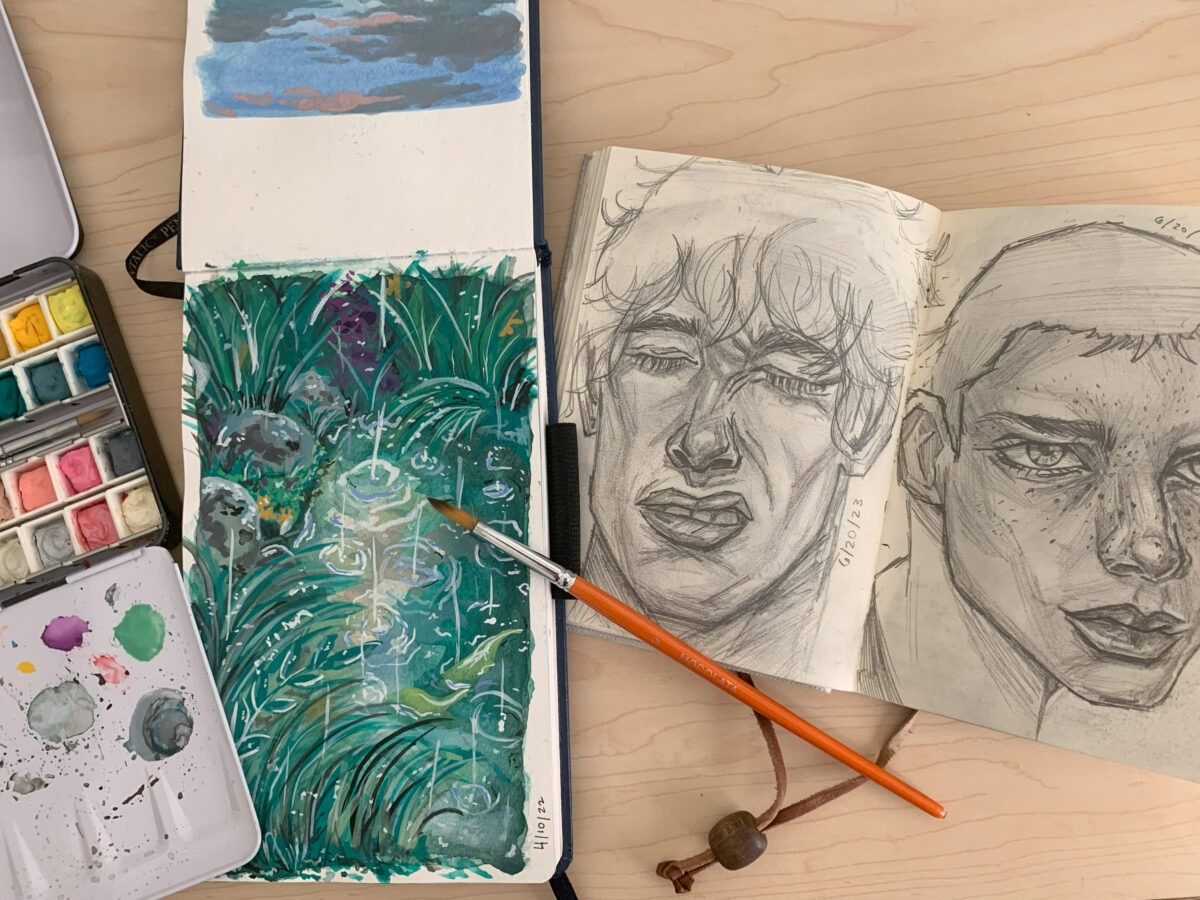
Ajeetha Aruchandran, a seniorbioinformatics and computational biology major, studies how the neural tube—a precursor to the spinal cord—forms in zebrafish embryos with Rachel Brewster, professor of biological sciences.
The development of the embryos, which are transparent, “is a very visual process,” Aruchandran says. Her artistic skills have allowed her to generate beautiful and accurate diagrams that communicate her research, she says. “When you’re not able to communicate science well, then the meaning is lost. So I think my art has really strengthened that aspect of my science. The connection has surprised and delighted me, because for a long time I thought my science and my art had to be separate.”
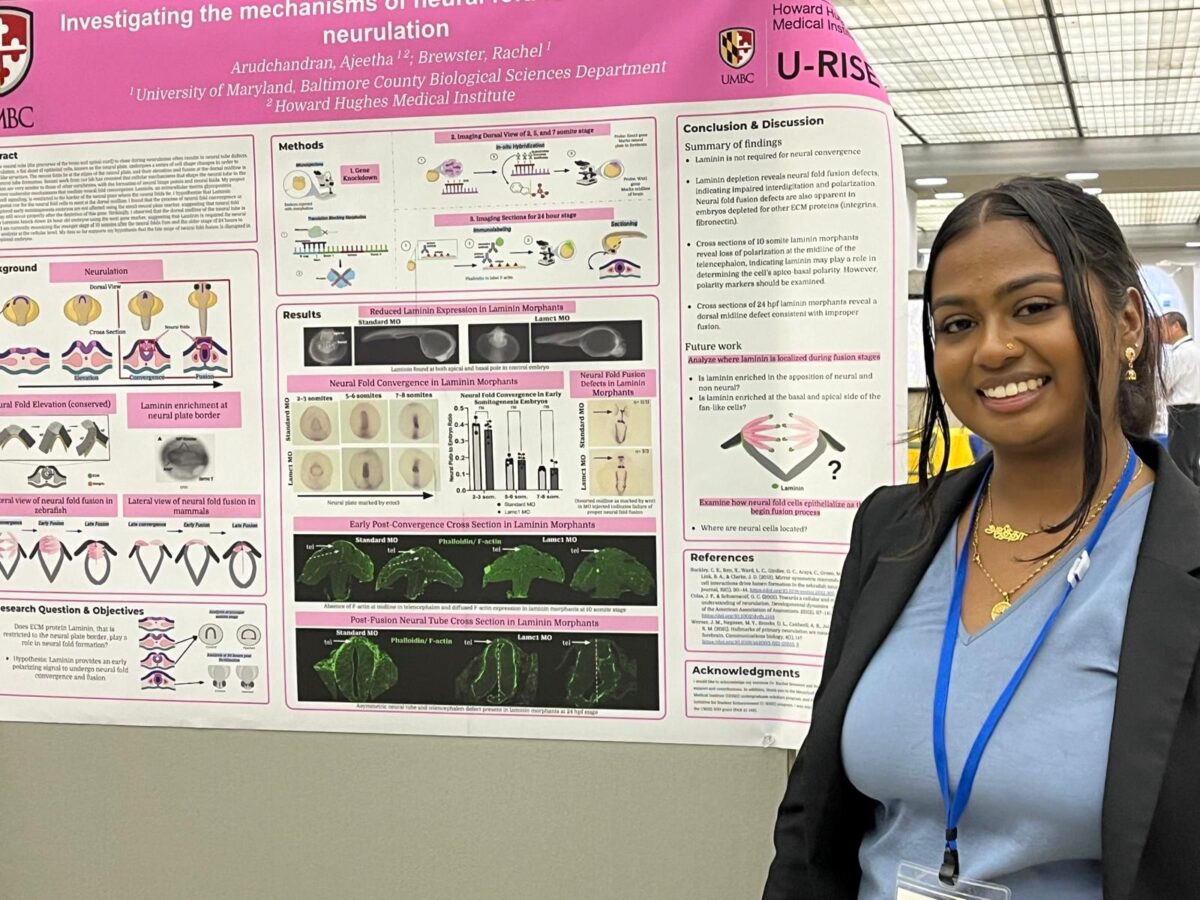
 Biologist Ajeetha Aruchandran also loves to paint. (Courtesy of Aruchandran)
Aruchandran began with drawing, but has transitioned to painting. “There’s something so special about the freeness of a brushstroke,” she says. The two pursuits “create balance in my life, because when I need more structure, I have research and the scientific method, but when I need to feel more free, I have my art.”
Rhythm and harmony
Lesley Hernandez, a senior majoring in biochemistry and molecular biology, is hunting for factors that regulate how viruses like HIV multiply in cells with Michael Summers, University Distinguished Professor of Cchemistry and Bbiochemistry. The ultimate goal is to disrupt the viruses’ replication. She also loves to dance.
“My family is from the Dominican Republic, so I grew up surrounded by music and movement. I decided to embrace that part of my culture at UMBC by joining the Latin Dance Club, where I could perform and share my love for dance with others,” Hernandez says. “I love incorporating dance into the workspace by sharing a laugh with my peers and dancing between experiments. It fosters stronger connections and creates an enjoyable work environment.”
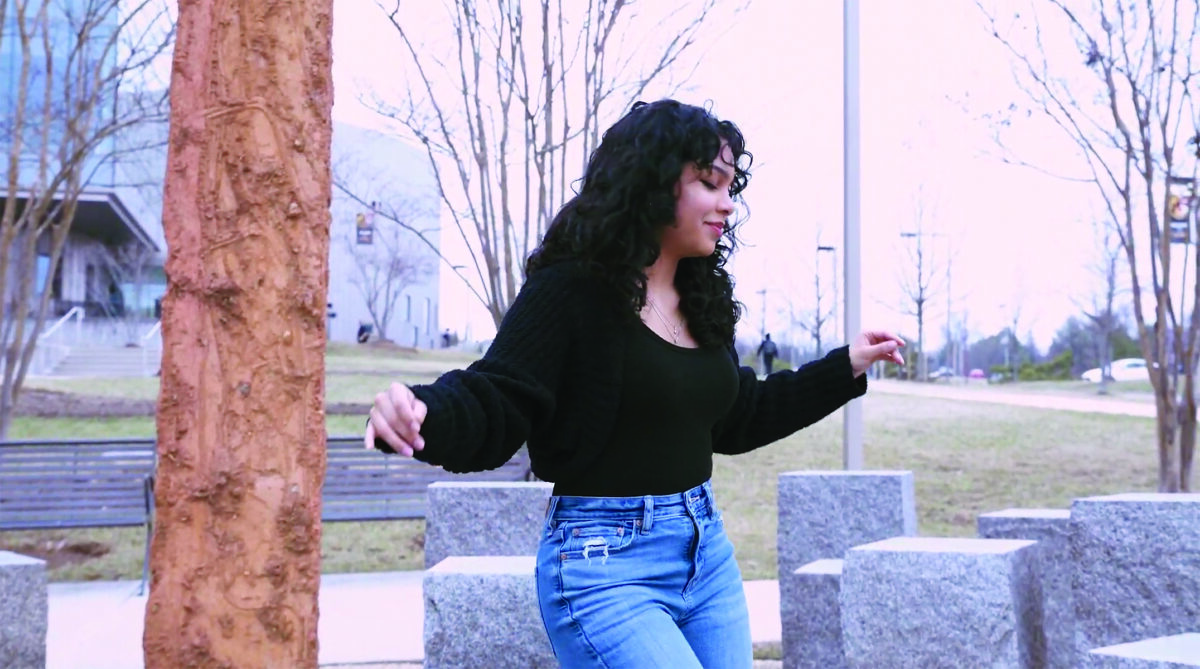
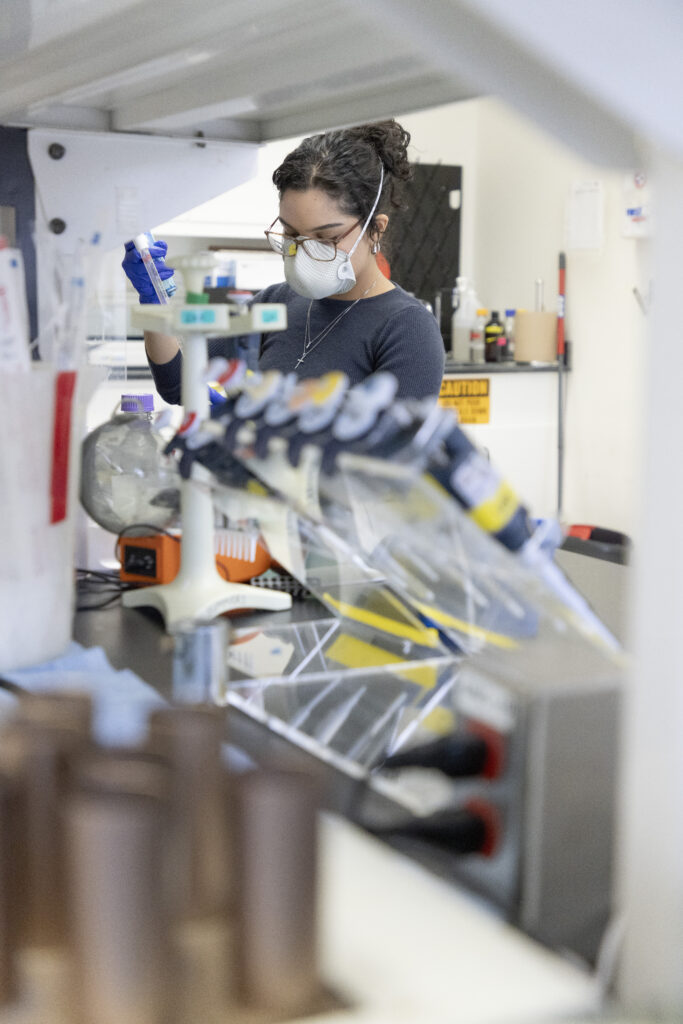 Lesley Hernandez loves being able to “go to my dance class and come back [to the lab] with a refreshed mind.” (Melissa Penley Cormier, M.F.A. ’17/UMBC)
And, when the science gets intense, “I can go to my dance class and come back with a refreshed mind,” Hernandez says. Her attention to detail benefits both her science and her dance. Being “a calculated person” helps her pick up rhythmically complex dance moves more quickly, for example. Both activities also require creativity, whether in trouble-shooting an experiment that’s not working or coming up with new dance routines.
In the Summers lab, “We are all really into science, but what is fun for you outside of that? Everyone in my lab has their own outlet, and that is encouraged,” Hernandez says.
For Daisy Parry, a senior majoring in biological sciences, that outlet is singing. “I’ve had a lot of interests that have come and gone, but singing has been a constant thread throughout my life. It’s very important and very centering to me,” Parry says. Her music minor has created dedicated times that provide a respite from the demands of science, she says.
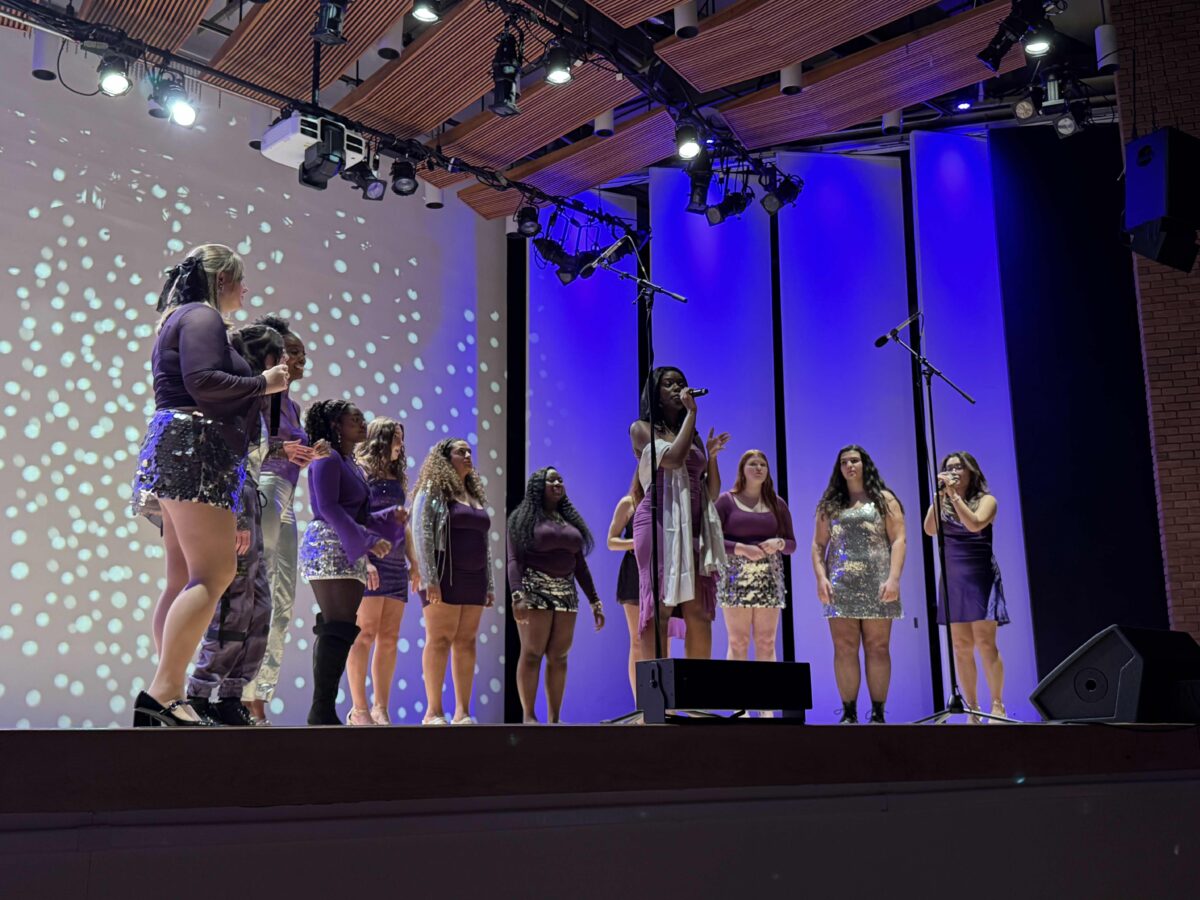 Daisy Parry (in front, with microphone) performs with the UMBC Stilettos, an all-female a cappella group. (Courtesy of Parry)
Parry is a member of The Stilettos, an all-woman a cappella group at UMBC, and her church choir. She arranges songs for The Stilettos to perform, which permits taking some creative license with the original work. “I like changing up the rhythms and dynamics to add depth to the music, and I think’s encouraged me to think a bit outside the box with my science, too, in terms of trying new experimental techniques.”
For now, her work on cell migration in fruit fly embryos with Michelle Starz-Gaiano, professor of biological sciences, her classes, and her music keep her busy, but Parry is looking forward to pursuing a master’s in public health after UMBC. She emphasizes how the concept of harmony—so central to music—carries over to the kind of work she wants to do. Factors such as research, clinical care, public policy, economics, the environment, and how they intersect are all relevant to public health outcomes, she explains.
‘It makes me whole’
Ella Reinders, a junior biological sciences major, also likes to tackle projects—scientific or artistic—from many angles. Watercolor and acrylic paints, sketching and drawing, handicrafts, sewing, and ballet have all captured her interest. “There are all different kinds of random things that I think are fun,” Reinders says.
In the lab, “I am able to come up with different ways of thinking about something because I’ve taken so many different approaches,” she says.
Reinders does behavioral research with Tara LeGates, assistant professor of biological sciences. The lab needed a new piece of equipment, but it was too expensive to buy off the shelf. “So I decided, why not create our own?” Reinders recalls.
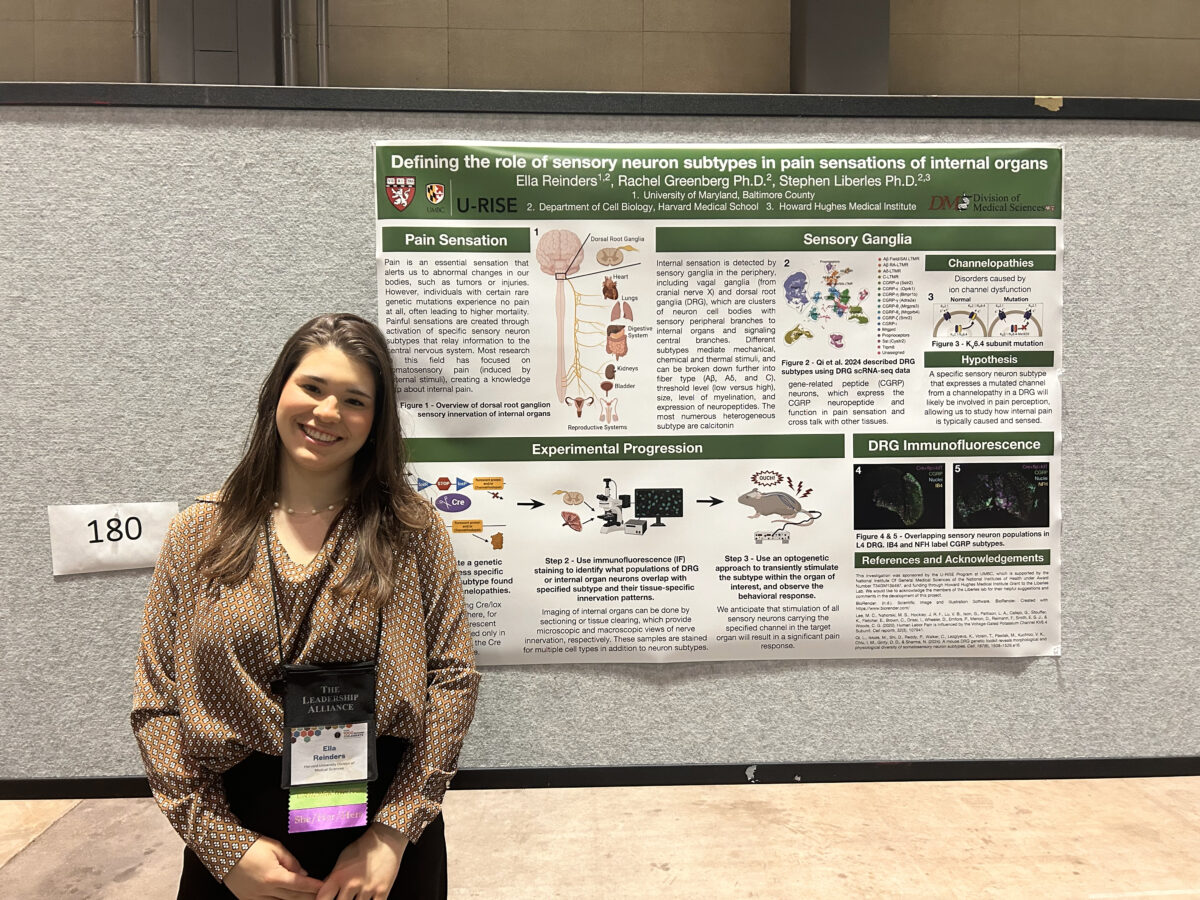
 Ella Reinders says that “moving through life with both scientific and artistic interests just makes everything more interesting.” (Courtesy of Reinders)
She sketched it out, learned how to render it on the computer, how to 3D print it at the UMBC library, and then how to wire it. “And now I’ve actually been using it, and it works,” she says. “It was really exciting. I love turning something from my brain into something that I’m actually holding.”
There is also direct overlap between Reinders’ science and her art. “I’ve done imaging of neurons, and being able to turn them into this piece of artwork that you want to hang on your wall is really exciting. Moving through life with both scientific and artistic interests just makes everything more interesting and feels like a way to express all sides of myself.”
For Joshua Dayie, a senior chemical engineering major, both discipline and creativity are required for his research and his art—playing the cello. “You really have to strike a balance between them to make any meaningful progress,” he says. Practicing cello requires hours of repetition, until technical passages flow out of his fingers from muscle memory alone. In the lab, sometimes experiments must be repeated many times before they’re successful—that’s the discipline.

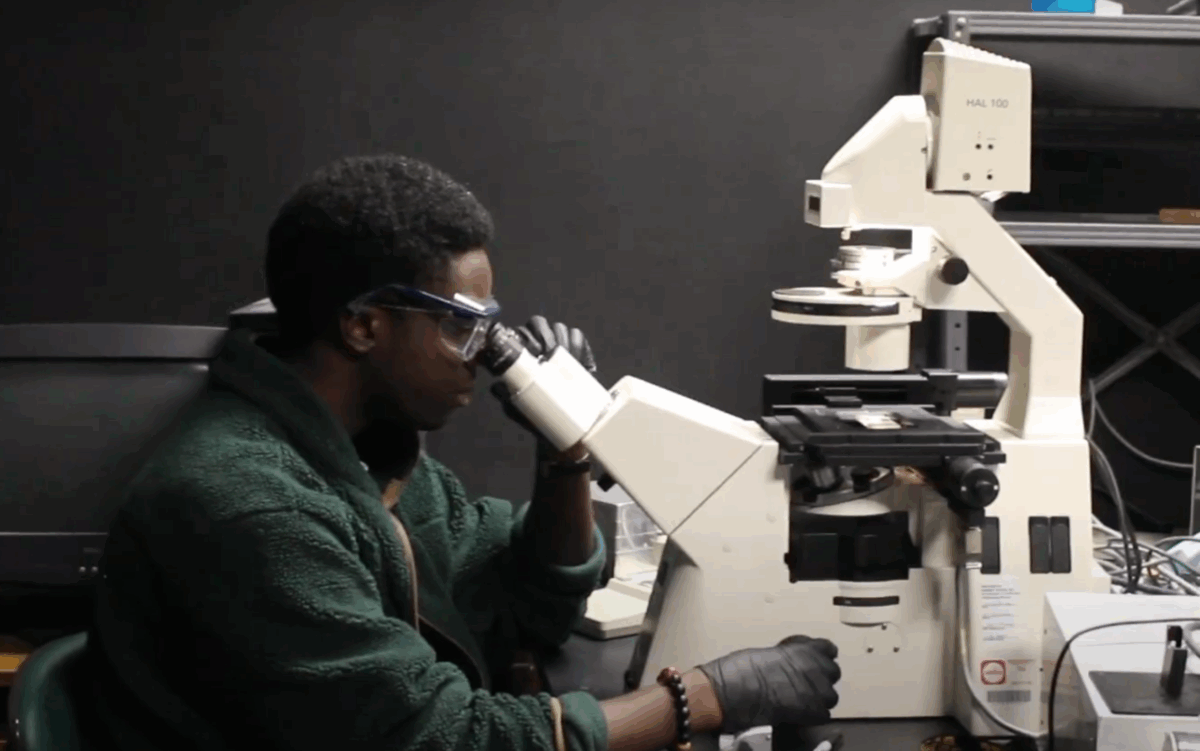 Playing the cello and conducting research makes Joshua Dayie feel “more whole.” (Melissa Penley Cormier, M.F.A. ’17/UMBC)
Dayie applies that discipline to his research with Mark Marten, professor of chemical, biochemical, and environmental engineering, on characterizing signaling pathways in fungi that activate in response to environmental stressors.
Then comes the creativity. Only after someone masters the fundamentals can they explore nuance in the tone or emotion conveyed on the cello, Dayie says. Similarly, in science “a lot of the innovation that you generate is really only meaningful after you’ve spent a lot of time understanding the core scientific concepts behind everything.”
“I think that’s been the most surprising thing: The creativity that comes from a very sound foundation of discipline is something that is translatable pretty much anywhere,” Dayie reflects.
As an added bonus, “Music has been a really nice outlet for me to use a different part of my brain, just to express myself in a different way,” he adds. “I feel like it makes me a little bit more whole.”
]]>
At UMBC, undergraduate students are redefining the boundaries of scientific and artistic pursuits. From a chemical engineer who graces the stage with his cello to a bioinformatician who paints and...
https://umbc.edu/stories/art-of-scientists/
https://dev.my.umbc.edu/api/v0/pixel/news/150074/guest@my.umbc.edu/8497eb97bed55a957858f91cb734d636/api/pixel
biochemistry-and-molecular-biology
bioinformatics
bioinformatics-and-computational-biology
biological-sciences
biology
cbee
chembiochem
cheme
chemeng
chemical-engineering
cnms
coeit
dance
discovery
magazine
music
story
UMBC News & Magazine
https://dev.my.umbc.edu/groups/umbc-news-magazine
https://assets1-dev.my.umbc.edu/system/shared/avatars/groups/000/001/943/24435aa6207c452e7bc15cc74b42c7bb/xsmall.png?1748556657
https://assets1-dev.my.umbc.edu/system/shared/avatars/groups/000/001/943/24435aa6207c452e7bc15cc74b42c7bb/original.png?1748556657
https://assets2-dev.my.umbc.edu/system/shared/avatars/groups/000/001/943/24435aa6207c452e7bc15cc74b42c7bb/xxlarge.png?1748556657
https://assets2-dev.my.umbc.edu/system/shared/avatars/groups/000/001/943/24435aa6207c452e7bc15cc74b42c7bb/xlarge.png?1748556657
https://assets3-dev.my.umbc.edu/system/shared/avatars/groups/000/001/943/24435aa6207c452e7bc15cc74b42c7bb/large.png?1748556657
https://assets1-dev.my.umbc.edu/system/shared/avatars/groups/000/001/943/24435aa6207c452e7bc15cc74b42c7bb/medium.png?1748556657
https://assets2-dev.my.umbc.edu/system/shared/avatars/groups/000/001/943/24435aa6207c452e7bc15cc74b42c7bb/small.png?1748556657
https://assets1-dev.my.umbc.edu/system/shared/avatars/groups/000/001/943/24435aa6207c452e7bc15cc74b42c7bb/xsmall.png?1748556657
https://assets2-dev.my.umbc.edu/system/shared/avatars/groups/000/001/943/24435aa6207c452e7bc15cc74b42c7bb/xxsmall.png?1748556657
UMBC News & Magazine
3
0
false
Tue, 13 May 2025 09:16:55 -0400
Tue, 13 May 2025 09:16:55 -0400
Meet a Retriever—Mariam Yaldram ’20, Alumni Board Member & Special Educator
Meet Mariam Yaldram ’20, history, a graduate from UMBC at the Universities at Shady Grove with a passion for education, disability justice, and global citizenship. She is a special education 8th-grade English Language Arts (ELA) teacher, and a Teach for America corps member. She also serves on the UMBC Alumni Association Board of Directors and Fulbrighters with Disabilities. Outside of work, she loves writing, collecting antiques, and exploring different cultures. Take it away, Mariam!
Q: What is your WHY? What brought you to UMBC?
A: I chose UMBC Shady Grove because I had transferred from Montgomery College, where I concentrated in history. Being located in Montgomery County, it felt like a natural transition for me. As a caregiver with many responsibilities, the Shady Grove campus offered the flexibility I needed to balance my academic journey with my personal commitments.
It provided an environment where I could continue to pursue my passion for history while being close to home, allowing me to stay involved in my family’s needs. The campus also offered leadership opportunities, such as serving as the president of the History Student Association and co-founding the UMBC History Journal at Shady Grove. These opportunities gave me the chance to grow both academically and professionally.
Ultimately, choosing UMBC at Shady Grove allowed me to pursue my education and career goals without compromising my family responsibilities—making it a perfect fit for where I was in my life.
Q: What’s one thing you’d want someone to know about the UMBC community?
A: One thing I’d want someone who hasn’t yet joined the UMBC community to know is that you will always find support here—whether academically, professionally, or personally. The faculty, staff, and student organizations truly care about your growth and success. My professors challenged and mentored me, helping me develop critical thinking and leadership skills, while my advisors provided guidance in student engagement, networking, and advocacy.
Whether you’re a student or an alum, UMBC is a place where you’ll find a welcoming, diverse, and empowering community that encourages you to grow and make an impact.
Mariam Yaldram ’20
history
Q: Who has inspired you or supported you?
A: Andrew Nolan, UMBC history program director at UMBC-Shady Grove, Melissa Blair, lecturer and public history minor coordinator, and Chelsea Moyer, assistant vice provost at UMBC-Shady Grove, have all played crucial roles in inspiring and supporting me throughout my educational journey. Their collective support has shaped my academic and professional path, reinforcing my passion for education, advocacy, and leadership.

My history professors, Dr. Nolan and Dr. Blair, helped me develop strong critical thinking skills in historical analysis, research, and writing. Their mentorship also encouraged me to take on leadership opportunities, such as serving as the president of the History Student Association and co-founding the first-ever student-led UMBC History Journal at Shady Grove.
Moyer, my leadership advisor, was instrumental in my growth as a student leader. Through UMBC Peer Advisory, I gained valuable leadership development experience by assisting with orientations, preview nights, outreach, and student engagement. Her guidance helped me build confidence in networking and creating meaningful connections within the UMBC community.
Q: How has the UMBC community helped you grow beyond the classroom?
A: Beyond the classroom, UMBC provided me with invaluable opportunities and resources, including being a Returning Women Scholar, serving on the Shady Grove Campus Student Council, and working as a UMBC Shady Grove Blogger. These roles allowed me to amplify student voices, advocate for my peers, and share my educational journey, all while balancing my responsibilities as a caregiver.
With UMBC’s supportive network and mentorship, I was also able to secure a Fulbright English Teaching Assistantship (ETA)—a transformative experience that reinforced my passion for education and global citizenship. Now, as a special education 8th-grade ELA teacher and Teach for America corps member, I see how these experiences shaped my ability to lead, teach, and advocate for equity in education.
Photo Left: Mariam during UMBC Spirit Week 2020, showing her UMBC pride from home.
Q: How have you stayed connected with the UMBC community?
A: Even after graduation, the UMBC Chapter of Young Alumni (CYA) and the UMBC Alumni Association Board of Directors have continued to offer a strong support system, allowing me to stay connected, share my journey through panels and networking events, and support UMBC alumni—especially those from Shady Grove, whose voices I am passionate about uplifting. My involvement with these groups has been an incredible opportunity for leadership, advocacy, and community engagement. These organizations have allowed me to stay connected with UMBC while supporting fellow alumni
The people and opportunities at UMBC didn’t just support me—they empowered me to grow, push boundaries, and create meaningful change. That’s what makes UMBC so special!
Mariam Yaldram ’20
history
Through CYA, I have had the chance to participate in networking events, mentorship opportunities, and outreach initiatives that foster connections among recent graduates. Being on the Alumni Association Board of Directors has further strengthened my advocacy skills, as I’ve worked to highlight the achievements and needs of Shady Grove alumni. One of the most meaningful aspects has been sharing my educational journey on panels, where I can inspire current and future Retrievers by discussing my path from student leadership to becoming a special education teacher and Teach for America corps member.
UMBC has been instrumental in my personal and professional growth, from providing leadership roles in student organizations to helping me secure a Fulbright ETA. These experiences have shaped my ability to lead, advocate, and build meaningful connections—all while giving back to the UMBC community that has given me so much.
 Mariam Yaldram in Taiwan with her students during her Fulbright English Teaching Assistantship.
For anyone considering a partnership with UMBC, I’d say it’s a great investment in a dynamic, diverse, and innovative community. UMBC fosters meaningful connections, leadership opportunities, and global impact, making it an incredible place to collaborate, support, and grow together.
 Mariam and her UMBC-Shady Grove history class visiting the Montgomery County Historical Society.
Q: Tell us more about your current job. What do you like most about it?
A: I’m a special education 8th-grade ELA teacher at Ingenuity Prep and a Teach for America corps member. What I enjoy most about my work is helping students find their voice through reading, writing, and critical thinking. Seeing my students grow academically and gain confidence in their abilities is incredibly rewarding. I also love creating an inclusive and supportive classroom environment, where students with diverse learning needs feel empowered to succeed. My role allows me to advocate for educational equity and disability justice, ensuring that all students have access to meaningful learning experiences. Every day, I get to make a difference in their lives, and that’s what makes my job so fulfilling!
* * * * *
UMBC’s greatest strength is its people. When people meet Retrievers and hear about the passion they bring, the relationships they create, the ways they support each other, and the commitment they have to inclusive excellence, they truly get a sense of our community. That’s what “Meet a Retriever” is all about.
Learn more about how UMBC can help you achieve your goals.
]]>
Meet Mariam Yaldram ’20, history, a graduate from UMBC at the Universities at Shady Grove with a passion for education, disability justice, and global citizenship. She is a special education...
https://umbc.edu/stories/meet-mariam-yaldram-alumni-board/
https://dev.my.umbc.edu/api/v0/pixel/news/150073/guest@my.umbc.edu/eebb2c8bb83701ed102d3ab444f3549d/api/pixel
alumni
alumni-board
history
magazine
meet-a-retriever
shady-grove
story
UMBC News & Magazine
https://dev.my.umbc.edu/groups/umbc-news-magazine
https://assets1-dev.my.umbc.edu/system/shared/avatars/groups/000/001/943/24435aa6207c452e7bc15cc74b42c7bb/xsmall.png?1748556657
https://assets1-dev.my.umbc.edu/system/shared/avatars/groups/000/001/943/24435aa6207c452e7bc15cc74b42c7bb/original.png?1748556657
https://assets2-dev.my.umbc.edu/system/shared/avatars/groups/000/001/943/24435aa6207c452e7bc15cc74b42c7bb/xxlarge.png?1748556657
https://assets2-dev.my.umbc.edu/system/shared/avatars/groups/000/001/943/24435aa6207c452e7bc15cc74b42c7bb/xlarge.png?1748556657
https://assets3-dev.my.umbc.edu/system/shared/avatars/groups/000/001/943/24435aa6207c452e7bc15cc74b42c7bb/large.png?1748556657
https://assets1-dev.my.umbc.edu/system/shared/avatars/groups/000/001/943/24435aa6207c452e7bc15cc74b42c7bb/medium.png?1748556657
https://assets2-dev.my.umbc.edu/system/shared/avatars/groups/000/001/943/24435aa6207c452e7bc15cc74b42c7bb/small.png?1748556657
https://assets1-dev.my.umbc.edu/system/shared/avatars/groups/000/001/943/24435aa6207c452e7bc15cc74b42c7bb/xsmall.png?1748556657
https://assets2-dev.my.umbc.edu/system/shared/avatars/groups/000/001/943/24435aa6207c452e7bc15cc74b42c7bb/xxsmall.png?1748556657
UMBC News & Magazine
11
0
false
Tue, 13 May 2025 08:54:00 -0400
Tue, 13 May 2025 08:54:00 -0400
Roche Named Vice President for UMBC Office of Institutional Advancement
The following message was shared with the UMBC community on May 12 to announce the naming of a new vice president for UMBC’s Office of Institutional Advancement:
* * * * *
Dear UMBC Community,
I am delighted to announce the appointment of Patrick Roche to the role of vice president for institutional advancement. Patrick will begin in the role July 1.
Patrick joins UMBC from the University of Minnesota Foundation, where he is currently vice president for principal gifts and interdisciplinary initiatives. The foundation is a separate nonprofit organization from the University of Minnesota that serves as the central development office for the university. Prior to assuming his current role in 2024, Patrick served for three years as associate vice president for central programs.
At the foundation, Patrick’s role as a member of the senior leadership team has focused on developing strategies for the university’s next comprehensive campaign, cultivating transformational philanthropic relationships with the university’s most prominent donors, and developing university-wide plans for interdisciplinary initiatives. He has led the foundation’s planned giving, international fundraising, regional development program, and leadership annual giving program in raising $130 million in Fiscal Year 2024, up from the $100 million the teams raised in FY 2023 and $70 million raised in FY 2022.
As important as his fundraising success are Patrick’s leadership abilities, his strategic mindset, and his dedication to the mission of higher education. He is incredibly thoughtful about the purpose of philanthropy in advancing mission and vision and the critical role of alumni in moving an institution forward. I know he is inspired by UMBC’s vision and its identity as a public research institution that sees inclusive excellence as its core defining value.
Before returning home to his native Minnesota to serve in leadership with the foundation, Patrick held numerous roles in advancement in California and New York. Most recently, he was vice president of development for Goodwill of Southern California, where he secured the organization’s largest single gift in 2020, grew and developed the staff, and implemented a strategic plan and new methodologies for fundraising programs and collaboration across the organization.
His advancement career in higher education includes four years as vice president of development and alumni relations at Clarkson University in Potsdam, NY, where he achieved three consecutive years of record growth in fundraising, as well as several leadership roles at Claremont McKenna College and annual and major gift fundraising roles at the California Institute of Technology. Patrick, who earned a bachelor’s degree in management from Rensselaer Polytechnic Institute, began his career in business development and sales management in the technology sector.
We are delighted that Patrick has accepted our offer to lead the OIA team and serve in this pivotal role as a partner to our senior leadership team and me. My sincere thanks to Kevin Yang ’07, president of the UMBC Alumni Association Board of Directors, and Karl Steiner, vice president for research and creative achievement, for their leadership of the search committee, as well as to all the members of the committee for their service.
I am deeply grateful to Stanyell Bruce, director of alumni engagement, and Kim Robinson, director of major gifts, who have served admirably in temporary co-leadership of OIA. Thank you, Stanyell and Kim, and welcome, Patrick!
Sincerely,
President Valerie Sheares Ashby
]]>
The following message was shared with the UMBC community on May 12 to announce the naming of a new vice president for UMBC’s Office of Institutional Advancement: * * * * * Dear UMBC...
https://umbc.edu/stories/roche-named-vice-president-for-umbc-office-of-institutional-advancement/
https://dev.my.umbc.edu/api/v0/pixel/news/150057/guest@my.umbc.edu/6072b7b224eccf8f511a03766985d7b3/api/pixel
alumni
story
vice-president-for-institutional-advancement
UMBC News & Magazine
https://dev.my.umbc.edu/groups/umbc-news-magazine
https://assets1-dev.my.umbc.edu/system/shared/avatars/groups/000/001/943/24435aa6207c452e7bc15cc74b42c7bb/xsmall.png?1748556657
https://assets1-dev.my.umbc.edu/system/shared/avatars/groups/000/001/943/24435aa6207c452e7bc15cc74b42c7bb/original.png?1748556657
https://assets2-dev.my.umbc.edu/system/shared/avatars/groups/000/001/943/24435aa6207c452e7bc15cc74b42c7bb/xxlarge.png?1748556657
https://assets2-dev.my.umbc.edu/system/shared/avatars/groups/000/001/943/24435aa6207c452e7bc15cc74b42c7bb/xlarge.png?1748556657
https://assets3-dev.my.umbc.edu/system/shared/avatars/groups/000/001/943/24435aa6207c452e7bc15cc74b42c7bb/large.png?1748556657
https://assets1-dev.my.umbc.edu/system/shared/avatars/groups/000/001/943/24435aa6207c452e7bc15cc74b42c7bb/medium.png?1748556657
https://assets2-dev.my.umbc.edu/system/shared/avatars/groups/000/001/943/24435aa6207c452e7bc15cc74b42c7bb/small.png?1748556657
https://assets1-dev.my.umbc.edu/system/shared/avatars/groups/000/001/943/24435aa6207c452e7bc15cc74b42c7bb/xsmall.png?1748556657
https://assets2-dev.my.umbc.edu/system/shared/avatars/groups/000/001/943/24435aa6207c452e7bc15cc74b42c7bb/xxsmall.png?1748556657
UMBC News & Magazine
0
0
false
Mon, 12 May 2025 15:37:19 -0400
