Janerra Allen, Ph.D. ’25: A first-generation engineering college grad uplifts fellow students
Janerra Allen, Ph.D. ’25, electrical engineering, studies electrical signals in the brain, looking for patterns that might help doctors diagnose or treat mental disorders such as schizophrenia. As a first-generation college student she forged her own path, mastering complex subjects so that she could reach the pinnacle of higher education—producing new knowledge.
Although she encountered challenges along the way, she never gave up, and she always found time to support her fellow students facing their own challenges. During her time at UMBC, she served as a graduate senator for the College of Engineering and Information Technology, secretary of the Graduate Student Association, and president of the Black Graduate Student Organization. “Janerra works tirelessly to create inclusive, supportive spaces for students,” says Jennifer Artis, the senior director of student belonging at UMBC. “Her ability to balance these leadership roles with her demanding Ph.D. research speaks volumes about her dedication, time management, and unwavering passion for service.”
Q: How did you get interested in science and technology?
A: When I was a child, I was interested in putting things together—“engineer” wasn’t in my vocabulary yet, so I think the word I used then was inventor. I wanted to be an inventor. I remember once trying to make a telescope out of a magnifying glass and an old paper towel roll.
When I was in middle school, I read a magazine article about Denis Mukwege, a doctor from the Democractic Republic of Congo who helped treat victims of sexual violence. Reading about the impact of his work made me realize I wanted to do healthcare related work too.
Q: How did you find your way to UMBC?
 Allen poses on the Golden Gate Bridge in San Francisco, where she completed a 3-month internship at Genentech, Inc. in 2023. (Image courtesy of Allen)
A: I went to the Benjamin Banneker Academy for Community Development in Brooklyn, New York, for high school, and then to the University of Wisconsin Madison for undergrad. I got my degree in material science engineering. It was at Wisconsin that I decided to focus on studying the brain, and I worked in a neuroimaging lab, imaging the brains of people who had suffered a stroke. The idea was to improve rehabilitation by stimulating the correct parts of the brain.
After graduating, and working in a lab for a year, I moved back to the East Coast and worked for a telehealth company, troubleshooting medical devices. But I knew I wanted to pursue graduate school. Someone I knew from Wisconsin actually suggested UMBC as a place to apply. She said it was a small, supportive school. UMBC is the only graduate school I applied to. I thought, “If it’s meant to be, I’m gonna end up here.”
Q: Who at UMBC has had the biggest impact on your time here?
A: So many people have profoundly influenced my time at UMBC. If I had to pick just one, I’d have to say Ms. Justine Johnson, mainly because she’s known me from the very beginning. She’s the associate director of the Graduate Research Training Initiative for Student Enhancement, and before I even arrived, she worked tirelessly with me for months to resolve funding concerns. We had so many phone calls and emails back and forth before I even came. And she really advocated for me in ways that reassured me I was worthy of continuing my graduate pursuits.
Q: What motivates you to get involved with student organizations?
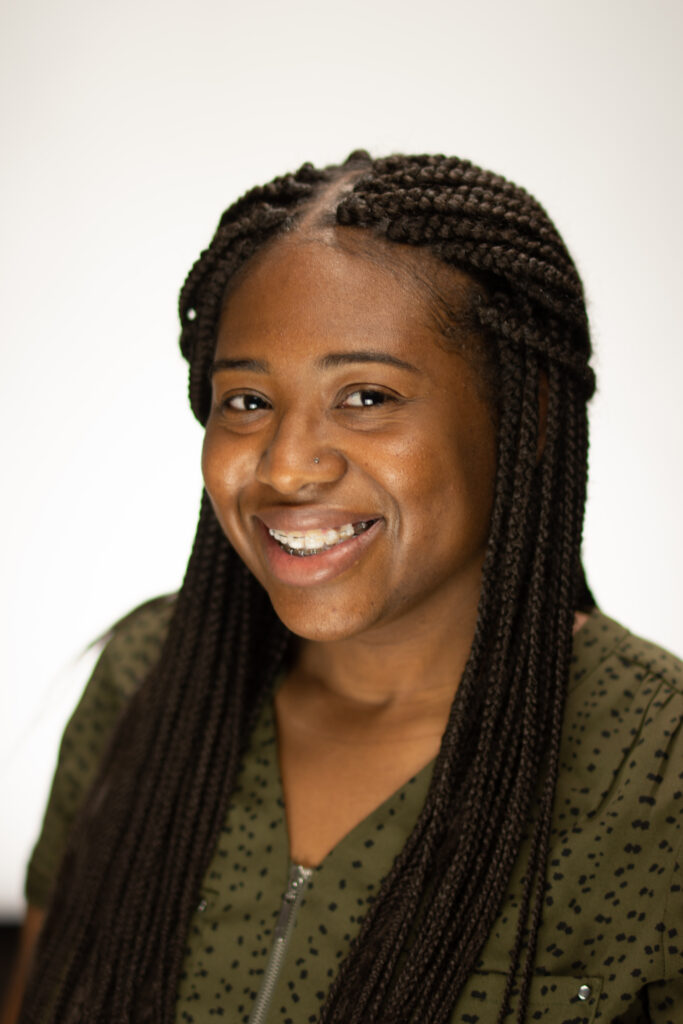
A: When I was in Wisconsin I joined the National Society of Black Engineers (NSBE) and the Society of Women Engineers. At NSBE, I went from being a member to eventually being the president for two years, which I was very, very proud of.
When I first arrived at UMBC, I focused first on my school work and research. But then I started to get more involved. In 2022, I went to the Ebony Ball, which is a yearly celebration held by the Black Graduate Student Organization (BGSO), and the president at the time encouraged me to become part of the executive board.
I know it’s sometimes hard to get grad students to be truly involved because we have so much going on, and we’re at more of an adult stage where we have our separate lives. But in the end, I decided to step up.
BGSO holds a special place in my journey because it fosters community, provides academic and professional resources, and creates a supportive space for Black graduate students. As president for the past two years, I have learned valuable lessons about leadership, resilience, and the importance of appreciating the process.
Q: What are your plans for after graduation?
A: I’ll be working as a post-doc at the Johns Hopkins Applied Physics Lab in their health and human machine systems group. I’ll have to propose my own project, and I’m thinking about how to analyze conditions that affect war veterans’ brains.
I love research, and I love that it can look very different depending on where you are. In the future, I can imagine working as a research director or as a professor. I love people and love mentoring them.
Q: How does your family feel about you graduating with a Ph.D?
A: Funny enough, some of them are just like “Wow, finally!” But they’re definitely proud. My grandma likes to brag, saying “My granddaughter is doing all these things; she’s going to be a doctor.” It’s been nice to have opportunities when my family visited and got to see what graduate student life is like, because that’s something they are not really familiar with.
Overall, they’re grateful that I got to see this process through. They had to live through my complaints and my worries and thinking that it was not meant to be. But with their support, they got to see me come through on the other side.
 Allen (far left) celebrates with UMBC colleagues as President Valerie Sheares Ashby accepts her 2022 Technologist of the Year award at the Women of Color STEM DTX Conference. (Image courtesy of Allen)
Q: How are you going to celebrate?
A: I’ll graduate this summer and my start date for my post-doc is July 14. My birthday is also coming up, so whatever I do, it’ll probably be a combination of relaxation and something else. I want to do something big to celebrate, maybe travel, but I don’t know yet. Right now I’m focused on crossing the finish line.
Read more Commencement 2025 stories.
]]>
Janerra Allen, Ph.D. ’25, electrical engineering, studies electrical signals in the brain, looking for patterns that might help doctors diagnose or treat mental disorders such as schizophrenia. As...
https://umbc.edu/stories/janerra-allen-ph-d-25-first-gen-engineering-grad-uplifts-students/
https://dev.my.umbc.edu/api/v0/pixel/news/149641/guest@my.umbc.edu/dc65d3d74e88b57d5c5a381295a8aaa4/api/pixel
class-of-2025
coeit
csee
news
research
story
UMBC News & Magazine
https://dev.my.umbc.edu/groups/umbc-news-magazine
https://assets1-dev.my.umbc.edu/system/shared/avatars/groups/000/001/943/24435aa6207c452e7bc15cc74b42c7bb/xsmall.png?1748556657
https://assets1-dev.my.umbc.edu/system/shared/avatars/groups/000/001/943/24435aa6207c452e7bc15cc74b42c7bb/original.png?1748556657
https://assets2-dev.my.umbc.edu/system/shared/avatars/groups/000/001/943/24435aa6207c452e7bc15cc74b42c7bb/xxlarge.png?1748556657
https://assets2-dev.my.umbc.edu/system/shared/avatars/groups/000/001/943/24435aa6207c452e7bc15cc74b42c7bb/xlarge.png?1748556657
https://assets3-dev.my.umbc.edu/system/shared/avatars/groups/000/001/943/24435aa6207c452e7bc15cc74b42c7bb/large.png?1748556657
https://assets1-dev.my.umbc.edu/system/shared/avatars/groups/000/001/943/24435aa6207c452e7bc15cc74b42c7bb/medium.png?1748556657
https://assets2-dev.my.umbc.edu/system/shared/avatars/groups/000/001/943/24435aa6207c452e7bc15cc74b42c7bb/small.png?1748556657
https://assets1-dev.my.umbc.edu/system/shared/avatars/groups/000/001/943/24435aa6207c452e7bc15cc74b42c7bb/xsmall.png?1748556657
https://assets2-dev.my.umbc.edu/system/shared/avatars/groups/000/001/943/24435aa6207c452e7bc15cc74b42c7bb/xxsmall.png?1748556657
UMBC News & Magazine
4
0
false
Wed, 30 Apr 2025 11:13:27 -0400
Wed, 30 Apr 2025 11:13:27 -0400
Coming full circle on musical pathways—UMBC students now teach at the programs that launched their success
All musicians start out as absolute beginners. Some might progress as self-taught, others might have private music lessons, and many will pick up their first instrument in school. But without a musical pathway—consistent access to physical instruments and dedicated music educators year after year—budding musicians will falter on their journey.
For Nema Robinson, and the thousands of other Baltimore City student musicians who have benefited from extra-curricular, free, equitable music education through programs like the Baltimore Symphony’s OrchKids and Peabody Institute’s Tuned-In program, these communities have opened musical doors to a professional career in music and so much more. Now on track to graduate with a music education degree, Robinson has reached a full circle moment to teach at the programs that set the stage for her own success.
The first violinist plays a long, drawn out A. The other musicians settle their feet against the stage floor and their backs hover near, but don’t quite touch the backs of their chairs. Suddenly, the noise of the orchestra breaks across your ears—briefly discordant and separate—but as the players all search for the same A, the notes weave together into a pleasing buzz of anticipated energy. In tune together, they look expectantly at the conductor.
 Robinson instructs students at Tuned-In.
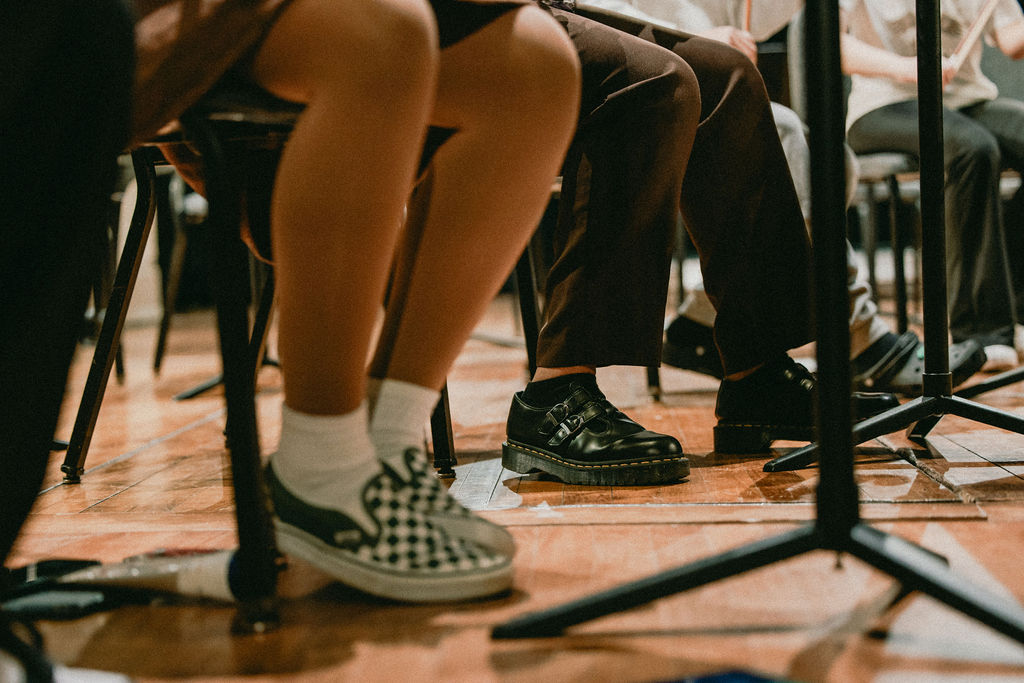
Among the Uggs and Vans and Crocs and Nikes nestled under the music stands are Nema Robinson’s double-buckled black platform Mary Janes. Robinson, a fourth-year music education student and Linehan Artist Scholar, is at one of her teaching gigs that supplement and complement her degree. Today, she’s in Friedberg Hall at the Peabody Institute in Mt. Vernon, Baltimore, as part of Tuned-In, a free musical study and youth development program for Baltimore-area students. The elegant marble relief sculptures that flank either side of the stage and the gentle curve of the stairs leading to the second story seating section are just the background to the real art on the stage: Middle and high schoolers are making music.
In Baltimore City, only 60 percent of public schools have some type of musical component, says Nick Skinner, the vice president and founding team member of BSO OrchKids—which also offers free, community-based, high-quality music instruction and programming in the city. Of that, only 12 percent of city schools have instrument programs, compared to nearly 100 percent in nearby Baltimore, Howard, and Montgomery county schools. “There’s no musical pathway. So if you’re lucky enough to have music in your elementary school, you may not be able to continue that music study sequentially into middle or high school,” says Skinner. “It’s a really patchwork model of how students can progress musically through their education.”
When former BSO conductor Marin Alsop began her tenure in the city, she saw a need to fill this gap, and in 2007 founded BSO OrchKids. As Skinner tells it, Alsop saw that “many of our students here in the city were locked out of these opportunities to have the power of music in their life—to benefit from the inherent value of playing an instrument and the benefits that come from the study and the artistic process of learning an instrument.”
Asked to lead
When Robinson was a kid, she was walking around Artscape with her mom waiting to see her cousin perform on stage. Artscape in Baltimore City is the nation’s largest free outdoor arts festival, famously held on whatever is the hottest weekend in the summer. Robinson recalls getting to the event early and waiting in the unbearable heat. They found a place to sit and wait for her cousin’s opera performance and during that period OrchKids took the stage. “And my mom was like, ‘Oh my God, all these Black musicians playing classical music.’ We immediately got applications, and all of this started from there.”
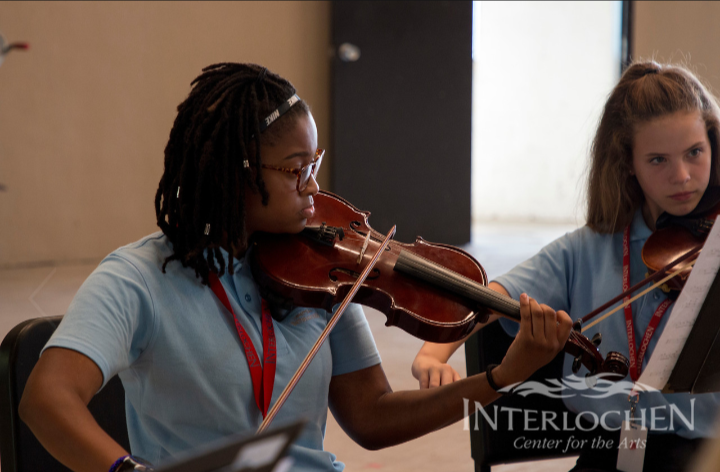
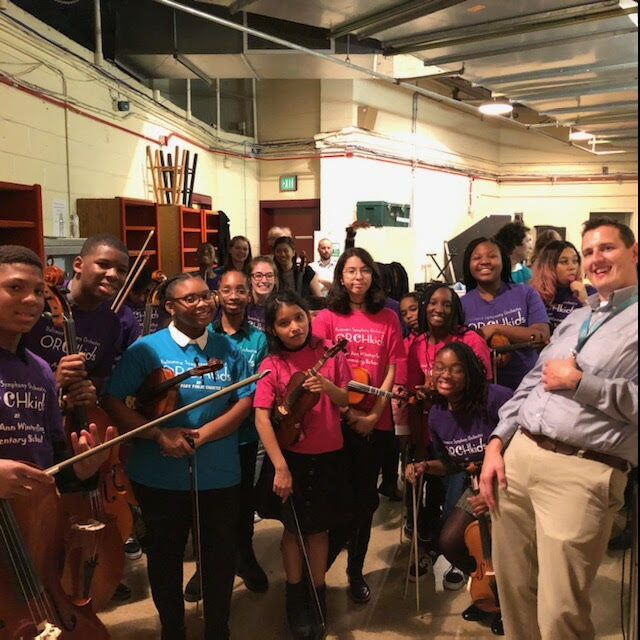
Young Nema Robinson playing the violin and with a group of BSO OrchKids. Robinson is crouching in purple, and fellow UMBC student Rickerra Bassett is standing in front with a teal shirt. Photos courtesy of Robinson.
In fourth grade, Robinson joined OrchKids and thought she wanted to play the tuba. Her mom shot that down for practical reasons, like 11-year-old Nema being able to even carry the instrument. “I’m still too small to play the tuba,” says Robinson. Her instrument of (second) choice was the violin, and through the daily after-school sessions at OrchKids and the all-day Saturdays at Tuned-In, along with numerous other musical opportunities she’s taken part in, Robinson has far surpassed the lauded 10,000 hours on her way to becoming an expert.
On stage in the Linehan Concert Hall rehearsing with UMBC’s Chamber Ensemble, Robinson stands in a semi-circle with a dozen other musicians. At this point, she’s been playing for 10 years. As the group launches into a slow baroque minor key waltz, Philip Mann, the conductor and assistant professor of music, stops them short. “Let’s move closer,” he says to the collection of string instrumentalists. With a shuffle of music stands, the ensemble tightens the circle. Black leather Doc Martens now firmly planted beneath her, Robinson leans into the music with her instrument familiarly tucked beneath her chin.

Before UMBC had a chamber orchestra—an intimate group of musicians—Robinson played in UMBC’s Symphony Orchestra, which is open to staff, students, and community members. She was a section leader her first year at UMBC. “I had to make sure I was locked in because this was a really big deal in a university just starting out. I think for me it was definitely nerve wracking, like, ‘Oh, I can’t mess up. But the conductor said, “You’re doing great. Just play.’” As time went on Robinson saw that as a music major and a Linehan Scholar, she was being asked to lead.
“I slowly adapted,” says Robinson, “and then I started to realize that music majors—maybe that’s why we are the section leaders—because we are setting an example for the community members.”
Listen to different nuances
Ann Sofie Clemmensen, director of the Linehan Artist Scholars Program, knows this was intentional. “Across the arts, we do lean on scholars to lead some assignments because they are receiving resources that others are not. In the music department, in dance and theater, and visual arts, we’re identifying leaders and those who can become leaders. And I think that’s what UMBC is very good at.”
 Robinson at the Peabody Institute.
This May, the Linehan Artist Scholars Program is celebrating three decades of supporting an arts-focused community at UMBC. Founded with support from Earl and Darielle Linehan, the scholarship supports students with an exceptional interest in the arts. Specifically, the program “acknowledges the importance of artists as leaders. As artists, we understand that a production or an orchestra is a component of many things that have to have some sort of organizational aspect,” says Clemmensen. “You have to listen to the different nuances.”
Robinson has found the scholars community to be uplifting and collaborative. “Insanely great,” to use her exact words. “It’s really cool to see how everyone else is very invested in their art, and it made me realize how it’s all tied together,” Robinson says. When she heard fellow OrchKid and Tuned-In student, Rickerra Bassett, was thinking about UMBC, Robinson immediately connected the young violist to Linehan, where she is now a first-year double major music education and performance scholar.
This is the dream
 Rickerra Bassett practices with the UMBC Chamber Ensemble.
Bassett started at BSO OrchKids during kindergarten, practically still a baby, she says. She stayed through her senior year, and like Robinson, has continued to work for the program as a graduate. Despite the camaraderie and the support BSO OrchKids offers, Bassett said it is rare that a student stay in the program for their full K-12 experience. “The main reason why I stuck with it is, well, I enjoyed it. I also realized how high demand violas are—there’s not as much competition for me to participate in orchestras compared with violin, so I feel like I’ve gotten way more opportunities because I play viola.”
“Rickerra and Nema are in so many ways, shape, and form what we always hope OrchKids to be,” says Skinner. “We’re always striving to improve, but looking at their trajectory—that is the dream in a lot of ways.” OrchKids has paved and paid the way for Robinson, Bassett, and many other musicians to attend prestigious music camps in other states, perform on the BSO’s Meyerhoff stage with world-class professional musicians, participate in the YOLA National Festival in Los Angeles, and so many other opportunities in addition to their daily musicianship classes and other education supports. And now they’re at UMBC, learning to mentor the next generation of musicians.
“In so many ways,” Skinner says, “they are the definition of what OrchKids is hoping to achieve.”
Watching other young people discover the joy of sticking with an instrument gave Bassett, who also played with Tuned-In, the idea to double major in music education. “Seeing the younger students get so excited about things that we would probably think of as small was just the sweetest thing,” says Bassett. “I was seeing myself in them since I started that young. And I’m just hoping that they keep going. I want to motivate them to keep going.”
Music as social transformation
It’s not just about the music. Or rather, the music is more than the music classes. “I can’t believe how much the musical development and the social development are connected,” says Daniel Trahey, who co-founded Tuned-In at Peabody in 2007, coincidentally the same year he was a founding team member at OrchKids. “When you see someone like Nema—when she saw what she was able to do—her confidence level just skyrocketed once she started practicing. And this is so key to all of our kids, we need our kids to be thinking about themselves and investing in themselves in order to be better for others. And the thing that’s the most amazing to me is to see someone like Nema start to invest in herself, start to map out time for only themselves to sit down and practice when their other friends are off doing other things.”
Skinner puts it similarly: “When learning an instrument, you’re developing skills that you don’t even really realize that you’re forming—creativity and collaboration, leadership, the responsibility of practicing your instrument or making sure you have your music for a rehearsal. These are skill sets that our students are forming from a very young age that become embedded in them and can then easily be reapplied. There’s a tremendous amount of research that’s been coming out over the past decade about the power of music and how it impacts the brain. There’s almost nothing like playing an instrument when it comes to really enhanced brain function and activity, cognitive development, and executive function capabilities.”


Rickerra Bassett has been playing the viola since kindergarten in programs like OrchKids and Tuned-In. Photos courtesy of Bassett.
For Robinson, the structure and consistency of the programs she played in was key. They gave shape to her education and the expectation of practice and performances, and ultimately shaped her talent and her work ethic that shines through her myriad teaching roles.
Trahey stops mid-sentence to brag on this young professional. “Nema is what, 20 years old? She has the best attendance, the best timeliness. She is the most professional at sending emails. She takes her job so dang seriously, it is inspiring to me. And Nema plays a very important role at Tuned-In because for our high school kids, who are really sick of hearing from me, they’re listening to Nema because Nema’s got real world experience.”
 Robinson looks on while Tuned-In student Mi’Onte McGhee asks a question.
Trahey’s hopes—and part of Tuned-In’s goals—is that the program would be fully staffed one day by graduates of the program. Commitment to continuum is how they put it: students become the teachers. “By valuing the community the student comes from, the student will want to come back and work toward creating an even healthier community,” says Trahey.
In the big picture view, the musicianship classes and camps and performances—they’re all leading toward social transformation, but Trahey doesn’t want that to mean that the students leave their communities behind along the way. “I hope for most of the kids, to do what they want to do, and then find a way to also give back to their communities. We’re already seeing this where our students have gone on to get political science degrees or medical degrees, and then they become our largest advocates, and so for many of the communities that we’re working in.”
“We are really looking at how we can use music as a vehicle to open up the world to our students,” says Skinner.
Robinson saw music education in action by watching Brian Kaufman, associate professor of music education, teach at BSO OrchKids. He helped her discover music education as a major and the idea to pursue it at UMBC. “He was just very passionate about it. And you can just see it in the work and the community he created,” she says. “And when I visited, UMBC felt so welcoming.”
From his years of watching her as a student and then as an assistant, Trahey says, “Nema’s always had it, but I think UMBC and the music education program has really helped her get a more global perspective. Before she would concentrate on maybe one kid’s problem or two kids’ problems. And now I’m seeing her be able to really serve the needs and hear the voices of every single child in her ensemble or in the room that she’s working in, and that’s been a huge growth point for her since being at UMBC.”
Not an everyday type of thing
Back in the marbled hall at the Peabody Institute, Robinson is threading through the music stands on stage to offer encouragement and correction to the young people on stage. The lead instructor has stepped away to give the reins to Robinson.
 Robinson plays outside the Peabody Institute in front of the Washington Monument in Baltimore, Maryland.
Mi’onte McGhee, a high school violinist who has been playing with Tuned-In for four years, says, “Nema is such a big help to us. She’s really good if you ask her a question about technique—you don’t even have to ask sometimes, she just comes up and says I can help you with that, but she’s really nice about it. She never makes you feel like you can’t play. She’s really kind and knowing that she’s gone through all this before helps me relate to her.”
For Robinson, there’s nothing like the feeling of creating music with people. “It’s like you’re in a different zone, if that makes sense. It’s not necessarily an everyday type of thing, she says. “You definitely have to have a good intention and really put your all toward it. It’s doing something you’re very passionate about and then putting it forward. It doesn’t always make sense, but when you do it, it feels right.”
]]>
All musicians start out as absolute beginners. Some might progress as self-taught, others might have private music lessons, and many will pick up their first instrument in school. But without a...
https://umbc.edu/stories/coming-full-circle-on-musical-pathways/
https://dev.my.umbc.edu/api/v0/pixel/news/149597/guest@my.umbc.edu/5851c1c34e6edf58c27f0881b3e27a30/api/pixel
baltimore-city
cahss
campus-life
feature
linehan-artist-scholars
magazine
music
music-education
spring-2025
story
UMBC News & Magazine
https://dev.my.umbc.edu/groups/umbc-news-magazine
https://assets1-dev.my.umbc.edu/system/shared/avatars/groups/000/001/943/24435aa6207c452e7bc15cc74b42c7bb/xsmall.png?1748556657
https://assets1-dev.my.umbc.edu/system/shared/avatars/groups/000/001/943/24435aa6207c452e7bc15cc74b42c7bb/original.png?1748556657
https://assets2-dev.my.umbc.edu/system/shared/avatars/groups/000/001/943/24435aa6207c452e7bc15cc74b42c7bb/xxlarge.png?1748556657
https://assets2-dev.my.umbc.edu/system/shared/avatars/groups/000/001/943/24435aa6207c452e7bc15cc74b42c7bb/xlarge.png?1748556657
https://assets3-dev.my.umbc.edu/system/shared/avatars/groups/000/001/943/24435aa6207c452e7bc15cc74b42c7bb/large.png?1748556657
https://assets1-dev.my.umbc.edu/system/shared/avatars/groups/000/001/943/24435aa6207c452e7bc15cc74b42c7bb/medium.png?1748556657
https://assets2-dev.my.umbc.edu/system/shared/avatars/groups/000/001/943/24435aa6207c452e7bc15cc74b42c7bb/small.png?1748556657
https://assets1-dev.my.umbc.edu/system/shared/avatars/groups/000/001/943/24435aa6207c452e7bc15cc74b42c7bb/xsmall.png?1748556657
https://assets2-dev.my.umbc.edu/system/shared/avatars/groups/000/001/943/24435aa6207c452e7bc15cc74b42c7bb/xxsmall.png?1748556657
UMBC News & Magazine
4
0
false
Tue, 29 Apr 2025 14:51:29 -0400
Tue, 29 Apr 2025 14:51:29 -0400
Ada Glaser ’25—An emerging social worker with a passion for youth development
Ada Glaser ’25, social work and individualized study (INDS), is following in her mother’s footsteps with career pursuits in social work. Growing up, Glaser’s family supported children who were placed into foster care, an experience that informed her passion for helping children and families who’re navigating challenging circumstances. Upon completing her undergraduate studies a year early, the Sondheim Public Affairs Scholar is excited to continue her social work education with a goal of one day supporting young children in their development.
Q: What led you to UMBC, and what motivated your decision to major in social work?
A: As a Baltimore County native, I wanted to stay close to my family. When I went through the college selection process, I didn’t know much about UMBC, but as I looked more into the school, I came across the Sondheim Public Affairs Scholars program, which seemed awesome. I applied and ended up getting into the program. As the oldest of six, the program’s financial support made it really realistic for me to go to college. It was great to see all of the different angles for approaching the general idea of public service as a Sondheim scholar.
My mom is a social worker and has her own private practice. When I was in high school, my family started supporting children in foster care. Getting to see all the work that social workers were doing with foster families opened my eyes to the profession. I started doing research on my own and thought social work seemed like a great field for me. My time in the Baccalaureate Social Work program reaffirmed that decision for me because I loved the classes, the professors, and my peers. I know it’s the right field for me.
Q: As an INDS student, what went into designing your major?
A: I always knew I wanted to work with kids. It’s something I’ve loved for a really long time. As a social work major, you need a second area of concentration. I originally came to UMBC wanting to study psychology, and I realized after my first year that there was so much else that I wanted to learn and do beyond the scope of psychology. I reached out to INDS advisor Holly Cudzilo and she explained the process of creating your own major. Cudzilo was instrumental in helping me develop my INDS concentration and making sure I stayed on track. The program allows you to put together the areas of concentration you want to do, define what the overall focus of the course is, and how to put the threads together that connect everything. That process helped me refine what I care about and what I’m passionate about.
Q: Who has helped you along your academic journey?
A: I met Jayshree Jani, associate professor of social work, during my first year when she was my advisor. During our first advising appointment, she was aware of my plan of wanting to graduate early and wrote out the three-year plan that I’ve followed. She’s shown me how much she cares and how much she wants me to succeed. She’s given me good advice about how to make my senior capstone project come to life and gave me good ideas to try. She encouraged me to feel confident to do difficult things.
 Glaser presenting the findings from her senior capstone project, titled “Goals and Motivations of Baltimore Early Intervention Providers,” at UMBC’s 2025 Undergraduate Research and Creative Achievement Day (URCAD) event. (Photo by Adriana Fraser)
Q: What experiential learning opportunities have you been a part of?
A: My senior year social work field placement was at the Furman Templeton Preparatory Academy elementary school in West Baltimore as a social work intern. I worked with the kids on things like emotional awareness and regulation and goal setting. Some of the students are experiencing a lot of interpersonal conflicts, so I helped them think about how they can address those conflicts. I’ve done lessons in the classroom, such as working with kindergarteners on how to be a good friend. I also worked with my supervisor on school-wide initiatives such as managing testing anxiety for fifth graders and attendance initiatives. It’s been a very intense and emotional experience, but also a great learning experience.
Q: What are some of the things you’ve learned from your experience as a social work intern?
A: I learned just how much there is that I don’t know and sometimes you don’t always know how you’re going to react to something until you’re in the moment. In some of the more intense situations, I thought I would be okay handling them and then I realized those moments affected me a lot more than I thought it would. That’s one of the benefits of why social work has this practicum element to it because you have to practice these skills and get used to being in intense situations. I’ve built up my resilience and learned about my own style as a social worker.
Q: How do you find time to take care of yourself and reset after those intense moments?
A: I’m big on journaling—I’ve been that way since middle school. It’s such a good way to dump all of my feelings and sort through them. I feel lucky to have good friends in my circle so when I’m going through something I talk it through with them and my sister as well. In the last year and a half, because of UMBC, I’ve gotten more into yoga. I took a lot of the free yoga classes at the Retrievers Activities Center, and now I do it at least three times a week. With that physical motion, I can get out of my head a little bit.
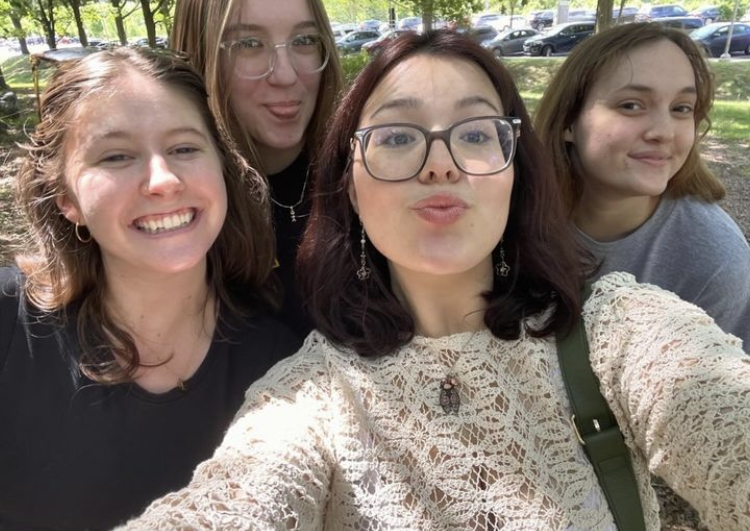 Glaser (left) with fellow UMBC classmates and friends in Summer 2024.
Q: What other activities did you participate in outside of your studies?
A: The Social Work Student Association (SWSA) has been such a big part of my time at UMBC. I was worried about being in a human services field at a more STEM-focused school, but I have found so much support, inspiring people, and encouragement through that group. Getting to be on the SWSA’s executive board and seeing this community develop has been so special. I’m also a part of UMBC’s Symphony Orchestra, which I’ve been involved in since my sophomore year. I play the upright bass. I started playing the bass in the fifth grade and continued through middle and high school. I love playing, growing my skills, and being able to connect with other people outside of my major. I love the end of the semester concerts that we do.
 Glaser (in gray, second to last on the right) with fellow members of the Social Work Student Association during a volunteering event with UMBC’s Retriever Essentials program in Spring 2025.
Q: What are some memorable highlights from your time at UMBC?
A: The people that I’ve met and the friends I’ve made have been highlights for me. Studying abroad in Cape Town, South Africa, in 2023 was also monumental. It was something I didn’t initially think I would have been able to do, but thanks to the Sondheim program, I got to experience community-engaged learning in South Africa as well as learning about the history of the country, the Apartheid movement, and a lot of the political movements that are happening now and how South Africa is dealing with that history. My college experience would have been so different had I not been at UMBC. I credit the university for a lot, and I’m glad that I went here.

 (left) Glaser in Cape Town, South Africa. (right) Glaser (left, second row) and fellow Sondheim Public Affairs scholars during the program’s study abroad trip to Cape Town in 2023.
Q: What are your aspirations for the future?
A: After graduation, my plan is to pursue a master’s degree in social work that focuses on working with children and families. I’m hoping to be placed in a Head Start program for my master’s because I learned during my internship that I love working with kids within the preschool age range. I also learned that I have a passion for working with kids with disabilities and I’m interested in exploring more of that.
Read more Commencement 2025 stories.
]]>
Ada Glaser ’25, social work and individualized study (INDS), is following in her mother’s footsteps with career pursuits in social work. Growing up, Glaser’s family supported children who were...
https://umbc.edu/stories/class-of-2025-ada-glaser/
https://dev.my.umbc.edu/api/v0/pixel/news/149588/guest@my.umbc.edu/1b0c4c5fba86e4f05896594d572f8caf/api/pixel
cahss
class-of-2025
inds
news
social-work
story
UMBC News & Magazine
https://dev.my.umbc.edu/groups/umbc-news-magazine
https://assets1-dev.my.umbc.edu/system/shared/avatars/groups/000/001/943/24435aa6207c452e7bc15cc74b42c7bb/xsmall.png?1748556657
https://assets1-dev.my.umbc.edu/system/shared/avatars/groups/000/001/943/24435aa6207c452e7bc15cc74b42c7bb/original.png?1748556657
https://assets2-dev.my.umbc.edu/system/shared/avatars/groups/000/001/943/24435aa6207c452e7bc15cc74b42c7bb/xxlarge.png?1748556657
https://assets2-dev.my.umbc.edu/system/shared/avatars/groups/000/001/943/24435aa6207c452e7bc15cc74b42c7bb/xlarge.png?1748556657
https://assets3-dev.my.umbc.edu/system/shared/avatars/groups/000/001/943/24435aa6207c452e7bc15cc74b42c7bb/large.png?1748556657
https://assets1-dev.my.umbc.edu/system/shared/avatars/groups/000/001/943/24435aa6207c452e7bc15cc74b42c7bb/medium.png?1748556657
https://assets2-dev.my.umbc.edu/system/shared/avatars/groups/000/001/943/24435aa6207c452e7bc15cc74b42c7bb/small.png?1748556657
https://assets1-dev.my.umbc.edu/system/shared/avatars/groups/000/001/943/24435aa6207c452e7bc15cc74b42c7bb/xsmall.png?1748556657
https://assets2-dev.my.umbc.edu/system/shared/avatars/groups/000/001/943/24435aa6207c452e7bc15cc74b42c7bb/xxsmall.png?1748556657
UMBC News & Magazine
27
0
false
Tue, 29 Apr 2025 11:40:00 -0400
Tue, 29 Apr 2025 11:40:00 -0400
Samuel Barnett ’25: Biochemistry researcher with a commitment to giving back
Samuel Barnett ’25, biochemistry, is on his way to the Ph.D. program in cellular and molecular biology at the University of Pennsylvania this fall, after seizing opportunities to conduct research at Howard Community College and then at UMBC. Always mindful of how others have supported him and wanting to pay it forward, Barnett has served in leadership roles in UMBC student organizations and created resources to help his classmates land their own opportunities.
Q: How did you choose your major?
A: My high school biology teacher was adamant about getting high school students involved in STEM. Even though the course was online because of the pandemic, she was still able to enrapture people in the wonders of biological sciences. I added the chemistry aspect because I wanted to dive a little bit deeper into how everything works from a basic science perspective. The interdisciplinary nature of biochemistry can sometimes make things a little more challenging, but also fun. Actually, if what I’m doing isn’t challenging, it’s not going to be as fun, I don’t think.
Q: How did you choose UMBC?
My research mentor at Howard Community College, Joseph Sparenberg, nominated me for the BUILD a BRIDGE to STEM (BBS) Internship at UMBC, part of the STEM BUILD program, after my sophomore year. I can confidently say that BBS was the most crucial turning point of my undergraduate career, making the shift from HCC to the “bigger pond” of UMBC much smoother. The mission of the BBS internship was to give transfer students a sense of belonging while immersing them in biological research. While I had research experience from Howard Community College, BBS made me feel like a researcher at UMBC.
The BBS mentors gave us a lot of autonomy and intellectual freedom to create our own projects, and I acquired experience that was relevant for my lab at UMBC and a later internship at the University of Pennsylvania. I also connected with a diverse network of mentors, familiarized myself with unique scholarship and scientific presentation opportunities, and met fellow community college transfers who helped inspire me to become the scientist I am today.
 Sam Barnett with the research poster he presented to conclude his internship at the University of Pennsylvania. (Courtesy of Barnett)
Q: How did you get connected with your research mentor at UMBC, Fernando Vonhoff, and what are you studying?
A: It’s a funny story, actually—Dr. Vonhoff grew up in Mexico and is fluent in Spanish, and one day he stepped in for my UMBC Spanish teacher. I talked to him after the Spanish class about his work and later visited him in his office to learn more. Even though his lab is mostly focused on behavioral neuroscience, I was up front about the fact that I’m interested in molecular biology. Dr. Vonhoff could have said I wasn’t a good fit, but he gave me a chance and connected me with one of his Ph.D. students, Zach Smith, who does a lot of the molecular work in the lab. Gaining those molecular skills has opened up doors for me when it comes to getting research experience.
I started in the lab in January 2024. Initially, I worked with Zach to master skills like qPCR and later Western blotting—foundational research techniques for identifying and quantifying genetic material and proteins in a sample. This semester I’ve been trusted to do Western blotting completely on my own.
Dr. Vonhoff’s lab works with fruit flies, a common model system for lots of kinds of studies. I’m trying to figure out a better way to identify the presence of a specific very tiny protein in the flies. Because it’s so small, it’s hard to visualize using traditional Western blotting. We tried a procedure that added a larger, fluorescent protein to the small protein to make it easier to see on the blots. It didn’t pan out, but that happens! So now we’re trying to go back to the basics and find new ways to observe the really small protein, but it’s really difficult.
That was definitely disappointing, but I think at the end of the day that’s just how the scientific process works. Progress ebbs and flows. We’re always asking, what can we do beyond this?
Samuel Barnett
That was definitely disappointing, but I think at the end of the day that’s just how the scientific process works. Progress ebbs and flows. We’re always asking, what can we do beyond this? Maybe another type of test or approach will work. I think the best way to approach those challenges is just optimism and to engage your curiosity and expose yourself to alternative solutions.
Q: Along with Vonhoff, who else has supported you along the way?
A: I first met Dr. Maria Cambraia, assistant director for research and international affairs in CNMS, through the BUILD a BRIDGE to STEM internship, and she has since been one of the most influential people on my undergraduate journey. She advised me on what pathways to take when I transferred to UMBC, gave me opportunities to present at national conferences, wrote letters of recommendation for anything and everything under the sun, and has been an overwhelming source of support throughout my undergraduate career. It is genuinely difficult to quantify the impact she has had on me and my fellow undergraduates.
Dr. April Householder, director of undergraduate research and prestigious scholarships, has also been essential in making sure that my place at UMBC was seen and heard. She helped me apply for the prestigious Goldwater and Knight-Hennessy Scholarships, and was always there to lend an ear. She worked overtime with the Goldwater representative at HCC, Cheryl Campo, to help me get my application submitted.
 Sam Barnett, right, with April Householder, director of undergraduate research and prestigious scholarships.
Q: What are you most proud of from your time at UMBC?
A: I am most proud of winning the Barry Goldwater Scholarship. According to the Barry Goldwater Scholarship website it is “the most prestigious undergraduate scholarship in the natural sciences, mathematics, and engineering in America.” An academic institution can select up to five students to apply for the scholarship, including one slot for transfer students. Originally, I competed for the transfer slot at UMBC, but wasn’t selected. However, at a national conference I attended, I met the president of the Goldwater foundation, who told me about a policy change that allowed transfer students to reapply at their previous institution. That led to Dr. Householder and Dr. Campo rushing to help me get my application submitted as a nominee from HCC. In April 2024, I got the email that I had won the scholarship. At the moment I won, I could hardly believe it; I was quite literally shaking and overjoyed.
Q: What else are you involved in at UMBC, and how have those activities benefited, challenged, or surprised you?
A: In addition to research, I’ve served in leadership roles as the vice president of the American Chemical Society’s (ACS) UMBC chapter and secretary of the UMBC chapter of the Tau Sigma National Honor Society, an honor society specifically for transfer students. I’ve also been a tutor for analytical chemistry on campus and volunteered regularly at Grassroots Crisis Intervention.
 Sam Barnett presents at a general body meeting of the UMBC chapter of the American Chemical Society in 2024. (Courtesy of Barnett)
The biggest surprise was my position within the ACS chapter here. It turned out to be a bigger job than I expected. I compiled a list of 200+ active internships to help out other students. Recently, I leveraged one of my connections at the Institute of Marine and Environmental Technology to invite a guest speaker to campus. A lot of my work for the ACS chapter was self-driven, but I’m grateful to the group’s advisor, Dr. Maria van Staveren, who really supported my ambitions to make the position into more than the minimum required.
Q: What’s next for you, and what are you looking forward to?
A: This fall, I’ll begin a Ph.D. in cellular and molecular biology with a concentration in cancer biology at the University of Pennsylvania. I was an intern at Penn’s Center for Cellular Immunotherapies in summer 2024, and I had a really good time there. The rigorous research environment was just enthralling to me. I was able to focus completely on being a researcher for the first time. I had my own independent project, under guidance from a postdoc. It was really intimidating at first. At Penn, you’re able to work through the entire research process and bring new things to the table.
 Sam Barnett, far right, with STEM BUILD Trainees at UMBC’s Summer Undergraduate Research Fest in 2023.
Q: What has been the best part of your UMBC experience?
A: The best part of my UMBC experience has been the opportunity to meet mentors that have defined my career. I’ve been given a lot of opportunities, and sure, I’ve taken initiative and put in effort, but at every step of my undergraduate journey, I’ve had a mentor in my corner who’s been willing to lend me a hand and give me a chance.
UMBC offers many opportunities for undergraduates to get connected to administrators and research faculty. In my experience, faculty have always been friendly and open to connecting with undergraduates. I am extremely grateful to both UMBC and my mentors for the continued support throughout my career, and all that support has inspired me to try to give back, through efforts like the ACS internship database.
Q: What advice do you have for transfer students and aspiring undergraduate researchers?
A: Don’t feel afraid to reach out to everyone—faculty members, classmates, staff. They can all help you. And if they don’t respond via email, you can go to their office to introduce yourself. Even in a period of uncertainty, move forward anyway—research is still necessary and important. Stay ambitious, and stay involved in science.
Read more Commencement 2025 stories.
]]>
Samuel Barnett ’25, biochemistry, is on his way to the Ph.D. program in cellular and molecular biology at the University of Pennsylvania this fall, after seizing opportunities to conduct research...
https://umbc.edu/stories/sam-barnett-biochemistry-researcher/
https://dev.my.umbc.edu/api/v0/pixel/news/149589/guest@my.umbc.edu/95fdbe9b44e03b6629bb1df443d39f4a/api/pixel
biochemistry
chembiochem
class-of-2025
cnms
news
science-and-tech
story
undergradresearch
UMBC News & Magazine
https://dev.my.umbc.edu/groups/umbc-news-magazine
https://assets1-dev.my.umbc.edu/system/shared/avatars/groups/000/001/943/24435aa6207c452e7bc15cc74b42c7bb/xsmall.png?1748556657
https://assets1-dev.my.umbc.edu/system/shared/avatars/groups/000/001/943/24435aa6207c452e7bc15cc74b42c7bb/original.png?1748556657
https://assets2-dev.my.umbc.edu/system/shared/avatars/groups/000/001/943/24435aa6207c452e7bc15cc74b42c7bb/xxlarge.png?1748556657
https://assets2-dev.my.umbc.edu/system/shared/avatars/groups/000/001/943/24435aa6207c452e7bc15cc74b42c7bb/xlarge.png?1748556657
https://assets3-dev.my.umbc.edu/system/shared/avatars/groups/000/001/943/24435aa6207c452e7bc15cc74b42c7bb/large.png?1748556657
https://assets1-dev.my.umbc.edu/system/shared/avatars/groups/000/001/943/24435aa6207c452e7bc15cc74b42c7bb/medium.png?1748556657
https://assets2-dev.my.umbc.edu/system/shared/avatars/groups/000/001/943/24435aa6207c452e7bc15cc74b42c7bb/small.png?1748556657
https://assets1-dev.my.umbc.edu/system/shared/avatars/groups/000/001/943/24435aa6207c452e7bc15cc74b42c7bb/xsmall.png?1748556657
https://assets2-dev.my.umbc.edu/system/shared/avatars/groups/000/001/943/24435aa6207c452e7bc15cc74b42c7bb/xxsmall.png?1748556657
UMBC News & Magazine
3
0
false
Tue, 29 Apr 2025 11:37:11 -0400
Tue, 29 Apr 2025 11:37:11 -0400
Julie Granruth ’25, financial economics—For the love of numbers
Math is Julie Granruth’s love language. It has bookmarked her life, starting as a student at Towson High School, where her master tutoring skills made what sometimes looked like a labyrinth of numbers accessible and fun for other students. This caught the attention of Donatella Spigarelli, a mom of one of the students—and a certified public accountant and an audit and accounting principal at Baltimore-based accounting firm Ellin & Tucker. Spigarelli was so impressed with Granruth that she encouraged her to apply to the firm’s college internship program. After three years and an accounting internship, Julie is graduating with a degree in financial economics, a 4.0 GPA, and a job as a tax and audit associate at Ellin & Tucker.
Q: What led you to study at UMBC?
A: My journey to UMBC, I would say, was a little bit different. When I was about 10 or 12, my middle brother was very interested in chess and played in many tournaments at UMBC. I came with him throughout middle school and high school, experiencing UMBC at a very young age. When I applied to colleges, I discovered that UMBC had a great financial economics program. Combined with my experience of UMBC’s community as a kid, it became one of my top picks.
Q: Is your love of math a family affair?
 Granruth with her brother. (Image courtesy of Granruth)
A: Growing up, our parents always taught us to save all of our money and only buy what we needed. I took that to heart and became interested in math, especially in the global impact of the actions of individuals on the economy. There was a direct application to the real world.
I chose financial economics because the passion with which my economics professors taught and how they applied it to their research made me passionate about it, too. I enjoyed watching them express their enjoyment of economics. It helped me better understand my enjoyment of it as well.
Q: What’s an unexpected thing you love about your major?
A: I’m a very technical and analytical person. I now love working in Excel, especially for my accounting classes. In my first accounting class, I was assigned a group project to create a company and work out its financial statements. That’s when I learned the most about how to work in Excel. I developed the skills and cool tricks that made spreadsheets work fast and efficiently. Last semester, in advanced accounting, I analyzed the financial ratios of different companies and used the Excel skills I learned to compare their performance.
I visualized everything and organized things in a way that made sense to me and then explained it to someone else in a way that they understood it. That’s why, after graduation, I want to continue my education and become a Certified Public Accountant. I’ve always been interested in it, but I wasn’t always 100 percent sure until last summer during my accounting internship. Helping people save money on their company taxes or their personal taxes is something I’m really interested in doing.
Q: What advice do you have for students interested in financial economics or becoming a CPA but aren’t sure it’s for them?
A: I have frequently heard students say that a lack of confidence in math is the main reason they don’t pursue either of these paths. My advice is to take advantage of all the opportunities you have. Never be afraid to ask for help. The professors are very welcoming and kind and will be able to help you in any way they can. A big part of economics is relating it to the real world. If you’re interested in talking about theories and policies, which is why I chose economics, math is just one piece of the equation. I don’t think there’s a ceiling, even if numbers aren’t your best friend!
Q: Where did you find the most sense of community while at UMBC?
A: I have had a passion for economics since high school and was eager to join a group of people with similar passions. The Economics Council of Majors was a community that welcomed me during my freshman year. I came to love this community, and as treasurer and then as president, I helped shape and lead the future of this group I loved.
I also enjoyed the Student Events Board (seb). I was grateful to have so many amazing friends who inspired me to put myself out there and join this community. I became the vice president of internal programming; I had never taken on such a large role in my community—I was intimidated. However, once I realized the impact I could have, I never felt more comfortable surrounded by peers who shared my interests.
 Granruth (second from right) with (seb) welcoming new students at the fall 2024 Retriever Fest. (Image courtesy of Granruth)
During events, when I spoke with attendees about our related hobbies, watched groups of strangers become friends over a shared interest, and collaborated with other campus organizations, I was inspired to pursue new passions. These experiences revealed something I hadn’t originally considered. While the events we created were intended to form the UMBC community that we wished to see, I have also felt the warmth of this community as those around me expressed their heartfelt enjoyment of my programs. I felt so welcomed by the leaders of seb in my freshman year, and I felt honored that I had a role in the way new and returning students experienced UMBC and its beautiful community.


 (l-r): Granruth with True Grit at the 2023 Homecoming puppy parade, serving pizza at the 2024 Pack the RAC event, and in Pittsburgh at the 2024 National Association for Campus Activities conference with UMBC (seb) members. (Images courtesy of Granruth)
Q: How have you dealt with challenging moments at UMBC?
A: Despite new classes that seemed impossibly difficult, changes in my social sphere and goals, and my peers seeming farther ahead than I was, one thing that has never changed is my persistence and passion.
When I first faced defeat, I felt not only the fear of that defeat but also the fear of future defeats. However, through my persistence, defeat became somewhat of a friend, someone I turned to as I reclaimed my footing and approached the problem time and time again, unafraid to ask for help to do my best. I take my defeats as starting points for future growth. I now hold onto them as fond memories and stories of strength.
This is why, since the spring of my freshman year, I worked hard every semester as a teaching assistant. I understood how easy it was to let academic troubles envelop me and how it seemed easier to seal this envelope than to change the script and deliver a new message. Having gone through this myself, I became passionate about helping students bring out the best in themselves. I showed them that one defeat was not just a defeat. It was an opportunity for greater future success.
Q: Carry over the one. What place have numbers had in your community service?
A: One of the students I tutored at Catonsville Elementary School was very numbers-oriented. The first question she asked me when I met her was, ‘What’s six times six?’ Talking about our love of numbers opened a way for me to communicate with her during the mentoring process.
Since my freshman year, I have volunteered as a Shriver Living Learning Community mentor at Catonsville Elementary School. I acted as someone between a friend and an adult they could look up to, yet also relate to. I encouraged my students to take pride in who they were and reminded them that they only had one chance in life to be who they are, so they might as well own it.
As the student leader for this site, I supervised the registration, onboarding, evaluation, and weekly attendance of 20 UMBC student volunteers throughout the year. This meant staying organized—it always came back to spreadsheets!
The best part of my UMBC experience was the privilege of engaging with so many communities and giving back to them with my time. I believe that service to those beyond ourselves is part of what makes our lives so fulfilling, and I can not imagine a life without it.
Read more Commencement 2025 stories.
]]>
Math is Julie Granruth’s love language. It has bookmarked her life, starting as a student at Towson High School, where her master tutoring skills made what sometimes looked like a labyrinth of...
https://umbc.edu/stories/julie-granruth-25-financial-economicsfor-loves-numbers/
https://dev.my.umbc.edu/api/v0/pixel/news/149590/guest@my.umbc.edu/f64ef71b6363f98747ca614a41a5351e/api/pixel
cahss
class-of-2025
economics
news
policy-and-society
shriver-living-learning-community
story
UMBC News & Magazine
https://dev.my.umbc.edu/groups/umbc-news-magazine
https://assets1-dev.my.umbc.edu/system/shared/avatars/groups/000/001/943/24435aa6207c452e7bc15cc74b42c7bb/xsmall.png?1748556657
https://assets1-dev.my.umbc.edu/system/shared/avatars/groups/000/001/943/24435aa6207c452e7bc15cc74b42c7bb/original.png?1748556657
https://assets2-dev.my.umbc.edu/system/shared/avatars/groups/000/001/943/24435aa6207c452e7bc15cc74b42c7bb/xxlarge.png?1748556657
https://assets2-dev.my.umbc.edu/system/shared/avatars/groups/000/001/943/24435aa6207c452e7bc15cc74b42c7bb/xlarge.png?1748556657
https://assets3-dev.my.umbc.edu/system/shared/avatars/groups/000/001/943/24435aa6207c452e7bc15cc74b42c7bb/large.png?1748556657
https://assets1-dev.my.umbc.edu/system/shared/avatars/groups/000/001/943/24435aa6207c452e7bc15cc74b42c7bb/medium.png?1748556657
https://assets2-dev.my.umbc.edu/system/shared/avatars/groups/000/001/943/24435aa6207c452e7bc15cc74b42c7bb/small.png?1748556657
https://assets1-dev.my.umbc.edu/system/shared/avatars/groups/000/001/943/24435aa6207c452e7bc15cc74b42c7bb/xsmall.png?1748556657
https://assets2-dev.my.umbc.edu/system/shared/avatars/groups/000/001/943/24435aa6207c452e7bc15cc74b42c7bb/xxsmall.png?1748556657
UMBC News & Magazine
3
0
false
Tue, 29 Apr 2025 11:35:35 -0400
Tue, 29 Apr 2025 11:35:35 -0400
John Stolle-McAllister Appointed CAHSS Interim Dean
The following message was shared with the UMBC community on April 28 to announce the naming of a new interim dean for the College of Arts, Humanities, and Social Sciences:
* * * * *
Dear UMBC Community,
As you probably are aware, the current dean of the College of Arts, Humanities, and Social Sciences (CAHSS), Kimberly Moffitt, will be leaving UMBC this summer to join Howard University. I am excited to announce that John Stolle-McAllister has been appointed interim dean of the College of Arts, Humanities, and Social Sciences effective July 1. John brings two-and-a-half decades of experience at UMBC to his new role. He is a professor of modern languages, linguistics, and intercultural communication and currently serves as chair.

John previously served as associate dean in CAHSS from 2014 to 2022, and in that role he focused on student success initiatives, including creating the CAHSS advising center, collaboratively designing classroom renovations, leading the college’s response to COVID, and organizing faculty participation in the Planning Instructional Variety for Online Teaching (PIVOT) program.
John earned his bachelor’s from Bates College, and he received his master’s in Hispanic literatures and Ph.D. in comparative studies of discourse and society from the University of Minnesota. His research and teaching interests include multilingualism, cultural change, environmental issues, and social movements in Latin America.
A national search for a permanent dean will be conducted over the next year. I have asked Ana Oskoz, vice provost for faculty affairs, to chair the search committee. Isaacson Miller will support UMBC in this search for the next dean for CAHSS.
Please join me in welcoming John to his new role as interim dean of the College of Arts, Humanities, and Social Sciences.
Sincerely,
Manfred H.M. van Dulmen
Provost and Senior Vice President for Academic Affairs
]]>
The following message was shared with the UMBC community on April 28 to announce the naming of a new interim dean for the College of Arts, Humanities, and Social Sciences: * * * * * Dear...
https://umbc.edu/stories/stolle-mcallister-interim-dean-of-cahss-at-umbc/
https://dev.my.umbc.edu/api/v0/pixel/news/149563/guest@my.umbc.edu/75f68716b9667e21443badd36fb28946/api/pixel
story
uncategorized
UMBC News & Magazine
https://dev.my.umbc.edu/groups/umbc-news-magazine
https://assets1-dev.my.umbc.edu/system/shared/avatars/groups/000/001/943/24435aa6207c452e7bc15cc74b42c7bb/xsmall.png?1748556657
https://assets1-dev.my.umbc.edu/system/shared/avatars/groups/000/001/943/24435aa6207c452e7bc15cc74b42c7bb/original.png?1748556657
https://assets2-dev.my.umbc.edu/system/shared/avatars/groups/000/001/943/24435aa6207c452e7bc15cc74b42c7bb/xxlarge.png?1748556657
https://assets2-dev.my.umbc.edu/system/shared/avatars/groups/000/001/943/24435aa6207c452e7bc15cc74b42c7bb/xlarge.png?1748556657
https://assets3-dev.my.umbc.edu/system/shared/avatars/groups/000/001/943/24435aa6207c452e7bc15cc74b42c7bb/large.png?1748556657
https://assets1-dev.my.umbc.edu/system/shared/avatars/groups/000/001/943/24435aa6207c452e7bc15cc74b42c7bb/medium.png?1748556657
https://assets2-dev.my.umbc.edu/system/shared/avatars/groups/000/001/943/24435aa6207c452e7bc15cc74b42c7bb/small.png?1748556657
https://assets1-dev.my.umbc.edu/system/shared/avatars/groups/000/001/943/24435aa6207c452e7bc15cc74b42c7bb/xsmall.png?1748556657
https://assets2-dev.my.umbc.edu/system/shared/avatars/groups/000/001/943/24435aa6207c452e7bc15cc74b42c7bb/xxsmall.png?1748556657
UMBC News & Magazine
0
0
false
Mon, 28 Apr 2025 15:45:34 -0400
Mon, 28 Apr 2025 15:45:34 -0400
CAHSS Interim Dean Announcement
Dear UMBC Community,
As you probably are aware, the current dean of the College of Arts, Humanities, and Social Sciences (CAHSS), Kimberly Moffitt, will be leaving UMBC this summer to join Howard University. I am excited to announce that John Stolle-McAllister has been appointed interim dean of the College of Arts, Humanities, and Social Sciences effective July 1. John brings two-and-a-half decades of experience at UMBC to his new role. He is a professor of modern languages, linguistics, and intercultural communication and currently serves as chair.

John previously served as associate dean in CAHSS from 2014 to 2022, and in that role he focused on student success initiatives, including creating the CAHSS advising center, collaboratively designing classroom renovations, leading the college’s response to COVID, and organizing faculty participation in the Planning Instructional Variety for Online Teaching (PIVOT) program.
John earned his bachelor’s from Bates College, and he received his master’s in Hispanic literatures and Ph.D. in comparative studies of discourse and society from the University of Minnesota. His research and teaching interests include multilingualism, cultural change, environmental issues, and social movements in Latin America.
A national search for a permanent dean will be conducted over the next year. I have asked Ana Oskoz, vice provost for faculty affairs, to chair the search committee. Isaacson Miller will support UMBC in this search for the next dean for CAHSS.
Please join me in welcoming John to his new role as interim dean of the College of Arts, Humanities, and Social Sciences.
Sincerely,
Manfred H.M. van Dulmen
Provost and Senior Vice President for Academic Affairs
]]>
Dear UMBC Community, As you probably are aware, the current dean of the College of Arts, Humanities, and Social Sciences (CAHSS), Kimberly Moffitt, will be leaving UMBC this summer to join...
https://my3.my.umbc.edu/groups/announcements/posts/149526
https://dev.my.umbc.edu/api/v0/pixel/news/149543/guest@my.umbc.edu/b145b6cd460bde6b7251c6ecec642503/api/pixel
president
president-valerie-sheares-ashby
rss
story
UMBC News & Magazine
https://dev.my.umbc.edu/groups/umbc-news-magazine
https://assets1-dev.my.umbc.edu/system/shared/avatars/groups/000/001/943/24435aa6207c452e7bc15cc74b42c7bb/xsmall.png?1748556657
https://assets1-dev.my.umbc.edu/system/shared/avatars/groups/000/001/943/24435aa6207c452e7bc15cc74b42c7bb/original.png?1748556657
https://assets2-dev.my.umbc.edu/system/shared/avatars/groups/000/001/943/24435aa6207c452e7bc15cc74b42c7bb/xxlarge.png?1748556657
https://assets2-dev.my.umbc.edu/system/shared/avatars/groups/000/001/943/24435aa6207c452e7bc15cc74b42c7bb/xlarge.png?1748556657
https://assets3-dev.my.umbc.edu/system/shared/avatars/groups/000/001/943/24435aa6207c452e7bc15cc74b42c7bb/large.png?1748556657
https://assets1-dev.my.umbc.edu/system/shared/avatars/groups/000/001/943/24435aa6207c452e7bc15cc74b42c7bb/medium.png?1748556657
https://assets2-dev.my.umbc.edu/system/shared/avatars/groups/000/001/943/24435aa6207c452e7bc15cc74b42c7bb/small.png?1748556657
https://assets1-dev.my.umbc.edu/system/shared/avatars/groups/000/001/943/24435aa6207c452e7bc15cc74b42c7bb/xsmall.png?1748556657
https://assets2-dev.my.umbc.edu/system/shared/avatars/groups/000/001/943/24435aa6207c452e7bc15cc74b42c7bb/xxsmall.png?1748556657
UMBC News & Magazine
0
0
false
Mon, 28 Apr 2025 10:41:47 -0400
Mon, 28 Apr 2025 10:41:47 -0400
Maryland Energy Administration awards UMBC $1.2 million for solar panels and more
UMBC has received a $1.2 million solar energy grant from the Maryland Energy Administration (MEA) to support solar power installations on campus and other sustainability initiatives.
The funding will enable construction of solar canopies over the north portion of the Stadium Lot. Rooftop solar arrays will be mounted on UMBC’s central receiving warehouse, located adjacent to the lot. The installations will be highly visible to the UMBC community and members of the public attending events at the Chesapeake Employers Insurance Arena.
Together, these solar installations will generate 1,000 kWAC of clean, carbon-free energy, or about 2.5 percent of UMBC’s current annual electricity. The solar panels’ output will reduce UMBC’s carbon footprint by roughly 500 tons per year and earn Solar Renewable Energy Credits from the state of Maryland, which can be sold to power companies. The combined savings from the electricity generation and accompanying SRECs may save UMBC $200,000 to $300,000 annually.
“This solar energy project is a significant step forward for UMBC to reach its sustainability goals, and will benefit our campus and local communities,” Taylor Smith, assistant director in the Office of Sustainability, says. “For the first time, the university will generate a significant amount of clean, renewable electricity right here on campus. We are lucky to have a community of partners that made this happen.”
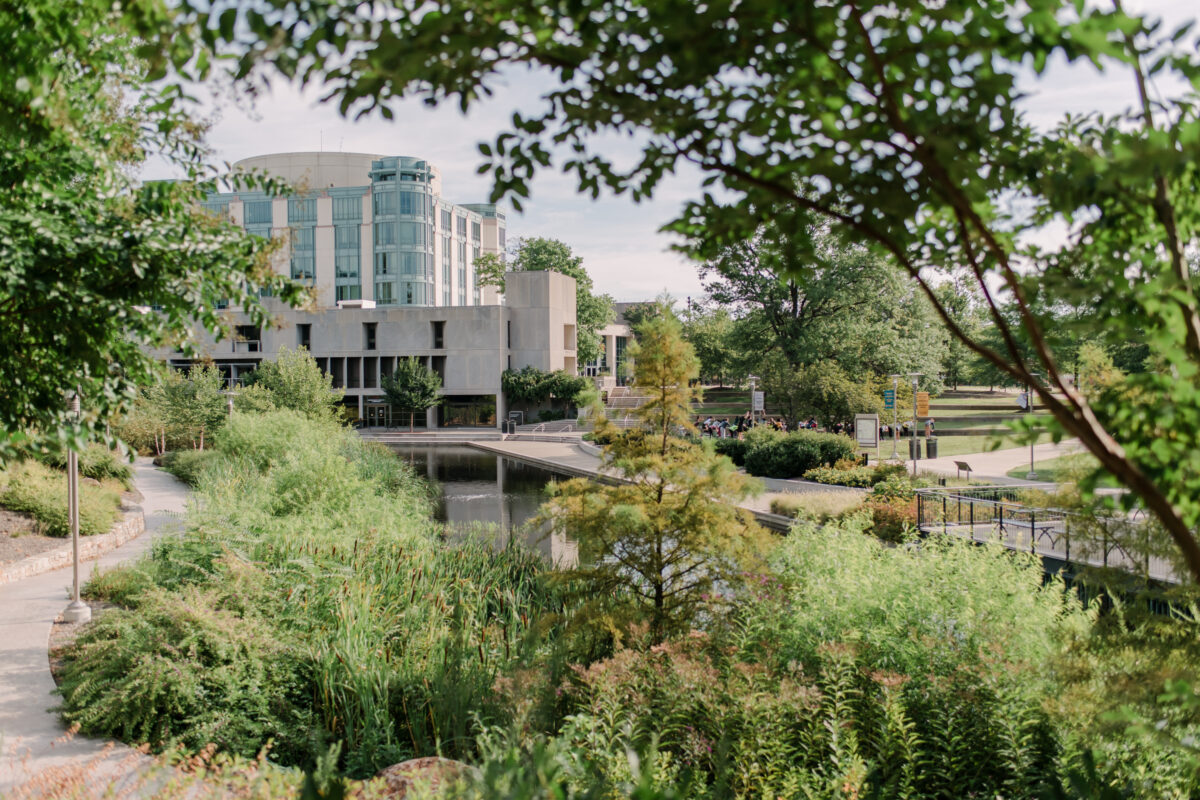 The UMBC Library Pond and surrounding vegetation are home to numerous wildlife species, such as yellow-crowned night herons and red-winged blackbirds. The pond also serves as an important stormwater management feature on campus. (Marlayna Demond ’11/UMBC)
Beyond solar
The grant will also support the development of UMBC’s Campus Clean Energy Master Plan (CCEMP). The CCEMP will rely on past studies and a forthcoming decarbonization engineering study to identify opportunities to save energy and decarbonize campus energy systems, including the central and satellite utility plants.
UMBC’s geography and environmental systems department and engineering faculty affiliated with the Grand Challenges Scholars Program are designing new learning opportunities that will use the solar project as an educational tool. Grant funds will partially fund academic experiences that provide students with hands-on learning opportunities in solar energy technology, renewable energy systems, and sustainability management, integrating real-world problem-solving into the academic curriculum. Five interns will also gain critical experience through supporting these projects, under the supervision of the Office of Sustainability and departmental faculty.
“The campus community can be proud of this commitment to bring solar energy to campus,” Smith says. “This project will not only accelerate UMBC’s shift to clean energy but will also create a visible, tangible symbol of the progress that’s been made. Plus, the new solar arrays will create learning opportunities for students to build the skills they need to thrive in the green economy.”
]]>
UMBC has received a $1.2 million solar energy grant from the Maryland Energy Administration (MEA) to support solar power installations on campus and other sustainability initiatives. The...
https://umbc.edu/stories/mea-funds-solar-panels-and-more/
https://dev.my.umbc.edu/api/v0/pixel/news/149491/guest@my.umbc.edu/7b6a267f5bb303b383508c83b3fe0688/api/pixel
cahss
coeit
community
engineering
gcsp
ges
news
science-and-tech
story
sustainability
UMBC News & Magazine
https://dev.my.umbc.edu/groups/umbc-news-magazine
https://assets1-dev.my.umbc.edu/system/shared/avatars/groups/000/001/943/24435aa6207c452e7bc15cc74b42c7bb/xsmall.png?1748556657
https://assets1-dev.my.umbc.edu/system/shared/avatars/groups/000/001/943/24435aa6207c452e7bc15cc74b42c7bb/original.png?1748556657
https://assets2-dev.my.umbc.edu/system/shared/avatars/groups/000/001/943/24435aa6207c452e7bc15cc74b42c7bb/xxlarge.png?1748556657
https://assets2-dev.my.umbc.edu/system/shared/avatars/groups/000/001/943/24435aa6207c452e7bc15cc74b42c7bb/xlarge.png?1748556657
https://assets3-dev.my.umbc.edu/system/shared/avatars/groups/000/001/943/24435aa6207c452e7bc15cc74b42c7bb/large.png?1748556657
https://assets1-dev.my.umbc.edu/system/shared/avatars/groups/000/001/943/24435aa6207c452e7bc15cc74b42c7bb/medium.png?1748556657
https://assets2-dev.my.umbc.edu/system/shared/avatars/groups/000/001/943/24435aa6207c452e7bc15cc74b42c7bb/small.png?1748556657
https://assets1-dev.my.umbc.edu/system/shared/avatars/groups/000/001/943/24435aa6207c452e7bc15cc74b42c7bb/xsmall.png?1748556657
https://assets2-dev.my.umbc.edu/system/shared/avatars/groups/000/001/943/24435aa6207c452e7bc15cc74b42c7bb/xxsmall.png?1748556657
UMBC News & Magazine
13
0
false
Fri, 25 Apr 2025 16:33:40 -0400
Fri, 25 Apr 2025 16:33:40 -0400
Popular AIs head-to-head: OpenAI beats DeepSeek on sentence-level reasoning
Written by Manas Gaur, assistant professor in computer science and electrical engineering, UMBC
ChatGPT and other AI chatbots based on large language models are known to occasionally make things up, including scientific and legal citations. It turns out that measuring how accurate an AI model’s citations are is a good way of assessing the model’s reasoning abilities.
An AI model “reasons” by breaking down a query into steps and working through them in order. Think of how you learned to solve math word problems in school.
Ideally, to generate citations an AI model would understand the key concepts in a document, generate a ranked list of relevant papers to cite, and provide convincing reasoning for how each suggested paper supports the corresponding text. It would highlight specific connections between the text and the cited research, clarifying why each source matters.
The question is, can today’s models be trusted to make these connections and provide clear reasoning that justifies their source choices? The answer goes beyond citation accuracy to address how useful and accurate large language models are for any information retrieval purpose.
I’m a computer scientist. My colleagues − researchers from the AI Institute at the University of South Carolina, Ohio State University and University of Maryland Baltimore County − and I have developed the Reasons benchmark to test how well large language models can automatically generate research citations and provide understandable reasoning.
We used the benchmark to compare the performance of two popular AI reasoning models, DeepSeek’s R1 and OpenAI’s o1. Though DeepSeek made headlines with its stunning efficiency and cost-effectiveness, the Chinese upstart has a way to go to match OpenAI’s reasoning performance.
Sentence specific
The accuracy of citations has a lot to do with whether the AI model is reasoning about information at the sentence level rather than paragraph or document level. Paragraph-level and document-level citations can be thought of as throwing a large chunk of information into a large language model and asking it to provide many citations.
In this process, the large language model overgeneralizes and misinterprets individual sentences. The user ends up with citations that explain the whole paragraph or document, not the relatively fine-grained information in the sentence.
Further, reasoning suffers when you ask the large language model to read through an entire document. These models mostly rely on memorizing patterns that they typically are better at finding at the beginning and end of longer texts than in the middle. This makes it difficult for them to fully understand all the important information throughout a long document.
Large language models get confused because paragraphs and documents hold a lot of information, which affects citation generation and the reasoning process. Consequently, reasoning from large language models over paragraphs and documents becomes more like summarizing or paraphrasing.
The Reasons benchmark addresses this weakness by examining large language models’ citation generation and reasoning.
How DeepSeek R1 and OpenAI o1 compare generally on logic problems.
Testing citations and reasoning
Following the release of DeepSeek R1 in January 2025, we wanted to examine its accuracy in generating citations and its quality of reasoning and compare it with OpenAI’s o1 model. We created a paragraph that had sentences from different sources, gave the models individual sentences from this paragraph, and asked for citations and reasoning.
To start our test, we developed a small test bed of about 4,100 research articles around four key topics that are related to human brains and computer science: neurons and cognition, human-computer interaction, databases and artificial intelligence. We evaluated the models using two measures: F-1 score, which measures how accurate the provided citation is, and hallucination rate, which measures how sound the model’s reasoning is − that is, how often it produces an inaccurate or misleading response.
Our testing revealed significant performance differences between OpenAI o1 and DeepSeek R1 across different scientific domains. OpenAI’s o1 did well connecting information between different subjects, such as understanding how research on neurons and cognition connects to human-computer interaction and then to concepts in artificial intelligence, while remaining accurate. Its performance metrics consistently outpaced DeepSeek R1’s across all evaluation categories, especially in reducing hallucinations and successfully completing assigned tasks.
OpenAI o1 was better at combining ideas semantically, whereas R1 focused on making sure it generated a response for every attribution task, which in turn increased hallucination during reasoning. OpenAI o1 had a hallucination rate of approximately 35% compared with DeepSeek R1’s rate of nearly 85% in the attribution-based reasoning task.
In terms of accuracy and linguistic competence, OpenAI o1 scored about 0.65 on the F-1 test, which means it was right about 65% of the time when answering questions. It also scored about 0.70 on the BLEU test, which measures how well a language model writes in natural language. These are pretty good scores.
DeepSeek R1 scored lower, with about 0.35 on the F-1 test, meaning it was right about 35% of the time. However, its BLEU score was only about 0.2, which means its writing wasn’t as natural-sounding as OpenAI’s o1. This shows that o1 was better at presenting that information in clear, natural language.
OpenAI holds the advantage
On other benchmarks, DeepSeek R1 performs on par with OpenAI o1 on math, coding and scientific reasoning tasks. But the substantial difference on our benchmark suggests that o1 provides more reliable information, while R1 struggles with factual consistency.
Though we included other models in our comprehensive testing, the performance gap between o1 and R1 specifically highlights the current competitive landscape in AI development, with OpenAI’s offering maintaining a significant advantage in reasoning and knowledge integration capabilities.
These results suggest that OpenAI still has a leg up when it comes to source attribution and reasoning, possibly due to the nature and volume of the data it was trained on. The company recently announced its deep research tool, which can create reports with citations, ask follow-up questions and provide reasoning for the generated response.
The jury is still out on the tool’s value for researchers, but the caveat remains for everyone: Double-check all citations an AI gives you.
This article is republished from The Conversation under a Creative Commons license. Read the original article and see more than 250 UMBC articles available in The Conversation.
]]>
Written by Manas Gaur, assistant professor in computer science and electrical engineering, UMBC ChatGPT and other AI chatbots based on large language models are known to occasionally make...
https://umbc.edu/stories/openai-beats-deepseek-on-sentence-level-reasoning/
https://dev.my.umbc.edu/api/v0/pixel/news/149488/guest@my.umbc.edu/69dcefe3fe9f16a5fbdeffeebfd38916/api/pixel
coeit
discovery
magazine
research
story
the-conversation
UMBC News & Magazine
https://dev.my.umbc.edu/groups/umbc-news-magazine
https://assets1-dev.my.umbc.edu/system/shared/avatars/groups/000/001/943/24435aa6207c452e7bc15cc74b42c7bb/xsmall.png?1748556657
https://assets1-dev.my.umbc.edu/system/shared/avatars/groups/000/001/943/24435aa6207c452e7bc15cc74b42c7bb/original.png?1748556657
https://assets2-dev.my.umbc.edu/system/shared/avatars/groups/000/001/943/24435aa6207c452e7bc15cc74b42c7bb/xxlarge.png?1748556657
https://assets2-dev.my.umbc.edu/system/shared/avatars/groups/000/001/943/24435aa6207c452e7bc15cc74b42c7bb/xlarge.png?1748556657
https://assets3-dev.my.umbc.edu/system/shared/avatars/groups/000/001/943/24435aa6207c452e7bc15cc74b42c7bb/large.png?1748556657
https://assets1-dev.my.umbc.edu/system/shared/avatars/groups/000/001/943/24435aa6207c452e7bc15cc74b42c7bb/medium.png?1748556657
https://assets2-dev.my.umbc.edu/system/shared/avatars/groups/000/001/943/24435aa6207c452e7bc15cc74b42c7bb/small.png?1748556657
https://assets1-dev.my.umbc.edu/system/shared/avatars/groups/000/001/943/24435aa6207c452e7bc15cc74b42c7bb/xsmall.png?1748556657
https://assets2-dev.my.umbc.edu/system/shared/avatars/groups/000/001/943/24435aa6207c452e7bc15cc74b42c7bb/xxsmall.png?1748556657
UMBC News & Magazine
0
0
false
Fri, 25 Apr 2025 14:56:38 -0400
Fri, 25 Apr 2025 14:56:38 -0400
Kelley Bell, M.F.A ’06, brings a sense of play to the BMA with “Fantastic Village”
When associate professor of visual arts Kelley Bell thinks back to her childhood growing up in the Capitol Hill area of Washington, D.C., she recalls fond memories of playing in her neighborhood playground, locally dubbed as “Turtle Park.”
“I remembered the concrete structures behind the turtle in the playground and it really inspired me to want to figure out how they came to be,” Bell says.
The public park, officially named Marion Park, was given the “Turtle Park” moniker because of the large concrete turtle structure that lived in the center of its playground, designed by Virginia Dortch Dorazio in 1953. Bell, M.F.A. ’06, imaging and digital arts, remembers Turtle Park as a prominent staple of her adolescence and decades later, the park also acts as the inspiration behind her latest project “Fantastic Village,” which will be on display at the Baltimore Museum of Art (BMA) from April 27 through July 27 as part of the museum’s Baker Artist Awards exhibition.
Maryland Public Television’s 2024 Baker Artist Awards Special featuring Kelley Bell.
The power of design
Bell was a 2024 recipient of the Greater Baltimore Cultural Alliance’s Baker Artist Award. The BMA exhibit will feature 20 works from five recent Baker Artist Award recipients, including Bell’s “Fantastic Village.” The colorful geometries of Bell’s installation draw on memories of now-demolished playgrounds of her youth in Washington, D.C., and Baltimore’s iconic rowhomes, bridging together the two places she calls home.
Bell creates vibrant projection-mapping works on a grand scale and gallery installations that emphasize joy, playfulness, community, and human connection. Before pursuing her current career as a visual artist, designer, and educator, Bell initially thought she’d be a lawyer. She believed that since her father was a speechwriter for President Gerald Ford and her mother was a teacher, she’d continue the family’s lineage of public service work.
However, “drawing in class was always a problem with me to the degree that it’s written on a lot of my report cards, saying, ‘Kelley has a lot of attention issues.’ I never thought of art as a career,” says Bell.
 Kelley Bell. (Photo courtesy of Bell)
Growing up in the nation’s capital, Bell was heavily influenced by the city’s independent music scene. During her wanderings through downtown Washington as a teenager, a chance encounter with a repurposed “five and dime” store (then home to the Washington Project for the Arts) changed everything.
“When I walked in that store, I never saw anything like it,” Bell recalls, “There were zines, posters, paintings, and tapes for bands all around. It was a window into this idea that art doesn’t have to be this picture on the wall and that was an amazing idea to me even at a young age.”
 The poster for Fluid Movement’s 2007 “War and Fleas” water ballet, designed by Kelley Bell. (Photo courtesy of Bell’s website)
After graduating from Pratt, Bell landed a designer role for a record pressing plant that worked with dance music labels. Continuing her work in the entertainment industry, she freelanced for MTV Networks for several years before she was encouraged to explore Baltimore after a recommendation from a fellow designer who boasted about the city’s arts scene. A one-day exploration of the city convinced Bell that Baltimore was the place for her.
Bell was accepted into the Pratt Institute in Brooklyn, New York where she initially majored in illustration. But once there, she was introduced to the concept and the power of design. “A friend explained that designers construct the existing world, and I believe that’s an amazing power to have. I quickly switched my major after that,” says Bell.
In 1997, Bell moved into Baltimore’s now-defunct H&H Arts Building, a five-story warehouse where local artists lived and worked for more than two decades. It was at H&H where Bell was initially connected toperformer and fellow UMBC alum Beatrix “Trixie Little” Burneston ’99, visual and performing arts, a founding member of Fluid Movement, a Baltimore-based organization that utilizes public spaces to create joy and community through performance art that most notably includes quirky water ballet performances in Baltimore City public pools.
“Fluid Movement did a rendition of the opera ‘Carmen’ with hotdogs on sticks. They designed a stage and costumes for hotdogs and had a composer to do the score,” shares Bell. “To see people pour that much love and effort into something that ultimately is incredibly silly and unusual is, to me, a heroic act.”
Bell worked with Fluid Movement as a designer and the group then became a long-time client that she worked with throughout the years. Bell has also collaborated with a number of organizations and art collectives across Baltimore, including working with the Enoch Pratt Library and the community art space Creative Alliance. Bell’s project “The Clock Strikes 100,” a series of short animations designed for and projected within the Baltimore’s historic Bromo Seltzer Art Tower, was designated “Best Public Artwork” in Baltimore Magazine’s “Best of Baltimore 2011” issue.
“Projections, Inflatables, and Artistic Spectacles”
Bell’s first introduction to UMBC was on a snowy day in 2001. Her friends recommended UMBC’s campus as a great place for sledding due to the campus’ hilly landscape. Soon after, Bell decided to expand her skillset and enrolled in UMBC’s M.F.A program.
“I was like a kid in a candy store with all of the stuff that I could do. It was a new world being opened up to me,” says Bell.
After experiencing difficulties in executing her thesis project to her satisfaction, Bell was advised by her then-thesis chair Preminda Jacob to consider extending her time in the program for an additional year.
“That extra year was the year that I figured out projection mapping. Doing guerilla projection projects changed the way that I thought about making art. That has been a form of art that’s served me since I’ve graduated from UMBC and it was all because of that fourth year,” says Bell. Guerilla projection mapping—the use of projectors to display images, animations, or videos onto various surfaces in public spaces without formal authorization or permits—helped to inform the foundation of Bell’s artistic pursuits.
Bell’s large-scale projection-mapping works and public installations have been featured in national and international festivals for almost two decades. Among her notable works include “The Herd,” a 2018 installation that was part of Light City Festival in Baltimore City. The project featured more than 300 solar powered inflatables that were placed into Baltimore’s Inner Harbor as a call to action for healthy waterways in the harbor.
 Bell’s “The Herd” installation in Baltimore City’s Inner Harbor in 2018. (Marlayna Demond ’11 for UMBC)
In addition to her artistic practice, Bell has been an educator at UMBC since 2008. Earlier this year, Bell presented a retrospective of her work and her research practice with the presentation “Projections, Inflatables, and Artistic Spectacles,” organized by the UMBC’s Center for Innovation, Research, and Creativity in the Arts (CIRCA).
“The CIRCA talk was a breakthrough. It was the first time that I took in the full scope of starting with an M.F.A. and how that work led up to the BMA exhibit,” she says.
The motivation behind Bell’s BMA exhibit “Fantastic Village” largely stemmed from her collaboration with UMBC theater professor Collete Searls on the “Enchanted Jangle” installation that was part of the 2024 Sweaty Eyeballs: Animation Adjacent gallery exhibition, curated by Corrie Parks, associate professor of visual arts. The installation is described as an “epic cardboard fort your five-year-old self dreamed of.”

 (left) Installation view ofBell’s “Enchanted Jangle” at UMBC’s Performing Arts and Humanities Building. (right) Performance of “Enchanted Jangle” at Area 405 Gallery featuring UMBC theatre student Jazmine McDonald. (Photos courtesy of Bell)
“There’s a playfulness about it but also a deeply-weird and creepy aspect to it. This is the place I like to dwell—giving people something new and something that they can’t figure out is something that is very important to me in my work.”
]]>
When associate professor of visual arts Kelley Bell thinks back to her childhood growing up in the Capitol Hill area of Washington, D.C., she recalls fond memories of playing in her neighborhood...
https://umbc.edu/stories/kelley-bell-bma-fantastic-village/
https://dev.my.umbc.edu/api/v0/pixel/news/149486/guest@my.umbc.edu/e09eef2fe04214a6d9d5dcec5a868f8e/api/pixel
alumni
arts-and-culture
cahss
community
mfa
news
research
story
visualarts
UMBC News & Magazine
https://dev.my.umbc.edu/groups/umbc-news-magazine
https://assets1-dev.my.umbc.edu/system/shared/avatars/groups/000/001/943/24435aa6207c452e7bc15cc74b42c7bb/xsmall.png?1748556657
https://assets1-dev.my.umbc.edu/system/shared/avatars/groups/000/001/943/24435aa6207c452e7bc15cc74b42c7bb/original.png?1748556657
https://assets2-dev.my.umbc.edu/system/shared/avatars/groups/000/001/943/24435aa6207c452e7bc15cc74b42c7bb/xxlarge.png?1748556657
https://assets2-dev.my.umbc.edu/system/shared/avatars/groups/000/001/943/24435aa6207c452e7bc15cc74b42c7bb/xlarge.png?1748556657
https://assets3-dev.my.umbc.edu/system/shared/avatars/groups/000/001/943/24435aa6207c452e7bc15cc74b42c7bb/large.png?1748556657
https://assets1-dev.my.umbc.edu/system/shared/avatars/groups/000/001/943/24435aa6207c452e7bc15cc74b42c7bb/medium.png?1748556657
https://assets2-dev.my.umbc.edu/system/shared/avatars/groups/000/001/943/24435aa6207c452e7bc15cc74b42c7bb/small.png?1748556657
https://assets1-dev.my.umbc.edu/system/shared/avatars/groups/000/001/943/24435aa6207c452e7bc15cc74b42c7bb/xsmall.png?1748556657
https://assets2-dev.my.umbc.edu/system/shared/avatars/groups/000/001/943/24435aa6207c452e7bc15cc74b42c7bb/xxsmall.png?1748556657
UMBC News & Magazine
2
0
false
Fri, 25 Apr 2025 14:21:50 -0400
Fri, 25 Apr 2025 14:21:50 -0400