<?xml version="1.0"?>
<News hasArchived="false" page="1" pageCount="1" pageSize="10" timestamp="Sun, 26 Apr 2026 20:59:55 -0400" url="https://dev.my.umbc.edu/groups/umbc-ai/posts.xml?tag=funding">
  <NewsItem contentIssues="false" id="146738" important="false" status="posted" url="https://dev.my.umbc.edu/groups/umbc-ai/posts/146738">
    <Title>Naghmeh Karimi funded to study computing-in-memory AI accelerators</Title>
    <Body>
      <![CDATA[
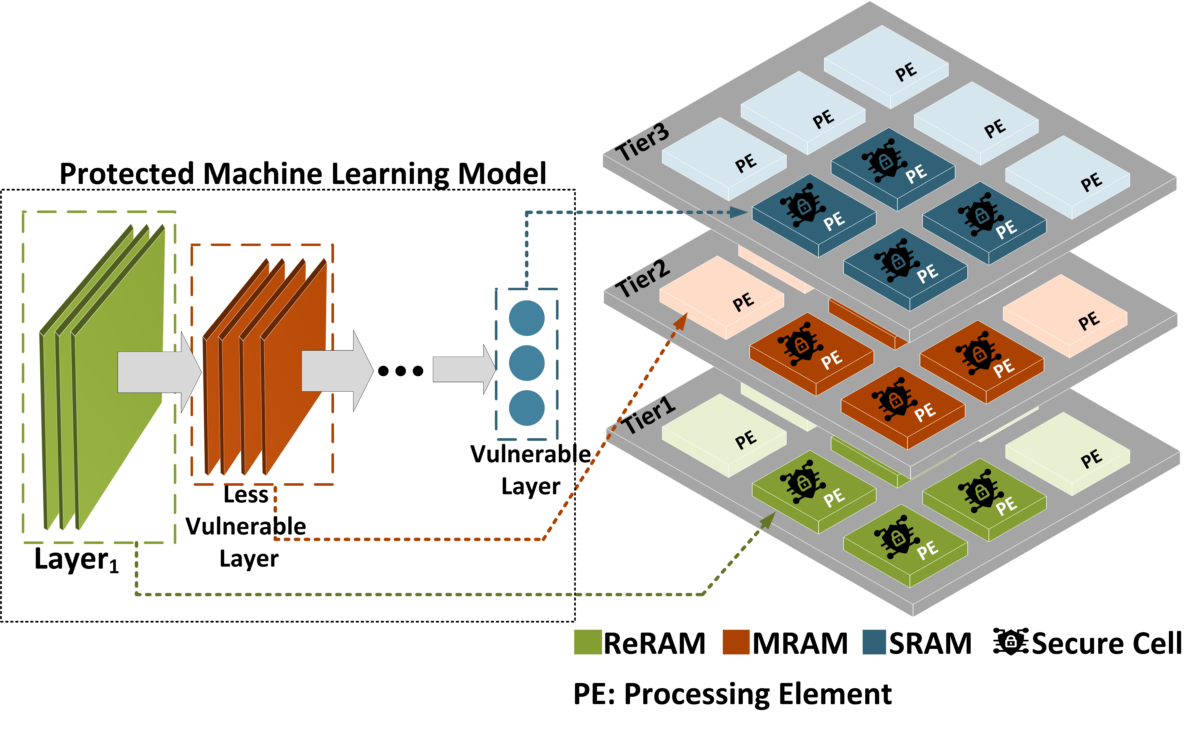
          <div class="html-content"><p><a href="https://userpages.cs.umbc.edu/nkarimi/" rel="nofollow external" class="bo"><strong><span>Naghmeh Karimi</span>,</strong></a> an associate professor in the Department of Computer Science and Electrical Engineering, was recently granted more than $300,000 in funding from the <a href="https://www.src.org/" rel="nofollow external" class="bo"><strong>Semiconductor Research Corporation</strong></a> (SRC) to study the security of promising hardware components that speed up the computing process. </p><p>SRC brings together technology companies, academics, and government agencies to tackle large scientific and technical challenges, and Karimi’s research will be funded by three leading technology companies: IBM-Research, AMD, and Siemens. </p><p>Karimi and her team, including graduate students and a collaborator from Arizona State University, will study computer chips whose design and structure allows <strong>computing-in-memory (CiM)</strong>, where data processing happens directly within the computer’s memory. CiM architectures are promising for speeding up the use of machine learning algorithms because they consume less energy.</p><p>Different types of CiM devices (such as RRAM, MRAM, and SRAM) each have their own strengths and weaknesses in terms of performance, power use, and size, and to get the best results, engineers need to combine different CiM devices into one system. Building these systems in 3D layers can further improve their efficiency and performance. However, the security of these 3D architectures has received little attention to date. </p><img width="1200" height="730" src="https://umbc.edu/wp-content/uploads/2025/01/Karimi-figure-1200x730.png" alt="Schematic shows layers of computing elements." style="max-width: 100%; height: auto;">Karimi and her team will study the security of computing-in-memory architectures, as shown in this project overview. (Image courtesy of Karimi)<p><br></p><p>Karimi’s team will study the security of 3D CiM technologies used in AI applications. In particular, the research will focus on evaluating the security vulnerabilities of the technologies and developing mitigation strategies. </p><p>“I’m excited about this project because the topic is very timely,” says Karimi. “The support from three leading companies in the AI field shows the importance of the problem and the promise of the solutions we are working on.”</p><p>The team aims to enhance the security of CiM-based AI accelerators against physical attacks that adversaries might launch to leak sensitive data or induce malfunctions. The researchers will work closely with the funding companies over the next three years in this area.</p><p>This post was written by <a href="https://umbc.edu/author/cmeyers2/" rel="nofollow external" class="bo">Catherine Meyers</a> and originally published online <a href="https://umbc.edu/quick-posts/naghmeh-karimi-ai-accelerators/" rel="nofollow external" class="bo">here</a>.</p><hr><a href="https://ai.umbc.edu/" rel="nofollow external" class="bo"><strong>UMBC Center for AI</strong></a></div>
      ]]>
    </Body>
    <Summary>Naghmeh Karimi, an associate professor in the Department of Computer Science and Electrical Engineering, was recently granted more than $300,000 in funding from the Semiconductor Research...</Summary>
    <Website>https://umbc.edu/quick-posts/naghmeh-karimi-ai-accelerators/</Website>
    <TrackingUrl>https://dev.my.umbc.edu/api/v0/pixel/news/146738/guest@my.umbc.edu/97c10bda2cac5558508bba82692d4854/api/pixel</TrackingUrl>
    <Tag>ai</Tag>
    <Tag>cim</Tag>
    <Tag>computing-in-memory</Tag>
    <Tag>funding</Tag>
    <Tag>research</Tag>
    <Group token="umbc-ai">UMBC AI</Group>
    <GroupUrl>https://dev.my.umbc.edu/groups/umbc-ai</GroupUrl>
    <AvatarUrl>https://assets4-dev.my.umbc.edu/system/shared/avatars/groups/000/002/081/cfb27ebe008c2636486089a759ea5c36/xsmall.png?1691095779</AvatarUrl>
    <AvatarUrl size="original">https://assets2-dev.my.umbc.edu/system/shared/avatars/groups/000/002/081/cfb27ebe008c2636486089a759ea5c36/original.png?1691095779</AvatarUrl>
    <AvatarUrl size="xxlarge">https://assets1-dev.my.umbc.edu/system/shared/avatars/groups/000/002/081/cfb27ebe008c2636486089a759ea5c36/xxlarge.png?1691095779</AvatarUrl>
    <AvatarUrl size="xlarge">https://assets1-dev.my.umbc.edu/system/shared/avatars/groups/000/002/081/cfb27ebe008c2636486089a759ea5c36/xlarge.png?1691095779</AvatarUrl>
    <AvatarUrl size="large">https://assets1-dev.my.umbc.edu/system/shared/avatars/groups/000/002/081/cfb27ebe008c2636486089a759ea5c36/large.png?1691095779</AvatarUrl>
    <AvatarUrl size="medium">https://assets3-dev.my.umbc.edu/system/shared/avatars/groups/000/002/081/cfb27ebe008c2636486089a759ea5c36/medium.png?1691095779</AvatarUrl>
    <AvatarUrl size="small">https://assets3-dev.my.umbc.edu/system/shared/avatars/groups/000/002/081/cfb27ebe008c2636486089a759ea5c36/small.png?1691095779</AvatarUrl>
    <AvatarUrl size="xsmall">https://assets4-dev.my.umbc.edu/system/shared/avatars/groups/000/002/081/cfb27ebe008c2636486089a759ea5c36/xsmall.png?1691095779</AvatarUrl>
    <AvatarUrl size="xxsmall">https://assets1-dev.my.umbc.edu/system/shared/avatars/groups/000/002/081/cfb27ebe008c2636486089a759ea5c36/xxsmall.png?1691095779</AvatarUrl>
    <Sponsor>UMBC AI</Sponsor>
    <PawCount>0</PawCount>
    <CommentCount>0</CommentCount>
    <CommentsAllowed>true</CommentsAllowed>
    <PostedAt>Sun, 26 Jan 2025 18:33:37 -0500</PostedAt>
  </NewsItem>
  <NewsItem contentIssues="false" id="137946" important="false" status="posted" url="https://dev.my.umbc.edu/groups/umbc-ai/posts/137946">
    <Title>OpenAI research grants: agentic AI systems &amp; Superalignment</Title>
    <Tagline>deadlines: 1/20/2024 and 2/18/2024</Tagline>
    <Body>
      <![CDATA[
          <div class="html-content"><span>Open AI's </span><a href="https://openai.smapply.org/prog/agentic-ai-research-grants/" rel="nofollow external" class="bo"><strong>Research into the Agentic AI Systems</strong></a><span> program is accepting applications until midnight ET on January 20, 2024. Grants will be between $10,000 and $100,000 for research for 3-8 month projects on the impacts of </span><strong>agentic AI systems</strong><span> and practices for making them safe. It defines </span><strong>agenticness</strong><span> as the degree to which an AI system can adaptably achieve complex goals in complex environments with limited direct supervision. </span><br><br><span>Open AI also has </span><a href="https://openai.com/blog/superalignment-fast-grants" rel="nofollow external" class="bo"><strong>Superalignment Fast Grants</strong></a><span>, which will award $100K to $2 Million grants for academic labs, nonprofits, and individual researchers researching to answer the question: How can humans steer and trust AI systems much smarter than them? The application is open, with a deadline of February 18, 2024. </span><div><span><br></span></div></div>
      ]]>
    </Body>
    <Summary>Open AI's Research into the Agentic AI Systems program is accepting applications until midnight ET on January 20, 2024. Grants will be between $10,000 and $100,000 for research for 3-8 month...</Summary>
    <Website>https://openai.smapply.org/prog/agentic-ai-research-grants/</Website>
    <TrackingUrl>https://dev.my.umbc.edu/api/v0/pixel/news/137946/guest@my.umbc.edu/06e8bdcea3345f8b080799e97ab3c81e/api/pixel</TrackingUrl>
    <Tag>funding</Tag>
    <Tag>grants</Tag>
    <Tag>openai</Tag>
    <Group token="umbc-ai">UMBC AI</Group>
    <GroupUrl>https://dev.my.umbc.edu/groups/umbc-ai</GroupUrl>
    <AvatarUrl>https://assets4-dev.my.umbc.edu/system/shared/avatars/groups/000/002/081/cfb27ebe008c2636486089a759ea5c36/xsmall.png?1691095779</AvatarUrl>
    <AvatarUrl size="original">https://assets2-dev.my.umbc.edu/system/shared/avatars/groups/000/002/081/cfb27ebe008c2636486089a759ea5c36/original.png?1691095779</AvatarUrl>
    <AvatarUrl size="xxlarge">https://assets1-dev.my.umbc.edu/system/shared/avatars/groups/000/002/081/cfb27ebe008c2636486089a759ea5c36/xxlarge.png?1691095779</AvatarUrl>
    <AvatarUrl size="xlarge">https://assets1-dev.my.umbc.edu/system/shared/avatars/groups/000/002/081/cfb27ebe008c2636486089a759ea5c36/xlarge.png?1691095779</AvatarUrl>
    <AvatarUrl size="large">https://assets1-dev.my.umbc.edu/system/shared/avatars/groups/000/002/081/cfb27ebe008c2636486089a759ea5c36/large.png?1691095779</AvatarUrl>
    <AvatarUrl size="medium">https://assets3-dev.my.umbc.edu/system/shared/avatars/groups/000/002/081/cfb27ebe008c2636486089a759ea5c36/medium.png?1691095779</AvatarUrl>
    <AvatarUrl size="small">https://assets3-dev.my.umbc.edu/system/shared/avatars/groups/000/002/081/cfb27ebe008c2636486089a759ea5c36/small.png?1691095779</AvatarUrl>
    <AvatarUrl size="xsmall">https://assets4-dev.my.umbc.edu/system/shared/avatars/groups/000/002/081/cfb27ebe008c2636486089a759ea5c36/xsmall.png?1691095779</AvatarUrl>
    <AvatarUrl size="xxsmall">https://assets1-dev.my.umbc.edu/system/shared/avatars/groups/000/002/081/cfb27ebe008c2636486089a759ea5c36/xxsmall.png?1691095779</AvatarUrl>
    <Sponsor>UMBC AI</Sponsor>
    <PawCount>0</PawCount>
    <CommentCount>0</CommentCount>
    <CommentsAllowed>true</CommentsAllowed>
    <PostedAt>Tue, 26 Dec 2023 10:39:32 -0500</PostedAt>
  </NewsItem>
</News>
