Finding “true success” by supporting younger students

Favour Nwagugo
Degree: B.S., Biological Sciences
Hometown: Capitol Heights, MD
Plans: National Cancer Institute postbac program
“Every time I look at where I am, I always try to look around and give back to other people and to the community, because I feel like that’s what true success is—to be able to give back, and to use my gifts and talents to help others up any way I can.”
Favour Nwagugo ’22, biological sciences, is a Meyerhoff Scholar and LSAMP Scholar. From his first semester, he has also been a dedicated volunteer with the CHOICE Program at UMBC, working each week with elementary through high school students. He’s introduced them to the college campus environment through eating at True Grit’s dining hall and playing basketball in the Retriever Activities Center, and he’s led activities in science, art, computer coding, and more.
By spring 2020, Nwagugo was chosen to be a student coordinator with the program, which involved organizing volunteers, leading reflection sessions, and relaying information back to supervisors at the Shriver Center. Beginning in fall 2020, he also served as a peer health educator at UMBC, working to educate UMBC students about healthy lifestyles and choices.
Nwagugo completed research with Phyllis Robinson, professor of biological sciences at UMBC, and completed a summer research experience at Brown University. After a postbac at the National Cancer Institute, Nwagugo plans to pursue an M.D./Ph.D.
]]>
Favour Nwagugo Degree: B.S., Biological Sciences Hometown: Capitol Heights, MD Plans: National Cancer Institute postbac program “Every time I look at where I am, I always try to look...
https://umbc.edu/stories/finding-true-success/
https://dev.my.umbc.edu/api/v0/pixel/news/125391/guest@my.umbc.edu/fc3850e83fe2777049a5feda73b0e75f/api/pixel
biology
choiceprogram
class-of-2022
cnms
meyerhoffscholars
news
supportingyouth
UMBC News & Magazine
https://dev.my.umbc.edu/groups/umbc-news-magazine
https://assets1-dev.my.umbc.edu/system/shared/avatars/groups/000/001/943/24435aa6207c452e7bc15cc74b42c7bb/xsmall.png?1748556657
https://assets1-dev.my.umbc.edu/system/shared/avatars/groups/000/001/943/24435aa6207c452e7bc15cc74b42c7bb/original.png?1748556657
https://assets2-dev.my.umbc.edu/system/shared/avatars/groups/000/001/943/24435aa6207c452e7bc15cc74b42c7bb/xxlarge.png?1748556657
https://assets2-dev.my.umbc.edu/system/shared/avatars/groups/000/001/943/24435aa6207c452e7bc15cc74b42c7bb/xlarge.png?1748556657
https://assets3-dev.my.umbc.edu/system/shared/avatars/groups/000/001/943/24435aa6207c452e7bc15cc74b42c7bb/large.png?1748556657
https://assets1-dev.my.umbc.edu/system/shared/avatars/groups/000/001/943/24435aa6207c452e7bc15cc74b42c7bb/medium.png?1748556657
https://assets2-dev.my.umbc.edu/system/shared/avatars/groups/000/001/943/24435aa6207c452e7bc15cc74b42c7bb/small.png?1748556657
https://assets1-dev.my.umbc.edu/system/shared/avatars/groups/000/001/943/24435aa6207c452e7bc15cc74b42c7bb/xsmall.png?1748556657
https://assets2-dev.my.umbc.edu/system/shared/avatars/groups/000/001/943/24435aa6207c452e7bc15cc74b42c7bb/xxsmall.png?1748556657
UMBC News & Magazine
0
0
false
Tue, 17 May 2022 14:42:42 -0400
Fri, 13 May 2022 14:42:42 -0400
Campus Compact Mid-Atlantic names UMBC’s Rehman Liaqat, human rights advocate, a 2022-23 Civic Fellow

Rehman Liaqat ’22, political science, has received the inaugural Campus Compact Mid-Atlantic (CCMA) Civic Fellowship. He is one of 13 students chosen from institutions across Maryland, Delaware, and Washington D.C. This honor follows Liaqat’s recent recognition as a 2022 finalist for the prestigious Truman Scholarship.
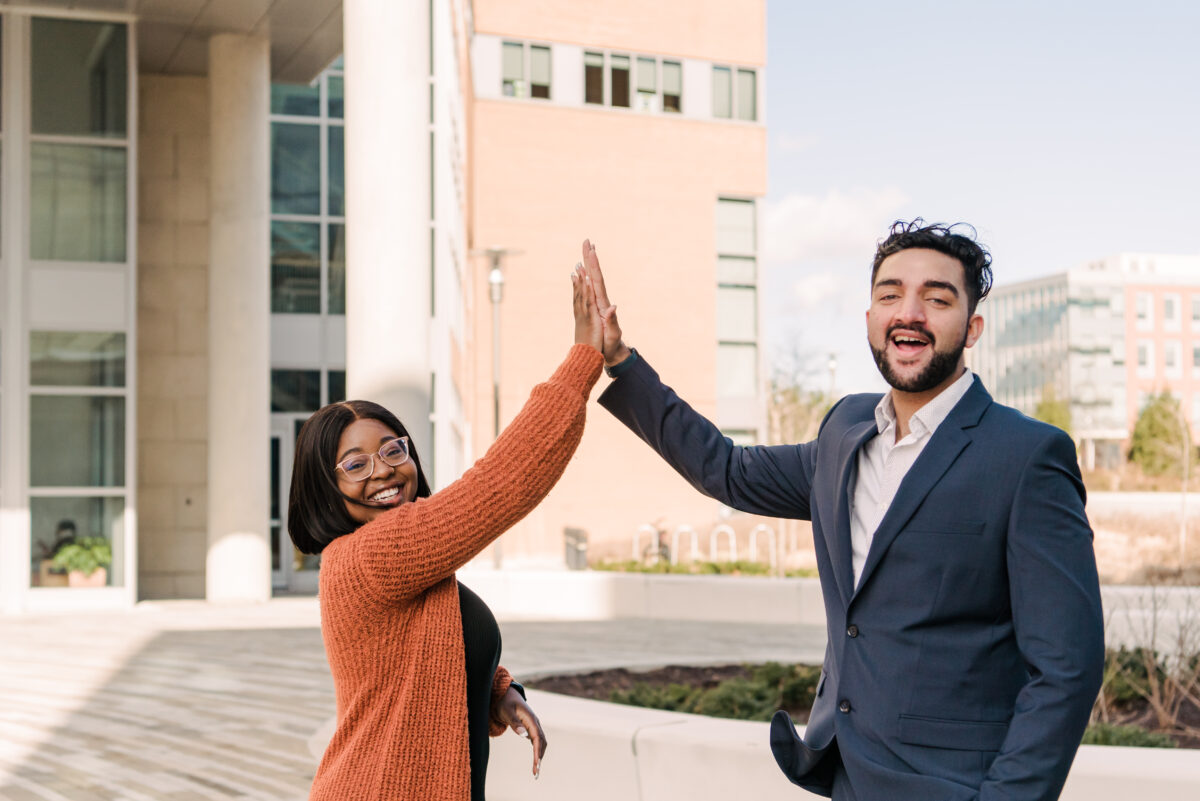 Haleemat Adekoya and Rehman Liaqat 2022. (Marlayna Demond ’11/UMBC)
The CCMA Civic Fellows program develops student leaders who are “engaged global citizens, actively contributing to the creation of equitable, healthy, sustainable, and socially just communities.” CCMA will provide Liaqat with learning and networking opportunities that emphasize personal, professional, and civic growth. This includes conversations with regional and national experts focused on leadership development and advancing equity through civic and community engagement in the Mid-Atlantic region.
Crossing bridges
Liaqat came to the United States from Pakistan when he was eleven. He spent his teen years in Wicomico County Public Schools in Salisbury on Maryland’s Eastern Shore. His time was split between school and working at OC Quickstop, one of three family-owned gas stations. In a predominantly white public high school, Liquat felt like he didn’t quite fit.
In retrospect, not fitting in gave him insight into managing two cultures, two countries, and many different social worlds. So when a group of Pakistani women moved into his apartment complex, Liaqat’s mother encouraged him to serve as a cultural tutor of sorts. Two times a week he would review how to fill out school forms for their children, apply for other resources, and access services.
”I found value in the knowledge I had acquired transitioning into living and working in Salisbury,” says Liaqat. These skills became a tool to help the Pakistani women feel empowered as members of the community.
This project caught the attention of Liaqat’s English teacher, who nominated him for a Light of Literacy Youth Luminary award hosted by the Friends of the Wicomico County Public Libraries. At the award ceremony, he connected with local leaders who invited him to volunteer on political campaigns. He didn’t know at the time how all of these experiences would shape his path.
Transformative mediation
When Liaqat began researching colleges he wasn’t sure what his future would look like, but he did have a clear example of the impact he wanted to have from his grandfather. His grandfather leads community-oriented mediation sessions through restorative practices among local villagers in Chak Pindi, Punjab, Pakistan. The villagers depend on his grandfather’s mediation skills, Liaqat explains, because often they cannot depend on the legal system, due to cost and corruption.
“When I was eight I began to sit next to him as he mediated. It showed me, at an early age, the dire need in our community for advocacy and well-being, especially when the systems in place become undependable,” says Liaqat. “Reflecting back, sitting next to him and observing his mediation depicts, to me, the power of meaningful public service. This work can completely transform the lives of people left vulnerable by the system and by society.”
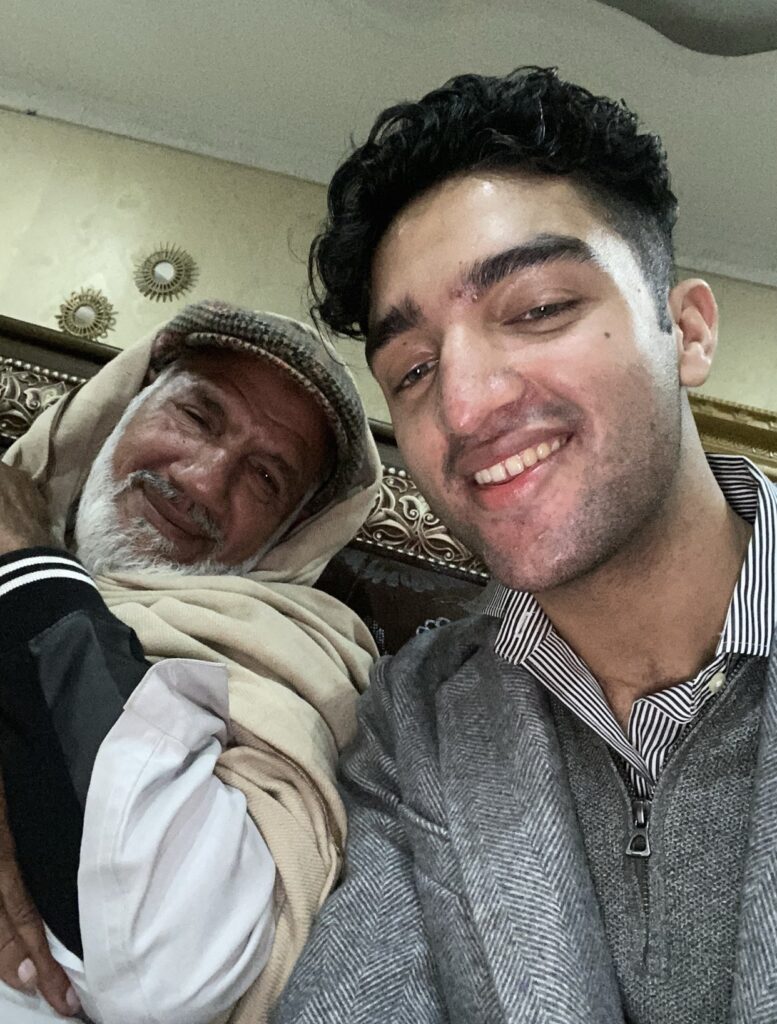 Liaqat with his grandfather. (Image courtesy of Liaqat)
His experiences in Maryland and in Pakistan revealed to him the importance of representation and community action. He ardently worked to convince his parents that attending UMBC—a diverse community rich with new opportunities for his future—was the best decision for him. He would be the first-ever member of his family, across generations, to move out of the family home to go to college.
It wasn’t just moving out, but moving away across the Chesapeake Bay Bridge, 2.5 hours from Salisbury. Over the past four years, Liaqat has driven back home every weekend to work at his family’s gas station. He’s also remained involved with his communities, all while maintaining a 4.0 GPA.
Beyond my comfort zone
“My family is very traditional,” says Liaqat. “They are very proud of me and what I have accomplished.” At the same time, he says he is very proud of himself for “going out of my comfort zone to become the person I want to be.”
Liaqat, who will be entering Georgetown University in the fall, thanks his mentors for guiding him toward increasingly challenging growth opportunities throughout his four years. During his first week on campus, he reached out to four faculty and staff members for guidance and resources. He was surprised by the immediate and heartfelt responses he received from them all, and their willingness to answer all of his questions without hesitation.
Lori Hardesty, associate director of applied learning and community engagement at UMBC’s Shriver Center, connected Liaqat with an applied learning experience. “She was the first person to ‘see me’ at UMBC,” shares Liaqat. “I still remember sitting in her office four years ago when she said, “What matters is that you are here now and you have the opportunity to make a difference every day.’’
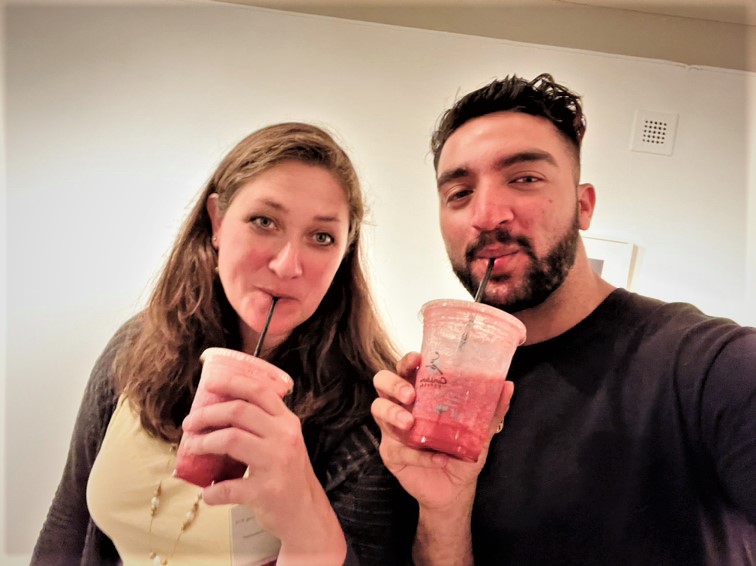 Lori Hardesty with Liaqat. (Image courtesy of Hardesty)
Liaqat also remembers being inspired by the words of Sargent Shriver, the center’s namesake, who said, “Serve, serve, serve… because, in the end, it will be the servants who save us all.” Shriver’s meaningful contributions to society have become an inspiration for a journey of lifelong service, says Liaqat.
Over the years, Liaqat has served as a peer mentor and peer facilitator for the Shriver First-Year Experience course and as a workshop facilitator for UMBC’s Community Read program. Through the Shriver Center, he has also helped support Baltimore City students by participating in the Choice Program’s annual Jam and Slam event and College Night program.
“As a son of Pakistani immigrants who was the first to pursue higher education in the U.S., I was expected to pursue a path that was determined for me,” says Liaqat. “However, as I became a member of UMBC’s Shriver Living Learning Community, I felt more confident embracing a path of my own design.”
Broader perspective
With the support of the Shriver Center, Liaqat felt more comfortable seeking out mentors and exploring UMBC’s social change resources. He remembers fondly walking into the Center for Democracy and Civic Life intent on creating a UMBC football team.
There he met Center Director David Hoffman, Ph.D. ’13, language, literacy, and culture (LLC), and Assistant Director Romy Hübler ’09, modern languages and linguistics, M.A. ’11, intercultural communication, Ph.D. ’15, LLC. “They didn’t know who I was and I had no idea if the center would listen to all of my ideas,” says Liaqat.
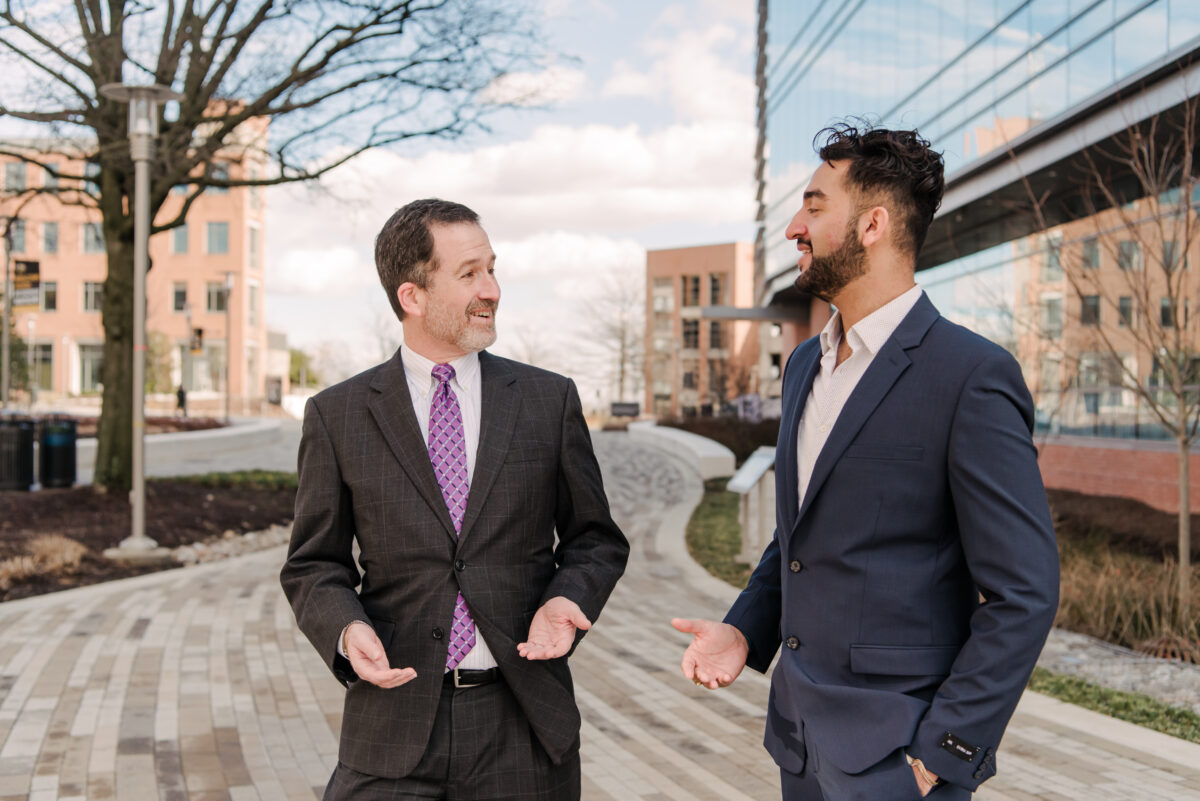 David Hoffman with Liaqat. (Marlayna Demond ’11/UMBC)
For weeks Hoffman and Hübler sat with him as he shared his passionate ideas. “They never deterred me,” says Liaqat. Instead, they walked him through the process of seeing different points of view and the intentionality of the decision of university leadership to invest in a broad range of sports rather than putting significant funds toward a football team. This process informed his work in student and community organizations for the rest of his time at UMBC.
“Rehman arrived at UMBC with a thirst for learning, a desire to make a difference, and big ideas,” says Hübler. “Over the past four years, we have spent many hours talking about his commitment to addressing social issues and approaches he could take to doing so. It has been a wonderful experience seeing him build relationships, empower his peers, and strengthen our community.”
Beyond theory
In a political science course, William Blake, associate professor and associate chair of political science, brought to life constitutional law for Liaqat. He enrolled in all of Blakes’s human and civil rights classes, discovering a passion for understanding the power of a constitution to impact lives. He joined UMBC’s Moot Court team and eventually became its president, with Blake as the organization’s faculty advisor.
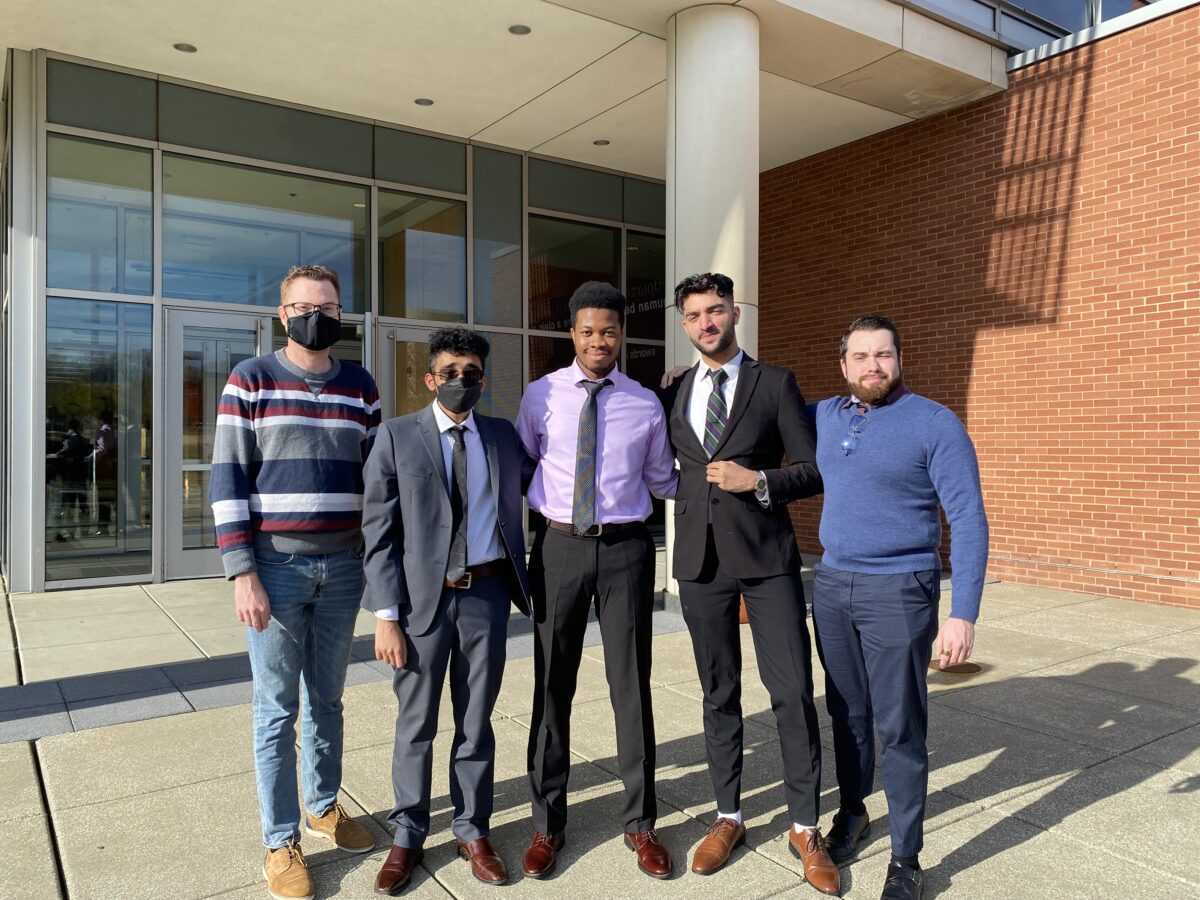 Liaqat (second from right) with Moot Court team. (Image courtesy of Liaqat)
“Rehman is one of those rare students whose passion, curiosity, and analytical skills make him a force to be reckoned with,” says Blake. “He is an impressive student leader, and it has been a pleasure to have a chance to teach him and work with him on the UMBC Moot Court team.”
Liaqat also worked closely with Carolyn Forestiere, professor of political science, as executive president of the department’s council of majors. “Rehman has been a guiding force in our Council of Majors over the past several years,” Forestiere says. She notes that Liaqat has been instrumental in very important ways, including co-leading an effort to develop a diversity, inclusion, and equity initiative that would impact the department’s syllabi and curricula.
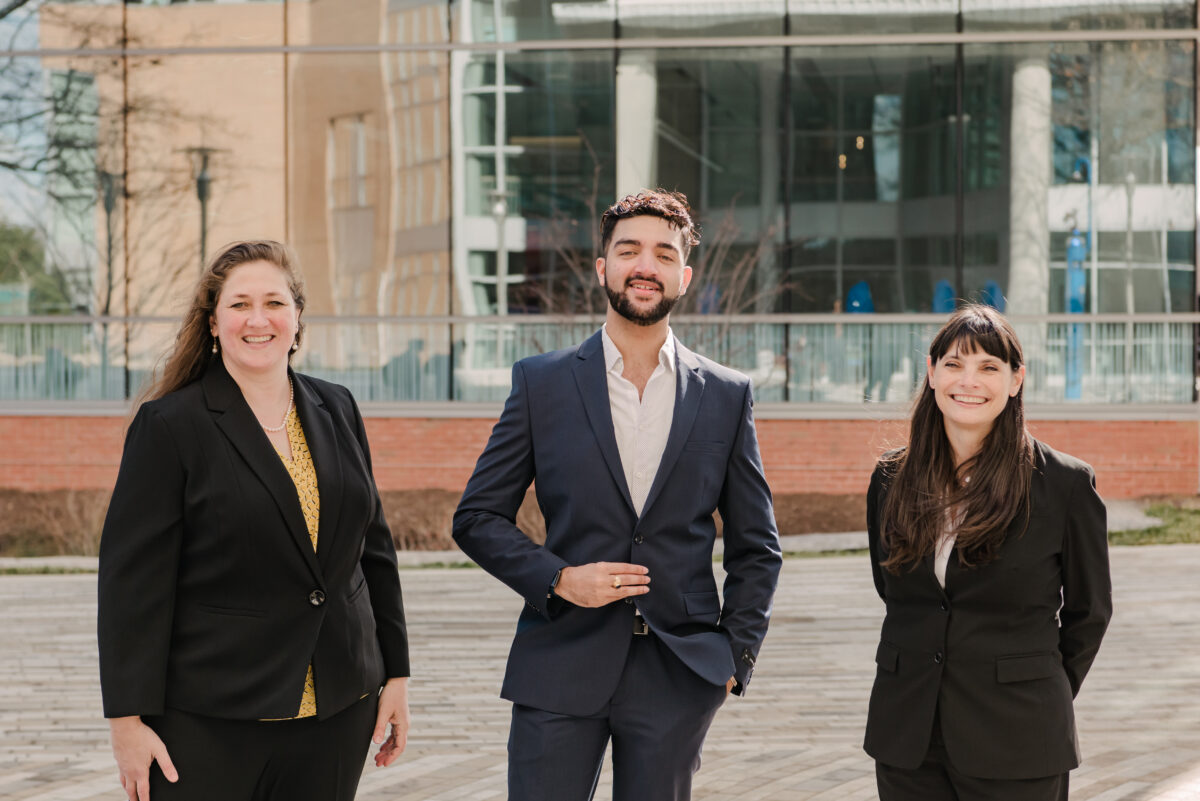 Hardesty (l), Liaqat (c), Carolyn Forestiere (r). (Marlayna Demond ’11/UMBC)
“His professionalism and passion for promoting positive change are fundamental elements of his character,” says Forestiere. “He leaves a legacy of sincere compassion and engaged activism that I hope students emulate for years to come.”
Growing confidence, growing impact
Through mentorship and new experiences, Liaqat’s confidence grew. He learned to navigate diverse political environments as a legal intern at the Maryland Office of the Public Defender, Maryland’s State’s Attorney’s Office, and at Pakistan’s Supreme Court and Ministry of Human Rights. He is now the co-founder of a human rights legal aid organization in Pakistan, which has been asked to expand its reach by local leaders. And he has pursued an accelerated master’s degree in public policy at UMBC alongside his undergraduate degree.
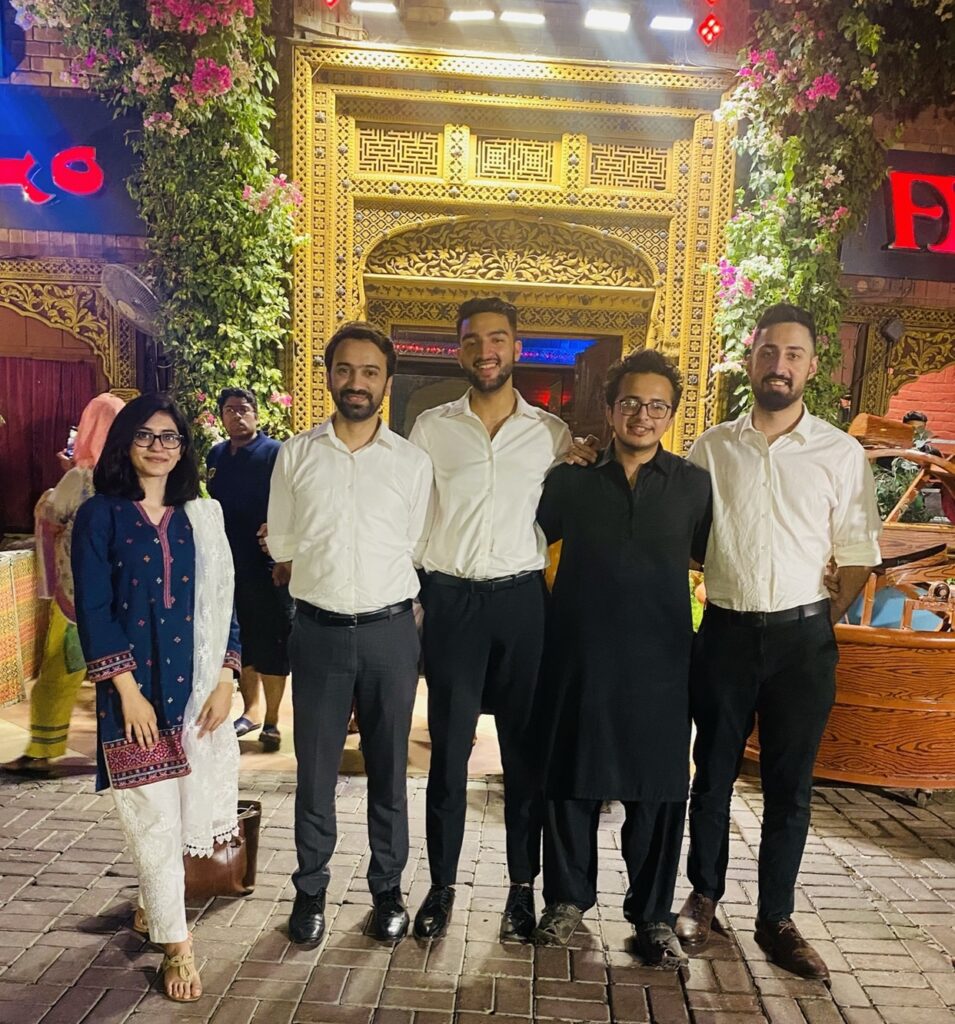 Liaqat (c) in Pakistan with other Pakistan Supreme Court law clerks and attorneys from
Axis Law Chambers. (Image courtesy of Liaqat)
Liaqat arrived at UMBC in 2018 full of excitement, but also uncertainty. “Coming to UMBC meant my family would be far away. I was a college kid who had a lot of ambitions to do more, but had never gone beyond my home environment,” says Liaqat. He says his mentors gave him the self-assurance to grow in new directions while still remaining part of his family’s life and culture.
 Liaqat (third from the left) with attorneys from the Bar Council in Lahore, Pakistan. (Image courtesy of Liaqat)
Now, Liaqat is graduating as a CCMA Civic Fellow who will soon begin a joint master’s of public policy and juris doctor program at the McCourt School of Public Policy and the Georgetown University Law Center.
Liaqat says he was told “UMBC is a magical place” during orientation, and this proved to be true. He has had meaningful, enriching civic engagement experiences throughout his undergraduate years. “UMBC’s magic is real, genuine, and more alive than ever,” he says, “because of the commitment and devoted service by every member of its community.”
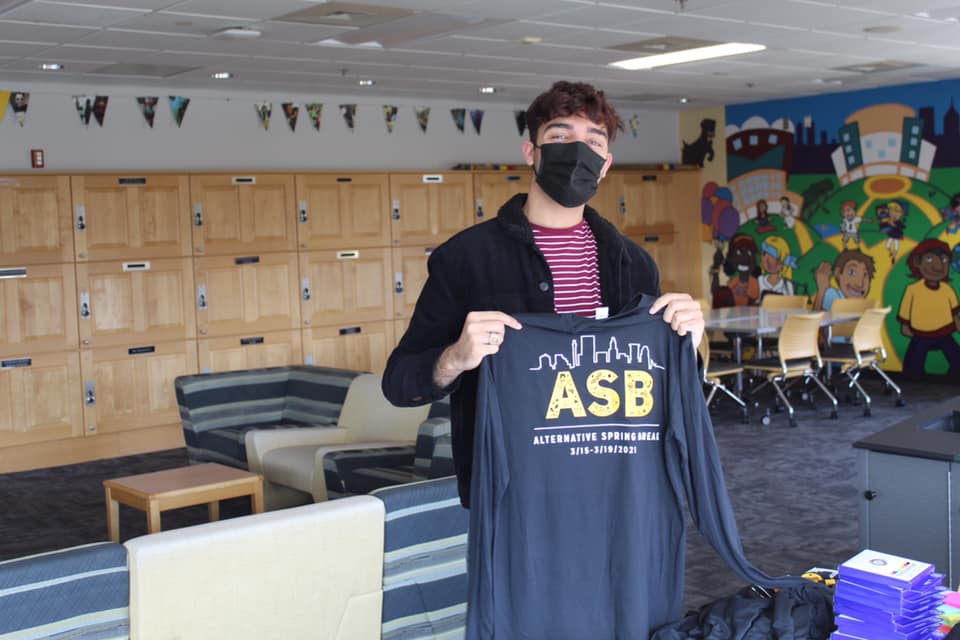 Liaqat preparing for Alternative Spring Break. (Image courtesy of Liaqat)
He hopes to take a piece of this magic with him well after graduation. The first step will be living out his Civic Fellowship’s driving mission: to create equitable, healthy, sustainable, and socially just communities. He says, “I want to show future generations of Pakistani students all that is possible.”
]]>
Rehman Liaqat ’22, political science, has received the inaugural Campus Compact Mid-Atlantic (CCMA) Civic Fellowship. He is one of 13 students chosen from institutions across Maryland, Delaware,...
https://umbc.edu/stories/rehman-liaqat-named-civic-fellow/
https://dev.my.umbc.edu/api/v0/pixel/news/119427/guest@my.umbc.edu/0d2dc8fc01d52b8189dd59bfd78679df/api/pixel
cahss
cahssresearch
center-for-democracy-and-civic-life
choiceprogram
policy-and-society
politicalscience
research
shrivercenter
UMBC News & Magazine
https://dev.my.umbc.edu/groups/umbc-news-magazine
https://assets1-dev.my.umbc.edu/system/shared/avatars/groups/000/001/943/24435aa6207c452e7bc15cc74b42c7bb/xsmall.png?1748556657
https://assets1-dev.my.umbc.edu/system/shared/avatars/groups/000/001/943/24435aa6207c452e7bc15cc74b42c7bb/original.png?1748556657
https://assets2-dev.my.umbc.edu/system/shared/avatars/groups/000/001/943/24435aa6207c452e7bc15cc74b42c7bb/xxlarge.png?1748556657
https://assets2-dev.my.umbc.edu/system/shared/avatars/groups/000/001/943/24435aa6207c452e7bc15cc74b42c7bb/xlarge.png?1748556657
https://assets3-dev.my.umbc.edu/system/shared/avatars/groups/000/001/943/24435aa6207c452e7bc15cc74b42c7bb/large.png?1748556657
https://assets1-dev.my.umbc.edu/system/shared/avatars/groups/000/001/943/24435aa6207c452e7bc15cc74b42c7bb/medium.png?1748556657
https://assets2-dev.my.umbc.edu/system/shared/avatars/groups/000/001/943/24435aa6207c452e7bc15cc74b42c7bb/small.png?1748556657
https://assets1-dev.my.umbc.edu/system/shared/avatars/groups/000/001/943/24435aa6207c452e7bc15cc74b42c7bb/xsmall.png?1748556657
https://assets2-dev.my.umbc.edu/system/shared/avatars/groups/000/001/943/24435aa6207c452e7bc15cc74b42c7bb/xxsmall.png?1748556657
UMBC News & Magazine
0
0
false
Wed, 11 May 2022 09:02:24 -0400
Wed, 11 May 2022 09:02:24 -0400
UMBC leaders and community support congressional resolution for national racial healing work
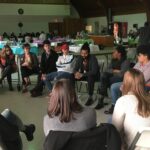
The fourth annual National Day of Racial Healing is on Tuesday, January 19. The goal of the day is to promote racial healing and equity across the United States through collective action. UMBC will observe the day in spirit and action.
As a unified front, UMBC leadership—including President Freeman Hrabowski, Provost Philip Rous, and shared governance leaders—are signing a letter to Maryland’s Congressional delegation in support of a Congressional Resolution, which calls for the establishment of a United States Commission on Truth, Racial Healing, and Transformation (TRHT).
“Having university leadership sign on in support of this resolution is a big step,” says Eric Ford, director of The Choice Program at UMBC. “It sets the example for other institutions of higher education to do the same. For so long, higher ed has perpetuated inequities and now we have the responsibility to address it. By taking this step, UMBC is sending a message to the campus community that inclusive excellence is not just a slogan but a virtue we live by.”
 Ford (far right) and Choice staff visit the Administration Building’s rooftop after a successful presentation to the UMBC’s President’s Council in 2015. All photos courtesy of Eric Ford.
Melody Wright, president, Non-Exempt Staff Senate, is one of the campus leaders signing the joint letter. “The voices of those seeking justice have been muffled for far too long,” says Wright, “and those voices must be amplified and heard for true racial healing to begin. You cannot truly understand someone’s story unless you have lived it with them, but carefully listening to someone’s lived experiences is a great place to start.”
In addition to the letter signed by campus leaders, UMBC community members have an opportunity to write to their own senators and representatives about the TRHT resolution. An online event on January 19 will provide additional information about the goal of the TRHT resolution and the work of Truth, Racial Healing, and Transformation at UMBC.
Transformation is ongoing work
In 2017, UMBC partnered with the Association of American Colleges and Universities to become one of the first Truth, Racial Healing, and Transformation Campus Centers in the country. UMBC’s THRT Campus Center work involves breaking down racial hierarchies with a focus on the university’s service-learning and community engagement partnerships in Baltimore City. Ford shares that truth, racial healing, and transformation are all essential to effective and responsible service-learning and community engagement.
To begin the process of truth telling, The Choice Program underwent a yearlong antiracism audit of the organization. As a result, according to Ford and Frank Anderson, a doctoral student in language, literacy, and culture and the associate director of programs at Choice, the organization’s entire service model was rewritten. Their focus is to ensure that the voices and experiences of the young people being served are at the forefront of the work.
 Choice and UMBC staff host students from Baltimore high schools as a part of Choice’s Education program aimed at increasing college access.
The Choice Program—the Shriver’s Center’s oldest and largest service-learning initiative—has become an opportunity to envision the TRHT model at scale, identifying what it means to engage 36 AmeriCorps members as they serve more than 600 young people each year.
Accountability is crucial
Briscoe Turner ’21, psychology, was drawn to Choice after hearing about the program-wide audit. Now an intern at the TRHT Campus Center, Turner is helping to spearhead the letter-writing initiative.
“Members of Congress need to hear the thoughts and experiences of students and staff to make sure that the TRHT Commission actually serves its purpose by actively challenging the racist practices and policies embedded in this country’s major institutions that impact the surrounding community,” says Turner. “Accountability is crucial.”
By following the TRHT model, The Shriver Center has also been able to work with undergraduate researchers to reevaluate media narratives about Baltimore. The Center has also used lessons from TRHT to reflect on already successful programs like College Night.
With College Night, young people from the Baltimore area connect with UMBC every Monday night, through on-campus visits pre-COVID-19 and virtual events today. Through the THRT model, organizers revised College Night training materials and reflections to ensure volunteers understood the broader context within which they were working.
Supporting nationwide change
In September 2020, UMBC hosted the first Truth, Racial Healing, and Transformation Town Hall during which community members learned more about the THRT Campus Center and UMBC’s connection to a national framework addressing race equity. Community partners and alumni spoke about how structural racism has impacted youth development in Maryland and how campus members can become agents of change.
 Choice participant performs at the 2015 Imagining America event hosted by UMBC.
UMBC supports the Congressional resolution, proposed by Sen. Cory Booker and Rep. Barbara Lee, says Ford, because it amplifies the broader goals of the TRHT center and the important work being done by Retriever students and staff.
“It speaks truth to power by encouraging the acknowledgement of centuries of oppression of people of color,” says Ford. “It stresses the importance of telling the ‘story’ of people of color and their experiences in this country, which will restore our humanity that was stripped away by structural racism. And it is a step toward system change which is needed to achieve equity.”
A multiprong approach
UMBC’s TRHT Campus Center is only one facet of a larger institutional acknowledgement that the university, like others across the country, needs to confront racism within its own structures and community.
In 2019, UMBC founded the Office of Equity and Inclusion (OEI), which is responsible for promoting and coordinating the university’s core values of inclusive excellence and equity. The center has primary responsibility for managing UMBC’s work related to Title IX as well as other civil rights issues.
 Baltimore City’s first Poet Laureate Derick Ebert performs spoken word for Choice participants at its 2015 “Youth in Action” community arts showcase.
In June 2020, UMBC formed an Inclusion Council to bring together faculty, staff, students, and alumni to help address issues of equity and inclusion at UMBC. The council’s co-chair, Ariana Arnold, director of OEI, shares her hopes for the group and campus as a whole.
“What I’d like to be able to say a year from now,” Arnold shares, “is that we are doing the work and not just talking about the work. And that five years from now we’ve had a measurable impact on campus in terms of both engaging people from all political, racial, ethnic, religious, cultural backgrounds, abilities, and nationalities and improving the sense of inclusion and belonging on campus.”
The Inclusion Council, OEI, and TRHT Campus Center are working together to make that vision of UMBC come to fruition. UMBC’s letter to Maryland’s representatives supporting the effort to bring the TRHT model to a national scale is the next step in the university’s ongoing work for truth, racial healing, and transformation.
Featured photo: In a 2017 gathering, Choice staff and AmeriCorps members take part in reflecting on how service transformed their lives. Photo courtesy of Eric Ford.
]]>
The fourth annual National Day of Racial Healing is on Tuesday, January 19. The goal of the day is to promote racial healing and equity across the United States through collective action. UMBC...
https://umbc.edu/stories/umbc-leaders-and-community-support-congressional-resolution-for-national-racial-healing-work/
https://dev.my.umbc.edu/api/v0/pixel/news/119701/guest@my.umbc.edu/630d9d49bf5538c97a318c60e41aadc9/api/pixel
cahss
campus
choiceprogram
diversity
page1
policy-and-society
shrivercenter
UMBC News & Magazine
https://dev.my.umbc.edu/groups/umbc-news-magazine
https://assets1-dev.my.umbc.edu/system/shared/avatars/groups/000/001/943/24435aa6207c452e7bc15cc74b42c7bb/xsmall.png?1748556657
https://assets1-dev.my.umbc.edu/system/shared/avatars/groups/000/001/943/24435aa6207c452e7bc15cc74b42c7bb/original.png?1748556657
https://assets2-dev.my.umbc.edu/system/shared/avatars/groups/000/001/943/24435aa6207c452e7bc15cc74b42c7bb/xxlarge.png?1748556657
https://assets2-dev.my.umbc.edu/system/shared/avatars/groups/000/001/943/24435aa6207c452e7bc15cc74b42c7bb/xlarge.png?1748556657
https://assets3-dev.my.umbc.edu/system/shared/avatars/groups/000/001/943/24435aa6207c452e7bc15cc74b42c7bb/large.png?1748556657
https://assets1-dev.my.umbc.edu/system/shared/avatars/groups/000/001/943/24435aa6207c452e7bc15cc74b42c7bb/medium.png?1748556657
https://assets2-dev.my.umbc.edu/system/shared/avatars/groups/000/001/943/24435aa6207c452e7bc15cc74b42c7bb/small.png?1748556657
https://assets1-dev.my.umbc.edu/system/shared/avatars/groups/000/001/943/24435aa6207c452e7bc15cc74b42c7bb/xsmall.png?1748556657
https://assets2-dev.my.umbc.edu/system/shared/avatars/groups/000/001/943/24435aa6207c452e7bc15cc74b42c7bb/xxsmall.png?1748556657
UMBC News & Magazine
0
0
false
Fri, 15 Jan 2021 19:09:40 -0500
UMBC’s Eric Ford, Choice Program director, leads Maryland group supporting youth development

Eric Ford, director of The Choice Program at UMBC, has been appointed to serve as chair of Maryland’s State Advisory Group (SAG), a part of the Governor’s Office of Crime Prevention, Youth, and Victim Services (GOCCP).
Ford has dedicated his career to serving young people facing inequalities. As director of Choice, he guides the program in providing community-based, family-centered services for youth. Choice seeks to promote positive outcomes for young people who are incarcerated, on probation, or would benefit from support to avoid entering the juvenile justice system. Ford’s new leadership role with Maryland’s SAG extends the impact of his work across the state.
 Ford, first on the right, with Choice youth unveil a mural created over spring break at Lane Manor Recreation center in partnership with Artivate Inc.1
As SAG chair, Ford will assist in the review of grant proposals, monitor juvenile justice programs, and advise the governor and legislators on compliance with the Juvenile Justice and Delinquency Prevention Act. The appointment, which began July 1, 2020, comes after four years of service. Ford also served as the vice chair of the SAG for one of those years. During this period, he helped develop a three-year plan outlining the goals and objectives for the SAG.
Dedicated to serving young people
Ford has focused on supporting youth for more than 25 years through a range of community and educational institutions. He actually began his work with Choice as a case worker in 1993, before serving as a case manager, career counselor, community schools coordinator, and in other high-impact roles.
Ford later returned to Choice in 2011 as assistant director, before becoming associate director of operations in 2014. Four years later he advanced to acting director and was then selected as director.
“I am pleased to name Eric Ford as the next Chair of Maryland’s State Advisory Group,” shares Glenn Fueston, executive director of the GOCCP and a fellow former Choice case worker. “As the SAG continues to address Maryland’s juvenile justice system needs, Eric’s background in youth development programming will help solidify the SAG’s commitment and responsibilities under the Juvenile Justice and Delinquency Prevention Act.”
Supporting reform at the state level
The SAG chair appointment is Ford’s second recent appointment from the governor. Last year he was appointed to Maryland’s first Juvenile Justice Reform Council (JJRC), a part of Maryland’s Department of Juvenile Services (DJS). The council develops a statewide framework to reform the state’s juvenile justice strategy and its implementation at the local level.
DJS and Choice have worked closely together over the years. DJS is the top funder for Choice programming, which has demonstrated over decades the value of investing in youth. Choice has supported DJS in developing practices that include youth and family voices and that recognize the importance of racial equity.
 Eric Ford (second on the left) with President Freeman Hrabowski and other Hampton University alumni at the Department of Juvenile Services Leadership Conference.
“Eric’s inclusion on the JJRC is important because The Choice Program has been a great partner with DJS for decades,” said Sam Abed, secretary of DJS. “They have a tremendous trove of first-hand knowledge and experience working to support our youth in the community. That perspective is vital to help us shape the future of juvenile services in Maryland.”
Representing youth voices
Both new appointments are important to Ford. Each furthers Choice’s anti-racist mission of a collaborative mentorship process led by young people’s goals for themselves. Ford sees this work as integral to addressing current disparities in the juvenile justice system, including arrest rates and detention rates for young men of color.
 Ford (on the right) presents an award to a Cherry Hill community youth during Choices yearly Jam and Slam Back to School event.
For decades, Ford has supported youth in reaching toward their futures while facing incredible challenges. Now, as Choice’s longest-tenured leader of color, chair of the SAG, and a member of the JJRC, he hopes to offer other leaders a glimpse into the experiences of young people of color in the juvenile justice system.
“I represent all young men and men of color that are still in a juvenile facility who may not have a voice,” says Ford. “I have to speak for them.”
Banner image: Ford (first on the left) Ford (first on left) with students and staff at John Bartram High School in Philadelphia. This mentoring program was run in partnership with Pride Youth Services. All photos courtesy of Eric Ford.
]]>
Eric Ford, director of The Choice Program at UMBC, has been appointed to serve as chair of Maryland’s State Advisory Group (SAG), a part of the Governor’s Office of Crime Prevention, Youth, and...
https://umbc.edu/stories/umbcs-eric-ford-choice-program-director-leads-maryland-group-supporting-youth-development/
https://dev.my.umbc.edu/api/v0/pixel/news/119851/guest@my.umbc.edu/33152597aa8ee693ec7d639537afbe5f/api/pixel
campus
choiceprogram
policy-and-society
UMBC News & Magazine
https://dev.my.umbc.edu/groups/umbc-news-magazine
https://assets1-dev.my.umbc.edu/system/shared/avatars/groups/000/001/943/24435aa6207c452e7bc15cc74b42c7bb/xsmall.png?1748556657
https://assets1-dev.my.umbc.edu/system/shared/avatars/groups/000/001/943/24435aa6207c452e7bc15cc74b42c7bb/original.png?1748556657
https://assets2-dev.my.umbc.edu/system/shared/avatars/groups/000/001/943/24435aa6207c452e7bc15cc74b42c7bb/xxlarge.png?1748556657
https://assets2-dev.my.umbc.edu/system/shared/avatars/groups/000/001/943/24435aa6207c452e7bc15cc74b42c7bb/xlarge.png?1748556657
https://assets3-dev.my.umbc.edu/system/shared/avatars/groups/000/001/943/24435aa6207c452e7bc15cc74b42c7bb/large.png?1748556657
https://assets1-dev.my.umbc.edu/system/shared/avatars/groups/000/001/943/24435aa6207c452e7bc15cc74b42c7bb/medium.png?1748556657
https://assets2-dev.my.umbc.edu/system/shared/avatars/groups/000/001/943/24435aa6207c452e7bc15cc74b42c7bb/small.png?1748556657
https://assets1-dev.my.umbc.edu/system/shared/avatars/groups/000/001/943/24435aa6207c452e7bc15cc74b42c7bb/xsmall.png?1748556657
https://assets2-dev.my.umbc.edu/system/shared/avatars/groups/000/001/943/24435aa6207c452e7bc15cc74b42c7bb/xxsmall.png?1748556657
UMBC News & Magazine
0
0
false
Thu, 02 Jul 2020 15:28:06 -0400
UMBC’s Denise Meringolo continues Baltimore Uprising public history project through Whiting Fellowship

Denise Meringolo was teaching her graduate-level Introduction to Public History course in the spring of 2015 when Freddie Gray died in police custody and city residents responded with protest, marching in the streets of Baltimore. The events of that time didn’t just make national headlines, they also sparked difficult conversations in homes, offices, community centers, and classrooms across the city about equality, representation, and safety.
Knowing that history is often told through official documents and representatives, Meringolo, an associate professor of history at UMBC, felt an urgency to help the local community control and document the story of their experience, and she initiated the crowdsourced story and image collection platform BaltimoreUprising2015.org.
 Protester holds sign during the Baltimore Uprising, 2015. Photo by Sean Scheidt (with permission).
“Museums are often not very democratic places,” Meringolo notes, explaining that their collections processes and guidelines often reinforce the voices and experiences of wealthy, white people rather than broader communities in all their diversity. In contrast, the Baltimore Uprising digital collection puts decisions into the hands of the public.
The project offers individuals the opportunity to upload their own materials and decide what they want to become part of the accessible public record. The collection, built and managed in partnership with Joe Tropea, Maryland Historical Society digital projects specialist, now includes 3,000 images, oral histories, and written accounts, and that number continues to grow.
 Protest signs in front of Baltimore City Hall, 2015. Photo by Jessica Baroody (with permission).
Recognizing the significant potential of this work to have a lasting impact, The Whiting Foundation has awarded Meringolo a $50,000 Public Engagement Fellowship to teach historical understanding through the “Preserve the Baltimore Uprising” project. Meringolo is one of just seven scholars to receive Whiting fellowships in 2018. The recipients represent the diversity of thought and research in the humanities, from history, literature, philosophy, and anthropology to gender studies, and they engage numerous different communities across the United States, particularly groups underrepresented in the humanities.
“The Whiting Fellowship Program is among the nation’s foremost awards for civically engaged research and scholarship,” says Scott Casper, dean of UMBC’s College of Arts, Humanities, and Social Sciences. “Dr. Meringolo’s recognition highlights the importance of her work preserving the archive of the Baltimore Uprising, a signal example of UMBC’s collaboration with communities in greater Baltimore.”
In this next phase of the project, Meringolo seeks to ensure the collection grows and is accessible as a resource for Baltimore City teachers and students. “This is an opportunity to share methods and best practices in conducting oral histories and relevant historical research with the next generation of public historians and their teachers,” she says. Through this work, she hopes to highlight community-based understandings of “the historical roots of racial injustice, economic equality, and social and political unrest in Baltimore.”
Over the next year, Meringolo will collaborate with campus and community partners in this work. As part of the Truth, Racial Healing, and Transformation Centers initiative, Frank Anderson, assistant director of the Choice Program, will lead the UMBC Shriver Center Choice education team in connecting the project with community partners and developing related youth-centered enrichment programs.
Community organizer Denise Griffin Johnson and Lee Boot, director of UMBC’s the Imaging Research Center, will support the initiative in creating story circles programs to guide student scholars in formulating and answering critical questions as they develop their stories. This arts-based component of the project will use materials assembled in the digital collection with and interviews Lee Boot and visual arts graduate students filmed with student protesters after the Baltimore Uprising.
“The work, I believe, will reflect, in particular, the young voices of tomorrow,” says Griffin Johnson. “I believe this action and work is instrumental in capturing the hearts, minds, and voices of people who embrace a community identity of self and others.”
Meringolo’s original collaboration with the Maryland Historical Society will expand to include oral history and interview techniques support by Joe Tropea. Thinking about conservation of the project for future community members, Lindsey Loeper, UMBC special collections archivist, will help the team develop a long-term plan to manage the digital collection.
Meringolo expects to conclude her Whiting Fellowship in a way that carries through her project’s initial vision: doing collaborative public history that honors and amplifies community voices. Participating Baltimore City students will present their research at a neighborhood branch of the Enoch Pratt Free Library.
Ultimately, the project all comes down to the “public” in “public history.” “I want to remind Freddie Gray’s community that the collection exists,” says Meringolo. “That it is theirs.”
Header image: Denise Meringolo. Photo by Marlayna Demond ’11 for UMBC.
]]>
Denise Meringolo was teaching her graduate-level Introduction to Public History course in the spring of 2015 when Freddie Gray died in police custody and city residents responded with protest,...
https://umbc.edu/stories/umbcs-denise-meringolo-continues-baltimore-uprising-public-history-project-through-whiting-fellowship/
https://dev.my.umbc.edu/api/v0/pixel/news/120524/guest@my.umbc.edu/87e147aece90f14a50bbd64b5b6c729e/api/pixel
arts-and-culture
cahss
choiceprogram
diversityandinclusion
history
irc
policy-and-society
UMBC News & Magazine
https://dev.my.umbc.edu/groups/umbc-news-magazine
https://assets1-dev.my.umbc.edu/system/shared/avatars/groups/000/001/943/24435aa6207c452e7bc15cc74b42c7bb/xsmall.png?1748556657
https://assets1-dev.my.umbc.edu/system/shared/avatars/groups/000/001/943/24435aa6207c452e7bc15cc74b42c7bb/original.png?1748556657
https://assets2-dev.my.umbc.edu/system/shared/avatars/groups/000/001/943/24435aa6207c452e7bc15cc74b42c7bb/xxlarge.png?1748556657
https://assets2-dev.my.umbc.edu/system/shared/avatars/groups/000/001/943/24435aa6207c452e7bc15cc74b42c7bb/xlarge.png?1748556657
https://assets3-dev.my.umbc.edu/system/shared/avatars/groups/000/001/943/24435aa6207c452e7bc15cc74b42c7bb/large.png?1748556657
https://assets1-dev.my.umbc.edu/system/shared/avatars/groups/000/001/943/24435aa6207c452e7bc15cc74b42c7bb/medium.png?1748556657
https://assets2-dev.my.umbc.edu/system/shared/avatars/groups/000/001/943/24435aa6207c452e7bc15cc74b42c7bb/small.png?1748556657
https://assets1-dev.my.umbc.edu/system/shared/avatars/groups/000/001/943/24435aa6207c452e7bc15cc74b42c7bb/xsmall.png?1748556657
https://assets2-dev.my.umbc.edu/system/shared/avatars/groups/000/001/943/24435aa6207c452e7bc15cc74b42c7bb/xxsmall.png?1748556657
UMBC News & Magazine
0
0
false
Fri, 09 Mar 2018 22:28:17 -0500
UMBC selected for national initiative to prepare the next generation of social justice leaders
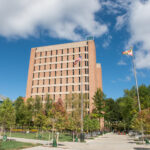
The Association of American Colleges and Universities (AAC&U) has selected UMBC as one of 10 institutions nationwide to participate in a bold, new initiative designed to “educate, prepare, and inspire the next generation of leaders to advance justice and build equitable communities.”
Participating colleges and universities will establish Truth, Racial Healing and Transformation (TRHT) Campus Centers to engage campus and community stakeholders around issues impacting racial equity, such as conscious and unconscious bias. AAC&U President Lynn Pasquerella shares that this is the first piece of a broader vision “to ensure that higher education is playing a leadership role in promoting racial and social justice” through a future national network of 150 such centers.
Frank Anderson, assistant director of The Choice Program at UMBC, coordinated UMBC’s TRHT proposal, with support from Zeevelle Nottingham-Lemon, associate director. The Choice Program has served more than 25,000 youth from Maryland’s most underserved communities for nearly 30 years, providing 24/7 wrap-around support. The program is based in UMBC’s Shriver Center, which works to realize the vision of Eunice Kennedy Shriver and Sargent Shriver to mobilize higher education to confront and solve major challenges facing urban America today.
“The Shriver Center’s Choice Program at UMBC recognizes that now, more than ever, there exists a need to create platforms for Baltimore City youth, UMBC service-learners, and our communities to voice their truth about systemic racism, and to seek opportunities for transformation,” says Anderson.
UMBC’s proposal focuses on the Shriver Center’s service-learning and community engagement work with youth, artists, advocates and community-serving organizations in and around Baltimore. It also incorporates plans for youth-led community conversations, at UMBC and in Baltimore, around racial equality and transformation. The $30,000 AAC&U grant will support The Choice Program’s Youth in Action group, which unites students and service-learners at UMBC with youth in Baltimore through art and social justice, and college night programming for Baltimore City school students, among other activities.
“Youth are often the most affected by social justice issues, but the least represented when solutions are sought,” says Anderson. He suggests that UMBC is in a strong position to elevate their perspectives, experiences, and ideas given the university’s history of youth mentoring and organizing through The Choice Program, as well as robust partnerships in Baltimore City Public Schools and other youth-serving organizations.
Across the country, 125 institutions applied to participate in this first cohort of TRHT Campus Centers. UMBC is joined by Brown University, Duke University, Spelman College, Rutgers University, and other innovative institutions on the list of 10 sites selected to launch the program’s first stage.
The UMBC TRHT Campus Center team includes Eric Ford, associate director of the Choice Program; Beverly Bickel, clinical associate professor of language literacy and culture; Keisha Allen, assistant professor of education; Charlotte Keniston, associate director of the Peaceworker Program; and Eloise Grose, program coordinator for service-learning in the Shriver Center, in addition to Anderson and Nottingham-Lemon.
“We are honored that UMBC has been selected to help launch this new national program. Our university is dedicated to open inquiry and understands that the diversity of our community is one of our greatest strengths,” says President Freeman Hrabowski. “Preparing today’s young people to serve as the next generation of leaders in creating a more equitable society is core to our mission as a civically-engaged public research university.”
Featured image: Administration Building and flags at the main entrance to UMBC. Photo by Marlayna Demond ’11 for UMBC.
]]>
The Association of American Colleges and Universities (AAC&U) has selected UMBC as one of 10 institutions nationwide to participate in a bold, new initiative designed to “educate, prepare, and...
https://umbc.edu/stories/umbc-selected-for-national-initiative-to-prepare-the-next-generation-of-social-justice-leaders/
https://dev.my.umbc.edu/api/v0/pixel/news/120694/guest@my.umbc.edu/1d573957ad6b4ceab25bdc354fbc7a1a/api/pixel
choiceprogram
community
majoraward
policy-and-society
shrivercenter
UMBC News & Magazine
https://dev.my.umbc.edu/groups/umbc-news-magazine
https://assets1-dev.my.umbc.edu/system/shared/avatars/groups/000/001/943/24435aa6207c452e7bc15cc74b42c7bb/xsmall.png?1748556657
https://assets1-dev.my.umbc.edu/system/shared/avatars/groups/000/001/943/24435aa6207c452e7bc15cc74b42c7bb/original.png?1748556657
https://assets2-dev.my.umbc.edu/system/shared/avatars/groups/000/001/943/24435aa6207c452e7bc15cc74b42c7bb/xxlarge.png?1748556657
https://assets2-dev.my.umbc.edu/system/shared/avatars/groups/000/001/943/24435aa6207c452e7bc15cc74b42c7bb/xlarge.png?1748556657
https://assets3-dev.my.umbc.edu/system/shared/avatars/groups/000/001/943/24435aa6207c452e7bc15cc74b42c7bb/large.png?1748556657
https://assets1-dev.my.umbc.edu/system/shared/avatars/groups/000/001/943/24435aa6207c452e7bc15cc74b42c7bb/medium.png?1748556657
https://assets2-dev.my.umbc.edu/system/shared/avatars/groups/000/001/943/24435aa6207c452e7bc15cc74b42c7bb/small.png?1748556657
https://assets1-dev.my.umbc.edu/system/shared/avatars/groups/000/001/943/24435aa6207c452e7bc15cc74b42c7bb/xsmall.png?1748556657
https://assets2-dev.my.umbc.edu/system/shared/avatars/groups/000/001/943/24435aa6207c452e7bc15cc74b42c7bb/xxsmall.png?1748556657
UMBC News & Magazine
0
0
false
Thu, 17 Aug 2017 20:41:11 -0400
UMBC receives Collaborative Opportunity Grant to launch college access program with Baltimore City high schools

The Choice Program at UMBC has received a $50,000 Collaborative Opportunity Grant to launch The Path Before Me, an initiative designed to increase the number of Baltimore City Public School students who are ready to enroll and succeed in college degree programs.
UMBC is one of 12 public institutions nationwide selected to receive such a grant from the Association of Public and Land-grant Universities (APLU) and Coalition of Urban Serving Universities (USU), supported with funding from the Bill & Melinda Gates Foundation. These new grants support programs to boost student success through advancing university-community partnerships.
UMBC’s Choice Program has long been recognized as a national model in providing community-based, family-centered case management for youth. For nearly 30 years, the program has provided 24/7 wrap-around support and job training, reaching over 20,000 youth from Maryland’s highest risk communities. The Path Before Me seeks to build on this strength in community engagement to support greater community empowerment, with youth active in shaping the direction of the program in their own schools.
The project will work with a cohort of 40 students (20 juniors, 20 seniors) from Baltimore City high schools. So far, Ben Franklin High School and Baltimore Polytechnic Institute have joined in the partnership. It will provide exposure to the college experience, mentoring, SAT preparation, and support for the admissions and matriculation processes in a way that responds to how students express their own college readiness needs.
UMBC works with Baltimore City high school students through a number of different programs, including the Choice Program, based in UMBC’s Shriver Center, as well as more recently launched initiatives, like the Sherman STEM Teacher Scholar Program. Through these partnerships, a core group of high school students is emerging voicing an interest in expanding college access as a matter of both social justice and personal opportunity. In addition to supporting these students’ college preparedness, The Path Before Me will work to articulate and grow a culture of service-learning and social justice within partner high schools, taking the lead from students on what social justice means in their communities.
“The aim of this grant fits perfectly with existing pathways we are creating between Baltimore City Schools and UMBC, and its potential impact is far reaching,” explains Eric Ford, director of operations for The Choice Program. “The success of social justice movements,” he suggests, “hinges on providing transformational experiences to young people from underserved communities.”
Beyond impacting the particular students involved in the program, The Path Before Me will also enable UMBC to critically examine university processes and services, working to ensure equitable and sustainable pathways for Baltimore City high school students to enroll in UMBC and successfully earn their degrees.
In awarding UMBC a Collaborative Opportunity Grant, the APLU and USU recognize the university’s deep and sustained commitment to Baltimore, and to creating innovative approaches to boosting student success.
“The public universities receiving these grants have undertaken efforts that represent a sea change in the way we think about student success,” says Shari Garmise, vice president of APLU’s Office of Urban Initiatives and Executive Director of USU. “For decades, institutions have applied a nearly singular focus on addressing academic hurdles students face once they’re enrolled. These institutions are saying that isn’t enough. We have to work with community partners to ensure students have the required resources to apply, the necessary instruction to be prepared for the rigor of college coursework, and the tools they need to thrive in the workforce and drive positive change in their communities.”
In July, representatives of all 12 universities awarded grants, including UMBC, will convene in Washington, D.C. to strategize and collaborate on their initiatives. As the programs move forward, USU and APLU will share key findings to expand their benefits to additional universities, in the form of new partnership models and best practices.
Update (6/27/2017):
The Choice Program at UMBC has just received a three-year commitment of $40,000 annually in AmeriCorps funding from the Corporation for National and Community Service (CNCS), the federal agency for volunteering and service programs. These funds will support the work of 50 AmeriCorps members through the Choice Community Service Learning Fellowship beginning this fall. UMBC’s 50 Choice AmeriCorps Fellows will also each be eligible to receive a $5,730 educational award at the end of each year of their service, for a total of $286,500 in educational awards granted to Choice fellows annually (up to $859,500 over three years). CNCS has invested in The Choice Program since its inception in 1994.
Additionally, The Annie E. Casey Foundation has selected The Choice Program to receive $150,000 in grant funding for work to support East Baltimore residents as they gain skills and credentials for employment. Choice is one of five nonprofit workforce initiatives to receive these funds, which total $700,000.
Header image: Choice Program participant Daesha Johnson at an event celebrating the launch of a new job training site for participants in The Choice Program. Photo by Marlayna Demond ’11 for UMBC.
]]>
The Choice Program at UMBC has received a $50,000 Collaborative Opportunity Grant to launch The Path Before Me, an initiative designed to increase the number of Baltimore City Public School...
https://umbc.edu/stories/umbc-receives-collaborative-opportunity-grant-to-launch-college-access-program-with-baltimore-city-high-schools/
https://dev.my.umbc.edu/api/v0/pixel/news/120742/guest@my.umbc.edu/5b7d25741326e524097111871cd1daaf/api/pixel
choiceprogram
community
policy-and-society
shrivercenter
UMBC News & Magazine
https://dev.my.umbc.edu/groups/umbc-news-magazine
https://assets1-dev.my.umbc.edu/system/shared/avatars/groups/000/001/943/24435aa6207c452e7bc15cc74b42c7bb/xsmall.png?1748556657
https://assets1-dev.my.umbc.edu/system/shared/avatars/groups/000/001/943/24435aa6207c452e7bc15cc74b42c7bb/original.png?1748556657
https://assets2-dev.my.umbc.edu/system/shared/avatars/groups/000/001/943/24435aa6207c452e7bc15cc74b42c7bb/xxlarge.png?1748556657
https://assets2-dev.my.umbc.edu/system/shared/avatars/groups/000/001/943/24435aa6207c452e7bc15cc74b42c7bb/xlarge.png?1748556657
https://assets3-dev.my.umbc.edu/system/shared/avatars/groups/000/001/943/24435aa6207c452e7bc15cc74b42c7bb/large.png?1748556657
https://assets1-dev.my.umbc.edu/system/shared/avatars/groups/000/001/943/24435aa6207c452e7bc15cc74b42c7bb/medium.png?1748556657
https://assets2-dev.my.umbc.edu/system/shared/avatars/groups/000/001/943/24435aa6207c452e7bc15cc74b42c7bb/small.png?1748556657
https://assets1-dev.my.umbc.edu/system/shared/avatars/groups/000/001/943/24435aa6207c452e7bc15cc74b42c7bb/xsmall.png?1748556657
https://assets2-dev.my.umbc.edu/system/shared/avatars/groups/000/001/943/24435aa6207c452e7bc15cc74b42c7bb/xxsmall.png?1748556657
UMBC News & Magazine
0
0
false
Tue, 06 Jun 2017 14:24:28 -0400
Baltimore Stories final event focuses on listening to communities, strengthening coalitions
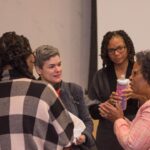
On December 3rd, more than 100 humanities scholars, cultural organizers, educators, and students convened at UMBC to discuss their efforts over the past year to amplify the voices of Baltimore communities and to use narrative as a tool to promote change.
“Reflecting on Baltimore Stories” was the culmination of a year-long series of public programs examining how stories of and about Baltimore influence the lives of its people. UMBC’s Dresher Center for the Humanities hosted the day-long event that considered what is changing in stories of identity in the city and what these changes mean for the future of Baltimore.
Baltimore Stories, made possible by a $225,000 grant from the National Endowment for the Humanities, connected UMBC with partners University of Maryland, College Park (UMCP); Maryland Humanities; Enoch Pratt Free Library; and the Greater Baltimore Cultural Alliance. Sheri Parks, associate dean of UMCP’s Center for Synergy, and Phoebe Stein, executive director of Maryland Humanities, led the effort.
“We so often want to think that personal stories and storytelling are about simple themes, direct connections, and easy understanding of truths,” said Jessica Berman, director of the Dresher Center for the Humanities. But frequently, she suggested, “it’s about complexity. Stories should be complex, and they often are.”
This complexity was a central theme of the Baltimore Stories concluding event, which included panels and roundtable discussions on how public universities engage with their communities, the power of media and collective memory in telling stories about Baltimore, and Baltimore Stories in the context of national discussions.
 WYPR’s Aaron Henkin speaks during Baltimore Stories panel.
Young people from UMBC’s CHOICE Program shared digital stories about their lives, and students from Midtown Academy in Baltimore spoke about the process of learning to write and publish their own creative work about Baltimore. Lee Boot, director of UMBC’s Imaging Research Center, presented Art of Transformation, a project that examines how Baltimoreans are telling their own stories to counteract misleading narratives about life in the city. Denise Meringolo, associate professor of history at UMBC, shared Preserve the Baltimore Uprising, which aims to ensure that the stories activists tell about their experiences are preserved for future historians.
 President Hrabowski participates during Baltimore Stories panel.
Campus leaders from UMBC and UMCP approached the event as an opportunity for reflection. They discussed the genesis of Baltimore Stories and how such projects can help universities more effectively engage with their local communities. President Freeman Hrabowski‘s remarks offered a few examples from UMBC, including the BreakingGround initiative and the university’s leadership through last year’s Imagining America conference.
University collaborations with communities must start with understanding the needs and perspectives of people in those communities, President Hrabowski emphasized. “First, we must ask. Listen, and then act,” he said. “What we work to do here…is to struggle to understand what people are going through, and we often do it through stories.”
Bonnie Thornton Dill, dean of the University of Maryland College of Arts and Humanities, shared how the idea for Baltimore Stories emerged from critical conversations about more complex, nuanced, and interdisciplinary approaches to working with communities.
 Bonnie Thornton Dill speaks during Baltimore Stories.
“We felt that the arts and humanities could bring a perspective and understanding of these issues that was often missing,” explained Dill. “Community engagement is not something that just happens…it’s the building of relationships over time.”
The Baltimore Stories project included 20 public events throughout the past year. During these events, local humanities scholars, cultural organizers, artists, educators and other Baltimore residents participated in dynamic discussions about building democracy, fostering social justice, and improving Baltimore’s future. Project participants are now developing a curriculum based on this work for K-12 educators nationwide.
 Pictured from left to right: UMBC’s Ana Maria Schwartz Caballero, Kathy O’Dell, David Hoffman, and Bev Bickel participate in roundtable during Baltimore Stories.
WombWork Productions, Aaron Henkin’s Out of the Blocks, The Kids Safe Zone, New Lens, and Charm Literary Magazine are just a few of the many organizations that were involved in the Baltimore Stories project and participated at the culminating event, and partners intend to keep the collaboration and conversation going.
 Artwork by Maryland Institute College of Art (MICA) students Ben Hamburger and Justin Stafford on display at Baltimore Stories.
“Now more than ever, it is crucial to consider the role of coalitions, forged across boundaries, in practicing public humanities and supporting the work of active and engaged communities,” said Berman.
For additional coverage of the “Reflecting on Baltimore Stories” event, read “‘Baltimore Stories’ event aims to discuss race, narratives effect” in The Baltimore Sun.
Header image: Baltimore Stories concluding event, December 3, 2016. All photos by Abnet Shiferaw ’11 for UMBC.
]]>
On December 3rd, more than 100 humanities scholars, cultural organizers, educators, and students convened at UMBC to discuss their efforts over the past year to amplify the voices of Baltimore...
https://umbc.edu/stories/baltimore-stories-final-event-focuses-on-listening-to-communities-strengthening-coalitions/
https://dev.my.umbc.edu/api/v0/pixel/news/120922/guest@my.umbc.edu/11bb26fa5421036a1f4f93ceb9b502cb/api/pixel
arts-and-culture
cahss
choiceprogram
community
dreshercenter
engage
history
hrabowski
policy-and-society
UMBC News & Magazine
https://dev.my.umbc.edu/groups/umbc-news-magazine
https://assets1-dev.my.umbc.edu/system/shared/avatars/groups/000/001/943/24435aa6207c452e7bc15cc74b42c7bb/xsmall.png?1748556657
https://assets1-dev.my.umbc.edu/system/shared/avatars/groups/000/001/943/24435aa6207c452e7bc15cc74b42c7bb/original.png?1748556657
https://assets2-dev.my.umbc.edu/system/shared/avatars/groups/000/001/943/24435aa6207c452e7bc15cc74b42c7bb/xxlarge.png?1748556657
https://assets2-dev.my.umbc.edu/system/shared/avatars/groups/000/001/943/24435aa6207c452e7bc15cc74b42c7bb/xlarge.png?1748556657
https://assets3-dev.my.umbc.edu/system/shared/avatars/groups/000/001/943/24435aa6207c452e7bc15cc74b42c7bb/large.png?1748556657
https://assets1-dev.my.umbc.edu/system/shared/avatars/groups/000/001/943/24435aa6207c452e7bc15cc74b42c7bb/medium.png?1748556657
https://assets2-dev.my.umbc.edu/system/shared/avatars/groups/000/001/943/24435aa6207c452e7bc15cc74b42c7bb/small.png?1748556657
https://assets1-dev.my.umbc.edu/system/shared/avatars/groups/000/001/943/24435aa6207c452e7bc15cc74b42c7bb/xsmall.png?1748556657
https://assets2-dev.my.umbc.edu/system/shared/avatars/groups/000/001/943/24435aa6207c452e7bc15cc74b42c7bb/xxsmall.png?1748556657
UMBC News & Magazine
0
0
false
Thu, 08 Dec 2016 16:47:42 -0500
Alumni Awards highlight profound impact, drive, and commitment of UMBC alumni and faculty

The UMBC community gathered in the Linehan Concert Hall on October 6 for a moving ceremony to honor the profound impacts and achievements of nine outstanding Retrievers at the 2016 UMBC Alumni Awards.
“This year’s awardees truly capture the depth of our community,” said John Becker ’01, president of the alumni association. Irina Vishnevetsky ’99, chair of the alumni awards committee, shared, “Each year the number of submitted nominations grows, and each year I am amazed by the incredible accomplishments of UMBC alumni.”
Tulay Adlai, electrical engineering, introduced awardee Vincent Calhoun ’02, Ph.D. electrical engineering, as an excellent teacher and mentor, cutting-edge brain researcher, and “a truly genuine human being.”
 Vince Calhoun, Ph.D. ’02, accepts the award for Outstanding Alumnus in Engineering and Information Technology.
Today, Calhoun serves as one of the youngest distinguished professors at the University of New Mexico. His primary appointment is in electrical and computer engineering, and, known for his interdisciplinary work, he maintains affiliate appointments with biology, computer science, neuroscience, and psychiatry. In accepting the award, Calhoun emphasized the importance of imagination in scientific research and told the students in the audience, “honesty and integrity in your work will make it endure over the long term.”
Award recipient Ian Ralby ’02, modern languages, linguistics, and intercultural communication (MLLI) and M.A. intercultural communication, was a Humanities Scholar and varsity diver at UMBC, and graduated as valedictorian. He went on to earn a law degree at the College of William and Mary and M.Phil. and Ph.D. degrees at the University of Cambridge, before founding I.R. Consilium, a consultancy that advises governments on international law and policy.
Ralby credits his UMBC humanities education for much of his success in international negotiation, remarking, “I learned to pick up on the subtleties of human interaction, in my own culture and across cultures.” He noted that those skills have “frequently been the deciding factor in whether my work has been merely technically proficient or truly successful.” Thomas Field, MLLI, presented Ralby’s remarks, as he was in Finland at an international maritime security conference and unable to return to the U.S. for the ceremony.
Philip Farabaugh, biological sciences, introduced natural sciences awardee Henry Baker ’78, Ph.D. ’84, biological sciences, who serves as Hazel Kitzman Professor of Genetics, professor of surgery, and chair of molecular genetics and microbiology at the University of Florida College of Medicine, and associate director of the University of Florida Genetics Institute. Farabaugh praised Baker for making the “courageous decision” to change the course of his research when “he recognized the clue to understanding human disease lay in determining how people’s genes change during disease.”
Baker, a Catonsville native, has been proud to watch UMBC grow over the years. “UMBC has truly excelled since its beginning in 1966 up to today, and is headed on to an even higher trajectory,” he shared. “From UMBC, you can get anywhere.”
 Left to right: President Hrabowski, Ruby Lu ’94, David Mitch, John Becker ’01.
Social and behavioral sciences awardee Ruby Lu ’94, economics, traveled from Beijing to attend the awards ceremony. After earning a master’s degree in international economics from Johns Hopkins, she co-founded DCM China, a Beijing-based venture capital firm. She has been named one of the top 50 venture capitalists in China by Forbes magazine, 2011–15. Her approach to venture capital is “to invest in companies she thinks will use technology to bring about positive change to society,” shared her nominator, David Mitch, professor and chair of economics. Lu, who came to study at UMBC from China, was a member of the university’s first class of McNair Scholars and reflected on how faculty profoundly impacted her life as teachers, mentors, and friends, at a time when she was far from home and working hard to learn English while preparing for a career.
LaMar Davis, director of The Choice Program at UMBC, referred to this year’s alumni award winner in social work as “a legend.” “If you don’t know who Joe Jones is,” he said, “you’re likely from out of town.”
 Joe Jones ’06 (right), recipient of the award for Outstanding Alumnus in Social Work, shakes hands with LaMar Davis.
Joseph Jones, Jr., ’06, social work, founded the Center for Urban Families in Baltimore City in 1999. The organization has served more than 26,000 Baltimore residents through workforce development and other initiatives, and has placed more than 6,400 in full-time jobs. Jones didn’t intend to get a college degree, but that changed when he met President Hrabowski. At UMBC, Jones shared, he developed “the ability to think about how do we create institutions, how do we move systems forward, how do we agitate in a way that creates change?” That reflection has dramatically benefited the people of Baltimore, shard Davis, noting that through his “steadfast belief and unrelenting drive” Jones has “transformed tens of thousands of lives with impacts that will be felt for generations.”
Tiffany Holmes, MFA ’99, this year’s awardee in visual and performing arts, is now the dean of undergraduate studies at the School of the Art Institute of Chicago. Holmes began her career as a middle school art teacher in Baltimore City and brought her students to tour UMBC’s Imaging Research Center. There, she recalled, “I quickly realized that I was interested in using technology to make art.” After over a decade in the field, she has made a “permanent mark on the canon of this once marginalized and little-understood discipline” and she is known for her “commitment to art that poses unique social challenges,” shared her nominator, Lisa Moren, professor of visual arts.
 Tiffany Holmes, MFA ’99, receives the award in visual and performing arts.
Ellen Hemmerly, executive director of bwtech@UMBC, was thrilled to introduce Tom Sadowski ’89, political science, as the 2016 Distinguished Service awardee. Sadowski, vice chancellor for economic development for the University System of Maryland, “has always valued relationships and supported partnerships, and has a knack for bringing people together and making things happen,” says Hemmerly. “I believe with Tom at the helm, UMBC and other system campuses will lead the nation in supporting innovation and creating knowledge jobs of the future.”
Accepting his award, Sadowski shared that he’s “just a guy who likes to…help solve problems, help people work as a team and achieve collective goals, or simply help people find that better part of themselves and grow.” Sadowski said that he’s particularly valued his relationship with the university over the past three decades because “UMBC leads its students to believe in themselves, and further, to believe there is nothing they cannot accomplish within themselves and within their communities by working together, with passion, and a deep, heartfelt purpose.”
 Galina Madjaroff ’08, M.A. ’11, accepts the Rising Star award from Judah Ronch.
Judah Ronch, dean of the Erickson School, introduced Galina Madjaroff ’08, psychology, M.A. ’11, aging studies, as the Rising Star awardee. Madjaroff serves as undergraduate program director and clinical assistant professor in the Erickson School, whose undergraduate program has grown from almost 400 in 2011 to almost 1,900 today. Ronch noted, “This is really due to the passion, hard work, leadership, and vision that Galina has brought to the program.” In particular, “Her passion is to help society and our students understand the major issues in cybersecurity and tech use for older people,” which has led her to pursue a Ph.D. in human-centered computing at UMBC. Madjaroff says UMBC is special because of the “faculty who are so nurturing, who reach out and take that extra step,” and she is driven to be that supportive mentor to current and future students.
The alumni association honored Kimberly Moffitt, professor of American studies, with the outstanding faculty award for 2016. “Everyone deserves a Dr. Moffitt—someone who shows them the goodness of the world while asking essential follow-up questions to ensure that they never get complacent,” shared her student, Ngeri Nnachi ’11, American studies. “I consider myself blessed to have such a strong, gifted, beautiful woman as my role model.” Accepting her award, Moffit emphasized, “I want to make sure my students know they have voice. And no matter what space they walk into, their voice matters. They matter.”
 Kimberly Moffitt, American studies, accepts the Outstanding Faculty Award.
This focus on impact, commitment, and connection emerged again and again throughout the evening, and for good reason, shared President Freeman Hrabowski. “One measures the impact of a university by the research it produces, the questions it asks, the people who are graduates, and what they do,” Hrabowski said. “People you see on this stage are not just amazingly talented, they are good people who have done great work. I can’t think of anything an educator would want more than that: People who care about others, who strive for excellence, and who never, never, never give up.”
Banner image: From left to right: Freeman Hrabowski, Joseph Jones, Tiffany Holmes, Ruby Lu, Tom Sadowski, Galina Madjaroff, Vince Calhoun, Henry Baker, Kimberly Moffitt, John Becker; all photos by Marlayna Demond ’11 for UMBC.
]]>
The UMBC community gathered in the Linehan Concert Hall on October 6 for a moving ceremony to honor the profound impacts and achievements of nine outstanding Retrievers at the 2016 UMBC Alumni...
https://umbc.edu/stories/alumni-awards-highlight-profound-impact-drive-and-commitment-of-umbc-alumni-and-faculty/
https://dev.my.umbc.edu/api/v0/pixel/news/120983/guest@my.umbc.edu/4c516aaec7dfa6c6826615366831aef1/api/pixel
alumni
americanstudies
arts-and-culture
biology
bwtech
cahss
choiceprogram
cnms
coeit
community
csee
economics
ericksonschool
gerontology
hrabowski
mlli
policy-and-society
psychology
science-and-technology
visualarts
UMBC News & Magazine
https://dev.my.umbc.edu/groups/umbc-news-magazine
https://assets1-dev.my.umbc.edu/system/shared/avatars/groups/000/001/943/24435aa6207c452e7bc15cc74b42c7bb/xsmall.png?1748556657
https://assets1-dev.my.umbc.edu/system/shared/avatars/groups/000/001/943/24435aa6207c452e7bc15cc74b42c7bb/original.png?1748556657
https://assets2-dev.my.umbc.edu/system/shared/avatars/groups/000/001/943/24435aa6207c452e7bc15cc74b42c7bb/xxlarge.png?1748556657
https://assets2-dev.my.umbc.edu/system/shared/avatars/groups/000/001/943/24435aa6207c452e7bc15cc74b42c7bb/xlarge.png?1748556657
https://assets3-dev.my.umbc.edu/system/shared/avatars/groups/000/001/943/24435aa6207c452e7bc15cc74b42c7bb/large.png?1748556657
https://assets1-dev.my.umbc.edu/system/shared/avatars/groups/000/001/943/24435aa6207c452e7bc15cc74b42c7bb/medium.png?1748556657
https://assets2-dev.my.umbc.edu/system/shared/avatars/groups/000/001/943/24435aa6207c452e7bc15cc74b42c7bb/small.png?1748556657
https://assets1-dev.my.umbc.edu/system/shared/avatars/groups/000/001/943/24435aa6207c452e7bc15cc74b42c7bb/xsmall.png?1748556657
https://assets2-dev.my.umbc.edu/system/shared/avatars/groups/000/001/943/24435aa6207c452e7bc15cc74b42c7bb/xxsmall.png?1748556657
UMBC News & Magazine
0
0
false
Fri, 14 Oct 2016 20:36:06 -0400
Community Law in Action honors LaMar Davis, director of The Choice Program, as a 2016 Baltimore Inspiring Voice
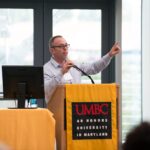
Each year, Community Law in Action (CLIA), an organization dedicated to cultivating the leadership skills of Baltimore youth, honors a select group of individuals who create positive social change and transform the city. LaMar Davis, director of The Choice Program at UMBC, was one of just eight people honored by CLIA during this year’s “Inspiring Voices” award ceremony, held May 10 at the University of Maryland, Baltimore.
During the event, CLIA Executive Director Corryne Deliberto recognized the awardees for dedicating their skills and expertise to serving as positive leaders, role models, and mentors to Baltimore youth who are devoted to making Baltimore a better city.
As a 2016 CLIA Inspiring Voice award winner, Davis was featured in a compelling video produced by CLIA about The Choice Program, a nationally recognized model for community-based intervention that has served more than 25,000 youth and their families from Maryland’s highest risk communities.
 Choice Program Deputy Director Rae Gallagher (l) and LaMar Davis (r) at the 2016 Inspiring Voices Award event
“The Choice Program is UMBC’s response to addressing pressing social issues within Maryland and Baltimore City,” Davis explains in the video, which was screened at the award ceremony. “What we know is that when youth enter into detention facilities, the likelihood that they will enter as an adult goes up exponentially.”
For more than 28 years, The Choice Program has partnered with the Maryland Department of Juvenile Services (DJS) to focus on four areas of intervention: education, employment, family involvement, and community supervision. The program works within high poverty communities in Baltimore City and in Baltimore, Prince George’s, and Montgomery Counties to reduce obstacles impacting youth and family success. Last year, 92% of participating court-involved youth completed the program and were not adjudicated with new charges.
During the CLIA Inspiring Voice award ceremony, Davis shared that the tremendous success of the program over the years has been largely due to an approach that focuses on youth, their families, and the community, supported by 50 AmeriCorps community service-learning fellows. Those fellows provide critical contact, mentoring, and advocacy to young people and their families involved in the juvenile justice and social services systems.
“We bring an approach that says, ‘What are your strengths?’ Youth and families already know what their problems are, but it’s much more difficult for them and for others to really identify what they do well,” said Davis in the video. “We are also looking at how to give young people in Baltimore and Baltimore County an opportunity to get that first job experience, to build a resume, and get some on-the-job experience though our Choice Flying Fruit Café, kiosk, and stand.”
The Choice Jobs Program, which serves 200 local youth each year, expanded earlier this year with the grand opening of Baltimore’s first Flying Fruit Café, located at the University of Baltimore (UB) John and Frances Angelos Law Center.
As UMBC is in the midst of its 50th anniversary celebration year, Davis is optimistic that the program will continue to build on its success, serving even larger numbers of Baltimore youth in the future.
“UMBC and our president, Dr. Freeman Hrabowski, continue to lead the way on how a public university should support its community and commit to being part of the solution,” says Davis. “I am honored to have received this award on behalf of the university, The Choice Program at UMBC, our amazing staff, and AmeriCorps Community Service-Learning Fellows who do the work every day. This award speaks to our program and institution’s inspired commitment.”
Images: (1) LaMar Davis speaks at the 2015 University Retreat. Photo by Marlayna Demond ’11 for UMBC. (2) LaMar Davis receives 2016 Inspiring Voice Award. Photo courtesy of Community Law in Action.
]]>
Each year, Community Law in Action (CLIA), an organization dedicated to cultivating the leadership skills of Baltimore youth, honors a select group of individuals who create positive social change...
https://umbc.edu/stories/lamar-davis-recognized-as-a-2016-baltimore-inspiring-voice-for-his-work-to-create-positive-social-change/
https://dev.my.umbc.edu/api/v0/pixel/news/121120/guest@my.umbc.edu/1465c2eedbe6e5e8c21b138f697b9c38/api/pixel
arts-and-culture
choiceprogram
community
policy-and-society
shrivercenter
staff
umbc50
UMBC News & Magazine
https://dev.my.umbc.edu/groups/umbc-news-magazine
https://assets1-dev.my.umbc.edu/system/shared/avatars/groups/000/001/943/24435aa6207c452e7bc15cc74b42c7bb/xsmall.png?1748556657
https://assets1-dev.my.umbc.edu/system/shared/avatars/groups/000/001/943/24435aa6207c452e7bc15cc74b42c7bb/original.png?1748556657
https://assets2-dev.my.umbc.edu/system/shared/avatars/groups/000/001/943/24435aa6207c452e7bc15cc74b42c7bb/xxlarge.png?1748556657
https://assets2-dev.my.umbc.edu/system/shared/avatars/groups/000/001/943/24435aa6207c452e7bc15cc74b42c7bb/xlarge.png?1748556657
https://assets3-dev.my.umbc.edu/system/shared/avatars/groups/000/001/943/24435aa6207c452e7bc15cc74b42c7bb/large.png?1748556657
https://assets1-dev.my.umbc.edu/system/shared/avatars/groups/000/001/943/24435aa6207c452e7bc15cc74b42c7bb/medium.png?1748556657
https://assets2-dev.my.umbc.edu/system/shared/avatars/groups/000/001/943/24435aa6207c452e7bc15cc74b42c7bb/small.png?1748556657
https://assets1-dev.my.umbc.edu/system/shared/avatars/groups/000/001/943/24435aa6207c452e7bc15cc74b42c7bb/xsmall.png?1748556657
https://assets2-dev.my.umbc.edu/system/shared/avatars/groups/000/001/943/24435aa6207c452e7bc15cc74b42c7bb/xxsmall.png?1748556657
UMBC News & Magazine
0
0
false
Wed, 15 Jun 2016 20:28:36 -0400


