Manav Narendra ’26—Applied mathematician and cancer survivor fueled by support at UMBC and at home
Through a rigorous academic curriculum, service as a tutor, internships, tennis pick-up games, close friendships, and more, Manav Narendra ’26, mathematics and computer science, has made the most of his time at UMBC and built a strong foundation for future success in applied math and related fields. A leukemia survivor, Narendra has adopted a posture of gratitude and resilience, crediting in part his mother’s unwavering support and UMBC’s close-knit community for helping him thrive academically and personally. Here, Narendra reflects on his path to date, the people who shaped it, and the lessons he’s carrying forward.
Q: Why did you choose UMBC and your two degrees?
A: As a QuestBridge Scholar in high school, I was able to apply to select colleges with no application fee and the potential for a full-ride scholarship. In the end, UMBC just felt right—it was the closest to home, and I appreciated the smaller, more intimate community feel. I felt like at a bigger school I could’ve gotten lost in the crowd, but here I could actually stand out. Plus, UMBC gave me a merit scholarship, which mattered a lot coming from a single-parent household.
I’ve always loved math—calculus was my favorite class in high school. I originally planned to double major in math and physics, because I wanted to go into astronomy or astrophysics. But the job outlook seemed stronger for computer science, and I’d enjoyed coding since middle school, so I switched to that. Now I’m leaning toward applied math fields like actuarial science, because I enjoy stochastic (chaotic) process modeling and probability analysis more than pure software development.
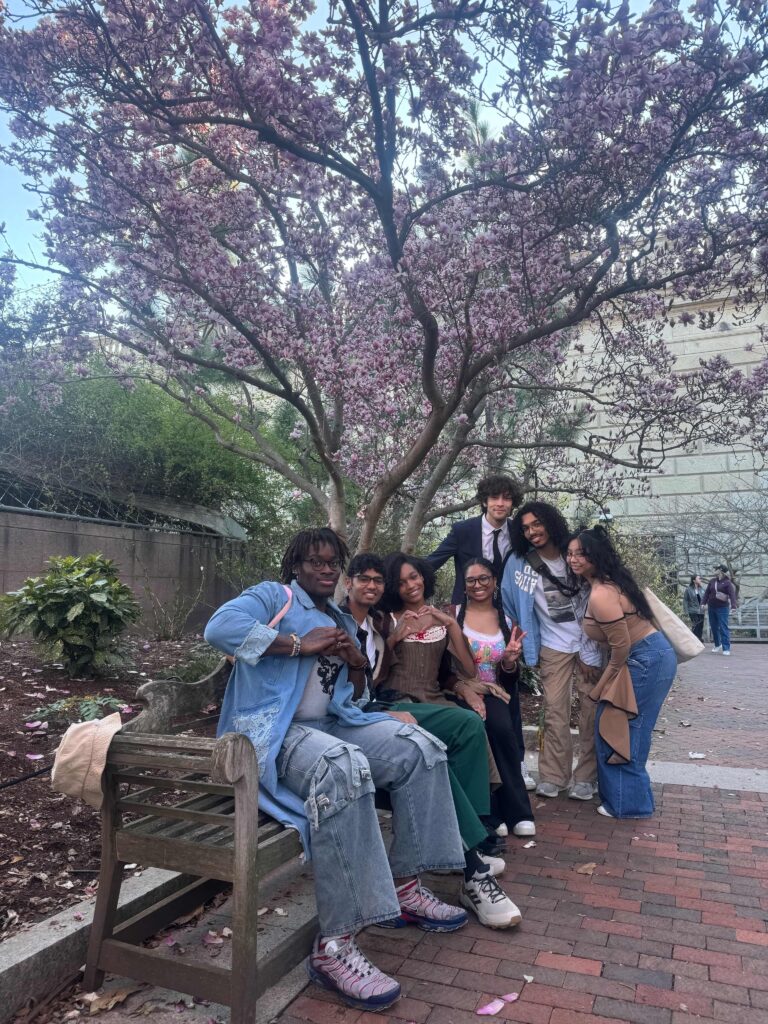
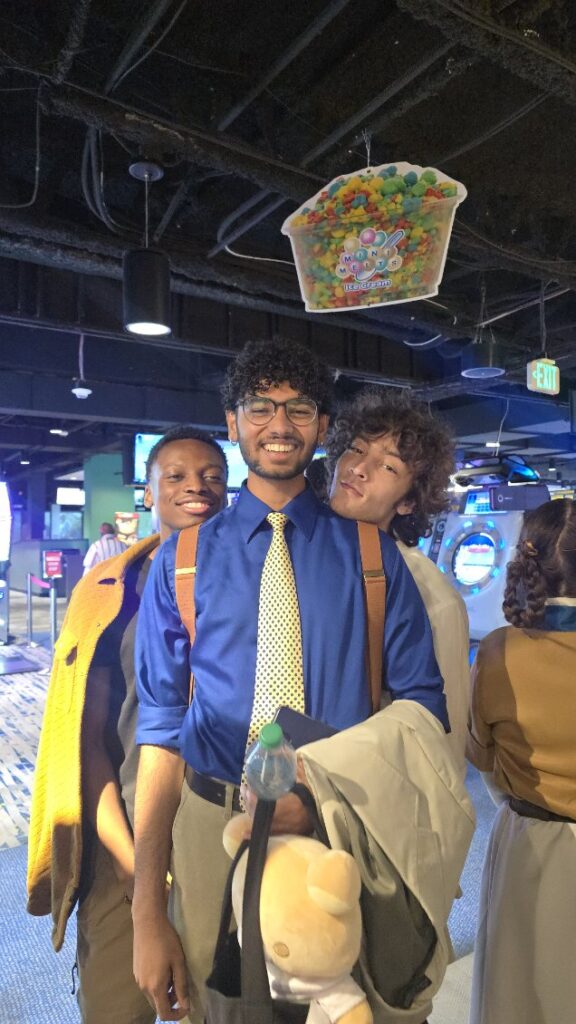 Manav Narendra made friends at UMBC through the discussion and connection possible in smaller classes. (Courtesy of Narendra)
Q: How did your internships enhance your education and influence your career trajectory?
A: I did the same business operations internship at the investor services division of Mitsubishi UFJ Financial Group, where I supported third-party mutual fund administration, twice—after my sophomore and junior years. I’m convinced that talking to company reps in person at the UMBC Career Fair really helped me get the offer. I spent a ton of time in Excel and learned Visual Basic for Applications (VBA), writing programs to automate procedures for other teams at the company. The internship taught me what a corporate environment feels like—being accountable, professional, and how one mistake could have a real effect on production.
The experience was incredibly valuable, even though I don’t think it’s the exact kind of work I want to do long term. I had zero Excel or VBA experience before, and those skills are huge in actuarial work. So even though I realized I want something more independent and creative, the internships gave me practical skills I can take straight into data analysis or actuarial roles. The internships also showed me it’s okay to explore—every experience teaches you something you can carry forward.
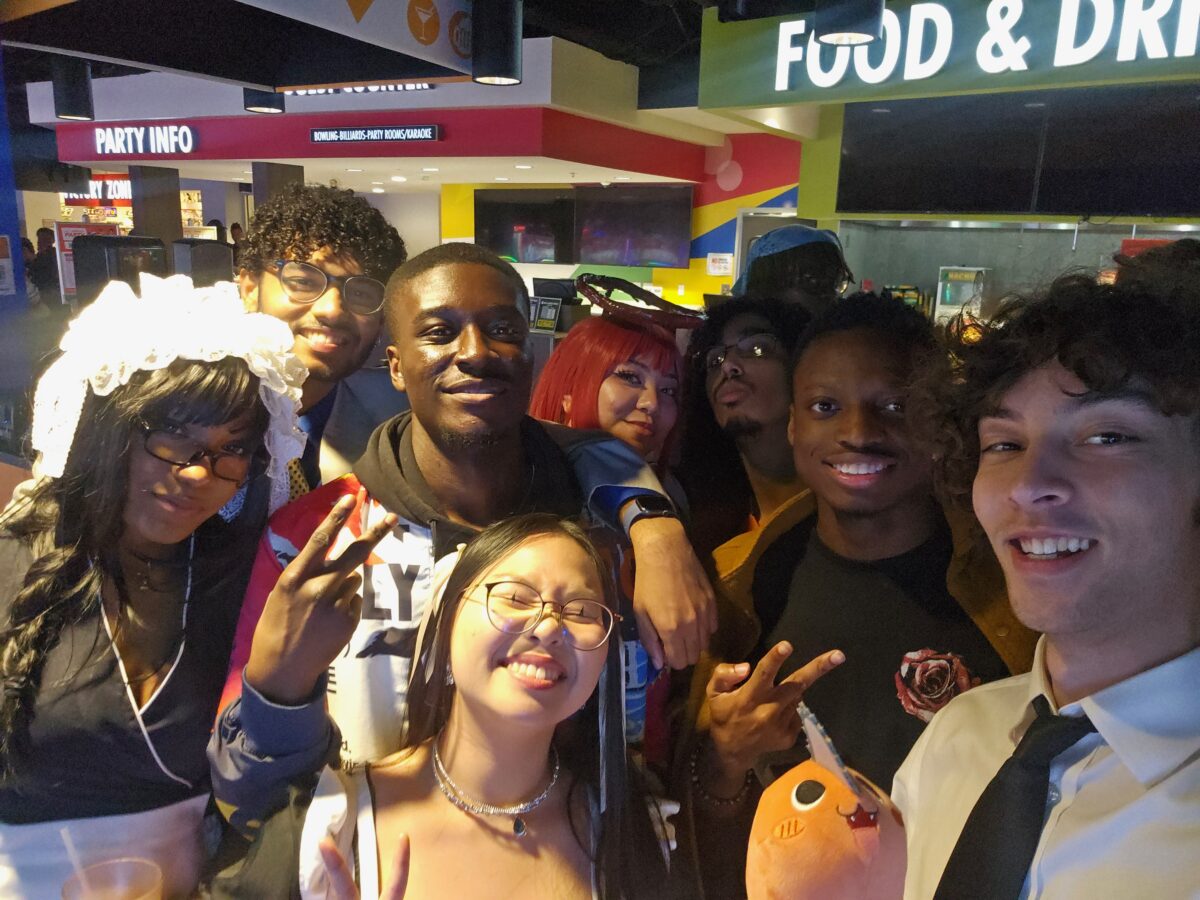 Manav Narendra (back row, left) found plenty of opportunities to spend time with friends despite his demanding academic curriculum. (Courtesy of Narendra)
Q: What’s next for you after graduation?
A: The job market is tough right now, so I’m keeping my options open. I’m considering actuarial positions, data science and analysis, underwriting, even some IT and software roles. I’m open to moving anywhere—I’ve moved a lot in my life, and after five years in Maryland I’m actually getting a little restless!
Certification exams are really important in the fields I want to go into, and I took my first actuarial exam in January. Right now I’m in the Financial Math for Actuaries class at UMBC, which lines up perfectly with the next exam in June. I just want to get my foot in the door somewhere and keep learning.
Q: How have you gotten involved on campus, and how have those experiences supported your well-being and growth?
A: The smaller class sizes at UMBC—especially the 20- to 30-person ones—made everything feel more personal. That’s where I made most of my friends, through connections sparked by real discussion. I also tutored math and Japanese at the Academic Success Center for three years. That was rewarding and kept me grounded.
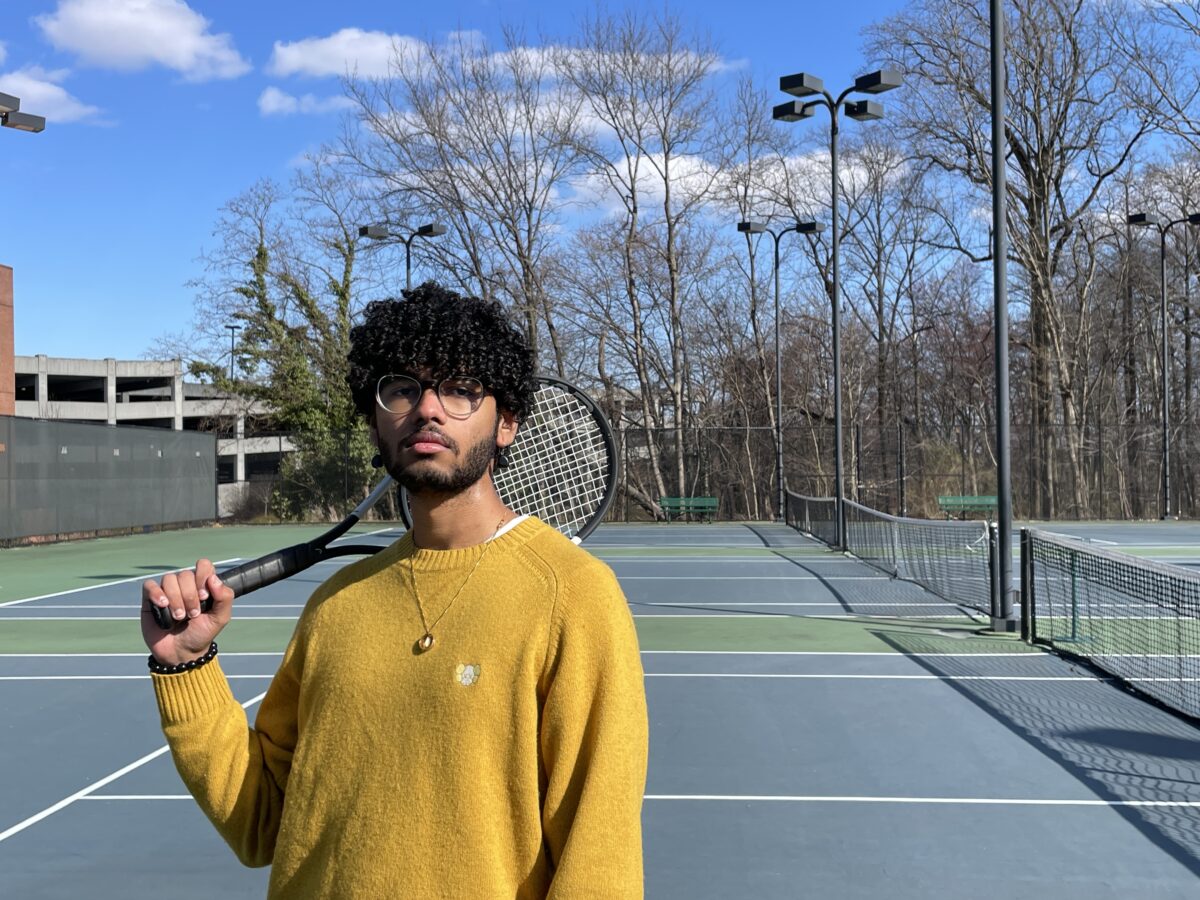 Manav Narendra enjoyed pick-up tennis matches during his time at UMBC. (Courtesy of Narendra)
I’m in the Honors College and the national mathematics honor society, Pi Mu Epsilon, and I just applied to Mu Sigma Rho, the honor society for statistics. My friend is an officer of the Bonsai Club, and I’ve gone to some of their origami and painting events. And I play a lot of pickup tennis—UMBC’s courts are great, and that’s been huge for my physical and mental health and making friends. All of it kept me balanced, especially with a heavy course load to complete both of my degrees in four years.
Q: Who has supported you in your academic and life journey, and what difference has that made?
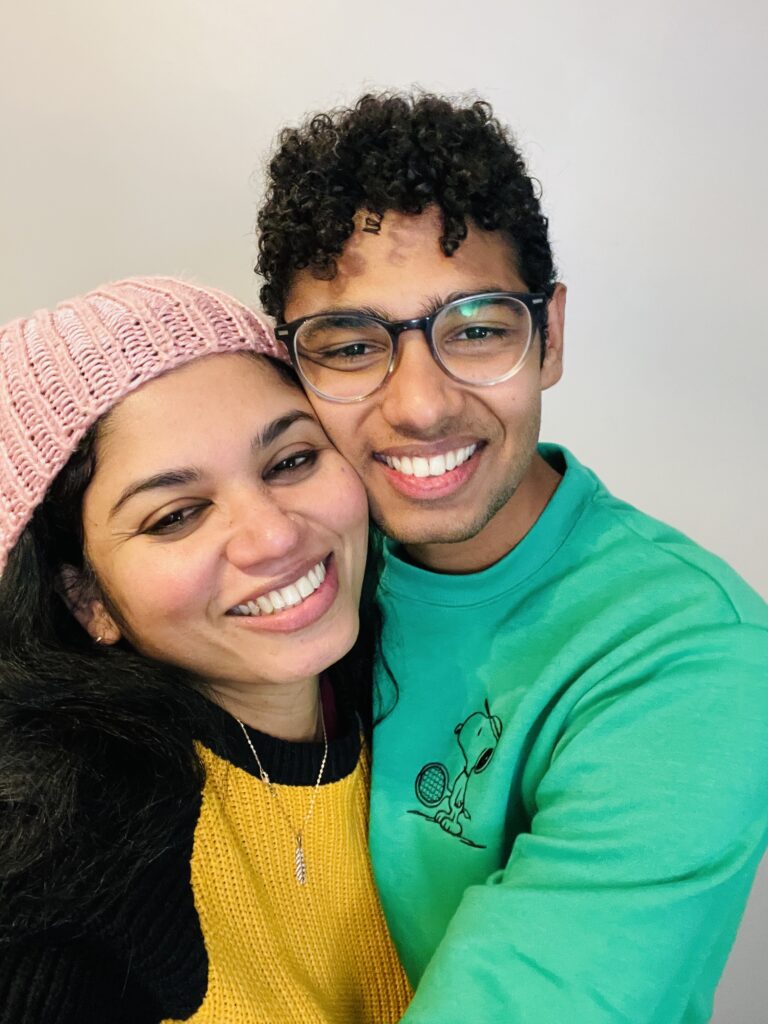 Manav Narendra with his mom, who has provided critical support for him as he underwent cancer treatment and now pursues his professional goals.
A: My mom has been everything. She’s my biggest supporter and my lifelong inspiration, both personally and academically. She stopped working for years to take care of me when I had cancer, getting me to every appointment and advocating for my treatment. I tell people it was much harder for her than for me—I just had to deal with the physical pain, but she handled so much, mentally, emotionally…I wasn’t the brave one during treatment; she was. She’s overcome so much adversity to get me to where I am today, and for that I’m eternally humbled and grateful. Also, at a time in India when women were discouraged from pursuing their dreams and there were large gender disparities in higher education, she embraced her passion for public health and became the first person from her village to earn a doctorate. She later completed a postdoc at Duke—that’s why we first came to the U.S. Her story inspires me every single day to chase after my dreams and always stay true to myself.
At UMBC, Dr. Simon Stacey andDr. Julie Oakes in the Honors College; Dr. Hye-Won Kang and Dr. Kal Nanes in the math department; and pretty much every professor I’ve had have been incredible. They’ve advised me on careers, written recommendation letters, and helped me explore actuarial science. That support made me feel seen and capable.
Q: How did having cancer affect your outlook?
A: When I was 13, I was diagnosed with acute lymphoblastic leukemia (ALL) while we were living in India. The first year of intense chemo was brutal—my brain has blocked out memory of the worst of the agonies. In my debilitated state, I was forced to miss the bulk of 8th grade. Later on, I had GI complications that left me bedridden and using a nasal feeding tube for months, but one silver lining of that time overlapping with the pandemic was that I could join online school right from my bed. Thankfully, I’ve been off treatment since summer 2020, and I’m doing well now. I still have some minor residual issues from treatment—but I’m here!
Cancer gave me resilience. It’s my second chance at life. Challenges that used to feel huge just don’t faze me the same way anymore. That experience put everything in perspective: If I could get through that, I can get through anything. I try to live life to the fullest because of it.
Q: What advice do you have for incoming UMBC students?
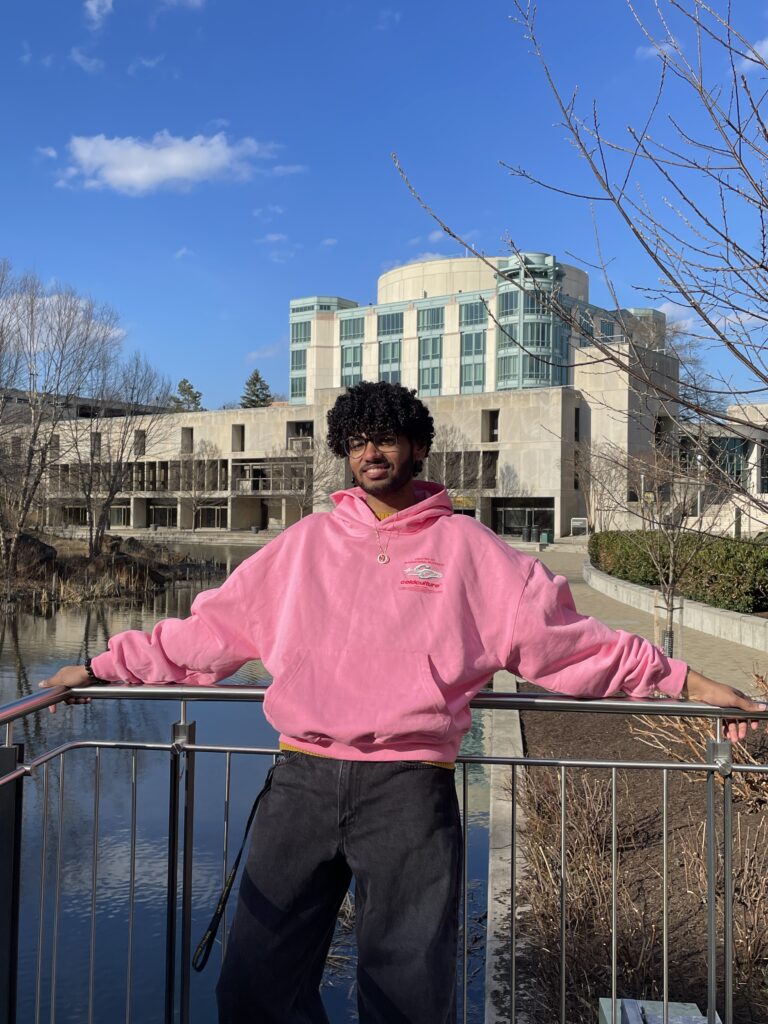 Manav Narendra has come into his own at UMBC, and now he is ready to take on his next chapter. (Courtesy of Narendra)
A: Keep going. Even when things get hard—personal stuff, academics, whatever—just keep moving forward. Break everything into small steps. I’m a serial procrastinator, but I still get everything done by staying consistent with a simple to-do list. Whatever your goal is—an internship, a recital, a competition—just take one small step at a time. Nothing is impossible.
And above all, try to be a good person. I love this Einstein quote: “Try not to become a man of success, but rather try to become a man of value. He is considered successful in our day who gets more out of life than he puts in. But a man of value will give more than he receives.” Be kind. Be empathetic. That matters more than straight As. And UMBC’s community will meet you where you are, and then help you grow, as long as you show up.
]]>
Through a rigorous academic curriculum, service as a tutor, internships, tennis pick-up games, close friendships, and more, Manav Narendra ’26, mathematics and computer science, has made the most...
https://umbc.edu/stories/manav-narendra-mathematician-and-cancer-survivor/
https://dev.my.umbc.edu/api/v0/pixel/news/158897/guest@my.umbc.edu/4e584111e90d8a3ae6e3c320e09c669f/api/pixel
class-of-2026
cnms
coeit
community
csee
mathstat
news
science-and-tech
story
UMBC News & Magazine
https://dev.my.umbc.edu/groups/umbc-news-magazine
https://assets1-dev.my.umbc.edu/system/shared/avatars/groups/000/001/943/24435aa6207c452e7bc15cc74b42c7bb/xsmall.png?1748556657
https://assets1-dev.my.umbc.edu/system/shared/avatars/groups/000/001/943/24435aa6207c452e7bc15cc74b42c7bb/original.png?1748556657
https://assets2-dev.my.umbc.edu/system/shared/avatars/groups/000/001/943/24435aa6207c452e7bc15cc74b42c7bb/xxlarge.png?1748556657
https://assets2-dev.my.umbc.edu/system/shared/avatars/groups/000/001/943/24435aa6207c452e7bc15cc74b42c7bb/xlarge.png?1748556657
https://assets3-dev.my.umbc.edu/system/shared/avatars/groups/000/001/943/24435aa6207c452e7bc15cc74b42c7bb/large.png?1748556657
https://assets1-dev.my.umbc.edu/system/shared/avatars/groups/000/001/943/24435aa6207c452e7bc15cc74b42c7bb/medium.png?1748556657
https://assets2-dev.my.umbc.edu/system/shared/avatars/groups/000/001/943/24435aa6207c452e7bc15cc74b42c7bb/small.png?1748556657
https://assets1-dev.my.umbc.edu/system/shared/avatars/groups/000/001/943/24435aa6207c452e7bc15cc74b42c7bb/xsmall.png?1748556657
https://assets2-dev.my.umbc.edu/system/shared/avatars/groups/000/001/943/24435aa6207c452e7bc15cc74b42c7bb/xxsmall.png?1748556657
UMBC News & Magazine
1
0
false
Fri, 17 Apr 2026 10:19:24 -0400
Fri, 17 Apr 2026 10:19:24 -0400
‘Why do I need to know this?’ Padhu Seshaiyer, Ph.D. ’98, on why math matters
More than 20 years ago, Padmanabhan “Padhu” Seshaiyer, Ph.D. ’98, applied mathematics, observed researchers stretching aneurysm tissue samples in a neighboring lab, generating a dataset to describe the resilience of artery walls under varying conditions. Those mathematical computations could then be used to help doctors predict how likely an aneurysm in a patient’s artery was to rupture and choose the safest effective treatment—potentially saving lives.
For Seshaiyer, that exposure was a revelation. “Mathematics has a place to change people’s lives,” he realized. Today, as a professor of mathematical sciences at George Mason University (GMU), he directs the Center for Outreach in Mathematics Professional Learning and Educational Technology (COMPLETE). Previously, he also directed the STEM Accelerator Program for the College of Science at GMU, where he later served as associate dean for academic affairs. Both initiatives embody his mission: reform STEM education so every student experiences that same powerful connection to real-world impact.
Learning from mistakes
Seshaiyer grew up in India, earning a bachelor’s degree in electrical and electronics engineering and a master’s in mathematics. He loved math but, like many kids, kept asking, “Why do I need to know this?” Seeking applied graduate programs abroad, he chose UMBC in 1993 for its strong faculty and focus on applied math research—plus a presidential scholarship that made it possible. “UMBC had some really top-notch professors, and in particular, really good people doing applied mathematics,” he recalls.
At UMBC, mentors lit Seshaiyer’s path in research and teaching. With Manil Suri, professor of mathematics,he studied finite element methods, which break a complex problem into many simple pieces, solve each separately, then combine the results to approximate the behavior of the whole. His scholarship didn’t require him to teach, but he pursued classroom opportunities anyway to enrich his experience—which they certainly did. For example, “four into eight” means multiplication in Indian English, but division to American students. “Unless you’re in front of the classroom, make that mistake, and learn from it—well, that’s how you become a good teacher,” he reflects.
From “how” to “why”
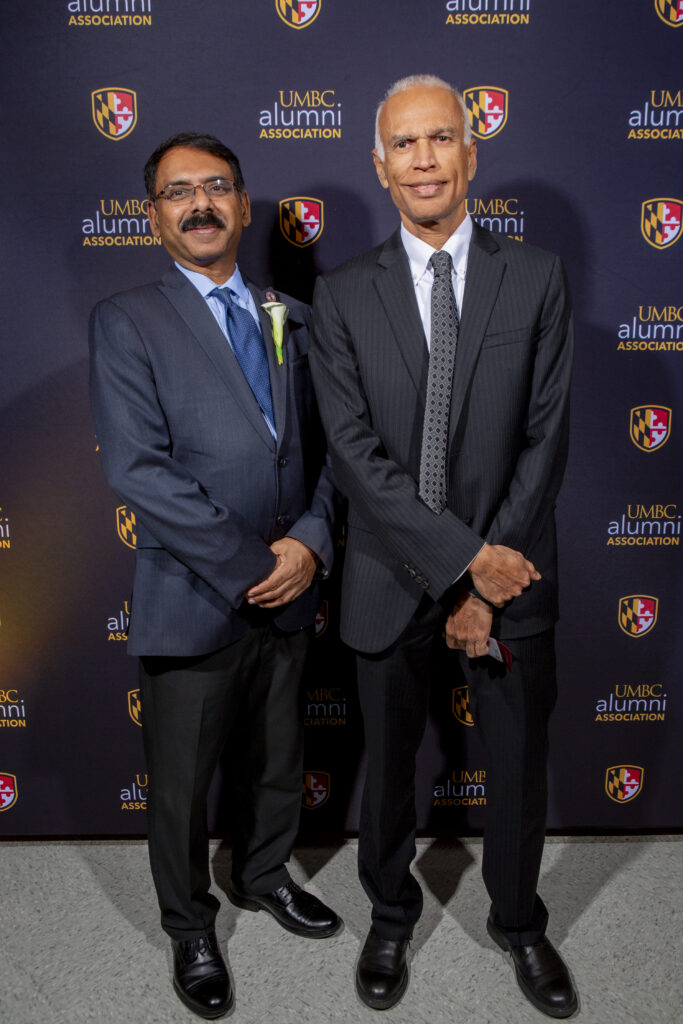 Padmanabhan Seshaiyer (left) with Manil Suri, one of his UMBC mentors, at the 2024 UMBC Alumni Awards. (Photo by Jill Fannon, M.F.A. ’11)
A course with former UMBC engineering professor Jay Humphrey exposed Seshaiyer to biomechanics. Impressed, Humphrey later recruited him for a postdoctoral position at Texas A&M University. It was there that Seshaiyer observed the aneurysm experiments that sparked his pivot to education reform. Traditional teaching, he had seen, often skipped the “why,” leaving students disengaged.
“There was a gap,” he says, “between understanding how to do the mathematics and the why.” That idea inspired him to found the COMPLETE Center, which has trained over 2,500 teachers since 2010 in blending procedural skills with conceptual understanding. The training is grounded in evidence-based pedagogy, such as the 5E instructional model: engage, explore, explain, elaborate, and evaluate.
“Students are not just consumers of mathematics,” Seshaiyer emphasizes. “They are producers of mathematics. It’s important to treat them as producers.” He starts lessons by making connections to real life. When teaching conic sections—the various cross-section shapes created if one slices through a cone—he begins with GPS satellites, which draw intersecting circles to pinpoint a location: “Now, I just told you why we need to learn what we’re learning.”
UMBC has emphasized this same shift toward relevance and active discovery in its own curriculum. MATH 110: Math in Action, launched in fall 2023, is a lab-based class for non-STEM majors that replaces traditional lectures with hands-on experiments—such as tracking brine shrimp movement to explore velocity or using clinometers to measure real-world heights—to demonstrate how math permeates everyday life. By encouraging students to investigate, analyze data, and forge their own connections, the course helps transform math anxiety into curiosity and shows that understanding the “why” can make the subject engaging and empowering for all learners.
Student-led discovery
Seshaiyer has realized that reforming mathematics education at the college level is insufficient, though. As chair of Virginia’s STEM Advisory Board, he spearheaded the state’s first K – 12 data science standards, in part responding to employer demands for a data science-ready workforce. Data science sits at the intersection of statistical reasoning, mathematical foundations, and computational thinking and may not carry the emotional baggage that straight-up “math” does for some students, Seshaiyer explains.
In Virginia’s data science curricula, students follow a hands-on cycle: acquire data, process it, visualize trends, generate a model, use it to predict future results, and communicate the findings. Students often get to choose their own projects, which have included everything from river pollution to rates of depression among high schoolers.
The process follows a framework Seshaiyer developed called the “five Cs.” It starts with “context” (a real-world problem), followed by creating a meaningful “curriculum” that incorporates integrated “content” presented via effective teaching “concepts.” Throughout the process, the teacher cultivates student “competencies” including communication skills, collaboration, critical thinking, and creativity.
Sometimes, the best thing a teacher can do to foster these skills is step away: A high school student interested in modeling the spread of Zika virus was in Seshaiyer’s office when an undergraduate student arrived who was interested in gang violence in Puerto Rico. Seshaiyer stepped out (ostensibly for a cup of coffee) and encouraged the two to discuss their ideas. When he returned, the two students had come up with modes of gang violence “transmission” that paralleled the ways Zika spreads. The research eventually yielded a published paper on which both students were co-authors.

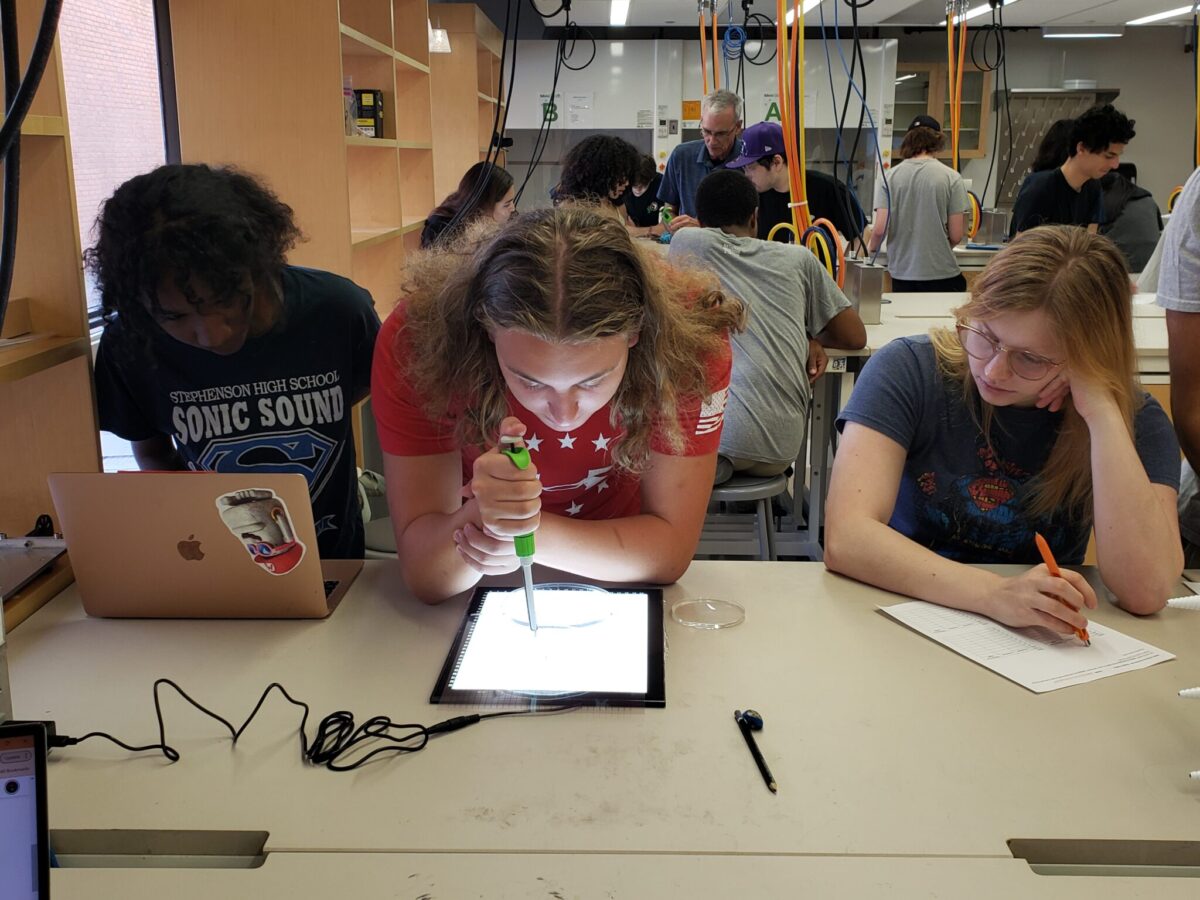 Left: Students in the Building STEPs program run a trial in a lab activity about potential and kinetic energy. (Photo by Brad Ziegler/UMBC) Right: Students in MATH 110: Math in Action record the movements of brine shrimp. (Photo by Sarah Hansen, M.S. ’15/UMBC)
“Mathematics for impact”
Seshaiyer’s experiences at UMBC remain foundational, including a personal relationship with president emeritus (and fellow mathematician) Freeman Hrabowski, with whom he’s shared the stage for keynote addresses. “UMBC has definitely taught me so much,” says Seshaiyer, who received a 2024 Outstanding Alumni Award from the UMBC Alumni Association Board of Directors.
Recently nominated for Virginia’s Math Educator of the Year, his core passion—“mathematics for impact”—endures. UMBC is extending that same impact into K – 12 classrooms through strategic partnerships with Baltimore City high schools. A longstanding collaboration with Building STEPs brings MATH 110-style hands-on labs to rising seniors, helping build math confidence and real-world connections.
Newer partnerships, such as with the Ingenuity Project at Baltimore Polytechnic Institute, include hosting campus visits for students and professional development for teachers and supporting student research in math modeling. These efforts create pipelines for engaged, math-ready learners—proving that when institutions meet students where they are, math can be an exciting path forward rather than an obstacle to overcome.
]]>
More than 20 years ago, Padmanabhan “Padhu” Seshaiyer, Ph.D. ’98, applied mathematics, observed researchers stretching aneurysm tissue samples in a neighboring lab, generating a dataset to...
https://umbc.edu/stories/seshaiyer-why-math-matters/
https://dev.my.umbc.edu/api/v0/pixel/news/155833/guest@my.umbc.edu/418e3482bd412f305fede66cd1b8fb9a/api/pixel
alumni
cnms
mathstat
news
science-and-tech
story
UMBC News & Magazine
https://dev.my.umbc.edu/groups/umbc-news-magazine
https://assets1-dev.my.umbc.edu/system/shared/avatars/groups/000/001/943/24435aa6207c452e7bc15cc74b42c7bb/xsmall.png?1748556657
https://assets1-dev.my.umbc.edu/system/shared/avatars/groups/000/001/943/24435aa6207c452e7bc15cc74b42c7bb/original.png?1748556657
https://assets2-dev.my.umbc.edu/system/shared/avatars/groups/000/001/943/24435aa6207c452e7bc15cc74b42c7bb/xxlarge.png?1748556657
https://assets2-dev.my.umbc.edu/system/shared/avatars/groups/000/001/943/24435aa6207c452e7bc15cc74b42c7bb/xlarge.png?1748556657
https://assets3-dev.my.umbc.edu/system/shared/avatars/groups/000/001/943/24435aa6207c452e7bc15cc74b42c7bb/large.png?1748556657
https://assets1-dev.my.umbc.edu/system/shared/avatars/groups/000/001/943/24435aa6207c452e7bc15cc74b42c7bb/medium.png?1748556657
https://assets2-dev.my.umbc.edu/system/shared/avatars/groups/000/001/943/24435aa6207c452e7bc15cc74b42c7bb/small.png?1748556657
https://assets1-dev.my.umbc.edu/system/shared/avatars/groups/000/001/943/24435aa6207c452e7bc15cc74b42c7bb/xsmall.png?1748556657
https://assets2-dev.my.umbc.edu/system/shared/avatars/groups/000/001/943/24435aa6207c452e7bc15cc74b42c7bb/xxsmall.png?1748556657
UMBC News & Magazine
0
0
false
Thu, 22 Jan 2026 14:19:08 -0500
Thu, 22 Jan 2026 14:19:08 -0500
CNMS GradFest fosters research connections and builds community
On November 7, graduate students and postdoctoral researchers from the College of Natural and Mathematical Sciences (CNMS) gathered for the college’s second annual CNMS GradFest.
Prableen Chowdhary, Ph.D. ’24, biological sciences, currently a postdoc with Rachel Brewster, professor of biological sciences, and a member of the student-led planning committee, expressed hope that GradFest would “spark conversations and collaborations across disciplines.”
CNMS dean William LaCourse offered advice to attendees as the program kicked off. “Whatever you do in life, do it with all your heart. If you’re doing research, do it like you own it,” he said. “Live in the present and seize opportunities. Enjoy every moment, like this moment today. You can’t change yesterday; when I make mistakes, I’m grateful for grace and forgiveness. And you can plan for tomorrow, but you can’t control it.”
 Prableen Chowdhary (left) and Hasan Al Banna, CNMS GradFest’s two emcees, welcome attendees to the event. (Brad Ziegler/UMBC)
Following the introductions, seven students presented “lightning talks,” five-minute presentations describing their research in engaging, accessible terms for those outside their field. The talks featured students in biological sciences, physics, chemistry and biochemistry, marine biotechnology, and mathematics and statistics. They discussed topics like novel therapeutic targets for ovarian cancer, innovative two-dimensional materials for improved sensors, and previously unobserved plasma jets from black holes.
GradFest as a stepping stone
“Part of our goal was to intentionally include graduate students with less presentation experience or early-stage projects,” shared Maria Cambraia, director for research and international affairs in CNMS, and lead staff member on the planning committee. “GradFest gives them a chance to practice in a friendly environment.”
 Lightning talk presenters and CNMS GradFest planning committee members worked hard to make the event a success. Rear, left to right: Maria Cambraia, Lara Scott, Andrew Wolff, Sean Ravel, Peng Yan, Codi Hrynko, Jalil Ahmad. Front, left to right: Prableen Chowdhary, Lizbeth Joy Tan, Megha Pandya, Ronita Sequeira, Hasan Al Banna. Planning committee members not pictured: Ayo Ogunsanya, Elana Frazier, Jeanne Ngo. (Brad Ziegler/UMBC)
Following the talks, the ballroom buzzed during two poster sessions, where dozens more students discussed their projects with peers, mentors, and guests. GradFest encouraged presentations of research at all stages of development.
Muhammad Jalil Ahmad, president of the Mathematics and Statistics Graduate Student Association and a planning committee member, presented a lightning talk and poster on mathematical modeling for complex phenomena like weather or disease spread.
Ahmad, a fourth-year applied mathematics Ph.D. candidate mentored by Animikh Biswas and Kathleen Hoffman, professors of mathematics, agreed. “Presenting at GradFest is useful before heading to a bigger stage, like a national meeting,” he said. “Even at a math conference, people are studying different topics, so it’s good to practice communicating with people outside your field.” He added that GradFest offers the opportunity to network with researchers using similar methods for different applications.

 Muhammad Jalil Ahmad (left) and Lara Scott (right), Ph.D. students in mathematics, presented lightning talks at GradFest. (Brad Ziegler/UMBC)
Ian Kirn ’23, physics, a second-year physics Ph.D. student, presented a poster on astroseismology, which investigates earthquake-like phenomena on stars. Kirn chose to pursue his Ph.D. with Eileen Meyer, professor of physics, after doing undergraduate research with her. “It’s important for different disciplines to talk to each other, because they’re actually all related,” Kirn says. “This event encourages collaboration.”
Fidelia Asomani, a third-year biological sciences Ph.D. candidate working with Erin Green, associate professor of biological sciences, called GradFest “a good first opportunity to get my feet wet presenting.” Asomani studies yeast, which shares basic functions with complex organisms. “It’s important to invest in studying processes conserved across species,” she says, which can inform human disease treatment.

 Ian Kirn (left) discussed his astroseismology research, and Fidelia Asomani (right) explains her research on protein regulation in yeast, with GradFest attendees. (Brad Ziegler/UMBC)
The humble heart of a scientist
LaCourse also encouraged embracing humility. “By remembering you won’t always be the best, humility helps you celebrate others’ successes and accept failure—and research involves a lot of failure,” he said. “Humility is a path you walk, not a trait you innately possess, and it leads to learning, growth, and respect.”
By late afternoon, GradFest had turned strangers into collaborators, boosted first-time presenters’ confidence, and made the ballroom a launchpad for breakthroughs. Attendees left with new contacts and the dean’s words in their hearts—proof that bold discoveries can begin with a humble “hello.”
Learn more about graduate programs in CNMS.
]]>
On November 7, graduate students and postdoctoral researchers from the College of Natural and Mathematical Sciences (CNMS) gathered for the college’s second annual CNMS GradFest. Prableen...
https://umbc.edu/stories/cnms-gradfest-2025/
https://dev.my.umbc.edu/api/v0/pixel/news/154570/guest@my.umbc.edu/e98c847e7012a2b534bab5add27d1f0c/api/pixel
biology
chembiochem
cnms
community
gradresearch
graduateschool
marinebiotech
mathstat
news
physics
science-and-tech
story
UMBC News & Magazine
https://dev.my.umbc.edu/groups/umbc-news-magazine
https://assets1-dev.my.umbc.edu/system/shared/avatars/groups/000/001/943/24435aa6207c452e7bc15cc74b42c7bb/xsmall.png?1748556657
https://assets1-dev.my.umbc.edu/system/shared/avatars/groups/000/001/943/24435aa6207c452e7bc15cc74b42c7bb/original.png?1748556657
https://assets2-dev.my.umbc.edu/system/shared/avatars/groups/000/001/943/24435aa6207c452e7bc15cc74b42c7bb/xxlarge.png?1748556657
https://assets2-dev.my.umbc.edu/system/shared/avatars/groups/000/001/943/24435aa6207c452e7bc15cc74b42c7bb/xlarge.png?1748556657
https://assets3-dev.my.umbc.edu/system/shared/avatars/groups/000/001/943/24435aa6207c452e7bc15cc74b42c7bb/large.png?1748556657
https://assets1-dev.my.umbc.edu/system/shared/avatars/groups/000/001/943/24435aa6207c452e7bc15cc74b42c7bb/medium.png?1748556657
https://assets2-dev.my.umbc.edu/system/shared/avatars/groups/000/001/943/24435aa6207c452e7bc15cc74b42c7bb/small.png?1748556657
https://assets1-dev.my.umbc.edu/system/shared/avatars/groups/000/001/943/24435aa6207c452e7bc15cc74b42c7bb/xsmall.png?1748556657
https://assets2-dev.my.umbc.edu/system/shared/avatars/groups/000/001/943/24435aa6207c452e7bc15cc74b42c7bb/xxsmall.png?1748556657
UMBC News & Magazine
2
0
false
Fri, 14 Nov 2025 15:37:10 -0500
Fri, 14 Nov 2025 15:37:10 -0500
Who is AI for? Eric Stokan receives USM professorship to address barriers and promote AI equity for students and faculty
For tech-savvy individuals like Eric Stokan, artificial intelligence, programming languages, and open-source software are powerful tools that can turn once-impossible ideas into reality. Researchers can use human language processing to analyze historical documents or legal texts. Through collaborative platforms, global organizations can collaborate quickly without incurring travel costs. In the social sciences, open-source tools provide students with unique opportunities to work with experts developing projects that address community needs. However, to take full advantage of these revolutionary technologies, these tools often require advanced computing skills or access to expensive software, which can limit their impact and exclude those without the necessary resources or training.
Stokan, director of the Center for Social Science Scholarship (CS3), is committed to removing these barriers for faculty and students in computational social science, which uses computers, data, and algorithms to study human behavior and social systems. His research lies at the intersection of urban policy, economic development, and computational social science, with a focus on how local governments make policy decisions and how those decisions impact equity, economic growth, and environmental sustainability.
The University System of Maryland (USM) William E. Kirwan Center for Academic Innovation has awarded Stokan the Elkins Professorship for Academic Transformation to address this gap with his project “Computational Social Science and Generative AI: Scalable, Modular Training for Teaching, Research, and Public Impact.”

The Elkins Professorship is named after Wilson H. Elkins, a former Rhodes Scholar and president of the University of Maryland, College Park from 1954 to 1978. This prestigious award is for faculty within USM who are working on innovative projects focused on the use of generative AI to advance academic transformation, foster improvements in access, affordability, quality of outcomes, and/or stewardship of people’s time, money, and other scarce resources.
 Stokan’s examples of the R open-source programming language.
“The professorship will allow me, through the Center for Social Science Scholarship, to first assist faculty and students in understanding how to leverage advances in computing and AI to address new research questions and scale their research in ways that were unfathomable during Dr. Elkins tenure,” says Stokan, associate professor of political science, who earned one of three $10,000 awards. He will use the funding to complete Computational Public Administration—his first book written with R, a free programming language used for statistical computing and graphics—about computational social science methods focused on addressing public policy and administration topics, such as climate change and economic development.
The funding will also support the design and implementation of five hands-on training modules and workshops tailored for faculty, students, and community organizations. Participants will learn to use generative AI large language models (LLM) like ChatGPT and R. The goal is to help participants answer novel and important research questions, develop marketable technical skills, to work more effectively with data, and better communicate the results of their analyses with the broader community.

 Left: Codi Hrynko, Ph.D. ’29, chemistry, and Sarah Lanasa, Ph.D. ’25, environmental engineering work together. Right: Nagaraj Neerchal, professor of statistics, at the first workshop series on AI, LLMs, and computational methods.
“I am deeply honored to receive the Elkins Professorship, in honor of the late Wilson H. Elkins, who was a transformational leader, administrator, and educator,” says Stokan. “This award is important to me because it not only provides support but also affirms my commitment to accommodating learners at all levels of experience in computational social sciences, promoting accessibility, equity, and methodological transparency.”
Initial support for the project came from the UMBC’s Faculty Development Center, the AOK Library’s Digital Scholarship Services, iHARP/Data Science Scholars, and the Institute for Public Leadership at the University of Maryland, College Park.
The workshops will be offered through CS3 in collaboration with CGC-SCIPE, the UMBC Division of Information Technology, and ScaleS. A lecture series component, which will include external speakers, is being co-sponsored with the Department of English, the Department of Sociology, Anthropology, and Public Health, and the Department of Modern Languages, Linguistics, and Intercultural Communications.
Register for the fall semester’s workshop series on AI, LLMs, and computational methods.
]]>
For tech-savvy individuals like Eric Stokan, artificial intelligence, programming languages, and open-source software are powerful tools that can turn once-impossible ideas into reality....
https://umbc.edu/stories/eric-stokan-elkins-professorship/
https://dev.my.umbc.edu/api/v0/pixel/news/153447/guest@my.umbc.edu/bbab2ee0a08b4098a167cd53ca08b643/api/pixel
cahss
cahss-research
cbee
cs3
doit
english
mathstat
mlli
news
politicalscience
research
saph
science-and-tech
story
UMBC News & Magazine
https://dev.my.umbc.edu/groups/umbc-news-magazine
https://assets1-dev.my.umbc.edu/system/shared/avatars/groups/000/001/943/24435aa6207c452e7bc15cc74b42c7bb/xsmall.png?1748556657
https://assets1-dev.my.umbc.edu/system/shared/avatars/groups/000/001/943/24435aa6207c452e7bc15cc74b42c7bb/original.png?1748556657
https://assets2-dev.my.umbc.edu/system/shared/avatars/groups/000/001/943/24435aa6207c452e7bc15cc74b42c7bb/xxlarge.png?1748556657
https://assets2-dev.my.umbc.edu/system/shared/avatars/groups/000/001/943/24435aa6207c452e7bc15cc74b42c7bb/xlarge.png?1748556657
https://assets3-dev.my.umbc.edu/system/shared/avatars/groups/000/001/943/24435aa6207c452e7bc15cc74b42c7bb/large.png?1748556657
https://assets1-dev.my.umbc.edu/system/shared/avatars/groups/000/001/943/24435aa6207c452e7bc15cc74b42c7bb/medium.png?1748556657
https://assets2-dev.my.umbc.edu/system/shared/avatars/groups/000/001/943/24435aa6207c452e7bc15cc74b42c7bb/small.png?1748556657
https://assets1-dev.my.umbc.edu/system/shared/avatars/groups/000/001/943/24435aa6207c452e7bc15cc74b42c7bb/xsmall.png?1748556657
https://assets2-dev.my.umbc.edu/system/shared/avatars/groups/000/001/943/24435aa6207c452e7bc15cc74b42c7bb/xxsmall.png?1748556657
UMBC News & Magazine
0
0
false
Thu, 09 Oct 2025 17:19:07 -0400
Thu, 09 Oct 2025 17:19:07 -0400
Who is AI for? Eric Stokan receives USM professorship to address barriers and promote AI equity for students and faculty
For tech-savvy individuals like Eric Stokan, artificial intelligence, programming languages, and open-source software are powerful tools that can turn once-impossible ideas into reality. Researchers can use human language processing to analyze historical documents or legal texts. Through collaborative platforms, global organizations can collaborate quickly without incurring travel costs. In the social sciences, open-source tools provide students with unique opportunities to work with experts developing projects that address community needs. However, to take full advantage of these revolutionary technologies, these tools often require advanced computing skills or access to expensive software, which can limit their impact and exclude those without the necessary resources or training.
Stokan, director of the Center for Social Science Scholarship (CS3), is committed to removing these barriers for faculty and students in computational social science, which uses computers, data, and algorithms to study human behavior and social systems. His research lies at the intersection of urban policy, economic development, and computational social science, with a focus on how local governments make policy decisions and how those decisions impact equity, economic growth, and environmental sustainability.
The University System of Maryland (USM) William E. Kirwan Center for Academic Innovation has awarded Stokan the Elkins Professorship for Academic Transformation to address this gap with his project “Computational Social Science and Generative AI: Scalable, Modular Training for Teaching, Research, and Public Impact.”
The Elkins Professorship is named after Wilson H. Elkins, a former Rhodes Scholar and president of the University of Maryland, College Park from 1954 to 1978. This prestigious award is for faculty within USM who are working on innovative projects focused on the use of generative AI to advance academic transformation, foster improvements in access, affordability, quality of outcomes, and/or stewardship of people’s time, money, and other scarce resources.
Stokan’s examples of the R open-source programming language.
“The professorship will allow me, through the Center for Social Science Scholarship, to first assist faculty and students in understanding how to leverage advances in computing and AI to address new research questions and scale their research in ways that were unfathomable during Dr. Elkins tenure,” says Stokan, associate professor of political science, who earned one of three $10,000 awards. He will use the funding to complete Computational Public Administration—his first book written with R, a free programming language used for statistical computing and graphics—about computational social science methods focused on addressing public policy and administration topics, such as climate change and economic development.
The funding will also support the design and implementation of five hands-on training modules and workshops tailored for faculty, students, and community organizations. Participants will learn to use generative AI large language models (LLM) like ChatGPT and R. The goal is to help participants answer novel and important research questions, develop marketable technical skills, to work more effectively with data, and better communicate the results of their analyses with the broader community.
Left: Codi Hrynko, Ph.D. ’29, chemistry, and Sarah Lanasa, Ph.D. ’25, environmental engineering work together. Right: Nagaraj Neerchal, professor of statistics, at the first workshop series on AI, LLMs, and computational methods.
“I am deeply honored to receive the Elkins Professorship, in honor of the late Wilson H. Elkins, who was a transformational leader, administrator, and educator,” says Stokan. “This award is important to me because it not only provides support but also affirms my commitment to accommodating learners at all levels of experience in computational social sciences, promoting accessibility, equity, and methodological transparency.”
Initial support for the project came from the UMBC’s Faculty Development Center, the AOK Library’s Digital Scholarship Services, iHARP/Data Science Scholars, and the Institute for Public Leadership at the University of Maryland, College Park.
The workshops will be offered through CS3 in collaboration with CGC-SCIPE, the UMBC Division of Information Technology, and ScaleS. A lecture series component, which will include external speakers, is being co-sponsored with the Department of English, the Department of Sociology, Anthropology, and Public Health, and the Department of Modern Languages, Linguistics, and Intercultural Communications.
Register for the fall semester’s workshop series on AI, LLMs, and computational methods.
]]>
For tech-savvy individuals like Eric Stokan, artificial intelligence, programming languages, and open-source software are powerful tools that can turn once-impossible ideas into reality....
https://umbc.edu/stories/eric-stokan-usm-professorship-ai-access/
https://dev.my.umbc.edu/api/v0/pixel/news/153456/guest@my.umbc.edu/c3599eb85a6c2ad8fd93f23e15267920/api/pixel
cahss
cahss-research
cbee
coeit
cs3
doit
english
graduate-school
mathstat
mlli
news
politicalscience
research
saph
science-and-tech
story
UMBC News & Magazine
https://dev.my.umbc.edu/groups/umbc-news-magazine
https://assets1-dev.my.umbc.edu/system/shared/avatars/groups/000/001/943/24435aa6207c452e7bc15cc74b42c7bb/xsmall.png?1748556657
https://assets1-dev.my.umbc.edu/system/shared/avatars/groups/000/001/943/24435aa6207c452e7bc15cc74b42c7bb/original.png?1748556657
https://assets2-dev.my.umbc.edu/system/shared/avatars/groups/000/001/943/24435aa6207c452e7bc15cc74b42c7bb/xxlarge.png?1748556657
https://assets2-dev.my.umbc.edu/system/shared/avatars/groups/000/001/943/24435aa6207c452e7bc15cc74b42c7bb/xlarge.png?1748556657
https://assets3-dev.my.umbc.edu/system/shared/avatars/groups/000/001/943/24435aa6207c452e7bc15cc74b42c7bb/large.png?1748556657
https://assets1-dev.my.umbc.edu/system/shared/avatars/groups/000/001/943/24435aa6207c452e7bc15cc74b42c7bb/medium.png?1748556657
https://assets2-dev.my.umbc.edu/system/shared/avatars/groups/000/001/943/24435aa6207c452e7bc15cc74b42c7bb/small.png?1748556657
https://assets1-dev.my.umbc.edu/system/shared/avatars/groups/000/001/943/24435aa6207c452e7bc15cc74b42c7bb/xsmall.png?1748556657
https://assets2-dev.my.umbc.edu/system/shared/avatars/groups/000/001/943/24435aa6207c452e7bc15cc74b42c7bb/xxsmall.png?1748556657
UMBC News & Magazine
0
0
false
Thu, 09 Oct 2025 17:19:07 -0400
Thu, 09 Oct 2025 17:19:07 -0400
Explore or exploit: Research with robotics and medical applications that decodes animal decision-making earns NIH grant
A glass knifefish darts back and forth in a short tube, its brain activity being recorded in real time. This small fish, alternating between swift bursts of sensing activity and slower, task-driven behaviors, is helping scientists understand how animals decide when to gather information about their environment versus act on it. A team of researchers is blending neuroscience, math, and engineering to decode these choices, with potential to guide robots in uncertain terrains or unlock secrets of the brain.
The team’s research has just been funded by the Collaborative Research in Computational Neuroscience (CRCNS) program—a joint initiative of the National Institutes of Health (NIH) and the National Science Foundation (NSF) that supports interdisciplinary research. Kathleen Hoffman, professor of mathematics and statistics, co-leads the grant.
The CRCNS program emphasizes collaborative efforts to advance understanding of nervous system functions through computational tools. With the lead investigator at Johns Hopkins University and additional collaborators at the New Jersey Institute of Technology (NJIT), and the University of Minnesota, the team for the newly funded project spans biology, engineering, mathematics, and computer science—a mix well-positioned to discover deeper insights into brain mechanisms.
 Kathleen Hoffman is leading data analysis for the newly funded project. (Courtesy of Hoffman)
‘Explore’ or ‘exploit’?
The new project builds on the same team’s prior research, published in 2023 in Nature Machine Intelligence, which revealed similar decision-making patterns across species, from amoebas to humans. In that work, the team analyzed the behavior of glass knifefish—weakly electric fish that navigate dark waters using self-generated electric fields—in experiments run by Noah Cowan, the lead investigator for the new grant. Then they compared their findings to the behavior of other species as described in the scientific literature, uncovering similar patterns in 11 species, including bats, mice, moths, and humans.
In the prior work, “We looked at velocity distributions, and we found that there were two modes of movement. We called them ‘explore’ and ‘exploit,’ but you could also describe them as ‘fast’ and ‘slow,’” Hoffman explains. During experiments in narrow tubes, the fish alternated between two modes: rapid, exploratory movements to sense their surroundings (“explore”) and slower, deliberate actions using the information they’d collected (“exploit”).
That research challenged robotics norms, showing that animals don’t constantly scan their environment, but rather burst into action when needed, a strategy the team showed is both more economical and more effective. The new project ramps up data collection—from 40 seconds per trial to 10 minutes—allowing the team to reveal subtler patterns, like burst lengths and correlations between the fish’s movement mode and its position in the tube.
 This glass knifefish is participating in the team’s experiments, which involves measuring the velocity of the fish’s movements. (Courtesy of Noah Cowan)
Deciphering animal decisions
A primary goal is to uncover what prompts the mode switch. “How does it decide when to switch? And the hypothesis that we’re considering is that it’s based on some internal measure of uncertainty in the fish, meaning that if the fish isn’t sure if it’s inside the tube, it’s going to move so it can gather sensory information,” Hoffman says.
To test this, the team integrates several methods. At the University of Minnesota, engineers led by Andrew Lamperski will apply machine learning to map relationships between sensory inputs and behavioral outputs in the form of mathematical functions. Hoffman handles data analysis, starting with manual pattern-spotting before coding.
“I can’t wait to get my hands on the data,” Hoffman says. She’ll start by simply printing out the velocity and position results and poring over them visually. “I don’t think there’s anything better than the human brain to see patterns, and mathematics is the study of patterns,” she adds. After observing what looks like a pattern, she’ll bounce her ideas off the rest of the team, and eventually “go write a program to automatically go through all the data and see if that pattern recurs.”
A boon for the project comes from NJIT, where biologist Eric Fortune will record neural activity via electrodes inserted into the fish’s brains during the movement experiments—a technique unavailable in prior work. This will let the team compare brain signals with behavior in real time, and look for an underlying mechanism that drives the switch from “explore” to “exploit.”
A scientific ‘dream team’
This project’s power lies in its teamwork. Hoffman coordinates from UMBC, analyzing data from all the collaborators. Cowan oversees behavioral tests on fish without brain probes, which allows for more complex experimental setups. Fortune at NJIT is handling the neural recordings, while Lamperski at Minnesota focuses on machine learning models that reflect what the others are seeing in the lab.
“What I love about this project is that all the components are necessary to elucidate the mechanism,” Hoffman reflects. “Nobody could do this completely on their own.”
“I’m excited to have this dream team of mathematicians, engineers, and neuroscientists to assemble behind this problem,” Cowan said. “My lab at Hopkins has struggled to make sense of these movements for over a decade. This new team puts us on a path to finally decode the neural mechanisms animals use to switch gears between gathering task information, on the one hand, and getting the task done, on the other.”
 Noah Cowan at Johns Hopkins University is the overall lead for the new project. (Courtesy of Cowan)
‘My favorite kind of science’
This research could eventually transform robotics.
“If you want to build a robot that is going to mimic the motion of animals that exhibit this explore/exploit pattern for incorporating sensory information, you have to know how the animals do it,” Hoffman says. “This grant is focused on figuring out what that mechanism is.”
A robot that mimics natural intermittent sensing might navigate uncertain spaces, like disaster zones, more efficiently than constant-scanning models. The shared explore-exploit pattern also suggests broader relevance for the research, potentially informing understanding of neurological disorders—though Hoffman stresses those possibilities are further down the road.
The grant will also open doors for students: Hoffman plans to involve undergraduates in data visualization and analysis, offering hands-on experience in interdisciplinary research that demonstrates how together, diverse minds can unlock secrets of the brain—with ripple effects in tech and health.
“The one thing I’m really excited about in this grant is that it’s completely multidisciplinary,” Hoffman says. “Everybody has a different perspective that helps us understand what’s going on. This is my favorite kind of science.”
]]>
A glass knifefish darts back and forth in a short tube, its brain activity being recorded in real time. This small fish, alternating between swift bursts of sensing activity and slower,...
https://umbc.edu/stories/explore-exploit-animal-decision-making-research/
https://dev.my.umbc.edu/api/v0/pixel/news/152225/guest@my.umbc.edu/bca6db74cb3e19c63c3bef0777cf37c7/api/pixel
cnms
mathstat
news
research
science-and-tech
story
UMBC News & Magazine
https://dev.my.umbc.edu/groups/umbc-news-magazine
https://assets1-dev.my.umbc.edu/system/shared/avatars/groups/000/001/943/24435aa6207c452e7bc15cc74b42c7bb/xsmall.png?1748556657
https://assets1-dev.my.umbc.edu/system/shared/avatars/groups/000/001/943/24435aa6207c452e7bc15cc74b42c7bb/original.png?1748556657
https://assets2-dev.my.umbc.edu/system/shared/avatars/groups/000/001/943/24435aa6207c452e7bc15cc74b42c7bb/xxlarge.png?1748556657
https://assets2-dev.my.umbc.edu/system/shared/avatars/groups/000/001/943/24435aa6207c452e7bc15cc74b42c7bb/xlarge.png?1748556657
https://assets3-dev.my.umbc.edu/system/shared/avatars/groups/000/001/943/24435aa6207c452e7bc15cc74b42c7bb/large.png?1748556657
https://assets1-dev.my.umbc.edu/system/shared/avatars/groups/000/001/943/24435aa6207c452e7bc15cc74b42c7bb/medium.png?1748556657
https://assets2-dev.my.umbc.edu/system/shared/avatars/groups/000/001/943/24435aa6207c452e7bc15cc74b42c7bb/small.png?1748556657
https://assets1-dev.my.umbc.edu/system/shared/avatars/groups/000/001/943/24435aa6207c452e7bc15cc74b42c7bb/xsmall.png?1748556657
https://assets2-dev.my.umbc.edu/system/shared/avatars/groups/000/001/943/24435aa6207c452e7bc15cc74b42c7bb/xxsmall.png?1748556657
UMBC News & Magazine
0
0
false
Tue, 09 Sep 2025 11:35:28 -0400
Tue, 09 Sep 2025 11:35:28 -0400
UMBC mathematician honored with invitation to Stephen Smale’s 95th birthday conference
Matthew Kvalheim, assistant professor of mathematics, was one of only about 20 scholars who spoke at a conference celebrating the 95th birthday of Stephen Smale, one of the most influential mathematicians alive today. Held July 21 – 22, 2025, at the Simons Institute for the Theory of Computing in Berkeley, California, the invitation to present was an honor for Kvalheim, who joined the UMBC faculty in 2023.
Stephen Smale, a Fields Medalist (an award often likened to a Nobel Prize in mathematics), revolutionized fields like topology and dynamical systems. His groundbreaking work, which Kvalheim uses as a basis for his own research, has shaped modern mathematics.
Kvalheim’s research explores systems that evolve over time. Specifically, he studies “asymptotically stable” systems—those that naturally settle into a predictable state, like a pendulum coming to rest. Kvalheim’s talk at the conference built on Smale’s foundational discoveries, using them to determine whether certain system behaviors are possible or fundamentally unattainable.
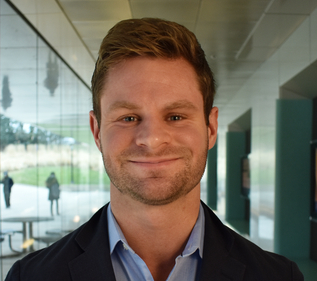 Matthew Kvalheim (courtesy of Kvalheim)
“It was a great privilege to speak about Professor Smale’s legacy, and in particular the deep impact his work has had on one of my projects funded by the Air Force Office of Scientific Research,” Kvalheim says. “The result of this project, which relies heavily on Smale’s breakthrough solution of a mathematical puzzle known as the ‘generalized Poincaré conjecture,’ helps us understand limitations in designing stable real-world systems.”
This work has far-reaching implications, from ensuring the safety of autonomous vehicles to optimizing complex robotics. By developing mathematical tools that apply across diverse applications, Kvalheim’s research offers universal insights into what systems can and cannot do, blending creativity with mathematical rigor to tackle fundamental questions with real-world impact.
Learn more about UMBC’s programs in mathematics and statistics.
]]>
Matthew Kvalheim, assistant professor of mathematics, was one of only about 20 scholars who spoke at a conference celebrating the 95th birthday of Stephen Smale, one of the most influential...
https://umbc.edu/quick-posts/stephen-smale-95th-conference/
https://dev.my.umbc.edu/api/v0/pixel/news/151331/guest@my.umbc.edu/8ad034036c83a56ebecfa693023dd927/api/pixel
cnms
mathstat
news
quick-post
research
science-and-tech
UMBC News & Magazine
https://dev.my.umbc.edu/groups/umbc-news-magazine
https://assets1-dev.my.umbc.edu/system/shared/avatars/groups/000/001/943/24435aa6207c452e7bc15cc74b42c7bb/xsmall.png?1748556657
https://assets1-dev.my.umbc.edu/system/shared/avatars/groups/000/001/943/24435aa6207c452e7bc15cc74b42c7bb/original.png?1748556657
https://assets2-dev.my.umbc.edu/system/shared/avatars/groups/000/001/943/24435aa6207c452e7bc15cc74b42c7bb/xxlarge.png?1748556657
https://assets2-dev.my.umbc.edu/system/shared/avatars/groups/000/001/943/24435aa6207c452e7bc15cc74b42c7bb/xlarge.png?1748556657
https://assets3-dev.my.umbc.edu/system/shared/avatars/groups/000/001/943/24435aa6207c452e7bc15cc74b42c7bb/large.png?1748556657
https://assets1-dev.my.umbc.edu/system/shared/avatars/groups/000/001/943/24435aa6207c452e7bc15cc74b42c7bb/medium.png?1748556657
https://assets2-dev.my.umbc.edu/system/shared/avatars/groups/000/001/943/24435aa6207c452e7bc15cc74b42c7bb/small.png?1748556657
https://assets1-dev.my.umbc.edu/system/shared/avatars/groups/000/001/943/24435aa6207c452e7bc15cc74b42c7bb/xsmall.png?1748556657
https://assets2-dev.my.umbc.edu/system/shared/avatars/groups/000/001/943/24435aa6207c452e7bc15cc74b42c7bb/xxsmall.png?1748556657
UMBC News & Magazine
1
0
false
Tue, 05 Aug 2025 14:22:26 -0400
Tue, 05 Aug 2025 14:22:26 -0400
Interdisciplinary UMBC team deepens understanding of cell migration, important for potential medical advances
Imagine cells navigating through a complex maze, guided by chemical signals and the physical landscape of their environment. At UMBC, a team of researchers has contributed an important discovery about how cells move, or migrate, through this maze of bodily tissues. Potential implications include better understanding of diseases like cancer and advancing medical treatments.
Published in iScience, the team’s study combines biological experiments and mathematics to reveal new insights into cell migration. Alex George, Ph.D. ’24, biological sciences, and Naghmeh Akhavan, Ph.D. ’25, mathematics, led the study, which explores how cells in fruit fly egg chambers navigate their environment. Their mentors, Michelle Starz-Gaiano, professor of biological sciences, and Brad Peercy, professor of mathematics, are co-authors.
By integrating mathematical modeling with advanced imaging, the team discovered that the physical shape of the egg chamber, combined with chemical signals called chemoattractants, significantly influences how cells move.
 Alex George (left) and Naghmeh Akhavan present their research at a conference at the University of Maryland, College Park. (Courtesy of Starz-Gaiano)
“This paper takes an interdisciplinary focus with tight collaboration between a mathematical framework and experimental design,” Peercy says. “The results promote the idea that complex distribution of chemical attractants can explain specific variations in migratory movement.” His enthusiasm highlights the study’s innovative approach, which merges precise mathematical models with real-world biological experiments to uncover patterns that were previously invisible.
Following the breadcrumbs
The team’s work focuses on border cells, a type of cell in fruit fly egg chambers, which are a model system for studying cell migration because of their similarities to processes in human development and disease. The team found that the border cells’ movement wasn’t just driven by continuously increasing chemical concentrations from one end of the egg chamber to the other, as earlier models suggested. Instead, the physical structure of the tissue—narrow tubes alternating with wider gaps—played a critical role.
“This was the first time that we characterized that there were these patterns of migration behavior that ended up correlating to aspects of the tissue geometry,” explains George, who specializes in capturing live images of these cells. He likens the process to Hansel and Gretel following breadcrumbs through a forest: On a flat plain, the trail is clear, but in a landscape with ravines and valleys, the breadcrumbs pool in unexpected ways, complicating the path.
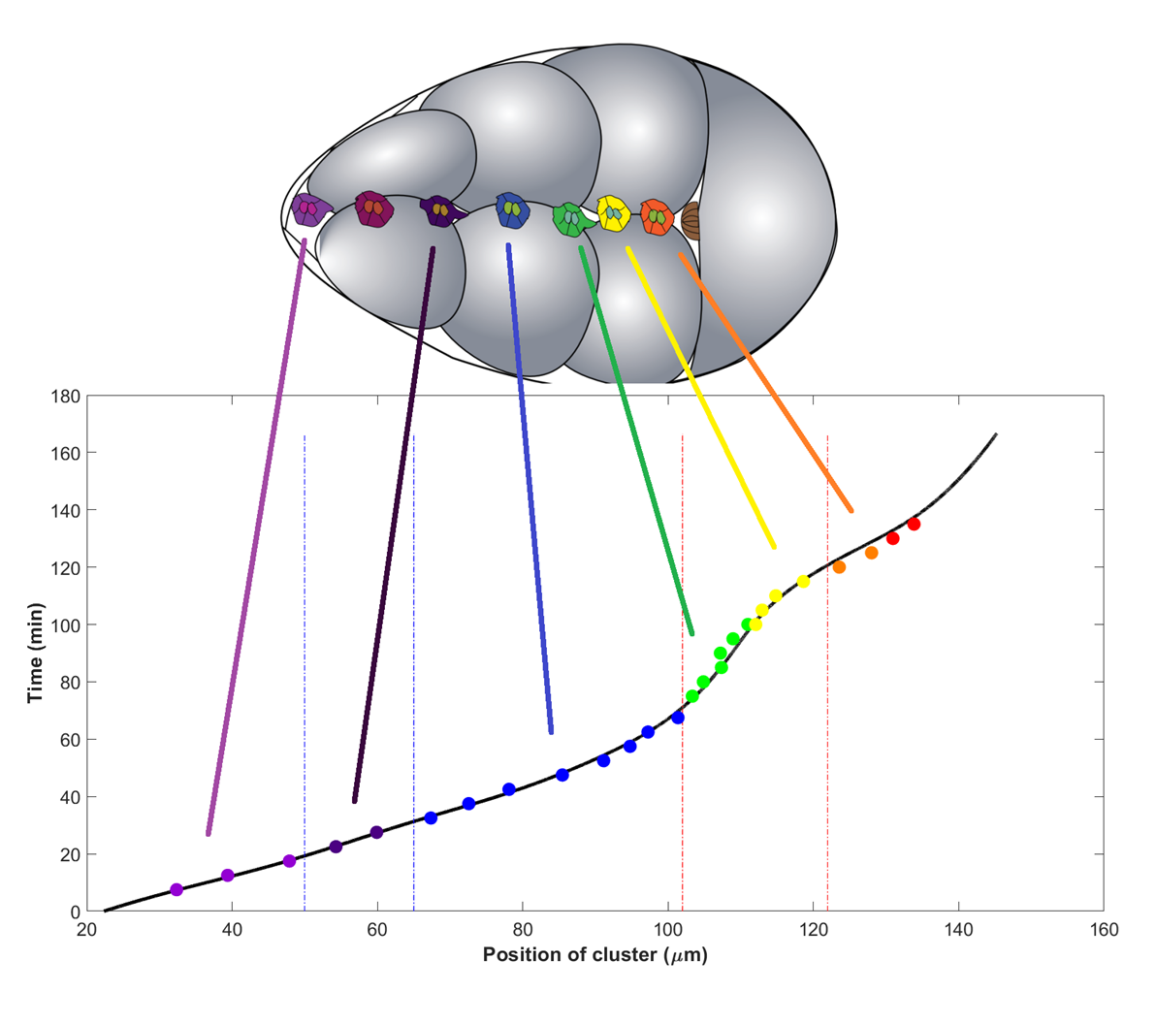 This visualization of Akhavan’s mathematical model shows how migration speed shifts in each zone of the egg chamber, pictured above the graph. A steeper slope indicates a slower speed. (Courtesy of Akhavan)
To understand this, Akhavan developed mathematical models that simulate how cells respond to both chemical signals and tissue geometry together. “Alex’s experiments showed that the speed is not exactly the way previous models showed it,” she says. Her models revealed that cells speed up in narrow tubes and slow down in larger gaps, a pattern confirmed by George’s imaging.
Both approaches—wet-lab experiments and modeling—bring unique strengths to the work. Putting them together “is like unveiling the invisible from two different perspectives,” George says. “My experiments would refine her model, and her model would refine my experiments.”
And then, “When our model shows exactly what Alex found in his experiments, we love that,” Akhavan adds.
Learning new languages
This synergy didn’t always come easily. Working across disciplines meant learning to speak each other’s scientific “languages.” Akhavan, with a background in pure mathematics, recalls that when she joined the project in spring 2022, “Everything was in a different language for me.” Similarly, “A couple of times I opened my MATLAB code and Alex’s eyes got huge,” Akhavan laughs.
Yet, their collaboration flourished, fostering not only scientific breakthroughs but also friendship. “It’s a challenge to communicate across disciplines since it’s almost like speaking in different languages,” Starz-Gaiano says. “Both Alex and Naghmeh got more adept at explaining their work and honing their research questions as a result of working together over a couple of years, which was great to watch.”
Putting together wet lab experiments and mathematical modeling “is like unveiling the invisible from two different perspectives. My experiments would refine her model, and her model would refine my experiments.”
Alex George, Ph.D. ’24, biological sciences
“It is a risky and vulnerable situation to be open with colleagues in areas in which you are not a burgeoning expert,” Peercy adds. “Naghmeh and Alex have grown so much through this project to genuinely rely on each other’s opinion.”
The study’s broader impact lies in its potential to inform fields beyond developmental biology. Cell migration is critical in processes like wound healing, immune responses, and cancer metastasis. “Most research on how cells navigate the world has focused only on chemical signals or only on structural ones, so this is one of the first studies to consider how those two things impact each other, which is likely to be relevant in many cases,” Starz-Gaiano explains. By showing how tissue geometry and chemical signals interact, the research could guide new strategies for controlling cell movement via medical treatments.


 Left: The team traveled to the Janelia Research Campus in Virginia to do advanced imaging for the cell migration project, which will open new avenues for research. (Courtesy of Starz-Gaiano) Center: A moment of levity in the Starz-Gaiano lab. (Courtesy of Akhavan) Right: Brad Peercy and Michelle Starz-Gaiano shared their collaborative work at the “RetriEVER Empowered: Student Success + Research + Community”event in April 2022.
New strategies lead to new discoveries
George refined his expertise in microscopy through working with Tagide deCarvalho in UMBC’s Keith R. Porter Imaging Facility. “It helped me learn a lot, getting my hands on other people’s work and visualizing all the cool things,” he says. “A picture is worth a thousand words, but a movie? Ten thousand words.” Now he’s taking his skills to the Dartmouth Cancer Center’s microscopy core facility at the Geisel School of Medicine, where he’ll start as a research scientist in June.
For Akhavan and George, leading this project has been a defining experience. Akhavan’s models, including a new approach that uses energy calculations to better capture the egg chamber’s complex geometry, have become a cornerstone of her dissertation, and she plans to continue this work post-graduation.
George and Akhavan’s mentors played a pivotal role in their success. “Michelle is a role model for me,” Akhavan says, praising the collaborative spirit of Starz-Gaiano and Peercy. “Dr. Peercy and Dr. Starz-Gaiano make the best combination for doing interdisciplinary research. This collaboration is amazing.”

 Left: Naghmeh Akhavan (center) accepts the Outstanding Graduate Research in Mathematics Award at CNMS Awards and Recognition Day. (Courtesy of Akhavan) Right: Michelle Starz-Gaiano and Alex George take some time for fun while attending the Society for Developmental Biology Annual Meeting in Chicago in 2023. (Courtesy of Starz-Gaiano)
The team’s work continues to evolve, including recent experiments at the Advanced Imaging Center at the Janelia Research Campus in Virginia, where George used advanced microscopes to capture previously unseen dynamics of the relevant chemoattractants. These findings will further refine their models, opening new avenues for research.
“We are developing new experimental strategies both on the biology and the math side of things,” Starz-Gaiano says, “so it will be exciting to see where this will take us next.”
]]>
Imagine cells navigating through a complex maze, guided by chemical signals and the physical landscape of their environment. At UMBC, a team of researchers has contributed an important discovery...
https://umbc.edu/stories/cell-migration-research-medical-advances/
https://dev.my.umbc.edu/api/v0/pixel/news/150422/guest@my.umbc.edu/5bddad5f85a6271f260efba4d150dbfc/api/pixel
biological-sciences
biology
cnms
gradresearch
mathematics-and-statistics
mathstat
news
research
science-and-tech
story
UMBC News & Magazine
https://dev.my.umbc.edu/groups/umbc-news-magazine
https://assets1-dev.my.umbc.edu/system/shared/avatars/groups/000/001/943/24435aa6207c452e7bc15cc74b42c7bb/xsmall.png?1748556657
https://assets1-dev.my.umbc.edu/system/shared/avatars/groups/000/001/943/24435aa6207c452e7bc15cc74b42c7bb/original.png?1748556657
https://assets2-dev.my.umbc.edu/system/shared/avatars/groups/000/001/943/24435aa6207c452e7bc15cc74b42c7bb/xxlarge.png?1748556657
https://assets2-dev.my.umbc.edu/system/shared/avatars/groups/000/001/943/24435aa6207c452e7bc15cc74b42c7bb/xlarge.png?1748556657
https://assets3-dev.my.umbc.edu/system/shared/avatars/groups/000/001/943/24435aa6207c452e7bc15cc74b42c7bb/large.png?1748556657
https://assets1-dev.my.umbc.edu/system/shared/avatars/groups/000/001/943/24435aa6207c452e7bc15cc74b42c7bb/medium.png?1748556657
https://assets2-dev.my.umbc.edu/system/shared/avatars/groups/000/001/943/24435aa6207c452e7bc15cc74b42c7bb/small.png?1748556657
https://assets1-dev.my.umbc.edu/system/shared/avatars/groups/000/001/943/24435aa6207c452e7bc15cc74b42c7bb/xsmall.png?1748556657
https://assets2-dev.my.umbc.edu/system/shared/avatars/groups/000/001/943/24435aa6207c452e7bc15cc74b42c7bb/xxsmall.png?1748556657
UMBC News & Magazine
0
0
false
Tue, 27 May 2025 14:10:11 -0400
Tue, 27 May 2025 14:10:11 -0400
New endowed chair honors math professor Thomas Seidman, who helped shape the department
Thomas Seidman, late emeritus professor of mathematics and statistics, gave 45 years of his life to teaching, mentoring, and conducting research at UMBC before retiring in 2017. After his death in August 2024, his estate donated $1.06 million to UMBC to create the Dr. Thomas I. Seidman Endowed Chair in mathematics. The Maryland E-nnovation Initiative, an effort within the Maryland Department of Commerce, matched the bequest, bringing the total endowment to more than $2 million.
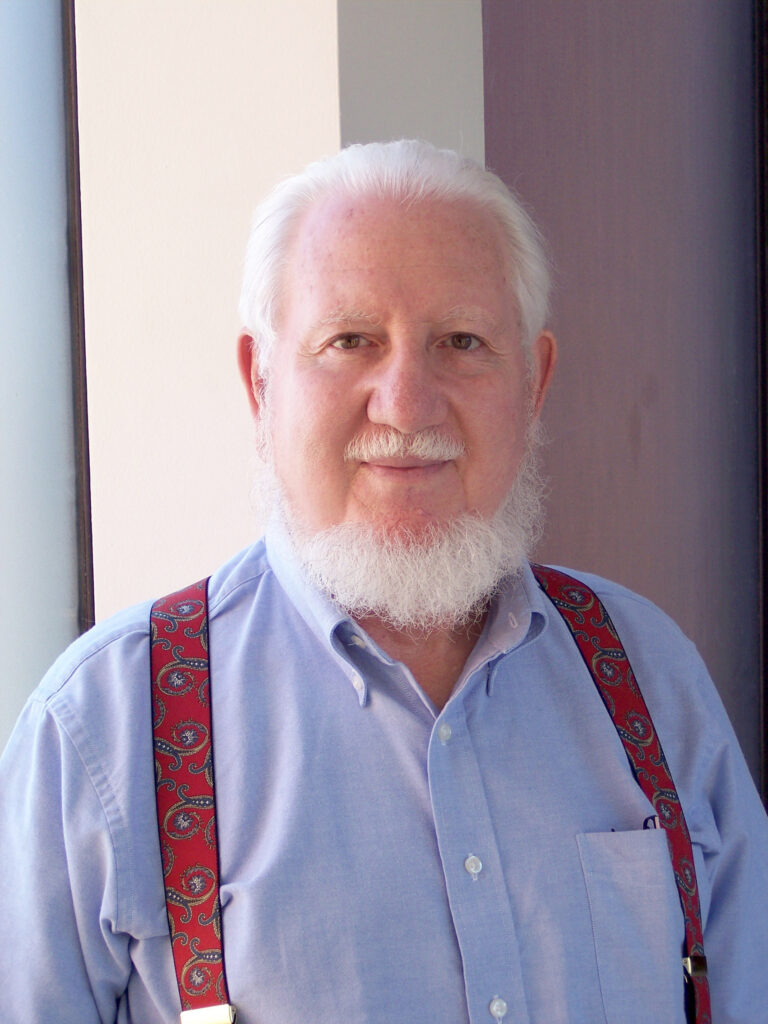 Thomas Seidman (Courtesy Seidman family)
“The Seidman family’s generous gift, along with the MEI match, will make it possible for UMBC to hire world-class applied mathematics faculty with expertise in research fields that will drive the economy of the future,” said William R. LaCourse, dean of the College of Natural and Mathematical Sciences. “CNMS is deeply grateful for Dr. Seidman’s service to UMBC throughout his decades as a faculty member. With this gift, his impact will extend even further by helping UMBC students prepare for rewarding careers in booming fields like data science and AI.”
Joining UMBC only a few years after the university’s founding in 1966, Seidman created a home for himself in the mathematics and statistics department. In addition to his prolific and widely-cited scholarship in applied analysis and fierce dedication to teaching, Seidman also contributed to the young department’s development through writing bylaws for department chair election processes, chairing the promotion and tenure committee for many years, and serving as acting department chair in 1992. He never missed a department seminar and was known for asking insightful questions.
“He was able to build a niche and a role for himself that fit him perfectly,” Seidman’s son, Gregory Seidman, says. “The continuity and stability of the environment, combined with the roots our family had put down in the area, made him feel at home in a way he couldn’t imagine rebuilding elsewhere.”
Leaving a legacy
Seidman “cared deeply about teaching,” his son says, and took pride in instructing students in both foundational math courses like Linear Algebra and courses for non-majors, such as a course on the history of mathematics. Seidman’s one regret was that he did not advise more graduate students, his son shares.
Gregory believes his father hoped to leave a legacy by supporting further work in his mathematical research fields and creating opportunities for students. “It is my hope that his bequest will support many doctoral students following in his research footsteps,” Gregory says, “who would otherwise have been that legacy.”
The younger Seidman remembers spending much of his childhood in his father’s office and in a UMBC computer lab. Father and son learned to program an original Apple PC together in the early 1980s, which inspired Gregory to pursue computer science. Eventually, he even co-authored a research paper with his father. Gregory also recalls regular meetings of the minds with department members in the Seidman household when he was young.
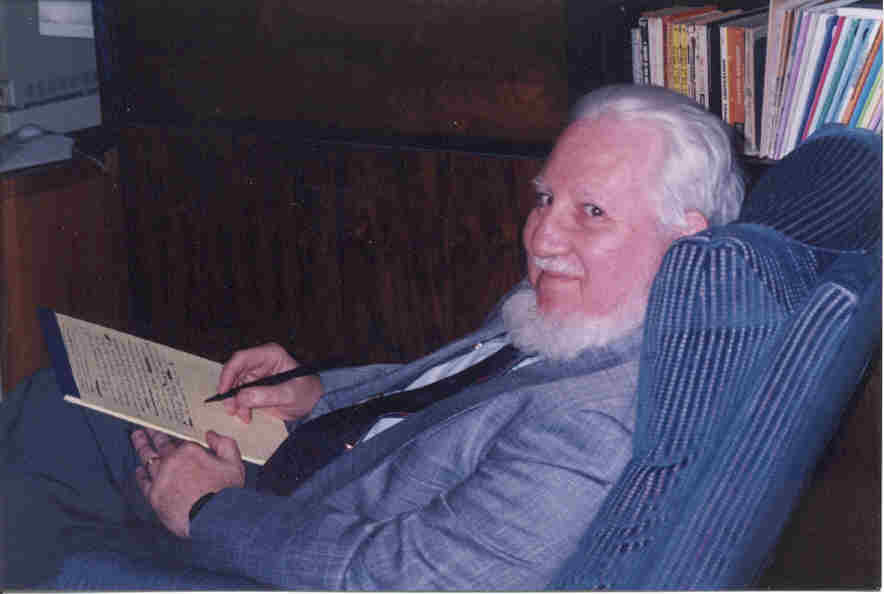 Thomas Seidman was known for his commitment to teaching, and his bequest will create more opportunities for UMBC students to study with outstanding mathematicians. (Courtesy Seidman family)
“While I know my father made a difference at UMBC in various ways, some more significant than others, it feels good to have his name on something that will be seen for years to come,” Gregory says. “I’m also especially pleased that, some day, my kids will be able to show their kids that their great-grandfather, whom they will never meet, made a difference here.”
Seidman notes that his father’s life was a fulfilling one, rich in warm personal relationships and professional success. “His was a life well lived,” he says. And now, the Dr. Thomas I. Seidman Endowed Chair will help create opportunities for more aspiring mathematicians to build their own lives and legacies.
]]>
Thomas Seidman, late emeritus professor of mathematics and statistics, gave 45 years of his life to teaching, mentoring, and conducting research at UMBC before retiring in 2017. After his death in...
https://umbc.edu/stories/thomas-seidman-mei-chair/
https://dev.my.umbc.edu/api/v0/pixel/news/148072/guest@my.umbc.edu/762f5171b4cffa14db4778c384396ef0/api/pixel
cnms
mathstat
news
science-and-tech
story
UMBC News & Magazine
https://dev.my.umbc.edu/groups/umbc-news-magazine
https://assets1-dev.my.umbc.edu/system/shared/avatars/groups/000/001/943/24435aa6207c452e7bc15cc74b42c7bb/xsmall.png?1748556657
https://assets1-dev.my.umbc.edu/system/shared/avatars/groups/000/001/943/24435aa6207c452e7bc15cc74b42c7bb/original.png?1748556657
https://assets2-dev.my.umbc.edu/system/shared/avatars/groups/000/001/943/24435aa6207c452e7bc15cc74b42c7bb/xxlarge.png?1748556657
https://assets2-dev.my.umbc.edu/system/shared/avatars/groups/000/001/943/24435aa6207c452e7bc15cc74b42c7bb/xlarge.png?1748556657
https://assets3-dev.my.umbc.edu/system/shared/avatars/groups/000/001/943/24435aa6207c452e7bc15cc74b42c7bb/large.png?1748556657
https://assets1-dev.my.umbc.edu/system/shared/avatars/groups/000/001/943/24435aa6207c452e7bc15cc74b42c7bb/medium.png?1748556657
https://assets2-dev.my.umbc.edu/system/shared/avatars/groups/000/001/943/24435aa6207c452e7bc15cc74b42c7bb/small.png?1748556657
https://assets1-dev.my.umbc.edu/system/shared/avatars/groups/000/001/943/24435aa6207c452e7bc15cc74b42c7bb/xsmall.png?1748556657
https://assets2-dev.my.umbc.edu/system/shared/avatars/groups/000/001/943/24435aa6207c452e7bc15cc74b42c7bb/xxsmall.png?1748556657
UMBC News & Magazine
2
0
false
Thu, 13 Mar 2025 10:27:59 -0400
Thu, 13 Mar 2025 10:27:59 -0400
“Teaching them to think”: New course prepares students for success in proof-based mathematics

A new course in UMBC’s Department of Mathematics and Statistics is having a positive impact on student success in a notoriously difficult course for math majors everywhere. Two new papers by UMBC mathematicians and members of UMBC’s Faculty Development Center strongly suggest that MATH 300: Introduction to Mathematical Reasoning(IMR) is helping students succeed in MATH 301: Real Analysis, the first course math majors take that relies on one’s ability to construct and analyze proofs, rather than just do calculations.
In Real Analysis, “We’re switching gears of how students think. They go from calculational things to proof-based work,” says Kathleen Hoffman, professor of mathematics and lead author on the new papers. “Now your solution is a paragraph that you have to write in full sentences. It has to have logical structure. It has to start with a hypothesis and end with a conclusion. It’s a big hump for students to get over.”
Real Analysis is easily one of the most challenging courses for math majors nationwide, Hoffman says. Over the years, many institutions have introduced a preparatory course that teaches students how to develop proofs without requiring them to learn new math content at the same time. The conventional wisdom is that these courses help, but almost no one had conducted a rigorous study to find out.
“There was a huge gap in the literature,” Hoffman says.
Forming the team
UMBC math faculty had seen the need and been talking about adding a dedicated proof-writing course for years, but it hadn’t quite come together. Hoffman jump-started the process by applying for a Hrabowski Innovation Fund Grant in the Scholarship of Teaching and Learning category. These awards support faculty who want to do ambitious projects that they might not otherwise have bandwidth for.
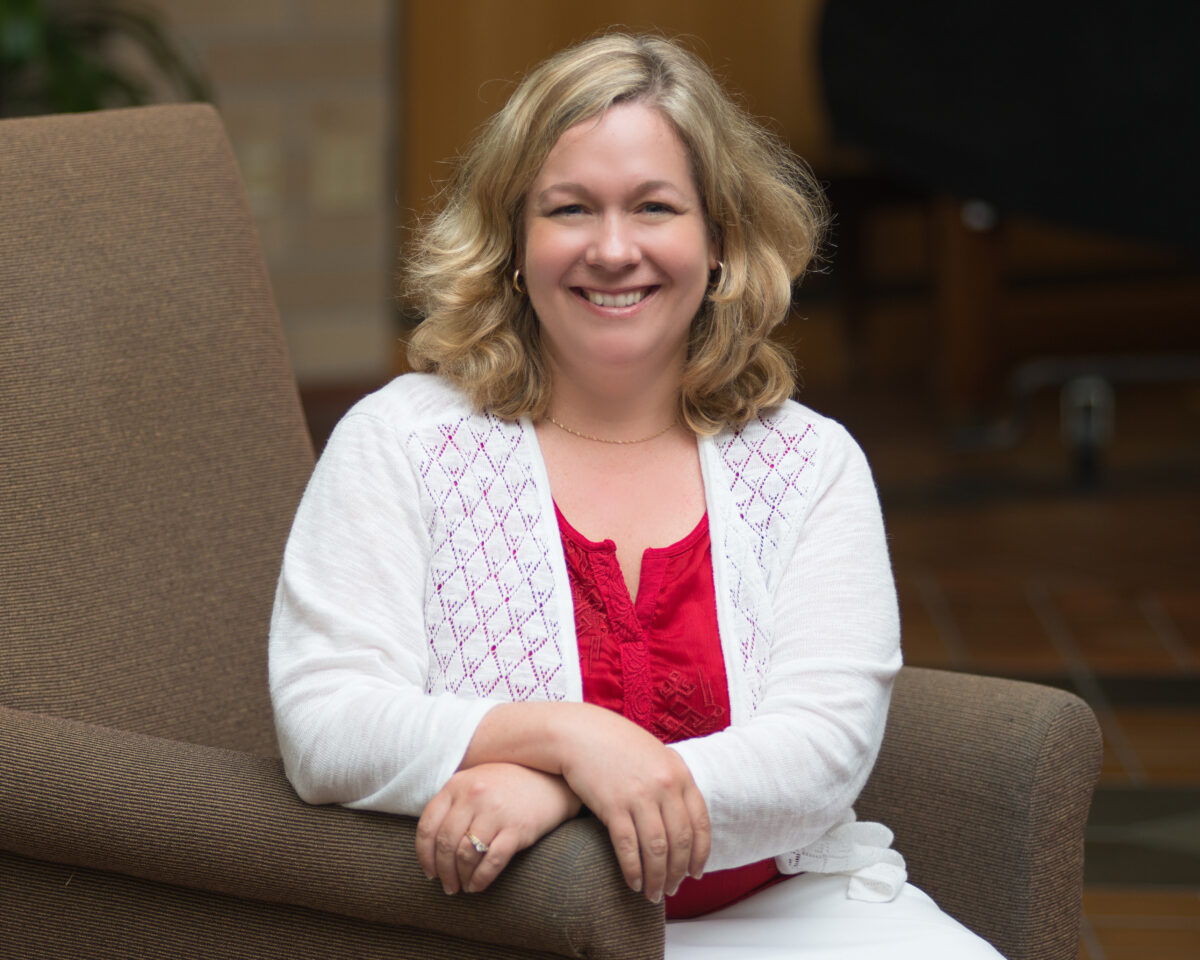 Kathleen Hoffman wrote the Hrabowski Fund for Innovation proposal that supported the team’s efforts to rigorously evaluate the effectiveness of their new course. (Courtesy of Hoffman)
When the award was funded, Hoffman formed a team with Justin Webster, associate professor of mathematics, and Kal Nanes, associate teaching professor of mathematics, to design the course for UMBC. Webster had re-designed and updated one of these proof-writing courses at his previous institution, the College of Charleston. The math team also worked with staff in UMBC’s Faculty Development Center to design a rigorous study to evaluate the course’s effectiveness over time. The team knows of only one other such study, from the 1980s, despite the rising incidence of proof-writing courses at universities nationwide.
Hoffman, Webster, and others believed that IMR would help UMBC math students, and informal observations supported their hunch once the course launched. These publications provide statistical analyses to back their intuition, and now Retrievers and students from other institutions can benefit from their successful formula.
Thinking about thinking
The first paper, published in a special issue of Educational Sciences, focused on written reflections the students completed every week along with their proofs. Prior research suggests that students tend to struggle in specific skills related to proof-writing, so the students were required to address how well they thought they did on each of four skills in their reflections.
“Students who did very thoughtful responses did much better in this course, but they also did much better in Real Analysis, where they didn’t do any reflections,” Hoffman says. The reflections “give the students a framework for understanding what they know and what they don’t know. It gives them the words to use.”
The study analyzed the quality of the reflections, but not necessarily the content. It didn’t seem to matter exactly what aspects of proof-writing the students addressed in their writing—simply the act of metacognition, or “thinking about thinking,” seemed beneficial.
The correlation was strong, but Hoffman admits the study does not prove causation. Strengthening the evidence, though, is that thoughtful reflections in IMR were not correlated with success in its prerequisite course, MATH 221: Introduction to Linear Algebra. That suggests the reflections, and potentially other elements of IMR, were the difference-maker for students moving forward.
A solid foundation
A second paper, published in the International Journal of Mathematical Education in Science and Technology, compared students’ grades in Real Analysis depending on whether or not they had taken the proof-writing course. The findings showed that IMR did not much affect the outcomes for students who earned As in the prerequisite linear algebra course—they were also likely to do well in Real Analysis whether they took IMR or not. However, students who earned a B or C in the prerequisite course were much more likely to successfully complete Real Analysis if they had taken IMR.
The researchers also received overwhelmingly positive feedback from students who had taken IMR about its benefits. One student said,
“I feel like [IMR] gave me a solid foundation in understanding how to write proofs, which allowed me to come into [Real Analysis] with a bit more confidence. Without it, I probably would have struggled through [Real Analysis] since I would have been learning how to write proofs and the [Real Analysis] material at the same time.”
Based on the results of these studies, the UMBC mathematics and statistics department has decided to make IMR a required part of the curriculum for math majors and minors. Minors used to take Real Analysis as their terminal course, but now they take IMR. For majors, IMR provides the foundation needed to support success in Real Analysis.
More than pushing symbols around
When he took it as an undergraduate, an IMR-type course “was the thing that made me want to be a math major,” Webster says, so designing this course for UMBC was an exciting prospect. Becoming proficient in writing and analyzing proofs, rather than doing calculations, is like “writing versus writing literature,” he says—you have to spend a lot of time thinking about what you’re trying to accomplish and how to structure your arguments. You can’t just “plug-and-chug,” applying various theorems and techniques to instances of a given type of problem. “Math isn’t just the act of pushing symbols around,” Webster says.
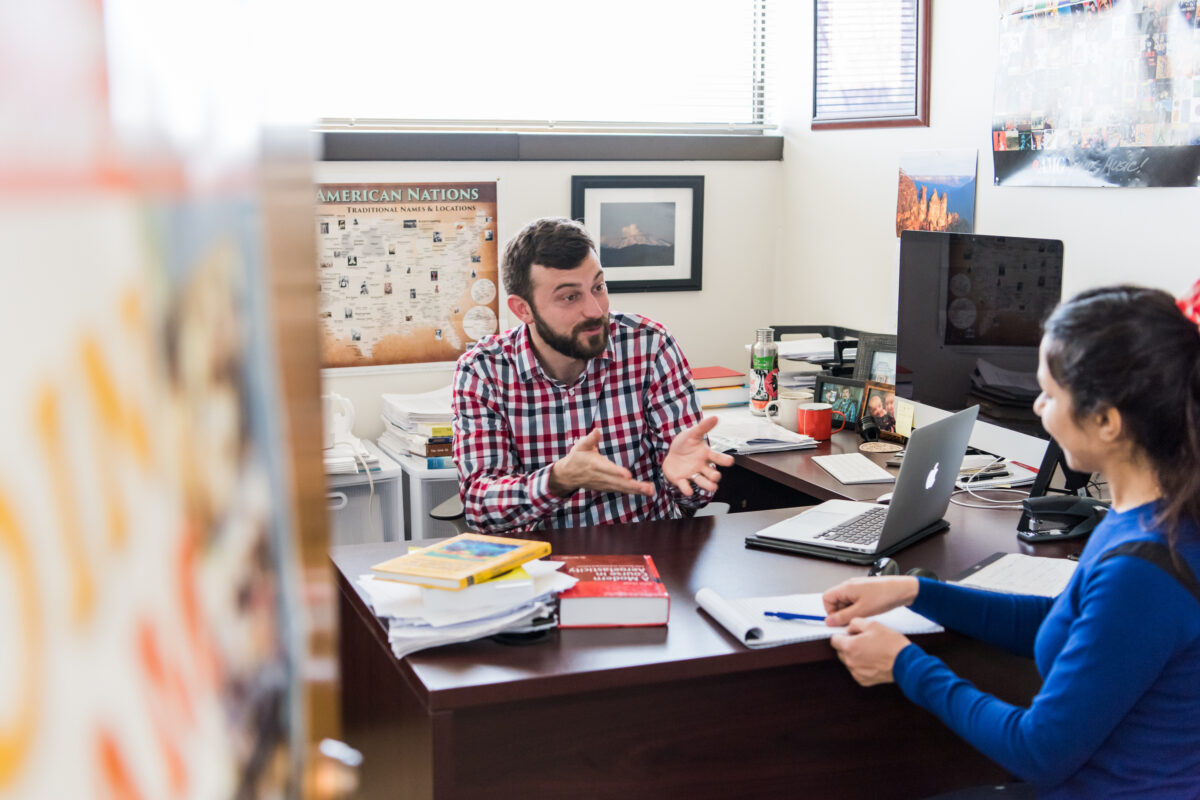 Justin Webster often meets with students to support their progress in math courses. (Marlayna Demond ’11/UMBC)
To prepare students to write mathematical literature, Hoffman says that in IMR, “In one sense I’m teaching math, but in another sense I’m not. I’m teaching them how to think—how to structure their argument and express it clearly.” Almost never can a student simply sit down and write a proof in one sitting, like completing a problem set in prior math courses. It’s more like writing a paper.
When you work on a proof, “You think, you don’t get it, you go do something else, you think, ‘Oh, I think I know what to do,’ you come back, and that is normal,” Hoffman says. “They have to understand, this is not instant gratification—you will struggle with this and I’m expecting you to. It’s inevitable that they will struggle—I’m teaching them to persist through the struggle.”
A collective commitment
The studies would not have been possible without support from the Faculty Development Center. While many faculty might like to conduct more rigorous analysis of their teaching methods, it’s not their area of expertise. “If you want people like me who do disciplinary research to engage in pedagogical research, you have to give me some help,” as Hoffman put it.
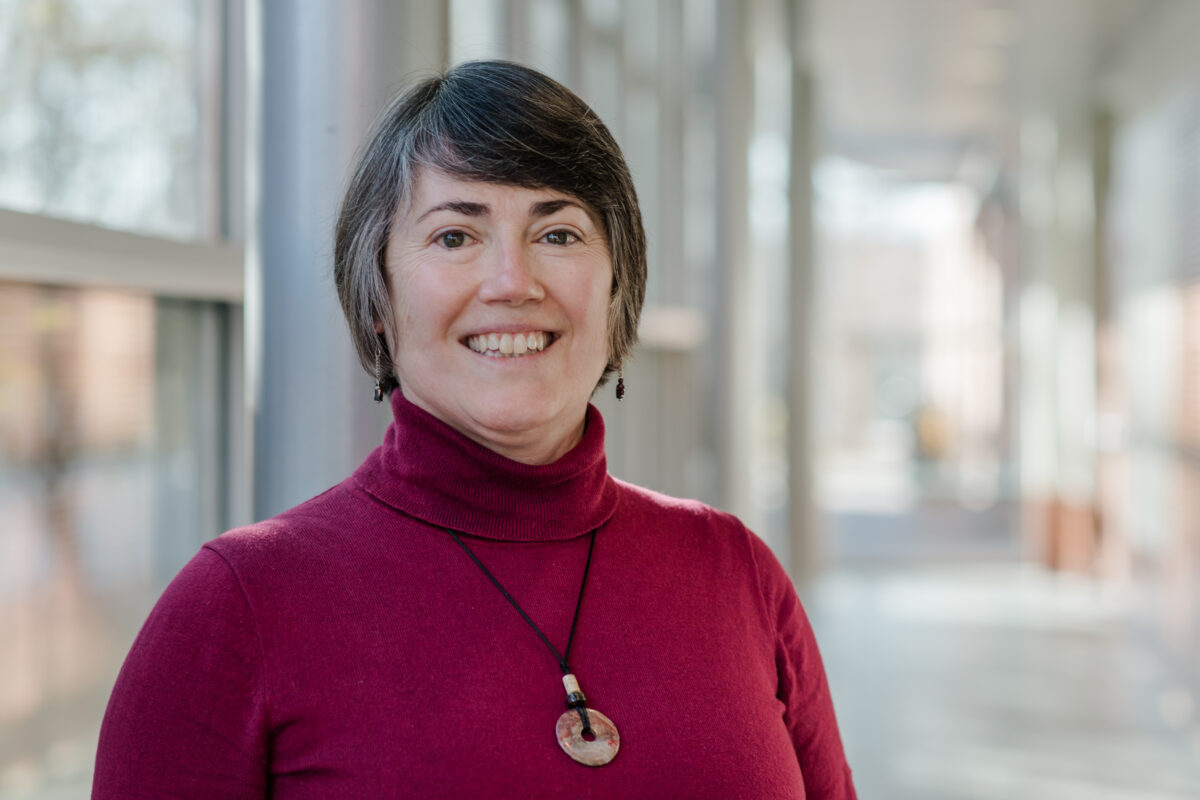 Kerrie Kephart was one of several members of the Faculty Development Center who contributed to the study of the new course’s impact. (Marlayna Demond ’11/UMBC)
That’s where the FDC came in. Several staff members became involved in the project, including Tory Williams, Jennifer Harrison, Kerrie Kephart, and Linda Hodges, adding their individual areas of expertise.
“The math faculty have deep expertise in math pedagogy, but needed our support to help plan the intervention, design the research study, and analyze the data. The project required all hands on deck.” shares Kephart, co-author on the written reflections study and interim FDC director. “As a qualitative researcher with expertise in the teaching of academic writing, I enjoyed the challenge of figuring out how to study the effects of incorporating reflective writing into a math class.”
The project is also a demonstration of the math department’s commitment to supporting student success, even if that required some culture change. Since IMR’s initial offering in 2019, several additional math faculty have taken on teaching the course. Each time someone new takes it on, they work closely with experienced instructors, and all sections of the course are closely coordinated to ensure quality and consistency for students.
The project is a masterclass in recognizing a challenge (a high failure rate in Real Analysis) and taking creative, concerted, and collective action to address it, with very positive results. “After realizing there was a gap in students’ preparation, a group worked together to fill it, and in the process learned a lot about how to measure progress in math education and pedagogy,” Webster says. “We leaped at this opportunity to effect change and measure outcomes in a novel and modern way.”
And because they carefully evaluated the project’s effects and published the results, now other math departments can benefit from their findings. That possibility was a highlight for Kephart. “Since our work in the FDC generally supports faculty, teaching, and learning here at UMBC,” she says, “it’s exciting to make a contribution toward the development of math pedagogy beyond our campus.”
]]>
A new course in UMBC’s Department of Mathematics and Statistics is having a positive impact on student success in a notoriously difficult course for math majors everywhere. Two new papers by UMBC...
https://umbc.edu/stories/new-course-for-success-in-proof-based-mathematics/
https://dev.my.umbc.edu/api/v0/pixel/news/147392/guest@my.umbc.edu/f1881142676dd57b1445f1260dc9b9c5/api/pixel
cnms
mathstat
news
research
science-and-tech
story
UMBC News & Magazine
https://dev.my.umbc.edu/groups/umbc-news-magazine
https://assets1-dev.my.umbc.edu/system/shared/avatars/groups/000/001/943/24435aa6207c452e7bc15cc74b42c7bb/xsmall.png?1748556657
https://assets1-dev.my.umbc.edu/system/shared/avatars/groups/000/001/943/24435aa6207c452e7bc15cc74b42c7bb/original.png?1748556657
https://assets2-dev.my.umbc.edu/system/shared/avatars/groups/000/001/943/24435aa6207c452e7bc15cc74b42c7bb/xxlarge.png?1748556657
https://assets2-dev.my.umbc.edu/system/shared/avatars/groups/000/001/943/24435aa6207c452e7bc15cc74b42c7bb/xlarge.png?1748556657
https://assets3-dev.my.umbc.edu/system/shared/avatars/groups/000/001/943/24435aa6207c452e7bc15cc74b42c7bb/large.png?1748556657
https://assets1-dev.my.umbc.edu/system/shared/avatars/groups/000/001/943/24435aa6207c452e7bc15cc74b42c7bb/medium.png?1748556657
https://assets2-dev.my.umbc.edu/system/shared/avatars/groups/000/001/943/24435aa6207c452e7bc15cc74b42c7bb/small.png?1748556657
https://assets1-dev.my.umbc.edu/system/shared/avatars/groups/000/001/943/24435aa6207c452e7bc15cc74b42c7bb/xsmall.png?1748556657
https://assets2-dev.my.umbc.edu/system/shared/avatars/groups/000/001/943/24435aa6207c452e7bc15cc74b42c7bb/xxsmall.png?1748556657
UMBC News & Magazine
3
0
false
Mon, 17 Feb 2025 11:27:34 -0500
Mon, 17 Feb 2025 11:27:34 -0500