Michael Hunt ’06, Ph.D. ’25, Outstanding Staff award winner, lifts up students and builds community
When Shaniah Reece ’23, information systems, now a Ph.D. student in computer science at Emory University, was navigating her academic journey at UMBC, there were times she felt like giving up. One evening, around 10 p.m. at night, she was exhausted and considering not submitting an important application. But then Michael Hunt, director of the McNair Scholars Program, with which she was affiliated, gave her a call.
“He said, ‘There are two hours left, and I haven’t seen any indication that you’ve submitted it,’” Reece relates. “I could hear his family and the TV in the background—he was off the clock, at home—but he still made that call. That moment was so impactful because he thought about me, believed in me, and pushed me in a moment when I was too weak to push myself.”
It’s just one example of the many times that Hunt ’06, applied mathematics, Ph.D. ’25, language, literacy, and culture, has shown up for students in just the ways they need. Since 2019, Hunt has directed the federally funded UMBC McNair program with a goal of empowering students from underrepresented segments of society to earn research-based doctoral degrees. Not only does he support the 30 students who enter the full program each year—he’s worked hard to extend opportunities to affiliated students, through a program now called the Retriever Graduate Preparation Network, and to spread the supportive culture of the McNair program across the university as a whole.
On October 29, Hunt’s contributions will be recognized when he receives the 2025 Outstanding Staff award from UMBC’s Alumni Association Board of Directors.
Showing up for students
 From l-r: McNair Scholar Nogaye Khady Wade, McNair coordinator Antoinette Newsome, McNair Scholar Noor Huma and Michael Hunt at the American Educational Research Association annual meeting in 2023. (Photo courtesy of Hunt)
What makes Hunt such an effective mentor? For one thing, he asks students what they need and makes their voices and experiences a central part of his relationship with them. He strives to support them holistically, including emotional, cultural, and academic support. He wants the mentor-mentee relationship to be reciprocal, to honor the value of the mentee’s contributions, and to extend into a wider network of community support.
The approach, called holistic critical mentoring, has been central to the McNair Scholar’s Program under Hunt’s leadership. Hunt even wrote his Ph.D. dissertation on the subject and his interviews of former McNair scholars showed how much they valued the mentoring philosophy.
“I am one of the many UMBC students whose trajectory was forever changed by Dr. Hunt’s mentorship,” says Ting Huang ’21, psychology, the program coordinator for UMBC McNair Scholars Program and a former scholar herself. “I didn’t know my path until I stumbled onto McNair as an undergraduate. Through the program, I conducted research virtually for the first time during the height of the COVID-19 pandemic. Despite the remote nature of those years, I had never felt more connected to a community. That sense of belonging was cultivated by Dr. Hunt and his team, showing how intentional leadership can overcome even the most isolating circumstances.”
Building community
Hunt says the experience of reaching out to current and former McNair program participants to request their help supplying information for his dissertation research was ultimately very gratifying. He wondered how many would respond, given their busy schedules, but a large number were eager to engage.
“I was genuinely surprised, I didn’t expect that number of responses. But then my mentor pointed out: That’s what happens when you build relationships,” Hunt says.
 Michael Hunt with his family at the Black and Latine/x Celebration and Awards in spring 2025. (Brad Zeigler/UMBC)
Hunt says the continued support of program alumni makes him feel like he is making a difference. He’s happy that former participants, some as far away as California, regularly offer to serve as volunteer mentors for current students.
This summer, Hunt had the opportunity to sit in on the dissertation defense of one of the first students to go through the McNair Scholars Program under his watch.
“It’s wonderful to see these alums thriving,” Hunt says. “We are building community. And while we stood on the shoulders of giants, we’re making sure to also be the shoulders that others can stand on next.”
Mark your calendars for the 2025 Alumni Awards on Wednesday, October 29, at 6 p.m., and consider joining the UMBC community at the Chesapeake Employers Insurance Arena to celebrate Michael Hunt and the many remarkable individuals receiving awards. The event will be livestreamed for those unable to join in person. You can learn more at alumni.umbc.edu/alumniawards.
]]>
When Shaniah Reece ’23, information systems, now a Ph.D. student in computer science at Emory University, was navigating her academic journey at UMBC, there were times she felt like giving up. One...
https://umbc.edu/stories/michael-hunt-outstanding-staff-award/
https://dev.my.umbc.edu/api/v0/pixel/news/153998/guest@my.umbc.edu/9f1ef4212ec1126461db307e1dc3f9e0/api/pixel
alumni
alumni-awards
cahss
cnms
coeit
is
llc
magazine
math
mcnairscholars
meyerhoff
story
UMBC News & Magazine
https://dev.my.umbc.edu/groups/umbc-news-magazine
https://assets1-dev.my.umbc.edu/system/shared/avatars/groups/000/001/943/24435aa6207c452e7bc15cc74b42c7bb/xsmall.png?1748556657
https://assets1-dev.my.umbc.edu/system/shared/avatars/groups/000/001/943/24435aa6207c452e7bc15cc74b42c7bb/original.png?1748556657
https://assets2-dev.my.umbc.edu/system/shared/avatars/groups/000/001/943/24435aa6207c452e7bc15cc74b42c7bb/xxlarge.png?1748556657
https://assets2-dev.my.umbc.edu/system/shared/avatars/groups/000/001/943/24435aa6207c452e7bc15cc74b42c7bb/xlarge.png?1748556657
https://assets3-dev.my.umbc.edu/system/shared/avatars/groups/000/001/943/24435aa6207c452e7bc15cc74b42c7bb/large.png?1748556657
https://assets1-dev.my.umbc.edu/system/shared/avatars/groups/000/001/943/24435aa6207c452e7bc15cc74b42c7bb/medium.png?1748556657
https://assets2-dev.my.umbc.edu/system/shared/avatars/groups/000/001/943/24435aa6207c452e7bc15cc74b42c7bb/small.png?1748556657
https://assets1-dev.my.umbc.edu/system/shared/avatars/groups/000/001/943/24435aa6207c452e7bc15cc74b42c7bb/xsmall.png?1748556657
https://assets2-dev.my.umbc.edu/system/shared/avatars/groups/000/001/943/24435aa6207c452e7bc15cc74b42c7bb/xxsmall.png?1748556657
UMBC News & Magazine
1
0
false
Tue, 28 Oct 2025 16:03:47 -0400
Tue, 28 Oct 2025 16:03:47 -0400
Meet a Retriever—Maxwell Amoh-Mayes, biological sciences major, mentor, and multicultural ambassador
Meet Maxwell Amoh-Mayes, a junior biological sciences major and Meyerhoff Scholar who is minoring in public health and on the pre-med/Ph.D. track. Maxwell has truly found his people at UMBC, from the work he does in HIV research, to volunteering at Shock Trauma, and spending time with his friends in the African Student Association (and beyond). We’re excited you’ve shared your story with us, Maxwell—take it away!
Q: What’s one essential thing you’d like people to know about you?
A: I’m a junior majoring in biological sciences with a minor in public health, on the pre-M.D./Ph.D. track. I come from Ghanaian immigrant parents who instilled in me a deep sense of culture, which inspires much of the work I do on campus. I’m passionate about uplifting underrepresented groups in STEM and take pride in mentoring students, especially those exploring the sciences or navigating the pre-med path. I enjoy showcasing cultural expression and creating spaces where identity and excellence thrive together. I currently conduct HIV research in Dr. Michael Summers’ lab and do clinical volunteering in the Shock Trauma Center at the University of Maryland Medical Center, both of which have deepened my dedication to research and patient-centered care.
 Maxwell Amoh-Mayes (right) in the lab with his PI, Dr. Michael Summers, HHMI investigator (left). (Photo courtesy of Eric Nkrumah ’28.)
Q: What’s the one thing you’d want someone who hasn’t joined the UMBC community to know about the support you find here?
A: At UMBC, you’re never just a face in the crowd—you’re a thread in a tightly woven net that catches you when you fall and lifts you higher when you rise. That net is made up of tutoring centers, SI PASS sessions, counseling services, various student orgs, and leadership opportunities—each strand designed to hold you up, stretch with you, and pull you forward. The support here isn’t just available—it finds you, grows with you, and walks beside you, woven into every part of your journey.
Q: Are you a part of any scholars programs?
A: Yes, I am currently part of the Meyerhoff Scholars Program at UMBC, and it has completely shaped my college experience for the better. The community within the program is incredibly strong and supportive—I honestly don’t think I would have made as many like-minded, goal-oriented peers in just my first year had I attended another college for a full four years. From the start, Meyerhoff creates a space where driven students in STEM can uplift and push one another, forming bonds that go beyond the classroom.
What I appreciate most is how we all support each other through the challenges of rigorous coursework and personal growth, constantly holding each other accountable and encouraging one another to stay focused on our long-term goals. On top of that, the advising and mentorship from faculty, Mrs. Mitsue Wiggs, Mrs. Holly Willoughby, and Mr. Keith Harmon is unmatched. They provide consistent guidance on academics, research, and career development, making sure we’re not just surviving but thriving. The program doesn’t just offer opportunity—it offers a true family, one that motivates me daily to stay grounded in my purpose and push forward with confidence.
 Amoh-Mayes with his Meyerhoff mentees from different STEM concentrations. Bottom (L-R): Yazlin Moujalled ’27 (computer science), Petrina Offei ’28 (mechanical engineering), Ololade Lawrance ’28 (chemical engineering) ’28. Top (L-R): Jennifer Frimpong Debrah ’28 (biological sciences), Winnifred Opuni ’28. (biological sciences) (Photo courtesy of Eric Nkrumah ’28.)
Q: Tell us about someone in the community who has inspired you or supported you, and how they did it.
A: There are many individuals who have supported and inspired me throughout my time at UMBC, but three in particular have played a pivotal role in shaping who I am today.
Mr. Keith Harmon, the director of the Meyerhoff Scholars Program, has been a consistent source of guidance and strength. His leadership and commitment to student success especially for those from underrepresented backgrounds has taught me the value of community, excellence, and perseverance. His belief in my potential has motivated me to push forward, even during the most challenging moments.
At UMBC, you’re never just a face in the crowd—you’re a thread in a tightly woven net that catches you when you fall and lifts you higher when you rise…each strand designed to hold you up, stretch with you, and pull you forward.
Maxwell Amoh-Mayes, junior biological sciences major
Dr. Michael Summers, my principal investigator and research mentor, has played a key role in developing my scientific mindset. Conducting HIV research in his lab has sharpened my technical and analytical skills while fueling my passion for biomedical discovery. His mentorship has shown me what it means to pursue research with both curiosity and integrity.
Dr. Hua Lu has deeply inspired my approach to mentorship. Through an NSF-funded summer program, I worked alongside her to guide high school students from underrepresented communities through the fundamentals of research. That experience reminded me of the power of mentorship and how transformative it can be to create space for young students to see themselves in science.
Q: Tell us about what you love about your academic program or an organization you’re involved in.
 Members of the M34 cohort of the Meyerhoff Scholars Program. (Photo courtesy of Amoh-Mayes.)
A: What I love most about being part of the Meyerhoff Scholars Program is the genuine sense of community, support, and shared purpose. It’s more than just an academic program—it’s a family that fosters excellence, resilience, and the pursuit of higher goals, especially for students from underrepresented backgrounds in STEM.
Early in my journey, I was fortunate to be mentored by Noah Cruz [’24, biological sciences and psychology], a UMBC alum whose support and encouragement made a lasting impact on me. The way he guided me—patiently, intentionally, and with genuine care—inspired me to do the same for others. His mentoring style showed me how powerful it is to have someone who believes in you and walks alongside you through the challenges.
That inspiration led me to become a mentor to five students in the program. Helping them navigate research, academics, and campus life has been one of the most meaningful parts of my college experience. I see parts of myself in them, and it reminds me why mentorship matters.
Being in Meyerhoff has taught me the value of lifting as you climb. I’ve grown academically and professionally, but more importantly, I’ve grown into someone who can support others just as I was supported. Helping others build confidence and find their voice in STEM has been one of the most fulfilling aspects of my journey.
Q: What brought you to UMBC in the first place?
A: My reason for UMBC is threefold: diversity, STEM programs offered, and closeness to home. Four of my cousins — Nana Kwame Owusu-Boaitey M19, Kwadwo Owusu-Boaitey M22, Kwame Owusu-Boaitey M26, and Yaw Owusu-Boaitey M29 — attended UMBC and I had the chance to visit with them on campus. One of the first things I noticed was how diverse the campus was while walking around. The school feels like a melting pot of various ethnic groups and made me feel very welcomed. Given the opportunity, UMBC would be a place where I can also use my background to enrich diversity at the school.
UMBC offers minorities interested in the STEM fields the opportunity to develop their skills. Four of my cousins were part of the Meyerhoff program, and the program is still aiding them to pursue their Ph.D.s and medical school. The success stories of my cousins relating to UMBC programs inspired me to follow in their footsteps, if given the opportunity.
 Amoh-Mayes (center) with roomates (L-R): Nathan Dayie ‘26 and Kwesi Halm ‘26
UMBC is close to home making it attractive to me. Having a good support system and being close to home helps me balance academic work and social/family life. The school gives me the social interactions needed to balance academic life, but it is also equally important to have the support system of the family.
Q: Since you’ve been a part of the UMBC community, how have you found support?
A: During difficult times, my roommate Nathan Dayie and Kwesi Halm, both Meyerhoff Scholars and Ghanaian like myself, have been my pillars of strength. They have the same cultural heritage and career ambitions, and we understand each other. Through late-night conversations regarding our dreams, academic responsibility towards each other, or just being there when times were tough, they’ve been instrumental in my life.
Additionally, my study group of Antuan Palmer, Ryan Addai, and Emmanuel Omole has been my friends since the first year. We are all pre-med and share the commitment with one another that has given us a bond as close as it gets. We study, we motivate, and we celebrate together. That continuity and support have not just served academically but also emotionally as we work together to meet the same long-term goals.
Together, this network has grounded me, kept me focused, and reminded me that I’m not in this alone. It’s made all the difference in staying true to my WHY.
 Amoh-Mayes says he couldn’t have had the success of his academic journey without his pre-med study group (L-R): Ryan Addai ‘26, Maxwell Amoh-Mayes ‘26, Antuan Palmer ‘26, Emmanuel Omole ‘26 (Photo courtesy of Eric Nkrumah ’28.)
Q: What clubs, teams, or organizations are you a part of? What do you love about them?
A: I’m an active member of the African Student Association (ASA), and it’s one of the communities on campus that I feel most connected to. What I love about ASA is how it brings together students from across the African and Black diaspora to celebrate our cultures, share our stories, and create a space where we feel seen, heard, and valued.
I’ve had the opportunity to be at the forefront of many of our events. I ran for Mr. ASA during our annual pageant, which gave me the chance to represent not just myself, but my Ghanaian heritage with pride. I was also the groom in our mock traditional wedding—a vibrant, high-energy event where I performed Azonto and showcased a variety of traditional dances from different African cultures. It was more than entertainment—it was a powerful display of unity, rhythm, and cultural pride.
One of my favorite projects was organizing a cultural photoshoot for Ghanaian students on campus in honor of Ghana’s Independence Day. We dressed in beautiful traditional attire, from kente to smock, and used the shoot to highlight the elegance and diversity of Ghanaian fashion. It was a way to not only celebrate our heritage but also educate and engage others in the richness of our traditions.
Being part of ASA has helped me grow as a leader, collaborator, and cultural ambassador—while having a lot of fun along the way.
 Amoh-Mayes participating in various club activities. Center photo: Bottom (L-R): Tiffany Frimpong ’25 , Ryan Addai ’26, Betty Kyei ’25 Top(L-R): Letitia Fianko ‘25, Maxwell Amoh-Mayes ‘26, Kelsey Wontumi ‘25 (Photo courtesy of Malaika Mbu ’26 and Kwame Obeng ’26)
Q: What do you enjoy most about being a student leader?
A: One of the most meaningful roles I’ve taken on is being a research mentor for high school students over the summer. I worked closely with students who were just starting to explore STEM and research, helping them understand not just the technical side of the work, but also how to think critically, ask questions, and gain confidence in their abilities.
What I enjoy most about it is seeing their growth—watching a student who was once hesitant about speaking up in a lab meeting become the one confidently presenting their findings at the end of the program. It’s rewarding to be part of that transformation and to know I’m helping shape future scientists. Being a mentor also pushes me to be a better communicator and leader, and it reminds me why I love science in the first place: It’s about curiosity, discovery, and sharing knowledge with others.
* * * * *
Header photo courtesy of Eric Nkrumah ’28.
* * * * *
UMBC’s greatest strength is its people. When people meet Retrievers and hear about the passion they bring, the relationships they create, the ways they support each other, and the commitment they have to inclusive excellence, they truly get a sense of our community. That’s what “Meet a Retriever” is all about.
Learn more about how UMBC can help you achieve your goals.
]]>
Meet Maxwell Amoh-Mayes, a junior biological sciences major and Meyerhoff Scholar who is minoring in public health and on the pre-med/Ph.D. track. Maxwell has truly found his people at UMBC, from...
https://umbc.edu/stories/meet-a-retriever-pre-med-maxwell-amoh-mayes/
https://dev.my.umbc.edu/api/v0/pixel/news/150326/guest@my.umbc.edu/d024f544c31834b88f342363350d1090/api/pixel
asa
cnms
lsamp
meet-a-retriever
meyerhoff
news
stem
story
UMBC News & Magazine
https://dev.my.umbc.edu/groups/umbc-news-magazine
https://assets1-dev.my.umbc.edu/system/shared/avatars/groups/000/001/943/24435aa6207c452e7bc15cc74b42c7bb/xsmall.png?1748556657
https://assets1-dev.my.umbc.edu/system/shared/avatars/groups/000/001/943/24435aa6207c452e7bc15cc74b42c7bb/original.png?1748556657
https://assets2-dev.my.umbc.edu/system/shared/avatars/groups/000/001/943/24435aa6207c452e7bc15cc74b42c7bb/xxlarge.png?1748556657
https://assets2-dev.my.umbc.edu/system/shared/avatars/groups/000/001/943/24435aa6207c452e7bc15cc74b42c7bb/xlarge.png?1748556657
https://assets3-dev.my.umbc.edu/system/shared/avatars/groups/000/001/943/24435aa6207c452e7bc15cc74b42c7bb/large.png?1748556657
https://assets1-dev.my.umbc.edu/system/shared/avatars/groups/000/001/943/24435aa6207c452e7bc15cc74b42c7bb/medium.png?1748556657
https://assets2-dev.my.umbc.edu/system/shared/avatars/groups/000/001/943/24435aa6207c452e7bc15cc74b42c7bb/small.png?1748556657
https://assets1-dev.my.umbc.edu/system/shared/avatars/groups/000/001/943/24435aa6207c452e7bc15cc74b42c7bb/xsmall.png?1748556657
https://assets2-dev.my.umbc.edu/system/shared/avatars/groups/000/001/943/24435aa6207c452e7bc15cc74b42c7bb/xxsmall.png?1748556657
UMBC News & Magazine
0
0
false
Fri, 16 May 2025 13:48:00 -0400
A Journey of Growth
International travel offers ample opportunities to stretch yourself—one minute you may be the expert and the next, completely clueless about how something works. Retrievers currently in the Fulbright U.S. Student Program—teaching English or researching around the globe—find themselves oscillating between their teaching and student roles on a daily or hourly basis. By engaging their host communities through openness and cultural humility (and many shared cups of tea or coffee), these Fulbrighters are finding their balance along the way.
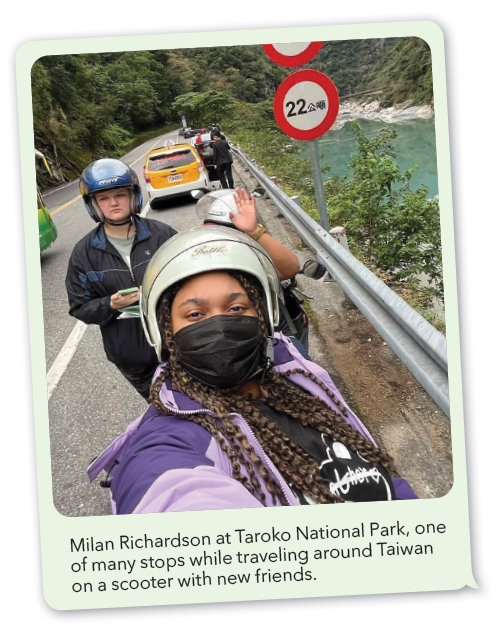
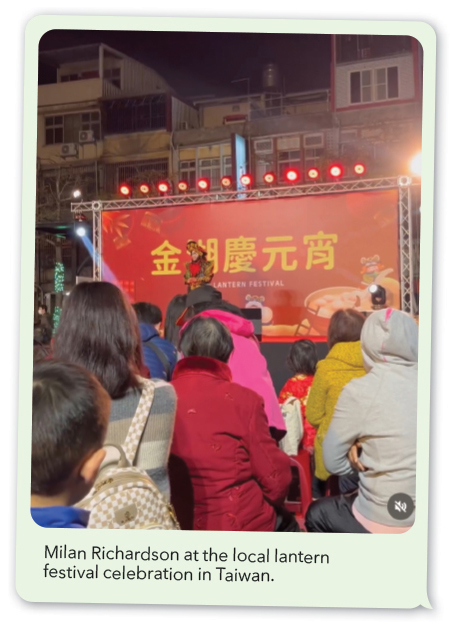
All eyes are on Milan Richardson ’23 as she helps her co-teacher keep score in a Jeopardy-like game her students are playing. Richardson teaches English to several classes of first through sixth-grade students at Jinsha Elementary School in Kinmen County, Taiwan. As she completes the Mandarin character for the numeral 5, a wave of giggles and chatter flows through the room.
Similar to a U.S. tally—four strokes and a strike though, the Mandarin character has 5 strokes total and needs to be written a certain way to represent 1, 2, 3, 4, or 5. “The students were so confused because I wrote the character strokes in the wrong order,” says Richardson, who is used to solving complex math as a Meyerhoff Scholar having earned a bachelor’s degree in bioinformatics and computational biology and minors in computer science and modern, languages, linguistics, and intercultural communication.
“I wanted to write the character correctly. I asked, and they showed me the proper order to write the strokes,” says Richardson, a Fulbright English Teaching Assistant (ETA). “They started clapping once I got it right. This was one of the many cool moments where my students were able to teach me.”
While she may be new to teaching in Taiwan, Richardson brings with her four years as an English and math tutor and a minor in Mandarin. “Taiwan was so different from any place I’ve ever been to. I was overwhelmed at first,” says Richardson. “I like it a lot, now. In my second month, I applied for a scooter license. Now I ride around the island and have taken my scooter other places on trips.”
Diplomas earned. Visas in hand. Vaccines completed. Luggage packed. Destination confirmed. Last summer, UMBC’s eight participants in the 2023 – 2024 Fulbright U.S. Student Program checked off all the important items on their to-do lists. The only thing left was to get to their placements on islands and in landlocked countries, cities, and countrysides across East Asia and Eastern Europe. It’s easier written than done. To adapt well to a new community, job, language, and culture, they must practice the art of humility and flexibility as their roles shift regularly from teacher to student.
Leading the Fulbright charge
All technicalities aside, the Fulbright experience is the beginning of building an international network of teachers and researchers who share the diversity and possibility of the U.S. with the world. In return, across the globe, communities welcome the next generation of leaders into their cities, neighborhoods, schools, and homes to share their country’s history, innovations, and culture. Since Fulbright’s inception in 1946, these reciprocal acts of kindness have created multiple paths forward to lifelong worldwide collaboration and understanding based on the simple act of giving someone different than yourself a chance.
“The Fulbright Program truly demonstrates public diplomacy in action,” says Brian Souders, M.A.’19, TESOL, and Ph.D. ’09, language, literacy, and culture, the associate director of global learning at UMBC’s Center for Global Engagement. In this role, Souders, who received a 2023 Fulbright International Education Administrator award to Germany, has led hundreds of Retrievers through the Fulbright application process as UMBC’s Fulbright Program advisor. “Whether in the classroom as teachers, students, or researchers, recipients learn about the world as much as they share what it means to be from the U.S. and UMBC alumni,” says Souders.
Thanks to Souders’ guidance, UMBC is one of 57 doctoral universities nationwide and three in Maryland to receive a Fulbright Top Producing Institution designation for 2023 – 2024, for the third time in the last five years. In the last decade, more than 80 UMBC alumni have received Fulbright awards. Out of the 10 Retrievers who received a 2023 – 2024 Fulbright, eight are currently placed internationally, seven are ETAs and one is on a research grant.
The hard work of play
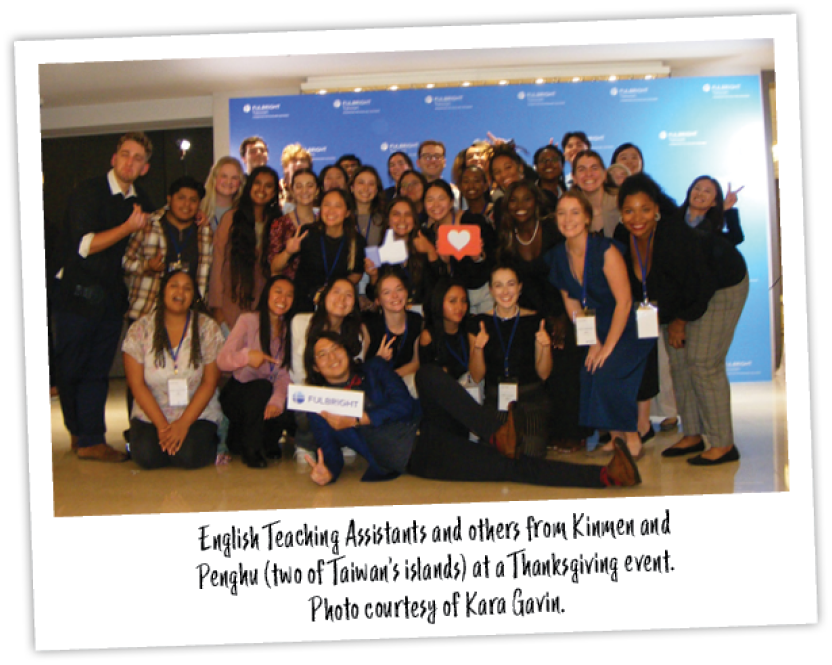
There are U.S. Fulbright student scholars in more than 100 countries worldwide. Three Retrievers were placed in Taiwan—they keep in touch regularly, see each other at ETA trainings, and are planning to travel together during their Fulbright year. But they all arrived in Taiwan separately and faced different challenges settling in.
“I arrived in Taiwan and immediately changed my plans because the airline lost my luggage,” says Humanities Scholar Kara Gavin ’20, English. She was grateful to have a carry-on. “It was chaotic. I was taking it all in,” says Gavin. A day and a 50-minute plane ride later, she arrived in Penghu County, Taiwan, an archipelago of about 90 islands between China and the main island of Taiwan. “The little beach town is in its own little world,” says Gavin. “The smell of the sand gave me comfort.”
Gavin teaches beginner English at two local junior high schools. New to Asia and Mandarin, Gavin’s thinking cap is on 24 – 7, including learning Mandarin in between teaching classes. “Living independently for the first time is hard on its own, but doing it in a foreign country is a whole other ball game,” says Gavin. “I’m acquiring many new life skills that will last me a lifetime.”
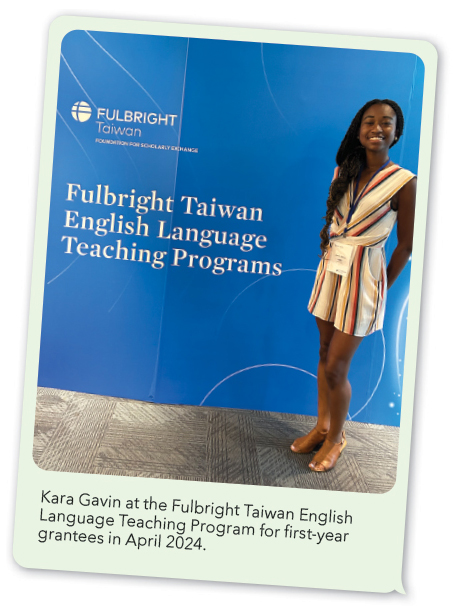
One of those is sympathizing with her students and anyone learning a new language and culture. “I teach the English pronunciation and spelling of a word,” says Gavin. “Then, they like to share the Mandarin equivalent with me. It’s all about patience, balance, and trust.” She also models intercultural teamwork by developing and teaching lessons with her bilingual (Mandarin/English) Taiwanese co-teacher to foster student engagement and enrichment.
For Fulbright Scholars, it is equally important to engage with communities beyond the classroom. When they apply for the grant, the Fulbright Program asks them to develop ideas to share their passions and skills in a community project. For Gavin, this meant adding a little drama to have a lot of fun. As a performing artist, Gavin knows the theatre can be a powerful community-building outlet. “I wanted to encourage students and other community members to express themselves and share their culture with me and others,” says Gavin.
She found a kindred spirit in a professor at a local university. They formed a drama club at the university for English language learners at all levels to explore American play formats with Taiwanese traditions and histories.“Writing original bilingual plays, in English and Mandarin, based on folktales about island traditions is creating an artistic and fun cultural exchange and understanding outside of my ETA duties,” says Gavin.
Finding the right pace
For fellow Humanities Scholar Nailah-Benā Chambers ’23, global studies, a Fulbright award to Taiwan was a natural next step. Chambers began learning Mandarin and all things Taiwanese in sixth grade at a Taiwanese Mandarin language immersion school in her hometown of Richmond, Virginia. As her Mandarin improved, she tutored other English speakers. This oscillating pattern of being a student and a teacher makes Chambers adaptable and persistent, she says.
But it hasn’t always been easy. When she first visited Taipei, Taiwan, in the spring of 2023 on a Mandarin language-intensive study abroad program, “I was so confident. I walked into a 7-Eleven to shop. No one could understand me,” says Chambers. “It was a bit embarrassing. Even with my language and cultural skills, I had a long way to go to mastering Mandarin.”
Now on her Fulbright ETA grant, Chambers arrived on solid ground, both culturally and linguistically. “I felt such a sense of calm and familiarity. Taiwan is so welcoming,” says Chambers. “It calms you down. Things are much slower here than in the U.S.” Soon enough, Chambers was balancing classrooms at Huludun Elementary and Fu Chun Elementary in Taichung City, on the main island of Taiwan, with students at both schools on the extreme spectrum of English proficiency.
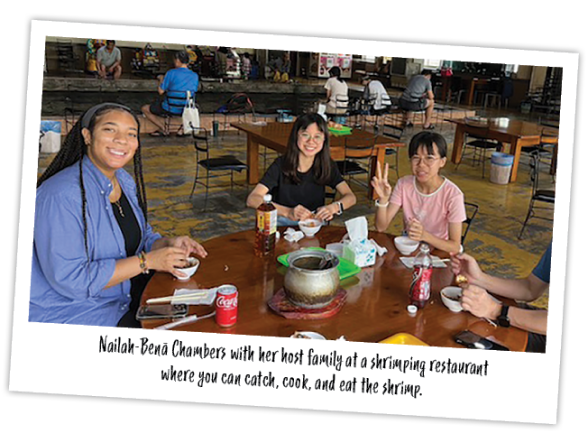
The upside of working with proficient English language learners is connecting on more advanced topics and sticking to Fulbright’s English-only immersion model. At one of her schools, the students are beginning English language learners, and the administrators only speak Mandarin. “My experience as a bilingual teacher and learner with a high level of understanding of the local language and culture has helped with classroom management and fostering powerful connections with students and administrators,” says Chambers. “It also helps to advance their grasp of the nuances of American English, especially when there are gray areas or misunderstandings.”
Keeping your ears open
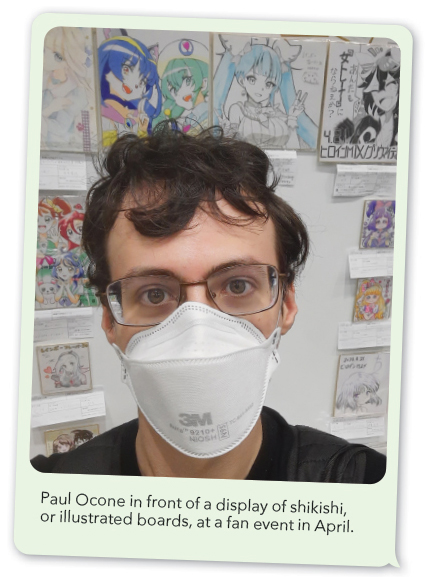
Watching anime, reading manga, (Japanese graphic novels), and participating in their fandom inspired Paul Ocone ’22, individualized study, a Linehan Artist Scholar, to research these subjects and learn Japanese. “I have deeply engaged in fan social life and communities—from leading an anime club to participating in and running conventions to moderating online communities—my affinity for and interest in anime fan spaces runs deep,” says Ocone. Part of Ocone’s observations include witnessing how some fan subcultures limit their membership in fear that a broader fanbase would weaken their subculture identity. In contrast, he says, other fan subcultures are more flexible while maintaining their identity.
Interested in adding to his initial research in U.S. fan spaces, Ocone is now at the epicenter of anime and manga culture as a Fulbright Student Researcher doing anthropological research with Morikawa Kaichirō, a leading scholar in this field at Meiji University’s School of Global Japanese Studies in Tokyo, also home to the Yoshihiro Yonezawa Memorial Library of Manga and Subcultures.
“I have had some amazing experiences participating in anime pilgrimage or anime tourism, including learning much from other fans and benefitting from their generosity,” says Ocone. “My Japanese is conversational—sometimes it’s challenging to understand specialized topics, but this has not deterred me from adding anime and manga tourism as a second research project.” In January, Ocone presented his work at the Popular Culture Tourism Stakeholders Summit in Japan.
Ocone is a sort of tourist himself, enjoying various aspects of Japanese pop culture. The daily musicality of Tokyo teaches him about enjoying the rhythm of the day. “Each train station plays a unique melody when the train departs,” says Ocone. These melodies or “hassha merodii,” are catchy and echo around in his brain like the convenience store jingles that also greet customers. “I was happily surprised when I heard a loudspeaker playing a symphony in my neighborhood,” says Ocone. “Another one played the following day and the next. I learned this was a daily sunset ritual.” He knows these sound experiences will play in his head long after returning to the U.S.
Learning new languages
This is not the first time David Bullman ’22, ancient studies, visited North Macedonia. He first went in 1995 as a performing musician and public affairs representative for the U.S. Army.
“North Macedonia was very different coming out of the Cold War,” says Bullman. “The infrastructure and general state of repair of public spaces and businesses is much better than I recall from that time.”
Now, as an ETA, Bullman teaches British civilization and American civilization in addition to three different levels of English at the University of Totovo in the Republic of North Macedonia, a landlocked country north of Greece. In Totovo, students begin learning English in elementary school and are fluent by the time they reach college. “I thought I would be teaching English basics,” says Bullman, “but it’s been great to teach a complex subject in the context of where my students live.”
His students are equally glad to help him with the local language. Macedonian and Albanian are the country’s two official languages. Bullman began learning some key Macedonian phrases in preparation for his trip. However, Albanian is the preferred language in Tetovo. After traveling with the Army to more than 15 countries on three continents, Bullman is used to rapidly switching gears and accepting help.
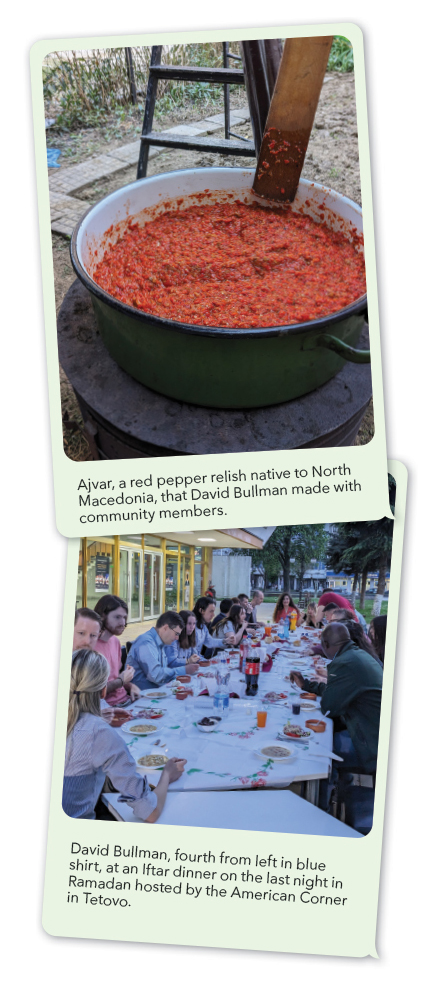
He eagerly takes on the student role when it comes to learning about new foods. Bullman’s apartment faces the Hapësira Socio-Kulturore Tetovë, a community center where locals and the nearby Peace Corps Volunteers sometimes organize activities, like an ajvar-making gathering. Ajvar is a delicacy across the Balkans made every fall. It’s a tradition passed down through centuries with many recipe variations. “Ajvar is made by charring red bell peppers that are then peeled, minced, seasoned, and cooked for hours,” says Bullman. It boils down to a relish that can be preserved for months, but locals tell Bullman that’s rare because it’s too good to keep for even one week. After participating in the preparation and getting to take home a few jars, Bullman agrees with the locals. Ajvar is now his go-to condiment on eggs, pasta, toast—anything goes.
Albanian and cooking are not the only languages Bullman tapped into while in Tetovo. As a lifelong clarinet player, Bullman hoped to create a musical exchange with local musicians. The opportunity presented itself when the dean of the Faculty of Art wanted to celebrate Thanksgiving. Bullman collaborated with the music faculty, the orchestra director, and students to create a concert of six songs. “I’m glad I returned to North Macedonia. The people are as warm and friendly as I remembered them to be,” says Bullman. “I wanted to come back and experience it myself again.”
Tapping into curiosity
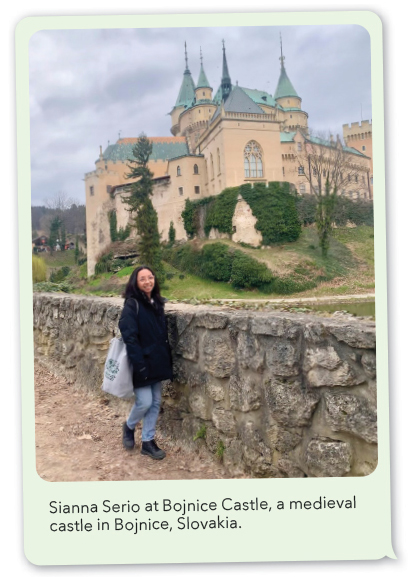
On her way to her Fulbright placement, Sianna Serio ’23, computer science, went city hopping. “I was headed to Žilina, Slovakia, east of Austria and south of Poland,” says Serio. “I flew into Vienna, Austria, then I took a one-hour bus ride crossing Austria’s eastern border into Slovakia to get to Bratislava, the capital.“ There she met other ETAs for orientation. “A week later, I hopped on a two-hour train ride to my teaching placement in Žilina and I met my wonderful mentor, Maria Veršova, who became my second mom.”
Serio teaches at the Hotel Academy, Žilina. The academy focuses on hotel management, gastronomy, and tourism. “My students are beginning English language learners,” says Serio. “I teach what the class is interested in, like American pop culture, because they rarely meet a native English speaker.” During outings with her students, they ask about a wide range of topics. “There are many topics that I would not have thought to cover if it were not for time spent outside of the classroom,” says Serio, “Some of those conversations became formal lessons, like the lesson on the three branches of the U. S. government.”
Serio appreciates her students’ curiosity. She tapped into her love of website development and design to improve her students’ confidence in writing and speaking English and prepare for their Maturita exam, a national high school exit exam. “Some of my students are helping me design a class webpage for them where I will showcase their class and post some of their practice writing in English,” says Serio. “These posts will include topics covered in the Maturita exam, information about their school, and answers to questions about Slovakia.”
Serio’s mentor Maria Veršova, head of the English department, is her motivation. She guides her through lesson planning, class schedules, and the challenges of relocating to a new country. “When my original housing plans fell through, Maria found housing for me five minutes from her house,” says Serio. “She helped me find health insurance and open a bank account. Her husband set up my internet.” They have welcomed Serio almost daily into their home for dinner, tea, coffee, or wine. Serio is a gracious guest and lent her graphic design expertise to help Veršova design invitation cards for her 50th birthday party. Veršova tells Serio she will always have a place to stay in Žilina.
Fulbright: The next generation
Teaching has defined the last decade for Tiffany Powell, a master’s student in UMBC’s TESOL program, a passion she invested in as an English language learner teacher in Seoul and in Miryang City, South Korea, for five years, and in Florida this past year. Now, she is in Iași, Romania, southwest of Ukraine, at the Alexandru Ioan Cuza University teaching American studies. Powell is committed to bridging culture, community, and belonging by bringing technology into the classroom.
Powell also decided to bring the research and cultural understanding closer to home by partnering with Romanian teachers to develop a five-part series on African American women’s history. “We talked about Black women in science in the context of the movie Hidden Figures and discussed Hollywood’s portrayal of Black life,” says Powell. The class is now creating a series on Romanian women. Helping students better understand the similarities and differences between U.S. and Romanian cultures has been an eye-opening experience for Powell.
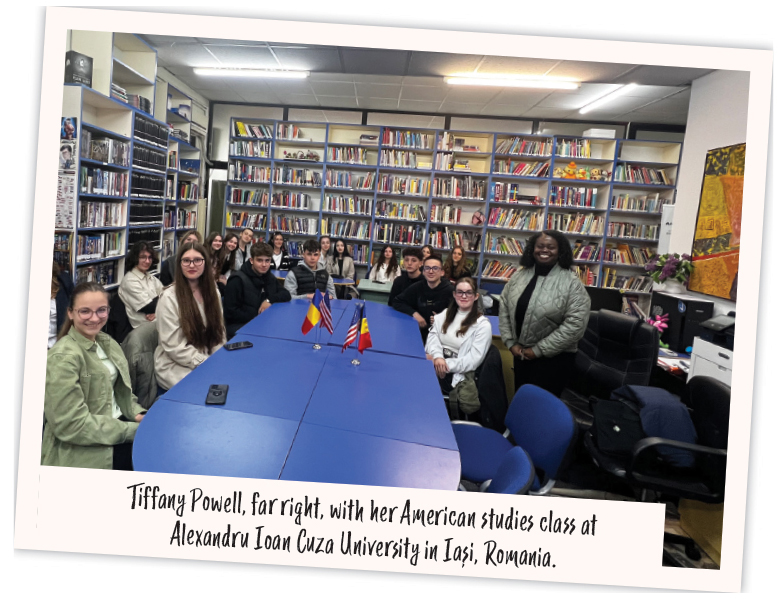
She sees the impact of a country formerly under communism. In Iași, sometimes the internet doesn’t work and, in her school, there are no clubs or student organizations to gain the skills needed to earn a Fulbright award. “My students have given me a new perspective. You may want to come in and make changes, but you must understand where they’re coming from. There is a saying in Iași, ‘It’s not impossible. It’s just difficult,’” says Powell. She is trying to help with the difficult part by leading Fulbright application and leadership workshops.
Powell, like the other Fulbrighters, will bring her experiences home with her and wherever she ends up teaching English next. When their Fulbright year ends, these Retriever ambassadors will find themselves as emissaries yet again, returning to their hometowns, sharing the good news of ajvar made in community, the freedom of a scooter ride along a Taiwanese beach, or the correct stroke order for writing the Mandarin number five. The lessons their students and host families passed along—including pausing to take a breath and appreciate their international successes small and large—will continue to form and shape the way they see the world.
“Having a flexible mindset and under-standing the historical context of your placement is key,” says Powell. “I carry myself as a U.S. representative. Living abroad teaches humility, adaptability, and open-mindedness to press on through challenging times.”
]]>
International travel offers ample opportunities to stretch yourself—one minute you may be the expert and the next, completely clueless about how something works. Retrievers currently in the...
https://umbc.edu/stories/a-journey-of-growth/
https://dev.my.umbc.edu/api/v0/pixel/news/142391/guest@my.umbc.edu/429a43e449ef9d4187b1ae1d4e63ca4e/api/pixel
alumni
ancient-studies
bioinformatics-and-computational-biology
cahss
cge
computer-science
education-abroad
english
feature
fulbright
global-studies
humanities
inds
linehan
llc
magazine
meyerhoff
spring-2024
story
UMBC News & Magazine
https://dev.my.umbc.edu/groups/umbc-news-magazine
https://assets1-dev.my.umbc.edu/system/shared/avatars/groups/000/001/943/24435aa6207c452e7bc15cc74b42c7bb/xsmall.png?1748556657
https://assets1-dev.my.umbc.edu/system/shared/avatars/groups/000/001/943/24435aa6207c452e7bc15cc74b42c7bb/original.png?1748556657
https://assets2-dev.my.umbc.edu/system/shared/avatars/groups/000/001/943/24435aa6207c452e7bc15cc74b42c7bb/xxlarge.png?1748556657
https://assets2-dev.my.umbc.edu/system/shared/avatars/groups/000/001/943/24435aa6207c452e7bc15cc74b42c7bb/xlarge.png?1748556657
https://assets3-dev.my.umbc.edu/system/shared/avatars/groups/000/001/943/24435aa6207c452e7bc15cc74b42c7bb/large.png?1748556657
https://assets1-dev.my.umbc.edu/system/shared/avatars/groups/000/001/943/24435aa6207c452e7bc15cc74b42c7bb/medium.png?1748556657
https://assets2-dev.my.umbc.edu/system/shared/avatars/groups/000/001/943/24435aa6207c452e7bc15cc74b42c7bb/small.png?1748556657
https://assets1-dev.my.umbc.edu/system/shared/avatars/groups/000/001/943/24435aa6207c452e7bc15cc74b42c7bb/xsmall.png?1748556657
https://assets2-dev.my.umbc.edu/system/shared/avatars/groups/000/001/943/24435aa6207c452e7bc15cc74b42c7bb/xxsmall.png?1748556657
UMBC News & Magazine
5
0
false
Wed, 29 May 2024 14:32:52 -0400
A Journey of Growth
International travel offers ample opportunities to stretch yourself—one minute you may be the expert and the next, completely clueless about how something works. Retrievers currently in the Fulbright U.S. Student Program—teaching English or researching around the globe—find themselves oscillating between their teaching and student roles on a daily or hourly basis. By engaging their host communities through openness and cultural humility (and many shared cups of tea or coffee), these Fulbrighters are finding their balance along the way.
All eyes are on Milan Richardson ’23 as she helps her co-teacher keep score in a Jeopardy-like game her students are playing. Richardson teaches English to several classes of first through sixth-grade students at Jinsha Elementary School in Kinmen County, Taiwan. As she completes the Mandarin character for the numeral 5, a wave of giggles and chatter flows through the room.
Similar to a U.S. tally—four strokes and a strike though, the Mandarin character has 5 strokes total and needs to be written a certain way to represent 1, 2, 3, 4, or 5. “The students were so confused because I wrote the character strokes in the wrong order,” says Richardson, who is used to solving complex math as a Meyerhoff Scholar having earned a bachelor’s degree in bioinformatics and computational biology and minors in computer science and modern, languages, linguistics, and intercultural communication.
“I wanted to write the character correctly. I asked, and they showed me the proper order to write the strokes,” says Richardson, a Fulbright English Teaching Assistant (ETA). “They started clapping once I got it right. This was one of the many cool moments where my students were able to teach me.”
While she may be new to teaching in Taiwan, Richardson brings with her four years as an English and math tutor and a minor in Mandarin. “Taiwan was so different from any place I’ve ever been to. I was overwhelmed at first,” says Richardson. “I like it a lot, now. In my second month, I applied for a scooter license. Now I ride around the island and have taken my scooter other places on trips.”
Diplomas earned. Visas in hand. Vaccines completed. Luggage packed. Destination confirmed. Last summer, UMBC’s eight participants in the 2023 – 2024 Fulbright U.S. Student Program checked off all the important items on their to-do lists. The only thing left was to get to their placements on islands and in landlocked countries, cities, and countrysides across East Asia and Eastern Europe. It’s easier written than done. To adapt well to a new community, job, language, and culture, they must practice the art of humility and flexibility as their roles shift regularly from teacher to student.
Leading the Fulbright charge
All technicalities aside, the Fulbright experience is the beginning of building an international network of teachers and researchers who share the diversity and possibility of the U.S. with the world. In return, across the globe, communities welcome the next generation of leaders into their cities, neighborhoods, schools, and homes to share their country’s history, innovations, and culture. Since Fulbright’s inception in 1946, these reciprocal acts of kindness have created multiple paths forward to lifelong worldwide collaboration and understanding based on the simple act of giving someone different than yourself a chance.
“The Fulbright Program truly demonstrates public diplomacy in action,” says Brian Souders, M.A.’19, TESOL, and Ph.D. ’09, language, literacy, and culture, the associate director of global learning at UMBC’s Center for Global Engagement. In this role, Souders, who received a 2023 Fulbright International Education Administrator award to Germany, has led hundreds of Retrievers through the Fulbright application process as UMBC’s Fulbright Program advisor. “Whether in the classroom as teachers, students, or researchers, recipients learn about the world as much as they share what it means to be from the U.S. and UMBC alumni,” says Souders.
Thanks to Souders’ guidance, UMBC is one of 57 doctoral universities nationwide and three in Maryland to receive a Fulbright Top Producing Institution designation for 2023 – 2024, for the third time in the last five years. In the last decade, more than 80 UMBC alumni have received Fulbright awards. Out of the 10 Retrievers who received a 2023 – 2024 Fulbright, eight are currently placed internationally, seven are ETAs and one is on a research grant.
The hard work of play
There are U.S. Fulbright student scholars in more than 100 countries worldwide. Three Retrievers were placed in Taiwan—they keep in touch regularly, see each other at ETA trainings, and are planning to travel together during their Fulbright year. But they all arrived in Taiwan separately and faced different challenges settling in.
“I arrived in Taiwan and immediately changed my plans because the airline lost my luggage,” says Humanities Scholar Kara Gavin ’20, English. She was grateful to have a carry-on. “It was chaotic. I was taking it all in,” says Gavin. A day and a 50-minute plane ride later, she arrived in Penghu County, Taiwan, an archipelago of about 90 islands between China and the main island of Taiwan. “The little beach town is in its own little world,” says Gavin. “The smell of the sand gave me comfort.”
Gavin teaches beginner English at two local junior high schools. New to Asia and Mandarin, Gavin’s thinking cap is on 24 – 7, including learning Mandarin in between teaching classes. “Living independently for the first time is hard on its own, but doing it in a foreign country is a whole other ball game,” says Gavin. “I’m acquiring many new life skills that will last me a lifetime.”
One of those is sympathizing with her students and anyone learning a new language and culture. “I teach the English pronunciation and spelling of a word,” says Gavin. “Then, they like to share the Mandarin equivalent with me. It’s all about patience, balance, and trust.” She also models intercultural teamwork by developing and teaching lessons with her bilingual (Mandarin/English) Taiwanese co-teacher to foster student engagement and enrichment.
For Fulbright Scholars, it is equally important to engage with communities beyond the classroom. When they apply for the grant, the Fulbright Program asks them to develop ideas to share their passions and skills in a community project. For Gavin, this meant adding a little drama to have a lot of fun. As a performing artist, Gavin knows the theatre can be a powerful community-building outlet. “I wanted to encourage students and other community members to express themselves and share their culture with me and others,” says Gavin.
She found a kindred spirit in a professor at a local university. They formed a drama club at the university for English language learners at all levels to explore American play formats with Taiwanese traditions and histories.“Writing original bilingual plays, in English and Mandarin, based on folktales about island traditions is creating an artistic and fun cultural exchange and understanding outside of my ETA duties,” says Gavin.
Finding the right pace
For fellow Humanities Scholar Nailah-Benā Chambers ’23, global studies, a Fulbright award to Taiwan was a natural next step. Chambers began learning Mandarin and all things Taiwanese in sixth grade at a Taiwanese Mandarin language immersion school in her hometown of Richmond, Virginia. As her Mandarin improved, she tutored other English speakers. This oscillating pattern of being a student and a teacher makes Chambers adaptable and persistent, she says.
But it hasn’t always been easy. When she first visited Taipei, Taiwan, in the spring of 2023 on a Mandarin language-intensive study abroad program, “I was so confident. I walked into a 7-Eleven to shop. No one could understand me,” says Chambers. “It was a bit embarrassing. Even with my language and cultural skills, I had a long way to go to mastering Mandarin.”
Now on her Fulbright ETA grant, Chambers arrived on solid ground, both culturally and linguistically. “I felt such a sense of calm and familiarity. Taiwan is so welcoming,” says Chambers. “It calms you down. Things are much slower here than in the U.S.” Soon enough, Chambers was balancing classrooms at Huludun Elementary and Fu Chun Elementary in Taichung City, on the main island of Taiwan, with students at both schools on the extreme spectrum of English proficiency.
The upside of working with proficient English language learners is connecting on more advanced topics and sticking to Fulbright’s English-only immersion model. At one of her schools, the students are beginning English language learners, and the administrators only speak Mandarin. “My experience as a bilingual teacher and learner with a high level of understanding of the local language and culture has helped with classroom management and fostering powerful connections with students and administrators,” says Chambers. “It also helps to advance their grasp of the nuances of American English, especially when there are gray areas or misunderstandings.”
Keeping your ears open
Watching anime, reading manga, (Japanese graphic novels), and participating in their fandom inspired Paul Ocone ’22, individualized study, a Linehan Artist Scholar, to research these subjects and learn Japanese. “I have deeply engaged in fan social life and communities—from leading an anime club to participating in and running conventions to moderating online communities—my affinity for and interest in anime fan spaces runs deep,” says Ocone. Part of Ocone’s observations include witnessing how some fan subcultures limit their membership in fear that a broader fanbase would weaken their subculture identity. In contrast, he says, other fan subcultures are more flexible while maintaining their identity.
Interested in adding to his initial research in U.S. fan spaces, Ocone is now at the epicenter of anime and manga culture as a Fulbright Student Researcher doing anthropological research with Morikawa Kaichirō, a leading scholar in this field at Meiji University’s School of Global Japanese Studies in Tokyo, also home to the Yoshihiro Yonezawa Memorial Library of Manga and Subcultures.
“I have had some amazing experiences participating in anime pilgrimage or anime tourism, including learning much from other fans and benefitting from their generosity,” says Ocone. “My Japanese is conversational—sometimes it’s challenging to understand specialized topics, but this has not deterred me from adding anime and manga tourism as a second research project.” In January, Ocone presented his work at the Popular Culture Tourism Stakeholders Summit in Japan.
Ocone is a sort of tourist himself, enjoying various aspects of Japanese pop culture. The daily musicality of Tokyo teaches him about enjoying the rhythm of the day. “Each train station plays a unique melody when the train departs,” says Ocone. These melodies or “hassha merodii,” are catchy and echo around in his brain like the convenience store jingles that also greet customers. “I was happily surprised when I heard a loudspeaker playing a symphony in my neighborhood,” says Ocone. “Another one played the following day and the next. I learned this was a daily sunset ritual.” He knows these sound experiences will play in his head long after returning to the U.S.
Learning new languages
This is not the first time David Bullman ’22, ancient studies, visited North Macedonia. He first went in 1995 as a performing musician and public affairs representative for the U.S. Army.
“North Macedonia was very different coming out of the Cold War,” says Bullman. “The infrastructure and general state of repair of public spaces and businesses is much better than I recall from that time.”
Now, as an ETA, Bullman teaches British civilization and American civilization in addition to three different levels of English at the University of Totovo in the Republic of North Macedonia, a landlocked country north of Greece. In Totovo, students begin learning English in elementary school and are fluent by the time they reach college. “I thought I would be teaching English basics,” says Bullman, “but it’s been great to teach a complex subject in the context of where my students live.”
His students are equally glad to help him with the local language. Macedonian and Albanian are the country’s two official languages. Bullman began learning some key Macedonian phrases in preparation for his trip. However, Albanian is the preferred language in Tetovo. After traveling with the Army to more than 15 countries on three continents, Bullman is used to rapidly switching gears and accepting help.
He eagerly takes on the student role when it comes to learning about new foods. Bullman’s apartment faces the Hapësira Socio-Kulturore Tetovë, a community center where locals and the nearby Peace Corps Volunteers sometimes organize activities, like an ajvar-making gathering. Ajvar is a delicacy across the Balkans made every fall. It’s a tradition passed down through centuries with many recipe variations. “Ajvar is made by charring red bell peppers that are then peeled, minced, seasoned, and cooked for hours,” says Bullman. It boils down to a relish that can be preserved for months, but locals tell Bullman that’s rare because it’s too good to keep for even one week. After participating in the preparation and getting to take home a few jars, Bullman agrees with the locals. Ajvar is now his go-to condiment on eggs, pasta, toast—anything goes.
Albanian and cooking are not the only languages Bullman tapped into while in Tetovo. As a lifelong clarinet player, Bullman hoped to create a musical exchange with local musicians. The opportunity presented itself when the dean of the Faculty of Art wanted to celebrate Thanksgiving. Bullman collaborated with the music faculty, the orchestra director, and students to create a concert of six songs. “I’m glad I returned to North Macedonia. The people are as warm and friendly as I remembered them to be,” says Bullman. “I wanted to come back and experience it myself again.”
Tapping into curiosity
On her way to her Fulbright placement, Sianna Serio ’23, computer science, went city hopping. “I was headed to Žilina, Slovakia, east of Austria and south of Poland,” says Serio. “I flew into Vienna, Austria, then I took a one-hour bus ride crossing Austria’s eastern border into Slovakia to get to Bratislava, the capital.“ There she met other ETAs for orientation. “A week later, I hopped on a two-hour train ride to my teaching placement in Žilina and I met my wonderful mentor, Maria Veršova, who became my second mom.”
Serio teaches at the Hotel Academy, Žilina. The academy focuses on hotel management, gastronomy, and tourism. “My students are beginning English language learners,” says Serio. “I teach what the class is interested in, like American pop culture, because they rarely meet a native English speaker.” During outings with her students, they ask about a wide range of topics. “There are many topics that I would not have thought to cover if it were not for time spent outside of the classroom,” says Serio, “Some of those conversations became formal lessons, like the lesson on the three branches of the U. S. government.”
Serio appreciates her students’ curiosity. She tapped into her love of website development and design to improve her students’ confidence in writing and speaking English and prepare for their Maturita exam, a national high school exit exam. “Some of my students are helping me design a class webpage for them where I will showcase their class and post some of their practice writing in English,” says Serio. “These posts will include topics covered in the Maturita exam, information about their school, and answers to questions about Slovakia.”
Serio’s mentor Maria Veršova, head of the English department, is her motivation. She guides her through lesson planning, class schedules, and the challenges of relocating to a new country. “When my original housing plans fell through, Maria found housing for me five minutes from her house,” says Serio. “She helped me find health insurance and open a bank account. Her husband set up my internet.” They have welcomed Serio almost daily into their home for dinner, tea, coffee, or wine. Serio is a gracious guest and lent her graphic design expertise to help Veršova design invitation cards for her 50th birthday party. Veršova tells Serio she will always have a place to stay in Žilina.
Fulbright: The next generation
Teaching has defined the last decade for Tiffany Powell, a master’s student in UMBC’s TESOL program, a passion she invested in as an English language learner teacher in Seoul and in Miryang City, South Korea, for five years, and in Florida this past year. Now, she is in Iași, Romania, southwest of Ukraine, at the Alexandru Ioan Cuza University teaching American studies. Powell is committed to bridging culture, community, and belonging by bringing technology into the classroom.
Powell also decided to bring the research and cultural understanding closer to home by partnering with Romanian teachers to develop a five-part series on African American women’s history. “We talked about Black women in science in the context of the movie Hidden Figures and discussed Hollywood’s portrayal of Black life,” says Powell. The class is now creating a series on Romanian women. Helping students better understand the similarities and differences between U.S. and Romanian cultures has been an eye-opening experience for Powell.
She sees the impact of a country formerly under communism. In Iași, sometimes the internet doesn’t work and, in her school, there are no clubs or student organizations to gain the skills needed to earn a Fulbright award. “My students have given me a new perspective. You may want to come in and make changes, but you must understand where they’re coming from. There is a saying in Iași, ‘It’s not impossible. It’s just difficult,’” says Powell. She is trying to help with the difficult part by leading Fulbright application and leadership workshops.
Powell, like the other Fulbrighters, will bring her experiences home with her and wherever she ends up teaching English next. When their Fulbright year ends, these Retriever ambassadors will find themselves as emissaries yet again, returning to their hometowns, sharing the good news of ajvar made in community, the freedom of a scooter ride along a Taiwanese beach, or the correct stroke order for writing the Mandarin number five. The lessons their students and host families passed along—including pausing to take a breath and appreciate their international successes small and large—will continue to form and shape the way they see the world.
“Having a flexible mindset and under-standing the historical context of your placement is key,” says Powell. “I carry myself as a U.S. representative. Living abroad teaches humility, adaptability, and open-mindedness to press on through challenging times.”
]]>
International travel offers ample opportunities to stretch yourself—one minute you may be the expert and the next, completely clueless about how something works. Retrievers currently in the...
https://umbc.edu/stories/a-journey-of-growth-retriever-fulbright/
https://dev.my.umbc.edu/api/v0/pixel/news/142404/guest@my.umbc.edu/ed280c216f570c718be808f58bf7c55a/api/pixel
alumni
ancient-studies
bioinformatics-and-computational-biology
cahss
cge
computer-science
education-abroad
english
feature
fulbright
global-studies
humanities
inds
linehan
llc
magazine
meyerhoff
spring-2024
story
UMBC News & Magazine
https://dev.my.umbc.edu/groups/umbc-news-magazine
https://assets1-dev.my.umbc.edu/system/shared/avatars/groups/000/001/943/24435aa6207c452e7bc15cc74b42c7bb/xsmall.png?1748556657
https://assets1-dev.my.umbc.edu/system/shared/avatars/groups/000/001/943/24435aa6207c452e7bc15cc74b42c7bb/original.png?1748556657
https://assets2-dev.my.umbc.edu/system/shared/avatars/groups/000/001/943/24435aa6207c452e7bc15cc74b42c7bb/xxlarge.png?1748556657
https://assets2-dev.my.umbc.edu/system/shared/avatars/groups/000/001/943/24435aa6207c452e7bc15cc74b42c7bb/xlarge.png?1748556657
https://assets3-dev.my.umbc.edu/system/shared/avatars/groups/000/001/943/24435aa6207c452e7bc15cc74b42c7bb/large.png?1748556657
https://assets1-dev.my.umbc.edu/system/shared/avatars/groups/000/001/943/24435aa6207c452e7bc15cc74b42c7bb/medium.png?1748556657
https://assets2-dev.my.umbc.edu/system/shared/avatars/groups/000/001/943/24435aa6207c452e7bc15cc74b42c7bb/small.png?1748556657
https://assets1-dev.my.umbc.edu/system/shared/avatars/groups/000/001/943/24435aa6207c452e7bc15cc74b42c7bb/xsmall.png?1748556657
https://assets2-dev.my.umbc.edu/system/shared/avatars/groups/000/001/943/24435aa6207c452e7bc15cc74b42c7bb/xxsmall.png?1748556657
UMBC News & Magazine
0
0
false
Wed, 29 May 2024 14:32:52 -0400
Meet a Retriever—Monroe Kennedy, III, ’12, mechanical engineering professor at Stanford University
Meet Monroe Kennedy, III, a Meyerhoff Scholar (M20) who earned his B.S. in mechanical engineering from UMBC in 2012 before earning his M.S. in robotics and Ph.D. in mechanical engineering and applied mechanics from the University of Pennsylvania. Monroe is now an assistant professor in the mechanical engineering department at Stanford University. His work is in collaborative robotics, building systems capable of extending robotic autonomy to scenarios where robots work closely around humans and must anticipate their needs to be effective teammates. Outside of his role as a professor, Monroe serves as a national director for Black in Robotics, a nonprofit organization dedicated to enhancing diversity within the field of robotics. Take it away Monroe!
Q: What brought you to UMBC?
A: I came to UMBC for its mechanical engineering program and the Meyerhoff Scholars Program. I had a passion for invention and design and UMBC was the perfect place to gain knowledge so I could have an impactful career. During high school, I was taking courses at a community college, and one instructor was aware of the Meyerhoff program and nominated me—I am so grateful for that initial introduction.
UMBC is truly a melting pot of ideas and culture. You will find a diverse and vibrant community and a place to call home.
Monroe Kennedy, III, ’12, M20
Q: What do you love about your academic program?
A: I love mechanical engineering. When I first joined UMBC, the movie Iron Man had just come out and there was a screening on the Quad. I remember thinking “I want to do that!” Tony Stark was the only hero whose superpower was truly achievable—his ability to innovate and invent.
Mechanical engineering is one of the oldest engineering disciplines. If you follow the Ph.D. “academic tree,” you will find many of the first mechanical engineers had advisors in more fundamental sciences. Because it is a fundamental engineering discipline it covers many areas from controls, dynamics, design, fluids, vibrations, and so much more.
An individual who learns to embrace the diversity of subjects within mechanical engineering learns to think about problems and solutions holistically and brings solutions from every sub-field to solve problems in the most elegant way possible. As a roboticist, a lot of my work is endowing my robots with a form of “intelligence,” but often we find ourselves wishing our robot had an additional physical feature, and as mechanical engineers, it is not difficult for us to make such concepts a reality very quickly.
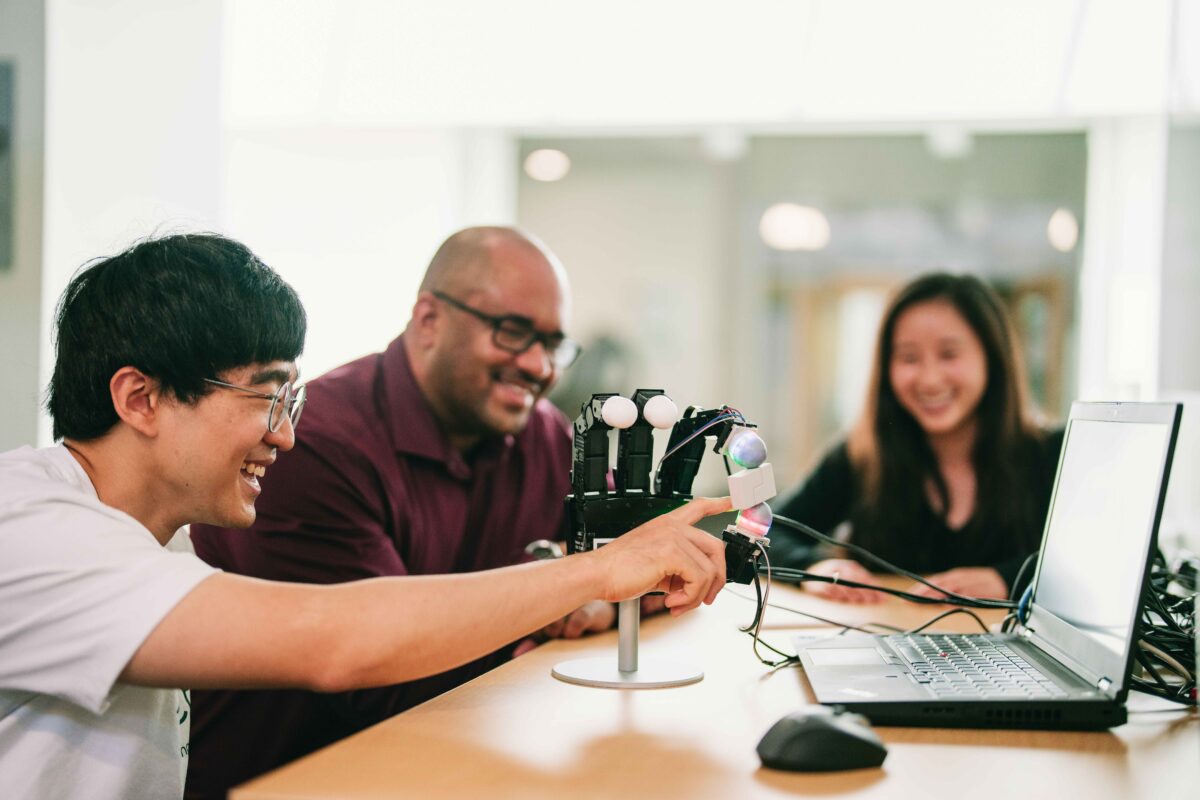 Monroe, a mechanical engineering professor at Stanford University, and his students looking at a robotic fingertip developed in the lab called DenseTact that will enable robots to perform dexterous tasks like humans in the near future.
Q: Tell us about someone in the community who has inspired you or supported you, and how they did it.
A: While at UMBC I was very fortunate to be able to work in Professor J. Vanderlei Martins‘ LACO (Laboratory for Aerosol and Cloud Optics) lab. Professor Martins was an amazing advisor who was able to use my limited experience at the time to contribute to a very impactful project involving designing the de-orbiting system for a picosatellite. Being given an opportunity to work on something that traveled to space was a key element in my ultimate trajectory, and I am very grateful to Professor Martins for his support and mentorship.
My favorite part of being a UMBC alumnus is the sense of forever community I’ve felt in the decade since graduating.
Monroe Kennedy, III, ’12, M20
Q: Tell us about your HOW.
A: The Meyerhoff community played a very big role in my career. Through the program, I was coached on applying for internships and graduate school. Additionally, having the support of professors like J. Vanderlei Martins, working in his laboratory, and receiving his recommendation was crucial to my academic trajectory.
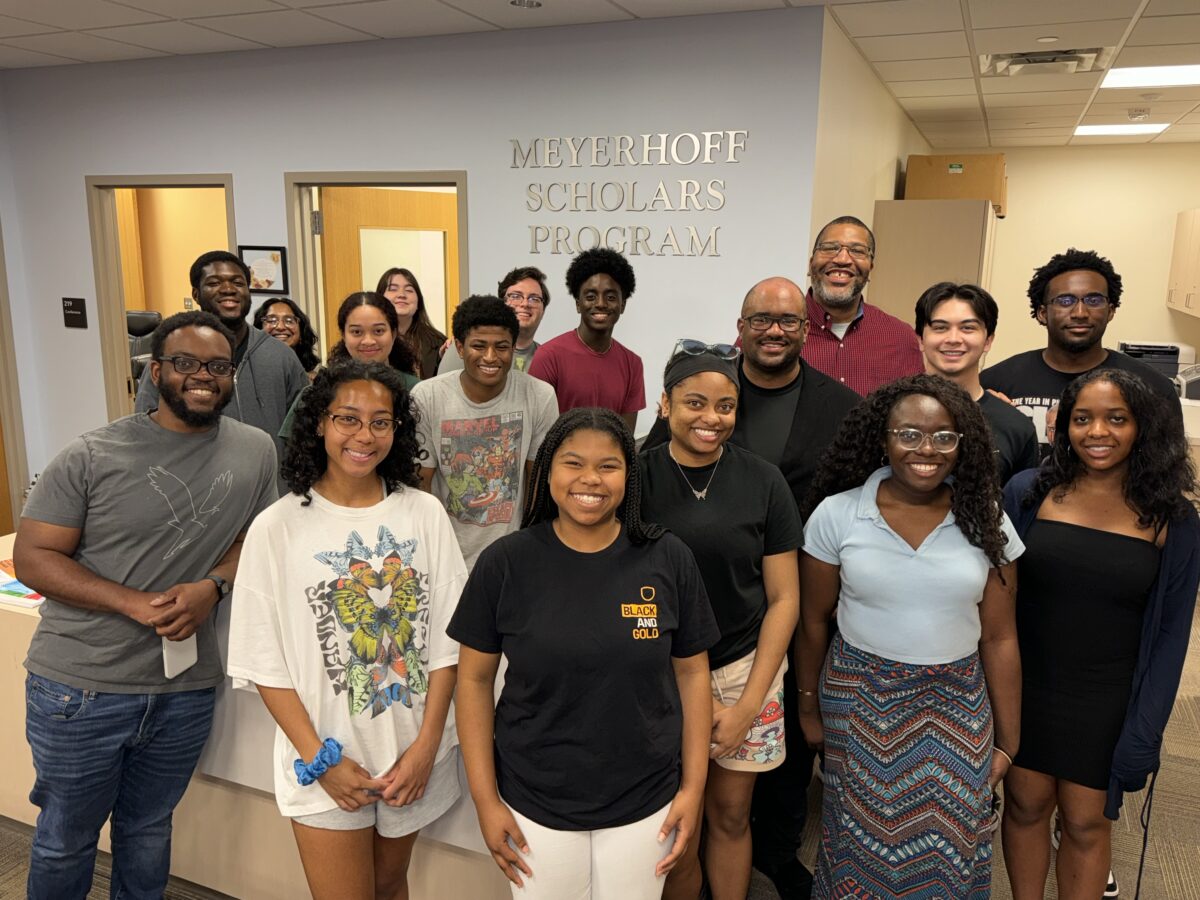 Monroe returned to campus recently to meet with current Meyerhoff students and tour faculty labs.
Q: Tell us about your current job. What do you like most about it?
A: I am an assistant professor in the mechanical engineering department with a courtesy appointment in computer science at Stanford University. My work is in collaborative robotics, building systems capable of extending robotic autonomy to scenarios where robots work closely around humans and must anticipate their needs to be effective teammates.
I love the Stanford community. You will find here that dreaming big and doing the extraordinary is quite ordinary here.
Outside of my role as a professor, I serve as a national director for Black in Robotics, a nonprofit organization dedicated to enhancing diversity within the field of robotics.
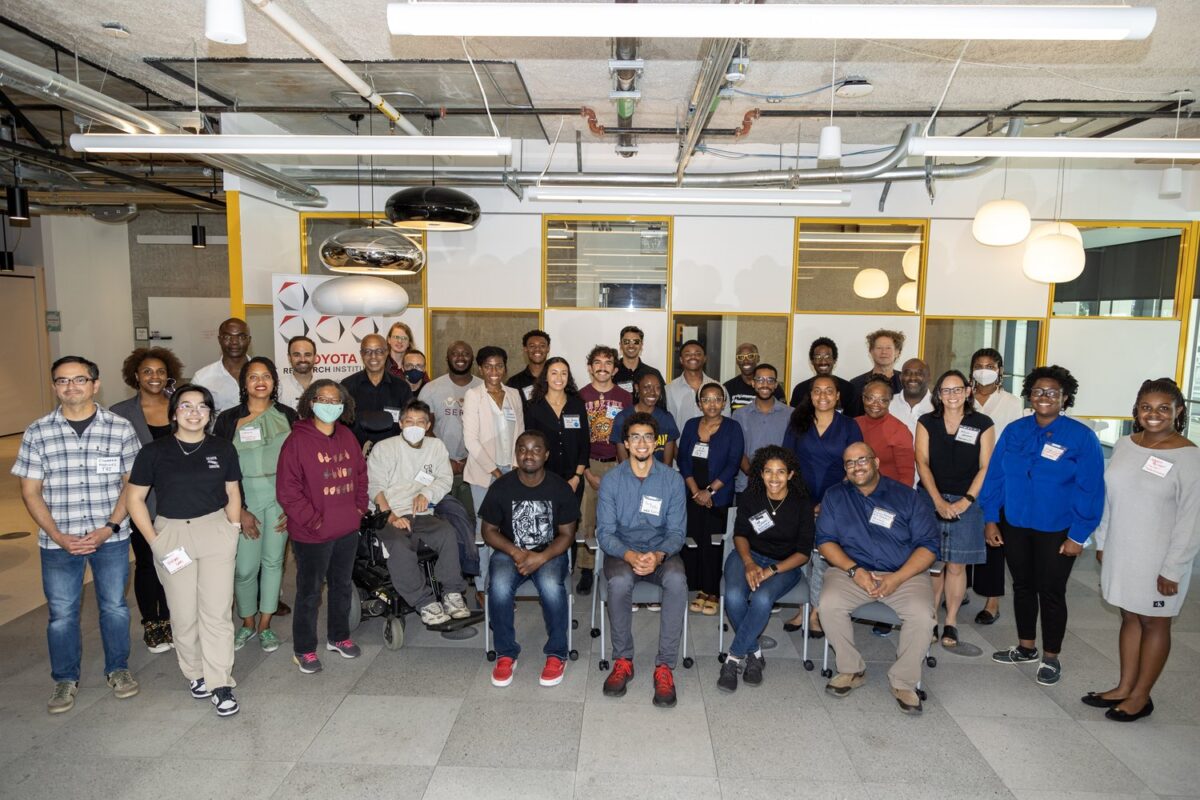 Group photo from a Black in Robotics networking event at the University of California, Berkeley.
Q: What drives you to support UMBC?
A: I want to see UMBC continue to produce leaders who are inquisitive and courageous, unafraid of setbacks, and yet very accomplished and making the world a better place.
* * * * *
UMBC’s greatest strength is its people. When people meet Retrievers and hear about the passion they bring, the relationships they create, the ways they support each other, and the commitment they have to inclusive excellence, they truly get a sense of our community. That’s what “Meet a Retriever” is all about.
Learn more about how UMBC can help you achieve your goals.
]]>
Meet Monroe Kennedy, III, a Meyerhoff Scholar (M20) who earned his B.S. in mechanical engineering from UMBC in 2012 before earning his M.S. in robotics and Ph.D. in mechanical engineering and...
https://umbc.edu/stories/mechanical-engineering-professor-monroe-kennedy/
https://dev.my.umbc.edu/api/v0/pixel/news/141656/guest@my.umbc.edu/adb4daec1996ac3764c5485836f34075/api/pixel
alumni
impact
magazine
mechanical-engineering
meet-a-retriever
meyerhoff
meyerhoff-alumni
meyerhoff-scholar
story
UMBC News & Magazine
https://dev.my.umbc.edu/groups/umbc-news-magazine
https://assets1-dev.my.umbc.edu/system/shared/avatars/groups/000/001/943/24435aa6207c452e7bc15cc74b42c7bb/xsmall.png?1748556657
https://assets1-dev.my.umbc.edu/system/shared/avatars/groups/000/001/943/24435aa6207c452e7bc15cc74b42c7bb/original.png?1748556657
https://assets2-dev.my.umbc.edu/system/shared/avatars/groups/000/001/943/24435aa6207c452e7bc15cc74b42c7bb/xxlarge.png?1748556657
https://assets2-dev.my.umbc.edu/system/shared/avatars/groups/000/001/943/24435aa6207c452e7bc15cc74b42c7bb/xlarge.png?1748556657
https://assets3-dev.my.umbc.edu/system/shared/avatars/groups/000/001/943/24435aa6207c452e7bc15cc74b42c7bb/large.png?1748556657
https://assets1-dev.my.umbc.edu/system/shared/avatars/groups/000/001/943/24435aa6207c452e7bc15cc74b42c7bb/medium.png?1748556657
https://assets2-dev.my.umbc.edu/system/shared/avatars/groups/000/001/943/24435aa6207c452e7bc15cc74b42c7bb/small.png?1748556657
https://assets1-dev.my.umbc.edu/system/shared/avatars/groups/000/001/943/24435aa6207c452e7bc15cc74b42c7bb/xsmall.png?1748556657
https://assets2-dev.my.umbc.edu/system/shared/avatars/groups/000/001/943/24435aa6207c452e7bc15cc74b42c7bb/xxsmall.png?1748556657
UMBC News & Magazine
0
0
false
Fri, 03 May 2024 07:17:57 -0400
Fri, 03 May 2024 07:17:57 -0400
UMBC students receive prestigious Goldwater Scholarship for fifth consecutive year
For the fifth consecutive year, multiple UMBC students have been awarded a Barry Goldwater Scholarship. Gabriel Otubu ’25, biochemistry, Nathaniel Glover ’25, chemical engineering, and Samuel Barnett ’25, biochemistry, were recently named among the 2024 Goldwater Scholars recipients, joining UMBC’s growing list of students to receive this prestigious research scholarship. Since 2005, 31 UMBC students have been awarded a Goldwater Scholarship.
The goal of the Barry Goldwater Scholarship and Excellence in Education Foundation includes ensuring that the “U.S. is producing the number of highly-qualified professionals the nation needs” in the natural sciences, mathematics, and engineering. Otubu, Barnett, and Glover are among the 438 recipients of this year’s scholarship, the largest number of scholars ever supported in a single year in the program’s history.
“UMBC’s continued success with the recent Goldwater recipients is a direct result of the strong faculty mentoring that our students receive,” says April Householder ’95, visual and performing arts, UMBC’s director of undergraduate research and prestigious scholarships. “This is also a reflection of the incredible support programs and staff that UMBC makes available to students, helping them go the extra mile.”
Supported by multiple scholars programs
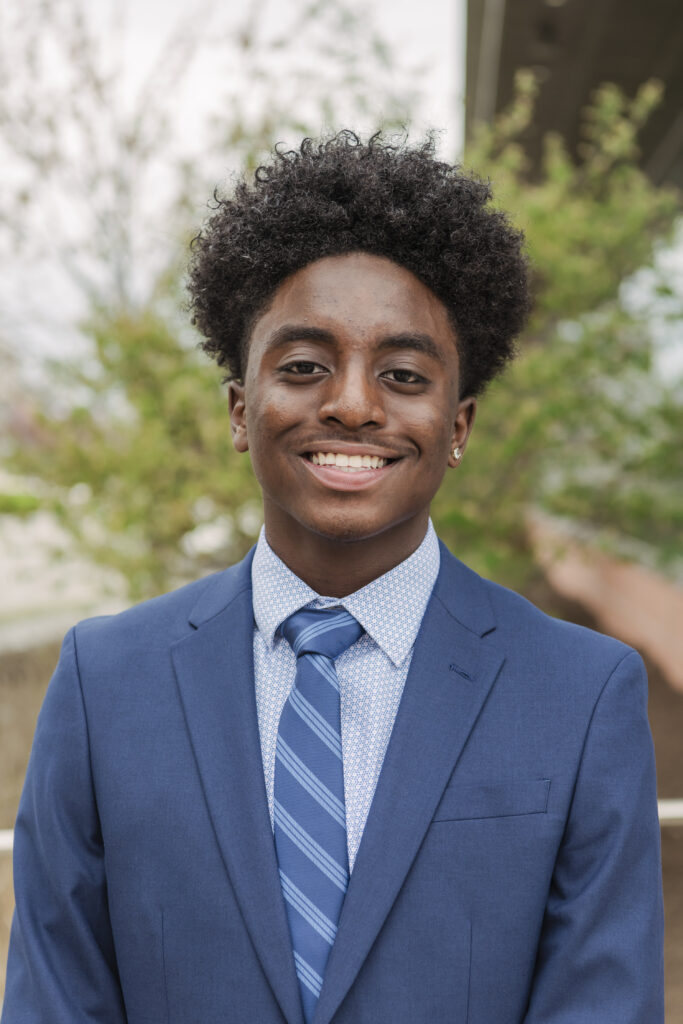 Gabriel Otubu.
As an undergraduate research fellow in biology professor Rachel Brewster’s lab, Gabriel Otubu is investigating the role of the Ndrg1b gene in neurulation—the process of forming a neural tube that takes a hollow shape that differentiates into the brain and spinal cord—and how it affects other genes. This research, Otubu says, is aiming to understand the genetic risk factors associated with specific congenital disorders, such as spina bifida, with a goal of finding treatment options for these disorders.
Otubu, a Meyerhoff Scholar who plans on pursuing an M.D./Ph.D., shares that with Brewster’s guidance, “I learned that the M.D./Ph.D [route] was possible for me, as well as the possibility of being able to have a commitment to helping people in the clinic and also doing research to support that.” He is also an Undergraduate Research Training Initiative for Student Enhancement (U-RISE) Scholar, an experience he says inspired him to pursue a career in research because he was able to be supported by like-minded people.
“One of the most important things about getting the Goldwater Scholarship is the motivation it gives me to be the best researcher I can be,” says Otubu. “It’s great to get that recognition that I’m really committed to research and using my platform to help other people from diverse backgrounds become interested in research.”
Nathaniel Glover, a fellow Meyerhoff Scholar, says that receiving the Goldwater scholarship will “open up a lot of opportunities for me to be a competitive grad school applicant.” His Goldwater proposal included the research he worked on to develop a dual-phase steel that can combat hydrogen embrittlement, the mechanical damage of metal due to the penetration of hydrogen, which causes a reduction in ductility.
Glover worked in the lab of C. Cem Taşan, associate professor of metallurgy at the Massachusetts Institute of Technology (MIT), as an MIT Summer Research Program participant in 2023.
The program, he shares, “was very helpful in teaching me how to write about my research, which was extremely beneficial in the Goldwater application process. Taşan and my research mentor, Dr. Kyung-Shik Kim, were instrumental in developing my research in this project, introducing me to the science behind it, and working with me throughout my work in the project. I learned how to write and portray my research in a way that’s well communicated, interesting, and educational.”
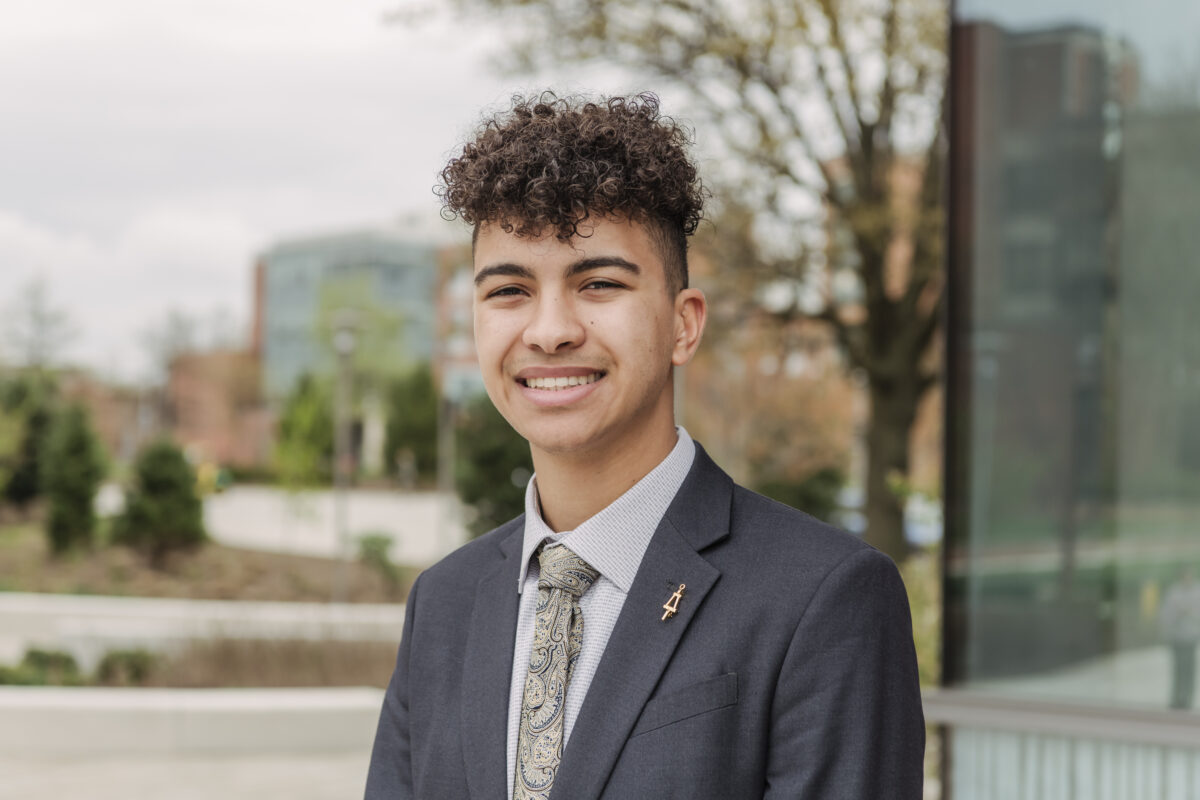 Nathaniel Glover.
Developing into a researcher
Samuel Barnett’s journey in becoming a Goldwater Scholar began during his time as a student at Howard Community College (HCC). Barnett, who transferred to UMBC last fall, was able to take advantage of the updated eligibility requirements for prospective scholarship applicants. The 2024 application cycle amended its eligibility criteria allowing transfer students to be nominated by the school they are currently enrolled in or by the school they matriculated from. With the help of the HCC research department and Householder, Barnett was nominated by HCC to receive the scholarship.
With this recent change, Householder shares that “cross-institutional collaborations like these are opening new pathways between UMBC and its transfer institutions [while] providing an additional layer of support to transfer students who come to UMBC with a strong research background, like Sam.”
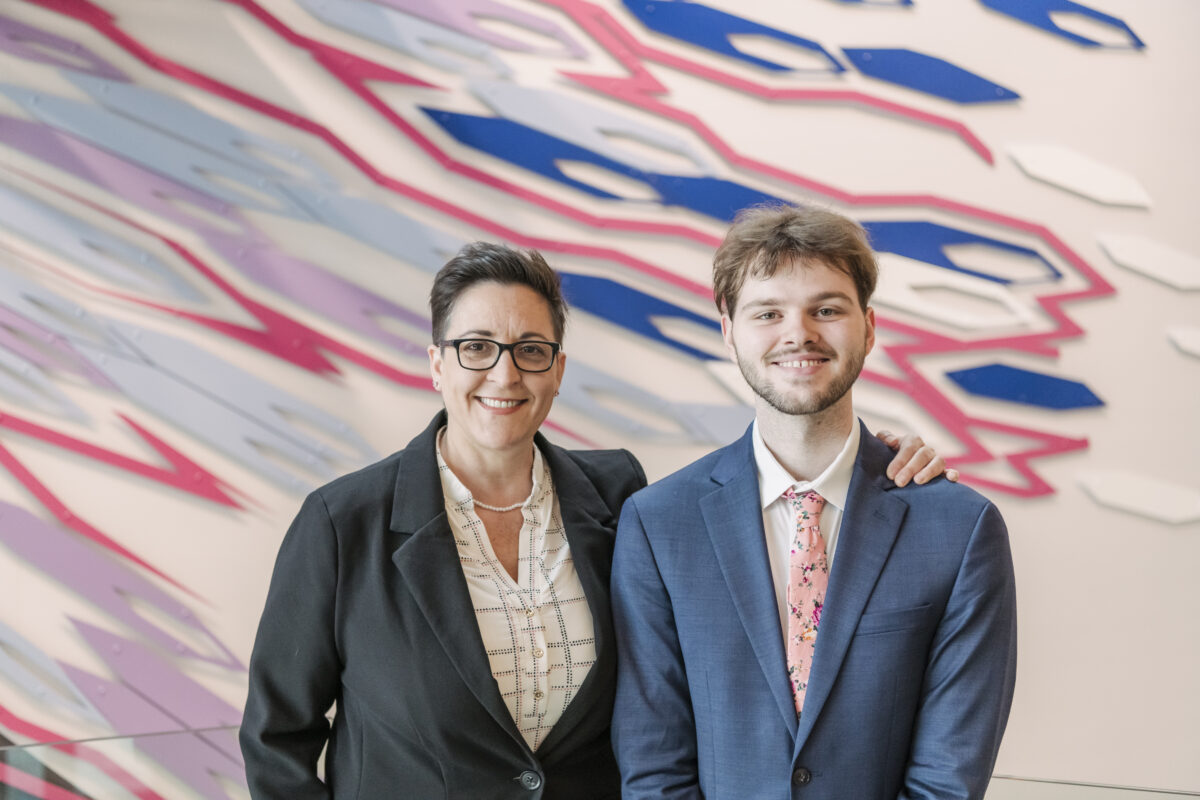 April Householder and Samuel Barnett.
Barnett worked with his mentor Joseph Sparenberg, professor of chemistry at HCC, on a project that uses a species of yeast, Saccharomyces cerevisiae, to model a type of cancer in humans that occurs from mutations in the KRAS gene. The model, which is still in the proof of concept stage, visualizes a live cell to see pathways and tumor growth in real-time.
Barnett nearly called it quits with his academic journey upon enrolling at HCC, saying that he “had no motivation to continue on with my education.” After participating in HCC’s research program, Barnett found a renewed sense of purpose and took his research interests to the next level.
Before transferring to UMBC, Barnett took part in the BUILD a Bridge to STEM internship program, a component of STEM BUILD at UMBC, which he says was vital for “my development in this Goldwater process.” During the internship, Barnett worked with Maria Cambraia Guimaro, assistant director of research and international affairs in the College of Natural and Mathematical Sciences, who he says played a significant role in his research journey at UMBC.
“It was extremely empowering to know that as a community college student, I could experience research there and also win a prestigious award for it,” adds Barnett. “I now have a collection of wonderful mentors throughout my research journey that’s helped to shape who I am today.”
]]>
For the fifth consecutive year, multiple UMBC students have been awarded a Barry Goldwater Scholarship. Gabriel Otubu ’25, biochemistry, Nathaniel Glover ’25, chemical engineering, and Samuel...
https://umbc.edu/stories/goldwater-scholars-24/
https://dev.my.umbc.edu/api/v0/pixel/news/141626/guest@my.umbc.edu/381303eddd955eec99840a46abcd0a28/api/pixel
biochemistry
cbee
chemical-engineering
cnms
coeit
community
meyerhoff
news
research
science-and-tech
stembuild
story
undergraduate-research
UMBC News & Magazine
https://dev.my.umbc.edu/groups/umbc-news-magazine
https://assets1-dev.my.umbc.edu/system/shared/avatars/groups/000/001/943/24435aa6207c452e7bc15cc74b42c7bb/xsmall.png?1748556657
https://assets1-dev.my.umbc.edu/system/shared/avatars/groups/000/001/943/24435aa6207c452e7bc15cc74b42c7bb/original.png?1748556657
https://assets2-dev.my.umbc.edu/system/shared/avatars/groups/000/001/943/24435aa6207c452e7bc15cc74b42c7bb/xxlarge.png?1748556657
https://assets2-dev.my.umbc.edu/system/shared/avatars/groups/000/001/943/24435aa6207c452e7bc15cc74b42c7bb/xlarge.png?1748556657
https://assets3-dev.my.umbc.edu/system/shared/avatars/groups/000/001/943/24435aa6207c452e7bc15cc74b42c7bb/large.png?1748556657
https://assets1-dev.my.umbc.edu/system/shared/avatars/groups/000/001/943/24435aa6207c452e7bc15cc74b42c7bb/medium.png?1748556657
https://assets2-dev.my.umbc.edu/system/shared/avatars/groups/000/001/943/24435aa6207c452e7bc15cc74b42c7bb/small.png?1748556657
https://assets1-dev.my.umbc.edu/system/shared/avatars/groups/000/001/943/24435aa6207c452e7bc15cc74b42c7bb/xsmall.png?1748556657
https://assets2-dev.my.umbc.edu/system/shared/avatars/groups/000/001/943/24435aa6207c452e7bc15cc74b42c7bb/xxsmall.png?1748556657
UMBC News & Magazine
4
0
false
Thu, 02 May 2024 11:17:37 -0400
Thu, 02 May 2024 11:17:37 -0400
Equation of Change
By: Susan Thornton Hobby Illustrations by: Marissa Clayton ’21
At the start of second grade, Freeman Hrabowski’s textbook, wrapped neatly in brown paper, arrived on his desk. His teacher warned the class to keep the book covers in place. But little Freeman was always curious. He peeled off a strip of paper, then another scrap, and another, until he could see the battered cover and a stamp inside, showing that the book had been used by children in the White school nearby.
Freeman marched up to his teacher’s desk. “Why’d they give us their hand-me-down books?” he asked. His teacher’s face, Hrabowski remembered, showed both embarrassment and anger.
“What do you tell a child who’s been told by the world that the child is second class?” Hrabowski recalled.
“She said, ‘You just remember this: You are a child of God. You are first class. The book may not be new, but the knowledge is worth getting. Just get the knowledge and you will be okay.’ So that wonderful teacher was telling me to believe in myself.”
While the hand-me-down books outraged Hrabowski, his teacher’s advice was treasured and passed along to those he has mentored: Believe in yourself. Hrabowski’s legacy is defined by mentoring, both by the parents and educators who guided him and by his hundreds of mentees. Hrabowski’s mentees are legion, whether they arrive from UMBC’s Meyerhoff Scholarship Program, or as the student body president, or just students he’s met on his walks around campus who then ask for his guidance.
It’s simple math. Hrabowski mentors hundreds. Those hundreds mentor thousands. Those thousands mentor hundreds of thousands. The result is Hrabowski’s exponential equation of change.
During the pandemic, Kafui Dzirasa ’01, M8, chemical engineering, texted Hrabowski, the mentor he calls Doc. “I said, ‘Your mentees are literally leading the coronavirus response, one as the U.S. surgeon general [Jerome Adams ’97, M4, biochemistry & molecular biology and psychology]. And the other one’s making a vaccine [Kizzmekia Corbett ’08, M16, biological sciences and sociology]. Your mentoring is literally going to save millions of lives. The end. That’s mentoring.’”
A Nickel and The Hard Truth
Hrabowski’s first mentors were his parents, a college-educated pair of teachers who supported and challenged him. “From my daddy, my father, I learned the importance of remaining calm in challenging times and giving yourself the time to think through the best approach to use in attacking a problem,” Hrabowski said. “From my mother, the importance of connecting right and left brain thinking… In both cases, they were teaching me how to learn, and think, and approach the world.”
By the time he reached high school, Hrabowski was always the one who tried to solve the math problems his principal would write on the chalkboard. He would bring his solutions to the principal’s office and earn a nickel to spend on Tootsie Rolls if they were right. If his equations weren’t correct, his principal would chastise him for carelessness. Both the nickels and the hard truths stuck with him, Hrabowski said, and he uses that tough love to mentor others.
“I’m first working with my mentees to build trust so that the mentee knows I care deeply,” Hrabowski said. “Then if I say something that is not comfortable, or something that maybe she doesn’t want to hear, I’m saying it out of love. I’m, perhaps, saying what others are thinking and won’t say. And I believe that effective mentors want to help students and their mentees to develop tough skin, to want to get constructive and honest feedback, because we can all improve.”
Kate Tracy, M.A. ’01, Ph.D. ’03, psychology, shadowed Hrabowski and was mentored by him as an American Council on Education Fellow. Hrabowski introduced her, connected her, and guided her for the 2019 to 2020 academic year. Never before, she laughed, had she given out a complete box of 500 business cards.
“As a mentor, Freeman is continuously available…he has an amazing amount of energy and he has an incredibly generous heart,” said Tracy, who serves as a professor in the University of Maryland School of Medicine’s Department of Epidemiology and Public Health and advises the University System of Maryland on COVID-19.
Hrabowski can offer hard truths, she said, because he demonstrates how deeply he cares. He often quotes Emily Dickinson: “Tell all the truth but tell it slant.” He recently gave her a “truth bomb,” Tracy said, and she thought, “he’s saying this for my own good, and if he’s willing to say it, I need to hear it.”
She was touched, Tracy said, when later in the day Hrabowski texted her, telling her how proud he was of her, and how hard it must have been to hear what he had to say.
“When you build a trusting relationship and you put relationships at the center of it, people can hear the hard truth because they know you’re doing it for their greatest good and because you believe in them,” Tracy said.
Chelsea Pinnix ’99, M7, biochemistry and molecular biology, said she learned the primacy of honesty from Hrabowski.
“It’s important to be vulnerable to your mentee,” said Pinnix, who is now the residency program director and associate professor in the Department of Radiation Oncology at Anderson Cancer Center. “Being honest about the mistakes you’ve made, about things that you wish you’d done differently. They are learning from your mistakes, but they’re also recognizing that you have these vulnerabilities and that you make mistakes. So then it’s okay for them to make mistakes, too.”
Telling Yourself a Story
Hrabowski’s early life bolstered his eager mind. When young Hrabowski received straight A’s, the entire congregation of his Birmingham church would rise for a 4.0 standing ovation. Starting at age 15, Hrabowski followed the advice of a mentor and started greeting himself in the mirror as “Dr. Hrabowski.”
At monthly family meetings for the Meyerhoff Scholars, Hrabowski instituted both ovations for good grades and the advice to address yourself in the mirror as your goal self. Have high expectations, Hrabowski said, and students will rise to them.
Dzirasa, an associate professor of psychiatry and behavioral sciences at Duke University who was recently elected to the National Academy of Medicine, thought the mirror exercise was “weird,” he said, laughing. “And yet, we did it. It wasn’t until I became a psychiatrist that I was like, wow, there’s an incredible power to self-reinforcement. Despite all the adversity that comes later, if you tell yourself a story, you will believe it.”
The Meyerhoff story began when Robert Embry, former Baltimore City councilman and longtime president of the Abell Foundation, which works to improve the quality of life in Baltimore, met Hrabowski as a young dean at Coppin State College. Embry was impressed by Hrabowski’s intellect, energy, and high expectations.
Embry eventually connected Hrabowski with philanthropist Robert Meyerhoff, who wanted to help Black science scholars. The Meyerhoff Scholars Program emerged. Years later, Hrabowski recruited Embry to join the board at UMBC.
“It didn’t take much,” Embry said. “Anything I could do to help him and to be identified with him and his success.”
The Meyerhoff Scholars Program, with its nationally recognized success in increasing diversity in the sciences, is one of the places Hrabowski practices what he preaches about mentorship.
In the Meyerhoff Program, Pinnix learned Hrabowski’s “superpower,” she said. “He has this profound ability to inspire. And he’s able to convince people of the things that they can accomplish before they even recognize that they can.”
“Focus, focus, focus,” Annica Wayman’99, M6, mechanical engineering, remembers Hrabowski often saying to Meyerhoff Scholars. Offered a Meyerhoff Scholarship on the spot after she introduced Hrabowski at her high school, Wayman later earned her doctorate at Georgia Tech. She worked for nearly a decade at USAID before returning to UMBC in 2018 as the College of Natural and Mathematical Sciences’ associate dean for Shady Grove affairs. As she leads programs like the Translational Life Science Technology bachelor’s degree, Wayman now mentors students herself, offering them support and hard truth, and telling them to focus, focus, focus.
Master the Self
In 1987, Michael Hooker, then the president of UMBC, recruited Hrabowski to the campus and became his mentor. Hrabowski said he learned a piece of wisdom from Hooker: “The hardest task any human being has is to master self.”
Many mentees need to hear that message, Hrabowski said.
Dzirasa, now a Howard Hughes Medical Institute investigator and a neuroscientist researching how genetics interact with environmental stress to affect the brain’s functioning, recalled when he was at his lowest.
After breezing through undergrad as an engineer at UMBC, he arrived at Duke Medical School thinking he didn’t need to memorize things. Or study. He began to fail classes. Then someone stole his identity and charged $40,000 to his credit. He went to see an advisor, who told him he wasn’t used to being a small fish in a big pond.
Feeling restless and despondent, Dzirasa started driving. He hit the Virginia state line. Then Maryland’s. Dzirasa ended up on Hrabowski’s porch, weeping and ready to drop out of medical school. Hrabowski comforted him, told him whatever choice he made would be okay. But maybe, Dzirasa recalls Doc telling him, he could drive back to Duke and try one more time.
A good mentor, Dzirasa said, dusts you off and urges you to persist, then keeps after you. Hrabowski, Dzirasa said with a laugh, loves to commend him, but then say, “you know…” and proceed to critique a portion of his performance.
Now Dzirasa returns to UMBC once a month as part of his appointment at Duke, to mentor students and to recruit Meyerhoff Scholars for his research lab.
“I basically give those kids all of myself, and in a hoodie and sweatpants,” Dzirasa said. “I look exactly like them, I talk exactly like them, I sat in exactly their chair, and I was probably more trouble than they are. It makes people’s dreams so tangible.”
Touching Eternity
Hrabowski remembers what Walter Sondheim, the Baltimore businessman and public servant, used to tell him: “Live life seriously, but don’t take it seriously.”
He thinks of that advice often. “His point was, it’s never quite as bad as you think it is, and don’t ever think you’re quite as important as people want to make you seem.… The human experience is that we leave, and others replace us, and if we’re lucky, we are connected to those people.”
Connections are vital to Hrabowski, and he still mentors current students. Sometimes though, students end up teaching the president.
Landry Digeon, M.A. ’09, intercultural communications, Ph.D. ’20, language, literacy, and culture, remembers meeting Hrabowski at the campus television studio, where he worked on videos Hrabowski was taping. The president wanted to learn Digeon’s native French. “Push me,” he told Digeon three times, before Digeon decided to take him up on it in 2014.
Ever since, Hrabowski has studied French with Digeon, who admires Hrabowski’s humility to be tutored by a student. They speak in French nearly every day, about poetry and culture, sometimes arguing about the different countries’ values.
“I learn more from him than he has learned from me,” Digeon said. “When he has a goal, he doesn’t let go. And I learn by watching how to treat people—you can be a great man, a renowned man, and be kind. And I’ve changed Freeman’s mind occasionally. I want to be like that—open-minded.”
When Hrabowski turns in his homework, usually late at night, the president ends his emails with, “Bonne nuit, mon professeur.”
The perfect conjugation of French verbs and his connections to scientists and leaders around the world aren’t the only benefits mentorship offers Hrabowski.
“There’s a great gratification when you see people evolving, and developing, and doing well, and seeing how they overcome challenges. It inspires me to want to be better,” Hrabowski said.
Wayman believes inspiring mentorship is the first element in the equation of change.
“Saving the world is first transforming the thinking of people, to think critically, to be more open-minded,” Wayman said.
Hrabowski, who still receives notes from people his mother taught 70 years ago, often remembers what his mother said in her dying days: “Teachers touch eternity through their students.”
“Those of us in education, we live through our students,” Hrabowski said. “We live through the people we help because we are paying it forward. We live through them and their actions.”
Read more about Jackie Hrabowski’s approach to mentorship in Because She Can.
]]>
By: Susan Thornton Hobby Illustrations by: Marissa Clayton ’21 At the start of second grade, Freeman Hrabowski’s textbook, wrapped neatly in brown paper, arrived on his desk. His teacher...
https://umbc.edu/stories/equation-of-change/
https://dev.my.umbc.edu/api/v0/pixel/news/119433/guest@my.umbc.edu/e330b1dec8c03e1a25d798cabde38856/api/pixel
hrabowski
impact
magazine
meyerhoff
spring-2022
spring-2022-special-issue
UMBC News & Magazine
https://dev.my.umbc.edu/groups/umbc-news-magazine
https://assets1-dev.my.umbc.edu/system/shared/avatars/groups/000/001/943/24435aa6207c452e7bc15cc74b42c7bb/xsmall.png?1748556657
https://assets1-dev.my.umbc.edu/system/shared/avatars/groups/000/001/943/24435aa6207c452e7bc15cc74b42c7bb/original.png?1748556657
https://assets2-dev.my.umbc.edu/system/shared/avatars/groups/000/001/943/24435aa6207c452e7bc15cc74b42c7bb/xxlarge.png?1748556657
https://assets2-dev.my.umbc.edu/system/shared/avatars/groups/000/001/943/24435aa6207c452e7bc15cc74b42c7bb/xlarge.png?1748556657
https://assets3-dev.my.umbc.edu/system/shared/avatars/groups/000/001/943/24435aa6207c452e7bc15cc74b42c7bb/large.png?1748556657
https://assets1-dev.my.umbc.edu/system/shared/avatars/groups/000/001/943/24435aa6207c452e7bc15cc74b42c7bb/medium.png?1748556657
https://assets2-dev.my.umbc.edu/system/shared/avatars/groups/000/001/943/24435aa6207c452e7bc15cc74b42c7bb/small.png?1748556657
https://assets1-dev.my.umbc.edu/system/shared/avatars/groups/000/001/943/24435aa6207c452e7bc15cc74b42c7bb/xsmall.png?1748556657
https://assets2-dev.my.umbc.edu/system/shared/avatars/groups/000/001/943/24435aa6207c452e7bc15cc74b42c7bb/xxsmall.png?1748556657
UMBC News & Magazine
0
0
false
Tue, 03 May 2022 16:24:34 -0400
Tue, 03 May 2022 16:24:34 -0400
UMBC President Freeman Hrabowski to retire in spring 2022 after three decades of transformational leadership

After three decades of transformational leadership at UMBC, President Freeman A. Hrabowski, III has announced his plan to retire at the end of the 2021-2022 academic year.
President Hrabowski is nationally celebrated for his results-driven commitment to inclusive excellence, collaborative approach to leadership, and mentorship that pairs high expectations with strong support. Through his time at UMBC, these qualities have become core to the university’s unique culture and community. They have also inspired national and global recognition.
During President Hrabowski’s tenure, UMBC has ascended in the national rankings. U.S. News ranked UMBC the nation’s #1 “Up and Coming” university for six years, 2009-14. In 2015 they transitioned to recognizing the nation’s “most innovative” national universities, featuring UMBC every year since the list launched. For the past decade, U.S. News has also consistently ranked UMBC among the nation’s leading institutions for Best Undergraduate Teaching.
 President Hrabowski with Orientation Peer Advisors, summer 2018.
Visitors to campus often see President Hrabowski walking down Academic Row. He greets students by name, asking about their classes and post-grad plans, listening, and offering encouragement. That personal level of care has become part of UMBC’s DNA. It’s a quality that draws thousands of new students to UMBC each year and inspires UMBC’s national recognition as a model for supporting student success.
Advocating for students
Born in Birmingham, Alabama, in 1950, Hrabowski was a child leader in the Civil Rights Movement. He graduated from Hampton Institute with highest honors in mathematics, and earned his M.A. in mathematics and Ph.D. in higher education administration/statistics from the University of Illinois at Urbana-Champaign.
President Hrabowski came to UMBC as vice provost in 1987, when UMBC was just two decades old, and has served as president since 1992. He is a national leader in science and math education, with an emphasis on the participation and achievement of underrepresented minority students.
Among many high-profile, high-impact leadership roles, President Hrabowski chaired the National Academies’ committee that produced a landmark 2011 report on expanding underrepresented minority participation in STEM. Barack Obama named him to chair the President’s Advisory Commission on Educational Excellence for African Americans in 2012. The following year, his TED talk “Four Pillars of College Success in Science” made waves worldwide, going on to receive more than one million views.
He emphasizes, “collaborative strategies have been at the core of it all.”
Learning from Meyerhoff
At the national level, President Hrabowski is also known for partnering with Robert Meyerhoff to found the Meyerhoff Scholars Program in 1988, to increase the diversity of STEM leaders. Science describes the program as the “gold standard for providing a path into academic research” for students from underrepresented groups.
 Pres. Hrabowski, Bob Meyerhoff, and Jackie Hrabowski at the Meyerhoff Scholars Program 30th anniversary celebration.
So far, UMBC has graduated more than 1,400 Meyerhoff Scholars with STEM degrees. More than 800 have already earned graduate or professional degrees. According to NSF data, UMBC is now the nation’s top producer of Black graduates who go on to a Ph.D. in the natural sciences and engineering.
These graduates include alumni like COVID-19 vaccine developer Dr. Kizzmekia Corbett ’08, M16, now an assistant professor of immunology and infectious diseases at Harvard. More than a dozen other institutions have replicated the Meyerhoff program, from Penn State and UNC to UC Berkeley and UCSD (supported by the Chan Zuckerberg Initiative).
 Alumna Kizzmekia Corbett in a lab at UMBC.
Supporting scholars
Meyerhoff has also had ripple effects within UMBC. Through the program, UMBC faculty and staff learned about what kinds of support most benefit students: hands-on research experience, intensive (even intrusive) advising and mentorship, and mutual peer support built on a cohort model. These findings have inspired programs like UMBC’s Center for Women in Technology Scholars and STEM BUILD at UMBC, reaching an ever-expanding number of students.
UMBC’s focus on providing a distinctive educational experience is evident across disciplines. The Linehan Artist Scholars, Sondheim Public Affairs Scholars, Humanities Scholars, Sherman STEM Teacher Scholars and several other programs provide hands-on learning, thoughtful reflection, and community support, preparing future leaders.
 Humanities Scholars attend a seminar with Pres. Hrabowski in the Dresher Center, 2016.
Whether they stay in Maryland or travel the world, UMBC’s 85,000 alumni carry with them a unique approach to co-creating communities. That approach is grounded in mutual respect and support, intellectual curiosity, and achievement through collaboration.
“Excellence is never an accident“
Behind UMBC’s accolades are students persevering every day to achieve their dreams, supported by caring faculty and staff. Over the last decade, UMBC has increased its six-year graduation rate for full-time freshmen from 55.7% to 69.2%. And UMBC has become known for welcoming and supporting transfer students, including a large number of first-generation college students.
 First-generation college student Julia del Carmen Aviles-Zavala ’22, psychology, with her parents.
This year, the pioneering University Innovation Alliance selected UMBC as a member. This public research university consortium works to boost student success through sharing and scaling approaches that work.
National stage
At UMBC, Retrievers quickly learn what’s possible in a community that pairs high expectations and robust support, and empowers students to pursue their passions. UMBC is the reigning national mock trial champion, defeating Yale in last year’s finals, and UMBC’s Cyber Dawgs have won national and regional championships. UMBC has won or tied for first place ten times at the Pan-American Intercollegiate Team Chess Championship.
 National champion UMBC Mock Trial team with Gov. Larry Hogan in Annapolis. Photo courtesy of the Office of the Governor.
In 2018, UMBC made basketball history as the first No. 16 seed to beat a No. 1 seed in an NCAA men’s tournament. In addition to conference championships in several sports during President Hrabowski’s tenure, men’s soccer rose to the NCAA semifinals and UMBC produced top national athletes in swimming and track and field.
Retrievers are regularly recognized as some of the world’s leading emerging researchers, as Rhodes Scholars and Goldwater Scholars. They explore the world as Fulbright Scholars and partner to support communities as Newman Civic Fellows.
“The UMBC story is one of excitement about learning and learning how to work with people different from oneself,” says President Hrabowski. “We are saying to the country and to young people that you don’t have to be rich to be the very best. Middle class institutions can produce some of the best thinkers in the world.”
 Dr. Hrabowski (r) and students on the roof of UMBC’s Administration Building, 2016.
Inspired by students
Over three decades, President Hrabowski has set the bar for educational leadership and earned the highest national honors a university president can receive. He’s written four books and mentored fellow university presidents through a Harvard leadership program. More than 40 universities nationwide—from Harvard and Princeton to University of Michigan and Arizona State—have granted him honorary degrees. But UMBC students are the legacy that makes him feel most proud and inspired.
“We have shown the country that we are a model of inclusive excellence,” President Hrabowski shares. “UMBC is just 55 years old, but we have worked very hard to make history. And we will always be a part of this nation’s history because we produce leaders, including thousands of teachers, lawyers, social workers, and entrepreneurs shaping our communities.”
“Our students, from undergraduate to Ph.D., represent best in class,” he says. “When you think about the UMBC alumni who serve as the head of Johns Hopkins Applied Physics lab, the president of Clemson, the speaker of the Maryland House of Delegates, and the first Black woman to create a vaccine in the history of the world, you can’t help but think of how well UMBC prepared them for those roles.”
 Clemson University President James P. Clements ’85, ’91 M.S., ’93 Ph.D. (l) with UMBC Pres. Hrabowski (r) at UMBC’s spring 2016 Graduate Commencement.
Setting the standard
University System of Maryland (USM) Board of Regents Chair Linda Gooden shares, “People seek out Freeman’s advice because they understand that, in many ways, he’s set the standard for supporting students to success—and I mean all students: students from every background, every race and ethnicity, every income level.”
This carries through to other areas of his leadership, she notes. “He’s set the standard for collaborative leadership and continuous organizational improvement,” says Gooden. “He’s set the standard for creating a culture that brings out people’s best character and best effort. We’ve known every day of his long career how profoundly lucky we are to have him.”
Ongoing growth
Looking ahead, President Hrabowski is excited to see what UMBC will become and achieve.
Cumulative investment in campus construction has grown from $118 million to $1.2 billion over the past three decades. This includes the addition of the Performing Arts and Humanities Building, Interdisciplinary Life Sciences Building, Chesapeake Employers Insurance Arena, and research and teaching spaces in downtown Baltimore. UMBC also has a vibrant presence—12 programs and more than 600 students—at the Universities at Shady Grove.
 UMBC’s new Interdisciplinary Life Sciences Building.
The bwtech@UMBC Research and Technology Park houses 131 companies and organizations that employ nearly 1,900 people. And UMBC’s research and development expenditures now surpass $84 million annually.
“Students and student achievement are at the center of everything we do,” President Hrabowski reflects. “At the same time, we support all people as they grow, including our faculty and staff. The dreams and aspirations of everyone in our community inspire us to keep working to be our best selves. There are so many amazingly talented people at UMBC, and we will continue to attract amazingly talented people at every level.”
Next steps
The USM Board of Regents and Chancellor Perman will soon launch a national search for the next president of UMBC, with details announced as they are available. President Hrabowski notes, “I have no doubt that they will work with the campus to attract a leader who appreciates UMBC values and shares our passion for being the very best at what we do.”
Chancellor Perman says of President Hrabowski, “I don’t think I’ve ever met a person who so powerfully inspires excellence. And that’s exactly what his legacy is—a commitment to inclusive excellence that lives on in UMBC, its students, faculty, staff, and alumni.”
 Pres. Hrabowski at Convocation 2018.
UMBC anticipates welcoming its next president in early 2022. Still, says President Hrabowski, “UMBC will always be a part of me. It has helped to define who I am. Wherever I am, I will be talking about the wonderful place that is UMBC.”
For more information, visit umbc.edu/president.
Featured Image: President Hrabowski speaks with UMBC students on campus, under the flags in The Commons. All photos by Marlayna Demond ’11 for UMBC.
]]>
After three decades of transformational leadership at UMBC, President Freeman A. Hrabowski, III has announced his plan to retire at the end of the 2021-2022 academic year. [Video]...
https://umbc.edu/stories/hrabowski-retirement/
https://dev.my.umbc.edu/api/v0/pixel/news/119569/guest@my.umbc.edu/caa4e8d10104be12610b33b4cbcefd86/api/pixel
a-featured-post
alumni
community
feature
hrabowski
meyerhoff
page1
UMBC News & Magazine
https://dev.my.umbc.edu/groups/umbc-news-magazine
https://assets1-dev.my.umbc.edu/system/shared/avatars/groups/000/001/943/24435aa6207c452e7bc15cc74b42c7bb/xsmall.png?1748556657
https://assets1-dev.my.umbc.edu/system/shared/avatars/groups/000/001/943/24435aa6207c452e7bc15cc74b42c7bb/original.png?1748556657
https://assets2-dev.my.umbc.edu/system/shared/avatars/groups/000/001/943/24435aa6207c452e7bc15cc74b42c7bb/xxlarge.png?1748556657
https://assets2-dev.my.umbc.edu/system/shared/avatars/groups/000/001/943/24435aa6207c452e7bc15cc74b42c7bb/xlarge.png?1748556657
https://assets3-dev.my.umbc.edu/system/shared/avatars/groups/000/001/943/24435aa6207c452e7bc15cc74b42c7bb/large.png?1748556657
https://assets1-dev.my.umbc.edu/system/shared/avatars/groups/000/001/943/24435aa6207c452e7bc15cc74b42c7bb/medium.png?1748556657
https://assets2-dev.my.umbc.edu/system/shared/avatars/groups/000/001/943/24435aa6207c452e7bc15cc74b42c7bb/small.png?1748556657
https://assets1-dev.my.umbc.edu/system/shared/avatars/groups/000/001/943/24435aa6207c452e7bc15cc74b42c7bb/xsmall.png?1748556657
https://assets2-dev.my.umbc.edu/system/shared/avatars/groups/000/001/943/24435aa6207c452e7bc15cc74b42c7bb/xxsmall.png?1748556657
UMBC News & Magazine
0
0
false
Wed, 25 Aug 2021 16:55:56 -0400
Creating Technology that Protects Us—Rising Together

Since 2009, as part of its Alumni Awards celebration, the UMBC Alumni Association names one “Rising Star” recipient each year who exemplifies early career and professional achievement. In the coming weeks, we will spend some time with awardees from the past decade to see where they are now—and how they’ve grown in their fields while maintaining ties to UMBC. In this installment, UMBC Rising Stars Isaac Kinde’05, M13, biological sciences, and Christopher Valentino ’02, M.S. ’06, information systems,discuss their roles in the healthcare and defense industries, respectively. Both alumni discovered their passion for their work while at UMBC and aim to harness technology to protect us from disease and cyber warfare.
As we embrace life in a technologically immersive world—scrolling out of habit or relying on a life-saving medical device—there’s a common question many of us have about the tech we’ve come to depend on: How can we best harness it to protect us? From malware and scams, but also from disease and unnecessary pain?
Two UMBC graduates, who previously received Rising Star alumni awards, are diligently working to create and influence technology that innovates and protects us.
Protecting lives with early detection technology
Isaac Kinde ’05, M13, biological sciences, is advancing healthcare technologies that work to protect people from possibly fatal diseases. Kinde is co-founder and vice president for technology assessment at Thrive, an Exact Sciences Company. Thrive was recently acquired by Exact Sciences for up to $2.15 billion assuming successful completion of certain milestones, says Kinde. He and his team work to save lives threatened by cancer by creating early detection technologies.
 Kinde at work in his lab at Thrive Early Detection in Baltimore, Maryland. Photo courtesy of Kinde.
“There’s two million cancer cases in the U.S. annually and 70 percent of those cases don’t have a screening test available,” says Kinde. “If you can find cancers earlier, particularly in the earliest stages, survival can be as high as 90 percent or greater. The technology that my company is developing really leverages decades of research into how cancers work, their biology, as well as method developments in order to exploit that biology.”
Getting an early start
Since being named a Rising Star alum in 2014, Kinde received his M.D.-Ph.D. from the Johns Hopkins University School of Medicine. He was named one of Forbes magazine’s 30 under 30 “Rising Stars Transforming Science and Health.” Kinde also received The Daily Record’s Innovator of the Year award in 2015.
While at UMBC as a Meyerhoff Scholar, Kinde’s appreciation for research blossomed. He said that his first research mentor, Michael Summers, a professor in the Chemistry and Biochemistry department, influenced his love of research after spending a summer in his lab. “I just got hooked and I just didn’t stop doing research. It was a continuous effort until I graduated,” Kinde recalls.
Kinde speaking at the 2014 Alumni Award ceremony, and pictured with President Hrabowski, Mike Summers, and Kenneth Pittman ’80. All photos courtesy of the Alumni Association, unless otherwise noted.
It was his doctoral work at the Vogelstein Lab at Hopkins that helped to propel the technological initiatives at Thrive. “We set out to apply the latest and greatest technologies to identify cancers in their earliest stages. It took new method creation. We had to develop new technologies in order to find the earliest signs of cancer in routine clinical specimens,” Kinde says.
The future of cancer detection technology
Thus, came about the creation of CancerSEEK, a blood test that has shown the ability to detect 65 percent of cancers prior to clinically evident metastasis in individuals without any history of the disease. Kinde noted that a test like CancerSEEK can detect multiple cancers from a single test and do so in real time.
“There was the prototype version [of CancerSEEK] that our academic lab published. Then there was another prototype version that our company collaborated with Hopkins in order to demonstrate how we could work in a real-world setting,” says Kinde. “It’s the first of its kind to demonstrate real world detection and intervention of cancers. We’re preparing to get FDA approval, to do the full clinical validation of the CancerSEEK test.”

K
inde, second from left, with his roommates Andy Windsor, Seth Miller, and Kenneth Gibbs, all fellow Meyerhoff Scholars, at a graduation celebration in 2005. Photo courtesy of Kinde.Kinde recalls the moment he saw successful Black Americans who were in the top M.D.-Ph.D. programs and top graduate programs while he studied at UMBC as an influential factor in his career progression. In fact, UMBC undergraduate alumni who identify as African American have gone on to pursue and earn more M.D.-Ph.D.s than alumni from any other institution across the country, largely in thanks to the support from the Meyerhoff Scholars Program.
“To me, that said, ‘well, why can’t I do that too?’ As I’ve progressed in my career, it’s the lesson that I remember. It’s something that I want to help future generations of people by being that example that they can look to.”
 Valentino with his family at the 2012 Alumni Award ceremony.
 Cybersecurity at the highest levels
Christopher Valentino ’02, M.S. ’06, information systems management, has more than two decades of expertise in domestic and global cybersecurity, which began during his undergraduate tenure at UMBC. Valentino spent 24 years working with Northrop Grumman Corp., a global aerospace and defense technology company, and its predecessor companies.
He started working at Northrop as an intern—working in what he called the “cyber mailroom”—and worked his way up. When he received the UMBC Alumni Association’s Rising Star award in 2012, Valentino was the then-director of contract research and development at Northrop.
“I had a parallel experience of working and going to school at the same time,” says Valentino, “while I was also starting a family. There are things I learned at UMBC as a student that I would not have learned anywhere else. The bottom line is UMBC is a really hard school. And it’s very underappreciated until you actually show up and become part of the institution, and go through the rigor that’s there.”
A leader in influencing cyberspace infrastructures
Nearly 10 years since being named a UMBC rising star, Valentino now serves as the chief strategy officer at Peraton, a next-generation national security company that provides technology solutions to space and intelligence, cyber mission, defense and security, and civil and health customers. Peraton acquired Northrop’s IT services business in February 2021 when Valentino transitioned into being the point person for shaping the future of the company.
“Peraton is a national security company focused on providing capabilities and solutions across the Department of Defense intelligence community—federal, civilian, and Homeland Security. I am responsible for operationalizing our strategy across those businesses,” Valentino says.
Valentino’s work emphasizes the importance of cybersecurity protection at the highest levels. While in his role as vice president of information warfare and cyber survivability at Northrop, Valentino shared insight on how some of the most powerful warfare structures in our country, such as the military and aerospace defenses, work to approach information warfare and how they keep our protections secure in the face of international threats on the Defense & Aerospace Report Podcast last June.
 Valentino speaks at the 2012 Alumni Award ceremony.
“You train as you fight. In this domain, things move fast and things can change. You have to know the right environments to be able to train your mission operators,” Valentino told podcast host Vago Muradian. “From an exercise perspective, you would always go out and train, train, train and then execute. It’s the same thing in information warfare.”
The past, present, and future of tech
In his long tenure in the cyber security field, Valentino is able to appreciate innovative technological protections while understanding that these advancements are interconnected with all the efforts of past researchers.
“The one thing that I can appreciate from being in the industry now for over two decades is that there’s repetition and then there’s innovation in the seams between the repetition,” says Valentino. “There’s a lot of concepts that were new 20-plus years ago that will still be new 20 years from now. Artificial intelligence is probably one that I would point to and say, 20 years ago, we were doing research and trying to apply technologies, and two decades later, we’re still working to operationalize that technology.”

Valentino with Provost Philip Rous, Aryya Gangopadhyay, information systems chair, and Bennett Moe ’88 at the 2012 Alumni Award Ceremony.
Threat protection
Valentino and Kinde’s efforts have created an impactful ripple effect in our understanding of how technology can protect us from threats. Kinde’s work in early detection technology is on track to save more lives ahead of a cancer diagnosis that can be fatal. One blood test may have the potential to accurately detect a variety of different cancers. Valentino, on the other hand, is continuing to fortify the infrastructure and systems that protects our land, air, space, and digital domains from threats.
Whether it be a threat against our immune systems or a threat to our cyber safety, these former UMBC rising stars are raising the bar and redefining what protections in technology look like.
— Adriana Fraser
Read more about other Retrievers rising together and stay tuned for more information about UMBC’s 32nd annual Alumni Awards in October.
]]>
Since 2009, as part of its Alumni Awards celebration, the UMBC Alumni Association names one “Rising Star” recipient each year who exemplifies early career and professional achievement. In the...
https://umbc.edu/stories/creating-technology-that-protects-us/
https://dev.my.umbc.edu/api/v0/pixel/news/119607/guest@my.umbc.edu/52cf200d1a5dba3b9f7d80322938fc88/api/pixel
alumni
alumni-awards
biological-sciences
information-systems
meyerhoff
mhoff
rising-together
UMBC News & Magazine
https://dev.my.umbc.edu/groups/umbc-news-magazine
https://assets1-dev.my.umbc.edu/system/shared/avatars/groups/000/001/943/24435aa6207c452e7bc15cc74b42c7bb/xsmall.png?1748556657
https://assets1-dev.my.umbc.edu/system/shared/avatars/groups/000/001/943/24435aa6207c452e7bc15cc74b42c7bb/original.png?1748556657
https://assets2-dev.my.umbc.edu/system/shared/avatars/groups/000/001/943/24435aa6207c452e7bc15cc74b42c7bb/xxlarge.png?1748556657
https://assets2-dev.my.umbc.edu/system/shared/avatars/groups/000/001/943/24435aa6207c452e7bc15cc74b42c7bb/xlarge.png?1748556657
https://assets3-dev.my.umbc.edu/system/shared/avatars/groups/000/001/943/24435aa6207c452e7bc15cc74b42c7bb/large.png?1748556657
https://assets1-dev.my.umbc.edu/system/shared/avatars/groups/000/001/943/24435aa6207c452e7bc15cc74b42c7bb/medium.png?1748556657
https://assets2-dev.my.umbc.edu/system/shared/avatars/groups/000/001/943/24435aa6207c452e7bc15cc74b42c7bb/small.png?1748556657
https://assets1-dev.my.umbc.edu/system/shared/avatars/groups/000/001/943/24435aa6207c452e7bc15cc74b42c7bb/xsmall.png?1748556657
https://assets2-dev.my.umbc.edu/system/shared/avatars/groups/000/001/943/24435aa6207c452e7bc15cc74b42c7bb/xxsmall.png?1748556657
UMBC News & Magazine
0
0
false
Tue, 08 Jun 2021 16:12:58 -0400
Career Q&A: Robert Deloatch ’11, M19
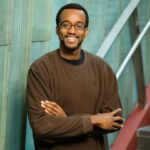
Every so often, we chat with an alum about what they do and how they got there. Robert Deloatch ’11, M19, computer science, has followed his research interests to an exciting job at Apple. We asked Robert about what his experience as a Meyerhoff Scholar means in his life today, and what he would say to a future scholar.
Q: What is your current job title and employer?
A: I am a Human Factors Engineer at Apple Inc.
Q: Tell us about your current job and what you enjoy most about it.
A: I manage a team of researchers who focus on applying user-centered design principles to design and develop Apple products. I collaborate with teams at Apple to come up with new ways to continue to enhance the customer experience. I enjoy the fast paced environment of Apple which allows for conducting research that leads to immediate customer impact.
Q: When you think about the “ripple effect” of the Meyerhoff Scholars Program, how do you see that playing out in your field and in your life?
A: I’ve been amazed at how the Meyerhoff Scholars Program has continued to affect my field and life. I’ve encountered researchers and faculty of color that were part of the Meyerhoff Scholars Program or programs that were modeled after Meyerhoff at conferences and internships. It’s been a reminder to me of the staying power of such a program and how it’s focus on leadership, diversity, and scholarship has been ingrained into my beliefs and relationships.
Q: Why is the Meyerhoff mission so important, not only to you, but to society?
A: The Meyerhoff mission is important because diversity in STEM is important. To generate the best ideas and solve complex problems requires discussion and being challenged. Having groups from various backgrounds and perspectives is foundational to promote useful discussion.
Q: What advice would you give to a student considering the program?
A: I would tell a student to follow the advice of your Meyerhoff staff. They have been instrumental in helping produce thousands of amazing scholars and have your best interest at heart. Listen to them.
Learn more about the Meyerhoff Scholars Program here.
]]>
Every so often, we chat with an alum about what they do and how they got there. Robert Deloatch ’11, M19, computer science, has followed his research interests to an exciting job at Apple. We...
https://umbc.edu/stories/career-qa-robert-deloatch-11-m9/
https://dev.my.umbc.edu/api/v0/pixel/news/119633/guest@my.umbc.edu/4cd30822664f76375c603032d56853ee/api/pixel
alumni
career-q-and-a
computer-science
meyerhoff
mhoff
UMBC News & Magazine
https://dev.my.umbc.edu/groups/umbc-news-magazine
https://assets1-dev.my.umbc.edu/system/shared/avatars/groups/000/001/943/24435aa6207c452e7bc15cc74b42c7bb/xsmall.png?1748556657
https://assets1-dev.my.umbc.edu/system/shared/avatars/groups/000/001/943/24435aa6207c452e7bc15cc74b42c7bb/original.png?1748556657
https://assets2-dev.my.umbc.edu/system/shared/avatars/groups/000/001/943/24435aa6207c452e7bc15cc74b42c7bb/xxlarge.png?1748556657
https://assets2-dev.my.umbc.edu/system/shared/avatars/groups/000/001/943/24435aa6207c452e7bc15cc74b42c7bb/xlarge.png?1748556657
https://assets3-dev.my.umbc.edu/system/shared/avatars/groups/000/001/943/24435aa6207c452e7bc15cc74b42c7bb/large.png?1748556657
https://assets1-dev.my.umbc.edu/system/shared/avatars/groups/000/001/943/24435aa6207c452e7bc15cc74b42c7bb/medium.png?1748556657
https://assets2-dev.my.umbc.edu/system/shared/avatars/groups/000/001/943/24435aa6207c452e7bc15cc74b42c7bb/small.png?1748556657
https://assets1-dev.my.umbc.edu/system/shared/avatars/groups/000/001/943/24435aa6207c452e7bc15cc74b42c7bb/xsmall.png?1748556657
https://assets2-dev.my.umbc.edu/system/shared/avatars/groups/000/001/943/24435aa6207c452e7bc15cc74b42c7bb/xxsmall.png?1748556657
UMBC News & Magazine
0
0
false
Fri, 14 May 2021 17:03:53 -0400