From better batteries to safer surgery: Three engineering grads to tackle society’s big challenges with support from prestigious NSF research fellowships
How can we make the world a better place? It’s a question that Nathaniel Glover ’25, chemical engineering, Jacob Lombardo ‘25, mechanical engineering, and August Phelps ’25, mechanical engineering, have spent a lot of time thinking about. And each has concluded that advancing science is a powerful way to advance humanity.
The three promising researchers were each recently recognized and rewarded by the National Science Foundation’s Graduate Research Fellowship Program (GRFP), which provides financial support to U.S. graduate students who have shown the potential to be high-achieving scientists and engineers.
“The NSF GRFP award is a very prestigious and competitive award,” says Deepa Madan, associate professor in the Department of Mechanical Engineering, who has worked with both Glover and Lombardo on research projects in her lab. So far this year the program has awarded 1,000 fellowships across the U.S., about half of the typical number, making the process even more competitive. This fall, Glover, Lombardo, and Phelps will all head to Johns Hopkins University in Baltimore to begin their graduate education and research.
The thrill of research
Glover, Lombardo, and Phelps knew early in their college careers that they wanted to become researchers. The three are part of the Meyerhoff Scholars Program at UMBC, which is at the forefront of efforts to increase diversity among future leaders in science, technology, engineering, and mathematics by supporting students who intend to pursue a Ph.D. or combined M.D./Ph.D. in these fields. Throughout their time at UMBC, they engaged in a variety of research projects with different faculty mentors.
 Nathaniel Glover stands next to the research poster he presented at the end of his internship at Argonne National Laboratory in summer 2024. (Photo courtesy of Glover)
“I really enjoy the quest to answer unanswered questions,” Glover says, explaining what attracts him to research. Most recently, he worked in Madan’s lab on a project to develop rechargeable, safe, and flexible zinc alkaline batteries, which could revolutionize how consumers power devices such as wearable health monitors.
Lombardo has also worked in Madan’s lab, studying materials that can convert wasted heat into electricity, while Phelps recently worked with mechanical engineering assistant professor Ankit Goel to develop methods for improving control over the flight trajectory of multicopters. Multicopters, which use multiple rotors for lift and maneuvering, are inherently unstable and underactuated, meaning the craft is limited in the ways it can move and must actively stabilize itself at all times. The researchers developed a method to guide the aircraft along a desired trajectory as precisely as possible despite variations in operating conditions and physical properties of the multicopter.
The problems the students and their mentors study—such as how to power and control machines—transcend any particular application, and the solutions the researchers develop could have profound effects on a variety of technologies.
For example, in graduate school, Phelps will join a lab that develops control systems for medical robots. There, he will study electrocauterization, a medical procedure that uses heat generated by an electric current to perform tasks such as removing harmful tissue and controlling bleeding during surgery. Phelps said the speed of the process needs to be carefully controlled to avoid excess damage to healthy tissue, and the lab he is joining is working on ways to automate this control. He notes that both his father and girlfriend have undergone medical procedures with long recovery times. Making the process better is personal to him.
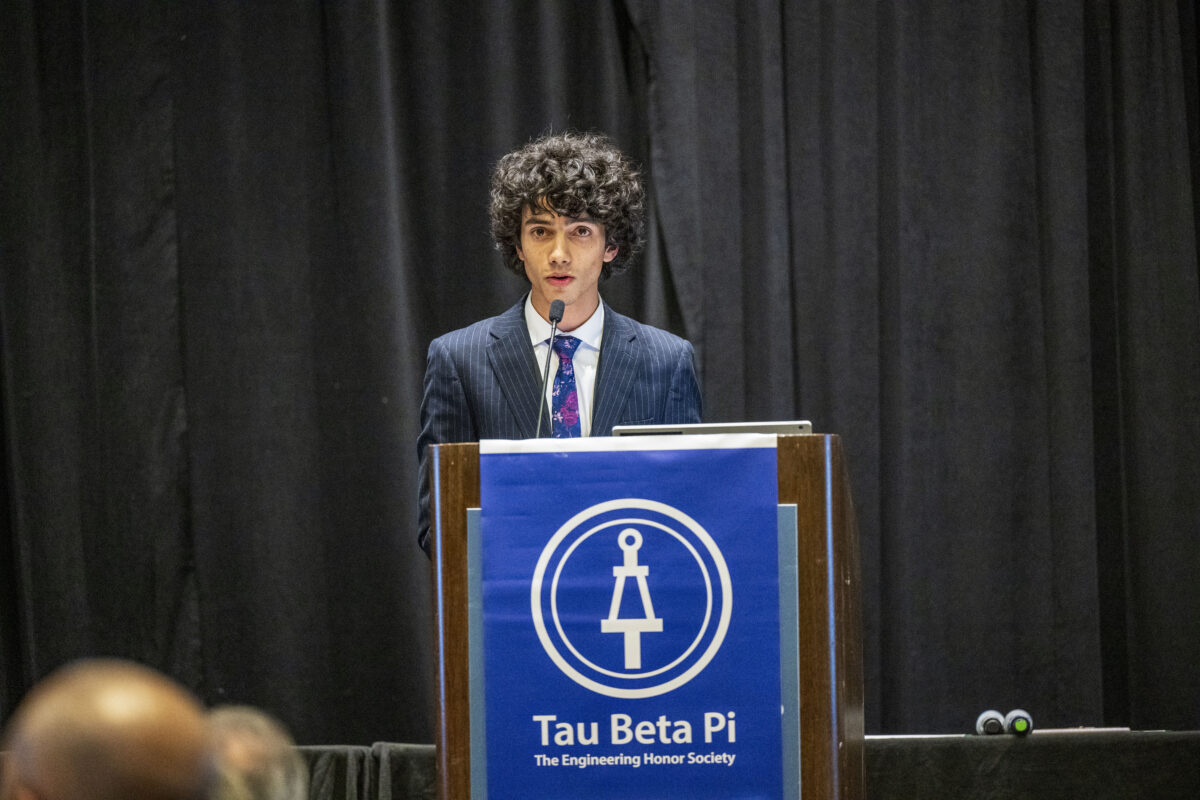 August Phelps speaks at the 2023 Tau Beta Pi National Convention in Atlanta, Georgia, as UMBC’s chapter delegate to the engineering honor society. (Photo by Kiffer Creveling)
Glover and Lombardo agree that what keeps them going, even through late-night problem solving and failed prototypes, is the desire to improve the way things get done. “I love how engineering research takes fundamental science principles and applies it to making a difference in the world,” says Lombardo.
“My real passion is figuring out how to progress as a species,” echoes Glover. “Science is one of our most powerful tools for that.”
A launch pad for big dreams
 Jacob Lombardo (left) and labmates Jiyuan Huang and Srushti Kulkarni attend the 2024 Consumer Electronics Showcase, as part of the Southwest I-Corp program. The program guides engineers to engage with stakeholders outside the lab to better understand market needs and consumer requirements. (Photo courtesy of Lombardo)
These Retrievers say UMBC offered the tools and the mentorship to progress toward their biggest ambitions.
“So many people took their time to sit with me, to push me forward,” says Lombardo. “I had the opportunity to go to scientific conferences, engage in world-class research, and find a community that embraced me.”
Lombardo notes that with support from programs such as the National Institute of Health’s Undergraduate Research Training Initiative for Student Enhancement (U-RISE) program and the Southwest Regional National Science Foundation Innovation Corps (I-Corps) program, he was able to network with researchers outside of his discipline, as well as with industry experts who understand the consumer market. The interactions honed his career goals and reinforced his passion for translating fundamental science principles into practical and impactful engineering, he says.
Glover, Lombardo and Phelps agree being awarded NSF GRFP fellowships is both a validation of the work they have done so far and an obligation to make a positive difference with research going forward. “It does make me feel that what we do is seen and appreciated,” Glover says. “I have this feeling that I will be able to have the impact that I am hoping to have on the world, which is inspiring and humbling.”
Phelps says he is excited to take the next steps: “I’m looking forward to exploring new topics, pushing the boundaries, and creating new things.”
]]>
How can we make the world a better place? It’s a question that Nathaniel Glover ’25, chemical engineering, Jacob Lombardo ‘25, mechanical engineering, and August Phelps ’25, mechanical...
https://umbc.edu/stories/three-engineering-grads-win-nsf-grfp-awards/
https://dev.my.umbc.edu/api/v0/pixel/news/150763/guest@my.umbc.edu/9e0b1a4e721e724c6e958f4ac3c812c3/api/pixel
cbee
coeit
meche
meyerhoff-program
news
research
science-and-tech
story
UMBC News & Magazine
https://dev.my.umbc.edu/groups/umbc-news-magazine
https://assets1-dev.my.umbc.edu/system/shared/avatars/groups/000/001/943/24435aa6207c452e7bc15cc74b42c7bb/xsmall.png?1748556657
https://assets1-dev.my.umbc.edu/system/shared/avatars/groups/000/001/943/24435aa6207c452e7bc15cc74b42c7bb/original.png?1748556657
https://assets2-dev.my.umbc.edu/system/shared/avatars/groups/000/001/943/24435aa6207c452e7bc15cc74b42c7bb/xxlarge.png?1748556657
https://assets2-dev.my.umbc.edu/system/shared/avatars/groups/000/001/943/24435aa6207c452e7bc15cc74b42c7bb/xlarge.png?1748556657
https://assets3-dev.my.umbc.edu/system/shared/avatars/groups/000/001/943/24435aa6207c452e7bc15cc74b42c7bb/large.png?1748556657
https://assets1-dev.my.umbc.edu/system/shared/avatars/groups/000/001/943/24435aa6207c452e7bc15cc74b42c7bb/medium.png?1748556657
https://assets2-dev.my.umbc.edu/system/shared/avatars/groups/000/001/943/24435aa6207c452e7bc15cc74b42c7bb/small.png?1748556657
https://assets1-dev.my.umbc.edu/system/shared/avatars/groups/000/001/943/24435aa6207c452e7bc15cc74b42c7bb/xsmall.png?1748556657
https://assets2-dev.my.umbc.edu/system/shared/avatars/groups/000/001/943/24435aa6207c452e7bc15cc74b42c7bb/xxsmall.png?1748556657
UMBC News & Magazine
0
0
false
Mon, 23 Jun 2025 11:18:40 -0400
Mon, 23 Jun 2025 11:18:40 -0400
Outstanding Alumnus: Isaac Kinde ’05

Over the next few weeks we’ll be introducing you to this year’s Alumni Award winners. The UMBC Alumni Association proudly honors distinguished alumni and faculty for their accomplishments and dedication to UMBC. Today we’re talking wit h Isaac Kinde ‘05, biological science, about his research with cancer diagnostics.
Name: Isaac Kinde ’05, biological science
Title: M.D./Ph.D. Candidate, The Johns Hopkins University School of Medicine
Award Category: Rising Star
Q: Please tell us a little about why you chose to attend UMBC and what, if any, involvement you have with the university currently.
The Meyerhoff Program was the most important reason why I chose to attend UMBC as a California native. Its immersive scientific experience was attractive, but I was even more excited about the opportunity to be closely surrounded by like-minded peers. The engagement of the faculty, staff, and administration further inspired confidence in my decision. I now return yearly to help interview candidates for the Meyerhoff Program.
Q: Is there a particular class or professor at UMBC who really inspired you?
Working with my research mentor, Dr. Michael Summers, was transformative. It was then I recognized that the best way to learn science was to do science. Having no prior research experience, I remember his patience and commitment to mentorship being central to my persistence in the lab. Equally memorable was how much fun I had. The group skiing trips, picnics, and mountain biking outings were great ways to bond with my colleagues and blow off steam. As a direct result of his mentorship, I ended up applying to combined M.D. /Ph.D. programs instead of solely pursuing my M.D.
Q: Please tell us a little about the trajectory of your career and what you are working on now:
My doctoral research produced novel cancer diagnostics based on improvements in DNA sequencing technology. Example applications include a prototype screening test for ovarian and endometrial cancer from Pap smear specimens, a noninvasive method of monitoring bladder cancers from urine, and a revelation in the development of treatment resistance from analyzing the blood of patients with colon cancer. With the help of my mentors and collaborators, I have published descriptions of these technologies and applications in leading scientific journals and submitted several patent applications detailing the inventions. Encouragingly, this work has attracted considerable attention from industry, spurring partnerships to facilitate its commercialization. The ultimate goal is to bring meaningful cancer diagnostic tests to the clinic – where the real difference to patients’ lives can be realized.
Q: What has been the greatest success in your career? The greatest challenge?
My greatest challenge led to my greatest success. When I began the graduate school portion of my training program, I joined a team working on applying new technologies to detect cancers at early, highly curable stages. We repeatedly identified the wrong technology to accomplish our goal, but the potential impact of finding the right technology kept us going. Three years later we created the technology we needed – a method that significantly improved the accuracy of commercial next- generation DNA sequencers. It wasn’t an easy process but the benefits of our technology have made the effort worthwhile. We’re now developing this technology for use in the earlier detection and optimal management of several cancers.
]]>
Over the next few weeks we’ll be introducing you to this year’s Alumni Award winners. The UMBC Alumni Association proudly honors distinguished alumni and faculty for their accomplishments and...
https://umbc.edu/stories/outstanding-alumnus-isaac-kinde-05/
https://dev.my.umbc.edu/api/v0/pixel/news/122315/guest@my.umbc.edu/bf8f3f0e76cea3faaad2453fa874a667/api/pixel
alumni
biological-sciences
cancer
dr-michael-summers
isaac-kinde
meyerhoff-program
umbc
university-of-maryland-baltimore-county
UMBC News & Magazine
https://dev.my.umbc.edu/groups/umbc-news-magazine
https://assets1-dev.my.umbc.edu/system/shared/avatars/groups/000/001/943/24435aa6207c452e7bc15cc74b42c7bb/xsmall.png?1748556657
https://assets1-dev.my.umbc.edu/system/shared/avatars/groups/000/001/943/24435aa6207c452e7bc15cc74b42c7bb/original.png?1748556657
https://assets2-dev.my.umbc.edu/system/shared/avatars/groups/000/001/943/24435aa6207c452e7bc15cc74b42c7bb/xxlarge.png?1748556657
https://assets2-dev.my.umbc.edu/system/shared/avatars/groups/000/001/943/24435aa6207c452e7bc15cc74b42c7bb/xlarge.png?1748556657
https://assets3-dev.my.umbc.edu/system/shared/avatars/groups/000/001/943/24435aa6207c452e7bc15cc74b42c7bb/large.png?1748556657
https://assets1-dev.my.umbc.edu/system/shared/avatars/groups/000/001/943/24435aa6207c452e7bc15cc74b42c7bb/medium.png?1748556657
https://assets2-dev.my.umbc.edu/system/shared/avatars/groups/000/001/943/24435aa6207c452e7bc15cc74b42c7bb/small.png?1748556657
https://assets1-dev.my.umbc.edu/system/shared/avatars/groups/000/001/943/24435aa6207c452e7bc15cc74b42c7bb/xsmall.png?1748556657
https://assets2-dev.my.umbc.edu/system/shared/avatars/groups/000/001/943/24435aa6207c452e7bc15cc74b42c7bb/xxsmall.png?1748556657
UMBC News & Magazine
0
0
false
Wed, 24 Sep 2014 12:00:30 -0400