A couple of years ago, Jessica Floyd was enjoying delicious olive flatbreads in Opio, France, a village on the French Riviera, thanks to the hospitality of Judith Legman, who owned the olive grove and a manuscript Floyd had been trying to find for her doctoral work for three years. This bucolic heaven was not where Floyd, who studies erotic folklore, thought she would find the holy grail of erotic chanteys by Stan Hugill, a renowned British sailor and chantey singer. These sailors’ work songs, first collected in the 1900s, were passed down verbally by sailors, with some never recorded. These bawdy versions were never meant to be heard or read by women, much less shared between them.
“When you’re talking about erotic content, it automatically becomes something that is salacious and provocative and therefore seen as taboo,” said Floyd, Ph.D. ’17, language, literacy, and culture, an adjunct instructor of English. “Publications that are not conservative in their treatment of sex, gender, and sexuality are often deemed taboo. Scholars who are actively working in this field have to fight not only for their legitimacy, but also because we’re considered dirty workers. We also fight for the legitimacy of the materials that we’re researching. These are real human experiences. They just happen to be from the darker corners of the human experience.”
Like other scholars in the field seeking access to a variety of documents, Floyd reached out to the librarians at the Kinsey Institute, which holds the largest historical archive on sexuality. “They weren’t sure if the manuscript could be found in the extensive archive of Gershon Legman, which Judith, his wife, had donated,” said Floyd, of her research for her debut book Cabin Boys, Milkmaids, and Rough Seas: Identity in the Unexpurgated Repertoire of Stan Hugill (University Press of Mississippi, 2024).
She emailed Legman, following a tip from other chantey folklorists and researchers that Legman, a famous connoisseur and collector of erotic jokes, folklore, and songs, had the manuscript. “Lo and behold, she emailed me back. I still get chills talking about it,” said Floyd. “Judith said, ‘Not only do I have it, I actually just sent it to the Kinsey Institute. If you’d like, I’ll send you the copy.’” Dispersed throughout Legman’s chapter on erotic folk songs were Hugill’s erotic chanteys that had never been circulated.
 The envelope sent by Judith Legman to Jessica Floyd with Stan Hugill’s unpublished manuscript. (Image courtesy of Jessica Floyd)
Chasing erotic rare texts
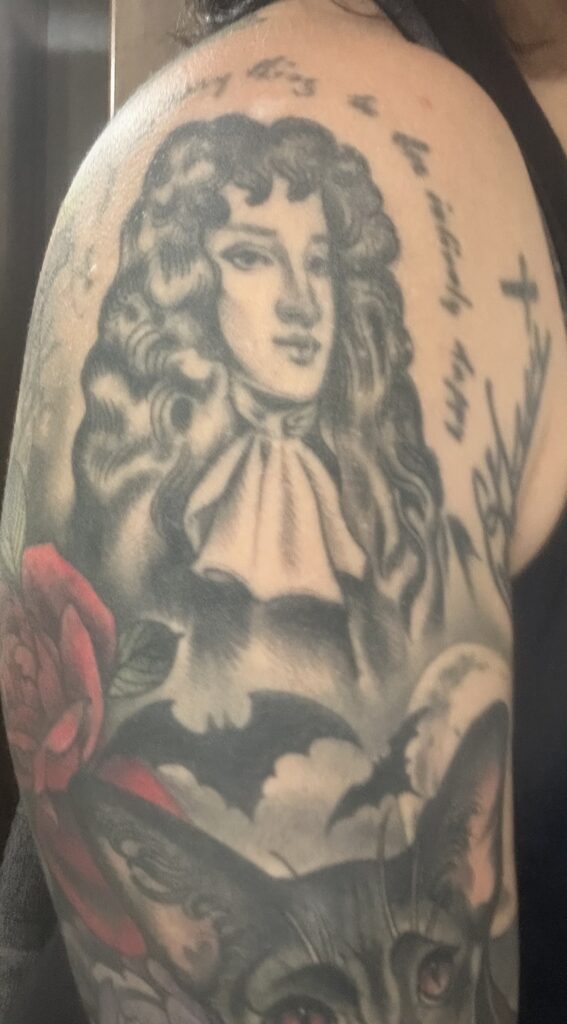 Floyd’s tattoo of John Wilmot, the Second Earl of Rochester, a late 17th-century English nobleman. (Image courtesy of Jessica Floyd)
Floyd is used to the chase and thrill of finding rare texts. She studies the gender and sexuality of sailors during the height of British and American sailing, from the mid-16th to the mid-19th centuries—when sailing ships dominated global trade and naval warfare—as well as 17th and 18th-century literature, erotic folklore, gender and women’s studies, and queer theory. This passion began in high school and continued through her undergraduate and graduate studies researching the life of John Wilmot, the Second Earl of Rochester, a late 17th-century English nobleman better known for questioning authority while also enjoying the excesses of court life and writing poetry that explored sex, desire, rebellion, and challenged social and gender norms.
“It made sense for me to research sexuality in chanteys because I want to understand why men sing dirty songs. What can chanteys tell us about how sailors negotiate sex and gender, especially in the constrained environment of the sailing ship?” said Floyd.
An epistolary discovery
Like Wilmot, Hugill also wrote and published his work. In the 1950s, Hugill began writing down the songs he remembered. In 1961, he published Shanties From The Seven Seas, a collection of over 400 chanteys now considered by chantey researchers and folklorists as the most comprehensive work on chanteys. Sailor Town was published in 1967, Shanties and Sailors’ Songs in 1969, followed by Songs of the Sea: The Tales and Tunes of Sailors and Sailing Shipsin 1977. Between 1962 and 1994, Hugill released 10 recordings—LPs, CDs, and cassette tapes—of chanteys and chantey history. Three were released posthumously. His Sea Songs CD, released in 1980, is now part of the Smithsonian Folkways Recordings catalogue.
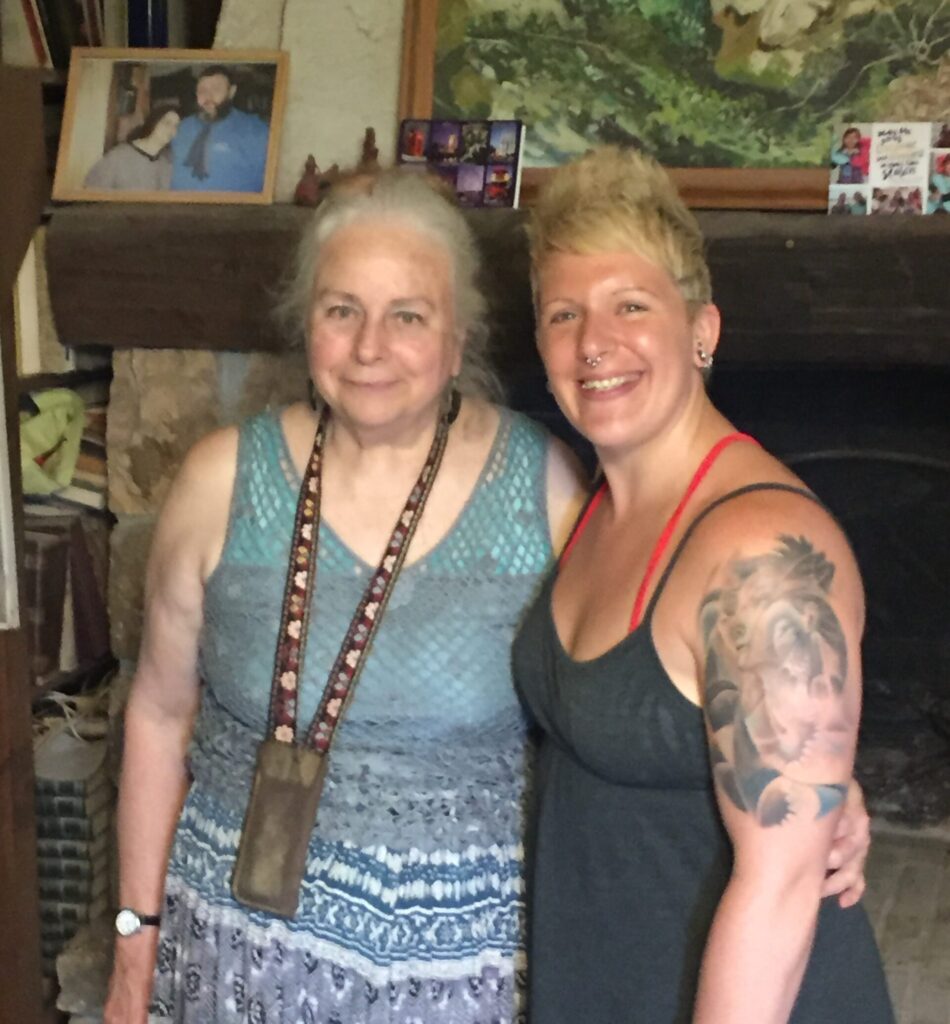 (l-r): Judith Legman and Jessica Floyd in Opio, France. (Image courtesy of Floyd)
However, unlike Wilmot, Hugill never penned the erotic versions and only sang them after a performance to an all-male audience. When Gershon Legman learned about Hugill’s repertoire, he wrote to Hugill, urging him to commit the erotic chanteys to paper for his vast collection. Hugill capitulated after years of correspondence with the condition that Legman not publish the manuscript before he could. Both men died in the 1990s without ever publishing it. With Hugill and Legman as the only witnesses of the manuscript’s existence, what was left for the chantey folklore community was rumors and the lore of its existence.
Thanks to funding from a 2016 UMBC Dresher Center for the Humanities summer fellowship, Floyd visited Judith Legman to study these letters alongside the manuscript. “Judith also had the letters shared between Hugill and Legman, which confirmed that this indeed was the sought-after manuscript,” said Floyd. She notes that by the time she left France, she had everything she needed to do a close analysis of the songs.
“Erotic worlds have fascinated me for a long time. It’s not your run-of-the-mill construction of gender. It’s actually focusing on the part of the human experience that we’re really reticent to talk about, especially in academic work,” said Floyd, who sports a palm-sized tattoo of Wilmot on her upper right arm. “This is the heart of my research—how do we write erotic worlds?”
Floyd is once again on the hunt for rare texts and has completed her second book, The Sons of Neptune. In this study, she is looking at cultural artifacts, from the 18th to the 20th century, that provide insight into why sailors are often thought of as sexy. This project is set to be published through the University of Mississippi Press in May 2026.