Corris Davis’98, M.P.P. ’19, Ph.D. ’25, didn’t originally envision such a long career at UMBC or the number of students she would directly impact. As a Meyerhoff Program Scholar, Corris experienced how intentional mentoring and support could lift up students on their UMBC journeys. Now the senior director of the Office of Academic Opportunity Programs—which she founded as a home to UMBC’s five TRIO Programs as well as first-generation student programming—Corris has been at the front lines for first-gen and low-income students for 26 years. By forging cross-departmental connections, Corris has built a network of support and encouragement for UMBC’s growing population of first-gen students. Tell us all about it!
Q: What’s one essential thing you’d want another Retriever to know about you?
A: I’m a three time UMBC alum—undergrad in biological sciences in 1998, M.P.P. ’19, and Ph.D. ’25, public policy—who has recently rekindled a love for Galaga and LEGOs (because everything old is new again).

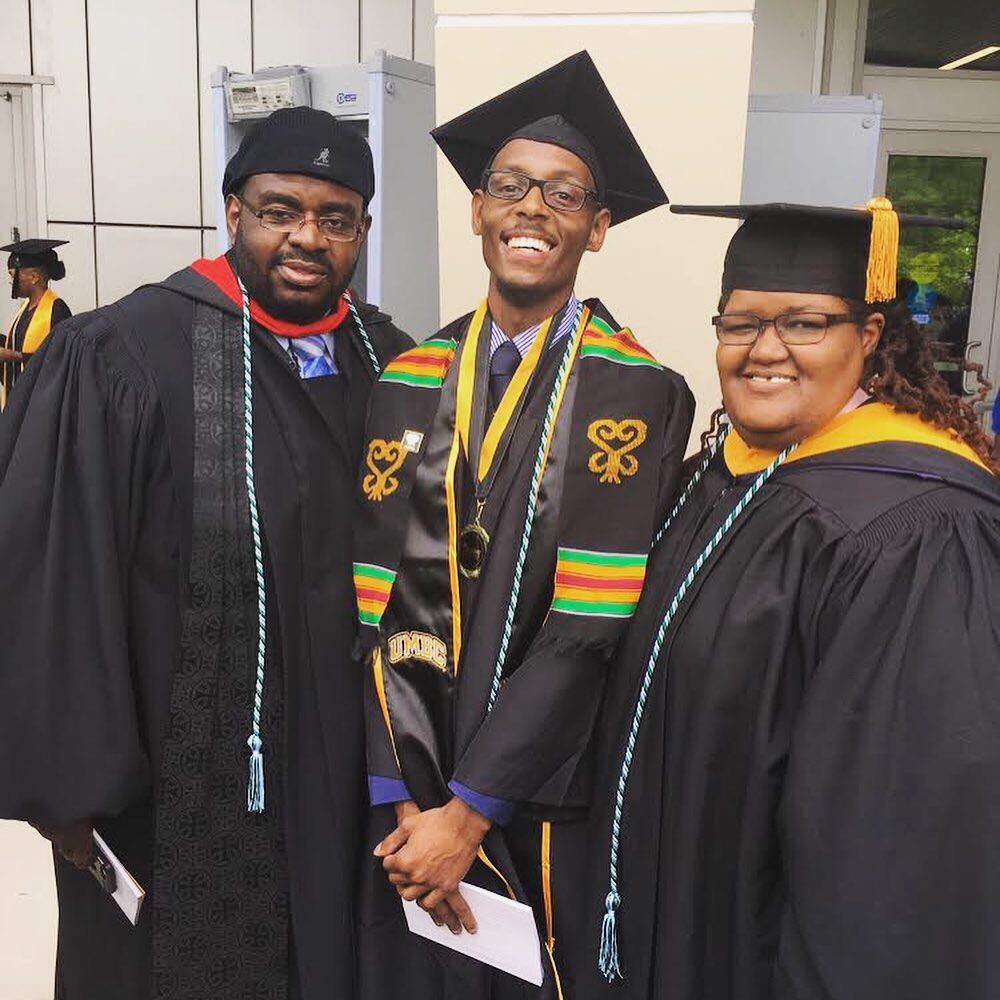 Left: Fellow staff of the Upward Bound Program outside of the Apollo Theatre in New York City during an end of summer field trip. Left to right: Terri Chambers, Christine Harris ’98, Allen Bolden ’99, Karriem Farrakhan ’97, Kerrian McLean ’00, and Corris. Right: At UMBC Commencement 2022, Dr. Michael Hunt, Damarius Johnson ’22 (McNair alum), and Corris.
Q: What’s the one thing you’d want someone to know about the support you find here?
A: “Support” and “community” aren’t just words. People show up for each other because that’s who we are, be it faculty, staff, students, or alumni.
Q: What part of your job do you enjoy the most and why?
A: I support programs that allow students from middle school all the way to undergrad to see what they can be. I have seen students that I met in 8th or 9th grade earn Ph.D.s. I love knowing that while I don’t always work directly with students, the work I do supports them in reaching their goals.
Q: What brought you to UMBC in the first place?
A: I started my professional staff journey as the office coordinator of the TRIO Upward Bound program at UMBC, one of what is now five TRIO programs hosted at UMBC (Upward Bound, Upward Bound Math/Science, Talent Search, McNair Scholars, and now Student Support Services). Since then, I’ve been the assistant director of Upward Bound, and then director. In 2016, I was able to form the Office of Academic Opportunity Programs that houses all of the TRIO Programs as well as first-generation student programming.
After completing my bachelor’s degree, I left UMBC to go to a Ph.D. program in molecular and cellular biology, but about seven months in, I realized that it was not a good fit. I had previously worked with Upward Bound as an undergrad so I essentially came home until I could figure out what my next moves were. I didn’t think that I would still be at UMBC 26 years later.
The reason I stay at UMBC is that I am given the space to help students who are from similar backgrounds to grow and thrive and have great experiences.
Photo: Over the years, many participants have become like family, says Corris. Left side front to back: Prentiss Haney, Gerrod Williamson (Upward Bound alum and current staff member), Corris’s wife, Consuela Lowery; on the right from front to back: Tobias Davis (Upward Bound alum), Dr. Durell Callier ’14, McNair Scholar alum), and Corris.

Q: Tell us about the people who have helped you at UMBC, and why it has made such a difference to you.
A: I must start with the late LaMont Toliver, director of the Meyerhoff Scholars Program. While my initial relationship with him was as a Meyerhoff Scholar, once I became a staff member, he provided even more guidance and support. I use much of what I learned from him in my work in supporting students now, both directly and behind the scenes. I recall him sharing a quote from Harry Truman: “It is amazing what you can accomplish if you do not care who gets the credit.” This has shaped a lot of my work at UMBC. It’s all about advancing our students.
I’ve found support at UMBC in two ways: sometimes by making the ask, and sometimes because people see the vision and step forward on their own. A great example is the creation of the First Generation Network. While it’s not as active as we’d like currently, it’s very existence comes from a group of campus partners, many of whom were first-generation students themselves who understand the importance of the work and volunteering.
“The quote… “It is amazing what you can accomplish if you do not care who gets the credit.” This has shaped a lot of my work at UMBC. It’s all about advancing our students.Corris Davis
Senior director of the Office of Academic Opportunity Programs
We’ve been able to honor first-generation graduates with cords for about six years now. Offices like the Academic Success Center, the Career Center, and several Student Affairs departments have regularly stepped up, not just as cord pick-up sites, but as co-creators of programming that supports UMBC’s first-gen students. Support may be handing out graduation cords, or staffing First Gen Week tables, or even redesigning programming and workshops so they tackle the hidden curriculum and the barriers created by higher-ed jargon.
 Staff of the various TRIO programs in the Office of Academic Opportunity Programs at the annual regional TRIO conference in Hershey, PA, in Feb 2023. Front, left to right: Tanaj Mogase, Talent Search, Corris, Ting Huang (UMBC and McNair alum), Ahdrianna Boyce (UMBC and Upward Bound alum); back left to right: Jennifer Appleby (former TS coordinator), Dr. Michael Hunt, and Dr. Sunji Jangha ’25
Although my office sits in Academic Affairs, this cross-division collaboration is exactly how things get done at UMBC: People come together to support students. It’s impossible to name everyone who has supported me and this work over the years, but I must acknowledge the incredibly talented staff in AOP. Their commitment, partnership, and care make everything we do not only possible, but even more meaningful.
Q: What would you tell someone who is considering a career at UMBC?
A: UMBC is a place where you can take a dream and run with it. We have a culture of supporting students and supporting each other in that work.
UMBC’s greatest strength is its people. When people meet Retrievers and hear about the passion they bring, the relationships they create, the ways they support each other, and the commitment they have to inclusive excellence, they truly get a sense of our community. That’s what “Meet a Retriever” is all about.