On a cloudy Saturday in January, UMBC buzzed with the energy of over 1,200 high school students from across the Mid-Atlantic region. For the third consecutive year, UMBC’s College of Natural and Mathematical Sciences (CNMS) hosted its Science Olympiad Invitational Tournament, transforming the campus into a vibrant hub of hands-on scientific discovery for the high school competitors.
From building hovercrafts and bridges to tackling exams in anatomy, astronomy, and beyond, the event showcased 23 competitive challenges across an array of STEM disciplines. What started as a modest gathering of 40 teams three years ago has ballooned into Maryland’s largest invitational, drawing participants from Virginia, Delaware, New Jersey, Pennsylvania, and D.C.
The tournament exemplifies UMBC’s commitment to nurturing young talent and building community connections. “A couple of years ago, I suggested a Science Olympiad tournament as a way to invite more high school students onto the campus and get them excited about science—and UMBC,” shared event co-organizer Bindu Abraham, Ph.D. ’06, chemistry, assistant teaching professor of chemistry and biochemistry, and executive director of Maryland Science Olympiad.
Abraham first encountered Science Olympiad as a homeschool parent watching a passion for science emerge in her son. Now, she is happy to be involved in encouraging a similar enthusiasm for science in students across the region. This year’s event also spotlighted partnerships with organizations like STEM Champions of Baltimore, ensuring under-resourced Baltimore City schools could participate in a dedicated league and envision futures at UMBC.
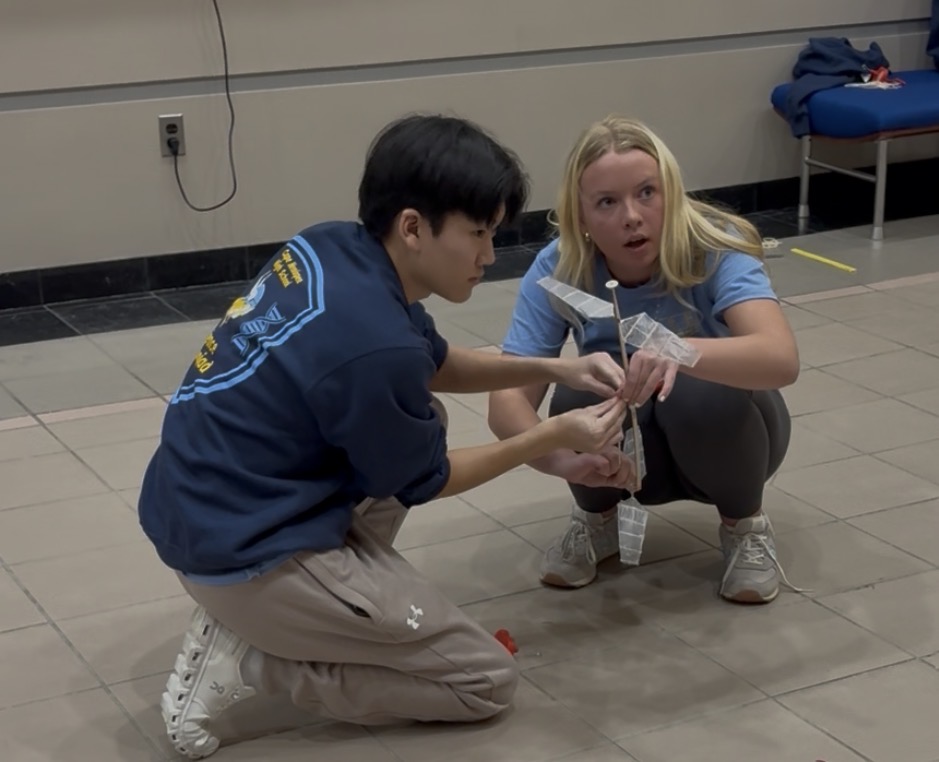
 Cape Henlopen High School in Delaware brought three complete teams to the Science Olympiad at UMBC. Left: Nathaniel Hoang and Ellie Sprague compete in the helicopter event. Right: Quinton Eisenmann and Ava Lewis prepare for the hovercraft event. (Photos courtesy of Priscilla Coolbaugh)
Inspiring students’ interest in science
Volunteers—including UMBC faculty, alumni, current students—made the day possible, each driven by motivations rooted in their own journeys. Mark Grzanna, M.S. ’15, biological sciences, today a Science Olympiad coach at John Carroll High School in Bel Air, Maryland, brought two teams of eager students for his third year at the UMBC tournament. Grzanna teaches biology, anatomy and physiology, and a biotech course he designed at John Carroll, and he views the Olympiad as a gateway to scientific curiosity.
“Education is so important. I became a teacher to get kids interested in science—or at least to help them understand enough science to navigate their world,” he said. His co-coach, John Carroll teacher Andrew Ketchum, echoed the sentiment: “It’s a great experience for our kids to see other students excited about science.”
Frank Tagaytay, a senior physics and math major, supervised the “boomilever” event, where teams tested structures’ strength and integrity. Based on experience as president of his high school Science Olympiad club, Tagaytay patiently guided participants through event regulations, offering encouragement amid the occasional structural mishap.

 Left: Frank Tagaytay (left), a senior UMBC physics and math major, encourages Aalyna Johnson (center) and Cassidy Mehegan from Cape Henlopen High School as they set up their “boomilever” for competition. (Photo by Sarah Hansen, M.S. ’15/UMBC) Right: Cape Henlopen students Theodore Noe Fellows, Shouta Sano, Quinton Eisenmann, and Ava Lewis (left to right) carry their equipment to the competition site in the UMBC Physics Building. (Photo courtesy of Priscilla Coolbaugh)
“It’s an early season event for teams to work out the kinks,” he explained, highlighting how the low-stakes environment builds confidence and resilience. For Tagaytay, volunteering bridges his past and present, reinforcing UMBC’s supportive community.
Fareedah Owolabi, a junior chemical engineering major who recently transferred from the Community College of Baltimore County, found the event particularly meaningful. “I have a soft spot for STEM outreach, because it’s how I was introduced to UMBC,” she shared. Through the Upward Bound Math and Science program, Owolabi connected with UMBC tutors as a high schooler. Now, as a volunteer, she fielded questions from participants about campus life. “I want to inspire younger students,” she said, embodying the cycle of mentorship that defines the tournament.
Broadening their horizons
Priscilla Coolbaugh, Science Olympiad coach at Cape Henlopen High School in Delaware, started her team three years ago after loving Science Olympiad as a student herself. “I want to share that love,” she said. Her three full teams traveled far to compete. “They get to see themselves at these universities. They might have planned to stay close to home, but this way they get exposure to out-of-state schools,” Coolbaugh said. “It broadens their horizons to different schools as well as different STEM fields.”

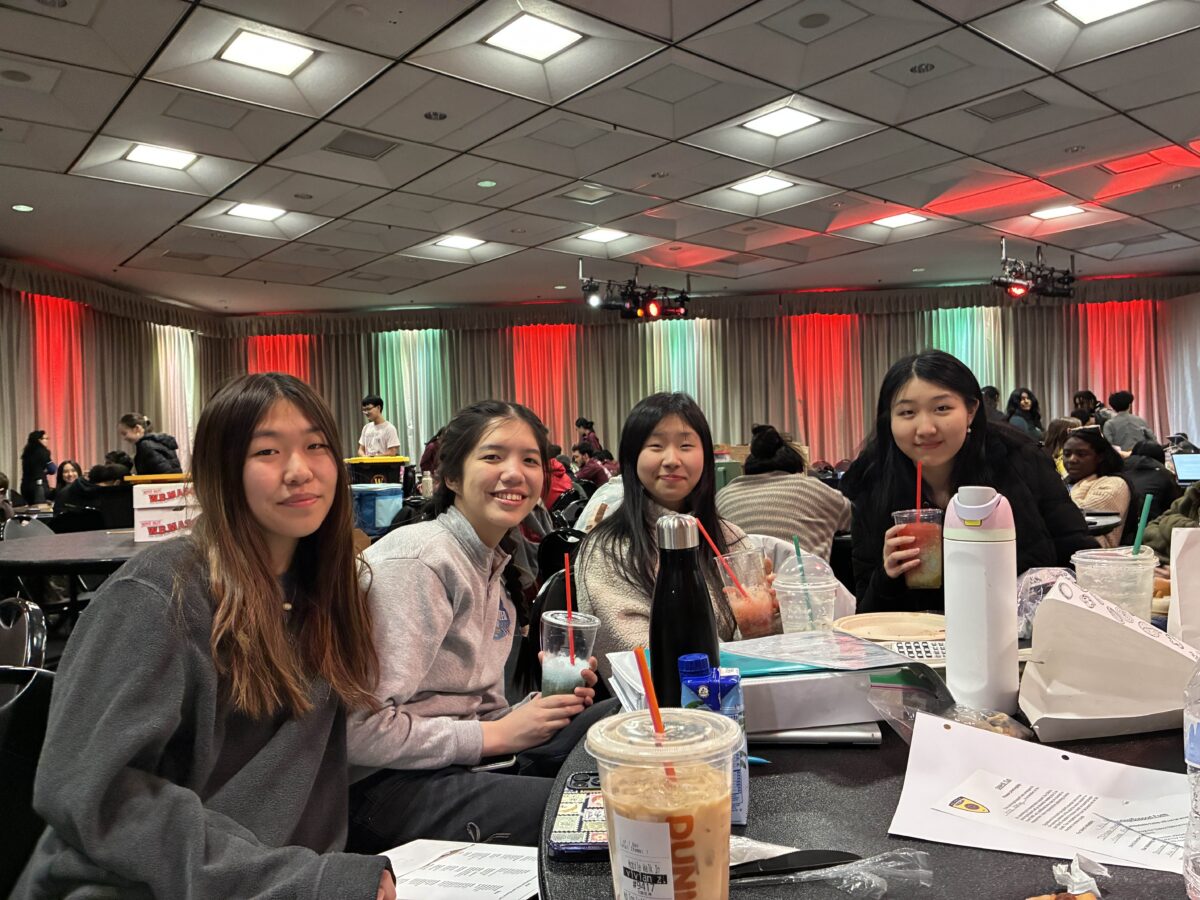 Students and a coach from Winston Churchill High School in Potomac, Maryland, relax in the UMBC Ballroom between events. (Photos courtesy of Jonathan Lee)
Students expressed their sense of community and excitement about their experiences at the UMBC event. Cape Henlopen freshman Aalya Desai noted how the event helped her make friends despite starting as a newcomer, and sophomore Grace Eanes appreciated the chance to bond with peers across grades while exploring the beautiful campus. Michael Song, a junior from Winston Churchill High School in Potomac, Maryland, who with his teammate, Leo Jiang, earned the top score in the hovercraft event, commented, “UMBC is much bigger than I expected. It’s a lot of fun to travel to Olympiad events.”
In good hands
Faculty and staff volunteers underscored the event’s broader impact. CNMS dean William R. LaCourse, surveying the awards ceremony, reflected on the promise of the participants. “As I stood on the stage looking over the ballroom filled with excited and creative students, I couldn’t help feeling as if I was looking into the future and thinking, ‘We (all of us) are in good hands,’” he said.
Zeev Rosenzweig, professor of chemistry and biochemistry, supervised the rocks and minerals test with three undergraduates and three of his graduate students. “Being here is just an important thing to do,” he said. “It’s a great outlet to show them that their interests matter,” he noted. “The kids who come to the Olympiad—they’re our people.” Ph.D. student Kushani Mendis, a Ph.D. student in Rosenzweig’s lab, added, “The best way to support the next generation in STEM is to organize events like this and spend time with them.”
In April, UMBC will host the Maryland State Science Olympiad for the first time, building on this invitational’s momentum. “It’s fun to see young people so excited about different areas of STEM,” shared Michelle Starz-Gaiano, professor and chair of biological sciences, adding, “It’s critical to foster the growth of young scientists. We love the energy and enthusiasm that they bring.”