Imagine a material where trillions of electrons are locked in an intricate, collective dance—so tightly choreographed that the tiniest nudge can send ripples across the entire system, transforming its behavior in dramatic ways. Now picture using light—especially the delicate touch of a single photon—to peek inside that dance, understand its hidden steps, and maybe even change the rhythm.
That’s the frontier Daniel Suárez-Forero is exploring at UMBC. He joined the Department of Physics as an assistant professor in August 2025 and leads the Quantum Optics of Correlated Materials group. His experimental approach sits at the intersection of two powerful fields: quantum optics, which studies how light behaves when quantum effects like entanglement come into play (the 2022 Nobel Prize recognized research in this area), and correlated materials, where electrons interact so intensely that they create physics impossible in ordinary conductors or insulators.
By shining quantum light into these strongly interacting systems, his lab aims to reveal quantum behaviors that existing tools can’t see, probe states that have so far been hidden, and help build the foundation for future technologies. His work, featured in two recent papers published in Science and Nature Materials, blends deep questions with real long-term promise, and he’s excited to build his lab here at UMBC.
Q: What will your research group at UMBC focus on, and how has your background prepared you for it?
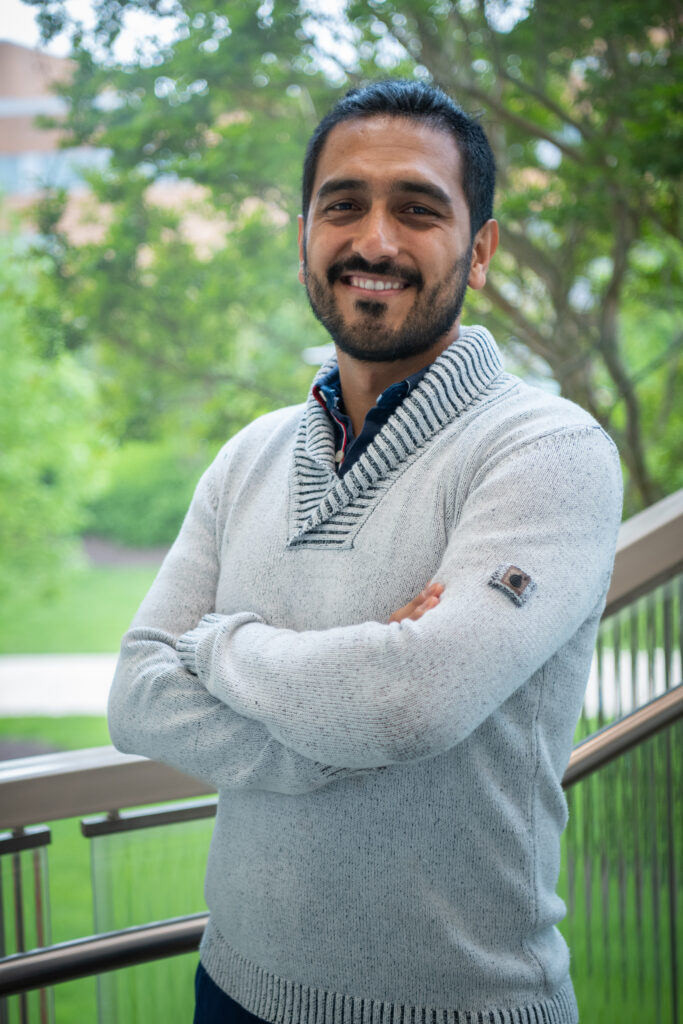 Daniel Suárez-Forero joined the UMBC faculty in 2025 and is already making waves in the physics department. (Brad Ziegler/UMBC)
A: At UMBC, my group will use single photons—the tiniest packets of light—to probe and even gently tweak materials where electrons interact extremely strongly. The exciting goal is to use one photon to affect about a trillion electrons at once: either to reveal hidden quantum details that ordinary tools miss, or to modify the whole material’s behavior with just one particle of light.
My path has been building toward this. In my Ph.D. in Italy, I worked on light-matter hybrids using entangled photons. Then, as a postdoc at the Joint Quantum Institute at the University of Maryland, I dived into these strongly interacting materials. Before joining UMBC, I spent a year in Geneva, Switzerland, learning new experimental techniques that I’m now bringing to campus. The fields of quantum optics and correlated materials had been developing separately, but technology is advancing so that the time is right to bridge them—and that’s what I’ll be doing at UMBC.
What excites me most is the scale: Using one photon to influence a trillion particles could unlock mysteries in these materials and help solve real challenges, like using photons more effectively in quantum computing or creating ultra-sensitive detectors. It’s fundamental science with huge potential for real impact.
Q: How did you choose UMBC and how is your first year going?
A: UMBC made the decision easy. The startup support for my lab’s equipment was strong, and infrastructure from recently retired professors transferred to incoming experimentalists like Geoffrey Diederich, Alex Senichev, and me—creating an excellent setup to build experiments.
Also, the DMV area is a major quantum hub, and Maryland’s initiative to become the “capital of quantum” aligns with UMBC’s Quantum Science Institute, which connects departments across science and engineering to advance quantum from every angle.
 Ph.D. student Nico Rueda-Becerra works with a laser in the Suarez-Forero laboratory. (Courtesy of Daniel Suárez-Forero)
My first year has been wonderful—I’ve gotten tremendous support from the administration, department, and students. I’ve taught graduate quantum mechanics, following the same cohort from their first to second semester. It’s rewarding to watch their understanding and independence grow. I now have one Ph.D. student from Colombia, another starting soon, and two enthusiastic undergrads helping set up the lab. It’s been a positive, exciting start.
Q: What were the key findings from your two recent papers, and how do they relate to your current work?
A: Both papers came from my time as a postdoc and looked at special layered materials where electrons interact very strongly with each other.
In the Science paper, we found something really surprising. Normally, when electrons get “stuck” in place because of their strong interactions (think of them crowding each other so much they can’t move easily), you’d expect other particles in the material to slow down too. But we saw the opposite: Certain particle pairs—made of an excited electron and the empty spot (or “hole”) it left behind—actually moved much faster, about 1,000 times faster than expected! The crowding actually helped these pairs zip around more freely by interfering with their usual tight pairing. It was a “wow” moment that showed how these interactions can lead to unexpected enhanced mobility.
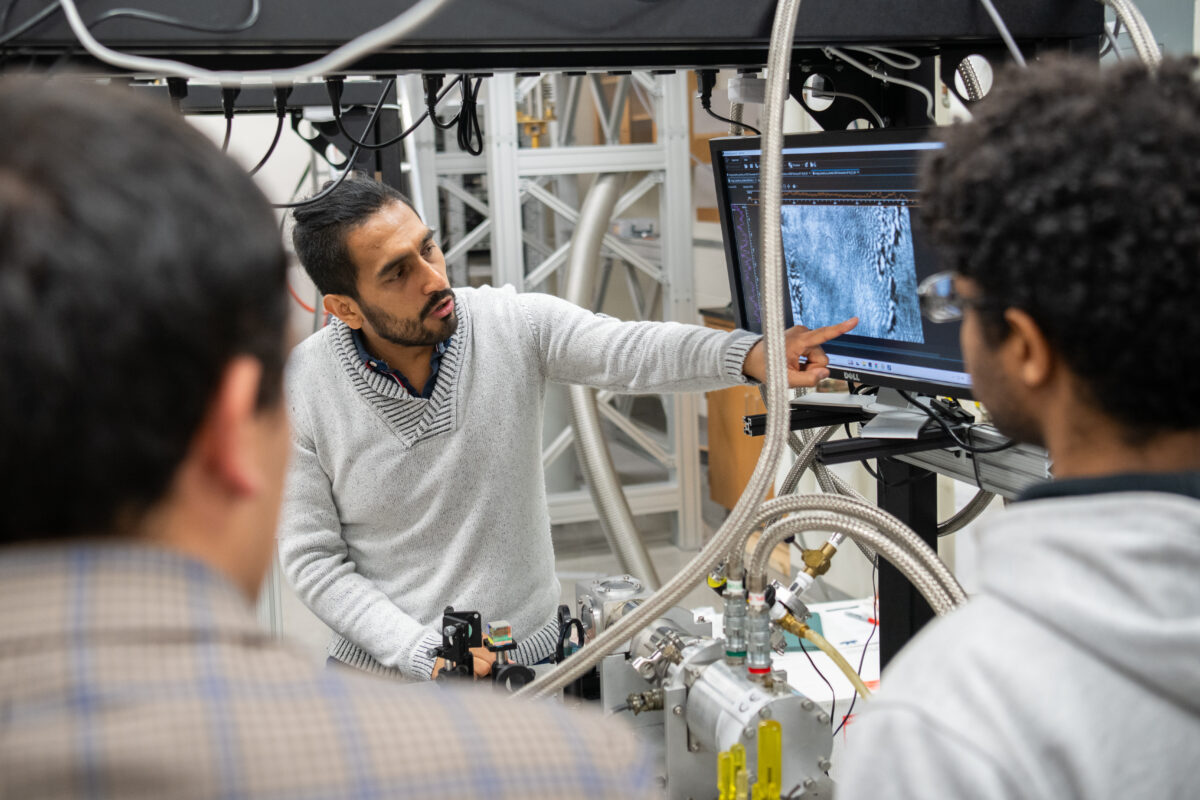 Daniel Suárez-Forero’s group uses complex optics systems to study the properties of correlated materials. Here, he explains the output of one of the research group’s tests. (Brad Ziegler/UMBC)
The Nature Materials paper looked at the flip side: When we shined laser light on the material to create more of those electron-hole pairs, they started lining up neatly all in the same direction—like tiny magnets snapping into alignment. And we could control and reverse this alignment just by turning the light on and off. It’s a way to use light to change how the material behaves, almost like flipping a switch.
These discoveries help us better understand how light and super-strong electron interactions can work together. That’s exactly what sets the stage for my research at UMBC: using single photons to explore or even tweak these materials in new ways—probing hidden details or switching states with just one photon.
Q: What advice do you have for students who are interested in quantum science?
A: If you’re already curious about quantum physics, of course I think that’s a good choice—it’s an exciting field. A Ph.D. can be challenging and involve a lot of failure—like experiments that don’t work—but persistence pays off. Keep digging, stay curious, try different approaches, and don’t get stuck on one path.
If you’re ready to start doing research, choose a group carefully—look at their publications and the tools they use to make sure they match what you’re passionate about. Get hands-on experience early. Quantum is challenging but incredibly rewarding—keep going, and the breakthroughs will eventually come.
 The gold cylinder Suárez-Forero (left) is holding is how samples are loaded into the cryostat instrument for experiments. Suárez-Forero discusses the process with Nico Rueda-Becerra. (Brad Ziegler/UMBC)