What if we could peer back in time to understand how our galaxy was built—one exploding star at a time?
When massive stars reach the end of their lives, they don’t go quietly. They explode in spectacular fashion, forging heavy elements and hurling them across space. Some of these particles, known as cosmic rays, eventually reach detectors built by humans. By studying which elements arrive and in what amounts, scientists hope to piece together the story of our galaxy’s chemical evolution.
But there’s a problem: As these cosmic rays race through space, they smash into hydrogen atoms and break apart. These reactions, called “proton spallation,” turn heavier elements like iron into lighter ones like sodium or chromium. Without knowing exactly how often these “break-ups” happen, it’s hard to translate what detectors see into a true picture of what’s out there. But if scientists could accurately reverse-engineer the process, determining how much of one element came from another, they would better understand the galaxy’s true chemical makeup.
Now, Priyarshini Ghosh, a nuclear physicist at UMBC’s Center for Space Sciences and Technology, is performing a first-of-its-kind experiment, hoping to fill some of this knowledge gap.
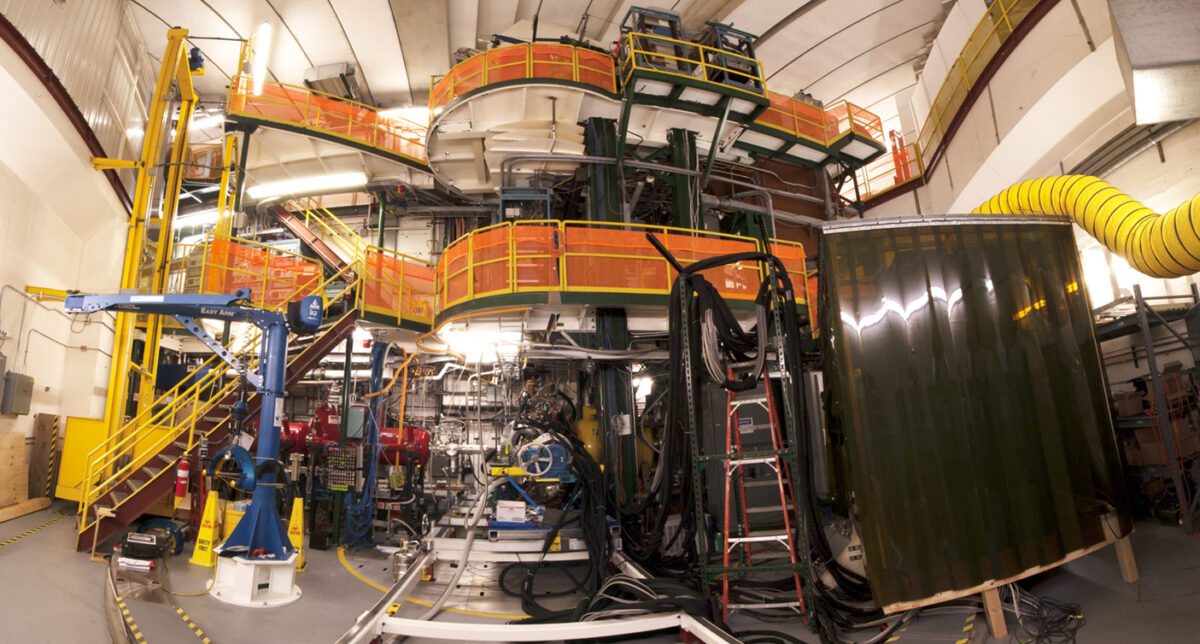 The research team will run a novel experiment on the S800 Spectrograph at the Facility for Rare Ion Beams at Michigan State University. They expect the results to increase understanding of the chemical makeup of the Milky Way galaxy. (Courtesy of FRIB)
In early June, Ghosh and her collaborators led the Facility for Rare Isotope Beams (FRIB) at Michigan State University to study, for the first time ever, how chromium-52 breaks apart when it interacts with hydrogen. Chromium-52 is of particular interest because it can shed light on processes happening in our galaxy, and yet it has never been measured before. Using a high-energy beam of this stable form of chromium, the team will record “proton spallation cross sections”—measures of the likelihood of violent interactions between protons and heavy ions. The experiment essentially recreates inside a Michigan laboratory what’s happening to cosmic rays in space, Ghosh says.
“Nuclear data acts as a translator from the data collected by missions like Voyager, converting it into a meaningful understanding of our galaxy,” Ghosh explains.
Mimicking cosmic rays
Current models don’t quite match what telescopes and spacecraft actually observe, especially for elements like chromium, titanium, and vanadium. The differences have puzzled researchers for years. These questions linger because the right kind of experimental data has been extremely laborious and expensive to obtain—until now.
“A sample of chromium-52 the size of a chocolate square can cost around $150,000,” Ghosh notes. So instead of using a large piece of chromium-52, FRIB’s chemists will collide a beam of less-expensive nickel-58 with a carbon target, producing a pure chromium beam—the first time this has ever been achieved.
 Priyarshini Ghosh operates a scanning electron microscope at Kansas State University, where she completed her Ph.D. in nuclear engineering. (Courtesy of Kansas State University)
The team will run the experiment for about 43 hours, collecting data on 50 to 60 different fragments produced as the chromium beam collides with various detectors and breaks apart. Then comes the long work of analysis. The results are expected to sharpen astrophysical models and bring us closer to understanding how elements are created and spread throughout the Milky Way.
“What makes this project exciting is that FRIB lets us reproduce, in a controlled way, a process that naturally happens in the universe: cosmic rays traveling from a dying star through the galaxy,” says Jorge Pereira, FRIB’s magnetic spectrometer operation group leader.
“Arm-wrestling with nature”
This chromium experiment is the first in a program that Ghosh is developing at UMBC dedicated to building a comprehensive proton-spallation cross-section database. Proton-based reactions—like the ones cosmic rays experience with hydrogen—have received little attention, even though they’re crucial for interpreting data from space.
By building a reliable database of these proton cross sections, the team is laying the groundwork that could transform how we read the cosmos. The results will directly support the upcoming TIGERISS mission, set to fly to the International Space Station in 2027. TIGERISS will be the first instrument to measure elements from boron all the way to lead with remarkable precision—and Ghosh’s nuclear data will help scientists make sense of what it sees.
For Ghosh, the thrill lies in the experimental challenge itself.
“This is such a feat of nuclear engineering,” she says. “We’re using detectors to expose the physics in very specific ways—arm-wrestling with nature to get the answers we need.”