The Academic Minute: Caring for kinless older adults

Social, cultural, and scientific advancements have helped people live longer. Not only are people living longer, but they also have fewer children than at any previous time in human history. This shift will present a unique situation where there will be more older adults outnumbering infants and teenagers in about four decades. How will the world take care of this burgeoning population?
Christine A. Mair, associate professor of sociology and gerontology and director of UMBC’s Center for Health, Equity, and Agingin the department of sociology, anthropology, and public health, examines the presence or absence of family and non-family ties. Mair seeks to document how social integration and support (or lack thereof; e.g., “kinlessness”) shape mental health, physical health, end-of-life experiences, and other aspects of well-being especially cross-nationally.
“Many of these older adults will also be unpartnered due to never marrying, divorce, or their eventual widowhood. These three intersecting trends of high longevity, low fertility, and low partnership will culminate to produce a growing population of people who are both unpartnered and childless. This group is sometimes referred to as ‘kinless,’” Mair explains to Lynn Pasquerella, president of the American Association of Colleges and Universities and host of The Academic Minute, a daily show featuring faculty from colleges and universities worldwide speaking about their cutting-edge research.
UMBC’s Academic Minute series
Mair joined six other UMBC scholars this fall in UMBC’s first Academic Minute series, featuring the latest research in media and communication studies; modern languages, linguistics, and intercultural communication; language, literacy, and culture; philosophy; gender, women’s, and sexuality studies; and history. This series is republished on NPR podcasts and Inside Higher Ed.
Learn more about Christine Mair’s research:
Learn more about UMBC’s program in sociology, anthropology, and public health.
]]>
Social, cultural, and scientific advancements have helped people live longer. Not only are people living longer, but they also have fewer children than at any previous time in human history. This...
https://umbc.edu/stories/academic-minute-caring-for-kinless-adults/
https://dev.my.umbc.edu/api/v0/pixel/news/137198/guest@my.umbc.edu/e784c9232a34ad75287dae4823bf9456/api/pixel
cahss
cahssresearch
news
policy-and-society
research
saph
UMBC News
https://dev.my.umbc.edu/groups/umbc-news
https://assets2-dev.my.umbc.edu/system/shared/avatars/groups/000/001/944/2c79aeea85b1abb37f8cf9fbcdc382b0/xsmall.png?1632921809
https://assets4-dev.my.umbc.edu/system/shared/avatars/groups/000/001/944/2c79aeea85b1abb37f8cf9fbcdc382b0/original.png?1632921809
https://assets4-dev.my.umbc.edu/system/shared/avatars/groups/000/001/944/2c79aeea85b1abb37f8cf9fbcdc382b0/xxlarge.png?1632921809
https://assets1-dev.my.umbc.edu/system/shared/avatars/groups/000/001/944/2c79aeea85b1abb37f8cf9fbcdc382b0/xlarge.png?1632921809
https://assets1-dev.my.umbc.edu/system/shared/avatars/groups/000/001/944/2c79aeea85b1abb37f8cf9fbcdc382b0/large.png?1632921809
https://assets1-dev.my.umbc.edu/system/shared/avatars/groups/000/001/944/2c79aeea85b1abb37f8cf9fbcdc382b0/medium.png?1632921809
https://assets4-dev.my.umbc.edu/system/shared/avatars/groups/000/001/944/2c79aeea85b1abb37f8cf9fbcdc382b0/small.png?1632921809
https://assets2-dev.my.umbc.edu/system/shared/avatars/groups/000/001/944/2c79aeea85b1abb37f8cf9fbcdc382b0/xsmall.png?1632921809
https://assets4-dev.my.umbc.edu/system/shared/avatars/groups/000/001/944/2c79aeea85b1abb37f8cf9fbcdc382b0/xxsmall.png?1632921809
UMBC News
0
0
false
Fri, 17 Nov 2023 09:07:11 -0500
The Academic Minute: Challenging misconceptions about queer sexualities in Arab cultures

For centuries, media has portrayed Arab culture as misogynistic and homophobic, leaving little room for the possibility that queer Arab communities exist and thrive. Adding to this sense of erasure is the belief some Arab communities have in thinking that homosexuality is not inherently Arab but something the Western world brought to the Arab world. However, the reality queer Arabs and those in the diaspora live is much more positive and complex.
Mejdulene Bernard Shomali, a queer Palestinian poet and associate professor in the department of gender, women’s, and sexuality studies,wrote the first study of desire that addresses the contemporary cultures and lives of queer Arab women in her book, Between Banat: Queer Arab Critique and Transnational Arab Archives (Duke University Press, 2023).
“My research looks at how Arab people experience and narrate their queerness in unexpected ways. For example, Arabs may be in same-sex relationships but might not claim gay or lesbian identities,” Shomali explains to Lynn Pasquerella, president of the American Association of Colleges and Universities and host of The Academic Minute, a daily show featuring faculty from colleges and universities worldwide speaking about their cutting-edge research. “Many queer Arabs might not check off Western benchmarks of LGBT identity, like being ‘out.’ Some of the existing Arabic terms for queer people have negative connotations and are also not popular.”
UMBC’s Academic Minute series
Shomali joined seven other UMBC scholars this fall in UMBC’s first Academic Minute series, featuring the latest research in media and communication studies; modern languages, linguistics, and intercultural communication; language, literacy, and culture; philosophy; gender, women’s, and sexuality studies; sociology, anthropology, and public health; and history. This series is republished on NPR podcasts and Inside Higher Ed.
Learn more about Mejdulene Bernard Shomali’s research:
- She is currently a 2023-24 Society for the Humanities fellow at Cornell University, where she is working on a project called Palestine Matters: Aesthetics, Embodiment, and Pleasure in Palestine and also teaching a seminar called “Feeling Free: Radical Aesthetics and Political Affects.”
- Her essays on gender and sexuality in transnational Arab culture include:
Learn more about UMBC’s gender, women’s, and sexuality studies.
]]>
For centuries, media has portrayed Arab culture as misogynistic and homophobic, leaving little room for the possibility that queer Arab communities exist and thrive. Adding to this sense of...
https://umbc.edu/stories/the-academic-minute-queer-arab-sexualities/
https://dev.my.umbc.edu/api/v0/pixel/news/137199/guest@my.umbc.edu/7d1781415f598bed477a3f580163433c/api/pixel
cahss
cahssresearch
gwss
magazine
news
policy-and-society
research
UMBC News
https://dev.my.umbc.edu/groups/umbc-news
https://assets2-dev.my.umbc.edu/system/shared/avatars/groups/000/001/944/2c79aeea85b1abb37f8cf9fbcdc382b0/xsmall.png?1632921809
https://assets4-dev.my.umbc.edu/system/shared/avatars/groups/000/001/944/2c79aeea85b1abb37f8cf9fbcdc382b0/original.png?1632921809
https://assets4-dev.my.umbc.edu/system/shared/avatars/groups/000/001/944/2c79aeea85b1abb37f8cf9fbcdc382b0/xxlarge.png?1632921809
https://assets1-dev.my.umbc.edu/system/shared/avatars/groups/000/001/944/2c79aeea85b1abb37f8cf9fbcdc382b0/xlarge.png?1632921809
https://assets1-dev.my.umbc.edu/system/shared/avatars/groups/000/001/944/2c79aeea85b1abb37f8cf9fbcdc382b0/large.png?1632921809
https://assets1-dev.my.umbc.edu/system/shared/avatars/groups/000/001/944/2c79aeea85b1abb37f8cf9fbcdc382b0/medium.png?1632921809
https://assets4-dev.my.umbc.edu/system/shared/avatars/groups/000/001/944/2c79aeea85b1abb37f8cf9fbcdc382b0/small.png?1632921809
https://assets2-dev.my.umbc.edu/system/shared/avatars/groups/000/001/944/2c79aeea85b1abb37f8cf9fbcdc382b0/xsmall.png?1632921809
https://assets4-dev.my.umbc.edu/system/shared/avatars/groups/000/001/944/2c79aeea85b1abb37f8cf9fbcdc382b0/xxsmall.png?1632921809
UMBC News
0
0
false
Wed, 15 Nov 2023 15:05:14 -0500
Study finds strongest evidence yet for local sources of cosmic ray electrons

A new study using data from the CALorimetric Electron Telescope (CALET)instrument on the International Space Station has found evidence for nearby, young sources of cosmic ray electrons, contributing to a greater understanding of how the galaxy functions as a whole.
The study included more than seven million data points representing particles arriving at CALET’s detector since 2015, and CALET’s ability to detect electrons at the highest energies is unique. As a result, the data includes more electrons at high energies than any previous work. That makes the statistical analysis of the data more robust and lends support to the conclusion that there are one or more local sources of cosmic ray electrons.
“This is one of the primary things that CALET is made to look for,” says Nicholas Cannady, an assistant research scientist with UMBC’s Center for Space Sciences and Technology, a partnership with NASA Goddard Space Flight Center, and a leader on the study. With this paper, he adds, “We were really able to push into the realm where we have few events and start to look for things at the highest energies, which is exciting.”
A better understanding of the galaxy
 Nicholas Cannady, the lead U.S. scientist on the new study, is excited that the CALET mission is bearing fruitful results. (Image courtesy of Cannady)
Current theory posits that the aftermath of supernovae (exploding stars), called supernova remnants, produce these high energy electrons, which are a specific type of cosmic ray. Electrons lose energy very quickly after leaving their source, so the rare electrons arriving at CALET with high energy are believed to originate in supernova remnants that are relatively nearby (on a cosmic scale), Cannady explains.
The study’s results are “a strong indicator that the paradigm that we have for understanding these high-energy electrons—that they come from supernova remnants and that they are accelerated the way that we think they are—is correct,” Cannady says. The findings “give insight into what’s going on in these supernova remnants, and offer a way to understand the galaxy and these sources in the galaxy better.”
CALET is a collaborative project built and operated by groups in Japan, Italy, and the United States, led by Shoji Torii. The lead contributors to this work in Japan are Torii, Yosui Akaike, and Holger Motz at Waseda University in Tokyo, and Louisiana State University is the lead institution in the U.S. The findings were published in Physical Review Letters.
New data lead to new cosmic ray sources
Previous work found that the number of electrons arriving at CALET decreased steadily as energy increased up to about 1 teravolt (TeV), or 1 trillion electron volts. The number of electrons arriving with even greater energy was extremely low. But in this study, CALET did not see the expected dropoff. Instead, the results suggest that the number of particles plateau, and then even increase, at the highest energies—all the way up to 10 TeV in a few cases.
Previous experiments could only measure particles up to about 4 TeV, so the highest energy event candidates above that in this study are a crucial new source of information about potential nearby sources of cosmic ray electrons. Cannady led the effort to individually analyze each of those events to confirm they represent a real signal, and a deeper dive into those events is forthcoming.
Addressing challenges
It’s difficult to distinguish between electrons and protons at high energies, and there are many more protons arriving than electrons, which poses challenges to an accurate analysis. To tell the particles apart, a program developed by the researchers analyzes how the particles break down when they hit the detector. Protons and electrons break down differently, so comparing the cascade of particles they create in that process can filter out the protons. However, at the highest energies, the differences between protons and electrons decrease, making it harder to accurately remove only the protons from the data.
To address this, Cannady led the CALET team’s effort to simulate the breakdown patterns of both protons and electrons coming from the exact direction each of the high-energy events arrived from. That increased the team’s ability to determine whether the events are electrons or protons as accurately as possible.
Based on that work, “We believe we are evaluating the likelihood of events being protons in a realistic fashion,” Cannady says. Enough presumed electrons remain in the dataset after that careful analysis to conclude there is a real signal.
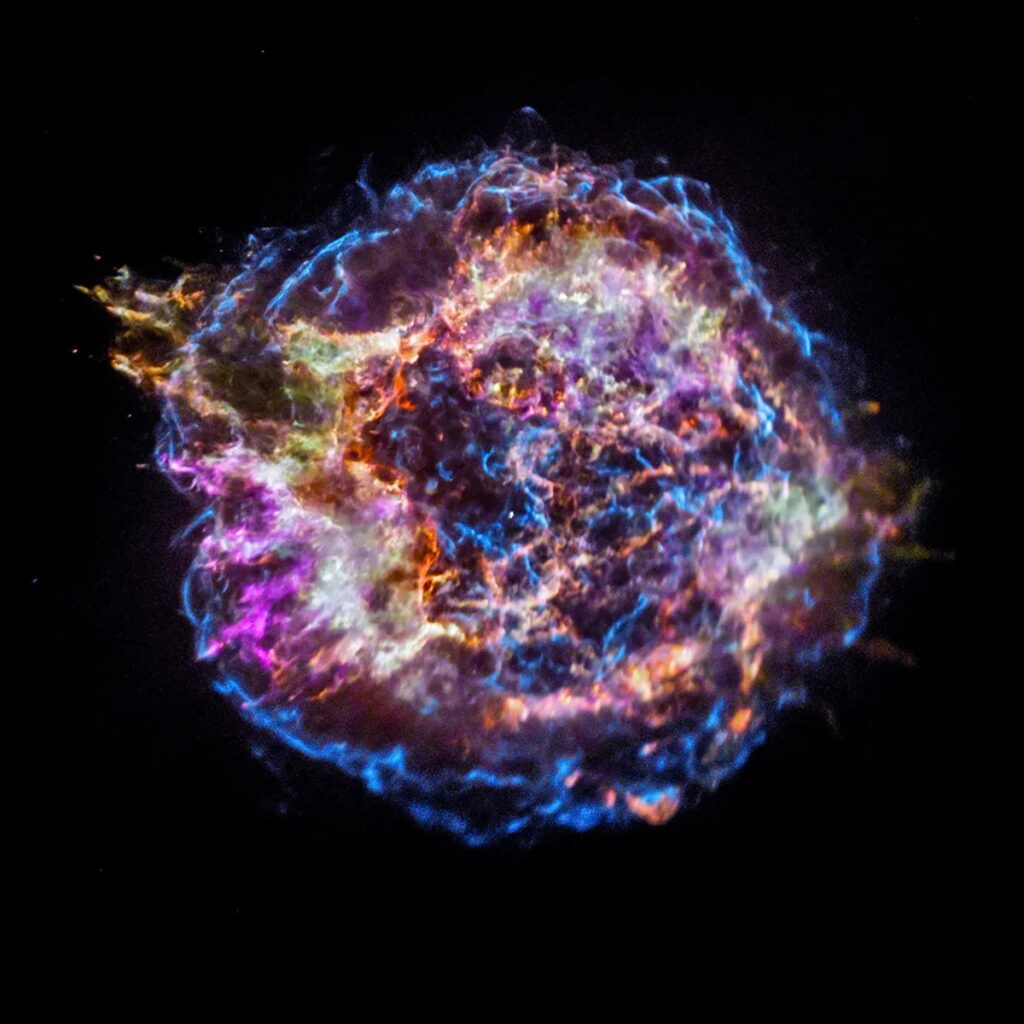 An x-ray image of Cassiopeia A, an example of a young supernova remnant. (Image courtesy of NASA)
Pushing boundaries
T. Gregory Guzik, professor of physics at LSU and the U.S. CALET collaboration lead, is excited that further analysis of the data suggested that electrons coming from the three best candidates for nearby supernova remnants can explain the high-energy arrivals.
“These CALET observations open the tantalizing possibility that matter from a particular nearby supernova remnant can be measured at Earth,” Guzik shares. “Continued CALET measurement through the life of the International Space Station will help shed new light on the origin and transport of relativistic matter in our galaxy.”
For Cannady, “The most exciting part is seeing things at the highest energies. We have some candidates above 10 TeV—and if it is borne out that these are real electron events, it’s really a smoking gun for clear evidence of a nearby source,” he says. “This is essentially what CALET was put up to do, so it’s exciting to be working on this and to finally be getting results that are pushing the bounds of what we’ve seen before.”
]]>
A new study using data from the CALorimetric Electron Telescope (CALET)instrument on the International Space Station has found evidence for nearby, young sources of cosmic ray electrons,...
https://umbc.edu/stories/calet-detects-high-energy-cosmic-ray-electrons/
https://dev.my.umbc.edu/api/v0/pixel/news/137202/guest@my.umbc.edu/bae1852ae8f6168160dedadc8bbe6128/api/pixel
csst
news
research
science-and-tech
UMBC News
https://dev.my.umbc.edu/groups/umbc-news
https://assets2-dev.my.umbc.edu/system/shared/avatars/groups/000/001/944/2c79aeea85b1abb37f8cf9fbcdc382b0/xsmall.png?1632921809
https://assets4-dev.my.umbc.edu/system/shared/avatars/groups/000/001/944/2c79aeea85b1abb37f8cf9fbcdc382b0/original.png?1632921809
https://assets4-dev.my.umbc.edu/system/shared/avatars/groups/000/001/944/2c79aeea85b1abb37f8cf9fbcdc382b0/xxlarge.png?1632921809
https://assets1-dev.my.umbc.edu/system/shared/avatars/groups/000/001/944/2c79aeea85b1abb37f8cf9fbcdc382b0/xlarge.png?1632921809
https://assets1-dev.my.umbc.edu/system/shared/avatars/groups/000/001/944/2c79aeea85b1abb37f8cf9fbcdc382b0/large.png?1632921809
https://assets1-dev.my.umbc.edu/system/shared/avatars/groups/000/001/944/2c79aeea85b1abb37f8cf9fbcdc382b0/medium.png?1632921809
https://assets4-dev.my.umbc.edu/system/shared/avatars/groups/000/001/944/2c79aeea85b1abb37f8cf9fbcdc382b0/small.png?1632921809
https://assets2-dev.my.umbc.edu/system/shared/avatars/groups/000/001/944/2c79aeea85b1abb37f8cf9fbcdc382b0/xsmall.png?1632921809
https://assets4-dev.my.umbc.edu/system/shared/avatars/groups/000/001/944/2c79aeea85b1abb37f8cf9fbcdc382b0/xxsmall.png?1632921809
UMBC News
0
0
false
Tue, 14 Nov 2023 11:50:52 -0500
GRIT-X 2023 explores wide range of UMBC’s research and creative achievement around campus and beyond
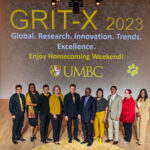
Spiders, robots, climate change, Vaudevillian history, and more—this year’s GRIT-X event had something for inquiring minds of all kinds, with explorations into elements of the past, our collective present, and possibilities for the future.
Back for its seventh year, GRIT-X returned to the Fine Arts Recital Hall during Homecoming 2023 with presentations from faculty and accomplished alumni addressing some of the most pressing issues facing society now and throughout history, and how UMBC scholars are working to build a better tomorrow.
“The goal of GRIT-X is to provide a sneak peek behind the scenes of some of the exciting and impactful research and creative achievement initiatives across our campus community,” says Karl V. Steiner, UMBC’s vice president of research and creative achievement. “[GRIT-X] takes you around the whole campus and beyond.”
Watch the GRIT-X 2023 talks.
“Disruptive” and intercultural thinking in the workforce
GRIT-X 2023 showcased how UMBC alumni are working to fuel innovation within the workforce and how faculty are strengthening the employability of future graduates. Melanie Harrison Okokoro, Ph.D. ’11, environmental science, opened this year’s GRIT-X with her discussion on how “bold and disruptive thinking” can help executives to lead, innovate, and transform their companies in the 21st century. Okokoro is the co-founder and CEO of Eco-Alpha, a firm that provides environmental compliance services and engineering workforce development training. Her talk outlined how leaders can create “disruptive strategies” in order to stay at the forefront of changes happening in their industries.
“Disruptive thinking is in my DNA,” said Okokoro during her presentation. “It defines how [Eco-Alpha] outcompetes our competitors in the marketplace and allows us to target a segment of the population that’s been traditionally overlooked.”
 Melanie Harrison Okokoro presenting her GRIT-X 2023 talk entitled “Disruptive Thinking: A Bold Business Strategy to Change How We Lead, Innovate, and Transform Companies in the 21st Century.”
Similarly to Okokoro, Zhensen Huang, M.S. ’00, Ph.D. ’04, information systems, used bold thinking to propel himself forward in his current career as CEO and founder of Precise Software Solutions, a firm that helps government and private sector clients modernize their IT systems. Huang spoke of his student experience at UMBC after emigrating to the U.S. from a small rural village in China—a future he says he didn’t think was possible when growing up. He shared how UMBC helped even when “It’s hard for us to make a connection between what we’re doing now to the great possibilities down the road,” says Huang.
“Embrace the present and envision the future,” Huang shared during his talk. “Sometimes you don’t know what your future possibilities are, and that’s okay. What’s important is to embrace what’s in front of you, especially the challenges.”
 Zhensen Huang
 Irina Golubeva
Irina Golubeva, professor and director of UMBC’s intercultural communication graduate program, is working to address some of those challenges students face, such as navigating culturally-diverse environments. Her GRIT-X presentation focused on her research on intercultural learning, which includes the InterEqual training program she created based on student feedback. Golubeva shared how she’s helping UMBC students develop their intercultural competence as they prepare for their professional careers.
“We cannot ignore and disregard these tendencies of job markets, and we must prepare our students to work and live in multicultural societies by equipping them with essential intercultural and language skills,” says Golubeva.
Investigating earthly phenomena with math and science
Justin Webster, associate professor of mathematics and statistics, explored the “relationship between mathematical models and the phenomena in the world” during his presentation. He highlighted specific examples of how mathematical modeling can deepen our understanding of infrastructure disasters like the Tacoma Narrows Bridge collapse of 1940, and how his mathematical process helped researchers find a possible hypothesis for detecting the onset of glaucoma.
“Mathematical modeling is a scientific empowerment tool. Anyone, anywhere, can do math modeling and study anything that they’re interested in,” says Webster. “That’s why it is so important that our students at UMBC, and students more broadly, are mathematically competent and excited so that they can go on to be students of the world.”
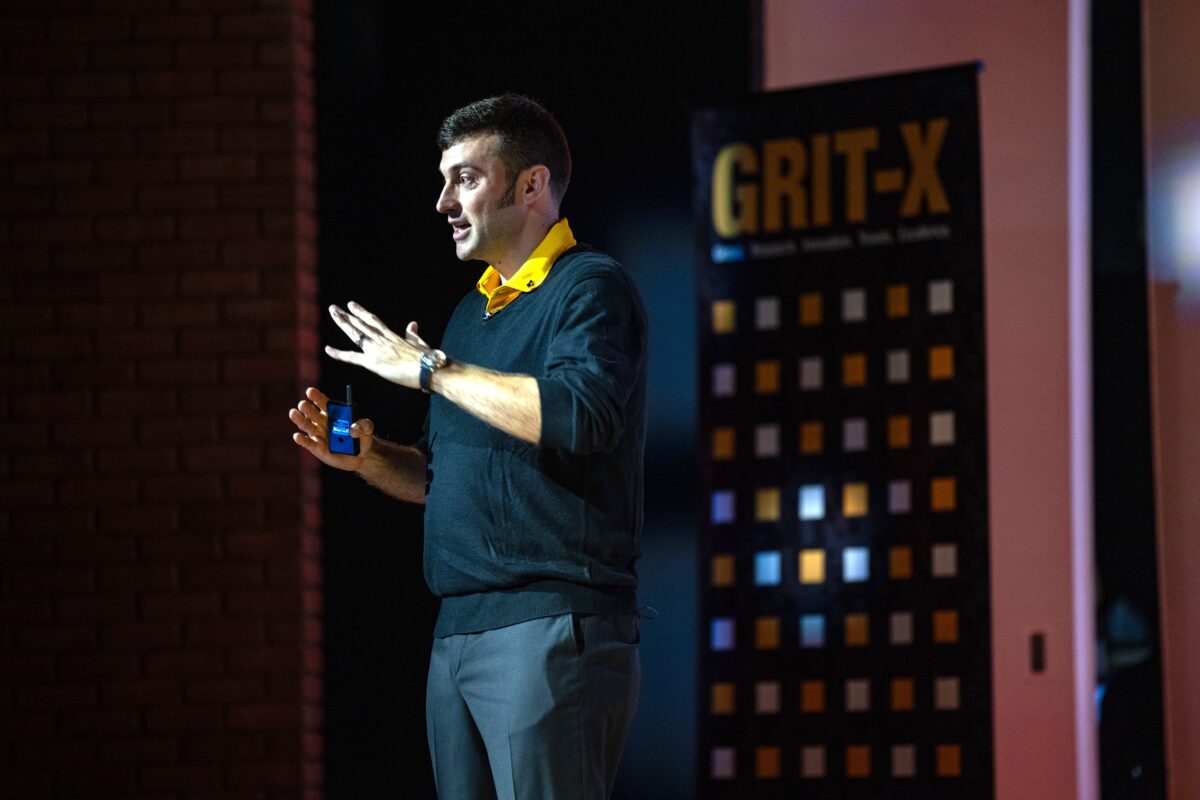 Justin Webster delivering his GRIT-X 2023 talk entitled “The Map is Not the Territory: Tales of Interest in Nonlinear Elasticity.”
Charles Ichoku, director of the UMBC-led Goddard Earth Science Technology and Research (GESTAR) Center II, also explored a phenomena that’s causing global concern—how rapidly the Earth is changing. Ichoku explained in his GRIT-X talk how climate change, people, and wildfire emissions are contributing to those changes to the Earth and the work he’s done with NASA’s Fire Energetics and Emissions Research project to understand causes of climate change.
“The world is warming dangerously, and human activities are driving the warming trend through the emission of heat-trapping long-lived greenhouse gasses (GHGs), particularly carbon dioxide (CO2), which has continued its upward trend over the last several decades. Wildfires are [also] contributing significantly to that,” shared Ichoku.
 Charles Ichoku
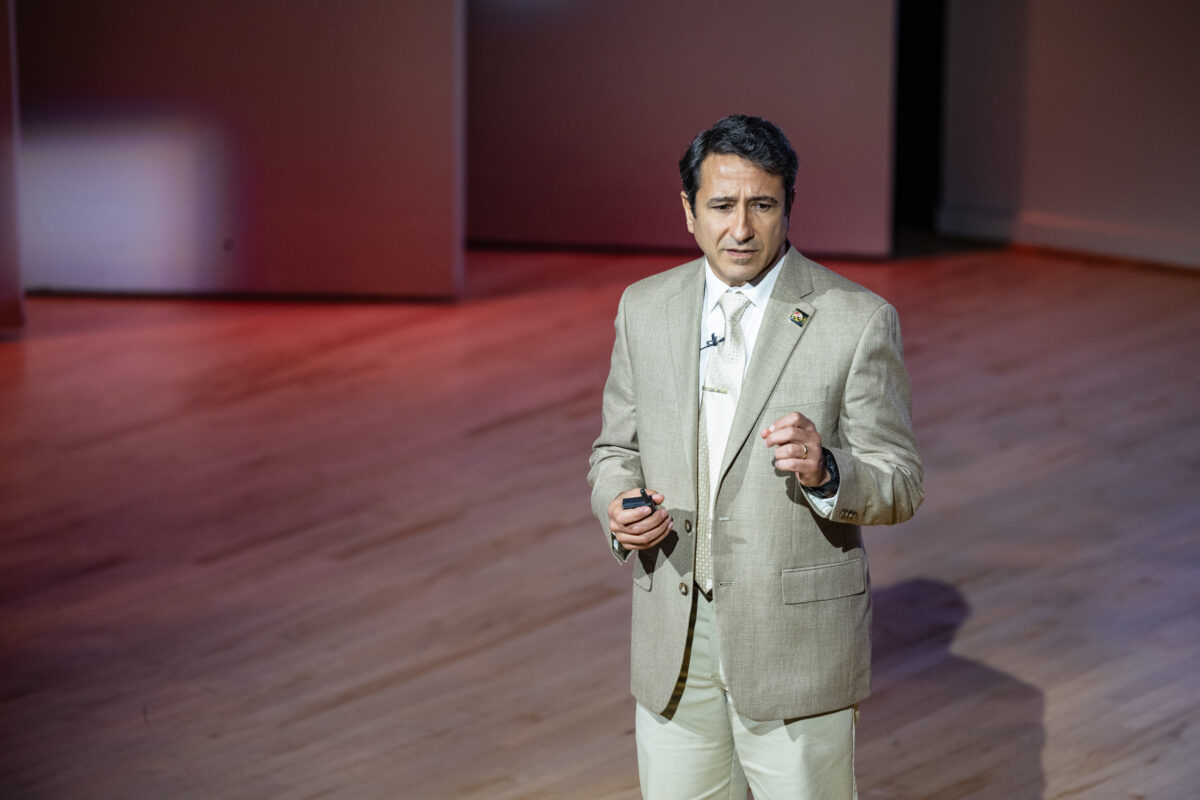 Carlos Romero-Talamás
Similarly, Carlos Romero-Talamás, associate professor of mechanical engineering, explained in his presentation how most sources of energy produce carbon and GHGs, and the work that’s being done to bring the global energy-related CO2 emission levels down to net zero. He discussed the benefits of using fusion energy to achieve that goal, which includes the work he’s doing as the principal investigator of the Centrifugal Mirror Fusion Experiment, a research effort between UMBC and the University of Maryland, College Park that explores a promising alternative to traditional fusion power approaches.
“Fusion energy is considered the ultimate source of energy—the fuel is abundant and is non radioactive,” says Romero-Talamás. “It is urgent to decarbonize our economy and our energy infrastructure because we are harming the planet [and] are running towards a climate disaster.”
Past histories and future possibilities
Michelle R. Scott, associate professor of history, brought the GRIT-X audience back to a moment in time in which Black Vaudeville performers used economic empowerment as a form of resistance in the 1920s. Scott explained her research into the institutional history of the Theater Owners’ Booking Association’s (T.O.B.A.) origins, which she wrote about in her book T.O.B.A. Time: Black Vaudeville and the Theater Owners’ Booking Association in Jazz Age America(University of Illinois Press, 2023).
“The [Vaudeville] circuit itself—its success—was a testament to Black excellence in terms of business, Black artistic skill, and a momentary period of interracial cooperation. It was truly an example of Jazz-age resistance,” Scott said during her presentation.
 Michelle R. Scott delivering her GRIT-X 2023 talk entitled “Jazz Age Resistance: Economic Empowerment and Entertainment in a Divided Nation.”
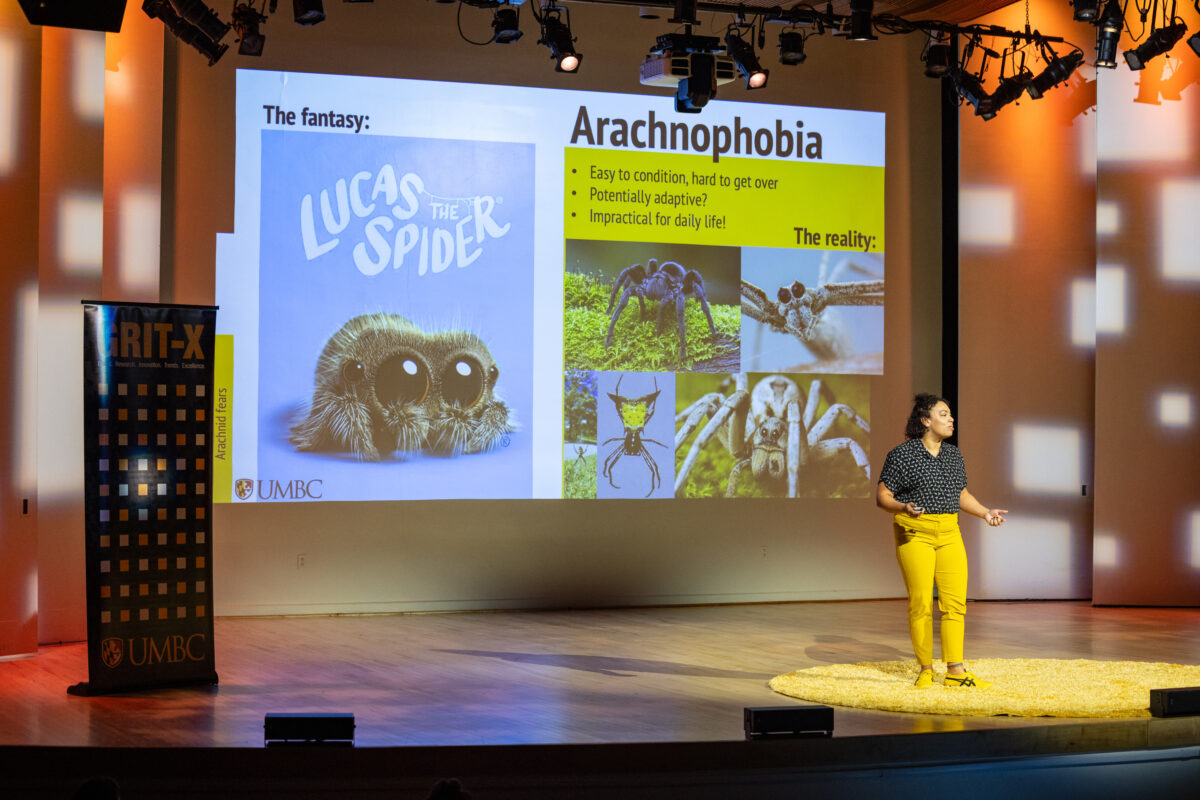
Mercedes Burns, assistant professor of biological sciences, explained a different kind of history—the history of arachnids. Burns, who received an NSF CAREER Award earlier this year, enlightened the audience with her research on spiders, opiliones (commonly known as daddy longlegs), and other kinds of arachnids. She outlined reasons why we should appreciate these “unloveable” creatures.
“Spiders have been living their lives for much longer than any vertebrate has —they’ve persisted over a millennia,” Burns explained in her GRIT-X talk. “Arachnids…thoughtfully consume unloveable things in our habitats. Arachnids are [also] quite attentive to their environment. They are master architects and material scientists. If you’re curious about the organisms that surround you and you’re interested in learning more or appreciating what those organisms do for the environment and their ecosystem, that leaves no room for fear.”
As a result of her being the first known female African American arachnologist, Burns had a species of trapdoor spiders named after her in 2021, called Ummidia mercedesburnsae. She reflected on the accomplishment, saying “Having experienced that honor of being the matranim of a described species really underscores the legacy that I want to leave.”
 Mercedes Burns
 Cynthia Matuszek
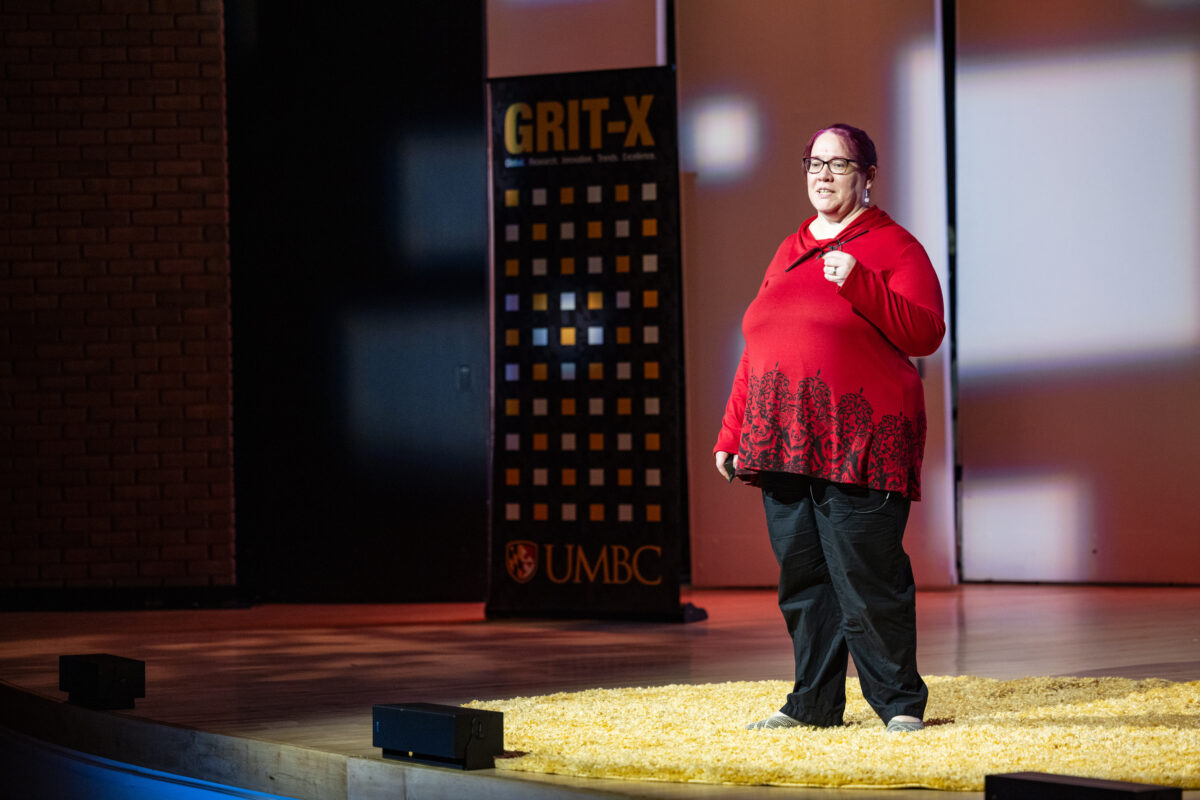
Fellow UMBC NSF CAREER Award recipient Cynthia Matuszek, assistant professor of computer science and electrical engineering, brought the GRIT-X audience into the future with her presentation on the possibilities of human-robot interaction. Matuszek explained how humans and robots can interact and exist in the same space and how robots can be more useful.
Her work in UMBC’s Interactive Robotics and Language Lab focuses on using grounded language—which refers to language that has meaning in and pertains to the physical world—as a tool to build robots that can perform tasks in real-world environments, instead of being programmed to handle a fixed set of predetermined tasks.
“In order to have robots that are useful in human spaces, we need robots that are flexible and capable of interacting in a variety of contexts,” Matuszek explained in her presentation. “When people use language, we don’t just use words. We use gestures, we point to things, we look at things, and we use body language. Useful language learning for robots needs to take all of these factors into account.”
Learn more about GRIT-X 2023, past speakers, and their research.
]]>
Spiders, robots, climate change, Vaudevillian history, and more—this year’s GRIT-X event had something for inquiring minds of all kinds, with explorations into elements of the past, our collective...
https://umbc.edu/stories/grit-x-2023/
https://dev.my.umbc.edu/api/v0/pixel/news/137207/guest@my.umbc.edu/4025cea26eeba9ab900d50e091ffc264/api/pixel
cahss
cnms
coeit
community
grit-x
news
rca-1
research
science-and-tech
UMBC News
https://dev.my.umbc.edu/groups/umbc-news
https://assets2-dev.my.umbc.edu/system/shared/avatars/groups/000/001/944/2c79aeea85b1abb37f8cf9fbcdc382b0/xsmall.png?1632921809
https://assets4-dev.my.umbc.edu/system/shared/avatars/groups/000/001/944/2c79aeea85b1abb37f8cf9fbcdc382b0/original.png?1632921809
https://assets4-dev.my.umbc.edu/system/shared/avatars/groups/000/001/944/2c79aeea85b1abb37f8cf9fbcdc382b0/xxlarge.png?1632921809
https://assets1-dev.my.umbc.edu/system/shared/avatars/groups/000/001/944/2c79aeea85b1abb37f8cf9fbcdc382b0/xlarge.png?1632921809
https://assets1-dev.my.umbc.edu/system/shared/avatars/groups/000/001/944/2c79aeea85b1abb37f8cf9fbcdc382b0/large.png?1632921809
https://assets1-dev.my.umbc.edu/system/shared/avatars/groups/000/001/944/2c79aeea85b1abb37f8cf9fbcdc382b0/medium.png?1632921809
https://assets4-dev.my.umbc.edu/system/shared/avatars/groups/000/001/944/2c79aeea85b1abb37f8cf9fbcdc382b0/small.png?1632921809
https://assets2-dev.my.umbc.edu/system/shared/avatars/groups/000/001/944/2c79aeea85b1abb37f8cf9fbcdc382b0/xsmall.png?1632921809
https://assets4-dev.my.umbc.edu/system/shared/avatars/groups/000/001/944/2c79aeea85b1abb37f8cf9fbcdc382b0/xxsmall.png?1632921809
UMBC News
0
0
false
Tue, 07 Nov 2023 16:53:48 -0500
Four tips from UMBC faculty on what to do and see at Undergraduate Research and Creative Achievement Day
UMBC’s annual Undergraduate Research and Creative Achievement Day—known on campus as URCAD—has long been a must-see event. It’s a chance for community members to get a glimpse of what students have dedicated hours to exploring and creating throughout the year.
]]>
UMBC’s annual Undergraduate Research and Creative Achievement Day—known on campus as URCAD—has long been a must-see event. It’s a chance for community members to get a glimpse of what students...
https://news.umbc.edu/four-tips-from-umbc-faculty-on-what-to-do-and-see-at-undergraduate-research-and-creative-achievement-day/
https://dev.my.umbc.edu/api/v0/pixel/news/118699/guest@my.umbc.edu/045bbdbdde94261e99dfc12626db7fa9/api/pixel
arts-and-culture
cahss
cnms
coeit
research
science-and-technology
urcad
UMBC News
https://dev.my.umbc.edu/groups/umbc-news
https://assets2-dev.my.umbc.edu/system/shared/avatars/groups/000/001/944/2c79aeea85b1abb37f8cf9fbcdc382b0/xsmall.png?1632921809
https://assets4-dev.my.umbc.edu/system/shared/avatars/groups/000/001/944/2c79aeea85b1abb37f8cf9fbcdc382b0/original.png?1632921809
https://assets4-dev.my.umbc.edu/system/shared/avatars/groups/000/001/944/2c79aeea85b1abb37f8cf9fbcdc382b0/xxlarge.png?1632921809
https://assets1-dev.my.umbc.edu/system/shared/avatars/groups/000/001/944/2c79aeea85b1abb37f8cf9fbcdc382b0/xlarge.png?1632921809
https://assets1-dev.my.umbc.edu/system/shared/avatars/groups/000/001/944/2c79aeea85b1abb37f8cf9fbcdc382b0/large.png?1632921809
https://assets1-dev.my.umbc.edu/system/shared/avatars/groups/000/001/944/2c79aeea85b1abb37f8cf9fbcdc382b0/medium.png?1632921809
https://assets4-dev.my.umbc.edu/system/shared/avatars/groups/000/001/944/2c79aeea85b1abb37f8cf9fbcdc382b0/small.png?1632921809
https://assets2-dev.my.umbc.edu/system/shared/avatars/groups/000/001/944/2c79aeea85b1abb37f8cf9fbcdc382b0/xsmall.png?1632921809
https://assets4-dev.my.umbc.edu/system/shared/avatars/groups/000/001/944/2c79aeea85b1abb37f8cf9fbcdc382b0/xxsmall.png?1632921809
UMBC News
0
0
false
Mon, 18 Apr 2022 16:45:15 -0400
Mon, 18 Apr 2022 16:45:15 -0400
Undefining life: UMBC’s Stephen Freeland offers fresh perspective on life’s origins
What if no single moment in time pinpoints when life began on Earth? Perhaps, rather than identifying a single point where life began, “it all traces back in a seamless ad infinitum progression,” Steve Freeland says. “That’s a very different way of thinking about the universe.”
]]>
What if no single moment in time pinpoints when life began on Earth? Perhaps, rather than identifying a single point where life began, “it all traces back in a seamless ad infinitum progression,”...
https://news.umbc.edu/undefining-life-umbcs-stephen-freeland-offers-fresh-perspective-on-lifes-origins/
https://dev.my.umbc.edu/api/v0/pixel/news/118561/guest@my.umbc.edu/36126dfcfaf93259052d2b51d6ff96c4/api/pixel
inds
research
science-and-technology
UMBC News
https://dev.my.umbc.edu/groups/umbc-news
https://assets2-dev.my.umbc.edu/system/shared/avatars/groups/000/001/944/2c79aeea85b1abb37f8cf9fbcdc382b0/xsmall.png?1632921809
https://assets4-dev.my.umbc.edu/system/shared/avatars/groups/000/001/944/2c79aeea85b1abb37f8cf9fbcdc382b0/original.png?1632921809
https://assets4-dev.my.umbc.edu/system/shared/avatars/groups/000/001/944/2c79aeea85b1abb37f8cf9fbcdc382b0/xxlarge.png?1632921809
https://assets1-dev.my.umbc.edu/system/shared/avatars/groups/000/001/944/2c79aeea85b1abb37f8cf9fbcdc382b0/xlarge.png?1632921809
https://assets1-dev.my.umbc.edu/system/shared/avatars/groups/000/001/944/2c79aeea85b1abb37f8cf9fbcdc382b0/large.png?1632921809
https://assets1-dev.my.umbc.edu/system/shared/avatars/groups/000/001/944/2c79aeea85b1abb37f8cf9fbcdc382b0/medium.png?1632921809
https://assets4-dev.my.umbc.edu/system/shared/avatars/groups/000/001/944/2c79aeea85b1abb37f8cf9fbcdc382b0/small.png?1632921809
https://assets2-dev.my.umbc.edu/system/shared/avatars/groups/000/001/944/2c79aeea85b1abb37f8cf9fbcdc382b0/xsmall.png?1632921809
https://assets4-dev.my.umbc.edu/system/shared/avatars/groups/000/001/944/2c79aeea85b1abb37f8cf9fbcdc382b0/xxsmall.png?1632921809
UMBC News
0
0
false
Thu, 14 Apr 2022 12:20:22 -0400
UMBC researchers discover genes linked to medication response, laying foundation for precision medicine
A new study that tested thousands of fruit flies may eventually give doctors the ability to make better-informed decisions about which medications to prescribe for older adults. “Our genetics matters,” says Mariann Gabrawy. “Humans don’t all react the same to various prescription medications. So it’s really important to be able to look at an individual patient and figure out if some particular medication is going to work for them or not.”
]]>
A new study that tested thousands of fruit flies may eventually give doctors the ability to make better-informed decisions about which medications to prescribe for older adults. “Our genetics...
https://news.umbc.edu/umbc-researchers-discover-genes-linked-to-medication-response-laying-foundation-for-precision-medicine/
https://dev.my.umbc.edu/api/v0/pixel/news/118320/guest@my.umbc.edu/bf4434574bf03014ce94313b9c716df3/api/pixel
alumni
biology
cnms
gradresearch
research
science-and-technology
UMBC News
https://dev.my.umbc.edu/groups/umbc-news
https://assets2-dev.my.umbc.edu/system/shared/avatars/groups/000/001/944/2c79aeea85b1abb37f8cf9fbcdc382b0/xsmall.png?1632921809
https://assets4-dev.my.umbc.edu/system/shared/avatars/groups/000/001/944/2c79aeea85b1abb37f8cf9fbcdc382b0/original.png?1632921809
https://assets4-dev.my.umbc.edu/system/shared/avatars/groups/000/001/944/2c79aeea85b1abb37f8cf9fbcdc382b0/xxlarge.png?1632921809
https://assets1-dev.my.umbc.edu/system/shared/avatars/groups/000/001/944/2c79aeea85b1abb37f8cf9fbcdc382b0/xlarge.png?1632921809
https://assets1-dev.my.umbc.edu/system/shared/avatars/groups/000/001/944/2c79aeea85b1abb37f8cf9fbcdc382b0/large.png?1632921809
https://assets1-dev.my.umbc.edu/system/shared/avatars/groups/000/001/944/2c79aeea85b1abb37f8cf9fbcdc382b0/medium.png?1632921809
https://assets4-dev.my.umbc.edu/system/shared/avatars/groups/000/001/944/2c79aeea85b1abb37f8cf9fbcdc382b0/small.png?1632921809
https://assets2-dev.my.umbc.edu/system/shared/avatars/groups/000/001/944/2c79aeea85b1abb37f8cf9fbcdc382b0/xsmall.png?1632921809
https://assets4-dev.my.umbc.edu/system/shared/avatars/groups/000/001/944/2c79aeea85b1abb37f8cf9fbcdc382b0/xxsmall.png?1632921809
UMBC News
0
0
false
Thu, 07 Apr 2022 15:03:03 -0400
UMBC’s Deepa Madan develops bendable zinc-based batteries
Rechargeable alkaline batteries are readily available at many stores and pharmacies, but they are rigid and cannot be used in slim or small devices that require batteries. Deepa Madan, assistant professor of mechanical engineering, and her research team are working to develop zinc-chitosan gel-based batteries that are enclosed in flexible plastic. This would revolutionize how consumers power devices they use every day.
]]>
Rechargeable alkaline batteries are readily available at many stores and pharmacies, but they are rigid and cannot be used in slim or small devices that require batteries. Deepa Madan, assistant...
https://news.umbc.edu/umbcs-deepa-madan-develops-bendable-zinc-based-batteries/
https://dev.my.umbc.edu/api/v0/pixel/news/117548/guest@my.umbc.edu/40de941152a580b18ebb119e96bb22a9/api/pixel
coeit
meche
page1
research
science-and-technology
UMBC News
https://dev.my.umbc.edu/groups/umbc-news
https://assets2-dev.my.umbc.edu/system/shared/avatars/groups/000/001/944/2c79aeea85b1abb37f8cf9fbcdc382b0/xsmall.png?1632921809
https://assets4-dev.my.umbc.edu/system/shared/avatars/groups/000/001/944/2c79aeea85b1abb37f8cf9fbcdc382b0/original.png?1632921809
https://assets4-dev.my.umbc.edu/system/shared/avatars/groups/000/001/944/2c79aeea85b1abb37f8cf9fbcdc382b0/xxlarge.png?1632921809
https://assets1-dev.my.umbc.edu/system/shared/avatars/groups/000/001/944/2c79aeea85b1abb37f8cf9fbcdc382b0/xlarge.png?1632921809
https://assets1-dev.my.umbc.edu/system/shared/avatars/groups/000/001/944/2c79aeea85b1abb37f8cf9fbcdc382b0/large.png?1632921809
https://assets1-dev.my.umbc.edu/system/shared/avatars/groups/000/001/944/2c79aeea85b1abb37f8cf9fbcdc382b0/medium.png?1632921809
https://assets4-dev.my.umbc.edu/system/shared/avatars/groups/000/001/944/2c79aeea85b1abb37f8cf9fbcdc382b0/small.png?1632921809
https://assets2-dev.my.umbc.edu/system/shared/avatars/groups/000/001/944/2c79aeea85b1abb37f8cf9fbcdc382b0/xsmall.png?1632921809
https://assets4-dev.my.umbc.edu/system/shared/avatars/groups/000/001/944/2c79aeea85b1abb37f8cf9fbcdc382b0/xxsmall.png?1632921809
UMBC News
0
0
false
Wed, 09 Mar 2022 08:40:45 -0500
Ten million reads: UMBC researchers hit milestone in sharing knowledge through The Conversation
Articles on The Conversation offer context to current events, explain natural phenomena, introduce new research in an accessible way, and more. “The Conversation helps us contribute to our public service mission as a public university,” says Vice President for Research Karl Steiner. “This milestone underscores the importance of academic researchers actively participating in the public discourse of complex issues."
]]>
Articles on The Conversation offer context to current events, explain natural phenomena, introduce new research in an accessible way, and more. “The Conversation helps us contribute to our public...
https://news.umbc.edu/ten-million-reads-umbc-researchers-hit-milestone-in-sharing-knowledge-through-the-conversation/
https://dev.my.umbc.edu/api/v0/pixel/news/117507/guest@my.umbc.edu/829daaa4ca1554b1c6d0d972770c705f/api/pixel
biology
cahss
chembiochem
cnms
coeit
community
csee
cybersecurity
is
page1
physics
psychology
publicpolicy
research
visualarts
UMBC News
https://dev.my.umbc.edu/groups/umbc-news
https://assets2-dev.my.umbc.edu/system/shared/avatars/groups/000/001/944/2c79aeea85b1abb37f8cf9fbcdc382b0/xsmall.png?1632921809
https://assets4-dev.my.umbc.edu/system/shared/avatars/groups/000/001/944/2c79aeea85b1abb37f8cf9fbcdc382b0/original.png?1632921809
https://assets4-dev.my.umbc.edu/system/shared/avatars/groups/000/001/944/2c79aeea85b1abb37f8cf9fbcdc382b0/xxlarge.png?1632921809
https://assets1-dev.my.umbc.edu/system/shared/avatars/groups/000/001/944/2c79aeea85b1abb37f8cf9fbcdc382b0/xlarge.png?1632921809
https://assets1-dev.my.umbc.edu/system/shared/avatars/groups/000/001/944/2c79aeea85b1abb37f8cf9fbcdc382b0/large.png?1632921809
https://assets1-dev.my.umbc.edu/system/shared/avatars/groups/000/001/944/2c79aeea85b1abb37f8cf9fbcdc382b0/medium.png?1632921809
https://assets4-dev.my.umbc.edu/system/shared/avatars/groups/000/001/944/2c79aeea85b1abb37f8cf9fbcdc382b0/small.png?1632921809
https://assets2-dev.my.umbc.edu/system/shared/avatars/groups/000/001/944/2c79aeea85b1abb37f8cf9fbcdc382b0/xsmall.png?1632921809
https://assets4-dev.my.umbc.edu/system/shared/avatars/groups/000/001/944/2c79aeea85b1abb37f8cf9fbcdc382b0/xxsmall.png?1632921809
UMBC News
0
0
false
Mon, 07 Mar 2022 16:35:09 -0500
Mon, 07 Mar 2022 16:35:09 -0500
UMBC ascends to the nation’s highest level as a research university
UMBC has officially reached the nation’s highest level of research performance. The Carnegie Classification of Institutions of Higher Education today announced that UMBC has been placed into the category of doctoral universities with very high research activity, popularly known as Research 1 (or R1). “This is an amazing accomplishment by faculty, staff, and administrative leaders who have built a research culture that nurtures undergraduate and graduate students,” says President Freeman Hrabowski. “This milestone reflects our commitment to excellence across the disciplines, from the humanities to the sciences.”
]]>
UMBC has officially reached the nation’s highest level of research performance. The Carnegie Classification of Institutions of Higher Education today announced that UMBC has been placed into the...
https://news.umbc.edu/umbc-ascends-to-the-nations-highest-level-as-a-research-university/
https://dev.my.umbc.edu/api/v0/pixel/news/116523/guest@my.umbc.edu/f9d4e473c2f21d5995e18cb93c03e003/api/pixel
community
gestar2
majoraward
page1
rankings
research
UMBC News
https://dev.my.umbc.edu/groups/umbc-news
https://assets2-dev.my.umbc.edu/system/shared/avatars/groups/000/001/944/2c79aeea85b1abb37f8cf9fbcdc382b0/xsmall.png?1632921809
https://assets4-dev.my.umbc.edu/system/shared/avatars/groups/000/001/944/2c79aeea85b1abb37f8cf9fbcdc382b0/original.png?1632921809
https://assets4-dev.my.umbc.edu/system/shared/avatars/groups/000/001/944/2c79aeea85b1abb37f8cf9fbcdc382b0/xxlarge.png?1632921809
https://assets1-dev.my.umbc.edu/system/shared/avatars/groups/000/001/944/2c79aeea85b1abb37f8cf9fbcdc382b0/xlarge.png?1632921809
https://assets1-dev.my.umbc.edu/system/shared/avatars/groups/000/001/944/2c79aeea85b1abb37f8cf9fbcdc382b0/large.png?1632921809
https://assets1-dev.my.umbc.edu/system/shared/avatars/groups/000/001/944/2c79aeea85b1abb37f8cf9fbcdc382b0/medium.png?1632921809
https://assets4-dev.my.umbc.edu/system/shared/avatars/groups/000/001/944/2c79aeea85b1abb37f8cf9fbcdc382b0/small.png?1632921809
https://assets2-dev.my.umbc.edu/system/shared/avatars/groups/000/001/944/2c79aeea85b1abb37f8cf9fbcdc382b0/xsmall.png?1632921809
https://assets4-dev.my.umbc.edu/system/shared/avatars/groups/000/001/944/2c79aeea85b1abb37f8cf9fbcdc382b0/xxsmall.png?1632921809
UMBC News
4
0
false
Wed, 02 Feb 2022 16:42:29 -0500