How to Build a Ramen Bridge
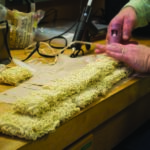
With Dr. Timmie Topoleski, Professor of Mechanical Engineering
Back in 1958, when the late Japanese food magnate Momofuku Ando developed his first package of ramen – a dried noodle requiring boiling water and a simple flavor packet to deliciously “activate” in your lunch bowl – little did he know he had created what would become a staple of college culinary life. He probably also didn’t realize the wavy bricks held yet another potential use: noodle bridge.
In honor of UMBC Magazine’s very first food issue, we asked UMBC mechanical engineering professor Dr. Timmie Topoleski to consider ramen as a legitimate building material. If you build a ramen bridge, how much weight could it handle?
— Jenny O’Grady
 Step 1: Set a Reasonable Goal
How big should the bridge be? How much weight should it bear? Why build it? (We’re chalking the last one up to “scientific curiosity.”)
For this project we decided to build a ramen bridge that would hold any or all of the following: 1) a True Grit puppy toy, 2) a cow femur (used in Topoleski’s real-life research on wear and resistance in artificial joints), or 3) as many packets of ramen as possible, weighing three ounces apiece.
Step 2: Test the Structural Integrity of Your Materials
Uncooked ramen comes in solid bricks measuring around 4 by 3.5 by .75 inches. (Appetizing, right?) As Topoleski discovered, the bricks aren’t as randomly constructed as they might seem at the bottom of your lunch bowl. In fact, each has a noodly cuff on one end, perfect for joining to another brick.

Kept uncooked, ramen makes for a fairly predictable building material. So, how best to arrange it to make the strongest bridge possible? I-Beams? T-Beams? Flat or end-to-end? Considering the wavy pattern of dried noodles, Topoleski decided to try a two-tiered alternating hinge, similar to what you might find in brick wall construction.
Step 3: Determine the Best Method of Bonding
Knowing the obvious option of using uncooked ramen bricks, Topoleski also considered wetting the noodles and reshaping them to dry in another form. However, given the time constraints of a guy who is not only a popular professor but also involved in numerous campus groups, we all decided to keep things simple – and dry.

“What we need is something that will penetrate and interdigitate with the fibers [of the noodles],” he decided. Elmer’s glue? Takes too long to dry. The silicone he uses in his joint research? Much too expensive. Hot glue? Cheap, strong and fast-drying. Eureka!
Step 4: Bridge Construction
Armed with a baggie of hot glue sticks and enough ramen to feed sixty college freshmen, Topoleski started gluing…and gluing…and gluing until he had what we called “the seven ramen bridge.” Using his “spot weld” plan cost approximately one stick of hot glue per weld, so for a structure seven ramen bricks long and two high, he used a little more than a dozen sticks for mortar.
Step 5: Test, Test, Test
Now for the fun part: loading weights on top of the bridge until it breaks. As Topoleski explained it, engineers learn as much from failures as successes. Good thing, considering how quickly ours collapsed.
Balancing the span of ramen across a gully approximately two feet deep, we first tested the seven ramen bridge with the 20-ounce True Grit stuffed puppy. When that broke in half after around 10 seconds, Topoleski used the fallen halves of the bridge (three and four spans each) to test again, this time piling packets of ramen noodles as high as possible. When those also broke, he tried a tiny two-span bridge, which held the dog and the hefty cow femur for nearly 30 seconds. Seems that shorter is sturdier in the case of ramen.

“For an off-the-cuff experiment, it’s not too bad,” said Topoleski. “We definitely learned this is not the best way to make a ramen bridge!”
Results
1) The seven ramen bridge held one 20-ounce True Grit stuffed puppy or seven packages of ramen (21 ounces total)
2) The three ramen bridge held 25 packages of ramen (four pounds, 11 ounces)
3) The two ramen bridge held one 20-ounce True Grit stuffed puppy and a 2.7-pound cow femur
[youtube http://www.youtube.com/watch?v=ZMoF2ESESac]

]]>
With Dr. Timmie Topoleski, Professor of Mechanical Engineering Back in 1958, when the late Japanese food magnate Momofuku Ando developed his first package of ramen – a dried noodle requiring...
https://umbc.edu/stories/how-to-build-a-ramen-bridge/
https://dev.my.umbc.edu/api/v0/pixel/news/124930/guest@my.umbc.edu/8f75c5a646be55c64bd624a666827918/api/pixel
stories
winter-2010
UMBC News & Magazine
https://dev.my.umbc.edu/groups/umbc-news-magazine
https://assets1-dev.my.umbc.edu/system/shared/avatars/groups/000/001/943/24435aa6207c452e7bc15cc74b42c7bb/xsmall.png?1748556657
https://assets1-dev.my.umbc.edu/system/shared/avatars/groups/000/001/943/24435aa6207c452e7bc15cc74b42c7bb/original.png?1748556657
https://assets2-dev.my.umbc.edu/system/shared/avatars/groups/000/001/943/24435aa6207c452e7bc15cc74b42c7bb/xxlarge.png?1748556657
https://assets2-dev.my.umbc.edu/system/shared/avatars/groups/000/001/943/24435aa6207c452e7bc15cc74b42c7bb/xlarge.png?1748556657
https://assets3-dev.my.umbc.edu/system/shared/avatars/groups/000/001/943/24435aa6207c452e7bc15cc74b42c7bb/large.png?1748556657
https://assets1-dev.my.umbc.edu/system/shared/avatars/groups/000/001/943/24435aa6207c452e7bc15cc74b42c7bb/medium.png?1748556657
https://assets2-dev.my.umbc.edu/system/shared/avatars/groups/000/001/943/24435aa6207c452e7bc15cc74b42c7bb/small.png?1748556657
https://assets1-dev.my.umbc.edu/system/shared/avatars/groups/000/001/943/24435aa6207c452e7bc15cc74b42c7bb/xsmall.png?1748556657
https://assets2-dev.my.umbc.edu/system/shared/avatars/groups/000/001/943/24435aa6207c452e7bc15cc74b42c7bb/xxsmall.png?1748556657
UMBC News & Magazine
0
0
false
Mon, 25 Jan 2010 14:19:09 -0500
Break Bread. Break Boards. Break Dance.
UMBC alumnus Father Leo Patalinghug ’92 finds the divine in cuisine and competition. His quest may yet make him one of America’s best-known Catholic priests.
By B. Rose Huber
Images courtesy of Grace Before Meals
Rev. Leo Patalinghug ’92, political science, says he never gets nervous when he hosts his popular online cooking show, Grace Before Meals. But even he might confess to having a bit of anxiety at a taping of his show that was also filmed by the Food Network last June.
As a rule, Patalinghug concentrates intensely on whatever task is at hand. He often grows impatient, for instance, if he needs more than one take for a segment of the show.

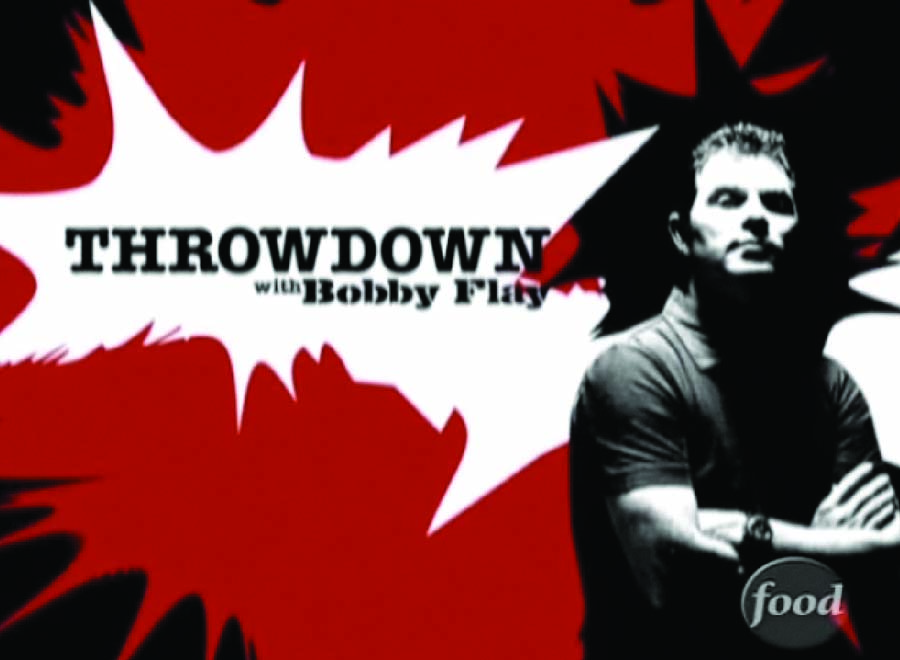
That keen focus on the immediate is likely why Patalinghug didn’t notice Bobby Flay – star of the network’s hit show Iron Chef America – lurking just to his left as he cooked, waiting to challenge the priest to an impromptu culinary contest for his other show, Throwdown with Bobby Flay.
When a producer finally alerted the priest to Flay’s presence on the set to propose a steak fajita contest, Patalinghug finally recognized one of the Food Network’s biggest stars and exclaimed: “My sweet Jesus! What in the heavens are you doing here?”
Patalinghug recovered quickly, at least for the camera. He simply looked back into the camera lens and deadpanned: “Food Network, you lied to a priest!”
When the priest accepted Flay’s Throwdown challenge, the heavens seemed to open up in a cloudburst of people, cameras, lights and activity. Flay’s assistants emerged to help him. Iron Chef Flay – a master of Tex/Mex cuisine – broke out his famous spice rub.
Patalinghug recalls that his hands were shaking, so he started cutting onions for his fajitas. But within no time, Patalinghug and Flay bantered as they cooked.
“You know who taught me how to cut? Mother Theresa,” the priest enthused as he prepared his dish. “When I was a seminarian, I’d go into the soup kitchens, and Mother Theresa said, ‘OK, brother, your job is to cut vegetables.”
Patalinghug whipped up a sweet steak fajita infused with Asian flavors as his entry. Flay took a spicier route and created a red-curry marinated skirt steak fajita. Then, almost as suddenly as the challenge was issued, the fates of both chefs’ dishes were in the hands of two local food writers that the Food Network enlisted as judges.
As the judges critiqued, Patalinghug pulled out a rosary and began praying.
“Do you want one?” he teased Flay. The Iron Chef asked what number “Hail Mary” he had reached. Patalinghug admitted that he had lost count.
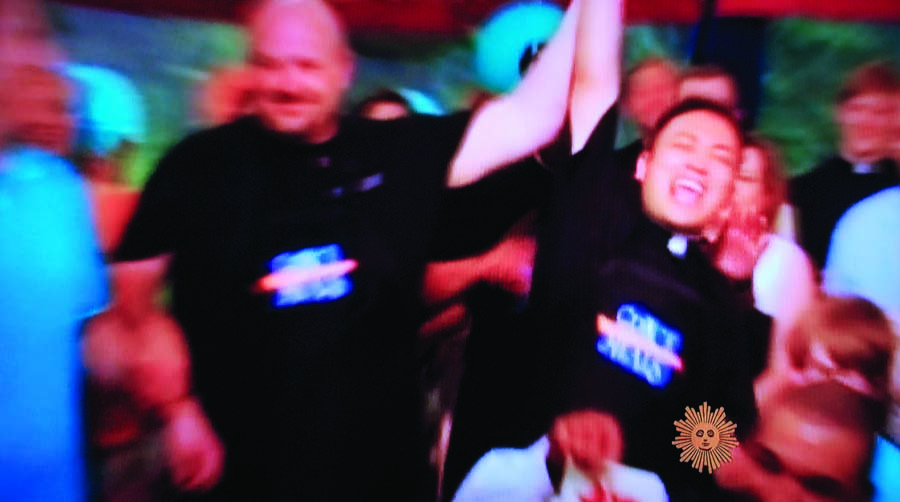
Eventually, the judges rendered their verdict. Patalinghug’s fajita had scored higher than Tex-Mex virtuoso Bobby Flay’s. The priest beamed as the crowd cheered and Flay offered his congratulations.
The contest with Flay aired nationally on the Food Network this past autumn, raising the national culinary profile of the telegenic 39-year-old priest even higher. (He already has a schedule bursting with public appearances centered on cooking and Grace Before Meals.)

But the televised throwdown with Flay also showcased other elements of Patalinghug’s personality: his love of competition, his quick wit and his devotion to God and the Roman Catholic Church.
The latter devotion, says Patalinghug, is the most important of all. Indeed, television show and public appearances and a lifetime of competition in everything from the martial arts to break dancing, he insists, is all about connecting people with God through what he calls the “greatest gift of all” – the family.
“We have so many blessings in life,” he says. “It seems that my life’s calling has been to help people recognize those blessings, beginning with the gifts on the table and the people with whom you share it.”
Keep It Simple
Cooking isn’t Father Leo Patalinghug’s only passion.
As an ordained Catholic priest, of course, God is passion number one. Patalinghug lives in Emmitsburg, Maryland, where he directs the Pastoral Field Education program for future priests at Mount Saint Mary’s Seminary.
But through the years, Patalinghug has also found time to become a black belt in karate, a champion stick-fighter, and a competitive break dancer.
Patalinghug’s spiritual journey has literally taken him around the world – from his birthplace in the Philippines to his years at UMBC as an undergraduate to a stop in Italy, where he studied to be a priest at the North American College in Rome.

As the youngest of four children, Patalinghug says he spent a great deal of time in the kitchen with his mother, who was a self-taught cook. The family had moved to the United States from the Philippines, and having fewer amenities than before, his mother had to learn her way around the kitchen. She often put Patalinghug to work, stirring a pot or chopping vegetables.
It was in Italy, however, that Patalinghug saw the power of food and what it could do for togetherness. At the North American College in Rome, he and his peers were required to have a meal together each day. “Even though we were classmates, the meal times made us brothers,” Patalinghug says. When he returned to America after his studies, he decided to bring the positive benefits of his seminary meals to the families in his parish.
His experiences in using food as an ingredient in his ministry inspired Grace Before Meals – which has grown quickly from a blog to a recipe book to the online cooking show. The show’s premise is simple but profound. In a world of fast food, reality TV and jam-packed schedules, bringing parents and kids together for meals is a way to facilitate real communication. Good meals, Patalinghug argues, can make better families.
Patalinghug blames fast food and fear for the disintegration of the family meal. Fast food was supposed to help families spend time together, he observes, but Americans have abused its convenience. “Like other gifts that have come our way, such as the internet and even love and relationships and sexuality,” he argues, “we are abusive with it, so I think we bought into it.”
Fear of happiness is another factor, he continues. “I think there is this fear in people,” Patalinghug says. “They don’t believe, and I use that word very pointedly, that God wants them to be happy and to have a peaceful, loving relationship with each other.”
Patalinghug has honed his culinary skills and his message over countless meals prepared and eaten with families in the parish. Often, they are seeking the priest’s counsel and advice. Sometimes, he finds that family members have trouble speaking with one another. “I just tell them, let’s talk about these things, and in the process, I’ll make you a pretty darn good meal,” Patalinghug says. Most of the time, he adds, it works.
The meals that Patalinghug urges families to prepare and eat together are not fancy. He uses simple tools and simple ingredients in familiar places, which he says makes meals satisfying and memorable.
Taste buds are not the only thing a good meal can satisfy, Patalinghug observes, pointing out that Jesus imparted many of his most important teachings over meals.
“Sometimes, when people hear the word ‘religion’ they hear different things depending on where they’re at in their faith,” he says. “But when you get down to the academic definition, food means ‘to bind’ in Latin. It’s religious because it brings people together.”
When we share meals with others, he says, we share stories. Many faiths have narratives and celebrations linked directly with food, all of which have been passed down through the ages. Most holidays of any sort have meals at the center, he observes, and Patalinghug hopes that Grace Before Meals helps families look at their meals together like holidays.
Hobbies and Holiness
Patalinghug says that when he was ordained, he gave God everything – including his hobbies. And cooking is not the only hobby that followed this priest into his ministry.
Patalinghug’s older brothers, for instance, sparked his early interest in martial arts. He began studying at age 8 and held a junior black belt in his hands by the time he was 12 years-old. When he was 17 years-old, he opened a karate school with his brother as he pursued – and won – international championships in full-contact stick fighting. Patalinghug still uses martial arts when he teaches youth groups and engages in other work with adolescents.

Break dancing – a popular artistic form when Patalinghug was growing up in the hip-hop happy 1980s – was another hobby in which the future priest excelled. He started break dancing with a group of friends at Columbia Skate Land. Despite the fact that they didn’t look the part (“We were all Filipino kids,” he says. “Our fathers, all American doctors.”), Patalinghug’s crew was good enough to dominate local contests -including the 1983 Maryland Break Dancing Competition.
But it was only in his sophomore year at UMBC that Patalinghug decided to take his hobbies – and his life – in a more spiritual direction. UMBC had impressed him as a place where faculty wanted students to “actually learn something,” and Patalinghug dove into a number of extracurricular activities, including singing in UMBC’s Camerata, working for the Student Government Association, and a stint as a disc jockey (“Leaping Leo”) for UMBC’s radio station.
Patalinghug was also deeply involved in local Catholic churches, serving as the music director for his home church and as a youth minister at another church. And he was beginning to sense that he might have a vocation to the priesthood, spurred on in part by conversations that he had with friends out on the patio between UMBC’s University Center and Chemistry building.
He recalls that space as a “hideaway hut” for him and his friends, whom he dubs the “philosophers” of UMBC in that era. “We were just college kids hanging out.” He remembers, “I wasn’t afraid to chat things out with them and have healthy discussions about life.”
Challenging religion courses in his curriculum also led him to ponder his future. Deep questions welling up inside him found answers that led Patalinghug to a higher power, and though he examined a number of religions, it was Catholicism in which he found peace.
“Many of the people were not happy with the Catholic Church at the time, and I remember finding myself defending the teachings but enjoying the debate and appreciating the fact that they offered the debate,” he says. “I found a real comfort in Catholic tradition.”
Patalinghug entered the seminary a year after graduation. He spent much of that year in prayer. “I was scared to death,” he says, “I didn’t understand it at the time.” He was ordained in 1999 and served as a parish priest for five years in Westminster before becoming a faculty member at Mount Saint Mary’s in 2007.
Food, Faith and Future
Watch a few episodes of Grace Before Meals and you get the sense that Patalinghug will do anything to break the ice of familial stress with food – and even a stiff drink or two.
In one episode, Patalinghug arrives at the home of a family that will soon host a party for one hundred people. Humorous quips and a concoction dubbed the “Orange Dew Drop” – Patalinghug’s tasty version of a traditional screwdriver – get the party started early.
“Jesus is going to have to multiply food, and to get us started, we’re just going to make ourselves a little drink,” he jests. He also involves family members and a neighbor in the process, asking them about their favorite drinks. Together they share stories and laughs, as they sip on Father Leo’s cool and colorful drinks. “You can see just how easy it is,” he says. “The food is just the means, not the ends, and that’s important. It’s just a means.”
With increasing fame (he already has a publicist to help him handle it all), what the future holds for Patalinghug is still up in the air. He insists that he’s coping through a combination of prayer and modesty. “I think God is very honest with me in telling me what I can and can’t do,” he says, “I don’t have the messiah complex; I know I can’t solve the world’s problems. I make dinner once in a while, it’s no big deal.”
In the near term, if the Food Network or another channel calls him, Patalinghug seems eager to bring the message of Grace Before Meals to a wider audience as he teaches at the seminary and works with youth groups.
Where he’d like to go ultimately, of course, should be no surprise.
“Hopefully Heaven,” Patalinghug says. “That’s the direction I’m trying to live, and if God wants me to move in different directions, I’m not in bad company.”
* * * * *
]]>
UMBC alumnus Father Leo Patalinghug ’92 finds the divine in cuisine and competition. His quest may yet make him one of America’s best-known Catholic priests. By B. Rose Huber Images courtesy...
https://umbc.edu/stories/break-bread-break-boards-break-dance/
https://dev.my.umbc.edu/api/v0/pixel/news/124931/guest@my.umbc.edu/2449acadccd46a10258b78e0ffdbbb91/api/pixel
stories
winter-2010
UMBC News & Magazine
https://dev.my.umbc.edu/groups/umbc-news-magazine
https://assets1-dev.my.umbc.edu/system/shared/avatars/groups/000/001/943/24435aa6207c452e7bc15cc74b42c7bb/xsmall.png?1748556657
https://assets1-dev.my.umbc.edu/system/shared/avatars/groups/000/001/943/24435aa6207c452e7bc15cc74b42c7bb/original.png?1748556657
https://assets2-dev.my.umbc.edu/system/shared/avatars/groups/000/001/943/24435aa6207c452e7bc15cc74b42c7bb/xxlarge.png?1748556657
https://assets2-dev.my.umbc.edu/system/shared/avatars/groups/000/001/943/24435aa6207c452e7bc15cc74b42c7bb/xlarge.png?1748556657
https://assets3-dev.my.umbc.edu/system/shared/avatars/groups/000/001/943/24435aa6207c452e7bc15cc74b42c7bb/large.png?1748556657
https://assets1-dev.my.umbc.edu/system/shared/avatars/groups/000/001/943/24435aa6207c452e7bc15cc74b42c7bb/medium.png?1748556657
https://assets2-dev.my.umbc.edu/system/shared/avatars/groups/000/001/943/24435aa6207c452e7bc15cc74b42c7bb/small.png?1748556657
https://assets1-dev.my.umbc.edu/system/shared/avatars/groups/000/001/943/24435aa6207c452e7bc15cc74b42c7bb/xsmall.png?1748556657
https://assets2-dev.my.umbc.edu/system/shared/avatars/groups/000/001/943/24435aa6207c452e7bc15cc74b42c7bb/xxsmall.png?1748556657
UMBC News & Magazine
0
0
false
Mon, 25 Jan 2010 14:09:28 -0500
The Scholar at the Supermarket

UMBC American studies professor Warren Belasco has pioneered food studies’ explosive growth in the classroom and the larger culture.
By Phoebe Connelly
“You did not go into food as an academic in 1972,” Warren Belasco told an audience of fellow scholars in Oxford, Mississippi this past October with a smile. “That was not something you did.”
So how did a professor of American studies at UMBC who did so end up as one of this country’s most prominent researchers on food and culture? In his 30 years at UMBC, Belasco has not just pioneered a discipline that has now captured the popular imagination. He also has helped define what we mean when we talk about food studies. His latest book, Food: The Key Concepts, is an introductory textbook for students of the burgeoning discipline.
And just why was he showing the oral historians of the Southern Foodways Alliance – an institute of the Center for the Study of Southern Culture at the University of Mississippi – slides of his 1970s dinner of soybean stroganoff?
To hear Belasco tell it, his own journey into food studies mirrors the path that the topic has taken to wider acceptance in the academy and in cultural discourse. It’s a personal tale in which his own diet and a fascination with how the mechanics of everyday phenomena (cars, Coca-Cola, drive-ins) fit into wider patterns of cultural discourse.
“Our tastes,” Belasco writes in Food, “are as telling as our distastes.”

Food has always been a key element in America’s melting pot culture, but its ability to speak to the culture of everything from business to politics has placed the topic squarely in the sights of scholars who are seeking ways of examining how we live.
For instance, Belasco gave his October talk at the second annual Viking Range Lecture, which is named for, and funded by, the manufacturer of high-end, commercial-grade ranges marketed to home cooks.
Belasco told that Mississippi audience that he “backed into [food studies] through something else.” In his case, it was research into leisure automobile travel in the United States during the early 20th century and the rise of motel chains which led to the publication of his first book, Americans on the Road: From Autocamp to Motel, 1910-1945, in 1977.
When he first interviewed at UMBC, the then-dean greeted the news of his scholarship on the roadside food chain Howard Johnson’s with a derisive, “that sounds like fun.” Belasco says he “knew immediately I was on to something that was not safe in academics.”
Belasco’s nose for the wider cultural patterns in everyday phenomena eventually led him straight to his own plate. As a graduate student at the University of Michigan in the 1970s, high meat prices forced Belasco to drop meat from his diet. He also discovered Francis Moore Lappé, whose influential 1971 book, Diet for a Small Planet, put forth the case for vegetarianism as a means of dealing with global food shortages.
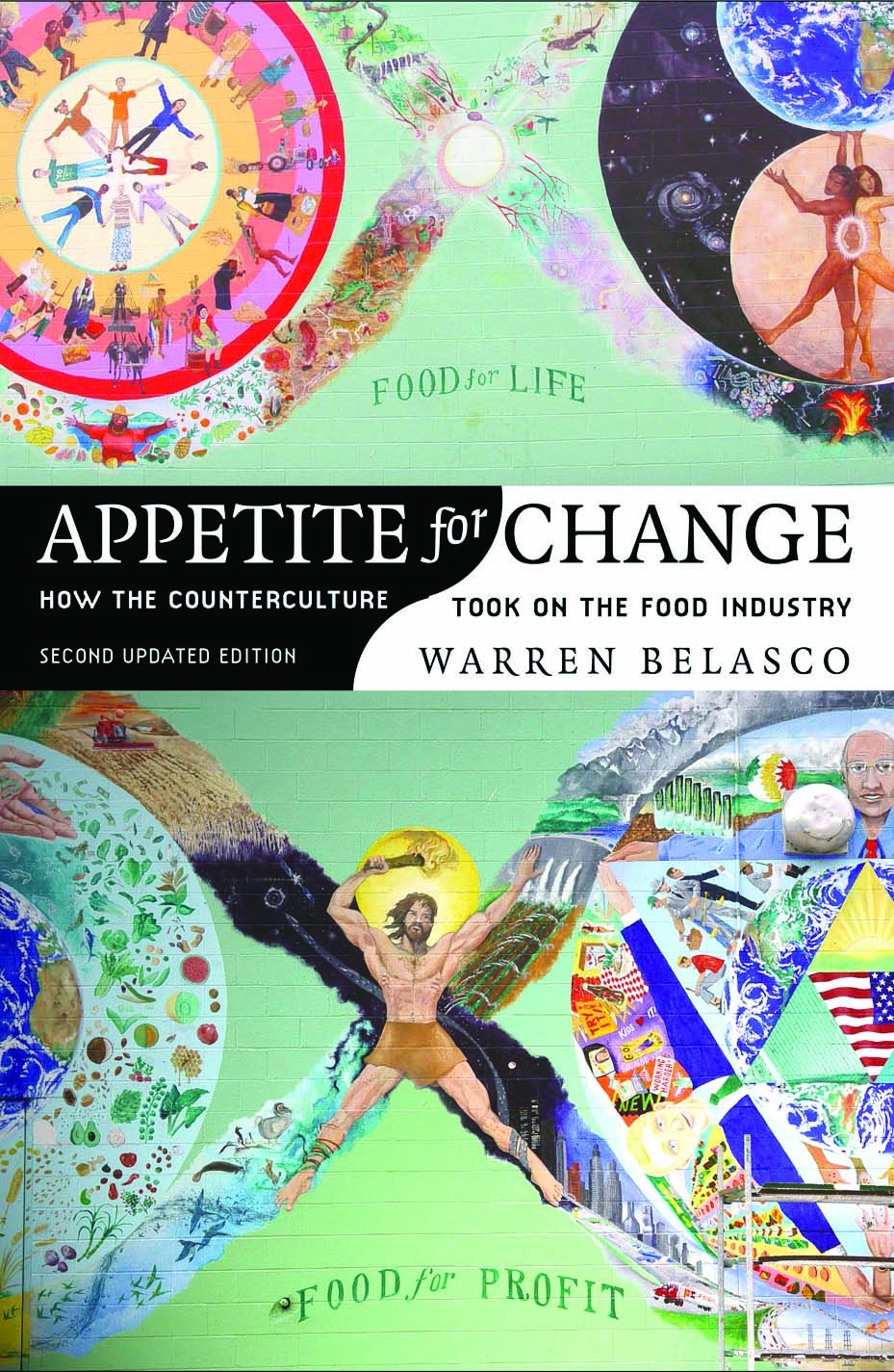
Making connections between his personal diet and the planet led Belasco to examine the alternative food culture of the 1960s and 1970s. He watched as that subculture surged into mainstream, and his first scholarly book on food, Appetite for Change: How the Counterculture Took on the Food Industry (1989), examined how goods like herbal tea and granola went from signifiers of radical culture to grocery store staples.
Belasco was not the only scholar focusing on food in the late 1980s. The Association for the Study of Food and Society began holding an annual conference in 1987. The association began publishing a journal – Belasco is the associate editor – in 1996.
Belasco also worked his academic interest into pedagogy, first offering a course dedicated to food studies as a senior seminar in the American studies department in 1985. In 1990, that same course became a regular offering for UMBC undergraduates.
 In 2008, he published Food: The Key Concepts, a slim introductory volume to food studies. (The best part of American studies texts may be their indexes – in Food you can find listings for Hank Williams as well as “free lunch.”) Belasco dedicated Food to his students, and says it’s the interactions with his classes that make the work rewarding.
Food culture’s emergence into the scholarly and cultural limelight may mean an increase in funding, or the odd phone call for an op-ed, but does it mean that food studies have carved a permanent niche in academia?
“At this stage we are at the level of individual courses,” Belasco says. It has become an accepted focus for professors. (Gone, he says, are the days where you were advised to wait until after you had secured tenure to tackle food studies.)
Perhaps more interesting is where his students are taking the discipline. Quite a few of them, he observes, have ended up not in the classroom, but in the kitchen.
Belasco’s most famous former student is Duff Goldman ’97, who started Baltimore’s Charm City Cakes, and became a foodie star with his Food Network show Ace of Cakes.
Goldman and other students who have studied with Belasco may have the cooking and the commerce down, but the UMBC professor says that there is value in examining the phenomenon for its other societal effects. “I feel like I’m giving them a political background they probably aren’t getting in cooking school,” Belasco says.
Belasco’s analysis of the intersection of food and wider culture has only deepened in subsequent years, moving from studying cultural shifts in consumer taste to a meditation on how human beings have used food as a means of charting our desires and fears.
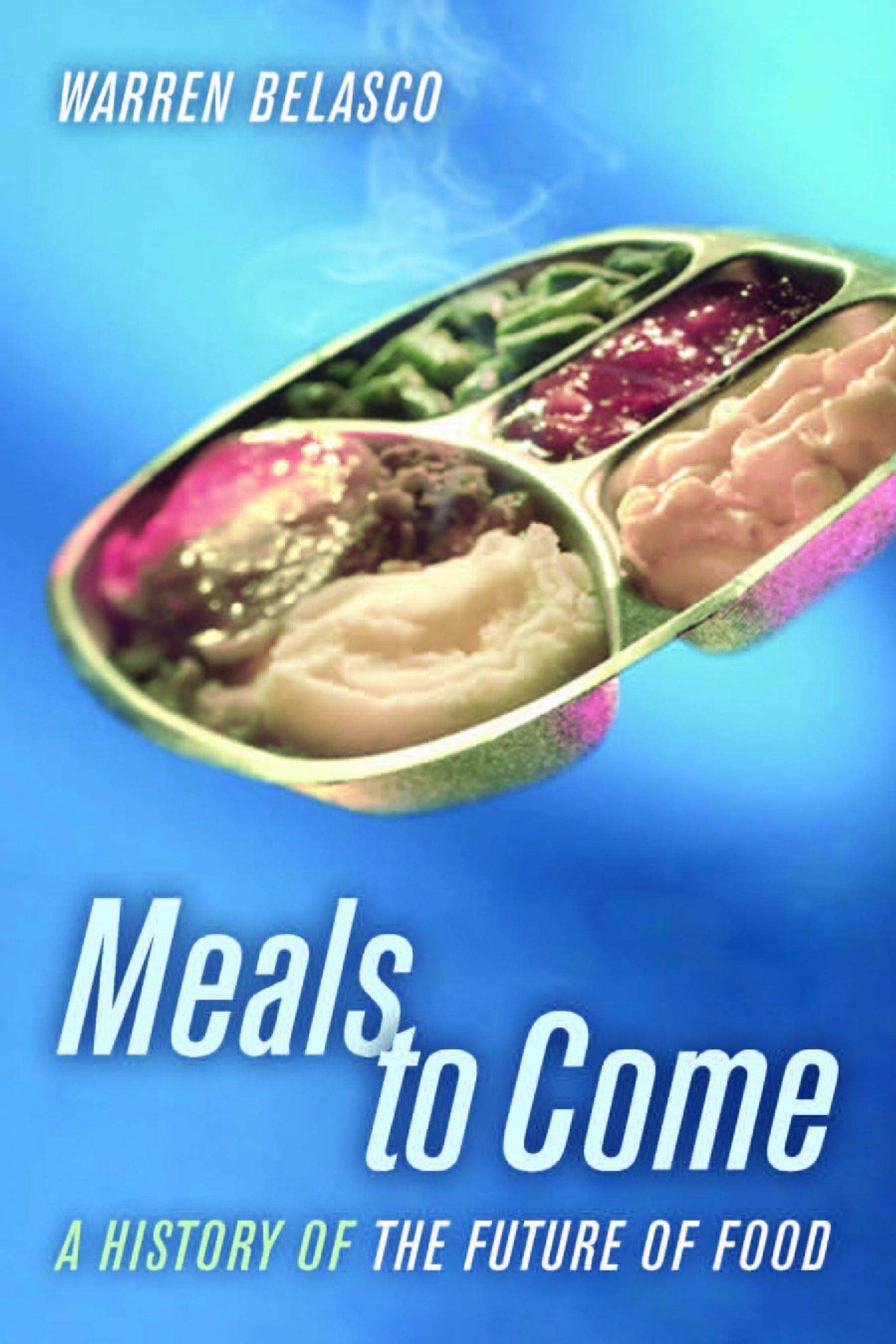
In his 2006 book, Meals to Come: A History of the Future of Food, Belasco argues that “the struggle for the control of the food supply is an old tale, to be sure, as are so many of the stories we tell about the future.” The food supply has been used as a rationale for westward expansion, a dream of a dazzling technological future, and a portent of uncontrolled population growth.
Belasco argues that to truly be a savvy consumer in a world where we are simultaneously encouraged to eat exotic, natural and super-supplemented meals, we must recognize how food is, and has been, marketed as a vehicle of hopes. Culinary innovations have always been sold with a combination of “false dichotomies, inappropriate analogies, questionable assumptions and dubious calculations,” he says.
It is a verdict that should give pause to those who are hitching their hopes on the locavore or “slow food” movements that are exciting interest at the moment.
 Warren and Amy Belasco harvest corn at their first community garden plot in Ann Arbor, MI, in the early 1970s.
Slow food movement advocates argue in favor of locally-sourced cuisine, the preservation of regional agriculture and food customs, and call for consumers to resist industry and intense processing. The movement was founded in Italy in the late 1980s, and the first United States chapter was formed in 2000. The turn toward local food goes hand in hand with the return of concern over industrial food, explored most famously by Eric Schlosser’s Fast Food Nation.
“In some ways it’s just another wave of interest brought about by worries in the present, and also, marketing and the refinement of consumer capitalism as people expand their tastes and turn to food as an area of discrimination, even more so than they have in the past,” Belasco says. Still, as he points out in Meals to Come the “‘gee whiz’ almost always trumps the ‘bummer.’” As much as the current food movement may appear to trade on the horrors of industry, it’s the appeal of down-home goodness that is successfully sold in the market. There, too, is a danger of culinary backlash. Belasco points to the criticism Michelle Obama has received for her work around improving diet, such as starting a White House garden and working to open a weekly farmer’s market blocks from the Oval Office.
Belasco is turning to his own back yard for inspiration for what comes next. He works in Baltimore, but since 1979, he has lived with his wife in Washington, D.C.’s Takoma Park. He took a sabbatical for the 2008-2009 academic year to focus on his next work, a food history of Washington, D.C.
Belasco considers himself to have “fingers in both cities.” Local food studies means defining the food shed – the combination of cuisine, suppliers and traditions that help define the ways people consume food. Belasco says Washington offers a unique take because it is a city of visitors.
“So much of Washington’s food culture is political, particularly among the rich,” Belasco says. The joke about food in Washington may be the culture of high priced dinners funded (at least until 2007 ethics reform) by lobbyists seeking the ears of politicians.
But he also observes that gastronomy continues to have a place in diplomatic relations. The tradition of the White House state dinner for visiting dignitaries continues (and is so recognized as a social event that President Obama’s first dinner was crashed by two would-be reality television stars).
Belasco traces political dining back to Thomas Jefferson, the second president to take up residence in the new capital. Three to four nights a week Jefferson would gather groups of as many as twelve guests to feast and discuss politics. While he may have tended toward French cuisine, by necessity, he sourced everything locally. “It was an interesting attempt to set a tone for the new republic,” Belasco says.
Gardening has its place as well. Slave gardens at the turn of the 19th century provided the income that allowed individuals to buy their freedom and get their start as independent purveyors of food. This seed capital helped cement the rise of the black middle class in Washington. “It’s not an original insight,” Belasco says, “but it’s another way of thinking about Washington.”
If the nation’s capital is a city of visitors, Belasco argues that Baltimore is a city of homebodies. “Baltimore is a city of local associations and affiliations,” Belasco says. He has formed a working group on food issues in Baltimore with a handful of other UMBC professors. Belasco reached out to Tony Geraci, who runs Baltimore’s school lunch program about getting UMBC students involved in efforts to transform the school lunch program, to feature fresh, locally grown food.
Geraci took over the lunch program in 2008. A chef by training, he helped transition New Hampshire’s school lunches to include locally sourced produce. His goal is a scalable, farm-to-fork model for creating school lunches and getting kids excited about food. “To teach a kid how to cook, there’s math, there’s science, there’s art,” Geraci told the Baltimore City Paper. “There’s music, when you integrate the cultural aspects. You teach it all, but you use food as the platform.” Belasco is not surprised to see food becoming the common language. “There are not that many people working on food, but there are a lot of people working around it.”
Food may have secured a place in the academy, but what happens next on our plates is still an open question. “In many ways meat is the real crunch problem of the future,” Belasco says. There is growing demand as western tastes for meat-centric meals spread. “The hopeful side of me says there will be more and more attempts to figure out how we can have our hamburgers and eat them as well.”
* * * * *
]]>
UMBC American studies professor Warren Belasco has pioneered food studies’ explosive growth in the classroom and the larger culture. By Phoebe Connelly “You did not go into food as an academic...
https://umbc.edu/stories/the-scholar-at-the-supermarket/
https://dev.my.umbc.edu/api/v0/pixel/news/124932/guest@my.umbc.edu/11bef239be0f417fb0c8c4cd75d5f447/api/pixel
stories
winter-2010
UMBC News & Magazine
https://dev.my.umbc.edu/groups/umbc-news-magazine
https://assets1-dev.my.umbc.edu/system/shared/avatars/groups/000/001/943/24435aa6207c452e7bc15cc74b42c7bb/xsmall.png?1748556657
https://assets1-dev.my.umbc.edu/system/shared/avatars/groups/000/001/943/24435aa6207c452e7bc15cc74b42c7bb/original.png?1748556657
https://assets2-dev.my.umbc.edu/system/shared/avatars/groups/000/001/943/24435aa6207c452e7bc15cc74b42c7bb/xxlarge.png?1748556657
https://assets2-dev.my.umbc.edu/system/shared/avatars/groups/000/001/943/24435aa6207c452e7bc15cc74b42c7bb/xlarge.png?1748556657
https://assets3-dev.my.umbc.edu/system/shared/avatars/groups/000/001/943/24435aa6207c452e7bc15cc74b42c7bb/large.png?1748556657
https://assets1-dev.my.umbc.edu/system/shared/avatars/groups/000/001/943/24435aa6207c452e7bc15cc74b42c7bb/medium.png?1748556657
https://assets2-dev.my.umbc.edu/system/shared/avatars/groups/000/001/943/24435aa6207c452e7bc15cc74b42c7bb/small.png?1748556657
https://assets1-dev.my.umbc.edu/system/shared/avatars/groups/000/001/943/24435aa6207c452e7bc15cc74b42c7bb/xsmall.png?1748556657
https://assets2-dev.my.umbc.edu/system/shared/avatars/groups/000/001/943/24435aa6207c452e7bc15cc74b42c7bb/xxsmall.png?1748556657
UMBC News & Magazine
0
0
false
Mon, 25 Jan 2010 14:04:06 -0500
Edible UMBC
Food is not only a means of individual sustenance. The act of sharing a meal helps to form and sustain communities as well. UMBC is no exception. Whether it’s a student and a professor discussing a term paper over a cup of coffee from Au Bon Pain or an off-campus expedition to a restaurant in Arbutus, Catonsville or Ellicott City, food and drink help cement the university community together.
And as 2010 dawns, almost anyone would agree that today’s UMBC students, faculty and staff are luckier than ever in their choice of eateries. The Commons boasts sushi, pizza and barbecue. The University Center now has a Chik-Fil-A and a Starbucks. And the university’s main food provider – Chartwell’s – has refurbished the dining hall into a spiffy new space called “True Grit’s.” Off-campus, the options are also increasing, while long-time student favorites such as Sorrento of Arbutus and the Double T Diner are still going strong.
In this issue, UMBC Magazine spotlights food in our communal lives. We asked Jeffrey “Duff” Goldman ’97 – star of the Food Network show Ace of Cakes – to share his thoughts on how to turn culinary passion into a thriving business. We talked with Warren Belasco – professor of American studies – about how his scholarly pursuits have made “food studies” a nexus of cross-disciplinary research. We interview another alumnus – Father Leo Patalinghug ’92 – whose telegenic combination of spirituality and food has left him poised to perhaps become UMBC’s next Food Network star.
We’ve also highlighted some of the places on and off campus where the UMBC community loves to eat, with a few of the entries provided by two UMBC students – Stefanie Mavronis ’12 and Evan Ponter ’12 – who write the university’s new food blog: UMBCeats.
We hope this trip through UMBC’s culinary highlights jogs your memory and entices you to share some of your own food memories about UMBC. Where did you eat when you studied here? Did we miss a favorite?
By Richard Byrne ’86
Images by Michelle Jordan ’93 and Melissa Van der Kaay
Taneytown Deli & Sandwich Shoppe
10 Mellor Avenue, Catonsville
410-747-2673
For the UMBC Magazine team, a trip to Taneytown Deli for a Fudclucker sandwich inspires poetry.
Oh, towering pile of chicken-y chunks,
Your layers of goodness delight me so!
Whenever my day has me in a funk
I know to the Taneytown I must go.
But how to do justice this tasty treat,
when the sum of its parts equals more than
simply a “sandwich,” some bread and some meat?
How do I show you I’m more than a fan?
A salad of chicken, but so much more:
Almonds and lettuce and celery, too,
and bacon – crisp bacon! – slices galore,
stacked on a pretzel sliced neatly in two.
Toss aside futile thoughts of dieting,
the battle’s lost: I must eat the whole thing.
— Jenny O’Grady
True Grit’s
UMBC Campus
443-612-3663

UMBC’s dining hall has been around for as long as there have been dormitories. But that space – so familiar to anyone who’s lived on campus – was revamped this year into a new space called True Grit’s. And what does that swipe of the campus card get you these days? Some things never change: eggs (including an omelet station) and cereal at breakfast; the student staples of salad and pizza and pasta at lunch or dinner. But True Grit’s has added some new twists to campus dining: sandwich station chefs will craft a delicious cold-cut sandwich to your specification at lunch; and dinners often feature specialty foods (steak, funnel cake, cheese steak) and seasonal themes (Oktoberfest and Thanksgiving dinner). If you’re on campus, check out the new school eats in an old school space.
— Evan Ponter ’12
Sorrento of Arbutus
5401 East Drive, Arbutus
410-242-6474
 If there’s any off-campus restaurant that is associated with UMBC, it’s Sorrento of Arbutus. Founded just a year before UMBC in 1965, Sorrento has been a high-profile booster of the university (and especially its athletics program). But the restaurant’s continuing popularity with students is based on its fresh and tasty hybrid menu of Italian (pizza/pasta) and American (fried chicken/steak sandwiches) foods. And, yes, that is shrimp and crab on the pizza toppings list!
— Richard Byrne ’86
Intercultural Language Exchange
Harbor Hall, UMBC Campus

Looking for global cuisine and conversation on campus? Harbor Hall’s Intercultural Language Exchange (ILE) floor is the place to be. Students on this floor dish up meals from every culture around the globe in a communal kitchen, with chances to engage with native speakers and organized discussions between faculty and students on the menu as well. Alas, these meals are invitation only! One of the perks of being a UMBC student committed to living, learning and sharing in a global context.
— Holly Britton ’11
Indian Delight
622 Frederick Road, Catonsville
410-744-4422
Lunch is the time to get Indian food. That’s not to say you can’t have a perfectly delicious dinner at Indian Delight, but you’d be missing out big time. Lunch means a “who-can-eat-the-most-plates?” buffet challenge. Lunch means piling spicy vindaloos on top of creamy spinach saags on top of savory chickpea masalas, letting one flow into the next until that magical moment your bite tastes vaguely of pumpkin pie – then mopping it all up with a triangle of toasty naan.

Lunch means leaving room for sweet kheer pudding, knowing you probably shouldn’t, but doing it anyway – because it’s there.
— Jenny O’Grady
Paul’s Restaurant
5507 Oregon Avenue, Arbutus
410-247-5620
Want a diner experience that’s just a few minutes’ walk from campus? Paul’s Restaurant’s hearty breakfasts and lunches (hint: try the crabcake) are served up by cheery waitresses with Baltimore accents thick enough to make you think you’ve walked into a Barry Levinson film. No fast food here; everything is cooked up fresh and worth the brief wait. Besides, Paul’s has free Wi-Fi and Keno on the TV screens to pass the time.
— Richard Byrne ’86

Double T Diner
6300 Baltimore National Pike, Catonsville
410-744-4151
Going to the Double T Diner in Catonsville with a large group of friends in the middle of the night has been a rite of passage for UMBC students since the university’s founding. It’s very close to campus, open 24 hours a day, and has a huge menu that blends delicious specialty items into a traditional diner menu.

Decorated with booths and jukeboxes, the Double T is a terrific (if busy) spot for a midday conversation or late-night study break. And make sure you don’t forget the dessert!
— Stefanie Mavronis ’12
H-Mart
800 North Rolling Road, Catonsville
443-612-9020
Adventure? World travel? Near campus? The Catonsville branch of Korean supermarket chain H-Mart has beckoned UMBC students in a wide array of languages for years. Don’t be daunted by aisles crammed with products in unfamiliar alphabets. Each whim of the international cuisine lover is indulged here. Seafood, spices, noodles, sweets? Check. Less than 10 minutes’ drive from campus? Check. Ethnic tunes, videos and a concession stand round out an international experience that’s a perfect match for UMBC’s diverse community.
— Holly Britton ’11

Catonsville Gourmet
829 Frederick Road, Catonsville
410-788-0005
Seafood is the specialty at Catonsville Gourmet Market and Fine Foods – a restaurant that reminds you just how close UMBC is to the Chesapeake Bay. Fresh fish is cooked to order with a wide array of sauces. Crab and shrimp are woven into appetizers, salads and main courses.

Oysters are served half-shell or cornmeal-dusted and fried. The crowds and rave reviews let you know that a fresh modern take on fine dining has arrived in Catonsville.
— Richard Byrne ’86
* * * * *
]]>
Food is not only a means of individual sustenance. The act of sharing a meal helps to form and sustain communities as well. UMBC is no exception. Whether it’s a student and a professor discussing...
https://umbc.edu/stories/edible-umbc/
https://dev.my.umbc.edu/api/v0/pixel/news/124933/guest@my.umbc.edu/d8c57d9e889fd1168657f127034ab190/api/pixel
stories
winter-2010
UMBC News & Magazine
https://dev.my.umbc.edu/groups/umbc-news-magazine
https://assets1-dev.my.umbc.edu/system/shared/avatars/groups/000/001/943/24435aa6207c452e7bc15cc74b42c7bb/xsmall.png?1748556657
https://assets1-dev.my.umbc.edu/system/shared/avatars/groups/000/001/943/24435aa6207c452e7bc15cc74b42c7bb/original.png?1748556657
https://assets2-dev.my.umbc.edu/system/shared/avatars/groups/000/001/943/24435aa6207c452e7bc15cc74b42c7bb/xxlarge.png?1748556657
https://assets2-dev.my.umbc.edu/system/shared/avatars/groups/000/001/943/24435aa6207c452e7bc15cc74b42c7bb/xlarge.png?1748556657
https://assets3-dev.my.umbc.edu/system/shared/avatars/groups/000/001/943/24435aa6207c452e7bc15cc74b42c7bb/large.png?1748556657
https://assets1-dev.my.umbc.edu/system/shared/avatars/groups/000/001/943/24435aa6207c452e7bc15cc74b42c7bb/medium.png?1748556657
https://assets2-dev.my.umbc.edu/system/shared/avatars/groups/000/001/943/24435aa6207c452e7bc15cc74b42c7bb/small.png?1748556657
https://assets1-dev.my.umbc.edu/system/shared/avatars/groups/000/001/943/24435aa6207c452e7bc15cc74b42c7bb/xsmall.png?1748556657
https://assets2-dev.my.umbc.edu/system/shared/avatars/groups/000/001/943/24435aa6207c452e7bc15cc74b42c7bb/xxsmall.png?1748556657
UMBC News & Magazine
0
0
false
Mon, 25 Jan 2010 13:53:21 -0500
Discovery – Winter 2010

A Date with Darwin
Forgive Sandra Herbert if she’s a bit exhausted as 2009 comes to a close.
Herbert, a professor emerita of history, is one of the world’s foremost authorities on the work of Charles Darwin, whose theorizing on natural selection and evolution revolutionized the course of scientific thought. And 2009 held not one but two significant Darwinian anniversaries: the 200th anniversary of his birth (on the same date, February 12, 1809, that Abraham Lincoln was born) and the 150th anniversary of the publication of his classic text, On the Origin of Species.

The “Darwin Year” saw Herbert giving lectures at venues including the Library of Congress and participating in events from Stockholm to Cambridge – the university where Darwin studied and later taught as a fellow at Christ’s College. Herbert was a distinguished visiting scholar at Christ’s College in the 2006-07 academic year, where she helped plan events for the Cambridge celebration and worked in the Darwin archives.
“The invitations started coming in 2005,” Herbert says. “It really was a bigger deal than we expected.” Herbert has edited groundbreaking scholarly editions of Darwin’s working notebooks – including the famous “Red Notebook,” which he started after his voyage to the Galapagos Islands, and in which he worked through early versions of evolutionary theory.
Her recent work on Darwin has excavated his early work as a geologist. Her book Charles Darwin, Geologist (Cornell University Press, 2005) not only unearthed Darwin’s passion for studying and theorizing about geology, but also drew clear links between that early work and his later revolutionary work in biology.
The biggest connection, says Herbert, was how Darwin and others built theories from the diligent work of 18th and early 19th century geologists to construct a geological record of the planet through analysis of various layers (or “strata”) of the earth’s soil and rock.
“By 1850, it was clear that if you go through the strata of the earth’s crust, you’re seeing the history of life on the planet,” she says. Geologists of that era “became very interested in when different kinds of life enter into the fossil record. And they knew that mammals came in much later than, say, fish…. So quite apart from the theory of evolution, there was already a growing understanding about the history of life on earth. And Darwin just presumed on that. He built on that. And offered an explanation as to why this was so. Why some species had become extinct and why others had replaced them. And he posited that newer species had come from the older ones.”
Herbert says that celebrating a Darwin year not only focused attention on the English scientist’s work, but also helped attract funding for a variety of Darwin-related projects, including an expedition made by Herbert and other American and British scholars – mainly geologists – to the Galapagos Islands to retrace the geological work that Darwin had done there on the voyage that changed science and history.
The journey resulted in a paper published earlier this year in Earth Sciences History, and Herbert says that it demonstrates what historians and geologists could accomplish working together as teams. “It was a lot of fun,” she says. “Lots of the other work I have done was manuscript work. Transcribing. It’s things you do like a monk. This was more congenial. People with different areas of expertise and knowledge coming together to answer each others’ questions.”
— Richard Byrne ’86
The Science of Salt
Hours before a snow storm roars in, trucks hit the road to spread a coarse form of table salt on highways and streets. Salt is a cheap and effective way to keep roads clear. It lowers the freezing point of the water on the road, creating brine which does not crystallize as the snow falls.
Some 20 million tons of sodium chloride are spread on roads every winter. But what happens to all that road salt when the storm passes? It is washed into the soil, the water table and eventually our drinking water. Chris Swan, associate professor of geography and environmental systems, studies the lingering effects of road salt. His preliminary findings are surprising.

The chloride in sodium chloride is the main problem, Swan says. Sodium atoms tend to stick to whatever is around them; chloride goes into the water. Vestiges of chloride from winter deicing can be traced well into the spring in soil samples, in the storm drain system, and in natural bodies of water. Swan’s lab also found increasing amounts in Baltimore’s drinking water. While the amount still is far below dangerous levels, the water eventually may become undrinkable.
To measure possible effects in nature, Swan and a graduate student, Robin Van Meter, put com-mon grey tree frogs into a 500-liter artificial pond and added salt in varying concentrations.
Amphibians are believed to be extremely sensitive to salt, so the researchers expected the frogs would get easily stressed and perhaps sicken, die, or become dwarfed and stunted. The reverse happened, Swan found. They grew from tadpole to adult frog a few days earlier and seemed to be a bit larger.
This finding does not mean the frogs are thriving in salt, Swan emphasizes. “We don’t know what’s going to happen once they are adults,” he says. “There could be less genetic variability; they could produce fewer eggs, natural selection could occur at a faster rate.” Their larger size might make them easier prey for natural predators, for instance.
Swan adds that salt’s effects on other creatures in a salt-tainted pond were more predictable. Tiny invertebrates near the bottom of the food chain called zooplankton die off in the salt, triggering both an increase in algae and a disruption of the food chain for other creatures who dine on them.
Despite these findings, Swan is not yet ready to endorse a ban on road salt. Authorities using it are generally responsible, he observes. But he emphasizes that the long-term effects of road salt are largely unknown.
“I don’t say salt is bad – just yet,” Swan insists. “But if you put value on ecological communities, what you are going to see [as a result of road salt’s use] will be different.”
Does Swan put salt on his own sidewalk at home in Columbia? He does. But he says that he makes sure he doesn’t overdo it.
— Joel N. Shurkin
Sign of the Times
UMBC’s Center for Art, Design and Visual Culture (CADVC) has received a $400,000 grant from the National Endowment for the Humanities. The grant will fund For All The World To See: Visual Culture and the Struggle for Civil Rights, an exhibit curated by Maurice Berger, a senior research scholar at the CADVC, on the role of visual images in the battle for civil rights in the United States.

The exhibit will appear at New York’s International Center of Photography in May and at the Smithsonian Institution’s National Museum of American History in June 2011 before concluding its tour at the CADVC in fall 2012. Yale University Press will publish a companion book to the exhibit.
Creating a Smarter Web
Imagine entering a conference room for a meeting. Your cell phone exchanges virtual business cards with the phones of everyone else in the room. Your laptop automatically uploads slides for your presentation directly to a projector on the table – without the aid of a thumb drive.
If UMBC computer science professor Tim Finin gets his way, a concept dubbed the “Semantic Web” will make such meetings a staple of the future.
A professor at UMBC since 1991, Finin has long been an esteemed researcher in the field of computerized artificial intelligence. Last year, the Computer Society of The Institute of Electrical and Electronics Engineers selected him to receive its esteemed Technical Achievement Award.

He began his explorations into artificial intelligence, or AI, as a student at the Massachusetts Institute of Technology in the late 1960s, when asking computers to recognize human speech and play chess were the frontiers. Those challenges have long since been conquered, but the search for smarter and better artificial intelligence continues. The newest frontier of AI seems to be in better harnessing the power of computer networks.
“When the Web happened in the mid 1990s it surprised everyone at how profoundly this changed the way we could exchange information,” Finin says. “There seems to be something special about the way the Web works and the way people connect to it.”
When Sir Tim Berners-Lee first thought up the idea of a Web of hyperlinked pages, he had computers, as well as people, in mind. Why couldn’t computers share their information as easily as cooks sharing recipes on Facebook? Berners-Lee called this concept the “Semantic Web.”

People view Web sites with computers, and can understand and differentiate between the sorts of data that these sites display. Computers do not. The text of a name and the text of an address, for a computer, are simply strings of data. The Semantic Web is the effort to annotate all data in a consistent way, so it can be understood by computers in such a way without additional boxes or schematic frames.
“Just as the Web made people more intelligent, the Semantic Web would make our computer programs more intelligent, because they would find the same information in a form that they could ingest and understand,” Finin says.
Finin has led a number of different projects at UMBC that demonstrate how the Semantic Web would work in real life, including a concept called “intelligent spaces” that would allow direct information sharing via portable devices. “The idea with these intelligent spaces is to have the devices be active in trying to understand who is in the room, and why they might be there,” he says.
Will the Semantic Web snowball catch on like the first Web did? “It’s totally impossible to predict how these things unfold,” he says. But if it does, we’ll have Finin’s work to thank.
— Joab Jackson ’90
Let it Snow
On May 7, 1959, English novelist C.P. Snow (left) gave a lecture at Cambridge University, “The Two Cultures and the Scientific Revolution,” that has helped define debate on the relationship between branches of human knowledge – especially the sciences and literature – for five decades.
 Portrait of Charles Percy Snow (1905-1980), English author, physicist, and diplomat. Undated photograph. — Image by © Bettmann/CORBIS
As Stefan Collini notes in his introduction to a new edition of the lecture published by Cambridge University Press to celebrate its 50th anniversary, Snow’s essay was a limited and imperfect formulation of the two cultures he described. His definition of “literary intellectuals” was narrowly drawn and quite specific to England. And Snow’s optimism in science’s ability to solve human problems has been undermined by a multiplicity of ethical concerns.
Yet the essay deftly captured a specific and continuing rupture between researchers in the so-called natural and physical sciences and their colleagues in the arts and humanities – as well as the awkward straddle of those in the social sciences between that divide. Snow’s notion of two cultures has been used to help explain the decline in the prestige of the humanities and the increasing corporate and governmental presence in research universities. But Snow’s most enduring and useful concept is that of a mutual linguistic and conceptual incomprehension across the lines he drew 50 years ago.
This past autumn, UMBC’s Human Context of Science & Technology Program (HCST) and the university’s Dresher Center for the Humanities created a series of five lectures – and an introductory level class – celebrating and critiquing Snow’s essay. The lectures drew prestigious scholars from as far afield as the United Kingdom (Cardiff University and the University of Warwick) to discuss and debate the influence of Snow and his ideas on the history of knowledge, cultural politics and climate change.
The result of the lecture series, says Joseph N. Tatarewicz, director of the university’s HCST program, was the stimulation of a campus-wide discussion that was “beyond my expectations.” He observes that “competition for scholars during this 50th anniversary year was intense, and we managed to attract some of the best scholars from a variety of disciplines and institutions to visit UMBC. Also gratifying was the diversity of the audience – humanists, social scientists, physical and natural scientists from on-and-off campus were there for all the events.”
Rebecca Boehling, director of the Dresher Center, says that the lecture series “seemed a good way to address head-on both differences between the humanities and the sciences with regard to the visibility of their research, as well as to reach out to the sciences – so that UMBC faculty and students outside the humanities might become more aware of both the historical dimension of these tensions.”

“Ideally,” continues Boehling, “neither faculty in the sciences and technology nor those in the humanities work in ways that are immune to the approaches of the others’ field. We share many similar concerns and goals in our research.”
Tatarewicz concurs, and notes his current work interviewing founding faculty for a history of UMBC has pointed to a convergence of ideas and disciplines in the university’s first years. “There wasn’t enough faculty for full departments of everything,” he observes, “so the university began in an atmosphere of interdisciplinarity and extreme collegiality. During this series, it felt like we had resurrected some of that early spirit.”
— Richard Byrne ’86
****
Header image: Sanitation workers assemble in front of Clayborn Temple for a Solidarity March in Memphis, TN.
]]>
A Date with Darwin Forgive Sandra Herbert if she’s a bit exhausted as 2009 comes to a close. Herbert, a professor emerita of history, is one of the world’s foremost authorities on the work of...
https://umbc.edu/stories/discovery-winter-2010/
https://dev.my.umbc.edu/api/v0/pixel/news/124934/guest@my.umbc.edu/e88b6b56fa6d406a94c763bd01268c88/api/pixel
stories
winter-2010
UMBC News & Magazine
https://dev.my.umbc.edu/groups/umbc-news-magazine
https://assets1-dev.my.umbc.edu/system/shared/avatars/groups/000/001/943/24435aa6207c452e7bc15cc74b42c7bb/xsmall.png?1748556657
https://assets1-dev.my.umbc.edu/system/shared/avatars/groups/000/001/943/24435aa6207c452e7bc15cc74b42c7bb/original.png?1748556657
https://assets2-dev.my.umbc.edu/system/shared/avatars/groups/000/001/943/24435aa6207c452e7bc15cc74b42c7bb/xxlarge.png?1748556657
https://assets2-dev.my.umbc.edu/system/shared/avatars/groups/000/001/943/24435aa6207c452e7bc15cc74b42c7bb/xlarge.png?1748556657
https://assets3-dev.my.umbc.edu/system/shared/avatars/groups/000/001/943/24435aa6207c452e7bc15cc74b42c7bb/large.png?1748556657
https://assets1-dev.my.umbc.edu/system/shared/avatars/groups/000/001/943/24435aa6207c452e7bc15cc74b42c7bb/medium.png?1748556657
https://assets2-dev.my.umbc.edu/system/shared/avatars/groups/000/001/943/24435aa6207c452e7bc15cc74b42c7bb/small.png?1748556657
https://assets1-dev.my.umbc.edu/system/shared/avatars/groups/000/001/943/24435aa6207c452e7bc15cc74b42c7bb/xsmall.png?1748556657
https://assets2-dev.my.umbc.edu/system/shared/avatars/groups/000/001/943/24435aa6207c452e7bc15cc74b42c7bb/xxsmall.png?1748556657
UMBC News & Magazine
0
0
false
Mon, 25 Jan 2010 13:47:30 -0500
At Play – Winter 2010

Gael Force
Catonsville’s a long, long way from Tipperary, but a local band with a strong UMBC connection is bringing Ireland and other musical ports of call a lot closer with their music.
Five of the six members of fiddlin’ around (yes, the name is lower case) call UMBC their alma mater or their workplace. Tara Ebersole ’08, Ph.D., public policy, Dave Aylsworth ’74, American Studies and Sarah Moreland ’97, M.S. electrical engineering, are alumni. Eric Ebersole is a lecturer in UMBC’s sociology department, and Terry Aylsworth is the executive administrative assistant in the College of Arts, Humanities and Social Sciences. (Akron University graduate Bill Batman rounds out the group.)

The band’s layered sound – which weaves mandolin, harmonica, flute, fiddle, and a traditional Irish drum called a bodhran into a more customary guitar, bass and drums – offers a myriad of musical possibilities.
“We can go from traditional Irish to eclectic, and then we fill in the rest,” Terry Aylsworth explains. “We’ll throw in some bluegrass, some Johnny Cash, or any music we want to play that doesn’t have a niche.”
The band’s musical mix often changes with the audience. “We tailor our music sets to our crowds and venues,” Dave Aylsworth says, “so there’s a large variety between gigs.”
Those appearances are increasing in frequency and prestige, including the Catonsville Arts & Crafts Festival and the Maryland Avenue Irish Festival in Annapolis, but Dave Aylsworth insists that fiddlin’ around is all about the love of music. “We’re not out to make money,” he says. “We’re out to have fun.”
— Holly Britton ’11
World Class Coach
Lacrosse has been kind to Ricky Fried ’88, history. His stellar career at UMBC landed him a spot on the university’s All-Time men’s lacrosse team. Fried has since become a star head coach in the burgeoning field of women’s lacrosse at The Johns Hopkins University and at Georgetown University.

Last summer, he earned an even more prestigious honor when he was named head coach of the 2009-2013 U.S. Women’s Lacrosse National Team – a job he will hold along with the Georgetown job.
Women’s lacrosse is second only to women’s golf in its growth as an NCAA sport over the last decade. Fried was an assistant coach with the American team that won the gold medal at the Federation of International Lacrosse World Cup in Prague last summer.
Now, he looks forward to the chance to hold on to that title in 2013.
“You get an opportunity to work with elite athletes,” says Fried. “At [this] level, that’s the pinnacle of women’s lacrosse. It’s a great responsibility and it’s a privilege to be in that position. I’m excited about the challenges.”
Fried began his coaching career as an assistant with the men’s team at UMBC. After a stint at The Gilman School, he became an assistant coach for the Johns Hopkins women’s team. Fried stayed at Johns Hopkins for nine years before taking over at Georgetown. The 2010 season will be his sixth as the Hoyas’ head coach.
— Jeff Seidel ’85
Shots on Goal
UMBC men’s soccer team was great in 2009, boasting 14 wins and the two top scorers in NCAA Division I soccer. But the future promises even more success, because the Retrievers did it all with a team that featured only one senior on the entire squad.
The Retrievers’ 14 wins came with only six losses, including a heartbreaking 2-0 loss to SUNY at Stony Brook in the America East championship game. (A win would have secured the team an NCAA tournament bid.)
But UMBC will return its dynamic scoring duo – rising senior Levi Houapeu (left) and rising junior Andrew Bulls (right)– for next year’s campaign. After Bulls led the entire nation in scoring for most of the season, Houapeu pipped him at season’s end with 43 total points and 2.15 points per game. Bulls finished second in the NCAA with 41 points and 2.05 ppg.
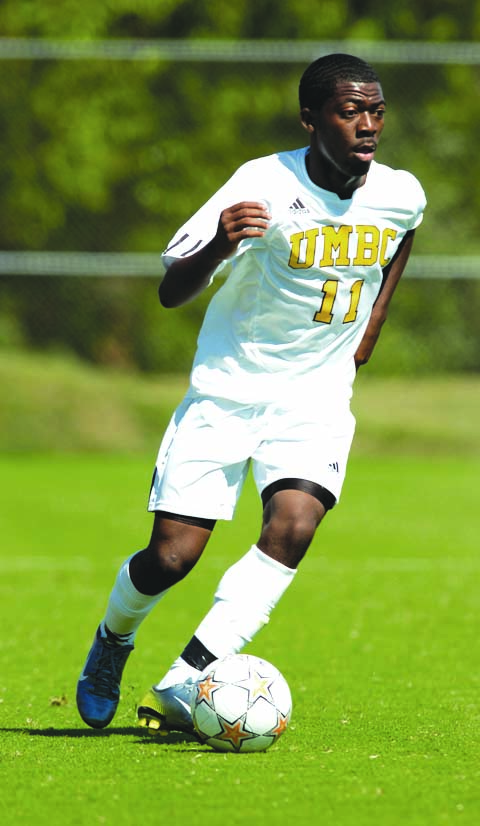
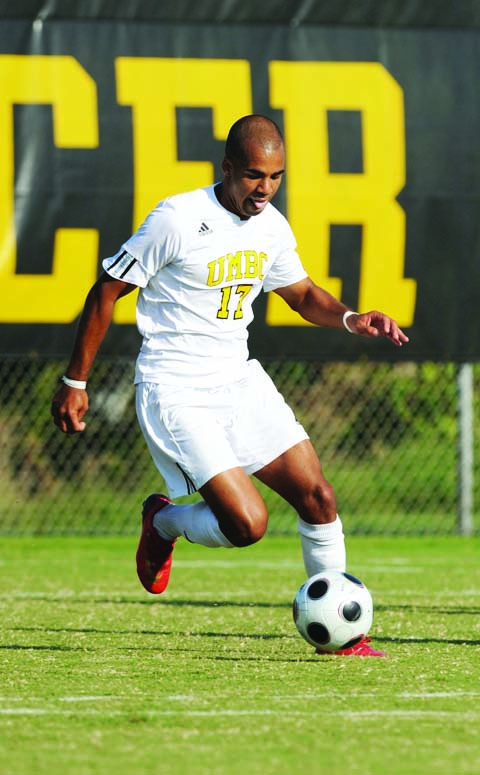
“To be honest, I always believed that this team could be as good as we were this year. No one expected this, but we believed,” said Houapeu.
Among the season’s other significant tallies:
• Houapeu and Bulls both scored 15 goals, combining for 30 of the team’s total of 43 goals.
• The Retrievers’ road victory over top-seeded New Hampshire in an America East semifinal was Coach Pete Caringi’s 200th win at UMBC.
• The 14 victories in 2009 were the most since the Retrievers won 15 games in 2000.
• The Retrievers’ 9-0-0 start to the season was the best in school history.
— Jeff Seidel ’85
Sole Power
UMBC attracts students from many corners of the globe. And sneaker artist and media and communications major Martin Figueroa ’11, has figured out a way that these homesick students can tap their heels together and remember that there’s no place like home. He’s painting the skylines of their hometowns – or any other image that represents their personal style – right onto their sneakers.

Figueroa started drawing sketches on his own shoes three years ago. Before long, friends asked if he would paint their shoes. Figueroa has now designed more than 25 pairs of shoes, with prices starting at $100 a pair, and decided to start a business.
When Figueroa contacted UMBC’s Alex. Brown Center for Entrepreneurship, the staff at the center gave his fledgling enterprise a leg up by putting him in touch with experts to help him get his new business launched. Figueroa hopes to be marketing his work professionally later this year.
Watch the video.
— B. Rose Huber
]]>
Gael Force Catonsville’s a long, long way from Tipperary, but a local band with a strong UMBC connection is bringing Ireland and other musical ports of call a lot closer with their music. Five...
https://umbc.edu/stories/at-play-winter-2010/
https://dev.my.umbc.edu/api/v0/pixel/news/124935/guest@my.umbc.edu/5f240305e19f20236e2090b7cc56221b/api/pixel
stories
winter-2010
UMBC News & Magazine
https://dev.my.umbc.edu/groups/umbc-news-magazine
https://assets1-dev.my.umbc.edu/system/shared/avatars/groups/000/001/943/24435aa6207c452e7bc15cc74b42c7bb/xsmall.png?1748556657
https://assets1-dev.my.umbc.edu/system/shared/avatars/groups/000/001/943/24435aa6207c452e7bc15cc74b42c7bb/original.png?1748556657
https://assets2-dev.my.umbc.edu/system/shared/avatars/groups/000/001/943/24435aa6207c452e7bc15cc74b42c7bb/xxlarge.png?1748556657
https://assets2-dev.my.umbc.edu/system/shared/avatars/groups/000/001/943/24435aa6207c452e7bc15cc74b42c7bb/xlarge.png?1748556657
https://assets3-dev.my.umbc.edu/system/shared/avatars/groups/000/001/943/24435aa6207c452e7bc15cc74b42c7bb/large.png?1748556657
https://assets1-dev.my.umbc.edu/system/shared/avatars/groups/000/001/943/24435aa6207c452e7bc15cc74b42c7bb/medium.png?1748556657
https://assets2-dev.my.umbc.edu/system/shared/avatars/groups/000/001/943/24435aa6207c452e7bc15cc74b42c7bb/small.png?1748556657
https://assets1-dev.my.umbc.edu/system/shared/avatars/groups/000/001/943/24435aa6207c452e7bc15cc74b42c7bb/xsmall.png?1748556657
https://assets2-dev.my.umbc.edu/system/shared/avatars/groups/000/001/943/24435aa6207c452e7bc15cc74b42c7bb/xxsmall.png?1748556657
UMBC News & Magazine
0
0
false
Mon, 25 Jan 2010 13:44:45 -0500
Bioengineering and Blitzing – Brooke Coley ’03, chemical engineering
Brooke Coley ’03, chemical engineering, remembers it as a dream play for a football defense. Two defenders burst through the …
]]>
Brooke Coley ’03, chemical engineering, remembers it as a dream play for a football defense. Two defenders burst through the …
https://magazine.umbc.edu/bioengineering-and-blitzing-brooke-coley-03-chemical-engineering/
https://dev.my.umbc.edu/api/v0/pixel/news/107624/guest@my.umbc.edu/b046607de904903ccbf13e9ae3d77f38/api/pixel
stories
winter-2010
UMBC Magazine
https://dev.my.umbc.edu/groups/umbc-magazine
https://assets3-dev.my.umbc.edu/images/avatars/group/5/xsmall.png?1776895223
https://assets3-dev.my.umbc.edu/images/avatars/group/5/original.png?1776895223
https://assets3-dev.my.umbc.edu/images/avatars/group/5/xxlarge.png?1776895223
https://assets1-dev.my.umbc.edu/images/avatars/group/5/xlarge.png?1776895223
https://assets3-dev.my.umbc.edu/images/avatars/group/5/large.png?1776895223
https://assets1-dev.my.umbc.edu/images/avatars/group/5/medium.png?1776895223
https://assets2-dev.my.umbc.edu/images/avatars/group/5/small.png?1776895223
https://assets3-dev.my.umbc.edu/images/avatars/group/5/xsmall.png?1776895223
https://assets4-dev.my.umbc.edu/images/avatars/group/5/xxsmall.png?1776895223
UMBC Magazine
0
0
false
Mon, 25 Jan 2010 10:12:19 -0500
Building and Bonding – James Donlan ’85, economics
If you marvel at how well UMBC’s buildings have been maintained over the last decade or so, you can point …
]]>
If you marvel at how well UMBC’s buildings have been maintained over the last decade or so, you can point …
https://magazine.umbc.edu/building-and-bonding-james-donlan-85-economics/
https://dev.my.umbc.edu/api/v0/pixel/news/107625/guest@my.umbc.edu/dd088977c17d874a6b650c68b74ff59c/api/pixel
stories
winter-2010
UMBC Magazine
https://dev.my.umbc.edu/groups/umbc-magazine
https://assets3-dev.my.umbc.edu/images/avatars/group/5/xsmall.png?1776895223
https://assets3-dev.my.umbc.edu/images/avatars/group/5/original.png?1776895223
https://assets3-dev.my.umbc.edu/images/avatars/group/5/xxlarge.png?1776895223
https://assets1-dev.my.umbc.edu/images/avatars/group/5/xlarge.png?1776895223
https://assets3-dev.my.umbc.edu/images/avatars/group/5/large.png?1776895223
https://assets1-dev.my.umbc.edu/images/avatars/group/5/medium.png?1776895223
https://assets2-dev.my.umbc.edu/images/avatars/group/5/small.png?1776895223
https://assets3-dev.my.umbc.edu/images/avatars/group/5/xsmall.png?1776895223
https://assets4-dev.my.umbc.edu/images/avatars/group/5/xxsmall.png?1776895223
UMBC Magazine
0
0
false
Mon, 25 Jan 2010 10:11:20 -0500
Carny Attraction – James Taylor ’73, INDS
Sideshows featuring amazing feats and astonishing freaks became an industry in the United States in the 19th century. But these …
]]>
Sideshows featuring amazing feats and astonishing freaks became an industry in the United States in the 19th century. But these …
https://magazine.umbc.edu/carny-attraction-james-taylor-73-inds/
https://dev.my.umbc.edu/api/v0/pixel/news/107626/guest@my.umbc.edu/888a7d20e5c7210803a589cd19c276ce/api/pixel
stories
winter-2010
UMBC Magazine
https://dev.my.umbc.edu/groups/umbc-magazine
https://assets3-dev.my.umbc.edu/images/avatars/group/5/xsmall.png?1776895223
https://assets3-dev.my.umbc.edu/images/avatars/group/5/original.png?1776895223
https://assets3-dev.my.umbc.edu/images/avatars/group/5/xxlarge.png?1776895223
https://assets1-dev.my.umbc.edu/images/avatars/group/5/xlarge.png?1776895223
https://assets3-dev.my.umbc.edu/images/avatars/group/5/large.png?1776895223
https://assets1-dev.my.umbc.edu/images/avatars/group/5/medium.png?1776895223
https://assets2-dev.my.umbc.edu/images/avatars/group/5/small.png?1776895223
https://assets3-dev.my.umbc.edu/images/avatars/group/5/xsmall.png?1776895223
https://assets4-dev.my.umbc.edu/images/avatars/group/5/xxsmall.png?1776895223
UMBC Magazine
0
0
false
Mon, 25 Jan 2010 10:09:08 -0500
The Art of Educating – Laura Pasquini ’98, visual arts
When Laura Pasquini ’98, visual arts, started her studies in art at UMBC, she thought she wanted to be a …
]]>
When Laura Pasquini ’98, visual arts, started her studies in art at UMBC, she thought she wanted to be a …
https://magazine.umbc.edu/the-art-of-educating-laura-pasquini-98-visual-arts/
https://dev.my.umbc.edu/api/v0/pixel/news/107627/guest@my.umbc.edu/d815bfe2780d7b510d0bd3be33795769/api/pixel
stories
winter-2010
UMBC Magazine
https://dev.my.umbc.edu/groups/umbc-magazine
https://assets3-dev.my.umbc.edu/images/avatars/group/5/xsmall.png?1776895223
https://assets3-dev.my.umbc.edu/images/avatars/group/5/original.png?1776895223
https://assets3-dev.my.umbc.edu/images/avatars/group/5/xxlarge.png?1776895223
https://assets1-dev.my.umbc.edu/images/avatars/group/5/xlarge.png?1776895223
https://assets3-dev.my.umbc.edu/images/avatars/group/5/large.png?1776895223
https://assets1-dev.my.umbc.edu/images/avatars/group/5/medium.png?1776895223
https://assets2-dev.my.umbc.edu/images/avatars/group/5/small.png?1776895223
https://assets3-dev.my.umbc.edu/images/avatars/group/5/xsmall.png?1776895223
https://assets4-dev.my.umbc.edu/images/avatars/group/5/xxsmall.png?1776895223
UMBC Magazine
0
0
false
Mon, 25 Jan 2010 10:06:27 -0500