Killer Mix Tapes Cont’d
After spending the summer jamming on guitars in their living room together, Professor Morin and his son, Nick, traded mix tapes to commemorate the experience. They worked on their lists separately, but clearly have some similar tastes. (All tracks link to Amazon.com)
Mix tape for Nick Morin From Dad (2009)
by Professor Joseph “Skip” Morin
Track 1: “Funk #49”
by James Gang
Track 2: “(Night Time Is) The Right Time”
by Ray Charles
Track 3: “Ain’t Too Proud to Beg”
by The Temptations
Track 4: “Sad-Eyed Lady of the Lowlands”
by Bob Dylan
Track 5: “One Mint Julep”
by The Clovers
Track 6: “Blackbird”
by The Beatles *Original not available, Paul McCartney version substituted
Track 7: “Hold On, I’m Comin’”
by Sam & Dave
Track 8: “All You Need is Love”
by The Beatles *Original not available, Beatles Tribute Band version substituted
Track 9: “Gone for Good”
by The Shins
Music CD Mix Tape (2009)
by Nick Morin
Track 1: “Mix Tape”
by Brand New
Track 2: “Aeroplane”
by Red Hot Chili Peppers
Track 3: “Purple Haze”
by Jimi Hendrix
Track 4: “No Hardcore Dancing in the Living Room”
by Chiodos
Track 5: “Feathers”
by Coheed and Cambria
Track 6: “From the Second I Wake Up”
by Valencia *Not available on Amazon
Track 7: “Something”
by The Beatles *Original not available, The Beatles Tribute Project version substituted
Track 6: “Blackbird”
by The Beatles *Original not available, Paul McCartney version substituted
Track 9: “Roundabout”
by Yes
Track 10: “Jenny Was a Friend of Mine”
by The Killers
]]>
After spending the summer jamming on guitars in their living room together, Professor Morin and his son, Nick, traded mix tapes to commemorate the experience. They worked on their lists...
https://umbc.edu/stories/killer-mix-tapes-contd/
https://dev.my.umbc.edu/api/v0/pixel/news/124945/guest@my.umbc.edu/969bb724674fcaee5e261c7b9b709346/api/pixel
fall-2009
stories
UMBC News & Magazine
https://dev.my.umbc.edu/groups/umbc-news-magazine
https://assets1-dev.my.umbc.edu/system/shared/avatars/groups/000/001/943/24435aa6207c452e7bc15cc74b42c7bb/xsmall.png?1748556657
https://assets1-dev.my.umbc.edu/system/shared/avatars/groups/000/001/943/24435aa6207c452e7bc15cc74b42c7bb/original.png?1748556657
https://assets2-dev.my.umbc.edu/system/shared/avatars/groups/000/001/943/24435aa6207c452e7bc15cc74b42c7bb/xxlarge.png?1748556657
https://assets2-dev.my.umbc.edu/system/shared/avatars/groups/000/001/943/24435aa6207c452e7bc15cc74b42c7bb/xlarge.png?1748556657
https://assets3-dev.my.umbc.edu/system/shared/avatars/groups/000/001/943/24435aa6207c452e7bc15cc74b42c7bb/large.png?1748556657
https://assets1-dev.my.umbc.edu/system/shared/avatars/groups/000/001/943/24435aa6207c452e7bc15cc74b42c7bb/medium.png?1748556657
https://assets2-dev.my.umbc.edu/system/shared/avatars/groups/000/001/943/24435aa6207c452e7bc15cc74b42c7bb/small.png?1748556657
https://assets1-dev.my.umbc.edu/system/shared/avatars/groups/000/001/943/24435aa6207c452e7bc15cc74b42c7bb/xsmall.png?1748556657
https://assets2-dev.my.umbc.edu/system/shared/avatars/groups/000/001/943/24435aa6207c452e7bc15cc74b42c7bb/xxsmall.png?1748556657
UMBC News & Magazine
0
0
false
Sun, 20 Sep 2009 19:18:50 -0400
How To Make A Killer Mix Tape

With Joseph “Skip” Morin, Associate Chair & Lecturer, Music
In the 2000 hit film “High Fidelity,” romantically challenged record-store owner Rob Gordon discusses his own torturous process of making the perfect mix tape for a girl:
“The making of a great compilation tape, like breaking up, is hard to do and takes ages longer than it might seem. You gotta kick off with a killer, to grab attention. Then you got to take it up a notch, but you don’t wanna [overdo it], so then you got to cool it off a notch. There are a lot of rules.”
Sound daunting? Fortunately, Joseph “Skip” Morin, associate chair and lecturer in the UMBC’s music department is here to help. He has taught a “Rock and Related Music” course at the university since the mid-1990s.
— Jenny O’Grady

Step 1: Don’t Fear “The Blank Page”
You might find the prospect of choosing 10 to 15 songs from the – literally – millions ever written to be a bit scary. But don’t let this stop you before you even start.
“It can be such a vast endeavor,” says Morin, who made a mix tape for his son, Nick. “It’s something that could take a lifetime to do…or it could take an instant. Eventually you choose something that means something to you…if only to you.”
Step 2a: Know Thy Audience…
Who will be listening to this mix? Thinking about your audience before compiling songs will help you choose tracks that really speak to the listener.
“Is it for a single person’s pleasure,” asks Morin, “or for a group activity? You have to know who’s going to be listening before you start.”
Step 2b: On the Other Hand…
Don’t worry too much about what you think their reaction will be, he insists.
“Mix tapes ultimately have more meaning for the preparer than the person receiving the tape,” he says. “There’s no guarantee that the recipient will have the same reaction as the person who makes the tape.” And that’s OK.
Step 3: Pick an Awesome Theme
Love. Longing. Songs for shower singing. Songs for impromptu dance parties. Songs for days long past. Most any idea can be the starting point.
“One of the great virtues of music is the possibility that it can transport you back in time,” says Morin, who made a special mix tape for his son, Nick, after the two spent a memorable summer jamming on their guitars in their living room. “Capturing those moments in a musical state of reminiscence is a really great thing to do. You’ve got to catch it while you can.”
Step 4: Arrange Your Set List
Once you’ve chosen your songs, move into album-producer mode. You can vary your song order by pace, or go year by year from past to present. Group the songs by artist, or link them with a storyline. (Boy meets girl. Boy loses girl. Boy gets girl back again.) The options are limitless.
“A lot of people see the order of the songs, the compilation, as an art form,” says Morin, who considered both song pace and theme while ordering the mix tape for his son.
Step 5: Presentation is Key
As for the look and feel of your mix tape, you can go ultra high-tech – or keep it super low-fi. If you’re going the cassette-tape route, you might enjoy decorating the label stickers to match your theme. If you have iTunes or another online music account, you can easily burn a CD and even create jewel case art. Some music-video enthusiasts have taken the concept even further by using artwork and music to create video mix tapes to post on YouTube.
For Morin and his son, it was more meaningful to scribble set lists on paper, and then share them face-to-face. At least for now.
“I do think we’ll record them eventually,” he says. “I like the idea of permanence.”
Click here to see their mix tapes.
]]>
With Joseph “Skip” Morin, Associate Chair & Lecturer, Music In the 2000 hit film “High Fidelity,” romantically challenged record-store owner Rob Gordon discusses his own torturous process of...
https://umbc.edu/stories/how-to-make-a-killer-mix-tape/
https://dev.my.umbc.edu/api/v0/pixel/news/124946/guest@my.umbc.edu/3c6fe1e1a282a8c972940798441d3bb1/api/pixel
fall-2009
stories
UMBC News & Magazine
https://dev.my.umbc.edu/groups/umbc-news-magazine
https://assets1-dev.my.umbc.edu/system/shared/avatars/groups/000/001/943/24435aa6207c452e7bc15cc74b42c7bb/xsmall.png?1748556657
https://assets1-dev.my.umbc.edu/system/shared/avatars/groups/000/001/943/24435aa6207c452e7bc15cc74b42c7bb/original.png?1748556657
https://assets2-dev.my.umbc.edu/system/shared/avatars/groups/000/001/943/24435aa6207c452e7bc15cc74b42c7bb/xxlarge.png?1748556657
https://assets2-dev.my.umbc.edu/system/shared/avatars/groups/000/001/943/24435aa6207c452e7bc15cc74b42c7bb/xlarge.png?1748556657
https://assets3-dev.my.umbc.edu/system/shared/avatars/groups/000/001/943/24435aa6207c452e7bc15cc74b42c7bb/large.png?1748556657
https://assets1-dev.my.umbc.edu/system/shared/avatars/groups/000/001/943/24435aa6207c452e7bc15cc74b42c7bb/medium.png?1748556657
https://assets2-dev.my.umbc.edu/system/shared/avatars/groups/000/001/943/24435aa6207c452e7bc15cc74b42c7bb/small.png?1748556657
https://assets1-dev.my.umbc.edu/system/shared/avatars/groups/000/001/943/24435aa6207c452e7bc15cc74b42c7bb/xsmall.png?1748556657
https://assets2-dev.my.umbc.edu/system/shared/avatars/groups/000/001/943/24435aa6207c452e7bc15cc74b42c7bb/xxsmall.png?1748556657
UMBC News & Magazine
0
0
false
Sun, 20 Sep 2009 19:16:54 -0400
Over Coffee – Fall 2009

Establishing a legacy that spans generations is important for a school that is only 43-years-old – and one father and son team has created such a legacy as student-athletes at UMBC. John Goedeke ’79, economics, was one of the school’s better-known basketball players in the late ’70s, when he was a two-time academic All-America selection and a seventh-round selection by the NBA’s Atlanta Hawks. He is now a senior vice president in the treasury management division of Sandy Spring Bank. Kevin Goedeke ’10 has been a key member of the men’s lacrosse team in the last two years, helping the Retrievers earn two trips to the NCAA tournament. (He is on course to graduate next spring with a degree in aging services.) They talked with UMBC Magazine about their family’s involvement in UMBC and its athletics program.

What has it been like having another Goedeke as a prominent athlete at UMBC?
John: For me, it’s been a lot of fun. It enabled me to reconnect with a lot of people, although I’ve been active there over the years…. I have a lot of great memories, and to see him have success there is a lot of fun.
How has the legacy of your dad affected your time at UMBC?
Kevin: It was really cool to see all the pictures in the gym of him and all the old teams. It was nice when some of the faculty and professors knew my last name. A lot of people knew who he was, especially those who’d been there a long time. It opened up a lot of doors for me, and I definitely liked it.
How much did you talk about Kevin going to UMBC during the recruiting process?
John: We really didn’t. If he went to school at UMBC, I wanted it to be his decision…. I remember the day he went for the campus visit, my wife went with him. He really made the decision on his own. When you play sports in college, it really is a commitment. You’ve got to be happy and you’ve got to be in a place you want to be at.
Kevin: I always knew it was an option. He let me make my own decisions. He would answer any questions I had, but he’d never favor UMBC over any other choices. I know how my dad is, and I know he didn’t want to put any pressure on me to go where he went. He just wanted me to go where I’d be happy.
John: Once Kevin did make the decision, then there was a lot to talk about. He has played against some of the top teams in the country, and that was a thrill for him. I have never seen a team of players as close-knit as this team this year. It was unbelievable the way they worked together on and off the field.
Kevin: It’s more of a family than it is a team. That made it for me. We had a great group of people and that made the experience better.
Aside from its athletics, what makes the UMBC experience special?
John: Academics, obviously, is very important. I think UMBC has a great academic reputation, and that reputation is growing. I joke with everyone that I’m glad I went there when I did because I don’t know that I could get through now.
Kevin: I knew it was considered a good academic school, and it was nice to get to go and play lacrosse also. It was nice knowing that I’d be getting a good education. It’s hard to find a school that has really good athletics, but still has small classes and is still known as an honors university and still known as a good school.
John: It’s all about the people, and UMBC has great people. They did when I went to school there, and they still do today, and I think that’s a testimony to the university that a lot of the same people that were there when I went there are still there.
— Jeff Seidel ’85
]]>
Establishing a legacy that spans generations is important for a school that is only 43-years-old – and one father and son team has created such a legacy as student-athletes at UMBC. John Goedeke...
https://umbc.edu/stories/over-coffee-fall-2009/
https://dev.my.umbc.edu/api/v0/pixel/news/124947/guest@my.umbc.edu/4d001e836b63e2803326bc0f6ebea89b/api/pixel
fall-2009
stories
UMBC News & Magazine
https://dev.my.umbc.edu/groups/umbc-news-magazine
https://assets1-dev.my.umbc.edu/system/shared/avatars/groups/000/001/943/24435aa6207c452e7bc15cc74b42c7bb/xsmall.png?1748556657
https://assets1-dev.my.umbc.edu/system/shared/avatars/groups/000/001/943/24435aa6207c452e7bc15cc74b42c7bb/original.png?1748556657
https://assets2-dev.my.umbc.edu/system/shared/avatars/groups/000/001/943/24435aa6207c452e7bc15cc74b42c7bb/xxlarge.png?1748556657
https://assets2-dev.my.umbc.edu/system/shared/avatars/groups/000/001/943/24435aa6207c452e7bc15cc74b42c7bb/xlarge.png?1748556657
https://assets3-dev.my.umbc.edu/system/shared/avatars/groups/000/001/943/24435aa6207c452e7bc15cc74b42c7bb/large.png?1748556657
https://assets1-dev.my.umbc.edu/system/shared/avatars/groups/000/001/943/24435aa6207c452e7bc15cc74b42c7bb/medium.png?1748556657
https://assets2-dev.my.umbc.edu/system/shared/avatars/groups/000/001/943/24435aa6207c452e7bc15cc74b42c7bb/small.png?1748556657
https://assets1-dev.my.umbc.edu/system/shared/avatars/groups/000/001/943/24435aa6207c452e7bc15cc74b42c7bb/xsmall.png?1748556657
https://assets2-dev.my.umbc.edu/system/shared/avatars/groups/000/001/943/24435aa6207c452e7bc15cc74b42c7bb/xxsmall.png?1748556657
UMBC News & Magazine
0
0
false
Sun, 20 Sep 2009 19:15:50 -0400
Pedal Power

Two weeks after completing a grueling bicycle race that ran from Oceanside, Calif. to Annapolis, Adam Driscoll ’04, information systems, is still waiting for sensation to return to his fingertips.
Driscoll’s hands are still numb from gripping the handlebars of his Cannondale geared bicycle for a week. But he says that the lack of feeling is a small price to pay to take first place in the two-man division of the 2009 Race Across America (RAAM) – a 3,000-mile contest which they won in a time of seven days, one hour and 33 minutes.
The other member of the winning team, Patrick Blair ’03, computer science, is also a UMBC alumnus. The two men met when they were runners on UMBC’s varsity track team. Racing together under the name of their non-profit organization (Adventures for the Cure), the duo bested a pair of Slovenians who chased them from the outset and two other two-man teams in the race.
“To push yourself like that and to race like that, you truly feel alive,” says Blair. “You are truly, truly alive. There were nighttime shifts for like two hours where I would put my angry-music headphones in and race up those hills.”
The ardors of the race included a week in which the only sleep came in the passenger seat of a moving van. But while the physical sacrifices and satisfaction of competition excite Driscoll and Blair, the charitable aspect of their cycling also plays a big role in their ambitions.
Inspired in part by Driscoll’s life with Type I diabetes (he was diagnosed at age 12), Adventures for the Cure focuses on raising money for scientific research and for camps for children with diabetes. The charity also supports Kupenda for the Children, an organization that assists children with disabilities in Kenya.
Raising money for a camp for teenagers with diabetes is one of the duo’s recent endeavors. Driscoll says that the goal of the project is to show campers that diabetes is a manageable condition and it is possible to be athletic and adventurous while living with the disease.
“It’s also good for young diabetic kids to see other kids with diabetes and know that they’re not alone,” says Blair.
Driscoll and Blair – who have a tendency to finish each other’s sentences – have taken on extreme-cycling challenges like RAAM to raise money since 2005. Their first such challenge was a ride from Baltimore to Ocean City in two days, which netted $7,000 for charity.
Faith has also played a role in their endeavors.
“We got involved in a Bible study,” Blair recalls. “I guess we really became more Christian after college – and along with that came this desire to do something that mattered other than just work. It seemed like we had accomplished everything, graduated from college, got good jobs and everything, but we weren’t really doing anything to make a difference.”
Matching their love of cycling to causes that they believe in has made a difference. It’s also made the topic for a documentary film. A cross-country ride that the duo organized with their friend and fellow UMBC alumnus Jesse Stump ’06, engineering and information technology, was the subject of a film called Adventures for the Cure: The Doc. The project took the trio of riders on a three-month fund-raising ride from the state of Washington to Maryland on single-speed, fixed-gear bikes.
In 2008 the duo completed their first RAAM challenge as part of a four-man team, which they admit was a little easier to complete than this year’s journey.
“It was like 80 percent harder,” says Blair of the two-man trip.
“The four-person was like a party, like a fun time,” Driscoll concurs. “You had 12 hours off the bike…” “And you only had to bike 110 miles a day,” says Blair.
— Sarah Breitenbach
For more information about Adventures for the Cure visit http://adventuresforthecure.com/
]]>
Two weeks after completing a grueling bicycle race that ran from Oceanside, Calif. to Annapolis, Adam Driscoll ’04, information systems, is still waiting for sensation to return to his fingertips....
https://umbc.edu/stories/pedal-power/
https://dev.my.umbc.edu/api/v0/pixel/news/124948/guest@my.umbc.edu/a1ff7ac5619476585c54e64d4c5de557/api/pixel
fall-2009
stories
UMBC News & Magazine
https://dev.my.umbc.edu/groups/umbc-news-magazine
https://assets1-dev.my.umbc.edu/system/shared/avatars/groups/000/001/943/24435aa6207c452e7bc15cc74b42c7bb/xsmall.png?1748556657
https://assets1-dev.my.umbc.edu/system/shared/avatars/groups/000/001/943/24435aa6207c452e7bc15cc74b42c7bb/original.png?1748556657
https://assets2-dev.my.umbc.edu/system/shared/avatars/groups/000/001/943/24435aa6207c452e7bc15cc74b42c7bb/xxlarge.png?1748556657
https://assets2-dev.my.umbc.edu/system/shared/avatars/groups/000/001/943/24435aa6207c452e7bc15cc74b42c7bb/xlarge.png?1748556657
https://assets3-dev.my.umbc.edu/system/shared/avatars/groups/000/001/943/24435aa6207c452e7bc15cc74b42c7bb/large.png?1748556657
https://assets1-dev.my.umbc.edu/system/shared/avatars/groups/000/001/943/24435aa6207c452e7bc15cc74b42c7bb/medium.png?1748556657
https://assets2-dev.my.umbc.edu/system/shared/avatars/groups/000/001/943/24435aa6207c452e7bc15cc74b42c7bb/small.png?1748556657
https://assets1-dev.my.umbc.edu/system/shared/avatars/groups/000/001/943/24435aa6207c452e7bc15cc74b42c7bb/xsmall.png?1748556657
https://assets2-dev.my.umbc.edu/system/shared/avatars/groups/000/001/943/24435aa6207c452e7bc15cc74b42c7bb/xxsmall.png?1748556657
UMBC News & Magazine
0
0
false
Sun, 20 Sep 2009 19:14:00 -0400
The Best of Both Worlds

How a decade-long battle over bwtech@UMBC Research and Technology Park created a thriving link between campus and business and a dedicated green space for research and teaching.
By Richard Byrne ’86
When a new wooden footbridge linking UMBC’s main campus to the university’s bwtech@UMBC Research and Technology Park and its Conservation and Environmental Research Areas (CERA) opened earlier this year, the walkway represented more than a convenient new path between previously disconnected areas of campus.
 BWTech Park bridge with people.
The new bridge also links UMBC’s larger efforts related to commerce and sustainability back to campus. The research park has capitalized on the opportunities presented to the university in technology and in entrepreneurship. The green spaces of the CERA are a dedicated space for research and teaching about our climate and our natural resources.
Walk across the bridge on a pleasantly cool summer day, and one feels an immediate connection to nature – even as the tips of buildings in the research park peek out over the trees. Foliage shades much of the walkway from sun, and the Herbert Run gurgles charmingly underneath the bridge and onward past Pig Pen Pond.
 BWTtch Research Park
But the waters on this site have not always run so smoothly. The land now shared by the research park and the CERA was the scene of a sustained and divisive battle unparalleled in UMBC’s 40-plus years. Vocal opposition to the research-park project development – both on-and-off-campus – and lawsuits held up the project for more than a decade.
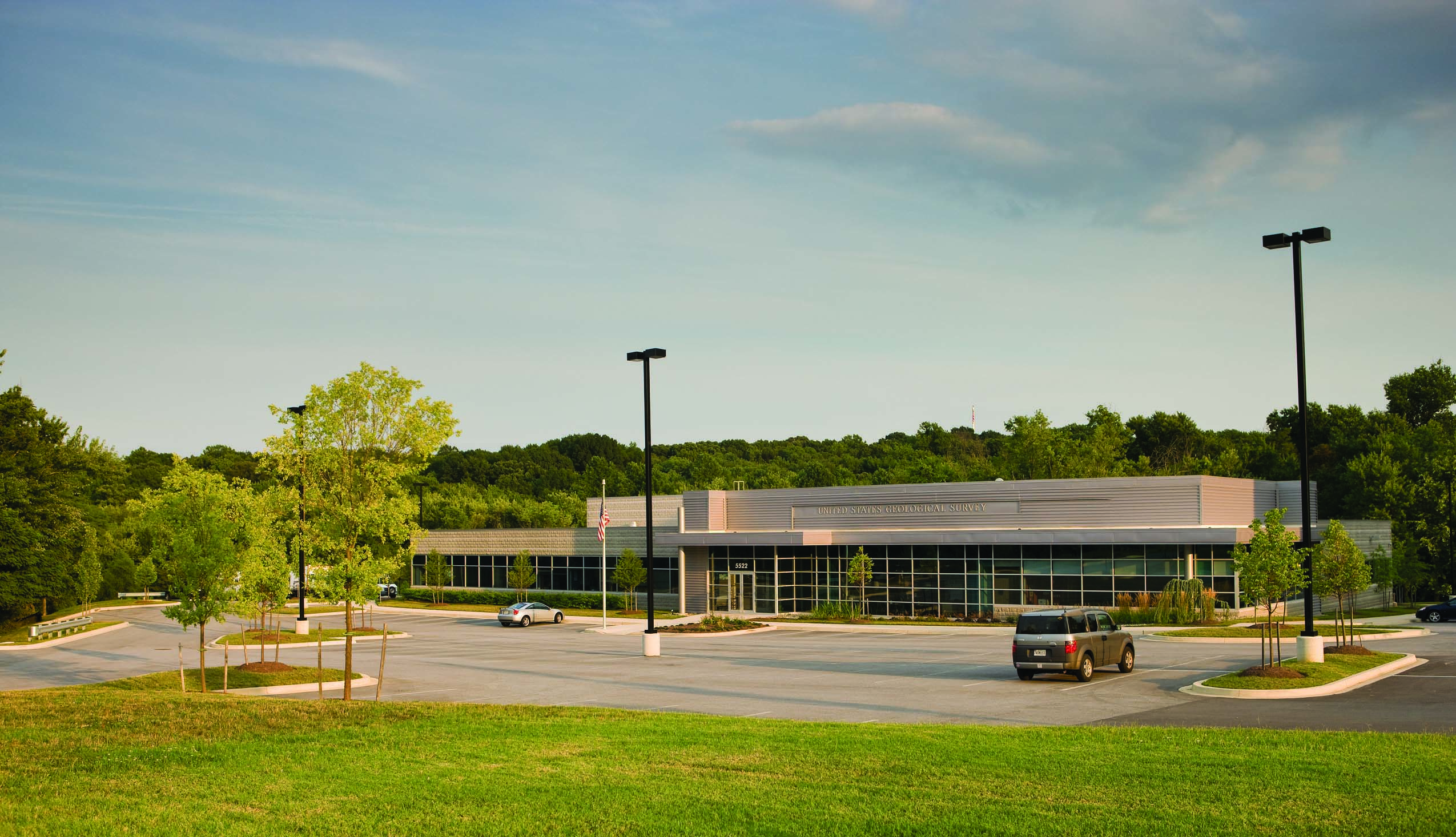
Only a hard-won compromise between the administration, the research park advocates and UMBC faculty finally pushed the project forward. But that compromise has paid dividends: creating space on campus for innovative companies and boosting UMBC’s efforts in environmental research, teaching and sustainability. The university even lured the U.S. Geological Survey to locate a regional water center in the park.
UMBC President Freeman A. Hrabowski, III credits “shared governance” between various campus constituencies as the key to the deal. And the payoff?
“The research park has become a major indicator of the value we bring to this region,” he observes. “The CERA is a physical representation of our interest in the environment. And it’s also a great research space.”
Growing the University
When former UMBC President Michael Hooker died in 1999, the Baltimore Sun observed that “he laid the philosophical foundation for [Maryland’s] current drive to marry academic research and economic development.”
The university research park proposed by Hooker in the late 1980s was designed to be a tangible sign of that marriage. The proposal called for 12 new buildings to be built on 94 acres of land just south of UMBC’s campus. “Michael Hooker understood well that major research universities play a significant role in the economies of the regions in which they reside,” says Hrabowski. “We had strengths here that could be used to do that.”
 BWTtch Research Park
The project was also meant to signal UMBC’s growth and maturity, adds Hrabowski. “We needed to be viewed by the state as a major research university,” he says. “We were still evolving, and it was very important to show what we could do.”
When Hooker left UMBC in 1992 to head the University of Massachusetts system, however, ground had not yet been broken on the project.
As UMBC’s new president, Hrabowski inherited not only the vision, but also considerable vitriol. Some residents in nearby communities vocally opposed the project for a number of reasons. UMBC was big enough already, some argued. Others cited wetlands and potentially-sensitive archaeological sites. Still others feared potential health risks associated with industries that might locate in the park.
University officials tried to quell opposition by emphasizing the economic benefits to the region. They also insisted that strong covenants were in place to control what sort of companies would populate the park. Unmollified by these efforts, a coalition of local residents eventually filed lawsuits in 1994 and 1996 to block the project altogether.
Skepticism among UMBC faculty members was also an issue confronting the research-park project. Many professors wondered aloud about the park’s potential impact on the environment and on their own research.
“The faculty had legitimate concerns,” recalls Andrew J. Miller, an associate professor of geography and environmental systems who sat on the research park’s board as a faculty representative in the 1990s. “What’s in it for the campus? Will this project lose money?”
A Timely Solution
When Ellen Hemmerly came on board as executive director of the research park in 1995, the proposal was bogged down. In contrast to Hooker’s grand vision, the park itself was comprised of an incubator with two trailers located on campus.
Hemmerly recalls being surprised at opposition to the project and frustrated by the delays. “We thought the project was providing clean and high-paying jobs that were going to rejuvenate the local economy,” she says. A bit of luck helped break the project out of the quagmire. In the process of consolidation following the 1995 merger between aerospace and technology giants Lockheed Corporation and Martin Marietta, a laboratory owned by Martin Marietta just off Gun Road and close to UMBC’s campus came onto the market in late 1996.
 BWTtch Research Park
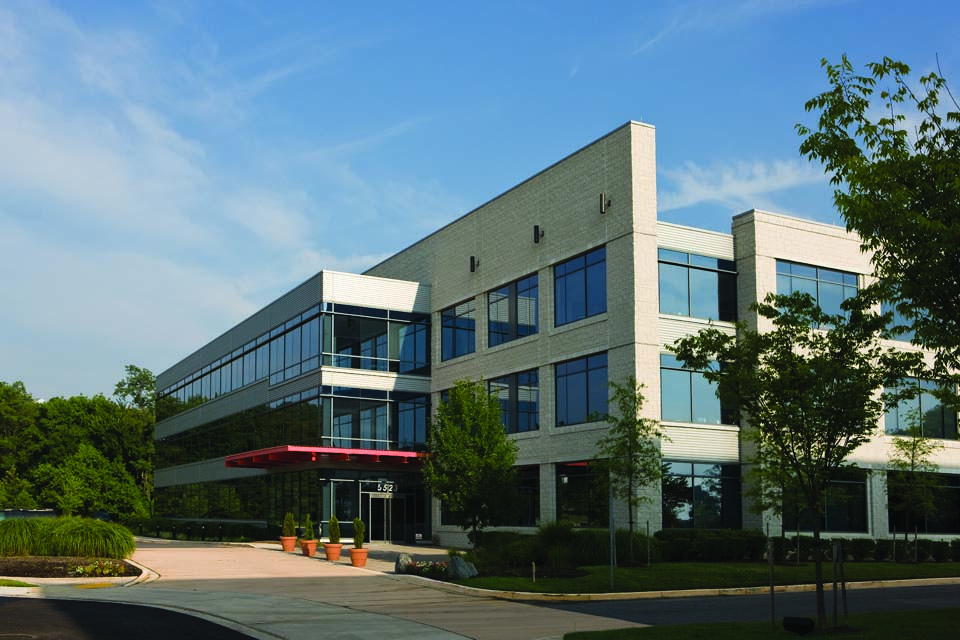
UMBC administrators and the research-park team concluded that the 170,000 square feet of space was a good fit for a number of projects connected with the research park – particularly as an incubator for start-up companies. They worked quickly to make an agreement with officials in Maryland state government: The state would purchase the laboratory and lease it to the university.
Miller says that the deal jump-started the research park. “It was now possible to do some things while the land was being argued about,” he says.
The lease deal also offered an opportunity to scale back the new park’s potential footprint on the contested site south of campus. In March 1996, UMBC administrators announced a new plan for the park that maximized the first of two planned phases and eliminated the second phase altogether.
The new plan – and a subsequent emendation made in the process of settling legal action brought by off-campus opponents – ultimately cut the project size roughly in half: five buildings on 20-plus acres of land. “The university just felt: ‘Look, it’s becoming an issue on campus,’” says Hemmerly. “When Martin Marietta came up for sale, it made it really easy to say, ‘Let’s maximize Phase One. Let’s move on. Let’s put this behind us.’”
Green Synergies
As the university scaled down its own plan and ramped up its new laboratory site, a number of UMBC faculty members also had been pondering how the research park fit into their vision of the campus. Would there be true synergy between scholarly research and the companies at the park? And where did the environment fit into the vision?
In late 1994, the university’s Committee on University Priorities created a subcommittee on campus environment, co-chaired by Robert Burchard, now an emeritus professor of biological sciences, and Patricia La Noue, director of UMBC’s interdisciplinary studies program, to weigh in on these issues.
 BWTtch Research Park
La Noue tackled similar questions with her students in a Fall 1995 seminar examining various approaches to the planning and creation of a campus greenway. The class had a tangible result: The creation of the Herbert Run Greenway, which connects various green spaces on campus, including what is now the Beuys Sculpture Garden and the land that would eventually become the CERA.
La Noue recalls that the seminar was also concerned with larger questions: “What is a stewardship ethic? How do we use our space?”
Sandy Parker, now the chairman of the geography and environmental systems department, was thinking along the same lines. And as UMBC announced its revised plan, Parker developed a proposal to create a new entity for research and teaching on the unused acreage in concert with a working group on the Campus Environment Committee and the Faculty Senate.
Drawing on a series of master plans for the university that envisioned the “protection of natural woods,” Parker’s proposal noted that the area offered “a wide range of research and teaching opportunities for faculty and students alike.” Equally important, the CERA would also encompass archaeologically sensitive sites – including pre-Columbian sites – that had sparked opposition on-and-off-campus.
Parker recalls that when the university revised its plans, “suddenly the landscape snapped into focus… I wrote the proposal and put it forward as a quid pro quo strategy.”
The pitch for a conservation and environmental research area took little over a year to wind its way to approval by the university. (The Faculty Senate approved it in late 1996.) The CERA was officially dedicated at a ceremony in front of the Albin O. Kuhn Library on April 28, 1997.
Almost five more years and settlement of remaining lawsuits passed before the RWD Applied Technology Laboratory became the first building to open in the new bwtech@UMBC Research and Technology Park in March 2002. Despite more than a decade between vision and reality, UMBC was still the first university in Maryland to successfully construct its own research park.
The agreement to create the CERA was a key moment in making the research park a reality. “The compromise did make it so that people on campus felt more comfortable with [the research park],” recalls Miller. “We had positives on both sides.”
Surveying the Ground
The new walkway allows easier pedestrian access to both the research park and to green spaces that many on campus point to as favorite places for getting away from it all.
Burchard observes that in the CERA, “you hardly know that you’re on a major university campus just off I-95.” But the space is not just a place to get away. Indeed, there are signs of a growing synergy between the two entities at the heart of the compromise.
Hemmerly touts the fact that bwtech@UMBC Research and Technology Park is increasingly seeking companies that are developing new green technologies. The park has concluded an agreement with the Maryland Clean Energy Center to create the state’s first Clean Energy Technology Incubator.
The university’s winning bid for the U.S. Geological Survey regional water science center (which covers Maryland, Delaware and the District of Columbia) to relocate into the research park in 2006 is even more compelling evidence.
Miller and Claire Welty, a professor of civil and environmental engineering and the director of UMBC’s Center for Urban Environmental Research and Education, were the prime movers behind bringing the center to UMBC as a spur to research and teaching.
“The presence of USGS alone makes everything else worthwhile,” Miller says.
Miller and others also point to the CERA’s use as a “teaching landscape” and a place where vital research in a range of disciplines can be done. For instance, Kevin E. Omland, an associate professor of biological sciences at UMBC, has conducted his research on Baltimore and orchard orioles in the vicinity.
Looking back, Hrabowski observes that the successful compromise highlighted some of UMBC’s best qualities. “We listened carefully, worked through the challenges and came to a point where we said: ‘We can do this. We can handle both sets of opportunities involving companies and involving the environment.’”
]]>
How a decade-long battle over bwtech@UMBC Research and Technology Park created a thriving link between campus and business and a dedicated green space for research and teaching. By Richard Byrne...
https://umbc.edu/stories/the-best-of-both-worlds/
https://dev.my.umbc.edu/api/v0/pixel/news/124949/guest@my.umbc.edu/005c8b4436bf23911b123d1773c97652/api/pixel
fall-2009
stories
UMBC News & Magazine
https://dev.my.umbc.edu/groups/umbc-news-magazine
https://assets1-dev.my.umbc.edu/system/shared/avatars/groups/000/001/943/24435aa6207c452e7bc15cc74b42c7bb/xsmall.png?1748556657
https://assets1-dev.my.umbc.edu/system/shared/avatars/groups/000/001/943/24435aa6207c452e7bc15cc74b42c7bb/original.png?1748556657
https://assets2-dev.my.umbc.edu/system/shared/avatars/groups/000/001/943/24435aa6207c452e7bc15cc74b42c7bb/xxlarge.png?1748556657
https://assets2-dev.my.umbc.edu/system/shared/avatars/groups/000/001/943/24435aa6207c452e7bc15cc74b42c7bb/xlarge.png?1748556657
https://assets3-dev.my.umbc.edu/system/shared/avatars/groups/000/001/943/24435aa6207c452e7bc15cc74b42c7bb/large.png?1748556657
https://assets1-dev.my.umbc.edu/system/shared/avatars/groups/000/001/943/24435aa6207c452e7bc15cc74b42c7bb/medium.png?1748556657
https://assets2-dev.my.umbc.edu/system/shared/avatars/groups/000/001/943/24435aa6207c452e7bc15cc74b42c7bb/small.png?1748556657
https://assets1-dev.my.umbc.edu/system/shared/avatars/groups/000/001/943/24435aa6207c452e7bc15cc74b42c7bb/xsmall.png?1748556657
https://assets2-dev.my.umbc.edu/system/shared/avatars/groups/000/001/943/24435aa6207c452e7bc15cc74b42c7bb/xxsmall.png?1748556657
UMBC News & Magazine
0
0
false
Sun, 20 Sep 2009 19:13:15 -0400
The News – Fall 2009
Top Dawgs
“We’re Number One! We’re Number One!”
It isn’t often that UMBC President Freeman A. Hrabowski, III’s “State of the University” address is interrupted by an impromptu chant. But this year’s speech – given on Aug. 20 – was something different. Local media flocked to cover the address, and the crowd packed into the University Center was bursting with school spirit.

The press attention and pride was in response to news that the editors of U.S.News & World Report’s “America’s Best Colleges” guide had released only hours before: UMBC was ranked in the top spot for national universities in the guide’s “Up-and-Coming Schools.”
UMBC was also the top-ranked public university in a separate measure of schools showing “unusual commitment to undergraduate teaching” that placed only Dartmouth, Princeton and Yale Universities above the Retrievers in the tally. (Stanford was tied with UMBC.)
The U.S. News guide is one of the most influential such publications in higher education – a resource for parents and potential applicants. UMBC’s recognition “speaks volumes about how the country is looking at our progress,” Hrabowski said. UMBC already had placed fifth in the “Up-and-Coming” category in 2009.
UMBC also was named with 20 other universities as a “Program to Look For” in the category of “Undergraduate Research/Creative Projects.”
Hrabowski noted that the prestigious U.S. News rankings sent a strong message to alumni, philanthropists and politicians: “When you give us the resources we need, we can do great things.”
For more information about the U.S. News rankings, visit www.umbc.edu/bestcolleges.
— Richard Byrne ’86
Exceptional Alumni
UMBC’s alumni excel in a wide range of fields – and in service to the community and the university. That achievement is recognized every year in a very tangible way: UMBC’s Outstanding Alumni of the Year Awards.
In 2009, a committee comprising members of UMBC’s Alumni Board of Directors picked seven award winners whose career success and service make them exceptional examples of what the university can produce.
• James P. Clements ’85, computer science, and ’91 M.S. and ’93 Ph.D., operations analysis, president of West Virginia University, is the Engineering and Information Technology Alumnus of the Year (Clements was profiled in the Summer 2009 UMBC Magazine).
• Jeffrey “Duff” Goldman ’97, history, star of Food Network’s Ace of Cakes, is the Humanities Alumnus of the Year.
• Crystal Watkins ’95, biological sciences, a researcher at The Johns Hopkins Medical Institutes, is the Alumna of the Year in Natural and Mathematical Sciences.
• Delegate Jon Cardin ’96, M.P.S., policy sciences, a member of Maryland’s House of Delegates, is the Social Science Alumnus of the Year.
• Laura Pasquini ’98, visual arts, director of community programs at the Corcoran Gallery of Art, is the Visual Arts Alumna of the Year.
• Gustavo Matheus ’90, biological sciences, is the recipient of the Distinguished Service Award. (See profile on page 41.)
• Alicia Wilson ’04, political science, the first UMBC student to win the prestigious Truman Scholarship, is the recipient of the award: The Alumni Association’s new “Rising Star” Award.
For more information about these Exceptional Alumni, visit http://retrievernet.umbc.edu/alumawards.
— Richard Byrne ’86
Ladies First
For the first time in UMBC history, three female students hold the top leadership positions on campus. But Yasmin Karimian ’11 (Student Government Association president), Jen Kent ’11 (SGA vice president) and Gaby Arevalo ’10 (Retriever Weekly Editor) care much more about the tasks ahead of them than any history that they’ve made.
“While I think it’s wonderful that Yasmin, Jen and I are all women and minorities,” says Arevalo, “that isn’t what we’re known for. We’re known for the positions we hold, not for our backgrounds or gender.”
Karimian and Kent are the first female duo in the SGA in the group’s history. But they had no idea they were in a position to achieve that distinction until after turning in their applications to run. Both officers point to generational changes as a reason for their success.
“We’ve been fortunate enough to have grown up in a generation where female leadership is encouraged, and the idea of gender equality is second nature,” says Kent.
While all three women feel lucky to be at a school where it’s not uncommon for women and minorities to hold leadership positions, they also acknowledge that it wasn’t always so common for those who came before them. “We take for granted the support we receive by being women and being able to hold these positions without skeptics surrounding us,” says Karimian. “That certainly was not the case for some of our predecessors, like the first female SGA President, Lisa Dickerson.”
Dickerson ’78, political science (who was profiled in the Winter 2009 UMBC Magazine) gave a speech at the SGA Inauguration in Spring 2009 and noted the struggles she faced 32 years ago.
“I have had the most incredible role models in my two years here, and they shared everything they knew and gave me all the opportunities they could so I would one day be able to serve as SGA president. I hope to do the same for someone else,” says Karimian.
— B. Rose Huber
Co-Creating Campus Citizenry
“Students’ power to create the campus life they want hinges on being able to pull together and express a reasonably unified point of view. When you have student leaders elected in a high-turnout election, the people to whom they speak on behalf of students – campus administrators, public officials and others – know they have to listen. If you don’t vote, you actively make it harder for next year’s SGA to accomplish anything on your behalf.”
When David Hoffman posts on his blog, Co-Create UMBC, about issues that concern students and their role at the university, they (and many others on campus) read and respond.
Hoffman is the assistant director of Student Life for Civic Agency at UMBC, which endeavors to enlarge student participation and empowerment at the university.
He says that Co-Create UMBC is part of a larger effort “to saturate the UMBC environment with opportunities and messages that suggest to students that they have power here. And that being a citizen isn’t just a matter of casting a vote every couple of years. It’s a state of mind that you’re in all the time.”
Hoffman says that the blog gets roughly 1300 hits every week, a number that increased from 600 after the content started to stream from the university’s myUMBC site.
The posts on Co-Create UMBC include candid anecdotes about his own time as a student leader at the University of California, Los Angeles (part of his job at UMBC is to advise the Student Government Association) and a feature drawn from statistics about campus life. (Example: “2 = Number of times UMBC has been closed for an entire day due to snow in the past four years.”)
“‘UMBC by the Numbers’ is an attempt to start a conversation,” he says. “Things that just might wash over you if you see yourself as a customer and not a citizen.”
— Richard Byrne ’86
]]>
Top Dawgs “We’re Number One! We’re Number One!” It isn’t often that UMBC President Freeman A. Hrabowski, III’s “State of the University” address is interrupted by an impromptu chant. But this...
https://umbc.edu/stories/the-news-fall-2009/
https://dev.my.umbc.edu/api/v0/pixel/news/124950/guest@my.umbc.edu/62c09c34e591be44ad257d84048a8a7d/api/pixel
fall-2009
stories
UMBC News & Magazine
https://dev.my.umbc.edu/groups/umbc-news-magazine
https://assets1-dev.my.umbc.edu/system/shared/avatars/groups/000/001/943/24435aa6207c452e7bc15cc74b42c7bb/xsmall.png?1748556657
https://assets1-dev.my.umbc.edu/system/shared/avatars/groups/000/001/943/24435aa6207c452e7bc15cc74b42c7bb/original.png?1748556657
https://assets2-dev.my.umbc.edu/system/shared/avatars/groups/000/001/943/24435aa6207c452e7bc15cc74b42c7bb/xxlarge.png?1748556657
https://assets2-dev.my.umbc.edu/system/shared/avatars/groups/000/001/943/24435aa6207c452e7bc15cc74b42c7bb/xlarge.png?1748556657
https://assets3-dev.my.umbc.edu/system/shared/avatars/groups/000/001/943/24435aa6207c452e7bc15cc74b42c7bb/large.png?1748556657
https://assets1-dev.my.umbc.edu/system/shared/avatars/groups/000/001/943/24435aa6207c452e7bc15cc74b42c7bb/medium.png?1748556657
https://assets2-dev.my.umbc.edu/system/shared/avatars/groups/000/001/943/24435aa6207c452e7bc15cc74b42c7bb/small.png?1748556657
https://assets1-dev.my.umbc.edu/system/shared/avatars/groups/000/001/943/24435aa6207c452e7bc15cc74b42c7bb/xsmall.png?1748556657
https://assets2-dev.my.umbc.edu/system/shared/avatars/groups/000/001/943/24435aa6207c452e7bc15cc74b42c7bb/xxsmall.png?1748556657
UMBC News & Magazine
0
0
false
Sun, 20 Sep 2009 19:09:57 -0400
The Tweet Science

UMBC assistant professor of sociology Zeynep Tufekci investigates how we use Facebook, Twitter and other new social-networking services to define ourselves.
By Joab Jackson ’90
Illustration by Michael Glenwood
UMBC assistant professor of sociology Zeynep Tufekci is not a big fan of technology for its own sake. But if a new electronic gadget helps her get through the day more easily, she is all for it.
Take the baby rocker, for instance. She loves this device. On a summer day at home on maternity leave, Tufekci replaces the hulking C batteries of a pendulous crib that gently rocks her seven-week-old boy to sleep. Babies enjoy an easy back-and-forth motion when sleeping – the rhythmic lull reminds the infant of comfort of the womb. This crib creates a few minutes of space for Tufekci to attend to other matters.

The best technology not only solves human problems, but it can actually change our world – sometimes in ways we don’t fully recognize. And Tufekci has become one of the country’s most called-upon academic experts in explaining how new technologies of social networking—such as Facebook and Twitter—are changing the way we live. She has been interviewed by the New York Times, the Philadelphia Inquirer and other media outlets about the topic.
Although the term “social networking” is relatively new, the concept has been around since at least the 1980s, when people found that bulletin-board systems (which were nothing more than personal computers that other computers could dial into) provided a virtual meeting ground for exchanging messages, jokes, photos, recipes and anything else of interest.
From those humble beginnings, such virtual spaces are becoming an increasingly large part of our lives. Facebook alone reports having over 200 million users. And these spaces have impacts on external events. In June, thousands of disgruntled Iranians logged onto Twitter, another popular service that allows users to post 140-character messages for others to see, to protest the outcome of their presidential election. The cumulative effect of the angry and informative bursts of information from Tehran and elsewhere in the country not only brought more global news coverage to the election, but also helped protestors evade disruptions of mobile telephones and other messaging services by the government .
“People wonder why these technologies spread so much,” Tufekci says. “It’s kind of like asking: ‘Why do people like foods that are high in salt and sugar?’ Being deeply social is part of being human. It is part of your biology.”
Limits to the Digital Self
Researchers theorize that the average person can, at most, maintain cognitive relationships with about 150 people. Not surprisingly, then, the average number of the people who are “friended” in a typical Facebook user account is about 120, according to the company that runs the service.
Tufekci studies how social networking blurs the boundaries between public and private spaces, a topic she came across almost by accident, thanks to a group of students who “took a short cut they shouldn’t have,” she says.

In an introduction to a sociology class she taught, five students turned in sheets to a quiz with identical handwriting. When she confronted the students about it, they all swore that they didn’t know each other. She already knew they were acquaintances, however, even if they didn’t sit together in class. Each of their Facebook profiles had listed the others as friends. Eventually, they ’fessed up.
After Tufekci disciplined the students involved in the incident, she reflected at greater length on the interaction. “What got me really interested was the fact that these were very smart students, but they did not figure out that their Facebook profile was public,” she says. “I saw that these students are conceptualizing Facebook as a private place, but it is potentially a very public space.”
Tufekci found this peculiar conflation of private and public in digital space revealing. She argues that social networks are a natural extension of our social lives – albeit with some subtle but important differences. When the use of the Internet first became widespread in the mid-1990s, many assumed that users would adopt new roles online, expanding beyond the confines of their physical selves. “On the Internet, nobody knows you’re a dog,” was the caption of a famous New Yorker cartoon of the time.
But this perception that one has the ability to create a new self online largely hasn’t turned out to be the case. Most people use the Internet in general, and social networks in particular, as an extension of their lives, rather than as an alternative to them. “They want to do mundane things. They want to do people things,” she says.
Sam Gosling, an associate professor of sociology at the University of Texas at Austin who also studies social media, agrees with Tufekci. Social media, he observes, “is kind of like the telephone. It’s a new technology for expressing the sorts of things we need to do anyway.”
A Slippery Space
Nonetheless, such online social gathering spots can differ from our normal meeting places, such as a friend’s house or a restaurant, in subtle ways that most users don’t fully appreciate. This disparity in perceptions is what Tufekci’s work centers upon.
In a study published last year in the Bulletin of Science, Technology & Society, Tufekci examined the actions and perceptions of 704 college students who used Facebook. A peculiar conundrum emerged: Many students expressed privacy concerns about posting information in a public forum. Yet their concerns did not inhibit them from posting a great deal of revealing information about themselves – including their relationship status, their birth date and their cellular telephone numbers.

What are the dangers of having such information out there? In the real world, two individuals may meet and have a conversation. Both people see each other and the conversation fades into their memories. We traditionally think of this interaction as a private conversation. With social-networking sites, however, those same words can be preserved for the ages, and they are available for others to see.
“Usually intimate interactions are in closed space, and public spaces are civic stuff and they are not intimate. Here we have intimate stuff that is public,” Tufekci says. This “collapsing of the boundaries and conflating of characteristics of private and public spaces” can muddy the way people think about how to use such spaces, such as underestimating how many people will actually see that photo of late-night merriment that you posted only for a few friends.
“I’m a big fan of her work,” says Timothy Finin, a professor in UMBC’s Computer Science and Electrical Engineering Department who studies ways to bridge machine languages and human languages. “We’ve developed an understanding about information-sharing based on the physical world. And a lot of those same intuitions don’t apply to the virtual world, and that’s where people can run into problems.”
Talking about Tufekci’s work, Finin is reminded of something called the Wason Selection Task, in which sociologist Peter Wason showed that people may use a different part of their brains for thinking about social rules than they do for solving abstract problems. “Maybe, while on the Internet, you do most of the thinking with your [logical] part of the brain you use with the computers, and not the social part,” Finin says.
Computer Science to Social Science
Tufekci is no stranger to large, sprawling communities. She grew up in Istanbul, which, with about 12 million residents, is the fourth largest city in the world by most estimates. She actually started her career not in sociology, but in computer programming. But she found herself more fascinated by the social effects of technology than with the minutiae of the C programming language.
After taking a Ph.D. at the University of Texas at Austin in 2004, Tufekci studied the effects of technology on low-income people. As part of her research, she followed a group of people going through a computer-skills training program that held out the promise of high-paying jobs upon the completion of the courses.

“That was a time when people were saying that the Internet would solve everything for everyone,” Tufekci says. “I found it was not so great for people, especially if you are low-income and available jobs are being automated and outsourced.”
Tufekci’s work spans multiple disciplines – sociology, social psychology, computer science, psychology, anthropology and communications. “My work doesn’t fit into an existing discipline. It’s fairly grounded in sociology, but it has been very interdisciplinary,” she says.
Gosling observes that Tufekci’s work is “dispersed over many disciplines, many of which have difficulty talking with each other.”
UMBC has been instrumental in helping Tufekci follow this emerging field of study. When she was in the academic job market, she wanted to find a university that was open to her pursuit of a multi-disciplinary approach.
Surprisingly, such schools were hard to locate. While many hiring committees voiced appreciation for the benefits of studying across departmental lines, they were shyer about hiring such a wandering academic.
At UMBC, however, Tufekci says that she found kindred spirits.
“They hired me knowing that I would be cutting across different disciplines,” she says.
It would be a mistake to dismiss social-networking services as a fad. MySpace and Facebook are this year’s popular virtual destinations for many, and their influence may fade within a few years, but chances are they will replaced by other services. Social-networking services have gained their present popularity by reflecting both innate human behaviors and contemporary trends.
By and large, the Internet started out as a male-dominated domain. But in another 2008 study, published in Information, Communication & Society, Tufekci found that the gap has closed. More women than men whom she studied used Facebook, by a slim margin. “What this showed was that if you have the kind of application that is appealing to women, then they are perfectly willing to adopt it,” she says.
In the same study, Tufekci also found that the difference of how men and women used social-networking services reflected traditional gender roles. Men would use services as a search mechanism for finding things on the Internet. (“What they were searching for, we never found out,” Tufekci jokes.)
Women, by contrast, use such services to connect with existing friends. “I thought this is so stereotypical. You think we’re past that – but apparently not,” she says.
At present, Tufekci is working up an academic review that she hopes will explain how social networks fit in the larger picture of how people have traditionally related to one another. For Tufekci, the use of social-networking services represents a return, in at least some aspects, to a time when we lived in smaller and more close-knit communities.
Only in the past 150 years or so have the vast majority of people left their villages to live and work in larger cities, she notes. Such moves to larger urban centers have brought about a sense of isolation and even alienation, to judge from popular analysis from books such as 1950’s Lonely in the Crowd (written by David Riesman, Nathan Glazer and Reuel Denney) and 1956’s The Organization Man (William Whyte). In many ways, the social-networking sites are returning elements of this older way of living to us, for better and for worse.
“That is the kind of environment our species has lived in for the past 100,000 years,” Tufekci says. “We’re not going back to the village, but we’re bringing back some of its aspects. I want to explain why this is an important development in human history. The questions on the table are not trivial.”
Find UMBC Alumni On Facebook.
]]>
UMBC assistant professor of sociology Zeynep Tufekci investigates how we use Facebook, Twitter and other new social-networking services to define ourselves. By Joab Jackson ’90 Illustration by...
https://umbc.edu/stories/the-tweet-science-2/
https://dev.my.umbc.edu/api/v0/pixel/news/124951/guest@my.umbc.edu/7c72ab5d1b3ad6d3e3c5a0c5b3f8c58a/api/pixel
fall-2009
stories
UMBC News & Magazine
https://dev.my.umbc.edu/groups/umbc-news-magazine
https://assets1-dev.my.umbc.edu/system/shared/avatars/groups/000/001/943/24435aa6207c452e7bc15cc74b42c7bb/xsmall.png?1748556657
https://assets1-dev.my.umbc.edu/system/shared/avatars/groups/000/001/943/24435aa6207c452e7bc15cc74b42c7bb/original.png?1748556657
https://assets2-dev.my.umbc.edu/system/shared/avatars/groups/000/001/943/24435aa6207c452e7bc15cc74b42c7bb/xxlarge.png?1748556657
https://assets2-dev.my.umbc.edu/system/shared/avatars/groups/000/001/943/24435aa6207c452e7bc15cc74b42c7bb/xlarge.png?1748556657
https://assets3-dev.my.umbc.edu/system/shared/avatars/groups/000/001/943/24435aa6207c452e7bc15cc74b42c7bb/large.png?1748556657
https://assets1-dev.my.umbc.edu/system/shared/avatars/groups/000/001/943/24435aa6207c452e7bc15cc74b42c7bb/medium.png?1748556657
https://assets2-dev.my.umbc.edu/system/shared/avatars/groups/000/001/943/24435aa6207c452e7bc15cc74b42c7bb/small.png?1748556657
https://assets1-dev.my.umbc.edu/system/shared/avatars/groups/000/001/943/24435aa6207c452e7bc15cc74b42c7bb/xsmall.png?1748556657
https://assets2-dev.my.umbc.edu/system/shared/avatars/groups/000/001/943/24435aa6207c452e7bc15cc74b42c7bb/xxsmall.png?1748556657
UMBC News & Magazine
0
0
false
Sun, 20 Sep 2009 19:07:29 -0400
To You – Fall 2009
 I am delighted that one of the features in this issue is written by John Strausbaugh ’74, interdisciplinary studies. Strausbaugh has had a successful career in journalism and cultural criticism, and is the author of a string of books that explore fascinating byways of American culture.
But I’m particularly happy to have Strausbaugh in the magazine because I would not have launched my own career without his help. It’s a story that demonstrates the power that alumni have to mentor and shape the careers of those who follow after them.
You might already have recognized the goofy face on the UMBC identification card below. (Though the Social Security number that also served as campus identification back then has been obscured.) I arrived at UMBC in August 1984, having transferred from the University of Pittsburgh, and was interested in becoming a writer.
Thanks to a continuing web of alumni relations between writers and faculty in the English Department in that era, local writers like Strausbaugh (who was writing fiction and involved in local theatre at that time) were often invited back to give readings on campus.
But Strausbaugh’s increasing claim to fame at that moment was his book and music reviewing for Baltimore City Paper – reviews in which he championed his favorites and savaged whatever he thought was inferior.
After a reading that Strausbaugh gave at the English department one semester, we got to chatting about culture. He looked past the big goofy glasses and saw that I might have some future in the journalism game. Not only did Strausbaugh start letting me hang out with him occasionally, but he also eventually brokered a chance for me to break into print at City Paper. My first review – 10,000 Maniacs’ The Wishing Chair – ran in that newspaper in November 1985, while I was still a student at UMBC.
The chance to put clips from City Paper in my portfolio was a great launching pad for my career. I gained a foothold in journalism that eventually took me great places: On tour with Uncle Tupelo. Reporting on media in Bosnia and pop culture and politics in Serbia. Covering national political conventions.
But it happened largely because an alumnus helped out a student. And while it’s a story that no doubt has been repeated thousands of times at UMBC across many disciplines and schools, it’s also a reminder that we, as alumni, can help shape futures by becoming actively involved in the lives of those who attend UMBC after us.
Want an easy way to get started? Sign up to be a Professional Network mentor. The joint effort between UMBC’s Career Services Center and Alumni Relations allows students to connect with professionals in their desired fields. Go to www.careers.umbc.edu to see what it’s all about and sign up.
— Richard Byrne ’86
byrne@umbc.edu
]]>
I am delighted that one of the features in this issue is written by John Strausbaugh ’74, interdisciplinary studies. Strausbaugh has had a successful career in journalism and cultural criticism,...
https://umbc.edu/stories/to-you-fall-2009/
https://dev.my.umbc.edu/api/v0/pixel/news/124952/guest@my.umbc.edu/0545c9282a5557697a017d47b4386d91/api/pixel
fall-2009
stories
UMBC News & Magazine
https://dev.my.umbc.edu/groups/umbc-news-magazine
https://assets1-dev.my.umbc.edu/system/shared/avatars/groups/000/001/943/24435aa6207c452e7bc15cc74b42c7bb/xsmall.png?1748556657
https://assets1-dev.my.umbc.edu/system/shared/avatars/groups/000/001/943/24435aa6207c452e7bc15cc74b42c7bb/original.png?1748556657
https://assets2-dev.my.umbc.edu/system/shared/avatars/groups/000/001/943/24435aa6207c452e7bc15cc74b42c7bb/xxlarge.png?1748556657
https://assets2-dev.my.umbc.edu/system/shared/avatars/groups/000/001/943/24435aa6207c452e7bc15cc74b42c7bb/xlarge.png?1748556657
https://assets3-dev.my.umbc.edu/system/shared/avatars/groups/000/001/943/24435aa6207c452e7bc15cc74b42c7bb/large.png?1748556657
https://assets1-dev.my.umbc.edu/system/shared/avatars/groups/000/001/943/24435aa6207c452e7bc15cc74b42c7bb/medium.png?1748556657
https://assets2-dev.my.umbc.edu/system/shared/avatars/groups/000/001/943/24435aa6207c452e7bc15cc74b42c7bb/small.png?1748556657
https://assets1-dev.my.umbc.edu/system/shared/avatars/groups/000/001/943/24435aa6207c452e7bc15cc74b42c7bb/xsmall.png?1748556657
https://assets2-dev.my.umbc.edu/system/shared/avatars/groups/000/001/943/24435aa6207c452e7bc15cc74b42c7bb/xxsmall.png?1748556657
UMBC News & Magazine
0
0
false
Sun, 20 Sep 2009 19:06:49 -0400
Up On The Roof – Fall 2009
UMBC President Freeman A. Hrabowski, III takes your questions.
Q. What book do you recommend that every young person read before they go out into the “real world?”
— Shivonne L. Laird ’99, biological sciences
A. Right now, I think it’s important for students to be constantly reading. And to read even more when they go into the real world, because life is changing in so many ways.
Now if I were forced to choose a book, I would say Thomas Friedman’s Hot, Flat, and Crowded today. Because it focuses on the need for a green revolution, the impact of technology, the critical role that research on energy will play and the need for innovation and nation-building. It puts America into the global context.
Q. I am impressed by UMBC’s growth, but it seems like the arts are getting the short side of the stick. Are there plans to increase the budget for the arts at UMBC or to expand course and degree offerings in visual arts, theatre, writing and music?
— Maria E. Watters-Mahone ’87, English and M.A. ’00, instructional development systems
A. It’s a great question. The arts and humanities are very much alive here. The fact that we have a new College of Arts, Humanities and Social Sciences (CAHSS) has to do with our continued commitment to build those disciplines. And our number-one capital project – a $150 million facility – is the new performing arts and humanities building for which we have gotten planning funds, and hope to receive construction funds, in order to break ground in 2010.
I spent time today presenting our proposal for construction funds for that facility. And we’ll be spending time every day with legislators and people representing the Governor’s office, about the importance of that building. The fact is that the arts and humanities building, over the next few years, will transform the campus physically and aesthetically.
The development of our Humanities Scholars Program and our Linehan Artist Scholars program is especially significant in attracting high-achieving, talented students in the arts and humanities and getting them support here. Building a community of scholars. And the Dresher Center for Humanities itself is a very strong intellectual initiative on our campus, focusing on research and teaching in the humanities.
More and more is happening in those areas. I invite alumni to come back to some of these activities. And to serve as mentors to our current students.
I’m especially excited about the Kauffman entrepreneurship grant, which is heavily focused in the arts. People expect it to be in economics and engineering – and while those programs are involved, we have a lot of faculty in the arts and the humanities involved in entrepreneurship initiatives, with the thought that we should be preparing students through infusion of entrepreneurship into the curriculum, to be businesspeople. Because if you think about it, when someone starts a photography studio or a dance studio, it is a business that is designed to elevate people culturally, but also to make money. We are being creative about connecting entrepreneurs and the arts.
Q. Aesthetically, where do you think the university will be in five years? What kind of campus should I look forward to seeing when I visit a few years down the line?
— Elan Schnitzer ’06, political science
A. The greening of UMBC. That is our theme. Every time alumni come back, they will see more trees, bigger trees, more shrubbery, more flowers and more initiatives focused on the environment…. An emphasis on making the campus physically and aesthetically appealing to newcomers and alumni as well as faculty, staff and students.
With $400 million in new construction – and with the new arts and humanities building, it will be half a billion – it has been important to focus on the well-being of the environment. I think the biggest difference between the campus today and the campus 20 years ago is grass and trees. We’ve gotten rid of a lot of the concrete and laid down grass. And there are never enough trees. The growth of the trees is symbolic of the growth in the stature of the university itself.
]]>
UMBC President Freeman A. Hrabowski, III takes your questions. Q. What book do you recommend that every young person read before they go out into the “real world?” — Shivonne L. Laird ’99,...
https://umbc.edu/stories/up-on-the-roof-fall-2009/
https://dev.my.umbc.edu/api/v0/pixel/news/124953/guest@my.umbc.edu/ca55a988af19ca70f49b222f6b0b3c2e/api/pixel
fall-2009
stories
UMBC News & Magazine
https://dev.my.umbc.edu/groups/umbc-news-magazine
https://assets1-dev.my.umbc.edu/system/shared/avatars/groups/000/001/943/24435aa6207c452e7bc15cc74b42c7bb/xsmall.png?1748556657
https://assets1-dev.my.umbc.edu/system/shared/avatars/groups/000/001/943/24435aa6207c452e7bc15cc74b42c7bb/original.png?1748556657
https://assets2-dev.my.umbc.edu/system/shared/avatars/groups/000/001/943/24435aa6207c452e7bc15cc74b42c7bb/xxlarge.png?1748556657
https://assets2-dev.my.umbc.edu/system/shared/avatars/groups/000/001/943/24435aa6207c452e7bc15cc74b42c7bb/xlarge.png?1748556657
https://assets3-dev.my.umbc.edu/system/shared/avatars/groups/000/001/943/24435aa6207c452e7bc15cc74b42c7bb/large.png?1748556657
https://assets1-dev.my.umbc.edu/system/shared/avatars/groups/000/001/943/24435aa6207c452e7bc15cc74b42c7bb/medium.png?1748556657
https://assets2-dev.my.umbc.edu/system/shared/avatars/groups/000/001/943/24435aa6207c452e7bc15cc74b42c7bb/small.png?1748556657
https://assets1-dev.my.umbc.edu/system/shared/avatars/groups/000/001/943/24435aa6207c452e7bc15cc74b42c7bb/xsmall.png?1748556657
https://assets2-dev.my.umbc.edu/system/shared/avatars/groups/000/001/943/24435aa6207c452e7bc15cc74b42c7bb/xxsmall.png?1748556657
UMBC News & Magazine
0
0
false
Sun, 20 Sep 2009 19:05:23 -0400
Venus, If You Will – Deborah Randall ’94, Theatre
Many theatre companies are born out of a mixture of inspiration and frustration. Take The Venus Theatre in Laurel, for instance.
When its founder, Deborah Randall ’94, theatre, graduated from UMBC, she pursued a career as a playwright and a performer in Washington, D.C. Like many recent graduates, Randall had a desire to succeed in a challenging profession. But she also found some of the roles she played and the theatrical atmosphere that surrounded her to be stifling her creativity. She craved a theatre that valued women and living playwrights.
Randall recalls UMBC theatre professor Wendy Salkind’s advice to her. “Every time I would gripe to her,” Randall recalls, “she’d say: If it doesn’t exist, create it. That was her mantra to me.”
The theatre company that Randall founded in 2001 is dedicated to filling what she sees as a gap in the Baltimore-Washington region, presenting shows with a decidedly female perspective and recent work by contemporary playwrights.
The company is in the middle of its current season, which features new plays that include a fresh look at the experience of women characters in Shakespeare and a contemporary retelling of Medea set in Los Angeles. The series concludes this coming fall with a new World War II memory play called Why’d You Make Me Wear This, Joe? by acclaimed writer Vanda and a comedic look at a very difficult Helen of Troy in a new play called Helen of Sparta.
Randall says that the emphasis on new work – especially by women playwrights – is important to her. A steady cultural diet of reality television and revisiting the classical repertoire, she observes, has meant that “there are so many writers who are not getting an opportunity.”
Finding and nurturing new work, she says, “is part of the life of the theatre…. Finding the pulse in a new work is kind of what I wake up in the morning to do.”
Creating what ultimately became Venus Theatre took time, however. Randall started small, crafting one-woman shows for herself that played in various venues in Washington, D.C. She also started a reading series for women writers and tried her hand at children’s theatre before settling on more adult fare.
After a series of misadventures and mishaps, including one show that had its last week in a D.C. theater interrupted by a street explosion that rendered the space unusable, Randall decided that she needed to find a more permanent home.
The constant scrapping and hustling for space to rent “was not cute anymore,” says Randall, especially after the street explosion. After a long search, she finally settled on a storefront space just off Laurel’s Main Street, which she dubbed “The Venus Theatre Play Shack.” She and a dedicated crew of volunteers transformed the place into a black box theater that’s become a new home base for the company, perched halfway between Washington and Baltimore and drawing from both cities and the surrounding community.
Randall recalls her time at UMBC fondly. “I was a nontraditional student,” she says. “So I was a few years older than everyone else. I had been to community college, worked for three years, sown some wild oats…. I wanted to squeeze everything I could out of the experience.”
Along with Salkind, she counts professors Xerxes Mehta and Alan Kreizenbeck as influences on her current career path. Randall also recalls that her roles in a production of Peter Weiss’ Marat/Sade (directed by Mehta) and in Cinders – a play by Polish playwright Janusz Glowack, directed by Kreizenbeck – were particularly memorable.
Though Randall still writes plays (one of her works, Molly Daughter, is included in Anthracite! An Anthology of Pennsylvania Coal Region Plays, which was published by the University of Scranton Press), she says that she “has ended up more of a producer and a director than a writer and actor anymore.” Running a theatre company also involves a lot of logistics and fundraising.
But Randall’s commitment to helping produce new works by playwrights – especially women playwrights – remains a primary challenge that she’s happy to take on. With the classics, she observes, “all the kinks have been worked out in a way.” New work, she says, is where the sizzle and satisfaction is.
“If it has been done too often,” she says, “it doesn’t interest me.”
— Richard Byrne ’86
For more information about Venus Playhouse, visit http://www.venustheatre.org/.
]]>
Many theatre companies are born out of a mixture of inspiration and frustration. Take The Venus Theatre in Laurel, for instance. When its founder, Deborah Randall ’94, theatre, graduated from...
https://umbc.edu/stories/venus-if-you-will-deborah-randall-94-theatre/
https://dev.my.umbc.edu/api/v0/pixel/news/124954/guest@my.umbc.edu/88dde59e6923ede0049405b9286d1cee/api/pixel
fall-2009
stories
UMBC News & Magazine
https://dev.my.umbc.edu/groups/umbc-news-magazine
https://assets1-dev.my.umbc.edu/system/shared/avatars/groups/000/001/943/24435aa6207c452e7bc15cc74b42c7bb/xsmall.png?1748556657
https://assets1-dev.my.umbc.edu/system/shared/avatars/groups/000/001/943/24435aa6207c452e7bc15cc74b42c7bb/original.png?1748556657
https://assets2-dev.my.umbc.edu/system/shared/avatars/groups/000/001/943/24435aa6207c452e7bc15cc74b42c7bb/xxlarge.png?1748556657
https://assets2-dev.my.umbc.edu/system/shared/avatars/groups/000/001/943/24435aa6207c452e7bc15cc74b42c7bb/xlarge.png?1748556657
https://assets3-dev.my.umbc.edu/system/shared/avatars/groups/000/001/943/24435aa6207c452e7bc15cc74b42c7bb/large.png?1748556657
https://assets1-dev.my.umbc.edu/system/shared/avatars/groups/000/001/943/24435aa6207c452e7bc15cc74b42c7bb/medium.png?1748556657
https://assets2-dev.my.umbc.edu/system/shared/avatars/groups/000/001/943/24435aa6207c452e7bc15cc74b42c7bb/small.png?1748556657
https://assets1-dev.my.umbc.edu/system/shared/avatars/groups/000/001/943/24435aa6207c452e7bc15cc74b42c7bb/xsmall.png?1748556657
https://assets2-dev.my.umbc.edu/system/shared/avatars/groups/000/001/943/24435aa6207c452e7bc15cc74b42c7bb/xxsmall.png?1748556657
UMBC News & Magazine
0
0
false
Sun, 20 Sep 2009 19:00:35 -0400