On the fourth floor of UMBC’s Meyerhoff Chemistry Building, where students are hard at work exploring the intricacies of RNA molecules that may hold the key to combating viral diseases, a unique family tradition has taken root. Three sisters—Huda, Reem, and Rowah Abdelghani—have each stepped into the same research space and found the thrill of discovery, the warmth of community, and a mentor who welcomes eager learners at all levels.
It began with Huda, the trailblazing eldest of the three sisters. As a high school junior in Howard County’s Applications and Research Laboratory (ARL) biotechnology program, she dove into the program’s intensive training—mastering lab basics like micropipetting, PCR, and gel electrophoresis alongside students from across the county. ARL encourages seniors to pursue off-site internships, so Huda cold-emailed labs at nearby universities. “It was tough,” she recalls. “Some of my friends emailed over 30 people before finding a spot. I got lucky with Dr. Koirala.”

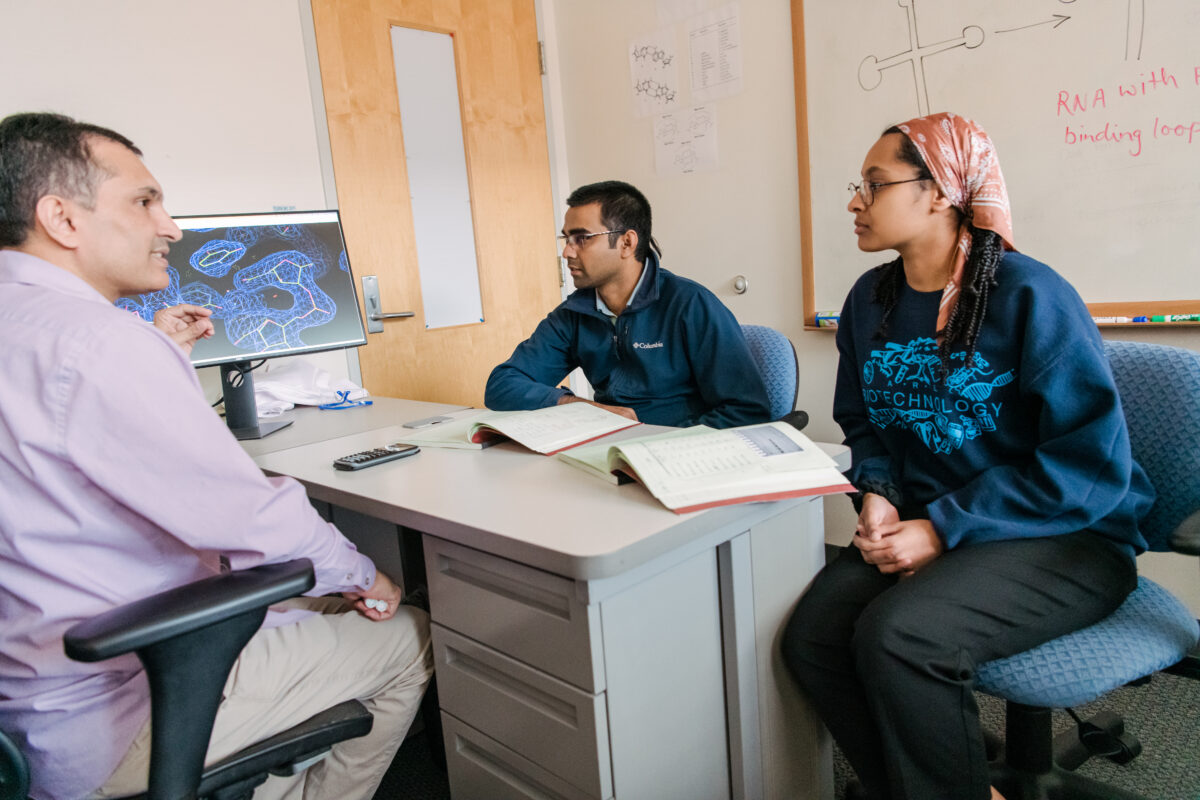 Huda Abdelghani (left) was the first of her three sisters to work in Deepak Koirala’s lab through Howard County’s Applications and Research Laboratory program. At right: Deepak Koirala (left), Naba Krishna Das (center), and Huda Abdelghani discuss their research in Koirala’s office. (Photos by Marlayna Demond ’11/UMBC)
Skills that apply everywhere
Deepak Koirala, associate professor of chemistry and biochemistry, leads a UMBC research group that studies the structures of RNA in enteroviruses—a family of pathogens behind illnesses like hand-foot-and-mouth disease, polio, and myocarditis. Huda joined in the summer of 2022 and stayed through spring 2023. Mentored by a Ph.D. student in the lab, Hasan Al Banna, she quickly learned that scientific research frequently involves failure—but that’s no reason to give up.
“You can do everything right and still not get results,” she says. “It’s not personal—that’s just science.” This lesson in perseverance stuck with her, as did Koirala’s individualized attention. When her graduate student mentor was away, he spent hours helping her set up trays of crystallization plates for her experiments.
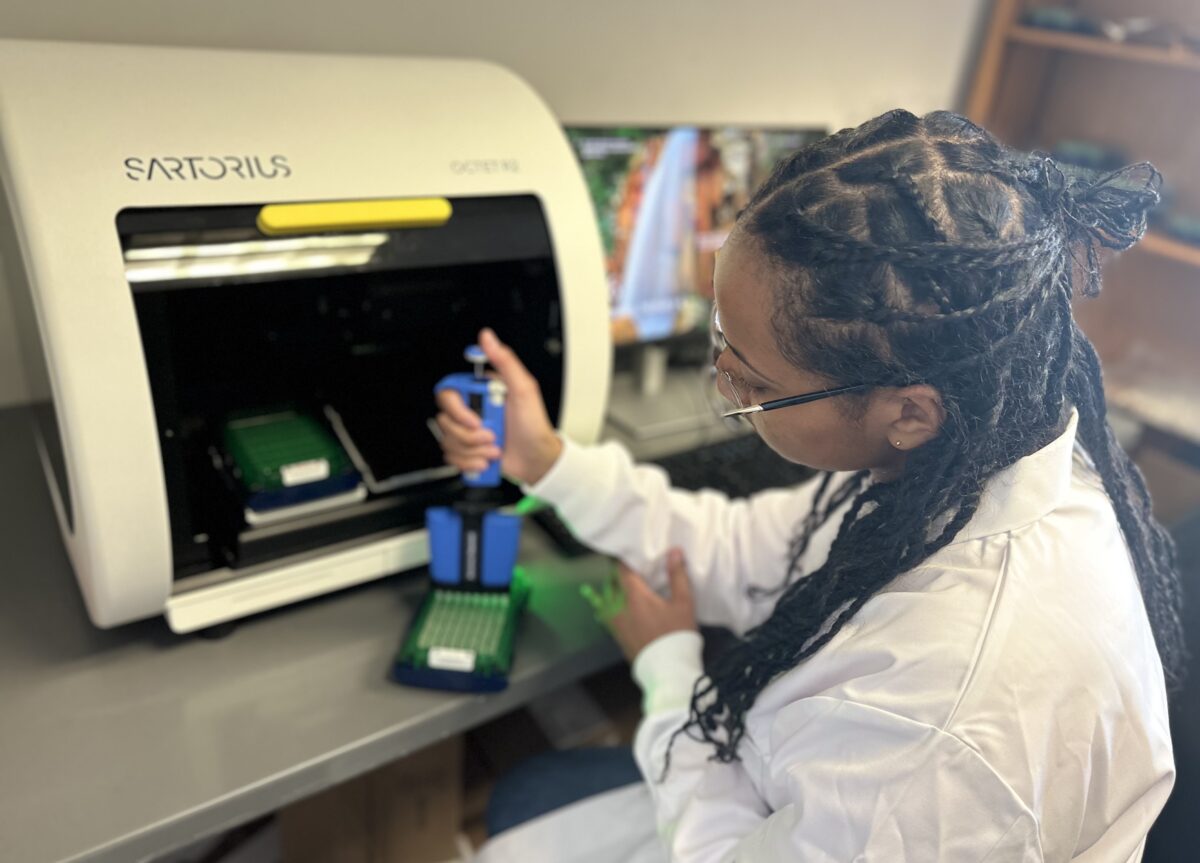
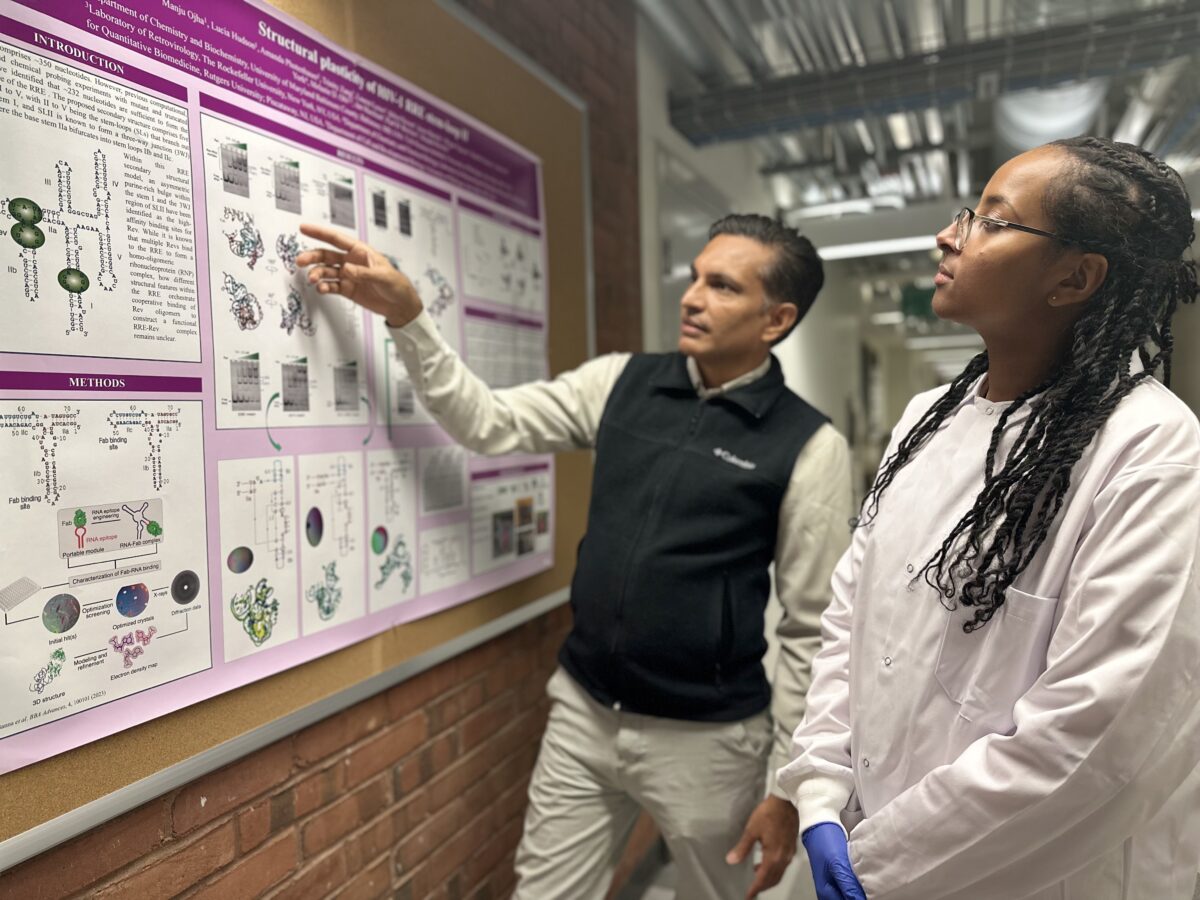 Left: Reem Abdelghani works with a multi-channel micropipet in the lab. Right: Reem and Deepak Koirala discuss research at a poster in the hallway outside Koirala’s lab. (Photos courtesy of Deepak Koirala)
Huda is now a junior mechanical engineering major at MIT, spending this semester on co-op with Apple’s Mac product design team in Austin, Texas—but the lab’s influence lingers. It sparked her interest in tools that help accelerate biochemistry research, like imaging platforms. “The technical and soft skills I gained at UMBC can apply anywhere,” she reflects. Even her first MIT lab connection came from a conversation overheard down the hall from her bench in Koirala’s lab. “It showed me the interconnectedness of academia,” she says.
Shattering preconceptions
Huda’s enthusiasm inspired Reem, the middle sister, to reach out to Koirala for her own ARL biotech internship. She started in Koirala’s lab in the summer of 2024, before her senior year of high school. “I saw how happy Huda was—and it looked like something I’d enjoy, too,” Reem says.
Mentored by Ph.D. student Naba Krishna Das, who isnow a postdoctoral fellow at the National Cancer Institute in Frederick, Maryland, Reem immersed herself in the lab’s operations, from presenting at lab meetings to executing tasks like sterilizing equipment and generating crystal structures of RNA and protein complexes. The lab’s collaborative vibe shattered her preconceptions. “I was worried grad school could be isolating, but it’s so interactive, with people at every stage of their scientific careers,” she explains.
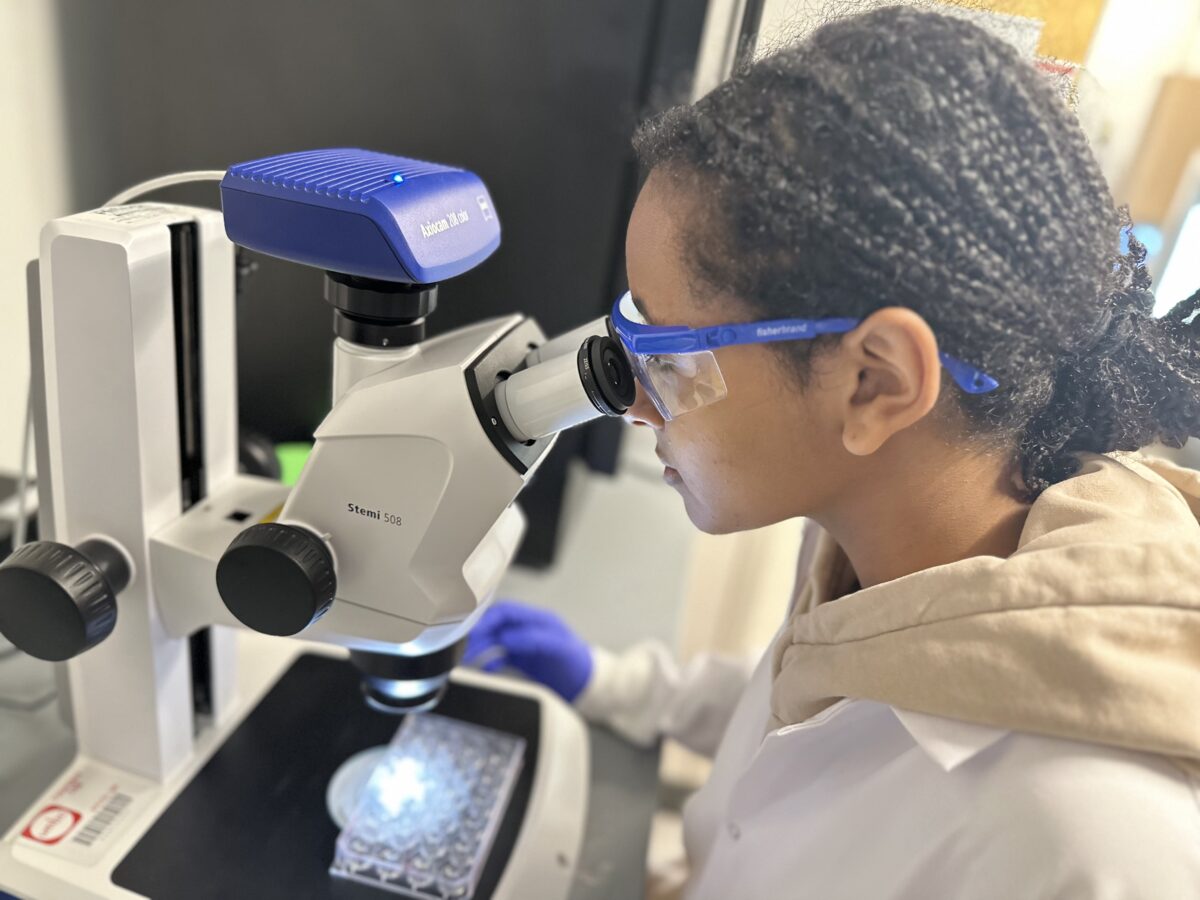
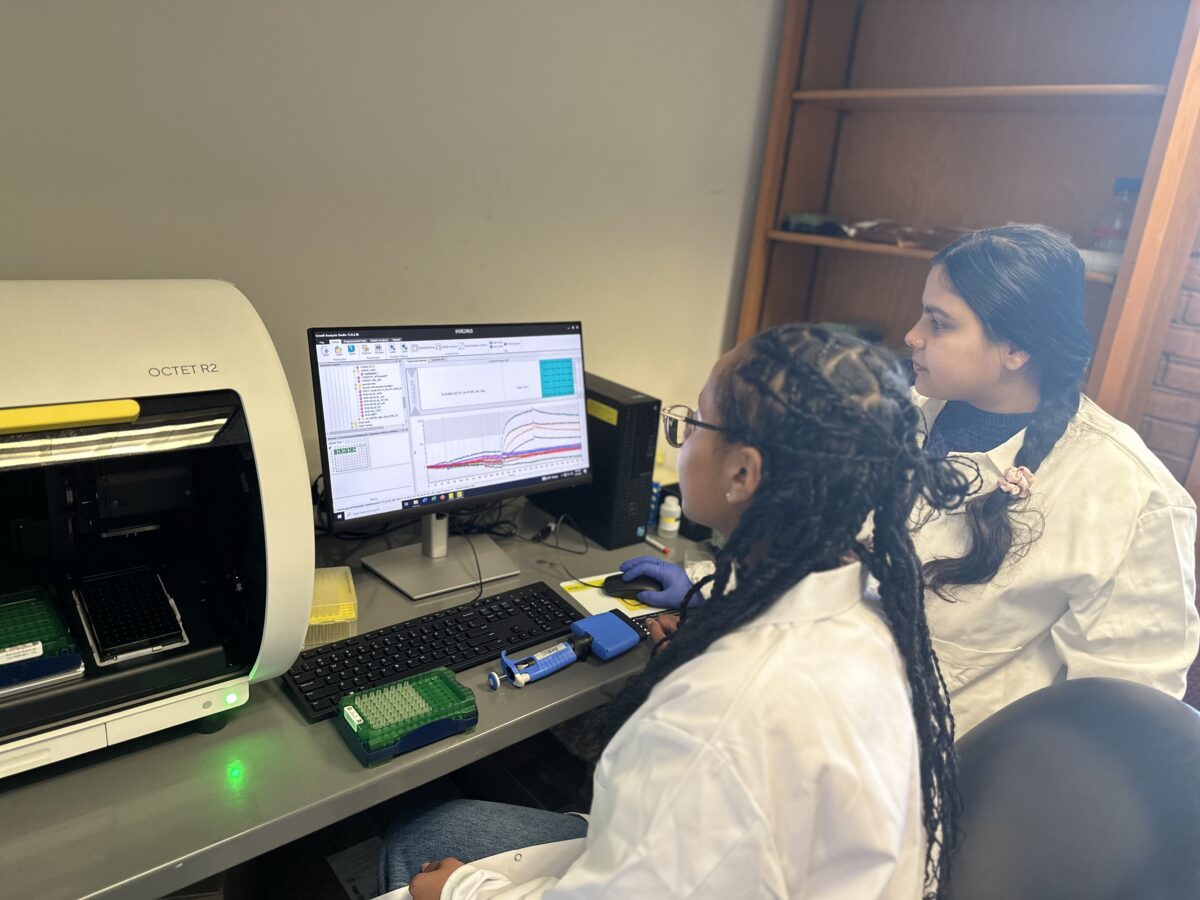 All three sisters gained valuable experience and skills working with Koirala. Left: Rowah looks at experimental wells under a microscope. Right: Reem (left) and Manju Ojha analyze data. (Photos courtesy of Deepak Koirala)
Reem conducted experiments for a project on viral replication, earning co-authorship on a 2025 Nature Communications paper as a high schooler. “I never expected to be so involved—I feel privileged,” she says. The process taught her the value of replication and troubleshooting. “Sometimes it’s trial and error as you’re exploring something new,” she says.
Now a first-year student at UMBC majoring in biochemistry, Reem plans to return to the Koirala lab as soon as space becomes available. “I didn’t consider grad school before, but now it’s definitely on the table,” she says—a perspective born of early research experiences that revealed what the scientific process is really like.
A real community
Rowah, a high school senior, joined the lab last fall. Her expectations of a “scary, strict PI” melted away. “Dr. Koirala is one of the kindest people I’ve met,” Rowah says. The lab’s supportive dynamic impressed her, too. Members shared resources, brainstormed next steps, and lifted each other up. “They push each other to do better—it’s a real community.”
Building on her ARL skills, Rowah felt like a valued member of the team. Her mentor in the lab, Ph.D. student Bethel G. Beyene, provided scientific papers for context, ensuring she grasped the concepts behind the team’s research, not just individual lab techniques. She, too, came face to face with failure and learned from it.
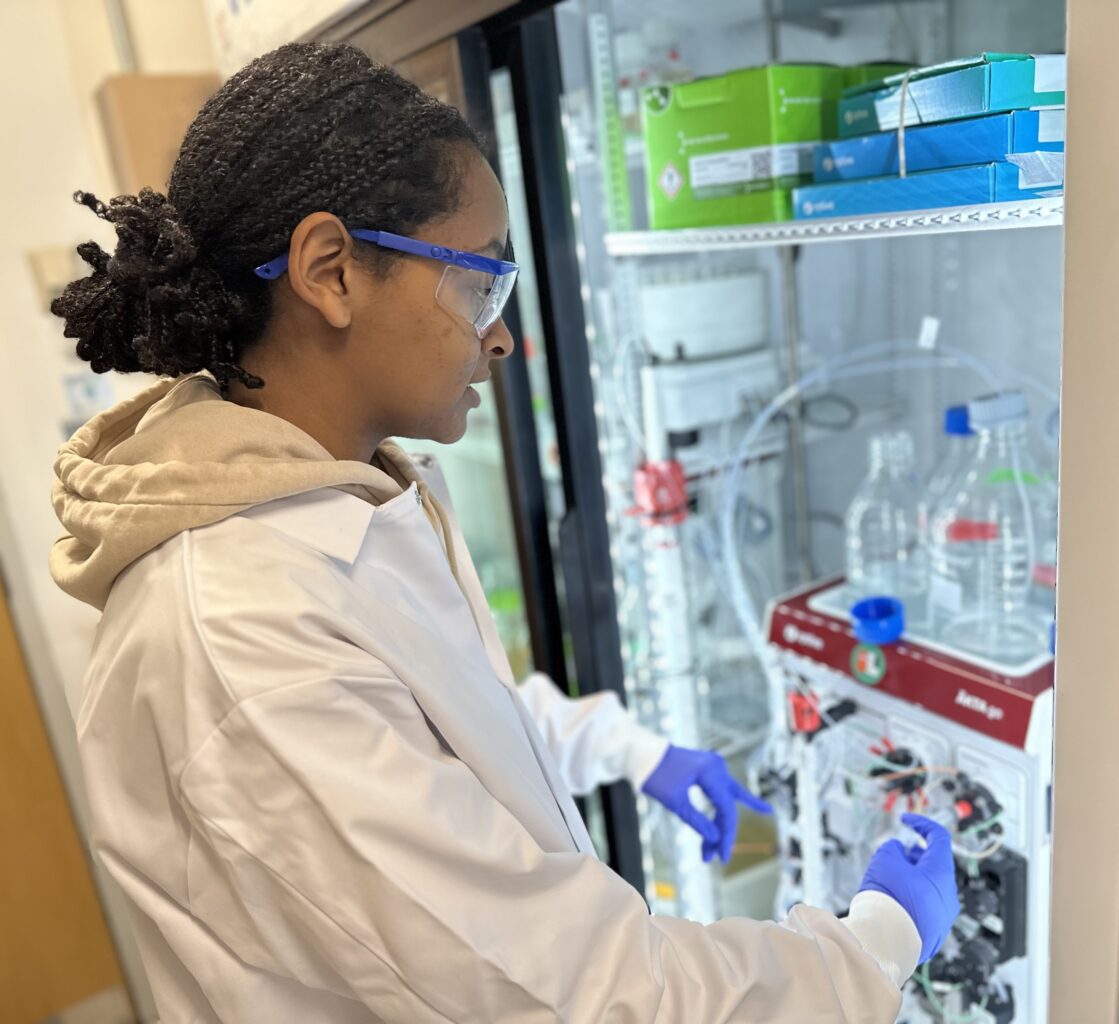
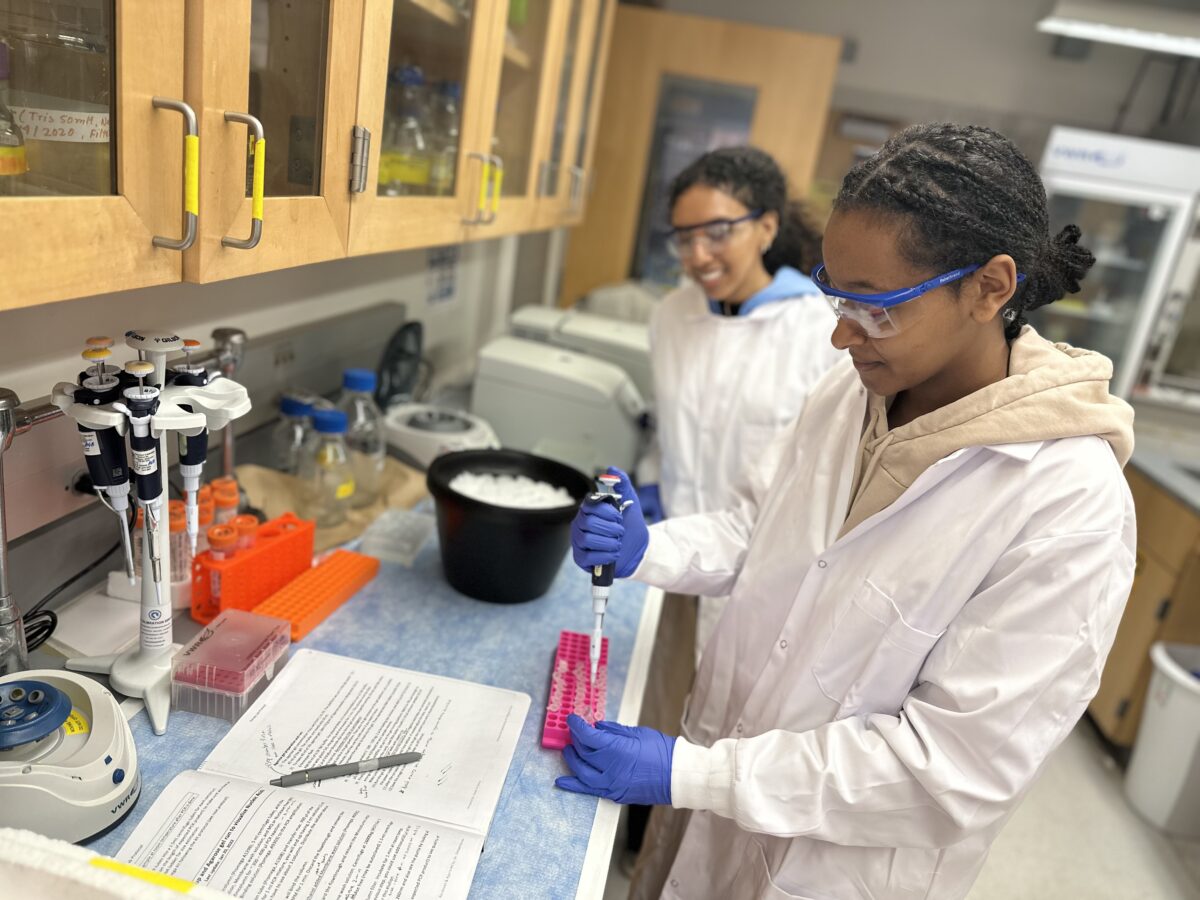 Rowah (at left and pipetting on right) received supportive mentorship from Ph.D. student Bethel Beyene (right photo, background). (Photos courtesy of Deepak Koirala)
“When things go wrong, we sit down and figure it out. It’s not that failure means you’re wrong; overcoming it is how you succeed.” That creative problem-solving carried over into her high school robotics competitions. “I applied lab thinking by evaluating all the possible sources of error to debug our robot—it felt great,” Rowah says. With her interests across biology and engineering, Rowah is considering a biomedical engineering major in the future. “The Koirala lab showed me that I don’t have to choose between my interests,” she says.
Making science better
The sisters’ bond fueled their experiences. “We talk openly—about lab life, plans, even arguments,” Reem laughs. Rowah says her admiration for Huda encouraged her to pursue working in Koirala’s lab. Though they never overlapped in the lab, Huda’s path reassured the others. “If I hadn’t had that chance, I couldn’t have shared it with my family,” Huda says.
Koirala credits the ARL program for bringing talented high schoolers like the Abdelghanis into his group. “They’re not just mentioned in the acknowledgments for completing experiments, but contributing intellectually at the level of authorship,” he says, noting the paper Reem co-authored.
His inclusive approach welcomes students with diverse backgrounds, training the next generation of scientists. “High schoolers, undergrads, women and men from varied backgrounds—they’re all making science better,” Koirala says. Clearly, including less experienced scientists isn’t hurting the lab’s output. Koirala has received multiple major grants and published high-profile papers since he arrived at UMBC in 2020.
In Koirala’s welcoming space, beginners become contributors, failures forge innovators, and family ties amplify ambition. As Rowah troubleshoots gels, Reem eyes graduate school, and Huda designs bioimaging tech at MIT, their paths affirm that science thrives on curiosity, community, and the courage to explore.