Keegan Cook Finberg, an assistant professor of English, started graduate school at UC Santa Cruz during the financial crisis of 2008, in a moment of extreme recession. “Privatization and austerity politics were everywhere. It was becoming increasingly clear that this wealth was stratifying upward, and notions of what constituted the public good were diminishing,” says Finberg. Finberg’s response to the times was to study avant-garde experimental poetry.
She notes that some might not see the connection between austerity politics and poetry. But she was excited about how poetry was engaging the public sphere. “Avant-garde poetry was obsessed with this notion of what made the public. And the category itself was becoming more interdisciplinary and more capacious,” said Finberg. “I started noticing and studying different forms of poems that didn’t look like what you might consider poetry. Poets were taking various aspects of state-controlled capitalist regimes and bureaucracy and using those forms as fodder for their poems.”
She remembers, around this time, books of poetry that were winning the major prizes were “avant-garde” in the sense that they chose words from material that wasn’t considered poetic. One poet chose words from the Department of Defense Dictionary of Military Terms to make poems about love. Others used these untraditional literary materials to document their experience of going through TSA at the airport, or repeating stories about racism on the street where people live. Finberg became interested in how all of these forms that we might think of as public forms were suddenly poetic forms.
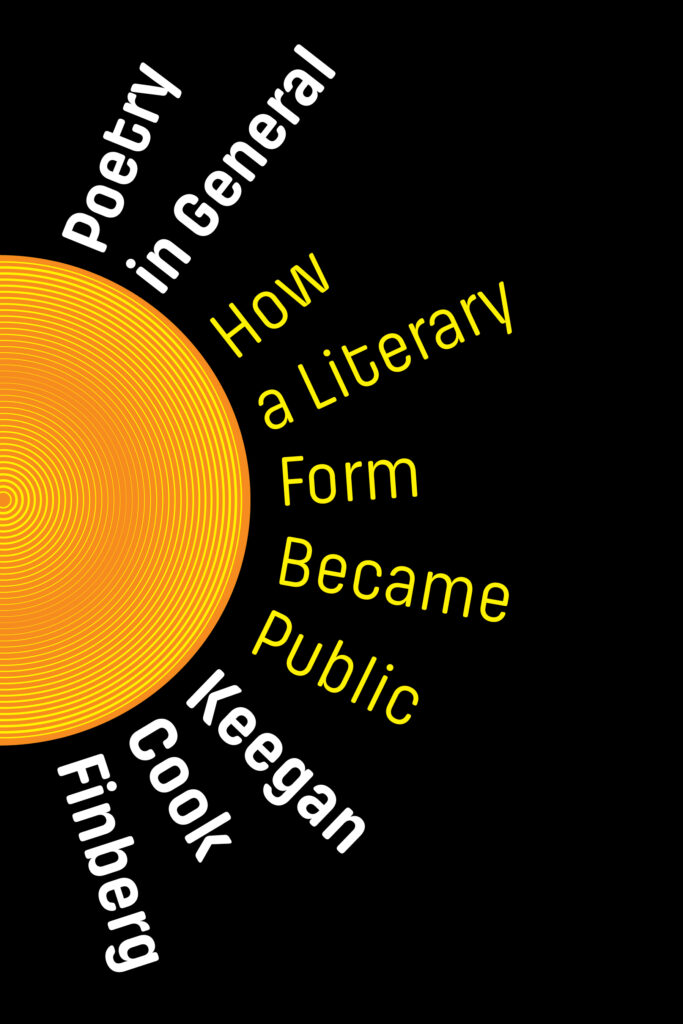
In her debut book, Poetry in General (Columbia University Press, 2025), Finberg explores the privatization of the welfare state and the way that poetry changed in relation to that notion of the public. “I located the beginning of this history around 1960, which many people consider the ballooning of the welfare state, the opposite of privatization,” says Finberg. “I started thinking about what poetic form looked like in that moment and how we might trace it to today.”
Q: What drew you to poetry?
A: I have loved poetry since I was an early reader. I was first drawn to it because it is a way of experiencing the world and understanding it. As I got deeper into my studies, I became really interested in the way that poetic form changes with history.
I’ve always been curious about how the category of poetry makes us think differently. What does it mean for us to read poetry versus the way we read other forms? Can anything be read as poetry? How do we think differently if we try to read things as poetry that aren’t poetry?
These questions excite me. It’s a way to slow down and model reading practices, a way of interacting with language that’s very intentional and precise. I think if you’re interested in play, the unknowable, or unmasterable, it can really change the way you see your everyday life. That’s how I got interested in poetry and what still excites me about poetry.
Q: Is there a piece of poetry that challenged you to accept being uncomfortable, not knowing exactly what it meant?
A: I remember when I was assigned Gertrude Stein‘s poetry as an undergraduate, it did not make any sense to me. Why would anyone assign this to me? I was irate about it at first, but once I started working with the text and playing with it, Stein’s poetry became richer and more interesting to me.
I began practicing different modes of orienting myself towards the text. Eventually, it helped govern the way that I think about the domestic sphere, feminism, and regular objects around the house. In her book Tender Buttons (1914), Stein makes objects and foods in her house come alive. Part of my attention to language and my love of language and detail comes from the practice of trying to do this type of work.
Q: Is there a particular poetic technique that you like best?
A: I love constraint-based processes where poets make a strict rule to limit the words they choose. Often, I find our brain is attuned to think in a certain way. These constraints help us outside of what we usually think of as creativity or imagination into this other world that we didn’t even know was possible.
 Keegan Cook Finberg. (Brad Ziegler/UMBC)
The book Zong! by M. NourbeSe Philip, a Canadian Caribbean poet, is a great example of a constraint-based process. The language for the book-length poem comes from the only historical record of an atrocious case that became important in the British abolitionist movement. Using only the text in the court case, Philip’s poem recounts the massacre of more than 130 enslaved Africans on the slave ship, Zong, headed to Jamaica from West Africa, who were thrown overboard to drown in 1781. The enslaved were dying of starvation and disease. Insurance would not cover this kind of loss. The captain decided that death by drowning could be claimed as a loss of property insurance claim. The insurance company approved the claim, but it was later overturned. No one was charged with murder.
Philip was trying to tell the story of the people on the ship and kept coming up against all of these gaps. The court case didn’t even contain the names of the people who were murdered. She decided to take the words of the court decision as a word bank for her book, to contort the case file to fill in these silences. The result is a testament to, and critique of, the horrors of the bureaucracy of slavery and its afterlife.
Most of the poems that I look at late in my book also use the language of archival documents about a major issue related to racial capitalism and the bureaucracy of the public sphere.
Q: What are other examples of constricted processes that you cover in the book?
A: I start the book with Yoko Ono. In the 1960s, she was doing wonderful experiments that were at the edge of what was performance and what was poetry. Ono was interested in speaking back to the category of racial capitalism through humor and expressions of everyday life as art. The poems in her book Grapefruit take this premise that instructions for everyday life can be fun, easy, or even impossible.
“I’ve always been curious about how the category of poetry makes us think differently. What does it mean for us to read poetry versus the way we read other forms? Can anything be read as poetry? How do we think differently if we try to read things as poetry that aren’t poetry?Keegan Cook Finberg
In my book, I also talk about three feminist artists from the 1970s, Eleanor Antin, Adrian Piper, and Bernadette Mayer. Their constraints are durational experiments where they go on some sort of diet, all of them for different reasons, for about the course of a month—the duration of a menstrual cycle—and document their journey. They’re writing about welfare and food assistance and their own reproductive rights on the precipice of Roe v. Wade. They’re interested in their own reproductive possibilities, and what it means to experiment with that as duration.
Q: This is your eighth year at UMBC. How do UMBC students respond to poetry in your classes?
A: For an upper-division class on feminist poetry, I recently taught Theresa Hak Kyung Cha’s Dictee, a famously complex avant-garde poem about Korean independence and about the experience of immigration and colonial violence. Cha writes in multiple languages to capture the disorientation of the acquisition of a new language, of a new culture, and the difficulty and violence of assimilation. It’s complex, and it can be off-putting to students.
In situations like these, I want students to be okay with not understanding everything that they’re reading while exploring the aspects that they do understand—to explore why this author might want it to be difficult in the beginning, why there might be something important in that feeling of discomfort that they’re experiencing with the text. Can they notice moments of beauty in the text, even if they don’t yet understand what they mean? A lot of our conversations start with that sort of work.
And once students realize that that is the goal—that they don’t need to be able to decode, they don’t have to be the person who knows it all in the room, there isn’t one right answer—it really unlocks a very different sort of space. I often watch that sort of journey with students. They realize that there’s something inherently important about this difficulty, important even to their understanding of themselves, their heritage, the way that language works in their households, even in their larger worlds.
And for my students who may take poetry to fulfill a lower division requirement, what I want more than anything is for them to see the ways that literature and poetry are alive in the world. Poetry is interesting, it’s happening, and they can read it. They don’t have to be afraid of it. Introductory level students are asked to attend literary events to see writers come and read and talk about their work. This is happening now. This is part of your world. If you’re a nurse, a scientist, or in whatever career path you follow, poetry and literature are alive and are going to continue to be part of the world that you live in. If you pay attention, this revelation may help you understand your experiences differently, connect to others in new ways, or even create new knowledge.
Learn more about Finberg’s work andUMBC’s English department.