The Association of International Education Administrators (AIEA) has awarded UMBC’s Global Learning Lab one of two Innovative Excellence in Internationalization Awards. This award honors creative, replicable, and innovative initiatives that are critical to internationalization and require strong leadership to achieve. The AIEA commends the Global Learning Lab for reflecting UMBC’s commitment to justice, equity, diversity, and inclusion by fostering inclusive, cost-effective models that integrate global perspectives into the curriculum.
The lab’s primary mission is to support faculty development in increasing student access to global learning opportunities. Through a cohort-based model, the lab brings faculty together for a series of workshops to develop best practices for integrating applied global learning into the curriculum. The initiative was originally launched as a pilot program by the Center for Global Engagement (CGE) and the College of Arts, Humanities, and Social Sciences (CAHSS) Dean’s Office in support of CAHSS faculty. In fall 2025, the lab was opened to all faculty with support from the Office of the Provost. Faculty who participate in this initiative produce concrete deliverables, such as course maps, faculty-led study abroad programs, and Collaborative Online International Learning (COIL) projects.
“To date, 48 faculty members have participated across 27 unique departments ranging from biological sciences to visual arts to chemical, biochemical, and environmental engineering,” according to Provost Provost and Senior Vice President for Academic Affairs, Manfred van Dulmen‘s February campus newsletter. “Projects continue to positively impact the student experience and have included nine mapping initiatives, 12 COIL projects, and 27 study abroad programs.”
Developing an intercultural curriculum
To receive the Excellence in Internationalization Award, the Global Learning Lab had to be grounded in the principles of comprehensive internationalization—an inclusive process that impacts teaching, research, and service. It also had to align with at least two of UNESCO’s 17 Sustainable Development Goals, reflect the underlying principles of justice, equity, diversity, and inclusion in higher education, and serve as a replicable model for other institutions.
Cheryl North, clinical associate professor of education, and Takashi Yamashita, director and professor of sociology, anthropology, and public health (SAPH), are alumni of the inaugural cohort. They were both in the process of designing international university and community partnerships, in Germany and Japan, respectively, before the Global Learning Lab was launched. The lab provided technical and collegial support that bridged the gap between idea and implementation.
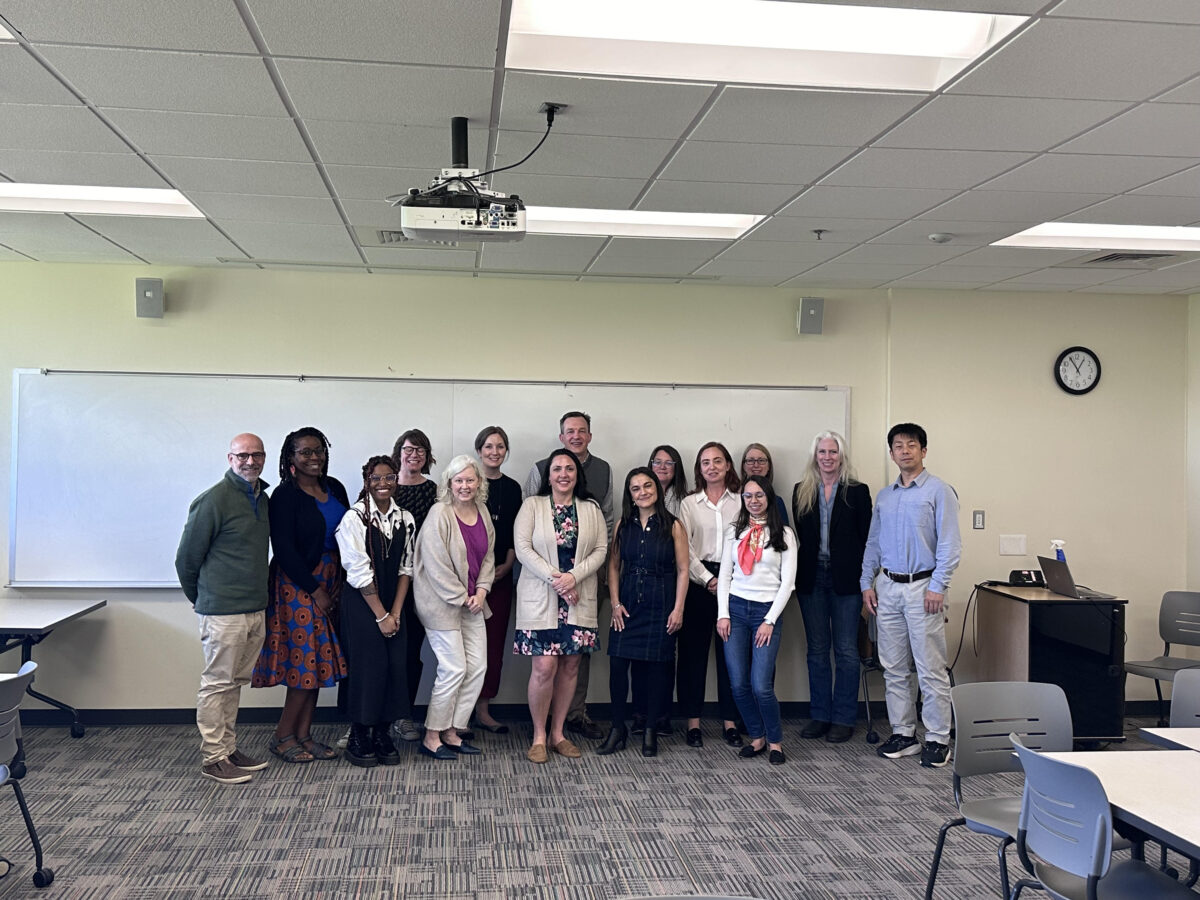 (l-r): Brian Souders (former CGE staff); Ogonna Owu Jones (former CGE staff); Alicyn Curtis (CGE staff); Rebecca Grenouilleau-Loescher (faculty fellow, modern languages, linguistics, and intercultrual communication); Katie Birger (faculty fellow, SAPH); Jessica Cook (faculty fellow, Sondheim Public Affairs Scholars Program); Katherine Heird (CGE staff); David Schultz (faculty fellow, pscyhology); Yolanda Valencia (faculty fellow, geography and environment sciences); Lauren Clay (faculty fellow, emergency and disaster health services); Racquel Matos (visiting dean of the faculty of education and psychology at Universidade Católica Portuguesa in Portugal); Jessica Pfeifer (faculty fellow, philosophy); Lina Mora (CGE intern/intercultural communication graduate student, North (second on the right); and Yamashita (first on the right). (Image courtesy of CGE)
North, along with faculty at the University of Kassel in Germany, had established the foundations for a virtual classroom exchange for their education students, but had experienced technical and scheduling conflicts. “After participating in the Global Learning Lab, we learned to structure the collaboration effectively,” said North. “When we implemented these insights, UMBC students were able to share completed lessons and reflections, while the German students shared their process in the early stages of planning and implementation. Despite the scheduling differences, the exchange was successful, meaningful, and professionally enriching for everyone involved.”
The lab’s funding, technical training, and networking opportunities provided essential support that helped Yamashita develop the Global Health and Aging in Japan faculty-led study abroad program, which will launch in summer 2026.
“Developing a study abroad program can often feel like an isolated effort for a single faculty member,” says Yamashita. “Having a dedicated technical support team from CGE, along with a community of UMBC colleagues to share unique ideas, made the process much more engaging. These interactions kept me inspired and motivated to bring this program to UMBC students.”
Campus-wide internationalization
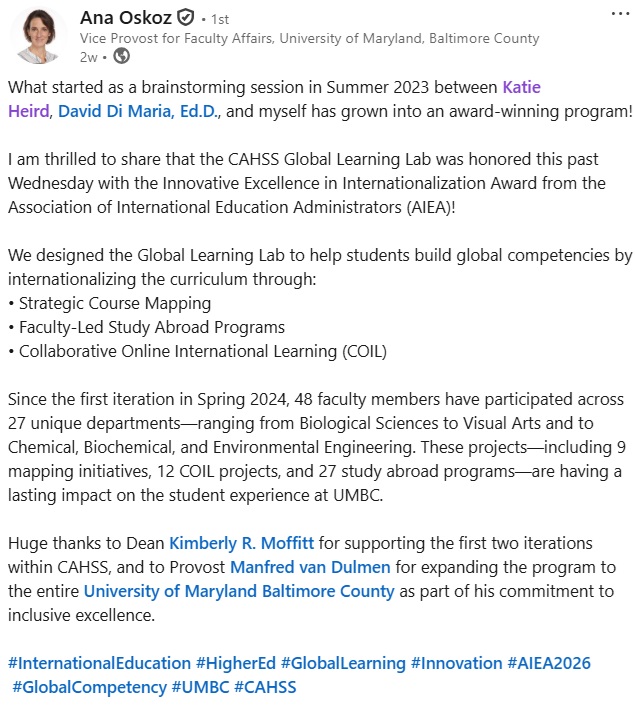
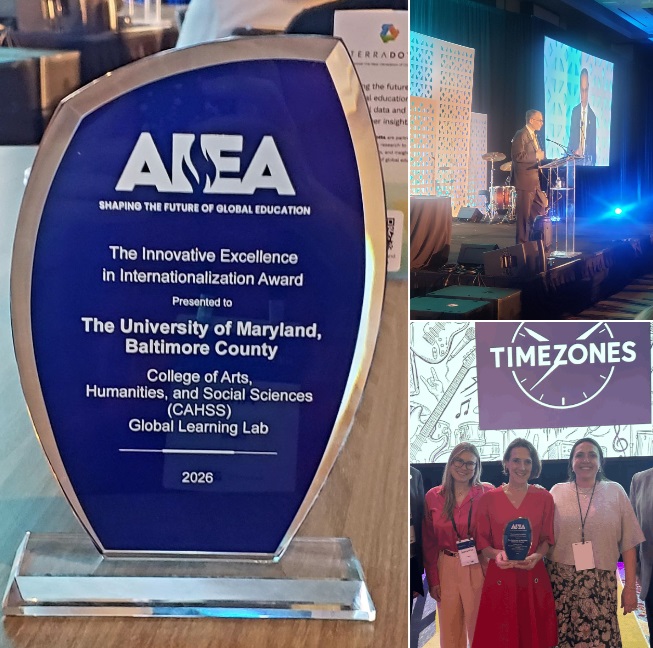 UMBC faculty and staff at the AIEA award. (Image courtesy of CGE)
“The impact of the Global Learning Lab has been profound,” wrote Ana Oskoz, vice provost for faculty affairs, in her recommendation letter. “It is a shining example of innovative internationalization that prioritizes inclusivity, equity, and academic excellence.”
Faculty interested in participating in the Global Learning Lab are encouraged to follow the Faculty Affairs page on MyUMBC for notifications regarding future offerings.