This spring, the Meyerhoff Scholars Program at UMBC celebrates a landmark achievement: 500 program graduates have earned a Ph.D.
The milestone highlights the program’s success as the nation’s original model for increasing diversity in science, technology, engineering, and mathematics (STEM). Grounded in high expectations and robust support, Meyerhoff Scholars consistently go on to excel in top graduate programs and lead in academia, industry, and government while mentoring the next generation. UMBC has maintained its position as the national leader in producing Black M.D./Ph.D. graduates: Between 2014 and 2024, UMBC alumni accounted for 15 percent of all such dual-degree recipients nationwide, far outpacing any other institution. UMBC is also the leader in graduating Black students who go on to earn Ph.D.s in the life sciences, math and computer sciences, and engineering.
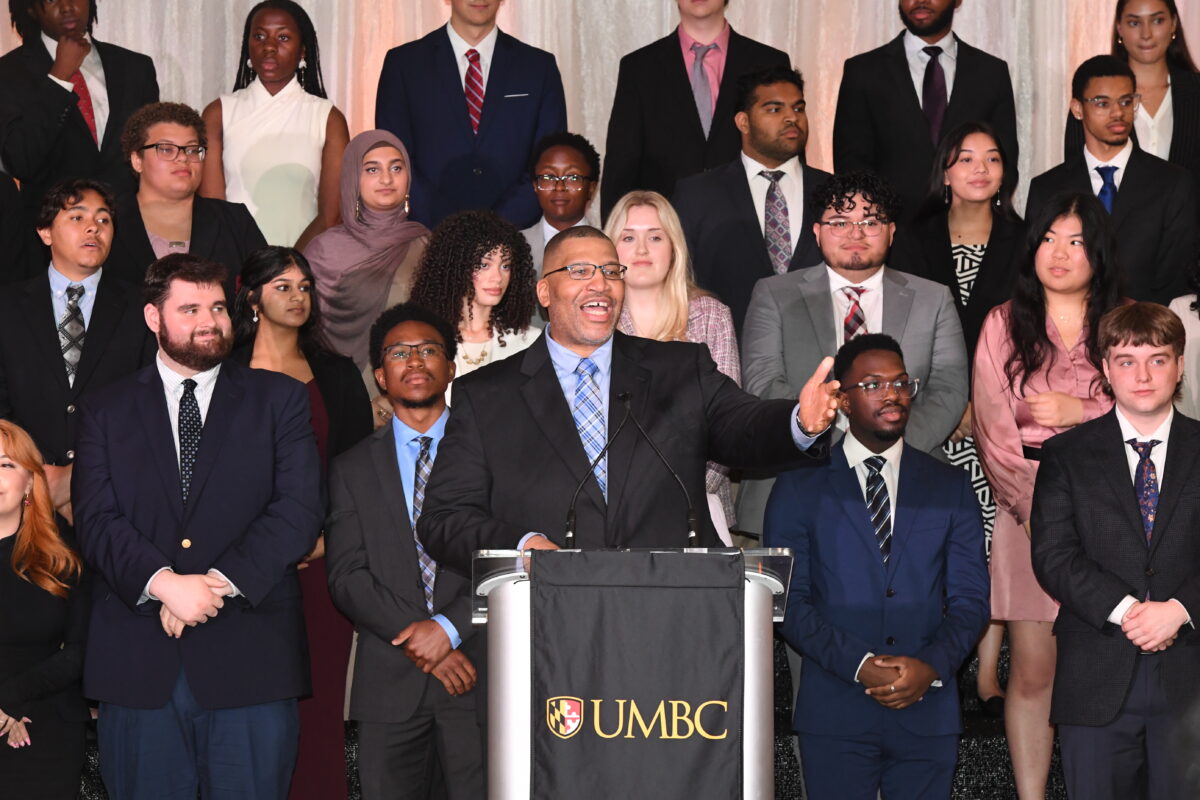 Keith Harmon, director of the Meyerhoff Scholars Program, celebrates graduating scholars at the 2024 Meyerhoff Senior Reception. (Jim Burger for UMBC)
Joseph Washington ’97, mechanical engineering, a member of the fourth Meyerhoff cohort (M4), embodies this trajectory. A first-generation college student, he initially considered trade school after a knee injury derailed his plans to attend the U.S. Naval Academy. The Meyerhoff scholarship changed his path. In particular, Selection Weekend for admitted Meyerhoff Scholars and Summer Bridge, intensive group programming prior to the scholars’ first UMBC semester, affirmed his identity and potential: “The most important message I internalized from the Meyerhoff program was that I can be Black and intelligent,” he recalls.
Washington earned a master’s degree before returning to UMBC for his Ph.D. Today, he serves as an assistant teaching professor at UMBC at the Universities at Shady Grove. He mentors students informally, advises the UMBC chapter of the American Institute of Aeronautics and Astronautics, and creates space for Meyerhoff Scholars to discuss graduate school and careers. “UMBC has always felt like home,” he says. “I would not be here if not for the Meyerhoff Scholars Program.”
A family tradition
Sadella Santos ’12, chemical engineering, M20, and her sister Melissa Santos ’12, chemical engineering, M19, also credit the program with shaping their journeys. Sadella, a senior scientist at Exponent, Inc. with a Ph.D. in chemical engineering, values the emphasis on community. “Academic success is a collective effort, rather than individual competition,” she says. “At work, I champion the message that diverse perspectives are necessary to drive scientific progress.” She pays it forward by reviewing abstracts for the Annual Biomedical Research Conference for Minoritized Scientists (ABRCMS) and hosting lab visits to expose high school students to possible careers.
 Meyerhoff Scholar alumni gathered at the 2022 Meyerhoff Family Meeting. (Marlayna Demond ’11/UMBC)
Melissa, who earned a Ph.D. in chemical engineering followed by a J.D., applies problem-solving and adaptability skills honed through Meyerhoff to her legal career. She recently participated in a panel for McNair Scholars on summer research experiences. “Community and network are important,” she notes. “Surround yourself with people who will support you but also challenge you to grow.”
Meyerhoff scholars often refer to themselves as family—and that’s especially true for the Santoses. Justin Santos ’17, biochemistry and molecular biology, M25, is the third scholar in the family. He is completing his M.D./Ph.D. in neuroscience at Emory University this spring and will begin residency in emergency medicine at Washington University in St. Louis. He mentors students pursuing clinical-scientist careers and assists with ABRCMS abstract reviews. “High-quality, comprehensive mentorship” was invaluable to him, and he works to provide that same guidance to others.
Reaching back to pay it forward
Naomi Mburu ’18, M26, chemical engineering, was UMBC’s first Rhodes Scholar, attending Oxford University on one of the world’s oldest and most prestigious scholarships. She earned a D.Phil. in engineering science from the University of Oxford and today serves as lead analyst at Fusion Advisory Services, providing analysis of the fusion industry to a wide range of stakeholders. Meyerhoff pushed her beyond her comfort zone into leadership roles and strengthened her public speaking and networking skills, she says. She now reviews scholarship essays for UMBC students and organizes summer internships to bring diverse talent into the fusion energy field. “Supporting the next generation is so important,” she says. “I have only come this far myself with the help of my own mentors.”
 From left to right, UMBC sophomore Amir Walton-Irvin, and juniors Jessica Slaughter, Deeya Mistry, and Phoenix Bryant all received a Goldwater Scholarship this year—and all four are Meyerhoff Scholars. (Brad Ziegler/UMBC)
These alumni illustrate the program’s lasting influence. Meyerhoff Scholars do not simply succeed—they reach back, creating opportunities and building communities for current students and early-career researchers. The model’s impact now extends even further: universities including Penn State, UNC-Chapel Hill, UC Berkeley, Stony Brook, and others have adapted key elements of the Meyerhoff approach with support from funders such as the Chan Zuckerberg Initiative and Simons Foundation.
With more than 2,200 undergraduates supported to date and a national reputation for producing leaders committed to diversity in STEM, the 500th Ph.D. stands as compelling proof of the Meyerhoff model’s effectiveness. As alumni advance in their fields and invest in those who follow, the Meyerhoff Scholars Program continues to change lives one by one, transforming the face of American science through excellence, community, and a powerful ripple effect that will benefit generations to come.