When Chinonso Ezeobi decided to pack up his life and come to the United States to pursue his Ph.D. in electrical engineering at UMBC, he was thrilled at the prospect of finding a program that would bring him fulfillment. However, financial struggles and the impact of COVID pandemic quickly threatened Ezeobi’s plans for the future. Never one to be derailed, he found mentors across campus who made it their mission to keep him on the path to his Ph.D. Ezeobi recognized how invaluable their support was and found his own ways to give back to the place and people who gave him so much, including founding two organizations on campus and keeping his door open to any students who may be struggling.
Q: What brought you to the United States and to UMBC to earn your doctorate?
A: After earning my bachelor’s degree in Nigeria, I went into the telecommunications industry for about 15 years. Then I went to graduate school in Finland with the hope of completing my Ph.D. to qualify me to be a teacher, as I believed that I would impact people more by becoming a teacher. But, none of the Ph.D. programs I was interested in in Finland could give me full funding.
As part of my search for fully funded Ph.D. programs, my wife and I visited the United States in 2018 and had the opportunity to come to UMBC. I had a meeting with the chair of the Department of Computer Science and Electrical Engineering (CSEE). After that, my wife and I ate lunch in The Commons. There was a Nigerian flag hanging from the ceiling. When I saw it, I thought, “Oh, my people are represented here.” I applied for several Ph.D. programs and was offered admission to UMBC. Seeing the Nigerian flag that day played a big part in choosing UMBC for my doctoral study.
Q: What is your most meaningful memory from your time at UMBC?
A: When I came to UMBC, I actually didn’t have funding in my very first semester. So I struggled. I paid out of pocket from my savings. I discovered this wasn’t sustainable. At the end of my first semester, I had made up my mind to leave UMBC and transfer to a different university I had been admitted to because I still couldn’t get funding, and I couldn’t afford to pay anymore. I was stressed; I was anxious; I was depressed. I went to the inaugural meeting of the Black Graduate Student Organization. There were about 15 students in attendance as well as [President Emeritus] Freeman A. Hrabowski and [Dean Emerita of Graduate Studies] Janet Rutledge. Dr. Hrabowski and Dr. Rutledge went around the table and asked each student to share how we were faring and what our experiences at UMBC had been like. I told them it wasn’t easy. And the president directed me to work with Dr. Rutledge to sort my situation out. I and Dr. Rutledge had several one-on-one meetings afterwards where she helped me to navigate my challenges at UMBC. When I reached out to Dr. Rutledge the week I wanted to leave UMBC, she asked me to give her one more week to figure out how to fund me. That was what changed everything. I was able to get the support I needed, and the rest, they say, is history.
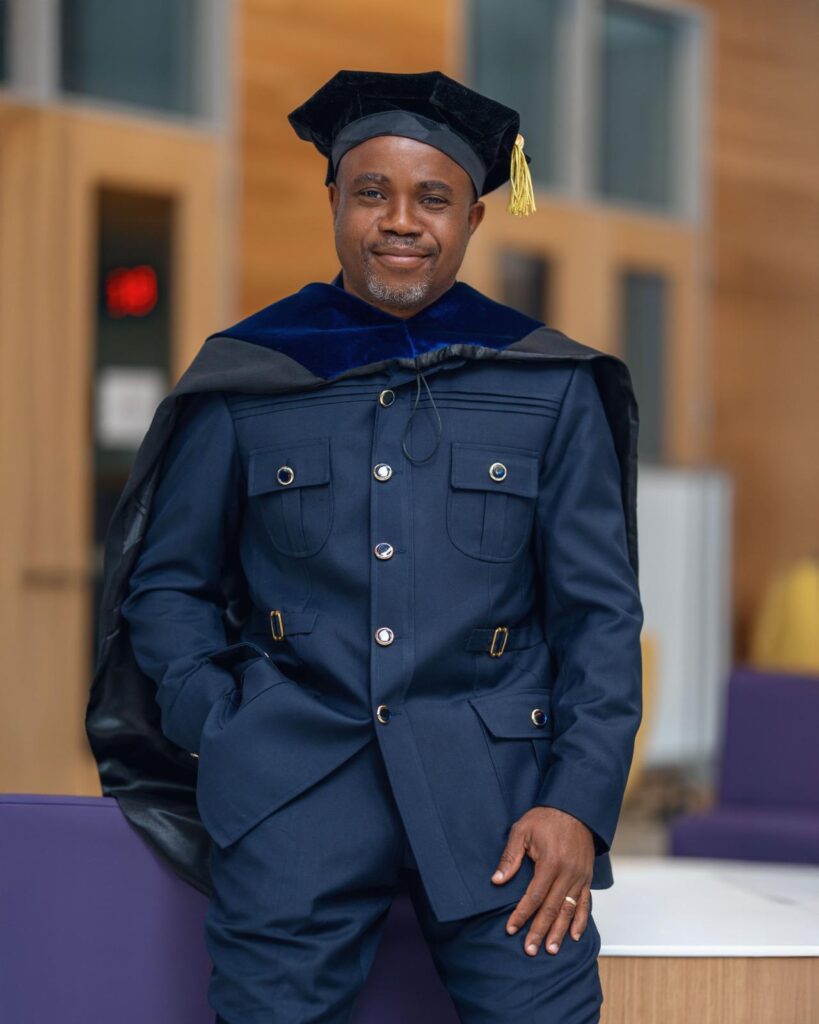 Ezeobi in Commencement regalia. (Courtesy of Ezeobi)
Q: How have you navigated and overcome the challenges you’ve faced during your time at UMBC?
A: I faced a lot of challenges in my time at UMBC. I was coming in from industry, and I had not been in school for a long time. I was trying to acclimatize. But then the COVID-19 pandemic hit in my second semester, and everybody was at home. It was so devastating for me as someone who loves to interact with other people in person. I had left a good job to come to graduate school, and I started to wonder, “Did I do the right thing?”
The kind of research I was doing in my previous lab was difficult to adjust, and I needed a little more help, but because everything was virtual it wasn’t easy to get the kind of help I needed. The lab was able to fund me for a semester, but unfortunately, the day my wife arrived in the United States they informed me that they couldn’t support me any longer. So now my wife had joined me but I had no source of income and funding for my Ph.D. program. The graduate program director of CSEE department offered me a grader position without tuition remission, which I accepted.
Then I got an email from Dr. Robin Cresiski asking if I was available to work with her in the Graduate School based on Dr. Rutledge’s recommendation. She was able to give me a position that could pay for my tuition and still allow me to work in the CSEE department. That was how my relationship with Dr. Cresiski started. She and the Graduate School have always been there for me.
The challenges with my research were similarly massive. Because my lab didn’t have funding, it was very self-driven research. My mentor, Dr. Anthony Johnson, was skeptical about the novelty of my research in the beginning since the ZBLAN sample [a fiber optics slab sample] I used had been around for a long time. Not only did I have to search for and obtain the samples and materials I needed, but I had to convince him that my research was worth it. I went the extra mile to go to the company where I got my samples (Thorlabs) and pulled them into a meeting with Dr. Johnson and I discussed my approach and possible outcome. The meeting highlighted the novelty of my approach to the ZBLAN material and that was how he came on board.
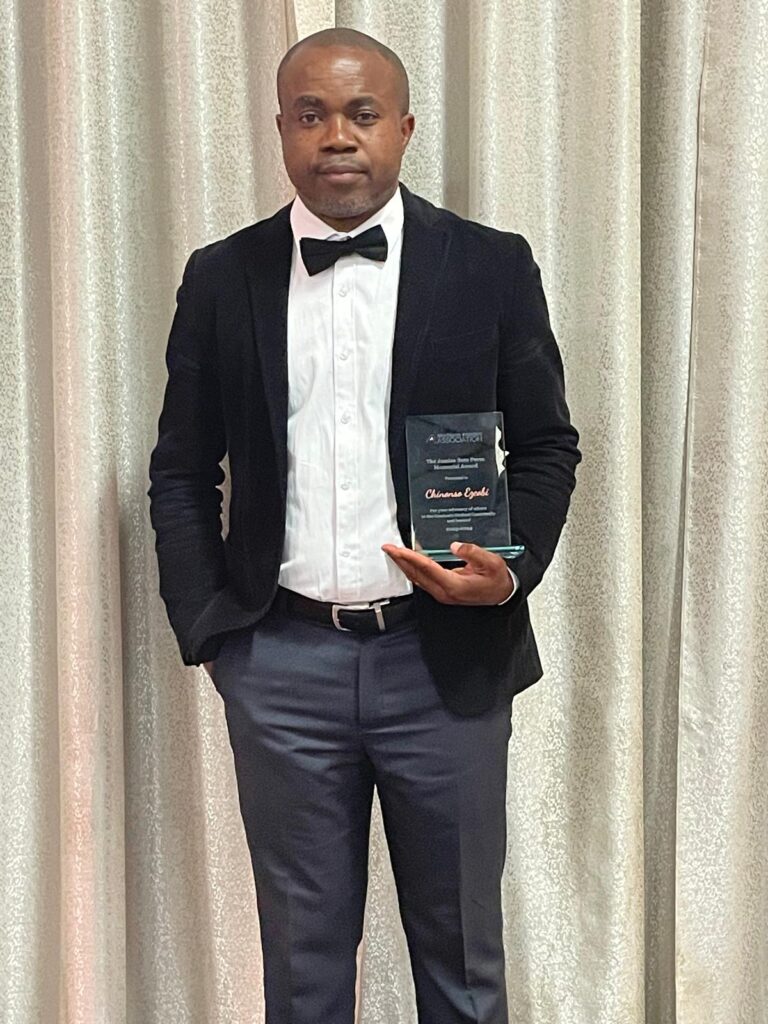 Ezeobi stands with an award for his work. (Courtesy of Ezeobi)
Once I navigated through one challenge, another one came in. But at the end of the day—it was worth it. I was able to pull through all of those challenges. I was also able to transition from being an international student to having a green card through self-petition and self-advocacy, so I’m able to graduate without the additional pressure of thinking about my visa status while looking for jobs. My faith and the community at UMBC were essential in navigating through all challenges. The motivation was that I had a community of people who wanted my success, people who I felt would advocate for me even when I’m not in the room.
I wouldn’t change my UMBC experience for anything. The struggles I’ve faced have been very, very challenging, but I’m glad I went through them. It has made me a better person. It has prepared me for the next phase of my life, which will be teaching. And when you’re teaching students, you teach with context of all of the challenges you have been through to try to make sure that the students have a good experience.
Q: How have your experiences engaging and organizing within UMBC’s graduate student community enhanced your journey here?
A: I know a lot of people on campus. When other graduate students have serious issues, they will come to me and share their challenges. I have ideas of who they can talk to and am able to connect them with people who can help. I follow through with whatever issues students are having and make sure they are solved. Some of the students will even request that I sit in meetings with them and help them navigate the conversation! Because of my advocacy and engagement work, I was also nominated to serve on a lot of committees, including a Student Emergency Fund disbursement committee that supports students when they experience financial hardships and need support with groceries. It’s been a good opportunity to get to know more people, and I’m glad that we’re able to make UMBC a better place.
I also have helped in organizing most of the Graduate School’s events through PROMISE. I make sure that I advertise the events in such a way that we bring graduate students together. After the COVID lockdowns ended, I helped improve turn-out at our in-person events. Many international graduate students like myself feel like when they come here, they want to be the best in everything: best in their class, best in their research. There’s nothing wrong with that, but what happens is that they end up not living. They don’t experience the school. Based on my experiences, I have seen that those who advance more in life are those who know people who can mention their names when they’re not in the room. One of the events we organize in the Graduate School is to help students understand how to access the resources on campus before they need it in order to enhance their experience at UMBC. We organize events as simple as a coffee hour with graduate students, where students can come and talk about their classes. It helps them to destress and creates an opportunity for them to see graduate students from other departments.
Doing all of this gives me fulfillment. It’s the same reason that I want to be a teacher: Whenever I help students solve their problems, I feel good about it. I feel that the struggles I have experienced throughout my UMBC journey have given me this capacity to help others.
Q: As an aspiring educator, what teaching practices from your time as a UMBC student do you want to carry forward?
A: Several of my UMBC professors, including Dr. Johnson, Dr. Fow-Sen Choa, and Dr. Gary Carter, have exemplified what it means to be a teacher. They make sure that every student is heard and seen. They assign amazing class projects. And they’re very responsive to email, even when I reach out to them late at night. I don’t think I’ve ever sent an email that they didn’t get back to almost immediately.
I also took some trainings with UMBC’s Center for Research, Teaching, and Learning on how to be a better teacher, on how to engage students and support active learning. I would highly recommend that UMBC graduate students who are aspiring faculty take this training in teaching, because earning a Ph.D. or being a good researcher does not automatically make one a good teacher.
In the course of my study here, I have also had the opportunity to participate in the UMBC Summer Enrichment Academy as an instructor and as a mentor to other instructors. I’ve been able to connect with high school students, teach them optics, try to help them be interested in engineering, and it has been fulfilling.
I’m hoping to get a faculty position and eventually a tenure track position around here after I graduate. I believe that having a bigger stage will present a bigger challenge, and will result to a bigger impact.
Written by Tess McRae ’22, Assistant Director for Connective Learning, Center for Democracy and Civic Life