The UMBC career of Rileigh Mansfield ’26, mathematics, has been a masterclass in combining high-level theory with real-world impact. A Meyerhoff Scholar who began conducting research in her first year, Mansfield has spent the last three years applying complex data assimilation to everything from epidemiology to volcanology. Her academic path has taken her from the Andes of Ecuador to a math camp in Rwanda, and now it will take her to Stanford University to pursue a Ph.D. in geophysics. But Mansfield’s time at UMBC has included much more than academics: It has been defined by resilience and a contagious enthusiasm for building community—whether through tutoring and mentoring fellow students or playing Settlers of Catan with classmates and friends.
Q: What’s next for you after graduation?
A: I’m heading to Stanford University to pursue a Ph.D. in geophysics. Stanford has always been my dream school. I was nervous about applying, because I was switching from math to geophysics and graduating a year early. Plus, I didn’t do as well as I’d hoped on the GRE, and I felt like it was going to be impossible to get in. But I went for it anyway, with encouragement from my best friend—and now I get to go!
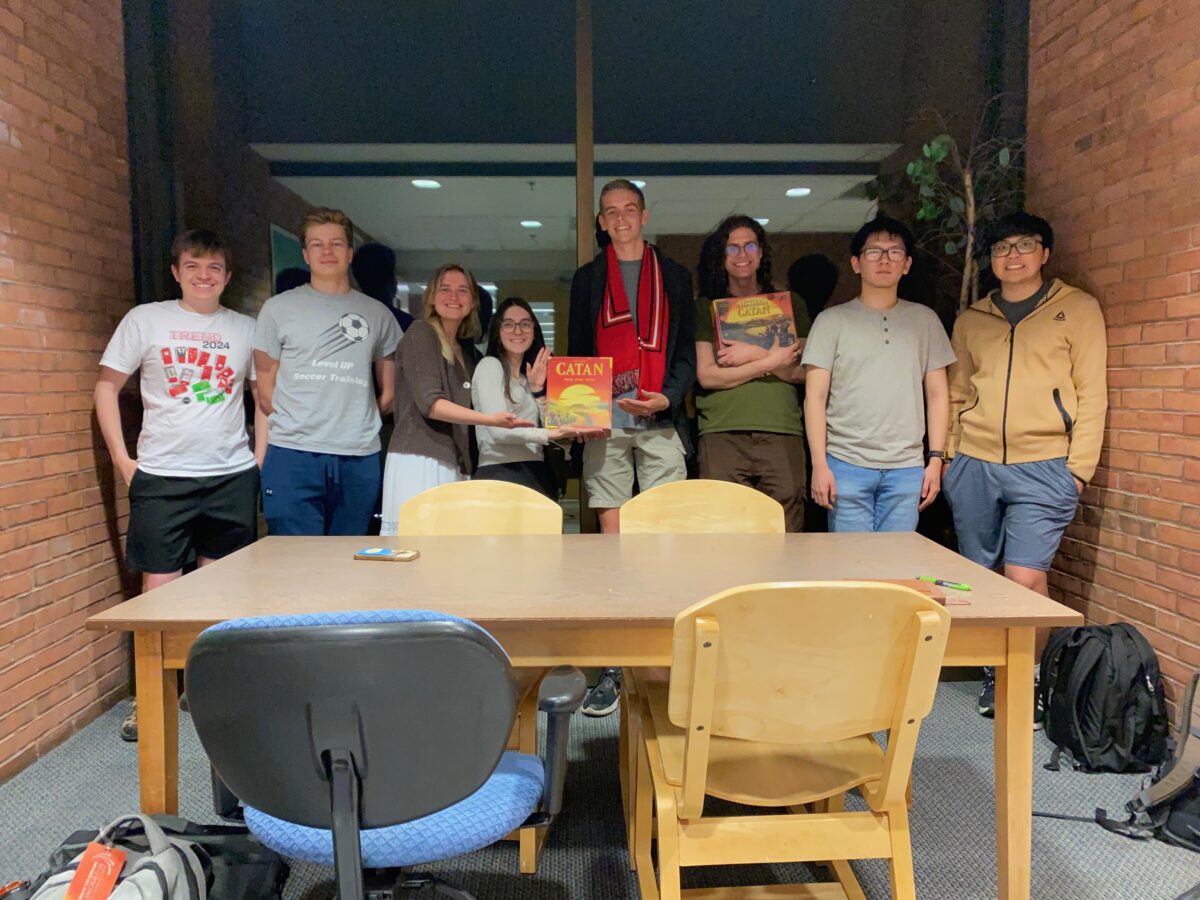 Rileigh Mansfield (third from left) gets together regularly with friends to play the strategic board game Catan. (Courtesy of Mansfield)
Q: How have you gotten involved on campus, and how have those activities supported your growth?
A: I’ve served as the president of Pi Mu Epsilon (the national math honors society), a Meyerhoff Peer Advisor, and a teaching assistant in the math department. I also conducted research with math professors Dr. Animikh Biswas and Dr. Kathleen Hoffman. But honestly, some of my most meaningful involvement has been more informal. Last spring, I was having a tough semester when I got invited to join a group from the math lounge to play the board game Catan on Tuesdays. It became a little community and something to look forward to every week—a much-needed step back from school and work. I actually play in competitive Catan tournaments now, and I’m even hosting an official tournament this spring through the math honors society.
Q: How did you first get involved in research at UMBC, and what did you focus on?
A: I got involved in research through the Meyerhoff Scholars Program. Dr. Biswas taught one of my Summer Bridge classes. I asked a lot of questions, and he said I should apply to be in his lab. In the fall, a notification went out for a research position in the math department, so I filled it out, and it ended up being for his lab combined with Dr. Hoffman’s. I got to start my first year, which was really cool. My research focused on data assimilation—specifically looking at parameter sensitivity and estimation for biological models. I was studying how diseases like cholera and HIV spread. Jumping into that as a freshman was tricky, but I had a lot of support from the seniors in the lab.
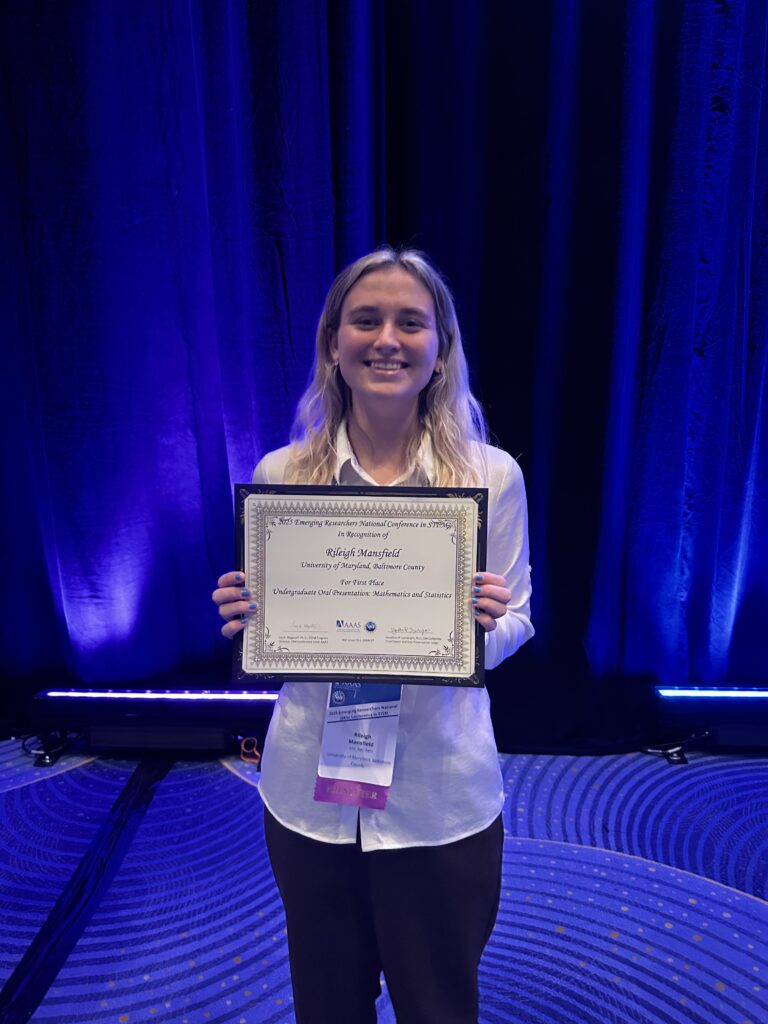 Rileigh Mansfield won first place in the Undergraduate Oral Presentation category at the 2025 Emerging Researchers National Conference in STEM. (Courtesy of Mansfield)
Q: So how did you end up pivoting to geophysics for graduate school?
A: My dad was a budget analyst for NASA, so I grew up around space and earth science. I’ve always been mystified by natural disasters like earthquakes and volcanoes, because we don’t really have them in Maryland. When Dr. Biswas introduced me to data assimilation, he mentioned it’s used for weather forecasting. That was the spark. I liked my research at UMBC, because it’s easy to see how working in biology can help save people’s lives, but honestly biology isn’t my passion. When I looked internally at what I’m excited about that can also help people, natural disasters came to mind. I realized I could use my math background to work on earthquake or volcano early-warning systems.
Q: Who has supported you throughout your UMBC journey?
A: I met my friend Emilia Pelegano-Titmuss at a summer program at Caltech in 2024, and we have supported each other in our pursuit of earth science ever since. Last spring, I had an incredibly challenging semester. My grades dipped, and I lost my self-confidence; I felt like I wasn’t made for research. Emilia talked me through it. She told me, “If you and I aren’t made for the research life, I don’t know who is.” She pushed me to graduate early and apply to grad school with her. Without her courage and motivation, I wouldn’t be in the position I am today.
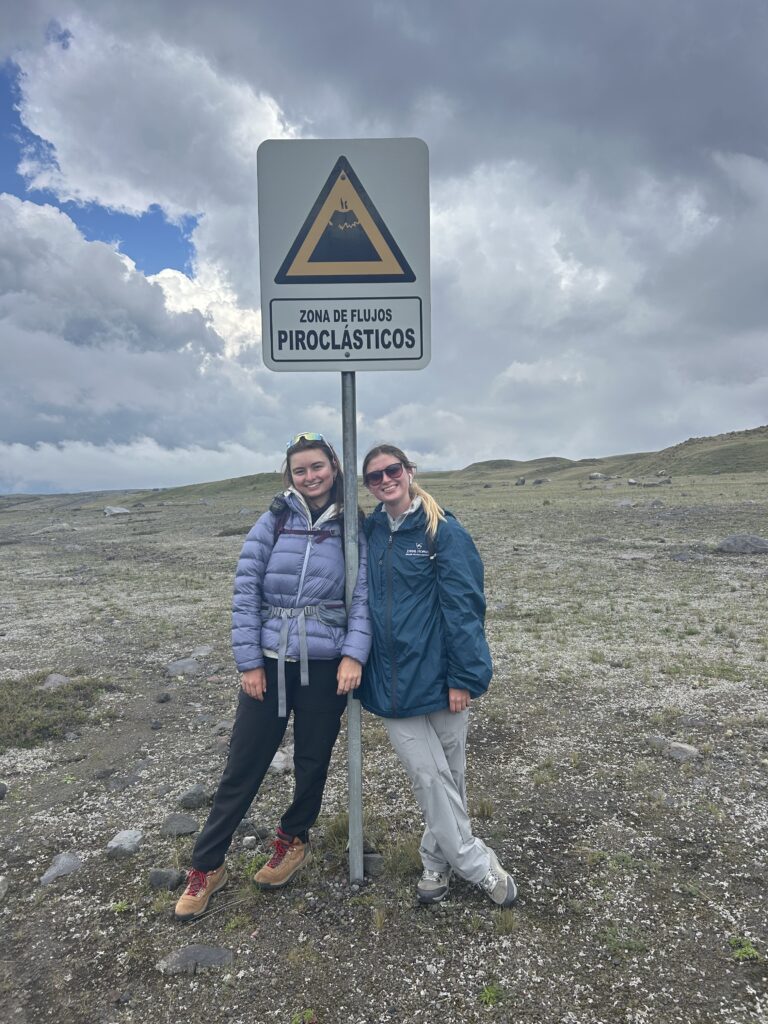 Rileigh Mansfield (right) and her best friend, Emilia Pelegano-Titmuss (left), studied volcanoes in Ecuador among the indigenous people who live there. The sign warns that they are in a volcanic flow zone. (Courtesy of Mansfield)
Q: Can you describe key takeaways from your education abroad experiences?
A: Going to Ecuador was my favorite part of undergrad. In winter 2025, I went into the Andes to do field work in volcanology with Emilia, who goes to Hunter College. We stayed with indigenous communities who lived right on a volcano. It was a huge cultural experience in addition to the science we did. I even got to shear alpacas! Sitting down for dinner with the people I want my work to impact was a huge motivator. I learned about how there was a lot of distrust between their community and scientists, including the ones who order evacuations around disasters. I want to help bridge those divides.
I also went to Rwanda to teach elective math seminars at a Supporting African Maths Initiative (SAMI) camp. I taught game theory and disease modeling, but I also spent a lot of time helping students understand the U.S. college admissions process. Many of those students are so bright, and they really want to come to the U.S. for college, but they don’t have the resources or information to navigate the system. I still talk to some of them today to help them through the Common App.
Q: Why is it important to you to make a positive impact and help others?
A: I don’t like to feel like I’m wasting my time—if I’m going to spend my life doing research, I want to know it’s having a real-world impact. I’m also just genuinely excited about what I do. I really love it, and I want everyone else to love it, too. My favorite type of mentor is someone who loves something so much that even if at first you don’t understand what they’re talking about, you start caring about it just because they do—their enthusiasm is contagious. I try to bring that same energy to my work as a teaching assistant and peer mentor and to sharing math and science with anyone and everyone.
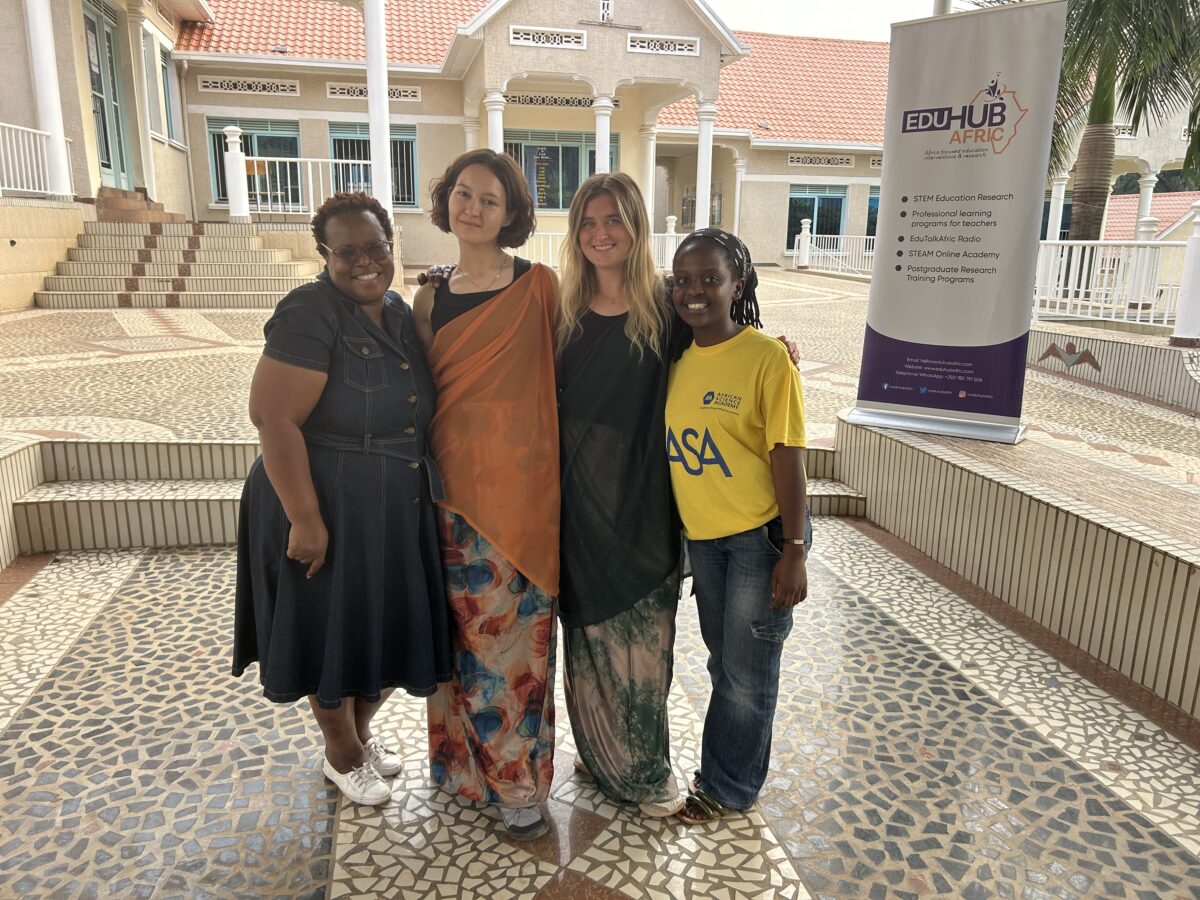 Rileigh Mansfield (second from right) had a transformative experience tutoring math in Rwanda. (Courtesy of Mansfield)
Q: What’s something unique about you that isn’t obvious from your résumé?
A: I am obsessed with the show Survivor. I audition for it every year. I’ve been watching it since third grade, and I’m always training for it. One year during finals, I even practiced eating only small portions of rice and working out on very little sleep just to see if my brain could still function—and it turned out it could. I also practiced starting fires with a flint.
I also did competitive trampolining for years, and I play in competitive Catan tournaments. It’s interesting because, like Survivor, it’s a social game and a strategic game. My strength is always the social game. More recently, I went on The Price is Right with my friend Emilia. If you watch the June 1 episode, you’ll see us screaming and jumping up and down in the audience; she got picked to participate!
Q: What advice do you have for incoming UMBC students or aspiring undergraduate researchers?
A: Go to office hours. Even if you don’t have a specific question, just go and talk to your professors. It helps the professors know who you are, which can have the side benefit of motivating you even more to do well in the class. It can also create opportunities, like how I talked to Dr. Biswas at Summer Bridge, which led to doing research in his lab.
And if you really want something, you can always find a way to get it. Don’t just say, “UMBC doesn’t offer it,” or, “It’s not easy to get.” Many of the things I did weren’t here at UMBC, but UMBC professors sent me applications for workshops and opportunities. Dr. Justin Webster and Dr. Biswas sent me to a workshop in Texas on partial differential equations and to Colorado for a conference on data simulation—both were incredibly valuable. The resources are there to help you get what you want, but you have to go after it.